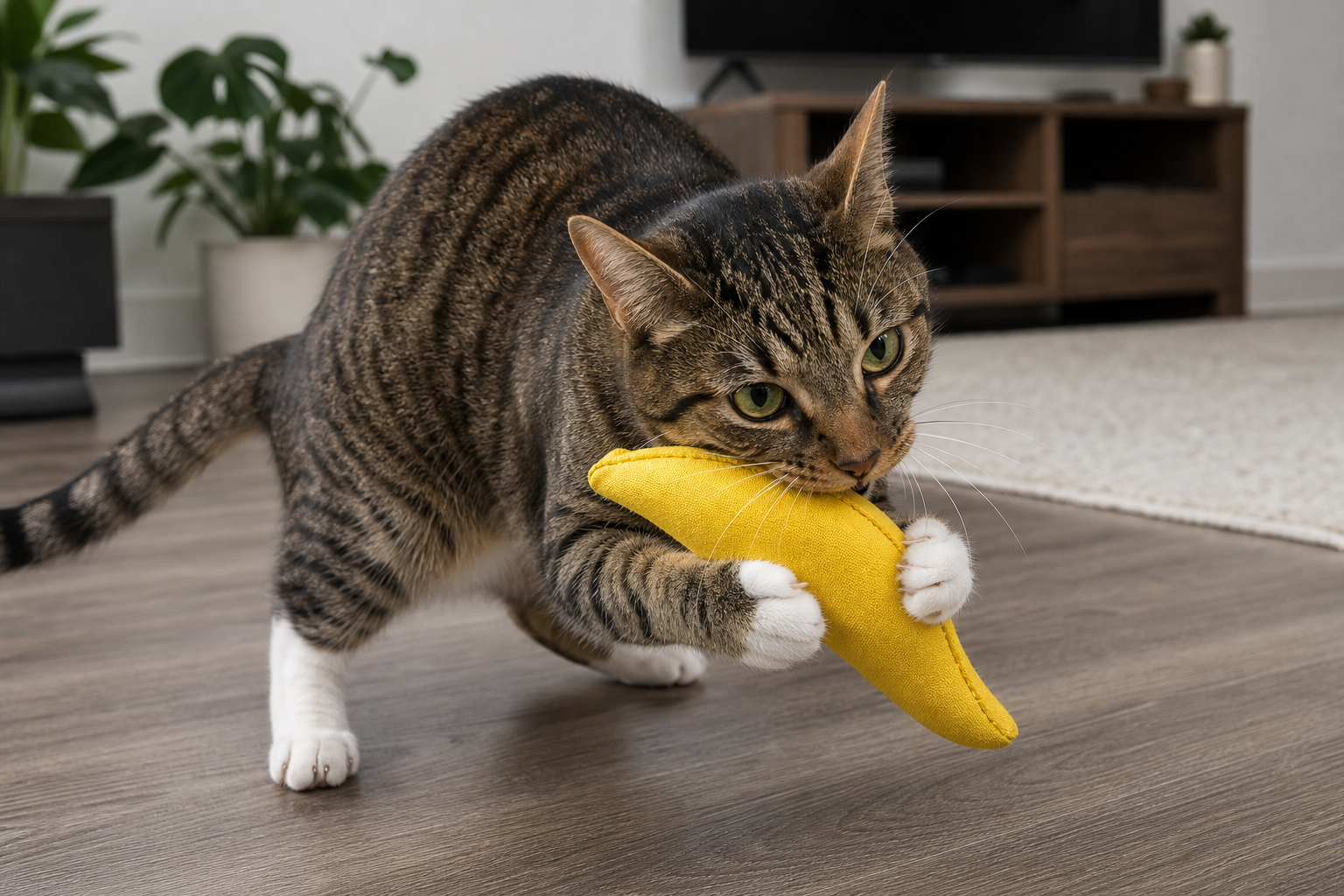
A banana cat toy is usually a curved, fabric catnip kicker shaped like a banana. The shape looks funny to people, but it makes sense to cats: it is long enough to hug, curved enough to grab, and soft enough for biting and bunny-kicking. That is why the classic catnip banana has become one of the most recognizable cat toys online.
The best banana cat toy is not the cutest one. It is the one that fits your cat’s play style, stays intact through biting and raking, and gives you a clear way to inspect seams before the next session. For cats that destroy ordinary toys, treat a banana kicker as a supervised enrichment tool, not a permanent chew object.
What Is a Banana Cat Toy?
Most banana cat toys are plush or fabric kickers filled with catnip, stuffing, or a mix of both. The search results are dominated by the well-known Yeowww banana, retail listings, and owner videos because this shape has become shorthand for a catnip kicker toy. Yeowww describes its Chi-CAT-a Banana as a 7-inch cotton twill toy filled with organically grown catnip. Other brands copy the general idea with different fabrics, sizes, stuffing, refill pockets, crinkle layers, or lower-cost plush shells.
The useful feature is the format. A banana toy gives a cat a legal target for the grab-bite-rake sequence: front paws wrap around the toy, teeth land on fabric, and back feet kick the body of the toy instead of your wrist. That makes it especially relevant for high-energy indoor cats and cats that escalate quickly during hand play.
If you are comparing banana toys with other rough-play formats, read Titan Claws’ guide to cat kicker toys. If your cat shreds soft toys quickly, the broader durable cat toys guide explains how to judge fabric, size, seams, and failure points.
Why Do Cats Like Banana Cat Toys?
Cats do not care that the toy looks like fruit. They care about what the toy lets them do. The banana shape works because it is easy to pin, wrestle, carry, and bite. Many cats also respond strongly to catnip, so a catnip-filled banana can trigger rolling, rubbing, kicking, licking, and short bursts of intense play.
The AAFP/ISFM feline environmental needs guidelines recommend giving cats outlets for pseudo-predatory play and feeding behavior. That includes toys and owner-guided play that let cats search, chase, capture, bite, and rake. A banana kicker covers the capture, bite, and rake part of that sequence well, especially after a wand or chase game has already warmed the cat up.
Not every cat responds to catnip. A 2017 study on feline responses to cat attractants found that silver vine, Tatarian honeysuckle, and valerian root can appeal to some cats that do not respond to catnip. If your cat ignores a catnip banana, the problem may be the attractant, the freshness, the setting, or simply your cat’s preferences.
What Ranking Product Pages Miss
Most pages ranking for banana cat toy are shopping pages. They tell you the price, size, star rating, shipping details, and sometimes the outer material. That is useful, but it leaves out the owner decision that matters most: will this toy fail safely for your cat?
A toy can be popular and still be the wrong fit for a specific rough player. A cat that gently rubs and carries a banana may keep one for months. A cat that bites seams and eats fabric may open it in one afternoon. Product photos rarely show stitching under stress, how much stuffing is inside, whether the catnip is loose, or whether the toy has small decorative pieces that can detach.
When you read reviews, look for patterns instead of single dramatic stories. Useful review details include how long the toy lasted, whether stuffing or catnip leaked, whether the fabric pilled or shredded, and whether cats chewed pieces off. Ignore any claim that implies a soft toy is indestructible. Fabric toys are consumables for some cats.
How to Choose a Safer Banana Cat Toy
Use the same standard you would use for any toy your cat will bite with enthusiasm. The banana shape is a bonus; construction is the buying decision.
- Size: choose a toy long enough for hugging and back-foot kicking, and too large for your cat to swallow or wedge deeply in the mouth.
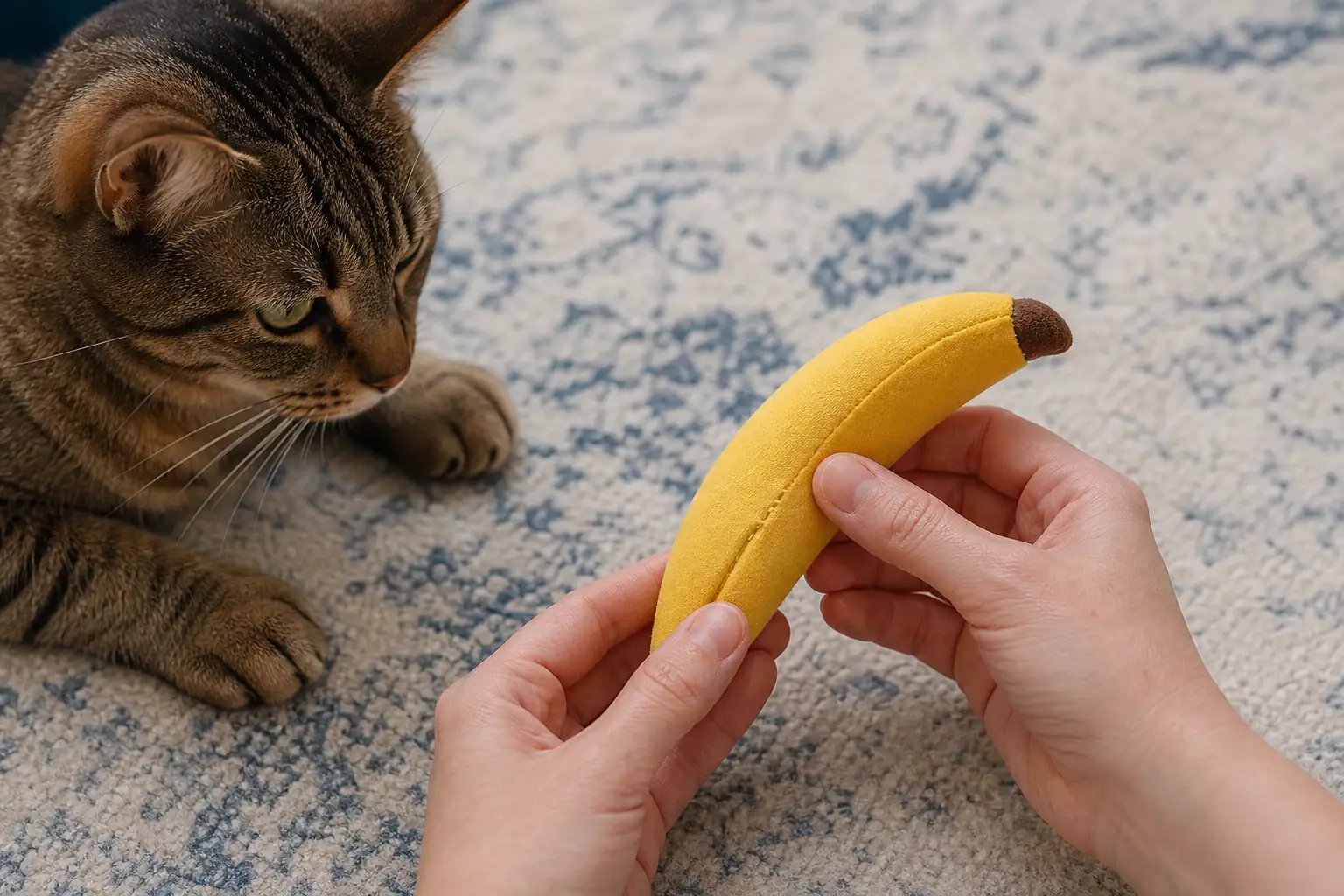
- Outer fabric: dense cotton twill, canvas-like fabric, or tightly woven material usually survives better than thin fuzzy plush for rough cats.
- Seams: inspectable seams are better than hidden weak points. Avoid toys with gaps, loose thread, or edges your cat can peel open immediately.
- Fill: catnip-only toys can be exciting, but leaked loose catnip may encourage chewing and licking. Stuffed toys need strict inspection if your cat pulls filling out.
- Attachments: skip glued eyes, ribbons, bells, plastic leaves, sparkle pieces, and tiny add-ons for cats that chew.
- Cleanability: washable or wipeable shells are useful for cats that drool, carry toys to food bowls, or drag toys near litter areas.
- Smell: avoid toys with a strong chemical odor. A catnip smell is expected; solvent, perfume, or rubbery smells are not.
Cornell Feline Health Center advises avoiding toys with small pieces or linear strand-like parts, such as feathers and string, that can separate and be ingested. The University of Wisconsin School of Veterinary Medicine gives similar advice for cats that chew aggressively, noting that feathers, strings, and sparkly pieces are risky for cats likely to ingest them.
Is the Banana Shape Better Than a Straight Kicker?
Sometimes. A curved banana can be easier for a cat to clamp against the body, especially if the toy is firm enough to keep its shape. The curve also gives a cat multiple angles to bite and rake. That can make the toy feel more alive than a flat plush shape.
A straight kicker may be better for very large cats, long-bodied cats, or cats that need more distance between their teeth and your hands during play. The right length depends on the cat. If your cat wraps around the toy and back feet land on the toy instead of your arm, the size is doing its job.
For cats that play rough, do not buy by novelty shape alone. Compare banana toys against long kickers, sturdy fabric tubes, refillable catnip kickers, and larger dog-style soft toys that are safe for cats and have no hard parts. The better toy is the one that handles your cat’s actual bite pressure and is easy for you to check.
How to Use a Banana Cat Toy in a Play Routine
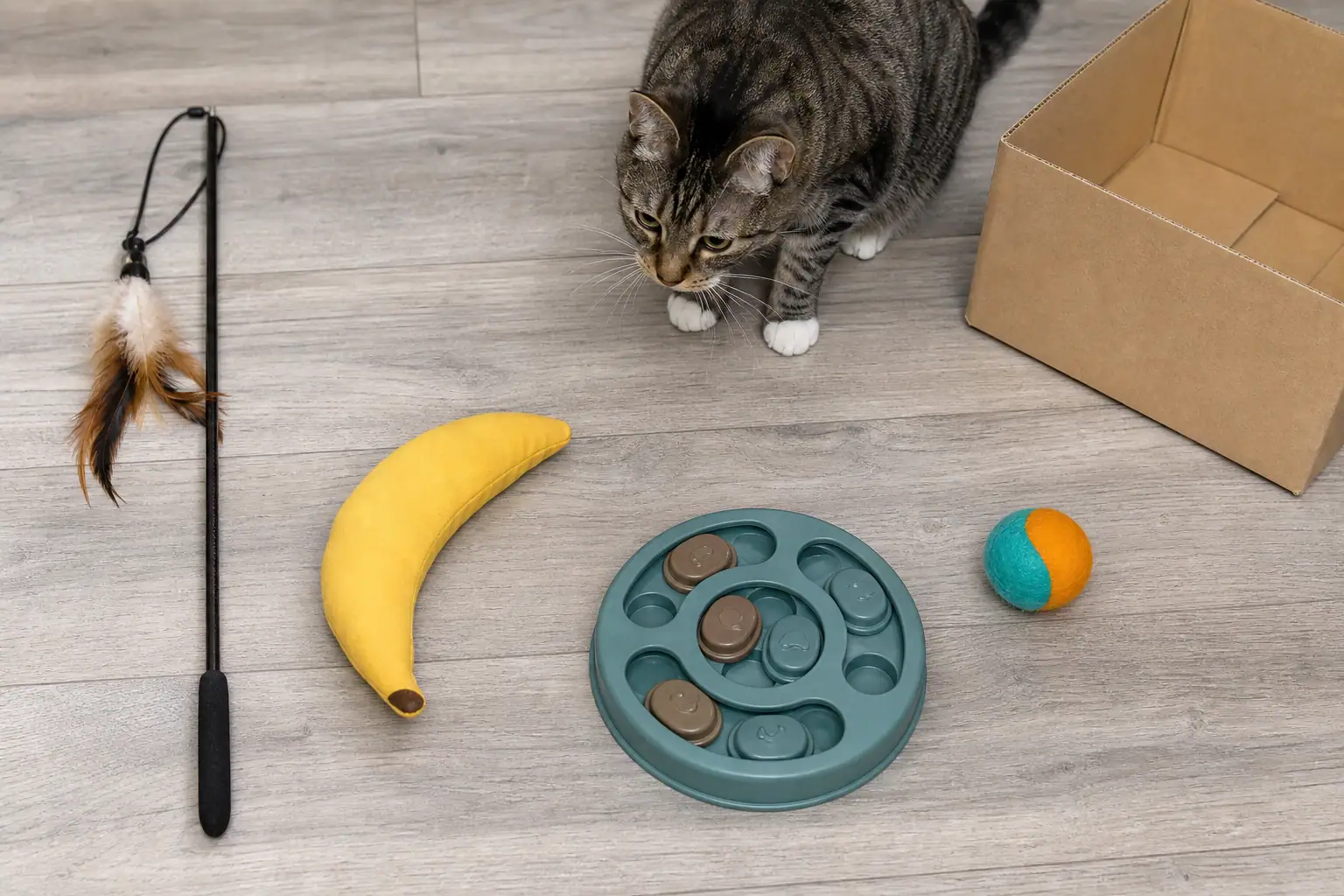
A banana toy works best as the catch-and-wrestle finish to a short hunting game. Start with movement, then hand off the kicker when your cat is ready to grab something. This helps redirect teeth and claws away from people.
- Start with stalking: move a wand lure slowly around a corner, box, tunnel, or chair leg.
- Add a chase: let the lure move away from the cat instead of poking the cat in the face.
- Let the cat catch: allow a real capture so the game has a satisfying finish.
- Swap to the banana: slide the banana toy into the kicking zone and let the cat bite and rake the toy.
- Wind down: end with a small meal, treat scatter, or puzzle feeder.
- Inspect: check the banana before putting it away or leaving it out.
VCA Animal Hospitals recommends toy rotation to keep play interesting, suggesting owners keep a larger assortment but offer only a few toys at a time. That approach also makes safety easier because the active toys are easier to inspect. For rotation ideas, see Titan Claws’ guides to cat toys for enrichment and cat toys for boredom.
When to Replace a Banana Cat Toy
Replace or retire the toy when it stops being an intact play object and starts becoming loose material your cat can swallow. That line comes sooner for hard chewers than for gentle cats.
- Seams are opening or threads are loosening.
- Stuffing, catnip, plastic, crinkle film, or filler is leaking.
- Your cat is pulling fabric fibers out and swallowing them.
- The toy has hardened, cracked, sharp, or dirty areas you cannot clean.
- Decorative pieces are loose or missing.
- The toy is small enough to become a choking or swallowing risk.
- Your cat guards the toy and redirects bites toward people or other pets.
- The toy smells sour, moldy, or heavily soiled.
If you think your cat swallowed part of a toy, string, stuffing, fabric, plastic, or a banana peel, contact your veterinarian. Do not pull on string or strand-like material if it is visible from the mouth or rectum. Linear material can create serious internal injury and needs veterinary guidance.
What About Real Bananas?
A banana cat toy is not the same thing as feeding your cat banana. The ASPCA lists the banana plant as non-toxic to cats, but fruit is still not a meaningful part of a cat’s diet. If your cat steals a tiny bite of peeled banana, that is different from letting the cat chew peel, strings, stickers, wrappers, or large pieces.
For play, use a cat toy rather than real fruit. Banana peels are slippery, fibrous, dirty once they hit the floor, and not designed for chewing. Wrappers, produce stickers, and loose peel strings are exactly the kind of household debris that rough players may try to swallow.
Quick Checklist Before Buying
Before you buy a banana cat toy, answer these questions:
- Does my cat need a kicker for wrestling, or a chase toy for running?
- Is the toy large enough for hugging and too large to swallow?
- Can I see and inspect the seams?
- Are there any glued, dangling, shiny, or strand-like pieces?
- Is the fabric tougher than ordinary thin plush?
- Will this be supervised-only for my cat’s chewing style?
- Do I have a plan to rotate it so the catnip stays interesting?
- Am I willing to retire it as soon as it starts leaking or shredding?
For many cats, a banana cat toy is a smart, simple enrichment buy. For destructive cats, it is a useful tool with a short inspection loop: play, check, rotate, replace when damaged. That mindset gives your cat the fun part of the banana without pretending any soft toy can survive every set of teeth and claws.
Sources
- Yeowww: Chi-CAT-a Banana product details
- Cornell Feline Health Center: Safe toys and gifts
- University of Wisconsin School of Veterinary Medicine: Safe toys for cats
- AAFP/ISFM Feline Environmental Needs Guidelines
- VCA Animal Hospitals: Cat play and toy rotation
- Responsiveness of cats to silver vine and other cat attractants
- ASPCA: Banana plant toxicity listing