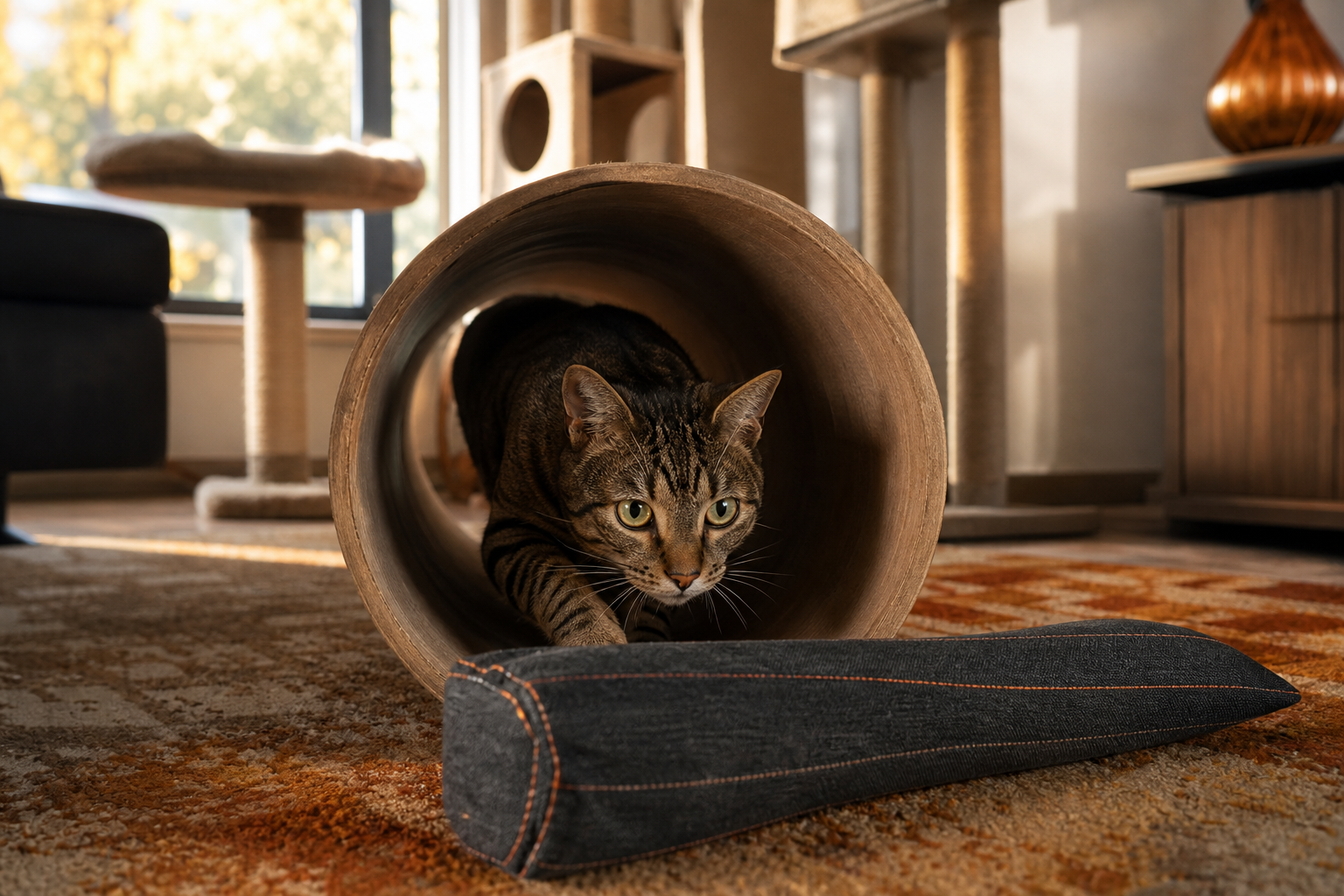
Cat enrichment means giving a cat safe opportunities to perform natural behaviors and make meaningful choices. It is more than buying toys. A useful enrichment setup lets a cat hide, climb, scratch, watch, sniff, search for food, stalk, chase, catch, and rest without being forced into constant activity.
Start small: create one secure perch or hiding place, offer one appropriate scratching surface, and schedule one or two short hunting-style play sessions. Add a simple food-search activity if it suits your cat’s diet. Watch what your cat chooses, then keep, move, simplify, or retire each activity based on that response.
What counts as cat enrichment?
Enrichment changes a cat’s environment or routine in a way that encourages species-typical behavior. A window perch supports watching and resting. A sturdy scratcher supports stretching, claw maintenance, and scent marking. A wand game supports stalking and capture. A puzzle feeder supports searching and manipulating. A familiar box supports hiding and observation.
The AAFP and ISFM feline environmental needs guidelines organize a healthy cat environment around five pillars: a safe place; multiple, separated key resources; opportunities for play and predatory behavior; positive, consistent human interaction; and respect for a cat’s sense of smell. That framework is more useful than treating enrichment as a shopping list.
Novelty can help, but novelty is not the goal by itself. Moving a favorite bed every day, starting a motorized toy beside a sleeping cat, or introducing several new scents at once may create uncertainty rather than interest. Predictability and choice form the base; small, reversible challenges sit on top.
Audit your home before adding more toys
Walk through the rooms your cat uses and score each area below as available, needs improvement, or missing. Fix missing basics before adding complicated puzzles.
| Need | What to look for | A practical improvement |
|---|---|---|
| Safety and retreat | A quiet place where the cat can hide or rest without being followed | Open a carrier, clear a shelf, or place a box with two exits in a calm room |
| Separated resources | Food, water, litter, scratching, play, and rest are not crowded into one station | Move one resource so the cat has choices and does not need to pass a rival cat |
| Vertical space | Stable, reachable perches with a safe route up and down | Clear a window ledge or anchor a cat tree that does not wobble |
| Scratching | At least one stable surface in the cat’s preferred angle and material | Put a tall vertical scratcher or wide horizontal pad near a resting or marking area |
| Hunting and play | Chances to watch, stalk, chase, catch, bite, and kick an appropriate target | Use a wand for the chase and finish with a large capture toy |
| Foraging | Some safe opportunity to search or work for part of a normal meal | Start with kibble in an open egg carton or wet food spread in a shallow textured feeder |
| Social choice | The cat can request, accept, or leave interaction | Pause during play or petting and continue only when the cat re-engages |
| Sensory comfort | Familiar scents remain; strong fragrance and unpredictable noise are limited | Keep familiar bedding and introduce new scent items one at a time |
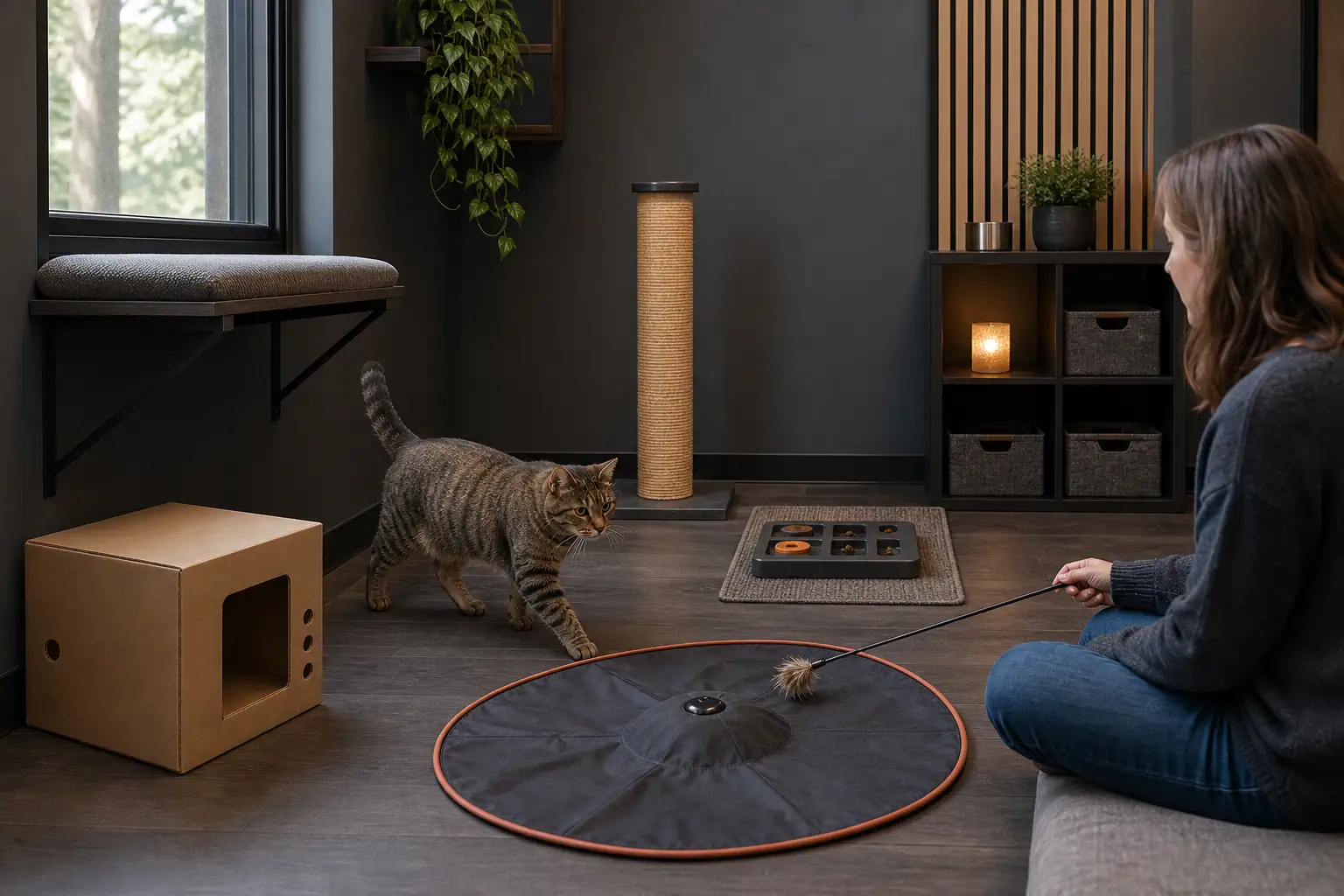
In a multi-cat home, count access rather than objects. A single premium cat tree in a narrow hallway can be controlled by one cat. Several modest perches, water points, litter boxes, and resting areas on different routes often provide more real choice.
Match enrichment to the behavior your cat already offers
Your cat’s current behavior is the best starting brief. Do not begin with the product that looks most impressive; begin with what the cat repeatedly tries to do.
- Stalks ankles or ambushes from corners: schedule floor-level wand play before the usual ambush time. Move the lure away like prey, pause behind cover, allow frequent catches, and redirect the final grab to a long kicker. If attacks are frequent or painful, use the step-by-step plan in our cat play aggression guide.
- Climbs cabinets or watches from door tops: add a stable legal high route with more than one way down. Do not punish climbing while leaving no acceptable vertical option.
- Shreds small plush toys: choose a larger, densely constructed capture toy with minimal attachments, supervise the first sessions, and inspect after play. Our durable cat toy guide explains seams, fabrics, sizing, and retirement signs.
- Wakes people for food: try a measured food hunt or an easy puzzle using part of the normal daily ration. Start simple; do not make every meal difficult on day one.
- Scratches one sofa corner: place a stable scratcher beside that exact location and match the angle and texture. Reward investigation; move it gradually only after the cat uses it reliably.
- Watches birds for long periods: provide a secure perch and a way to leave the view. If outdoor cats at the window trigger crouching, tail lashing, spraying, or redirected aggression, block the lower sightline instead of calling the view enriching.
- Ignores toys left on the floor: rotate a small set and change how you animate it. Our cat enrichment activities guide has games for chase, forage, scent, climbing, and training.
A 2023 survey of 1,591 cat guardians found that a greater variety of games was associated with higher reported feline quality-of-life scores, while longer daily play and more games were associated with stronger guardian-reported relationships. The study on play and welfare shows associations, not proof that a particular schedule causes those outcomes, but it supports offering varied games and letting both cat and person initiate play.
A 7-day cat enrichment starter plan
This plan is an assessment week, not a permanent quota. Keep sessions brief enough that your cat remains interested. For many adult cats, five to ten minutes of interactive play is a sensible starting window; kittens and highly active cats may ask for more frequent sessions, while seniors or cats with pain may prefer slower, shorter work. Stop before the activity becomes frantic or exhausting.
- Day 1: establish safety. Add or improve one quiet retreat and one elevated observation point. Make sure each is stable and easy to exit. Leave the cat to discover them; do not place or hold the cat inside.
- Day 2: run a prey-style game. Drag a wand lure away along the floor, let it hide, pause, and allow several catches. Finish with a holdable toy or a small portion of the cat’s normal meal. Store the wand securely afterward.
- Day 3: make food easy to find. Put a small measured portion in an open puzzle, scatter it across a clean mat, or hide a few pieces in obvious locations. If the cat walks away, make the task easier rather than withholding the meal. See our puzzle cat toy guide for a gradual difficulty ladder.
- Day 4: offer texture and scent. Present a cardboard scratcher, paper packing without tape or staples, or a sturdy toy with a small amount of catnip or silvervine. Use only cat-appropriate plants and remove material the cat tries to swallow.
- Day 5: add a tiny training game. Mark and reward one voluntary behavior, such as touching a target, stepping onto a mat, or entering an open carrier. Use a few repetitions and end on an easy success. Never force the cat into position.
- Day 6: create a new route. Arrange a stable box, tunnel, chair, or low perch so the cat can explore a short path with at least two exits. Keep it away from stairs and do not build with tape loops, staples, or collapsing stacks.
- Day 7: rotate and review. Put away ignored or fragile items, return one successful activity, and record what produced relaxed attention, repeated approaches, stalking, scratching, foraging, or restful use.
Free enrichment is still enrichment. Boxes, a cleared windowsill, a towel food search, a paper ball too large to swallow, and five attentive minutes with a familiar lure can be more useful than a crowded toy basket. For more low-cost options, use our list of free cat enrichment ideas.
How to set the right difficulty
A good challenge sits between instant completion and repeated failure. Look for orientation, approach, investigation, and small progress. Then change only one variable at a time: distance, height, movement speed, number of covered food wells, or how long the target disappears.
- Too easy: the cat completes it immediately and leaves. Add one small step, change the route, or rotate it out while it is still intact.
- About right: the cat investigates, pauses, tries again, succeeds, and voluntarily returns later.
- Too hard or intense: the cat freezes, startles, flattens the ears, lashes the tail, bites the equipment, looks repeatedly toward an exit, gives up, or avoids the area afterward. Simplify or stop.
Food puzzles deserve special care because failure can interfere with eating. A review of food puzzles for cats recommends matching mobile or stationary designs to the individual and introducing them gradually. Keep water freely available and count puzzle food within the cat’s regular diet. Ask a veterinarian before changing feeding routines for a cat with a medical condition, prescription diet, low appetite, or a history of food conflict.
Safety for cats that bite, kick, and destroy toys
Rough play is not a reason to remove enrichment; it is a reason to choose targets and supervision more carefully. No cat toy is indestructible. Durability buys inspection time, but a strong cat can still open a seam, pull off an attachment, crack plastic, expose a battery, or chew a piece small enough to swallow.
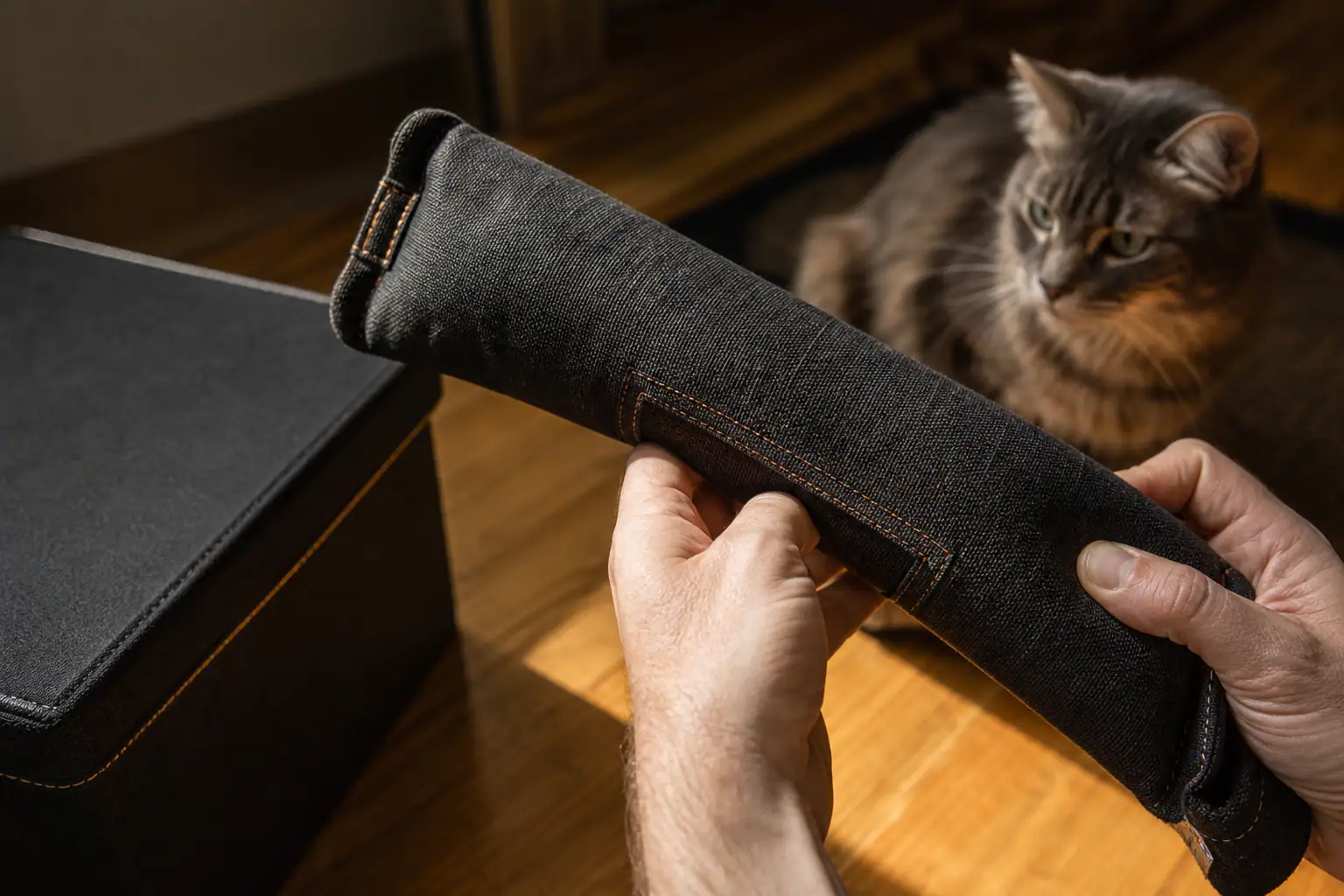
Use a three-stage check:
- Before play: tug attachments, flex plastic, press battery doors, and check the toy’s size against your cat’s open mouth. Remove loose bells, ribbon, elastic, glued decorations, sharp edges, and exposed stuffing.
- During play: watch how the cat uses the object. A toy that is safe for batting may not be safe for sustained chewing. Keep strings, wire, feathers, motors, and small components within active supervision.
- After play: inspect the entire surface, not just the obvious bite area. Retire the toy if a seam gaps, the shape changes, fabric becomes wet and thin, stuffing shows, a rattle moves toward an opening, or any component loosens.
Store wand toys and fragile lures in a closed cabinet or container, not on a high open shelf a determined cat can reach. Choose only thoroughly tested items for independent access, and reconsider anything that tangles, sheds, heats up, tips, traps a paw, or breaks into mouth-sized pieces. Our guide to automatic cat toys for when you are away separates supervised gadgets from safer solo options.
DIY does not automatically mean harmless. Remove bag handles; avoid yarn, thread, rubber bands, hair ties, foil, splintering wood, staples, tape loops, and brittle plastic. Supervise cardboard and paper projects if your cat chews or eats non-food material. The ASPCA likewise advises close, active supervision of DIY enrichment and immediate removal if a cat tries to ingest it.
Adapt the plan for age, ability, and multiple cats
- Kittens: provide frequent short outlets for chase and wrestling, but use large targets without detachable parts. Protect hands by directing bites and kicks to toys from the beginning.
- Senior cats: use warm resting places, low stable steps, nonslip surfaces, slower lures, and food tasks that do not require painful crouching or forceful pawing. A sudden reduction in play can signal pain or illness.
- Blind cats: keep the room layout predictable and use sound, scent, texture, and toys that remain in a known area. Our guide to toys for blind cats covers setup and safety in detail.
- Deaf cats: use floor vibration, visible motion, scent, and gentle visual cues. Approach within sight so play does not begin with a startling touch.
- Multi-cat homes: offer parallel play stations and separate feeding puzzles. Watch for blocking, staring, displacement, and one cat finishing another’s food. Not all housemates want to play together.
- Shy or newly adopted cats: prioritize hiding, predictable routines, and choice. Place enrichment near a secure retreat and let distance decrease gradually.
Do not assume that adopting another cat will enrich the first one. Cats vary in sociability, and an incompatible introduction can create competition and chronic stress. Add another cat only because you can support both individuals and manage a slow introduction—not as a substitute for play or environmental improvements.
How to tell whether enrichment is working
Judge the cat’s behavior, not the price of the item. Useful signs include voluntary approach, relaxed ears and body, focused watching, stalking, scratching, foraging, successful capture, returning after a pause, and resting in a new safe place. Some cats engage intensely; others investigate for thirty seconds and return later.
Keep a simple one-week note with four fields: activity, time offered, what the cat did, and what you will change. This prevents the common mistake of buying more when the real issue is timing, location, motion, difficulty, or a mismatch with the cat’s preferred behavior.
Contact a veterinarian if play or exploration drops suddenly, or if you notice hiding, appetite change, weight change, limping, reluctance to jump, overgrooming, house-soiling, disorientation, or new aggression. Enrichment can support well-being, but it cannot diagnose or treat pain, dental disease, urinary problems, cognitive change, anxiety, or other medical conditions. A qualified feline behavior professional can help after medical causes have been assessed.
One intriguing real-world trial found that introducing five to ten minutes of daily object play was associated with a 25% reduction in prey animals brought home by hunting cats compared with controls and the pre-treatment period. The 2021 controlled trial does not prove that indoor games replace every motivation to hunt, but it shows how a small, repeatable play routine can matter beyond simply keeping a cat busy.
Cat enrichment quick checklist
- Does your cat have a secure retreat and a stable elevated option?
- Are food, water, litter, scratching, play, and rest resources separated where possible?
- Can your cat choose to approach, continue, pause, or leave?
- Does play include stalking, chasing, catching, and a physical finish?
- Is the challenge easy enough to produce success?
- Are food rewards measured as part of the normal diet?
- Do multiple cats have separate routes and stations?
- Are strings, feathers, motors, and small parts supervised and stored afterward?
- Do you inspect toys before and after rough play?
- Are you changing one variable at a time and recording what your cat actually chooses?
A strong enrichment routine is not a perfect room or a mountain of products. It is a safe environment that gives your cat choices, supports normal behavior, and changes in response to what the cat tells you.
Research and guidance used
- AAFP and ISFM Feline Environmental Needs Guidelines — the five-pillar framework for a healthy feline environment.
- Cats just want to have fun: Associations between play and welfare in domestic cats — a large international guardian survey on play, reported quality of life, and cat–guardian relationships.
- Food puzzles for cats: Feeding for physical and emotional wellbeing — practical review and case examples for gradual puzzle introduction.
- Provision of High Meat Content Food and Object Play Reduce Predation of Wild Animals by Domestic Cats — controlled trial that included a daily object-play intervention.
- ASPCA: Feline DIY Enrichment — project ideas and ingestion/supervision cautions.