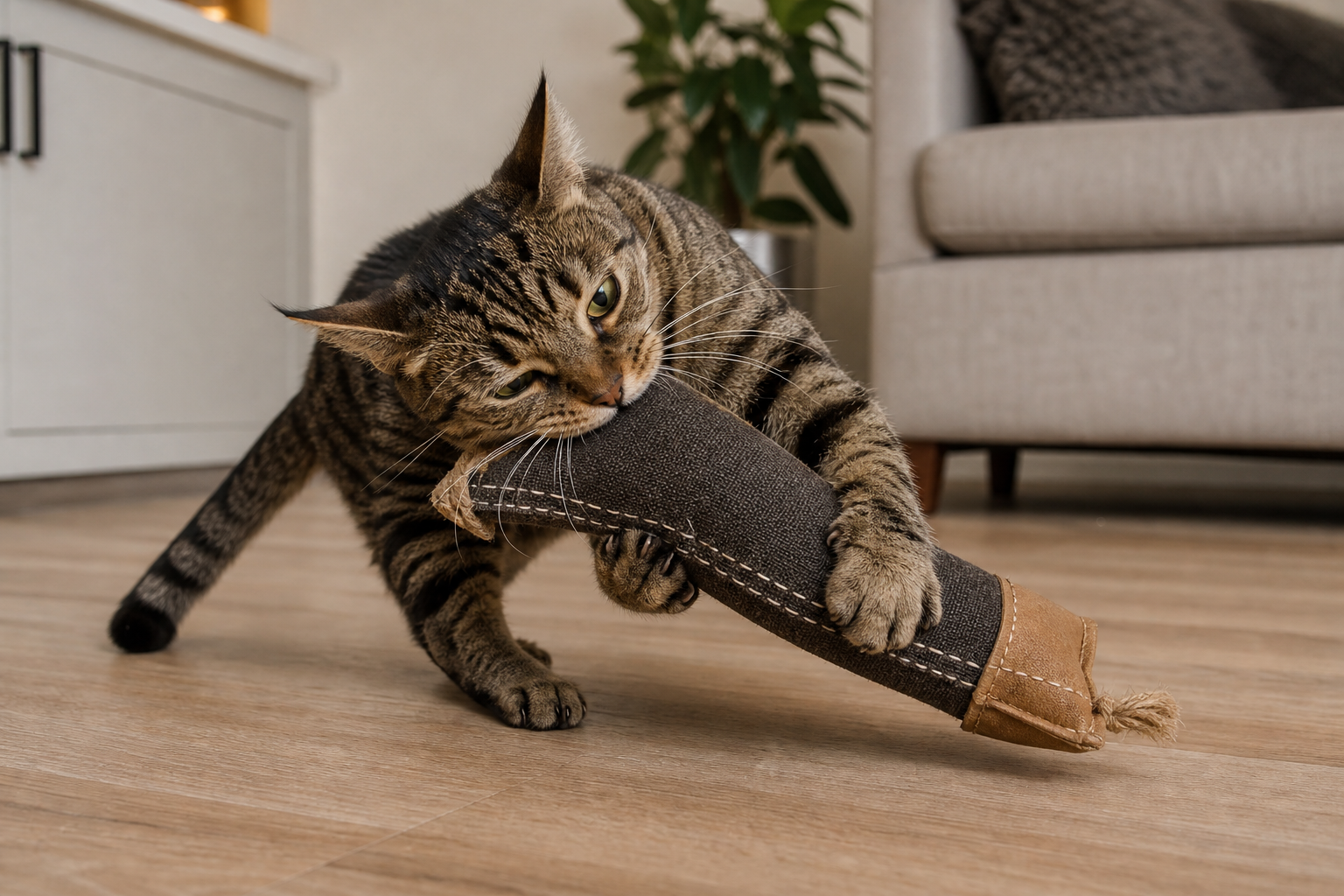
Cat enrichment toys for indoor cats should do more than fill a toy basket. The best setup gives your cat safe ways to stalk, chase, pounce, grab, kick, chew, solve, climb, hide, and rest. For most homes, that means a small mix of interactive chase toys, puzzle feeders, sturdy kickers, safe chew outlets, cardboard or tunnel play, and a rotation plan that keeps the toys interesting.
If your indoor cat destroys ordinary toys, choose enrichment by job and failure point, not by cuteness. A feather wand may be perfect for supervised chase, but risky if left out. A rugged kicker may be better for biting and bunny-kicking. A puzzle feeder may do more for a bored food-motivated cat than another plush mouse. No toy is a complete enrichment plan by itself.
What Indoor Cat Enrichment Toys Need to Do
Indoor cats still have predatory behavior, curiosity, food-seeking drive, scent interest, climbing needs, and social preferences. Good enrichment toys let those needs show up in safe household ways. The AAFP and ISFM environmental needs guidelines describe play and predatory behavior as a core part of a healthy feline environment, including toys, owner play, compatible-cat play, and feeding devices that make cats work for food.
That is why the best answer to this keyword is not a single best toy. It is a toy system. A healthy indoor setup usually covers these jobs:
- Chase: wand toys, large balls, rolling toys, tunnels, and floor lures.
- Capture: kickers, soft prey toys, and toys the cat can grab after a chase.
- Forage: puzzle feeders, treat balls, snuffle-style mats, food hunts, and DIY cardboard puzzles.
- Investigate: boxes, paper bags with handles removed, tunnels, scent-safe objects, and rotated textures.
- Climb and watch: cat trees, shelves, window perches, and safe vertical routes.
- Chew or wrestle: simple sturdy toys that are large enough, inspectable, and matched to the cat’s mouth and claws.
For a broader activity plan beyond toys, Titan Claws has a practical guide to cat enrichment activities. For a product-focused angle, pair this article with interactive cat enrichment toys.
What Current Ranking Articles Get Right and Miss
The current results for cat enrichment toys for indoor cats are a mix of Reddit threads, shopping pages, product roundups, shelter guidance, and a recent Guardian buying guide. They get several things right: indoor cats need novelty, puzzle feeding can help, cardboard is underrated, and owner-led play often matters more than expensive gear.
The gap is durability and safety for real rough players. Many lists recommend feather toys, strings, plush mice, electronic toys, catnip toys, and puzzle feeders without helping the owner decide what can be left out, what must be supervised, and what should be retired after damage. For Titan Claws readers, that distinction is the article.
Think of each toy as either a leave-out toy, a supervised toy, or a test-only toy. Leave-out toys must be simple, stable, larger than swallowable, and proven safe for your specific cat. Supervised toys can be more exciting because you control the session. Test-only toys are new or higher-risk toys that need short sessions until you know how your cat damages them.

The Best Toy Types for Indoor Enrichment
A strong indoor enrichment setup covers multiple play styles without leaving risky pieces everywhere. Start with one or two toys from each category instead of buying a giant mixed pack.
Wand toys for chase and confidence
Wand toys are excellent because you can mimic prey. Move the lure away from the cat, around furniture edges, behind a box, under a towel edge, or in short pauses. Do not jab the toy at the cat’s face. Let the cat watch, stalk, sprint, and catch. Store string, ribbon, elastic, and feather lures after the session.
If your cat escalates into biting hands or ankles, use longer reach and a clearer handoff to a kicker. Titan Claws’ guide to cat toys for play aggression can help redirect that energy.
Puzzle feeders for bored food-motivated cats
Puzzle feeders turn part of a meal into problem solving. They work best when the difficulty is adjustable. Start easy: loose kibble in an open egg carton, a few treats in a paper towel tube with large holes, or a shallow puzzle tray. Increase difficulty only after the cat understands the game.
The ASPCA’s feline DIY enrichment guidance includes simple food puzzles made from household cardboard items. That is useful because enrichment does not have to be expensive, but DIY toys still need safety checks: remove tape, staples, handles, sharp edges, and tiny pieces your cat might eat.
Kicker toys for cats that grab and bunny-kick
Kickers are a good match for indoor cats that latch on with the front paws and rake with the back feet. Choose a length that keeps your hands away from the kicking zone, dense fabric, reinforced seams, and minimal decorations. A rough cat can turn weak plush into exposed stuffing quickly, so inspect kickers after hard sessions.
For heavy players, read Titan Claws’ durable cat toys guide before buying by marketing words like tough, premium, or indestructible. The important question is how the toy fails under teeth and claws.
Boxes, tunnels, and hiding toys for ambush play
Boxes and tunnels let an indoor cat hide, watch, burst out, and reset. A plain cardboard box can become a hunting blind, puzzle feeder, scent station, or nap spot. Cut large openings, remove tape and loose flaps, and replace cardboard when it gets soggy, shredded, or snack-sized.
For budget options, Titan Claws’ homemade cat enrichment toys article goes deeper on cardboard, paper, and household-object ideas.
Chew and carry toys for mouthy cats
Some indoor cats need to bite and carry. Give those cats simple, sturdy toys that are too large to swallow, easy to inspect, and free from loose bells, eyes, ribbons, feathers, and glued trim. If your cat eats fabric, thread, foam, rubber, or plastic, treat that as a veterinary and management issue, not just a shopping problem.
For cats that target strings specifically, use the safety guidance in Titan Claws’ cat string toys article before leaving any strand-like toy accessible.
How to Build a Simple Enrichment Rotation
Indoor cats often ignore toys that never change. Rotation helps the same few toys feel fresh, and it gives you a natural inspection rhythm. Cornell Feline Health Center also recommends rotating toys to prevent boredom, while warning owners to avoid small parts and strand-like pieces that can detach and be swallowed.
Try this simple weekly rotation:
- Daily supervised chase: one wand or moving lure session, 5 to 10 minutes, ending with a real catch.
- Daily food puzzle: part of one meal in an easy puzzle, treat ball, scatter hunt, or cardboard feeder.
- Two leave-out toys: one sturdy object for batting or carrying, plus one safe hide or tunnel option.
- One rough-play outlet: a kicker or chew-safe toy used when your cat grabs, bites, or bunny-kicks.
- One environment upgrade: a box, perch, paper bag with handles removed, window view, or safe scent object.
Do not rotate everything at once if your cat is timid. Change one piece, watch the response, and keep the routine predictable. For cats that are already restless, destructive, or demanding attention, Titan Claws’ best cat toys for bored indoor cats article can help you troubleshoot the boredom side.

Safety Rules for Rough-Playing Indoor Cats
Enrichment should lower risk, not add hidden hazards. The University of Wisconsin School of Veterinary Medicine warns that aggressive chewers may ingest feathers, strings, sparkly bits, and similar toy materials, and that intestinal obstruction can be serious. Cornell gives similar cautions about toys with small pieces or linear strand-like parts, especially when those parts separate during chewing.
Use these rules for any indoor cat toy:
- Store string toys after play. Wand cords, ribbons, yarn, elastic, and feather lures are supervised-only.
- Remove weak decorations. Avoid or remove bells, beads, glued eyes, small tails, loose feathers, tassels, and brittle plastic pieces.
- Inspect the toy’s failure points. Check seams, stuffing, caps, battery doors, crinkle layers, refill openings, and attachment points.
- Separate leave-out toys from session toys. The toy that makes a great chase session may be unsafe at 2 a.m.
- Retire damaged toys early. Exposed stuffing, loose threads, sharp plastic, missing parts, and flaking surfaces are stop signs.
- Call a veterinarian for ingestion concerns. Vomiting, appetite loss, lethargy, straining, or suspected swallowed string or toy parts should not be watched casually.

How to Match Toys to Your Cat’s Play Style
Owners often buy the wrong enrichment toy because they shop for the behavior they want instead of the behavior the cat already shows. Watch one play session and choose from the pattern.
- The stalker: likes hiding, watching, and slow buildup. Use boxes, tunnels, low wand movement, and corner peeks.
- The sprinter: wants fast movement. Use hallway rolls, wand chases, ball tracks, and short high-energy sessions.
- The wrestler: grabs and bunny-kicks. Use long kickers, sturdy fabric toys, and supervised handoffs after chase.
- The solver: paws at cabinets, cups, or food containers. Use puzzle feeders, treat hunts, and cardboard feeders.
- The chewer: mouths fabric, cords, plastic, or toy seams. Use fewer, tougher, inspectable toys and remove strand-like hazards.
- The watcher: prefers observing before joining. Use slow prey movement, window perches, quiet puzzles, and predictable routines.
Age matters too. Kittens may need short frequent motion games and teething-safe options. Senior cats may prefer slower ground play, easier puzzles, and stable surfaces. Multi-cat homes may need separate sessions so one cat does not monopolize the toy or guard the puzzle feeder.
Quick Buying and Setup Checklist
- Does this toy have a clear job: chase, capture, forage, chew, hide, climb, or rest?
- Is it safe to leave out, or is it supervised-only?
- Is the smallest piece too large to swallow?
- Are there strings, feathers, bells, beads, glued eyes, tassels, caps, or battery doors to inspect?
- Can you clean it or replace it before it gets dirty, soggy, or shredded?
- Does the toy match how your cat actually plays?
- Do you have a way to let your cat catch something at the end of chase play?
- Will rotation make the toy more interesting without flooding the floor with hazards?
The best cat enrichment toys for indoor cats are not the flashiest toys. They are the toys that give your cat a safe outlet for a specific behavior, survive long enough to be useful, and get inspected before damage becomes dangerous. Start with a small balanced setup, play with purpose, rotate thoughtfully, and replace anything your cat is beginning to defeat.