Tag: cat enrichment

  • Homemade Cat Toys: Safe DIY Ideas for Cats Who Play Rough

    Homemade Cat Toys: Safe DIY Ideas for Cats Who Play Rough

    Homemade cat toys can be excellent for indoor cats when they are simple, supervised, and easy to inspect. The safest DIY options are usually cardboard puzzles, paper games, box mazes, fabric kickers, and wand-style games that you put away after play. The risky ones are toys with loose string, yarn, ribbon, rubber bands, beads, bells, glued eyes, staples, small plastic pieces, or stuffing your cat might eat.

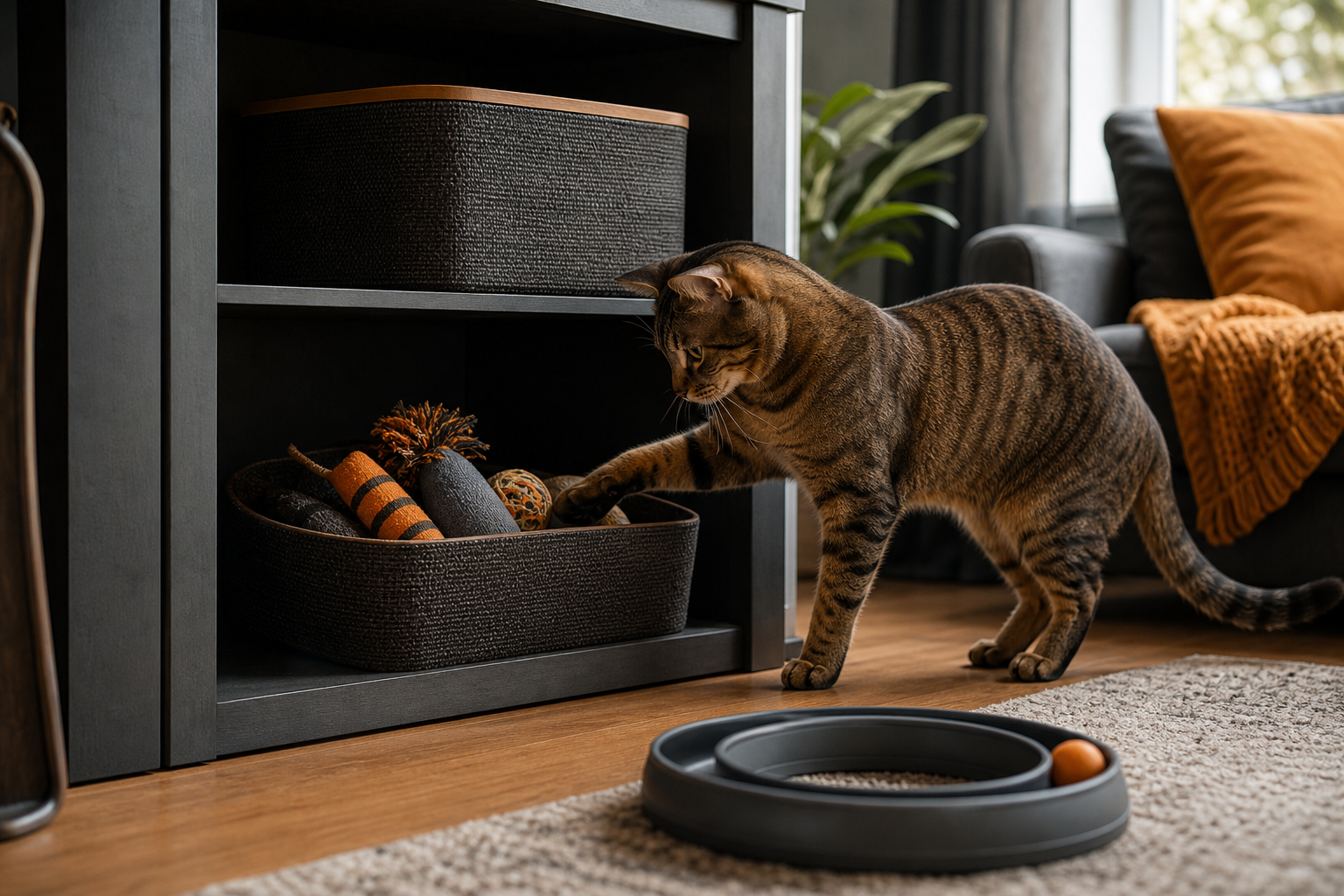
    If your cat plays rough, treat homemade toys as temporary enrichment rather than permanent equipment. Build them cheaply, use them intentionally, inspect them hard, and retire them early. A homemade toy does not need to survive forever. It needs to give your cat a safer outlet for stalking, chasing, pouncing, biting, kicking, and problem-solving without leaving swallowable parts behind.

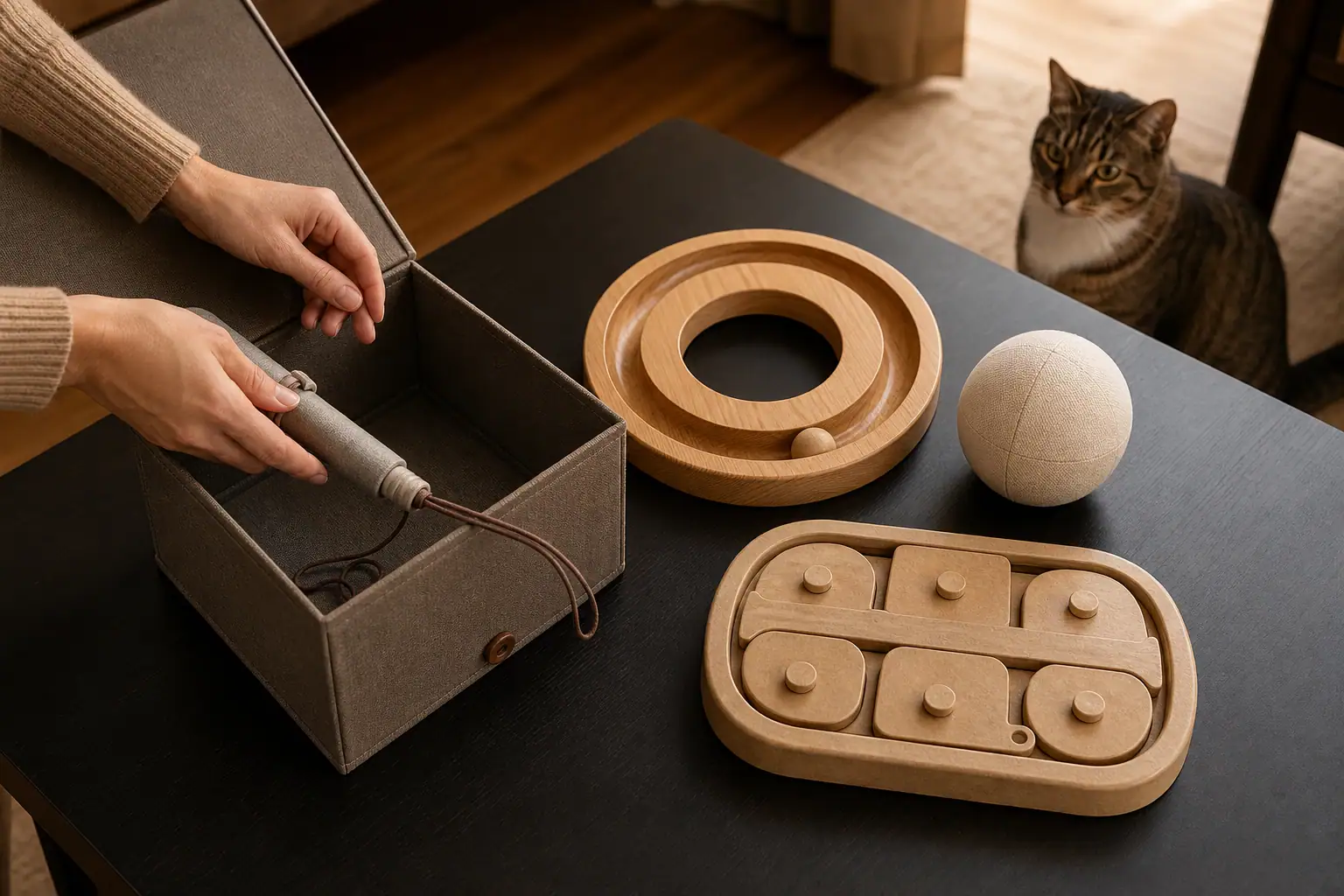
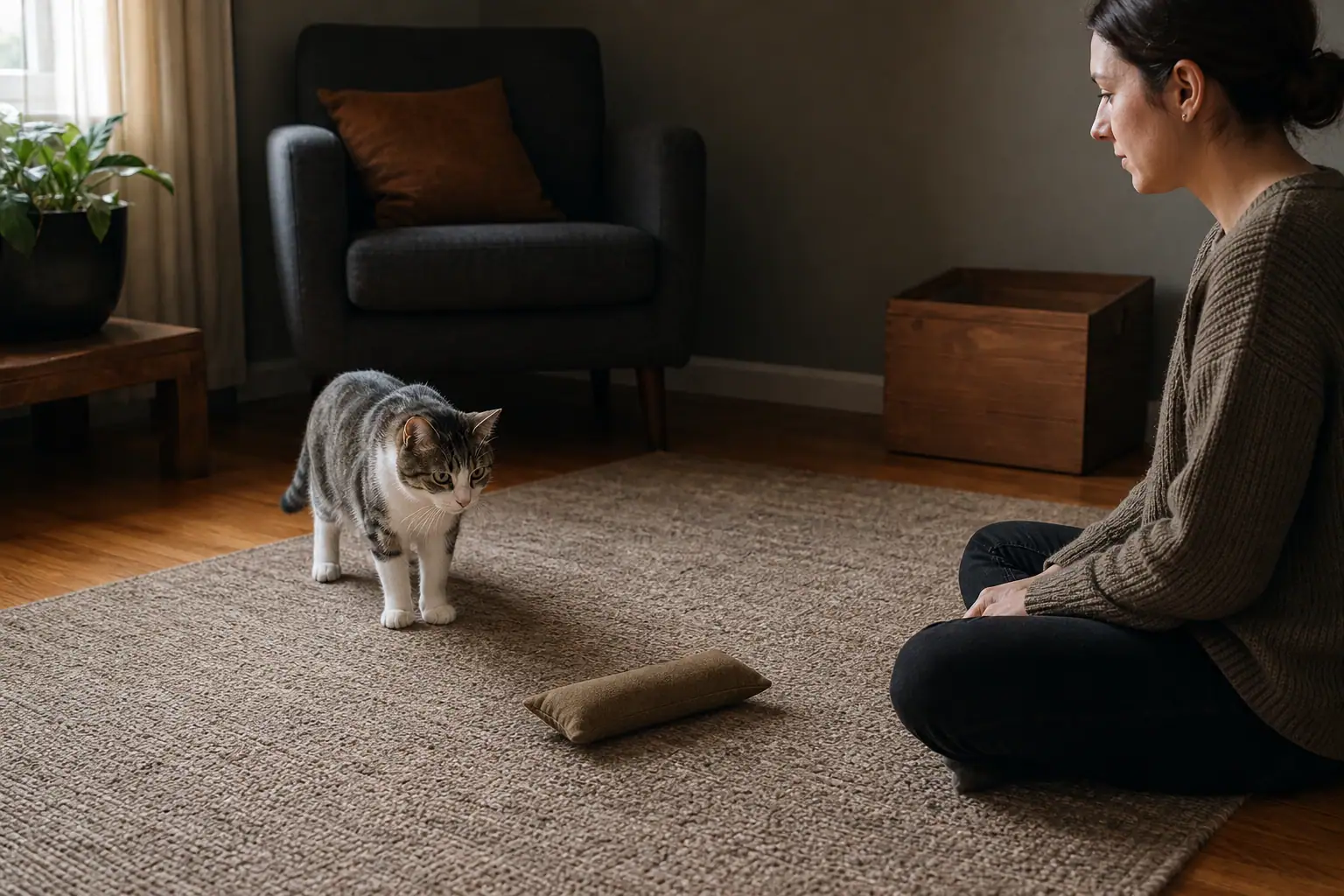
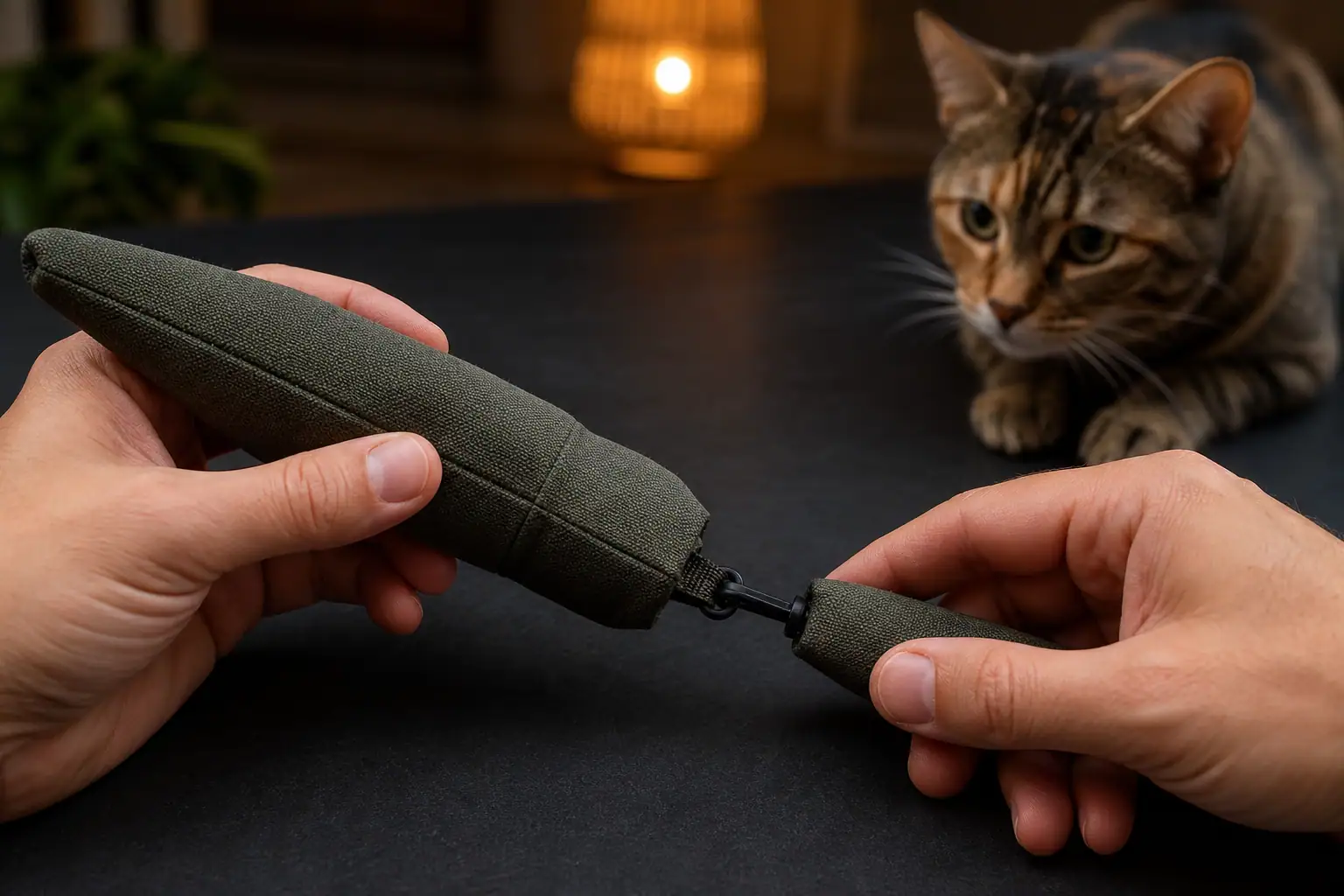
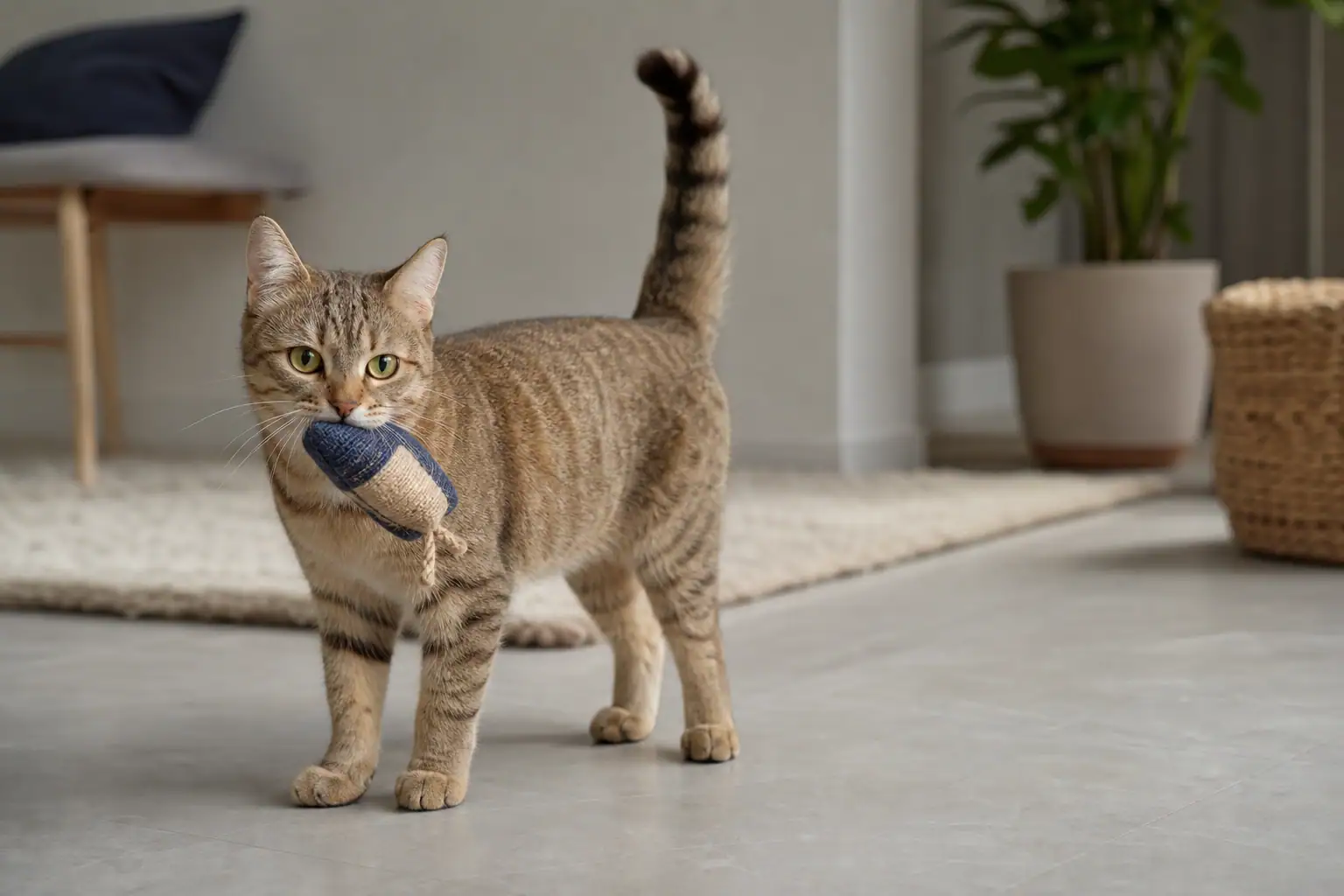
    Safe homemade cat toy materials arranged on a table
    Good homemade cat toys start with boring, inspectable materials: plain cardboard, clean fabric, paper, and secure knots.

    What Homemade Cat Toys Are Best For

    Homemade cat toys are best for variety. They let you test textures, sounds, hiding spots, food puzzles, and hunting games before buying a full toy setup. They are especially useful for cats that get bored with the same toy bin or ignore expensive gadgets but go wild for boxes, crinkly paper, and moving targets.

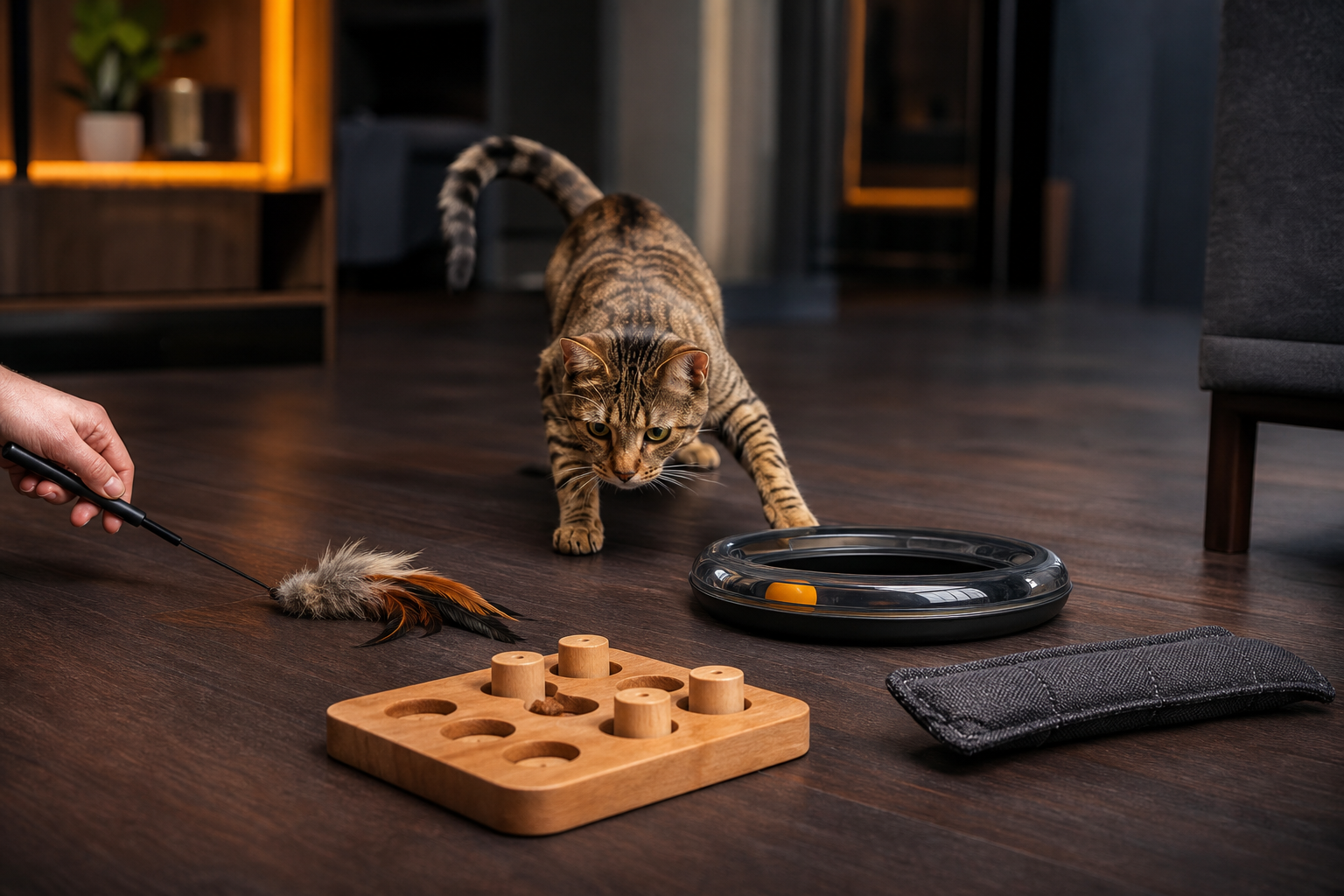
    The strongest DIY toys usually solve one job at a time. A cardboard tube puzzle makes food harder to grab. A box tunnel creates ambush cover. A paper ball gives a lightweight chase target. A fabric kicker gives the back feet something to rake. A wand game lets you mimic prey movement. Trying to make one homemade toy do everything usually adds weak points.

    The AAFP and ISFM feline environmental needs guidelines recommend giving cats opportunities for play and predatory behavior, including toys, owner-led play, and feeding devices that make the cat work for food. Homemade toys fit that well when they let the cat search, chase, catch, manipulate, and then settle down.

    For a broader rotation, pair this guide with Titan Claws articles on DIY cat toys, best cat toys for bored indoor cats, and cat toys for enrichment.

    The Safety Rule: Build for How Your Cat Breaks Things

    Most homemade cat toy lists assume the cat will bat, chase, and walk away. Titan Claws readers often have a different cat: the one that bites seams, pulls feathers out, eats fuzz, shreds cardboard, or tries to carry the whole toy under the couch. For that cat, the right question is not, “Can I make this?” It is, “What happens when my cat damages it?”

    • If your cat chews fabric: avoid loose stuffing, weak felt, thin yarn pom-poms, and glued decorations.
    • If your cat eats string-like objects: skip yarn, ribbon, elastic, long tassels, dental floss, thread, and dangling cords.
    • If your cat shreds cardboard: use cardboard only during supervised sessions and recycle it before pieces become snack-sized.
    • If your cat cracks plastic: avoid plastic eggs, bottle caps, brittle containers, and small lids.
    • If your cat carries toys away: make the toy larger than the cat can swallow and keep supervised-only toys in a closed drawer.

    Cornell Feline Health Center warns that many household items can be hazardous to cats and advises prompt veterinary consultation when a cat may have ingested something toxic or dangerous. For homemade toys, use that same caution with non-food items. If you think your cat swallowed string, ribbon, stuffing, plastic, rubber, wire, a bell, or any toy part, call your veterinarian or an emergency clinic instead of waiting to see what happens.

    Five Safer Homemade Cat Toys to Try

    These ideas are intentionally plain. Plain is good. It means fewer tiny parts, fewer mystery materials, and fewer failure points.

    1. Cardboard Tube Treat Puzzle

    Set several empty toilet paper rolls upright inside a shallow cardboard box. Add a few pieces of kibble or treats into some of the tubes. Let your cat fish the food out with paws. Keep the puzzle shallow enough that the cat cannot get trapped, and remove tape, staples, plastic coating, and loose labels first.

    This is a strong first homemade toy because it is cheap, easy to inspect, and close to the food-puzzle examples recommended by veterinary enrichment sources such as the ASPCA feline DIY enrichment guide and AAHA’s DIY enrichment toy guidance.

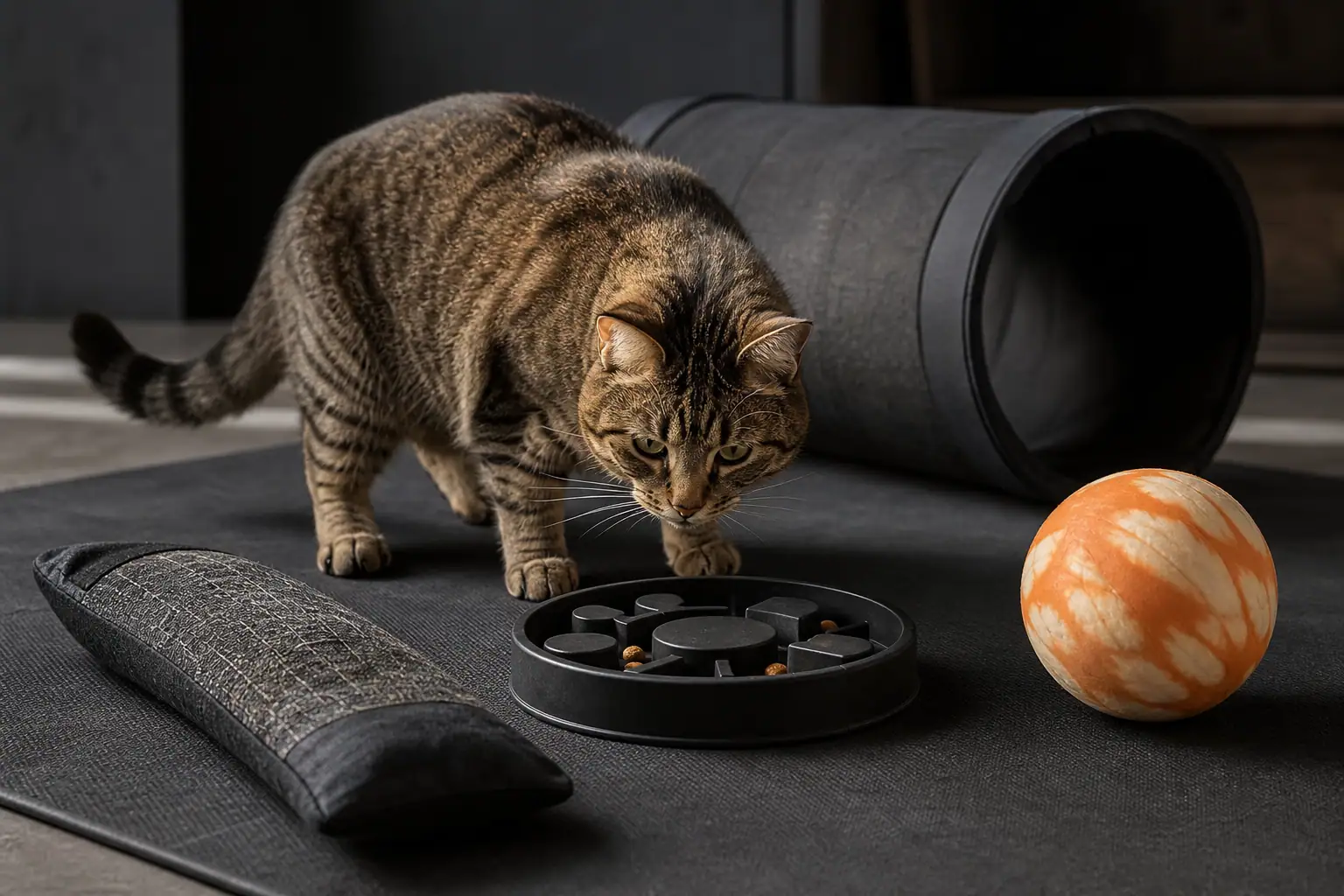
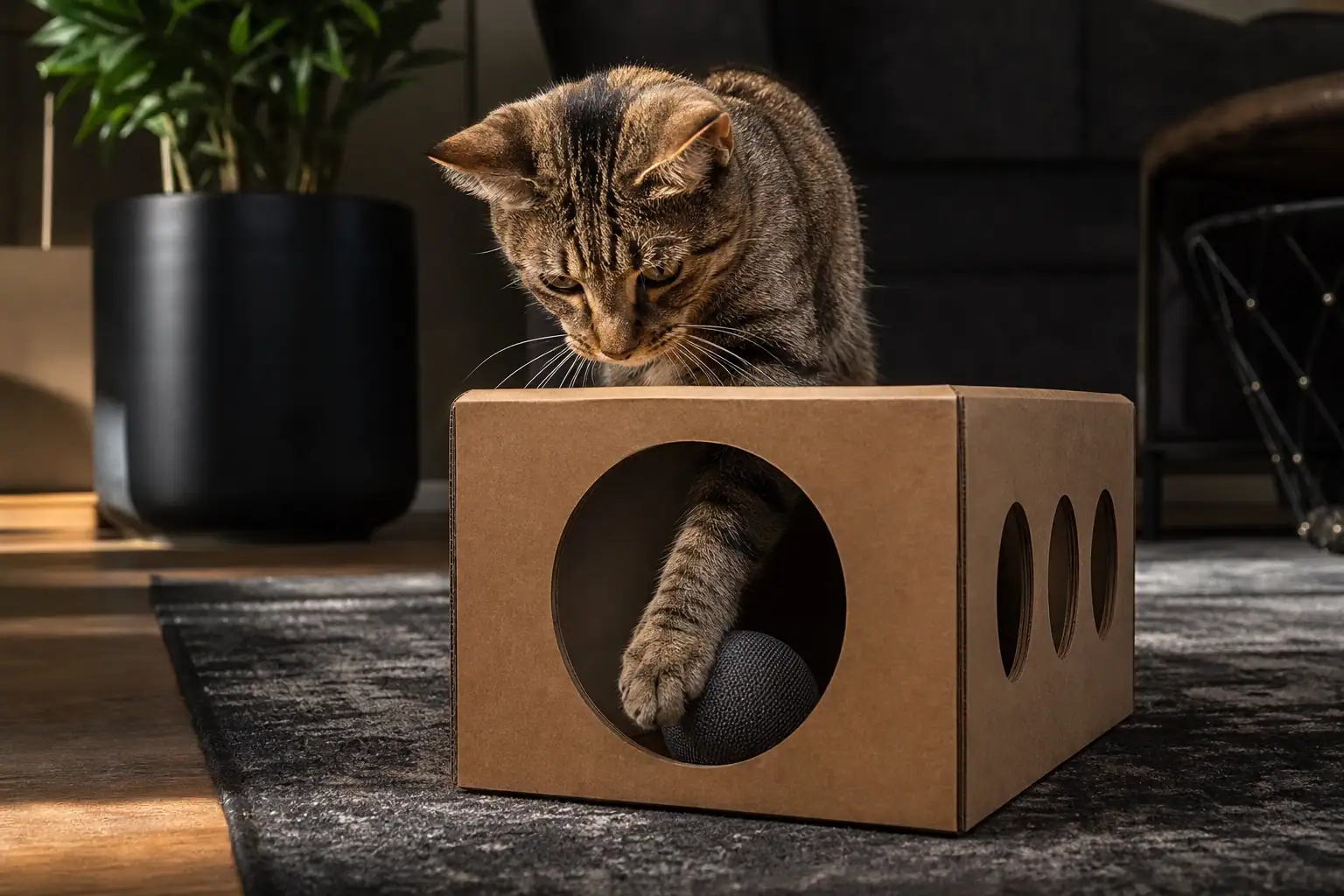
    Cat using a cardboard treat puzzle made from toilet paper rolls
    Cardboard puzzles are cheap, useful, and easy to retire before they become soggy or bite-sized.

    2. Paper Chase Ball

    Crumple plain packing paper into a loose ball about golf-ball to tennis-ball size, depending on your cat. Toss it down a hallway or slide it behind a box so the cat can stalk and chase. Avoid foil, cellophane, gift ribbon, twist ties, and paper with heavy ink or glitter. Retire the ball when it gets wet, torn into small pieces, or chewed flat.

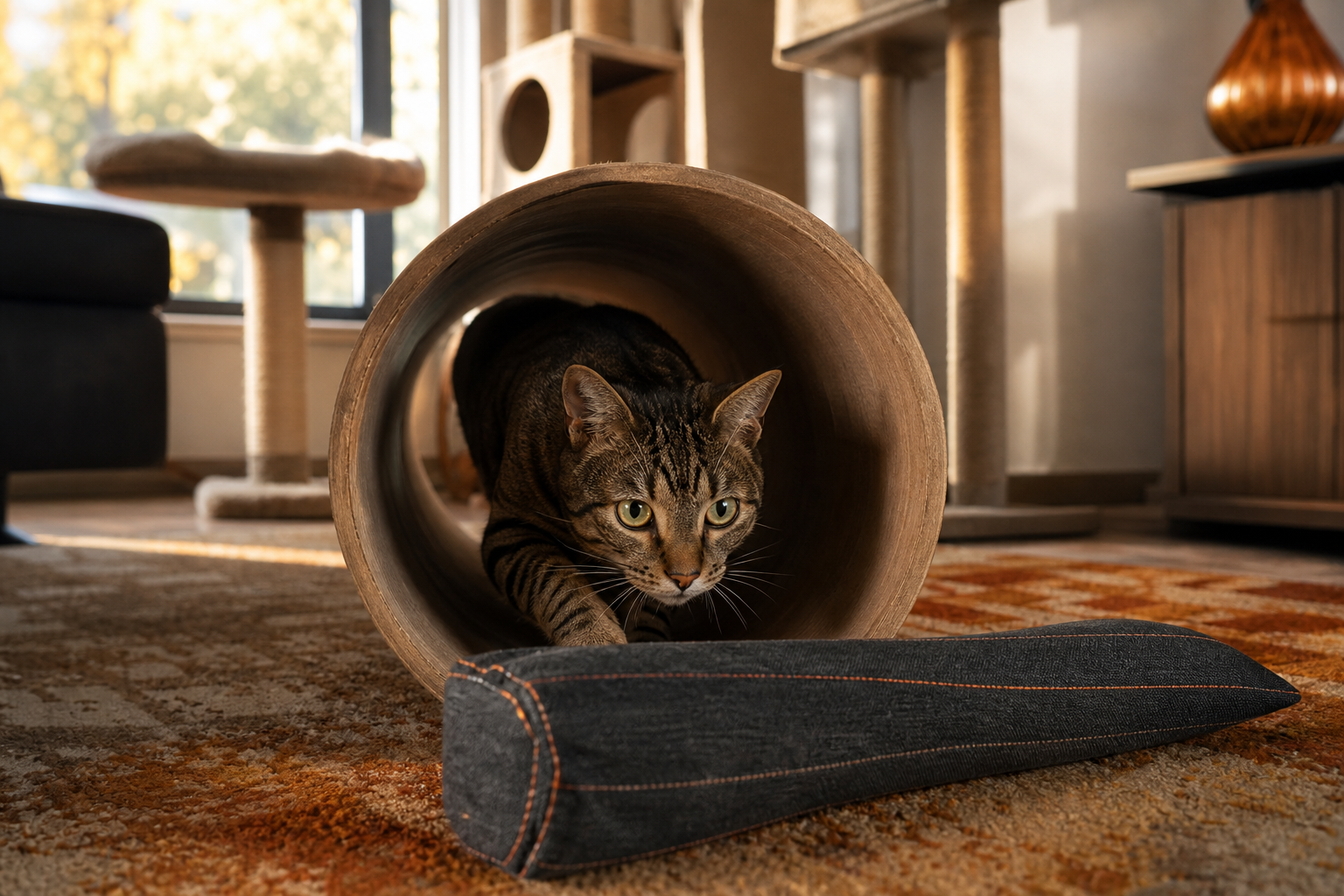
    3. Box Ambush Tunnel

    Cut two large doorways into a plain cardboard box so your cat can enter and exit without squeezing. Add a second box nearby or drape a towel over one edge to create a hiding spot. Use a wand toy outside the openings so the cat can pounce from cover. Do not use plastic bags, handled shopping bags, staples, or tight holes that could catch a collar or paw.

    4. No-Frills Fabric Kicker

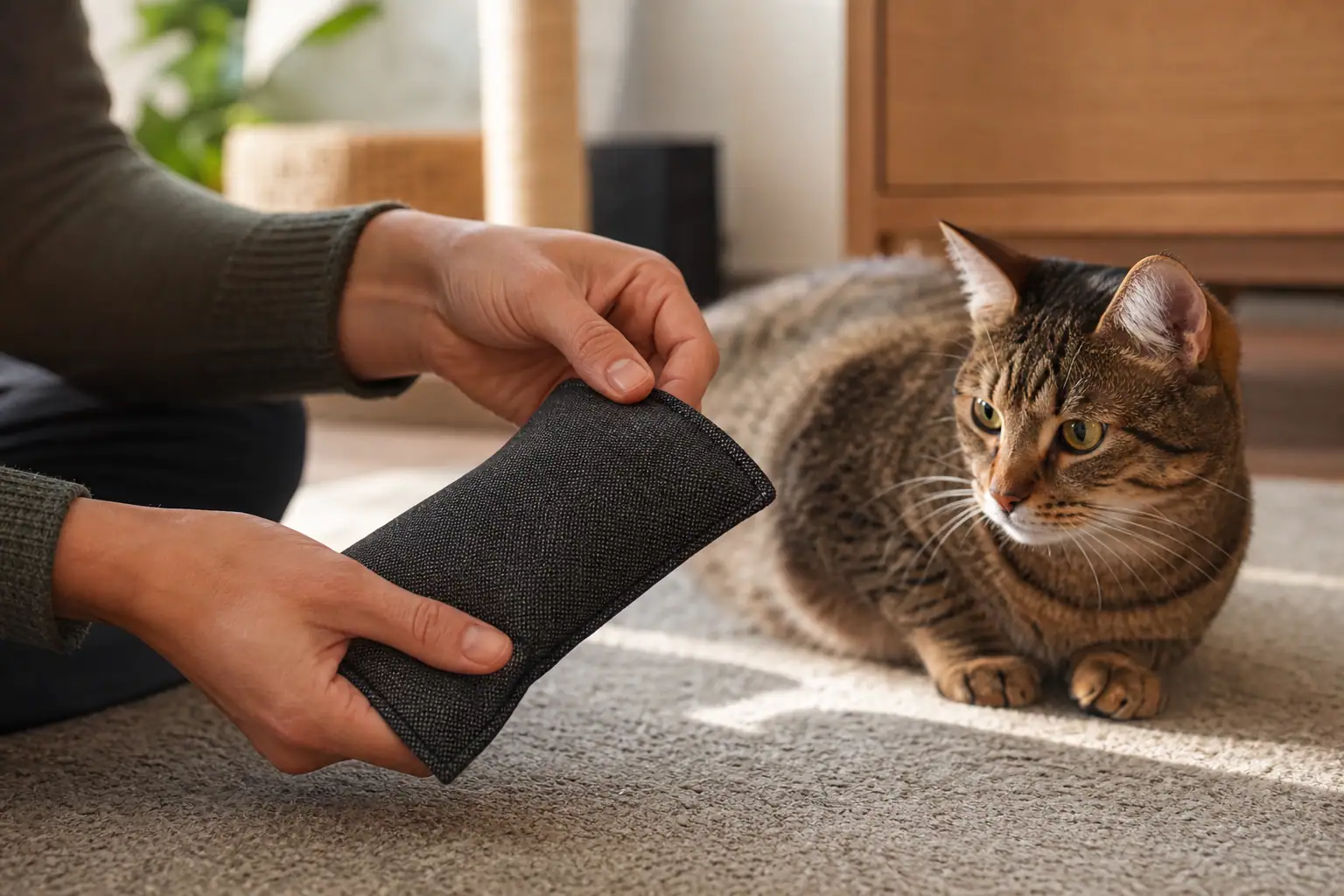
    Roll clean, sturdy cotton fabric into a long shape and secure it with tight stitching if you sew, or with large, firm knots if you do not. Keep it long enough for your cat to hug and kick without reaching your hand. Skip buttons, beads, bells, glued eyes, loose yarn hair, and weak seams. If you add catnip or silvervine, seal it inside a durable inner layer and retire the toy when the closure loosens.

    A homemade kicker is not automatically a durable toy. It is a test. If your cat opens seams quickly or eats fabric, move that cat to supervised-only play and read Titan Claws’ guides to cat kicker toys, toys for cats that chew, and safe cat chew toys.

    5. Supervised Wand Game

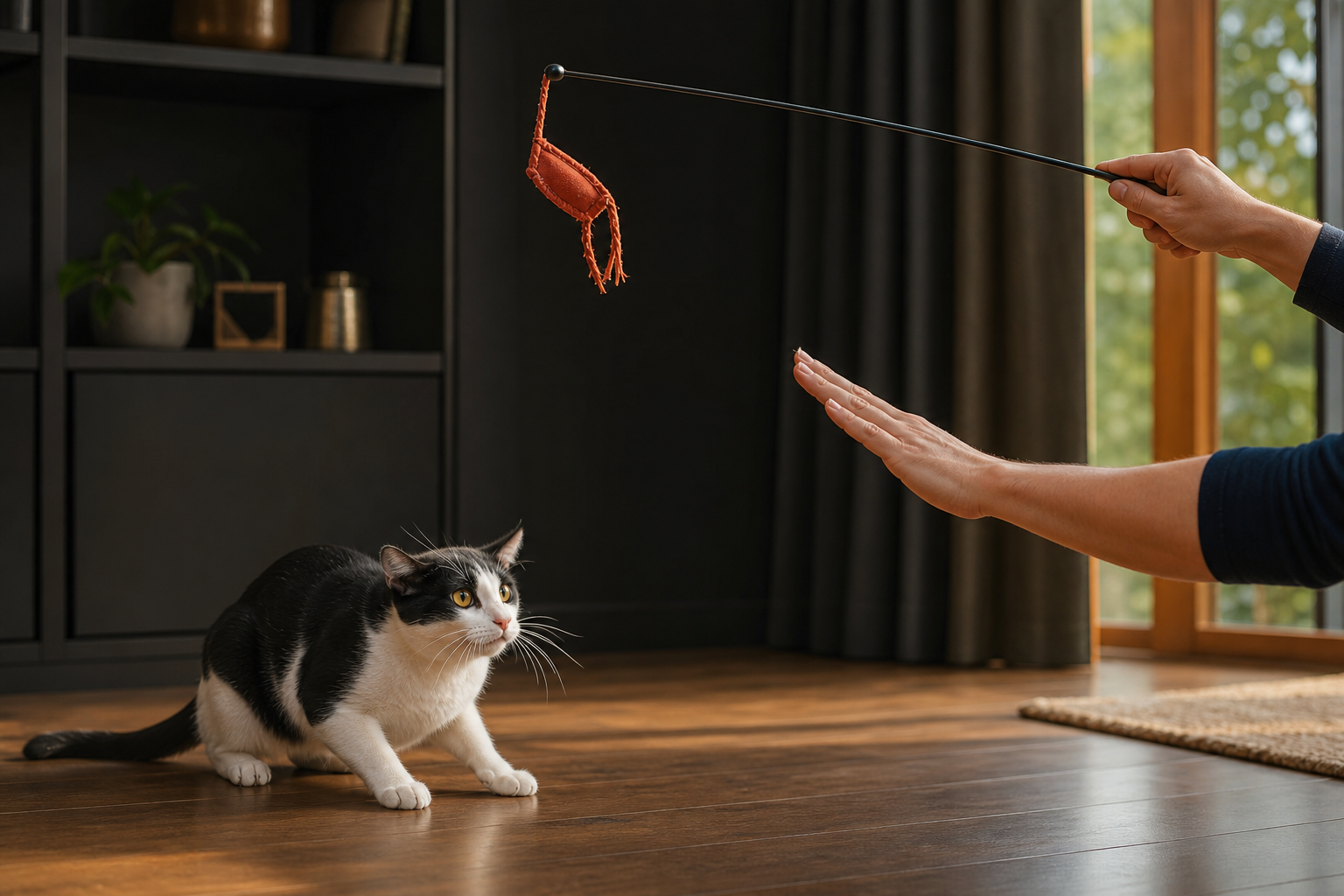
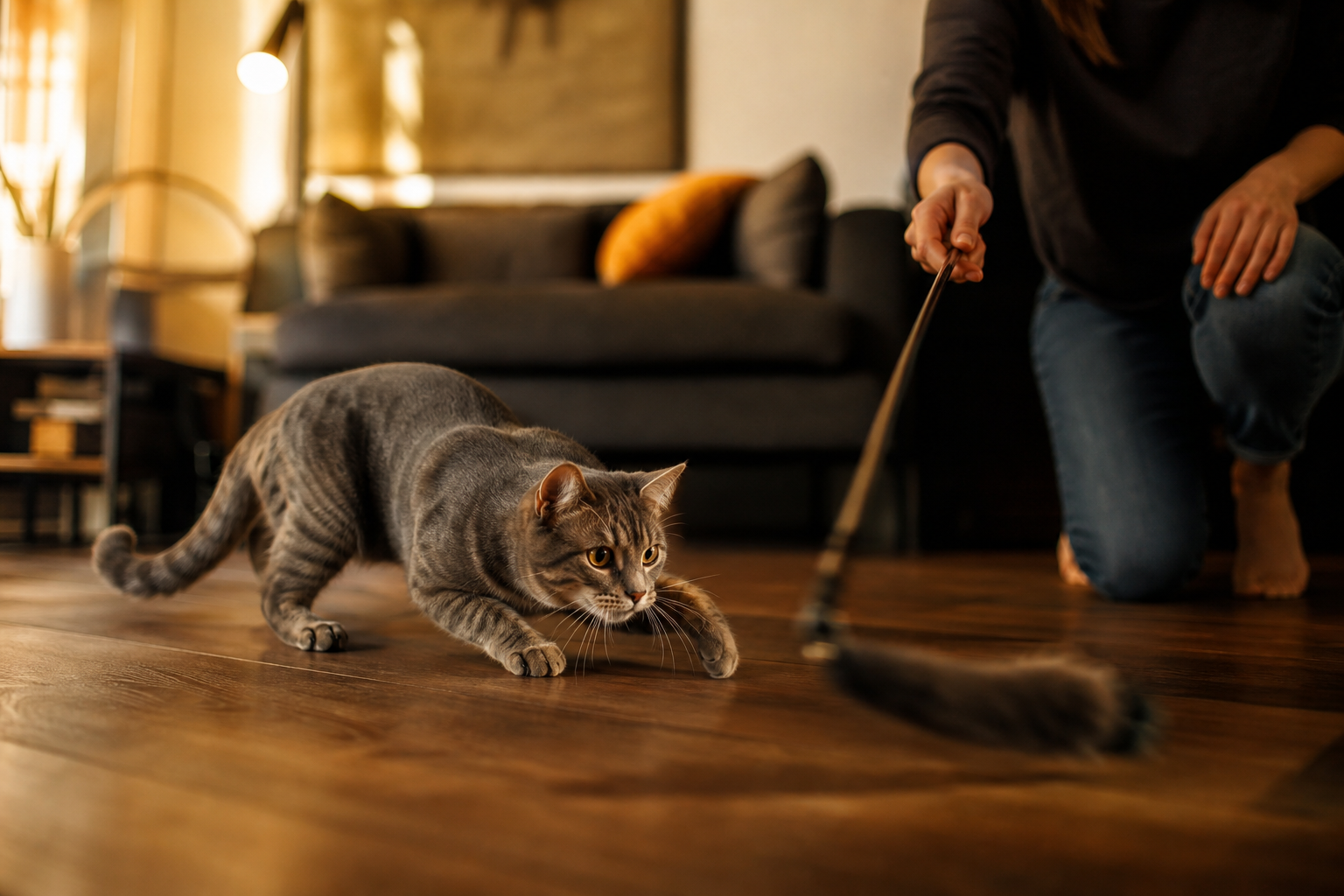
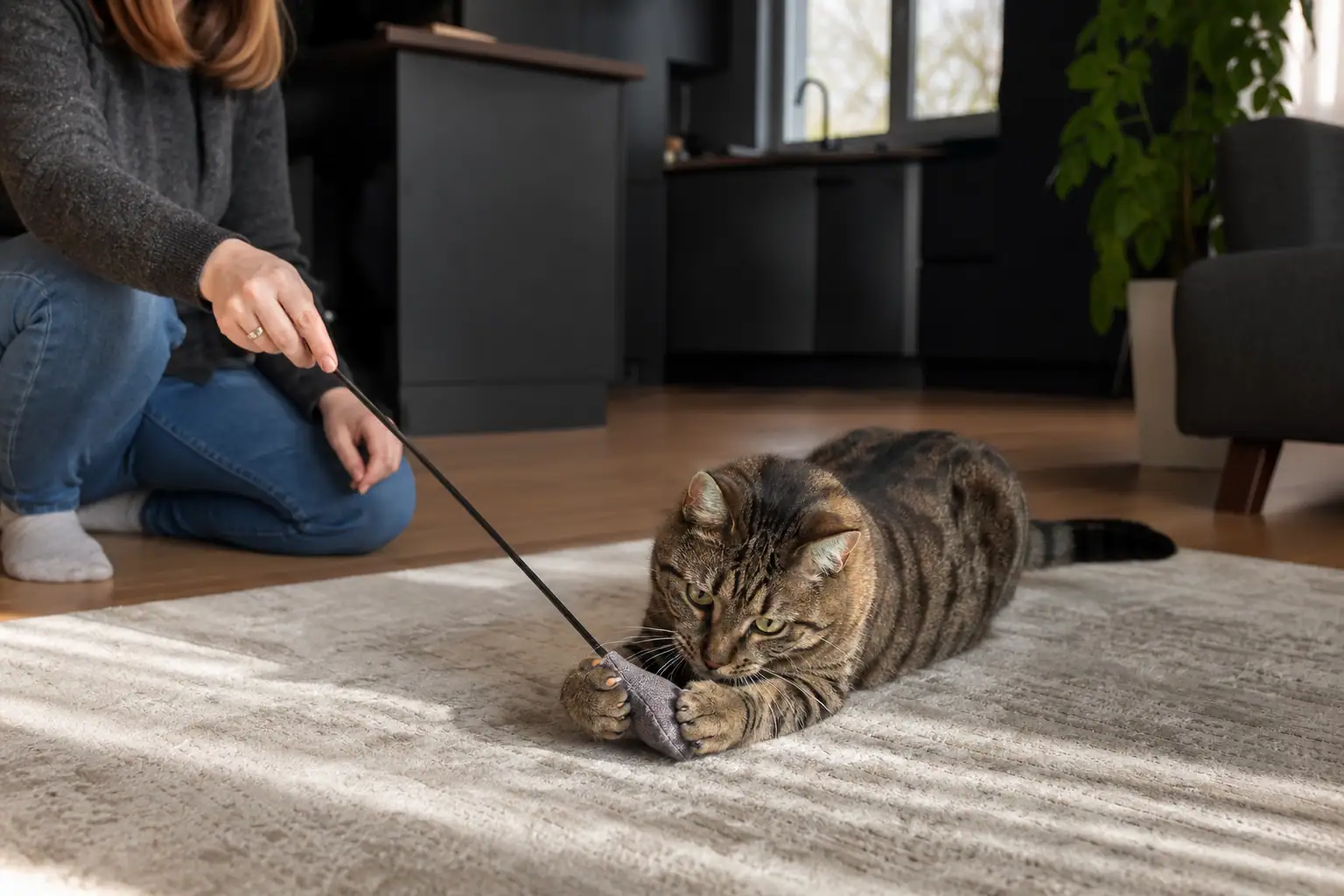
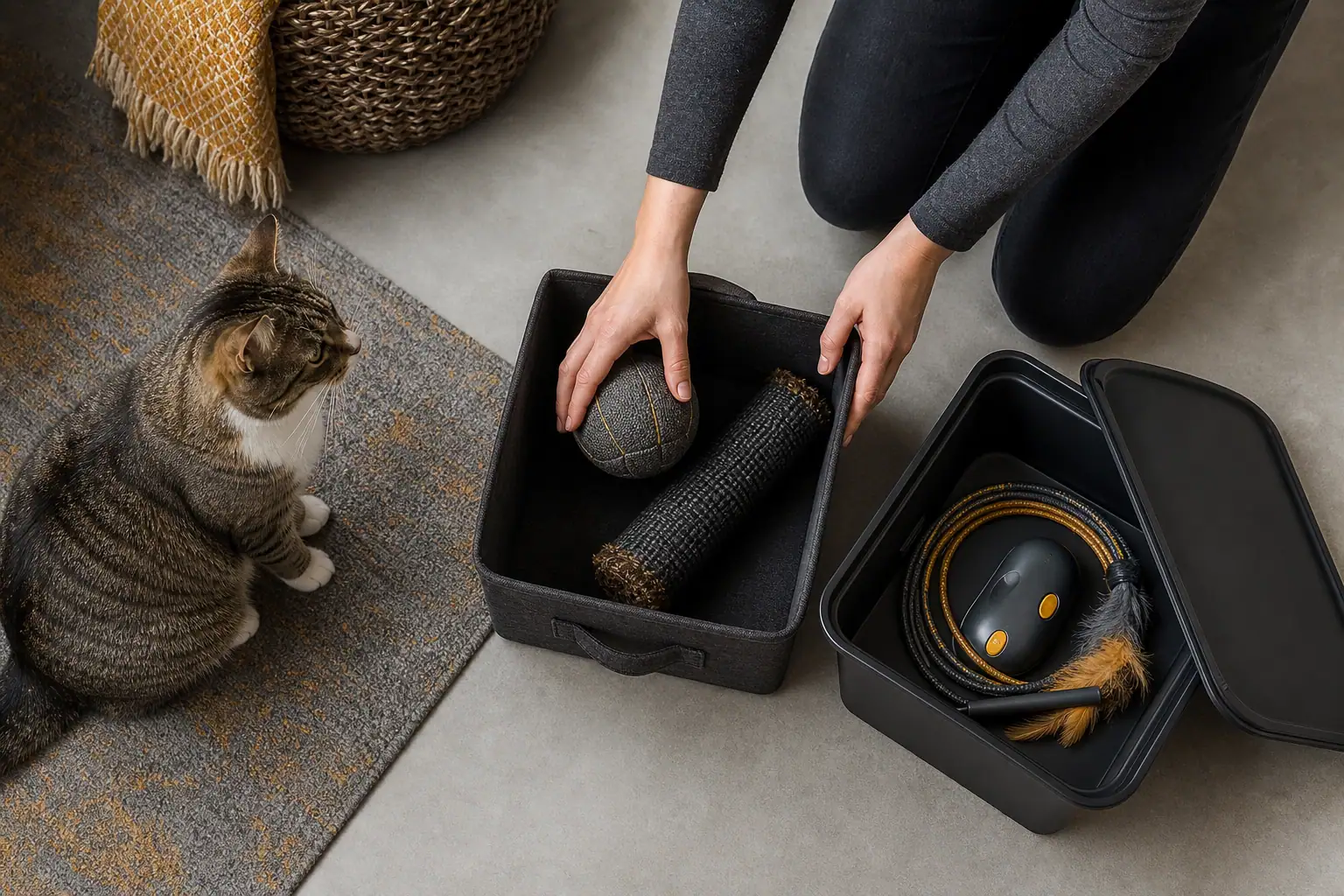
    You can make a simple wand game with a sturdy dowel and a short fabric strip, but this is supervised-only. Move the lure like prey: away from the cat, around corners, behind boxes, and across the floor. Let the cat catch it sometimes. When the session ends, put the entire wand away where the cat cannot chew the fabric or cord.

    If your cat loves feather-style movement, Titan Claws has separate safety guidance on cat feather toys and the Da Bird cat toy, including why feather and string lures should not be left out for unsupervised chewing.

    Homemade Toys to Skip for Rough Players

    Some DIY toys look cute in photos but are poor matches for cats that chew, shred, or swallow non-food material. Skip these unless your veterinarian has given specific advice and you can supervise closely.

    • Yarn pom-poms: loose strands can separate, and some cats chew or swallow them.
    • Ribbon teasers: ribbon is exciting but risky if swallowed, especially for cats that eat linear objects.
    • Rubber-band toys: rubber bands can snap, be swallowed, or encourage chewing elastic.
    • Plastic egg rattles: many guides suggest filling plastic eggs with rice or beans, but hard plastic can crack and small contents can spill.
    • Small bottle caps: they skid nicely, but they are too small for some cats and can be chewed.
    • Decorated plush mice: glued eyes, bells, tails, and thin felt often fail before the body of the toy does.
    • Anything with staples or pins: they do not belong in cat toys, even as hidden construction shortcuts.

    Use a simple rule: if a part would worry you on a toddler’s toy, it should worry you on a cat toy. Cats do not need decorative details. They need movement, texture, scent, hiding, food puzzles, and safe capture.

    How to Make Homemade Toys More Durable

    Durability is not about making a homemade toy indestructible. That is the wrong promise. Durability means the toy fails slowly, visibly, and in a way you can catch before your cat eats pieces.

    1. Use larger pieces: make toys big enough that your cat cannot swallow them whole.
    2. Choose one main material: cardboard, paper, or fabric is easier to monitor than a mixed toy full of attachments.
    3. Avoid glue when possible: stitching, folding, and simple box construction are easier to inspect.
    4. Keep seams exposed: if you sew, make inspection easy rather than hiding weak seams under trim.
    5. Build replacement into the plan: cardboard puzzles and paper balls are meant to be replaced often.
    6. Test under supervision: the first few sessions tell you whether the toy is safe enough for your specific cat.
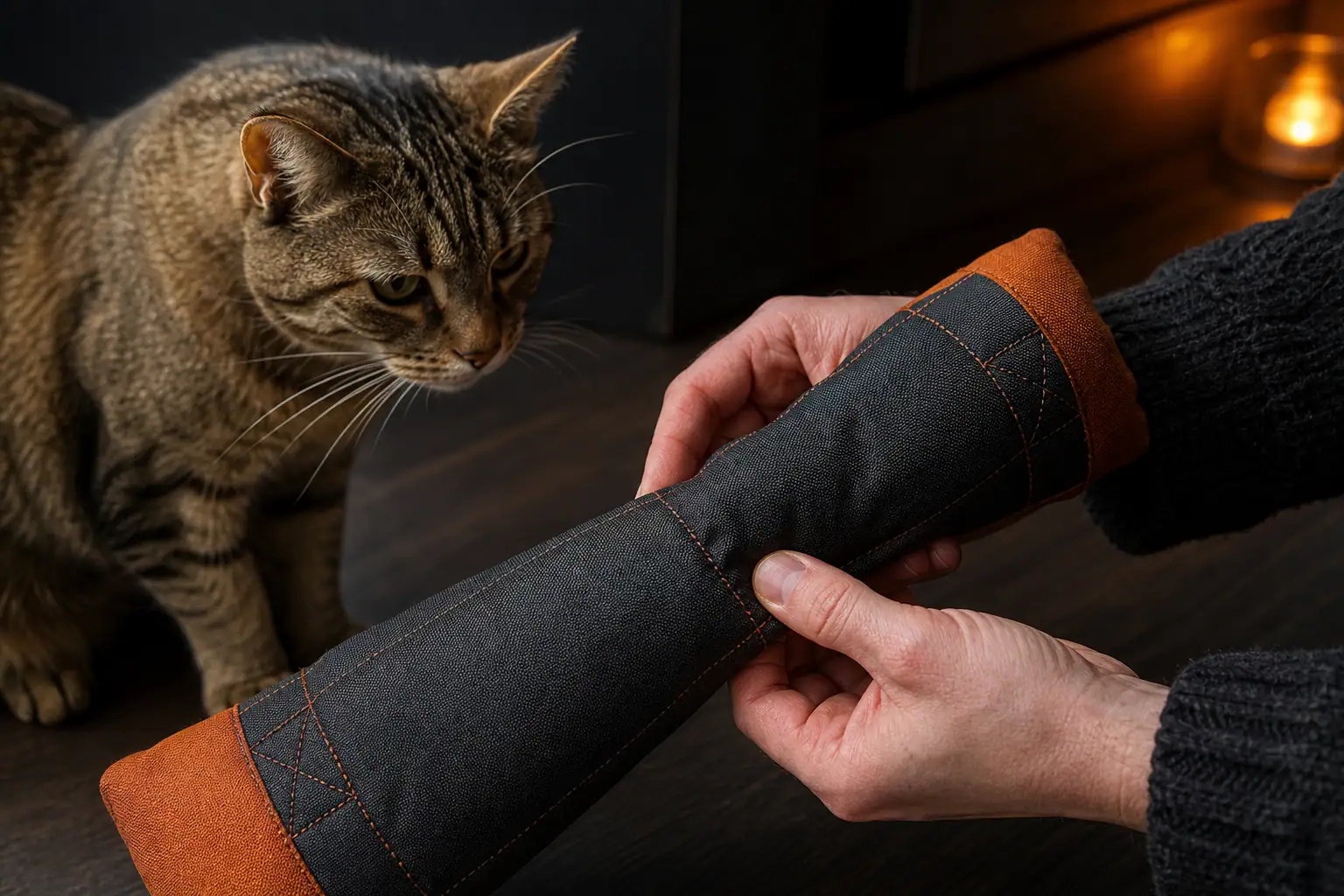
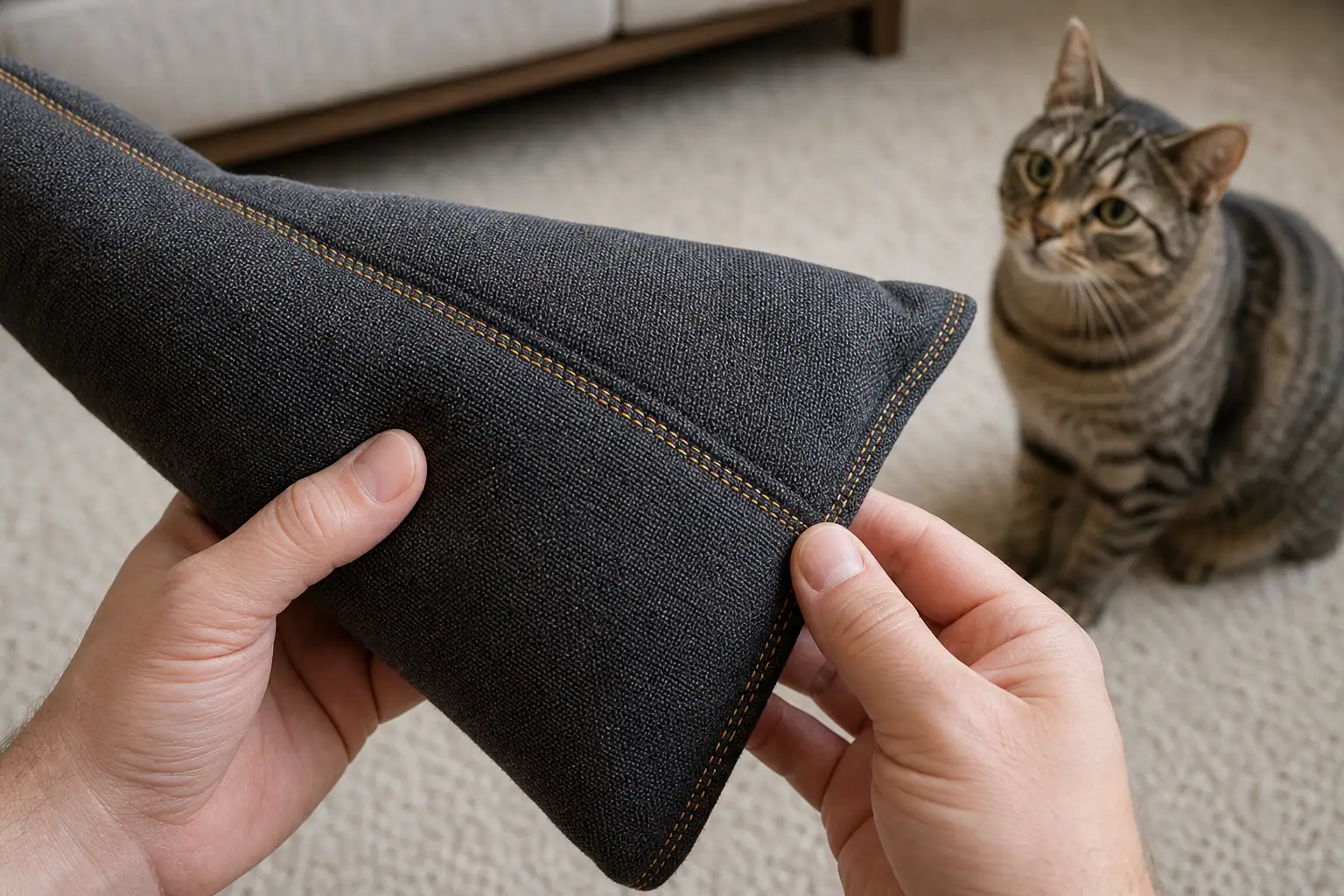
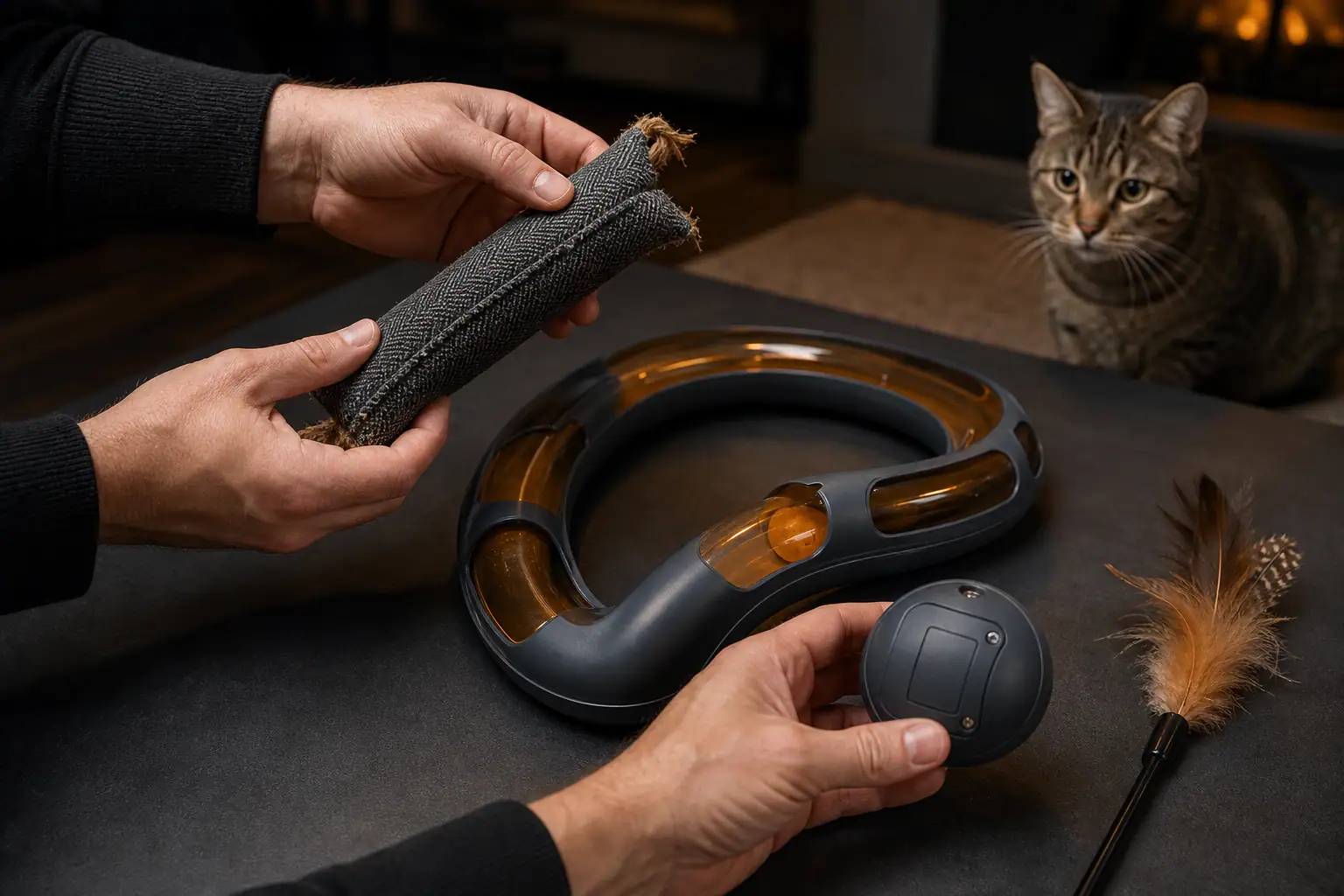
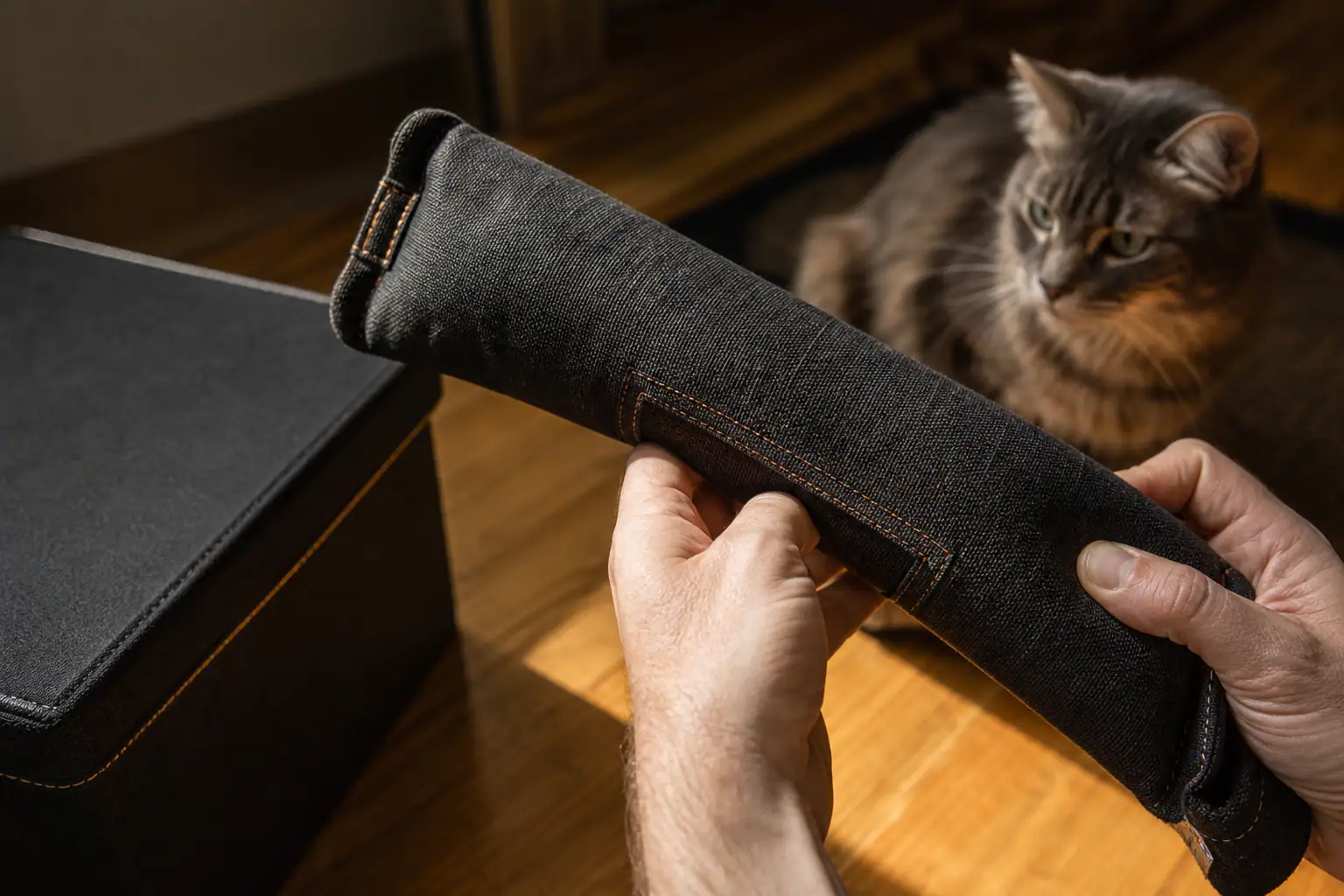
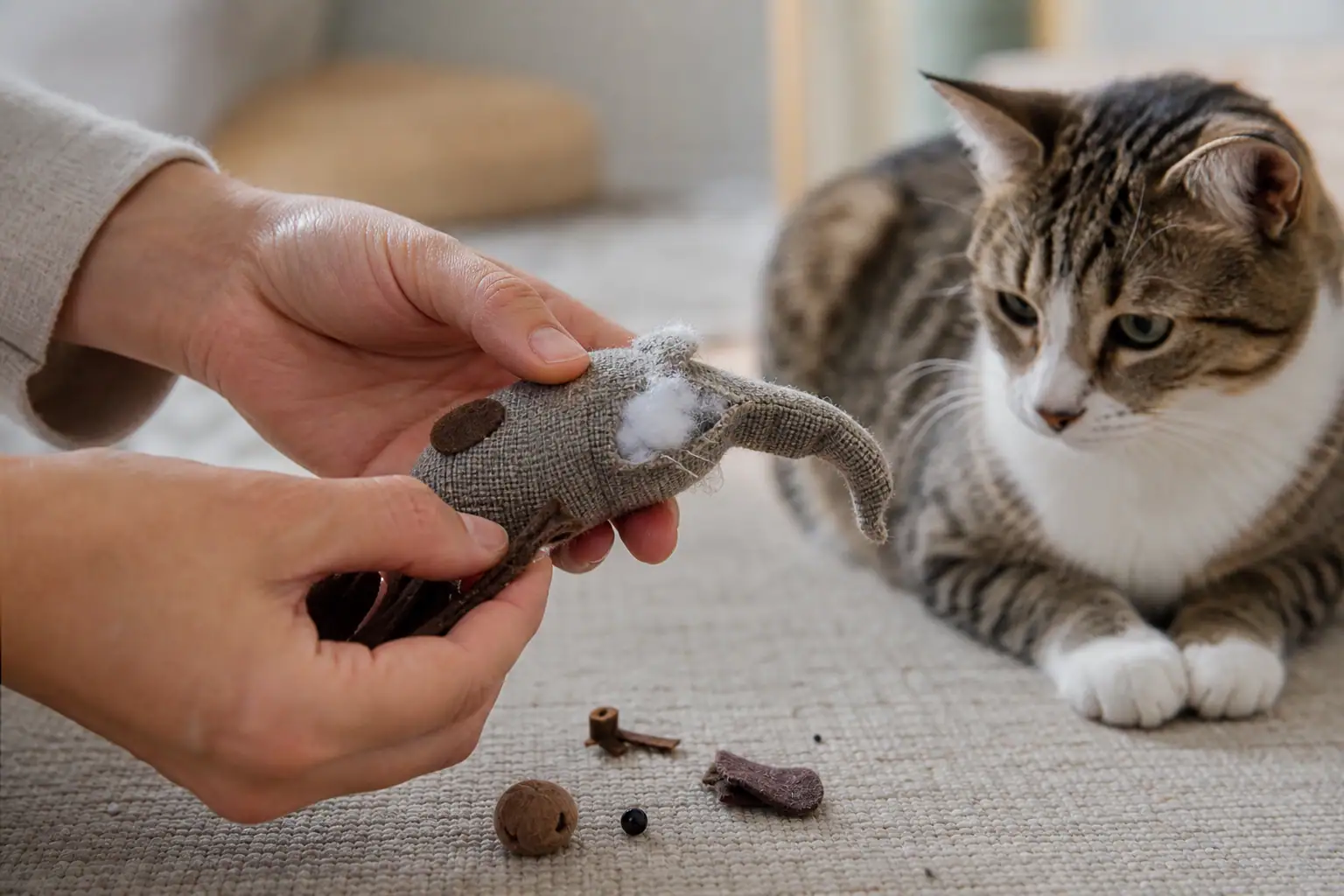
    Hands inspecting a homemade fabric cat toy for loose seams
    Homemade toys need the same rule as store-bought toys: inspect before play, inspect after play, and retire early.

    For cats that destroy homemade toys in minutes, durability may mean changing the role of DIY. Use homemade boxes and puzzles for searching and pouncing, then hand off to a tougher store-bought capture toy for the biting and kicking phase. That gives the cat variety without asking cardboard or paper to absorb the hardest part of play.

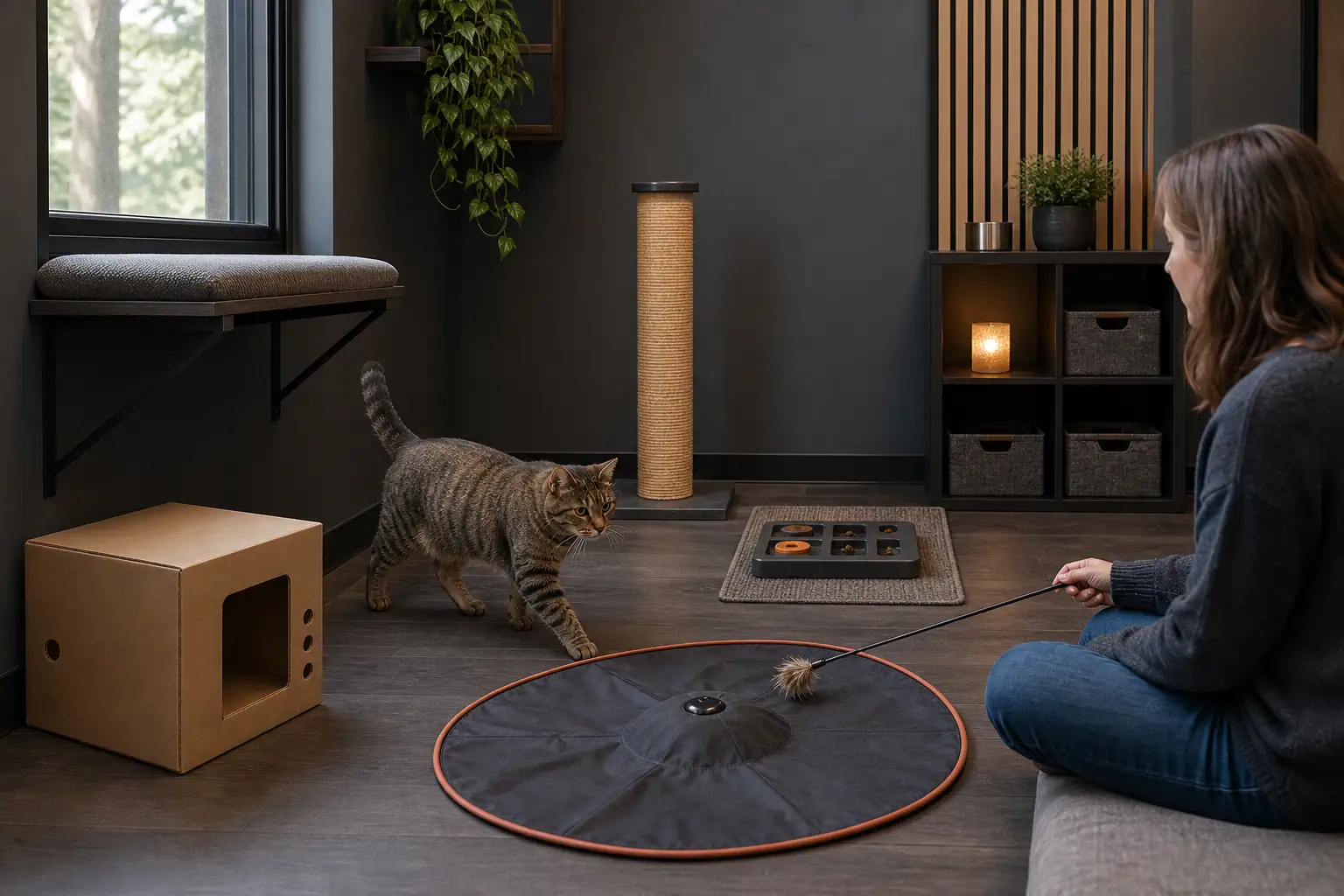
    A 20-Minute Homemade Play Routine

    A toy by itself is less useful than a routine. This structure works well for many indoor cats and is easy to adjust for age, fitness, and confidence.

    1. Set the room: remove cords, plants, breakables, food wrappers, and small objects from the play area.
    2. Start with search: put a few kibble pieces in a cardboard tube puzzle or under crumpled paper.
    3. Add stalking: move a wand lure around a box opening or behind a towel edge.
    4. Offer chase: toss a paper ball or move the lure away from the cat in short bursts.
    5. Give capture: let the cat grab a fabric kicker, soft toy, or safe lure instead of your hand.
    6. Cool down: finish with a small food puzzle, meal portion, or calm grooming if your cat enjoys it.
    7. Inspect and store: throw away damaged cardboard, put wand toys away, and check fabric toys for seams or missing pieces.

    Short sessions are usually better than one long chaotic session. Stop before your cat gets frantic, panting, irritated, or so wound up that they redirect onto your hands or another pet. For higher-energy cats, repeat shorter sessions through the day.

    When Store-Bought Is the Safer Choice

    Homemade toys are not always the frugal or safer option. If your cat has a history of swallowing fabric, string, plastic, or rubber, you may need fewer toys, stricter storage, and more purpose-built options that can survive the way your cat actually plays. If your cat obsessively chews non-food objects, discuss it with your veterinarian because pain, stress, diet, compulsive behavior, or gastrointestinal issues can all change the safety picture.

    Store-bought can also be better for specific jobs: battery-safe automatic toys, washable puzzle feeders, heavier kickers, stable scratchers, and products with fewer detachable pieces. The buying standard stays the same. Avoid impossible claims, inspect before and after play, and replace toys before damage turns into ingestion risk.

    Quick Homemade Cat Toy Checklist

    • Is every part too large for my cat to swallow?
    • Did I remove staples, tape, handles, plastic film, labels, and loose coating?
    • Are there any strings, ribbons, yarn strands, rubber bands, bells, beads, feathers, or glued decorations?
    • Can I inspect the whole toy in under a minute?
    • Do I know whether this is supervised-only or safe to leave out for this specific cat?
    • Will the toy fail visibly, or could hidden pieces come loose?
    • Have I watched how my cat bites, kicks, carries, and damages it?
    • Do I have a replacement plan before the toy becomes soggy, torn, sharp, or bite-sized?

    The best homemade cat toys are not elaborate craft projects. They are simple enrichment tools that match your cat’s prey drive, mouth, claws, and habits. Start with cardboard, paper, fabric, and food puzzles. Supervise the first sessions. Retire early. For cats who hit hard, let homemade toys create the hunt, then use tougher, inspectable toys for the catch.

    Sources

  • Cat Feather Toys: How to Choose and Use Them Safely

    Cat Feather Toys: How to Choose and Use Them Safely

    Cat feather toys are popular because they do something simple very well: they make indoor play feel like a small hunt. A feather wand can flutter, pause, skitter, hide, and flee in ways that trigger stalking, chasing, pouncing, and catching. For many cats, especially cats with high prey drive, that is more satisfying than a toy that just sits on the floor.

    The catch is safety. Feathers, strings, clips, bells, elastic cords, and small lure parts can become problems when a cat chews them loose or swallows them. The best way to use cat feather toys is to treat them as supervised interactive toys, not all-day floor toys. Choose stronger construction, run short play sessions, let your cat catch the lure, inspect for damage, and store the wand when you are done.

    Hands checking a feather cat toy for loose feathers and string wear
    Feather toys are best treated as supervised toys: inspect the feathers, knots, clips, string, and wand before every rough session.

    Why Cats Love Feather Toys

    Feather toys work because they mimic prey movement better than many static toys. A wand lets you make the lure glide like a bird, dart behind furniture like a mouse, freeze after a pounce, or disappear behind a box. That unpredictability gives the cat a job instead of just an object.

    The AAFP and ISFM feline environmental needs guidelines recommend play that lets cats express parts of the predatory sequence, including using a rod or wand with a feather or fur toy to mimic flying or ground prey. That is the real value of a feather wand: it helps a cat stalk, chase, catch, and reset without needing outdoor hunting.

    For Titan Claws readers, the important point is not that feathers are magic. It is that the movement pattern is powerful. A tough fabric lure, a worm-style attachment, or a kicker handoff can sometimes be a better choice for cats that love the chase but destroy feather bundles the moment they catch them.

    What Search Results Get Right and Miss

    The top results for cat feather toys are mostly shopping pages, brand pages, and best-of lists. They are useful for seeing the main formats: feather wands, replacement feather lures, door-hanging teasers, plush-and-feather toys, crinkle attachments, refill packs, and well-known options such as Go Cat Da Bird.

    What many results miss is the decision-making layer. A product page can tell you a wand has feathers, bells, catnip, or a high review count. It often does not tell you whether the attachment is a good match for a cat that chews feather shafts, eats loose strands, cracks plastic clips, or refuses to release captured prey.

    A better buying question is: how does this toy fail under my cat’s teeth and claws? For rough players, the safest feather toy is not necessarily the flashiest one. It is the one you can control, inspect, store, and replace before pieces come off.

    Are Cat Feather Toys Safe?

    Cat feather toys can be safe when they are used under supervision and retired when damaged. They become risky when loose feathers, strings, ribbons, elastic, bells, clips, or small lure pieces are left where a cat can chew or swallow them.

    The Cornell Feline Health Center advises avoiding toys with small pieces or linear parts such as feathers and string that can separate and be ingested, especially when chewed. Cornell also recommends thinking about the play environment and rotating toys to prevent boredom. That guidance fits feather wands exactly: they are excellent interactive tools, but poor candidates for unsupervised access.

    If your cat swallows feathers, string, ribbon, elastic, or any toy fragment, call your veterinarian for advice. Get urgent help if you see repeated vomiting, loss of appetite, lethargy, gagging, choking, abdominal pain, straining, drooling, or string hanging from the mouth or rectum. Do not pull visible string; a veterinarian should guide that situation.

    Types of Cat Feather Toys

    Most feather toys fall into a few practical categories. Each can work, but each has different failure points.

    • Feather wand toys: Best for interactive chase and jump sessions. Watch the string, swivel, clip, knot, and feather bundle. Store the wand after play.
    • Replacement feather lures: Useful because you can replace a damaged lure instead of keeping a dangerous one in use. Check that the connector fits securely and does not create a small chewable part.
    • Short stick feather toys: Easier to control in small rooms, but they put your hand closer to teeth and claws. Use them with cats that have polite capture behavior.
    • Door-hanging or elastic feather toys: Convenient, but risky for cats that chew cords or play unsupervised until parts detach. These are poor choices for destructive cats unless you can monitor them closely.
    • Plush toys with feathers: Better for carrying and batting than true hunting play. Avoid glued-on feathers or tiny tails for cats that chew decorations off toys.
    • Electronic feather toys: Can add movement, but they introduce battery doors, spinning parts, plastic housings, and detachable lures. Inspect them more like small appliances than simple toys.

    If your cat is tough on toys, compare feather options with Titan Claws’ guides to wand cat toys, cat toys for hunting, and cat kicker toys. Many rough players do best with a feather wand for the chase and a sturdier kicker for the bite-and-rake finish.

    Cat stalking a feather lure around a cardboard box
    The best feather play makes the lure behave like prey: hide, twitch, flee, pause, and let the cat catch it.

    How to Choose a Better Feather Wand

    For ordinary play, engagement matters. For rough play, construction matters just as much. Look past color and choose the toy by handle control, attachment strength, and how easy it is to inspect.

    1. Choose a comfortable wand length: A longer wand gives your cat room to jump without landing on your hand. A shorter wand is better for tight spaces and low-impact play.
    2. Check the string or cord: Thin monofilament, elastic, ribbon, and string should never be left out. For supervised play, make sure the cord is intact and securely tied or clipped.
    3. Inspect the lure attachment: Swivels and clips can make movement more realistic, but they are also small parts. Replace the lure if a connector bends, cracks, loosens, or becomes chew-marked.
    4. Pick feathers for your cat’s mouth habits: Long fluffy feathers are exciting but easy to shred. Tighter feather bundles or non-feather lures may be better for cats that chew hard.
    5. Avoid extra decorations: Bells, beads, tinsel, loose ribbons, and glued-on trim add swallowable failure points.
    6. Prefer replaceable lures: A wand with replaceable attachments lets you retire damaged feathers early without throwing away the whole toy.
    7. Read low-star reviews: Look for patterns such as feathers fell out, string snapped, clip broke, cat swallowed pieces, or wand splintered.

    Do not buy a feather toy because the listing says durable and stop there. Durable is not a regulated promise. The real test is whether the toy’s weakest part matches your cat’s strongest habit.

    How to Play So the Toy Feels Like Prey

    Many people accidentally make feather play less satisfying by waving the toy in the cat’s face. Real prey usually moves away, hides, pauses, and tries to escape. Your feather toy should do the same.

    1. Start slow: Drag or twitch the lure near a box, chair leg, rug edge, or doorway. Let your cat notice and stalk.
    2. Move away from the cat: Make the feather flee across the floor or glide away through the air. Avoid poking your cat with it.
    3. Use pauses: Stop the lure behind an object. Many cats pounce after the pause, not during constant motion.
    4. Vary height: Some cats love bird-like swoops; others prefer ground prey. Keep big jumps reasonable for kittens, seniors, and cats with mobility concerns.
    5. Let the cat catch it: A game with no catch can frustrate some cats. Let your cat pin the lure briefly, then reset.
    6. Hand off to a tougher toy: If your cat chews feathers after every catch, swap to a sturdy kicker or chew-safe toy for the bite-and-rake moment.
    7. End with food or foraging: A small meal, treat scatter, or puzzle feeder can complete the hunt-eat-groom-rest rhythm.

    For cats that need more daily indoor stimulation, connect feather play with a broader enrichment plan. Titan Claws has separate guides to cat toys for enrichment, interactive cat toys for indoor cats, and toys for bored indoor cats.

    What to Do for Cats That Destroy Feather Toys

    If your cat catches the feather lure and immediately tries to eat it, do not leave the toy out and do not keep playing tug-of-war until feathers rip free. Change the routine.

    • Shorten the capture: Let your cat catch the lure, praise the catch, then trade for a kicker before chewing starts.
    • Use tougher attachments: Try fabric, leather-style, felt-free, or worm-style lures if feathers are too fragile for your cat.
    • Switch to ground prey: Some cats chew feathers because the game is too aerial and overstimulating. Ground movement can lower the intensity.
    • Use two toys: Keep one lure moving while the captured one goes still, then redirect before chewing escalates.
    • Retire damaged lures immediately: Loose feathers, exposed shafts, unraveling knots, bent clips, frayed string, or cracked plastic mean the lure is done.
    • Build a chew outlet: Add a larger durable kicker or chew-appropriate toy so your cat has somewhere safer to bite hard.

    For cats that reliably shred ordinary toys, read Titan Claws’ unbreakable cat toys guide and safe cat chew toys guide. The first title uses the common search phrase, but the practical standard is more careful: no cat toy should be treated as impossible to destroy. The goal is to match the toy to the job: feather for chase, tougher object for chewing, and storage for anything with string or small parts.

    A feather wand stored beside sturdier cat toys for rotation
    Use feather wands for interactive chase, then switch to sturdier kickers, puzzle feeders, or balls for leave-out enrichment.

    Quick Safety Checklist

    • Is this feather toy supervised-only? For most feather wands, the answer should be yes.
    • Are the feathers tight, clean, and free of loose shafts?
    • Is the string, elastic, ribbon, or monofilament intact with no frays or chew marks?
    • Are clips, swivels, bells, beads, or knots too small or too tempting for your cat to chew?
    • Can your cat catch the lure without landing on your hand, furniture edges, or unstable objects?
    • Does your cat chew and swallow toy pieces, or just bite and release?
    • Do you have a storage place your cat cannot open?
    • Do you have replacement lures ready so damaged feathers get retired early?

    Best Answer for Most Cat Owners

    Cat feather toys are worth using when you treat them like interactive hunting tools. Pick a wand you can control, use prey-like movement, let your cat catch the lure, inspect the attachment after play, and put it away. For gentle cats, that may be enough. For rough players, pair feather chase with a tougher kicker or durable toy so the feathers are not asked to survive chewing they were never built to handle.

    If you remember one rule, make it this: feather toys are for shared play, not unsupervised chewing. That one habit preserves the fun while removing most of the avoidable risk.

    Sources

  • Da Bird Cat Toy: Is It Worth It for Cats Who Play Rough?

    Da Bird Cat Toy: Is It Worth It for Cats Who Play Rough?

    The Da Bird cat toy is a feather wand made for interactive chase play. Its appeal is simple: the feather attachment spins, flutters, and changes direction in a way many cats read as bird-like prey. For cats that ignore stiff teaser toys, that movement can be the difference between a bored glance and a full stalking, leaping, pouncing session.

    For rough players, the honest answer is more careful: Da Bird can be an excellent supervised toy, but it is not a leave-out toy and it is not a chew toy. If your cat bites down, pulls feathers out, chews cord, or swallows toy pieces, use it as a short-session wand and inspect it after every hard play session.

    The best use is a controlled hunt: make the lure flee, let your cat catch it, hand off a sturdier kicker if your cat wants to bite and rake, then store the feather wand where your cat cannot reach it. That gives you the value of the toy without pretending feathers, string, or clips are safe for unsupervised access.

    Feather wand cat toy laid out with spare refills and a storage hook
    Treat feather wands as supervised chase tools, not leave-out toys. The fun comes from movement; the safety comes from storage and inspection.

    What Is the Da Bird Cat Toy?

    Da Bird is part of the Go Cat Feather Toys line. The official product page describes it as an interactive cat toy with real feathers attached to a durable string, and the current options include standard or pull-apart rods plus guinea or turkey feathers. Go Cat also sells separate refills and related attachments, which matters because feather lures wear out faster than the wand itself.

    That refill system is one reason owners search for Da Bird by name. If your cat loves the action but destroys the lure, replacing the feather end is usually more practical than buying an entirely new wand. It also lets you retire a damaged attachment before it becomes a swallowing risk.

    Do not judge the toy only by price or popularity. Judge it by your cat’s failure pattern. A cat that chases and releases may get many sessions from a refill. A cat that pins, chews, and grinds feathers can damage one quickly. Both cats may love the toy, but they need different rules.

    Why Cats Like Da Bird-Style Feather Wands

    Good wand play lets a cat perform pieces of the predatory sequence: watch, stalk, chase, pounce, grab, bite, and recover. The AAFP and ISFM feline environmental needs guidelines recommend play that mimics flying or ground prey, including moving a wand in ways that resemble prey movement and letting the cat catch the toy at the end of the chase.

    Da Bird works because the lure is light and responsive. When the handler moves the wand well, the feathers can swoop around furniture, pause near a hiding spot, flutter away, and drop behind an obstacle. That is more engaging than dangling the toy in the cat’s face.

    The mistake is making every session an endless aerial sprint. Cats need the chance to stalk, miss, catch, and reset. If the toy never lands, some cats get frustrated. If it lands and stays in the mouth too long, feather-chewers may start dismantling it. A better session mixes short flights with controlled captures.

    What Current Search Results Get Right and Miss

    The current search results answer the buying question well. You can find the official Go Cat page, marketplace listings, retailer pages, refills, attachments, and owner discussions. That is useful if you already know you want the toy.

    What many results do less well is help a specific owner decide whether Da Bird fits a cat that destroys toys. Product pages understandably focus on fun and prey-like motion. Retail listings focus on availability. Forum threads often share real owner experience, but they can be scattered: one cat loves it, another shreds the attachment, another ignores cheaper wands.

    For Titan Claws readers, the useful question is not just “Is Da Bird good?” It is “How do I use a feather wand with a cat that plays hard without creating a feather, string, or cord hazard?”

    Safety Rules for Da Bird and Feather Wand Toys

    Cornell Feline Health Center advises avoiding toys with small pieces or linear strand-like parts such as feathers and string that may separate and be ingested, especially when chewed. That warning applies directly to feather wands. Vetstreet gives similar guidance: fishing-pole toys can be used with supervision, but they should be placed out of reach when play is over, and owners should be careful with strings, yarn, ribbons, feathers, and detachable plastic parts.

    Hands checking a feather cat toy refill for loose feathers and frayed cord
    After a hard session, check the cord, clip, and feather base before the toy goes back into storage.
    • Supervise every session: Da Bird is for owner-led play, not all-day floor access.
    • Store it closed away: Put the wand, cord, clips, and feather refills in a drawer, closet, or sealed bin after play.
    • Inspect before and after use: Look for loose feathers, a bent clip, frayed cord, exposed wire, bite-notched parts, cracked connectors, or feathers pulling free at the base.
    • Retire damaged refills early: A favorite lure is not worth keeping once pieces can come off.
    • Do not let your cat chew the cord: If your cat targets the string instead of the lure, shorten the session and switch to a sturdier toy.
    • Keep play away from hazards: Avoid stairs, glass tables, unstable shelves, open fireplaces, hot stoves, blind cords, and rooms with fragile objects your cat may crash into.

    If your cat swallows a feather, string, toy fragment, or unknown piece, call your veterinarian. Watch especially for vomiting, gagging, appetite loss, lethargy, belly pain, straining, repeated swallowing, or hiding. A wand toy is supposed to enrich the day, not create a medical gamble.

    Is Da Bird Durable Enough for Rough Players?

    The wand and cord may last a long time for many households, but the feather attachment is a consumable part. That is not automatically bad. Feathers create the movement cats like precisely because they are light, flexible, and prey-like. The tradeoff is that they are not built like a tough kicker, rubber chew, or heavy fabric toy.

    For a rough player, think of Da Bird as a high-value chase tool with replaceable weak points. Buy refills before the first one is destroyed, set a retirement rule, and do not let the cat sit with the lure after the catch. If your cat immediately tries to eat feathers, the toy may still be usable, but only in shorter sessions with faster trade-offs.

    Use this rough-player test:

    What your cat does Da Bird fit Better rule
    Chases, pounces, releases Strong fit Use normal supervised sessions and store after play.
    Grabs and bunny-kicks the lure Good fit with limits Let the catch happen briefly, then swap to a sturdy kicker.
    Chews feathers until they loosen Use cautiously Keep sessions short, inspect often, and replace refills early.
    Targets the cord or clip Poorer fit Try a different wand style or a larger lure with fewer string-access moments.
    Swallows toy material High risk Pause feather toys and ask your veterinarian for guidance.

    If your cat destroys ordinary toys, pair Da Bird with stronger capture outlets. Titan Claws’ guide to unbreakable cat toys explains why no toy is truly indestructible and how to think about failure points. For mouthy cats, also see chewy cat toys for material and inspection rules.

    How to Use Da Bird Well

    Most weak wand sessions fail because the human makes the toy act like a dangling object instead of prey. Do not bop your cat on the nose with it. Do not spin it endlessly above their head. Make the lure behave like something trying to escape.

    1. Start low and slow: Drag the lure partly behind a chair leg, box, tunnel, or doorway so your cat can stalk it.
    2. Let it flee away: Move the toy away from the cat, not toward the cat’s face. Prey usually retreats.
    3. Add short flights: Use brief swoops and fluttering turns, then land the lure where your cat can pounce.
    4. Allow the catch: Let your cat pin the lure for a few seconds. That prevents frustration and makes the game feel complete.
    5. Trade before chewing starts: If your cat settles in to gnaw feathers, swap to a bigger kicker, treat, or food puzzle.
    6. End cleanly: Stop before exhaustion, inspect the toy, and store it out of reach.

    For high-drive cats, two five-minute sessions are usually better than one frantic marathon. Short sessions preserve novelty, reduce sloppy landings, and give you more chances to end before the lure becomes a chew project.

    Da Bird Refills, Attachments, and Alternatives

    Searchers often look for Da Bird refills, attachments, mouse lures, and retailer listings because the attachment is the part that takes the punishment. Refills are useful, but do not use them as permission to keep a damaged lure in rotation. Replace because the old one is done, not because you want to stretch one more risky session out of it.

    Consider these options by play style:

    • Feather refills: Best for cats that love air movement. Watch closely if your cat chews or swallows feathers.
    • Fur or mouse-style attachments: Better for ground-prey stalking and short captures, but still supervised-only if attached to cord or small parts.
    • Larger fabric kickers: Better for cats that need to bite, hug, and rake after the chase.
    • Track toys and puzzle feeders: Better for unsupervised enrichment because they do not rely on string or feather access.
    • DIY wand experiments: Only use materials too large to swallow, firmly attached, and easy to inspect. Avoid ribbon, yarn, rubber bands, and fragile craft parts.

    If you want more motion-toy comparisons, Titan Claws’ guide to cat toys that move covers electronic, rolling, wand, and chase categories. For indoor boredom routines, use best cat toys for bored indoor cats.

    Cat toy rotation with a feather wand, sturdy kicker, puzzle feeder, and cardboard box
    Da Bird-style play works best as part of a routine: chase, catch, bite an appropriate toy, then wind down with food or foraging.

    A Safer Routine for Da Bird Fans

    Da Bird is strongest when it has one job: ignite the hunt. It should not be the only toy your cat gets, and it should not be the object your cat is expected to chew for ten minutes after every catch.

    Try this routine for cats that play hard:

    1. Prep the room: Clear fragile objects, close risky doors, and keep play away from stairs or slick landings.
    2. Hunt with Da Bird: Run a short chase sequence with hiding, fleeing, fluttering, and a few catches.
    3. Swap to a bite-safe target: Offer a durable kicker or larger fabric prey toy when your cat wants to pin and chew.
    4. Feed or forage: End with part of a meal, a treat scatter, or a puzzle feeder so the hunt has a natural finish.
    5. Inspect and store: Check the feather attachment and cord, then put everything away.

    This routine also protects the toy. If every session ends with your cat grinding the feather lure, refills will vanish quickly. If the lure is mostly for chase and the kicker takes the bite, both safety and durability improve.

    When Da Bird Is Not the Right Toy

    Skip or pause Da Bird-style toys if your cat has a history of swallowing string, feathers, plastic, fabric, or toy parts. Also be cautious with cats that become so aroused they crash into furniture, redirect onto hands, or guard the toy aggressively from other cats.

    In multi-cat homes, use wand toys one cat at a time if competition gets tense. The AAFP/ISFM environmental guidelines emphasize multiple separated resources in the home, and that same idea applies to high-value play. A nervous cat should not have to compete with a bolder cat for the only exciting toy in the room.

    For kittens, keep jumps low and sessions short. Growing cats can be enthusiastic but clumsy. If you are shopping for a young cat, Titan Claws’ kitten toys and kitten teething toys guides are better starting points for age, mouth size, and teething behavior.

    Quick Checklist Before You Buy or Replace

    • Am I buying Da Bird for supervised play, not solo entertainment?
    • Does my cat chase and release, or do they chew and swallow toy pieces?
    • Do I have spare refills and a clear rule for retiring damaged lures?
    • Can I store the wand, cord, and attachments where my cat cannot reach them?
    • Do I have a sturdier kicker or chew-safe target for the bite-and-rake part of play?
    • Is the play space clear of stairs, cords, unstable furniture, and breakable objects?
    • Will I inspect the feather base, clip, and cord after rough sessions?
    • If my cat targets string or feathers, am I ready to stop and choose a safer routine?

    The Bottom Line

    Da Bird is popular for a good reason: it can make a feather wand behave more like real prey than many generic teasers. For indoor cats that need movement, stalking, and capture, that can be excellent enrichment.

    For cats that play rough, the value depends on how you manage it. Use Da Bird as a supervised chase toy. Replace feather refills before they shed pieces. Trade to a durable kicker when your cat wants to chew. Store the wand after every session. Done that way, Da Bird can be a useful part of a tough-toy household without being asked to do a job it was not built for.

    Sources

  • DIY Cat Toys: Safer Homemade Ideas for Indoor Cats and Rough Players

    DIY Cat Toys: Safer Homemade Ideas for Indoor Cats and Rough Players

    DIY cat toys can be simple, cheap, and genuinely useful: cardboard boxes, toilet paper rolls, paper bags with handles removed, washable fabric kickers, and food puzzles can all give indoor cats something to stalk, paw, chase, and solve. The catch is safety. A homemade toy is only a good toy if it matches how your cat actually plays and if you inspect it before small parts, string, stuffing, tape, or shredded cardboard become a swallowing risk.

    For gentle cats, DIY toys are a great way to add variety without buying a new toy every week. For cats that chew, rabbit-kick, rip seams, or destroy ordinary toys, DIY projects need stricter rules: bigger pieces, fewer dangling parts, supervised sessions, and a clear retirement point.

    What Makes a Good DIY Cat Toy?

    A good homemade cat toy does one clear job. It may make food more interesting, give your cat something to pounce on, create a hiding-and-ambush setup, or provide a safe target for kicking. The best DIY toys are also easy to inspect. If you cannot tell whether a seam is opening, a knot is loosening, or a glued part is coming off, it is not a good unsupervised toy.

    Useful DIY toys usually share a few traits:

    • They are sized for your cat. Pieces should not be small enough to swallow or wedge in the mouth.
    • They avoid loose decorations. Skip plastic eyes, bells, beads, sequins, staples, and fragile glued-on parts.
    • They use simple materials. Cardboard, paper, clean cotton fabric, fleece, and washable socks are easier to judge than mystery plastics or brittle craft pieces.
    • They support a real play sequence. Cats want to stalk, chase, pounce, grab, bite, kick, and finish the game.
    • They can be retired quickly. If the toy starts shedding, tearing, or exposing stuffing, it should leave the rotation.

    If your cat destroys store-bought toys, start with Titan Claws’ guide to chewy cat toys and the safety notes in safe cat chew toys. DIY toys can add enrichment, but rough players need materials and supervision chosen with chewing in mind.

    The Safety Rules Before You Start

    Most DIY cat toy articles list ideas. Fewer explain when those ideas should not be used. That is the important difference for cats that play hard.

    Cornell Feline Health Center notes that toys encourage exercise and cognitive enrichment, but it also cautions owners to avoid small pieces and strand-like parts such as feathers or string that can separate and be ingested. VCA Animal Hospitals also warns that cats may swallow thread, yarn, rubber bands, paper, plant material, and small toys, and that string-like foreign bodies can become dangerous if they anchor in the mouth, stomach, or intestines.

    • Use string only when you are holding the toy. Put wand toys and string toys away after play.
    • Remove bag handles. Paper bags are fun, but handles can trap a head, leg, or body.
    • Avoid rubber bands and hair ties. They are easy to chew and swallow.
    • Skip staples and pins. Use folded cardboard, tight knots, or stitching instead.
    • Be careful with tape. Tape can peel, collect hair, and become chewable. If tape is needed, keep it outside the chewing area and inspect it closely.
    • Do not use essential oils. Cats groom themselves and are sensitive to many compounds people use for scent.
    • Retire anything wet, dirty, frayed, sharp, or shredded. Homemade toys are supposed to be replaceable.
    Hands inspecting a homemade cat toy for loose seams and small parts
    Inspect homemade toys before and after play, especially if your cat chews, shreds, or tries to swallow pieces.

    Easy DIY Cat Toys That Are Worth Making

    These projects use common household materials and can be adjusted for gentle cats or rough players.

    1. Toilet Paper Roll Treat Puzzle

    Put a few pieces of kibble or dry treats inside an empty toilet paper roll, fold the ends loosely, and cut one or two holes large enough for food to fall out. Let your cat bat it around and work for the reward.

    Best for: indoor cats that need slower feeding, puzzle enrichment, or solo pawing practice. Watch for: chewing the tube into small wet pieces. If your cat eats cardboard, use this only under supervision or skip it.

    2. Cardboard Foraging Box

    Place several toilet paper rolls upright in a shallow box, drop a few treats among the tubes, and let your cat reach, paw, and sniff. You can also crumple plain packing paper into loose balls and hide kibble between them.

    Best for: cats that like searching more than sprinting. Watch for: tape, staples, sharp cut edges, or a cat that tries to chew and swallow the cardboard instead of pawing through it.

    3. Paper Bag Ambush Tunnel

    Use a plain paper grocery bag with the handles removed. Open it on its side and drop a toy just outside the entrance so your cat can stalk from cover. For extra stability, fold the opening once to keep it from collapsing.

    Best for: stalkers and pouncers. Watch for: handles, glossy coatings, food residue, and cats that rip bags into chewable strips.

    4. Fleece Kicker Roll

    Roll a rectangle of fleece or sturdy cotton around a smaller fabric core, then stitch the long edge and both ends closed. Make it long enough for your cat to hug with the front paws and kick with the back feet. Catnip can be added if your cat responds well to it, but keep the fill modest and contained.

    Best for: grabbers, kickers, and cats that need a better target than your hands. Watch for: loose seams, exposed filling, or fabric that pills and sheds under chewing.

    5. Sock Crinkle Toy

    Put a small amount of clean packing paper inside a washed sock, knot the open end tightly, and trim excess fabric if it creates a dangling strip. Keep it large enough that your cat cannot swallow it and simple enough to inspect.

    Best for: cats that like sound and batting. Watch for: plastic bags, loose threads, and socks thin enough for teeth to puncture quickly. Avoid plastic grocery bag pieces inside the toy.

    6. Wand-and-Catch Game

    Tie a wide strip of fleece to a dowel or wand and use it only while you are actively playing. Drag it away from the cat, pause behind furniture, then end the chase by letting your cat catch a separate kicker toy or treat.

    Best for: high-energy cats that need movement. Watch for: string chewing, elastic, feathers, and leaving the wand out after play. For more structured prey-play ideas, see cat toys for hunting and cat toys that move.

    DIY Toys for Cats That Get Bored Indoors

    Indoor cats often need variety more than complexity. The ASPCA’s feline DIY enrichment guidance emphasizes food enrichment, environmental enrichment, boxes, tubes, and active supervision. AAHA also frames DIY toys as a way to support mental and physical well-being by encouraging curiosity, exercise, and natural hunting behavior.

    A simple weekly DIY rotation can work better than leaving a pile of homemade toys on the floor:

    • Monday and Tuesday: toilet paper roll puzzle at mealtime, then remove it.
    • Wednesday: paper bag ambush setup during supervised evening play.
    • Thursday: fleece kicker after wand play so your cat has a safe catch target.
    • Friday: cardboard foraging box with a few treats or part of dinner.
    • Weekend: box tunnel, hallway tosses, and inspection of all toys before anything goes back into storage.

    This kind of rotation pairs well with the broader routines in cat enrichment activities, cat toys for enrichment, and cat toys for bored cats. DIY toys should be part of a full environment that includes scratching, climbing, hiding, food puzzles, and daily human play.

    DIY cat toy rotation with cardboard rolls paper bag fabric kicker and puzzle box
    A small DIY rotation keeps enrichment fresh and makes damaged toys easier to spot.

    What Current DIY Toy Lists Often Miss

    Many ranking DIY cat toy articles are useful for inspiration, but they often treat all cats as gentle players. That leaves out the owner whose cat bites through plush, pulls feathers off wands, eats string, shreds cardboard, or opens weak seams. For those cats, the question is not just “can I make this?” It is “what happens when my cat wins the toy?” A homemade toy does not have to last forever. It does need to fail visibly, retire easily, and avoid parts that become hidden hazards.

    When to Choose a Store-Bought Toy Instead

    DIY toys are excellent for rotation and enrichment, but choose a well-made store-bought toy when the toy needs consistent stitching, washable construction, enclosed moving parts, or a shape that stands up better to kicking and biting. Store-bought is often the better call for cats who swallow cardboard, rip seams in one session, chew elastic, or need a puzzle feeder that is washable and harder to dismantle.

    For food puzzles specifically, compare homemade foraging boxes with the setup advice in puzzle cat toys. A cardboard puzzle is fine for a cat that paws delicately. A washable puzzle may be safer for a cat that chews the puzzle itself.

    How to Inspect Homemade Cat Toys

    Inspection should be fast enough that you actually do it. Use a simple pass-fail check.

    1. Before play, tug on seams and knots. If anything loosens, fix it or retire it.
    2. Check for swallowable pieces. Look for torn cardboard tabs, loose knots, small fabric scraps, and detached paper bits.
    3. Feel for sharp edges. Cut cardboard can become rough after chewing.
    4. Look for moisture. Wet cardboard, drool-soaked fabric, or dirty paper should be discarded.
    5. Watch the first minute. If your cat tries to eat the toy instead of playing with it, take it away.
    6. Inspect again after play. This catches new damage.

    If your cat vomits, stops eating, strains to defecate, becomes lethargic, paws at the mouth, or you suspect a swallowed string or toy piece, contact a veterinarian promptly. Do not pull a string from your cat’s mouth or rectum.

    Quick DIY Cat Toy Checklist

    • The toy has one clear purpose: chase, pounce, kick, forage, hide, or solve.
    • No staples, pins, beads, plastic eyes, rubber bands, or loose bells are used.
    • String, ribbon, yarn, feathers, and elastic are only used during supervised play.
    • Paper bags have handles removed.
    • Cardboard toys are removed if your cat chews and swallows pieces.
    • Fabric toys are retired when seams open.
    • The toy is large enough that your cat cannot swallow it.
    • You inspect before and after play.

    The Bottom Line

    DIY cat toys are worth making because they give cats novelty, problem-solving, and hunting-style play without much cost. The safest options are simple, inspectable, and matched to your cat’s habits: cardboard puzzles for pawers, paper bag ambush setups for stalkers, fleece kickers for grabbers, and supervised wand games for chasers.

    For rough players, the standard is higher. Avoid small and stringy parts, supervise harder play, retire damaged toys quickly, and use durable store-bought options when homemade materials are not holding up. The goal is not a perfect homemade toy. The goal is a steady rotation of safe challenges that keeps your indoor hunter busy without turning playtime into a swallowing hazard.

  • Cat Toys That Move: How to Choose Safer Motion Toys for Rough Play

    Cat Toys That Move: How to Choose Safer Motion Toys for Rough Play

    Cat toys that move can be excellent for indoor cats because motion wakes up the stalking, chasing, pouncing, grabbing, and kicking parts of play. The best choice is not simply the toy with the fastest motor or flashiest movement. It is the toy your cat can chase, catch, and use without swallowing parts, chewing electronics, or destroying the toy after two sessions.

    For gentle cats, a rolling ball, covered-motion toy, wand lure, or track toy may be enough. For cats that bite hard, rabbit-kick, carry toys away, or dismantle plush, choose motion toys with fewer weak points and use stricter supervision. Treat “moves on its own” as a feature, not a safety guarantee.

    What Counts as a Cat Toy That Moves?

    Moving cat toys fall into three practical groups. Each group solves a different problem, and each carries different safety tradeoffs.

    • Owner-guided motion: wand toys, fishing-pole teasers, dragged fabric strips, and toss toys. These give you the most control and usually create the most realistic prey movement.
    • Self-moving toys: automatic balls, flopping plush toys, concealed-motion mats, spinning lures, and toys with timed or motion-activated motors. These can help when your hands are busy, but they need more inspection.
    • Small-motion enrichment: tracks, spring toys, crinkle toys, puzzle feeders, and food-dispensing balls. These may not race across the room, but they encourage pawing, searching, and problem-solving.

    If you are comparing automatic cat toys or electronic interactive cat toys, separate entertainment from durability. A toy can be exciting and still be a poor fit for a cat that chews seams, feathers, cords, or battery covers.

    Why Motion Works for Cats

    Movement matters because cats are built to notice small, irregular motion. A toy that darts, hides, pauses, or twitches can feel more like prey than a toy sitting in the same corner every day. That is why many cats ignore a basket of old toys but sprint across the room when a feather disappears behind a chair.

    The AAFP and ISFM feline environmental needs guidelines recommend giving cats ways to express predatory play, including chasing, pouncing, catching, manipulating toys, using food puzzles, and rotating toys to reduce boredom. The key phrase for motion toys is not just chase. It is chase, catch, and finish.

    A moving toy that never lets the cat catch anything can frustrate some cats. Laser-only play is the classic example, but the same issue can happen with a motorized lure hidden too well under fabric or a rolling toy that never becomes grabbable. End motion play with a physical toy, treat, or meal so the sequence has a satisfying close.

    Choose by Play Style, Not by Hype

    The right moving toy depends on what your cat does during play. Watch the first ten minutes closely. Your cat will usually tell you which category is safest and most useful.

    • The stalker: waits, watches, and pounces from cover. Try concealed-motion toys, wand games around furniture, slow rolling balls, and puzzle boxes.
    • The sprinter: chases down hallways and wants speed. Try owner-guided wand play, rolling toys in an open room, tunnels, and chase games that end with a catch target.
    • The grabber: pins the toy and bites or kicks. Use larger fabric kickers, tough prey-shaped toys, and supervised wand sessions. Avoid tiny moving parts.
    • The problem solver: paws at gaps, doors, and containers. Try track toys, treat balls, food puzzles, and covered toys that require searching.
    • The destroyer: chews seams, pulls feathers, opens weak plush, or attacks battery compartments. Keep electronics supervised and prioritize simple, inspectable toys.

    For hunting-style play ideas, use Titan Claws’ guide to cat toys for hunting. If your cat’s main habit is chewing through toys, read toys for cats that chew and safe cat chew toys before buying a motorized toy.

    Hands inspecting a moving cat toy for loose parts and bite damage
    Inspect moving toys before and after hard play, especially around seams, attachments, shells, and battery doors.

    Safety Rules for Toys That Move on Their Own

    Automatic movement adds convenience, but it also adds failure points. Before any self-moving toy becomes part of your routine, ask what your cat can bite off, swallow, wrap around a paw, or expose by chewing.

    Cornell Feline Health Center’s safe toys guidance cautions owners to avoid toys with small pieces or strand-like parts such as feathers and string that may separate and be ingested, and to avoid electrical cords a cat can chew. That advice is especially important with toys that move, because motion encourages harder grabbing.

    • Check attachments: feathers, tails, ribbons, bells, plastic eyes, and elastic cords are common weak points.
    • Check power access: battery doors should screw shut, charging ports should be covered, and cords should be removed before play.
    • Check size: avoid toys small enough to swallow or wedge deep under appliances.
    • Check heat and noise: stop using a toy that gets hot, smells odd, clicks sharply, or scares your cat into hiding.
    • Check the room: keep moving toys away from stairs, blind cords, water bowls, fragile objects, unstable furniture, and tight spaces where the toy can trap paws.

    Do not leave a new powered toy out while you are gone just because the package describes it as interactive. Titan Claws’ guide to automatic cat toys for when you are away explains the stricter test for unsupervised access.

    The Best Motion Types for Rough Players

    Rough players need toys that still make sense after the catch. If a cat can pin it, kick it, and bite it, the toy has to be large enough, simple enough, and sturdy enough for that job. No fabric toy is permanent, but some designs fail more predictably than others.

    • Wand plus durable catch toy: use the wand to create motion, then let the cat land on a tougher kicker or plush target instead of chewing the string or feather.
    • Covered-motion toys: a moving lure under fabric can work well if the cover is tough and the cat does not chew through it to reach the mechanism.
    • Track toys: enclosed balls offer repeatable movement with fewer loose pieces. Check that the ball cannot pop out and the track does not pinch paws.
    • Hard-shell rolling toys: useful for chasers, but only if the shell resists cracking and the toy is too large to disappear under dangerous furniture.
    • Food-dispensing motion: treat balls and puzzle feeders add movement and reward without relying on feathers, strings, or plush electronics.

    The common mistake is buying a fast toy for a hard-biting cat when the real need is a better capture object. For destructive cats, motion should lead to a safe bite-and-kick target, not a fragile motor, thin ribbon, or dangling feather.

    How to Test a Moving Toy Before Trusting It

    Use a staged test instead of making the first session a full-speed free-for-all.

    1. Inspect before play. Tug gently on attachments, check seams, confirm battery doors are closed, and remove packaging bits.
    2. Introduce it turned off. Let your cat sniff, paw, and walk away. A fearful cat does not need the motor switched on immediately.
    3. Run a short supervised session. Watch whether your cat chases, hides, chews, tries to open the toy, or gets overstimulated.
    4. End with a catch. Offer a physical toy or treat so the hunt does not stop at endless pursuit.
    5. Inspect after play. Look for new holes, loosened seams, missing parts, cracked plastic, exposed stuffing, or tooth marks near power areas.
    6. Repeat before expanding access. A toy should pass several sessions before it becomes a regular solo option.

    If a toy shows damage, retire it or move it to very limited supervised use. Do not trim off a broken piece and assume the rest is safe unless the remaining toy is still structurally sound and easy to inspect.

    Cat toy rotation with a track toy puzzle feeder wand and durable kicker
    A balanced motion rotation mixes chase, capture, problem-solving, and rest instead of leaving every toy out all week.

    Build a Motion Rotation Instead of a Toy Pile

    Many cats get bored when every toy is available all the time. Rotation keeps motion interesting without forcing you to buy more gadgets. It also makes inspection easier because fewer toys are on the floor.

    A simple weekly rotation might look like this:

    • Daily owner-led motion: one wand or chase session with a clear catch ending.
    • Two or three solo toys: a track, puzzle feeder, rolling toy, or sturdy fabric toy matched to your cat’s habits.
    • One high-energy session: tunnel chase, hallway tosses, or an automatic toy while you supervise.
    • Rest days for favorites: put the most exciting toy away before it becomes background clutter.
    • Inspection day: check seams, shells, batteries, attachments, and missing parts before toys return to the rotation.

    For more non-gadget ideas, see cat toys for enrichment and cat enrichment activities. Motion is useful, but it works best alongside scratching, climbing, scent exploration, food puzzles, and human play.

    What to Avoid

    Some moving toys are fine for a gentle cat and a poor match for a rough player. Be careful with these categories:

    • Thin feather spinners: exciting, but feathers and connector pieces can detach under hard biting.
    • String or elastic toys: useful during supervised wand play, risky when left out.
    • Electronic plush toys for chewers: soft covers can hide batteries, stuffing, zippers, and charging parts.
    • Laser-only routines: chase without capture can leave some cats keyed up. End with a real toy or food reward.
    • Very small rolling toys: they may wedge under furniture, disappear, or become a chewing hazard.
    • No-name gadgets with weak doors: skip toys with loose battery covers, sharp seams, brittle plastic, or glued decorations.

    Also avoid using hands or feet as the moving target. The AAFP/ISFM guidelines specifically warn against hand-and-foot play because it can injure the cat or handler and teaches the wrong target.

    Quick Buying Checklist

    • The toy matches how your cat actually plays: stalk, sprint, grab, solve, or chew.
    • The moving parts are enclosed, oversized, or supervised.
    • There are no loose feathers, strings, ribbons, bells, plastic eyes, or elastic cords available during solo play.
    • Battery doors and charging areas are secure and not attractive chew targets.
    • The toy can be inspected in under a minute.
    • Your cat gets to catch something physical at the end of chase play.
    • The room is clear of cords, stairs, breakables, and tight traps.
    • You have a replacement plan when seams, shells, or attachments start to fail.

    The Bottom Line

    Cat toys that move are worth using when they create healthy hunting-style play and still hold up to the way your cat behaves after the chase. For many cats, the best setup is a mix of owner-guided motion, one or two carefully tested solo toys, and a rotation that keeps play fresh.

    If your cat destroys ordinary toys, choose motion more carefully. Favor simple designs, supervised sessions, real catch targets, and post-play inspection. The goal is not to find a mythical toy your cat can never damage. The goal is to give your cat movement, challenge, and capture while keeping the toy’s failure points under control.

  • Chewy Cat Toys: How to Pick Safer Toys for Cats Who Chew

    Chewy Cat Toys: How to Pick Safer Toys for Cats Who Chew

    Chewy cat toys can mean two different things: cat toys sold on Chewy-style shopping pages, or toys made for cats that like to chew. Either way, the smart choice is not the toy with the cutest shape or the longest feature list. The smart choice is a toy that matches your cat’s chewing style, has fewer swallowable parts, can be inspected quickly, and gives your cat a satisfying outlet without pretending any toy is impossible to destroy.

    If your cat chews cords, plastic, fabric, feathers, toy tails, or plush seams, start with safety before shopping. Look for larger-than-swallowable toys with simple construction, sealed seams, non-toxic mouth-contact materials, and no loose string, bells, glued eyes, or brittle pieces. Then decide whether the toy is safe to leave out or should only appear during supervised play.

    Chew-friendly cat toy materials arranged for comparison
    For cats that chew hard, material choice matters less than how the toy fails under teeth and claws.

    What Search Results Get Right and Miss

    The current results for chewy cat toys are mostly shopping pages, marketplace listings, and broad product roundups. They are useful for seeing what categories exist: catnip toys, chew ropes, dental toys, balls, kickers, wands, electronic toys, and puzzle toys. The weak spot is that many listings do not help you decide what is safe for a specific chewer.

    A product page may say a toy is durable, dental, natural, or interactive, but those words do not answer the questions that matter at home: Can my cat bite off a strand? Is there a bell or feather shaft they can swallow? Will the toy crack into sharp edges? Is this a supervised toy or a leave-out toy? Does it redirect chewing, or does it accidentally teach my cat to eat fabric?

    For Titan Claws readers, the better standard is simple: buy for the way your cat breaks toys. A gentle mouther and a determined shredder should not get the same toy just because both listings say “chew toy.”

    Why Cats Chew Toys in the First Place

    Chewing can be normal exploration, play, teething, comfort-seeking, boredom relief, or a response to texture and smell. PetMD notes that cats may chew toys or household objects out of curiosity, comfort, play, anxiety, boredom, or health issues. That means a chew toy is not just a product. It is part of an environment plan.

    Some chewing is especially risky. Electrical cords, string, rubber bands, ribbon, plastic bags, toy fragments, and fabric a cat actually eats can cause emergencies. If your cat is swallowing non-food material, vomiting, losing appetite, straining, acting lethargic, chewing obsessively, or targeting cords, call your veterinarian. A safer toy setup helps, but it does not replace medical advice when chewing becomes ingestion or compulsion.

    For kittens, chewing is often mixed with teething and rough motor practice. If you are shopping for a young cat, pair this guide with Titan Claws’ kitten teething toys and kitten toys guides so the toy also fits age, mouth size, and coordination.

    The Best Types of Chewy Cat Toys

    There is no single best toy for every chewing cat. A good setup usually combines several safer outlets so one object does not take all the damage.

    • Durable fabric kickers: Good for cats that bite, hug, and rake with back feet. Choose dense fabric, reinforced stitching, no loose decorations, and a size long enough to keep claws away from your hand.
    • Molded rubber or silicone toys: Useful for cats that like a springy mouth feel. Avoid thin tabs, weak glued seams, strong chemical smells, and pieces small enough to swallow.
    • Cat-specific dental chew toys: These can help redirect gnawing, but inspect them like any other toy. Dental language is not a guarantee that a determined cat cannot damage the surface.
    • Plain cardboard and boxes: Many cats love cardboard for chewing, hiding, and ambush play. Remove tape, staples, handles, and loose plastic coating. Replace soggy or shredded cardboard before pieces become snack-sized.
    • Puzzle feeders and treat balls: Good for cats that chew because they are bored. Choose sturdy, washable designs with no sharp edges or detachable caps your cat can pry off.
    • Wand toys: Excellent for chase and capture, but they are supervised-only. Put strings, elastic cords, feather lures, and ribbons away when the session ends.

    If you want a deeper material breakdown, Titan Claws’ guide to materials for tough cat toys explains the tradeoffs between rubber, silicone, ballistic fabric, reinforced fibers, and hard plastics. The key idea is that tougher is not automatically safer. Softer materials can wear faster; harder materials can crack sharper when they fail.

    How to Shop Chewy-Style Toy Listings

    When you are scanning a large retail page, ignore the first impression and read the toy like a failure report. Product photos and reviews can tell you where the toy is likely to break.

    1. Start with your cat’s behavior: Does your cat gnaw, shred seams, eat fuzz, crack plastic, swallow string, or just carry toys around?
    2. Check the smallest part: Bells, tails, feathers, beads, plastic eyes, caps, and refill openings are often the weak points.
    3. Look for seam exposure: Long plush seams, thin felt, and glued-on trim are poor matches for cats that work one spot with their teeth.
    4. Separate supervised toys from floor toys: Wands, feather teasers, ribbon toys, and electronic toys with moving attachments should be stored after play.
    5. Read low-star reviews first: Look for patterns: stuffing came out, tail detached, cat ate rope, battery door popped open, plastic cracked, or the toy was smaller than expected.
    6. Buy one test toy, not a giant pack: Variety packs are tempting, but they often include mixed-risk pieces. Test one or two toy types before filling a bin.

    For cats that destroy ordinary plush toys, see Titan Claws’ unbreakable cat toys guide. The title uses the common search phrase, but the practical advice is more careful: match size, material, supervision, and replacement timing instead of trusting the word “unbreakable.”

    Safety Rules for Cats That Chew

    Cornell Feline Health Center advises avoiding toys with small pieces or linear strand-like parts, including feathers and string, that may separate and be ingested. Cornell also warns against electrical cords a cat can chew. That guidance should shape how you use chewy cat toys at home.

    Hands inspecting a cat toy for loose seams and chew damage
    Inspect chew toys after rough sessions. Retire anything with exposed stuffing, sharp edges, loose strands, or pieces your cat could swallow.
    • No string left out: String, ribbon, yarn, elastic, and toy cords belong in a closed drawer after play.
    • No loose decorations: Remove or avoid glued eyes, plastic noses, bells, beads, feathers, tails, and thin tassels for cats that chew.
    • No exposed stuffing: Retire plush toys as soon as seams open or stuffing appears.
    • No cracked plastic: Replace hard toys with cracks, sharp edges, or bite-notched areas that can snap.
    • No cord access: If your cat chews electrical cords, block access, use cord protectors, and talk with your vet about the underlying behavior.
    • No mystery materials: Avoid toys with strong odors, shedding coatings, unknown loose fillings, or parts that flake under a fingernail.

    Vetstreet gives similar cautions for traditional risky toys such as string, ribbon, yarn, rubber bands, and toys with detachable plastic pieces. That does not mean cats can never play with exciting toys. It means access has to match risk: supervised chase toys during play, simple inspectable toys for unsupervised time.

    Leave-Out Toys vs. Supervised Toys

    A toy that is fun is not automatically a toy that should live on the floor all day. Divide your cat’s toy collection into two bins.

    Leave-out candidates are simple, larger-than-swallowable, easy to inspect, and proven safe for your cat’s chewing style. Examples may include a sturdy ball track, a plain larger ball, a tough kicker your cat does not shred, a cardboard box with unsafe pieces removed, a stable scratcher, or a simple puzzle feeder with no detachable parts.

    Supervised-only toys include wands, strings, ribbons, feather teasers, small mice with tails, electronic toys with detachable pieces, refillable catnip toys with weak closures, and any toy your cat chews intensely. For powered toys, also check battery doors, charging ports, wheels, motorized tails, and fabric sleeves. Titan Claws’ automatic cat toys guide covers those extra moving-part checks.

    A Better Routine for Chewing Cats

    Chewy cat toys work best when they are part of a play routine, not a pile of objects. VCA Animal Hospitals recommends predatory games with toys a cat can eventually catch, and the AAFP/ISFM environmental needs guidelines recommend letting cats complete the catch during wand play while putting away toys with ingestible parts afterward.

    A small rotation of safer cat toys for chewing, chasing, and puzzle play
    A useful toy setup gives chewing cats more than one outlet: chew, chase, kick, forage, hide, and rest.
    1. Warm up with stalking: Move a wand lure slowly around furniture edges or a box opening.
    2. Give a real chase: Let the toy flee away from the cat instead of poking the cat in the face.
    3. Allow the catch: Let your cat grab and bite the lure briefly so the game has a finish.
    4. Swap to a chew or kicker: Hand off a tougher toy so teeth and back feet land on the object, not your hand.
    5. End with food or foraging: Use a small puzzle, treat scatter, or part of a meal to bring the energy down.
    6. Inspect and store: Check the toy that took damage, then put supervised toys away.

    Rotate toys every few days instead of leaving everything out. Cornell notes that rotation can help prevent boredom, and it also gives you a natural inspection schedule. A stored toy returns feeling newer, while damaged toys get caught before they become hazards.

    For indoor cats that chew because they are under-stimulated, add more than chew objects. Try chase play, puzzle feeding, cardboard ambush spots, scent rotation with catnip or silvervine if your cat responds well, climbing areas, and short sessions throughout the day. Titan Claws’ cat toys for enrichment and best cat toys for bored indoor cats guides can help you build that wider plan.

    Quick Buying Checklist

    • Is the toy too large to swallow and appropriate for my cat’s jaw size?
    • Does it have string, ribbon, feathers, bells, glued eyes, tails, beads, or caps that can detach?
    • Can I inspect every seam, surface, and attachment in under a minute?
    • Does the material bend, fray, crack, shed, or splinter when damaged?
    • Will this toy be left out, or does it need a supervised session?
    • Do low-star reviews mention the exact failure risk my cat tends to create?
    • Do I have a plan to replace the toy before pieces come off?
    • Is my cat chewing for normal play, or are they swallowing non-food material and needing a vet conversation?

    The best chewy cat toys are not magic objects. They are safer outlets chosen for a real cat’s teeth, claws, habits, and environment. Shop slowly, test one toy at a time, inspect after rough play, and build a routine that gives your cat something better to chew, chase, kick, and solve.

    Sources

  • Automatic Cat Toys for When You Are Away: What Is Safe to Leave Out?

    Automatic Cat Toys for When You Are Away: What Is Safe to Leave Out?

    Automatic cat toys can help when you are away, but they should not be treated as a full-day babysitter. The safest choices are short-session, low-risk toys that add movement without exposing your cat to string, feathers, charging cords, loose plush, weak seams, or chewable battery compartments. For many cats, the best away setup is a mix of one carefully tested automatic toy, passive enrichment, food puzzles, scratchers, window viewing, and owner-led play before or after you leave.

    If your cat destroys ordinary toys, be stricter. Do not leave out an electronic plush fish, spinning feather, elastic tail, wand attachment, or battery toy just because the package says interactive. Watch several supervised sessions first, inspect the toy after hard bites, and reserve anything with removable or chewable parts for when you are home. Automatic should mean less hands-on effort, not less judgment.

    What Automatic Toys Can Do While You Are Away

    Automatic toys are useful for adding unpredictable movement to an indoor cat’s day. A motion-activated ball, enclosed peekaboo toy, or timed electronic teaser may prompt stalking, pouncing, batting, and short bursts of exercise. That matters because cats need outlets for normal predatory behavior, not just a bowl of food and a place to nap.

    The AAFP and ISFM feline environmental needs guidelines describe play, predatory behavior, owner interaction, and feeding devices as part of a healthy feline environment. The same guidelines recommend letting cats catch toys, using food puzzles, rotating toys to reduce boredom, and putting away string-like or ingestible toys after play. That is the standard automatic toys need to fit.

    In practice, automatic toys are best for short bursts. Most cats do not need a gadget running for eight hours. They need novelty, a safe room, enough resources, and a routine that includes real capture and rest. A toy that activates occasionally can be helpful. A toy that runs constantly, gets trapped under furniture, or teaches your cat to chew electronics is not.

    The Safer Away-From-Home Rule

    Before leaving any automatic cat toy available, ask one question: if my cat attacks this hard while I am gone, what can come loose? If the answer is string, feathers, bells, plastic eyes, elastic, stuffing, a battery door, a charging cover, or a glued-on decoration, treat that toy as supervised-only.

    For unattended time, look for fewer failure points:

    • Enclosed movement: moving parts are inside a tunnel, track, or sturdy housing instead of dangling from a string.
    • Secure power: battery doors screw shut, charging ports are covered, and no cord is available during play.
    • Automatic shutoff: the toy stops after a short session instead of overheating, draining, or overstimulating your cat.
    • Simple materials: no feathers, ribbons, small bells, thin elastic, exposed foam, or loose fabric edges.
    • Easy inspection: you can see cracks, opened seams, bite marks, and missing pieces quickly.

    Cornell Feline Health Center’s safe toys guidance warns against small pieces, strand-like parts such as feathers and string, electrical cords, and unsafe play areas where cats could fall or knock heavy objects over. Those points matter more when you are not there to interrupt the session.

    Hands inspecting the battery door and seams of an automatic cat toy
    Before a toy becomes an away option, inspect the battery door, seams, shell, attachments, and charging area after real play.

    Best Types of Automatic Cat Toys for When You Are Away

    No category is automatically safe for every cat, but some designs are easier to justify for short unsupervised access after testing.

    • Enclosed track toys: A ball inside a track or covered raceway gives batting movement without loose attachments. Check that the ball cannot pop out and that the track cannot pinch paws.
    • Peekaboo toys with protected lures: Toys that hide movement under a cover can trigger stalking. Use only if the cover is tough and your cat does not chew through fabric to reach the mechanism.
    • Sturdy rolling toys: Hard-shell rolling toys can work for chasers in open rooms. Avoid thin shells that crack, fuzzy covers that peel, or toys small enough to wedge under appliances.
    • Timed feeders and food puzzles: These are not always sold as toys, but they are often safer away enrichment because they make your cat work for food without chasing electronics.
    • Smart camera or treat devices: These can be useful if you actively monitor them, but treat launchers, cords, wheels, and moving attachments still need the same inspection standards.

    Product roundups often focus on which gadget is most entertaining. For owners of rough players, the better ranking question is: which toy fails least dangerously? A toy your cat ignores is a waste. A toy your cat dismantles while you are at work is worse.

    What Not to Leave Out When You Are Gone

    Some toys can be excellent during supervised play and poor choices for unsupervised time. Put them away before you leave.

    • Wand toys and automatic string toys: String, ribbon, elastic, and lure cords can be swallowed or wrapped around a cat.
    • Feather spinners: Feathers, wire arms, and plastic connectors can break loose, especially with cats that grab and kick.
    • Electronic plush toys for chewers: Soft covers can hide batteries, zippers, seams, charging modules, and stuffing.
    • Laser-only toys: Lasers can trigger chase without capture. Save them for supervised sessions that end with a physical toy or treat.
    • Cheap toys with glued parts: Bells, eyes, tails, thin plastic tabs, and decorative pieces are common failure points.
    • Anything already damaged: A cracked shell, loose seam, exposed stuffing, missing screw, or weak battery door means the toy is done.

    For more detail on powered toys in general, use Titan Claws’ broader guide to automatic cat toys. If the problem is chewing rather than boredom, start with toys for cats that chew and safe cat chew toys before adding electronics.

    Build an Away Routine, Not a Gadget Pile

    The best automatic cat toys for when you are away work as part of a routine. Cats are more likely to use toys safely when their day includes a predictable play rhythm, places to rest, and several low-risk enrichment options instead of one overstimulating machine.

    Try this setup on a normal workday:

    1. Before you leave: five to ten minutes of wand play, ending with a catch, treat, or breakfast.
    2. While you are away: one tested automatic toy in a clear area, plus a scratcher, window perch, puzzle feeder, and a few sturdy solo toys.
    3. When you return: inspect the automatic toy, pick up anything damaged, and offer a short capture game with a kicker or wand.
    4. At night: store high-risk toys and rotate one or two options for the next day.

    This approach closes a gap in many automatic-toy articles: the question is not only which product moves. It is what happens before the motion starts, what your cat can safely do after catching it, and whether the toy is still intact when you get home.

    Away-from-home cat enrichment setup with automatic toy puzzle feeder scratcher and window perch
    A safer away routine combines limited automatic movement with passive enrichment instead of relying on one powered gadget.

    How to Test a Toy Before Leaving It Out

    Do not make the first unsupervised trial the long workday. Test the toy in stages.

    • Session 1: Place the toy off. Let your cat smell it, paw it, and walk away.
    • Session 2: Turn it on while you sit nearby. Watch for fear, obsessive biting, paw trapping, chewing, or attempts to open covers.
    • Session 3: Run the toy in the exact room where it might be left. Check whether it jams under furniture, hits stairs, blocks food or litter access, or startles your cat near resting spots.
    • Session 4: Leave the room for ten minutes, then inspect the toy. Look for bite marks, loosened parts, heat, broken plastic, frayed fabric, and missing pieces.
    • Short errand test: Only after it passes supervised checks, try it while you are gone briefly. Inspect again when you return.

    If your cat carries the toy by a weak attachment, chews the battery area, flips it aggressively, or fixates on a seam, move that toy to supervised-only status. The toy may still be fun. It is just not an away toy for that cat.

    Better Alternatives for Rough Players

    Some cats should not be left with powered toys at all. That does not mean they need an empty room. It means the enrichment should shift toward passive, inspectable, and durable options.

    • A sturdy scratcher placed where your cat already stretches or patrols.
    • A window perch with safe access and no blind cords nearby.
    • A beginner puzzle feeder or scatter-feeding game using part of a measured meal.
    • Cardboard boxes or paper bags with handles removed, checked for staples and tape.
    • Large, simple solo toys that are too big to swallow and easy to inspect.
    • A durable kicker reserved for supervised capture play before or after you leave.

    For broader ideas, see Titan Claws’ cat enrichment activities guide and best cat toys for bored indoor cats. If your cat attacks ordinary plush toys, the guide to unbreakable cat toys for aggressive chewers explains why durable still needs inspection and supervision.

    Multi-Cat Homes Need Extra Planning

    Automatic toys can create competition in multi-cat homes. One cat may guard the toy, another may get chased away, and a nervous cat may avoid the room entirely. The AAFP and ISFM guidelines advise separating key resources and using separate play locations for cats when needed. Apply that same thinking to toys.

    If you have more than one cat, test the toy with each cat individually first. Then watch the group. Place resources in more than one area, keep escape routes open, and avoid a toy that corners cats near food, water, litter boxes, or favorite resting spaces. If an automatic toy creates tension, save it for supervised sessions with one cat at a time.

    Quick Checklist Before You Leave

    • The toy has passed multiple supervised sessions with this cat.
    • No string, feather, ribbon, elastic, bell, small plastic part, or exposed stuffing is available.
    • The battery door, charging port, screws, shell, and seams are intact.
    • The toy has a shutoff or limited activation pattern.
    • The play area is away from stairs, cords, fragile objects, water bowls, and unstable furniture.
    • Your cat can leave the toy and reach food, water, litter, and resting spots without being chased or blocked.
    • You have safer passive enrichment available, not only one powered gadget.
    • You will inspect the toy when you get home and retire it at the first real damage.

    The Bottom Line

    Automatic cat toys for when you are away are best used as limited enrichment tools, not replacements for human play or safety checks. Choose enclosed, sturdy, inspectable designs. Avoid loose parts and chewable electronics. Test every toy while you are home before trusting it during an errand or workday.

    For gentle cats, a tested motion toy can add welcome movement to the day. For cats that destroy toys, the safer plan may be passive enrichment while you are gone and tougher supervised play when you return. Either way, the goal is not to keep the toy running all day. The goal is to help your cat hunt, solve, scratch, rest, and stay safe until you are back.

  • Best Cat Toys for Bored Indoor Cats: A Practical Rotation That Works

    Best Cat Toys for Bored Indoor Cats: A Practical Rotation That Works

    The best cat toys for bored indoor cats are not one magic gadget. They are a small rotation that covers the whole hunt: chase, pounce, grab, bite, kick, search for food, scratch, climb, and rest. For most bored indoor cats, start with a wand toy for owner-led movement, a durable kicker for capture, a puzzle feeder for foraging, a few safe solo toys, and a scratcher or box setup that changes the room.

    If your cat destroys ordinary toys, choose fewer toys and inspect them more often. Avoid claims like indestructible, watch hard chewers closely, and retire toys with loose strings, exposed stuffing, cracked plastic, detached feathers, or seams your cat can open. A bored cat needs stimulation, but a rough player also needs safer materials, supervision, and a plan for what happens when the toy starts to fail.

    Cat toy rotation with wand toy puzzle feeder ball and kicker toy
    A useful boredom setup mixes movement, capture, food work, and rest instead of relying on one novelty toy.

    What Bored Indoor Cats Actually Need From Toys

    Indoor cats can live rich, comfortable lives, but the home has to give them acceptable outlets for normal cat behavior. The AAFP and ISFM feline environmental needs guidelines emphasize that a healthy feline environment should let cats express natural behaviors and reduce stressors that contribute to unwanted behavior. Toys are one part of that environment, along with safe resting places, scratching surfaces, vertical space, predictable routines, and positive interaction.

    That is why the strongest toy setup is a routine, not a shopping list. A toy that only rolls around may trigger chase but never gives your cat a satisfying catch. A plush mouse may be fun for biting but boring if it never moves. A puzzle feeder may be excellent for food work but will not replace the sprint-and-pounce part of play. Boredom usually improves when you combine these jobs in a way your cat can understand.

    For a broader routine, pair this article with Titan Claws guides on cat enrichment activities and cat toys for bored cats. This guide focuses on choosing the actual toy mix.

    The Best Toy Categories for Bored Indoor Cats

    Instead of asking which single toy is best, build a compact rotation from five categories. Each one solves a different boredom problem.

    • Wand toys: best for interactive chase, jumping, direction changes, and bonding with you.
    • Kicker toys: best for cats that need to grab, bite, hold, and bunny-kick something physical.
    • Puzzle feeders: best for food-motivated cats, fast eaters, and cats that need a calmer mental task.
    • Solo chase toys: best for short independent sessions, especially balls, springs, tracks, and sturdy toss toys.
    • Environmental toys: best for changing the room, including boxes, tunnels, scratchers, paper bags with handles removed, and perch-based play.

    This mix beats most generic top-ten lists because it covers more of the cat’s day. Your cat gets movement, capture, chewing or kicking, problem solving, and environmental novelty without needing a pile of fragile toys on the floor.

    Best First Pick: A Wand Toy for Chase and Control

    If you only add one owner-led toy, make it a wand or teaser that lets you control speed, distance, and difficulty. Wand play is useful because you can make the toy move like prey: hide behind a corner, pause, dart away, crawl slowly, then let your cat catch it. That is much more interesting than waving the lure in your cat’s face.

    Use wand toys in short sessions of about five to fifteen minutes. Let your cat catch the lure several times, then end with a kicker, treat, or meal if it fits your feeding plan. If your cat is a leaper, keep jumps low and controlled. If your cat is a hard biter, choose replaceable lures and put the wand away after play. Strings and feathers should not be left out for unsupervised chewing.

    For a deeper setup, use the Titan Claws wand cat toy guide and the indoor movement advice in cat toys for exercise.

    Best for Rough Players: A Durable Kicker Toy

    Many bored indoor cats do not just want to chase. They want to grab hard, bite, clamp down, and kick. A kicker toy gives that energy a legal target. This is especially helpful if your cat attacks soft plush toys, grabs your arm during play, or tries to wrestle moving gadgets after the chase.

    Look for a size your cat can hold with the front paws while kicking with the back legs. Check for tough fabric, tight seams, limited small parts, and a shape that does not invite your cat to swallow loose pieces. Bigger is often safer than tiny for hard players because the toy is easier to wrestle and harder to gulp.

    Even a tough kicker needs supervision and inspection. Titan Claws is built around durable play, but no fabric toy should be treated as chew-proof. If you are choosing for a cat that shreds toys, read cat kicker toy, toys for cats that chew, and safe cat chew toys before buying another soft toy.

    Hands inspecting a cat toy for loose seams and damaged parts
    For cats that play hard, inspection is part of the toy routine, not an afterthought.

    Best for Food-Motivated Cats: Puzzle and Foraging Toys

    Puzzle feeders are useful for bored indoor cats because they turn food into a job. Instead of receiving every bite in a bowl, the cat has to paw, roll, nudge, lick, or search. Best Friends Animal Society recommends food puzzles and simple foraging ideas as part of indoor cat enrichment, including scatter feeding and hiding small food portions around the home.

    Start easier than you think. A puzzle that is too hard can frustrate a cat and make them quit. Use a clear, simple feeder at first, put a few treats or kibble pieces where your cat can smell them, and let the cat succeed. Increase difficulty only after your cat understands the task.

    Puzzle toys are not automatically safe for rough players. Inspect hard plastic for cracks, remove broken lids or sliding parts, and avoid tiny removable pieces. For more detail, see the Titan Claws guide to puzzle cat toys.

    Indoor cat using a puzzle feeder after active play
    Puzzle and foraging toys help turn play energy into calmer problem solving after the chase.

    Best Solo Toys: Simple, Sturdy, and Easy to Rotate

    Solo toys are useful between owner-led play sessions, but they should be chosen carefully. Good options often include sturdy balls, springs, soft toss toys, track toys, cardboard boxes, tunnels, and paper bags with handles removed. The best solo toy is one your cat uses safely without you having to hope a fragile part survives.

    Cornell Feline Health Center’s safe toys guidance warns owners to avoid small pieces, string-like parts, feathers, electrical cords, and other parts that can separate and be swallowed. That advice matters even more for bored indoor cats, because bored cats may chew, pry, and test toys longer than they would during a brief supervised session.

    Do not leave out every toy all the time. Keep a small active set and store the rest. Rotate toys every few days, refresh scent with catnip or silvervine if your cat responds to it, and change the play location. A spring in the hallway, a ball in a dry bathtub, and a box beside a scratcher can feel like three different games.

    Where Automatic and Electronic Toys Fit

    Automatic toys can help bored indoor cats, but they work best as one tool in the rotation. A rolling toy, moving mouse, or concealed wand can create quick bursts of movement when you are busy. The risk is treating the gadget as a babysitter. Many electronic toys have small attachments, battery doors, charging ports, tails, feathers, or moving parts that deserve inspection.

    Use electronic toys after supervised testing. Watch whether your cat bites the casing, traps paws, removes attachments, carries the toy by a fragile part, or becomes stressed by sound and movement. If the toy passes, use it for short sessions and then give your cat a real capture toy or food puzzle so the hunt has an ending.

    The Titan Claws guides to interactive cat toys for indoor cats, automatic cat toys, and electronic interactive cat toys cover those decisions in more detail.

    A Simple Seven-Day Toy Rotation

    Use this rotation as a starting point, then adjust based on what your cat actually chooses.

    1. Day 1: wand chase, then kicker capture, then dinner or a small food puzzle.
    2. Day 2: tunnel or box game with a toss toy hidden inside.
    3. Day 3: puzzle feeder for part of a meal plus short wand play at night.
    4. Day 4: solo balls or springs in a hallway, then inspect and store them.
    5. Day 5: high-energy wand session with low, controlled jumps.
    6. Day 6: kicker toy, scratcher, and scent refresh with catnip or silvervine if appropriate.
    7. Day 7: quiet foraging game: scatter a few food pieces or hide them in easy locations.

    The point is not to follow a strict calendar forever. The point is to stop asking one toy to do every job. Most bored indoor cats do better when the week has variety, predictable interaction, and a few toys that disappear before they become stale.

    Safety Checklist Before You Leave Toys Out

    • Remove string, feather, ribbon, elastic, and wand toys after supervised play.
    • Retire toys with exposed stuffing, open seams, cracked plastic, loose bells, or detached parts.
    • Use larger toys for cats that try to swallow small plush toys.
    • Keep battery toys, charging cords, and electronic parts away from hard chewers unless supervised.
    • Place active toys away from stairs, blind cords, water bowls, fragile objects, and unstable furniture.
    • Watch new toys for several sessions before treating them as solo-play options.
    • Stop using any toy that causes fear, obsessive searching, gagging, coughing, limping, or swallowed pieces.
    • Ask a veterinarian promptly if you suspect your cat swallowed string, stuffing, plastic, feathers, or any toy part.

    Quick Buying Guide

    For a bored indoor cat, buy in this order:

    1. One good wand toy for daily interactive chase.
    2. One durable kicker for biting, holding, and bunny kicking under supervision.
    3. One beginner puzzle feeder for food work and calmer problem solving.
    4. Three to five simple solo toys that can be rotated, inspected, and stored.
    5. One room-changing item such as a scratcher, tunnel, perch, or box setup.

    That small kit is usually more useful than a large bundle of fragile novelty toys. The best cat toys for bored indoor cats are the ones that match your cat’s play style, survive reasonable supervised use, and fit into a routine you can repeat. Build the rotation first. Then upgrade individual toys as your cat shows you what kind of hunter they are.

  • Electronic Interactive Cat Toys: How to Choose and Use Them Safely

    Electronic Interactive Cat Toys: How to Choose and Use Them Safely

    Electronic interactive cat toys can be useful when they create short bursts of movement, curiosity, and hunt-style play. They are not a replacement for you, and they are not automatically safe just because they are marketed for pets. The best electronic toy for most cats is one that moves unpredictably, shuts off on its own, has protected batteries or charging parts, and can be paired with a real toy your cat can catch.

    For owners of bored indoor cats, electronic toys are most useful as part of a rotation: a motion toy for chase, a wand or teaser for interactive play, a puzzle feeder for foraging, and a durable kicker for biting and bunny kicking. If your cat destroys ordinary toys, the safety standard has to be higher. Inspect the toy before and after play, remove damaged attachments, and do not leave strings, feathers, cracked plastic, loose covers, exposed wires, or accessible batteries within reach.

    Electronic cat toy, wand toy, puzzle feeder, and durable kicker arranged for a play routine
    Electronic toys work best as one part of a routine: movement, chase, capture, food puzzle, and rest.

    What Electronic Interactive Cat Toys Are Good For

    Electronic interactive cat toys are designed to move, chirp, flutter, roll, pop out, vibrate, flash, or respond when a cat touches them. Common types include rolling balls, concealed-wand toys, moving mouse toys, flopping fish, motion-activated teasers, automatic lasers, and app-controlled toys. Some cats love them immediately. Others watch once, decide the movement is fake, and walk away.

    The real value is not the technology. The value is whether the toy gives your cat a better outlet for normal feline behavior. The AAFP and ISFM feline environmental needs guidelines include opportunities for play and predatory behavior as a core part of a healthy feline environment. A good electronic toy can help with the chase portion of that need, especially for indoor cats that get bored between human-led play sessions.

    Where many shopping results fall short is that they treat electronic toys like babysitters. A toy that spins for two hours may sound convenient, but a cat still needs safe setup, a way to complete the hunt, and an owner who notices when the toy is becoming frustrating, frightening, or damaged.

    How To Choose the Right Type

    Start with your cat’s play style, not with the most complicated gadget. A cat that loves to stalk from under furniture may prefer a hidden wand or pop-out mouse. A cat that sprints down hallways may prefer a rolling toy that changes direction. A cat that bites and wrestles needs a physical capture toy nearby, because most electronic shells are not built for hard chewing.

    Use these matches as a starting point:

    • Chasers: rolling balls, moving mice, or floor toys with irregular movement.
    • Stalkers: concealed-wand toys, peekaboo toys, or slow toys that disappear and return.
    • High-prey-drive cats: short electronic chase sessions followed by a wand, kicker, or treat puzzle.
    • Food-motivated cats: puzzle feeders and treat-dispensing toys, especially when boredom leads to pestering or night activity.
    • Rough players: electronic toys for movement only, plus tougher supervised toys for biting, kicking, and carrying.

    If you are building a broader setup, pair this guide with the Titan Claws article on automatic cat toys and the practical rotation in cat toys for bored cats. Electronic toys should earn a role in the routine instead of becoming another ignored object on the floor.

    Safety Checks Before You Buy

    Electronic toys add failure points that simple fabric toys do not have. Before buying, look closely at the battery compartment, charging port, seams, outer shell, moving attachments, and replacement parts. Avoid toys where a determined cat can peel off a cover, chew through a tail, expose a wire, or remove small parts that can be swallowed.

    Battery safety deserves special attention. In 2025, the U.S. Consumer Product Safety Commission warned consumers to stop using a specific smart interactive cat toy because its remote control included an easily accessible coin battery and lacked required warnings. The CPSC warning was focused on child ingestion risk, but it is a useful reminder for pet homes too: small batteries, loose covers, and cheap remotes deserve scrutiny.

    Also check the toy’s charging design. USB-rechargeable toys should have a covered charging port, no accessible cord during play, and no swelling, heat, odor, or cracking after charging. Battery-powered toys should have a screw-secured compartment. If the battery door can be opened with a claw, tooth, or light pressure, skip it.

    Hands checking the battery compartment and seams of an electronic cat toy
    Before leaving any electronic toy available, check the battery door, charging port, seams, attachments, and loose parts.

    Strings, Feathers, Lasers, and Moving Parts

    Many electronic toys use feathers, string tails, elastic cords, or small fabric attachments because those parts trigger chase. They are also the first parts rough cats destroy. Cornell Feline Health Center’s safe toys and gifts guidance cautions against toys with small pieces or strand-like parts that can detach and be ingested, especially when chewed. That applies directly to many electronic teaser toys.

    For cats that chew hard, treat feather and string attachments as supervised-only parts. Put them away after the session. If your cat pulls feathers out, eats fuzz, bites through cords, or tries to drag the whole device away, the toy is not a good solo-play choice.

    Automatic lasers need extra judgment. Never point a laser at eyes, mirrors, reflective surfaces, or places that encourage unsafe jumps. End the session by redirecting your cat to a real toy or food reward so the hunt has a physical finish. If your cat becomes agitated, searches anxiously for the dot, or starts chasing random reflections, stop using laser play and switch to a toy they can catch.

    How To Use Electronic Toys Without Creating Frustration

    Think of the electronic toy as the chase stage, not the whole hunt. Cats are often more satisfied when play moves from motion to capture to a small reward or rest. A simple sequence works well:

    1. Run the electronic toy for five to ten minutes while your cat is interested.
    2. Switch to a wand, tossable toy, or kicker so your cat can grab and bite something real.
    3. Offer a small food puzzle, a few treats, or the next meal if it fits your feeding plan.
    4. Put away fragile attachments and inspect the toy before the next session.

    This matters most for high-drive cats. If the toy only teases and never lets them catch, they may get more wound up instead of more settled. For a fuller routine, use the structure in cat enrichment activities or the movement ideas in cat toys for exercise.

    Cat gripping a durable kicker toy after playing with an electronic motion toy
    For rough players, pair the electronic chase with something physical the cat is allowed to grab, bite, and kick under supervision.

    Can You Leave Electronic Cat Toys On While You Are Away?

    Sometimes, but only after you have tested the exact toy with your exact cat. Do several supervised sessions first. Watch whether your cat bites the casing, traps paws under moving parts, chews attachments, carries the toy by the wrong piece, or becomes stressed by sound and motion. A toy that is fine for a gentle swatter may be wrong for a cat that attacks like a full-body wrestler.

    If you plan to use one while you are out of the room, choose a toy with an automatic shutoff, stable construction, no removable string or feather parts, no exposed charging cable, and no accessible batteries. Place it on a clear floor away from stairs, water bowls, fragile objects, blind cords, and furniture gaps where it can wedge itself and keep running.

    Do not leave automatic lasers, string teasers, dangling attachments, or toys with damaged covers running unattended. For many cats, a safer away-from-home enrichment plan is a food puzzle, a few sturdy solo toys, a scratcher, window perch, and a short electronic session after you return.

    Best Setup for Cats That Destroy Ordinary Toys

    For rough players, the mistake is expecting a small motorized toy to survive the biting job. Let the electronic toy create movement, then give the biting job to something designed for supervised impact. That might mean a larger kicker, a chew-resistant toss toy, or a wand lure with replaceable attachments.

    Use this Titan Claws-style setup:

    • Motion toy: starts the chase and gets attention.
    • Wand or toss toy: lets you control speed, distance, and difficulty.
    • Durable kicker: gives the cat something legal to bite, hold, and kick.
    • Puzzle feeder: slows the ending and turns excitement into foraging.
    • Inspection habit: catches damage before it becomes a swallowing risk.

    If chewing is the main issue, read toys for cats that chew before buying another gadget. An electronic toy with a soft tail may be fun for one cat and a bad fit for a determined biter.

    When To Replace or Retire an Electronic Cat Toy

    Retire the toy immediately if you see cracked plastic, exposed wires, loose battery doors, swelling batteries, sharp edges, missing feathers, detached bells, broken string, leaking stuffing, strange heat, electrical odor, or behavior that looks fearful or obsessive. Do not repair pet toys with household glue, tape, staples, or loose stitching if your cat can chew the repair.

    Also retire a toy if it changes your cat’s behavior in the wrong direction. Hiding every time it turns on, guarding it aggressively, panting after short play, limping, coughing, gagging, or swallowing pieces are stop signs. For sudden behavior changes, pain signs, or suspected ingestion, contact a veterinarian.

    Quick Buying Checklist

    • Does the toy match your cat’s real play style?
    • Does it have an automatic shutoff?
    • Is the battery compartment screw-secured or otherwise inaccessible?
    • Are charging cords removed before play?
    • Can feathers, strings, tails, bells, or covers detach?
    • Can your cat catch a physical toy after the electronic chase?
    • Have you tested it under supervision before leaving it out?
    • Will you inspect it after rough sessions?

    Electronic interactive cat toys can be worth buying when they solve a specific job: more movement, better boredom relief, or a useful bridge between owner-led sessions. The winning setup is not the toy with the most features. It is the routine that gives your cat safe motion, real capture, and regular inspection.

  • Cat Toys for Exercise: Build a Better Workout for Indoor Cats

    Cat Toys for Exercise: Build a Better Workout for Indoor Cats

    The best cat toys for exercise are the ones that make your cat move through a complete mini-hunt: watch, stalk, chase, pounce, grab, bite, kick, eat, and rest. For most indoor cats, that means a small rotation of wand toys, tossable toys, kicker toys, tunnels, puzzle feeders, scratchers, and safe climbing or jumping setups. The goal is not to exhaust your cat. The goal is to give short, repeatable outlets for movement and hunting behavior.

    If your cat destroys ordinary toys, exercise play needs an extra safety layer. A toy that gets your cat sprinting is not a good choice if it sheds string, exposes wire, cracks plastic, or turns into swallowable pieces after one hard session. Use the routines below to build better activity while keeping supervision and inspection part of the workout.

    Cat exercise toy setup with wand toy, kicker toy, tunnel, puzzle feeder, and scratcher
    A good exercise setup covers several movement jobs: chase, jump, grab, kick, forage, scratch, and cool down.

    What Counts as Exercise for a Cat?

    Cat exercise does not look like dog exercise. Most cats are built for short bursts, not long steady workouts. A good play session might be only five to fifteen minutes, but it should include real movement: stalking around furniture, sprinting after a lure, jumping from a stable surface, wrestling a larger toy, batting a rolling object, climbing to a perch, or working food out of a puzzle.

    The Cornell Feline Health Center describes toys as a way to encourage exercise and cognitive enrichment by letting cats stalk, pounce, and problem solve. That is the standard to use: the toy should ask your cat to do something natural, not simply sit in a pile on the floor.

    A practical exercise routine should cover four jobs:

    • Chase: wand toys, lures, rolling toys, and moving toys that travel away from the cat like prey.
    • Capture: larger toys the cat can grab, bite, and bunny-kick after the chase.
    • Forage: puzzle feeders, treat balls, scatter feeding, and hidden food searches that turn eating into work.
    • Climb, stretch, and reset: scratchers, shelves, cat trees, tunnels, boxes, and perches that change the room.

    Why Product Lists Miss the Point

    Many ranking pages for cat exercise toys are useful product roundups. They mention wands, lasers, wheels, tunnels, balls, puzzle toys, and electronic toys. The gap is that product type alone does not tell you how to use the toy, when to stop, or whether it fits a cat that bites through fabric and strings.

    A wand toy can be excellent exercise, but it becomes risky if the string is left out for chewing. A laser can make a cat sprint, but it can also frustrate some cats if the game never ends with a physical catch. A cat wheel can help a cat who chooses to use it, but it is not a cure for boredom by itself. A kicker can be perfect for a rough player, but only if it is large enough and inspected after use.

    Think of toys as tools inside a routine. If boredom is the main problem, pair this guide with Titan Claws’ article on cat toys for boredom. If your cat needs a fuller daily setup, our cat enrichment activities guide covers the broader mix of play, food work, climbing, scent, and rest.

    A 15-Minute Cat Exercise Routine

    Use this routine once or twice a day, especially near dawn or dusk if that is when your cat is naturally active. Keep it short enough that your cat finishes interested, not panting or irritated.

    1. Two minutes of warm-up: drag a wand lure slowly around furniture, a box, or a tunnel. Let your cat watch and stalk before asking for speed.
    2. Five minutes of chase: move the lure away from your cat in quick bursts. Let it hide, pause, and escape. Avoid waving it directly in your cat’s face.
    3. Three minutes of jumping or climbing: use low, controlled jumps over a rug or direct the toy up a stable cat tree. Skip jumps if your cat is older, recovering, heavy, limping, or unsure.
    4. Three minutes of capture: switch to a kicker or tough soft toy so your cat can grab, bite, and rake something physical.
    5. Two minutes of food work and cleanup: end with a small portion of the normal meal in a puzzle feeder or hidden in easy spots, then store string toys and inspect anything your cat chewed.

    PetMD’s veterinarian-reviewed exercise guidance also emphasizes short sessions and notes that play should stop if a cat pants or breathes too heavily. That is a useful rule for owners who feel pressure to make an inactive cat work hard. Build conditioning gradually and ask your veterinarian before changing activity for a cat with obesity, arthritis, heart or breathing concerns, recent surgery, or sudden changes in play behavior.

    Indoor cat leaping safely after a wand toy on a rug
    Use short bursts and soft landings for jumping games, especially with young, heavy, older, or less conditioned cats.

    Best Exercise Toy Types by Movement Goal

    Instead of buying every toy with the word exercise in the listing, choose the movement you need first.

    Movement goal Toy types that help How to use them well
    Short sprints Wand toys, lures, rolling balls, remote or automatic movers Move the toy away from the cat, add pauses, and give real catches.
    Jumping and agility Wands, feather lures, tunnels, low platforms, cat trees Keep jumps low and landings stable. Avoid slick floors and clutter.
    Wrestling and kicking Kicker toys, larger plush toys, dense fabric toys Use after chase so the cat can complete the hunt without biting hands.
    Food-motivated movement Puzzle feeders, treat balls, slow feeders, hidden kibble searches Use part of the normal meal and start with an easy puzzle.
    Solo batting Track toys, sturdy balls, springs, tunnels, safe self-play toys Leave out only toys that are safe for your cat without strings or loose parts.
    Stretching and climbing Scratchers, cat trees, shelves, window perches Place them near play zones so the cat can reset between bursts.

    For cats that love grabbing and raking, a capture toy is not optional. It keeps teeth and claws away from your hands and gives the exercise session a satisfying end. Titan Claws’ cat kicker toy guide explains how to size and use that style of toy for cats that play with force.

    How to Exercise a Cat That Seems Lazy

    A cat who seems lazy may be bored, under-conditioned, overweight, stressed, sore, older, or simply uninterested in the toy style you keep offering. Start with easy wins instead of trying to force a workout.

    • Lower the difficulty: use slow ground movement before jumps, and make food puzzles easy enough to solve.
    • Change the timing: try short sessions before meals or during your cat’s normal active windows.
    • Use hiding and corners: many cats chase harder when the toy disappears behind a box, rug edge, or chair leg.
    • Reward small movement: one hallway chase or two puzzle-feeder minutes is progress for a sedentary cat.
    • Check health first: sudden low activity, limping, hiding, appetite changes, or reluctance to jump deserve veterinary attention.

    Do not label a cat lazy and keep escalating toy intensity. If a cat wants to play but quits quickly, the issue may be fitness, pain, fear, slippery flooring, or a toy that asks for the wrong kind of movement.

    Laser Pointers, Wheels, and Electronic Toys

    Laser pointers can create movement, but they need an ending. Use a laser briefly, never shine it in eyes, and finish by directing your cat to a physical toy or food reward. Both PetMD and product-review competitors note the same practical issue: a red dot cannot be caught, so the session can feel incomplete for some cats.

    Cat exercise wheels can be useful for cats who voluntarily enjoy them, especially energetic indoor cats in smaller homes. Choose a stable wheel sized for your cat’s stride, introduce it slowly, and do not force use. Watch for overexcitement, slipping, fear, or repeated jumping off.

    Electronic and automatic toys can add movement while you work, but they should not replace human-led play. Inspect battery doors, charging ports, detachable tails, feathers, strings, and cracked plastic. Our automatic cat toys guide goes deeper on what to avoid when a toy runs without your hand on it.

    Safety Rules for Rough Exercise Play

    Exercise toys create speed and impact. That makes safety checks more important, especially for cats that chew seams, pull feathers, swallow bits, or slam toys into furniture.

    Hands inspecting a cat toy seam after rough exercise play
    For rough players, the workout is not finished until strings are stored and chewed toys are checked.
    • Put away wand strings, ribbons, yarn, elastic cords, and feather lures after every supervised session.
    • Retire toys with exposed wire, loose bells, torn seams, leaking stuffing, cracked plastic, sharp edges, or detached pieces.
    • Avoid toys small enough for your cat to swallow whole.
    • Use rugs or carpet for chase and jump games if hard floors make your cat slide.
    • Keep exercise routes clear of glass, unstable lamps, sharp furniture corners, and shelves with objects that can fall.
    • Do not use hands or feet as prey. Use a wand or larger toy to create distance.
    • Separate cats if one cat guards food puzzles or overwhelms the other during chase games.

    The AAFP and ISFM feline environmental needs guidelines recommend opportunities for play and predatory behavior, including wand play, food-containing toys, large soft toys for raking and biting, hidden toys, and rotating toys to prevent boredom. That same logic supports a Titan Claws-style rule: exercise should satisfy the hunt, but the toy still has to survive inspection well enough to remain safe.

    How Often Should You Use Cat Toys for Exercise?

    Most households should start with one or two short sessions per day. High-energy kittens and young adults may want more brief rounds. Seniors, overweight cats, and cats with medical concerns may need gentler, shorter sessions with more rest. Consistency matters more than one intense weekend workout.

    A realistic weekly plan can be simple:

    • Daily: one wand chase, one capture toy, one food puzzle or hidden-food search.
    • Three times a week: add tunnel play, low jumping, or a short climbing route.
    • Weekly: wash washable toys, rotate stale toys out, and retire damaged ones.
    • Monthly: reassess whether your cat is moving better, tiring too fast, or avoiding certain surfaces or jumps.

    If your cat already has plenty of toys but does not use them, rotation may matter more than shopping. See Titan Claws’ guide to cat toys for enrichment for a broader rotation framework.

    Quick Checklist Before You Buy

    • Which movement does this toy support: chase, jump, capture, forage, solo batting, scratching, or climbing?
    • Can your cat catch something physical at the end of the session?
    • Does the toy have strings, feathers, bells, small parts, batteries, charging ports, or weak seams?
    • Can you inspect, clean, and store it easily?
    • Is it large enough for your cat’s bite and kick style?
    • Will it work on your actual floor surface without causing sliding or frustration?
    • Does it add a role your current toy rotation is missing?

    The Bottom Line

    Cat toys for exercise work best as a routine, not a random product pile. Use chase toys to start movement, kicker toys to finish the hunt, puzzle feeders to make food active, and scratch or climb outlets to let your cat reset. Keep sessions short, watch your cat’s breathing and body language, and end before the game turns frantic.

    For cats that destroy ordinary toys, durability is only part of the answer. The better habit is supervised play, toy roles that match the cat’s real bite strength, and a post-play inspection every time. That gives your indoor hunter more movement without pretending any toy is indestructible.