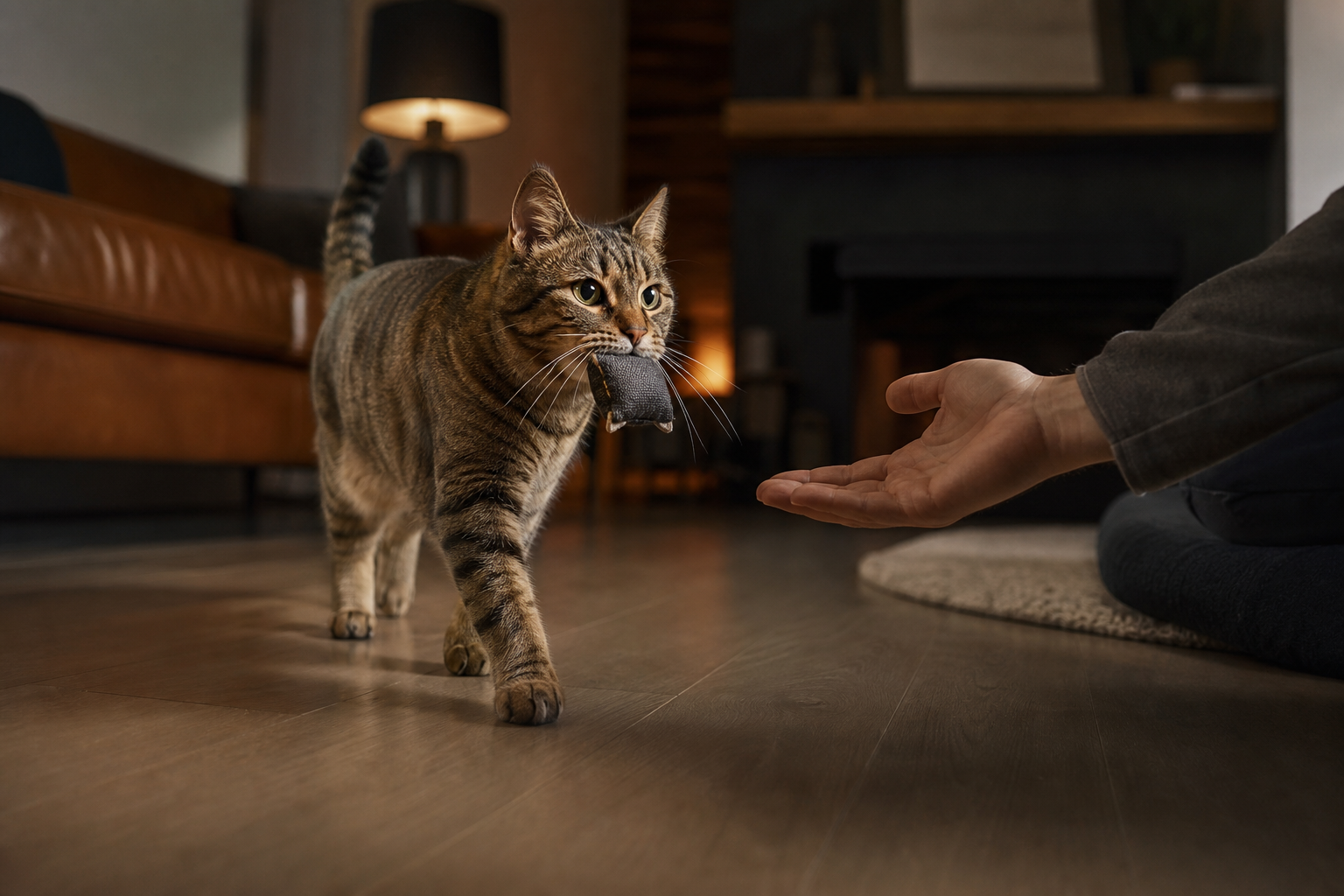
About 41% of cats play fetch at least sometimes, according to a 2024 study of 8,224 owner questionnaires. The exact result was 40.9%—roughly four cats in ten. Fetch is therefore common enough to be a normal part of cat play, even though dogs were reported to fetch much more often at 77.8%.
That headline needs one careful qualifier. Researchers grouped cats who fetched sometimes, usually, or always together as fetchers. The finding does not mean 41% of all cats reliably return a toy on command, and it is not a census of every pet cat. It is the strongest large-sample estimate currently available, and it shows that feline fetch is far from a rare trick.
Where Does the 40.9% Cat Fetch Figure Come From?
The figure comes from a peer-reviewed PLOS ONE study published in 2024. Researchers analyzed responses to the Feline Behavioral Assessment and Research Questionnaire, or Fe-BARQ, collected from September 2015 through September 2023. Owners answered how often their cat “plays fetch” or likes to retrieve thrown objects or toys.
The response scale ran from never to always. For the prevalence analysis, the researchers made two groups:
- Fetchers: cats reported to fetch sometimes, usually, or always.
- Non-fetchers: cats reported to fetch never or seldom.
That definition matters. A cat who occasionally returns a toy counted alongside a cat who starts a nightly game. The study measured owner-reported behavior, not performance in a controlled fetch test. Most respondents were in the United States, the United Kingdom, Australia, or Canada, and people chose to complete the questionnaire. Those features make 40.9% a useful estimate for the survey sample—not a guarantee that exactly 40.9% of cats everywhere fetch.
Is It Rare for a Cat to Play Fetch?
No. If roughly four in ten cats fetch at least sometimes, the behavior is unusual enough to be delightful but too common to call rare. A cat that chases a tossed toy, picks it up, and returns it toward a person is showing a recognizable form of social object play—not behaving like the wrong species.
You may also see a lower number quoted from older research. The 2024 paper notes a previous veterinary-clinic survey in which 16.5% of 819 cats were said to know fetch as a “trick.” That question and setting were different, so the two percentages are not direct contradictions. Asking whether a cat knows a trick is narrower than asking how often the cat retrieves thrown objects or toys.
Another widely shared number—94.4%—does not mean that 94.4% of all cats fetch. A separate 2023 Scientific Reports survey recruited people whose cats already fetched. Among those known fetchers, owners said 94.4% began without explicit training. That study is valuable for understanding how fetch unfolds, but its recruitment method cannot tell us how common the behavior is across all cats.
Why Do Some Cats Play Fetch?
Fetch combines several behaviors cats already perform: watching movement, chasing, grasping, carrying, and interacting with a person. The throw creates prey-like motion; the pickup and carry continue the sequence; bringing the object back makes the motion happen again. It can be both a hunting-style game and a social exchange.
The 2024 analysis found that fetching was most clearly associated with activity and playfulness. Fetch had much smaller correlations with trainability, prey interest, predatory behavior, and sociability toward people. In other words, the data fit the idea of fetch as an active play pattern better than a simple “smart cat” or “social cat” label.
The researchers also found associations—not rules—within their sample:
- Fetching was reported more often in younger cats and male cats.
- Indoor-only cats were more likely to fetch than cats with outdoor access.
- Cats living without dogs were more likely to fetch than cats living with dogs.
- Bengal, Burmese, Siamese, and Tonkinese cats were more likely than expected to fetch, while domestic longhairs were less likely than expected.
None of those traits determines what an individual cat will do. A senior female domestic longhair may love fetch; a young male Siamese may ignore every toss. Breed, age, sex, housing, and household composition were statistical associations in owner reports, not a checklist for predicting one cat.
Do Cats Naturally Play Fetch?
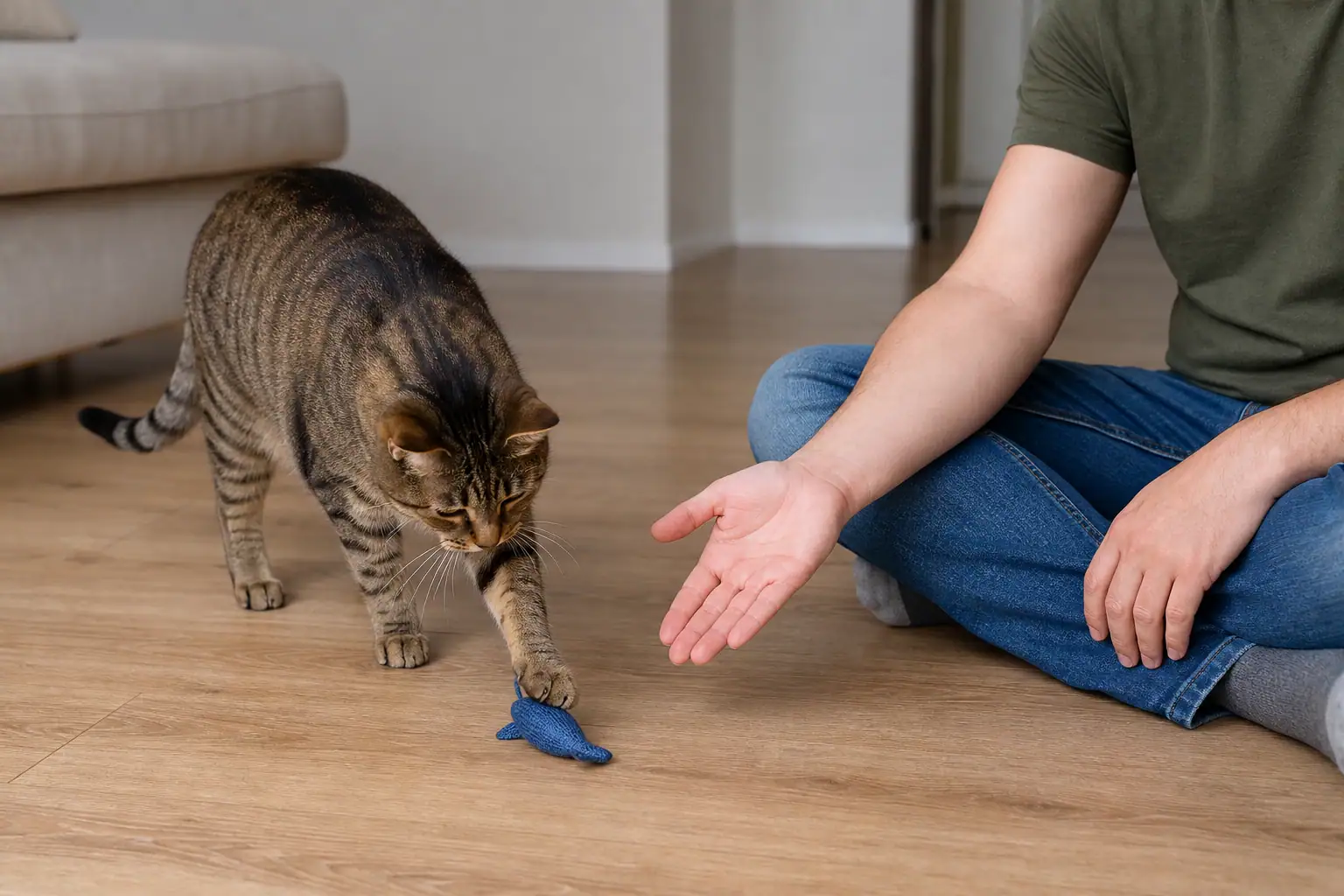
Many do. In the 2023 study of 1,154 known fetching cats, owners reported that most first showed the behavior as kittens or young adults, and 94.4% began without explicit training. Cats initiated and ended sessions more often than their owners did. Some fetched only one object, in one place, or with one particular person.
That cat-led pattern explains why fetch can seem to appear overnight. A cat discovers that dropping a favorite object near a person produces another chase, and the person learns to respond. The pair builds a turn-taking routine even if nobody formally trained it.
If your cat carries a toy to you but does not wait for a throw, do not assume it is an incomplete fetch. Carrying can be play solicitation, a learned attention routine, or simply something the cat enjoys. Our guide to why cats carry toys and meow explains how to read the timing and surrounding body language.
Is Playing Fetch a Sign of Intelligence in Cats?
Fetch shows learning, coordination, attention, and turn-taking, but it is not an intelligence test. The 2024 study did not measure feline IQ, and its association between fetching and trainability was small. A cat that does not fetch may be just as capable but less interested in that object, movement, room, reward, or style of interaction.
Preference matters enormously in cat play. One cat may solve food puzzles, another may stalk a wand, and another may retrieve the same fabric mouse twenty times. Treat fetch as one possible enrichment outlet—not a score your cat needs to pass.
How to Find Out Whether Your Cat Wants to Fetch
Look for pieces of the behavior before trying to teach it. A promising cat may already carry toys, bring objects into the room, chase a short floor-level toss, pick the object up, or turn back toward you while holding it.
- Choose one familiar, safe toy. Use a lightweight object your cat already carries. It should be large enough not to swallow, free of loose pieces, and easy to inspect.
- Make one short, low toss. Roll or skim the toy one or two feet across a clear floor. Do not throw it at the cat or toward stairs, furniture edges, another animal, or a person.
- Wait instead of chasing. Sit still. If your cat picks up the toy and takes even one step toward you, respond calmly with praise, a tiny reward, or another toss.
- End while interest is high. Two good returns can be a complete first session. If the cat walks away, let the game end.
If your cat likes the first experiment, use our complete cat fetch toy and training guide to choose an object, shape a partial return, troubleshoot the drop, and build distance gradually. There is no need to force the behavior if your cat prefers stalking, pouncing, wrestling, or foraging; our indoor cat enrichment guide covers those alternatives.
Fetch Safety for Cats That Bite and Shred Toys
Fetch repeatedly puts an object in the mouth and sends it across the room, so the toy and the route both need attention. A toy that is fine for gentle batting may fail after repeated biting, impact, and carrying.
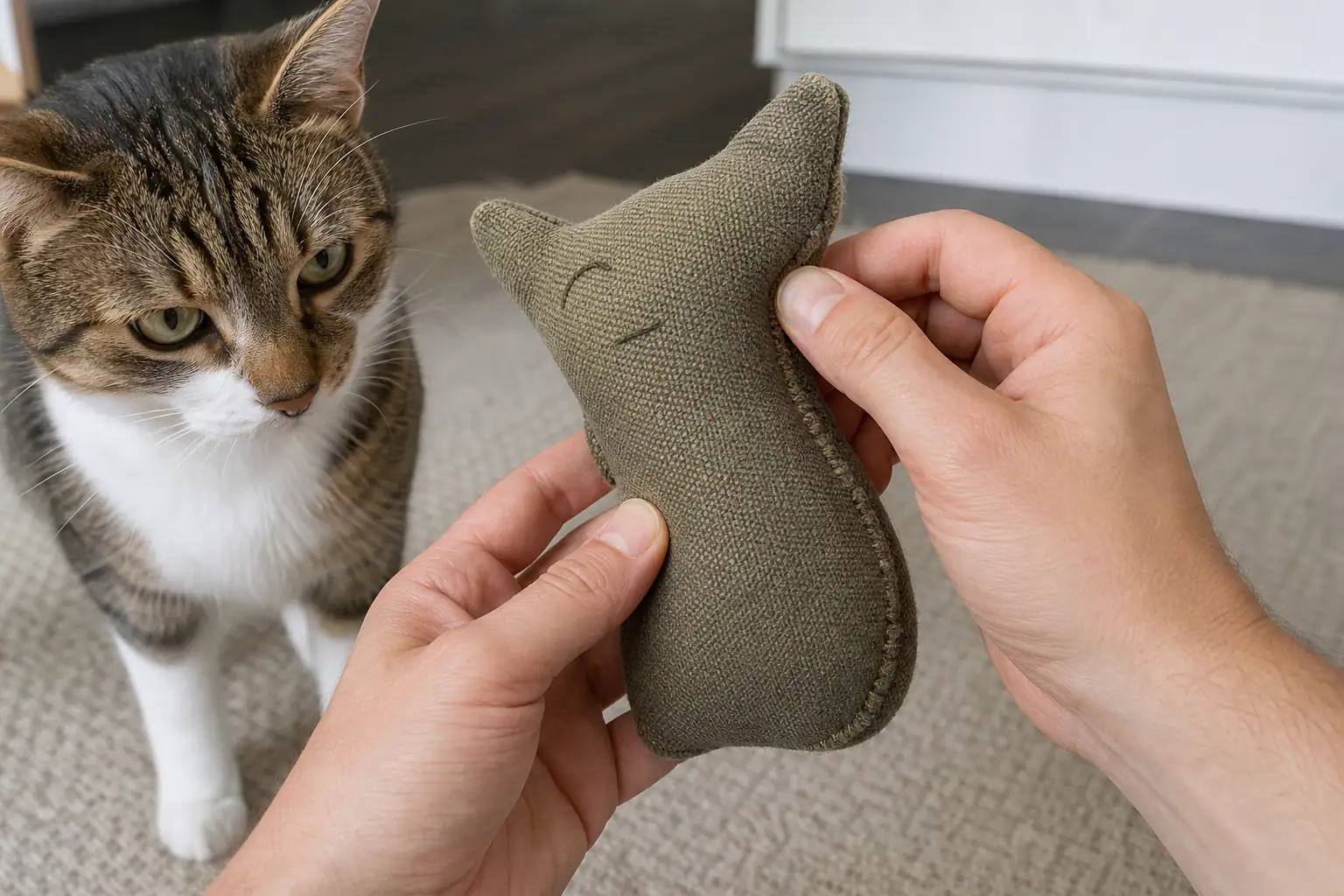
- Avoid swallowable and strand-like parts. Cornell Feline Health Center advises avoiding small pieces and linear parts such as string or feathers that can separate when chewed and be ingested.
- Inspect before and after play. Retire the toy if a seam opens, fabric thins, stuffing shows, thread loosens, plastic cracks, or any piece is missing. “Durable” never means damage-proof.
- Use a clear runway with traction. Keep tosses low and away from stairs, breakables, cords, doors, slippery floors, and other pets.
- Do not turn retrieval into tug. Trade for a reward or wait for the drop. Never pry a toy from the cat’s mouth or pull against the teeth.
- Watch the cat, not the throw count. Stop for loss of interest, tail lashing, flattened ears, uncoordinated movement, limping, coughing, or open-mouth breathing. Persistent breathing trouble, collapse, obvious pain, or a possible swallowed toy piece needs prompt veterinary advice.
Rough players need simpler construction and more frequent checks, not an “indestructible” promise. The inspection framework in our durable cat toys guide can help you compare seams, attachments, materials, and failure points before the next game.
Quick Answers About Cats and Fetch
What percentage of cats play fetch?
The best current large-sample estimate is 40.9%, or about four in ten cats. The 2024 study counted cats reported to fetch sometimes, usually, or always.
Do cats play fetch like dogs?
Both species can chase, retrieve, and return an object, but dogs were reported to fetch much more often: 77.8% versus 40.9% of cats in the same study. Cat sessions also tend to be highly dependent on the individual cat’s object, place, partner, and willingness to continue.
Can any cat learn to fetch?
Many cats can learn parts of the sequence, but there is no evidence that every cat will enjoy or complete it. Start with the behavior your cat already offers, reward small returns, and switch to another enrichment game if interest stays low.
What cat breeds are most likely to play fetch?
In the 2024 dataset, Bengal, Burmese, Siamese, and Tonkinese cats were more likely than expected to fetch. This is a population-level association, not a prediction for an individual purebred or mixed-breed cat.
The practical answer: cat fetch is common, usually voluntary, and best treated as a short, cat-led enrichment game. If your cat brings the toy back, enjoy the invitation. If not, nothing is wrong—the next favorite game may begin with a pounce rather than a return.