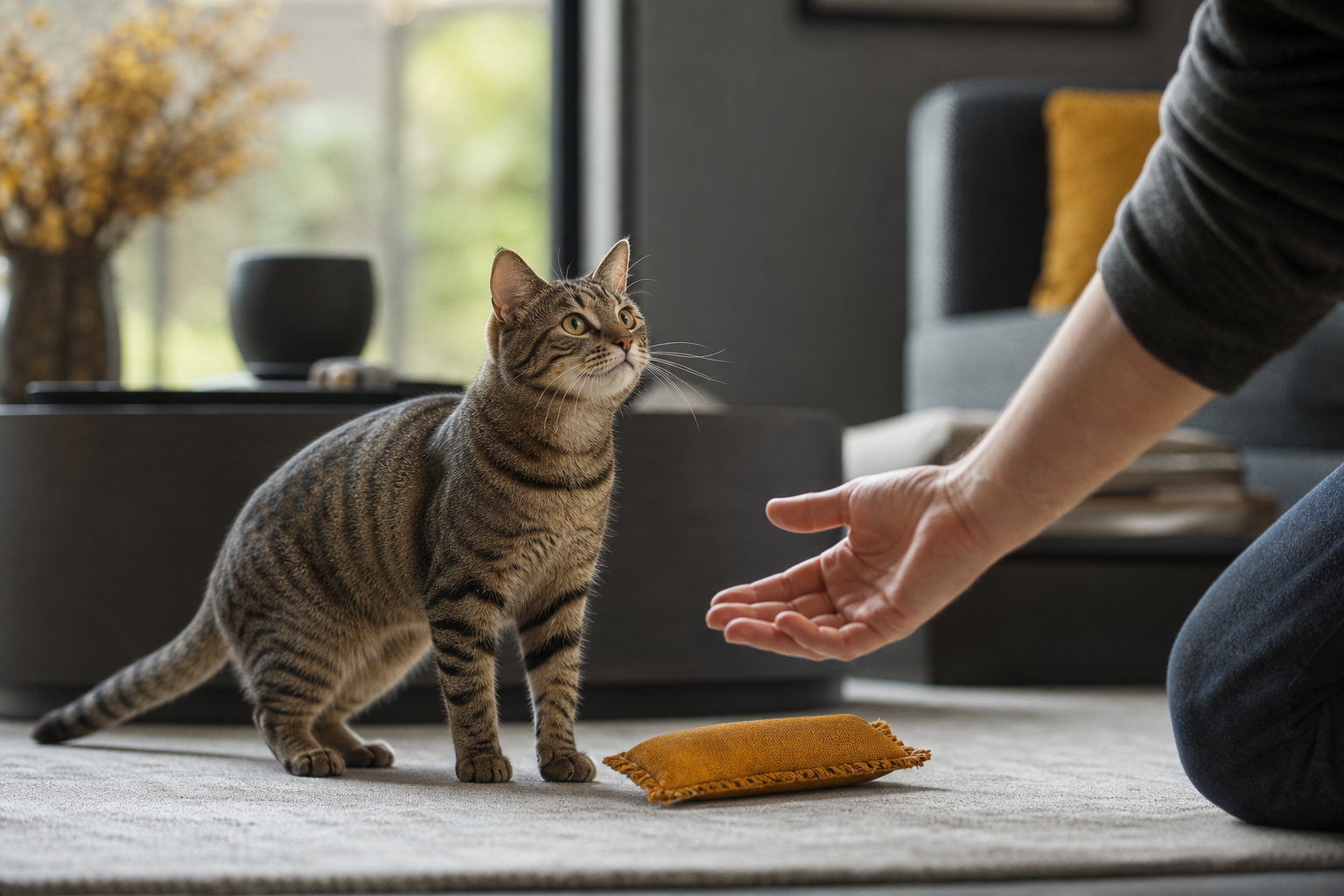
Common signs your cat wants to play include bringing or batting a toy, darting away and looking back, stalking your feet, crouching with a loose wiggling rear end, chirping near a play area, and racing through the house. The clearest evidence is not one pose or sound. It is a cluster of relaxed, energetic signals followed by willing pursuit when you offer an appropriate toy.
Context matters because the same meow, stare, tail movement, or dilated pupil can also appear with hunger, frustration, fear, or pain. Instead of guessing from a single cue, use the simple two-signal test in this guide: notice an invitation, offer a safe game, and watch whether your cat chooses to engage.
9 Signs Your Cat Wants to Play
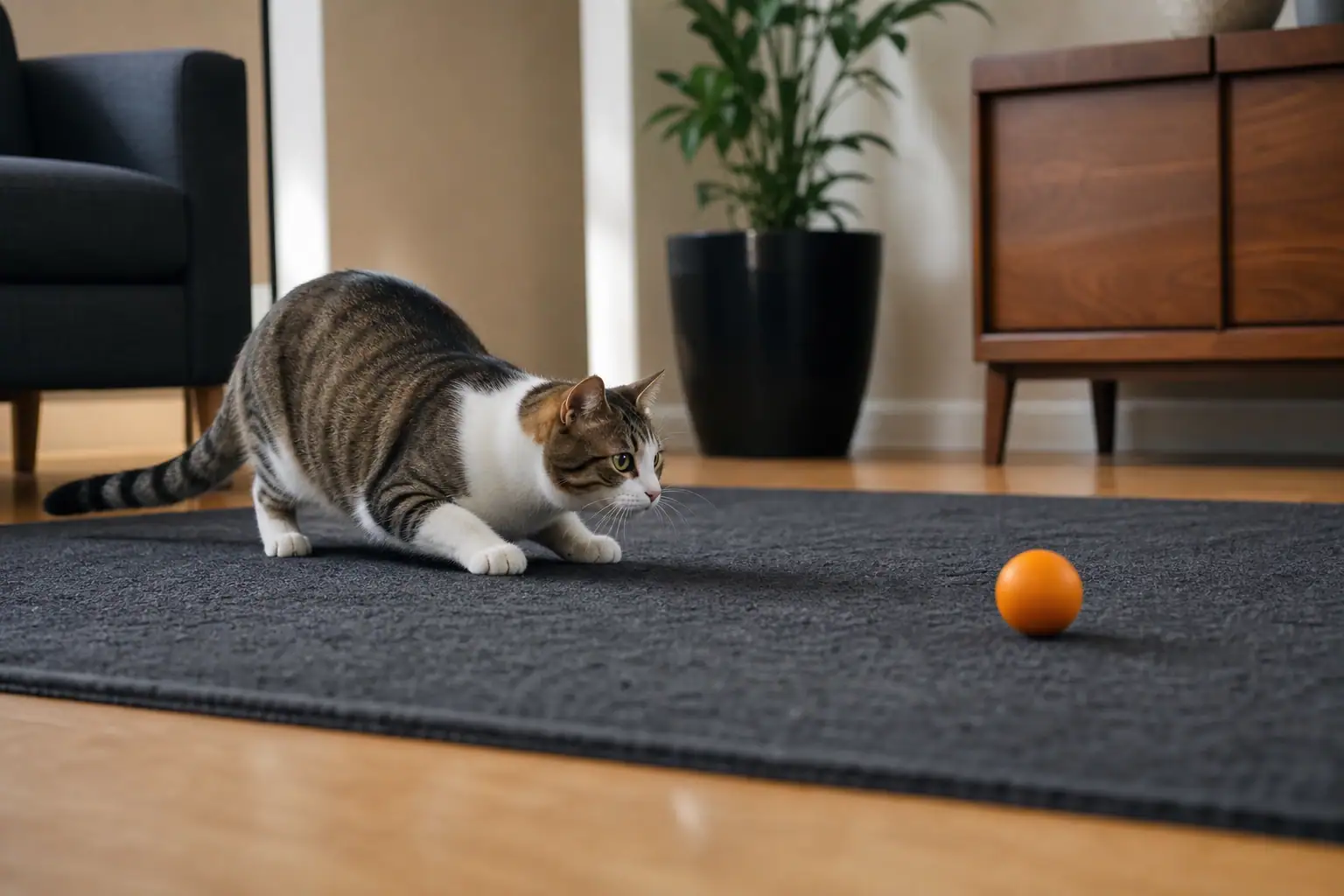
Learn your own cat’s patterns rather than waiting for a universal play pose. One cat may deliver a toy to your desk; another may sit silently beside the cabinet where the wand is stored. These nine behaviors become meaningful when they happen around a familiar play time or location and the rest of the cat’s body looks loose rather than defensive.
1. Your cat brings, bats, or waits beside a toy
This is the most direct invitation. Your cat may carry a toy into the room, push a ball toward you, tap a kicker, or sit beside the toy drawer. Some cats never retrieve, so simply returning to a known play station can be their version of asking.
2. Your cat darts away, then turns to check on you
A quick dash followed by a pause, glance, or return can invite you to continue the action. Do not chase your cat with your hands. Move a wand lure or toss an appropriate toy away from your body so the game has a clear target and your cat keeps teeth and claws off people.
3. Your cat crouches, stalks, or wiggles before a pounce
Focused watching, a low approach, a small rear-end wiggle, and a burst toward a moving object are parts of predatory-style play. The AAFP and ISFM feline environmental needs guidelines recommend giving cats opportunities to express play and predatory behavior, including stalking, chasing, pouncing, and catching.
4. Your cat pounces on ankles or ambushes you
An ankle ambush can mean that your moving feet have become the most interesting prey-like target available. It is an invitation you should redirect, not reward with hand wrestling. Freeze instead of jerking your foot, then move a long-distance toy away from your legs. Repeated or injurious attacks need a broader behavior plan; see our guide to cat play aggression toward an owner.
5. Your cat has a burst of zoomies
Running, skidding, climbing, and changing direction rapidly can signal that your cat has energy ready for an outlet. Zoomies are not automatically a request for human play, but they are a good moment to offer a chase game if the room is clear and the cat is receptive.
6. Your cat chirps, trills, or meows near you
Vocalizing can recruit your attention, especially when your cat pairs it with a toy, a trip toward the play area, or an alert posture. First rule out the obvious alternatives: an empty water bowl, a closed door, a dirty litter box, a missed meal, or another unmet need.
7. Your cat follows you and repeatedly re-engages
A cat that follows, steps into your path, leaves, and returns may be trying to start an interaction. Offer a toy once and see what happens. Following alone can also mean food, company, curiosity, or a preferred resting spot, so let the response—not your assumption—decide.
8. Your cat paws at moving objects or creates a game
Batting a pen, reaching under a rug, knocking a light object, or watching your cursor can reveal a desire to chase and investigate. Redirect that interest to a purpose-built toy before a swallowed cap, damaged cord, or broken desk object becomes part of the game.
9. Your cat appears at a predictable play time
Cats learn routines. If your cat becomes alert before your normal morning or evening session, waits at the same rug, or watches the cabinet where toys live, anticipation itself is a strong clue. Predictability also lets you start play before yowling or ankle attacks become the only signals that work.
Use the Two-Signal Test Instead of Guessing
No single tail position, pupil size, or sound proves that a cat wants to play. Read the whole body, the situation, and what happens next.
- Notice a possible invitation. Look for an approach, toy delivery, energetic movement, stalking, or a familiar play-time routine.
- Check the emotional tone. A playful cat is usually voluntarily approaching or re-engaging, with fluid movement and an available escape route. Hissing, growling, a rigid body, flattened ears, puffed fur, a tightly tucked tail, or attempts to hide point away from ordinary play.
- Offer—not impose—a toy. Move a wand lure along the floor away from the cat, roll a sturdy ball, or present a kicker at a comfortable distance. Never push a toy into the cat’s face.
- Let the response decide. Watching, stalking, chasing, catching, and returning for another pass confirm interest. Turning away, freezing, retreating, grooming abruptly, or remaining tense means pause and give space.
The test also respects a quieter play style. A cat can spend a minute watching a lure disappear behind furniture before pouncing. Watching is part of hunting-style play; nonstop jumping is not the only sign of engagement.
| What you see | It may mean play when… | Pause or investigate when… |
|---|---|---|
| Wide pupils | The body stays loose and the cat tracks a moving toy | The cat freezes, hides, flattens the ears, or reacts to a frightening event |
| Tail movement | The tip twitches during focused stalking | The tail lashes hard as the body tenses or the cat turns on you |
| Crouching | The cat advances toward a toy and pounces | The cat compresses into a hiding place or tries to escape |
| Meowing | The cat leads you to a toy or engages when one moves | Food, water, litter, access, distress, or illness may explain the call |
| Swatting | The cat bats an object with controlled movement | Claws stay out, the body is rigid, or hissing and growling follow |
The ASPCA’s overview of feline aggression and body language emphasizes that posture, facial expression, ears, tail, and whiskers must be read together. A defensive cat may crouch too, but often adds a tucked posture, flattened ears, wide eyes, hissing, or an attempt to get away.
Match the Game to the Invitation
The fastest way to lose a cat’s interest is to move every toy the same way. Respond to the behavior you just observed.
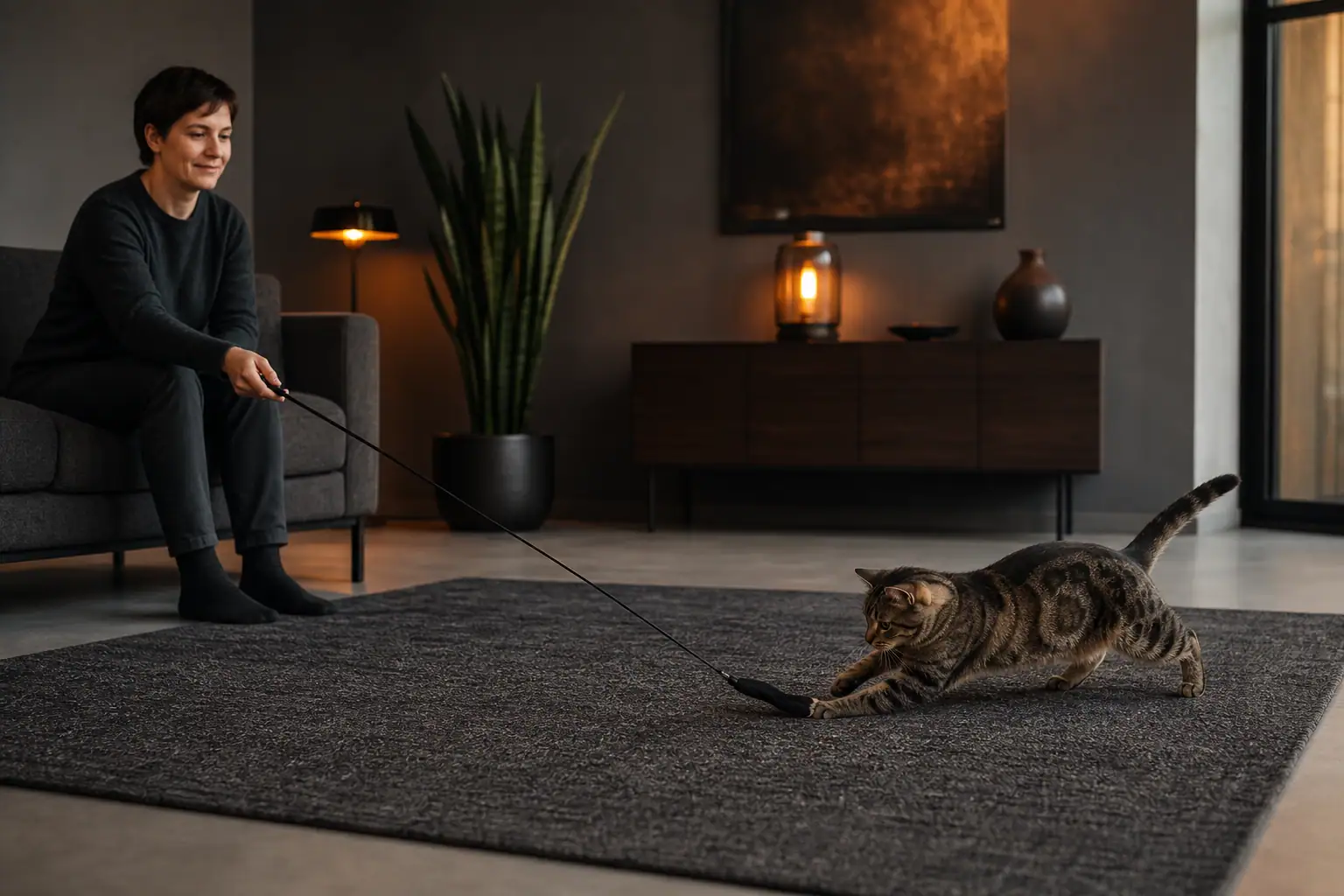
- For a stalker: slide a lure along the floor, pause behind a box, and let it reappear. Move it away like prey; do not repeatedly poke it toward the cat.
- For a chaser: roll a sturdy, appropriately sized ball through an open path or use a wand at ground level.
- For a jumper: use controlled, low arcs with safe footing. Avoid encouraging blind leaps near stairs, shelves, lamps, or hard furniture edges.
- For a wrestler: offer a large intact kicker that creates distance between claws and your hand. Owners of seam-focused cats should inspect the shell and attachments after hard sessions.
- For a thinker: hide a toy partly behind an obstacle or offer a simple food puzzle using part of the cat’s normal ration.
- For a senior or mobility-limited cat: keep the target low, slow, and easy to catch. Small paw reaches, head tracking, and short stalks still count as play.
Varying games is useful, but a massive toy collection is not required. Our sensory toy guide explains how movement, texture, sound, scent, and food can create distinct play options, while the daily cat play guide helps turn those options into a realistic routine.
How to Start and Finish a Better Play Session
Once your cat accepts the invitation, build a small hunting-shaped sequence rather than waving a toy continuously in the cat’s face.
- Clear the route. Move breakables, dangling cords, and unstable objects. Give the cat traction and an escape path.
- Start small. Make the toy rustle, creep, or pause at the edge of the cat’s attention.
- Alternate action and stillness. Prey does not fly at maximum speed without stopping. Pauses give the cat time to plan.
- Allow catches. A game that can never be caught can become frustrating. Let the cat grab the target, then restart only after the grip relaxes.
- End gradually. Reduce the speed, offer one final catch, and put stringed or easily swallowed components in closed storage. A small portion of the cat’s normal food can provide a natural-feeling finish when appropriate for the cat’s diet.
The environmental guidelines recommend interactive toys that mimic ground or flying prey, allowing capture, rotating toys to reduce boredom, and putting away strings or potentially ingestible parts after play. Cornell’s cat toy safety guidance also warns about small or strand-like pieces that can separate during chewing and about hazards in the surrounding play area.
Know When Your Cat Is Done—or Too Worked Up
Healthy play has pauses and choice. End or slow the session when your cat walks away, stops re-engaging, lies down without tracking the toy, or begins a normal post-play activity. Do not keep touching or cornering a cat to demand another round.
Stop immediately if you see a rigid body, persistent hard tail lashing, ears flattening, growling, hissing, repeated attacks on the handler, frantic chewing, open-mouth breathing, limping, or loss of coordination. Give the cat space and let arousal fall. Do not punish, grab, or try to soothe an agitated cat with your hands.
Inspect the toy before putting it away. Retire it when seams open, filling appears, hard material cracks, an attachment loosens, a battery compartment is damaged, or any piece is missing. “Durable” should mean easier to inspect and better matched to your cat’s play pattern—not indestructible. Our durable cat toy guide covers failure points for cats that bite, kick, and dismantle ordinary toys.
What If Your Cat Wants to Play All the Time?
Frequent invitations are normal for many kittens and active cats, but you do not have to answer every request with an exhausting marathon. Schedule several short sessions around times your cat naturally becomes active, then offer independent enrichment between them. Rotate a few options instead of leaving every toy out indefinitely.
If ankle attacks, yowling, or object-knocking reliably earns instant play, your cat may learn to repeat that sequence. Avoid punishment. Start a predictable session before the usual problem time and reinforce safer invitations, such as waiting at a play station or touching a designated toy. For a household stuck in a boredom cycle, the Titan Claws 7-day play reset provides a structured starting point.
In multi-cat homes, play with cats individually when competition makes one cat hang back or another monopolize the toy. Keep enough distance and resources that each cat can choose whether to participate.
When a Behavior Change Needs a Veterinarian
A sudden increase or decrease in play is information, not a personality verdict. Contact your veterinarian if a cat abruptly stops playing, seems painful, hides more, limps, tires unusually quickly, loses weight, eats or drinks differently, vocalizes in a new way, or becomes suddenly aggressive. Older cats and cats with known medical conditions may need adapted play, but a new change should not automatically be blamed on age.
Likewise, intense stalking or biting directed at people is not something every owner should solve alone. A veterinarian can check for pain and other medical contributors and, when needed, refer you to a qualified feline behavior professional. Seek prompt veterinary advice if a toy part may have been swallowed or if play causes an injury.
Quick Play-Invitation Checklist
- Is your cat approaching, returning, or leading you toward a play context?
- Does the body look fluid and curious rather than rigid, flattened, or defensive?
- Have you ruled out food, water, litter, access, and obvious distress?
- Does your cat choose to watch, stalk, chase, or catch when a toy moves away?
- Can the cat disengage and leave at any time?
- Is the room clear and the toy intact, appropriately sized, and supervised as needed?
- Will you allow a final catch and store risky components after the session?
Bottom line: The most reliable sign your cat wants to play is a pattern: your cat invites interaction, shows relaxed predatory interest, and willingly engages with an offered toy. Observe first, test gently, and let your cat’s next choice answer the question.