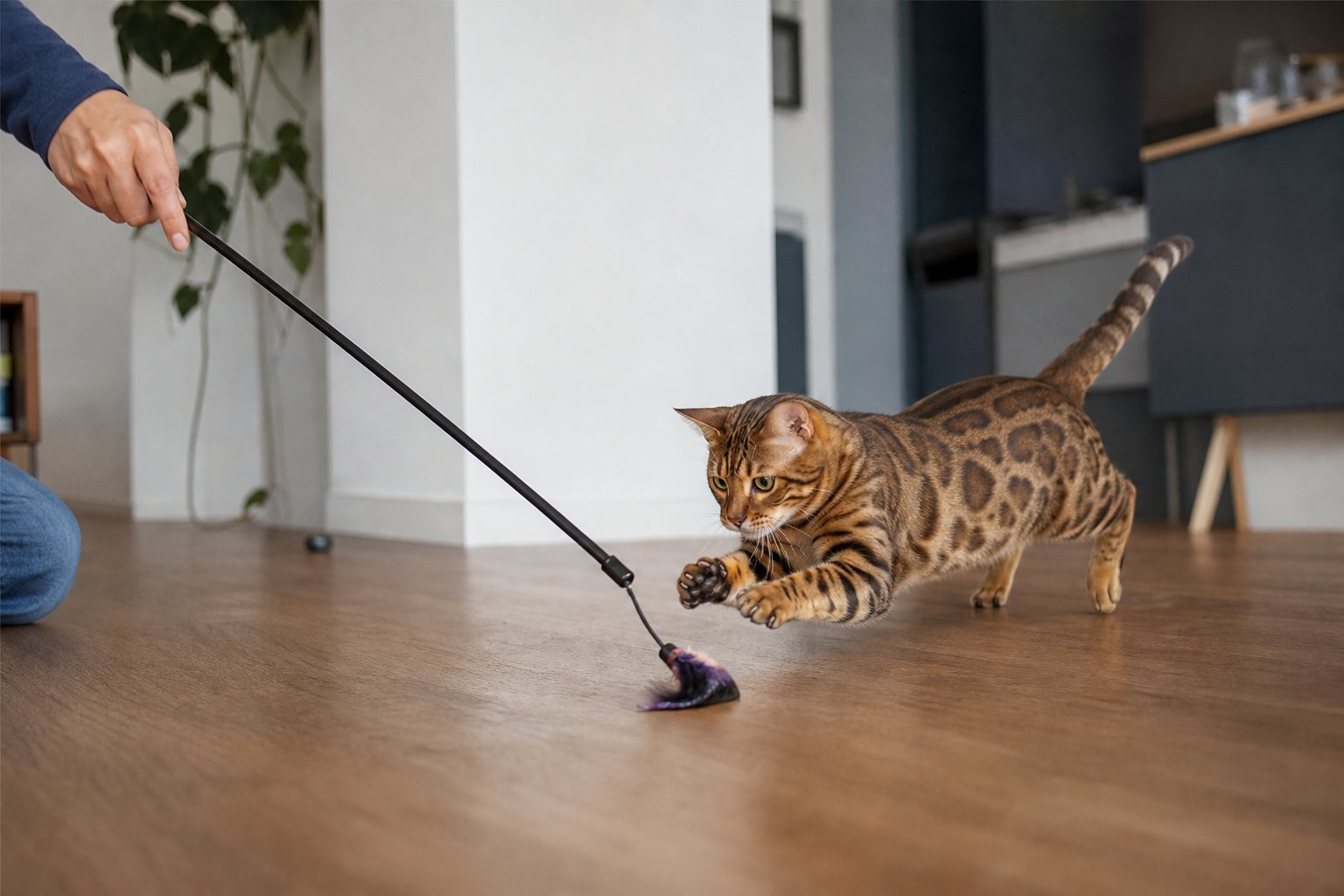
A cat stick toy is usually a wand, teaser, or fishing-pole-style toy that lets you move a lure like prey while keeping your hands out of the bite zone. The best ones are interactive toys, not leave-out toys. Use the stick to create stalking, chasing, pouncing, and catching, then put the cord, ribbon, feather, or lure away when the session ends.
For cats that destroy ordinary toys, the buying decision is not just “which wand is fun?” It is “where will this fail when my cat bites, twists, and bunny-kicks the lure?” A safer cat stick toy has enough reach, a controllable line, replaceable attachments, fewer swallowable parts, and a routine for inspection and storage.
What Is a Cat Stick Toy Called?
Owners use several names for the same basic category: cat stick toy, cat wand toy, teaser wand, feather wand, fishing pole toy, ribbon teaser, and interactive cat teaser. The exact design varies, but most have a handle or rod with a cord, wire, ribbon, or flexible strip attached to a lure.
That design matters because it gives you control over distance and movement. A good wand lets you drag the lure along the floor, hide it behind furniture, pause it like prey, and let your cat catch it without putting your fingers near claws. That is why stick toys are often better than hand wrestling for cats that get overexcited. If play already turns into biting people, pair this guide with Titan Claws’ cat toys for play aggression article.
What Current Product Pages Get Right and Miss
The search results for cat stick toy are dominated by marketplace pages, wand product pages, and best-of lists. They are useful for seeing common formats: telescoping rods, feather bundles, fleece ribbons, cardboard wire toys, plush mouse lures, worm lures, and replacement attachment packs.
The weak spot is that many pages rank products before they explain fit. A wand that is excellent for a gentle kitten can be wrong for a powerful adult cat that chews off feathers. A very long telescoping pole can create big movement in a wide room but feel flimsy or hard to control in a small apartment. A lure with bells may excite one cat and scare another. For a rough-player household, judge the whole system before you judge the product photo.

How to Choose the Right Wand, Cord, and Lure
Start with the part your cat will actually attack: the lure. Then work backward to the connector, cord, wand, and storage plan.
- Wand length: Choose enough reach to keep hands away from teeth and claws. Short sticks can work for couch play, but active cats usually need more distance.
- Wand control: A flexible rod can make lifelike motion, but a pole that is too whippy may be hard to steer or may snap under a strong grab.
- Cord type: Woven cord or a broad fabric ribbon is easier to see and inspect than thin elastic, thread, fishing line, or wire. Avoid cords your cat can chew through quickly.
- Connector: A sturdy clip makes lure replacement easier. Check for sharp edges, bent wire, or a clip small enough to swallow if it detaches.
- Lure material: Fabric worms, fleece strips, and simple plush lures are often easier to inspect than feather clusters. Feathers can be exciting, but they shed and should be supervised closely.
- Replacement parts: If the lure is meant to be destroyed eventually, buy a wand with replaceable attachments instead of replacing the whole toy every week.
If your cat tends to chew instead of only chase, read Titan Claws’ durable cat chew toys guide before choosing feather, ribbon, or plush attachments. The right answer may be a wand for movement plus a separate chew-safe or kicker toy for the catch.
Are Cat Stick Toys Safe?
Cat stick toys can be safe and useful when they are used as supervised interactive toys. They become riskier when the string, ribbon, feathers, elastic, or lure is left out for unsupervised chewing.
Cornell Feline Health Center says toys can support exercise, cognitive enrichment, stalking, pouncing, and problem solving, but it also advises avoiding small pieces and strand-like parts such as feathers and string that can detach and be ingested. The University of Wisconsin School of Veterinary Medicine gives similar advice for aggressive chewers: feathers, strings, sparkly pieces, loose decorations, loops, tags, and chewed-off parts should be avoided or removed.
The AAFP and ISFM environmental needs guidelines describe play and predatory behavior as a core feline need. A wand toy serves that need well because it creates a hunt you control. The safety rule is simple: the wand creates the chase; it does not become an all-day chew object.

The Safer Way to Play With a Cat Stick Toy
Many cats lose interest when the lure flops in front of their face. Move it like prey instead. Prey usually moves away, hides, pauses, darts, and makes mistakes. It does not repeatedly slap the cat in the nose.
- Start low and slow. Drag the lure along the floor or around a chair leg so your cat can stalk.
- Move away from the cat. Let the lure escape across the room instead of charging directly at your cat.
- Use cover. Hide the lure under a blanket edge, around a box, or behind a table leg.
- Build short bursts. Mix pauses with quick darts so the cat can plan a pounce.
- Let the cat catch it. A hunt with no capture can frustrate some cats. Let your cat pin the lure briefly.
- Hand off to a tougher toy. If your cat bites hard, offer a durable kicker for the grip-and-rake finish.
- End before exhaustion. Stop while the session is still controlled, then store the wand out of reach.
For a fuller weekly routine, use wand play as one part of a broader cat toys for enrichment rotation. Wands are excellent for chase. They do not replace scratching surfaces, puzzle feeding, solo-safe batting toys, climbing space, or rest.
Best Stick Toy Features for Rough Cats
Rough cats need fewer weak points, not more decorations. A toy that looks exciting in the package may fail fast if it relies on glued feathers, tiny bells, thin elastic, exposed knots, brittle plastic, or a lure that can be swallowed whole.
- Use a larger lure: tiny attachments are easier to swallow and harder to inspect.
- Prefer simple shapes: skip glued eyes, beads, plastic noses, and dangling mini-parts.
- Look for reinforced connection points: the cord-to-lure joint and wand tip usually take the most force.
- Choose washable or replaceable lures: saliva-soaked fabric weakens faster and should not live permanently on the floor.
- Watch telescoping joints: they are convenient, but strong cats can bend or collapse cheap sections.
- Avoid elastic for chewers: elastic can snap, fray, or invite chewing if the cat likes rubbery textures.
No stick toy is indestructible. Titan Claws’ durable cat toys guide explains the broader standard: match the toy to the failure mode, inspect early, and retire it before damage becomes a swallowing hazard.

When to Replace the Lure or Retire the Toy
Replacement lures are normal. A wand toy is meant to take high-speed strikes, twisting, chewing, and clawing. The mistake is waiting until a damaged lure becomes confetti.
Replace the attachment or retire the whole toy if you see any of these signs:
- feathers, fabric strips, strings, or stuffing are coming loose;
- the cord is frayed, stretched thin, knotted badly, or partly chewed through;
- the clip bends open, rusts, or develops a sharp edge;
- the wand tip cracks or exposes wire, splinters, or sharp plastic;
- your cat tries to swallow pieces instead of only biting and releasing;
- the lure becomes small enough to fit fully in your cat’s mouth;
- the toy smells burnt, chemical, musty, or dirty after cleaning.
If your cat swallows string, ribbon, feather shafts, elastic, stuffing, plastic, or any other toy part, contact your veterinarian. Do not pull a visible string from the mouth or rear end unless your veterinarian tells you to; linear material can be dangerous if it is caught inside.
Quick Buying Checklist
- The wand is long enough to keep your hands out of the play zone.
- The lure matches your cat’s style: feather chaser, fabric grabber, ribbon swatter, or wrestler.
- The attachment is replaceable or clearly durable enough for your cat’s bite.
- The cord is visible, inspectable, and not tempting for unsupervised chewing.
- The toy has no tiny bells, beads, eyes, loose tags, sharp clips, or weak glued parts.
- You have a place to store it behind a door, drawer, or sealed bin after play.
- You can inspect the wand tip, cord, connector, and lure in under a minute.
- You have a tougher catch toy ready for cats that need to bite and kick hard.
The Bottom Line
A cat stick toy is one of the most useful interactive toys you can own because it lets you move prey, create distance, and give your cat a satisfying hunt. For destructive cats, choose sturdier parts, simpler lures, and replaceable attachments. Use the wand for active supervised play, hand off to a tougher toy when the cat needs to bite, and store the string or ribbon when the session ends.
The best cat stick toy is not the fanciest one. It is the one that fits your room, your cat’s play style, your inspection habits, and your willingness to retire damaged parts early.