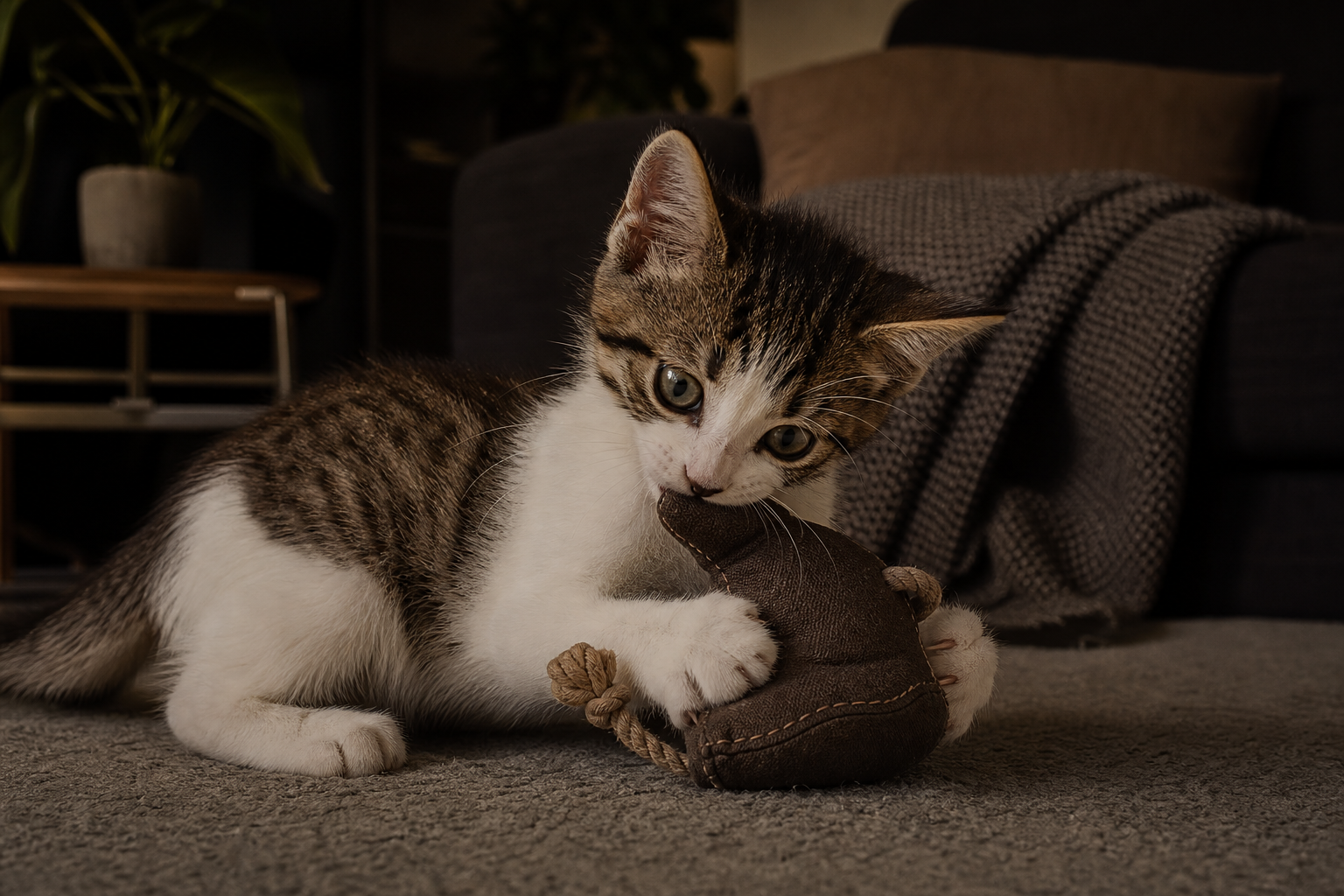
Cat teething toys should give a kitten something safe to bite without being so hard, tiny, stringy, or fragile that the toy creates a new risk. The best choices are soft fabric toys, flexible rubber or foam toys made for kittens, washable cloth chews, and supervised interactive toys that redirect biting away from hands, cords, shoes, and furniture.
The important word is safe, not indestructible. Teething kittens have sharp baby teeth, tender gums, and a strong urge to explore with their mouths. A toy that works for one kitten can be wrong for another if it is too hard, too small, covered in loose decorations, or left out after it starts to break down.
This guide explains when kittens teethe, what to look for in cat teething toys, what to avoid, how to set up a simple toy rotation, and when chewing or mouth pain deserves a call to your veterinarian.
When Kittens Teethe
Most owners notice the second teething phase, when a kitten’s baby teeth fall out and adult teeth come in. Cats Protection describes the common timeline this way: newborn kittens have no teeth, baby teeth come in during the first several weeks, baby teeth usually start falling out around 3 to 6 months, and adult teeth are typically in by about 7 months. Chewy’s veterinary-reviewed kitten teething guide gives a similar range, with adult incisors starting around 3.5 to 4 months and most adult teeth present by 5 to 7 months.
During this window, kittens may chew more, have mild gum irritation, leave tiny baby teeth around the house, or seem fussy with hard food. Many kittens swallow baby teeth without any problem, so not finding teeth on the floor is not automatically a concern.
Teething is temporary, but the habits you build can last. If a kitten learns that fingers, cords, hoodie strings, or shoe laces are chew toys, that behavior can follow them into adulthood. Good teething toys are partly about comfort and partly about training the mouth toward safer targets.
What Current Search Results Miss
The search results for cat teething toys are crowded with store pages, Reddit threads, and short product lists. Those can be useful when you already know what to buy, but they often skip the decision that matters most: matching the toy to the kitten’s mouth, chewing style, and supervision level.
A better teething-toy choice starts with four questions:
- Can my kitten chew it without cracking a tooth or hurting tender gums?
- Can any part break off and be swallowed?
- Is it large enough that it cannot disappear into the mouth?
- Is this a supervised toy or something safe enough for short independent play?
That framework is more useful than a list of cute products because kittens chew differently. One kitten mouths toys gently. Another attacks seams, shreds fabric, and tries to eat feathers. Titan Claws focuses on cats that play hard, so the standard here is simple: choose toys that can be inspected, rotated, supervised when needed, and retired before damage becomes dangerous.
Best Cat Teething Toy Types
No single toy solves kitten teething. Build a small set of options so your kitten can chew, chase, pounce, and rest without relying on one object all day.

Soft fabric chew toys
Soft fabric toys are often a good first choice because they have give under pressure. Look for firm stitching, no glued-on eyes, no plastic noses, no loose bells, and no long tails or ribbons. A small kicker, soft mouse, or simple fabric chew can work if it is too large to swallow and easy to inspect.
Flexible rubber, latex, or foam kitten chews
Some teething toys are made from softer rubber, latex, or foam. VCA Animal Hospitals advises avoiding extremely hard materials and choosing chew toys with some bend or that can be indented with a fingernail. That is a practical test: if a toy feels like a hard dog bone or rigid nylon, it may be too much for fragile kitten teeth.
Washable cloth chews
A clean cloth chew can help some kittens, especially if it is larger than the mouth and used under supervision. If you chill or freeze a damp cloth, keep it simple: no strings, no loose loops, no small scraps, and no broth or tuna juice unless your veterinarian says it fits your kitten’s diet. Wash it after use and throw it away if threads loosen.
Wand toys for redirecting bite energy
A teething kitten does not only need something to chew. They also need a legal target for stalking, pouncing, grabbing, and letting go. Wand toys can redirect bitey energy away from hands, but they must be put away after play. String, elastic, feathers, and connectors are not safe to leave on the floor with a determined chewer.
Food puzzles and foraging toys
Food puzzles are not teething toys, but they can reduce mischief by giving a kitten an appropriate job. Start easy. Choose puzzle pieces that are too large to swallow and avoid designs with removable caps if your kitten pries, chews, or carries parts away.
For related buying decisions, see Titan Claws’ guides to kitten toys, chewy cat toys, and cat chew toys for aggressive chewers.
What to Avoid During Kitten Teething
Teething does not make every chew object safe. In some cases, it makes household hazards more tempting.
- Hard nylon, wood, antler, bone, or rigid plastic: these can be too hard for baby teeth and tender gums.
- Loose string, yarn, ribbon, elastic, dental floss, and hair ties: these can be swallowed and may cause serious intestinal problems.
- Feathers, sparkles, glued-on eyes, bells, beads, and tiny plastic parts: these are common failure points for kittens that chew.
- Electrical cords: block access, use cord covers, and redirect immediately to an appropriate toy.
- Small balls or toy pieces that fit fully in the mouth: these are not good unsupervised choices.
- Dog chew toys made for heavy jaw pressure: some are too hard, too heavy, or treated with flavors meant for dogs.
The University of Wisconsin School of Veterinary Medicine warns that cats who chew aggressively may ingest feathers, strings, or sparkly parts from traditional cat toys, and recommends sturdy construction with no loose decorations. That advice applies strongly during teething because kittens may chew first and inspect never.
If your kitten bites off a piece, remove the toy. If a piece is missing and you think your kitten swallowed it, call your veterinarian for advice instead of waiting for symptoms to become obvious.
How to Use Teething Toys Safely
A good teething toy is only half the setup. The way you introduce, rotate, and inspect toys matters just as much.

Start with supervised sessions
Watch how your kitten uses a new toy for the first several sessions. Do they chew gently, shred seams, suck on fabric, tear at tags, or try to swallow pieces? That behavior tells you whether the toy belongs in the supervised-only group or can be part of short independent play.
Redirect, then reward
When your kitten chews your hand, cord, or clothing, interrupt calmly and offer the approved chew toy. The moment they bite the toy instead, praise them or offer a small treat. Repetition matters. The goal is to make the safe choice obvious, not to punish normal teething behavior.
Do not yank objects from the mouth
Cats Protection specifically warns against pulling toys or objects from a teething kitten’s mouth because baby teeth are fragile. Trade instead: offer a better toy or treat, let the jaw relax, then remove the unsafe item.
Inspect before and after play
Check seams, edges, rubber cuts, fabric thinning, loose stuffing, and missing parts. Teething toys live a hard life. A toy does not need to be dramatic to be done; one loose thread can become the start of a swallowed strand.
Separate supervised toys from leave-out toys
Wands, feathers, ribbon toys, elastic toys, and anything with moving attachments should be stored after play. Leave-out toys should be simpler: larger soft chews, sturdy balls that cannot be swallowed, closed ball-track toys, or other formats your kitten has proven they do not dismantle.
A Simple Teething Toy Rotation
Teething kittens get bored quickly. Rotation keeps toys interesting and helps you notice damage before a toy becomes unsafe.

Try this basic daily pattern:
- Morning: five to ten minutes of wand play, then a soft chew toy while you are nearby.
- Midday: one simple solo toy, such as a sturdy ball track or larger soft toy that has passed inspection.
- Evening: chase and pounce play before dinner, followed by a food puzzle or easy foraging activity.
- Night: remove string, wand, feather, elastic, and damaged toys before bed.
The AAFP and ISFM feline environmental needs guidelines describe play and predatory behavior as part of a healthy cat environment. That is why a teething plan should not be only about chewing. Kittens need to stalk, chase, catch, bite, kick, eat, groom, and sleep. If chewing is the only outlet available, everything in the room starts to look like a chew toy.
For more enrichment ideas that do not depend on buying more products, see Titan Claws’ free cat enrichment ideas and DIY cat enrichment toys.
When Teething Is Not Just Teething
Some chewing is normal. Pain, appetite changes, and persistent mouth problems need more attention.
Call your veterinarian if you notice any of these signs:
- Heavy drooling or drool with blood
- Refusing food, dropping food, or crying while eating
- Swollen, bleeding, or very red gums
- Bad breath that seems strong or persistent
- Pawing at the mouth repeatedly
- A baby tooth and adult tooth occupying the same spot for more than a few days
- Broken teeth, facial swelling, or a visible mouth injury
- Vomiting, lethargy, appetite loss, or straining after a possible swallowed toy piece
Chewy’s veterinary-reviewed guide notes that retained baby teeth can create problems when a baby tooth and adult tooth share the same space. Cats Protection also recommends veterinary advice when signs suggest more than ordinary teething discomfort. When in doubt, let a veterinarian look in the mouth; toy shopping cannot fix dental pain, injury, or a swallowed object.
Quick Buying Checklist
Use this checklist before buying or keeping a cat teething toy:
- Does it bend or indent slightly instead of feeling rock hard?
- Is it too large to swallow whole?
- Does it avoid glued eyes, bells, beads, feathers, yarn, ribbon, and loose tails?
- Are seams strong and easy to inspect?
- Can it be washed or replaced cheaply when it gets gross?
- Does the packaging identify the material and intended use?
- Is it sized for kittens, not just labeled cute?
- Can your kitten use it without your hand becoming the target?
- Will you supervise the first sessions?
- Will you throw it away when damaged?
If your kitten is already a serious shredder, combine this checklist with Titan Claws’ guide to durable cat toys. Durability should mean fewer weak points and easier inspection, not a promise that a toy can never fail.
Bottom Line
The best cat teething toys are soft, flexible, inspectable, and matched to your kitten’s real chewing style. Choose toys with give, avoid hard or stringy hazards, supervise new toys, rotate different play outlets, and retire damaged items early.
Teething usually passes within a few months. Safe chewing habits can last for life. Give your kitten better targets now, and you reduce the odds that adult teeth, adult claws, and adult strength get aimed at hands, cords, furniture, or toys that were never built for rough play.