Tag: cat toy cleaning

  • Is Vinegar Safe for Cats? Cleaning, Licks, Fleas, and First Aid

    Is Vinegar Safe for Cats? Cleaning, Licks, Fleas, and First Aid

    Household vinegar is not usually a poisoning emergency for cats in tiny accidental amounts, but it is not something to feed, spray on, or use as medicine. A diluted vinegar-and-water cleaner is generally low risk when you keep your cat away from the wet solution, rinse the treated item when appropriate, and let it dry completely. Undiluted vinegar can irritate the mouth, stomach, skin, and eyes, and stronger cleaning or horticultural acid products can cause much more serious injury.

    That makes the honest answer to “is vinegar safe for cats?” conditional. Safe use depends on the product, concentration, amount, route of exposure, and whether your cat can walk through or lick the residue. White vinegar and apple cider vinegar are not proven flea treatments, ear cleaners, skin remedies, or daily supplements for cats.

    Vinegar and Cats: The Quick Safety Guide

    Use this table to sort an ordinary household-cleaning question from an exposure that needs professional help. It cannot determine the risk for an individual cat, especially when the product or amount is unknown.

    Situation Likely concern What to do
    Cat briefly smells vinegar from across a ventilated room The sharp odor may be unpleasant or stressful, but a brief smell is not the same as drinking it Give the cat an exit, ventilate, and never spray toward the cat
    Cat returns after a diluted cleaning solution was rinsed and fully dried Low exposure when the product was used correctly Check that no puddles, damp cloths, or open containers remain
    One lick from a damp surface Possible drooling, mouth irritation, vomiting, or diarrhea Remove access, note the product and amount, and call your veterinarian if signs develop or the exposure is more than a trace
    Vinegar spilled on paws or coat Skin irritation plus ingestion during grooming Prevent grooming, rinse with lukewarm water, and contact a veterinarian or animal poison service for case-specific advice
    Product splashed into an eye Painful irritation or chemical injury Start a gentle water rinse if you can do so safely and contact a veterinarian immediately
    Cat drinks undiluted vinegar or contacts a concentrated acid product Greater risk of digestive or corrosive injury Call a veterinarian or animal poison service now; do not induce vomiting or try to neutralize it

    Do not assume every bottle called vinegar is ordinary food vinegar. Cleaning concentrates, horticultural products, and other acetic-acid solutions may be substantially stronger. Keep the original label, follow its directions, and treat an unknown concentration as a reason to call rather than guess.

    How to Clean With Vinegar Around Cats

    The ASPCA Animal Poison Control Center says vinegar can cause stomach upset and irritation, but a diluted solution is generally not an issue when it is rinsed and allowed to dry. Those last three conditions—dilution, rinsing, and drying—are the useful part of the advice.

    1. Read the exact bottle and surface instructions. Confirm the product concentration and whether vinegar is compatible with the floor, seal, grout, stone, appliance, or fabric. Do not pour a stronger product into an unmarked spray bottle.
    2. Move your cat and cat gear first. Put your cat in another comfortable room. Remove bowls, bedding, loose toys, and anything the cat mouths from the cleaning area.
    3. Use one product. Never improvise by adding bleach, disinfectant, ammonia, peroxide, essential oil, or another cleaner. The CDC warns never to mix household bleach or disinfectants with other cleaners; mixing bleach with an acid such as vinegar can release dangerous chlorine gas.
    4. Control wet contact. Wipe rather than creating a cloud of spray, close the bottle, and keep the cat away from buckets, soaked cloths, and damp floors.
    5. Rinse where appropriate. Food-contact surfaces, bowls, toys, and items a cat may lick deserve special care. Follow the item’s directions and remove both residue and strong odor.
    6. Ventilate and dry completely. Open a window or run ventilation, then inspect low corners and the floor before the cat returns.
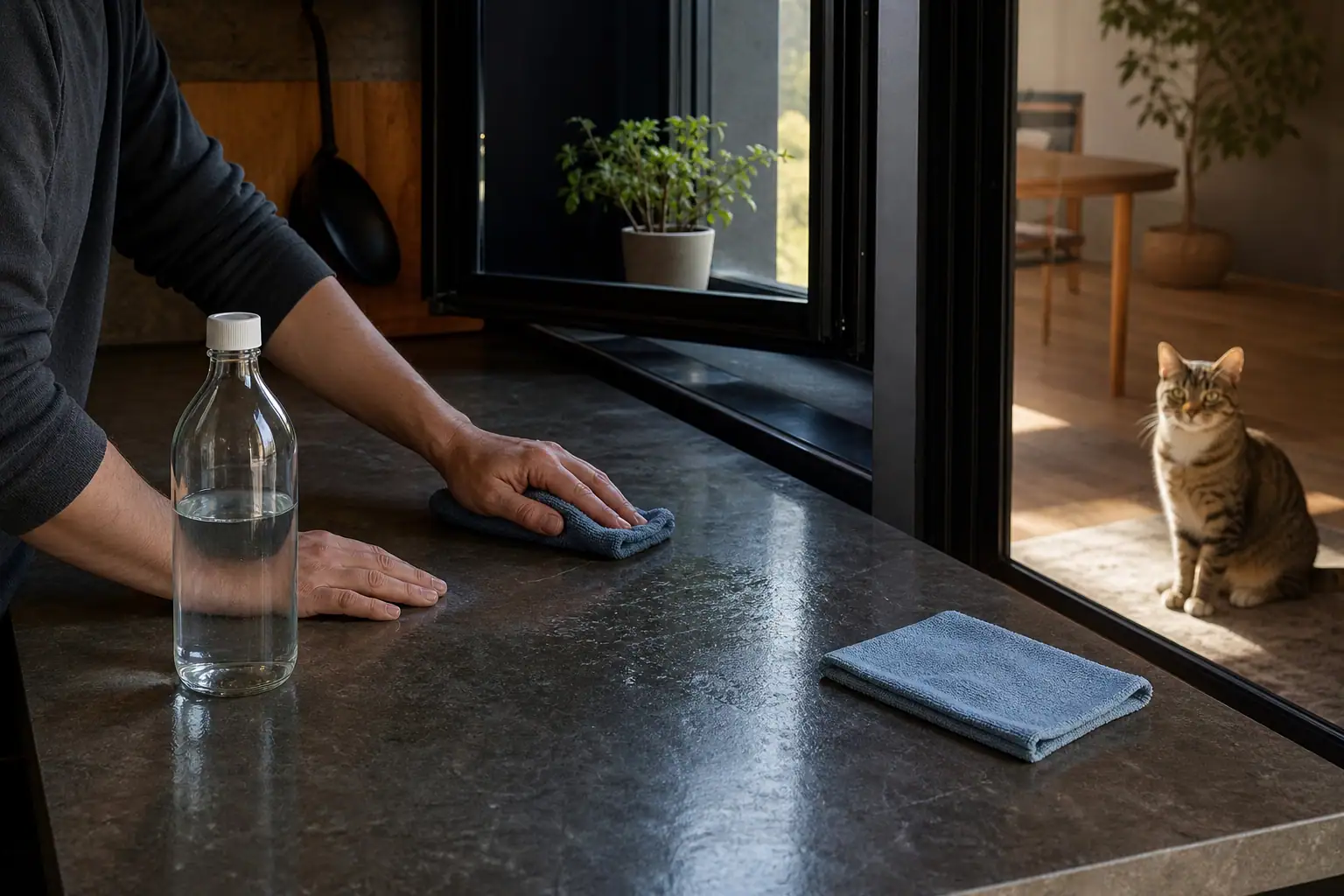
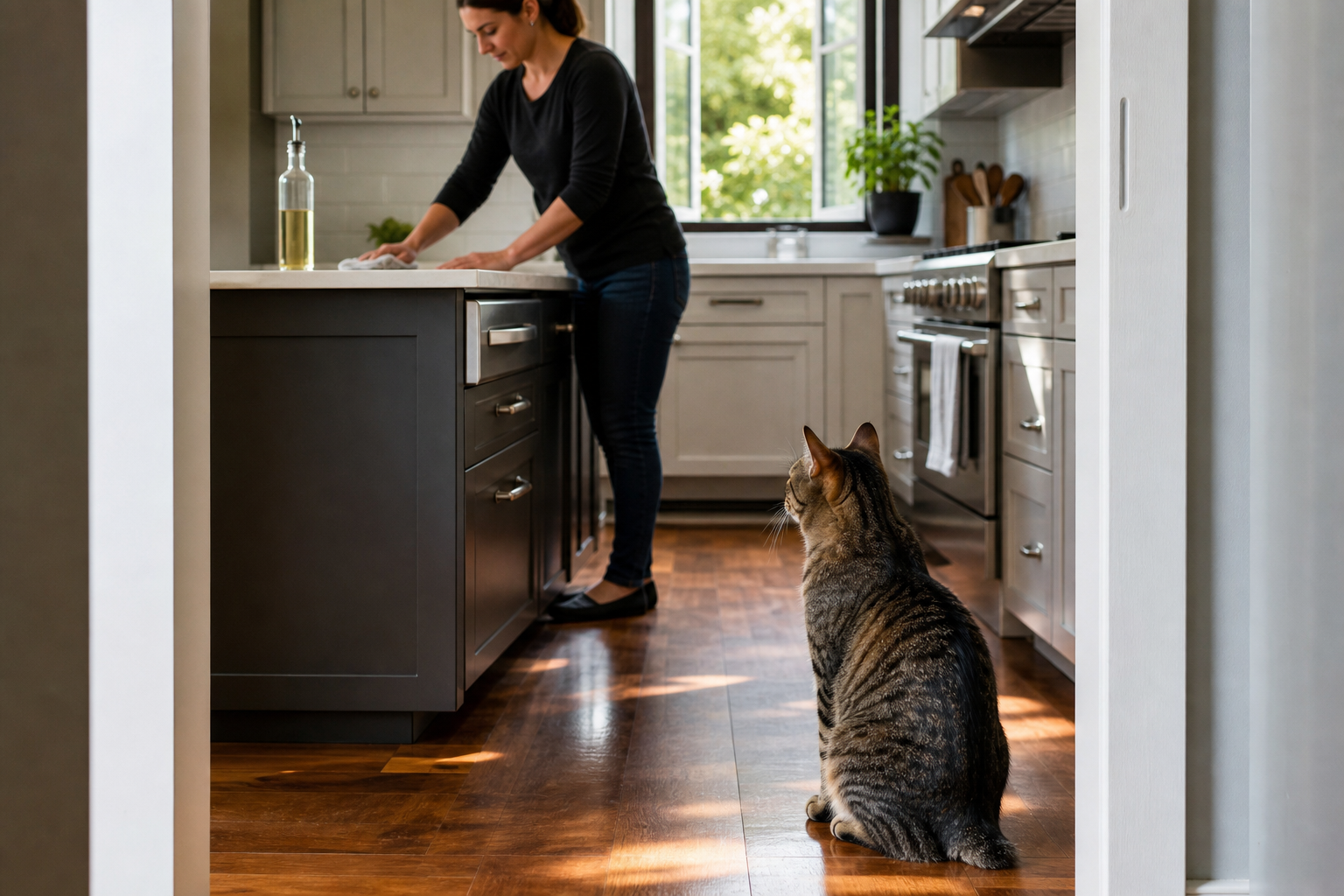
    Owner wiping and rinsing a hard surface while a cat stays in another room
    Correct use matters: keep the cat out, use one clearly identified product, rinse when appropriate, and wait for complete drying.

    Vinegar is a cleaner for certain jobs, not a universal disinfectant. The Merck Veterinary Manual explains that acetic acid has antimicrobial action at some concentrations, but that does not tell you whether a homemade mixture will kill a particular pathogen on a particular surface. If you truly need disinfection after infectious illness, ask your veterinarian which labeled product, dilution, contact time, rinse, and re-entry routine to use.

    For ordinary dirt, soap, water, and scrubbing are often enough. Our broader guide to pet-safe cleaners for cats explains how to compare products, clean floors, and handle enzyme cleaners without relying on a vague “natural” label.

    Should You Use Vinegar to Clean Cat Toys?

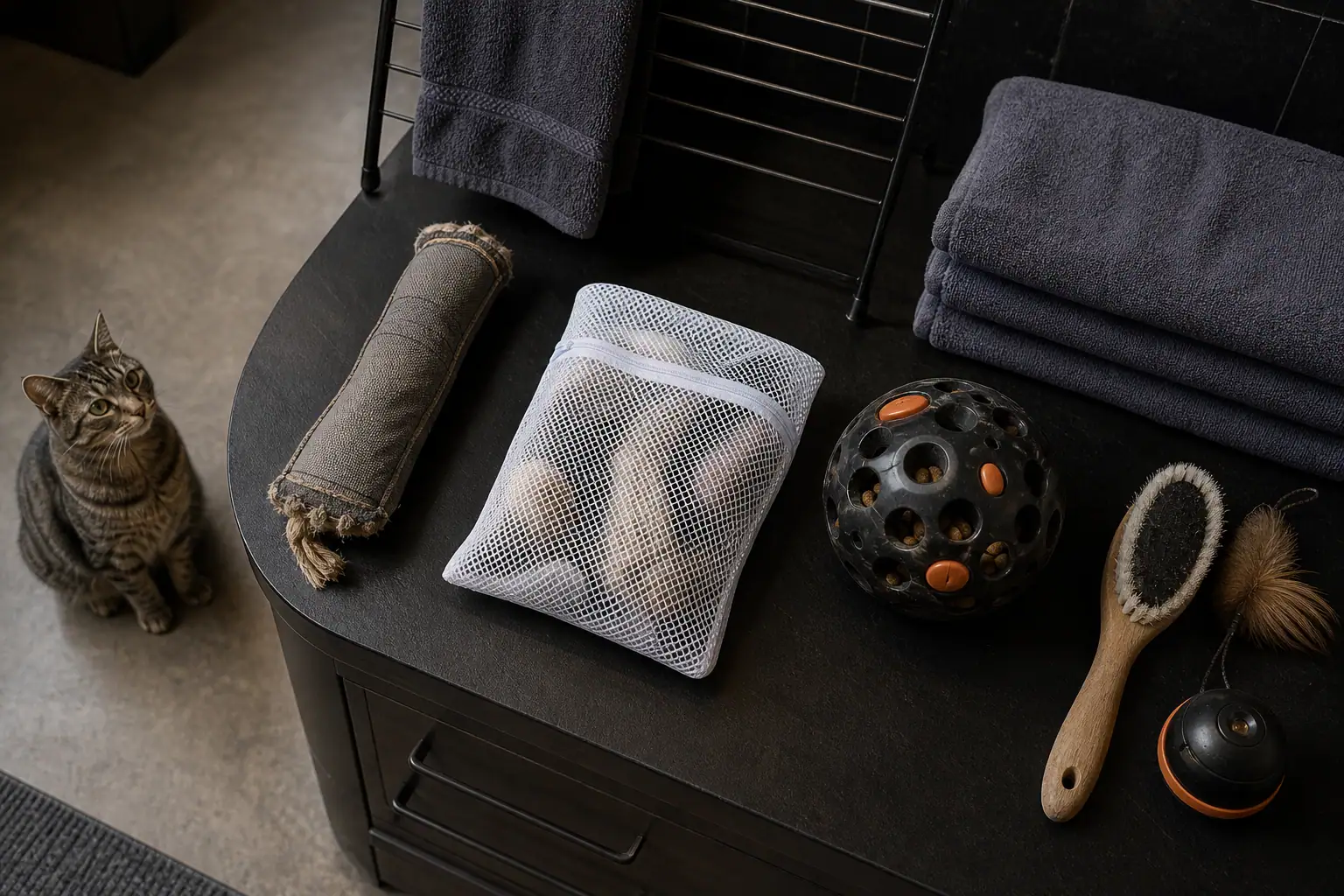
    You usually do not need vinegar to clean a cat toy. The better method depends on the toy’s material and manufacturer instructions. A washable hard toy may need warm water and mild fragrance-free detergent; a machine-washable fabric kicker may need a mesh bag and a full dry; an electronic toy may allow only surface wiping.

    • Hard plastic, rubber, and silicone: clean grooves and food residue using the maker’s method, rinse thoroughly, and retire anything cracked, sticky, swollen, or sharply chewed.
    • Fabric toys: use the permitted wash cycle, skip scent boosters and fabric softener, dry through the center, then pull gently at every seam.
    • Catnip or silvervine toys: follow the label. A toy that stays wet inside, smells musty, leaks filling, or cannot be cleaned should be replaced.
    • Wands, feathers, rope, and glued parts: surface cleaning cannot repair a frayed cord, bent wire, loose feather, or failing attachment.
    • Electronic toys: power off and follow the manual. Do not let liquid enter a motor, battery compartment, speaker, switch, or charging port.
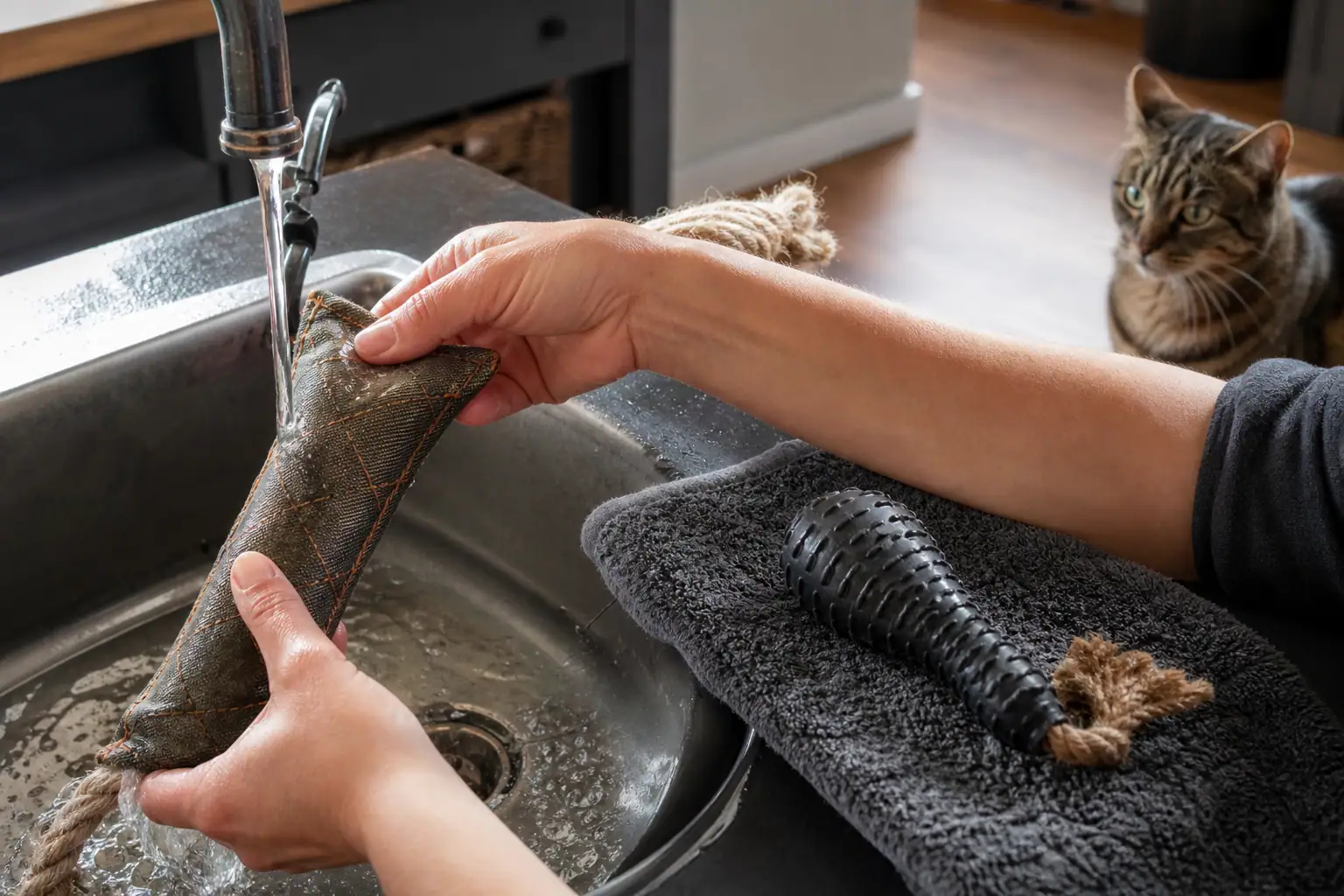
    Hands rinsing and inspecting a durable fabric cat toy at a sink
    Clean toys according to their materials, rinse away residue, dry fully, and inspect every seam before play resumes.

    If a manufacturer permits diluted vinegar, keep the cat away during cleaning, rinse the toy, dry it fully, and smell it before returning it to play. A lingering sharp odor may make the toy aversive even when residue is small. Never soak a toy simply because an internet recipe recommends it.

    For cats that bite, shake, and bunny-kick hard, cleaning time is inspection time. Press seams, check attachments, flex plastic, and account for every piece. Our durable cat toys guide shows the failure points rough players expose first. Cleaning cannot make an opened seam, exposed stuffing, sharp edge, or damaged battery door safe again.

    What to Do If Your Cat Licks or Spills Vinegar

    First, identify exactly what happened. A lick from a dry counter is different from drinking from a bowl, and ordinary kitchen vinegar is different from a concentrated acid cleaner. Find the container, note the concentration and ingredients, estimate the time and amount, and check whether exposure involved the mouth, skin, eyes, or breathing.

    1. Stop further contact. Close the room, remove the container, and keep the cat from grooming wet paws or fur.
    2. Move away from fumes. If products were mixed or the air is irritating, take people and pets into fresh air without lingering to clean up.
    3. Rinse external exposure. For vinegar on the coat or paws, rinse with lukewarm water if you can do so safely. Eye exposure needs immediate veterinary advice and prompt gentle irrigation.
    4. Call with the label in hand. Contact your veterinarian, the ASPCA Animal Poison Control Center at 888-426-4435, or Pet Poison Helpline at 855-764-7661. Consultation fees may apply.
    5. Do not induce vomiting. Do not give baking soda, milk, oil, food, charcoal, or another home remedy unless a veterinary professional specifically directs it.

    Pet Poison Helpline notes that acid injuries vary with strength and contact time. Warning signs can include repeated drooling, pawing at the mouth, vomiting, diarrhea, refusing food or water, red or painful skin, squinting, eye redness, coughing, noisy or difficult breathing, weakness, or collapse. Eye pain, breathing trouble, severe or persistent signs, and any concentrated-product exposure need urgent veterinary care.

    If the exposure involved detergent rather than vinegar, use our separate guide on Dawn dish soap and cats; surfactants create different concerns, especially when foam is swallowed or left on fur.

    Do Not Use Vinegar for Fleas, Ears, Skin, or Supplements

    Apple cider vinegar is heavily promoted as a natural cat remedy, but natural does not mean tested, effective, or comfortable. Do not add vinegar to a cat’s food or water, spray it onto the coat, pour it into an ear, or dab it on broken or inflamed skin unless your veterinarian has prescribed that exact use for that cat.

    • Fleas: vinegar does not provide reliable flea control. The Companion Animal Parasite Council recommends effective cat-appropriate flea control for every pet in an affected home and notes that established infestations can take months to control.
    • Skin: acid can sting irritated, scratched, or broken tissue, and a cat will ingest what remains while grooming.
    • Ears: redness, debris, odor, scratching, and head shaking can have different causes. Putting an acidic liquid into an unexamined, painful ear can worsen irritation and delay the correct diagnosis.
    • Urinary or digestive health: online anecdotes do not establish a safe feline dose or treat the underlying disease. Making water taste or smell unpleasant can also work against good hydration.

    Use a veterinarian-recommended flea preventive that is labeled for cats—never a dog product unless your veterinarian explicitly directs it. For itching, ear trouble, vomiting, diarrhea, appetite loss, or urinary signs, treat the symptom as a reason for diagnosis rather than a reason to experiment with vinegar.

    Is the Smell of Vinegar Safe, and Does It Deter Cats?

    A brief vinegar smell in a ventilated room is unlikely to poison a cat, but that does not mean the cat is comfortable. Cats may avoid the sharp odor. Never hold a cat near an open bottle, spray the air around them, or saturate a sleeping, eating, drinking, or litter area to force avoidance.

    Vinegar is also a poor behavior plan. If your cat scratches a sofa, block access temporarily, place an appealing stable scratcher beside the target, reward its use, and protect the surface with a material your cat does not enjoy scratching. Our guide to choosing a cat scratching post covers height, stability, material, and placement. If a cat urinates outside the litter box, arrange a veterinary check and address litter-box setup; masking or repelling the cat from one spot does not solve pain, stress, or resource problems.

    For urine residue, use a cleaner designed for that surface and organic stain, following its directions and blocking access until dry. Test any product—including vinegar—on a hidden area first because acids can damage some stone, grout, rubber, wood finishes, and appliance components.

    Vinegar Safety Checklist and FAQs

    • Use household vinegar only for a suitable cleaning job, not as cat medicine.
    • Check the concentration and keep the original labeled container.
    • Move cats, bowls, bedding, and toys before cleaning.
    • Never mix vinegar with bleach, disinfectant, or another cleaner.
    • Keep cats away from wet solution, buckets, cloths, and spills.
    • Rinse food-contact items and cat toys when appropriate.
    • Ventilate and wait for complete drying before re-entry.
    • Do not put vinegar in food, water, ears, or on skin and fur.
    • Call a veterinarian or animal poison service after a meaningful, symptomatic, eye, or concentrated-product exposure.

    What if my cat licks a little vinegar?

    One tiny lick of ordinary household vinegar may cause no signs or brief drooling or stomach upset. Remove access, offer normal fresh water, and observe. Call your veterinarian or animal poison control if the amount was more than a trace, the product was concentrated or mixed with other ingredients, or your cat develops symptoms. Do not induce vomiting.

    Is white vinegar safer than apple cider vinegar for cats?

    Neither should be given to a cat or applied as a routine remedy. For cleaning, the concentration, other ingredients, surface directions, rinsing, drying, and actual exposure matter more than whether the label says white or apple cider vinegar.

    Can vinegar kill cats?

    A trace encounter with ordinary household vinegar is not expected to kill a cat. A large ingestion, eye exposure, aspiration during vomiting, a stronger acid product, or fumes created by mixing cleaners can be much more serious. The product and circumstances determine the risk, so call promptly when either is unclear.

    Can cats walk on a floor cleaned with vinegar?

    Let the floor dry fully first, follow any rinsing directions, and inspect for puddles or residue. Cats groom their paws, so allowing access while a solution is wet turns floor contact into possible ingestion. Use a surface-compatible method and give the odor time to clear.

    Bottom line: ordinary vinegar can be used cautiously for some household cleaning, but it is not harmless, universal, or a feline health treatment. Keep it off the cat, use it only where appropriate, never mix cleaners, rinse and dry, and let a veterinarian—not a viral recipe—handle fleas, skin, ears, or illness.
    Sources

  • Pet-Safe Cleaners for Cats: A Practical Home Guide

    Pet-Safe Cleaners for Cats: A Practical Home Guide

    The best pet-safe cleaners for cats are products you can use exactly as labeled while keeping your cat away from the wet product. For everyday jobs, start with the least complicated option that works: vacuuming, a damp microfiber cloth, soap and water, or a fragrance-free cleaner with transparent directions. When buying a commercial cleaner, the EPA Safer Choice label is a useful screening tool because every ingredient is reviewed against health and environmental criteria, including considerations for pets.

    No bottle is safe for a cat to lick, walk through, or groom off its coat. Use the correct dilution, ventilate, close mop buckets and trash, and keep cats out until the surface is fully dry and any strong odor has cleared. That routine matters more than a vague “natural” or “pet-friendly” claim on the front label.

    Pet-Safe Cleaner Choices at a Glance

    You do not need one heavy disinfectant for every room. The CDC’s home-cleaning guidance says regular cleaning with soap, water, and scrubbing removes most dirt and germs; routine disinfection is generally unnecessary unless someone is sick or especially vulnerable. Using less product where less will do also reduces the opportunities for a curious cat to contact wet chemicals.

    • Dust, fur, and crumbs: vacuum, sweep, or use a damp microfiber cloth. There is usually no reason to add fragrance or disinfectant.
    • Everyday hard floors: choose a cleaner labeled for that floor, ideally fragrance-free and EPA Safer Choice-certified. Dilute it exactly as directed and keep the cat away until dry.
    • Food spills and counters: use soap and water or a surface-appropriate cleaner. Follow any label instruction to rinse food-contact surfaces.
    • Urine, vomit, and organic stains: use an enzyme cleaner labeled for the surface and for use in pet households. Block access until it has finished working and dried.
    • Washable bowls and hard toys: use warm water and a mild, fragrance-free dish detergent unless the manufacturer specifies another method. Rinse until no film or scent remains and dry fully.
    • True disinfection: use an appropriate registered disinfectant only when the job calls for it. Respect dilution, contact time, ventilation, rinsing directions, and the full drying period.

    A cleaner and a disinfectant do different jobs. A cleaner lifts grime; a disinfectant must remain wet for a stated contact time to kill listed organisms. Spraying a strong product and immediately wiping it away may add exposure without delivering the promised disinfection.

    How to Evaluate a Cleaner Instead of Trusting the Brand

    Searchers often ask whether Method, Mrs. Meyer’s, Lysol, or another whole brand is cat-safe. A brand-level yes or no is unreliable: formulas, concentrations, scents, and directions vary by product and can change. Evaluate the exact bottle you plan to use.

    1. Match the product to the job. Do not use an oven cleaner on a general spill or a disinfecting wipe for routine dust.
    2. Read the use sites. Confirm that the label permits use on your floor, counter, fabric, toy, or food-contact surface.
    3. Read every precaution. Look for ventilation, gloves, dilution, required rinsing, contact time, and re-entry instructions.
    4. Prefer independent screening. Search the current EPA Safer Choice product list, which can be filtered for home use, product type, and fragrance-free options.
    5. Check the current ingredient disclosure. The front-label words “green,” “natural,” and “plant-based” do not explain concentration or exposure risk.
    6. Ask a specific question. If information is unclear, contact the manufacturer with the exact product name and ask whether a floor needs rinsing before a cat can walk on it.

    Even an EPA Safer Choice product still needs label-compliant use and safe storage. The label means safer ingredients within its product class; it does not mean the liquid is food, paw wash, coat cleaner, or a toy your cat can investigate.

    Cleaning Ingredients and Formats That Need Extra Caution

    Risk depends on the ingredient, concentration, route of exposure, and amount. Avoid turning an ingredient list into a do-it-yourself toxicology test. Instead, recognize formats that deserve stricter handling or a different product.

    • Phenolic cleaners: phenols can injure skin, eyes, lungs, and the digestive tract. They may appear in some toilet-bowl and all-purpose cleaners.
    • Quaternary ammonium compounds: some disinfecting sprays and wipes contain “quats.” Pet Poison Helpline warns that cats are especially sensitive and that direct contact can cause corrosive injury.
    • Concentrates and pods: a small spill contains more cleaner, and a chewed packet can release it quickly. Store concentrates in their original closed container behind a secure door.
    • Essential oils and heavy fragrance: do not add tea tree, eucalyptus, peppermint, citrus, pine, or other essential oils to a DIY floor or toy cleaner. The ASPCA advises against using essential oils where pets have access unless a veterinarian approves the use.
    • Aerosols, powders, and strong fumes: airborne product can reach a cat before anything touches the floor. Use ventilation and choose a lower-drift format when practical, especially around cats with respiratory disease.
    • Drain, oven, and toilet cleaners: these jobs often use corrosive products. Close the room, secure the container and tools, and do not let cats investigate treated water or surfaces.

    Bleach is not automatically forbidden in a cat household, but it is not an everyday default. The ASPCA’s household-products guidance says properly diluted bleach can be used for pet toys and kennels when items are thoroughly rinsed and the odor has dissipated. Never improvise a concentration, never mix bleach with another cleaner, and keep the cat away throughout use and drying.

    A Safer Floor-Cleaning Routine for Cats

    Floors create a special exposure route: cats walk across them, rest on them, and then lick their paws. A simple room-by-room routine prevents most of that contact.

    1. Move the cat first. Set your cat up in another closed room with water, a resting place, and a safe toy. Pick up food bowls and loose toys from the cleaning area.
    2. Remove dry debris. Vacuum or sweep before adding liquid. This lets the cleaner contact the floor instead of mixing with fur and dust.
    3. Measure, do not guess. Use the label’s dilution. More concentrate can leave more residue and does not necessarily clean better.
    4. Control access and splashes. Keep the bucket covered or immediately empty it. Do not leave wet wipes, mop water, or soaked paper towels where a cat can paw or drink.
    5. Ventilate. Open a window or run exhaust ventilation when the label calls for it or the room holds an odor.
    6. Honor contact and rinse directions. A disinfectant may need to stay wet for several minutes. Rinse only when the label or surface instructions require it, then allow full drying.
    7. Inspect before re-entry. Check for puddles under furniture, residue at baseboards, a forgotten wipe, and damp mop strands. Reopen the room only when the surface is dry.
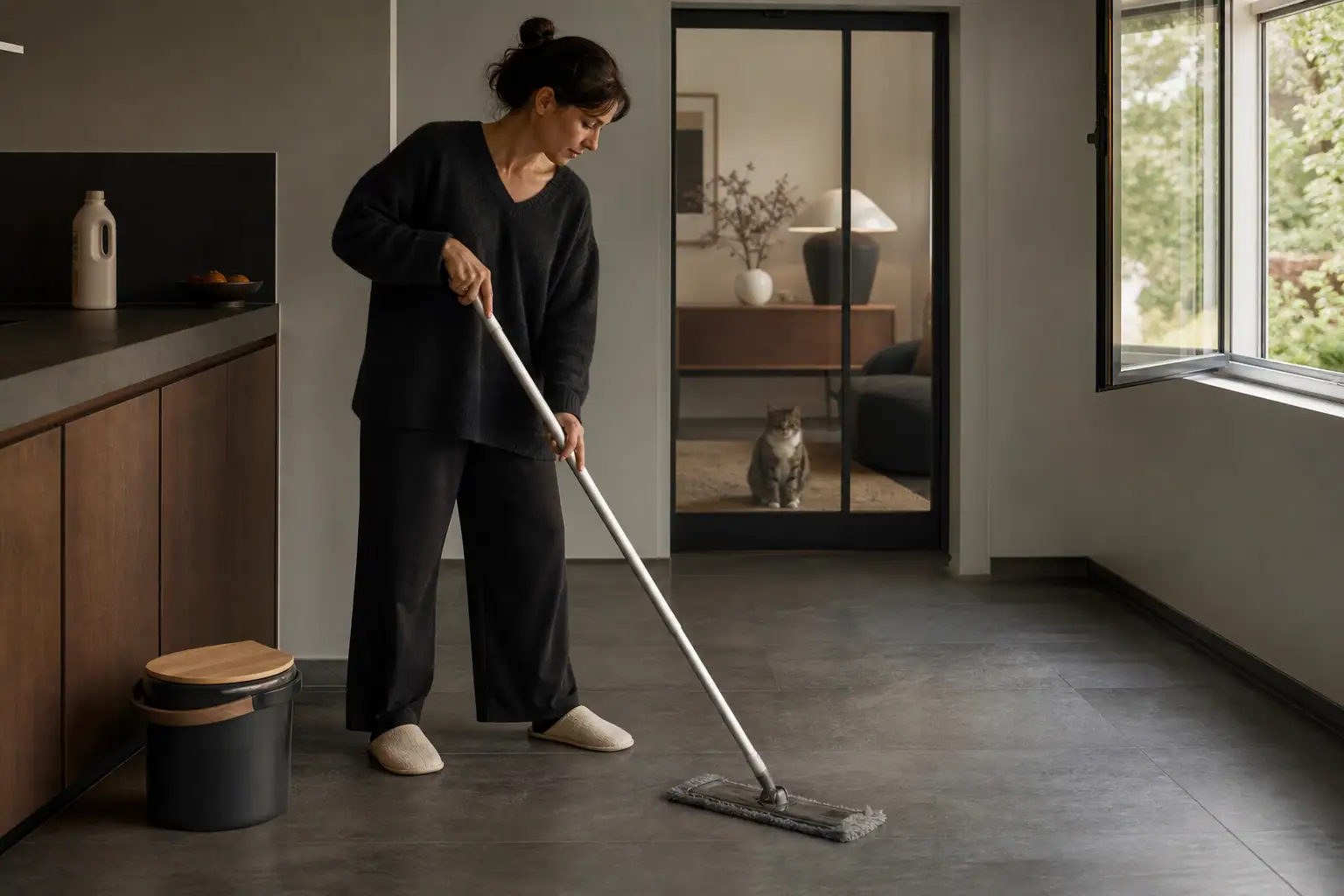
    Freshly mopped floor drying while a cat waits behind a closed glass door
    Keep cats out of the room during mopping, ventilate the space, and wait until the floor is completely dry before reopening it.

    If a cat repeatedly licks a particular floor, has asthma, or cannot be separated from the room, ask your veterinarian about the exact product rather than relying on a generic online safe list. Sometimes the best adjustment is a simpler cleaner, smaller cleaning zones, or cleaning while the cat is elsewhere.

    How to Clean Cat Toys Without Leaving Residue

    Toys collect saliva, fur, food, litter dust, and whatever is on the floor. They also go straight back into a cat’s mouth. Clean them by material, not as one mixed load.

    • Hard plastic, rubber, and silicone: check the manufacturer’s directions. Hand-wash with warm water and mild fragrance-free dish detergent, using a small brush for grooves. Rinse thoroughly and air-dry. Retire cracked, sticky, swollen, or permanently odorous pieces.
    • Machine-washable fabric toys: use a mesh bag and a fragrance-free detergent on the permitted cycle. Skip fabric softener and scent boosters. Dry all the way through, then check every seam before play.
    • Catnip and silvervine toys: follow the care label. Many stuffed toys lose potency or trap moisture if soaked. Spot cleaning may be appropriate, but a saliva-soaked toy that cannot be washed and dried fully should be replaced.
    • Puzzle feeders: empty food after each session and clean the corners, sliders, and cavities. Our guide to puzzle cat toys explains why cleanability belongs in the buying decision.
    • Electronic toys: power off and follow the manual. Never immerse a motor, charging port, or battery compartment. Replace a toy with corrosion, liquid inside, heat damage, or a compromised battery door.
    • Wands, rope, feathers, and glued parts: these often cannot be sanitized reliably. Surface cleaning does not repair fraying, bent wire, loose glue, or damaged attachments.
    Cat toy cleaning station with a frayed fabric toy ready to retire
    Separate toys by material, and use cleaning time to catch frayed seams like the damaged fabric toy shown here.

    Cleaning is also inspection time. Cats that bite and bunny-kick hard can open a seam during washing or expose damage that dried saliva had hidden. Review the failure points in our durable cat toys guide, and retire a toy when pieces, stuffing, sharp edges, or unreachable grime become part of the design.

    Are Vinegar, Baking Soda, and DIY Cleaners Safe?

    Diluted vinegar can be useful for some routine surface cleaning, but “natural” does not mean harmless or suitable for every surface. Vinegar is acidic, can irritate after direct exposure, and may damage stone, grout, rubber seals, or finishes. The ASPCA notes that diluted vinegar is generally not a concern when it is rinsed and allowed to dry. It is not a substitute for a registered disinfectant when disinfection is actually required.

    Baking soda can absorb odor and provide mild abrasion, but loose powder should not be left where a cat can walk through it, inhale it, or groom up a pile. Use only the amount needed, remove the residue, and keep the container secured.

    Never use internet recipes that combine cleaning chemicals. In particular, never mix bleach with ammonia, vinegar, acids, or another cleaner. Do not improve a homemade formula with essential oils. If plain water, soap, or one labeled product will do the job, use that instead of creating a chemistry experiment in the kitchen.

    What to Do If Your Cat Contacts a Cleaner

    Possible warning signs include drooling, pawing at the mouth, gagging, vomiting, coughing, rapid or difficult breathing, red or painful skin, eye irritation, lethargy, hiding, or refusing food. A cat may also arrive with wet paws or a chemical odor before symptoms begin.

    1. Stop the exposure. Move the cat away from the spill or fumes without exposing yourself.
    2. Save the evidence. Keep the package, ingredient label, and product name. Note the approximate time and whether contact involved the mouth, eyes, skin, coat, or breathing.
    3. Call for case-specific advice now. Contact your veterinarian, the ASPCA Animal Poison Control Center at 888-426-4435, or Pet Poison Helpline at 855-764-7661. Fees may apply.
    4. Do not induce vomiting. Do not give milk, oil, food, activated charcoal, or another home remedy unless a veterinary professional directs you.
    5. Follow decontamination instructions. The right rinse or wash depends on the product and exposure route. If breathing is difficult, the eyes appear injured, the cat collapses, or severe signs are present, seek emergency veterinary care.

    If the exposure involved dish detergent, our related guide, Is Dawn dish soap safe for cats?, covers licks, coat contact, rinsing, and why routine bathing needs a cat-specific product.

    Quick Checklist and Common Questions

    • Use the least complicated product that can do the job.
    • Prefer fragrance-free options and check the EPA Safer Choice list.
    • Read the exact label; do not approve or reject an entire brand.
    • Move cats, bowls, bedding, and toys before cleaning.
    • Measure dilution and respect contact time.
    • Ventilate, secure buckets and used wipes, and allow full drying.
    • Wash cat toys by material, rinse thoroughly, dry fully, and inspect.
    • Store every cleaner in its original closed container behind a secure door.
    • Keep the label and call a veterinarian or animal poison service after a suspected exposure.

    What is the safest cleaner to use around cats?

    For ordinary dirt, soap and water or a surface-appropriate fragrance-free cleaner is often enough. For a commercial product, EPA Safer Choice certification is a stronger screening signal than an unsupported front-label claim. Safe use still requires following the label and keeping the cat away until everything is dry.

    What can I mop my floor with that is safe for cats?

    Choose a floor-compatible, preferably fragrance-free Safer Choice cleaner, use the labeled dilution, and close the room until the floor is dry. Plain damp mopping may be sufficient for light soil. Do not add essential oils, and do not leave an open bucket.

    Are cleaning wipes safe for cats?

    Some surface wipes contain disinfectants, including quaternary ammonium compounds, and are not meant for a cat’s body. Use a wipe only on a labeled surface, discard it in a covered trash can, follow contact and rinse directions, and block access until dry. Never use a household disinfecting wipe on paws or fur.

    Are Method or Mrs. Meyer’s products safe for cats?

    There is no dependable whole-brand answer. Check the exact current formula, fragrance, intended surface, label precautions, and whether that specific product carries EPA Safer Choice certification. If the label does not answer how to use it in a cat household, ask the manufacturer and your veterinarian.

    Bottom line: pet-safe cleaning is a process, not a magic bottle. Match the cleaner to the mess, use it exactly as directed, control the cat’s access, and wait for full drying. That approach keeps the home clean without treating curious paws, grooming, and rough-play toys as afterthoughts.

  • Is Dawn Dish Soap Safe for Cats? What to Do After Exposure

    Is Dawn Dish Soap Safe for Cats? What to Do After Exposure

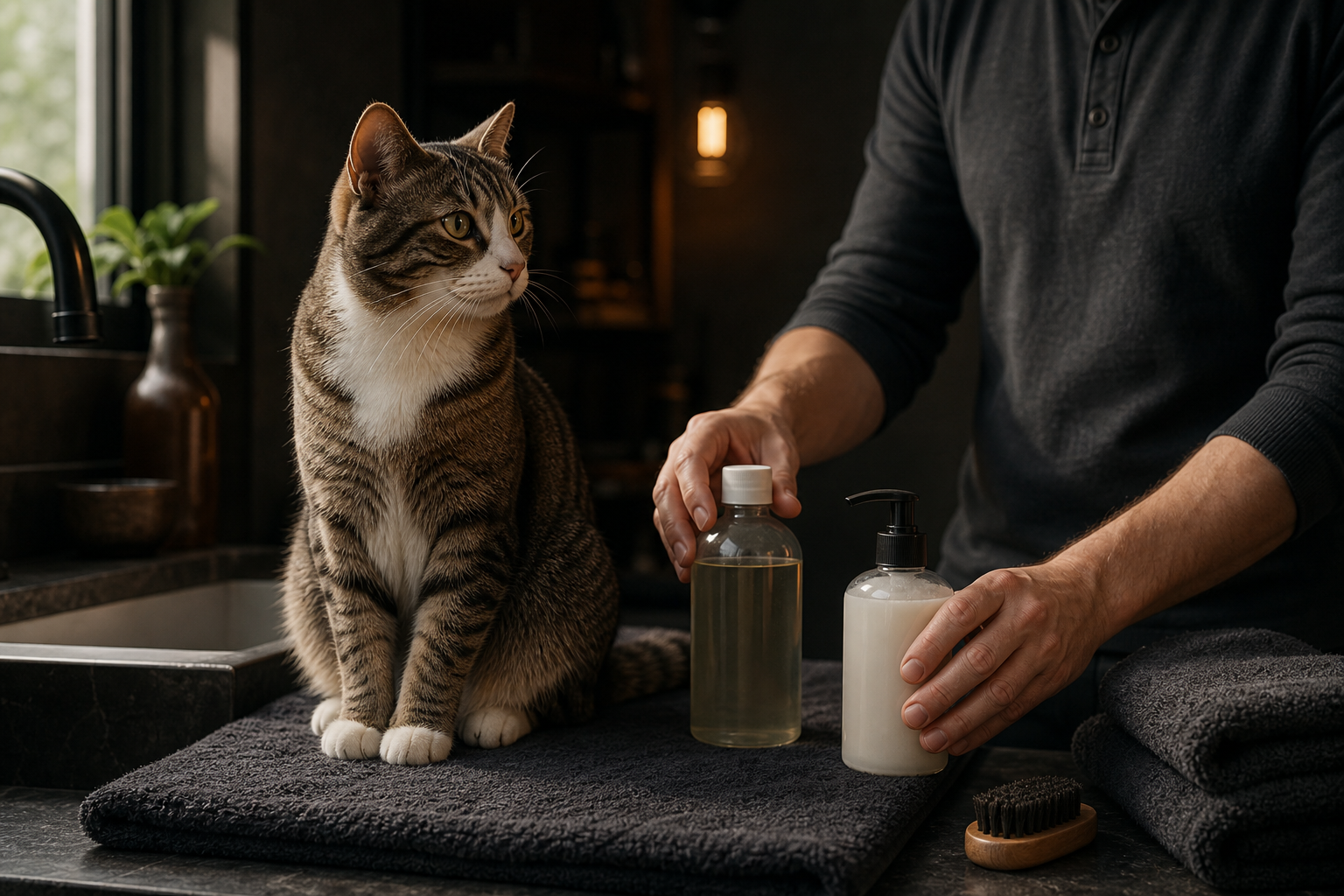
    The short answer: a tiny accidental lick of diluted Dawn dish soap is unlikely to poison an otherwise healthy adult cat, but Dawn is not a cat shampoo and it is not harmless. Dishwashing liquid can irritate the mouth, stomach, eyes, and skin. Soap left on fur is especially concerning because a cat will groom it off and may inhale foamy material if vomiting occurs.

    Do not use Dawn for routine baths or assume every Dawn formula is equivalent. If your cat has soap on their coat, rinse it away thoroughly. If they swallowed more than a trace amount, have persistent symptoms, or show any breathing difficulty, contact a veterinarian or animal poison service promptly. This guide offers first-aid context, not a diagnosis for an individual cat.

    Is Dawn dish soap safe for cats?

    Dawn is better described as low risk in a small, one-time exposure than simply “safe.” Liquid hand-dishwashing soaps contain surfactants—the ingredients that lift grease. The Merck Veterinary Manual says common anionic and nonionic detergents generally cause mild gastrointestinal irritation, with vomiting and diarrhea among the most common signs. Eye and mucous-membrane irritation can also occur.

    That does not make a lick an automatic emergency, nor does it make Dawn appropriate for regular grooming. Dawn publishes a broad ingredient list that includes cleaning surfactants, fragrance, preservatives, solvents, and colorants used across its formulas. Those formulas are designed and labeled for dishwashing—not for a cat’s skin, coat, or inevitable grooming behavior.

    Use this distinction

    • One small lick of diluted suds: often causes no signs or temporary drooling or stomach upset, but observe closely.
    • Soap left on the coat: rinse it off because grooming can turn a skin exposure into an ingestion exposure.
    • A mouthful, concentrated product, or repeated vomiting: call your veterinarian or animal poison control for case-specific advice.
    • Breathing trouble, collapse, blue or pale gums, or seizures: seek emergency veterinary care now.

    What to do if your cat licked Dawn

    Respond to what actually happened rather than relying on a blanket internet answer. Keep the bottle or take a clear photo of its front and ingredient label; the exact product, amount, time, and your cat’s weight and health all affect the advice.

    1. Remove access. Move the bottle, dishwater, soaked sponge, and any wet towels out of reach. Keep other pets away too.
    2. Clear external residue. If soap is on the paws or coat, rinse with clean lukewarm water. If there is only a tiny smear around the mouth, gently wipe it away with a damp cloth.
    3. Offer plain water. Let your cat drink if they want to, but do not force water by syringe. A stressed cat can inhale liquid.
    4. Do not induce vomiting. Foamy detergent can be inhaled into the lungs on the way back up. Merck specifically advises preventing vomiting after detergent, soap, or shampoo ingestion when possible.
    5. Watch closely. Note drooling, repeated lip-licking, pawing at the mouth, vomiting, diarrhea, coughing, noisy breathing, lethargy, or refusal to eat.
    6. Call when in doubt. Your veterinarian can assess the product and dose. In the United States, the ASPCA Animal Poison Control Center is available at 888-426-4435, and Pet Poison Helpline is available at 855-764-7661; consultation fees may apply.

    Do not give milk, oil, salt, hydrogen peroxide, activated charcoal, or another home remedy unless a veterinarian or poison specialist tells you to do so for this specific exposure. Good treatment advice is product- and patient-specific.

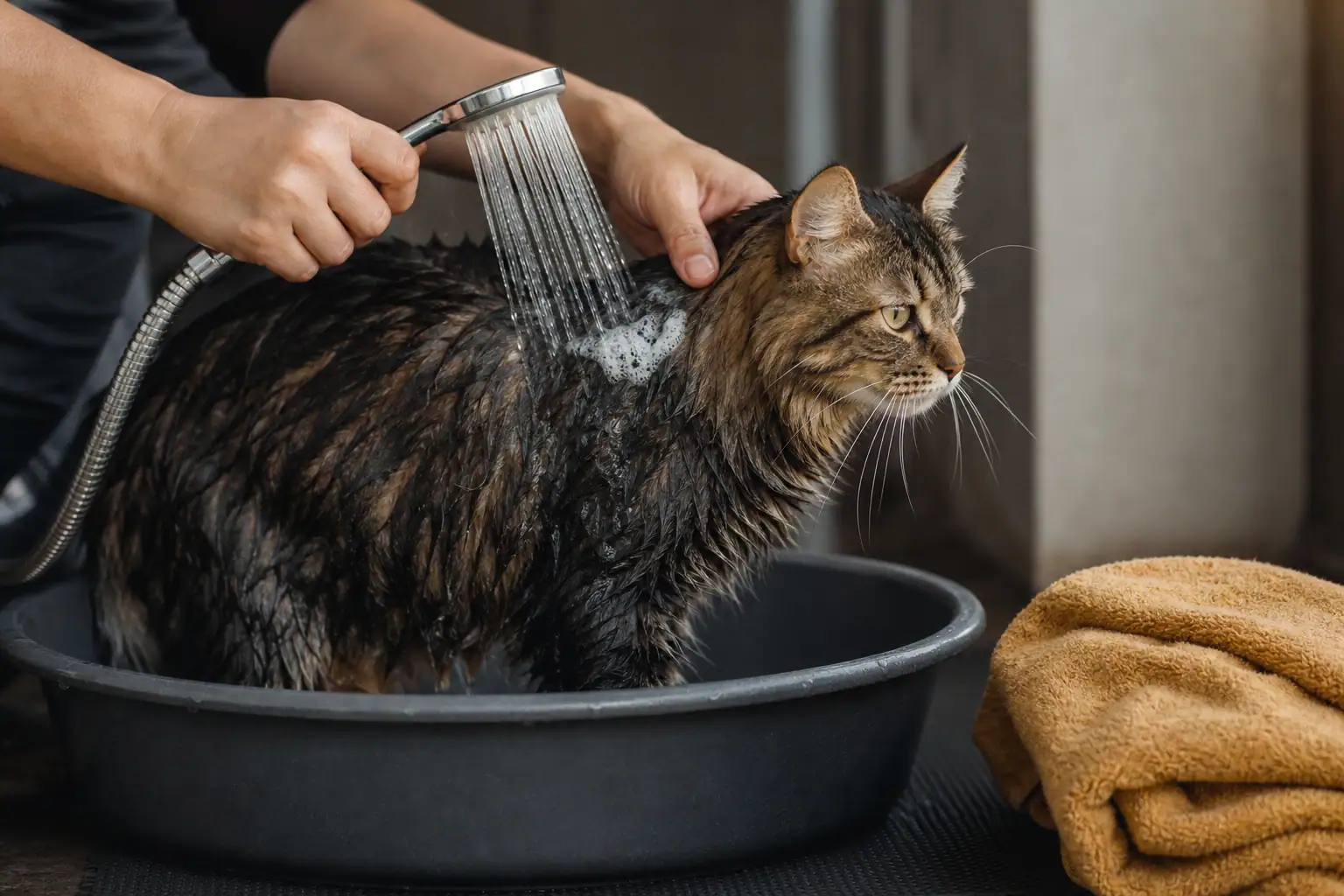
    Owner rinsing soap residue from a cat with clean lukewarm water
    If soap is on the coat, rinse thoroughly and prevent grooming until the residue is gone.

    What if you already bathed your cat with Dawn?

    Do not panic. The immediate priority is to remove the residue before your cat grooms.

    1. Rinse the entire soaped area with plenty of lukewarm water, keeping water out of the eyes, nose, and ears.
    2. Continue until the coat no longer feels slick and rubbing the wet fur produces no suds.
    3. Towel-dry your cat and keep them comfortably warm. Prevent licking until the coat is thoroughly rinsed.
    4. Check the skin over the next day for redness, itching, flaking, or unusual sensitivity.
    5. Call a veterinarian if the bath was meant to remove paint, oil, a pesticide, essential oil, or another chemical. The right decontamination method depends on the substance.

    A single well-rinsed bath may cause nothing more than temporary dryness, but repeated use can strip oils from the coat and worsen irritation. For ordinary dirt, use a shampoo labeled for cats and follow its directions. Cats with wounds, skin disease, very young kittens, seniors, or medically fragile cats deserve veterinary advice before a full bath.

    If Dawn got in the eyes

    Flush the affected eye gently with lukewarm water or sterile saline for several minutes. Do not use eye drops intended to “get the red out.” Squinting, holding the eye closed, marked redness, cloudiness, or continued tearing warrants prompt veterinary assessment; eye injuries can deteriorate quickly.

    Are Dawn Ultra, Platinum, Powerwash, or antibacterial versions safe?

    Do not choose a formula for your cat based on bottle color or “original Dawn” folklore. Dawn sells many liquids and sprays with different concentrations, fragrances, and additional ingredients, and product lines can change. “Free & Clear” also does not mean tested or labeled as a cat-care product.

    Sprays, concentrated formulas, antibacterial hand-soap variants, and products with added scents should not be treated as interchangeable with a plain liquid dish soap. If an exposure occurs, read the exact label and give the full product name to your veterinarian or poison specialist. When a veterinarian recommends a mild dish soap for a specific decontamination job, follow their instructions on product, dilution, contact time, and rinsing rather than substituting another formula.

    Does Dawn kill fleas on cats?

    Dawn can help water trap and drown some adult fleas present during a bath, but it does not provide residual protection and does not clear the eggs, larvae, and pupae spread through the home. A bath can therefore remove visible fleas without solving the infestation.

    Use a flea comb and ask your veterinarian about a preventive or treatment labeled for your cat’s species, age, and weight. The U.S. Environmental Protection Agency advises following the product label and never applying a dog flea-and-tick product to a cat. If your cat is a young kitten or is ill, pregnant, nursing, underweight, or already taking medication, get veterinary guidance before applying any flea product.

    Dawn is not a flea-control plan

    A complete plan may include a cat-labeled treatment, flea-combing, washing bedding, vacuuming, treating every pet appropriately, and follow-up timed to the flea life cycle. Never combine pesticides or repeat a dose early unless your veterinarian directs it.

    Can you use Dawn to clean cat toys?

    Sometimes, but the toy’s care label comes first. For a nonporous, non-electronic toy whose manufacturer allows hand-washing, a very small amount of mild dish soap can remove saliva and grime if the toy is rinsed exceptionally well. Dawn is a poor default for porous toys that hold detergent deep in stuffing or seams.

    Toy type Safer cleaning approach Retire it when
    Molded rubber or silicone Follow the maker’s directions; hand-wash, rinse every groove, and air-dry fully. There are deep punctures, tackiness, cracking, or pieces can be pulled away.
    Washable fabric kicker Use the care label. Choose a rinseable method, then press seams to check for trapped suds and moisture. Seams gap, stuffing escapes, odor persists, or the center will not dry.
    Catnip or stuffed plush Spot-clean if specified. Avoid soaking a toy that cannot dry all the way through. It smells musty, has visible mold, leaks filling, or has loose decorations.
    Electronic or motorized toy Remove batteries if the instructions allow and wipe only as directed. Never immerse electronics. The housing cracks, battery area corrodes, or a motor compartment can be opened by the cat.
    Wand lure or feather attachment Follow the label; replace rather than saturate a weak or glued attachment. String frays, quills splinter, clips deform, or small pieces loosen.

    Keep your cat away during cleaning. A washed toy should be residue-free, completely dry, and structurally sound before it returns to play. For rough players, squeeze and flex the toy after washing because wet seams can reveal damage that was easy to miss when dry. Our guide to safer motion toys for rough play includes a staged pre-play and post-play inspection routine.

    Hands rinsing a washable cat toy thoroughly under running water
    A washable toy is not ready for play until it is residue-free, fully dry, and inspected for damage.

    When to call a veterinarian now

    Call your veterinarian, an emergency clinic, or an animal poison service promptly if the exposure involved a concentrated amount, a spray or antibacterial formula, another cleaner mixed with the soap, or a cat with existing breathing, skin, or gastrointestinal disease.

    Seek urgent care for:

    • coughing, wheezing, noisy or labored breathing;
    • blue, gray, very pale, or brick-red gums;
    • repeated vomiting or diarrhea, blood, or inability to keep water down;
    • marked drooling, mouth pain, trouble swallowing, or facial swelling;
    • weakness, collapse, severe lethargy, tremors, or seizures;
    • persistent eye pain, squinting, or a cloudy-looking eye.

    Breathing signs can appear after detergent is aspirated into the lungs and should not be watched at home. Bring the product container or a label photo with you.

    A safer home routine

    • Store detergents, refill jugs, sponges, and cleaning buckets behind a closed door or latched cabinet.
    • Empty dishwater promptly instead of leaving a tempting greasy basin.
    • Use cat-labeled grooming products for routine coat care.
    • Follow every toy’s material-specific care directions and rinse until no residue remains.
    • Dry toys completely; trapped moisture and stuffing are a bad combination.
    • Inspect high-bite zones, seams, attachments, and battery doors before every hard play session.
    • Rotate a few clean toys instead of leaving a crowded, hard-to-audit toy box on the floor.

    Cleaning is only one part of a safe setup. A balanced cat enrichment routine gives your cat appropriate ways to stalk, chase, catch, bite, and rest, while our kitten toy guide covers sizing and failure points for younger cats.

    Frequently asked questions

    Can Dawn dish soap kill cats?

    A tiny lick of ordinary diluted hand-dishwashing liquid is more likely to cause mild irritation than life-threatening poisoning. Serious problems are still possible with larger amounts, certain added ingredients, aspiration into the lungs, or a medically vulnerable cat. Do not use the absence of immediate symptoms as proof that a substantial exposure is safe.

    What should I do if my cat licks Dawn off their fur?

    Stop the grooming, rinse the coat thoroughly with lukewarm water, and remove soap from the cat’s reach. Do not induce vomiting. Contact a veterinarian or animal poison service if more than a trace was swallowed, the exact amount is unknown, or any symptoms develop.

    Which Dawn dish soap is okay for cats?

    No Dawn formula should be your routine cat shampoo. A veterinarian may recommend a specific mild dish soap for one-time decontamination, but that is different from a product being generally approved for bathing cats. Use the exact product and method they specify.

    What can I wash my cat with if I do not have cat shampoo?

    If the problem is ordinary dust or dirt, try a warm damp cloth and brushing rather than improvising with a household cleaner. If the coat is contaminated with a chemical, oil, feces, or a sticky substance, call your veterinarian for advice before applying another product. The wrong solvent or cleanser can spread or react with the contaminant.

    Is Dawn safe for kittens?

    Kittens can become chilled during a bath and may be more vulnerable to skin irritation and incorrect flea treatment. Do not make Dawn your default. Ask a veterinarian what is safe for the kitten’s exact age, weight, health, and reason for bathing.

    Editorial note: This article provides general safety information and does not replace veterinary diagnosis or treatment. For a current exposure, use the exact product label and your cat’s clinical signs when seeking professional advice.