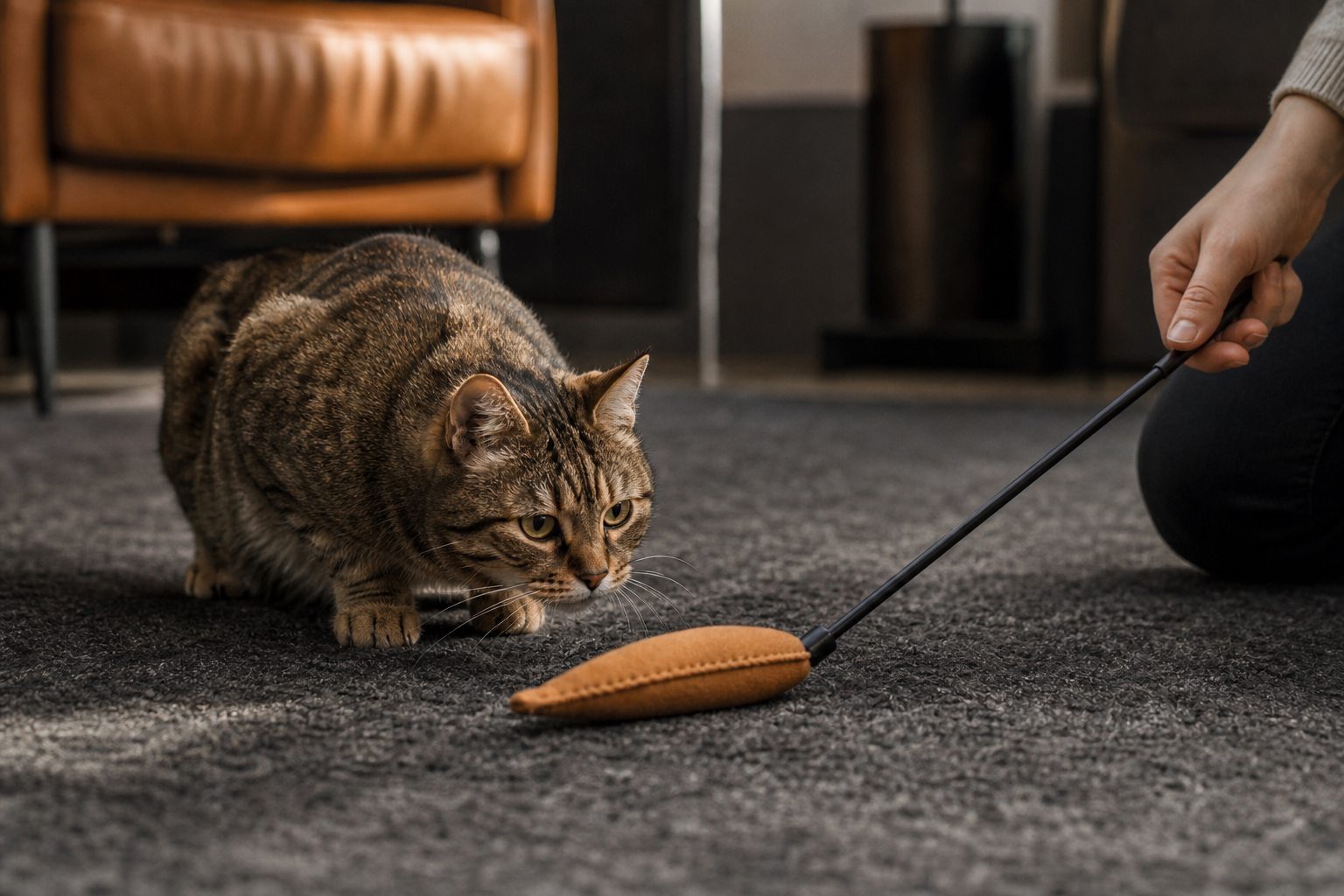
The best cat toys for senior cats are easy to reach, simple to control, comfortable to grip, and interesting without demanding repeated sprinting or jumping. Start with a ground-level wand game, a large soft kicker, a shallow food puzzle, a stable ball track, or an oversized lightweight ball. Put the play area on a nonslip rug and adjust the speed, distance, and difficulty to the cat in front of you.
Older cats still need opportunities to stalk, chase, catch, search, and wrestle, but age is not an instruction manual. One 12-year-old may race down the hall; another may prefer to bat from a warm bed. Choose by mobility, senses, health, and the way your cat actually plays—not by a “senior” label on the package.
A sudden loss of interest in play is not something to solve by buying a louder toy. The 2021 AAFP Feline Senior Care Guidelines list diminished play, decreased jumping, altered routines, increased sleeping, and changed responses to touch among the subtle signs that can accompany pain. Arrange a veterinary check when play or movement changes unexpectedly, especially if your cat also hides, eats less, loses weight, seems weak, or avoids being touched.
Best cat toys for senior cats at a glance
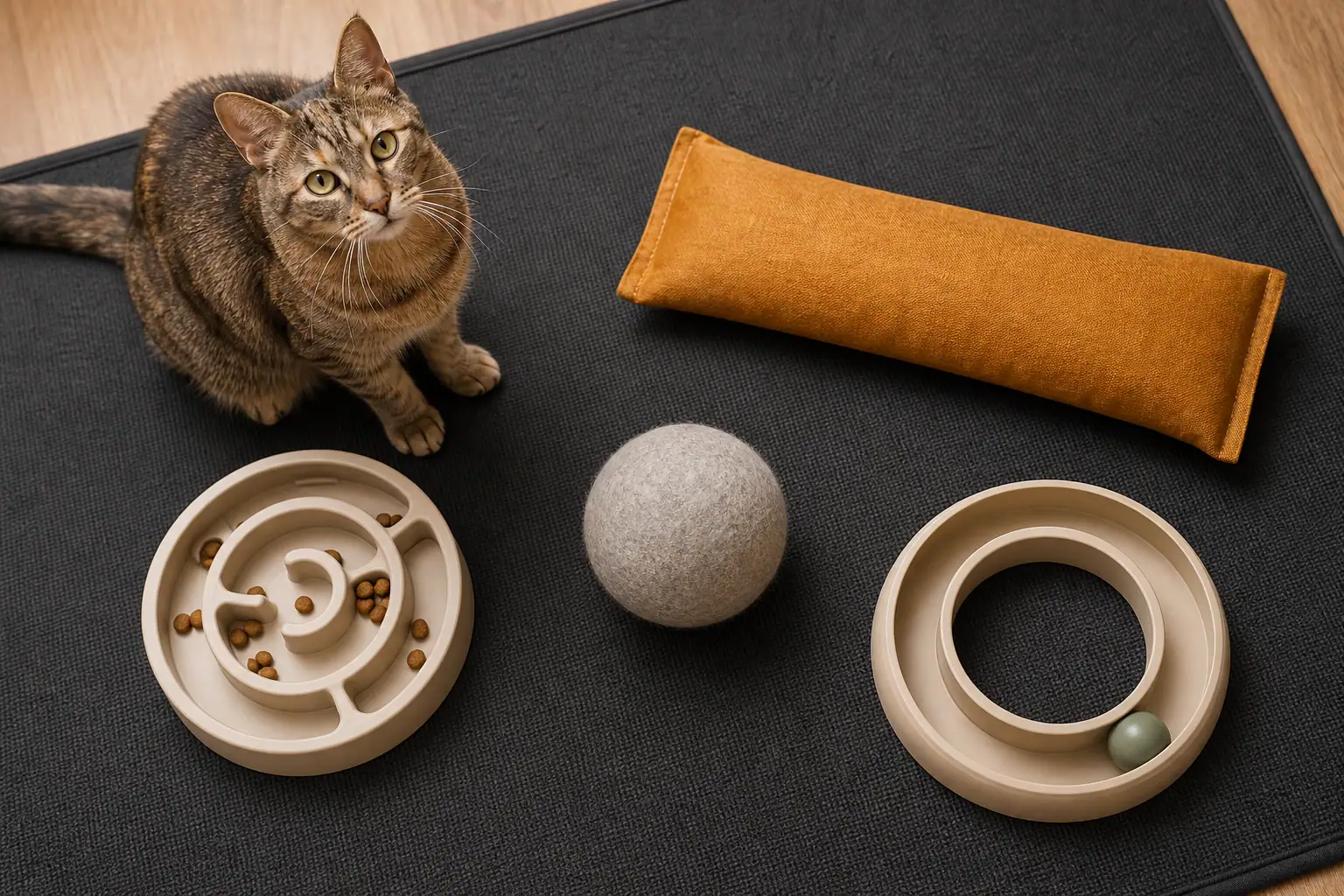
This shortlist covers different parts of the feline hunting sequence without assuming that every senior cat has arthritis, poor vision, or low energy.
| Toy type | Best for | Senior-friendly setup | Main safety check |
|---|---|---|---|
| Wand with a simple fabric lure | Stalking, reaching, short chases | Drag it slowly across a rug and offer frequent catches | Supervise; store cord, wire, clips, and lure after play |
| Large fabric kicker | Grabbing, biting, bunny-kicking | Offer beside the cat so no chase or jump is required | Inspect seams, filling, damp spots, and attachments |
| Shallow food puzzle | Searching and problem-solving | Use wide openings and begin with rewards partly exposed | Count food in the daily diet; wash food-contact surfaces |
| Stable enclosed ball track | Seated or lying-down paw play | Secure it on a nonslip mat within easy reach | Check for cracks, trapped claws, loose caps, and small parts |
| Oversized soft or felt ball | Gentle batting and short pursuit | Roll across a rug, not down stairs or over slick flooring | Too large to swallow; no loose fibers, foam, bells, or glued trim |
| Low, wide tunnel or cardboard hide | Exploring and ambushing | Keep entrances open and the route level | Remove torn mesh, exposed wire, staples, tape, and chewed pieces |
The joint AAFP/ISFM Feline Environmental Needs Guidelines say older cats still need play, although its type and intensity may need modification. They recommend allowing cats to perform parts of the predatory sequence, providing a real catch, rotating toys, and putting away strings or ingestible parts after play. Those principles are more useful than a ranked shopping list.
Do a one-minute comfort and mobility check
Watch your cat move before deciding how the toy should move. You are not trying to diagnose arthritis at home; you are looking for practical limits and changes you can describe to your veterinarian.
- Getting up: does your cat rise smoothly, or pause and pull forward with the front legs?
- Walking: look for stiffness, a shortened stride, wobbling, or reluctance to cross a slick floor.
- Turning: can the cat follow a slow lure in a broad curve without slipping or making a sharp pivot?
- Reaching: will the cat extend one paw comfortably while sitting or lying down?
- Jumping: compare current jumps with last year. Do not test this by making the cat leap for a toy.
- Recovery: after a brief invitation, does breathing remain easy and does the cat choose to re-engage?
Also notice vision, hearing, smell, dental comfort, and nail condition. A tiny fast lure may be hard to see. A silent ball may be difficult to locate. A hard toy may be unpleasant for a cat with dental pain. Overgrown nails can affect movement and catch in some fabrics. The right response is to adjust the setup and discuss new changes with a veterinarian—not to force a workout.
According to Cornell’s Feline Health Center, arthritis is common in older cats and often shows up as difficulty reaching resources rather than obvious lameness. Cornell also notes that hearing, vision, dental, kidney, thyroid, and blood-pressure problems become more relevant with age. That is why “my old cat is just lazy” is a risky conclusion when behavior has changed.
Match the toy to the movement your cat can enjoy
For a cat who prefers to stay on the floor
Choose horizontal play. Move a wand lure away from the cat in short, slow dashes, then let it pause beside a chair leg or the edge of a box. Keep the target within one or two comfortable body lengths and offer a catch every few movements. A wide tunnel, shallow box, kicker, or track toy lets the cat ambush and manipulate without jumping.
Put a low-pile rug or secured yoga-style mat under the play zone if wood or tile is slippery. Avoid loose blankets that bunch under the feet. Clear the route of bowls, cables, sharp furniture corners, and stairs before the game begins.
For a cat who tires quickly
Think in successful bursts rather than one long session. Thirty seconds of interested stalking, one catch, and a rest can be worthwhile. Stop while the cat is still comfortable; a senior does not need to be panting for play to “count.” Offer another short turn later if the cat approaches, watches the storage area, or responds to the start cue.
For a practical starting schedule, use our guide to how often to play with your cat, then shorten the individual sessions to match your senior’s endurance and veterinary advice.
For reduced vision or hearing
Make the toy easier to locate through another sense. Try a high-contrast lure against the floor, a quiet rattle contained inside an oversized ball, a toy rubbed with familiar catnip, or a treat placed partly in view in a shallow puzzle. Move consistently and begin within the cat’s usable field of view. Never startle a sleeping cat with a toy or touch from behind.
A mild sensory cue is enough. Avoid essential oils, concentrated fragrances, very loud electronic toys, flashing lights, and small external bells. If sight or hearing changed suddenly, seek veterinary care before treating it as ordinary aging.
For a food-motivated cat
Use an easy puzzle that rewards the first interaction. Place a small amount of the cat’s measured meal in wide, shallow compartments and leave some pieces uncovered. Once the cat succeeds comfortably, make only one element harder—cover one opening, spread the puzzle slightly farther, or add a gentle sliding piece.
Do not add uncounted treats to a senior cat’s day. Cats with kidney disease, diabetes, food allergies, dental pain, weight loss, or a prescribed diet need a veterinarian-approved food plan. Wash the puzzle after moist food, discard cracked porous parts, and use our puzzle cat toy guide to choose an appropriate difficulty and structure.
Try this eight-minute low-impact play routine
Eight minutes is a framework, not a quota. The cat can opt out at any point, and a few attentive minutes may be the right session for an individual with pain, heart disease, breathing problems, or limited stamina.
- Prepare for one minute. Put down a nonslip surface, close access to stairs, and inspect the toy. Bring the lure into view without touching the cat.
- Invite for one minute. Make two or three small movements away from the cat. Pause. An ear turn, focused look, whiskers forward, or paw reach can be enough interest to continue.
- Run two gentle hunt cycles. Move, pause, hide part of the lure, then allow a catch. Keep turns broad and the target low. Do not pull against the cat’s teeth or claws.
- Switch to a stationary catch. Offer a large kicker, soft ball, or easy puzzle beside the cat. Let the cat grip, sniff, bat, or simply investigate.
- End clearly. Slow the toy, allow a final capture, and use the same calm “all done” phrase or hand cue each time.
- Check recovery. The cat should settle comfortably with normal breathing. Inspect the toy and note any stiffness, slipping, confusion, or reduced interest to compare over time.
Adapt play for arthritis without guessing at treatment
Suspected arthritis changes how you arrange play, but it does not authorize home medication. Never give a cat human pain relievers or another pet’s medicine. Ask your veterinarian what movement is appropriate and how pain should be assessed and treated.
At home, reduce avoidable strain:
- Keep toys, water, resting places, scratchers, and litter boxes easy to reach without repeated stairs or jumps.
- Use ramps or stable intermediate steps to a favorite window perch; add a nonslip surface and check that the structure cannot tip.
- Choose slow ground-prey movement instead of tight circles, high leaps, and abrupt reversals.
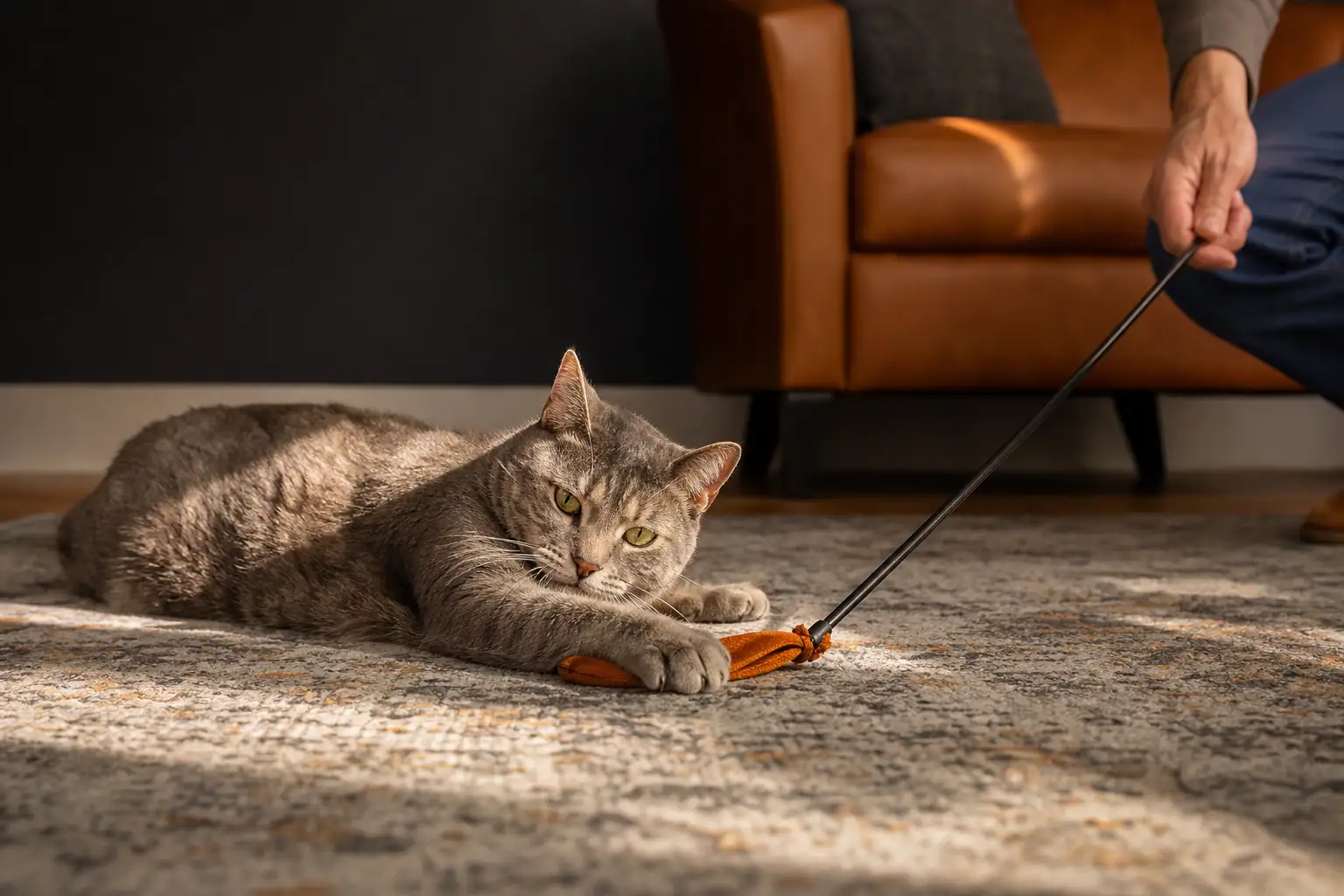
- Offer the kicker against the front paws rather than making the cat chase it across the room.
- Use shallow puzzles that do not require forceful pawing, deep neck flexion, or prolonged crouching.
- Let the cat choose posture. Sitting, side-lying, and standing play can all be valid.
Controlled activity may be part of a veterinary pain-management plan, but more is not automatically better. Record a short video of natural walking, getting up, using stairs, and playing at home. The AAFP senior-care guidelines specifically emphasize owner observations and videos because subtle mobility changes can be easier to see in the cat’s normal environment.
Choose differently for a senior cat who still plays rough
Senior does not mean gentle. An older cat may still clamp, pull, bunny-kick, and dismantle weak toys. Durability is a match between one toy, one cat, and one session—not a permanent or “indestructible” property.
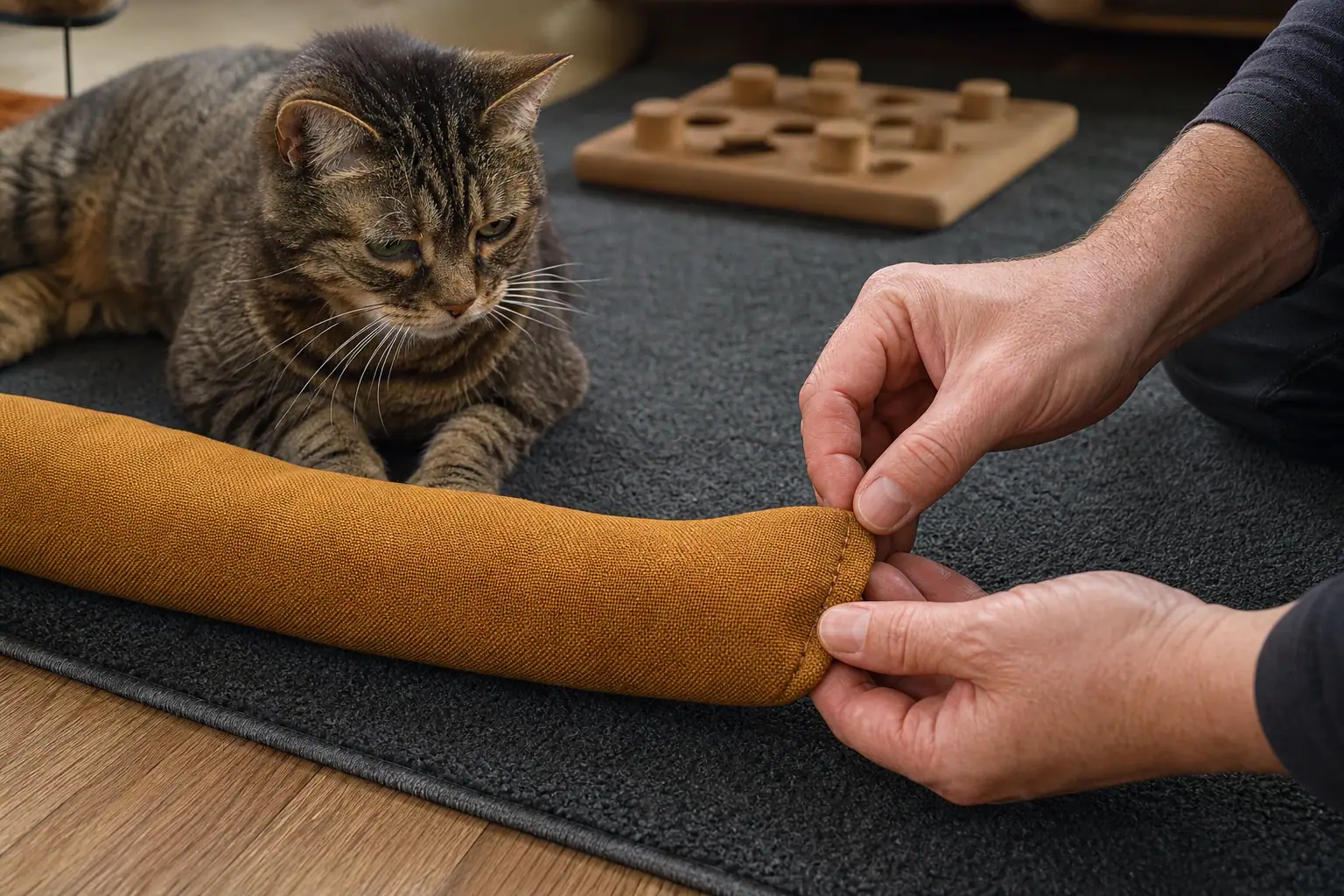
For rough play, favor simple shapes, reinforced seams, washable outer fabric, secure captive parts, and a size the cat cannot swallow. A large kicker gives the cat a legal target for teeth and hind feet without requiring a hard landing. Inspect it before and after every forceful session, especially if the cat also has dental disease or a history of eating non-food material.
The senior rough-player check
- Seams: retire the toy when stitches open or filling becomes reachable.
- Surface: look for sharp edges, cracked plastic, exposed wire, loose fibers, and sticky or flaking coatings.
- Attachments: tug gently on ears, tails, tabs, bells, feathers, and glued decorations; simpler is safer.
- Moisture: remove toys that stay saliva-soaked, smell unusual, or cannot be cleaned and dried fully.
- Grip: make sure claws do not snag deeply in loops, open weave, or damaged mesh.
- Behavior: supervised access is essential if your cat skins fabric, gnaws pieces off, or tries to eat the toy.
Our guide to durable cat toys for rough play goes deeper on materials, construction, sizing, and failure points. When a washable toy is still structurally sound but dirty, follow the material-specific steps in how to clean cat toys rather than masking odor with fragrance.
When to stop play and call the veterinarian
Stop the session if your cat repeatedly retreats, freezes, growls, swats defensively, slips, drags a limb, cannot settle, breathes with the mouth open, or seems confused. Give the cat a quiet route to a familiar resting place. Do not stretch a limb, massage a painful area, or “test” the movement again.
Contact a veterinarian promptly when you notice:
- a sudden or persistent drop in play, appetite, grooming, jumping, or social interaction;
- new stiffness, weakness, wobbling, collapsing, circling, head tilt, or an abnormal gait;
- open-mouth breathing, labored breathing, repeated coughing, or exercise intolerance;
- weight loss, increased thirst or urination, vomiting, diarrhea, or house-soiling;
- pain when touched, reluctance to be picked up, hiding, irritability, or a changed sleeping location;
- sudden vision or hearing change, disorientation, nighttime vocalizing, or altered sleep patterns;
- a damaged toy piece that may have been swallowed.
If breathing is difficult, the cat collapses, a string is hanging from the mouth or anus, or a swallowed object is suspected, seek urgent veterinary help. Do not pull visible string; it may be anchored internally.
Senior cat toy checklist
- The toy matches today’s mobility and energy—not last year’s.
- The play route is level, clear, and nonslip.
- The cat can reach, catch, and control the toy without forced jumping.
- Wand play includes frequent catches and a clear ending.
- Food puzzles start easy and use measured, diet-appropriate food.
- The toy is too large to swallow and has no accessible small parts.
- Strings, elastic, wire, feathers, and electronic mechanisms are supervised and stored afterward.
- Rough-play toys are checked before and after each session.
- The cat can pause, retreat, or finish at any time.
- New changes in play, movement, senses, appetite, or behavior go to the veterinarian.
Keep the rotation small: one supervised chase toy, one wrestle-and-catch toy, one easy search or food activity, and one low hiding or ambush space. Change the route, scent, surface, or movement before buying more objects. For a wider routine that includes scratching, resting, foraging, and choice, see our practical cat enrichment guide.
Do senior cats still play with toys?
Yes. Many senior cats still stalk, bat, chase, wrestle, forage, and explore. They may play for shorter periods or prefer lower, slower, easier-to-control toys. A persistent change from your cat’s normal play should be discussed with a veterinarian rather than dismissed as age.
What is the best toy for an elderly cat?
A ground-level wand with a simple fabric lure is the most adaptable choice because you control its speed, distance, and direction. A large kicker, shallow food puzzle, or stable ball track may be better for a cat who prefers stationary play. The best individual toy is comfortable, interesting, safely sized, and matched to the cat’s health and bite style.
How do I entertain an older cat who will not chase?
Try tiny lure movements beside a resting spot, an easy scent search, a partly uncovered food puzzle, a window view from an accessible perch, gentle target training, or a large toy the cat can grip while lying down. Watching and sniffing are forms of engagement. If the loss of chase behavior is new, arrange a veterinary examination.
Are laser toys good for senior cats?
A laser removes the weight of a physical lure, but it can still encourage sharp turns, collisions, and repeated pursuit without a catch. Never aim it at eyes or reflective surfaces. Keep the dot low and slow, avoid stairs, and always finish on a real toy or food reward. A fabric wand is usually easier to control and gives the cat something tangible to capture.
Editorial note: This guide provides general enrichment and toy-safety information. It does not diagnose pain, arthritis, sensory loss, cognitive change, or another medical condition, and it does not replace advice from a veterinarian who has examined your cat.