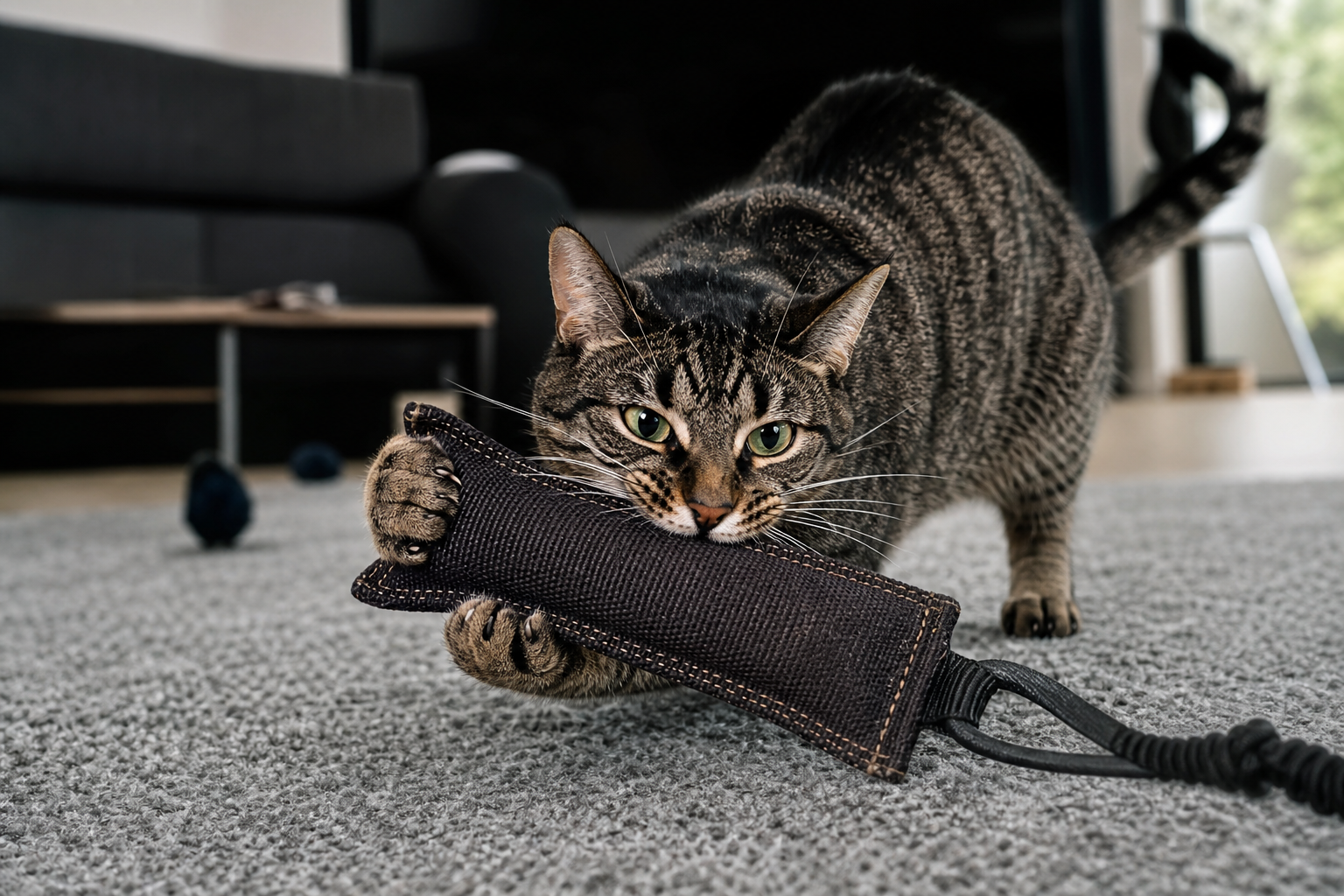
Good cat toys to chew on are large enough not to swallow, simple enough not to shed parts, and interesting enough to redirect your cat away from cords, plastic, fabric, plants, and hands. For most cats, the safest starting points are flexible rubber or silicone cat chew toys, rugged fabric kickers, silvervine-style chew sticks, cardboard scratchers, puzzle feeders, and supervised wand-to-catch play.
The wrong answer is handing over the strongest-looking object and hoping it survives. A chew toy needs to match how your cat chews. A rubber gnawer, a seam picker, a teething kitten, a bunny-kicking wrestler, and a cat that swallows non-food objects all need different rules. No cat toy should be treated as indestructible.
This guide is for owners who are tired of finding shredded fluff, bitten cords, or tooth marks in household objects. It explains what cats can chew on, what to avoid, when chewing may point to a health problem, and how to build a chew-safe toy rotation.

What Current Search Results Get Right and Miss
Current results for this topic are useful for discovering product categories: rubber chew wheels, dental mesh toys, catnip pouches, silvervine sticks, stuffed kickers, and marketplace chew-toy pages. Reddit threads add real owner frustration, especially for cats that chew wires or plastic. The weak spot is that many pages jump straight to products without helping owners diagnose the chewing pattern first.
That pattern matters more than the label on the package. A toy marketed as a dental chew can unravel in front of a seam picker. A silvervine stick can be fine for a gentle gnawer and a poor fit for a cat that splinters plant material. A small rubber toy can be fun until a hard biter removes nubs. The better question is not just, “What toy can my cat chew?” It is, “What toy can my specific cat chew without turning it into swallowable pieces?”
Titan Claws covers the same safety-first approach in safe cat chew toys, toys for cats that chew, and cat chew toys for aggressive chewers. Use those companion guides if your cat is already destroying ordinary toys.
First, Figure Out Why Your Cat Wants to Chew
Chewing can be normal play, teething, exploration, boredom relief, stress behavior, prey behavior, or a response to mouth discomfort. Watch one full session before buying more toys. Look at what your cat chooses, how hard they bite, and whether they spit out or swallow what comes loose.
- Rubber and cord gnawer: seeks springy, semi-firm textures such as wires, silicone, plastic edges, or rubber feet. Offer flexible rubber or silicone cat toys and block access to cords.
- Fabric shredder: opens seams, removes labels, or eats thread. Use fewer plush toys, choose stronger fabric, and supervise closely.
- Wrestler: grabs, bites, holds, and bunny-kicks. A longer rugged kicker may work better than a tiny chew toy.
- Teething kitten: chews because the mouth is changing. Use softer kitten-sized textures and avoid hard adult chews.
- Sensory chewer: likes scent, crinkle, cardboard, or plant material. Rotate safe sensory outlets instead of relying on one item.
- Pica-risk cat: swallows fabric, plastic, rubber, string, litter, or other non-food items. This is a veterinary and household-management issue, not only a toy issue.
If your cat is young, start with kitten chew toys or kitten teething toys. If the chewing is intense in an adult cat, treat a sudden change as a reason to check teeth, stress, diet, and environment.
Best Cat Toys to Chew On by Situation
No single chew toy type is safest for every cat. The best option is the one that gives your cat a satisfying bite while staying intact, visible, and easy to inspect.
Flexible Rubber or Silicone Toys
Flexible rubber and silicone can work well for cats that like a springy mouthfeel. Choose cat-sized toys that flex under pressure but do not have thin fins, tiny raised nubs, brittle edges, or small detachable parts. If your cat leaves deep gouges, sticky spots, cracks, or missing chunks, retire the toy. For a deeper material guide, see rubber chew toys for cats.
Rugged Fabric Kickers
Some cats described as chewers are really rough players. They want to bite and hold a target while kicking with the back legs. A longer fabric kicker gives that energy a legal target, especially after wand play. Keep it simple: dense fabric, strong stitching, no glued-on eyes, no loose tails, no long ribbons, and no exposed stuffing.
Silvervine or Catnip-Scented Chew Toys
Silvervine and catnip can make a safer toy more interesting, but scent also raises excitement. That means construction matters more, not less. Use silvervine sticks only under supervision until you know how your cat breaks them down. Remove loose bark, splinters, softened fragments, or pieces small enough to swallow. For more detail, read cat chew sticks.
Dental-Marked Cat Toys
Dental mesh toys, chew wheels, and textured toys may help some cats chew a legal surface. They are not a substitute for veterinary dental care. If you see bad breath, red gums, drooling, blood on toys, dropped food, chewing on one side, or a sudden new chewing habit, schedule a dental exam instead of trying to solve it with a toy.
Cardboard, Scratchers, and Puzzle Feeders
For many indoor cats, chewing improves when the day contains more work. Cardboard scratchers, paper bags with handles removed, puzzle feeders, treat scatters, and food-dispensing toys can satisfy hunting and foraging without asking one chew toy to carry the whole routine. If your cat eats cardboard or plastic parts, use these only while supervised.

If Your Cat Chews Wires, Fix the Room Before the Toy Bin
Wire chewing is not just annoying. PetMD notes that cats may chew cords because of texture, prey-like movement, boredom, stress, pica, nutritional issues, or dental disease, and that exposed wires can cause mouth burns, shock, swallowed material, and other serious injuries. Cornell’s Feline Health Center also warns that chewing wires and plugged-in cords is dangerous and recommends tying cords up or using heavy plastic cord protectors.
Use this order:
- Remove the immediate hazard. Unplug accessible cords when possible, route them behind furniture, bundle loose sections, or use rigid cord covers.
- Offer a legal texture. Place a flexible rubber or silicone chew toy, kicker, or scratcher near the old chewing zone.
- Add daily prey play. Use a wand toy or tossed toy so the cat can stalk, chase, catch, and bite something appropriate. Store string toys afterward.
- Check health triggers. Ask your veterinarian about dental pain, pica, stress, nutritional issues, or compulsive behavior if chewing is persistent or sudden.
- Reward the better choice. Praise, treats, or a short play burst can reinforce using the chew toy instead of the cord.
Do not rely on bitter sprays alone. They may help some cats, but they do not remove the electrical risk, and they do not explain why the cat wants that texture in the first place.
What Not to Give a Cat to Chew On
The University of Wisconsin School of Veterinary Medicine specifically warns that aggressive chewers may ingest feathers, strings, sparkles, and loose decorations, and that intestinal obstruction can be serious. That is the lens to use for every toy, even toys sold for cats.
- Avoid string, yarn, ribbon, tinsel, elastic, and rope for unsupervised chewing. Linear material can be especially dangerous if swallowed.
- Avoid feathers and sparkly decorations for cats that grind toys in their mouth. They are exciting, but they are also easy to remove.
- Avoid tiny bells, glued eyes, hard beads, and plastic charms. A determined cat can turn cute details into choking or swallowing risks.
- Avoid brittle plastic. Cracks can create sharp edges or chewable shards.
- Avoid rock-hard chews. If it does not give under pressure, it may be a poor match for feline teeth.
- Avoid dog chews by default. Some are too hard, too heavy, chemically treated, or shaped wrong for a cat’s mouth.
- Avoid plush toys after seams open. Exposed stuffing is a retirement sign.
The safer standard is simple: large enough, soft enough to protect teeth, strong enough not to shed pieces quickly, and plain enough that you can inspect every part.
A Better Chew Toy Routine for Rough Cats
A single chew toy left on the floor all week usually gets boring or gets destroyed. Build a small rotation that gives your cat several ways to use the mouth without turning one object into a project.
- Start with chase. Use a wand or tossed toy for short bursts of stalking and pouncing.
- End with a catch target. Let the cat grab a kicker or chew-safe toy when excitement peaks.
- Offer the chew outlet. Give a flexible rubber toy, silvervine-style item, or rugged fabric toy for a short supervised chew session.
- Add foraging. Use a puzzle feeder, treat scatter, or cardboard hide-and-seek setup.
- Inspect before storage. Check bite zones, seams, attachments, and missing pieces before the toy goes back in the bin.
If boredom is driving the chewing, pair this plan with cat toys for enrichment and free cat enrichment ideas. If your cat bites hands and ankles during play, use cat toys for play aggression as the companion guide.

Inspection Rules: When to Retire a Chew Toy
The safest chew toy is not the one that looks new forever. It is the one that fails slowly and visibly enough for you to remove it before your cat swallows part of it.
- Missing chunks, nubs, bark, fabric, rubber, or cardboard.
- Open seams, exposed stuffing, or leaking catnip.
- Long threads, rope strands, elastic loops, or loose tags.
- Sharp edges, cracks, splinters, sticky spots, or brittle areas.
- Small pieces on the floor after play.
- A toy that has become small enough to fit deep in your cat’s mouth.
- Strong odor, dampness, grime, or residue that cannot be cleaned.
- Your cat switches from chewing the surface to trying to eat the toy.
For hard chewers, inspect before and after play. For new toys, supervise the first several sessions. If a toy fails in a risky way once, do not buy the same design again just because your cat liked it.
When Chewing Needs a Veterinarian
Normal play chewing is common. Eating non-food objects, chewing suddenly, chewing obsessively, or chewing along with mouth symptoms deserves more attention. AAHA lists dental warning signs such as bad breath, red or swollen gums, drooling, blood on chew toys, dropped food, and eating on only one side of the mouth. Those signs should not be treated as a toy-shopping problem.
Call your veterinarian promptly if your cat swallows toy pieces, string, fabric, rubber, plastic, or wire coating, or if you see vomiting, gagging, appetite loss, lethargy, belly pain, drooling, oral burns, blood, or straining. For cats that chew and swallow objects repeatedly, combine veterinary input with a stricter room setup: closed closets, protected cords, no loose hair ties, no unattended fabric piles, and supervised enrichment only.
Quick Checklist
- Have I identified whether my cat gnaws, wrestles, picks seams, or swallows pieces?
- Is the chew toy too large to swallow and simple enough to inspect?
- Does the material flex without cracking, splintering, or shedding small parts?
- Have I removed or avoided ribbons, bells, feathers, loops, tags, and glued decorations?
- Did I supervise the first sessions and check how the toy actually fails?
- Are cords, plastic, fabric, and string-like household hazards blocked or stored?
- Does my cat also get chase, catch, scratch, forage, climb, and rest outlets?
- Will I retire the toy as soon as it creates loose or swallowable pieces?
The best cat toys to chew on are not magic objects. They are better outlets inside a safer routine. Match the toy to your cat’s chewing style, block the household hazards, inspect honestly, and replace early. That is how chewing becomes enrichment instead of another emergency risk.