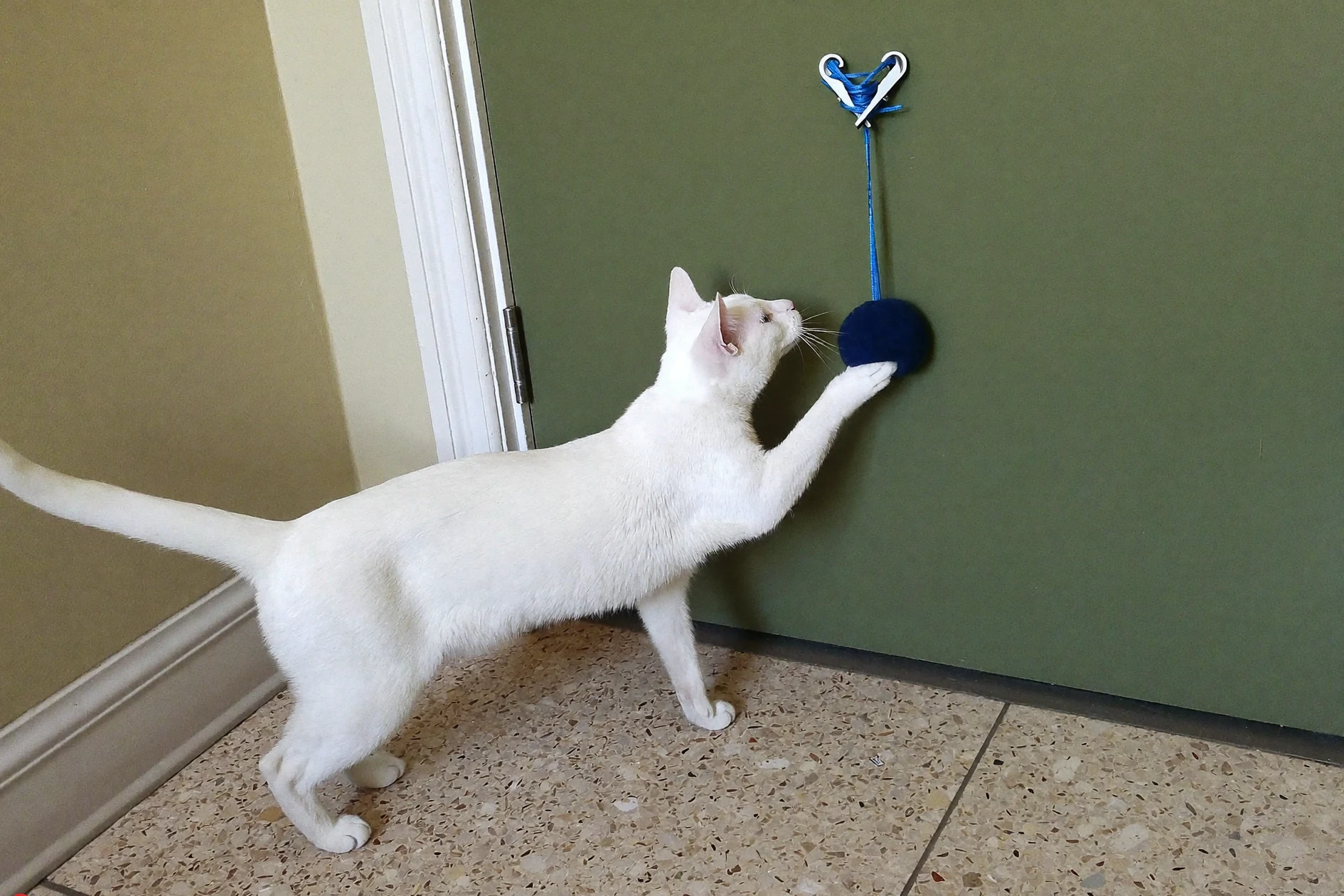
Hanging cat toys can create an exciting stalk, leap, and catch game, but toys on string or elastic should be treated as supervised play equipment—not all-day entertainment. Choose a simple, appropriately sized lure, an attachment you can inspect, and a cord that your cat cannot chew into loose strands. Hang it in a clear play area, watch the entire session, then remove or secure it in closed storage.
That rule matters even when a product is advertised for independent play. A determined cat can wrap a paw or body in slack line, bite through elastic, pull a small part free, or swallow string. The best hanging cat toy is therefore not the one that stays up longest. It is the one you can control, inspect, and put away before its weakest part fails.
Are Hanging Cat Toys Safe?
They can be useful during active supervision. They are a poor choice for unattended access when they include string, ribbon, wire, elastic, feathers, bells, clips, or a small lure. Supervision means an adult is present, watching the cat, and close enough to stop the game—not simply somewhere else in the home.
The Cornell Feline Health Center advises avoiding toys with small pieces or strand-like parts that may separate during chewing and be swallowed. The AAFP and ISFM feline environmental needs guidelines likewise say that toys with string or potentially ingestible parts should be put away after play.
Use a different leave-out option when nobody can watch: an intact track toy, a correctly sized sturdy ball, a simple food puzzle, or another toy your individual cat has used safely through repeated checks. If your cat eats thread, wool, fabric, plastic, or other non-food material, ask your veterinarian what types of enrichment are appropriate.

Why cats like dangling toys
A suspended lure changes direction when it is tapped, retreats when it is pulled, and returns after a miss. That unpredictable motion can resemble small prey and lets a cat stalk, chase, pounce, grab, and sometimes kick. Those behaviors are not frivolous: veterinary environmental guidance identifies opportunities for play and predatory behavior as a core part of a healthy feline environment.
The movement is only half the game. Let your cat catch the lure regularly. A toy that always springs out of reach can turn a hunting sequence into repetitive frustration. After a catch, pause. If your cat wants to clamp down and rabbit-kick, trade the hanging lure for a larger capture toy rather than allowing prolonged chewing on cord or elastic.
For more owner-controlled chase technique, see the Titan Claws guide to using a feather wand cat toy safely. If you are comparing suspended toys with powered or rolling options, our guide to cat toys that move covers their different failure points.
Choose the Right Hanging Style
Most hanging cat toys use a door frame, wall or window mount, cat-tree attachment, or ceiling anchor. Stores may also call them dangling teasers, bungee toys, retractable toys, or suspended cat toys. None is automatically safe. Choose by the way the whole system behaves when your cat pulls—not by how lively the lure looks in a product video.
| Style | What it does well | Main checks |
|---|---|---|
| Door-hanging cat toy | Easy to install and remove for a supervised session | Door cannot swing or close; mount does not drop a hard part; line stays away from hinges |
| Wall or window-mounted toy | Creates side-to-side batting and can suit a small room | Surface and adhesive suit the stated load; mount cannot become a chewable loose piece |
| Cat-tree hanging toy | Adds motion to a familiar play station | Tree stays stable; line cannot reach a neck, leg, platform edge, or nearby gap |
| Ceiling-hung toy | Offers a wide movement area | Purpose-built anchor; no fan, light, sprinkler, or improvised fixture; fully removable after supervised play |
| Motorized wall toy | Varies motion without constant hand movement | Protected battery door, no exposed charging cord, controlled session, automatic motion does not equal unsupervised safety |
Avoid hanging any toy from a ceiling fan, light fixture, curtain rod, blind cord, open door, unstable shelf, or object that can fall. Keep play away from stairs, glass, hot surfaces, breakables, and narrow gaps where a cat can land awkwardly. A door-hanging toy needs a door that cannot move while the cat plays; use a different location in a busy passageway.
Inspect the Five Failure Points Before You Buy
- The anchor: It should match the intended surface, remain visible for inspection, and not rely on an improvised household fitting. A mount that tears free can fall onto the cat; an immovable anchor paired with a long loop creates a different risk.
- The line: Skip fishing line, thread, ribbon, yarn, exposed rubber, or thin elastic your cat immediately tries to chew. A covered line is not automatically safe, but damage is often easier to see on a thicker, contrasting material.
- The adjustment: Knots, sliders, swivels, clips, crimps, and retractors are all potential weak points. Check whether each one can loosen, trap fur or a claw, or become a small swallowed part.
- The lure: Prefer a simple, intact lure that is too large for your cat to swallow whole. Avoid glued eyes, loose bells, brittle plastic, shedding feathers, open seams, exposed stuffing, and narrow tails for hard chewers.
- The storage plan: Decide where the complete toy will go after play. If removing it is awkward or the lure still hangs within reach when “put away,” the setup encourages risky access.
“Heavy-duty elastic” describes resistance to pulling; it does not prove that the toy is safe to chew, impossible to tangle in, or suitable without supervision. For a broader materials and seam check, use our durable cat toy buying checklist.

How to Hang and Test a Cat Toy
- Read the product instructions. Confirm the intended surface, installation method, weight or pull limits if provided, and whether the maker requires supervision.
- Clear the play zone. Give your cat a non-slip landing area and an open exit. Move cords, bags with handles, breakables, unstable furniture, and other pets that may crowd the game.
- Install without improvised extensions. Extra ribbon, string, rubber bands, wire, and homemade loops add failure points. Do not combine parts from unrelated products unless the manufacturer says they are compatible.
- Check every connection by hand. Gently test the mount, line, adjuster, and lure before the cat enters. Stop if anything shifts, opens, frays, exposes adhesive, or develops a sharp edge.
- Set the shortest practical line for the game. The lure should remain reachable, but there should not be loose coils or a body-sized loop. Because cats and rooms differ, there is no universal safe hanging height.
- Run a short first session. Watch whether your cat bats the lure, chews the line, twists repeatedly, wraps a limb, crashes into the mount, or tries to climb the cord. The cat’s actual behavior decides whether the setup is suitable.
- End, inspect, and store. Allow a final catch, trade for an intact kicker or food activity, detach the hanging toy, and put every cord and lure in closed storage.
Stop immediately if the line touches or loops around the neck, chest, abdomen, tail, or a limb. Calmly support the cat and release tension; do not yank a trapped limb against taut elastic. If your cat is hurt, breathing abnormally, limping, or cannot be freed quickly, seek urgent veterinary help.
Better Hanging Play for Cats That Destroy Toys
Rough play changes the job of the hanging toy. It should create the chase, not absorb unlimited biting. A cat that braces, pulls hard, chews the cord, or dismantles attachments needs shorter sessions and an earlier handoff to a large kicker or other supervised capture toy.
- Choose fewer components. Every bell, feather, clip, tail, and decoration is another part to inspect.
- Keep the lure visually different from the line so you can see whether the cat is targeting the toy or the cord.
- Interrupt cord chewing by making the lure move away, then end the session if the cat returns to the line.
- Keep replacement lures ready, but retire damaged parts before—not after—they break.
- Play with cats separately if two cats twist the line around each other, compete at the mount, or block one another’s escape.
Some cats are simply a bad match for hanging elastic. That is useful information, not a failed purchase. Try owner-held wand play, a track toy with a captive ball, a tunnel-and-toss game, or a food puzzle that provides movement without an accessible long line.
Can You Make a DIY Hanging Cat Toy?
You can make a supervised dangling lure, but the safer DIY boundary is to keep it in your hand like a wand and store it when the session ends. Do not create a permanent unattended hanging toy from yarn, fishing line, thread, dental floss, ribbon, rubber bands, hair ties, wire, or elastic cord. Familiar household material can still tangle, cut, snap back, or become a linear foreign body if swallowed.
For a simple supervised project, attach one large, plain fabric lure to a sturdy handle with a short, visible connection you inspect before every use. Skip bells, beads, staples, glued decorations, feathers that shed, and stuffing your cat can pull out. If you cannot verify the anchor and every connection, make a toss toy or cardboard foraging activity instead of suspending it.
When to Replace the Toy—or Call a Veterinarian
Retire the line or the entire toy if you see fuzzing, thinning, fraying, exposed elastic, permanent stretching, bite notches, a loose knot, a bent clip, a shifting mount, cracked plastic, leaking stuffing, loose feathers, or any missing piece. Replace it as soon as the damage appears; do not wait for the next hard pull to finish the break.
If you know or suspect that your cat swallowed string, elastic, ribbon, fabric, a feather, or another toy part, contact your veterinarian or an emergency clinic promptly even if the cat seems normal. Vomiting, retching, reduced appetite, lethargy, hiding, abdominal discomfort, diarrhea, straining, or strand-like material at the mouth or rectum are urgent warning signs. Do not pull visible material and do not induce vomiting unless a veterinarian specifically directs you. Titan Claws’ guide to foreign-body ingestion in cats explains why quick veterinary advice matters.
Quick Hanging Cat Toy Checklist
- Will an adult actively watch the full session?
- Is the mount designed for this surface and away from doors, stairs, fans, blind cords, and breakables?
- Is the line short, visible, intact, and free of loose loops?
- Is the lure simple, intact, and too large to swallow whole?
- Are clips, knots, swivels, adhesives, seams, and retractors easy to inspect?
- Does your cat attack the lure rather than chew or climb the line?
- Can your cat land with traction and leave the play area freely?
- Will you detach and store the whole toy immediately after play?
Bottom line: Hanging cat toys are best for short, supervised chase sessions. Choose the whole system—anchor, line, connections, lure, room, and storage habit—not just the moving end. Let your cat catch it, switch rough biting onto a better capture toy, inspect every part, and put the dangling toy away when the game is over.