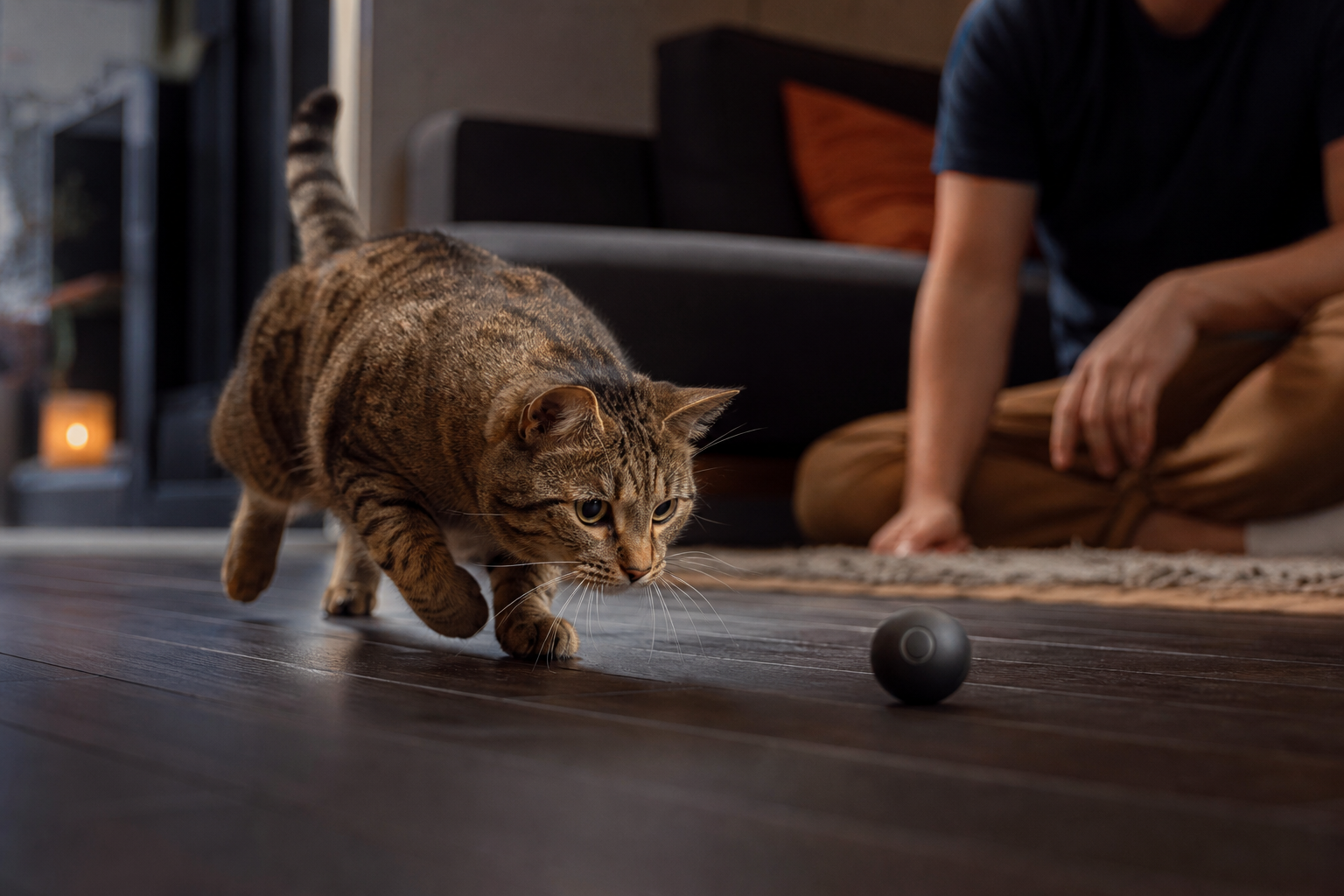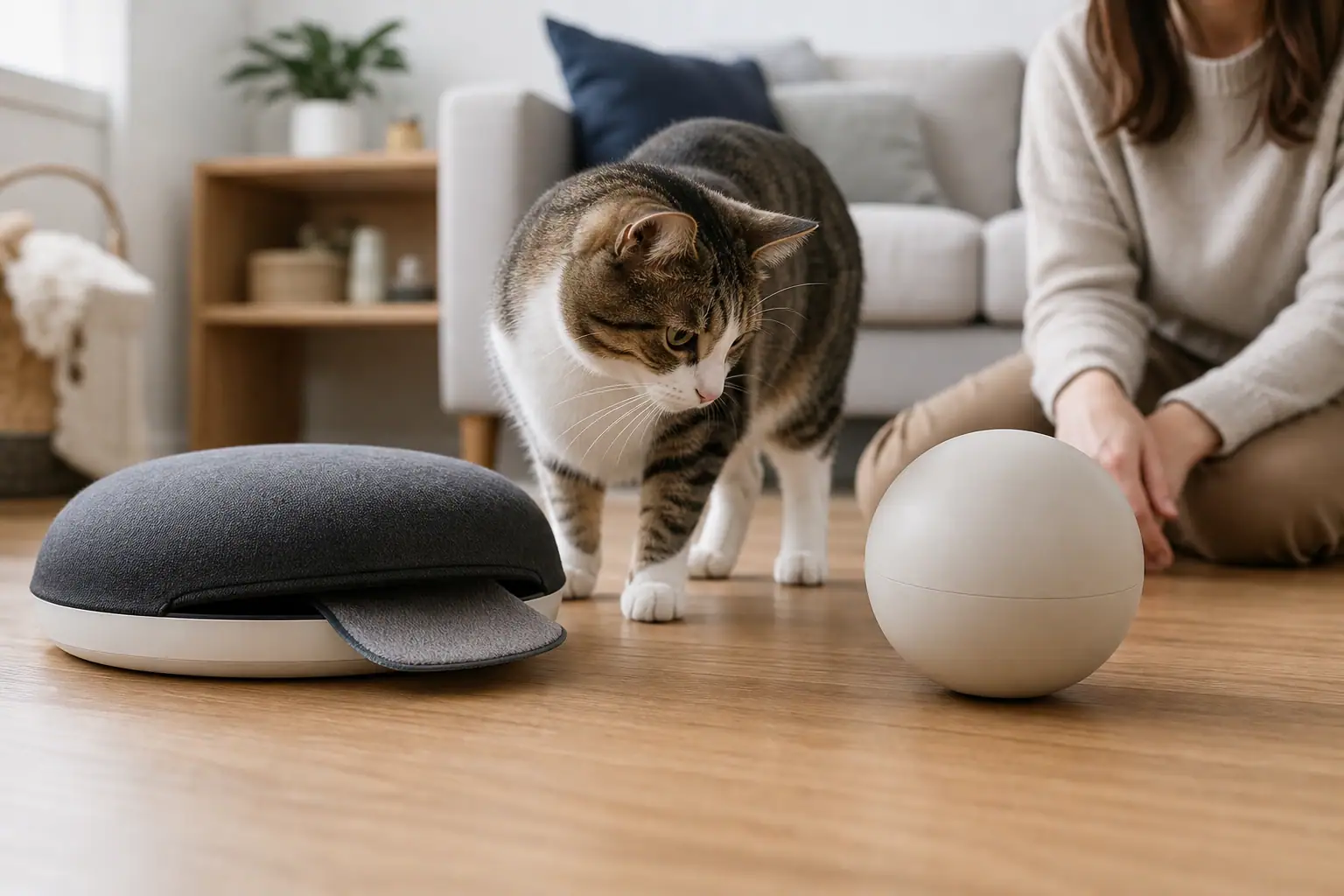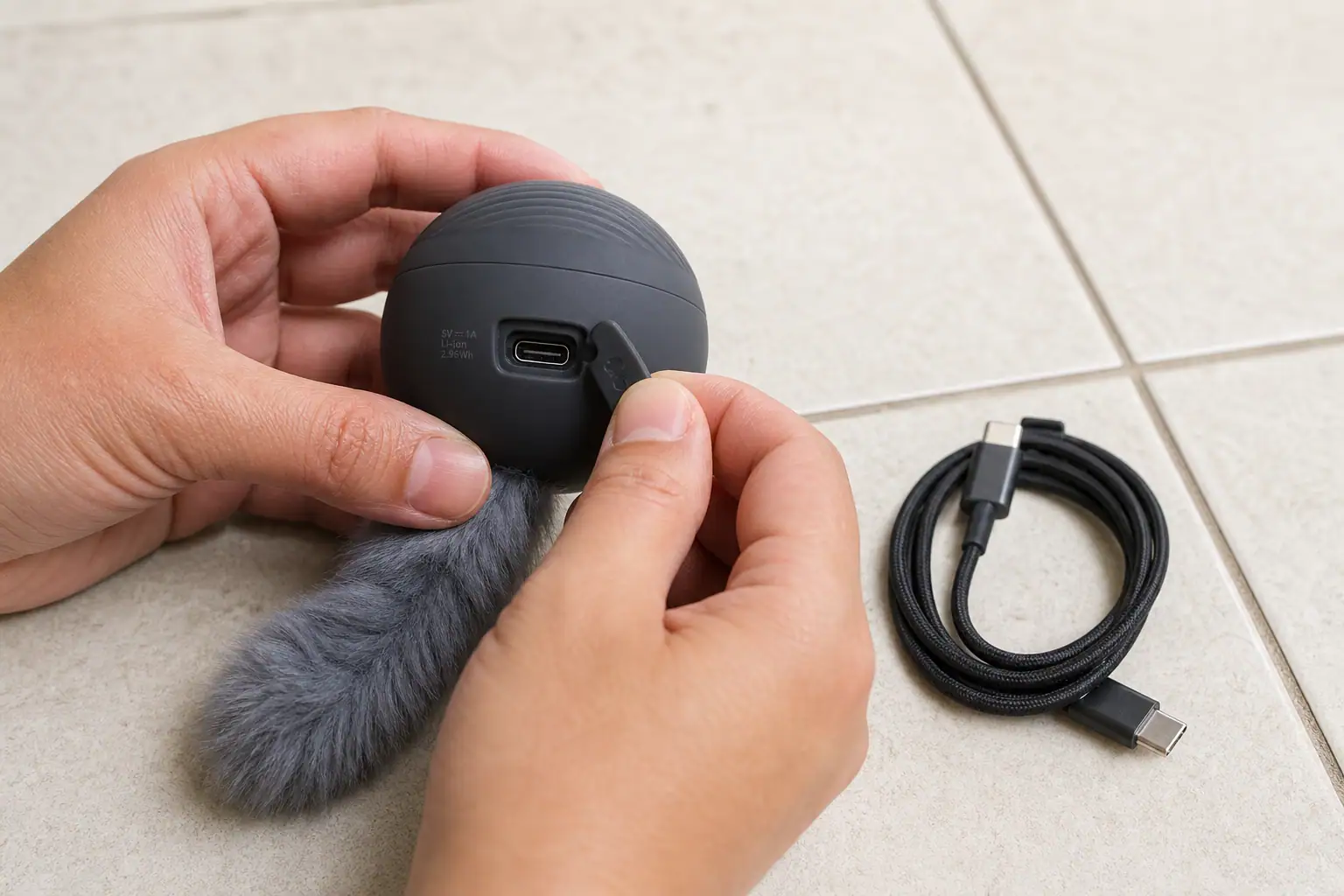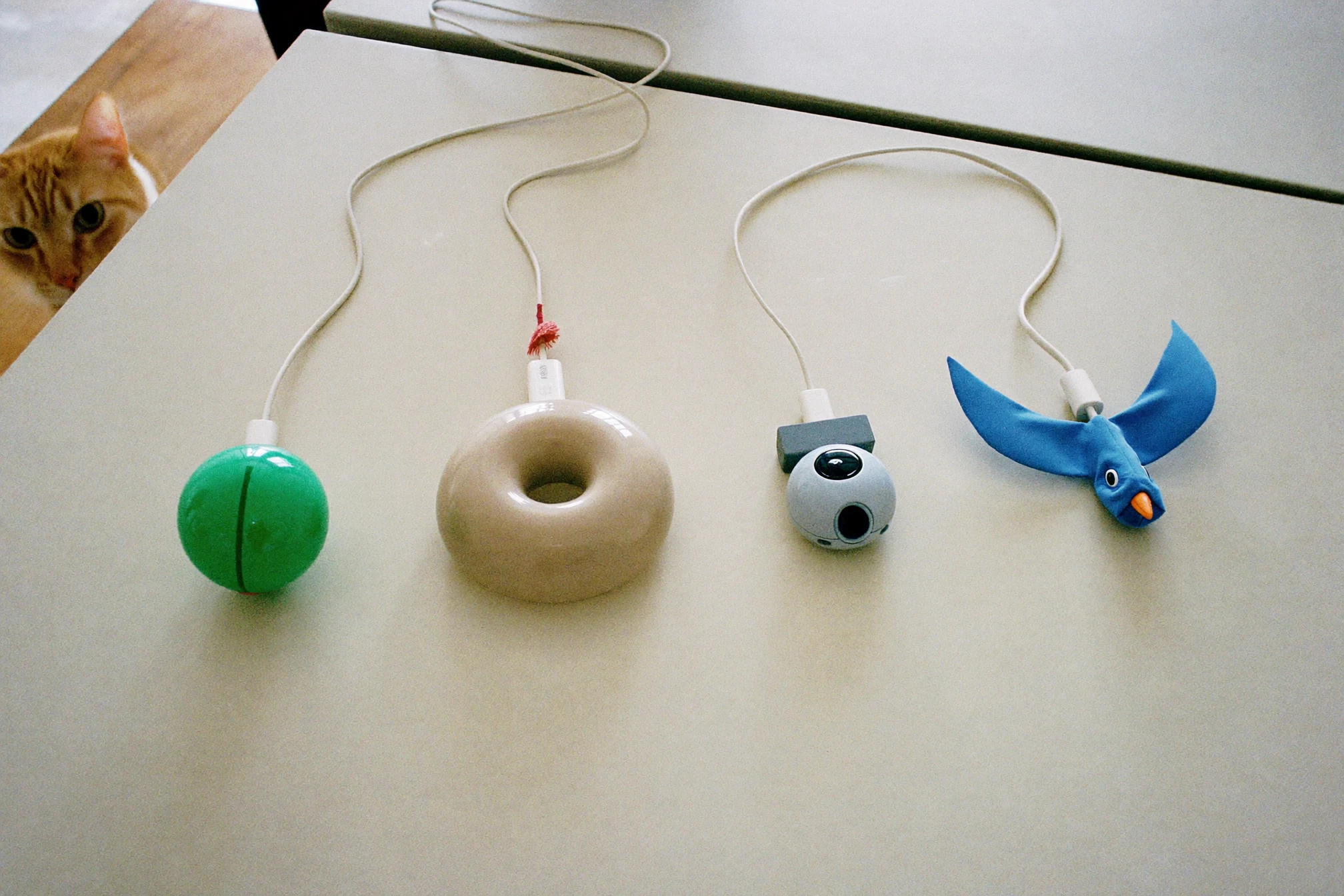
A floppy fish cat toy can be worth trying for a cat that likes to grab, wrestle, and bunny-kick—but it is not a universal hit and it is not a set-and-forget toy. The motor noise and sudden movement scare some cats. Rough players can also reach the hard electronic insert if the cover, zipper, or internal pocket fails.
Treat the moving fish as a supervised electronic toy, not an indestructible kicker. Choose one with a removable sealed motion module, a secure closure, washable cover, protected charging port, clear instructions, and no glued fins or small decorations. Introduce it switched off, use short flopping bursts, and inspect it after every energetic session.
What is a floppy fish cat toy, and how does it work?
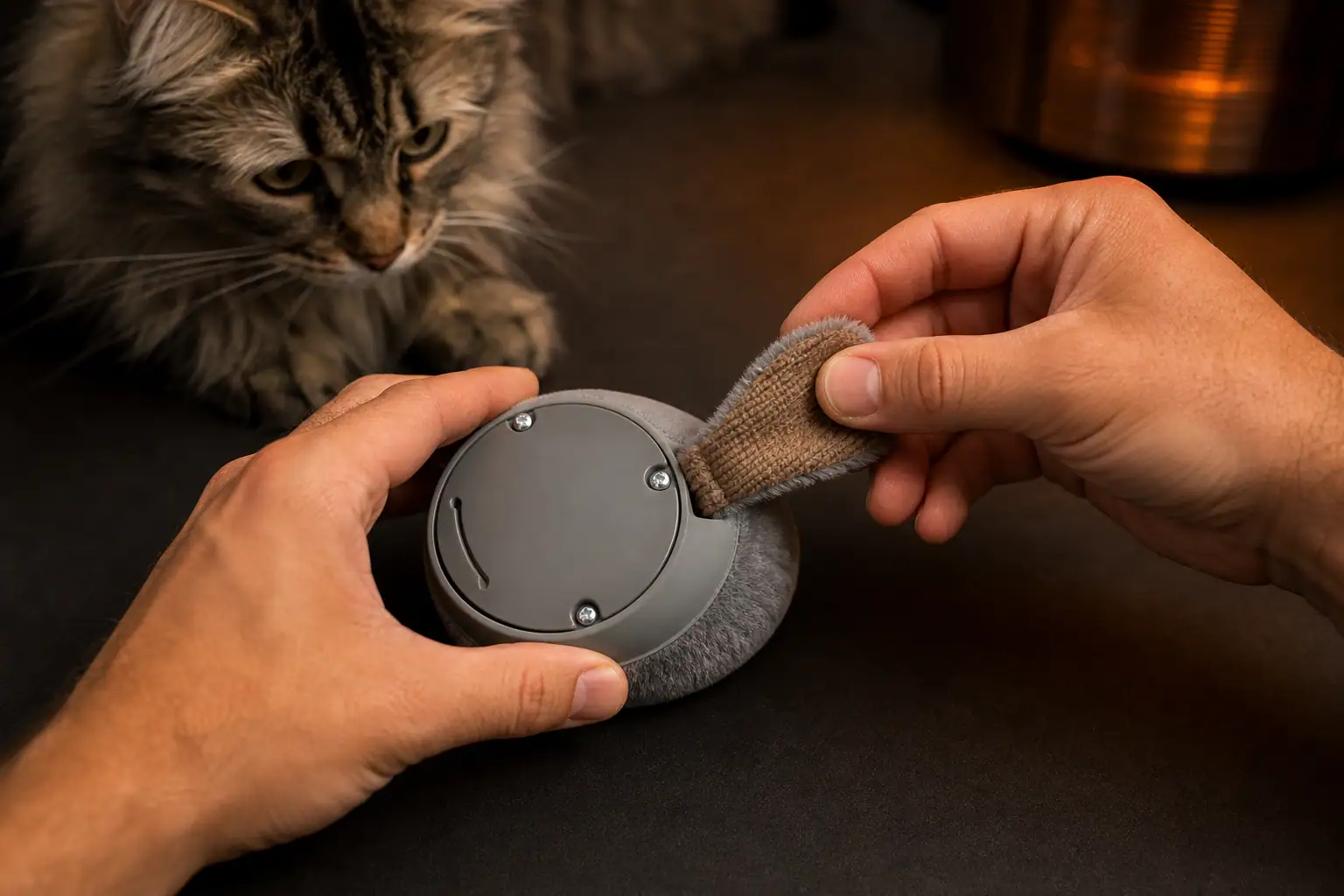
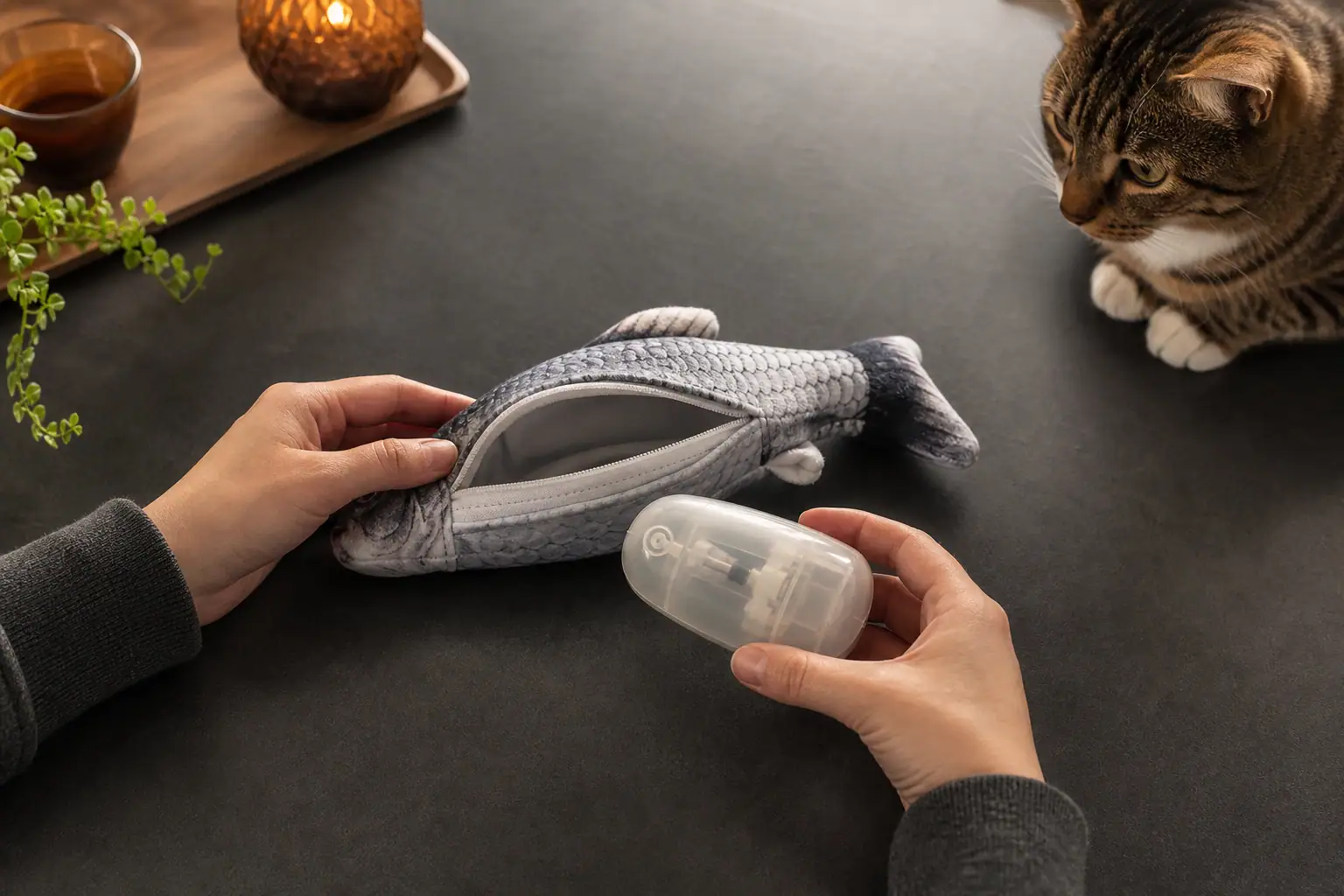
A floppy fish cat toy is a fish-shaped plush cover wrapped around a small motorized insert. On common models, tapping or moving the toy triggers a sensor; an internal arm then swings the tail for a short cycle. Many versions recharge by USB and include an internal pocket for a sealed catnip sachet.
The useful idea is not that a printed fish looks exactly like prey. It is that the toy combines three behaviors in one object: movement to notice, a body to grab, and enough length to rake with the hind feet. That makes it closer to an electronic kicker than to a ball or wand.
| Feature | Why it may help | What can go wrong |
|---|---|---|
| Touch-activated flopping | Movement returns when the cat makes contact | A sensitive sensor or abrupt start can frighten a cautious cat |
| Plush fish-shaped cover | Gives forepaws and hind feet a broad target | Thin fabric or weak seams can expose the hard module |
| Removable motor | Allows the cover to be cleaned separately | An insecure zipper or pocket gives teeth access to electronics |
| USB charging | Avoids routine disposable-battery changes | The port, cell, cable, and charging routine add failure points |
| Catnip pouch | Scent may encourage investigation | Not every cat responds, and loose plant material can foul the mechanism |
Specifications vary by brand and revision. Do not assume that charge time, connector, wash method, shutoff behavior, or replacement parts from one listing apply to another. Keep the instructions for the exact model you own.
Will your cat actually like a flopping fish?
Play style predicts more than popularity. A cat that already hugs long plush toys and kicks with both hind feet is a better candidate than a cat that only stalks tiny, quiet targets. Cats that chase movement may watch the tail but dislike contact with a vibrating body. Others may enjoy the fish only when its motor is off.
Published hands-on reviews show that split clearly. In one test, the cats avoided the activated fish and accepted it only after the motor was removed. In another, the cat was interested but overwhelmed by the motion and played most enthusiastically once the battery had died. Those are individual cats, not a controlled trial, but they are a useful warning against treating viral reactions as a guarantee.
- Good candidate: confidently wrestles kicker toys, investigates vibration, recovers quickly from new sounds, and does not dismantle plush.
- Possible candidate with a slow introduction: likes ground prey but pauses around noise or sudden movement.
- Poor candidate: hides from buzzing appliances, bites charging ports or plastic housings, tears directly into seams, or tries to swallow stuffing.
- Wrong use: a toy expected to entertain an unsupervised cat for hours.
Catnip is another variable, not a quality test. Research on cat-attracting plants has found meaningful differences among individual cats, so indifference to the included pouch does not mean the fish is defective. Try the motion and shape separately before adding more scent.
Cats also habituate to an unchanging toy. A study of object play in adult cats found play intensity declined by the third exposure to the same toy. Store the fish between sessions and rotate it with other movement, texture, and foraging games rather than leaving it on the floor until it becomes furniture.
Seven checks before you buy
- Secure module pocket: the closure should sit flat and remain inaccessible while the cat grips the fish. A covered zipper is preferable to a loose flap.
- Sealed electronic insert: reject visible battery cells, loose wiring, cracked housings, or a module that rattles. The cat should never contact the cell or internal mechanism.
- Plain, inspectable cover: choose reinforced seams and printed details instead of glued eyes, sequins, plastic fins, bells, or narrow ribbons.
- Right size for kicking: the fish should be long and broad enough for your cat to hold without wrapping teeth around the thick electronic center. Small does not automatically mean safer.
- Useful controls: look for a physical on/off switch and short automatic cycles. A low-intensity mode or owner-controlled start is helpful for cautious cats.
- Specific care instructions: confirm that the motor can be removed and the maker explains whether the cover is hand washable or machine washable. “Washable” is too vague by itself.
- Real support: look for a model number, manual, warranty, seller contact, and replacement-cover information. A low price is poor value if a failed port turns the whole toy into waste.
Read recent reviews for the exact version, focusing on repeated failure patterns rather than the average star score. Search within reviews for zipper, seam, charging port, noise, sensor, and stopped working. Product revisions can change, so check dates and photos.
If rechargeable mechanisms are new to you, use our broader rechargeable cat toy buying and charging guide to compare battery access, ports, timers, cleaning, and failure behavior.
How to introduce a floppy fish without startling your cat
Do not switch it on beside a sleeping cat or toss a flapping object toward the cat. A moving target that advances suddenly can feel more confrontational than prey-like. Give the cat control over distance and let curiosity build.
- Inspect and charge out of reach. With the module switched off, check the housing, port, cover, seams, closure, and included scent pouch. Charge only as the model instructions direct, away from the cat.
- Present the fish switched off. Set it several feet away in an open room with an easy exit. Let the cat approach, sniff, touch, or ignore it. Do not hold the cat near it.
- Test one cycle without the cat. Learn the noise, intensity, duration, and sensor sensitivity yourself. A fish that jumps hard on tile may be gentler on a rug.
- Soften the first movement. With the cat at a comfortable distance, partly hide the tail under a blanket edge or behind a box and trigger one brief cycle. Keep your hands away from the moving mechanism.
- Allow retreat or capture. If the cat approaches with loose posture, continue briefly. If the cat freezes, flattens the ears, crouches away, lashes the tail, bolts, or hides, switch it off and create distance.
- Finish with a safe catch. Let a suitable cat wrestle the switched-off fish under supervision, or transition to a sturdy unpowered kicker. End before interest becomes frantic.
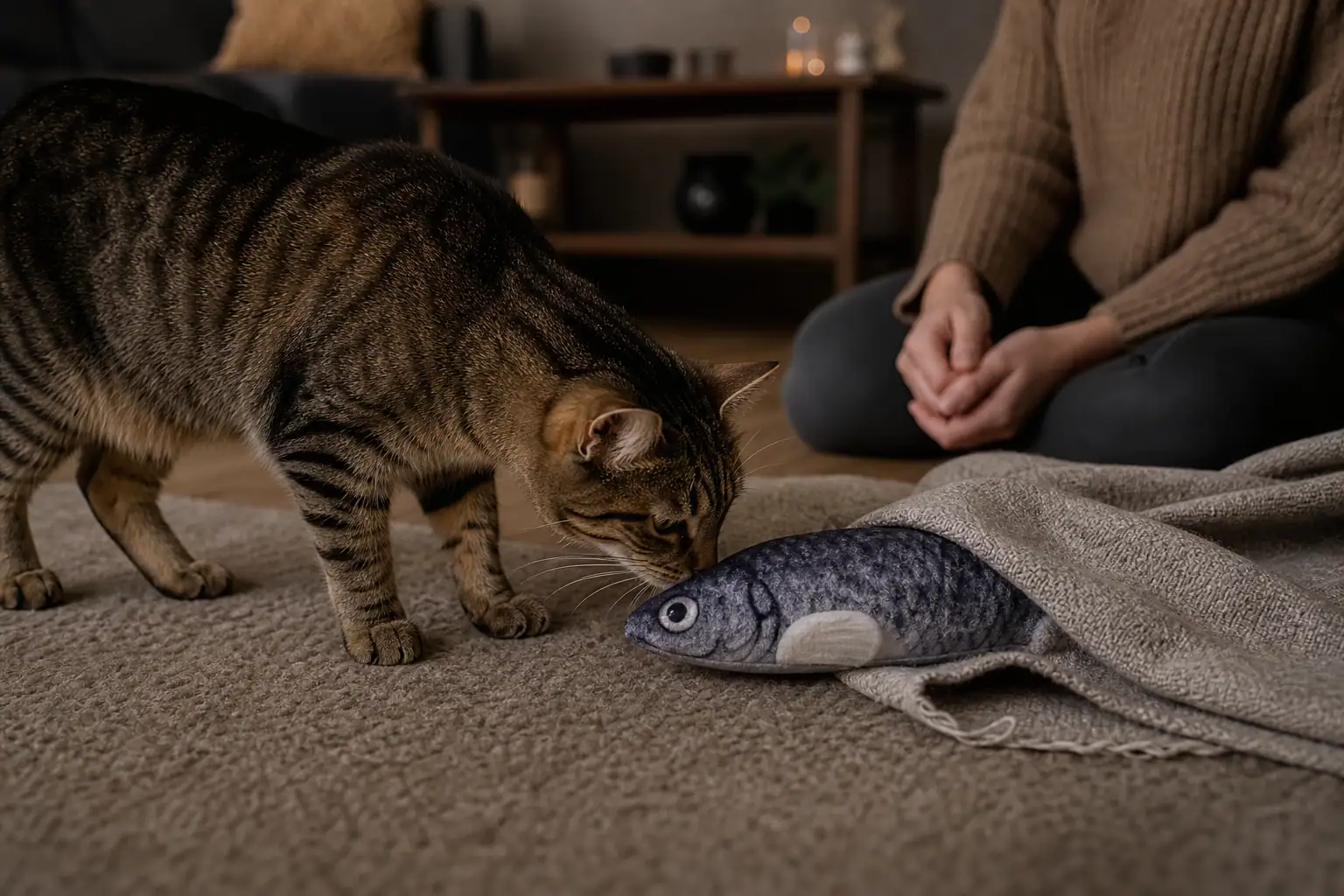
The Feline Veterinary Medical Association recommends opportunities for predatory play and notes that cats should be able to capture the “prey” intermittently. A motor can start the sequence, but it cannot adjust to your cat’s fear, frustration, or fatigue. For a fuller session structure, follow our hunt-catch-cool-down routine.
Safety rules for rough players
The plush cover is the safety barrier. Once a seam opens or the closure can be pulled apart, the fish is no longer a soft toy: it is direct access to a hard moving arm, plastic housing, wiring, battery, and possibly loose stuffing.
- Supervise every powered session, especially during the first uses and with cats that chew or dismantle toys.
- Keep the charging cable stored separately; never allow play while the fish is plugged in.
- Use the toy on a clear, dry floor away from stairs, liquids, breakables, and gaps beneath appliances.
- Do not let a dog claim it. A plush cover designed for cat play is not built to protect electronics from a strong chewing jaw.
- Do not add loose catnip beside the mechanism unless the exact instructions allow it. Use only an intact contained pouch that cannot spill or be swallowed.
- Count and inspect the cover, closure, fins, stuffing, module, switch, and port after play.
VCA’s toy guidance advises monitoring cats so they do not ingest toy material and keeping swallowable or string-like items out of unsupervised play. If part of the fish is missing, your cat chewed the battery module, or you suspect ingestion, contact a veterinarian or emergency clinic promptly. Do not wait for vomiting, appetite loss, lethargy, or abdominal pain to decide that a missing piece matters.
For a cat that defeats seams quickly, use the fish only as a short movement cue—if at all—and redirect the grab to a simpler unpowered kicker designed around the cat’s failure pattern. Our durable cat toy guide explains how to match toys to seam ripping, attachment pulling, hard chewing, and full-body tackling.
Why is my floppy fish cat toy not working?
Start with the simple checks in the manual. Do not pry open, puncture, solder, or replace parts inside a sealed lithium-battery module.
- Switch it off and inspect. Stop if the case, cable, connector, port, or battery looks damaged, wet, distorted, loose, or swollen.
- Confirm the charging procedure. Use the supplied cable and specified compatible power source. Check the model’s indicator-light instructions and disconnect after the stated cycle.
- Check the physical switch. Some models will charge while off but must be switched on before the touch sensor responds.
- Test the module outside the cover. Only if the manual permits it, place the sealed module on a clear surface, keep fingers away from the moving arm, and trigger it as directed. This separates a motor problem from a cover fitted too tightly.
- Reinstall it correctly. Align the moving arm with the tail and close every internal pocket and outer zipper fully. Never run it when the electronics remain accessible.
- Try the specified trigger. Motion-activated models may need a firm tap rather than nearby movement. Avoid striking the housing or repeatedly forcing a stalled arm.
If it still will not start, no longer holds a charge, works only when the cable is moved, sounds different, stalls under light pressure, or heats up, switch it off and contact the seller or maker. A loose port or failing cell is a replacement issue, not a cat-toy repair project.
Cleaning and storage
Remove the electronic module and catnip pouch before cleaning, but only when the instructions say the cover is removable. Close any hook-and-loop fastener or zipper to protect it. Wash by the stated method, avoid strongly scented products, rinse thoroughly, and let the cover dry completely before reassembly. Never immerse the motor, charge a damp unit, or reinstall electronics into a moist pocket.
Between sessions, switch the fish off and store it in a closed, dry place. Keep the cable separately so the cat cannot chew it. Periodic storage also preserves novelty. See our material-by-material cat toy cleaning guide for a broader cleaning and drying routine.
Better alternatives when the fish is a poor fit
| If your cat… | Try instead | Why |
|---|---|---|
| Loves kicking but destroys the motor pocket | A long, dense, unpowered kicker with reinforced seams | Provides a full-body catch without electronics inside |
| Watches the fish but avoids its noise | A quiet fabric lure moved behind cover | You control intensity, direction, pauses, and catches |
| Chases but does not wrestle | A large solid rolling toy on a clear floor | Separates pursuit from a vibrating capture |
| Ignores catnip | Motion, food puzzles, or a carefully chosen alternative cat-attracting plant | Scent response differs among cats; play does not require catnip |
| Needs solo enrichment | An appropriate food puzzle or robust nonmotorized toy proven safe for that individual | Fewer electronic and moving-part failure points |
No alternative is automatically safe to leave out. Size, materials, attachments, wear, and your cat’s known behavior still decide the supervision level.
Floppy fish cat toy checklist
- Choose it for a cat that already enjoys grabbing and bunny-kicking.
- Prefer a removable sealed module, secure closure, reinforced plain cover, and physical off switch.
- Read the exact model’s charging, activation, cleaning, and storage instructions.
- Introduce it switched off and trigger only one short cycle at first.
- Use a rug or other clear, dry, stable play surface.
- Supervise powered play and keep the cable out of reach.
- Inspect the cover, seams, pocket, module, port, and switch after every rough session.
- Retire it at the first structural, motor, port, heat, moisture, or battery problem.
- Use a simple unpowered kicker when your cat needs a tougher catch.
The best outcome is not a dramatic video. It is a cat choosing to stalk or wrestle comfortably, getting a safe catch, and stopping with the toy still intact. If your cat prefers the floppy fish with the motor off, that is useful information—not a failed purchase.
Sources
- Feline Veterinary Medical Association: Your Cat’s Environmental Needs — guidance on play, predatory behavior, and allowing intermittent capture.
- VCA Animal Hospitals: Dos and don’ts of kitten toys — supervision, toy rotation, and ingestion-risk guidance.
- Hall, Bradshaw and Robinson, Applied Animal Behaviour Science: Object play in adult domestic cats — research on habituation to an unchanging toy.
- Bol et al., BMC Biology: Behavioral differences in responses to cat-attracting plants — evidence that plant preferences and response behavior differ among cats.
- Love Your Cat: Floppy Fish Cat Toy Review and Rover: Interactive Fish Toy Review — independent hands-on accounts illustrating varied reactions to motion and motor noise.
Editorial note: This article provides general toy-selection, charging, and enrichment guidance. It does not replace the instructions for your model or veterinary care after suspected ingestion, battery exposure, burn, electrical exposure, or injury.