Tag: feather wand cat toy

  • Feather Wand Cat Toy: How to Choose, Use, and Inspect One Safely

    Feather Wand Cat Toy: How to Choose, Use, and Inspect One Safely

    A feather wand cat toy is one of the best tools for giving an indoor cat a real chase. The wand keeps your hands away from teeth and claws, the feather lure moves like prey, and you can control the speed, distance, hiding places, and final catch. For cats that shred ordinary toys, that control matters as much as the toy itself.

    The safest feather wand is not the flashiest one. Look for a comfortable wand, a cord that is not fraying, a secure lure attachment, feathers that do not shed sharp quills or loose pieces, and a design you can inspect after every rough session. Use feather wands for supervised play, then put them away. Strings, clips, feathers, and elastic cords are not good leave-out toys.

    What a Feather Wand Cat Toy Does Well

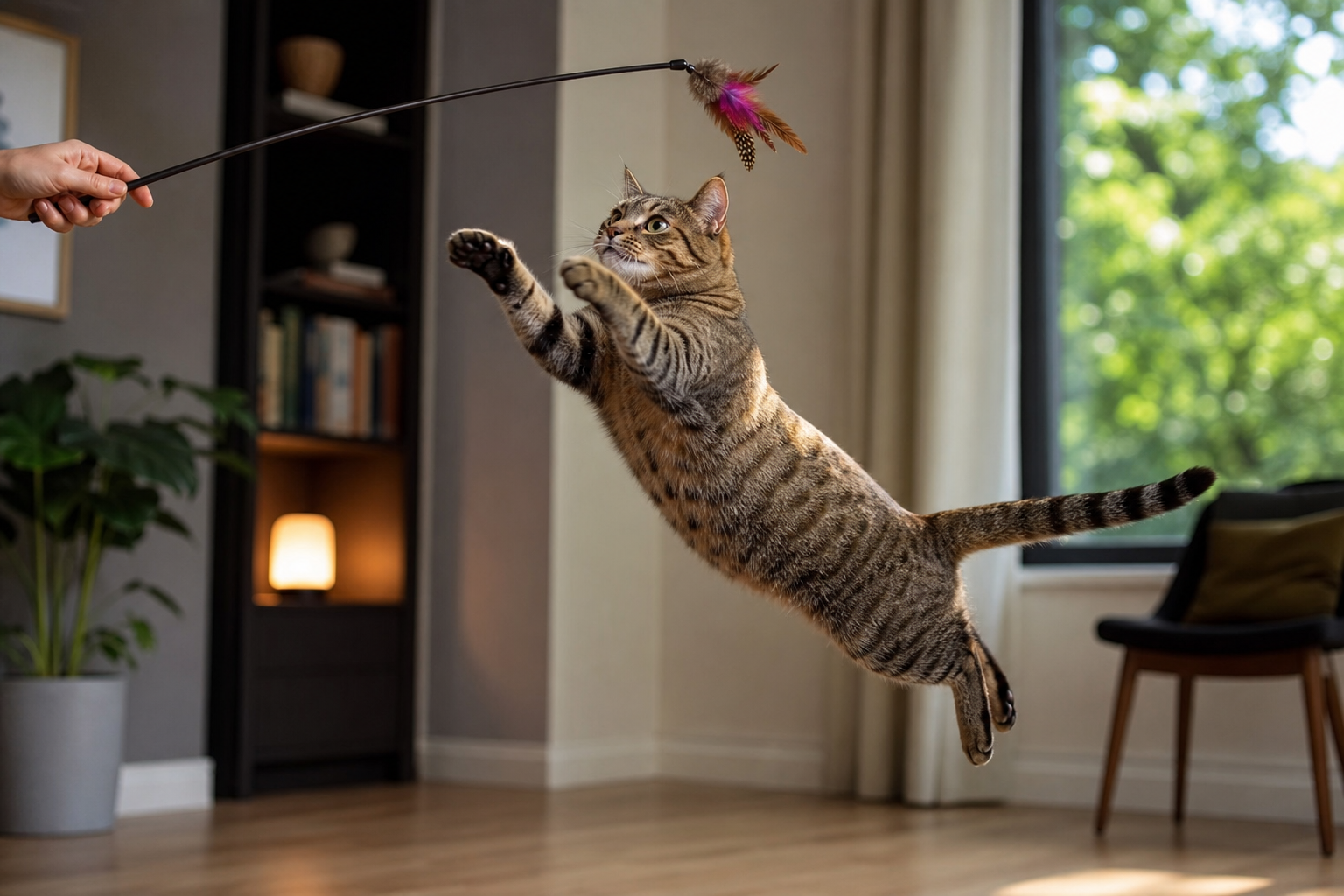
    Feather wands work because they let you imitate parts of the hunting sequence: hiding, watching, stalking, chasing, pouncing, catching, biting, and raking. That is why many cats ignore a feather dragged in a straight line but explode with interest when it disappears behind a chair leg, pauses under a paper bag edge, or flutters just out of reach.

    The AAFP and ISFM feline environmental needs guidelines describe play as a way for cats to express predatory behavior, including stalking, chasing, pouncing, and biting. A wand toy is useful because it lets the owner create that sequence without inviting the cat to hunt hands or feet.

    For Titan Claws readers, the main benefit is controlled intensity. A hard-playing cat can sprint, jump, and catch the lure while you keep fragile parts off the floor between sessions. That is different from leaving a feather toy out all day, where the same cat may chew the feathers apart, swallow thread, or work a clip loose.

    What Current Product Pages Often Miss

    The search results for feather wand cat toy are mostly product pages, marketplace grids, and best-of roundups. They are useful for seeing options, but many skip the owner decisions that prevent problems: how long sessions should be, how to let the cat catch the lure, what to inspect, and when feather toys are a poor match for a destructive chewer.

    A good feather wand is a routine, not just an object. You need a chase toy, a way to end the chase, a storage habit, and a replacement plan. If a ranking page only tells you that a lure spins, chirps, sparkles, or includes extra attachments, it has not answered the safety question for a cat that plays hard.

    Titan Claws already covers adjacent decisions in Cat Toy on Stick: How to Choose and Use Wand Toys Safely and Cat Feather Toys: How to Choose and Use Them Safely. This guide narrows in on feather wands: the handle, cord, lure, play pattern, and inspection points that matter most.

    How to Choose a Better Feather Wand

    Start with your cat’s play style. A gentle chaser can use a light feather teaser. A jumper needs more wand length so the lure can move without your hand entering the landing zone. A cat that grabs and bites needs sturdier attachments, shorter supervised sessions, and a separate capture toy for the finish.

    • Wand length: choose enough reach to keep hands and arms away from the pounce zone. Very short teasers are harder to use safely with intense cats.
    • Handle and shaft: look for a wand that flexes without splintering, cracking, or whipping unpredictably.
    • Cord: avoid frayed string, thin elastic that snaps back sharply, or cord long enough to wrap around a cat during chaotic play.
    • Attachment point: inspect swivels, clips, knots, crimps, and glue points. A removable lure is convenient only if the connector stays secure.
    • Feathers: skip lures that shed pieces before play even starts. Feathers should be firmly bound and easy to replace once damaged.
    • Noise parts: bells and crinkle details can add interest, but they are also small parts. Chewers need stricter supervision and faster retirement.

    Do not buy based on the number of replacement attachments alone. A bulk pack of weak lures can be worse than one sturdier wand paired with a safer end-of-play toy.
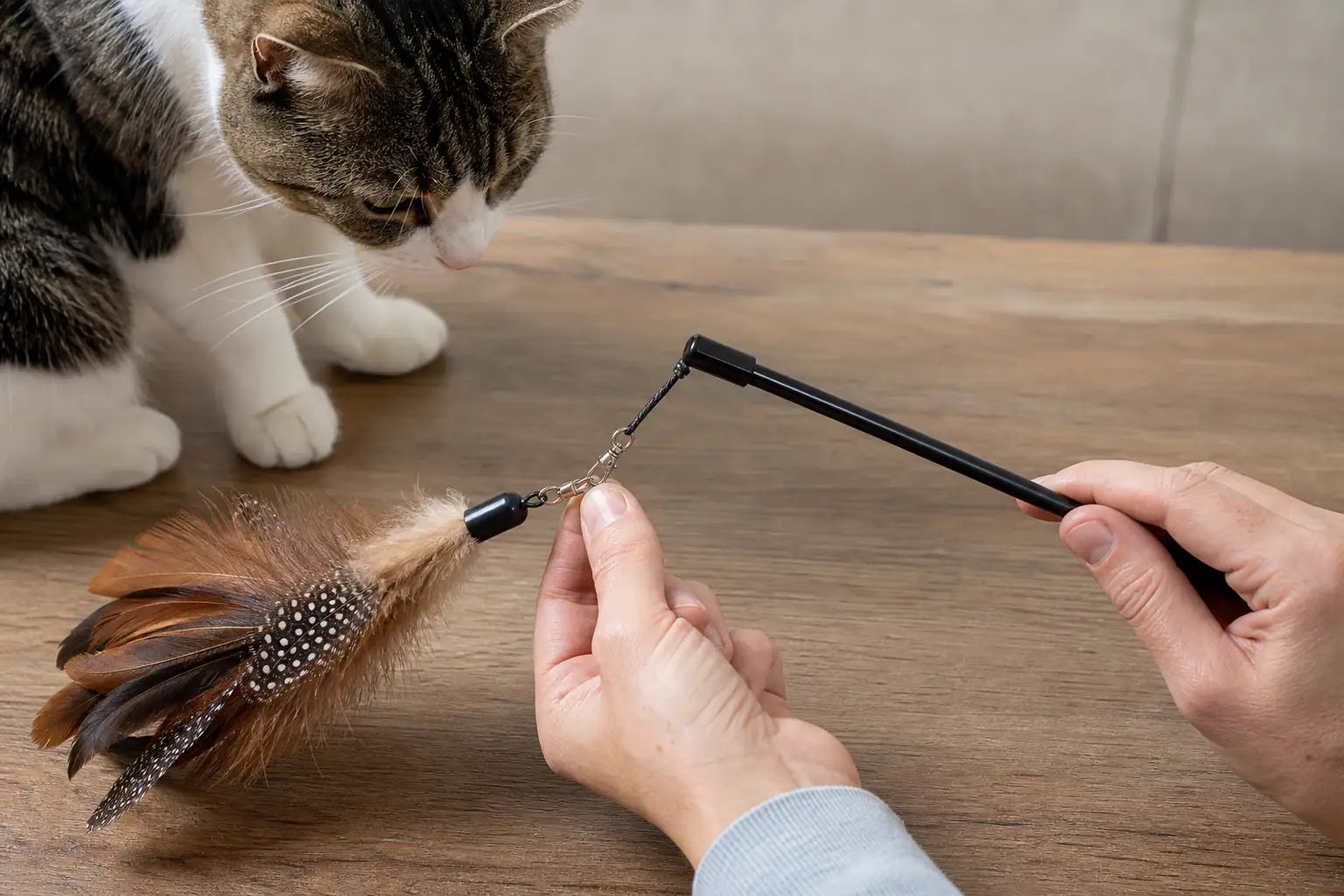
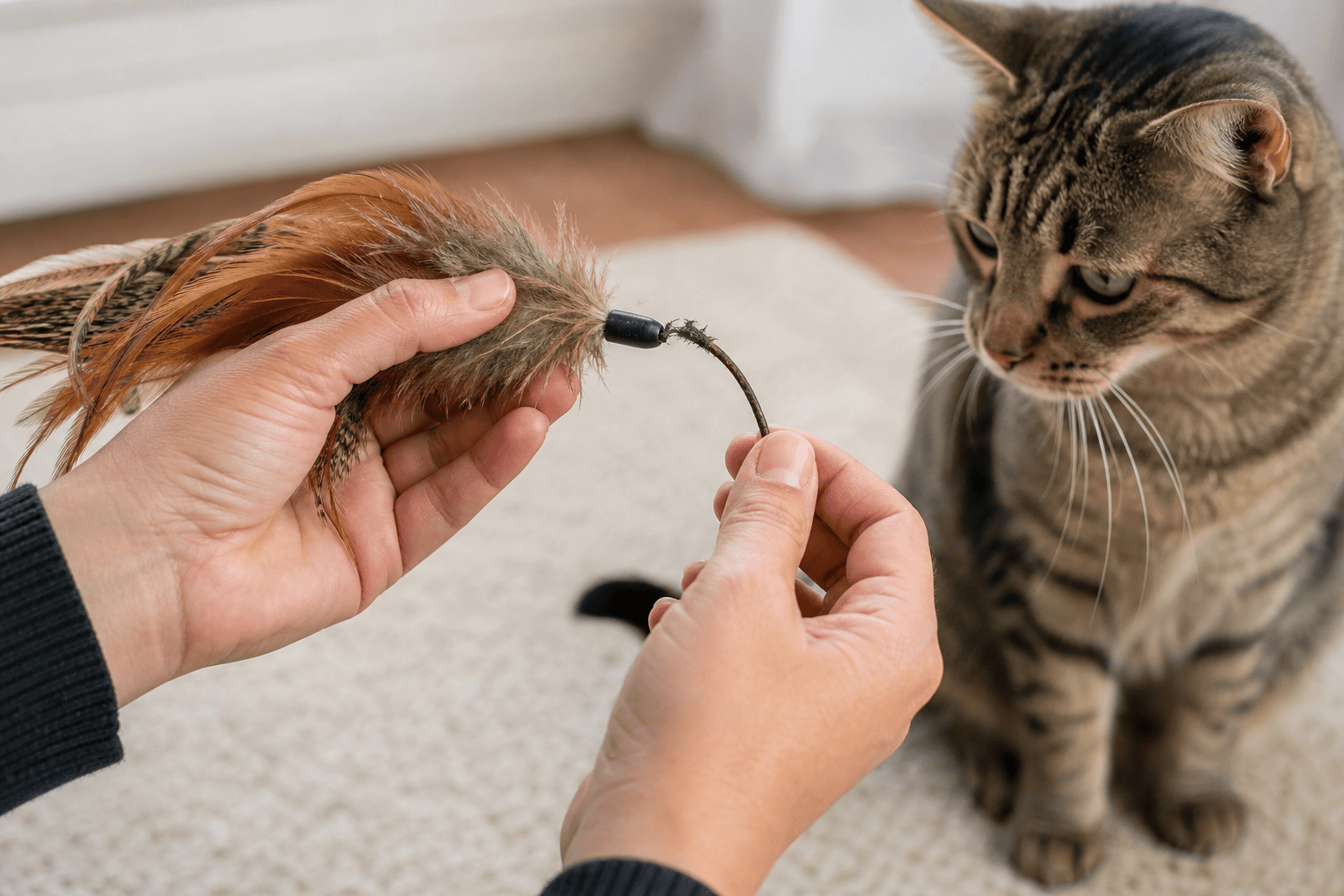
    Hands inspecting a feather wand cat toy clip string and feathers for damage
    Check the cord, clip, knot, feathers, and wand tip after hard sessions, especially if your cat bites or pulls the lure.

    Are Feather Wands Safe for Cats?

    Feather wands can be safe when they are used as supervised interactive toys. They become risky when cats are left alone with string, elastic, wire, clips, bells, feathers, or small lure parts that can be chewed off and swallowed.

    Cornell Feline Health Center advises avoiding toys with small pieces or strand-like parts that can separate and be swallowed. VCA Animal Hospitals also warns that wand or fishing-pole toys should not be left with cats unattended because string can tangle or be ingested.

    Use extra caution if your cat has a history of eating non-food objects, pulling stuffing, chewing cords, or swallowing fabric. Those cats may still enjoy feather wand play, but the wand belongs in your hands during the session and in a closed drawer afterward.

    How to Run a Better Wand Session

    Many owners move the wand too fast for too long. That can frustrate a cat because prey does not usually sprint in circles forever. A better session alternates movement and stillness.

    1. Wake up interest: let the feather twitch from behind a chair, tunnel, box, or blanket edge.
    2. Build the chase: move away from the cat in short bursts, then pause. Let the cat stalk.
    3. Offer a fair catch: let the cat pin the lure every few passes. Constant misses can create frustration.
    4. Redirect the bite: if your cat clamps down hard, trade the lure for a sturdy kicker or plush capture toy.
    5. Wind down: slow the movement near the end rather than stopping abruptly at peak arousal.
    6. Store it: inspect the lure, remove loose pieces, and put the wand away.

    Short sessions are often better than one exhausting marathon. Two or three five-to-ten-minute sessions can fit a high-energy cat better than a single long session that ends with panting, frustration, or rough handling.
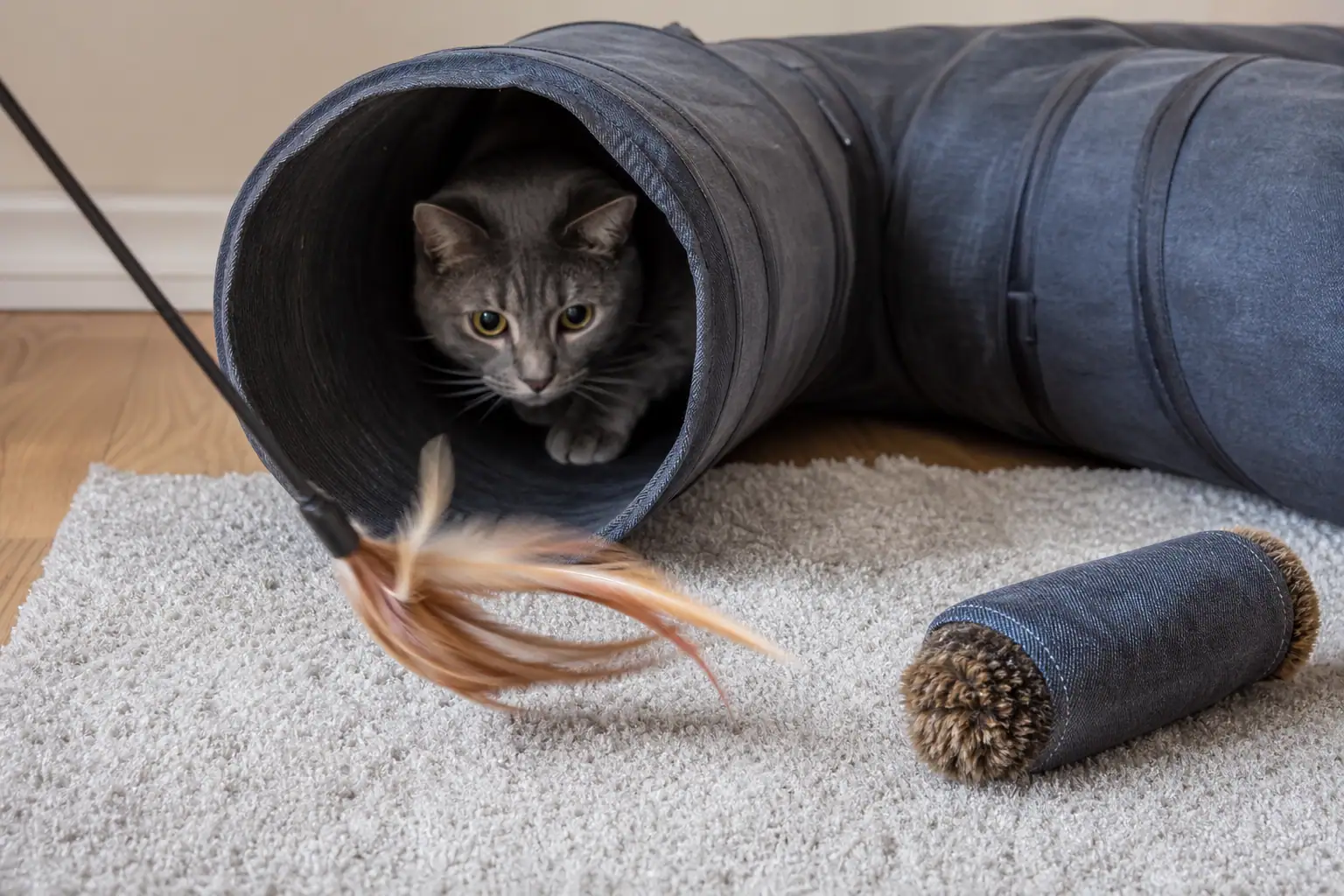
    Feather wand lure moving around a tunnel with a sturdy kicker toy nearby
    A good wand session has a chase, a pause, a catch, and then a safer capture target your cat can grip and kick.

    Best Feather Wand Types by Cat

    For jumpers

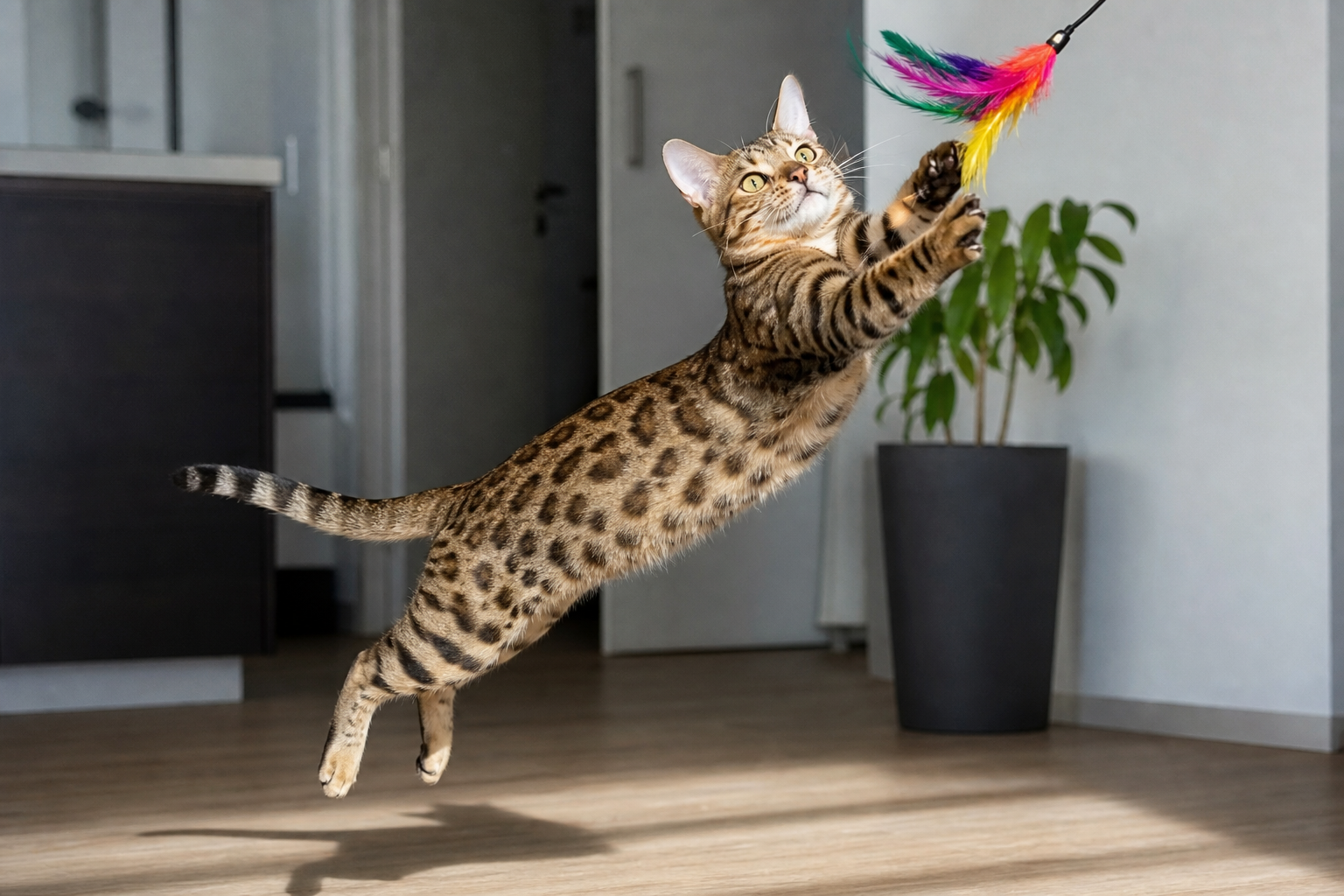
    Choose a longer wand with enough flex to create sweeping movement while keeping your body clear. Keep jumps low and controlled on slick floors, and avoid repeated high leaps for kittens, seniors, overweight cats, or cats with mobility concerns.

    For stalkers

    Use a quieter feather lure and move it through cover. Stalkers often prefer hiding, pausing, and ambush angles over constant flying motion. Pair the wand with a tunnel, cardboard box, or paper bag with handles removed.

    For grabbers and chewers

    Prioritize replaceable lures, strong attachment points, and quick inspection. Let the cat catch the feather, but do not let the session turn into unsupervised chewing. Finish with a tougher toy designed for gripping and kicking, such as the styles discussed in Titan Claws’ cat kicker toy guide.

    For timid cats

    Keep movement low, slow, and farther away. A feather flying directly over a timid cat’s head can feel threatening. Start at the edge of the room, let the cat watch, and reward any relaxed approach with an easy catch.

    Inspection Checklist for Rough Play

    Check feather wands before and after play. Retire the lure or the whole toy if you see any of these problems:

    • frayed cord, exposed elastic, or loose thread;
    • feathers pulling free, snapping, or exposing sharp quill ends;
    • a cracked wand tip, splintered shaft, or loose handle;
    • a clip, swivel, bell, crimp, or knot that is loosening;
    • glue residue or tape that your cat can chew;
    • missing pieces after a session;
    • your cat chewing the cord instead of chasing the lure;
    • your cat guarding the lure and redirecting bites toward people or other pets.

    If you think your cat swallowed string, feather pieces, plastic, metal, or fabric, contact your veterinarian promptly. Do not pull on strand-like material if it is coming from the mouth or rectum; that situation needs veterinary guidance.

    How Feather Wands Fit a Durable Toy Rotation

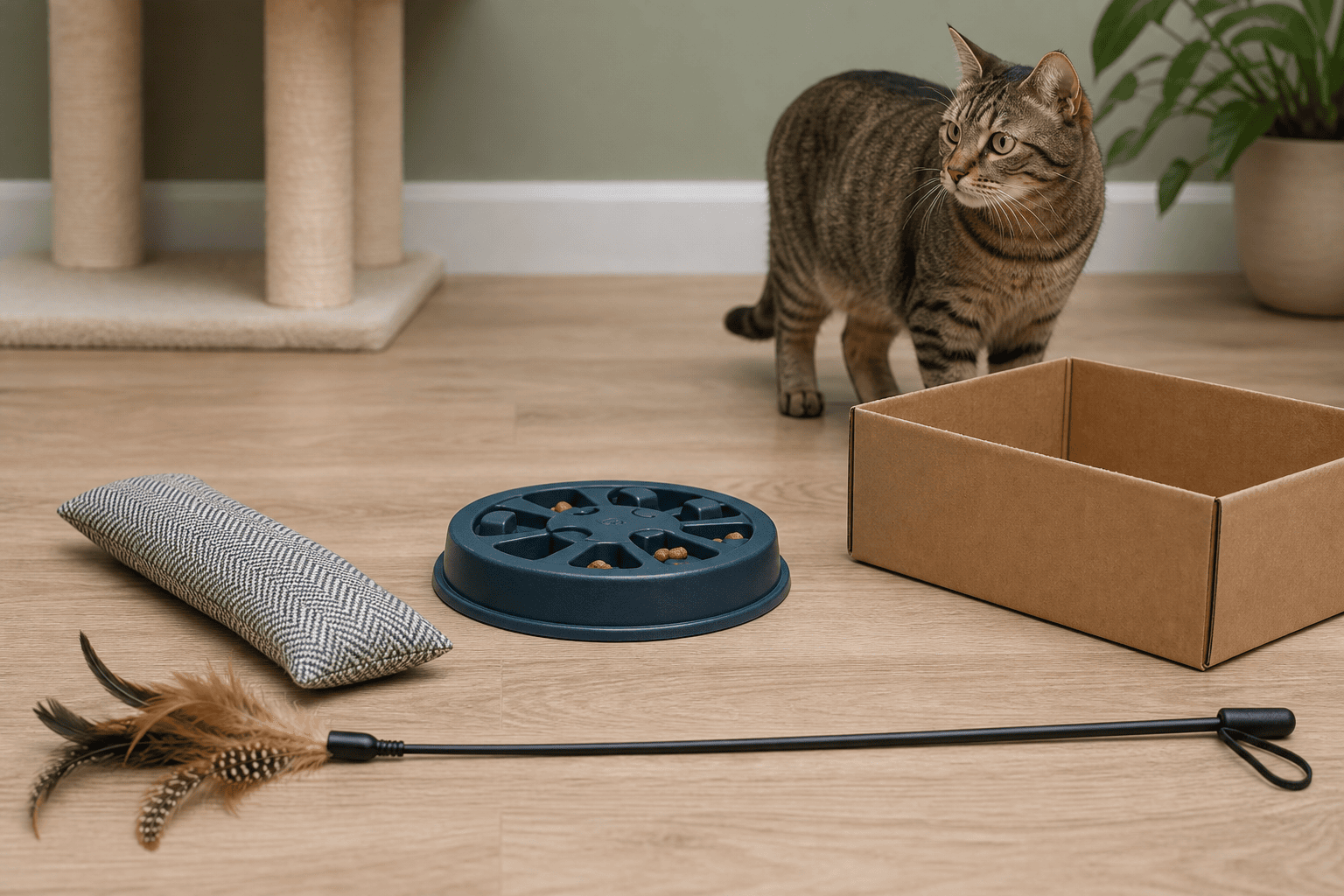
    A feather wand should usually be the chase part of the system, not the entire system. For rough cats, build a rotation with one supervised chase toy, one tougher capture toy, one safe solo batting toy, one food puzzle, and one hiding or stalking setup.

    That rotation keeps the feather wand special and reduces the temptation to leave risky string toys on the floor. It also gives your cat different kinds of work: running, stalking, grabbing, chewing, problem-solving, and settling down. For more rotation ideas, use Titan Claws’ guides to durable cat toys, cat toys for enrichment, and cat toys for boredom.

    Quick Buying Decision

    Choose a feather wand cat toy if your cat likes chasing, stalking, jumping, or owner-led play and you are willing to supervise and store it. Pick a longer wand for intense cats, a quieter lure for timid cats, and replaceable attachments for grabbers. Avoid weak cords, loose bells, shedding feathers, and tiny parts for cats that chew.

    Skip feather wands as leave-out toys. They are best as interactive tools: bring the prey to life, let your cat win, inspect the toy, and put it away. That routine is what makes a feather wand useful for serious play without pretending any feather toy is indestructible.
    Sources

  • Da Bird Cat Toy: Is It Worth It for Cats Who Play Rough?

    Da Bird Cat Toy: Is It Worth It for Cats Who Play Rough?

    The Da Bird cat toy is a feather wand made for interactive chase play. Its appeal is simple: the feather attachment spins, flutters, and changes direction in a way many cats read as bird-like prey. For cats that ignore stiff teaser toys, that movement can be the difference between a bored glance and a full stalking, leaping, pouncing session.

    For rough players, the honest answer is more careful: Da Bird can be an excellent supervised toy, but it is not a leave-out toy and it is not a chew toy. If your cat bites down, pulls feathers out, chews cord, or swallows toy pieces, use it as a short-session wand and inspect it after every hard play session.

    The best use is a controlled hunt: make the lure flee, let your cat catch it, hand off a sturdier kicker if your cat wants to bite and rake, then store the feather wand where your cat cannot reach it. That gives you the value of the toy without pretending feathers, string, or clips are safe for unsupervised access.

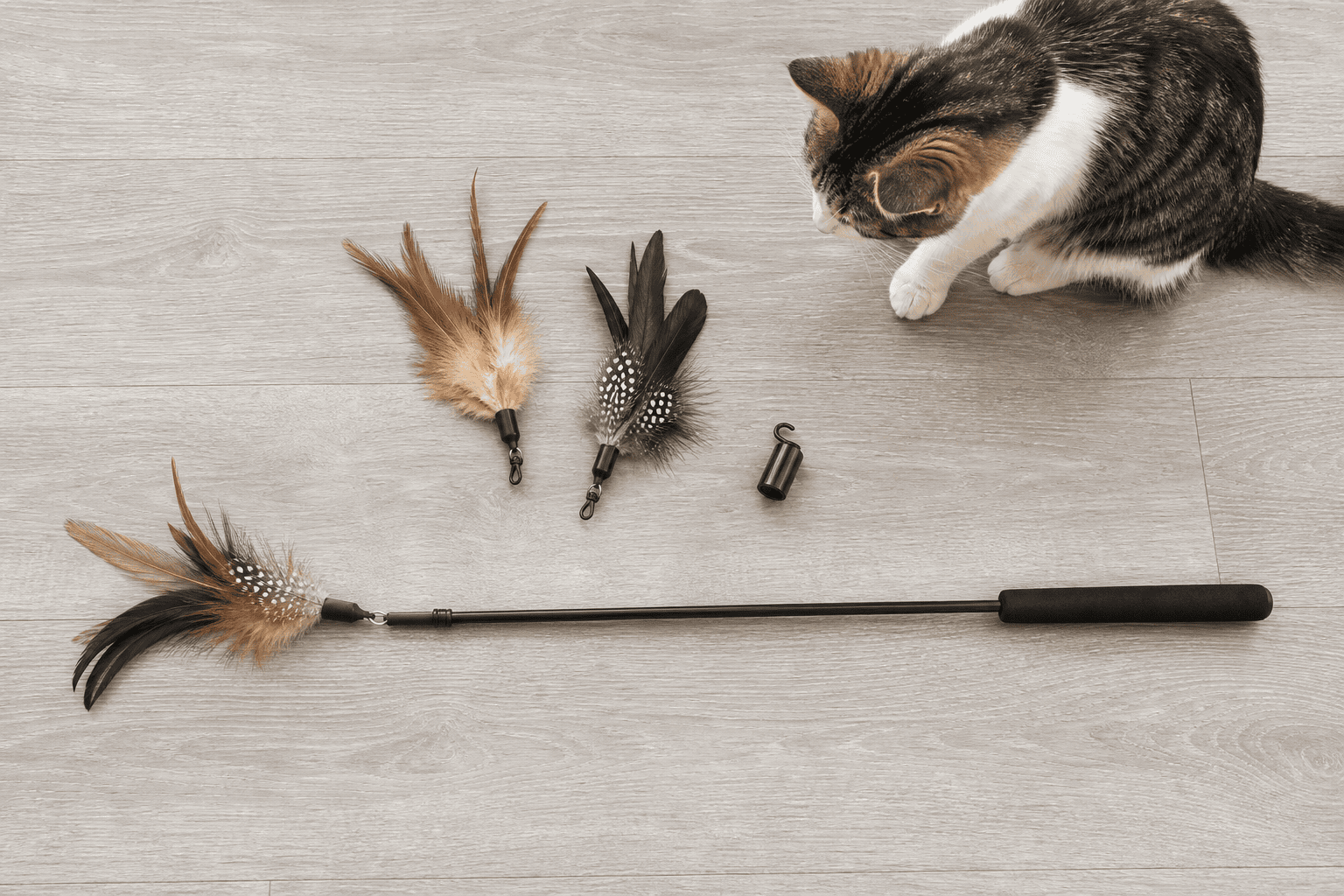
    Feather wand cat toy laid out with spare refills and a storage hook
    Treat feather wands as supervised chase tools, not leave-out toys. The fun comes from movement; the safety comes from storage and inspection.

    What Is the Da Bird Cat Toy?

    Da Bird is part of the Go Cat Feather Toys line. The official product page describes it as an interactive cat toy with real feathers attached to a durable string, and the current options include standard or pull-apart rods plus guinea or turkey feathers. Go Cat also sells separate refills and related attachments, which matters because feather lures wear out faster than the wand itself.

    That refill system is one reason owners search for Da Bird by name. If your cat loves the action but destroys the lure, replacing the feather end is usually more practical than buying an entirely new wand. It also lets you retire a damaged attachment before it becomes a swallowing risk.

    Do not judge the toy only by price or popularity. Judge it by your cat’s failure pattern. A cat that chases and releases may get many sessions from a refill. A cat that pins, chews, and grinds feathers can damage one quickly. Both cats may love the toy, but they need different rules.

    Why Cats Like Da Bird-Style Feather Wands

    Good wand play lets a cat perform pieces of the predatory sequence: watch, stalk, chase, pounce, grab, bite, and recover. The AAFP and ISFM feline environmental needs guidelines recommend play that mimics flying or ground prey, including moving a wand in ways that resemble prey movement and letting the cat catch the toy at the end of the chase.

    Da Bird works because the lure is light and responsive. When the handler moves the wand well, the feathers can swoop around furniture, pause near a hiding spot, flutter away, and drop behind an obstacle. That is more engaging than dangling the toy in the cat’s face.

    The mistake is making every session an endless aerial sprint. Cats need the chance to stalk, miss, catch, and reset. If the toy never lands, some cats get frustrated. If it lands and stays in the mouth too long, feather-chewers may start dismantling it. A better session mixes short flights with controlled captures.

    What Current Search Results Get Right and Miss

    The current search results answer the buying question well. You can find the official Go Cat page, marketplace listings, retailer pages, refills, attachments, and owner discussions. That is useful if you already know you want the toy.

    What many results do less well is help a specific owner decide whether Da Bird fits a cat that destroys toys. Product pages understandably focus on fun and prey-like motion. Retail listings focus on availability. Forum threads often share real owner experience, but they can be scattered: one cat loves it, another shreds the attachment, another ignores cheaper wands.

    For Titan Claws readers, the useful question is not just “Is Da Bird good?” It is “How do I use a feather wand with a cat that plays hard without creating a feather, string, or cord hazard?”

    Safety Rules for Da Bird and Feather Wand Toys

    Cornell Feline Health Center advises avoiding toys with small pieces or linear strand-like parts such as feathers and string that may separate and be ingested, especially when chewed. That warning applies directly to feather wands. Vetstreet gives similar guidance: fishing-pole toys can be used with supervision, but they should be placed out of reach when play is over, and owners should be careful with strings, yarn, ribbons, feathers, and detachable plastic parts.

    Hands checking a feather cat toy refill for loose feathers and frayed cord
    After a hard session, check the cord, clip, and feather base before the toy goes back into storage.
    • Supervise every session: Da Bird is for owner-led play, not all-day floor access.
    • Store it closed away: Put the wand, cord, clips, and feather refills in a drawer, closet, or sealed bin after play.
    • Inspect before and after use: Look for loose feathers, a bent clip, frayed cord, exposed wire, bite-notched parts, cracked connectors, or feathers pulling free at the base.
    • Retire damaged refills early: A favorite lure is not worth keeping once pieces can come off.
    • Do not let your cat chew the cord: If your cat targets the string instead of the lure, shorten the session and switch to a sturdier toy.
    • Keep play away from hazards: Avoid stairs, glass tables, unstable shelves, open fireplaces, hot stoves, blind cords, and rooms with fragile objects your cat may crash into.

    If your cat swallows a feather, string, toy fragment, or unknown piece, call your veterinarian. Watch especially for vomiting, gagging, appetite loss, lethargy, belly pain, straining, repeated swallowing, or hiding. A wand toy is supposed to enrich the day, not create a medical gamble.

    Is Da Bird Durable Enough for Rough Players?

    The wand and cord may last a long time for many households, but the feather attachment is a consumable part. That is not automatically bad. Feathers create the movement cats like precisely because they are light, flexible, and prey-like. The tradeoff is that they are not built like a tough kicker, rubber chew, or heavy fabric toy.

    For a rough player, think of Da Bird as a high-value chase tool with replaceable weak points. Buy refills before the first one is destroyed, set a retirement rule, and do not let the cat sit with the lure after the catch. If your cat immediately tries to eat feathers, the toy may still be usable, but only in shorter sessions with faster trade-offs.

    Use this rough-player test:

    What your cat does Da Bird fit Better rule
    Chases, pounces, releases Strong fit Use normal supervised sessions and store after play.
    Grabs and bunny-kicks the lure Good fit with limits Let the catch happen briefly, then swap to a sturdy kicker.
    Chews feathers until they loosen Use cautiously Keep sessions short, inspect often, and replace refills early.
    Targets the cord or clip Poorer fit Try a different wand style or a larger lure with fewer string-access moments.
    Swallows toy material High risk Pause feather toys and ask your veterinarian for guidance.

    If your cat destroys ordinary toys, pair Da Bird with stronger capture outlets. Titan Claws’ guide to unbreakable cat toys explains why no toy is truly indestructible and how to think about failure points. For mouthy cats, also see chewy cat toys for material and inspection rules.

    How to Use Da Bird Well

    Most weak wand sessions fail because the human makes the toy act like a dangling object instead of prey. Do not bop your cat on the nose with it. Do not spin it endlessly above their head. Make the lure behave like something trying to escape.

    1. Start low and slow: Drag the lure partly behind a chair leg, box, tunnel, or doorway so your cat can stalk it.
    2. Let it flee away: Move the toy away from the cat, not toward the cat’s face. Prey usually retreats.
    3. Add short flights: Use brief swoops and fluttering turns, then land the lure where your cat can pounce.
    4. Allow the catch: Let your cat pin the lure for a few seconds. That prevents frustration and makes the game feel complete.
    5. Trade before chewing starts: If your cat settles in to gnaw feathers, swap to a bigger kicker, treat, or food puzzle.
    6. End cleanly: Stop before exhaustion, inspect the toy, and store it out of reach.

    For high-drive cats, two five-minute sessions are usually better than one frantic marathon. Short sessions preserve novelty, reduce sloppy landings, and give you more chances to end before the lure becomes a chew project.

    Da Bird Refills, Attachments, and Alternatives

    Searchers often look for Da Bird refills, attachments, mouse lures, and retailer listings because the attachment is the part that takes the punishment. Refills are useful, but do not use them as permission to keep a damaged lure in rotation. Replace because the old one is done, not because you want to stretch one more risky session out of it.

    Consider these options by play style:

    • Feather refills: Best for cats that love air movement. Watch closely if your cat chews or swallows feathers.
    • Fur or mouse-style attachments: Better for ground-prey stalking and short captures, but still supervised-only if attached to cord or small parts.
    • Larger fabric kickers: Better for cats that need to bite, hug, and rake after the chase.
    • Track toys and puzzle feeders: Better for unsupervised enrichment because they do not rely on string or feather access.
    • DIY wand experiments: Only use materials too large to swallow, firmly attached, and easy to inspect. Avoid ribbon, yarn, rubber bands, and fragile craft parts.

    If you want more motion-toy comparisons, Titan Claws’ guide to cat toys that move covers electronic, rolling, wand, and chase categories. For indoor boredom routines, use best cat toys for bored indoor cats.

    Cat toy rotation with a feather wand, sturdy kicker, puzzle feeder, and cardboard box
    Da Bird-style play works best as part of a routine: chase, catch, bite an appropriate toy, then wind down with food or foraging.

    A Safer Routine for Da Bird Fans

    Da Bird is strongest when it has one job: ignite the hunt. It should not be the only toy your cat gets, and it should not be the object your cat is expected to chew for ten minutes after every catch.

    Try this routine for cats that play hard:

    1. Prep the room: Clear fragile objects, close risky doors, and keep play away from stairs or slick landings.
    2. Hunt with Da Bird: Run a short chase sequence with hiding, fleeing, fluttering, and a few catches.
    3. Swap to a bite-safe target: Offer a durable kicker or larger fabric prey toy when your cat wants to pin and chew.
    4. Feed or forage: End with part of a meal, a treat scatter, or a puzzle feeder so the hunt has a natural finish.
    5. Inspect and store: Check the feather attachment and cord, then put everything away.

    This routine also protects the toy. If every session ends with your cat grinding the feather lure, refills will vanish quickly. If the lure is mostly for chase and the kicker takes the bite, both safety and durability improve.

    When Da Bird Is Not the Right Toy

    Skip or pause Da Bird-style toys if your cat has a history of swallowing string, feathers, plastic, fabric, or toy parts. Also be cautious with cats that become so aroused they crash into furniture, redirect onto hands, or guard the toy aggressively from other cats.

    In multi-cat homes, use wand toys one cat at a time if competition gets tense. The AAFP/ISFM environmental guidelines emphasize multiple separated resources in the home, and that same idea applies to high-value play. A nervous cat should not have to compete with a bolder cat for the only exciting toy in the room.

    For kittens, keep jumps low and sessions short. Growing cats can be enthusiastic but clumsy. If you are shopping for a young cat, Titan Claws’ kitten toys and kitten teething toys guides are better starting points for age, mouth size, and teething behavior.

    Quick Checklist Before You Buy or Replace

    • Am I buying Da Bird for supervised play, not solo entertainment?
    • Does my cat chase and release, or do they chew and swallow toy pieces?
    • Do I have spare refills and a clear rule for retiring damaged lures?
    • Can I store the wand, cord, and attachments where my cat cannot reach them?
    • Do I have a sturdier kicker or chew-safe target for the bite-and-rake part of play?
    • Is the play space clear of stairs, cords, unstable furniture, and breakable objects?
    • Will I inspect the feather base, clip, and cord after rough sessions?
    • If my cat targets string or feathers, am I ready to stop and choose a safer routine?

    The Bottom Line

    Da Bird is popular for a good reason: it can make a feather wand behave more like real prey than many generic teasers. For indoor cats that need movement, stalking, and capture, that can be excellent enrichment.

    For cats that play rough, the value depends on how you manage it. Use Da Bird as a supervised chase toy. Replace feather refills before they shed pieces. Trade to a durable kicker when your cat wants to chew. Store the wand after every session. Done that way, Da Bird can be a useful part of a tough-toy household without being asked to do a job it was not built for.

    Sources