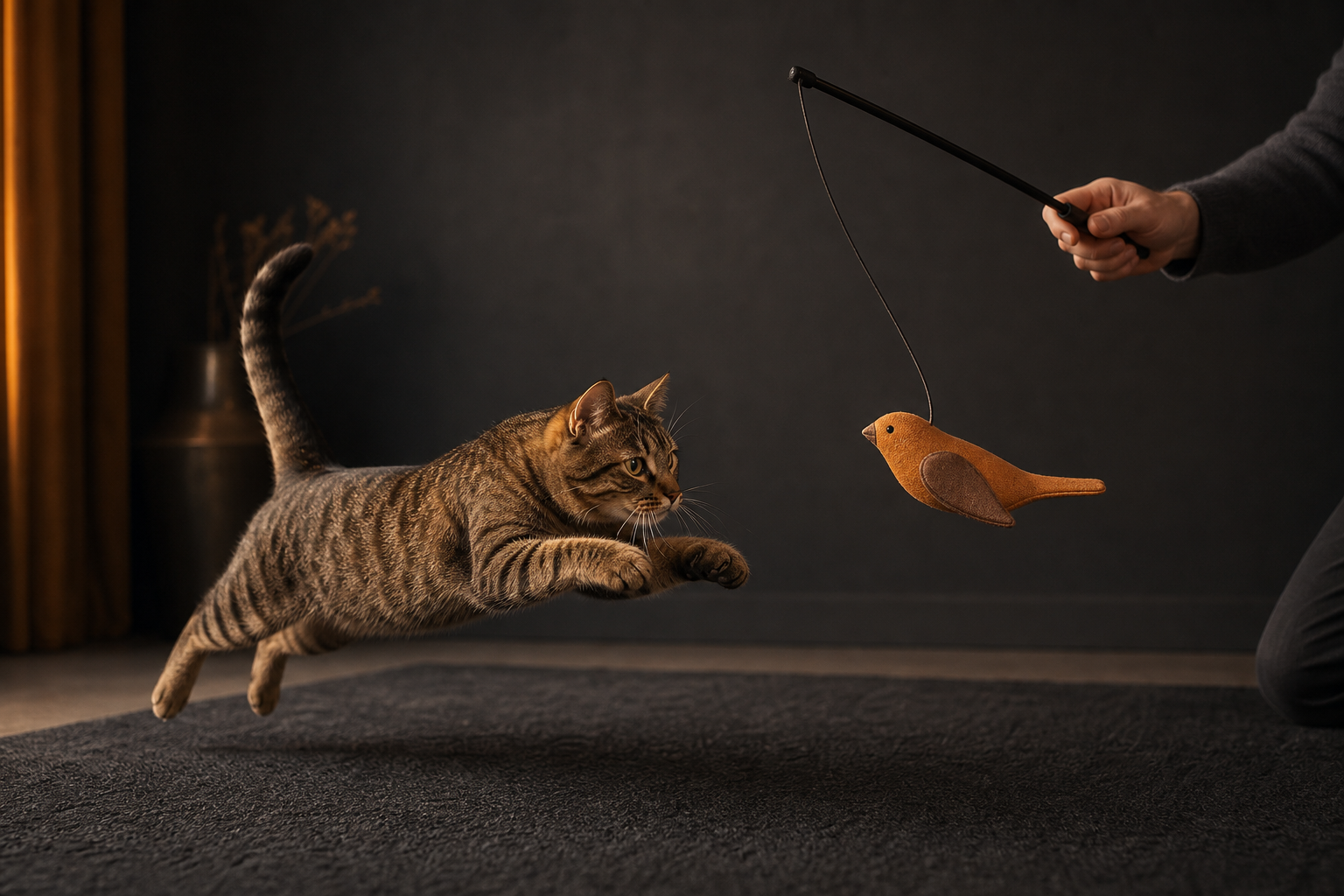
A flying cat toy is usually one of four things: a hand-controlled wand lure, a bird that circles from a fixed base, a hanging or door-mounted toy that bounces through the air, or an electronic plush bird that flaps on the floor. Only a small subset truly flies freely. Product listings often use flying to describe bird-like motion, so check the mechanism before you buy.
For most cats, the best choice is not the gadget that reaches the most altitude. It is the toy that lets the cat stalk, chase, catch, and release without exposing teeth or paws to propellers, loose string, weak feathers, or an accessible battery. A sturdy wand with a large fabric lure gives you the most control. A tethered motorized toy can add variety, but it still needs supervision and inspection.
This guide explains what flying bird toys actually do, how to choose one for your cat and room, and where rough players tend to break them. No cat toy is indestructible. The goal is useful movement, visible wear, and a routine that ends before a loose part becomes a swallowed part.
Flying cat toy types at a glance
| Type | How it ‘flies’ | Best use | Main risk |
|---|---|---|---|
| Wand or teaser | You sweep a fabric, feather, or plush lure through the air | Controlled interactive play and bonding | String, elastic, feathers, clips, and hard catches |
| Fixed-base circling bird | A motorized arm, wire, or tether moves a lure around a base | Predictable chase in a cleared area | Pinch points, exposed mechanism, tipping base, detachable lure |
| Hanging or mounted bird | An elastic or tether makes the lure bounce, flutter, or orbit | Vertical tracking without a handheld wand | Entanglement, weak mount, snapback, damaged cord |
| Flapping plush bird | A motion sensor activates wings while the toy stays on the floor | Grab, bite, and bunny-kick play | Seams, wing pieces, motor pocket, charging port, battery |
| Free-flying remote toy | A powered device moves through open air | Owner-operated novelty in a large clear room | Propellers, impact, hard housing, charging parts, frightened cats |
That last category is the rarest and the hardest to recommend as a direct-contact cat toy. If a device has exposed rotors, is built as a human hobby drone, or is not intended to be caught and bitten, keep the cat separated from it. A product that can fly is not automatically a product a cat should catch.
Do flying bird cat toys actually fly?
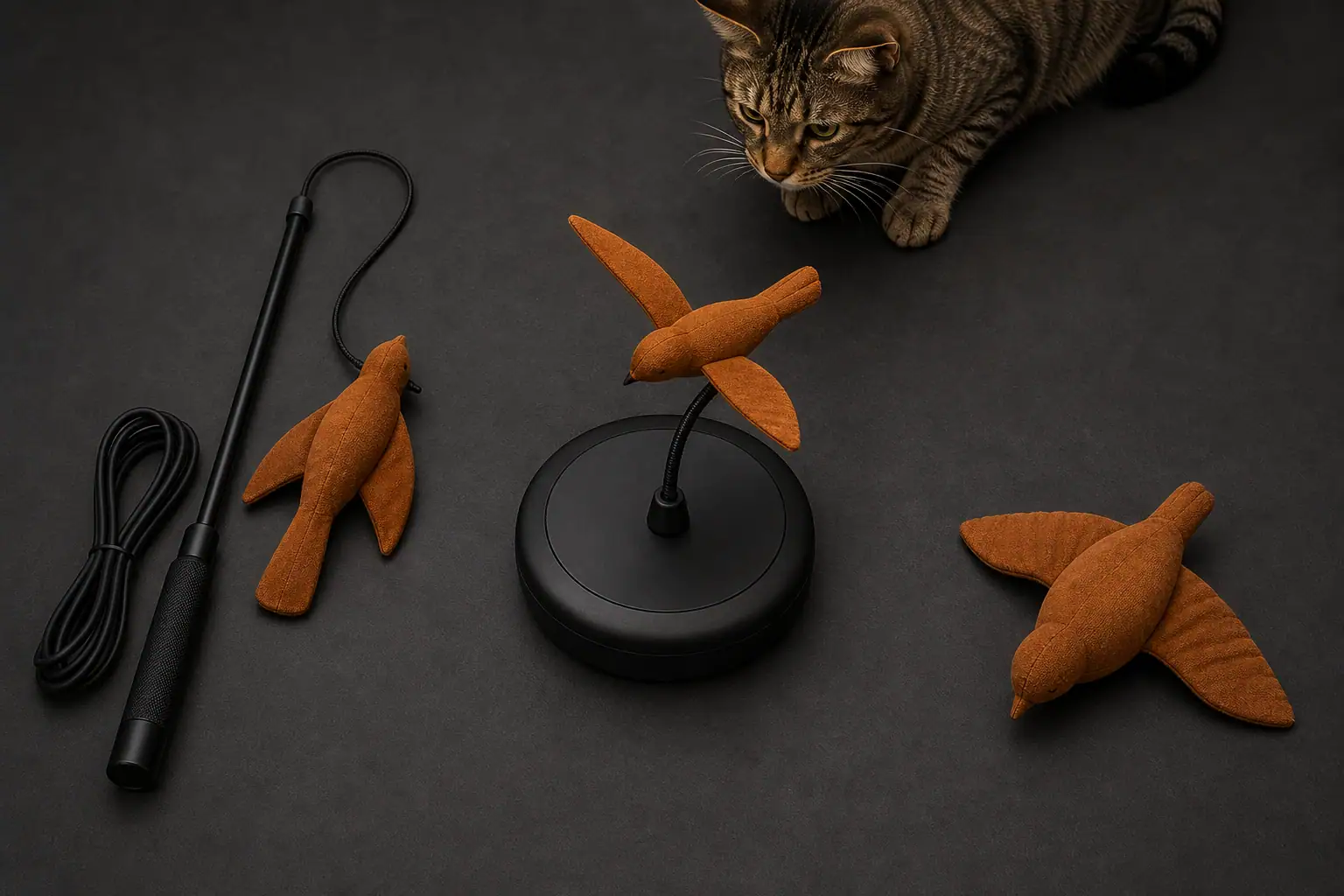
Most do not fly freely. Many popular ‘flying bird’ toys are plush birds with internal motors. They flap, chirp, and kick after a cat touches them, but they remain on the floor unless you attach them to a wand or tether. Others rotate in a circle from a fixed motor, bounce from a doorway, or glide only because a person moves the wand.
This matters because the mechanism changes both play value and safety. A floor-flapping bird is really a motorized kicker: its fabric, seams, wings, motor cover, and charging port must survive the catch. A circling bird behaves more like an automated teaser: the base, arm, connector, and lure are all failure points. A wand is human-powered and easier to interrupt, but its cord and attachment must be stored after play.
Seller pages often blur these differences. Some describe flapping plush toys as taking flight or recommend adding ordinary string to make them airborne. Treat those claims cautiously. If you add an attachment the manufacturer did not design, you change the load on the seam and create a new linear-object hazard. Use the supplied mechanism, follow its instructions, and do not improvise a dangling setup with yarn, ribbon, or elastic.
What is the cat toy that flies like a real bird?
A well-handled wand lure usually creates the most convincing bird-like path because you can skim, pause, hide, rise, and land in response to the cat. Fixed-base toys repeat a smaller route. Free-flying powered toys may cover more space, but realistic flight is less important than a safe catch. Cats need opportunities to capture the ‘prey’ intermittently; the Feline Veterinary Medical Association’s environmental-needs guidance specifically recommends prey-like interactive play, successful captures, toy rotation, and individual play for cats in multi-cat homes.
Choose by cat, room, and failure pattern
Ignore the demo video for a moment and picture the first catch. Does your cat tap and release, or clamp down, twist, and carry the toy away? Does the room have a rug and open floor, or tile, glass tables, and narrow gaps? The right mechanism is the one you can control after the excitement begins.
For an athletic cat who loves aerial chase
Use a longer wand with a broad fabric lure in a cleared room. Start near the floor and build small rises instead of repeated maximum-height jumps. Keep the route away from stairs, counters, hard corners, people, and other pets. Let the cat land on the rug rather than twisting in midair for a lure above the head.
For a cat who destroys the catch
Separate chase equipment from capture equipment. Fly a simple lure, allow a brief pin, then transfer the finish to a large reinforced kicker. A flapping plush bird can fill both jobs only if your cat cannot open its motor pocket, bite through its wings, or expose its electronics. Our guide to cat toys that move compares other motion systems for rough players, including covered-motion, track, rolling, and food-dispensing toys.
For a cautious or noise-sensitive cat
Begin with the toy switched off and motionless. Let the cat approach, sniff, and leave. Add one gentle movement at floor level; introduce sound or motor motion later, not at the same time. A cat who crouches tightly, flattens the ears, hides, flees, lashes the tail, or cannot settle is not being enriched by the novelty. Stop and make the next attempt quieter and farther away.
For kittens, seniors, and cats with limited mobility
Keep the path low and the landing soft. A kitten does not need dramatic jumps to practice stalking and pouncing. A senior may prefer a lure that disappears behind a box, moves across a rug, or pauses within paw reach. New reluctance to jump, limping, pain, open-mouth breathing, or a marked change in play deserves veterinary attention rather than a more stimulating toy.
For a multi-cat home
Run individual sessions first. One fast moving target can turn into competition, blocking, or redirected chasing. Give each cat a clear route and real catches. If two cats play together comfortably, use a wide room and stop when one cat repeatedly takes every catch or the other withdraws.
Safety checks before the toy takes off
The Cornell Feline Health Center’s toy guidance advises avoiding small pieces and linear strand-like parts that can separate and be swallowed, and it recommends checking the play area for fall and impact hazards. Flying toys combine both problems: they attract hard pursuit, and many depend on cords, feathers, connectors, electronics, or moving hardware.
The 60-second preflight check
- Clear the flight path: move glassware, lamps, unstable furniture, floor cords, plastic bags, and sharp-edged objects. Close unsafe stairs or balconies.
- Pull-test the lure: check wings, feathers, fabric tabs, eyes, bells, knots, clips, and seams. If a part shifts by hand, it does not get one more pounce.
- Inspect every linear part: look for frayed string, stretched elastic, kinked wire, weak tether points, and cord long enough to loop around a limb or neck.
- Check the mechanism: the base should not tip; moving arms should not expose gears or pinch gaps; guards and covers should be secure.
- Secure the power source: the battery compartment should require a tool or otherwise resist a cat’s teeth and claws. The charging port and cable stay inaccessible during play.
- Match the size: the catchable part should not fit wholly in the cat’s mouth, and hard housing should not strike the face when it swings or falls.
- Stay present: test every new toy and every new setup under active supervision. An automatic shutoff protects a motor, not a cat.
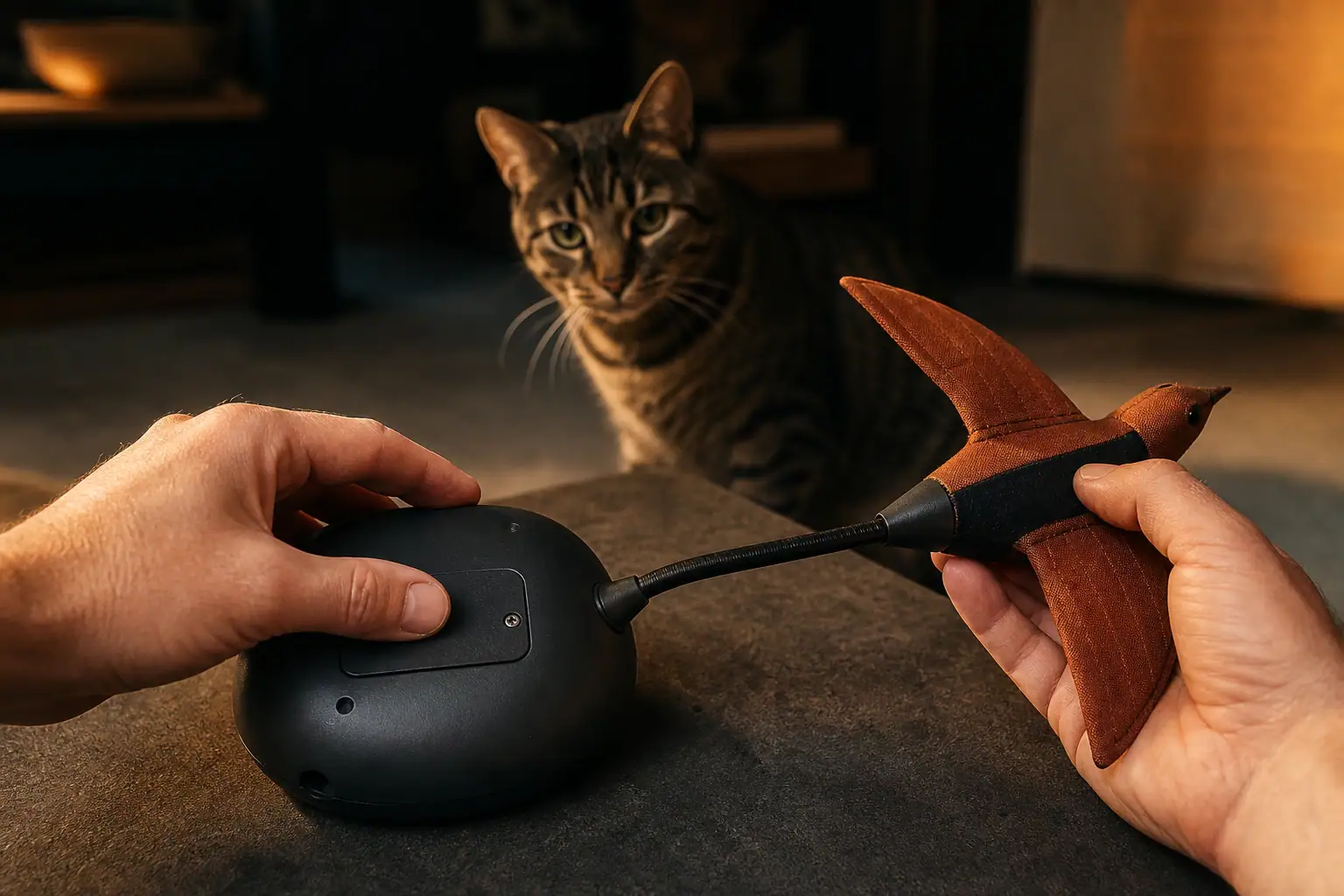
String deserves a firm rule. The ASPCA warns that swallowed string and similar materials can lodge in the stomach or intestines and may require emergency surgery. Store wand toys, elastic tethers, ribbons, and yarn in a closed location after play. If string is hanging from a cat’s mouth or anus, do not pull it—contact a veterinarian or emergency clinic.
Powered toys add a second emergency risk. If your cat punctures or swallows a battery, contacts leaking battery material, or breaks open a battery compartment, stop play and seek immediate veterinary or animal poison-control advice. Pet Poison Helpline explains that damaged or swallowed batteries can cause corrosive and electrical injury; visible mouth injury can be delayed.
What lasts when a cat plays rough?
Durability is a system, not a fabric adjective. A heavy shell attached to a weak plastic clip is still a weak toy. A strong base with an exposed wire is still a poor catch target. Judge the path from motor or handle to lure, then judge the lure after it has been wet, twisted, bitten, and kicked.
- Prefer simple capture surfaces. Large woven-fabric or tightly constructed plush lures are easier to inspect than layered wings, glued eyes, decorative beaks, loose feathers, and multiple dangling legs.
- Look for replaceable wear parts. On a wand or fixed-base toy, the lure is supposed to wear before the handle or motor. A clear replacement system is useful only when the connector remains secure and smooth.
- Choose visible seams. You should be able to find thinning fabric, skipped stitches, or a lifting edge before filling or electronics appear.
- Keep hard parts out of the bite zone. Motors, charging modules, clips, and rotating housings are not chew targets. If the cat can pin the mechanism, the design is wrong for unsupervised use.
- Favor stable, cleanable construction. A base that walks across the floor, a suction cup that releases under load, or plush that cannot be cleaned and dried becomes a short-lived system.
- Buy for replacement, not permanence. No feather, fabric wing, string, or plush body is indestructible. Retiring a cheap lure early is better than testing whether the next bite reaches the motor.
For a broader material and construction check, use Titan Claws’ guide to choosing so-called unbreakable cat toys. The useful question is not whether a listing says ‘tough.’ It is where the product will fail and whether you can see that failure coming.
How to use a flying cat toy in a better play session
Good flying play looks less like constant buzzing and more like a hunt. Prey appears, moves away, pauses, hides, escapes briefly, and gets caught. The person or device should not hover the toy in the cat’s face or make every pass impossible.
- Inspect and clear. Check the toy, choose a nonslip landing area, and remove hazards.
- Introduce the object. Let the cat see and sniff a new toy while it is still and silent.
- Start low. Skim the lure across the floor or a few inches above it. Movement away from the cat is usually more prey-like than movement toward the face.
- Use cover and pauses. Slip behind a box edge, stop, then make a short burst. Constant motion becomes predictable.
- Offer a real catch. Every few passes, let the cat pin the lure. Stop the motor or relax the wand instead of pulling against teeth.
- Transfer the hard finish. If the cat grips and bunny-kicks, offer a larger kicker before teeth move to string, clips, or electronics.
- Cool down. Make the final chase shorter and slower, allow one easy catch, then use part of the normal meal or a simple food search if appropriate for the cat.
- Inspect and store. Count removable parts, check every wear point, clean as directed, charge away from the cat, and put supervised equipment behind a closed door.
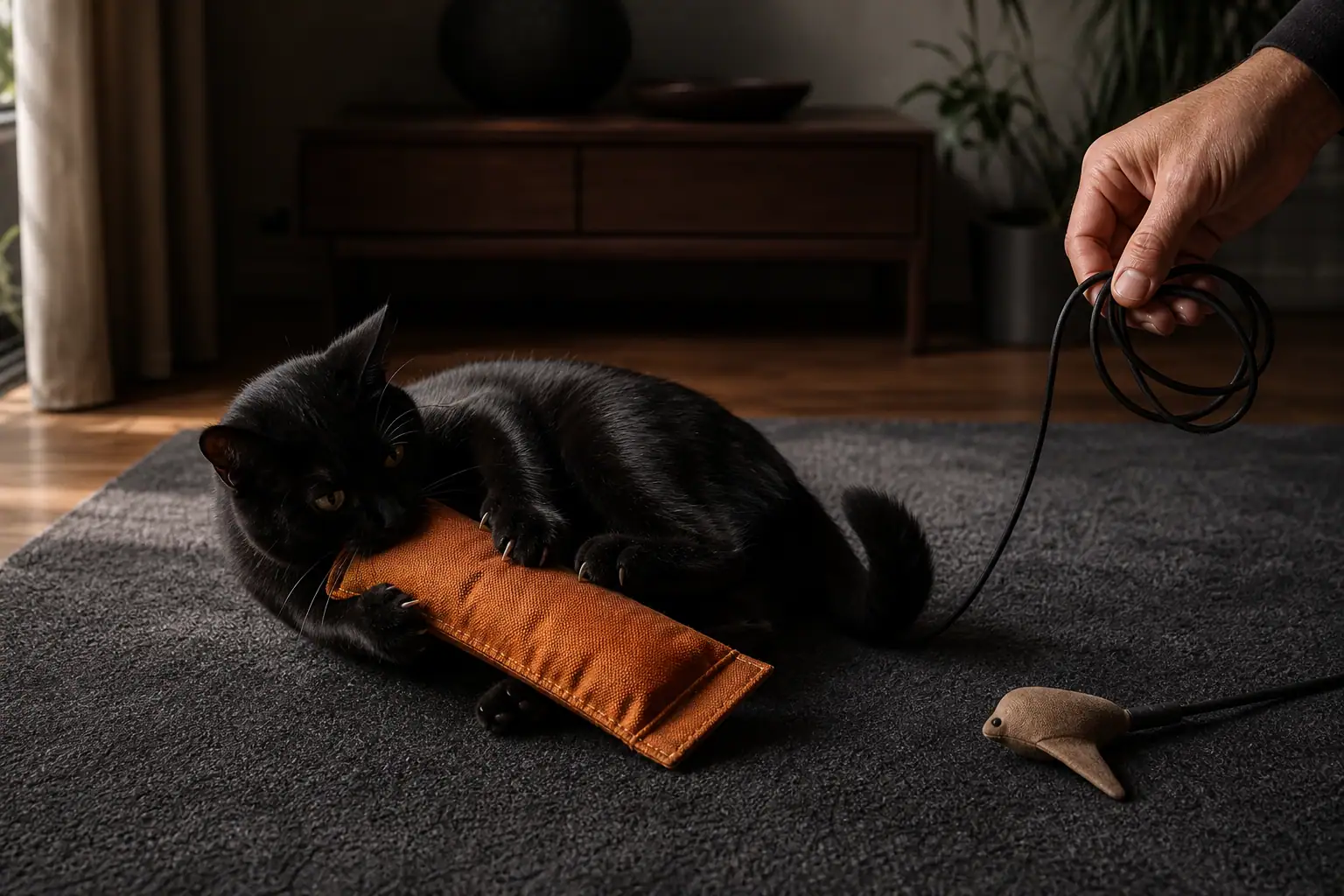
A wand is especially good for this sequence because you can respond instantly to the cat. Read the Titan Claws cat toy on a stick guide for lure, cord, storage, and play-technique details. If you use an automated model, interrupt it yourself for catches rather than assuming the programmed path supplies a satisfying finish.
When to stop, replace, or call a veterinarian
Stop the session if the cat begins panting, breathing with the mouth open, limping, crashing into objects, hiding, growling, or redirecting onto a person or another animal. Also stop if the toy changes sound, slows unexpectedly, smells hot, sheds a piece, opens at a seam, exposes a wire, or develops a loose battery cover.
Replace the lure or whole toy when:
- a feather, wing, tail, bell, eye, connector, or decorative piece is loose or missing;
- fabric thins, a seam opens, stuffing appears, or saliva-soaked material cannot be cleaned and dried;
- string frays, elastic stretches, wire kinks, a clip bends, or the mounting point loosens;
- plastic cracks, a hard edge forms, the base tips, or a guard no longer stays closed;
- the motor runs hot, smells unusual, sounds rough, or its housing can be reached by teeth;
- the charging port, cable, battery, or internal module becomes accessible;
- your cat stops chasing the lure and starts methodically dismantling the mechanism.
Suspected swallowing of string, feathers, fabric, plastic, a battery, or any toy part needs prompt veterinary advice. Repeated vomiting, loss of appetite, drooling, trouble swallowing, abdominal pain, lethargy, or straining after a piece goes missing can signal an urgent problem. Do not wait for the toy part to reappear and do not induce vomiting unless a veterinary professional directs you.
Quick buying checklist
- I know whether the toy truly flies, circles from a base, hangs from a tether, or only flaps on the floor.
- The intended catch point is soft, large, simple, and easy to inspect.
- The toy has no exposed propeller, gear, wire, battery, charging cable, or pinch gap.
- Strings, elastic, feathers, bells, clips, and other attachments stay supervised and get closed storage.
- The base or mount stays stable under the force my cat actually uses.
- I can buy or make a manufacturer-approved lure replacement before the original fails.
- The motion and sound can start gently, pause, and stop quickly.
- The play area has a nonslip landing and no fall, impact, or entanglement hazards.
- My cat gets regular catches and a sturdy target for biting and bunny-kicking.
- I am prepared to retire the toy at the first unsafe wear—not after total failure.
What is the best flying cat toy?
For most households, a sturdy wand with a large, simple fabric lure is the best starting point. It produces convincing aerial movement while giving you direct control over speed, height, direction, pauses, and catches. Store it after every session. If you prefer a motorized toy, choose an enclosed, stable mechanism with a replaceable lure and supervise it like a wand—not like furniture.
How do you charge a flying cat toy?
Follow the specific manufacturer’s instructions. Turn the toy off, remove it from the play area, inspect the port and cable, and charge where the cat cannot chew either one. Close the charging-port cover before play and do not use the toy while it is plugged in. Retire a device with swelling, heat, odor, leakage, damaged cable, or a battery compartment that will not stay secure.
Can I leave an interactive flying cat toy on while I am away?
Do not assume so. A timer or motion sensor does not remove cord, attachment, battery, pinch, or breakage risks. Only consider unattended access after repeated supervised sessions and only when the manufacturer explicitly permits it, the mechanism is fully enclosed, the toy has no reachable linear or detachable parts, and your cat has never tried to dismantle it. For a rough player, flying toys are supervised equipment.
The best flying cat toy earns attention without asking you to ignore physics. Choose the mechanism honestly, keep the flight path low and clear, let the cat catch, transfer hard biting to a sturdier target, and inspect every link between the power source and the prey. Exciting movement starts the game; a safe finish makes it worth repeating.
Editorial note: This article provides general enrichment and toy-safety information. It does not replace instructions for a specific product or advice from a veterinarian who has examined your cat.