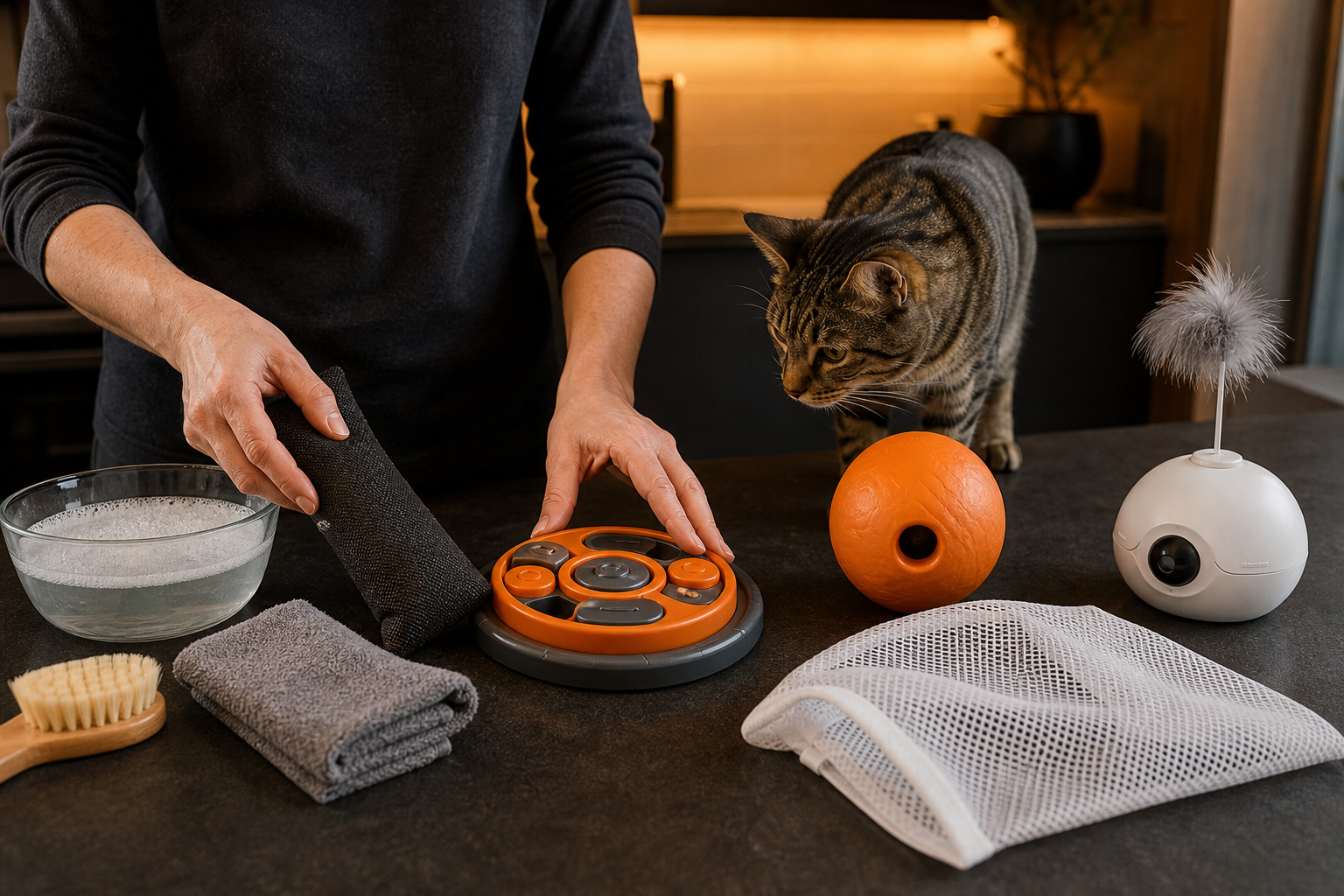
To clean cat toys safely, start with the care label and the material—not a one-method-fits-all cleaning hack. Remove hair and crumbs, inspect for damage, wash hard or washable toys with soap or detergent and warm water, rinse thoroughly, and let every part dry completely before play. Keep motors, battery compartments, glued feather attachments, and non-washable catnip filling out of the sink.
Cleaning can extend the useful life of a sound toy, but it cannot make a failing toy safe. If a rough-playing cat has opened a seam, loosened a bell, split plastic, exposed foam, or driven moisture deep into filling that will not dry, retire the toy instead of washing it back into the rotation.
Choose the Cleaning Method by Toy Type
The manufacturer’s instructions take priority because two toys that look alike may use different glue, filling, electronics, or heat-sensitive plastic. When no instructions remain, use the least aggressive method that can remove the dirt and still let you rinse and dry the toy fully.
| Toy type | Practical cleaning method | Do not | Retire when |
|---|---|---|---|
| Machine-washable fabric kicker or plush | Close fasteners, place in a mesh bag, use the labeled cycle and detergent amount, rinse well, then dry as directed | Assume hot water or a hot dryer is safe without checking the label | Seams open, filling escapes, hardware loosens, or the center stays damp |
| Non-refillable catnip toy | Follow its label; spot-clean only if that is the permitted method | Soak a toy that cannot be dried through the center | It is visibly dirty, moldy, musty, leaking filling, or cannot be cleaned as directed |
| Hard plastic, rubber, or silicone toy | Hand-wash with warm soapy water, scrub grooves, rinse, and dry; use a dishwasher only when labeled dishwasher-safe | Expose unknown plastic or rubber to high heat | It cracks, turns sticky, develops sharp gouges, or sheds pieces |
| Food puzzle | Disassemble as directed, remove food, clean every channel, rinse, and dry before reassembly | Leave wet food, oil, detergent, or moisture in hidden cavities | Food cannot be removed, parts deform, or a cat can pry pieces loose |
| Electronic or motorized toy | Switch off, unplug, remove batteries if the manual says to, and wipe only as directed | Immerse the motor, charging port, speaker, or battery compartment | There is corrosion, heat, odor, swelling, exposed wire, or a cracked housing |
| Wand lure, feather, fur, or glued attachment | Follow the attachment’s instructions; gently wipe or replace delicate parts when appropriate | Soak, machine-wash, or heat-dry a weak glued assembly by guesswork | String frays, quills split, clips bend, or small pieces loosen |
The CDC’s current pet-supply guidance uses the same basic distinction: hard items can be cleaned with soapy water, while soft washable items can go through a washer and dryer. It also says to follow product cleaning instructions and discard non-refillable catnip toys when they become dirty.
Inspect Before Washing: Clean, Repair, or Retire?
Give every toy a dry inspection before water hides the evidence. Pull gently at seams and attachments, flex hard shells, check every piece against the product photo or manual, and smell the toy. Set aside anything with a missing part until you know where that part went.
- Clean it when the toy is structurally sound and the care method can reach the dirty area without damaging the toy.
- Repair it only when the design supports repair and the result will not add loose thread, sharp knots, exposed glue, or an altered part your cat can swallow. When in doubt, replace it.
- Retire it when it has an open seam, exposed stuffing, splintered feather shaft, cracked plastic, damaged battery door, deep tooth cuts, persistent odor, visible mold, or a section that cannot be rinsed or dried.
For cats that bite and bunny-kick hard, washing is a stress test. Wet fabric may reveal a seam that was already separating, while flexing a clean rubber toy may expose a crack hidden by grime. The Titan Claws guide to durable cat toys explains the failure points worth checking before a toy returns to rough play.
How to Wash Fabric, Plush, and Catnip Toys
First remove loose fur with clean hands, a lint roller, or a vacuum attachment used carefully. Detach any refillable catnip pouch, bell, battery unit, or removable electronic mechanism only when the instructions say it is designed to come out.
Machine-washable fabric toys
- Read the tag for water temperature, cycle, detergent, and drying limits.
- Place small toys in a closed mesh laundry bag so they do not disappear or strike the drum.
- Use the detergent amount appropriate for the load. A dye-free, fragrance-free detergent may be a better choice for a cat with sensitive skin, according to the CDC.
- Run the labeled cycle. Skip fabric softener unless the manufacturer explicitly permits it.
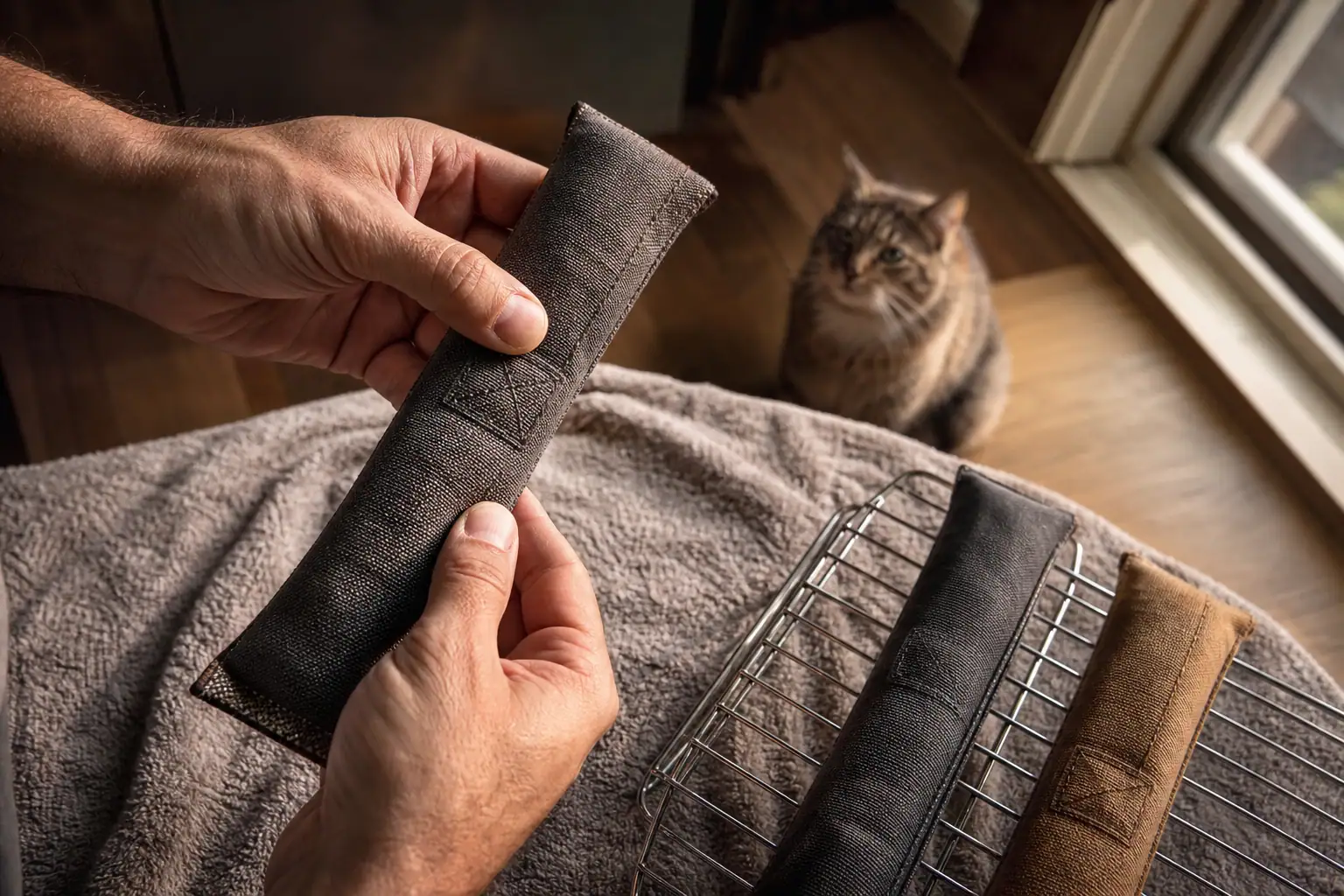
- Dry exactly as directed. Air-dry when required; use a dryer only at the allowed setting.
- Squeeze the center, smell the toy, and inspect seams and decorations again before returning it.
Catnip toys and non-washable plush
A refillable catnip toy is easier to maintain: remove the herb pouch, clean the empty cover as labeled, dry the cover fully, then refill it. For a sealed toy, do not assume that soaking is harmless. Water can carry soil into the filling and create a damp center you cannot inspect.
Spot-clean only when the label allows it, using the specified cleaner and as little moisture as necessary. If a sealed catnip toy is dirty through the fabric, smells musty, shows mold, or remains damp, discard it. You can restore interest in a clean refillable toy with fresh catnip after it is dry, but added catnip cannot refresh a contaminated toy.
How to Clean Hard Toys and Food Puzzles
For an intact, non-electronic hard toy, remove loose debris, wash it with soap or detergent and warm water, scrub joints and grooves with a dedicated soft brush, rinse away all dirt and suds, and dry it fully. Do not send a toy through the dishwasher unless its maker calls it dishwasher-safe; heat can warp plastic, damage rubber, loosen glue, or change how parts fit.
Food puzzles need a stricter routine because crumbs, wet food, and oils collect in corners. Disassemble only as the instructions permit. Wash food-contact pieces after use, especially when they held wet or raw food, and inspect ports and channels before reassembly. The FDA advises washing pet food bowls and feeding utensils with soap and hot water after each use; applying that hygiene principle to food-dispensing toy surfaces keeps yesterday’s meal out of today’s game.
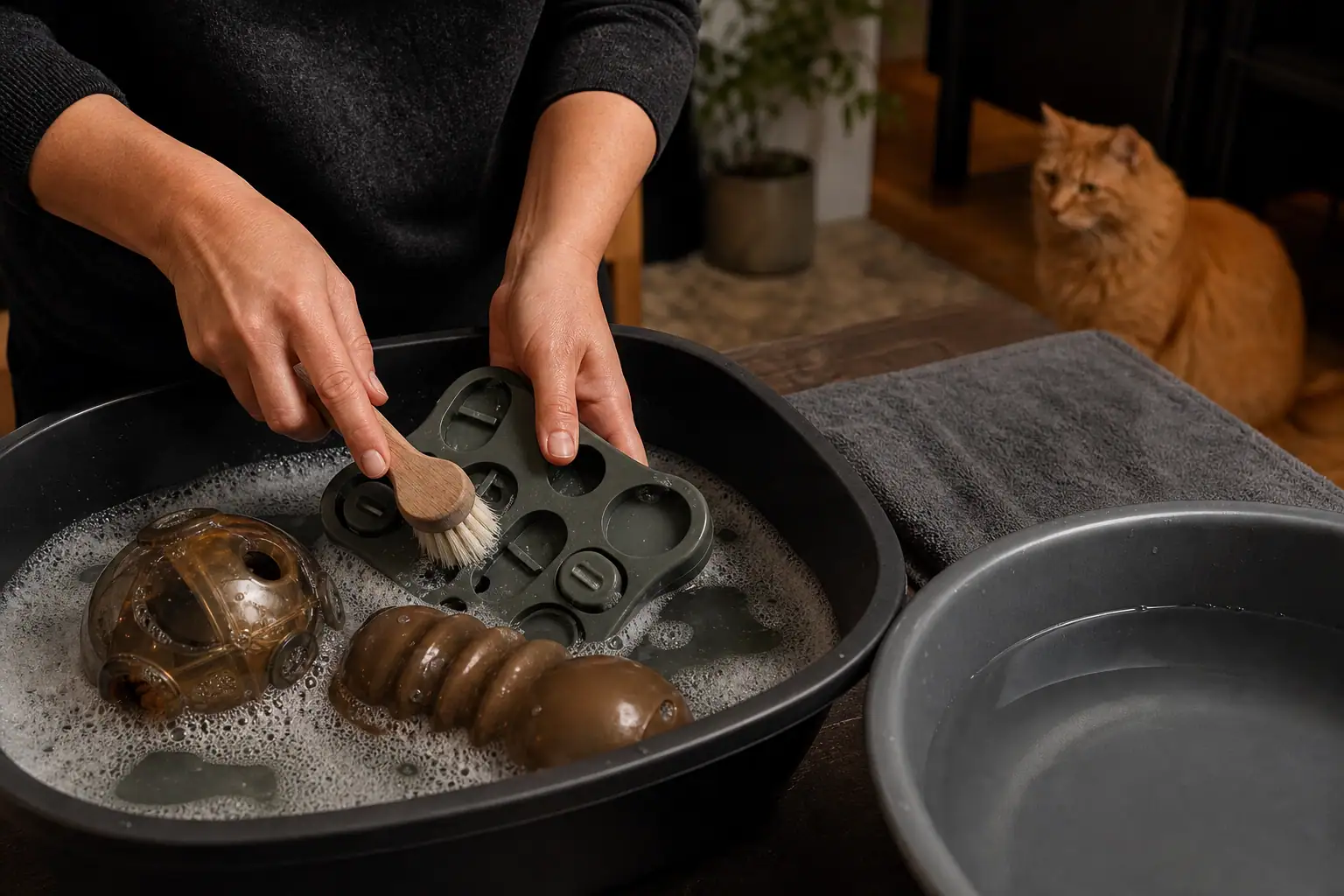
A dedicated cleaning brush helps you reach channels without borrowing a greasy kitchen sponge. Replace heavily scratched food puzzles or toys with rough, cloudy surfaces that no longer come clean. Damage that traps residue is both a hygiene problem and a possible failure point for a determined chewer.
Electronics, Wands, Feathers, and Mixed-Material Toys
Mixed-material toys are limited by their least washable component. A removable fabric sleeve may be machine-washable even though the motor inside is wipe-only. A plastic wand handle may tolerate a damp cloth while its feather lure needs replacement. Treat every power port, speaker opening, seam, adhesive joint, and attachment clip as a boundary.
- Turn electronic toys off and disconnect charging cables before cleaning.
- Remove batteries only if the instructions direct you to do so.
- Apply cleaner to the cloth rather than spraying toward openings, unless the manual says otherwise.
- Never power the toy while it is damp. Reassemble only when each permitted-to-clean part is fully dry.
- Store wands, string, elastic, ribbons, and feather lures in closed storage after supervised use, clean or not.
If moisture reaches a battery compartment or you find corrosion, swelling, unusual heat, exposed wire, or a chemical smell, stop using the toy. Cleaning cannot repair an electrical or battery fault. The same rule applies to a lure whose glue softens after wiping: replace the attachment before a cat can detach and swallow it.
When Does a Cat Toy Need Disinfecting?
Cleaning and disinfecting are different jobs. Cleaning with soap or detergent physically removes dirt and germs; a disinfectant is used to kill germs on a compatible surface. The CDC says cleaning is usually sufficient for most pet items. Disinfection becomes more relevant when a pet is sick, an item contacts urine or feces, or a person or animal in the home is at higher risk of severe illness.
If that situation applies, ask your veterinarian what needs disinfection and whether the toy is worth keeping. Use only a method compatible with the item, follow the disinfectant label’s dilution and contact time, keep the cat away during use, rinse when directed, and let the item dry fully before access. Never mix bleach with ammonia, vinegar, or another cleaner. If a porous toy was contaminated with waste, vomit, mold, or infectious material and cannot be reliably disinfected and dried, disposal is the safer choice.
Do not treat vinegar as a proven substitute for a registered disinfectant. The CDC notes that evidence is insufficient to show how well vinegar cleans or kills germs and recommends soap or detergent for cleaning. For a broader home-surface plan, see our guide to pet-safe cleaners for cats. If your question is specifically about hand-dishwashing liquid and feline exposure, read is Dawn dish soap safe for cats?
How Often Should You Clean Cat Toys?
Use the toy’s job and condition rather than one rigid calendar. The CDC gives monthly cleaning as a general example for pet toys, with more frequent cleaning when an item looks dirty or smells bad. Food-contact toys, heavily mouthed favorites, shared toys, and toys used by a sick cat need closer attention.
- After each use: remove wet food and clean food-contact puzzle parts; wipe up urine, feces, vomit, or another obvious contaminant using an appropriate plan.
- After a hard play session: inspect seams, string, clips, feathers, plastic edges, charging ports, and missing pieces. Clean saliva or dirt when needed.
- Weekly during rotation: review the active set, clean visibly soiled toys, and move questionable items to a wash-or-retire tray instead of the storage bin.
- About monthly: give the broader washable collection a cleaning check, even if the toys look acceptable from across the room.
- During illness: follow your veterinarian’s advice about frequency, separation, disinfection, and disposal.
A simple three-zone cat toy storage system makes the routine easier: one small active set, one closed container for supervised-only toys, and one clearly separate tray for wash-or-retire decisions. Never seal a damp toy in the bin.
Quick Cleaning Checklist
- Read the care label or manual before choosing water, heat, detergent, or a machine cycle.
- Remove fur, crumbs, removable refills, and batteries only as directed.
- Inspect the toy dry; account for every attachment and loose piece.
- Use warm soapy water for compatible hard toys and the labeled method for soft toys.
- Do not immerse electronics or guess that a dishwasher, washer, dryer, or microwave is safe.
- Rinse away soap and cleaner residue.
- Dry the surface, seams, grooves, and center completely.
- Inspect again after cleaning, especially if your cat plays rough.
- Disinfect only when needed and with a compatible, label-directed method.
- Retire toys with mold, cracks, open seams, exposed filling, loose parts, corrosion, or persistent odor.
Can I wash cat toys in the washing machine?
Yes, when the toy’s label says it is machine-washable. Put small items in a mesh bag, use the permitted cycle and detergent, and follow the drying instructions. Do not machine-wash toys with non-removable electronics, fragile glued parts, unknown filling, or a label that says to spot-clean only.
Can I wash cat toys with Dawn dish soap?
For an intact, nonporous, non-electronic toy whose instructions allow hand-washing, a small amount of mild dish soap may remove grime if you rinse it away completely. The exact product and toy label matter. Dish soap is a poor default for absorbent filling, feathers, electronics, or any toy that cannot be thoroughly rinsed and dried.
Can you wash cat toys with catnip inside?
Only if the care label says the filled toy can be washed. If the catnip pouch is removable, take it out and wash the empty cover as directed. Spot-clean sealed toys only when permitted, and discard a dirty, moldy, musty, or persistently damp non-refillable catnip toy.
Can I disinfect cat toys in a microwave?
Do not microwave a cat toy unless its manufacturer explicitly provides that method. Toys can contain metal bells, foil crinkle layers, batteries, heat-sensitive plastic, glue, or filling that heats unevenly. Use a label-approved cleaning or disinfecting method instead.
Bottom line: the safest clean toy is one that is still structurally sound, washed by a method its materials can tolerate, free of residue, and dry through the center. When cleaning exposes a weak seam, damaged shell, trapped moisture, or missing part, replacing the toy is better than stretching its life one more round.