Tag: indoor cat toys

  • Indoor Cat Enrichment Toys: A Practical Guide for Bored, Rough-Playing Cats

    Indoor Cat Enrichment Toys: A Practical Guide for Bored, Rough-Playing Cats

    Indoor cat enrichment toys should do more than keep a cat busy for five minutes. The best choices let an indoor cat stalk, chase, pounce, grab, bite, kick, forage, climb, hide, or solve a small problem in a way that is safe for that cat’s body and play style. If your cat gets bored fast or destroys ordinary toys, the answer is usually not one expensive gadget. It is a small rotation of toys with clear jobs and clear safety rules.

    For Titan Claws readers, the important distinction is simple: some toys are safe to leave out, some are for supervised play only, and some should be retired as soon as they show damage. This guide explains how to choose indoor cat enrichment toys for bored indoor cats, high-prey-drive cats, and rough players that chew, wrestle, or shred softer toys.

    What Indoor Cat Enrichment Toys Are For

    Enrichment means giving a cat appropriate ways to express natural behavior indoors. Cornell Feline Health Center describes toys as a way to encourage exercise and cognitive enrichment while letting cats stalk, pounce, and problem-solve. The AAFP and ISFM feline environmental needs guidelines go further: cats need opportunities for play and predatory behavior, including toys, owner interaction, and feeding practices that make the cat actively acquire food.

    That does not mean every toy has to be complicated. A cardboard box, a ping pong ball, a food puzzle, a sturdy kicker, and a wand toy can all be enrichment tools when they are matched to the cat. The useful question is not “What is the best indoor cat toy?” It is “What behavior does this toy support, and is it safe for my cat’s level of intensity?”

    The Main Types of Indoor Cat Enrichment Toys

    A balanced indoor setup usually includes toys from several categories. You do not need every option, but you do need enough variety that your cat can complete more of the hunting sequence instead of only staring at a toy that never gets caught.

    Chase toys

    Wands, teasers, skitter balls, springs, tunnels, and some automatic toys work because they move away from the cat. Move the target like prey: away, around a corner, behind a chair leg, under a tunnel edge, then pause. VCA recommends predatory games with toys the cat can eventually catch, which matters for intense cats that become frustrated by endless misses.

    Most chase toys are supervised toys. Strings, elastic cords, feathers, clips, and ribbon tails should be put away after play. For a deeper comparison of this category, see Titan Claws’ guide to wand cat toys and the related guide to cat toys on sticks.

    Catch and kick toys

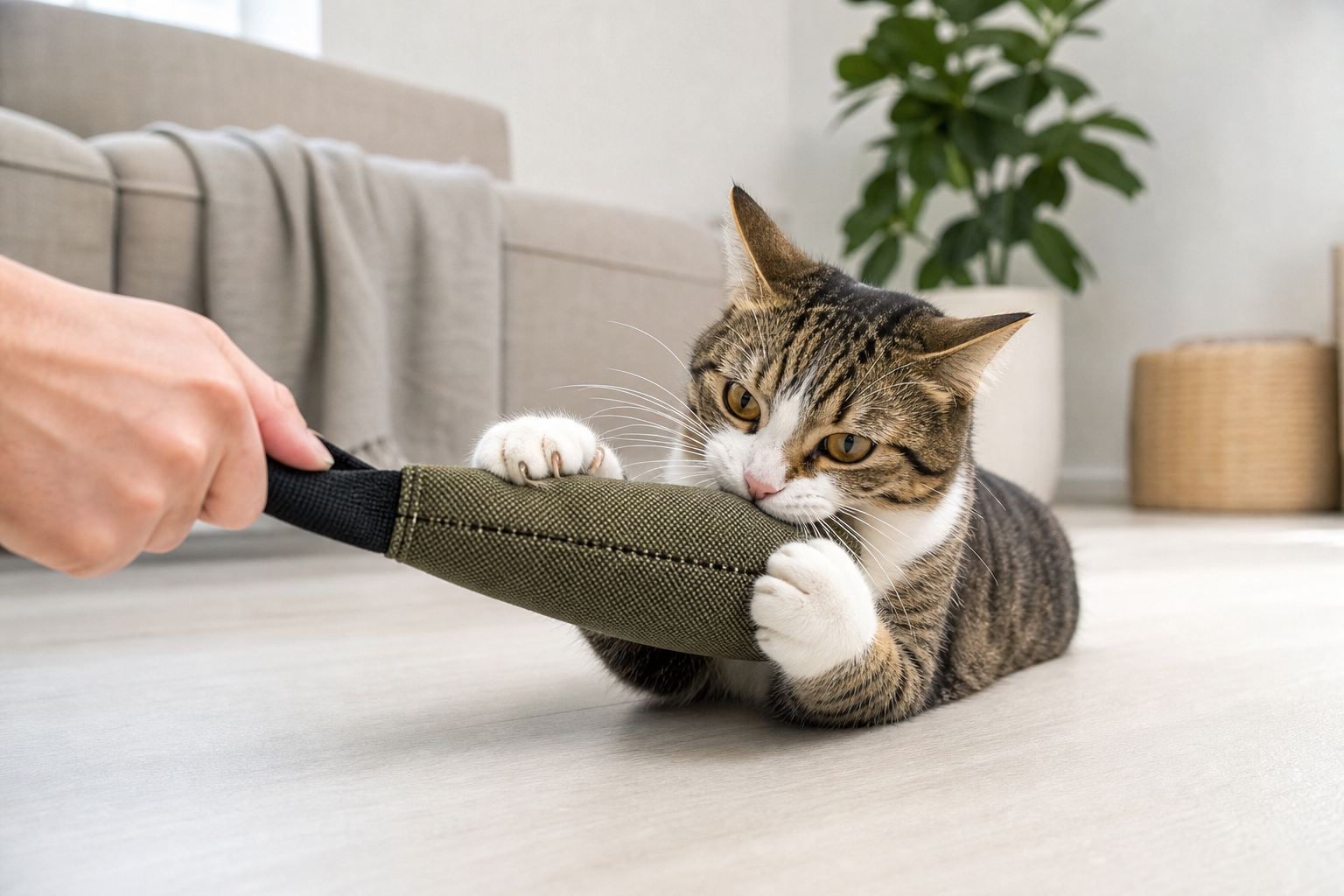
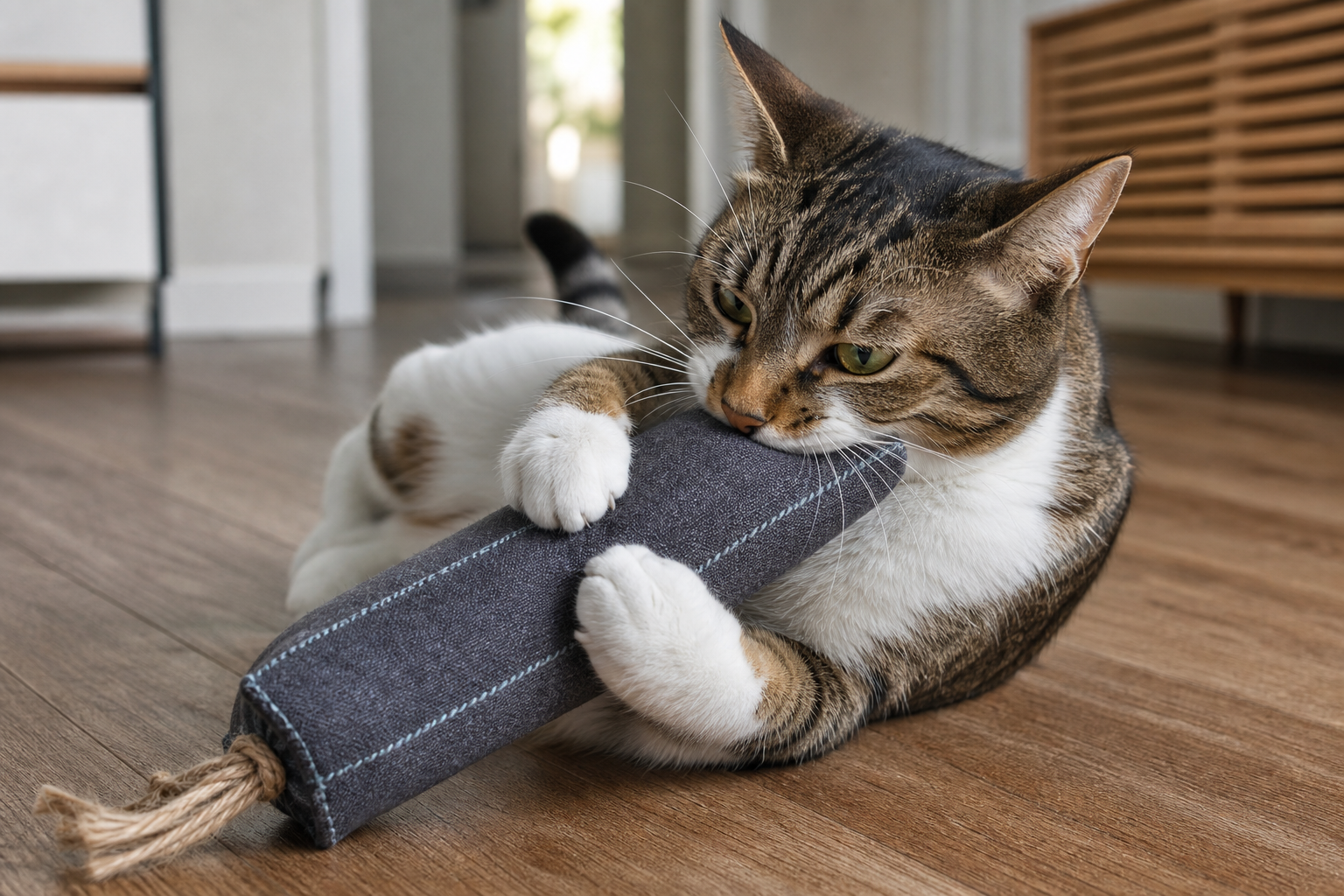
    Kicker toys give the cat something to grab with the front paws and rake with the back feet. They are especially useful for rough players, cats that redirect play onto hands, and cats that need a satisfying finish after a wand session. Choose a kicker long enough that your cat can hug it without your hand being in the bite zone.

    For cats that destroy plush toys, skip tiny mice, glued eyes, thin tails, weak seams, and loose bells. Look for simple shapes, durable fabric, visible stitching, and enough size that the toy cannot be swallowed whole. Titan Claws’ cat kicker toy guide goes deeper on sizing and failure points.

    Foraging and puzzle toys

    Puzzle feeders, treat balls, snuffle-style mats, lick mats, scatter feeding, and hidden kibble trails turn part of a meal into work. Best Friends Animal Society notes that foraging toys can satisfy a cat’s instinct to search for food, and VCA describes puzzle feeders as enrichment and exercise for indoor cats.

    Start easy. If a puzzle is too hard, the cat may walk away. Begin with a few pieces of kibble scattered on a rug, a towel fold, a toilet paper roll with safe openings, or a beginner puzzle with wide access points. Then increase difficulty only after your cat understands the game. Titan Claws’ puzzle cat toys article gives more detail on beginner, intermediate, and advanced options.

    Solo batting toys

    Large balls, track toys, plastic springs, crinkle balls, and sturdy rolling toys can help cats burn short bursts of energy without constant human input. The Ohio State Indoor Pet Initiative points out that cats are drawn to toys that squeak, chirp, jitter, swing, vibrate, roll, or otherwise act like moving prey.

    For solo use, size and construction matter. Avoid brittle plastic, toys small enough to swallow, loose caps, exposed batteries, and anything your cat can chew into sharp pieces. If a toy is electronic, inspect the battery compartment and moving parts regularly.

    Environmental toys

    Boxes, tunnels, paper bags with handles removed, scratchers, perches, window views, and safe hiding spots make ordinary toys more interesting. A spring rolling past a tunnel opening is more engaging than the same spring sitting in the middle of the floor. Enrichment is often the relationship between the toy and the room, not just the object itself.
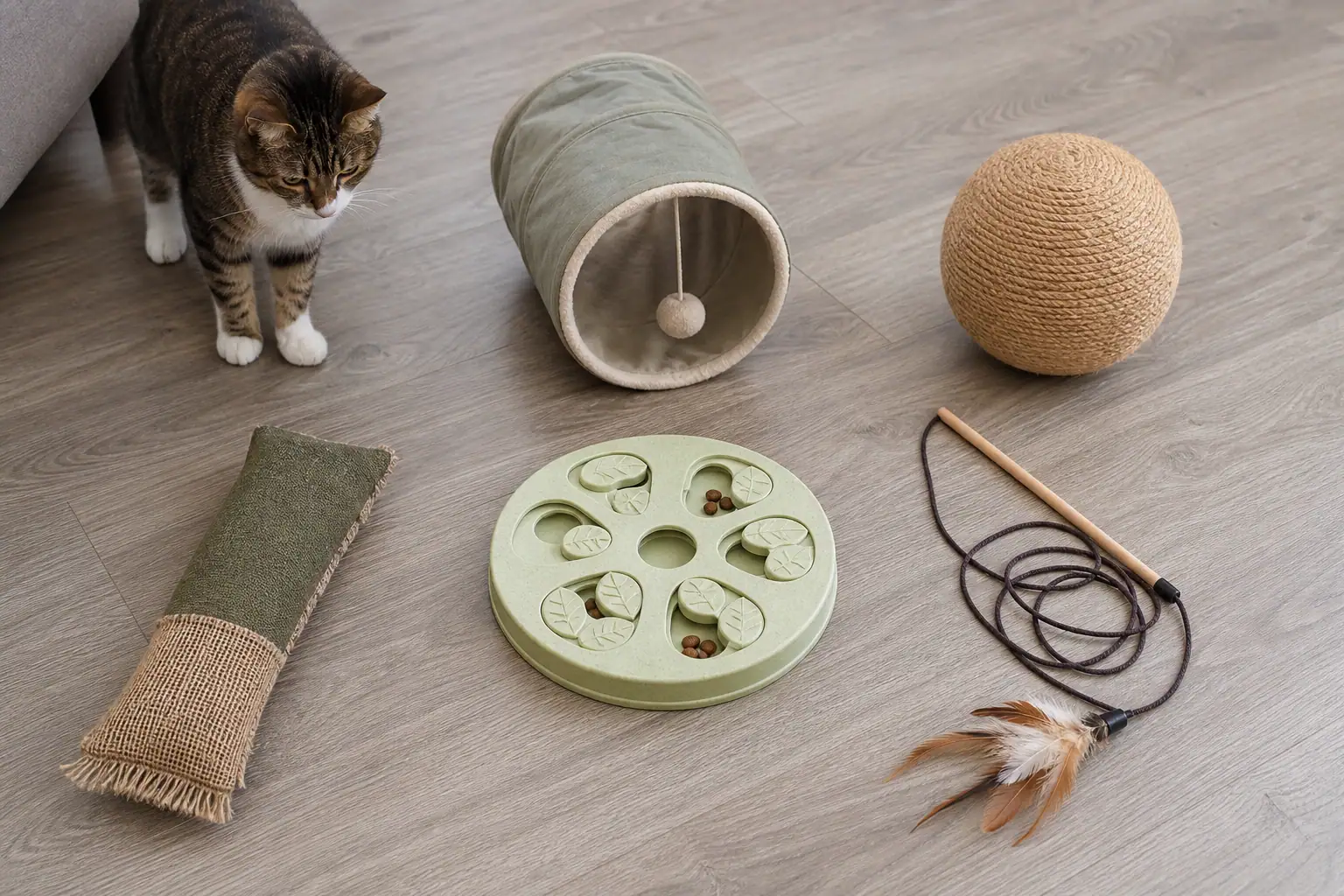
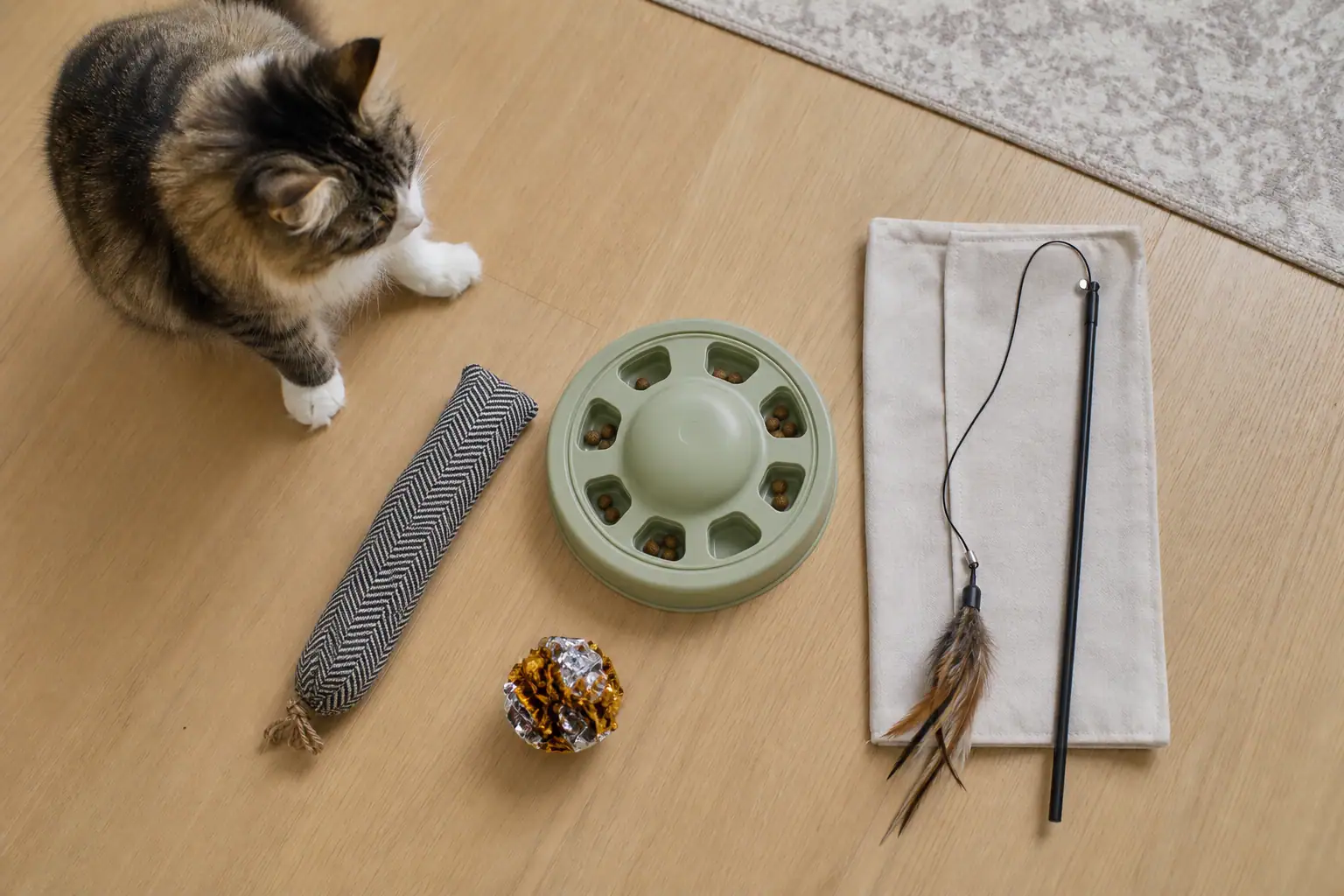
    Indoor cat enrichment toy rotation with kicker, puzzle feeder, wand, tunnel, and ball
    A useful enrichment setup gives each toy a job: chase, catch, kick, forage, hide, or bat.

    Match Toys to Your Cat’s Play Style

    Before buying more indoor cat enrichment toys, watch two or three play sessions and write down what your cat actually does. The pattern will tell you what kind of enrichment is missing.

    • The chaser runs after movement and may prefer wands, skitter toys, rolling balls, tunnels, and short hallway games.
    • The ambusher hides, waits, and pounces. Add boxes, tunnels, rug edges, and toys that disappear behind furniture.
    • The wrestler grabs and bunny-kicks. Use larger kickers and end chase games with a physical catch.
    • The chewer attacks seams, tags, feathers, and stuffing. Choose simpler, tougher toys and inspect them after every session.
    • The forager works for food. Use puzzle feeders, treat balls, scatter feeding, and hidden kibble searches.
    • The watcher enjoys lower-impact enrichment. Try window perches, bird-safe window views, slow wand movement, gentle food puzzles, and scent novelty.

    If your cat plays hard enough to ruin ordinary toys, pair this article with Titan Claws’ guides to durable cat toys, toys for cats that chew, and safe cat chew toys. The goal is durability plus inspection, not an impossible claim that any toy is indestructible.

    Solo Toys vs Supervised Toys

    One competitor gap in many enrichment lists is that they recommend toys without separating leave-out toys from supervised toys. That difference matters most for indoor cats that chew, swallow pieces, or get very excited during play.

    • Usually leave-out friendly: sturdy track toys, larger-than-mouth balls, simple tunnels, boxes, scratchers, durable kickers your cat does not chew open, and puzzles your cat cannot dismantle.
    • Supervised only: wands, string toys, ribbon toys, feathers, elastic cords, laser sessions, battery toys with removable attachments, catnip toys that trigger frantic chewing, and anything new until you know how your cat handles it.
    • Retire immediately: torn plush, exposed stuffing, loose thread, detached feathers, cracked plastic, chewed cords, loose bells, damaged battery doors, or any toy missing a piece.

    Cornell warns against toys with small pieces or strand-like parts that can detach and be swallowed, especially when chewed. The AAFP and ISFM guidelines also recommend putting away toys with string or other ingestible parts after play and avoiding small ingestible parts and bells for unsupervised access.

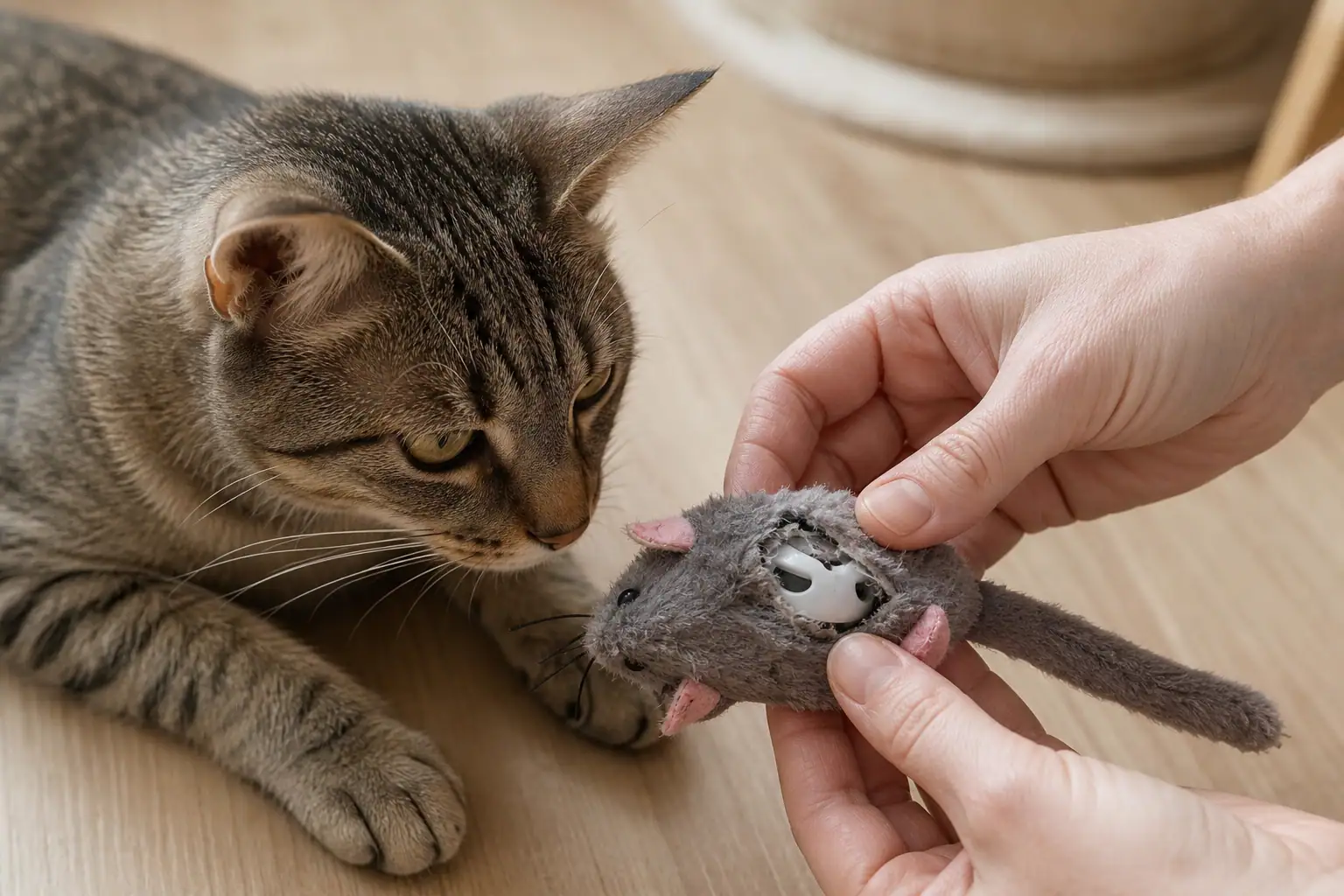
    Hands inspecting a cat enrichment toy for loose seams and chew damage
    Rough players need short sessions and quick inspections. Retire toys before loose parts become swallowable.

    A Simple Indoor Toy Rotation Plan

    Novelty helps, but novelty does not require constant shopping. VCA suggests keeping a larger assortment available while offering only a few toys at a time, then rotating them weekly. Cornell also recommends rotating toys to prevent boredom.

    Use this five-part rotation as a starting point:

    • One chase toy: a wand, teaser, or moving toy used in short supervised sessions.
    • One catch toy: a kicker or larger prey-shaped toy for grabbing and kicking.
    • One batting toy: a spring, ball, track toy, or crinkle toy for quick solo bursts.
    • One food puzzle: a beginner puzzle, treat ball, towel fold, or scatter-feeding game.
    • One environment piece: a box, tunnel, perch, scratcher, or paper bag with handles removed.

    Keep the active set small enough that you notice damage. Store the rest in a closed bin. If your cat responds well to catnip or silvervine, reserve scented toys for short sessions instead of leaving them on the floor until they become stale or chewed apart.

    How to Use Enrichment Toys Better

    Many owners buy more toys when the real fix is changing how the toy is used. Try these adjustments before replacing the whole toy basket:

    • Move prey away from the cat. Dragging a lure toward the face is less natural than letting it flee.
    • Add pauses. Stop behind a tunnel, box, chair leg, or rug edge so your cat can stalk.
    • Let the cat catch it. End some passes with a real grab, kicker handoff, or food reward.
    • Shorten rough sessions. A cat that shreds toys may need five focused minutes, an inspection break, and a calmer activity.
    • Change the surface. A ball behaves differently on carpet, hardwood, tile, and inside a box.
    • Match intensity to the cat. Kittens need size-appropriate toys. Seniors may need lower jumps, slower movement, and softer landing zones.

    Laser pointers need extra care. Some cats enjoy them, but the light cannot be caught. If you use one, keep it out of the eyes and finish with a physical toy or treat the cat can actually capture.

    Best Choices for Cats That Destroy Toys

    Rough players need a stricter filter. Choose indoor cat enrichment toys with fewer decorative parts, stronger seams, thicker fabric, larger shapes, and surfaces that are easy to inspect. Avoid tiny plush toys that fit fully in the mouth, yarn, ribbon tails, glued-on eyes, brittle plastic, weak bells, and toys that shed fibers during the first session.

    Do not leave a new toy out while you are gone until it has survived supervised play. Watch where your cat attacks first: seam, tag, corner, feather stem, tail, or stuffing area. That first failure point tells you what to avoid next time.

    If your cat repeatedly swallows non-food objects, tears toys open in minutes, guards toys aggressively, redirects hard bites onto people, or cannot settle after play, talk with your veterinarian or a qualified behavior professional. Enrichment helps many cats, but persistent chewing, pica-like behavior, aggression, or sudden behavior change can need individual medical or behavioral guidance.

    Quick Buying Checklist

    Use this checklist before buying or leaving out an enrichment toy:

    • What behavior does it support: chase, pounce, kick, bat, chew, carry, forage, hide, climb, or watch?
    • Is it too large to swallow whole?
    • Are there strings, feathers, bells, clips, eyes, tags, or decorations that could detach?
    • Can you inspect the seams, battery compartment, and surface after play?
    • Is this safe for solo access, or should it be stored after each session?
    • Does your cat get a real catch, food reward, or satisfying finish?
    • Can it be cleaned or replaced before it gets dirty or damaged?
    • Has your cat destroyed similar toys before?

    The best indoor cat enrichment toys are not just busywork. They give your cat controlled ways to hunt, solve, move, rest, and explore inside the home. Build a small rotation, separate supervised toys from leave-out toys, and retire damaged pieces early. For cats that play rough, that system will do more than another random basket of toys.
    Sources

  • Fun Cat Toys for Cats That Get Bored Fast

    Fun Cat Toys for Cats That Get Bored Fast

    Fun cat toys are not always the flashiest toys in the aisle. The toys cats return to are usually the ones that match a real feline behavior: stalking, chasing, pouncing, grabbing, biting, bunny-kicking, carrying, foraging, or hiding. If your cat gets bored fast or destroys ordinary toys, the best choice is not one magic product. It is a small, safer rotation of toys that gives your cat different ways to play.

    For Titan Claws readers, durability matters because rough play changes the risk. A feather wand may be perfect for the chase, but unsafe if it is left out with string attached. A cute plush may be fun for a gentle cat, but a short-lived stuffing hazard for a chewer. This guide shows how to choose fun cat toys by play style, how to keep them interesting, and when to retire them before damage becomes dangerous.

    What Makes a Cat Toy Fun?

    A fun cat toy usually does one of three things well: it moves like prey, it gives the cat a satisfying catch, or it rewards problem-solving. Cats are natural hunters, so many favorites involve movement that darts away, hides, pauses, or skitters across the floor. Others work because the cat can grab them with the front paws and kick with the back feet. Food puzzles work because they turn part of a meal into a small hunt.

    That is why cats sometimes ignore expensive toys and chase a cardboard box, paper ball, plastic spring, or bottle ring instead. The object is not exciting because it is fancy. It is exciting because it rolls unpredictably, makes a light sound, fits the cat’s batting style, or creates an ambush spot. Cornell Feline Health Center makes the same practical point: safe fun does not have to be expensive, and simple items such as boxes, paper bags, and ping pong balls can entertain cats when used sensibly.

    The missing piece in many toy roundups is safety. A toy can be fun and still be the wrong toy for unsupervised access. The goal is to separate toys by job and risk instead of dumping everything into one basket.

    Start With Your Cat’s Play Style

    Before buying more toys, watch your cat for two or three play sessions. The pattern matters more than the product name.

    • Chasers run after movement. They often like wand lures, skitter balls, springs, tunnels, and automatic toys that move away from them.
    • Pouncers crouch, wait, and explode toward the target. They often like toys dragged around corners, under blankets, or along baseboards.
    • Wrestlers grab with the front paws and kick hard with the back feet. They need longer kicker toys that keep claws and teeth on the toy instead of your arm.
    • Chewers bite seams, tags, feathers, and stuffing. They need fewer decorative parts, tougher materials, and stricter inspection.
    • Carriers pick up toys and move them around. They may like soft prey shapes, but size still matters if they chew.
    • Foragers work for food. They often enjoy puzzle feeders, treat balls, scatter feeding, and hidden kibble trails.
    A small set of cat toys arranged by chasing, kicking, pouncing, and foraging play styles
    A fun toy setup works best when each toy has a job: chase, catch, kick, bat, forage, or supervised wand play.

    If your cat is a rough wrestler or chewer, start with Titan Claws’ guide to durable cat toys and the more specific guide to toys for cats that chew. The right standard is not “indestructible.” It is better sizing, stronger construction, supervision where needed, and early replacement.

    The Best Fun Cat Toy Types by Job

    A strong toy rotation covers multiple jobs. You do not need every category, but you do need enough variety that your cat can use different parts of the hunting sequence.

    Wand and teaser toys for the chase

    Wand toys are often the fastest way to wake up a bored indoor cat because you control the prey. Move the lure away from the cat, let it hide, pause, and make short escapes. Avoid waving it in frantic circles until the cat gives up. VCA’s play guidance recommends predatory games with toys the cat can eventually catch, and that advice is especially important for intense cats that get frustrated by endless misses.

    Store wand toys after every session. Strings, ribbons, elastic cords, feathers, and clips are supervised-play parts. For a deeper safety comparison, see Titan Claws on wand cat toys, cat feather toys, and cat toys on sticks.

    Kicker toys for the catch

    A good kicker gives your cat something to grab, bite, and rake after the chase. This is useful for cats that attack hands, latch onto plush toys, or need a physical ending to a wand session. Look for a length that lets the cat hug the toy and kick at the same time, plus seams you can inspect easily.

    Skip hard eyes, loose bells, glued decorations, thin ribbon tails, and toys that shed fuzz after one session. If your cat plays like a small wrestler, Titan Claws’ cat kicker toy guide gives more detail on shape, size, and failure points.

    Balls, springs, and skitter toys for batting

    Simple batting toys can be some of the most fun cat toys because they move unpredictably. Plastic springs, soft balls, crinkle balls, track balls, and ping pong balls all work for different cats. Choose items that are too large to swallow, not brittle, and not packed with removable parts.

    For cats that lose interest quickly, change the route instead of buying a new toy. Roll a ball down a hallway, bounce it into a cardboard box, hide it behind a tunnel, or use a smooth floor where the toy can slide. The movement often matters more than the object.

    Puzzle toys for foraging

    Puzzle toys are fun for cats that like food, problem-solving, or slower solo activity. Best Friends Animal Society describes food puzzles as a way to satisfy the natural instinct to search for food, and VCA notes that foraging toys can provide enrichment and exercise for indoor cats.

    Start with easy wins. Scatter a small portion of kibble, hide a few pieces in a towel fold, or use a beginner puzzle with large openings. If the puzzle is too hard, the cat may quit. If it is too easy, rotate it or change the food placement. Titan Claws’ puzzle cat toys article covers beginner, intermediate, and advanced options.

    Boxes, tunnels, and low-cost ambush toys

    Do not overlook the environment around the toy. Boxes, tunnels, paper bags with handles removed, and safe hiding spots make ordinary toys more exciting because they create cover. A spring rolling past a box opening is more interesting than a spring sitting in the middle of the room.

    Use low-cost toys with the same safety judgment you would use for purchased toys. Remove bag handles, avoid sharp plastic, skip small trash-like objects your cat could swallow, and supervise anything that becomes a chewing target.

    Fun Does Not Mean Safe to Leave Out

    The best toy setup has three groups: leave-out toys, supervised toys, and retire-or-discard toys.

    • Leave-out toys: larger-than-mouth batting toys, sturdy kickers, simple track toys, boxes, tunnels, and puzzles your cat does not chew apart.
    • Supervised toys: wands, lures, feathers, ribbon toys, elastic cords, battery toys with moving attachments, laser sessions, and any toy your cat attacks intensely.
    • Retire-or-discard toys: torn plush, exposed stuffing, loose thread, cracked plastic, damaged bells, chewed cords, loose batteries, separated feathers, or any toy missing a piece.

    Cornell warns owners to avoid toys with small pieces or strand-like parts that may detach and be swallowed, especially when chewed. That warning matters for fun toys because high excitement produces harder biting, faster pouncing, and less careful handling. VCA also warns against leaving cats unattended with wand-style toys because string can tangle or be ingested.

    Hands checking a cat toy for loose seams and damaged parts
    Fun should not outlast safety. Check seams, string, stuffing, feathers, bells, batteries, and chew marks before a toy goes back into rotation.

    Build a Better Toy Rotation

    Novelty keeps toys fun, but novelty does not require constant shopping. VCA suggests keeping a larger assortment on hand while offering only a few toys at a time, then rotating them weekly. Cornell also recommends rotating toys to prevent boredom.

    A practical weekly rotation might include:

    • one supervised chase toy, such as a wand or teaser;
    • one capture toy, such as a sturdy kicker or larger plush prey toy;
    • one batting toy, such as a spring, ball, or crinkle toy;
    • one foraging toy, such as a puzzle feeder or scatter-feeding setup;
    • one environmental toy, such as a box, tunnel, or paper bag with handles removed.

    Keep the active set small enough that you notice damage. Store the rest in a closed bin. If your cat responds to catnip or silvervine, you can reserve scented toys for short sessions so they stay special instead of becoming stale floor clutter.

    For a wider routine, pair this guide with Titan Claws’ articles on cat toys for enrichment, cat toys for boredom, and cat enrichment activities.

    How to Make Play More Fun Without Making It Riskier

    Many owners buy more toys when the real problem is how the toy is being used. Try these upgrades before replacing the whole basket:

    • Move the toy away from the cat. Prey usually flees. Dragging a lure toward the cat’s face can feel confusing or threatening.
    • Use pauses. Stop behind a chair leg or box edge so the cat has time to stalk.
    • Let the cat catch it. A game with no capture can become frustrating. End some passes with a real grab, bite, or treat.
    • Match speed to age and health. Kittens may need simpler targets. Seniors may need lower jumps and slower movement.
    • Change the surface. A ball behaves differently on carpet, hardwood, a rug edge, or inside a box.
    • End before the toy fails. A rough cat may need short sessions with inspection breaks.

    Laser pointers deserve special caution. Some cats enjoy them, but the light cannot be caught. If you use one, keep it out of the eyes and transition to a physical toy or treat the cat can actually capture. Best Friends gives similar guidance: let the cat catch something at the end to reduce frustration.

    What to Avoid for Cats That Destroy Toys

    If your cat destroys ordinary toys, be stricter about materials and attachments. Avoid tiny plush mice that fit fully in the mouth, glued-on eyes, exposed bells, brittle plastic capsules, ribbon tails, yarn, loose feathers, weak seams, battery compartments your cat can pry open, and toys that shed fibers during the first session.

    Also avoid using your hands or feet as prey. VCA notes that finger- and toe-chasing can become painful and risky as a cat matures. Redirect stalking and biting into a toy that is built for the job, then put risky pieces away when the session ends.

    If your cat swallows non-food objects, repeatedly tears open toys, guards toys aggressively, redirects hard bites onto people, or cannot settle after play, ask your veterinarian or a qualified behavior professional for help. Those patterns may need more than a new toy.

    Quick Buying Checklist

    Use this checklist before buying or leaving out a new toy:

    • Does the toy match a specific play style: chase, pounce, kick, bat, chew, carry, or forage?
    • Is it too large to swallow whole?
    • Are there feathers, strings, bells, clips, eyes, tags, or decorations that could detach?
    • Can I inspect the seams and surface after play?
    • Would I leave this toy out when I am gone, or is it supervised only?
    • Does the toy give the cat a real catch or reward?
    • Can the toy be cleaned or replaced before it gets grimy?
    • Has my cat damaged similar toys before?

    The best fun cat toys are not just entertaining in the first five minutes. They keep your cat engaged, fit your cat’s natural play style, and remain easy to inspect. Build a small rotation, supervise high-risk toys, and retire damaged pieces early. For rough players, that approach is more useful than chasing the newest toy list every time your cat gets bored.

    Sources