Tag: interactive cat play

  • Hanging Cat Toys: How to Choose, Hang, and Use Them Safely

    Hanging Cat Toys: How to Choose, Hang, and Use Them Safely

    Hanging cat toys can create an exciting stalk, leap, and catch game, but toys on string or elastic should be treated as supervised play equipment—not all-day entertainment. Choose a simple, appropriately sized lure, an attachment you can inspect, and a cord that your cat cannot chew into loose strands. Hang it in a clear play area, watch the entire session, then remove or secure it in closed storage.

    That rule matters even when a product is advertised for independent play. A determined cat can wrap a paw or body in slack line, bite through elastic, pull a small part free, or swallow string. The best hanging cat toy is therefore not the one that stays up longest. It is the one you can control, inspect, and put away before its weakest part fails.

    Are Hanging Cat Toys Safe?

    They can be useful during active supervision. They are a poor choice for unattended access when they include string, ribbon, wire, elastic, feathers, bells, clips, or a small lure. Supervision means an adult is present, watching the cat, and close enough to stop the game—not simply somewhere else in the home.

    The Cornell Feline Health Center advises avoiding toys with small pieces or strand-like parts that may separate during chewing and be swallowed. The AAFP and ISFM feline environmental needs guidelines likewise say that toys with string or potentially ingestible parts should be put away after play.

    Use a different leave-out option when nobody can watch: an intact track toy, a correctly sized sturdy ball, a simple food puzzle, or another toy your individual cat has used safely through repeated checks. If your cat eats thread, wool, fabric, plastic, or other non-food material, ask your veterinarian what types of enrichment are appropriate.

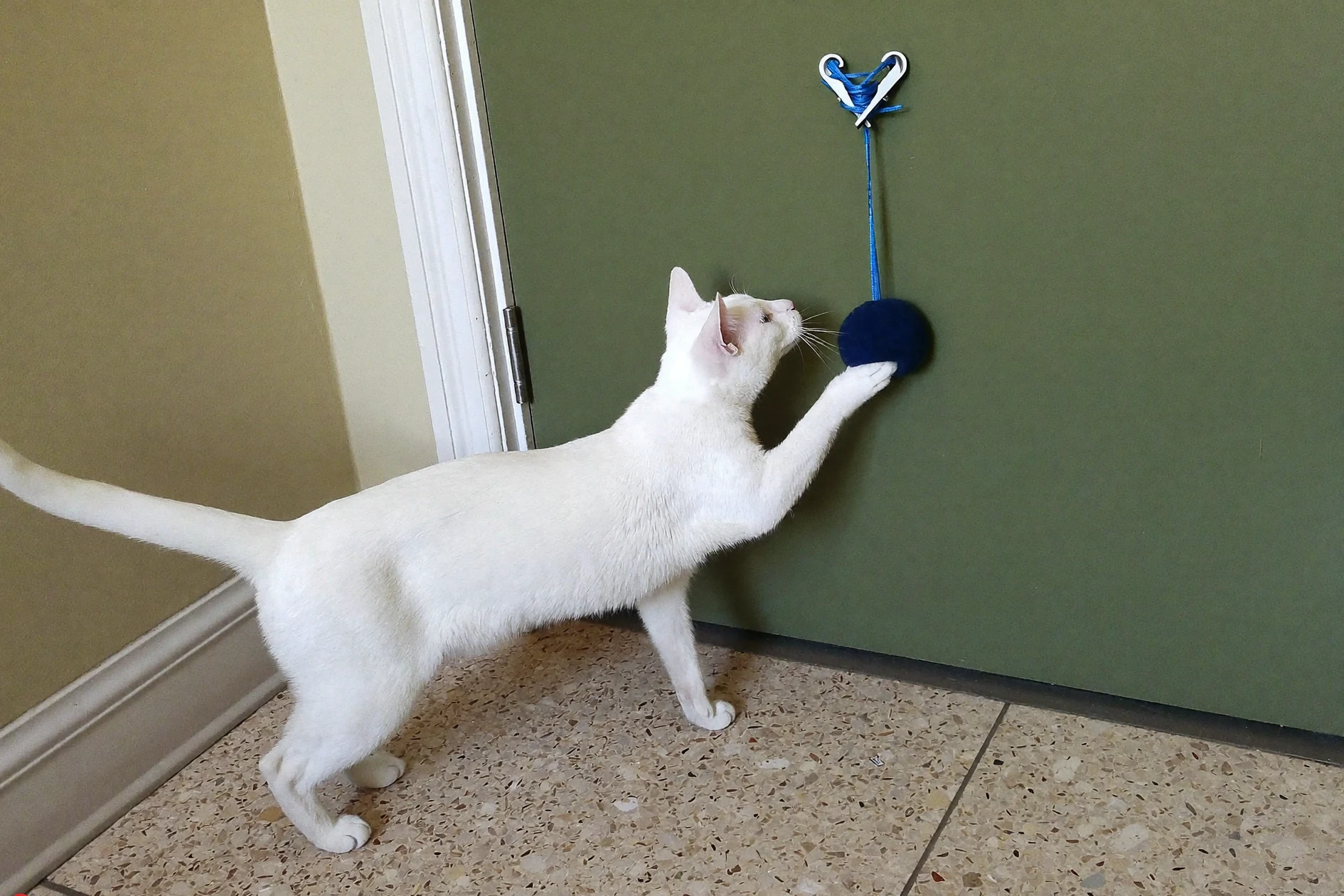
    Owner checking the mount and short cord of a door hanging cat toy
    Check the mount, line, adjuster, and lure by hand before every play session.

    Why cats like dangling toys

    A suspended lure changes direction when it is tapped, retreats when it is pulled, and returns after a miss. That unpredictable motion can resemble small prey and lets a cat stalk, chase, pounce, grab, and sometimes kick. Those behaviors are not frivolous: veterinary environmental guidance identifies opportunities for play and predatory behavior as a core part of a healthy feline environment.

    The movement is only half the game. Let your cat catch the lure regularly. A toy that always springs out of reach can turn a hunting sequence into repetitive frustration. After a catch, pause. If your cat wants to clamp down and rabbit-kick, trade the hanging lure for a larger capture toy rather than allowing prolonged chewing on cord or elastic.

    For more owner-controlled chase technique, see the Titan Claws guide to using a feather wand cat toy safely. If you are comparing suspended toys with powered or rolling options, our guide to cat toys that move covers their different failure points.

    Choose the Right Hanging Style

    Most hanging cat toys use a door frame, wall or window mount, cat-tree attachment, or ceiling anchor. Stores may also call them dangling teasers, bungee toys, retractable toys, or suspended cat toys. None is automatically safe. Choose by the way the whole system behaves when your cat pulls—not by how lively the lure looks in a product video.

    Style What it does well Main checks
    Door-hanging cat toy Easy to install and remove for a supervised session Door cannot swing or close; mount does not drop a hard part; line stays away from hinges
    Wall or window-mounted toy Creates side-to-side batting and can suit a small room Surface and adhesive suit the stated load; mount cannot become a chewable loose piece
    Cat-tree hanging toy Adds motion to a familiar play station Tree stays stable; line cannot reach a neck, leg, platform edge, or nearby gap
    Ceiling-hung toy Offers a wide movement area Purpose-built anchor; no fan, light, sprinkler, or improvised fixture; fully removable after supervised play
    Motorized wall toy Varies motion without constant hand movement Protected battery door, no exposed charging cord, controlled session, automatic motion does not equal unsupervised safety

    Avoid hanging any toy from a ceiling fan, light fixture, curtain rod, blind cord, open door, unstable shelf, or object that can fall. Keep play away from stairs, glass, hot surfaces, breakables, and narrow gaps where a cat can land awkwardly. A door-hanging toy needs a door that cannot move while the cat plays; use a different location in a busy passageway.

    Inspect the Five Failure Points Before You Buy

    1. The anchor: It should match the intended surface, remain visible for inspection, and not rely on an improvised household fitting. A mount that tears free can fall onto the cat; an immovable anchor paired with a long loop creates a different risk.
    2. The line: Skip fishing line, thread, ribbon, yarn, exposed rubber, or thin elastic your cat immediately tries to chew. A covered line is not automatically safe, but damage is often easier to see on a thicker, contrasting material.
    3. The adjustment: Knots, sliders, swivels, clips, crimps, and retractors are all potential weak points. Check whether each one can loosen, trap fur or a claw, or become a small swallowed part.
    4. The lure: Prefer a simple, intact lure that is too large for your cat to swallow whole. Avoid glued eyes, loose bells, brittle plastic, shedding feathers, open seams, exposed stuffing, and narrow tails for hard chewers.
    5. The storage plan: Decide where the complete toy will go after play. If removing it is awkward or the lure still hangs within reach when “put away,” the setup encourages risky access.

    “Heavy-duty elastic” describes resistance to pulling; it does not prove that the toy is safe to chew, impossible to tangle in, or suitable without supervision. For a broader materials and seam check, use our durable cat toy buying checklist.

    Detached hanging cat toy components laid out for inspection
    The anchor, line, adjustment point, lure, and storage plan all matter for rough play.

    How to Hang and Test a Cat Toy

    1. Read the product instructions. Confirm the intended surface, installation method, weight or pull limits if provided, and whether the maker requires supervision.
    2. Clear the play zone. Give your cat a non-slip landing area and an open exit. Move cords, bags with handles, breakables, unstable furniture, and other pets that may crowd the game.
    3. Install without improvised extensions. Extra ribbon, string, rubber bands, wire, and homemade loops add failure points. Do not combine parts from unrelated products unless the manufacturer says they are compatible.
    4. Check every connection by hand. Gently test the mount, line, adjuster, and lure before the cat enters. Stop if anything shifts, opens, frays, exposes adhesive, or develops a sharp edge.
    5. Set the shortest practical line for the game. The lure should remain reachable, but there should not be loose coils or a body-sized loop. Because cats and rooms differ, there is no universal safe hanging height.
    6. Run a short first session. Watch whether your cat bats the lure, chews the line, twists repeatedly, wraps a limb, crashes into the mount, or tries to climb the cord. The cat’s actual behavior decides whether the setup is suitable.
    7. End, inspect, and store. Allow a final catch, trade for an intact kicker or food activity, detach the hanging toy, and put every cord and lure in closed storage.

    Stop immediately if the line touches or loops around the neck, chest, abdomen, tail, or a limb. Calmly support the cat and release tension; do not yank a trapped limb against taut elastic. If your cat is hurt, breathing abnormally, limping, or cannot be freed quickly, seek urgent veterinary help.

    Better Hanging Play for Cats That Destroy Toys

    Rough play changes the job of the hanging toy. It should create the chase, not absorb unlimited biting. A cat that braces, pulls hard, chews the cord, or dismantles attachments needs shorter sessions and an earlier handoff to a large kicker or other supervised capture toy.

    • Choose fewer components. Every bell, feather, clip, tail, and decoration is another part to inspect.
    • Keep the lure visually different from the line so you can see whether the cat is targeting the toy or the cord.
    • Interrupt cord chewing by making the lure move away, then end the session if the cat returns to the line.
    • Keep replacement lures ready, but retire damaged parts before—not after—they break.
    • Play with cats separately if two cats twist the line around each other, compete at the mount, or block one another’s escape.

    Some cats are simply a bad match for hanging elastic. That is useful information, not a failed purchase. Try owner-held wand play, a track toy with a captive ball, a tunnel-and-toss game, or a food puzzle that provides movement without an accessible long line.

    Can You Make a DIY Hanging Cat Toy?

    You can make a supervised dangling lure, but the safer DIY boundary is to keep it in your hand like a wand and store it when the session ends. Do not create a permanent unattended hanging toy from yarn, fishing line, thread, dental floss, ribbon, rubber bands, hair ties, wire, or elastic cord. Familiar household material can still tangle, cut, snap back, or become a linear foreign body if swallowed.

    For a simple supervised project, attach one large, plain fabric lure to a sturdy handle with a short, visible connection you inspect before every use. Skip bells, beads, staples, glued decorations, feathers that shed, and stuffing your cat can pull out. If you cannot verify the anchor and every connection, make a toss toy or cardboard foraging activity instead of suspending it.

    When to Replace the Toy—or Call a Veterinarian

    Retire the line or the entire toy if you see fuzzing, thinning, fraying, exposed elastic, permanent stretching, bite notches, a loose knot, a bent clip, a shifting mount, cracked plastic, leaking stuffing, loose feathers, or any missing piece. Replace it as soon as the damage appears; do not wait for the next hard pull to finish the break.

    If you know or suspect that your cat swallowed string, elastic, ribbon, fabric, a feather, or another toy part, contact your veterinarian or an emergency clinic promptly even if the cat seems normal. Vomiting, retching, reduced appetite, lethargy, hiding, abdominal discomfort, diarrhea, straining, or strand-like material at the mouth or rectum are urgent warning signs. Do not pull visible material and do not induce vomiting unless a veterinarian specifically directs you. Titan Claws’ guide to foreign-body ingestion in cats explains why quick veterinary advice matters.

    Quick Hanging Cat Toy Checklist

    • Will an adult actively watch the full session?
    • Is the mount designed for this surface and away from doors, stairs, fans, blind cords, and breakables?
    • Is the line short, visible, intact, and free of loose loops?
    • Is the lure simple, intact, and too large to swallow whole?
    • Are clips, knots, swivels, adhesives, seams, and retractors easy to inspect?
    • Does your cat attack the lure rather than chew or climb the line?
    • Can your cat land with traction and leave the play area freely?
    • Will you detach and store the whole toy immediately after play?

    Bottom line: Hanging cat toys are best for short, supervised chase sessions. Choose the whole system—anchor, line, connections, lure, room, and storage habit—not just the moving end. Let your cat catch it, switch rough biting onto a better capture toy, inspect every part, and put the dangling toy away when the game is over.
    Sources

  • 9 Signs Your Cat Wants to Play (and How to Respond)

    9 Signs Your Cat Wants to Play (and How to Respond)

    Common signs your cat wants to play include bringing or batting a toy, darting away and looking back, stalking your feet, crouching with a loose wiggling rear end, chirping near a play area, and racing through the house. The clearest evidence is not one pose or sound. It is a cluster of relaxed, energetic signals followed by willing pursuit when you offer an appropriate toy.

    Context matters because the same meow, stare, tail movement, or dilated pupil can also appear with hunger, frustration, fear, or pain. Instead of guessing from a single cue, use the simple two-signal test in this guide: notice an invitation, offer a safe game, and watch whether your cat chooses to engage.

    9 Signs Your Cat Wants to Play

    Learn your own cat’s patterns rather than waiting for a universal play pose. One cat may deliver a toy to your desk; another may sit silently beside the cabinet where the wand is stored. These nine behaviors become meaningful when they happen around a familiar play time or location and the rest of the cat’s body looks loose rather than defensive.

    1. Your cat brings, bats, or waits beside a toy

    This is the most direct invitation. Your cat may carry a toy into the room, push a ball toward you, tap a kicker, or sit beside the toy drawer. Some cats never retrieve, so simply returning to a known play station can be their version of asking.

    2. Your cat darts away, then turns to check on you

    A quick dash followed by a pause, glance, or return can invite you to continue the action. Do not chase your cat with your hands. Move a wand lure or toss an appropriate toy away from your body so the game has a clear target and your cat keeps teeth and claws off people.

    3. Your cat crouches, stalks, or wiggles before a pounce

    Focused watching, a low approach, a small rear-end wiggle, and a burst toward a moving object are parts of predatory-style play. The AAFP and ISFM feline environmental needs guidelines recommend giving cats opportunities to express play and predatory behavior, including stalking, chasing, pouncing, and catching.

    4. Your cat pounces on ankles or ambushes you

    An ankle ambush can mean that your moving feet have become the most interesting prey-like target available. It is an invitation you should redirect, not reward with hand wrestling. Freeze instead of jerking your foot, then move a long-distance toy away from your legs. Repeated or injurious attacks need a broader behavior plan; see our guide to cat play aggression toward an owner.

    5. Your cat has a burst of zoomies

    Running, skidding, climbing, and changing direction rapidly can signal that your cat has energy ready for an outlet. Zoomies are not automatically a request for human play, but they are a good moment to offer a chase game if the room is clear and the cat is receptive.

    6. Your cat chirps, trills, or meows near you

    Vocalizing can recruit your attention, especially when your cat pairs it with a toy, a trip toward the play area, or an alert posture. First rule out the obvious alternatives: an empty water bowl, a closed door, a dirty litter box, a missed meal, or another unmet need.

    7. Your cat follows you and repeatedly re-engages

    A cat that follows, steps into your path, leaves, and returns may be trying to start an interaction. Offer a toy once and see what happens. Following alone can also mean food, company, curiosity, or a preferred resting spot, so let the response—not your assumption—decide.

    8. Your cat paws at moving objects or creates a game

    Batting a pen, reaching under a rug, knocking a light object, or watching your cursor can reveal a desire to chase and investigate. Redirect that interest to a purpose-built toy before a swallowed cap, damaged cord, or broken desk object becomes part of the game.

    9. Your cat appears at a predictable play time

    Cats learn routines. If your cat becomes alert before your normal morning or evening session, waits at the same rug, or watches the cabinet where toys live, anticipation itself is a strong clue. Predictability also lets you start play before yowling or ankle attacks become the only signals that work.

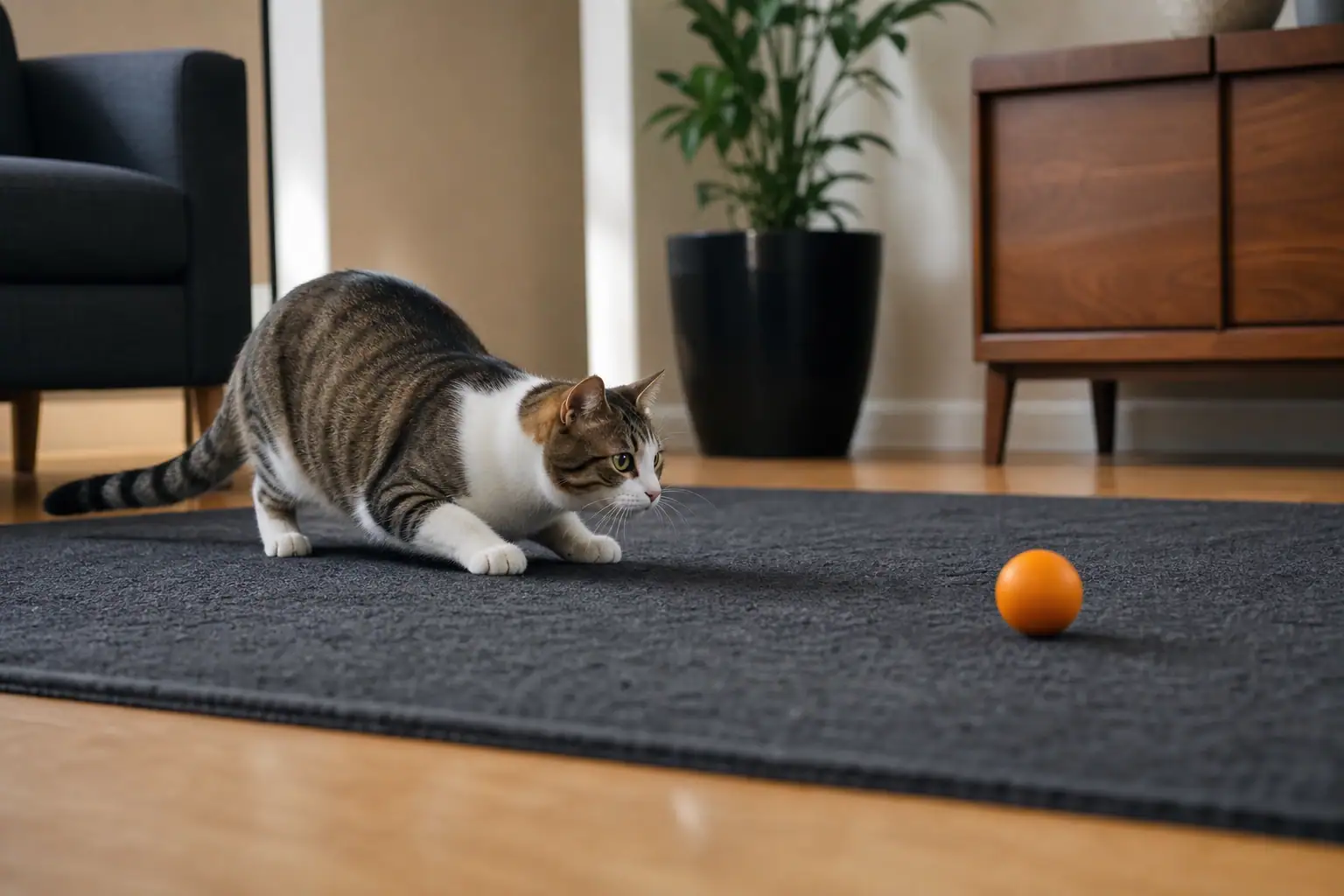
    Cat crouching loosely and watching a toy during a play invitation
    A loose crouch, focused watching, and voluntary re-engagement can form a cluster of play signals.

    Use the Two-Signal Test Instead of Guessing

    No single tail position, pupil size, or sound proves that a cat wants to play. Read the whole body, the situation, and what happens next.

    1. Notice a possible invitation. Look for an approach, toy delivery, energetic movement, stalking, or a familiar play-time routine.
    2. Check the emotional tone. A playful cat is usually voluntarily approaching or re-engaging, with fluid movement and an available escape route. Hissing, growling, a rigid body, flattened ears, puffed fur, a tightly tucked tail, or attempts to hide point away from ordinary play.
    3. Offer—not impose—a toy. Move a wand lure along the floor away from the cat, roll a sturdy ball, or present a kicker at a comfortable distance. Never push a toy into the cat’s face.
    4. Let the response decide. Watching, stalking, chasing, catching, and returning for another pass confirm interest. Turning away, freezing, retreating, grooming abruptly, or remaining tense means pause and give space.

    The test also respects a quieter play style. A cat can spend a minute watching a lure disappear behind furniture before pouncing. Watching is part of hunting-style play; nonstop jumping is not the only sign of engagement.

    What you see It may mean play when… Pause or investigate when…
    Wide pupils The body stays loose and the cat tracks a moving toy The cat freezes, hides, flattens the ears, or reacts to a frightening event
    Tail movement The tip twitches during focused stalking The tail lashes hard as the body tenses or the cat turns on you
    Crouching The cat advances toward a toy and pounces The cat compresses into a hiding place or tries to escape
    Meowing The cat leads you to a toy or engages when one moves Food, water, litter, access, distress, or illness may explain the call
    Swatting The cat bats an object with controlled movement Claws stay out, the body is rigid, or hissing and growling follow

    The ASPCA’s overview of feline aggression and body language emphasizes that posture, facial expression, ears, tail, and whiskers must be read together. A defensive cat may crouch too, but often adds a tucked posture, flattened ears, wide eyes, hissing, or an attempt to get away.

    Match the Game to the Invitation

    The fastest way to lose a cat’s interest is to move every toy the same way. Respond to the behavior you just observed.

    • For a stalker: slide a lure along the floor, pause behind a box, and let it reappear. Move it away like prey; do not repeatedly poke it toward the cat.
    • For a chaser: roll a sturdy, appropriately sized ball through an open path or use a wand at ground level.
    • For a jumper: use controlled, low arcs with safe footing. Avoid encouraging blind leaps near stairs, shelves, lamps, or hard furniture edges.
    • For a wrestler: offer a large intact kicker that creates distance between claws and your hand. Owners of seam-focused cats should inspect the shell and attachments after hard sessions.
    • For a thinker: hide a toy partly behind an obstacle or offer a simple food puzzle using part of the cat’s normal ration.
    • For a senior or mobility-limited cat: keep the target low, slow, and easy to catch. Small paw reaches, head tracking, and short stalks still count as play.

    Varying games is useful, but a massive toy collection is not required. Our sensory toy guide explains how movement, texture, sound, scent, and food can create distinct play options, while the daily cat play guide helps turn those options into a realistic routine.

    Owner moving a wand toy away from a cat across a clear play area
    Move the target away like prey, keep hands out of reach, and give the cat a clear route and a chance to catch.

    How to Start and Finish a Better Play Session

    Once your cat accepts the invitation, build a small hunting-shaped sequence rather than waving a toy continuously in the cat’s face.

    1. Clear the route. Move breakables, dangling cords, and unstable objects. Give the cat traction and an escape path.
    2. Start small. Make the toy rustle, creep, or pause at the edge of the cat’s attention.
    3. Alternate action and stillness. Prey does not fly at maximum speed without stopping. Pauses give the cat time to plan.
    4. Allow catches. A game that can never be caught can become frustrating. Let the cat grab the target, then restart only after the grip relaxes.
    5. End gradually. Reduce the speed, offer one final catch, and put stringed or easily swallowed components in closed storage. A small portion of the cat’s normal food can provide a natural-feeling finish when appropriate for the cat’s diet.

    The environmental guidelines recommend interactive toys that mimic ground or flying prey, allowing capture, rotating toys to reduce boredom, and putting away strings or potentially ingestible parts after play. Cornell’s cat toy safety guidance also warns about small or strand-like pieces that can separate during chewing and about hazards in the surrounding play area.

    Know When Your Cat Is Done—or Too Worked Up

    Healthy play has pauses and choice. End or slow the session when your cat walks away, stops re-engaging, lies down without tracking the toy, or begins a normal post-play activity. Do not keep touching or cornering a cat to demand another round.

    Stop immediately if you see a rigid body, persistent hard tail lashing, ears flattening, growling, hissing, repeated attacks on the handler, frantic chewing, open-mouth breathing, limping, or loss of coordination. Give the cat space and let arousal fall. Do not punish, grab, or try to soothe an agitated cat with your hands.

    Inspect the toy before putting it away. Retire it when seams open, filling appears, hard material cracks, an attachment loosens, a battery compartment is damaged, or any piece is missing. “Durable” should mean easier to inspect and better matched to your cat’s play pattern—not indestructible. Our durable cat toy guide covers failure points for cats that bite, kick, and dismantle ordinary toys.

    What If Your Cat Wants to Play All the Time?

    Frequent invitations are normal for many kittens and active cats, but you do not have to answer every request with an exhausting marathon. Schedule several short sessions around times your cat naturally becomes active, then offer independent enrichment between them. Rotate a few options instead of leaving every toy out indefinitely.

    If ankle attacks, yowling, or object-knocking reliably earns instant play, your cat may learn to repeat that sequence. Avoid punishment. Start a predictable session before the usual problem time and reinforce safer invitations, such as waiting at a play station or touching a designated toy. For a household stuck in a boredom cycle, the Titan Claws 7-day play reset provides a structured starting point.

    In multi-cat homes, play with cats individually when competition makes one cat hang back or another monopolize the toy. Keep enough distance and resources that each cat can choose whether to participate.

    When a Behavior Change Needs a Veterinarian

    A sudden increase or decrease in play is information, not a personality verdict. Contact your veterinarian if a cat abruptly stops playing, seems painful, hides more, limps, tires unusually quickly, loses weight, eats or drinks differently, vocalizes in a new way, or becomes suddenly aggressive. Older cats and cats with known medical conditions may need adapted play, but a new change should not automatically be blamed on age.

    Likewise, intense stalking or biting directed at people is not something every owner should solve alone. A veterinarian can check for pain and other medical contributors and, when needed, refer you to a qualified feline behavior professional. Seek prompt veterinary advice if a toy part may have been swallowed or if play causes an injury.

    Quick Play-Invitation Checklist

    • Is your cat approaching, returning, or leading you toward a play context?
    • Does the body look fluid and curious rather than rigid, flattened, or defensive?
    • Have you ruled out food, water, litter, access, and obvious distress?
    • Does your cat choose to watch, stalk, chase, or catch when a toy moves away?
    • Can the cat disengage and leave at any time?
    • Is the room clear and the toy intact, appropriately sized, and supervised as needed?
    • Will you allow a final catch and store risky components after the session?

    Bottom line: The most reliable sign your cat wants to play is a pattern: your cat invites interaction, shows relaxed predatory interest, and willingly engages with an offered toy. Observe first, test gently, and let your cat’s next choice answer the question.

    Sources

  • What Percentage of Cats Play Fetch? The 41% Finding Explained

    What Percentage of Cats Play Fetch? The 41% Finding Explained

    About 41% of cats play fetch at least sometimes, according to a 2024 study of 8,224 owner questionnaires. The exact result was 40.9%—roughly four cats in ten. Fetch is therefore common enough to be a normal part of cat play, even though dogs were reported to fetch much more often at 77.8%.

    That headline needs one careful qualifier. Researchers grouped cats who fetched sometimes, usually, or always together as fetchers. The finding does not mean 41% of all cats reliably return a toy on command, and it is not a census of every pet cat. It is the strongest large-sample estimate currently available, and it shows that feline fetch is far from a rare trick.

    Where Does the 40.9% Cat Fetch Figure Come From?

    The figure comes from a peer-reviewed PLOS ONE study published in 2024. Researchers analyzed responses to the Feline Behavioral Assessment and Research Questionnaire, or Fe-BARQ, collected from September 2015 through September 2023. Owners answered how often their cat “plays fetch” or likes to retrieve thrown objects or toys.

    The response scale ran from never to always. For the prevalence analysis, the researchers made two groups:

    • Fetchers: cats reported to fetch sometimes, usually, or always.
    • Non-fetchers: cats reported to fetch never or seldom.

    That definition matters. A cat who occasionally returns a toy counted alongside a cat who starts a nightly game. The study measured owner-reported behavior, not performance in a controlled fetch test. Most respondents were in the United States, the United Kingdom, Australia, or Canada, and people chose to complete the questionnaire. Those features make 40.9% a useful estimate for the survey sample—not a guarantee that exactly 40.9% of cats everywhere fetch.

    Is It Rare for a Cat to Play Fetch?

    No. If roughly four in ten cats fetch at least sometimes, the behavior is unusual enough to be delightful but too common to call rare. A cat that chases a tossed toy, picks it up, and returns it toward a person is showing a recognizable form of social object play—not behaving like the wrong species.

    You may also see a lower number quoted from older research. The 2024 paper notes a previous veterinary-clinic survey in which 16.5% of 819 cats were said to know fetch as a “trick.” That question and setting were different, so the two percentages are not direct contradictions. Asking whether a cat knows a trick is narrower than asking how often the cat retrieves thrown objects or toys.

    Another widely shared number—94.4%—does not mean that 94.4% of all cats fetch. A separate 2023 Scientific Reports survey recruited people whose cats already fetched. Among those known fetchers, owners said 94.4% began without explicit training. That study is valuable for understanding how fetch unfolds, but its recruitment method cannot tell us how common the behavior is across all cats.

    Why Do Some Cats Play Fetch?

    Fetch combines several behaviors cats already perform: watching movement, chasing, grasping, carrying, and interacting with a person. The throw creates prey-like motion; the pickup and carry continue the sequence; bringing the object back makes the motion happen again. It can be both a hunting-style game and a social exchange.

    The 2024 analysis found that fetching was most clearly associated with activity and playfulness. Fetch had much smaller correlations with trainability, prey interest, predatory behavior, and sociability toward people. In other words, the data fit the idea of fetch as an active play pattern better than a simple “smart cat” or “social cat” label.

    The researchers also found associations—not rules—within their sample:

    • Fetching was reported more often in younger cats and male cats.
    • Indoor-only cats were more likely to fetch than cats with outdoor access.
    • Cats living without dogs were more likely to fetch than cats living with dogs.
    • Bengal, Burmese, Siamese, and Tonkinese cats were more likely than expected to fetch, while domestic longhairs were less likely than expected.

    None of those traits determines what an individual cat will do. A senior female domestic longhair may love fetch; a young male Siamese may ignore every toss. Breed, age, sex, housing, and household composition were statistical associations in owner reports, not a checklist for predicting one cat.

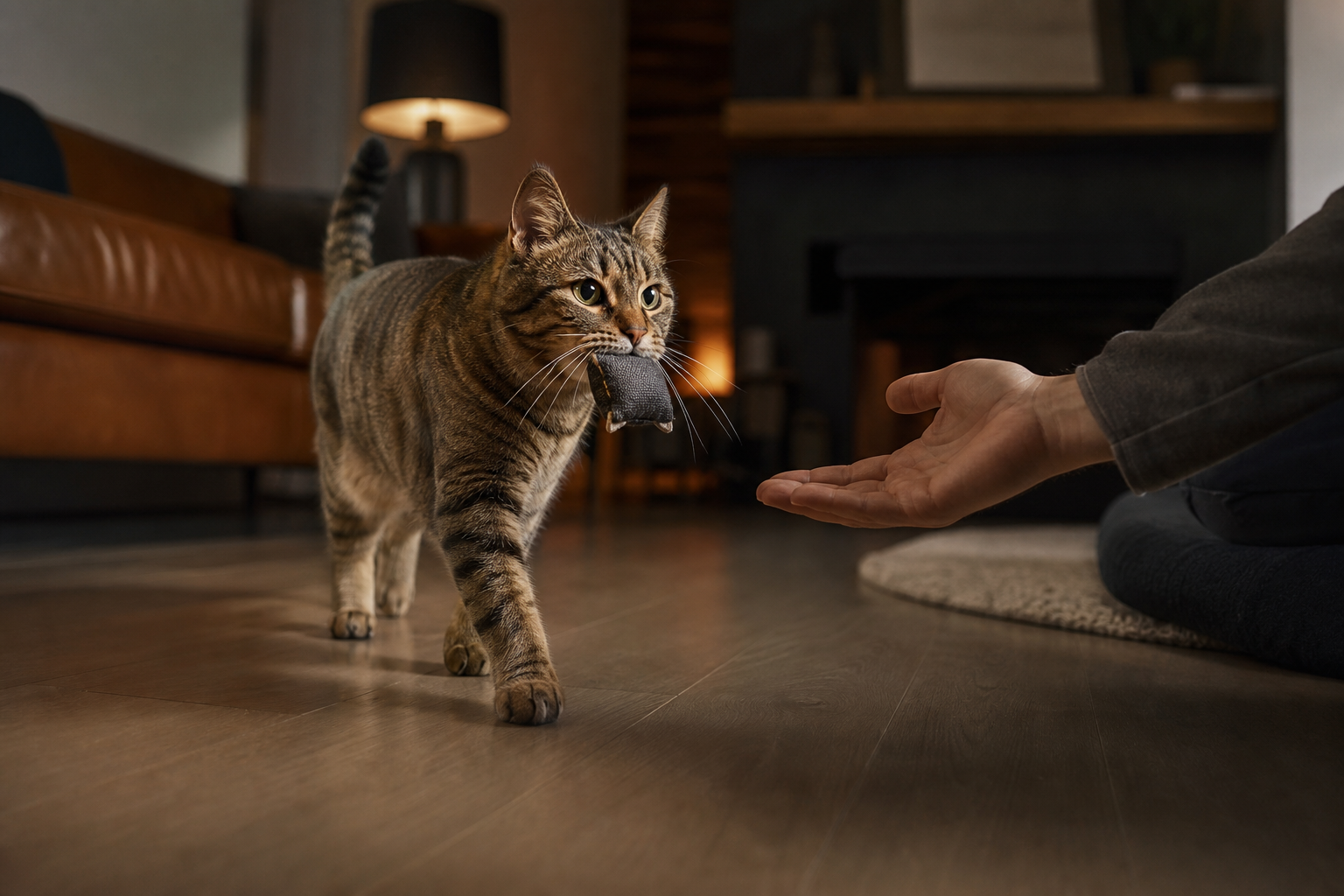
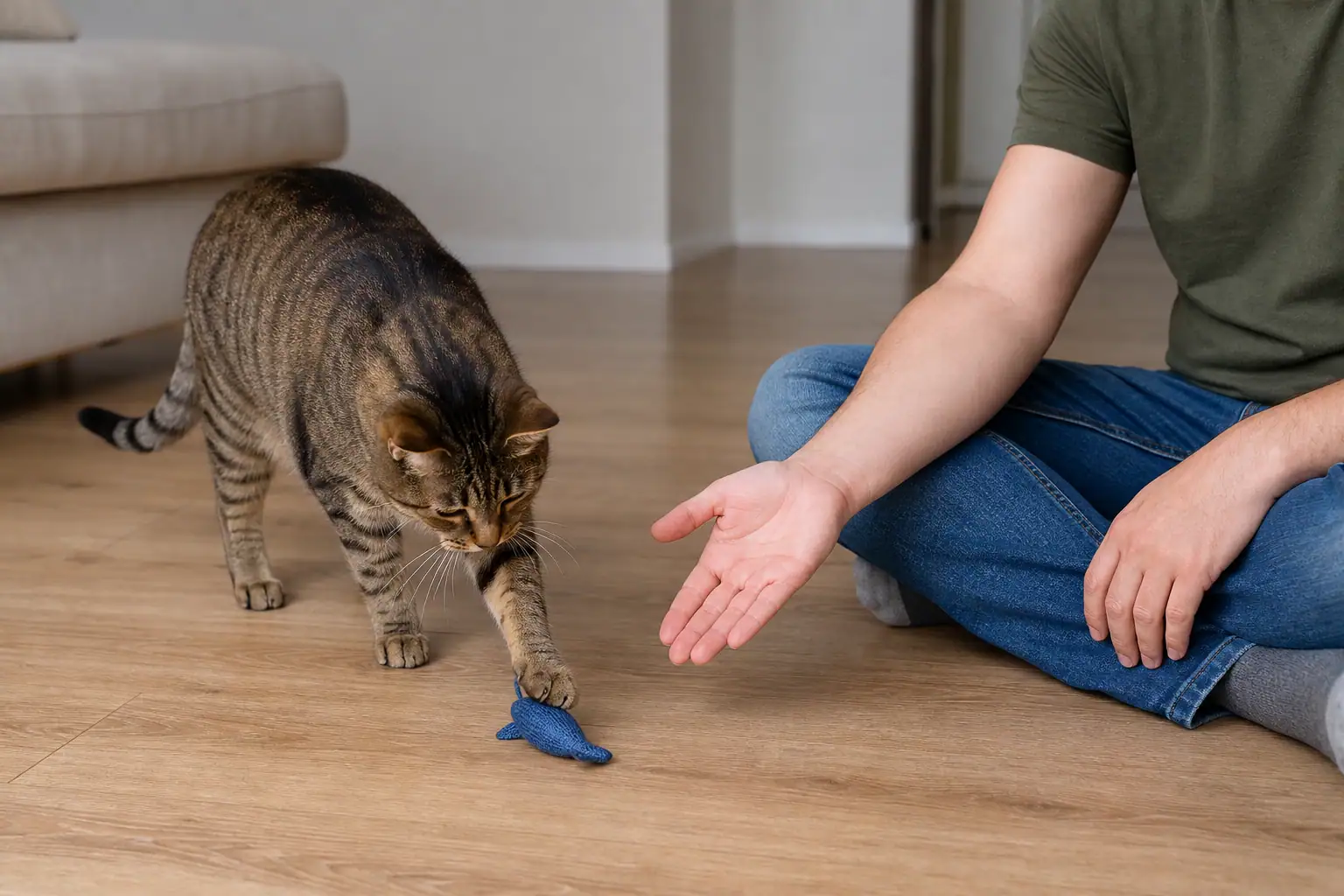
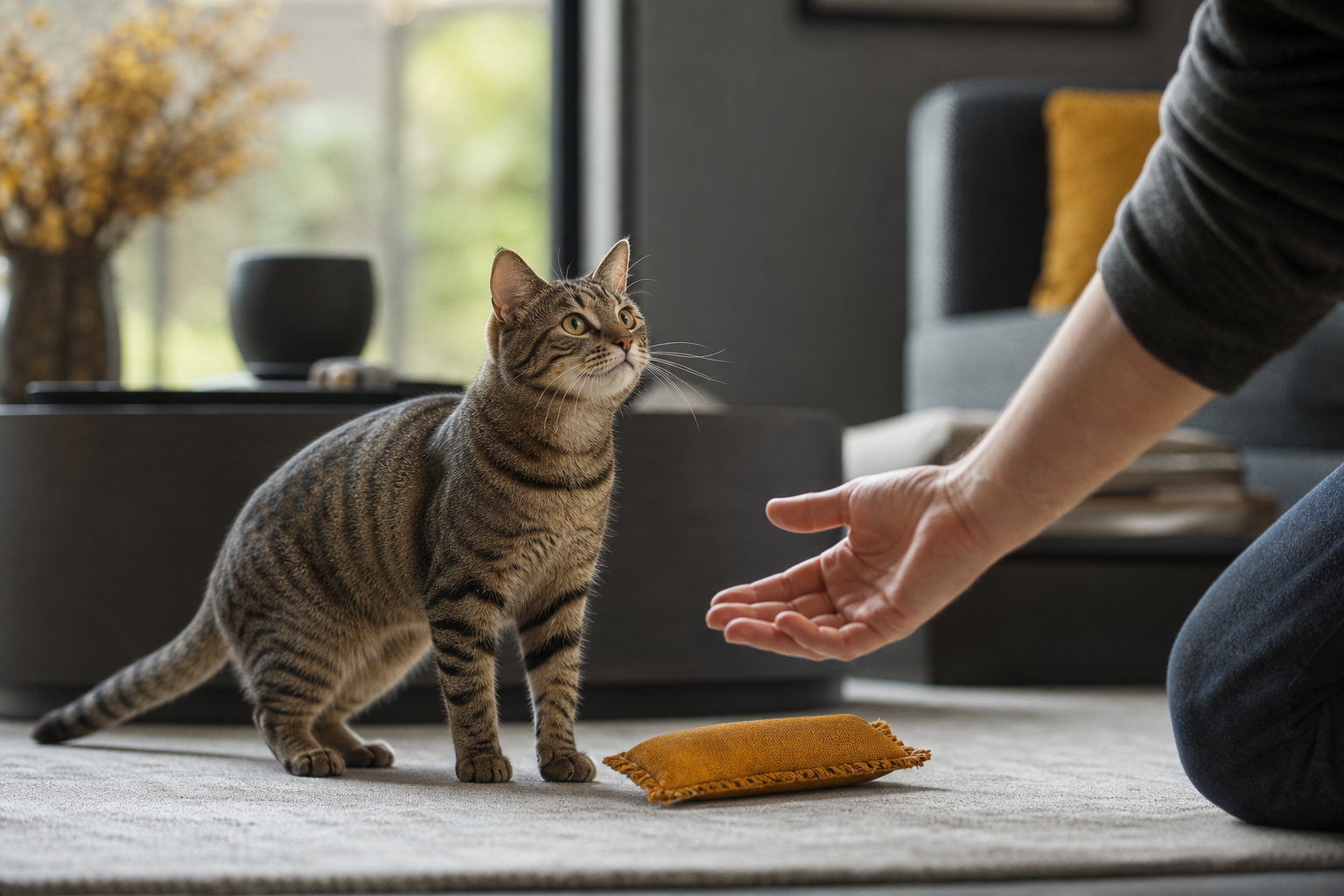
    Cat placing a fabric toy near a person to begin another fetch turn
    Many fetching cats appear to lead the game: they bring the object over, wait for the next toss, and stop when they have had enough.

    Do Cats Naturally Play Fetch?

    Many do. In the 2023 study of 1,154 known fetching cats, owners reported that most first showed the behavior as kittens or young adults, and 94.4% began without explicit training. Cats initiated and ended sessions more often than their owners did. Some fetched only one object, in one place, or with one particular person.

    That cat-led pattern explains why fetch can seem to appear overnight. A cat discovers that dropping a favorite object near a person produces another chase, and the person learns to respond. The pair builds a turn-taking routine even if nobody formally trained it.

    If your cat carries a toy to you but does not wait for a throw, do not assume it is an incomplete fetch. Carrying can be play solicitation, a learned attention routine, or simply something the cat enjoys. Our guide to why cats carry toys and meow explains how to read the timing and surrounding body language.

    Is Playing Fetch a Sign of Intelligence in Cats?

    Fetch shows learning, coordination, attention, and turn-taking, but it is not an intelligence test. The 2024 study did not measure feline IQ, and its association between fetching and trainability was small. A cat that does not fetch may be just as capable but less interested in that object, movement, room, reward, or style of interaction.

    Preference matters enormously in cat play. One cat may solve food puzzles, another may stalk a wand, and another may retrieve the same fabric mouse twenty times. Treat fetch as one possible enrichment outlet—not a score your cat needs to pass.

    How to Find Out Whether Your Cat Wants to Fetch

    Look for pieces of the behavior before trying to teach it. A promising cat may already carry toys, bring objects into the room, chase a short floor-level toss, pick the object up, or turn back toward you while holding it.

    1. Choose one familiar, safe toy. Use a lightweight object your cat already carries. It should be large enough not to swallow, free of loose pieces, and easy to inspect.
    2. Make one short, low toss. Roll or skim the toy one or two feet across a clear floor. Do not throw it at the cat or toward stairs, furniture edges, another animal, or a person.
    3. Wait instead of chasing. Sit still. If your cat picks up the toy and takes even one step toward you, respond calmly with praise, a tiny reward, or another toss.
    4. End while interest is high. Two good returns can be a complete first session. If the cat walks away, let the game end.

    If your cat likes the first experiment, use our complete cat fetch toy and training guide to choose an object, shape a partial return, troubleshoot the drop, and build distance gradually. There is no need to force the behavior if your cat prefers stalking, pouncing, wrestling, or foraging; our indoor cat enrichment guide covers those alternatives.

    Fetch Safety for Cats That Bite and Shred Toys

    Fetch repeatedly puts an object in the mouth and sends it across the room, so the toy and the route both need attention. A toy that is fine for gentle batting may fail after repeated biting, impact, and carrying.

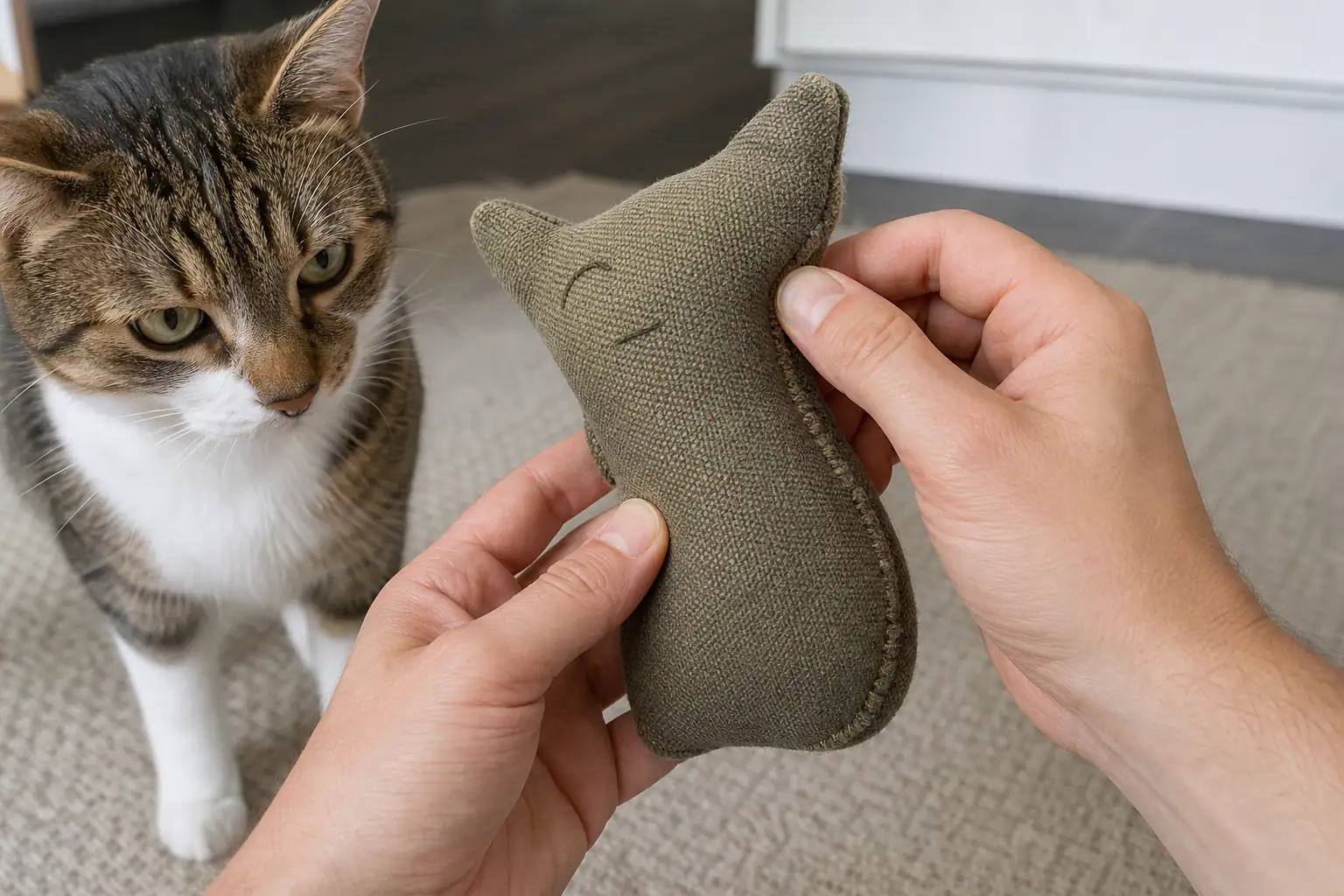
    Person inspecting a fabric cat toy for damage before a fetch game
    Fetch repeatedly puts the toy in your cat’s mouth. Check seams, fabric, and attachments before and after each rough play session.
    • Avoid swallowable and strand-like parts. Cornell Feline Health Center advises avoiding small pieces and linear parts such as string or feathers that can separate when chewed and be ingested.
    • Inspect before and after play. Retire the toy if a seam opens, fabric thins, stuffing shows, thread loosens, plastic cracks, or any piece is missing. “Durable” never means damage-proof.
    • Use a clear runway with traction. Keep tosses low and away from stairs, breakables, cords, doors, slippery floors, and other pets.
    • Do not turn retrieval into tug. Trade for a reward or wait for the drop. Never pry a toy from the cat’s mouth or pull against the teeth.
    • Watch the cat, not the throw count. Stop for loss of interest, tail lashing, flattened ears, uncoordinated movement, limping, coughing, or open-mouth breathing. Persistent breathing trouble, collapse, obvious pain, or a possible swallowed toy piece needs prompt veterinary advice.

    Rough players need simpler construction and more frequent checks, not an “indestructible” promise. The inspection framework in our durable cat toys guide can help you compare seams, attachments, materials, and failure points before the next game.

    Quick Answers About Cats and Fetch

    What percentage of cats play fetch?

    The best current large-sample estimate is 40.9%, or about four in ten cats. The 2024 study counted cats reported to fetch sometimes, usually, or always.

    Do cats play fetch like dogs?

    Both species can chase, retrieve, and return an object, but dogs were reported to fetch much more often: 77.8% versus 40.9% of cats in the same study. Cat sessions also tend to be highly dependent on the individual cat’s object, place, partner, and willingness to continue.

    Can any cat learn to fetch?

    Many cats can learn parts of the sequence, but there is no evidence that every cat will enjoy or complete it. Start with the behavior your cat already offers, reward small returns, and switch to another enrichment game if interest stays low.

    What cat breeds are most likely to play fetch?

    In the 2024 dataset, Bengal, Burmese, Siamese, and Tonkinese cats were more likely than expected to fetch. This is a population-level association, not a prediction for an individual purebred or mixed-breed cat.

    The practical answer: cat fetch is common, usually voluntary, and best treated as a short, cat-led enrichment game. If your cat brings the toy back, enjoy the invitation. If not, nothing is wrong—the next favorite game may begin with a pounce rather than a return.

    Sources