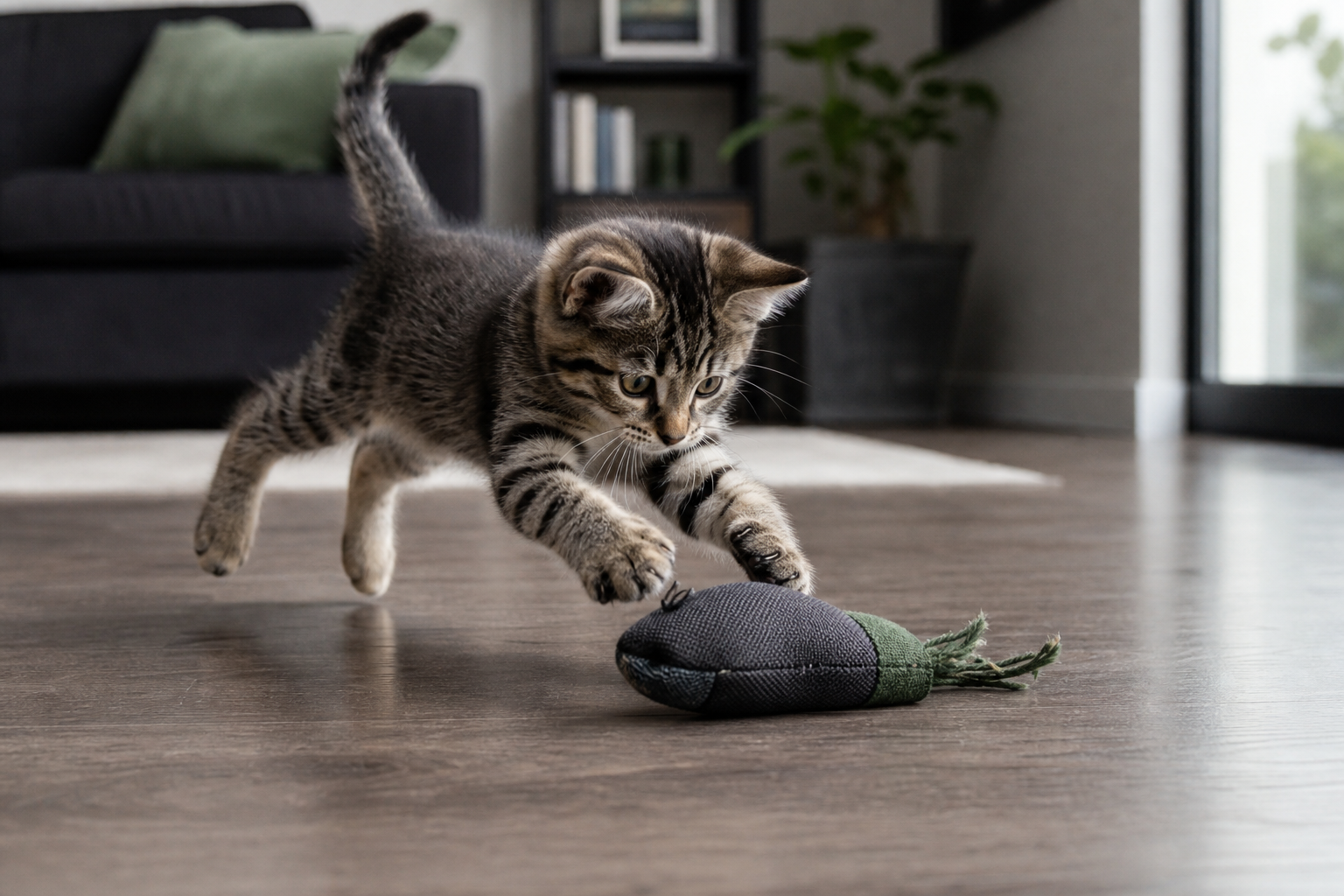
The best kitten toys are not just tiny versions of adult cat toys. Kittens need toys that match their age, mouth size, coordination, confidence, and play intensity. A good starter setup includes a supervised wand toy for chase, a soft capture toy for biting and kicking, a few lightweight batting toys, a safe chew option, a scratcher or tunnel, and a simple food puzzle once the kitten is ready.
If your kitten plays rough, choose toys by failure points instead of by cuteness. Avoid long strings left out after play, glued-on decorations, loose bells, brittle plastic, tiny pieces, and plush toys that leak stuffing after one hard session. Durable kitten toys should be appropriately soft, easy to inspect, and retired before they become swallowing hazards.

What Kitten Toys Should Do
Kitten toys have four jobs: teach safe hunting, protect human hands, build confidence, and burn energy without creating avoidable risk. Kittens learn through stalking, chasing, pouncing, biting, wrestling, climbing, hiding, and carrying things around. Toys give those instincts an acceptable target.
That is why a mixed toy kit works better than a single toy pile. VCA Animal Hospitals describes cats as natural hunters that enjoy toys they can stalk, chase, pounce on, capture, attack, and carry. The AAFP and ISFM feline environmental needs guidelines also recommend play that lets cats express predatory behavior, including wand movement that mimics flying or ground prey and toys a cat can catch, rake, and bite.
Most ranking product lists name popular toys, but they often skip the decision system owners need at home: what can be left out, what needs supervision, what is too hard for kitten teeth, and what to do when a kitten uses full claws and teeth on everything.
A Simple Kitten Toy Starter Kit
Start with fewer, better-chosen toys instead of a huge mixed bag with unknown safety quality. For most kittens, this six-part setup is enough:
- One wand or teaser toy: for supervised chase, pounce, and capture sessions.
- One soft kicker or wrestle toy: long enough for the kitten to hug and rake without biting your hand.
- Two lightweight batting toys: soft balls, crinkle balls, or toy mice that are too large to swallow and do not shed parts.
- One chew-safe texture: a kitten-specific chew toy or tightly stitched fabric toy for mouthy play.
- One hide-and-ambush option: a tunnel, box, paper bag with handles removed, or low-sided play cube.
- One beginner food puzzle: a simple treat ball, puzzle tray, or scatter-feeding routine once your kitten can use it safely.
This setup also helps you learn your kitten’s style. Some kittens are bird hunters that leap at feathers. Some are mouse hunters that crouch and ambush ground movement. Some are wrestlers that need a bigger object to grab and kick. Some are thinkers that settle better after foraging for part of a meal.
For a broader indoor setup, pair this guide with Titan Claws’ cat toys for enrichment. If your kitten is already chewing hard, read kitten teething toys before leaving chew toys available.
Best Toys by Kitten Age
Age matters because a twelve-week-old kitten and a six-month-old kitten may attack toys very differently.
8 to 12 weeks: soft, simple, and low-impact
Young kittens are still developing coordination. Use soft batting toys, small plush prey toys without loose parts, short floor-level wand sessions, shallow cardboard boxes, and gentle tunnels. Keep jumps low and avoid toys that require fast twisting or high launches.
3 to 5 months: chase, chew, and rules around hands
This is often the mouthy stage. Use wand play to burn movement, then hand off to a chew toy or small kicker so teeth land on the toy, not on fingers. If biting is becoming a habit, see Titan Claws’ guide on how to get a kitten to stop biting.
5 to 9 months: bigger play, stronger inspection
Older kittens can hit toys with surprising force. Add sturdier kickers, tougher fabric toys, puzzle feeders, and controlled chase games. This is also when weak seams, tiny attachments, and cheap feather toys start failing fast. Durable matters, but no toy should be treated as impossible to damage.
How to Choose Toys by Play Style
Watch what your kitten does before buying more. The right toy is the one that gives the kitten a safe version of the behavior they already want to practice.
- The chaser: Use wand toys, rolling balls, tunnels, and toys that move away from the kitten. Let the kitten catch the toy regularly so the game has a finish.
- The pouncer: Use low, unpredictable ground movement around boxes, rugs, and tunnel openings. Avoid wild overhead swings that cause awkward jumps.
- The wrestler: Use a soft kicker or longer plush toy. The toy should be big enough to keep claws and back feet away from your forearm.
- The chewer: Use kitten-specific chew textures, supervised fabric toys, and simple toys with no strings, bells, or glued parts. Read Titan Claws’ safe cat chew toys guide before leaving any chew object out.
- The bored problem-solver: Use puzzle feeders, hidden kibble, treat cups, and toy rotation. Start easy so the kitten succeeds instead of getting frustrated.

Wand Toys Are Great, But They Are Not Floor Toys
Wand toys are among the most useful kitten toys because they separate your hand from the prey object and let you control speed. Move the lure away from the kitten like prey, pause for stalking, then let the kitten catch it. VCA specifically recommends predatory games with toys the cat can eventually catch and cautions against using hands and feet as prey.
The safety rule is strict: wand toys, fishing-pole toys, ribbons, strings, feather attachments, and elastic cords should be stored after play. VCA warns that cats can get tangled in wand-style toys or ingest string. Cornell Feline Health Center also cautions against toys with small pieces or strand-like parts that may separate and be swallowed, especially when chewed.
For more detail on lure choice, storage, and rough players, use Titan Claws’ wand cat toy guide.
What Kitten Toys Can Be Left Out?
Only leave out toys that match your kitten’s proven chewing style. A toy that is safe for one kitten may be risky for another kitten that tears fabric, eats fuzz, cracks plastic, or swallows small pieces.
Safer leave-out candidates are usually simple, larger-than-swallowable objects with no strings, no detachable decorations, no exposed wires, no glued eyes, and no stuffing leaks. Examples include a sturdy ball track, a plain soft ball, a larger plush toy your kitten does not shred, a cardboard box, a scratcher, or a tunnel that has been checked for loose wires and frayed fabric.
Supervised-only toys include wand toys, feather lures, ribbon toys, yarn-like toys, small mice with tails, toys with bells, electronic toys with detachable tails, and anything your kitten chews intensely. If you are using automatic toys, inspect battery doors, wheels, charging ports, and moving fabric before each session. Titan Claws’ automatic cat toys guide covers those tradeoffs.
Durability Checks for Rough Kittens
For Titan Claws readers, the durability question is practical: how does this toy fail, and will I notice before the kitten can swallow part of it?

- Seams: pull gently before and after play. Retire toys with opening seams or exposed stuffing.
- Attachments: remove or avoid bells, beads, glued eyes, tails, feathers, and hard plastic pieces that can detach.
- Fabric: watch for fuzz, mesh, felt, or yarn that your kitten chews off and eats.
- Hard parts: check plastic tracks, puzzle feeders, and electronic shells for cracks or sharp edges.
- Size: avoid anything small enough to lodge in the mouth or be swallowed.
- Cleanliness: wash saliva-soaked fabric toys and dry them fully before reuse.
The AAFP and ISFM guidelines specifically note that kittens need size-appropriate toys and puzzle feeders, and that toys with string or ingestible parts should be put away after play. That is the right mindset: choose toys by size and behavior, then manage access.
A Daily Play Routine for Kittens
Kittens usually do best with several short sessions instead of one exhausting marathon. VCA notes that cats often play in short bursts followed by rest, and that novelty helps keep toys interesting. A simple routine can look like this:
- Start with stalking: move a wand lure slowly at the edge of attention.
- Add one chase: move the toy away, not into the kitten’s face.
- Let the kitten catch it: build in several real captures.
- Hand off to a kicker or chew toy: give the mouth and back feet a safe target.
- Finish calmly: offer a small food puzzle, part of a meal, grooming, or quiet rest.
Rotate toys weekly instead of leaving every toy out forever. Cornell and VCA both recommend rotation as a way to reduce boredom. Keep four or five options active, store the rest, and inspect each toy before it returns to the floor.
What to Avoid Buying
Skip toys that look exciting but fail common-sense safety checks. Avoid toys with long strings for unsupervised play, loose bells, tiny plastic parts, glued-on faces, brittle shells, sharp feather shafts, exposed elastic, weak battery doors, and plush toys that shed stuffing after a few bites.
Be careful with giant variety packs. They can be useful for learning preferences, but many include lightweight mice, bells, feathers, ribbons, and spring toys that need sorting before your kitten gets them. Keep the supervised pieces in a closed bin, and leave out only the toys that pass your kitten’s chewing test.
Also avoid using your hands under blankets as chase targets. It may be cute with a tiny kitten, but it teaches a rule you will not want when the cat is larger. Use a toy as the moving target every time.
Quick Kitten Toy Checklist
- Does this toy fit my kitten’s age, mouth size, and coordination?
- Can my kitten chase, catch, bite, or kick it without using my hands?
- Are there strings, bells, feathers, tails, or glued parts that need supervision?
- Is the toy soft enough for a kitten but sturdy enough for repeated play?
- Can I inspect every seam and surface quickly?
- Is this a leave-out toy or a supervised-only toy?
- Do I have a rotation plan so novelty does not depend on buying more toys?
The best kitten toys are the ones that teach safe play while giving a young cat real outlets for chase, pounce, bite, kick, hide, scratch, and forage. Build a small, inspectable toy system first. Then add tougher or more specialized toys only when you know how your kitten plays.