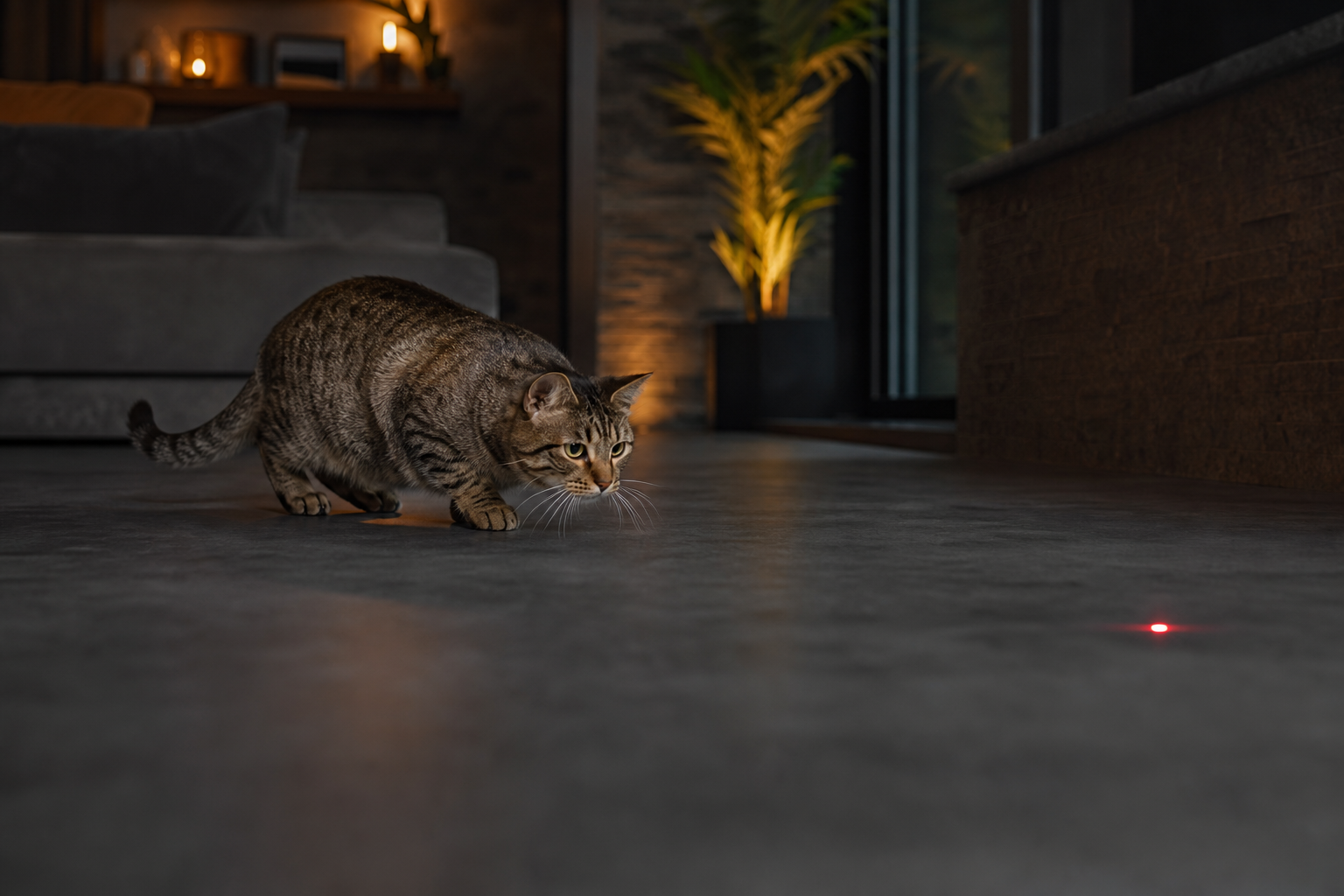
Laser toys are not automatically bad for cats, but they are easy to use badly. The main risks are accidental eye exposure, unsafe sprinting or jumping, and a chase that never gives the cat anything real to catch. Some cats finish a brief laser game and move on. Others become frustrated or begin searching for lights and reflections after the pointer is gone.
If you use a laser, keep the light on a clear floor, never aim it at any person or animal’s eyes, and finish every session with a physical capture: guide the dot onto a sturdy toy, switch the light off as your cat pounces, and let your cat grab, bite, or kick that toy. If your cat stays fixated on light after play, skip the laser and use a wand, tossed toy, or kicker instead.
The Short Answer: When a Cat Laser Is and Is Not a Good Toy
A laser can be a useful movement cue for a healthy cat that enjoys chasing, remains relaxed, and readily switches to a real toy. It can get a sedentary cat moving without asking the person to run around the room. The dot also mimics one feature that attracts cats to prey: small, quick, irregular movement.
But a dot is not prey. It has no texture, scent, resistance, or body to capture. A cat can stalk and chase it but cannot complete the satisfying grab-and-bite portion of play unless you supply a real target. That makes a laser better as a short opening act than as the entire game.
Choose another form of play when your cat:
- keeps searching walls, floors, reflections, or your hand after the light is off;
- paces, vocalizes, lashes the tail, or cannot settle after a session;
- ignores the physical toy or food you use to finish the game;
- collides with furniture or makes reckless jumps during pursuit;
- has pain, limited mobility, heart or breathing disease, or exercise restrictions from a veterinarian;
- guards the play area or redirects biting and swatting toward people or other cats.
A cat does not need to learn to tolerate laser play. If a wand lure, rolling toy, food puzzle, or sturdy kicker produces calmer and more complete play, use the option your cat handles best.
Can a Laser Pointer Hurt a Cat’s Eyes?
Yes. A laser beam should never be aimed into a cat’s eyes—or a person’s eyes. The eye focuses laser light onto a small area of the retina. The U.S. Food and Drug Administration’s laser guidance explains that hazard depends on the laser’s class and output, and that brightness or color alone does not tell you how powerful a pointer is.
For laser products sold as toys, the FDA recommends radiation levels no higher than Class 1, its lowest-risk category. The agency also advises consumers not to buy or use lasers above 5 milliwatts or products that do not state their output. A vague listing that says only “pet safe” is not a substitute for a readable class, output, manufacturer, and compliance label.
- Keep the dot below the cat’s shoulder level. Move it across a matte floor, never across the cat’s face or body.
- Avoid reflective targets. Mirrors, polished metal, glass, and glossy surfaces can redirect a beam unpredictably.
- Control the device yourself. Do not let children handle a laser around pets.
- Do not modify the laser. Discard a damaged device and follow local battery or electronic-waste rules.
- Be cautious with unknown products. Do not use an unlabeled pointer or assume a dim-looking beam is low power.
If a beam enters your cat’s eye or you notice squinting, a suddenly enlarged or uneven pupil, apparent vision trouble, bumping into objects, or unusual reluctance to move in dim light, stop play and contact a veterinarian promptly. Eye injury may not be obvious from the outside, so describe the product and exposure as accurately as you can.
Do Laser Toys Cause Frustration or Obsessive Behavior?
The concern is plausible, but the evidence needs careful wording. A 2021 peer-reviewed survey of 618 cat guardians found that more frequent laser-pointer play was associated with more owner-reported abnormal repetitive behaviors, except overgrooming. The strongest patterns involved chasing lights or shadows, staring at lights or reflections, and fixating on a particular toy.
That study was cross-sectional and based on an online owner survey. It cannot show that lasers caused the behaviors. Cats already attracted to lights may be more likely to receive laser play, and other differences in age, indoor lifestyle, stress, and enrichment can matter. The authors explicitly described the result as correlational and called for more research.
This means two common claims go too far: it is not accurate to say every laser game causes a disorder, and it is not responsible to say lasers are harmless for every cat. “Laser pointer syndrome” is also not a diagnosis you should make from an online checklist. What you can do is watch your own cat for a repeatable change in behavior and remove the trigger early.
Stop laser play if your cat repeatedly hunts sun glints, phone reflections, or blank walls; waits tensely at the drawer where the pointer is stored; seems unable to disengage; or redirects arousal into aggression. Record a short video and note when the behavior occurs. If it persists after the laser is retired, disrupts sleep or normal activity, causes injury, or is difficult to interrupt, ask your veterinarian for an assessment. Medical causes and environmental stress should be considered before labeling a behavior compulsive.
How to Use a Laser Toy More Safely
Prepare the ending before you switch on the light. Place a sturdy capture toy on the floor and keep a few pieces of your cat’s normal food or treats within reach. The capture toy should be large enough not to swallow, simple enough to inspect, and free of loose feathers, bells, ribbons, plastic eyes, or exposed stuffing.
- Clear a low-risk route. Remove breakables, close access to stairs, and provide traction. Do not send the dot up walls, across furniture, or toward another animal.
- Begin close and slow. Move the dot away from the cat in short, prey-like bursts with pauses for stalking. Endless fast circles create exercise but little hunting structure.
- Allow pauses and apparent catches. Stop the dot under a paw briefly rather than making it escape every pounce.
- Keep the session short. End while your cat is still coordinated and responsive—not after panting, frantic sprinting, or loss of interest.
- Lead to a real target. Move the dot onto the prepared kicker or tossed toy. Turn the laser off at the instant your cat lands on it.
- Let the cat finish physically. Give time to grip, bite, rake, or carry the toy. A small food reward can follow if it fits the cat’s diet.
- Put the laser away. Store it securely, then check that your cat shifts into normal grooming, resting, eating, or another ordinary activity.

Turning the dot off beside a toy is not enough if your cat ignores the toy and immediately resumes searching. That cat is telling you the handoff did not work. Retire the laser rather than repeating a game that consistently ends in agitation.
For a physical chase with built-in capture, use Titan Claws’ guide to choosing and handling a cat toy on a stick. A wand still requires supervision and secure storage, but its lure gives the cat something tangible to seize.
How Often Should You Play With a Cat Using a Laser?
There is no evidence-based schedule that makes laser play safe for every cat. Frequency matters less than the cat’s response, the device, the environment, and whether the game includes a successful physical finish. A few controlled minutes within a varied play routine is more sensible than making an automated laser the cat’s main daily activity.
Do not use panting as a fitness goal. Some cats may briefly pant after intense exertion, but open-mouth breathing can also signal overheating, respiratory trouble, heart disease, pain, or distress. Stop immediately, move the cat to a calm area, and seek urgent veterinary advice if breathing does not quickly return to normal or if there is weakness, collapse, pale or blue-tinged gums, or obvious distress.
Automated lasers deserve extra caution. A random moving dot can send a cat into furniture, involve an unwilling housemate, or continue after the cat becomes overstimulated. It also cannot reliably judge body language or perform a physical handoff. If you use one at all, supervise it in a cleared room and end with a real catch; do not treat it as unattended enrichment.
Better Alternatives for Cats That Need to Catch
Physical toys make the outcome easier to understand: the cat can touch, capture, and manipulate the target. They also let you match the toy to the cat’s preferred part of the hunting sequence.
- For stalkers and chasers: drag a wand lure low and away from the cat, pause behind furniture, and allow frequent captures.
- For pouncers: toss a sturdy, appropriately sized fabric mouse or rolling toy across a clear floor.
- For grab-and-kick players: hand off to a larger kicker that keeps teeth and back claws away from hands.
- For food-motivated hunters: scatter part of a measured meal or use a puzzle feeder so searching produces a real result.
- For cats that tire quickly: use slow ground movement, short distances, tunnels, and several brief opportunities rather than one exhausting chase.

The Feline Veterinary Medical Association’s indoor-cat guidance identifies play and predatory behavior as an essential environmental need. Its caregiver materials advise allowing cats to capture simulated prey intermittently to prevent frustration. A laser can imitate movement, but physical toys do more of that job.
Build variety with these cat toys for hunting, then use a small rotation instead of leaving every toy out all the time. For cats that bite, pull, and shred ordinary toys, the construction checklist in our durable cat toys guide helps you compare seams, attachments, materials, and failure points. Durable never means indestructible: supervise hard play and retire damaged toys early.
Laser Toy Safety Checklist
- Readable manufacturer, laser class, output, and compliance labeling?
- No direct beam exposure to eyes, faces, people, or animals?
- Matte floor free of stairs, mirrors, traffic, and collision hazards?
- Adult actively controlling and supervising the entire session?
- Short, prey-like movement with stalking pauses—not frantic nonstop circles?
- Sturdy physical toy ready before the laser turns on?
- Dot switched off as the cat captures the real toy?
- Cat disengages and returns to normal behavior afterward?
- No persistent searching for lights, reflections, or the stored pointer?
- Laser retired immediately if the session causes fixation, fear, conflict, or unsafe movement?
So, are laser toys bad for cats? They can be when the device is questionable, the beam is aimed unsafely, or the game creates chase after chase without a catch. A carefully labeled, adult-controlled laser used briefly on a clear floor may work for a cat that transitions easily to a physical toy. But it is optional—not essential enrichment. When in doubt, choose a game your cat can actually win.
Sources
- U.S. Food and Drug Administration: Frequently Asked Questions About Lasers
- U.S. Food and Drug Administration: Laser Toys—How to Keep Kids Safe
- Kogan and Grigg (2021): Laser Light Pointers for Use in Companion Cat Play
- Feline Veterinary Medical Association: Meeting the Physical and Emotional Needs of Owned Indoor Cats