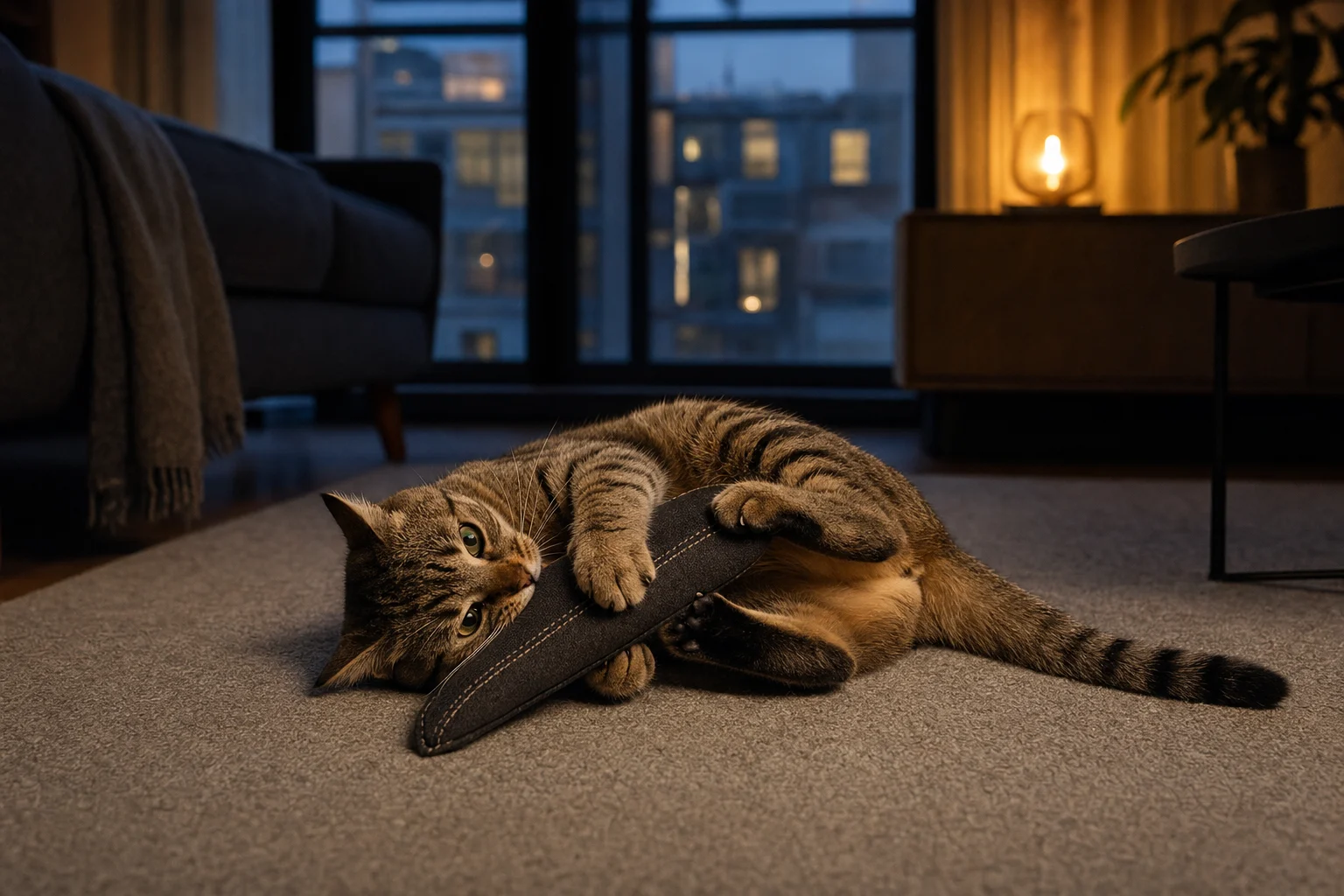
The best quiet cat toys are soft on the outside, free of bells, squeakers, crinkle film, and motors, and unlikely to skitter across hard floors. Good options include a large fabric kicker, a dense felt or fabric ball, a soft-covered rolling toy, and a stationary food puzzle. For interactive play, a simple fleece lure moved across a rug is quieter than a toy with hard clips, feathers, or a rattling reel.
Quiet does not automatically mean safe to leave out overnight. A silent foam ball can be a poor choice for a cat that bites off pieces, while a sturdy puzzle may still become noisy when shoved into a wall. Choose for your cat’s play style first, test the toy in the room where it will be used, and leave out only intact toys your cat has already handled safely.
Best Quiet Cat Toys by Play Style
Start with the behavior your cat repeats. A wrestler needs a different low-noise outlet from a cat that stalks, rolls objects, or searches for food.
| Play style | Quiet option | Why it is quieter | Main safety check |
|---|---|---|---|
| Biting and bunny-kicking | Large fabric kicker with no rattle or crinkle layer | Soft contact with the floor and furniture | Check seams, filling, and fabric thinning after hard play |
| Chasing and fetching | Dense felt ball or fabric-covered ball that is too large to swallow | No hard shell striking baseboards | Remove it if fibers pull free or the covering separates |
| Batting | Soft one-piece rolling toy on a low-pile rug | Soft surface reduces impact and rolling noise | Avoid biteable foam for cats that tear or eat soft material |
| Searching and foraging | Stationary puzzle with large captive pieces | No loose ball racing around the room | Use part of the normal ration; clean out food after use |
| Stalking with a person | Wide fleece lure on a plain wand | No bell, motor, hard lure, or metal clip hitting the floor | Supervise continuously and store the whole wand after play |
| Hiding and pawing | Stable cardboard box with a large fabric toy partly concealed | The target stays in a small, soft play zone | Remove tape, staples, handles, sharp tears, and swallowed cardboard |
A product label cannot tell you whether a toy will stay quiet in your home. A felt ball may be nearly silent on carpet and surprisingly audible when a cat drops it down wooden stairs. A stationary puzzle may be quiet until it slides. Treat the table as a shortlist, then run the home test below.

What Actually Makes a Cat Toy Noisy?
Most toy noise comes from four places. Check all four before deciding that a toy is suitable for sleep hours, a shared wall, or a sound-sensitive cat.
- Built-in sound: bells, rattles, squeakers, crinkle film, beeps, and recorded prey sounds are intentionally audible. Even a “gentle” crinkle may be too much beside a bedroom.
- Impact: hard plastic, wood, metal clips, and dense rubber knock against floors, doors, bowls, and baseboards. Lightweight does not always mean quiet; a hollow ball can amplify every bounce.
- Movement: motors, gears, vibrating parts, and automatic restarts create hums and sudden bursts. The lure may be soft while the drive unit is not.
- The room: tile, hardwood, empty hallways, stairs, and walls shared with a neighbor magnify sound. Rugs, curtains, and upholstered furniture absorb more of it.
There is also a difference between quiet for you and comfortable for your cat. A high-pitched electronic sound may be easy for a person to miss but still provoke ear flicking, freezing, retreat, or refusal to approach. The feline veterinarians behind Cat Friendly Homes advise keeping noise low around stressed cats and letting cats control their distance from unfamiliar experiences.
A 60-second home sound test
- Place the toy on the exact floor where your cat will use it.
- Roll, tap, or activate it as play would, not just as a slow demonstration in your hand.
- Listen from the bedroom or the other side of the shared wall. Check whether it travels under furniture or reaches the stairs.
- Then watch one supervised session. Stop if your cat startles, flattens the ears, repeatedly retreats, attacks the mechanism, or tries to dismantle the toy.
Do not make a noisy toy “soft” by wrapping it in loose socks, tape, yarn, or glued fabric. A homemade covering can shift, expose adhesive, block a motor, trap heat, or create pieces to swallow. Choose a purpose-built softer design or change the play surface instead.
Make the Play Zone Quieter Before Buying More Toys
The room often matters more than the product. A small setup change can quiet several toys at once and reduce nighttime collisions.
- Create a rug-sized play zone. Use a secure, low-pile, washable rug or non-slip mat with no curling corners or loose loops. Place rolling and kicking toys in the middle, away from hard furniture edges.
- Block the loud route. Close access to stairs or echoing hallways if you can do so without trapping the cat away from food, water, litter, resting places, or family members.
- Choose captive movement. A ball enclosed in a stable track may travel less than a loose ball, but test it: some tracks rattle loudly and some cats can pry off the cover.
- Move automatic play out of sleep hours. Timers and motion sensors can restart unexpectedly. Use motorized toys during a planned, observed window and switch them off afterward.
- Keep the floor clear. A quiet toy becomes noisy when it hits a metal bowl, wastebasket, doorstop, or another hard toy.
If a cat needs more variety without more gadgets, rotate texture, movement, hiding places, and food-search games. Our guide to sensory toys for cats explains how to build interest without relying on loud sound effects.
Which Quiet Toys Are Safe to Leave Out at Night?
Only leave out a toy after you have watched your cat use that exact item several times. “Quiet,” “solo,” and “automatic” are marketing descriptions, not permission to skip observation.
A possible overnight toy is simple, intact, appropriately sized, and has no string, elastic, feathers, exposed stuffing, detachable decoration, accessible battery, loose magnet, sharp edge, or piece your cat can chew off. It should also be familiar: nighttime is not the moment to discover that a new soft ball is irresistible to swallow.
Store these after every session:
- wands, yarn, ribbon, string, elastic, and fishing-line components;
- feathers, bells, clips, glued eyes, and other small attachments;
- electronic toys with damaged housings, charging cables, removable covers, or reachable batteries;
- foam, felt, fabric, or cardboard that your cat bites into pieces or eats;
- food puzzles that still contain wet food, oily residue, or forgotten treats;
- anything new or anything your cat attacks at its weakest point.
The Cornell Feline Health Center’s toy-safety guidance warns about small components and strand-like materials that can separate during chewing and be swallowed. If you use string play while you are awake, follow a strict supervised routine and the storage guidance in our cat string toy guide.
For a rough player, a large intact fabric kicker may be a reasonable independent option only if that individual cat carries and kicks it without opening seams or eating fibers. Another cat may destroy the same construction in minutes. The cat, not the category, decides the access level.
How to Introduce a Quiet Toy to a Sound-Sensitive Cat
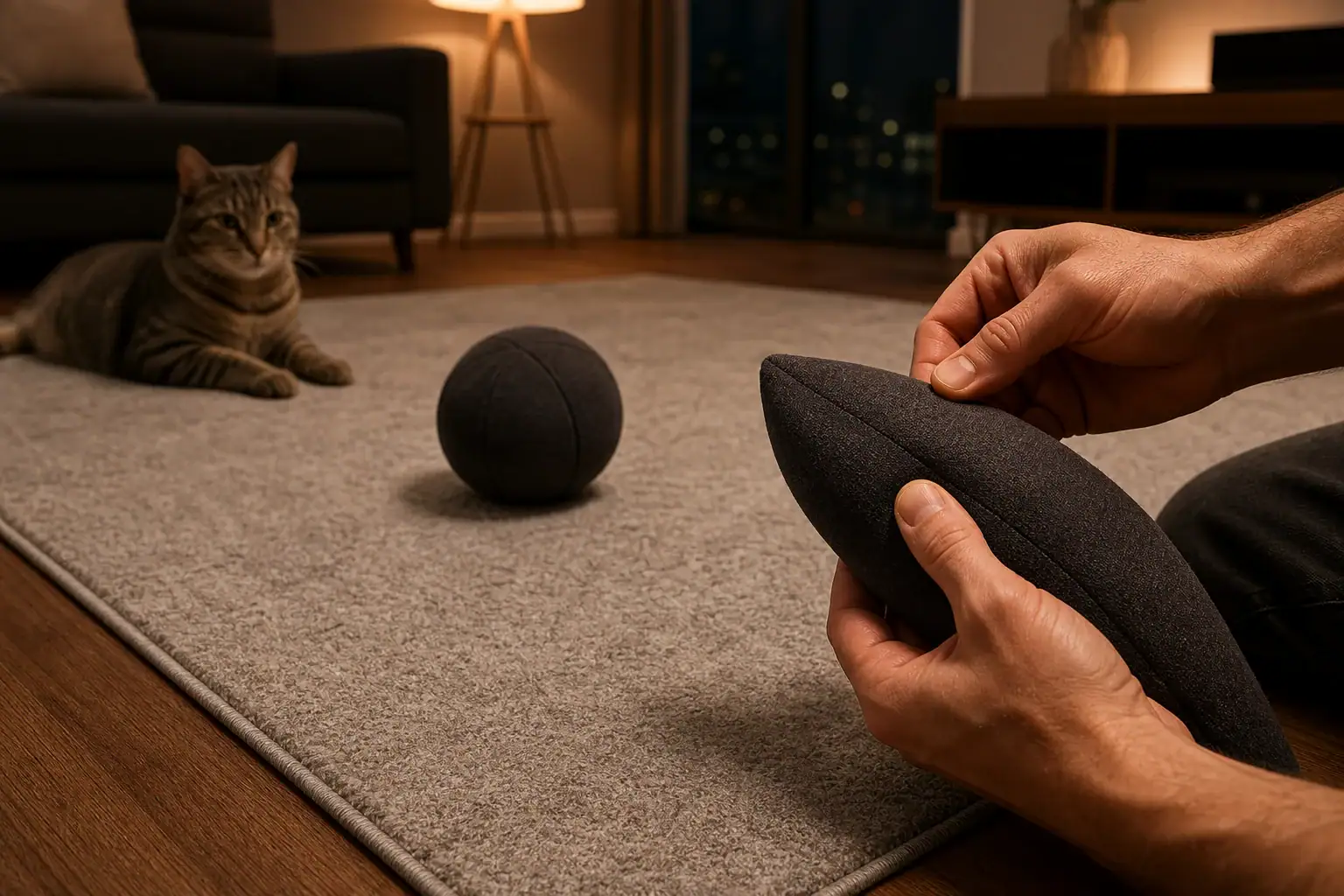
A cat that dislikes squeaks or motors does not necessarily dislike play. Preserve the prey-like movement and remove the startling feature.
- Begin with the toy still. Put it at the edge of a familiar rug while your cat has a clear route away. Do not push it toward the cat.
- Reward investigation. A glance, sniff, step forward, or paw reach is enough. Let the cat pause or leave.
- Add one small movement. Slide a soft toy a few inches away from the cat, then stop. Avoid activating lights, vibration, and sound at the same time.
- Allow a catch. Quiet play still needs a satisfying physical target. Let the cat hold or pin an appropriate toy rather than making every attempt fail.
- End while the body is relaxed. Store supervised components and leave the familiar play area available.
Comfort looks like voluntary approach, focused watching, a loose stalk, pawing, capture, and re-engagement after a pause. Stop if you see repeated retreat, a rigid crouch, flattened ears, hard tail lashing, hissing, hiding that continues after the toy is gone, or fixation on biting the mechanism.
Do not force repeated exposure to “get the cat used to it.” If your cat suddenly becomes sensitive to ordinary household sounds, seems disoriented, shakes or tilts the head, scratches at an ear, loses balance, stops playing, or changes behavior in other ways, contact your veterinarian. A new reaction can be more than a toy preference.
Build a Quieter Nighttime Play Routine
Leaving a pile of toys out at midnight is not the only way to handle evening energy. A predictable active session before bed can give your cat a better outlet while you are awake.
- Start before the usual noisy burst. Choose a time you can repeat most evenings.
- Use a quiet chase toy under supervision. Move a fleece lure across a rug, pause behind a box, and let the cat stalk and catch it.
- Finish on a holdable target. Transfer the final grab to a large intact kicker if your cat likes wrestling.
- Offer a small food finish when appropriate. Use part of the normal daily ration rather than adding uncounted treats. Ask your veterinarian before changing feeding routines for a cat with a medical condition or prescription diet.
- Inspect and reset. Put the wand away, remove damaged items, and leave only one or two proven low-noise solo toys available.
The Ohio State University Indoor Pet Initiative recommends variety and rotating a few toys at a time to renew interest. You do not need to replace toys every night. Rotate a small selection and keep a favorite available if your cat strongly prefers it.
Match the schedule to the cat rather than expecting one exhausting session to solve every nighttime behavior. Our guide to how often to play with your cat gives practical starting points for kittens, adults, seniors, and high-energy cats. If you use electronic enrichment during the day, review our distinction between supervised devices and more suitable solo options in automatic cat toys for time away.
Quiet-Toy Inspection for Cats That Play Rough
Soft materials reduce impact noise, but they can hide damage. Press and flex the whole toy under good light instead of checking only the obvious bite mark.
- Pull gently at every seam, corner, ear, tail, and attachment.
- Look for thinning fabric, damp patches, tooth holes, exposed filling, and a rattle that has shifted toward an opening.
- Roll balls between your fingers and retire them if the covering slips, fibers pull free, or the shape breaks down.
- Check puzzle feet, lids, sliders, food wells, and battery doors for cracks or looseness.
- Count detachable pieces before and after play.
- Wash according to the maker’s directions, dry completely, and inspect again before storage.
- Retire the toy when failure begins; do not wait until a part comes off.
VCA Animal Hospitals advises choosing an appropriately sized activity toy that will not easily fracture into swallowable pieces, supervising initial use, and discontinuing products a pet chews apart. It also notes that food toys need thorough cleaning. Our material-by-material cat toy cleaning guide covers fabric, hard toys, puzzles, catnip toys, and electronics.
If a toy piece is missing and may have been swallowed, contact your veterinarian promptly. Seek urgent veterinary advice for suspected string, ribbon, elastic, battery, or magnet ingestion, or for vomiting, repeated gagging, loss of appetite, unusual hiding, lethargy, pain, or straining. Do not pull visible string from the mouth or rectum.
Quiet Cat Toy FAQs
What is the quietest cat toy for nighttime?
A large, intact fabric kicker without bells, crinkle film, hard inserts, or loose decorations is often the quietest active option. It stays in one area and lands softly. It is suitable for overnight access only if your cat has repeatedly used it without tearing seams or eating fabric.
Are foam balls good quiet cat toys?
They can be quiet, but they are not a good default for cats that bite, shred, or ingest soft material. A large dense felt ball or securely fabric-covered ball may be easier to inspect, but any ball must be too large to swallow and retired when its surface loosens.
Are bells bad for cats?
Not every cat dislikes bells. Some use the sound to track a toy, while others startle or walk away. Watch your cat’s response. If the bell is built into a toy, do not cut it out and leave a weakened seam; choose a bell-free design.
Are silent automatic cat toys safe overnight?
“Silent” describes sound, not safety. Motors, cords, batteries, moving covers, heat, and detachable lures still need assessment. Observe the toy through complete start, stop, and restart cycles, follow its instructions, and do not leave it running overnight unless the manufacturer permits that use and your cat has demonstrated safe behavior. When in doubt, switch it off and store it.
How many quiet toys should I leave out?
One or two proven solo toys are enough for many nights. More toys can create more collisions and make damage harder to notice. Keep a larger reserve for rotation and use the more complex or fragile items during supervised daytime play.
Bottom line: choose quiet cat toys by play style, not by a “silent” label. Favor soft impact, simple construction, and controlled movement; test the toy on your actual floor; and separate low noise from overnight safety. For cats that destroy ordinary toys, inspection and deliberate access matter as much as the material.