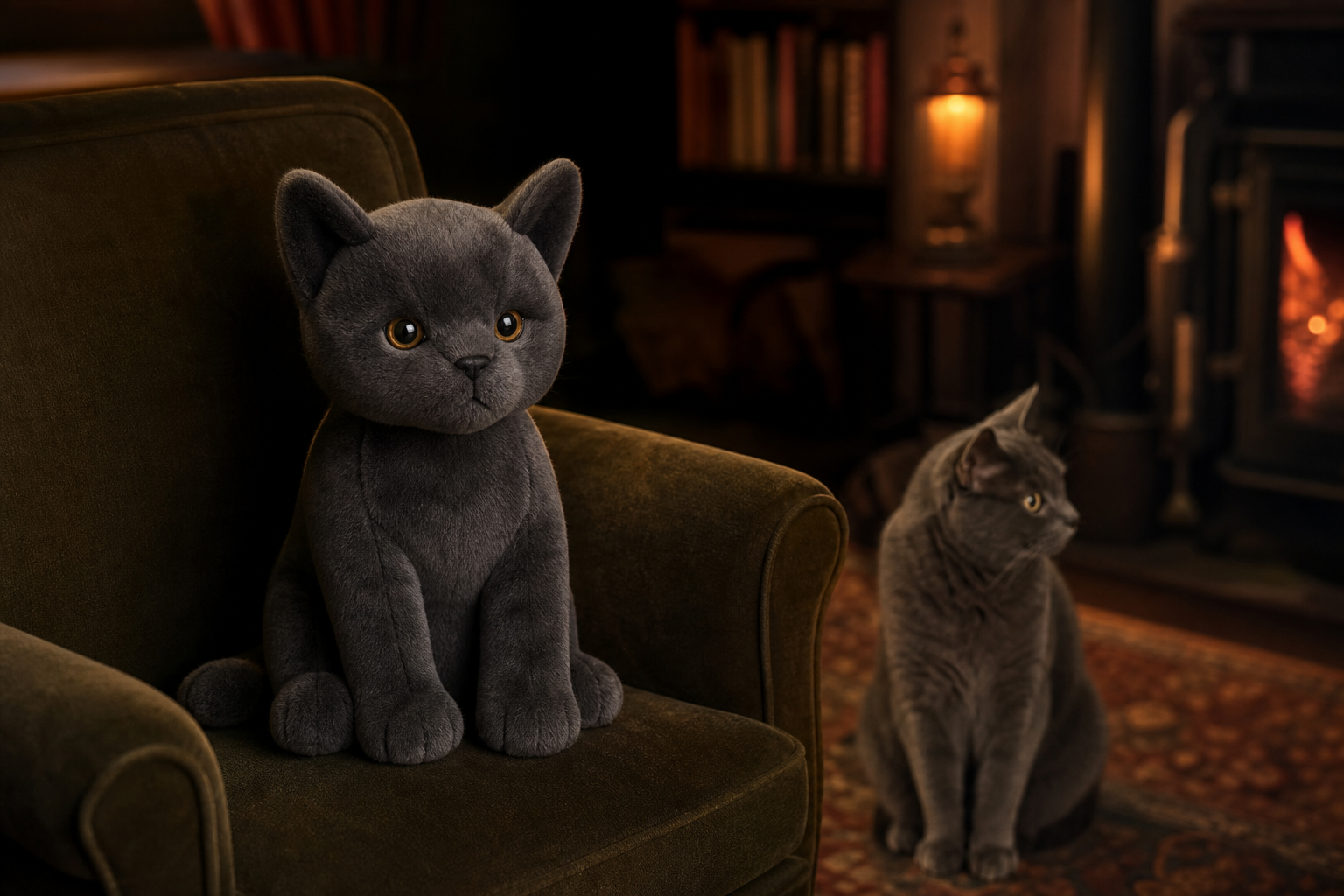
A good grey cat plush toy should match the person and purpose first. For a child or cuddle companion, prioritize a soft washable body, simple securely attached features, and the correct age guidance. For a collector or memorial keepsake, color, markings, posture, eye color, and facial shape matter more. If the plush is meant for a real cat, buy a pet-designed toy instead of assuming a human stuffed animal can withstand teeth and claws.
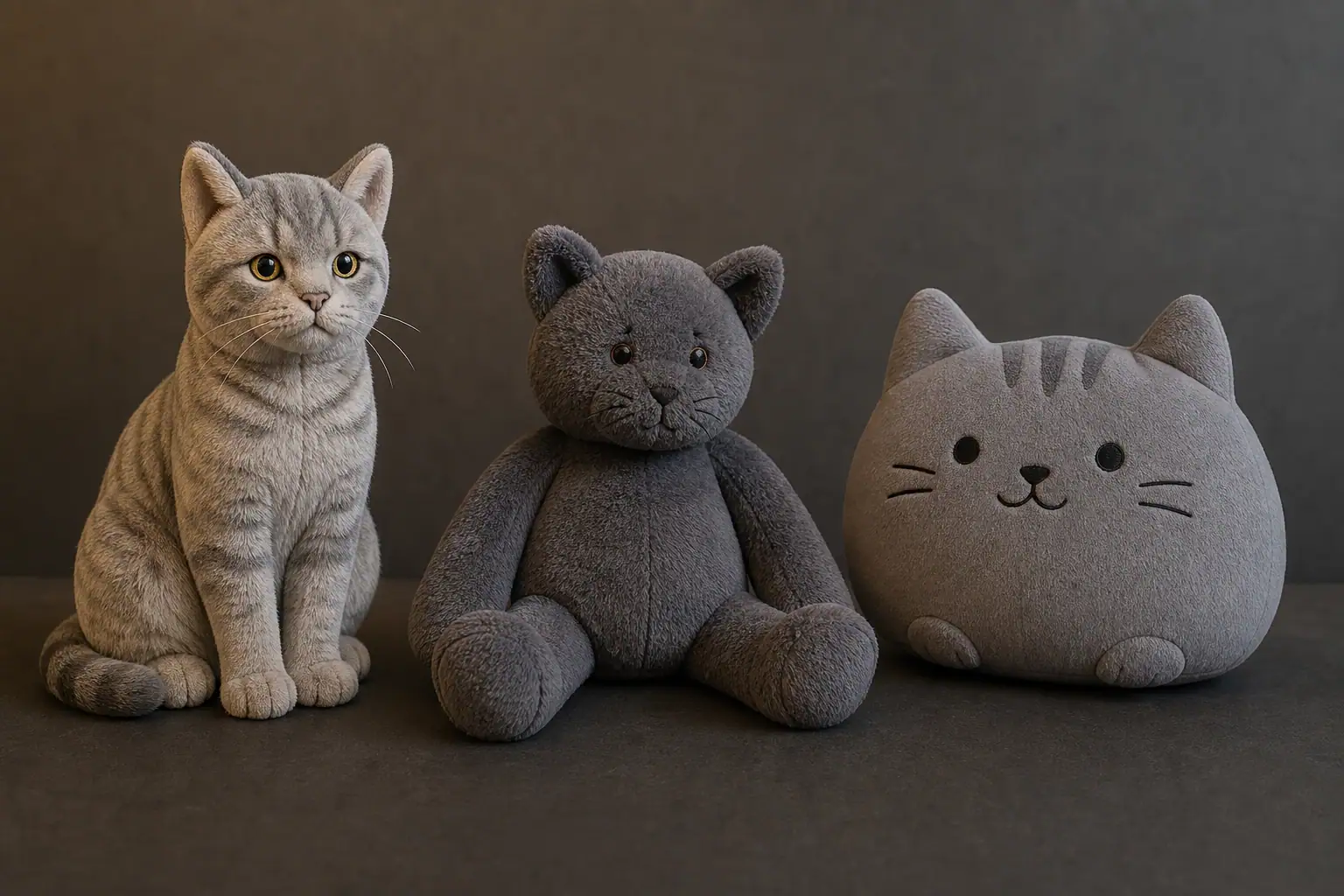
Start by choosing one of three directions: realistic, soft and floppy, or rounded and stylized. Then compare the shade of grey, size, fabric feel, filling, facial details, seams, care instructions, and return policy. This guide gives you a fast way to narrow the options—and a separate safety test for homes shared with children and real cats.
Grey cat plush toy choices at a glance
The word plush covers everything from palm-sized keychains to large decorative pillows. Search results also mix the British spelling “grey” with the American “gray,” so use both spellings if the selection seems thin.
| Plush style | Best for | Look for | Common tradeoff |
|---|---|---|---|
| Realistic sitting cat | Display, gifting, or matching a real pet | Natural proportions, breed-like face, layered markings, stable posture | May be firmer and less comfortable to hug |
| Floppy cuddle plush | Hugging, travel, and bedtime for an age-appropriate child | Soft body, even filling, washable construction, embroidered details | Shape is less lifelike and may flatten with use |
| Rounded or cartoon cat | Casual gifts, décor, and plush pillows | Simple silhouette, pleasant fabric, resilient fill, clean stitching | May not resemble a particular cat |
| Mini plush or keychain | Bags, desks, and small collectibles | Secure loop, compact stitching, no loose accessories | Small parts make it unsuitable for young children and many pets |
| Pet-designed plush or kicker | A real cat’s supervised grabbing and rabbit-kicking | Simple shape, reinforced seams, pet-appropriate fill, no glued face | Designed for play rather than realistic display |
Do not shop across all five categories at once. A highly realistic grey cat stuffed animal can be a lovely shelf piece but an awkward cuddle toy. A large floppy plush may feel perfect in the arms but fail to capture the exact expression of a beloved cat.
Get the shade, markings, and face right
“Grey” is not one color. Product photos may show cool blue-grey, warm taupe-grey, dark charcoal, pale silver, or a mixed tabby coat. Screen brightness and warm photography can also shift the apparent color. If matching a real cat matters, compare customer photos taken in ordinary daylight and read the written color description instead of trusting one polished image.
Choose a coat pattern
- Solid blue-grey: an even cool coat with little visible pattern. This is often used for plushes inspired by Russian Blue–type cats.
- Grey tabby: darker stripes, forehead lines, ringed tail, and sometimes a pale muzzle or belly.
- Grey and white: a grey back and head with white paws, chest, blaze, or muzzle.
- Silver tabby: a pale base with high-contrast dark markings.
- Long-haired smoke grey: a fluffy silhouette with light and dark fibers blended through the coat.
If you are trying to resemble a specific pet, outline the three details you notice first. It might be a white chin, green eyes, and a bent tail—not the nominal breed. Search with those traits, such as dark grey cat stuffed animal with green eyes or long-haired grey and white cat plush. A stock plush rarely matches every marking, so prioritize the face and color blocks before small stripes.
Realistic versus expressive faces
Realistic designs use a longer muzzle, smaller head-to-body ratio, shaped paws, and a natural sitting or lying pose. Stylized designs enlarge the head and eyes, shorten the limbs, and simplify the coat. Neither is inherently better. A realistic plush usually works better as a keepsake; a softer expressive face often feels friendlier as a general gift.
Match the size and feel to the recipient
Check dimensions rather than labels such as small, medium, or jumbo. Sellers may measure from the front paw to the end of the tail, which can make a narrow lying plush sound much larger than it feels. Look for seated height or body length, width, and weight. If only one measurement is listed, ask how it was taken.
- Under 8 inches: easy to display or carry, but more likely to include small-scale details and too little body for hugging.
- 8–14 inches: a versatile gift size that fits a shelf, lap, or travel bag.
- 15–24 inches: better for cuddling or use as a decorative cushion; check weight and washability.
- Over 24 inches: visually impressive, but harder to store, clean, and dry completely.
Fabric descriptions are useful only when they are specific. Short-pile plush tends to show markings clearly and collects less debris than shaggy faux fur. Minky-style fabric feels velvety and suits simplified shapes. Long faux fur can make a cat look lifelike but mats more easily and may hide seams or hard inner structure. A product described only as “premium plush” gives you little to evaluate.
For a child, follow the manufacturer’s age label and inspect the actual construction. The U.S. Consumer Product Safety Commission advises choosing toys that match a child’s abilities and keeping small parts away from children younger than three. The American Academy of Pediatrics recommends well-made stuffed toys with secure seams and parts, no loose ribbons or strings, and no accessible pellet-like filling. Keep stuffed toys and other soft objects out of an infant’s sleep space.
Inspect construction before cute details
A plush is only as dependable as its easiest failure point. Run this check before gifting it, and repeat it after washing or heavy use.
A 60-second plush inspection
- Read the label: confirm intended age, fiber and filling information, care instructions, and maker or importer details.
- Check the face: embroidered eyes and noses eliminate detachable plastic face pieces. If hard eyes are used, tug them gently and reject any movement.
- Trace every seam: look under the chin, between the legs, around the tail, and along the closing seam for gaps, skipped stitches, or protruding thread.
- Press the body: feel for unexpected wire, hard pieces, clumped fill, or small pellets collecting at one weak seam.
- Pull accessories: bows, collars, bells, whiskers, clothing, keychain hardware, and hook-and-loop parts should match the recipient’s age and use.
- Smell and surface-check: avoid a plush with strong unexplained odor, dye transfer, sticky residue, or fibers that shed with a light stroke.
- Test cleanability: verify that the care method is realistic for the person receiving it. “Surface clean only” is a poor match for a frequently handled toddler toy.
A label that says “non-toxic” does not tell you whether a seam will open, an eye will detach, or a long fiber will shed. Likewise, a machine-washable label does not make every decoration machine-safe. Evaluate the complete object and follow its care directions.
Can a real cat play with a grey cat stuffed animal?
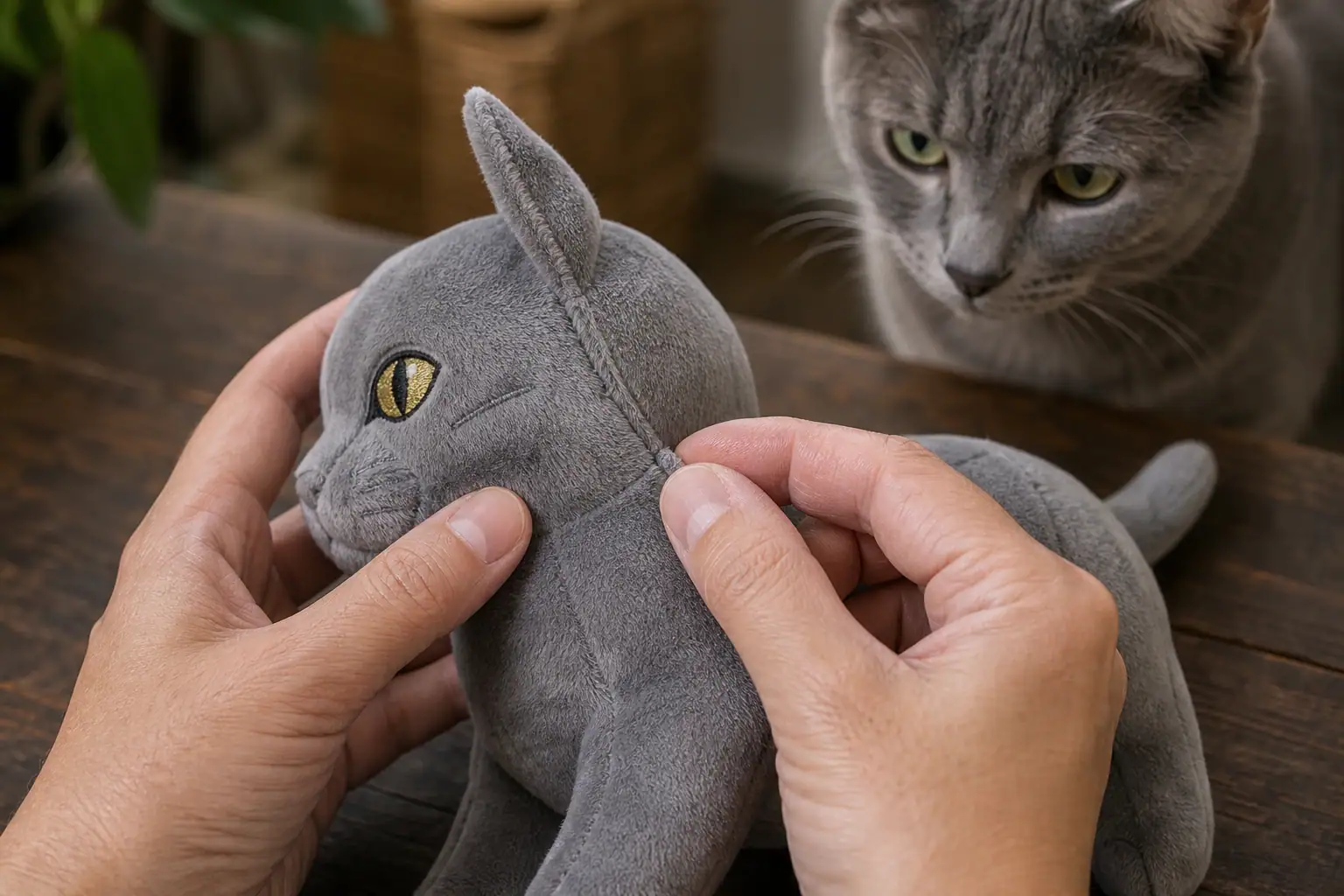
A stuffed animal made for people should not automatically become a cat toy. A real cat may bite off a plastic eye, chew synthetic whiskers, open a lightly sewn seam, pull out polyester fill, or reach weighted pellets. Realistic plushes may also contain wire or rigid shaping parts. Keychains, sound modules, batteries, ribbons, clothing, and fragrance add more failure points.
If your cat merely sleeps beside a human plush and never mouths it, store it when you cannot observe the interaction and inspect it regularly. If the cat bites, kneads aggressively, wrestles, carries, or rabbit-kicks it, replace it with a toy designed for cat play. Do not wait for visible stuffing on the floor; a determined cat can swallow a small piece before you notice the damage.
Cornell’s Feline Health Center advises avoiding small pieces and strand-like parts that may separate and be ingested. VCA Animal Hospitals specifically warns that stuffing from damaged pet toys can be swallowed and recommends removing a stuffed toy once it is damaged.
If part of a plush is missing, contact your veterinarian promptly for advice. Seek urgent veterinary care for trouble breathing, repeated gagging or vomiting, marked drooling, abdominal pain, refusal to eat, unusual lethargy, or suspected battery, string, wire, magnet, or sharp-part ingestion. Do not induce vomiting unless a veterinary professional directs you to do so.
If the plush is for your cat, choose a pet-designed kicker
A pet plush should match the cat’s play style rather than the color of the cat. Grey fabric can look good in the home, but length, construction, and failure points decide whether the toy fits the player.
- For carrying: choose a light, simple prey shape large enough not to swallow, without hard eyes, thin tail, or glued decorations.
- For wrestling and rabbit-kicking: choose a longer kicker the cat can grip with the front paws while reaching it comfortably with the hind feet.
- For rough chewers: look for dense fabric, reinforced or protected seams, minimal appendages, and a shape you can inspect on every side. Use it only under supervision.
- For kittens: favor soft, lightweight construction without long fibers or detachable details. Our kitten toy guide matches options to age and play style.
- For cats that prefer chase: a plush kicker may be the catch at the end of a wand or motion game. Use our guide to cat toys that move to build the chase safely.
No fabric cat toy is indestructible. Inspect it before and after hard play, and retire it when a seam gaps, thread forms a loop, fabric thins, a hard inner piece can be felt, filling shows, an attachment loosens, or the toy no longer dries fully after cleaning. If your cat routinely dismantles ordinary toys, the durable cat toys guide explains how to shop by the way a toy is likely to fail.
Clean and store a grey plush without ruining it
Follow the sewn-in care label first. If it allows machine washing, close any removable fasteners, place the plush in a mesh laundry bag or pillowcase, use the specified cycle, and dry it exactly as directed. Heat can distort synthetic fur, warp internal plastic, set stains, or damage glued details, so do not improvise with a hot dryer.
For a surface-clean-only plush, test a small hidden area with a barely damp light-colored cloth. Blot instead of scrubbing. Grey fabric can hide dust while showing light lint, so a clean soft clothes brush or low-suction upholstery tool may be more useful than frequent wet cleaning. Avoid fragrance sprays, essential oils, and unapproved disinfectants—especially when a real cat shares the room and may lick the surface.
Dry the plush completely before returning it to a child, shelf, or pet-accessible area. Turn and press it during drying to find damp areas in the belly and limbs. Store collector plushes away from direct sun, moisture, cooking residue, and a cat’s reach. For a washable cuddle plush, keep a photo of the care label before it fades.
Quick buying checklist
- The silhouette matches the job: realistic display, floppy cuddle, rounded décor, or pet play.
- The grey shade and markings are confirmed in more than one photo.
- Listed dimensions explain how the toy was measured.
- The face, posture, and eye color capture the traits that matter most.
- The fabric length and softness suit the recipient.
- Seams are even, especially around the tail, chin, legs, and closing point.
- Age guidance and warnings suit the child, if applicable.
- Small accessories, pellets, batteries, magnets, and exposed wire are absent when they should be.
- The care instructions are practical, and replacement or return terms are clear.
- A plush for a real cat is specifically designed for pet play and matches that cat’s bite-and-kick habits.
- You are willing to supervise, inspect, and retire a pet toy before it fails.
Grey cat plush toy FAQs
Should I search for grey or gray cat plush?
Use both. “Grey” is common in British English and “gray” in American English, but product listings use them inconsistently. Add the pattern, pose, size, or eye color to improve the results.
What makes a grey cat plush look realistic?
Natural body proportions, a smaller head, shaped paws, a defined muzzle, layered coat color, restrained eye size, and a believable sitting or lying posture matter more than extra fluff. Matching one cat requires its distinctive markings and expression, not only the correct shade.
Are plastic safety eyes always safe?
No component is universally safe for every age and use. Follow the manufacturer’s age label and inspect the complete toy. Embroidery removes a detachable hard face piece and is generally the simpler choice for young children and pet-accessible homes.
Can I wash a cat stuffed animal in a washing machine?
Only if its care label permits it. Internal wire, foam, pellets, sound modules, glued features, and long faux fur can require surface cleaning. Even a washable plush must dry completely before use.
Is a child’s grey cat plush safe for my cat?
Do not assume so. Human plushes may include plastic eyes, whiskers, pellets, long fibers, accessories, or light seams that were not selected for feline teeth and claws. Choose a pet-designed plush, supervise first use, and retire it at the first meaningful damage.
Editorial note: This guide offers general shopping and toy-safety information. Follow product instructions and age guidance, and ask a veterinarian about a cat that swallows non-food objects or has a sudden change in chewing behavior.