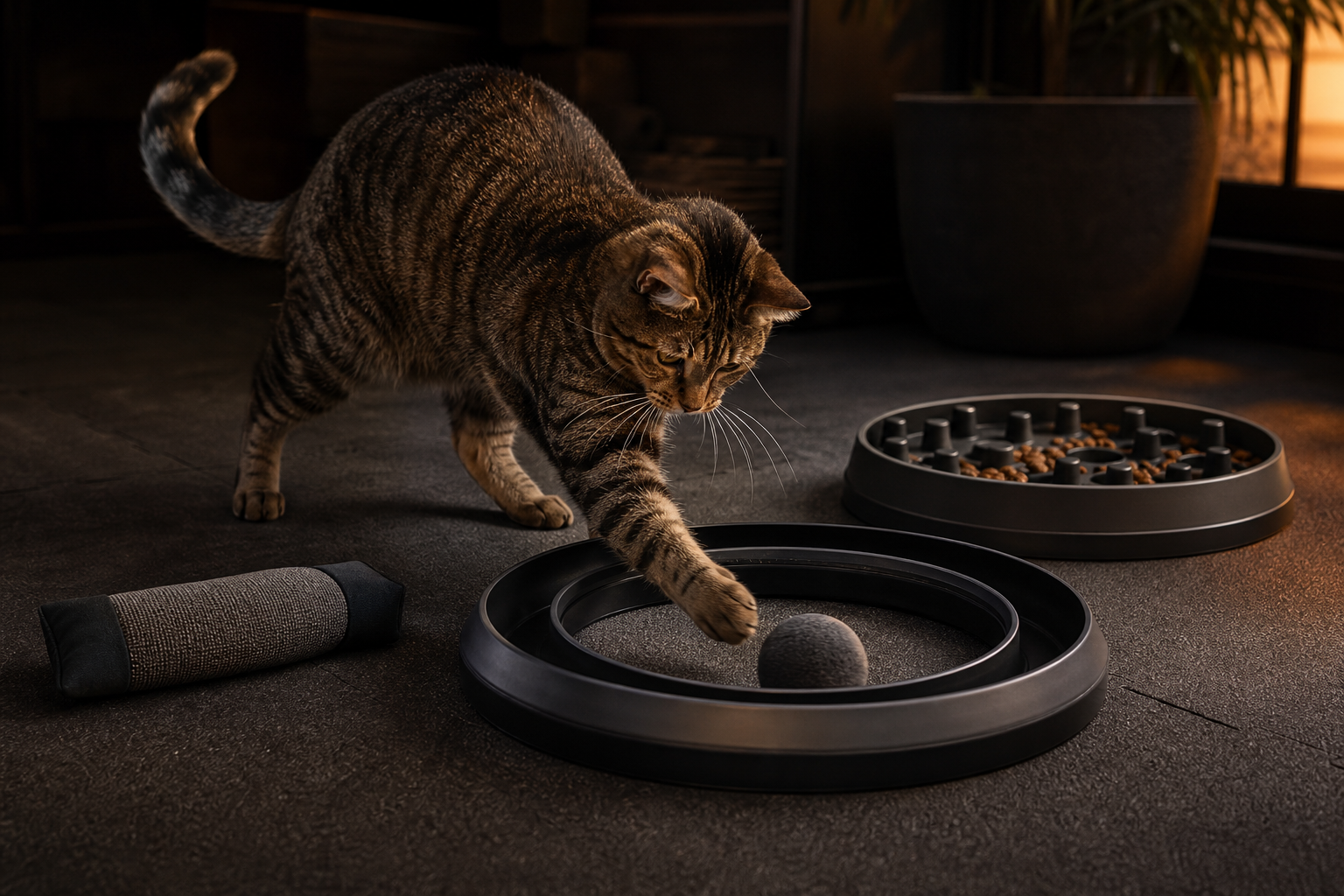
The best self-play cat toys are enclosed ball tracks, stable food puzzles, oversized batting toys, simple activity mats or tunnels, and sturdy kickers that match how your cat bites and paws. Motion-activated toys can also work, but only after you have watched several sessions and confirmed that your cat cannot expose a battery, motor, cord, or detachable lure.
The important distinction is easy to miss: self-play describes who moves the toy; it does not mean the toy is safe to leave with a cat unattended. A cat can play independently with a fabric mouse while you answer email in the same room, yet that same mouse may be a poor choice when you leave home if the cat tears off its tail or eats the stuffing.
A good setup uses a few toys with different jobs, not a floor covered in gadgets. Give your cat something to chase, something to catch, and something to solve. Keep string, ribbon, feathers, elastic, and fragile electronics for supervised sessions, especially if your cat destroys ordinary toys.
Quick picks: 9 self-play cat toy types
Choose from categories before comparing brands. Construction can vary widely within the same category, so inspect the exact product in your hands and test it with your cat.
| Toy type | Best for | Access rule |
|---|---|---|
| 1. Enclosed ball track | Swatting, circling, and repeated cause-and-effect play | Often suitable to leave out if the base is stable and the ball cannot come free |
| 2. Stationary food puzzle | Patient paw work and cats new to foraging | Start easy; use part of the normal food allowance and check for removable pieces |
| 3. Rolling food puzzle | Food-motivated cats that like to chase | Test the opening size, floor area, noise, and whether the toy can become trapped |
| 4. Oversized smooth ball | Batting and short hallway chases | Choose a size that cannot be swallowed and a material the cat cannot peel apart |
| 5. Wide tunnel or activity mat | Hiding, ambushing, scratching, and exploration | Remove exposed wire, elastic loops, torn mesh, dangling toys, and loose fasteners |
| 6. Simple fabric kicker | Grabbing, biting, carrying, and bunny-kicking | Conditional: inspect seams and remove it if the cat opens fabric or eats fibers |
| 7. Hunt box | Fishing toys or food from safe openings | Use only while present if the cat eats cardboard, foam, tape, or broken toy pieces |
| 8. Enclosed motion toy | Stalking and pouncing when you are busy nearby | Supervise first; require a screwed battery door and no accessible moving joint |
| 9. Automatic lure or spinner | Short, high-interest chase sessions | Supervised only when it includes feathers, string, elastic, wire, or detachable lures |
The joint AAFP/ISFM feline environmental-needs guidelines recommend opportunities to search, stalk, chase, pounce, catch, and manipulate toys. They also specifically advise putting away string-like or ingestible toys after play. That is why a balanced self-play kit includes both low-risk leave-out options and exciting toys that return to storage.
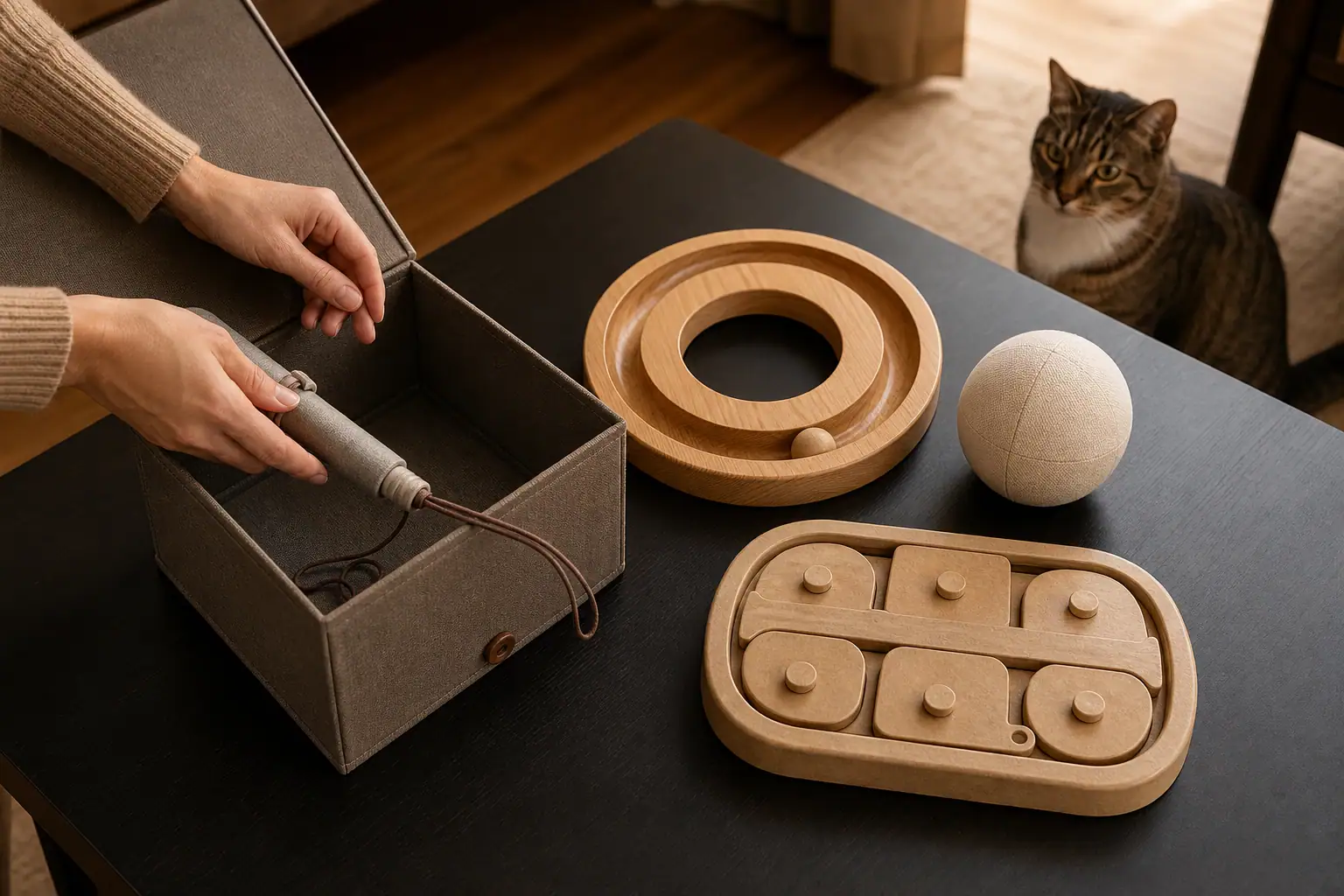
Match the toy to the first move your cat makes
The phrase “interactive cat toy” is too broad to predict what an individual cat will use. Watch the first move your cat makes when play begins, then choose a toy that lets that behavior produce a result.
- Crouches and waits: try a tunnel, hunt box, or enclosed motion toy that disappears and returns. Place it near cover rather than in the middle of an empty room.
- Swats repeatedly: try an enclosed track, large lightweight ball, or stationary puzzle with sliding pieces.
- Chases anything that rolls: try an oversized ball or rolling food puzzle on a clear floor. Block access under appliances before the first session.
- Grabs and bunny-kicks: use a kicker long enough for the front paws to hold while the back feet rake. A small mouse may be exciting, but it does not give a hard kicker enough target.
- Fishes under doors or furniture: try a stable puzzle board or a sturdy box with openings larger than a trapped paw but smaller than the cat’s head.
- Works for food: begin with a shallow stationary puzzle, then move to rolling or multi-step designs only after the cat succeeds easily.
A food puzzle is not merely a distraction. A review in the Journal of Feline Medicine and Surgery describes ways puzzles can support foraging and presents clinical cases in which they were used as part of broader health or behavior plans. The authors also emphasize matching the challenge to the cat and introducing puzzles gradually.
Food toys still need dietary judgment. Measure the portion before loading the puzzle, count treats within the daily plan, wash food-contact surfaces, and ask your veterinarian before changing how a cat with a prescription diet, diabetes, food guarding, dental pain, or mobility limitations is fed.
Use the six-point leave-out test
Before calling any toy an unattended option, watch your cat use it while you are present. Then check all six points below. A single failure moves the toy into supervised-only use.
- No linear parts: there is no accessible string, ribbon, yarn, elastic, feather shaft, wire, or long fabric tail. These can be chewed off, swallowed, or wrapped around a limb.
- No swallowable parts: balls, caps, bells, plugs, eyes, stuffing, foam, and broken fragments cannot enter the cat’s mouth or come free under pulling.
- No power access: a battery door closes with a screw, the housing has no cracks or bite openings, and charging cords are removed before play.
- No trapping route: the cat cannot wedge its head or paw into an opening, collapse the toy around itself, tip a heavy object, or chase it toward stairs, water, blind cords, or a tight gap.
- No edible failure material: the cat does not peel, shred, or consume the fabric, rubber, cardboard, carpet, glue, or coating.
- Easy to inspect: you can see the seams, shell, fasteners, openings, and attachments well enough to notice a change before the next session.
Cornell Feline Health Center’s toy-safety guidance cautions against small pieces, strand-like parts, feathers, string, and chewable electrical cords. It also points out that inexpensive options such as boxes and ping-pong-style balls can be enriching; price and technology do not determine whether a toy is useful.
Powered toys deserve an extra round of testing because motion invites harder capture attempts. Our guide to automatic cat toys for when you are away covers timer behavior, battery access, room setup, and alternatives for cats that dismantle electronics.
For rough players, use an access ladder
A toy does not earn permanent floor access because it survived one calm session. Cats change tactics when a toy becomes familiar: a swatter may start carrying it, and a kicker may discover a seam it ignored yesterday. For cats that bite, shake, shred, or chew, expand access in stages.
- Inspect before introduction. Tug gently on seams and attachments. Check for manufacturing gaps, loose thread, cracked plastic, sharp edges, and packaging remnants.
- Watch a two-minute session. Learn whether the cat bats, carries, chews, pins, or tries to open the toy.
- Repeat several short sessions. Run the toy in every mode and on the surface where it will be used. Inspect after each session.
- Try nearby self-play. Work or read in the same room while the cat controls the toy. Interrupt access if the play changes from batting to dismantling.
- Allow brief out-of-sight access only if every check passes. Recheck when you return. Some toys should never reach this stage.
- Revoke access after any change. A new hole, exposed stuffing, loosened ball, rough plastic edge, noisy motor, hot housing, or missing piece means stop.
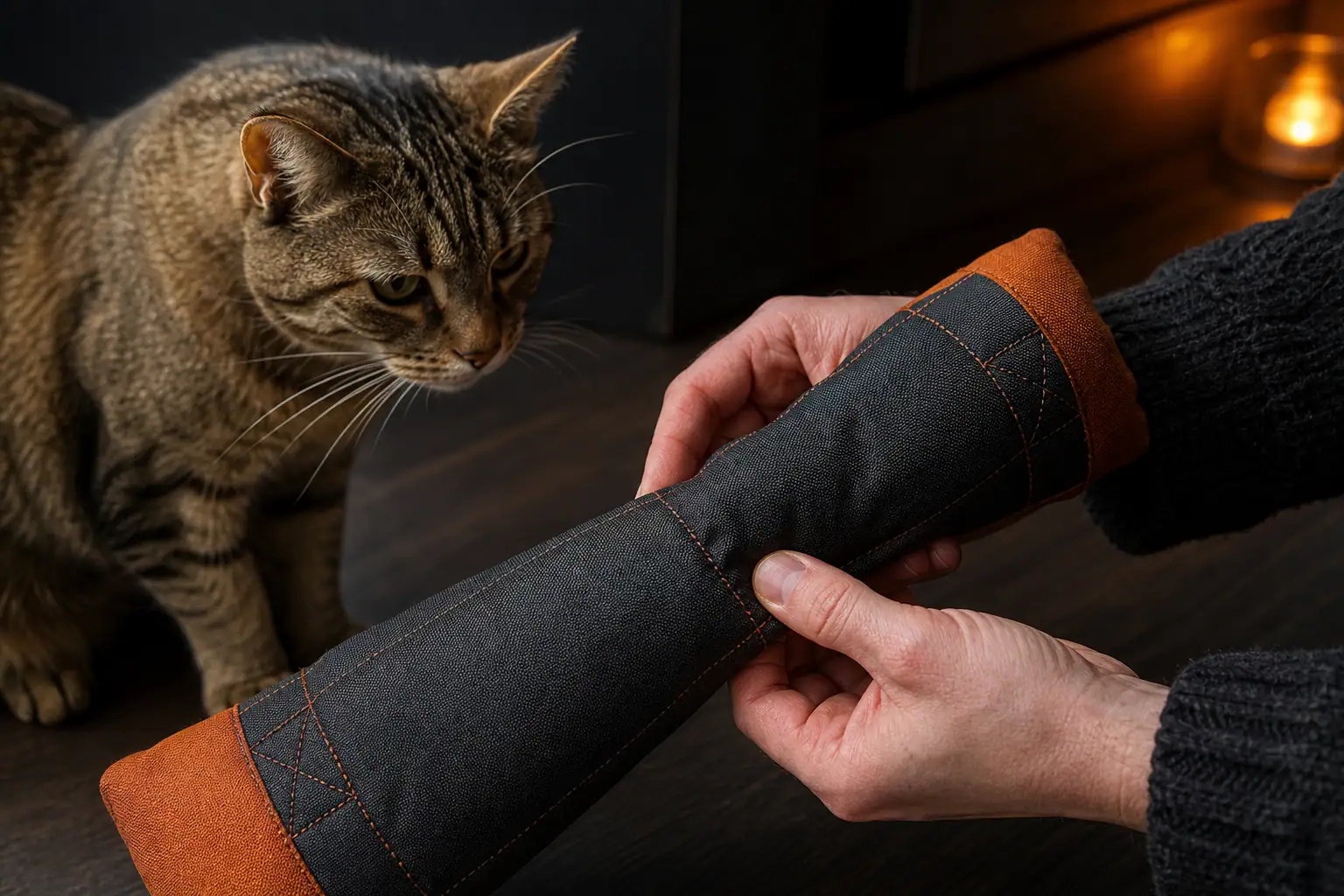
“Durable” is a relative description, not a lifetime guarantee. Material, seams, size, shape, and the cat’s attack style all matter. Use the construction checklist in our durable cat toys guide if your cat finds the weak point in every plush toy.
If part of a toy is missing and your cat may have swallowed it, contact a veterinarian promptly rather than waiting for obvious distress. VCA’s linear foreign-body guidance lists vomiting, refusing food, dehydration, lethargy, abdominal discomfort, and hiding among possible signs. Never pull visible string from a cat’s mouth or rear; it may be anchored internally.
How to teach a cat to play independently
You cannot force a cat to enjoy a category of toy, but you can make the first success obvious. Independent play usually grows from a short demonstration, an easy reward, and room for the cat to take over.
- Begin when your cat is alert. Look for orienting, stalking, zooming, or an invitation near a familiar play area. Do not wake or corner the cat for a lesson.
- Make one action work. Roll the track ball once, leave food visible in the easiest puzzle opening, or toss the kicker a short distance away from the cat.
- Reward investigation. Let the movement, food, or capture be the payoff. Avoid repeatedly putting the toy against the cat’s face or moving the cat’s paws.
- Reduce your help. After one or two demonstrations, become still. If the cat acts, allow the toy to respond without adding constant human motion.
- Stop while interest remains. A two-minute success is better than continuing until the toy becomes background clutter.
- Change one feature next time. Move the track beside a box, place the puzzle in a different room, or swap the kicker’s location. Keep the rules familiar while refreshing the setting.
Some cats prefer social play and may never spend long periods playing alone. That is not disobedience or a failure of enrichment. Keep daily owner-led play in the schedule and treat self-play as a supplement. If you need a starting rhythm, see how often to play with your cat.
Build a small rotation instead of a permanent toy pile
Adult cats can lose interest rapidly when an object never changes. In a controlled study of object play and habituation in adult domestic cats, play declined across repeated sessions with an unchanged toy, while a toy with changed sensory characteristics renewed interest. That does not mean buying something new every week. Rotation changes what is available while keeping the total collection small.
Try this practical three-part rotation:
- One solving toy: a stationary or rolling food puzzle adjusted to the cat’s skill.
- One movement toy: an enclosed track, oversized ball, or tested motion toy.
- One catch toy: a sturdy kicker or simple fabric prey toy, supervised if the cat chews fabric.
Put the rest in a closed cupboard. Swap one item every few days, or sooner if interest fades. Clean food puzzles after use, launder washable fabric toys according to their care label, and wipe tracks before debris jams the ball. Our guide to cleaning cat toys explains when washing helps and when damage or persistent odor means replacement.
A useful workday routine is simple: run a brief owner-led hunt before work, offer part of breakfast in an easy puzzle, and leave one or two toys that have already passed the access test. Later, provide another interactive session with a physical catch. For cats whose boredom has become a pattern, the seven-day interactive-toy reset helps separate novelty problems from a poor toy match.
Why a cat ignores self-play toys
- The toy does nothing after the first touch. Place a batting toy on a hard floor, use an enclosed track with free movement, or hide part of a familiar toy so the cat can search.
- The puzzle is too difficult. Make food visible and easy to remove. Increase difficulty only after repeated success.
- The toy is always available. Put it away for several days and change its location when it returns.
- The motion is frightening. Introduce electronic toys while switched off, start at a distance, and allow the cat to leave. A cat hiding from a motor is not being enriched.
- The room works against play. Add cover, clear slippery landings, block appliance gaps, and separate toys in multi-cat homes so one cat cannot guard everything.
- The toy does not match the cat’s body. Seniors and cats with mobility limits may prefer stable floor-level puzzles, slower balls, or large targets they can reach without jumping.
- The cat wants you. Self-play cannot replace positive interaction. Pair a safe solo option with predictable, owner-led hunt-and-catch sessions.
A sudden loss of interest in play deserves attention, especially with reduced appetite, limping, reluctance to jump, hiding, irritability, weight change, vomiting, or changes in drinking or litter-box use. Arrange a veterinary examination rather than assuming the cat is merely bored.
Self-play cat toys: final checklist
- The toy matches a behavior the cat already shows.
- The cat can make something useful happen: movement, capture, searching, scratching, or food access.
- The toy is too large to swallow and has no detachable small parts.
- String, ribbon, yarn, elastic, wire, feathers, and wand lures are stored after use.
- Battery doors screw shut and charging cords are removed.
- The room has no trapping gaps, unstable objects, stairs, or blind cords in the play path.
- Rough players progress through supervised testing before gaining more access.
- Food puzzles use measured food and a difficulty the cat can solve.
- Toys are rotated, cleaned, and inspected instead of left out until they fail.
- Self-play supplements daily human interaction; it does not replace it.
Can I leave self-play cat toys out while I am at work?
Only toys that have passed supervised testing and the leave-out test. Enclosed tracks, stable one-piece puzzles, and simple oversized balls are often better candidates than plush toys or electronics, but your cat’s chewing and dismantling habits decide. Store all string, feathers, elastic, fragile attachments, and charging cords.
Are automatic cat toys better than simple toys?
No. Automatic toys add movement, but they also add housings, joints, batteries, and attachments that can fail. Many cats get more reliable self-play from a track, food puzzle, tunnel, box, or appropriately sized ball. Use electronics for short tested sessions, not as proof that the cat can be left alone with the toy.
What is the best self-play toy for a cat that destroys toys?
Start with a stable enclosed ball track or sturdy one-piece food puzzle that the cat cannot lift, open, or bite apart. Add a simple large kicker only during supervised self-play until you know the cat will not split seams or eat fabric. Inspect every toy before and after hard play.
How many cat toys should I leave out?
Two or three different jobs are enough for many cats: one solving toy, one movement toy, and one safe catch or scratch option. A small rotation is easier to inspect and keeps favorites from becoming permanent background clutter.
Editorial note: This guide provides general enrichment and toy-safety information. It does not replace advice from a veterinarian who knows your cat’s health, diet, and ingestion history.