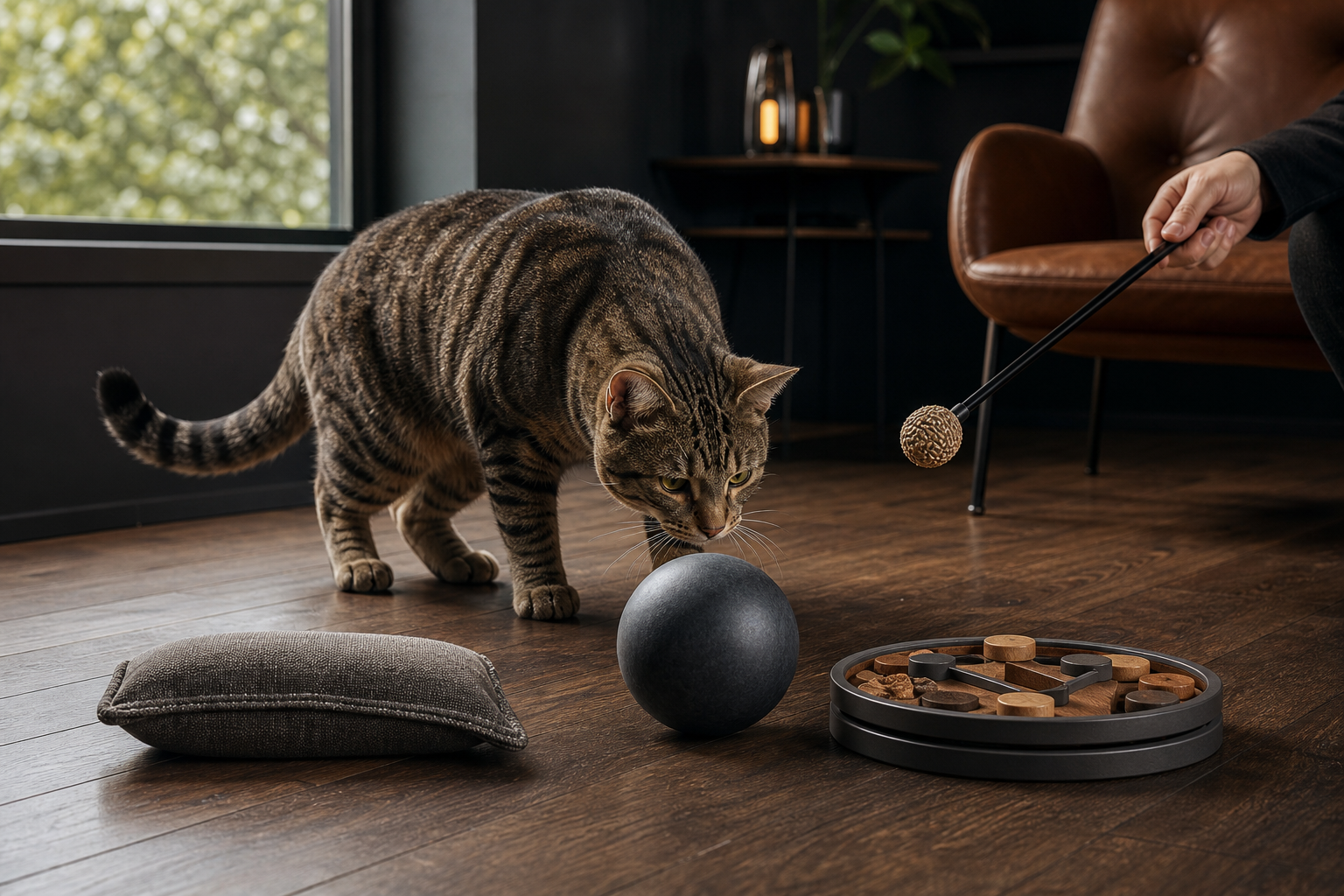
Target cat toys can cover the main kinds of feline play—chasing, pouncing, wrestling, batting, and foraging—but the best buy is not automatically the bestseller or the biggest multipack. Choose the toy that matches what your cat actually does, then check its size, seams, attachments, battery access, and likely failure point before it goes in the cart.
Target’s current cat-toy category includes feather wands, plush prey, kickers, balls, springs, tracks, puzzles, tunnels, and electronic chase toys. That range is useful, but a product grid cannot tell you whether a toy suits a gentle paw-tapper or a cat that clamps down, bunny-kicks, and opens ordinary plush toys in minutes.
This guide gives you a practical filter for shopping the aisle or ordering online. It does not rank temporary deals, and Titan Claws is not affiliated with Target or the brands mentioned. Inventory, designs, prices, and reviews can change, so recheck the current listing and label before buying.
Start with the play job, not the cutest toy
Cats do not need one magical toy. They need safe opportunities to perform parts of the predatory sequence: watch, stalk, chase, pounce, grab, bite, and sometimes kick. The AAFP/ISFM environmental needs guidelines identify play and predatory behavior as a core part of a healthy feline environment.
Before looking at colors or ratings, write down your cat’s favorite action. A cat that chases movement needs a different tool from one that wants to hug and wrestle. A cat that eats too quickly may get more value from a food puzzle than from another plush mouse.
| Toy format you may find | Best play job | Supervision starting point | What to inspect first |
|---|---|---|---|
| Wand or teaser | Stalk, chase, leap, and capture | Interactive sessions only; store after play | Cord, swivel, feathers, bells, knots, and lure attachment |
| Plush prey or kicker | Grab, bite, carry, and bunny-kick | Supervise until you know the cat’s damage pattern | Size, seam density, embroidered details, stuffing, and narrow appendages |
| Ball or spring | Bat, chase, and fetch | Only consider leave-out use after a supervised trial | Swallowable size, cracks, lattice gaps, coatings, and detachable pieces |
| Track with captive ball | Repeated paw chasing | Often lower interaction, but test first | Base stability, pinch gaps, sharp mold lines, and whether the track opens |
| Food puzzle | Search, paw, and forage | Introduce while present; count food in the daily ration | Opening size, stability, cleaning access, and chewable lids or plugs |
| Electronic chase toy | Novel movement and pursuit | Supervised until movement and failure mode are predictable | Battery door, charging cord, motor heat, hair-catching gaps, and loose shells |
| Tunnel | Hide, ambush, sprint, and retreat | Observe the first energetic sessions | Exposed support wire, hanging ties, torn fabric, and exit size |
The Ohio State University Indoor Pet Initiative similarly recommends varied toys that let cats stalk, pounce, chase, capture, and manipulate food. Its central shopping lesson is simple: offer different safe actions and let the cat show you which ones matter.

Use this 60-second Target aisle check
You usually cannot remove a toy from its packaging in the store, but a minute of close inspection can rule out many poor matches. For online orders, apply the same check to dimensions, close-up photos, label images, and the most critical reviews.
- Confirm the finished size. Do not rely on a close-up photo. Look for dimensions and compare them with your cat’s mouth, paws, and body. There is no universal safe diameter; reject anything your cat could swallow, wedge behind the canine teeth, or pull apart into swallowable pieces.
- Find the first likely failure point. On plush toys, it may be a narrow tail or lightly stitched seam. On wands, it may be the cord-to-lure connector. On electronics, it may be a snap-fit battery cover. If you can predict where your cat will attack, judge that spot first.
- Prefer structure over decoration. Simple shapes, enclosed seams, embroidered details, and captive moving parts are easier to monitor than glued eyes, pom-poms, tinsel, long fur, exposed bells, or clusters of feathers.
- Read the whole warning panel. Check intended species, age guidance, supervision language, cleaning directions, battery type, and disposal instructions. A pet-toy label is still not a promise that the toy suits every cat or chewing style.
- Check how it will be cleaned. A treat puzzle needs openings you can reach and dry. A fabric toy needs care instructions you can realistically follow. If saliva, food, or catnip can enter a cavity you cannot inspect, choose another design.
- Use reviews as failure reports. Sort past the star average and look for repeated reports of seams opening, feathers detaching, motors stalling, doors popping open, or pieces going missing. A high rating measures owner satisfaction, not safety certification.
- Buy one test toy before a multipack. The cheapest cost per piece is wasted if the scale, sound, texture, or durability is wrong for your cat.
Fast pass-or-skip rule
Pass when the toy is appropriately sized, simple, intact, inspectable, cleanable, and matched to a play behavior you have actually seen. Skip when the main appeal is a dangling or detachable detail your cat is likely to chew off.
Best Target cat toy types for rough players
For a rough-playing cat, shop by controlled failure mode. The question is not whether packaging says “durable.” Ask what happens after repeated punctures, pulling, and hind-leg kicks. Fabric that gradually fuzzes under inspection is easier to manage than a brittle shell that can crack sharply or a decorative piece that detaches without warning.
A larger, plain kicker is often the most useful starting point for a cat that grabs arms, attacks small plush mice, or wants full-body wrestling. Look for enough length to hold with the front paws while kicking with the hind legs, a shape too large to swallow, tight stitching, and minimal external decoration. Even a sturdy kicker remains a replaceable toy, not an indestructible one.
A wide track toy with a fully captive ball may work for forceful batting if the base stays flat, the track does not separate, and no paw or claw can become trapped in its openings. A stable food puzzle can add a quieter foraging job. Use part of the cat’s measured meal rather than adding unlimited treats, and retire a puzzle that develops deep tooth marks, cracks, or rough edges.
Wands are excellent for energetic rough players because they put distance between claws and hands, but their strings, feathers, wires, and small connectors make them session tools. VCA’s veterinary toy guidance recommends not leaving wand-style toys, string, feathers, rubber bands, hair bands, or yarn with kittens unattended.
If your cat destroys ordinary toys quickly, compare the construction details in our durable cat toys guide. For battery-powered options, use the more specific checks in our electronic cat toy safety guide.
Usually poor fits for a determined toy destroyer
- Tiny plush mice with glued features, thin tails, or loose fur
- Exposed bells, crinkle film, or rattles that become reachable after one seam opens
- Feather clusters and pom-poms used as bite targets rather than supervised chase lures
- Hollow plastic toys that whiten, dent, or crack when squeezed or bitten
- Electronic toys with a battery door that opens without a tool
- Any design whose pieces cannot be counted before and after play

Run a five-minute home test before regular use
The first session is a fit test. Clear the floor, keep other pets and children out of the play path, and remove tags, plastic fasteners, ties, and packaging. Photograph the intact toy if its parts or attachments are hard to count.
- Let the cat approach instead of pushing the toy into the cat’s face.
- Watch the first behavior: pawing, carrying, chewing, dragging, full-body grabbing, or ignoring.
- Interrupt calmly if the cat focuses on a seam, cord, battery door, feather shaft, or detachable decoration.
- For a wand, move the lure like prey—away from the cat, with pauses—and allow regular captures. Do not whip it around the face.
- End while play is controlled, trade for a treat if needed, and put interactive toys in closed storage.
- Inspect the toy under bright light and compare both sides with the before photo.
If the toy passes, its supervision level can sometimes change with experience—but the physical design still matters. A wand never becomes an unattended toy because the cat behaved well once. A ball does not become safe to leave out if it is small enough to enter the mouth. When in doubt, store it.
Rotate a small play kit instead of buying a pile
Novelty can come from timing, movement, and location, not constant shopping. Keep a small active set and store the rest in a closed container. A useful weekly kit might include one wand for shared chase, one kicker for capture and wrestling, one ball or track for batting, and one food puzzle for foraging.

Change one or two items every few days, but let a favorite remain if your cat uses it appropriately. Move a track to a different room, run a wand around a box, or place a food puzzle where the cat can search for it. VCA suggests offering several options and switching toys every few days or weekly; rotation is especially helpful when an old toy has become visually invisible.
Separate interactive toys from leave-out toys so nobody mistakes a feather wand for an all-day object. A cat toy bin and rotation system makes that distinction easier and helps you notice missing parts.
When to replace the toy—or call a veterinarian
Retire a cat toy as soon as its structure changes. Do not wait for complete failure. Raised or spreading seams, exposed filling, missing fur, loose thread, detached feathers, new sharp edges, deep punctures, stress whitening in plastic, a rattling battery door, unusual motor heat, or a newly exposed wire all end the session.
Do not patch a cat-contact toy with staples, pins, tape, household glue, or exposed thread. A repair can add another piece to swallow and hide the damage underneath. Take the toy out of circulation and replace it with a simpler design.
If string, ribbon, thread, elastic, stuffing, plastic, a bell, a battery, or another component is missing—and especially if you saw the cat swallow it—contact your veterinarian or an emergency clinic promptly. VCA explains that swallowed string-like material can anchor and bunch the intestines, potentially causing a life-threatening linear foreign body. Do not induce vomiting or pull material protruding from the mouth or anus unless a veterinarian instructs you to do so.
Repeated vomiting or gagging, refusal to eat, heavy drooling, unusual hiding or lethargy, abdominal pain, straining, or trouble breathing warrants urgent veterinary advice. Bring the remaining toy, packaging, and a photo or example of the missing material if the clinic asks.
Target cat toys FAQ
What are the best cat toys at Target?
The best option depends on your cat’s play pattern. Choose a wand for supervised chase, a large simple kicker for wrestling, a track or appropriately sized ball for batting, and a washable puzzle for foraging. Construction, scale, and supervision needs matter more than the bestseller label.
Are Boots & Barkley cat toys good?
Boots & Barkley is prominent in Target’s current cat-toy selection, but judge each design individually. The same brand can sell simple balls, plush toys, wands, tracks, puzzles, and electronic toys with very different materials and failure points. Read the current label and recent critical reviews, then test the exact toy with your cat.
Can I leave a Target cat toy out while I am away?
Do not leave out wands, strings, ribbons, feathers, hair-like fibers, loose elastic, or a toy your cat chews apart. A large intact ball, captive track, or simple puzzle may be a candidate only after supervised use confirms the size, stability, and construction suit your cat. Our guide to self-play cat toys includes a more detailed leave-out test.
How many cat toys should I buy?
Start with a few different play jobs rather than many versions of one toy. Four well-chosen formats—chase, capture, bat, and forage—can teach you more about your cat than a large novelty multipack. Rotate extras instead of leaving everything available.
Sources and shopping reference
- Target: current cat toys category
- Feline Veterinary Medical Association: AAFP/ISFM Environmental Needs Guidelines
- Ohio State University Indoor Pet Initiative: toys
- VCA Animal Hospitals: toy safety for kittens
- VCA Animal Hospitals: linear foreign bodies in cats
Editorial note: Target and Boots & Barkley are trademarks of their respective owner. Titan Claws is not affiliated with or endorsed by Target. Product availability and construction can change. This article provides general shopping and toy-safety information, not veterinary care.