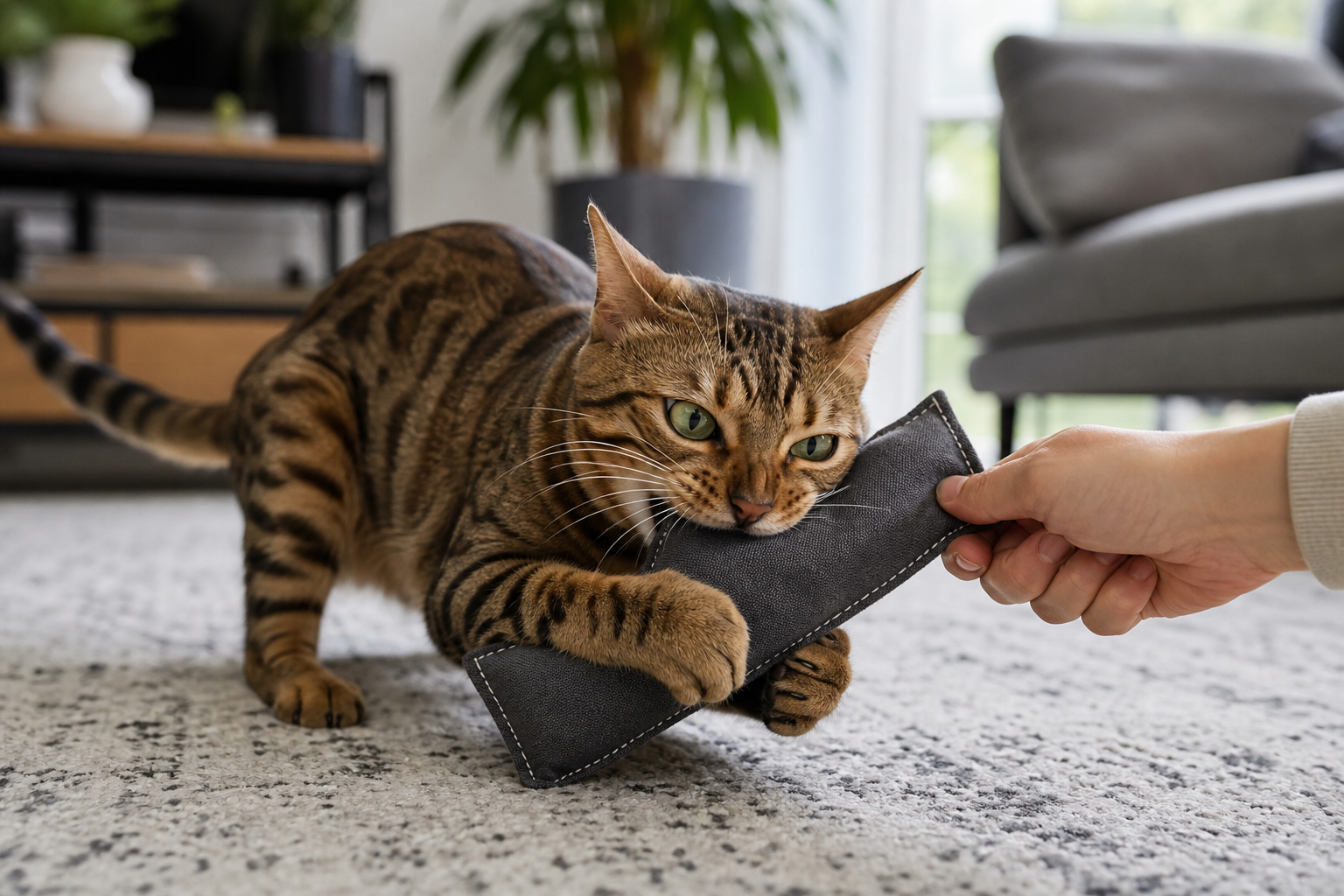
Cat chew toys for aggressive chewers should be simple, oversized enough to avoid swallowing, flexible enough for a cat mouth, and easy to inspect after every play session. The safest choice is rarely the toy that claims to be toughest. It is the toy your specific cat can bite, carry, kick, and release without tearing off pieces or eating the material.
Start by separating two problems. A cat who gnaws hard on toys needs durable chew outlets and supervised play. A cat who swallows plastic, rubber, fabric, string, hair ties, or toy pieces may be showing pica or another medical or behavioral issue. That cat needs prevention and veterinary guidance, not just a stronger toy.
What Makes a Cat an Aggressive Chewer?
In cat-toy terms, an aggressive chewer is not a bad cat. It is a cat with a strong bite pattern, high prey drive, teething discomfort, stress chewing, boredom chewing, or a habit of shredding soft objects after the chase is over. These cats may flatten plush mice, pull feathers from wands, chew holes in fabric tunnels, bite through elastic, or gnaw rubber and plastic household items.
The risk is not only mess. Cornell Feline Health Center’s safe toy guidance warns against small parts and strand-like pieces such as feathers or string that can separate when chewed and be ingested. That warning is directly relevant for cats that destroy toys quickly.
Search results for this topic are crowded with shopping pages and product roundups. Those can be useful for seeing common options, but they often skip the harder owner question: which toy can be left out, which toy is only for supervised play, and when does chewing move from normal play into a safety concern?
Best Types of Chew Toys for Cats That Bite Hard
There is no single best chew toy for every hard-chewing cat. The better approach is to match the toy type to the way your cat uses their mouth.
- Flexible rubber or silicone-style chews: Useful for cats who like pressure on the gums, bat small objects, or gnaw lightly after play. Choose cat-sized toys that flex under firm finger pressure and avoid thin spikes or detachable decorations.
- Tightly woven fabric chews: Good for cats who like a softer bite. Look for dense stitching, no loose tags, no glued-on eyes, and no stuffing that leaks easily.
- Long kicker toys: Best for cats who grab, bite, and rake with the back feet. A longer toy keeps the bite away from your hands and gives the cat a full-body target.
- Silvervine or matatabi sticks: Helpful for some cats that enjoy plant textures. Use them under supervision and remove splintered, tiny, or heavily shredded pieces.
- Puzzle feeders and treat balls: Not chew toys in the strict sense, but useful for cats whose chewing is partly boredom or foraging frustration.

Retailer categories show the range owners are comparing: Chewy lists fabric, rubber, silvervine, rope, wood, plant material, and thermoplastic rubber among cat chew-toy materials. That range is useful, but the material label alone does not answer whether a toy is safe for your cat’s bite strength.
What to Avoid for Rough Chewers
Many normal cat toys are poor choices for cats that chew aggressively. Avoid toys with feathers, elastic loops, ribbons, bells, beads, googly eyes, sequins, thin rubber nubs, glued-on parts, squeakers, long strands, and loose stuffing. These details can be fine for supervised batting in some cats, but they become ingestion risks for cats that bite until pieces come off.
The University of Wisconsin School of Veterinary Medicine gives similar practical advice for cats who chew: avoid feathers, strings, and sparkles, remove loose decorations, cut off loops and tags, and remove any pieces that get chewed off. Their guidance also notes that some cats who chew may do better with sturdy small stuffed toys that are too big to eat but small enough to carry.
Be cautious with dog toys. Some small dog toys are useful for large cats that need a tougher fabric target, but many dog chews are too hard, too heavy, or shaped for a dog mouth. Skip rock-hard nylon bones, antlers, cooked bones, dense hooves, and any chew that does not flex at all. Cats have sharp teeth, but they are not built to grind heavy dog chews.
The Safety Test Before You Buy
Before buying cat chew toys for aggressive chewers, use this five-part test:
- Size: The toy should not fit fully inside your cat’s mouth. For large cats or cats that swallow objects, size up.
- Flex: A chew toy should give under firm finger pressure. If it feels like a hard tool handle, it is probably too unforgiving for a cat mouth.
- Surface: Choose smooth, simple, inspectable surfaces over deep crevices, dangling parts, or fragile decorative details.
- Construction: Prefer one-piece molded chews, dense fabric, reinforced seams, and minimal parts. If you can pull a part loose with your fingers, your cat may remove it with teeth.
- Cleanability: Saliva, food residue, and catnip dust build up. If you cannot wash or fully inspect it, do not make it a daily chew outlet.
Claims such as dental, tough, natural, non-toxic, or durable are starting points, not proof. Chewy’s own chew-toy category notes that chew toys should still be supervised and removed when damaged, and that not all chew toys suit vigorous chewers or kittens. That is the right level of caution for this category.
How to Introduce a New Chew Toy
Give any new chew toy a watched trial before leaving it in normal rotation. Put the toy down during a calm play window, not when your cat is already over-aroused. Watch whether your cat licks, mouths, gnaws, shreds, guards, or tries to swallow pieces. Those are different behaviors and they call for different rules.
For the first week, use this routine:
- Offer the toy for 5 to 10 minutes while you watch.
- Pair it with movement so it feels like prey, not a random object on the floor.
- Inspect it before and after every session.
- Store it away if the cat tries to remove chunks.
- Only leave it out independently after several clean sessions with no missing pieces.
If your cat mostly wants to wrestle, use Titan Claws’ guide to cat toys for play aggression alongside this article. If your cat mostly gnaws household objects, compare options in cat chewing toys and rubber chew toys for cats.

When Chewing May Be Pica
Some chewing is normal. Swallowing non-food material is different. The Journal of Feline Medicine and Surgery case-control study on feline pica found pica directed at shoelaces or threads, plastic, fabric, rubber, paper or cardboard, wood, and other items. The same study reported that some cats ingested certain items while only chewing others, which is why owners need to watch what actually happens during play.
Call your veterinarian if your cat swallows toy pieces or repeatedly eats fabric, rubber, plastic, cardboard, hair ties, string, earbud tips, or similar objects. Also call if chewing comes with vomiting, drooling, pawing at the mouth, appetite loss, constipation, diarrhea, lethargy, hiding, weight loss, or a sudden change in behavior. A chew toy cannot rule out dental pain, gastrointestinal trouble, anxiety, nutritional issues, or compulsive behavior.
UC Davis School of Veterinary Medicine’s guidance on unusual eating habits in cats describes pica as chewing and consumption of non-nutritional substances and notes possible links to medical or behavioral causes. Treat that as the dividing line: chewing a toy is play; eating the toy is a health and safety problem.
A Better Toy Rotation for Aggressive Chewers
Hard-chewing cats usually need a small system, not one miracle toy. The goal is to satisfy several behaviors: chase, pounce, bite, kick, forage, and rest. Cornell also recommends toy rotation to prevent boredom, and environmental enrichment research for indoor cats consistently points toward play opportunities that let cats express normal predatory behavior.
Build a rotation like this:
- One supervised chew: flexible rubber, dense fabric, silvervine, or another gnawing outlet your cat can use without removing pieces.
- One long kicker: a bite-and-rake target for cats that wrestle.
- One wand toy: supervised only, used for chase and pounce, then put away before strings or feathers are chewed.
- One puzzle or food toy: a foraging outlet for boredom-driven chewing.
- One cheap safe novelty: a paper bag with handles removed, a box, or a ping-pong ball when appropriate for your cat.

Rotate a few safe options instead of covering the floor with every toy. Too many toys can become stale, and higher-risk toys should not be available when you are asleep or away. For more rotation ideas, read Titan Claws guides to durable cat toys, natural cat toys, and best cat toys for bored indoor cats.
When to Throw a Chew Toy Away
Retire a chew toy as soon as it becomes harder to inspect or easier to swallow. Do not wait until it is destroyed.
- Pieces, flakes, fibers, or splinters are missing.
- A seam opens or stuffing appears.
- Rubber develops cracks, sticky spots, sharp edges, or stretched holes.
- Fabric becomes stringy, fuzzy, or easy to pull apart.
- Silvervine becomes tiny, sharp, or heavily shredded.
- The toy now fits fully inside the cat’s mouth.
- Your cat starts guarding it and trying to swallow pieces.
- The toy has a strong chemical odor, peeling coating, or greasy residue.
For cats that destroy ordinary toys, replacement is part of ownership. A toy can be a good purchase and still be disposable once your cat changes its structure. The safer habit is to buy fewer, better-matched toys and inspect them often.
Quick Checklist
Use this checklist before choosing cat chew toys for aggressive chewers:
- Is the toy too large to swallow whole?
- Does it flex without being flimsy?
- Are there no strings, feathers, bells, beads, ribbons, tags, loops, or glued-on parts?
- Can every surface be inspected and cleaned?
- Does the toy match your cat’s actual chewing style: gnawing, kicking, carrying, or shredding?
- Have you watched at least several short trial sessions?
- Do you have a plan to store supervised-only toys?
- Have you blocked access to cords, rubber bands, hair ties, plastic packaging, and other forbidden chew targets?
- Will you throw the toy away at the first sign of missing pieces?
- Will you call a veterinarian if your cat is eating non-food objects?
The best chew toy for a rough cat is not the one marketed as impossible to destroy. It is the one that gives your cat a legal bite target, stays intact under your cat’s real play style, and fits into a routine of supervision, inspection, rotation, and early replacement.
Sources
- Cornell Feline Health Center: Safe toys and gifts
- University of Wisconsin School of Veterinary Medicine: Safe Toys for Cats
- Journal of Feline Medicine and Surgery: Characterization of pica and chewing behaviors in privately owned cats
- UC Davis School of Veterinary Medicine: Unusual Eating Habits in Cats
- Chewy: Cat Chew Toys category context