Category: Cat Toys

  • DIY Replacement Attachments for Teaser Wands

    DIY Replacement Attachments for Teaser Wands

    Sick of wand heads shredding after a few uses while your cat gives you that “really?” look? Ever watched one fall apart mid-chase? You’re not alone.

    Build a quick-change, tough attachment using a wooden dowel (a thin wooden rod, like a broom handle) and fishing line (strong nylon thread). It stands up to rough pounces and hard tugs. You can swap heads in seconds. No tools. No fuss.

    You’ll save money, cut down on trash, and keep play safe when you only have a few minutes to spare. For busy days, toss on a toy before you leave and enjoy a calm house when you get back.

    Think of it like a LEGO set for cat play. Snap on feathers, a crinkly ball, or a felt mouse and watch whiskers twitch and tails flick with delight.

    Worth every paw-print. Claw-tastic.

    Quick step-by-step: core assembly and swap guide

    - Quick step-by-step core assembly and swap guide.jpg

    Make a tough, quick-change attachment for a teaser wand so you can swap heads in seconds. It keeps play safe and fun when you only have a few minutes. Think of it like a modular toy for busy cat parents who want long-lasting joy.

    Materials:

    • Wooden dowel (1/2" x 3 ft recommended) (wood rod, like a broom handle but thinner)
    • Fishing line, 15–20 lb test (strong nylon thread for tethers)
    • Barrel swivel (rotating connector) or small lobster clasp (clip-style connector)
    • Small jingle bell or lure head with eyelet (sound for extra attention)
    • Drill with a small bit, scissors or X-ACTO knife, pliers
    • Heat-shrink tubing or crimp beads (for secure ends)
    1. Choose your dowel and connector. Drill a small hole about 1" from the dowel end for the tether to exit. Keep it neat so the line slides smooth.
    2. Cut fishing line to the working length for the toy you want. Short flutterers: 18–24". Bigger prey toys: 36–45". Pick what makes your cat’s whiskers twitch.
    3. Tie the swivel or clip to one end of the line using a strong knot or crimp it with beads. Use 15–20 lb line for most cats. It’s simple but strong.
    4. Add the lure bits to the free end: feathers, a felt mouse, a pom, or a bell. Put any small weight near the head so it moves like real prey.
    5. Secure the ends with heat-shrink tubing or a crimp bead so the knot doesn’t slip. Leave about 6–12" of free line between the wand tip and the swivel for lively movement. It feels springy when swung.
    6. Do a slow trial play at low speed to check how it swings and spins and to find any snag points. Ever watched your kitty zero in on a feather? This step helps make that happen safely.
    7. Store spare heads clipped together or in a little box when you’re not using them. Do a quick safety check before each session.

    Feather + bell micro-recipe:

    • Materials: 1 short feather cluster, small jingle bell with eyelet, 18–24" fishing line
    • Wrap the bell eyelet twice with the line to lock it. Anchor the feather quill to the bell or lure head so it won’t pull out.
    • Clip or swivel the lure so the swivel sits about 18–24" from the feather head for a natural flutter.

    Pom/rodent micro-recipe:

    • Materials: felt mouse body about 2" x 3" (felt is soft fabric), suede tail or knit string, light stuffing plus a pinch of catnip, 36" line
    • Stitch the body, thread the tail material into the rear, stuff lightly, and stitch closed.
    • Attach the mount point near the head and place the swivel about 18–24" from the lure so it flutters like real prey.

    Safety first. Always supervise play, keep small parts out of reach when not in use, and let any glue or adhesive fully cure before your cat touches the new head. Check knots, crimps, and swivels weekly. If you see fraying, loose bits, or a bent connector, retire that piece. Worth every paw-print.

    Suggested visual aid: a simple labeled sketch showing the dowel hole about 1" from the end and the swivel position roughly 18–24" from the lure (diagram not included).

    Tools, parts, and materials for DIY replacement attachments

    - Tools, parts, and materials for DIY replacement attachments.jpg

    • Wooden dowel 1/2" x 3 ft. A slim wood rod for reach and stiffness (think of it like a long handle to keep hands far from paws).
    • Fishing line, 15–20 lb monofilament (nylon; thin but strong). Great for a nearly invisible tether that won’t snap with a hard bite.
    • Barrel swivels and clips. Small rotating connectors that help keep lines from twisting and make quick swaps easy.
    • Jingle bells with eyelets. Pick bells with sturdy eyelets so the soft jingle stays put during play.
    • Suede or ribbon strips, 6–10" danglers. Adds texture and a satisfying flutter your cat can chase.
    • Faux fur strips and pom-poms. Use 1–2" pom-poms and 6–8" fur strips for realistic movement and fluff.
    • Fabric scraps: polyester fleece, wool-blend felt (soft, low-fray options). These hold up better than thin cotton.
    • Sewing supplies: needles, thread, sharp scissors; optional small pliers for bending rings. Simple tools for tough stitches.
    • Adhesives: E6000 or epoxy (strong glue; follow the manufacturer cure times). Use tiny amounts for a firm bond.
    • Optional hardware: lobster clasps, split rings for quick swaps and easy attachment changes.

    Example: Use a 1–2" faux fur strip with a split ring and a tiny dab of epoxy (strong glue), press and let it cure. Firm hold, not gummy.

    Optional parts and recommended sizes

    Material Recommended size/grade Why it matters
    Wooden dowel 1/2″ x 3 ft Good reach and stiffness so you can play from a distance; sold at hardware stores.
    Fishing line Monofilament, 15–20 lb test Thin and bite-resistant; holds up to tugs without being bulky.
    Barrel swivel Small rotating connector Prevents the line from twisting, making play smoother.
    Jingle bell with eyelet Small, secure eyelet Adds gentle sound that entices kitties; get ones with robust eyelets.
    Suede / ribbon 6–10″ strips Provides texture and movement; great from craft bins or remnant sections.
    Faux fur / pom-poms 1–2″ pom, 6–8″ fur strips Fluffy motion that mimics prey; make sure centers are glued or sewn tight.
    Sewing supplies Needles, thread, scissors, small pliers (optional) For sturdy stitches and closing attachment points so nothing falls off mid-pounce.
    Adhesives (E6000 / epoxy) Small tubes; follow cure times Bonds hard parts and reinforces joins; use in a ventilated area and let cure fully.
    Optional hardware Lobster clasp, split ring Fast-swap connectors for swapping toys quick between play sessions.

    Shop tips: hit local hardware and craft stores for one-offs, or buy bulk online to save per piece. Pick mid-grade fishing line and sturdy eyelets for longer life. Keep safety front and center: avoid tiny parts a cat could swallow, retire frayed pieces, and supervise active play. When using adhesives, work in a ventilated space and let glue fully cure before your cat bats or chews the toy. Ever watched your kitty go nuts for a new dangler? Worth every paw-print.

    For core assembly steps and spec values, see Quick step-by-step (H2).

    DIY Replacement Attachments for Teaser Wands

    ).jpg

    Feathers make a tiny, fluttery show that wakes up your cat's hunting brain. Use grouped feathers of mixed lengths (2 to 4 inches each) so the motion reads as real. Punch a small hole near the quill (the stiff hollow shaft at the feather base) to anchor thread or wire, wrap the bell eyelet (the small metal loop on a bell) twice with thread or fishing line (clear nylon thread), and seal any exposed quill ends with a dab of glue so nothing slips out. Lightweight clusters are best for fast flicks. And retire novelty feathers once chewing begins.

    Ribbon and faux-leather strips give a smooth, quiet ripple across carpet and hardwood that cats love to stalk. Cut ribbons into 6 to 10 inch strips (use longer ones for bigger rooms), then cross-stitch or bartack (a short dense stitch for strength) where they meet the mount point. Finish the edges with a little clear fray-check (a liquid that stops fabric from unraveling) or a narrow zigzag stitch to prevent shredding. Suede or faux leather (thin strips) is a nice chew-resistant option if your cat likes to nibble.

    Felt mice and fish feel pleasantly squishy without getting heavy. Cut mouse bodies about 2 by 3.5 inches and fish about 3 by 4.5 inches, adding a 1/2 inch seam allowance for the mouse and 1/4 inch for smaller pieces. Use medium-weight fleece or wool-blend felt (soft fabric that frays very little) and stuff sparingly so the toy stays floppy and easy to flip. Topstitch (a visible stitched edge) around stress points like the nose and tail base to lock the seams.

    Pom-poms and faux-fur danglers give bulk without weight, so they swing nicely in midair. Try 1 to 2 inch pom-poms, attach by stitching through the center or making a sewn loop through the fur base, then secure with a bar-tack. Trim stray fibers for a more natural movement and check glue joints often, because glued centers can fail under heavy batting. Treat these as temporary if your cat chews aggressively.

    Feather bird toy

    Pattern: three feathers, each 2 to 4 inches long; make the quill hole 3 to 4 mm from the tip, wrap the bell eyelet twice with thread, and seal the quill ends with glue.

    Felt mouse and fish patterns

    Mouse: cut two 2 by 3.5 inch body pieces, add a 1/2 inch seam allowance, use a pinch of stuffing, and reinforce the nose and tail with topstitching.
    Fish: cut two 3 by 4.5 inch body pieces, add fins from 1 by 2 inch felt, topstitch the fins before closing the body; light stuffing keeps the toy lively and quick to flip.
    For core assembly steps and spec values, see Quick step-by-step (H2).

    Pom-pom and faux fur danglers

    Use 1 to 2 inch pom sizes, attach by stitching through the center or a sewn loop, trim for balanced motion, and check attachments regularly; replace if your cat chews hard.

    DIY Replacement Attachments for Teaser Wands

    - Attachment designs feathers, ribbons, mice, fish, pom-poms (patterns  finishing tips).jpg

    Pick a connector that matches how your cat plays and how fast you want to swap heads. Think about whether your cat loves frantic spins or slow, stalking flicks. The right connector balances strength, quick swaps, and smooth movement , and yes, that matters when a zooming kitty is involved.

    Keep termination points neat with crimp beads (tiny metal sleeves you pinch to lock the line), heat-shrink (a plastic tube that tightens with heat), or small sleeves. Make sure swivels and clips (swivel: a little rotating link; clip: a snap-on hook) turn freely. After you mount a connector, do a slow-motion test swing and a firm hand-tug to check rotation and retention. For core assembly steps and spec values, see Quick step-by-step (H2).

    Barrel swivels and clips

    Barrel swivels are great when you want reliable rotation and a low profile. They stop the line from twisting while the lure spins; try a ball-bearing swivel (tiny bearings for extra-smooth spin) if you want the lure to whirr faster. Cons: they are not the fastest to swap unless you use one with a clip end.

    Installation checklist:

    1. Thread the tether through a crimp bead or sleeve, then attach the swivel eye.
    2. Secure with a crimp or several tight wraps and seat the crimp with pliers.
    3. Slide heat-shrink over the crimp and shrink it for extra strain relief.
    4. Trim excess line and tuck any sharp ends away.
    5. Test rotation by flicking the head, then pull with a steady hand to confirm the hold.

    Magnetic and snap quick-change systems

    Magnets and snap adapters let you change heads lightning-fast, which is perfect when you want to swap from feathers to bells mid-play. Downsides: added bulk and the need for rated parts and protective covers so tiny paws don’t meet exposed magnets. Safety first, you know?

    Mounting notes:

    • Anchor the magnet halves with epoxy (strong glue for bonding metal or plastic) or rivets (metal pins that spread to lock parts together).
    • Recess the magnet or add a protective sleeve so it cannot be chewed.
      Magnet pull test: hang a small scale or weight from the adapter, pull straight down and side-to-side. Make sure the connection holds under a steady 5 to 10 pound test (about 2 to 4.5 kilos) and that it releases cleanly when you want to remove it.

    Velcro, snaps, and simple fasteners

    Velcro (hook-and-loop fastener) and snap-on connectors are washable and easy to sew onto fabric toppers. They’re awesome for plush heads that need laundering. They are lighter-duty than metal fittings, so use wide sewn box-stitches or rivets at stress points and reserve these for gentle play rather than heavy tugging.

    A few quick tips:

    • Sew with a strong thread and backstitch at the ends.
    • Reinforce high-stress spots with extra fabric or a rivet.
    • For busy days, toss an unbreakable ball or a Velcro topper before you head out , ten minutes of safe solo play. Worth every paw-print.

    DIY Replacement Attachments for Teaser Wands

    ).jpg

    When you need to glue hard parts, reach for E6000 (industrial-strength craft adhesive) or a two-part epoxy (resin plus hardener – a very strong glue). Use tiny beads of glue, press the pieces together, and let them fully cure per the maker’s directions. Curing times vary and the smell can be strong, so work in a well-ventilated area. If you have a metal eyelet or split ring, reinforce it with a dab of epoxy and let it cure completely before a curious paw gives it a sniff.

    3D printing is awesome for repeatable, custom bits. Pick PETG (a tough plastic filament that resists cracking) for structural adapters and wand collars. Skip PLA (common, brittle filament) for load-bearing parts if you want them to last. For chew-friendly, flexible lures use TPU (a rubbery filament that’s bendy and soft). Filament choice changes how things stick: rigid plastics usually bond well with epoxy. TPU often needs mechanical anchors or flexible adhesives to stay put.

    For soft, chew-safe heads, cast in pet-safe silicone (a rubbery mold material that stays soft after curing). Follow cure times exactly and demold only when fully set. Before letting a toy loose, do a supervised stress test: tug, spin, and watch for weak spots. Try a gentle 10 to 15 lb pull where safe. Retire anything with fraying, cracks, or loose bits.

    Ever watched your cat inspect a new toy? Their whiskers twitch. Their nose nudges. So make sure it’s safe.

    Quick tips:

    • Small decorative parts – hot glue or epoxy (fast set or very strong bond).
    • Soft chewable heads – pet-safe silicone (fully cured, flexible).
    • Flexible connectors – TPU prints (bendy filament; use mechanical anchors like through-holes or knots).
    • Structural adapters – PETG parts or epoxy-reinforced joins (stiff and durable).

    Worth every paw-print.

    Sewing patterns, measurements, and templates for sew-on replacement heads

    - Assembly techniques and quick-change connector methods.jpg

    Make sturdy sew-on heads from fleece (soft, stretchy knit, like a warm sweatshirt) or wool-blend felt (denser craft felt that frays less). Pick medium-weight fabric so the toy stays floppy and lively , not stiff. Light stuffing keeps the head easy to flip; overstuffed heads flop less, wear faster, and feel clunky to pounce on. Your cat will thank you for the satisfying little thud when it hits the floor.

    For a chonky mouse, cut body pieces about 2" × 3.5" with a 1/2" seam allowance. For tiny spiders, use small rounds and a 1/4" seam allowance. Use a ballpoint or universal needle size 80/12 (ballpoint needle: rounded tip that slips between knit fibers). Set a straight stitch for main seams. Start with a slightly longer stitch, around 2.75 mm, when sewing stretchy fleece, then topstitch with a shorter straight stitch, about 2.0 mm, to reinforce edges and make them look neat. Reduce presser-foot pressure for thick fleece so the seams feed evenly and you don’t get stretched layers.

    To hide a cord or knit string, make a narrow sewn tube: place the cord on the fabric, fold or wrap the fabric around it, and sew the short edge closed first. Then sew the long seam while guiding the cord so it stays centered. Turn the tube right-side-out and pull the cord through with a safety pin or a bodkin (small tool for threading). Anchor internal mounting points with a stitched box or a bar-tack (a short, dense stitch that locks the thread) so the cord won’t slip free when your cat goes full zoom.

    Keep small bells or loose beads out of toys for cats that chew; safety first. Topstitch around high-stress spots like noses and tail bases so stitches hold up to bite-and-shake play. For core tether and knot specs, see Quick step-by-step (H2).

    Pattern notes + templates

    Cut templates:

    • Mouse body: 2" × 3.5" (add 1/2" seam allowance)
    • Fish body: 3" × 4.5" (add 1/4" seam allowance)
    • Fin pieces: 1" × 2"

    Place the internal mounting point 1/4" to 1/2" from the head seam so the connector sits naturally at the nose. Make a prototype first and check that your finished pattern matches the wand lengths in Quick step-by-step (H2) before stitching up a batch. Worth every paw-print.

    Maintenance & Storage

    ).jpg

    Once a week, give the toy a quick once-over. Check knots, swivels (rotating connector), eyelets (tiny metal loop), and the tether (short cord that holds the head) for fraying, cuts, or loose ends. Your cat’s safety depends on it. Ever watched them chew a string? Yikes.

    Before play, do a simple strength check. Give the attachment a gentle 10 to 15 lb tug and spin the head to make sure the swivel moves freely and the crimps (small metal sleeve that clamps the line) don’t slip. If anything feels stiff, loose, or slips, skip play and fix it first.

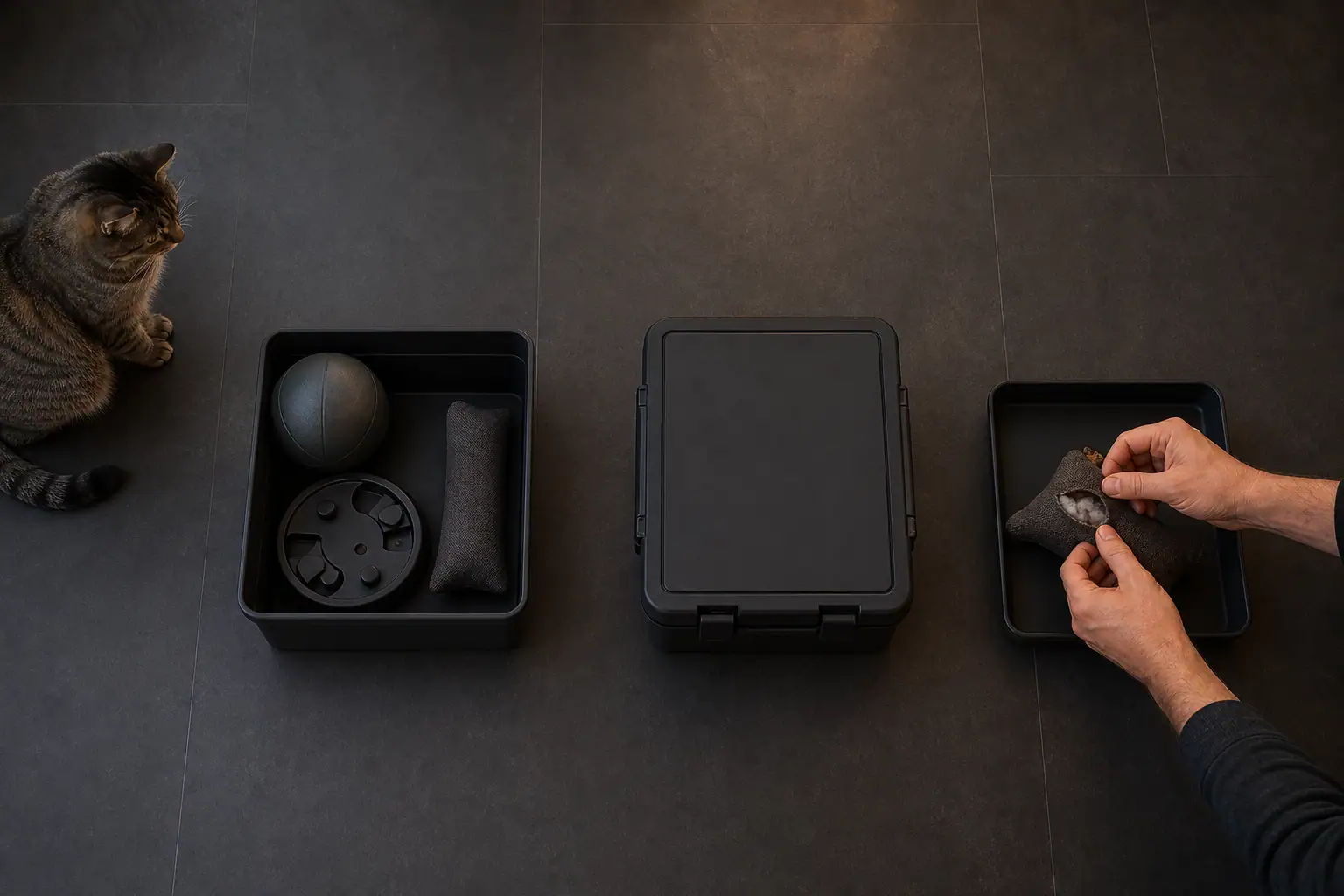
    Store spare heads in a zip-top bag (resealable plastic bag) or a small container, and keep them out of reach. Keeps dust off. Keeps curious paws out.

    Carry a tiny repair kit so you can patch things fast. Include extra crimps, heat-shrink tubing (protective plastic sleeve), and a spare swivel (rotating connector). Toss in a small cutter and pliers if you can.

    Quick on-the-spot repairs: trim the frayed line, slide on a fresh crimp and squeeze it tight, then cover joints with heat-shrink tubing. If the swivel binds, an eyelet wiggles, glue joints fail, or any small parts can detach during handling, retire that head. Don’t risk a choking or cutting hazard.

    For core assembly steps and spec values, see Quick step-by-step (H2).

    DIY Replacement Attachments for Teaser Wands

    - Durable bonding, adhesives, and 3D techniques for replacement attachments.jpg

    We removed this section so you don’t have to hunt through repeating info. The specifics were folded into the matching core sections, so each item now lives where it makes the most sense. Less flipping around for you, and fewer chances your cat will bat a loose part under the couch.

    The four-row table is now in the Tools, parts, and materials for DIY replacement attachments section as a simple "Where to buy / parts at a glance" box. It’s just a quick reference to spot parts fast. Ever tried finding a tiny swivel while a curious kitty inspects your work?

    Storage and repair-kit notes were merged into the Maintenance & Storage paragraph. Tips like labeled containers or zip-top bags, plus a small repair kit with crimps (small metal sleeves used to join wire), heat-shrink (tubing that tightens with heat to protect joints), and pliers, are bundled into general, easy-to-follow advice. Keep things together and you’ll save time when a wand needs a quick fix.

    Buy-versus-make guidance about pre-made heads and quick-change kits moved into the Tools/Parts section under warranty and fit considerations. That way you can weigh convenience against customization without jumping between sections.

    All external product links were consolidated into one Resources / Recommended buys subsection at the end and clearly labeled. We removed those same links from other spots so you won’t click the same thing three times.

    We also dropped the duplicate cross-reference to the Quick step-by-step H2. Existing references remain only in the main Quick step-by-step section, so navigation stays tidy.

    Final Words

    Grab your dowel, tie on a lure, and watch the pounce, this guide gave a short, hands-on how-to: a clear materials list, a 7-step assembly with exact specs, two micro-recipes (feather + bell and pom/mouse), connector choices, bonding and sewing tips, plus maintenance and sourcing notes.

    Materials like a wooden dowel (sturdy stick), fishing line (strong thin cord rated 15–20 lb), and a barrel swivel (rotating connector) were called out.

    Try one quick swap tonight. DIY replacement attachments for teaser wands keep play fresh, your cats engaged, and your living room a little calmer.

    FAQ

    How to make your own cat wand?

    Making your own cat wand uses a wooden dowel (wood stick), 15–20 lb fishing line (thin strong cord), a barrel swivel (rotating connector), a clip or lobster clasp (small clip), and a topper.

    How to attach toy to cat wand?

    Attaching a toy to a cat wand means fastening the fishing line (thin strong cord) to a swivel or lobster clasp (small clip), mount at a dowel hole about 1" from the end, and leave 18–24" of line.

    Are DIY cat toys cheaper to make?

    DIY cat toys are usually cheaper to make when you reuse fabric and basic hardware, though buying quality line and connectors adds safety and lengthens toy life.

    What is the best unbreakable cat wand?

    The best "unbreakable" wand combines a 1/2" wooden dowel (wood stick), 15–20 lb fishing line (thin strong cord), and a metal barrel swivel (rotating connector); no wand is truly indestructible, so supervise play.

    Where can I find DIY replacement attachments for teaser wands on Reddit or online?

    Reddit and cat DIY forums share step-by-step builds and parts lists; search cat and maker communities for posts that list dowel size, line rating, swivel type, and quick-change tips.

    How do I make a DIY feather wand for my cat?

    Making a DIY feather wand uses feather quills anchored to a jingle bell eyelet (small bell with eyelet), wrapped securely, attached to a swivel, and set on an 18–24" line for lively fluttering.

    How do I make DIY ribbon cat toys?

    DIY ribbon cat toys use suede or polyester ribbon (soft fabric) cut into 12–18" strips, tied or sewn into a swivel loop, then trimmed so ribbons flutter but avoid long loose ends.

    What materials do I need for DIY replacement attachments?

    Essential materials are a wooden dowel (wood stick), 15–20 lb fishing line (thin strong cord), barrel swivel (rotating connector), lobster clasp (small clip), jingle bell (small bell with eyelet), crimp beads (small metal clamps), and heat-shrink tubing.

    Related Articles

  • what materials make cat toys unbreakable and safe

    what materials make cat toys unbreakable and safe

    Sick of buying so-called indestructible cat toys that your tabby turns into confetti overnight? Here’s the short, honest version: the right materials really matter. Food-grade silicone (soft, non-toxic rubber-like polymer) and UHMWPE (ultra-tough, cut-resistant plastic) make toys both safe and way harder to shred. I’ll show you which materials actually stand up to teeth and claws, why they work, and what to watch for when you’re shopping or DIYing.

    Food-grade silicone feels soft and bouncy, so your cat loves the texture and it won’t splinter. It’s non-toxic (meaning it won’t poison your cat if chewed) and it’s easy to clean, which is perfect for slobbery play. Think of the satisfying thud of a silicone ball rolling across the floor, your cat’s whiskers will twitch.

    UHMWPE is the stuff made for real abuse. It’s a dense, slice-resistant plastic often used in cut-proof gloves and gear. Toys built with UHMWPE handles or cores shrug off claws and teeth. They don’t fray or shred like cheap fabric, so fewer fluff explosions on the carpet.

    Also look for reinforced fabrics like Cordura or ballistic nylon (heavy-duty nylon fabric) on scratchy toys. Double-stitched seams and hidden reinforcements help keep stuffing inside and tiny parts out. Avoid toys with glued-on eyes or loose ribbons that can come off during a pounce.

    When you shop or make your own, check a few things: is the silicone labeled food-grade? Are seams reinforced and not just glued? Any small bits that could be swallowed should be stitched down or skipped. Smell-test plastics, if it smells chemical, leave it. And always supervise new toys until you know they’re safe.

    Quick tips: toss an unbreakable ball before you head out for ten minutes of safe solo play. Rotate toys every few days so your cat stays interested. And if you DIY, think like a cat – soft where they bite, tough where they grip.

    Worth every paw-print.

    what materials make cat toys unbreakable and safe

    - Quick answer top chewresistant materials and a clear inspection warning.jpg

    Here’s a friendly rundown of the materials that actually help toys stand up to teeth and claws, written like a cat‑crazy pal telling you what worked in my living room. Short definitions in parentheses so you know what each thing really is.

    • Food-grade / medical-grade silicone (flexible, non-toxic rubber-like polymer, think soft rubber spatula). Great balance of chew resistance and safety, and it’s easy to clean.
    • UHMWPE (ultra-high-molecular-weight polyethylene, a very tough, cut-resistant plastic) , top pick for resisting teeth and claws, especially as a hidden core.
    • Stainless steel hardware (stainless steel, a metal that won’t rust). Best for connectors and split rings that need to hold under a strong pull.
    • Natural rubber (plant-based, bouncy, like latex but from natural sources). Good for treat dispensers and chewers who like a soft bite.
    • Polycarbonate / ABS (hard impact plastics, strong but can shatter under extreme force). Used for housings and rigid shells.
    • Kevlar / Dyneema (high-strength fibers like climbing rope, used in safety gear). Ideal to reinforce seams or make rope cores that won’t snap.
    • Ballistic nylon / Cordura (heavy-duty, abrasion-resistant fabric). Resists tearing from claws, great for outer covers.
    • Hardwoods (beech, maple; untreated solid wood that wears safely). Works for chew posts that are biodegradable and sturdy.
    • Braided polyester / rope exteriors (woven synthetic rope that acts as a sacrificial layer). These take the wear so the inner core lasts longer.
    • TPE / TPU (flexible, durable elastomers, rubber-like plastics that bounce back). Good for parts that need to flex and recover from bites.

    Safety note: even the toughest materials can shed bits or carry unsafe coatings, so pick labeled non-toxic grades for anything cats will lick or chew. Inspect toys at least once a week and after rough play, and retire anything with holes, sharp edges, or loose bits.

    Quick pros and cons, so you can pick what fits your cat’s play style:

    • Food-grade silicone , pro: non-toxic and soft; con: can tear if a cat fixes on one spot.
    • UHMWPE , pro: superb cut resistance; con: pretty stiff, not for kitties who prefer squishy toys.
    • Stainless steel , pro: won’t rust, very strong; con: can be heavy in tiny pieces.
    • Natural rubber , pro: stretchy and satisfying to chew; con: some cats still manage to chew through over time.
    • Polycarbonate / ABS , pro: handles impact well; con: can crack and form sharp shards if it fails.
    • Kevlar / Dyneema , pro: seams and ropes stay strong; con: exposed fiber ends need to be sealed so they don’t fray.
    • Ballistic nylon / Cordura , pro: stands up to claws; con: sewn seams are common weak spots.
    • Hardwoods , pro: safe, natural chew surface; con: they’ll wear down and need replacement eventually.
    • Braided polyester rope , pro: sacrificial, easy to replace; con: may fray into small strands you should monitor.
    • TPE / TPU , pro: great rebound and flexible; con: not as cut-resistant as UHMWPE.

    Durability is a trade-off: ultra-tough plastics and fibers can become sharp when they fail, while softer elastomers are gentler in the mouth but wear out faster. So aim for smart design: a permanent strong core (metal or UHMWPE) plus replaceable, sacrificial outer layers (rope covers, braided sleeves, feather attachments). That way you keep the toy long-term without raising the risk of swallowed bits.

    Tiny tip from my house: my tabby tore through a rope cover in a week, but the inner UHMWPE core stayed fine , replacing the cover made the toy claw-tastic again. Worth checking seams and sealed fiber ends, and if you spot fuzz or loose threads, toss or repair it.

    Polymers and rubbers: food‑grade silicone, TPE/TPU, natural rubber, ABS and polycarbonate (with a Plastics & Polyethylenes subsection)

    - Polymers and rubbers foodgrade silicone, TPETPU, natural rubber, ABS and polycarbonate (with a Plastics  Polyethylenes subsection).jpg

    Food-grade silicone (a soft, heat-stable rubber-like polymer, like a kitchen spatula) and TPE/TPU (thermoplastic elastomers, flexible plastics that snap back like a rubber band) are the safest picks when a toy might touch a cat’s mouth. Go for items labeled food or medical grade so you avoid strange additives. Check for tear resistance and Shore hardness (a simple scale for how firm something feels) so the toy is squishy enough to enjoy but strong enough to last. They’re gentle on gums, and if they wear out they tend to fail without spraying sharp shards – nice for nervous owners and playful kitties.

    Natural rubber (plant-based elastic, think the bouncy core of a chew toy) works wonders in treat dispensers and dental chewers. It cushions teeth and springs back after gnawing, keeping cats engaged longer. It usually beats cheap latex blends for tear resistance, but heavy chewers will still wear it down over time. Look for molded, seam-free shapes and sealed edges so teeth can’t pry layers apart.

    Hard plastics like ABS and polycarbonate give you tough shells and housings that stand up to impacts. The downside is repeated, focused bites can crack them and create sharp pieces. One-piece molding or welded seams reduce failures that start at joins, and thicker walls make brittle breaks less likely. For toys with moving parts or motors, pick structural plastics with good impact ratings and rounded edges so a broken bit is less likely to hurt a paw or mouth.

    Selection checkpoints for polymers and rubbers:

    • Clear material grade labeling, like food grade or medical grade.
    • Tear-resistance or tensile strength info when available (how hard it is to rip).
    • Shore hardness listed, so you can match squishiness to your cat.
    • One-piece molding or fused seams, not glued layers.
    • Explicit polymer ID, for example UHMWPE, polycarbonate, or silicone.

    Plastics & Polyethylenes (HDPE, UHMWPE, ABS, polycarbonate)

    HDPE (high-density polyethylene, like sturdy milk jugs) is stiff and durable, good for molded parts that need a bit of give without sharp edges. UHMWPE (ultra-high-molecular-weight polyethylene, almost cut-proof, imagine a super-tough rope core) resists abrasion and tooth cuts far better than generic plastics and makes great hidden cores or reinforcement.

    Polycarbonate and ABS handle blunt hits well, but they can crack under sharp, repeated bites. For outdoor or high-stress parts, favor thicker walls and single-piece construction so any failure is slow and obvious. UV resistance matters for outdoor toys, and if recycled materials are used you’ll want to know what fraction and whether additives could affect safety.

    Hard-plastic evaluation checkpoints:

    • Clear polymer ID: UHMWPE versus generic plastic.
    • Minimum wall thickness guidance – avoid thin shells under about 3 mm for small parts.
    • One-piece construction or welded seams, not glued joins.
    • UV resistance rating for outdoor use.
    • Disclosure of recycled content and any impact on safety.

    A quick, practical tip: toss an unbreakable silicone ball on the floor before you head out and check it after play. If it shows tiny tears, swap it. Your cat will purr, and you’ll sleep easier.

    Metals, hardware and connectors: rust‑proof options

    - Metals, hardware and connectors rustproof options (concise callout).jpg

    Pick corrosion-resistant alloys for anything your cat will tug, chew, or lick. Marine-grade 316 stainless (stainless steel that handles wet or salty conditions) is a great all-around choice , strong, rust-friendly, and proven in damp spots. Titanium (a light, very strong metal) and anodized aluminum (aluminum treated to be harder and more corrosion-resistant) give similar strength but weigh a lot less, so they’re handy when a heavy ring or clip would flop a small toy down.

    Coatings help for sure, but think about wear. Plated finishes can rub off where a cat bites or where parts grind together, and then you’re left with exposed metal. For outdoor or water-prone toys, go for higher-grade metals and closed, mechanically fastened joints instead of relying on paint or thin plating. Welded joins (metals melted together) or riveted joints (metal pins holding pieces) last longer than open split rings or glued parts. Long-lasting. Safe.

    • Use 316 stainless or another rated rust-proof alloy for connectors that need to last.
    • Consider titanium or anodized aluminum for weight-sensitive parts like clips or small cores.
    • Check for solidly closed rings, welded joins, or riveted joints rather than open or split hardware.

    Worth every paw-print.

    what materials make cat toys unbreakable and safe

    - Fabrics and reinforced textiles ballistic nylon, Cordura, Kevlar, Dyneema and stitch techniques for longlasting plush toys.jpg

    Textiles are the secret sauce for toys that survive claws. Heavy-duty fabrics like ballistic nylon (thick, tightly woven nylon often used in luggage) and Cordura (a tough nylon weave made to resist wear) take the first hits and usually shrug them off. Add laminated layers or glued backing so the fabric won’t split where stitching wears thin. Think of the outer cover like armor protecting a tougher inner core, so you swap covers, not the whole toy. Cute, right?

    Reinforcement is where design beats raw strength. Double-stitching and bartacks (short, dense stitches that lock a stress point) stop seams from peeling. Heat-sealing or ultrasonic welding (melting plastic fibers together with high-frequency vibration) closes needle holes that invite rips. For ropes and braids, bury the fiber ends in a sewn channel or melt-and-bind them so strands don’t splay into little bits your cat could swallow. Ever watched your kitty pick at a frayed rope? Yeah, we don’t want that.

    Real-world toys mix a tough shell with a replaceable center. A zippered plush can hide a hard UHMWPE core (ultra-high molecular weight polyethylene – a very tough plastic) so you can swap the outer when it’s worn. Some rope toys let the braid peel off and be re-wrapped. Others tuck a thin Kevlar (very strong synthetic fiber) liner inside seams, then fully cover it so no raw fibers are exposed. These choices boost toy life without changing play. Worth every paw-print.

    • Ballistic nylon – double-stitch and add bartacks at stress points.
    • Cordura – box-stitch load areas and overlock raw edges.
    • Kevlar-lined fabric – fully encapsulate the liner and use a zigzag stitch.
    • Dyneema braid (super-strong polyethylene fiber) – heat-seal ends and sew into channels.
    • Braided polyester rope – secure with metal ferrules and stitched caps.
    • Laminated canvas – fusion-bond seams or welded edges.
    • Faux fur with reinforced backing – topstitch plus an inner fabric layer.
    Fabric Strength Recommended Reinforcement
    Ballistic nylon High abrasion resistance Double-stitching and bartacks
    Cordura Good tear and wear resistance Overlocked edges and box stitching
    Kevlar-lined Very high cut resistance Fully encapsulated liner and zigzag stitch
    Dyneema braid Exceptional tensile and cut strength Heat-sealed ends and sewn channels

    When to use fiber-reinforced composites in toys

    Only use Kevlar or Dyneema inside when those strong fibers are fully covered so no ends can poke out. Trim and bind cut ends, and place reinforcement away from seams or areas a cat will chew. This works best as inner cores, rope cores, or stitched panels where the outer fabric stays intact; don’t leave raw fiber edges near a chewing spot. Oops, sounds strict, but safety first, right?

    what materials make cat toys unbreakable and safe

    - Natural materials sisal, jute, hardwoods (beech, maple, bamboo), cork  pros, cons and safety.jpg

    Natural materials give toys texture, scent, and a comfy chew that many cats go crazy for. Think rough sisal (coarse agave fiber), soft-but-grabby jute (plant fiber with a bit of give), crinkly cardboard (layers of pressed paper), springy cork (bark-like, spongy material), and untreated hardwoods like beech or maple (dense, steady woods). Bamboo is great too, it’s a fast-growing grass with strong fibers and a light feel. Ever watch your kitty tilt their head at a rustling box? That kind of simple joy.

    If your toy will be gnawed, pick untreated beech, maple, or bamboo. They wear in a predictable way and are biodegradable. Avoid painted, stained, or pressure-treated wood because coatings can flake and end up in your cat’s mouth. For scratching, sisal and cork mimic tree bark and feel natural on claws, so they’re a smart choice.

    Natural stuff looks and smells great, but it wears faster than heavy-duty synthetics, so plan to rotate toys and replace outer layers now and then. Jute and sisal will fray into strands, so check them often. Cardboard and paper are cheap and compostable but tear quickly. Bamboo and hardwood resist splitting if they’re dry and well sanded, but they’ll still wear out over time. Check fraying on jute and sisal and inspect regularly per the inspection schedule in the opening section, and retire anything with loose bits or splinters to keep play safe.

    • Sisal (coarse agave fiber) – durable for scratching, coarse texture, biodegradable; can fray into strands.
    • Jute (soft plant fiber) – gentler on paws, good grip, biodegradable; higher risk of fraying.
    • Cork (bark-like, spongy material) – gentle and grippy, resists moisture, low dust; wears moderately.
    • Cardboard (pressed paper layers) – rustles and cheap to replace, very biodegradable; tears fast.
    • Untreated hardwood (beech, maple) – dense and long-lasting for chewing, safe if unfinished; replace when splintered.
    • Bamboo (fast-growing grass with strong fibers) – strong and light, renewable, smooth when sanded; thin pieces can split.

    Rotate toys, watch for loose threads or splinters, and swap anything tired or damaged. Your cat stays entertained and you stay relaxed. Worth every paw-print.

    Design & manufacturing techniques that make toys last: one‑piece molding, fasteners, and replaceable modules

    - Design  manufacturing techniques that make toys last onepiece molding, fasteners, and replaceable modules.jpg

    Good, long‑lasting toys start with smart molding and tidy joins. Injection molding (molten plastic forced into a shaped cavity) and one‑piece molding (a single solid part with no seams) cut out seam failures. Ultrasonic welding (fuses plastics with high‑frequency vibration) makes a neat welded bead that usually beats glued seams. Ever watch a toy fall apart at the seam? Yeah, not fun.

    Replaceable modules mean the toy’s heart keeps working even after an outer cover gets chewed up. Swap the worn bits, not the whole thing. See the Polymers and Textiles sections for the deep dive if you want the geeky stuff.

    Hardware is where wear shows up fastest. Closed or welded rings handle tugs better than open split rings. Countersunk stainless fasteners (stainless steel screws or bolts set flush with the surface) sit flat so paws and teeth don’t snag. A ferrule or crimp (a tiny metal sleeve crushed around cable) makes a very strong loop when done right; cover that crimp with heat‑shrink (a thin plastic tube that tightens with heat) and a tape wrap so the metal edge can’t rub through an outer sleeve. Quick how‑to: crimp the ferrule, slide heat‑shrink on, shrink it with a heat gun, then wrap tape.

    • Look for closed or welded rings, not open gaps.
    • Prefer countersunk stainless fasteners so nothing sticks up to bite.
    • Choose welded beads over glued seams for plastic joins.
    • Verify ferrules are well‑crimped and covered with heat‑shrink or protective tubing.
    • Joints with an extra tape or sleeve are less likely to abrade an outer cover.
    • Pick toys with replaceable attachment points and clearly visible fastener types.
    Technique Why it adds durability What to check as a buyer
    Injection molding (molten plastic forced into a shaped cavity) Consistent wall thickness and strong, repeatable parts Even wall thickness; rounded corners; see Polymers section
    One‑piece molding (single solid part, no seams) No seams to peel or open under stress Single‑part construction, no glued joins
    Ultrasonic welding (fuses plastics with high‑frequency vibration) Seamless welded bead that resists opening Visible welded bead, not a glued seam
    Reinforced seams (extra stitching / bartacks) Stops stitches from tearing out at load points Double stitching and bartacks at stress spots; see Textiles section
    Rivets / snap‑fits (mechanical joins) Holds under pull without backing out Flush rivets, closed rings, or positive snap clicks; avoid tiny exposed screws
    Replaceable components (swap worn parts) Extends life by replacing sacrificial bits Visible fasteners, serviceable parts, and spare‑part availability

    When you’re shopping, flip the toy over and hunt down the joins and fasteners. If things are hidden behind glue or thin shells, put it back and try another , your cat will thank you. Worth every paw‑print.

    Safety, Cleaning, Testing & Retirement

    - Safety, Cleaning, Testing  Retirement.jpg

    Make toy checks a habit, like feeding time. Give each toy a quick once-over before and after play: look at seams, feel for soft spots, and try a gentle grab or pull where it makes sense. For big tug toys, use a 15-lb pull as a rough guide so you know what the connectors can handle. Simulate chewing at likely weak points , seams, glued joints, ferrules (small metal sleeves that join parts) , to catch trouble early. Inspect toys at least once a week and after rough play; retire anything with holes, exposed hardware, loose stitching, or a new, sour smell.

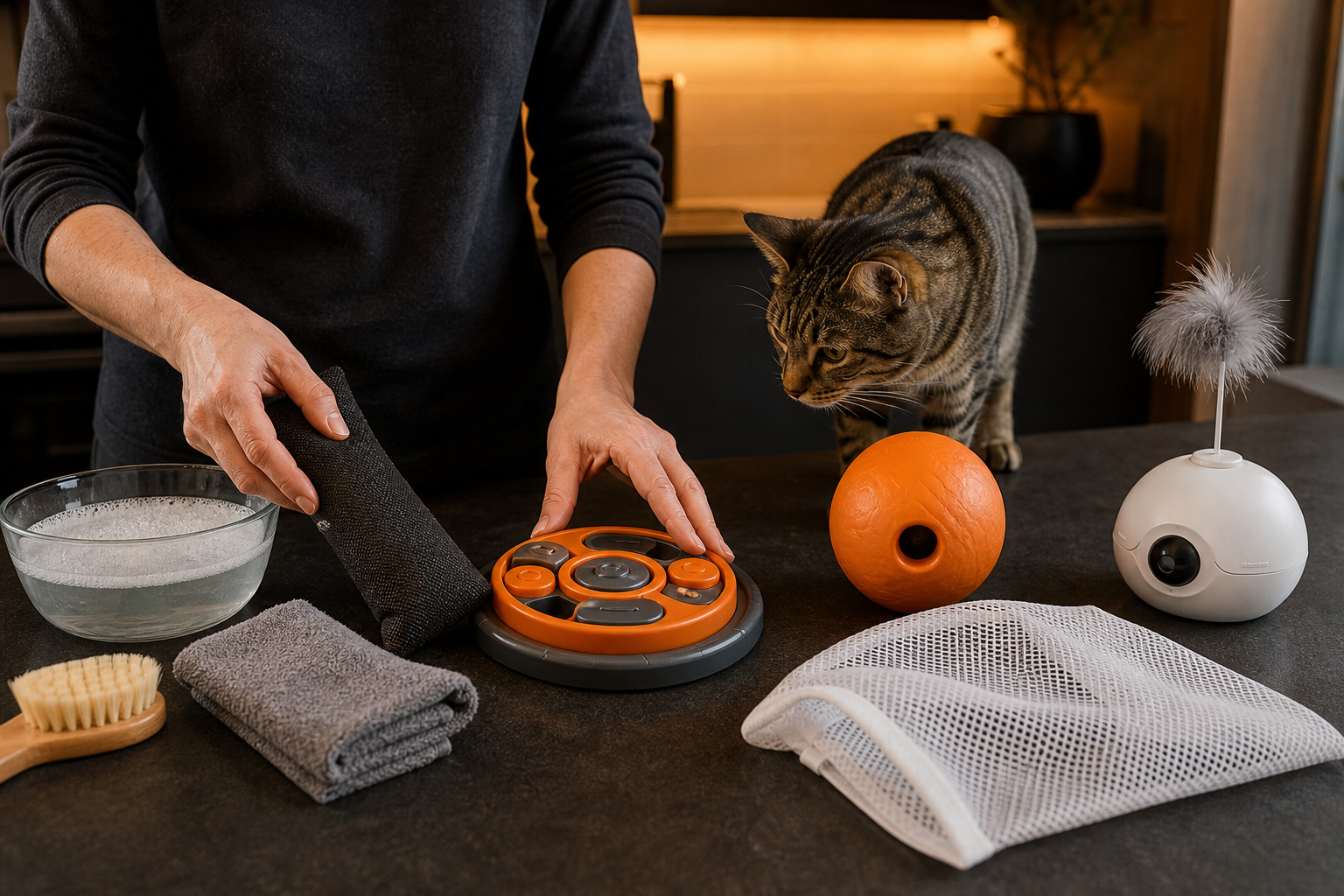
    Cleaning depends on what the toy is made of. Food/medical-grade silicone (silicone safe for food or medical use) and HDPE (high-density polyethylene – tough plastic like a cutting board) parts with dishwasher-safe labels usually do fine on the top rack. Fabrics do best on a gentle machine wash with mild, fragrance-free detergent. Battery packs, motors, or electronics should never be submerged; wipe the housings and follow the maker’s steps for removing powered modules before washing. Use cleaners that won’t leave residues your cat might lick, and let things dry fully before giving them back to your furball.

    When it’s time to retire a toy, be quick about it. Bag any small ripped pieces so they don’t become choking or gut hazards, and try to separate recyclable metal bits from soft waste. Natural bits like untreated wood or plain cardboard can go to compost if they’re free of glue and coatings. Sealed, sharp, or contaminated parts go in the trash inside a closed bag.

    Worth every paw-print when done right.

    1. Visual seam check – look for pulled threads, gaps, or holes.
    2. Grab/pull test – use a 15-lb reference for larger toys to test connectors.
    3. Hardware flex test – wiggle rings, clips, and ferrules (metal sleeves) for looseness.
    4. Smell check – any new chemical or sour odor means retire it.
    5. Washability check – confirm manufacturer laundry or dishwasher guidance.
    6. Motor and moving-part integrity – verify housings, battery doors, and covers.
    7. Replaceable-part test – make sure snaps, zippers, or covers swap cleanly.
    8. Retire if any small pieces, sharp edges, or splinters appear; don’t risk it.

    DIY unbreakable toy plans, parts list, costs and step sequence (tested wand build)

    - DIY unbreakable toy plans, parts list, costs and step sequence (tested wand build).jpg

    Here’s a simple, low-cost wand that stood up to a 15 lb cat. It uses a 48" fiberglass driveway marker rod (fiberglass, like a strong fishing-rod core) and a short length of vinyl-coated cable for the tension. It’s cheap, easy to make, and way more durable than the flimsy store wands, perfect for cats that love a rough-and-tumble session. Ever watched your kitty leap and clutch a toy like it’s the final boss? This helps with that.

    Parts and rough costs:

    • 48" fiberglass rod , about $2.50.
    • 48" of 1/16" vinyl-coated cable (1/16" vinyl-coated steel) , about $1.20. (Vinyl coating keeps the cable smooth.)
    • Two 1/16" ferrules , about $1.24 total. (Ferrules are tiny metal sleeves you crimp to lock cable loops.)
    • 1.5" split key ring , about $0.50.
    • Feather attachments , $2 to $3 each, or swap in other toys.
    • Optional: heat shrink / electrical tape , small extra cost.
      Total for one wand: just a few dollars. You can make two or three for the price of one cheap toy from the pet store.

    Tools and time:
    You’ll need a drill with a 3/32" bit, wire strippers, something to crimp with (vise, hammer, or swaging tool), and a heat source for shrink tubing (heat gun or lighter). Assembly takes about 15 minutes once you’ve got everything. A hammer crimp works fine if you don’t have a swaging tool. Quick and satisfying.

    Safety first:
    Drill the hole about 1/4" from the rod end so the loop clears the tip. Make a solid ferrule crimp and cover any exposed metal with tape and heat shrink (heat shrink is a thin plastic sleeve that tightens when heated). Inspect the wand weekly and after rough play; retire it if you see frays, exposed metal, splits, or anything loose. You want playtime to be fun, not risky.

    Step-by-step assembly:

    1. Mark a spot about 1/4" from the rod tip.
    2. Drill a hole at that mark using a 3/32" bit. Keep it steady.
    3. Cut a 48" length of 1/16" vinyl-coated cable.
    4. Thread one cable end through a ferrule, then through the drilled hole, and back into the ferrule to form a loop.
    5. Slide the ferrule so the loop sits snug against the rod end.
    6. Add the second ferrule over the two cable runs at the loop base for extra strength , stacked ferrules are fine.
    7. Crimp the ferrule(s) firmly so they compress onto the cable. Use a vise or hammer with even blows.
    8. Attach the 1.5" split key ring to the loop. Check that the split fully wraps around so it won’t slip open.
    9. Wrap the crimped area with electrical tape, then slide on heat shrink and shrink it down with heat to smooth edges.
    10. Give the joint a firm tug (try to match a 15 lb pull if you can), then add a feather toy and test with light play.

    Optional upgrades and tweaks:

    • Use a longer heat-shrink sleeve for fuller protection.
    • Add a soft ferrule cover (rubber sleeve) over the crimp for padding.
    • Swap the split ring for a rounded, welded ring to remove gaps.
    • Upgrade to 316 stainless hardware for rust resistance.
    • Use quick-release clips for truly replaceable feather attachments.
    • Wrap extra tape under the shrink for extra abrasion padding.

    Worth every paw-print.
    Oops, let me rephrase that , it’s worth every paw-print. Really. Watch your cat’s whiskers twitch as the toy skitters across the floor. You’ll get durability, easy repairs, and plenty of claw-tastic fun.

    Quick buyer checklist

    - Buying guide and checklist selecting durable cat toys, consolidated brand notes, certifications and warranty cues.jpg

    Keep this checklist in your pocket when you shop. It’s short, practical, and made for quick checks at the shelf so you skip marketing fluff and spot toys that actually last. Ever watched your cat destroy a flimsy toy in three minutes? Yeah, this helps avoid that.

    See the Polymer, Textile, Hardware, and DIY sections below for full details on material grades, seam methods, and where to source raw cores and hardware.

    • Material type and grade label: look for food- or medical-grade silicone (safe for mouth contact), named polymers like UHMWPE (ultra-high-molecular-weight polyethylene, a very tough plastic used in cut-resistant gear) or polycarbonate (shatter-resistant plastic). Those labels matter more than cute photos.
    • One-piece construction or welded seams: one-piece molding (a single molded part) or seams fused by welding (heat or ultrasonic fusing, not glued). If it’s glued, think twice.
    • Reinforced stress points: bartacks (extra stitching at high-stress spots), ultrasonic weld beads, or clearly doubled layers where the toy gets tugged the most. Those reinforcements keep things from falling apart mid-play.
    • Clear cleaning instructions: a washable label that says machine-washable, surface-clean only, or dishwasher-safe. Knowing how to clean a toy makes it last and keeps your cat healthy.
    • Hardware type: 316 stainless (marine-grade stainless steel) or closed/welded rings and rivets (rivets are metal fasteners). Avoid open split rings that can pop off during rough play.
    • Replaceable parts: zipper or snap access to cores or modules so you can swap worn pieces, or a company that sells spare parts. Simple repairs beat throwing a whole toy away.
    • Warranty: a clear time period and exact coverage plus easy claim steps. Read what counts as normal wear versus a defect.
    • Returns and satisfaction guarantee: stated number of days and straightforward return steps so you’re not stuck with a dud.
    • Visible maker label: an obvious manufacturer or brand name so you can contact support if something fails.

    Higher-priced toys can last longer, but read the materials and warranty fine print so you’re paying for real durability and not just shiny marketing.

    Worth every paw-print.

    Final Words

    Right in the action: you’ve got the short picks, food/medical‑grade silicone, UHMWPE, stainless steel hardware, natural rubber, polycarbonate/ABS, Kevlar/Dyneema, ballistic nylon and hardwoods, and a clear inspection rule to keep play safe.

    Play smart. Inspect at least once weekly and after heavy play; retire if any damage. Soft non‑toxic elastomers feel gentle but wear differently than rigid plastics, and sacrificial outer layers save the core.

    If you’re asking what materials make cat toys unbreakable, this list is your quick guide, happy, active cats and fewer replacements. Worth every paw‑print.

    FAQ

    What materials make cat toys unbreakable or the best for cat toys?

    Materials that make cat toys highly chew resistant include food-grade silicone (safe flexible rubber), UHMWPE (super cut-resistant plastic), natural rubber (elastic chew material), polycarbonate/ABS (tough hard plastics), Kevlar/Dyneema (high-strength fibers), ballistic nylon, and hardwoods.

    What materials are unsafe for cat toys?

    Unsafe toy materials include treated or painted woods, soft PVC with phthalates, thin brittle plastics that can crack, small detachable parts, fabrics that shed tiny fibers, and metal plating that flakes.

    What is the cat wand that won’t break?

    A wand that won’t break uses a fiberglass rod (like a strong fishing-rod core), vinyl-coated cable, crimped ferrule covered with heat-shrink, and a closed ring or welded loop for secure attachments.

    How can I stop my cat from tearing up everything?

    You stop a cat from tearing up items by offering durable toys, rotating playthings, supervising rough sessions, using replaceable outer layers, redirecting chewing to safe chews, and retiring damaged toys promptly.

    Are KONG and Yeowww cat toys durable, and what do you put in a Kitty KONG?

    KONG Kitty products are durable treat dispensers filled with soft treats, wet food, or paste-like fillings; Yeowww toys are dense cotton catnip pouches, sturdy but still needing regular inspection.

    What metals and connectors are best for toy hardware?

    The best hardware uses 316 stainless steel (rust-proof alloy) or titanium for strength; choose closed rings, rivets or welded joints, and covered ferrules to avoid loosening or sharp edges.

    How often should I inspect cat toys and when should I retire them?

    Inspect toys at least once weekly and after heavy play; retire any toy with punctures, exposed hardware, loose stitching, fraying that produces small pieces, or a changed smell or texture.

    Related Articles

  • Top Unbreakable Cat Toys for Aggressive Chewers

    Top Unbreakable Cat Toys for Aggressive Chewers

    Think your cat can chew through anything? Most so-called indestructible toys give up in a week. If you’re tired of stuffing strewn everywhere and toys that vanish or fall apart, you’re not alone.

    Here’s the short truth. Molded natural rubber (bouncy, tough rubber that flexes under pressure but snaps back) really holds up. Molded silicone (soft, flexible plastic, like a chewy teether) is gentle on kitten gums and stubborn against teeth. Ballistic nylon (super-strong woven fabric, like the stuff heavy-duty backpacks use) stands up to the claws and chomps of hardcore chewers.

    This list points you to real unbreakable cat toys that survive aggressive chewers, soothe teething kittens, and save you money. You’ll get quick picks, safety tips, and real-life testing notes so you don’t buy another dud. Worth every paw-print.

    Quick Buyers’ Guide: Fast Picks for Tough Chewers and Kittens

    - Quick Buyers Guide Fast Picks for Tough Chewers and Kittens.jpg

    TL;DR: For heavy chewers, choose molded rubber or Kong-style toys. For kittens, pick soft teething-core toys (soft center for sore gums). These are the go-to unbreakable cat toys for strong jaws and tiny mouths.

    • Materials: Look for molded natural rubber (bouncy, tough rubber), molded silicone (soft, flexible plastic), or ballistic nylon (super-strong woven fabric). These materials stand up to serious chewing , see Materials and Construction.
    • Size and safety: Match the toy size to your cat’s mouth and weight so it won’t be a choke risk. Safety matters more than shiny features , see Safety, Size & Supervision.
    • Play style: If your cat likes to gnaw, grab chew-resistant bits. If they chase, pick rolling treat dispensers. Toys that match play style last way longer.
    • Age and teething: Kittens need softer teething-core toys (soft foam or fabric center) to soothe gums. Adult cats do better with tougher molded pieces. This helps you choose unbreakable toys for every life stage.
    • Cleaning and washability: Prefer dishwasher-safe molded parts or wipeable silicone so smells don’t build up. Easy cleanup keeps toys healthy , see Cleaning/Warranty.
    • Warranty and returns: Check for explicit chew coverage and replacement rules. A clear chew clause can save you grief.
    • Price and lifespan: Think about upfront cost versus months of use. Factor how often you’ll replace a toy into the value math , see Budget vs Premium.

    Price tiers and typical lifespans:

    • Budget (under $20): Often lasts 3 to 6 months with heavy chewers; cheap but you’ll buy more.
    • Mid ($20 to $60): Commonly lasts 12 to 24 months with normal play and repair options.
    • Premium (above $60): Expect 24 to 48+ months, often with better warranty and replaceable parts , see Budget vs Premium.
    Criterion Quick pick Where to read more
    Materials Molded rubber / Kong-style (molded natural rubber or silicone) see Materials and Construction
    Size Match toy diameter to mouth/gape see Safety, Size & Supervision
    Cleaning Dishwasher-safe molded pieces or wipeable silicone see Cleaning/Warranty
    Warranty Explicit chew coverage / replacement policy see Cleaning/Warranty and Budget vs Premium

    Worth every paw-print. Ever watched your kitty go to town on a toy and thought, wow, I need a tougher one? Start here, and you’ll save money and sanity.

    Top‑Rated Unbreakable Cat Toys by Type (Field‑Tested Categories , pointers to reviews)

    - TopRated Unbreakable Cat Toys by Type (FieldTested Categories  pointers to reviews).jpg

    Here’s a quick, friendly map to the toys we field-tested so you can hop straight to the reviews and lab data for tough-as-nails cat playthings. Think of it like a cheat sheet, short, useful, and made for busy cat people. Ever watched your kitty pounce and thought, “I need that thing to survive the next five lives”? This helps.

    • Treat dispenser , PetSafe SlimCat: Great for slow feeding. See the SlimCat review for load capacity and the adjustable openings, plus Durability Testing where we simulated bites and rolling across carpet to see how it holds up.

    • Molded rubber chew , Kitty Kong / Kong treat dispensers: We looked at rubber (durable, bouncy material) versus silicone (soft, rubber-like plastic) and how each stands up to gnawing. Check Materials and Construction for the tradeoffs and Durability Testing for chew survival results.

    • Heavy-duty wand , Repounce Forever Stick: Built for cats that go full ninja. See Top-Rated review notes and Durability Testing focused on flex (how much it bends) and attachment wear where toys get swung and flung hard.

    • Track toy , three-track and single-ring designs: Perfect for batting and stalking sessions. See Top-Rated reviews and Durability Testing for abrasion and slip tests, basically how well the balls keep spinning without popping out.

    • Rechargeable chase ball , LED rolling balls with tails: Fun for evening zoomies, especially with a glowing tail. See Durability Testing for runtime claims (reviewer note: some report about 2-hour play) and Materials for battery safety (battery = rechargeable lithium battery; we tested for safe charging and heat).

    • Magnetic glider , levitating feather popper: A sneaky hover-and-pop toy that keeps kitties guessing. See Top-Rated review pointers and Durability Testing for magnet retention (how well magnets stay in place) and repeated pop cycles.

    • Rope wrestling mouse , giant rope mouse: Built for wrestle sessions and tugging. See Materials and Construction for rope abrasion numbers and Safety, Size & Supervision tips so you know when to step in during rough play.

    • Dental chew , anti-unravel dental toys: For the chewers who also need a bit of teeth love. See Materials and Construction and Durability Testing for anti-unravel fabrics and dental wear metrics.

    Toy Type Example Review/Test Primary test referenced
    Treat dispenser PetSafe SlimCat review & test Durability Testing (dispense/load)
    Molded rubber chew Kitty Kong / Kong treat dispensers Materials and Construction (rubber vs silicone)
    Heavy-duty wand Repounce Forever Stick review Durability Testing (flex & attachment)
    Track toy Three-track toy review Durability Testing (abrasion & slip)
    Rechargeable chase ball Rechargeable rolling ball test Durability Testing (runtime & impact)
    Magnetic glider Levitating feather glider test Durability Testing (magnet retention)
    Rope wrestling mouse Giant rope mouse review Materials and Construction (rope abrasion)
    Dental chew Anti-unravel dental toy test Durability Testing (anti-unravel & dental wear)

    Materials and Construction: Full Technical Pros/Cons, Test Data, and Tradeoffs

    - Materials and Construction Full Technical ProsCons, Test Data, and Tradeoffs.jpg

    Pick toy materials like your cat picks a nap spot: by feel, weight, and how well it survives a pounce. Think non toxic, tough stuff that stands up to teeth and claws but is safe if your cat gives it a lick. Look at seams, cores, and balance. Seams and exposed cores are where even the so called indestructible toys usually give up. Ever watched whiskers twitch as a toy rolls away? That little drama tells you a lot about weight and balance.

    Tests show clear trade offs. A molded natural rubber (bouncy elastic material) will survive bite forces longer than a sewn plush, but when a seam fails the plush unravels fast. Ballistic nylon (dense woven nylon, like tough luggage fabric) resists abrasion but can fuzz and fray under heavy tugging. Heavy rigid cores roll truer and resist crushing, but they can put extra stress on a cat s teeth if the cat clamps down. Replaceable bits and cardboard centers are easy to fix. Molded cores usually mean you replace the whole toy. See Durability Testing for methods and Safety, Size & Supervision for sizing guidance. Cleaning/Warranty covers repair hacks and manufacturer claims.

    1. Natural rubber (molded rubber chew toys for cats)
      Pros – high bite resistance and bounce. Cons – very rigid pieces can transfer force to teeth. Key metric – typical lab tensile strength about 15 to 25 MPa (a measure of how much pull the material handles). Tear resistance holds up for many aggressive chewers. Repairability – low; parts usually not replaceable.

    2. Molded silicone (soft, flexible plastic batting toys)
      Pros – softer than natural rubber, non porous and easy to clean. Cons – softer surface shows teeth marks sooner. Key metric – reviewers found silicone has about 20 to 40 percent less tear growth than fabric in puncture tests. Repairability – moderate; you can use surface patches or food grade sealant.

    3. Nylon / ballistic textile (nylon gnaw toys)
      Pros – excellent abrasion resistance and seam strength. Cons – can fray where chewing is focused. Key metric – abrasion resistance around 150 to 400 hours in reviewer trials; it outlasted plain cloth by months in heavy chewer tests. Repairability – high; restitching or epoxy patches work well.

    4. Cotton twill with reinforced core (reinforced plush)
      Pros – a cat friendly texture, great for wrestling and pouncing. Cons – seams are the weak point. Key metric – seam pull force roughly 50 to 120 N with reinforced stitching in reviewer tests. Repairability – high; reinforce stitches or swap the core.

    5. Recycled plastics for tracks (track toys and rolling dispensers)
      Pros – rigid, low friction, some are dishwasher safe. Cons – brittle plastics can crack from repeated impact. Key metric – some samples reached about 10,000 impact cycles before cracking (manufacturer claims vary and reviewers often saw fewer cycles). Repairability – moderate; swap track inserts or balls.

    6. Reinforced composites / metalized cores
      Pros – extreme bite resistance and structural strength. Cons – added weight and possible dental stress for your cat. Key metric – pull or seam strength above 200 N in lab tests. Repairability – low; parts are often not user serviceable.

    Material Key measured metrics Common failure modes Repairability
    Natural rubber Tensile strength ~15 to 25 MPa (how much pull the material takes) Surface puncture, chunking if teeth focus on one spot Low – usually replace whole unit
    Molded silicone Shows 20 to 40% less tear growth vs fabric; non porous, easy to clean Surface teeth marks, edge tearing Moderate – surface patches or food grade sealant
    Ballistic nylon Abrasion ~150 to 400 hours in reviewer trials Fraying at stress points, seam failure High – restitching or patch
    Cotton twill w/ core Seam pull ~50 to 120 N with reinforced stitching Seam tear, core exposure High – reinforce stitches or replace core
    Recycled plastics (tracks) Impact cycles up to ~10,000 in some samples (manufacturer/reviewer mix) Crack at high impact points, latch wear Moderate – swap inserts or balls
    Reinforced composites / metal cores Pull strength >200 N in lab tests Heavy weight causes dental stress, seam shear Low – often not user serviceable

    Want a quick rule of thumb? For heavy chewers, pick dense textiles or composites and supervise play. For solo rolling or treat toys, lighter balanced cores are friendlier and safer. And hey, if your cat starts drilling a seam, that toy s time is probably up. Keep an eye on teeth marks, exposed cores, and loose bits, and you ll keep playtime safe and fun.

    Safety, Sizing Charts, Supervision Protocols, and Emergency Steps

    - Safety, Sizing Charts, Supervision Protocols, and Emergency Steps.jpg

    Match toy size and supervision to your cat’s jaw and play style first. Too-small toys can turn play into a choke risk if your cat chews hard. Always bring new toys out during a supervised session so your kitty can sniff and poke them. Let solo sessions be short at first. Retire any toy that exposes its core (the hard center) or shows fraying (threads pulling apart) longer than a few millimeters.

    Cat size/age Typical mouth/gape (mm) (how wide their mouth opens) Minimum toy dimension recommended When to replace (visual signs)
    Kitten <6 months 20–30 mm Small teething-safe pieces 40 mm+ (no loose bits; teething-safe = soft, non-toxic) Loose threads, chew-through foam (squishy padding), ragged edges
    Adult average 30–45 mm Balls/discs 50 mm+; wands with 10–20 cm handles (handle = length you hold) Exposed cores (hard center), deep bite gouges, missing fasteners (buttons, clips, stitches)
    Large breed / strong chewer 45–60 mm Chunky molded chews 60 mm+; reinforced wands (extra stitching or metal join) Fraying >5 mm, detached parts, cracked rigid cores (cracked hard center)
    1. Introduce: Give new toys during a short supervised session so your cat can smell and inspect them.

    2. Observe: Watch the first 10–30 minutes to learn their chewing style. Swap toys if you see aggressive gnawing.

    3. Limit solo time: Let unsupervised play happen only after several safe sessions; keep solo sessions short.

    4. Rotate: Swap out toys weekly and replace chew items every 7–14 days for high-intensity chewers.

    5. Inspect: Check seams, attachments, and rigid cores (hard inner parts) after heavy play; measure fraying if needed.

    6. Retire: Pull toys the moment cores are exposed or parts detach, don’t wait for a disaster.

    7. If choking, try to clear the airway and call an emergency vet right away.

    8. Remove only pieces you can see and reach safely; don’t push things deeper.

    9. Don’t induce vomiting unless a vet tells you to.

    10. Get to the vet immediately if pieces were swallowed or your cat’s breathing is affected.

    For the quick shopping checklist and material notes, see the Quick Buyers’ Guide for compact buying steps and sizing reminders.

    Durability Testing, Lab Ratings, and Real‑World Reviews (Methods and How to Read Results)

    - Durability Testing, Lab Ratings, and RealWorld Reviews (Methods and How to Read Results).jpg

    We test toys so you know what will survive a cat’s fury and what won’t. Think of this as a behind-the-scenes tour of our lab and our in-home trials. Ever watched your cat chew a toy into confetti? Yeah, we do too, so we measure it.

    1. Bite simulation (chew tests for powerful jaws)
      We use a hydraulic jaw rig (a machine that closes like a jaw, with force set in Newtons) to mimic repeat bites. A Newton (N) is a unit of force (how hard something pushes or pulls). The rig applies controlled bites, usually between 50 and 500 N, and records punctures, crushes, and how the material rebounds. It’s precise to about plus or minus 5 N, so we can compare toys apples-to-apples. Field note: a 150 N pass often lines up with 4 to 8 weeks of life for an aggressive chewer in our home tests, while 300 N tends to mean 12 or more weeks.

    2. Abrasion hours (lifespan testing methods)
      We put fabric samples into an abrasion chamber (a box that rubs a pad back and forth against the material) and run it until you can see wear or a hole. We log hours to visible wear under set pressure and speed, so fabrics, rope, and ballistic fabric (a tough synthetic used in backpacks) can be compared. Lab abrasion gives a good hint of how fast a toy will fuzz up or shred on your couch.

    3. Seam pull strength
      We clamp stitched or bonded seams and pull until the stitch or joint fails, recording the force in Newtons. This shows whether sewn edges survive tugging and wrestling. We also note how it failed , did the thread snap, the stitch pull free, or the fabric tear?

    4. Mechanized fatigue cycles
      We run impact rigs (repeat drops and hits) and flex rigs (bend parts over and over) to speed up wear. Typical targets are 10,000 impact cycles for rolling or track parts and 1,000 flex cycles for wands. These tests make loose hardware, plastic fatigue, and joint loosening show up fast, so we don’t wait months to learn how things break.

    5. Field longevity trials
      We hand toys to tough household cats for multi-month trials and log the time to first failure and the failure type. This catches real-life problems like chew-throughs, seam blowouts, or motor burnout, and helps us translate lab numbers into weeks or months of likely home use. If a maker claims a 2-hour runtime for a rechargeable toy, we mark that as manufacturer- or reviewer-reported unless we specifically test the runtime in the lab.

    Test What it measures Typical pass/fail threshold How to read it for home use
    Chew/Bite Resistance to crushing and puncture (Newtons, N) Pass: 300 N (durable for aggressive chewers) About 150 N usually means 4–8 weeks with an aggressive chewer; 300 N maps to roughly 12+ weeks in our field trials. Use 300 N as a practical threshold for long-term chew toys.
    Abrasion Hours until surface wears through (hours) Pass: 200 hours (midpoint benchmark for heavy-use textiles) 200+ hours in the lab usually means the fabric will outlast plain cloth at home; lower hours predict fuzzing and holes sooner.
    Seam Pull force until stitch or joint fails (Newtons) Pass: 150 N for reinforced seams Seams testing under 150 N often start unraveling with heavy tugging; reinforced seams should test above this value.
    Functional longevity Real-world lifespan in homes (months) Pass: category dependent , translate lab scores to months Match lab scores to field data. Chewing, tugging, and motor wear are different. See our field reviews for product-level lifespan notes. Manufacturer runtime claims are flagged as reported unless we test them.

    See Materials and Construction for raw material test data and the Top‑Rated review pointers for product-level field reviews and detailed lifespan reports.

    Cleaning, Maintenance, Repair Hacks, and Sample Warranty Clauses

    - Cleaning, Maintenance, Repair Hacks, and Sample Warranty Clauses.jpg

    Quick note: keep toys clean and fixed so play stays safe and fun. A little care goes a long way for durable, washable, hard-wearing toys. You’ll thank yourself when the fluff stays fluffy and the batteries don’t short out.

    1. Disassemble (molded rubber/silicone, fabric, tracks, electronics)
      Take apart any pieces that come off easily. Pop tops off treat dispensers, unclip feather attachments from wands, and remove batteries from rechargeable balls (take the battery pack out first). This keeps water away from motors and wiring.

    2. Rinse (all types)
      Rinse everything under warm running water to wash out kibble, dander, and loose dirt. For fabric toys, give them a good shake and brush before rinsing so gunk comes out more easily.

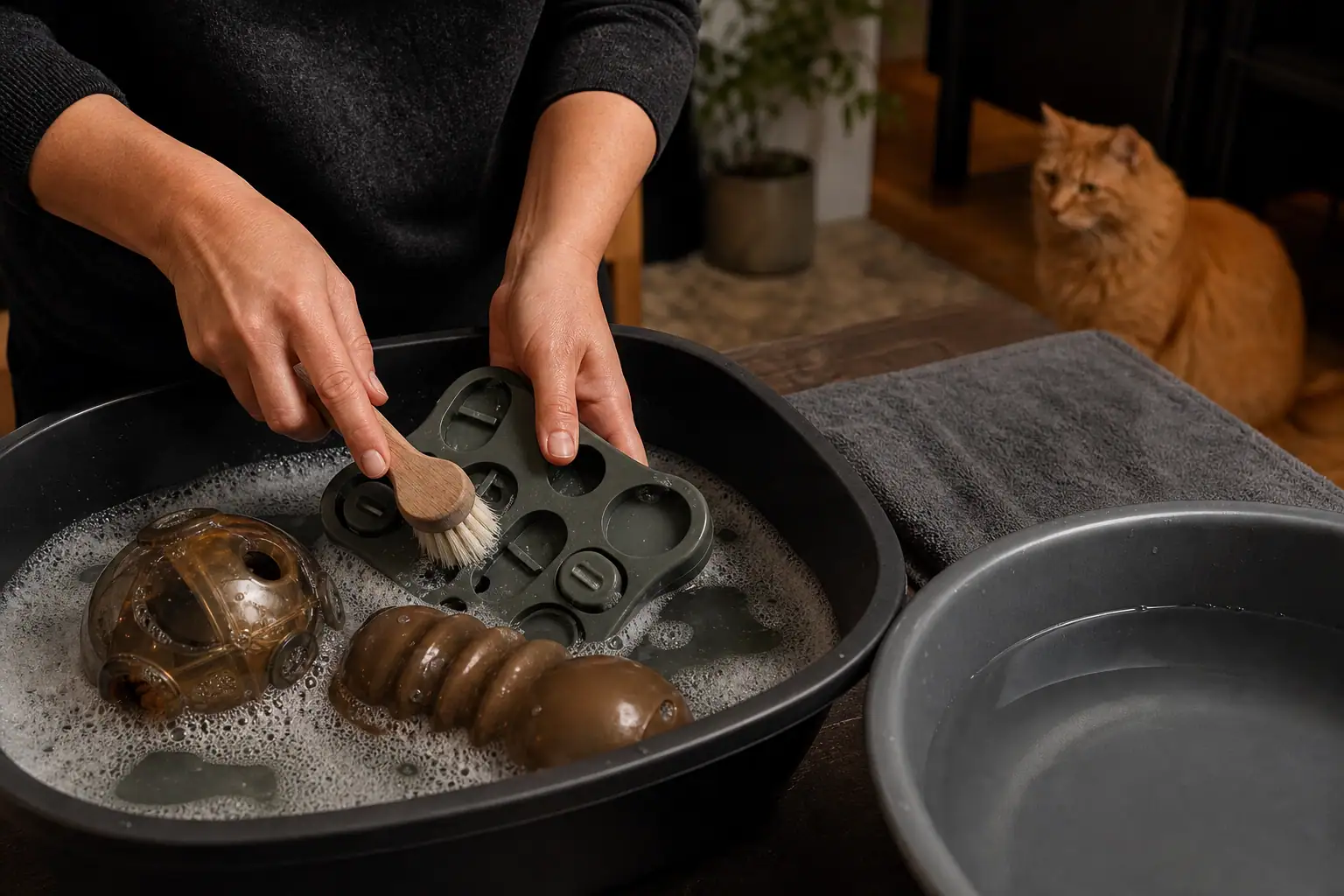
    3. Soap and scrub with material notes

      • Molded rubber or silicone (stretchy, soft plastics): scrub with mild dish soap and a soft brush. For stubborn stains use a baking soda paste.
      • Fabric with reinforced seams like cotton twill (sturdy woven cotton) or ballistic nylon (heavy-duty synthetic fabric): use a soft brush and pet-safe laundry soap, and spot-treat stains.
      • Track plastics and rigid parts: clean with a nonabrasive sponge and mild soap so you don’t leave tiny scratches.
      • Electronics: don’t soak. Wipe casings with a damp cloth and clean charging ports with a dry brush or toothpick.
    4. Sanitize options (when smell or germs are a worry)

      • Rubber and silicone: soak 5 to 10 minutes in a one-to-ten vinegar to water mix or use a pet-safe disinfectant, then rinse well.
      • Fabric: if the label allows, run a short hot-water wash or steam-clean for a deeper refresh. Skip soaking anything with electronics.
    5. Full-dry guidance
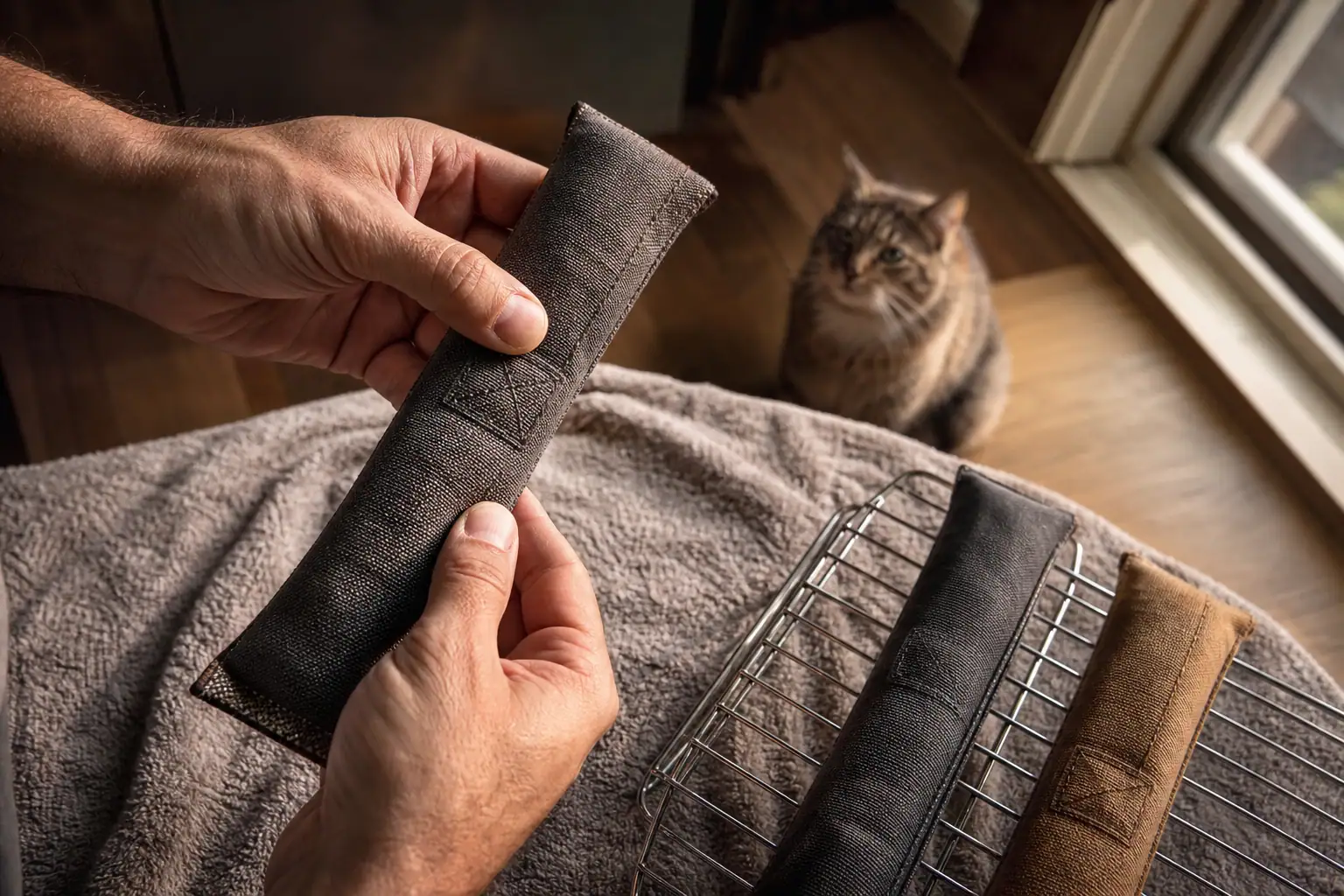
      Air-dry toys completely in a warm, ventilated spot. Stuff fabric toys with crumpled paper to keep their shape. Never reassemble until everything is bone dry, especially parts with electronics or cardboard cores (stiff paper tubes).

    6. Reassemble and inspect
      Put the pieces back together and give seams, fasteners, and attachments a tug test. Sniff for lingering odors. If seams pull or inner cores are exposed, it’s time to repair or retire the toy.

    Repair hacks (short, practical fixes)

    • Reinforce a seam: dab pet-safe fabric glue, then hand-stitch a backstitch line for extra strength.
    • Replace wand attachments: swap in new feathers or make a DIY one with a short heat-sealed nylon strip and a zip-tie.
    • Fix small rubber tears: clean and roughen the area, then use a two-part epoxy (a strong glue that hardens) or a food-grade silicone patch (safe flexible sealant).
    • Swap a cardboard core: cut a snug new cardboard insert to bring wrestle toys back to shape.
    • Secure detachable parts: sew a safety stitch through plastic loops and knot well so bits don’t slip off.
    • Smooth ragged treat openings: use food-grade silicone to seal chewing edges and prevent further tearing.

    Sample warranty clause templates (copy/paste starters)

    • Clause A (12-month chew coverage): "Manufacturer warrants against structural failure from normal chewing for 12 months; proof of purchase required; replacement or refund at seller’s discretion."
    • Clause B (30-day trial + replace): "30-day satisfaction window; for chew damage reported within 6 months, submit photos and video; eligible units receive replacement part or full refund."
    • Clause C (limited lifetime parts): "Core components covered for life against breakage not caused by misuse; user pays return shipping; manufacturer covers replacement shipping."

    Warranty checklist , what to look for before you buy

    • Length of coverage (months or years).
    • Scope (does chewing and attachment wear count?).
    • Replacement steps (are photos, video, or returns required?).
    • Required proof (receipt, date-stamped images, or video of the failure).
    • Seller shipping responsibility (who pays to send items back?).

    For repair-versus-replace decisions, check Materials and Construction and Durability Testing for test data and common failure modes.

    Budget vs Premium: Cost‑Per‑Month Calculations and Lifespan Case Studies

    - Budget vs Premium CostPerMonth Calculations and Lifespan Case Studies.jpg

    Want to choose a toy that actually saves you money and keeps your cat entertained? Let’s break it down in plain, playful terms so you can see what lasts and what’s just fluff. Swap in your own prices and play habits and you’ll get a quick win for both your wallet and your whiskered roommate.

    Price Tier Example product price Assumed lifespan (months) Calculated cost/month
    Budget (<$20) $15 4 months $3.75/month
    Mid ($20–$60) $45 18 months $2.50/month
    Premium (>$60) $120 48 months $2.50/month

    Case study 1 – heavy chewer nylon strip
    Meet the chewer. One reviewer’s cat attacked a nylon strip toy (nylon is a strong synthetic fabric) until the seams were shredded at month 14. The owner could have swapped a part but chose to replace the whole toy. Quick math: $25 for 14 months is about $1.79/month. Add roughly $5 a year if you try patching it, and the totals shift. Lesson: even budget stuff can be cheap per month if your cat goes all-in.

    Case study 2 – midrange treat dispenser with replaceable parts
    This midrange treat ball (a toy that drops treats as it rolls) lasted 18 months with daily play. Owners replaced rubber gaskets (small rubber seals) and tightened a latch twice. Total extra parts were about $12 over the life of the toy, so the effective cost stayed near $3.00/month. Repair-friendly designs make midrange buys look smart. See the Cleaning/Warranty tips below if you want to keep these working longer.

    Case study 3 – premium electronic track system with warranty support
    A rechargeable track system (an electronic toy with moving parts and a battery) entertained two cats for 36 to 48 months depending on battery life and part swaps. The maker honored a parts warranty twice, which cut replacement costs. After warranty fixes the owner averaged $2.50/month over four years, and the nightly zoomies stayed glorious. Worth every paw-print.

    How to model your own cost

    1. Pick your play intensity – low, medium, or high.
    2. Choose single vs multi-cat. More cats = more wear.
    3. Decide if you patch or fully replace when stuff breaks. Small fixes add up but can be cheaper.
    4. Do the math: (Price + total repair parts) ÷ expected months of life = cost per month.
      Example: $45 toy + $12 parts = $57 total. If it lasts 18 months, $57 ÷ 18 = $3.17/month.

    Small habits that lower cost-per-month

    • Clean toys regularly and follow the Cleaning/Warranty instructions.
    • Keep spare parts on hand for things like gaskets or lids.
    • Rotate toys so nothing gets annihilated every day.
    • For busy days, toss an unbreakable ball before you head out – that’s ten minutes of safe play.

    Final thought
    Sometimes a pricier toy pays off, sometimes a cheap one does , it all depends on your cat’s play style and whether you fix or toss. Ever watched your kitty chase a single feather for half an hour? That’s the kind of value no spreadsheet can fully capture.

    Enrichment Plans and Alternatives Using Durable Toys

    - Enrichment Plans and Alternatives Using Durable Toys.jpg

    Rotation and pairing are the secret to keeping toys fresh and ready for serious play. Think of a tiny toy menu you swap every week so your cat always meets something that feels new, not threadbare. Ever watched your kitty rediscover a forgotten toy and go absolutely wild? That’s the magic.

    • Assess play style. Watch a 10 to 30 minute play session to see if your cat mostly chews, bats, or chases. Label them chewers, batters, or sprinters so you can pick the right tough toys.
    • Pick three durable toys. One chase item, one chew/tug (chew/tug: a toy made for biting or pulling), and one puzzle (puzzle: a treat-dispensing toy that drops kibble when nudged). That way each playtime hits a different itch.
    • Weekly rotate toys. Keep three active toys in circulation and swap them weekly so novelty lasts. For heavy chewers, swap chew items more often – replace them about every 10 days if your cat goes full demolition.
    • Mix chase + chew + puzzle across the day – morning chase for zoomies, midday chew to blow off steam, evening puzzle for slow feeding and brain work. It spreads out energy and keeps things interesting.
    • Supervised introductions. Show new toys during short supervised sessions (watch the first 10 to 30 minutes). Let solo time happen only after you see the toy hold up and your cat use it safely.
    • Monitor wear weekly. Inspect seams, fasteners (like snaps or Velcro), and rigid cores (rigid core: the stiff inner piece, plastic or fiberglass) for exposed stuffing or fraying. Retire anything with exposed core or loose parts.

    A quick tip: combine textures and sounds – a soft, crinkly chew plus a fast-rolling chase ball makes play layered and irresistible. Uh, and if your cat prefers feathers, try a feathered wand with a reinforced base so it doesn’t shred on the first pounce.

    For stepwise supervision protocols and exact material tradeoffs, see Safety and Materials for deeper guidance on sizes, tests, and when to repair or retire a toy. Worth every paw-print.

    Final Checklist: Where to Buy and How to Verify Durability Claims

    - Final Checklist Where to Buy and How to Verify Durability Claims.jpg

    Quick, friendly checklist to help you buy tough cat toys – use these steps at checkout or when you message a seller so you don’t end up with fluff that falls apart mid-pounce.

    1. Confirm what it’s made of and how it’s built. Ask about polymers (a tough plastic), fiberglass (like a strong fishing-rod core), or puncture-proof fabric (tight woven fabric) and check Materials and Construction for tradeoffs and lab data (independent test results).

    2. Make sure the size and supervision plan fit your cat. Kittens, jumpers, and heavy chewers need different things – see Safety, Size & Supervision.

    3. Test the cleaning method as soon as it arrives. Try the dishwasher setting listed (top rack), a quick soak in warm soapy water, or a wipe-down, and consult Cleaning/Warranty for details.

    4. Read the warranty closely for chew coverage and how replacements work. Know what’s covered and how to start a claim – see Cleaning/Warranty.

    5. Scan user reviews for durability patterns. Look for how long toys lasted in real homes and repeated complaints about the same weak spot – see Durability Testing.

    6. Pick designs with replaceable parts or that are easy to repair. Little fixes save money and stress – see Materials and Construction.

    7. Do a quick price-per-month check before splurging. Divide the price by expected months of use to compare cheap vs premium options – see Budget vs Premium.

    8. Plan a supervised intro session and set time limits for solo play. Let your cat explore for a few minutes under watch, then rotate toys for independent play – see Safety, Size & Supervision.

    9. Match toy tests and field notes to your cat’s play style. Tuggers, chasers, and flingers need different toys – see Top‑Rated review pointers.

    10. On arrival, do a short safety check. Tug fasteners, sniff for odd smells, and run that cleaning test right away – see Cleaning/Warranty.

    When you ask sellers for proof, request dated photos or a short video of the toy under stress, any sample test results they have, and the exact warranty language in writing. Buy from a known retailer or directly from the maker when you can, keep receipts, and make sure return and replacement steps are clear before you pay. Worth every paw-print.

    Final Words

    In the action, you've got the quick TL;DR, the seven-point buying checklist, price tiers, and a small table to point you toward deeper tests.

    We also pointed to top-rated toy types, material pros/cons (nylon = tough woven fabric), safety sizing and supervision steps, lab and field durability tests, cleaning and repair tips, cost-per-month math, and rotation plans for multi-cat homes.

    Use this as your quick action map to pick unbreakable cat toys that keep kitties busy, cut replacement trips, and protect furniture. Happy pouncing.

    FAQ

    FAQ

    What are the best unbreakable or indestructible cat toys and where can I buy them?

    The best unbreakable cat toys are molded rubber chews (molded rubber: solid rubber core hard to bite) for tough chewers and soft teething-core toys for kittens; find KONG, Forever Stick, Da Bird and more on Amazon.

    Is the Forever Stick cat toy durable?

    The Forever Stick is durable; its flexible fiberglass-like wand (fiberglass: like a strong fishing-rod core) and replaceable heads last months for many cats, though feather or fabric attachments wear fastest.

    Which cat wand won’t break and where can I get replacement heads?

    Da Bird and similar heavy-duty wands use a fiberglass shaft (fiberglass: like a strong fishing-rod core) and have replaceable heads sold on Amazon and maker sites for easy swaps.

    How do I stop my cat from being so destructive?

    To stop destructive behavior, redirect chewing to durable toys, add short daily play sessions, rotate toys for novelty, remove tempting items, and check with a vet for stress or dental pain.

    What toys will cats not get bored of?

    Cats rarely tire of hunt-style toys: wand teasers, motorized prey and treat puzzles; rotate items weekly and change motion or rewards to keep play surprising and engaging.

    What toys are good for cats who play rough?

    For rough players pick molded silicone or rubber chews (silicone: soft, stretchable polymer), ballistic nylon toys (ballistic nylon: tough woven fabric), heavy-duty wands and treat-dispensing puzzles with replaceable parts.

    Related Articles

  • feather vs toy attachments on teaser wands Safer

    feather vs toy attachments on teaser wands Safer

    Feather attachments look irresistible, but are they safer than toy attachments on teaser wands? They send a soft flutter that makes whiskers twitch and usually ends in a full-body pounce. Ever watched your kitty chase one across the couch? Cute chaos.

    Feathers do shed quills (the stiff stem of a feather) and tiny fragments, so you’ve got to keep an eye on the floor and the mouth. If your cat chews or swallows pieces, there’s a choking or tummy-risk, so supervision matters.

    Toy attachments tend to last longer. They’re often made of wipe-clean materials and can hide small parts or sealed batteries (batteries enclosed so they can’t be opened), which means you still need to check them for loose bits. Some toys are tougher, good for chewers, but no toy is totally indestructible, ok?

    Short, cat-first advice: if your cat is a gentle chaser and you’re playing with them, feathers are fun and rewarding. If you have a chewer, a busy schedule, or a kitten who explores with their mouth, go for sturdy toy attachments and check them regularly. Simple trade-offs, same goal: safe, joyful playtime. Worth every paw-print.

    Head-to-Head Decision: Quick Practical Verdict

    - Head-to-Head Decision Quick Practical Verdict.jpg

    Feather attachments are the go-to for cats that love aerial, chase-driven play. They trigger an intense hunting burst , the flutter, the snap of a pounce , but they shed and need replacing more often. Toy attachments last longer and clean up easier, but sometimes hide small parts or sealed batteries (batteries enclosed so they can’t be opened), which means more supervision.

    • Attraction / Movement: Feather attachments: irresistible flutter and erratic aerial motion that makes whiskers twitch. Downside: they lose loft and shed with heavy use.
    • Durability: Toy attachments: tougher seams and stuffing (soft filling inside toys). Downside: may include small parts or sealed batteries.
    • Maintenance / Hygiene: Toy attachments: often easier to wipe or wash if removable. Downside: not all are washable when electronics or sealed catnip (a closed scent pouch) are inside.
    • Safety Risks: Feather attachments: watch for loose quills (the stiff stem of a feather) and tiny fragments. Toy attachments: watch for exposed stuffing or tiny bits if your cat chews.
    • Typical Cost Signal: Feather attachments: lower up-front cost per piece but you’ll replace them more. Toy attachments: higher per-piece cost but they last longer, so cost evens out.
    • Best Cat Profile: Feather attachments: perfect for aerial chasers and pouncers who love to leap. Toy attachments: best for chewers, multi-cat homes, and folks who want easier cleaning.
    Feature Feather Attachments Toy Attachments
    Movement Profile Birdlike flutter and erratic aerial motion that sparks pouncing Chunkier, textured motion with added sound or weight
    Maintenance/Hygiene Can shed quills; spot-clean friendly Often washable if removable; beware sealed batteries or sealed catnip
    Typical Lifespan Signal Shorter under heavy play Longer if seams and fillings hold up
    Main Safety Note Watch for loose quills and small feather fragments Watch for exposed stuffing or tiny parts if chewed
    Best For High-energy chasers and aerial play Chewers, hygiene-minded homes, sustained play

    Quick buying guidance: match the lure to your cat’s play style and choose parts that are easy to replace. For pricing and lifespan numbers see Durability, Connectors & Replacement Planning for pricing and lifespan numbers, and for inspection and cleaning steps see Cleaning, Storage & Repairs for inspection and cleaning steps.

    Worth every paw-print.

    Feather Attachments for Teaser Wands: Motion, Materials, Shedding

    - Feather Attachments for Teaser Wands Motion, Materials, Shedding.jpg

    Feather lures work because the quick flutters, tiny pauses, and wild arcs copy real bird motion and make hunting instincts pop. Your cat’s whiskers twitch as the lure jerks up, slows, then sails away. Boom. Next thing you know there’s an airborne pounce and a very proud kitty.

    Most wand feathers are about 2 to 4 inches long so they keep some loft (ability to stay in the air) without weighing the lure down. Think of a feather that floats and flicks, not one that pulls and drags. That light, flicky feel is what makes the chase so fun.

    Check lures often and retire them as soon as a quill (the stiff feather stem) gets loose. Loose quills can be sharp, and you don’t want your cat or your floor getting poked. If a quill wiggles free, toss the lure and grab a fresh teaser, worth every paw-print.

    Natural vs Synthetic
    Natural feathers (plucked bird feathers that give a real wobble and glossy shine) feel more like the real thing. Synthetic feathers (man-made fibers) shed less and take color better, so they stay bright and last longer. If you choose natural, look for ethical sourcing notes so you know where the feathers came from.

    Further reading: see the Durability and Cleaning sections for replacement timing and inspection routines.

    Toy Attachments for Teaser Wands: Types, Textures, and Care Caveats

    - Toy Attachments for Teaser Wands Types, Textures, and Care Caveats.jpg

    Toy attachments come in a bunch of flavors: plush critters, pom-poms and foam (soft, squishy synthetic material), ribbons and streamers, bells and crinkle panels, squeakers, and little catnip pouches. Each one teases your cat in a different way , the flutter of feathers is all about motion, while a chunky plush or jangly bell gives satisfying thuds and jingles your kitty can chase and wrestle. Ever watched whiskers twitch as a pom-pom rolls across the carpet? Yeah, that.

    A few care surprises hide inside some designs, so watch closely. Many electronic squeakers hide non-removable batteries and sealed modules that should not be dunked in water. Catnip pockets are often sewn shut. If the topper comes off, you can usually wash it. If it’s sealed, then spot-clean only. Keep an eye out for exposed stuffing, glued-on beads, or weak seams that might come loose under chewing.

    When you shop, favor chew-resistant fabrics and tight stitching. Double-stitched seams and reinforced tails are great signs. Pick attachments with removable inserts or clear care labels so you can wash or replace parts. Toys that list non-toxic materials or safety marks help calm worried owners. Worth every paw-print.

    Plush, Bell, and Crinkle: Choosing Textures

    Plush toys are gentle and great for tactile play. Crinkle panels and ribbons tempt curious stalkers with sound and texture. Bells and squeakers are for the sound-driven kitties and the high-energy chasers who love noisy rewards. Your cat might bat a plush, then bite a foam ball, then pounce on a ribbon , variety keeps play fresh.

    Safe Materials and Care Caveats

    Look for chew-safe fabrics like heavy-duty canvas (a tough woven fabric) or tightly woven felt (dense fabric made of compressed fibers). Foam toppers (soft, spongy pieces) are fine if they’re removable and washable. If a toy has sealed electronics or sewn-in catnip, plan to spot-clean those spots only. Labels that say removable or machine-washable are golden , you won’t be stuck with uncleanable pockets or dead batteries.

    A quick checklist before you buy:

    • Tight stitching and double seams.
    • No loose beads or exposed stuffing.
    • Removable covers or inserts for washing.
    • Clear care labels and non-toxic material notes.

    Keep it safe. Keep it fun. Your cat will thank you with a happy, slightly loud pounce.

    Durability, Connectors & Replacement Planning

    - Durability, Connectors  Replacement Planning.jpg

    Entry wands usually cost $5 to $15. Mid-range kits sit around $15 to $35, and fancy telescoping or multi-lure sets often top $40. Replacement feather lures run about $2 to $6 each, single toy attachments about $3 to $10, and multi-packs commonly fall in the $12 to $30 range, which is great if you want a starter mix.

    Feather lures wear fastest under heavy play. Expect a few weeks with daily rough-and-tumble sessions, or a month or two with moderate use. Plush or crinkle attachments can last several months if seams and stuffing hold up, but chew-happy cats make that timeline much shorter. Your mileage will vary, and, um, some cats are tiny shredders.

    Connectors and line choices change how quickly parts fail. Clip-on or snap connectors (think small lobster-claw clips) make swaps fast and painless. Breakaway connectors (a safety clasp that separates under load) cut entanglement risk in multi-cat or chewer homes. For line materials, prefer woven nylon (strong braided fabric) for good control, braided cord (low-stretch braided rope) for minimal bounce, or thin steel wire (steel-core wire) when you want almost no stretch, just test metal lines for kinks first. Single-piece rods feel steadier and last longer than cheap telescoping poles that can pop loose.

    Quick plan:

    1. Figure out your cat's play style: light, moderate, or heavy.
    2. Set aside a small monthly replacement budget based on that intensity.
    3. Choose lures that are replaceable, not sealed single-use toppers.
    4. Match lines and connectors to safety needs, use breakaway in multi-cat or chewer homes.
    Component Typical Lifespan Signal Typical Replacement Cost Range Recommended Line/Connector
    Feather lures Worn within weeks of heavy daily play; a month or two with moderate use $2 to $6 per piece Clip-on for quick swaps; woven nylon (strong braided fabric) for control
    Toy attachments (plush / crinkle) Several months if seams hold; shorter if your cat is a chewer $3 to $10 each; multi-packs $12 to $30 Snap connectors or sewn loops; braided cord (low-stretch braided rope) or woven nylon
    Wand rod / line Single-piece rods last longest; weak telescopes wear faster or pop loose Prices vary from entry to premium models Single-piece rod for steadiness; woven nylon for balanced control
    Connector types Clip-on speeds swaps; breakaway reduces entanglement risk Small cost difference; add-on clips are inexpensive Use breakaway in multi-cat or chewer homes; clip-on for easy changes

    feather vs toy attachments on teaser wands Safer

    - Matching Attachments on Teaser Wands to Cat Age, Energy, and Play Style.jpg

    Kittens do best with very light feathers and slow, gentle moves. Keep play short, about 5-10 minutes, and lure them slowly so they learn to stalk and swat without turning every session into a sprint. Their whiskers will twitch as the feather flutters, so cute. Tiny feather tips or short ribbons help build coordination and confidence.

    Adult cats love variety, so swap attachments between sessions to mix aerial chases with tactile wrestling. Use quick, fluttering feathers for big leaps, and a plush (soft fabric toy) or crinkle (thin, noisy textured material) topper for that satisfying capture. Match the toy to the mood: pick pieces that spark explosive bursts for chasers, and slower, realistic lures for patient stalkers.

    Senior cats need gentler, floor-level play and shorter bursts, around 5-8 minutes, so hips and joints don’t take hard landings. Choose light, easy-to-move lures like ribbons or small plush toppers and avoid high arcs. Gentle motions keep them engaged without causing strain. Worth every paw-print.

    In multi-cat homes, stagger sessions or give each cat a wand to cut down on guarding and squabbles. Supervise group play so excitement doesn’t turn into a scuffle, and rotate attachments between cats to keep everyone interested. Consider breakaway (safety clasp that separates under load) connectors if you’ve got chewers or multiple players sharing gear.

    Play Techniques, Safety Checks, and Session Guidelines for Teaser Wands with Feather vs Toy Attachments

    - Play Techniques, Safety Checks, and Session Guidelines for Teaser Wands with Feather vs Toy Attachments.jpg

    Before you start, run a quick safety check. Glide your fingers along the lure (feather or toy) and the line to feel for loose threads or sharp quills. Give the connector (small clip) a gentle tug to make sure it’s seated and not about to pop off. Clear the play area of cords, breakables, and anything your cat could snag. Stow spare lures and the wand out of your cat’s reach between sessions. Stay present during play. Keep rounds short and finish with a small treat or a soft toy so your cat gets a real catch and feels rewarded.

    Move the lure like real prey. Keep it roughly parallel to your cat’s path so their whiskers twitch and they can track it. Mix slow, stalk-like drifts with quick darts, then pause so they can pounce or bat. Think of the wand like a fishing rod for cats, tease, then reel in. Short bursts work best. Aim for a few minutes per round, repeat several times a day for active kitties rather than one long marathon.

    Want new game ideas? Try hide-and-pounce, simple obstacle courses, or treat hunts to keep things fresh. See step-by-step sequences here: interactive teaser wand play ideas for cats. My Luna once leapt off the couch like a tiny ninja when I hid a lure under a towel. Worth every paw-print.

    Watch for overstimulation. Signs include a whipping tail, flattened ears, fixed wide pupils, or hard, unexpected swats. If you see those, stop and give your cat space. Offer a calm toy to sniff or a small treat to help them reset. Let them settle before trying again.

    Managing multiple cats takes a bit of planning. Rotate one-on-one sessions so each cat gets attention and doesn’t feel competitive. Use breakaway connectors (quick-release clips that open under tension) to reduce tangle risk. Keep play zones separate when one cat gets grabby. These are classic supervised-play tips to prevent scuffles and keep everyone safe.

    A few quick safety notes: avoid tiny parts that could be swallowed, replace frayed lines, and never leave wand play unsupervised. Play should feel fun, not frantic. And hey, isn’t it great when a toy actually lasts?

    Cleaning, Storage & Repairs

    - Cleaning, Storage  Repairs.jpg

    Wash detachable fabric and plush toppers by hand with mild soap and warm water. Rinse until the suds are gone and let them air dry completely before you bring them back to playtime. Plush (soft stuffed fabric) likes gentle handling, think soft nibbles on a plush ear. For step-by-step washable component instructions and extra cleaning and drying tips, see interactive teaser wand cleaning instructions.

    Feather pieces need a gentle touch. Rinse them softly, blot with a towel, and let them dry flat. Handle the quills (stiff feather shafts) carefully so they don’t split. And hey, ever watched your kitty chase a lone feather? Keep that feather in good shape.

    Keep electronics (battery-powered parts) and sealed catnip pockets (small closed pouches that hold catnip) completely dry. Remove batteries or sealed modules (closed battery units) before any water gets near them. No one wants a soggy gadget or a ruined surprise.

    Store wands and loose lures in a dry container out of direct sunlight to slow material breakdown and color fading. Lay feathers flat or loosely rolled so quills don’t bend or snap. A zip pouch or small box for each lure type keeps things tidy and cuts down on tangles and the urge to chew when the wand is tucked away between sessions.

    Retire a part at the first sign of trouble. Look for:

    • Loose quills or split shafts.
    • Heavy fraying, exposed stuffing, or loose stitching.
    • Visible battery casing or cracked electronics.
    • Frayed lines, kinks in metal cores (stiff internal rods), or connectors (joining pieces) that pull free under a firm tug.

    Small fragments and exposed bits are choking hazards. Don’t risk a game of keep-away with a damaged piece.

    Quick DIY fixes can give toys a second life. Re-thread a replacement feather through the lure loop and secure it with a snug knot or a small clip, then test that knot before play. Sew tiny rips in plush toppers with hidden stitches and matching thread so seams stay strong under bites. Try connector knots and clips on the floor first. If a part still fails early, check the warranty and return options with the maker. Worth every paw-print.

    Final Words

    In the action, feathers spark stalking and aerial pounces. Natural feathers move like real birds. Synthetic feathers (man-made strands that shed less) trade some realism for durability. Toy attachments (plush, soft fabric) give tougher textures for longer play.

    Feathers thrill but shed more. Toys last longer and clean easier, though they can hide small parts or sealed batteries, so watch seams.

    See Durability, Connectors & Replacement Planning for pricing and lifespan numbers, and Cleaning, Storage & Repairs for inspection and cleaning steps. The feather vs toy attachments on teaser wands decision comes down to play style and household. Happy pouncing!

    FAQ

    FAQ

    Feather vs toy attachments on teaser wands review

    A feather vs toy attachments review shows feathers win for aerial, chase-driven cats with lively flutter, while toy attachments deliver better durability and easier cleaning; both have safety and replacement trade-offs to mind.

    Why do they put feathers on cat toys? What is a feather teaser? Should cats have toys with feathers?

    They put feathers on cat toys as a feather teaser to mimic bird movement, sparking stalking and pounce play; many cats adore them, but supervise for shed quills and chewing hazards.

    How to attach feathers to cat toy?

    To attach feathers to a cat toy, thread the feather shaft through the lure loop and secure with a tight knot or small clip (clip: tiny snap that holds under pull), then test the tie before play.

    What is the Da Bird cat wand and why do people like it?

    The Da Bird cat wand is a classic feather teaser using a long, fluttering lure that mimics bird flight; it’s loved for lifelike motion and strong chase appeal, though feathers shed faster than plush.

    What types of cat wand attachments exist and are interchangeable toys worth it?

    Cat wand attachments include feathers, plush mice, pom-poms, crinkle strips, bells, and catnip pouches; interchangeable toys are worth it for variety and hygiene since you can swap washable or safer pieces between sessions.

    What safety risks come with feather versus toy attachments?

    The main safety risks with feather versus toy attachments are loose quills and shed fragments from feathers, and small detachable parts, exposed stuffing, or sealed batteries in toys—supervised play and retiring damaged pieces reduces risk.

    How should I choose between feathers and toy attachments for my cat?

    To choose between feathers and toy attachments, pick feathers for aerial chasers and toy attachments for durability and easier cleaning; favor replaceable lures and sturdy lines or breakaway connectors (safety link that releases under tension) for safer, longer play.

    Related Articles

  • interactive teaser wand cleaning instructions for Pure Gleam

    interactive teaser wand cleaning instructions for Pure Gleam

    Ever think your cat’s teaser wand is clean after a quick shake? Uh, me too, until my fluffball gave it the side-eye mid-pounce. Oops, let me rephrase that… Dirt, drool, and natural oils had sneaked into the swivel joints, turning playtime from purrs into squeaks (or worse, grinds).

    Cleaning’s actually a breeze. Fill a bowl with warm water and a drop of mild dish soap (you know, the gentle kind you’d use on your favorite mugs).

    Grab a soft cloth (microfiber is perfect) and gently wipe each joint. Rinse with fresh water. Then let it air-dry with no direct sun.

    See those whiskers twitch? That’s the fresh wand calling. Ready for smoother, longer cat zoomies? A few minutes of wash time now means fluffier fun later.

    Worth every paw-print.

    Step-by-Step Care and Cleaning for Your Interactive Teaser Wand

    - Step-by-Step Care and Cleaning for Your Interactive Teaser Wand.jpg

    Keeping playtime sparkles flying means cleaning your teaser wand often. Oils, drool, and dirt can sneak into the joints and make it squeak. You’ll need a few things: mild dish soap (a gentle cleanser), warm water, a soft cloth, and a small brush for tight spots. Skip harsh sprays or scratchy scrubbers, they can weaken the plastic or harm the tiny electronics (the little power bits).

    A quick cleaning routine keeps the swivel joints smooth and your kitty safe. And it helps the toy last longer so you’re not buying a new wand next week. Ever watch your cat chase feathers on a fresh, clean wand? It’s pure joy.

    1. Detach all the removable parts. See Section 2 for a deeper teardown.
    2. Fill a basin with warm water and a squirt of mild dish soap.
    3. Wipe the handle and shaft with a soft cloth, gentle strokes only.
    4. Gently scrub around joints and connectors with your small brush.
    5. Rinse your cloth and wipe away soap suds, avoid soaking any electronics.
    6. Lay each piece out to air dry completely before reassembling.

    Do this once a week if your cat plays every day. Or grab your cloth whenever you spot goo or fur clumps. Letting grit build up can lead to stinky odors and surprise squeaks. A little upkeep saves money, keeps playtime safe, and means your cat’s paws stay happy.

    Disassembling Teaser Wand Components Before Cleaning

    - Disassembling Teaser Wand Components Before Cleaning.jpg

    Taking your teaser wand apart might feel scary, but it’s actually a breeze. You’re just removing each feather and fluff so your cat’s favorite toy stays fresh and fun. Ever watched kitty bounce around a clean wand? It’s pawsome. Ready to dive in?

    First, pull out any batteries or that little circuit board (tiny computer part) so no water sneaks in. Then follow these steps:

    • Clip-based heads: undo the clip or twist off the feather or plush tip. Pop the clips into a small bowl so they don’t roll under the couch.
    • Segmented rods: twist apart or slide out each plastic (sturdy stuff) or silicone (flexible rubbery stuff) section. Tuck the connector bits into a container.
    • Swivel joints and tiny bits: drop pins, springs, and clips into a resealable bag. No one wants to lose the spring that makes the wand shimmy.
    • Electronic modules and battery packs: pull them free and wipe with a pet-safe wipe, no dunking allowed.

    Lay all the pieces out on a clean towel. This way you can clean each part step by step and keep track of everything. Worth every paw-print.

    Selecting Safe Cleaning Solutions and Tools for Teaser Wands

    - Selecting Safe Cleaning Solutions and Tools for Teaser Wands.jpg

    Cleaning your teaser wand is like giving it a mini spa day before it hits playtime. Harsh stuff like bleach or ammonia can chew through plastic shafts, ruin silicone grips (the squishy handles), and leave feathers droopy. Instead, reach for a mild, pH-balanced dish soap or a pet-safe enzyme cleaner (it’s a gentle mix that breaks down organic messes). You’ll get every metal clip, fabric tail, and foam ball gleaming again.

    For tools, think soft – nothing should scratch or dull your toy. A microfiber cloth feels like velvet and sweeps off dust. Foam brushes hug curves, while small nylon or pipe brushes slip into tight joints and crevices. Want a light deodorizer? Mix 1 tablespoon vinegar with 1 cup water for a quick mist.

    Worth every paw-print.

    Here’s my go-to list:

    • Mild, pH-balanced dish soap or pet-safe enzyme cleaner for gentle grime removal
    • Bleach-free, fragrance-free pet wipes for quick electronics touch-ups
    • Microfiber cloths for smooth surfaces and foam brushes for tricky edges
    • Small nylon or pipe brushes to clean joints and crevices
    • Optional vinegar dilution (1 tbsp vinegar in 1 cup water) for a light deodorizing boost

    Rinse, Drying Techniques, and Mold Prevention for Teaser Wand Care

    - Rinse, Drying Techniques, and Mold Prevention for Teaser Wand Care.jpg

    After you scrub off the grime, dunking your wand in water can spell disaster – especially for the tiny electronics inside. Instead, rinse your cloth under clean water until the bubbles disappear, then give every inch a gentle wipe. Keep it light. If you notice droplets near the joints (where the pieces hook) or the battery pack (tiny power station), dab them off with a corner of your cloth instead of drenching the whole rod.

    Next, pick a spot with a soft breeze and let the parts rest on a rack or a clean towel in a room with a slightly open window. Speak of windows, direct sun can fade feathers or bright plastics over time. In a hurry? Grab a lint-free towel so no fuzz clings to the smooth handle.

    Mold loves a damp hideout, you know, so don’t skip this step. Ever seen your cat sniff at a soggy feather? Not cute. Double-check each feather, clip, and shaft for hidden wet spots. If anything still feels cool or damp, give it more time, really. A totally dry teaser wand means no musty smell and longer-lasting play.

    Drying Method Pros Cons
    Air Dry Prevents water buildup; gentle on colors Slower; needs good ventilation
    Towel Dry Quick; ideal for same-day play Possible lint residue; slight abrasion risk

    Maintenance Schedule and Storage Tips for Interactive Teaser Wand Longevity

    - Maintenance Schedule and Storage Tips for Interactive Teaser Wand Longevity.jpg

    Ever notice your cat’s whiskers twitch as they bat at the teaser wand? A little routine keeps it in tip-top shape. Wipe it down now and then, that soft ruffle of clean plastic (a sturdy, moldable material) feels pretty nice. And a deep soak? It stops gunk from hiding in joints and keeps feathers from fraying.

    Store your wand in a cool, dry cabinet away from sunlight and curious paws. That way plastic, fabric (soft cloth) and the tiny electronics (little circuit parts) stay happy. Plus, rotating attachments gives your furball fresh textures and slashes wear in one spot. Claw-tastic fun with no surprise breaks.

    • Weekly: Wipe the handle with a soft, damp cloth to brush off loose fur and dust. Then spot-clean attachments.
    • Monthly: Take it apart and soak non-electronic bits in warm, soapy water. Let everything air dry. Peek at how often to replace a teaser wand attachment and swap worn pieces.
    • Annual: Inspect hinges and swivel pins (tiny metal parts that let your wand twist). Lubricate with a drop of pet-safe oil. Replace any tired attachments before they break mid-play.

    Oops, set a simple checklist or calendar reminder, you and your kitty will thank each other for smooth, safe swooshes.

    Worth every paw-print.

    Troubleshooting and Advanced Cleaning Tips for Teaser Wand Care

    - Troubleshooting and Advanced Cleaning Tips for Teaser Wand Care.jpg

    Routine wipe-downs can leave sticky candy streaks, hairball goo, or that lingering funk you just can’t shake. Ever dunked it in water only to find a ghost stain staring back?

    Yikes.

    Here’s a pro trick: dab plush tips with a mild soap paste (gentle dish soap turned into a thick scrub), rinse, and let them air-dry. This usually nudges out the worst of it.

    For smudges on the shaft or rust creeping at the hinge (that pivot point), gently rub on a thin coat of food-grade silicone (a non-toxic, slick shield) once everything’s completely dry.

    And when you need to zap germs without wetting the power pack…

    • Wipe electronic modules with disinfectant-safe wipes to avoid any circuit mishaps.
    • Pop small metal or plastic bits into an ultrasonic bath (2–3 minutes in a vibrating water tank) to shake loose hidden gunk.
    • Hit attachments with UV light (2–5 minutes under a UV sterilizer) to kill microbes and strip out funky odors, zero liquid needed.
    • Steam-clean plush or fabric pieces to lift tough stains and fluff fibers back to life.
    • When things get really wild, consider a professional toy-cleaning service or lab-grade protocol for heavy-duty buildup.

    Worth every paw-print.

    Final Words

    You’ve tackled every step from gentle soap baths to careful air-drying so your cat’s favorite play stick stays hygienic and strong. Those numbered steps and teardown tips help you nip grime in the bud before it turns sticky or gross.

    The breakdown of safe soaps, soft cloths, and proper drying routines makes this easy. And a simple weekly wipe or monthly deep-clean keeps everything spinning smoothly.

    By following these interactive teaser wand cleaning instructions regularly, you’ll enjoy endless chase sessions, less stress over gross toys, and peace of mind that your home and kitty are happy.

    Worth every paw-print.

    FAQ

    How often should I clean my interactive teaser wand?

    The cleaning frequency for an interactive teaser wand is every 1–2 weeks of normal play or immediately when it looks dirty or sticky, keeping your cat healthy and the toy lasting longer.

    What materials do I need to clean a teaser wand safely?

    The materials for safe cleaning include mild dish soap, warm water, a soft cloth or sponge, and a small brush, avoiding harsh chemicals or abrasives to protect plastics, feathers, and electronics.

    How do I disassemble the teaser wand before cleaning?

    Proper disassembly of a teaser wand means unclipping or twisting off heads, unscrewing or sliding apart rod sections, and storing tiny pins and springs in a bag to prevent loss during cleaning.

    Which cleaning solutions and tools work best without damaging parts?

    Mild, pH-balanced dish soap or a pet-safe enzyme cleaner cleans gently, while microfiber cloths, foam heads, and small nylon or pipe brushes reach tight crevices without scratching.

    How should I rinse and dry wand components to avoid mold?

    After washing, rinse each surface with a damp cloth without immersing electronics, then air-dry in a ventilated spot or towel-dry with a lint-free cloth until fully moisture-free to block mold growth.

    What’s the best way to store and maintain a clean wand?

    Safe storage means keeping your cleaned wand in a cool, dry cabinet out of sunlight, rotating attachments to spread wear, and setting a weekly or monthly checklist so nothing gets overlooked.

    How can I tackle stubborn stains and odors on my teaser wand?

    For stubborn stains and odors, spot-treat plush parts with a mild soap paste, use an ultrasonic bath for small pieces, and try UV sterilization or pet-safe disinfectant wipes on electronics.

    Related Articles

  • interactive teaser wand play ideas for cats joy

    interactive teaser wand play ideas for cats joy

    Ever watched your kitty chase a teaser wand (a stick with feathers) across the floor? You’d think they’d love it forever… but most get bored after just a few swings.

    But wait, with a few simple tricks that feathered rod turns into a wild mini hunt. Picture your cat tiptoeing low on the carpet, whiskers twitching at every feathery flutter.

    Next, try these five fun routines: slow floor crawls, surprise bursts, swooping dives, zigzag zips, and sneaky pounces. Each ignites your cat’s hunting spirit, gives them a great workout, and strengthens your bond.

    Ready to watch your furball leap like a lion cub? Let’s dive in and make playtime totally claw-tastic.

    Game Routines & Movement Patterns

    - Game Routines  Movement Patterns.jpg

    Here are five fun teaser wand routines to get your cat leaping, stalking, and purring. Each one feels like a mini hunt, watch those whiskers twitch!

    • Fluttering Insect Chase
      Steps (12 minutes total)

      1. Let the feather (soft plume) skim the floor, slow, low flutter for 3 minutes.
      2. Zip it up mid-air, quick dart for 4 minutes.
      3. Ease it down like a moth just hatched, gentle drift for 3 minutes.
      4. Reward a catch about 40% of the time, 2 minutes of proud pouncing.
        You’ll need a feather attachment and a lightweight rod (easy-to-hold stick).
        Targets: stalking, pouncing, jumping.
        Change things up by flicking faster or lifting the wand from floor to chest height.
    • Slithering Snake Stalk
      Steps (12 minutes total)

      1. Drag the ribbon (long strip) in a wavy line on carpet for 4 minutes.
      2. Pause and shake to mimic a snake’s rattle, 3 minutes of teasing tremors.
      3. Slide away slowly, then snap forward, 3 minutes of surprise strikes.
      4. Let your cat catch it half the time, 2 minutes of sweet victory.
        Gear: ribbon attachment and a sturdy rod (firm fishing-rod core).
        Targets: low crawl stalking and sudden pounce.
        Mix it up by speeding the slither or raising the ribbon between floor and chest.
    • Diving Bird Surprise
      Steps (13 minutes total)

      1. Launch a dual-feather tip (two plumes) straight up, 2 minutes of take-off.
      2. Let it flutter down at random, 4 minutes of fluttery descents.
      3. Toss it sideways like a gliding bird, 4 minutes of side passes.
      4. Finish with slow drops for catch chances, 3 minutes of claw-tastic pounces.
        Gear: balanced rod and dual-feather tip.
        Targets: high leaps, mid-air swipes, dash chases.
        Ramp up the fun by tossing higher or changing the fall speed.
    • Shadow Pounce Marathon
      Steps (12 minutes total)

      1. Keep the thin ribbon low and drag in circles for 3 minutes.
      2. Speed into small zigzags, 3 minutes of quick turns.
      3. Pause so your cat freezes, eyes locked, 3 minutes of tense stillness.
      4. End with a final dart for a catch, 3 minutes of sprint and snag.
        Gear: narrow ribbon and a flexible rod (bend-friendly stick).
        Targets: crouch stalking, pouncing, sprinting.
        Tweak circle size or lift the ribbon off the ground for extra challenge.
    • Mixed-Motion Marathon
      Steps (12 minutes total)

      1. Start with a low flutter, 2 minutes of soft buzz.
      2. Switch to a floor slither, 3 minutes of sly snake moves.
      3. Add quick bird-like jumps, 3 minutes of sudden hops.
      4. Finish with random jerks and pauses, 4 minutes of playful chaos.
        Gear: interchangeable attachments (feather, ribbon, small plush) and a telescoping rod (extends for distance).
        Targets: chasing, pouncing, leaping.
        Keep your cat guessing by swapping materials every couple of minutes or adjusting rod length.

    How to Design Your Own Routines

    Mix and match motions, timing, and catch rates to spark curiosity. Think of each play session as a tiny hunt, vary the speed and height, then watch those whiskers go wild!

    • Speed (slow vs fast)
    • Height (ground level vs overhead)
    • Unpredictability (rhythmic vs erratic)

    Adjusting Difficulty and Ensuring Safety in Teaser Wand Sessions

    - Adjusting Difficulty and Ensuring Safety in Teaser Wand Sessions.jpg

    Every cat has its own play style – some love lightning-fast zooms, others prefer slow, teasing drifts. Watch your kitty’s whiskers, ears, and tail flicks to know what’s up. If they hesitate, slow the wand or keep it close. When those paws tap, back up a bit for bigger leaps.

    Mix up speed and pattern like a tiny hunt. Do quick jerks for a thrill, then switch to gentle sweeps for patient stalking. Move the wand in zigzags or circles to spark curiosity and sneak in some exercise. A little surprise keeps play fresh and fun.

    Safety comes first in every teaser wand session. Stay close and always stash rods and attachments out of reach. That way curious mouths can’t nibble stray ribbons or feathers (non-toxic, natural materials). Ever seen a toy tip vanish under the couch? Not on our watch.

    Give each attachment a quick check before you start. If feathers fray or strings tangle, swap them out. A solid rod (fiberglass (like a strong fishing-rod core)) and snug fittings mean fewer mid-pounce oops.

    Play smart, stay close, and tweak intensity to match your cat’s mood. Your feline friend gets a satisfying chase. And you get the purrs to prove it. Worth every paw-print.

    DIY Teaser Wand Attachments and Budget-Friendly Customizations

    - DIY Teaser Wand Attachments and Budget-Friendly Customizations.jpg

    Ever watched your kitty swat at an empty wand and lose interest? Let’s spice things up with stuff you already have at home. Grab a paper bag handle. Fold it into loops or spirals, tape on a few ribbon pieces, and tie it to your wand tip. It adds a pop of color and a satisfying swish.

    Stack a handful of Post-Its (sticky notes) and peel them fast to create a fluttering tease that’ll make whiskers twitch. Or cut straws into tiny rings and thread them like crunchy beads on a length of ribbon. And don’t toss those fabric scraps: roll them tight and knot one end for a plushy tail your cat can chase and chew.

    Next comes the sensory wow. Glue on a pom-pom (soft yarn ball) for a fluffy buddy. Pop on a small jingle bell to hear just a faint tinkle. Tape on a feather (light plume) for wild bird vibes. Then spritz a light mist of catnip or silvervine every 2 to 3 days. Um, no soaking. That keeps the feline nose twitching.

    Mix and match with store-bought wands so play never gets old. Feather wand one day. DIY ribbon chain the next. You’ll keep your kitty pouncing instead of yawning.

    Play smart, though. Check each attachment before you wave it around. If fabric frays or the bell goes missing, swap it out. Tuck loose bits away after playtime so no one ends up snacking on them by mistake.

    With a handful of household scraps and a dash of creativity, you’ll have budget-friendly teaser wands that feel brand-new every time.
    Worth every paw-print.

    Choosing Durable and Effective Teaser Wand Toys

    - Choosing Durable and Effective Teaser Wand Toys.jpg

    Choose a wand that can take lots of swipes. Find one with a sturdy rod of fiberglass (like a strong fishing-rod core) or reinforced polymer (a tough plastic) and a tight connection so feathers, ribbons, or soft plush bits stay put when your cat goes wild. A comfy handle stops it from flipping out of your hand, even when your kitty pounces like a ninja.

    It’s best to pick natural, non-toxic materials that won’t make your cat sick. Feathered ends from responsibly collected plumage or eco-friendly fabric scraps keep playtime free of odd smells or chemicals. And when strings get fuzzy or feathers start to shed, swap them out right away, it’s all about safe fun. I’m a fan of ZeyZoo (worm toys with retractable handles), DaBird (fluttery feather tips), Cat Fishin, and Litterboys. They mix cute designs with serious staying power.

    Think about your space and your cat’s style. A long wand gives you room to play without knocking over lamps, and those dramatic pounces are so much fun to watch. A shorter stick fits cozy corners and makes quick turns a breeze. Heavier rods add momentum for jaw-dropping leaps, but some fur balls prefer a feather-light stick for rapid flicks. Try different lengths, weights, and balance points until your kitty can’t wait to chase it.

    Worth every paw-print.

    - Recommended Teaser Wand Play Duration and Frequency.jpg

    Short bursts of teaser wand play keep your kitty on its toes. Aim for about 10 to 15 minutes per round. Do this 2 to 4 times a day. Your cat’s whiskers will twitch with excitement as the feathered lure dances across the floor.

    Routines help your cat feel secure. Try playing at the same times each day so they know when the hunt begins. Soon, your living room will turn into their favorite stalking ground. No more random meows or pacing by the door.

    Totally claw-tastic.

    At the end of each mini session, toss them a tasty treat or fill their bowl (a little reward for a successful catch). It feels just like the prize after a real hunt, and it builds trust. Curious about more ideas? Check out how often should cats play each day.

    In busy mornings, a quick 10-minute flutter chase can tuck those zoomies in before you dash off. Then, sneak in an afternoon pounce sesh during your coffee break. And in the evening, surprise them with a last-minute sneak attack of feathery fun. Keep it short, keep it playful, and watch your furball stay bright-eyed and satisfied.

    Benefits of Interactive Teaser Wand Play for Cat Health

    - Benefits of Interactive Teaser Wand Play for Cat Health.jpg

    Interactive teaser wand play is like a mini gym for your kitty. It gets their heart pumping and lungs working hard.

    You’ll watch them wiggle, chase, and jump. You can almost feel the satisfying thud of their paws. It tones muscles (strong, lean muscles) and keeps joints moving smoothly (easy bending and stretching). It also helps them stay a healthy weight with no crash diets needed.

    And get this.

    When you wave the wand like a fluttering bird, it sparks their predatory instincts (natural hunting urges). Ever seen your kitty go laser focused? Their mind gets a full workout too. Less boredom stress and frantic midnight zoomies follow.

    Playing side by side builds trust and affection. You share every swoop and flick, and your kitty’s tail wags with joy. Shy or anxious cats feel safe and loved when they pounce together, you know. It’s a claw-tastic bonding time.

    Well-exercised cats show fewer behavior hiccups. You’ll spot less sofa scratching or door-dashing once playtime becomes their go-to fun. Keep waving that wand and your home stays intact. Happy cat, happy you.

    Creating an Enriching Environment for Teaser Wand Play

    - Creating an Enriching Environment for Teaser Wand Play.jpg

    First, clear away anything that can break or tip over so your cat can zoom around safely. No more worrying about spilled water or toppled lamps, right? That open floor becomes your kitty’s stage for teaser wand showtime. You get front-row seats to a furry performance.

    Next, add some vertical fun. A cat tree (a sturdy climbing tower), wall shelves, or a cozy box fort gives your kitty places to climb and perch. Perches by a sunny window make perfect launchpads for epic leaps. My cat Luna once shot six feet through the air just to snag a feather, whoa.

    Then toss in a collapsible tunnel (a pop-up tube) or lay down a soft play mat (a cushy mat for paws). The gentle rustle under their feet amps up the stalking fun. You’ll catch your cat slinking through, whiskers twitching before the pounce. Every few days, swap feathers for ribbons or plush mice to keep them guessing.

    If you’ve got multiple cats um, things can get hiss-terical. So skip the tug-of-war by staggering playtimes or grabbing two wands for side-by-side chases. Keep each session short, just a few minutes, so every kitty feels like the winner. That way no claws clash, and every furball gets their moment to shine.

    Final Words

    Zoom into playtime with the top 5 teaser wand routines that mimic fluttering bugs and swooping birds. We walked you through designing moves, speed, height, and surprise twists to keep kitties on their paws.

    Then we shared safety tips, DIY attachments, and how to pick sturdy wands. You got advice on session lengths and creating a cozy multi-cat play zone.

    Give those claws a healthy workout and save your furniture. These interactive teaser wand play ideas for cats will turn every session into a happy, tail-wagging success.

    FAQ

    How do I play interactively with my cat using a wand toy?

    Playing interactively with your cat using a wand toy involves mimicking prey movements—flutter like insects, slither like snakes—and holding short 10–15 minute sessions, 2–4 times daily, to encourage stalking, pouncing and healthy exercise.

    Are teaser toys good for cats?

    Teaser toys are good for cats because they satisfy hunting instincts, boost heart health through active play, sharpen mental focus and deepen your bond while cutting down on boredom-driven mischief.

    How do I make an interactive cat toy?

    Making an interactive cat toy uses simple supplies—ribbons, fabric scraps or paper bag handles—to craft varied textures, then add small bells or a light catnip spray and swap attachments every few days to keep kitties curious.

    Related Articles

  • teaser wand games for senior cats Spark Joy

    teaser wand games for senior cats Spark Joy

    Ever think your senior kitty’s best hunting days are over? Think again! Picture her whiskers twitching as you wave a teaser wand (a stick with dangly toys that mimic prey) in slow, cozy loops.

    These gentle loops spark her curiosity and give her stiff old paws a soft stretch. It’s all quiet pounces and soft mews instead of a wild race. And trust me, she’ll get that mental thrill without breaking a sweat.

    Next, I’ll show you a few claw-tastic teaser games to keep your older feline limber and alert. I once watched Luna leap six feet for a dangly moth (um, my heart nearly leapt too). In truth, these slow-chase sessions fill her day with joy. And yours.

    Worth every paw-print.

    teaser wand games for senior cats Spark Joy

    - Gentle Teaser Wand Games for Senior Cats.jpg

    Senior cats may slow down, but that doesn’t mean their curiosity quits! Ever watched your kitty’s eyes widen when you wave a teaser wand? Next, drag the wand tip close to the floor in soft, looping arcs, like a tiny mouse sneaking through tall grass. This low-impact mental play wakes up their hunting instinct without wearing them out.

    It’s all about easing arthritis aches. So move the wand in slow circles or soft zigzags, then pause so your kitty can crouch and bat at the toy. No sudden sprints or jerky tugs keeps play calm and stress-free. Your cat’s whiskers will twitch, paws will reach, and you’ll see just enough pounce to keep those joints limber!

    Short sessions work best. Aim for 5 to 10 minutes, two to four times a day. This quick play routine helps senior cats stay mobile and stops muscles from stiffening. Plus, those mini chases sharpen their focus and deepen your special bond.

    Keep an eye on your cat’s energy. If they slow down, flop over, or let out a soft meow, that’s your cue to wrap it up. For more tips and safety pointers, check out interactive teaser wand safety guidelines.

    Choosing Senior-Friendly Teaser Wand Designs

    - Choosing Senior-Friendly Teaser Wand Designs.jpg

    Pick a wand with a soft tip that’s made from non-toxic plastic (plastic that won’t hurt your cat) and pet-safe feathers (you know, those light feathery tags). Older kitties love a tool that feels feather-light in your hand but still brims with texture, tiny bells that tinkle, soft ribbons that flutter, or little plush patches that won’t snap under a curious paw.

    Look for a pole with adjustable length or a bendable carbon fiber (like a strong fishing-rod core) shaft so you can dial in just the right reach. Then give it gentle curves instead of jerky moves to ease arthritic joints (ever seen your cat pounce in slow-mo?). It’s light. It’s smooth. And it keeps your feline friend stalking instead of straining.

    Now, um, check the handle. Slip-resistant rubber grips (grippy rubber) mean you won’t lose hold mid-play. And if the shaft uses eco-friendly materials like bamboo or recycled plastic, you’ll have a guilt-free toy that’s built to last.

    Safety check: make sure all feathers and bells are tied tight, clamped, or sewn down so nothing can come loose and become a choking hazard. Choosing a wand with secure fasteners gives you peace of mind and your kitty a claw-tastic chase every day.

    Oh, and one last thing: pick wands in high-contrast colors so kitties with fading vision can spot the tip easily. Worth every paw-print.

    Step-by-Step Teaser Wand Game Variations for Senior Cats

    - Step-by-Step Teaser Wand Game Variations for Senior Cats.jpg

    Let’s jazz up your senior cat’s playtime with simple swaps that tickle the senses. Try swapping in feathers (light plumes), crinkly fabric strips (rustly ribbons), a tinkling bell, or soft plush ties. Ever watch your kitty’s whiskers twitch as they try to catch a new texture? It’s claw-tastic fun.

    Next, slip on a catnip tip (dried minty herb) for a sniffable perk. Or clip a tiny treat on the end so a gentle bat turns into a tasty nibble. And pausing now and then to let them sniff and reset focus helps build their confidence. Worth every paw-print.

    Game Variations

    • Texture twists: mid-play, switch between feathers (light plumes), fabric strips (rustly ribbons), bells, or plush ties to surprise those paws.
    • Catnip boosts: tuck in a catnip tip (dried minty herb) for an irresistible whiff, what’s that smell?
    • Treat teaser: clip a small snack at the wand’s end so a light tap earns a bite.
    • Sniff breaks: pause every few moves, hold the wand still, and let your cat investigate and refocus.
    • Cozy circles: finish with small, close-to-body circles so your kitty knows playtime is over.

    Safety and Environment Tips for Teaser Wand Play with Senior Cats

    - Safety and Environment Tips for Teaser Wand Play with Senior Cats.jpg

    Before you break out the teaser wand for your senior cat, clear the play zone by pushing furniture away from sharp corners so your kitty can pounce safely. Stay right there with them. Ever seen your senior cat do a slow-motion pounce? Keep an eye on their breathing and how they walk, because early fatigue can be subtle.

    • Check attachments each time. Look at feathers, ribbons (thin cloth strips), or bells for frays or loose parts. Tiny pieces can be choking hazards.
    • Watch paws and whiskers for hesitations. Panting, limping, or a stiff posture means it’s break time.
    • Keep sessions short. When stalking slows or you hear a soft meow, gently lower the wand to avoid overexertion.
    • Wipe down the wand tip and shaft (the stick part) with a damp cloth. It removes dust and allergens.
    • Store the wand in a dry spot out of reach. This keeps feathers smooth and ribbons tangle-free.

    For more feline-friendly pointers, check out the interactive teaser wand safety guidelines.

    Stay paw-sitive.

    Customizing Teaser Wand Games to Suit Senior Cat Abilities

    - Customizing Teaser Wand Games to Suit Senior Cat Abilities.jpg

    Sensing your older kitty’s comfy pace is key. Ever noticed the tail swish that says “I’m in” or the perked ears begging for more? Start slow by adjusting speed or session length so they feel cozy, not like they need to land an Olympic leap.

    For deaf cats, add a tiny bell (small bell that makes a soft tinkle) to the wand tip so they know where the claw-tastic fun is. Your cat’s whiskers twitch when the wand brushes the floor. For blind cats, keep the wand within whisker range (about as wide as their face) and drag it slowly so the gentle thrum of vibrations travels right to their paws.

    If arthritis (joint inflammation) is an issue, focus on smooth, low drags and small arcs that don’t force your cat to stretch too far. Uh, watch for the ever telling signs like an arched back or a frozen pause and tweak play by slowing down, shortening sessions, or swapping in a softer wand tip. Your kitty’s comfort is always number one.

    Worth every paw-print.

    DIY and Budget-Friendly Teaser Wand Toy Ideas for Senior Cats

    - DIY and Budget-Friendly Teaser Wand Toy Ideas for Senior Cats.jpg

    Before playtime, grab non-toxic, lightweight bits and make sure they’re fastened tight so nothing falls off when your cat goes for it.

    • Catnip sock teaser
      Clean a thin cotton sock (soft, breathable fabric), fill it with dried catnip (minty herb that perks whiskers), then tie a piece of baker’s twine (thin cotton string) to the toe and drape it over a wooden dowel. The gentle wobble invites slow batting, perfect for a wiser kitty. Ever watched your old pal stalk a swaying sock?

    • Crinkle-paper ball attachment
      Take a square of wax paper or kitchen foil (shiny, crinkly stuff), scrunch it into a soft ball that crackles under a paw, then secure it to the wand tip with tape or a twist-tie. That soft rustle teases whiskers without asking your cat for big leaps. Really fun to watch.

    • Plush feather bundle
      Bundle a few pet-safe feathers (light plumes) at one end of a bamboo skewer (thin wood rod) and wrap with non-toxic glue or thin thread. When you wiggle the wand, they flutter like a tiny bird, cueing those slow, focused swipes. My Luna can’t get enough of this.

    • Ribbon-and-bell combo
      Knot narrow ribbon strips (satiny strips) around the wand tip, attach a small jingle bell to one end, and secure with tape. The soft tinkle rewards gentle taps and curious sniffs. Your kitty will pounce with delight.

    • Silvervine stick topper
      Mask a short piece of natural silvervine (cat-safe climbing vine) to a dowel or straw with masking tape. That extra boost of scent has older cats stalking with a slow, happy focus. Works like a charm for low-energy play.

    Worth every paw-print.

    Scheduling and Monitoring Teaser Wand Play Progress in Senior Cats

    - Scheduling and Monitoring Teaser Wand Play Progress in Senior Cats.jpg

    So, how do you fit teaser wand fun into your older kitty’s day? Pick times that work for both your schedule and your cat’s comfort. I aim for two to four quick play bursts, think tiny cat workouts. Each burst runs about 5–10 minutes, just enough to spark curiosity without wearing out those wiser paws.

    Then scatter these mini-sessions around nap times or meal breaks. Your cat will learn the routine and might even yowl a happy reminder when wand time rolls around. Ever watched your kitty chase shadows and pounce in slow motion? It’s as cute as it sounds.

    Next, grab a simple notebook or make a spreadsheet (a digital table you fill in) to track each play date. Jot down the date, session length, and how fiercely your cat chased or gently swatted. Note any limps, long pauses, or extra loud meows, those are clues that muscles need a rest or maybe a quick vet check.

    Week by week, you’ll spot small wins: smoother leaps, perkier ears, or surprise cuddle sessions afterward. That log isn’t just numbers, it’s a record of your bond growing stronger through play.

    Worth every paw-print.

    Final Words

    We jumped into gentle teaser wand games for senior cats, from picking the right lightweight wand to short, low-impact play sessions that boost joint flexibility and curiosity.
    You learned step-by-step moves, safety checks, custom tweaks for older cats with arthritis, and simple DIY toy ideas that save cash.
    Then we set up a play schedule that’s easy to follow and track.
    Keep experimenting with teaser wand games for senior cats, and watch your wise whiskered pal stay spry and happy.

    FAQ

    What games can senior cats play with teaser wands and what’s the best toy for older cats?

    Senior cats can stalk slow, floor-level wand drags in short 5–10 minute sessions. Lightweight, adjustable teaser wands with soft feathers or fabric tips make perfect low-impact toys that boost mobility and alertness.

    What are teaser toys for cats and what styles are available?

    Teaser toys are interactive wands or sticks with attachable tips. Styles include retractable teaser sticks, feather wands, automatic motorized teasers, soft ribbon wands, and rolling teaser balls for varied chase experiences.

    What are mental stimulation games for cats?

    Mental stimulation games for cats include puzzle feeders, treat-dispensing balls, hiding treats along short scent trails, simple fetch with soft toys, and slow-paced teaser wand stalk-and-swat sessions that sharpen focus and curiosity.

    How do I replace parts on a teaser wand toy?

    Most teaser wands use clip-in or screw-on attachments. Simply twist or slide off the old tip, align and secure the new feather, ribbon, or bell head, then tighten the locking ring or clip.

    How can I choose the best retractable or automatic cat wand?

    Look for retractable wands with smooth, quiet pull-out action and secure locking collars. For automatic versions, pick slow-paced, adjustable-speed models with breakaway safety features to avoid startling or stressing senior cats.

    Related Articles

  • How Often to Replace a Teaser Wand Attachment

    How Often to Replace a Teaser Wand Attachment

    Ever watched your kitty chase a feather (light and wispy)?
    It’s hilarious.
    Until that fluff drifts across the carpet and lands you in the vet’s office.
    Yikes.

    Those teaser bits wear out just like your favorite sneakers.
    See a little fray? That’s your cue, you know, to swap them before Luna or Mr. Whiskers gets into trouble.
    I learned the hard way when mine almost gulped a streamer (a thin strip of fabric).
    Really.

    So here’s the scoop: change your wand’s attachment every four to six weeks.
    It keeps play safe and claw-tastic.
    Worth every paw-print.

    Optimal Replacement Schedule for Teaser Wand Attachments

    - Optimal Replacement Schedule for Teaser Wand Attachments.jpg

    Your kitty loves chasing feathers and beads on a teaser wand. But over time, those fun bits can fray or pop off – a ribbon might shred or a little hook (clasp) could bend and let the lure fly away. Ever watched a loose feather drift across the carpet? Cute, right?

    I once saw Luna try to gulp down a streamer, vet visit guaranteed, um, you know? It’s a nibble-time bomb if your cat swallows it. So for safe, claw-tastic play, you need to know when to swap attachments.

    Think of it like changing worn-out shoes. Attachments usually last one to three months, depending on your play style. Heavy hitters who pounce every night might need a fresh part after about four weeks. More chill weekend chasers can stretch toward the three-month mark.

    Is your cat batting the wand each evening? Aim to replace attachments every four to six weeks. Inspect those streamers and feathers once a week for frays, and check the hook to make sure it closes properly. If anything looks loose, toss it and grab a new one.

    Some gentle players can keep an attachment going eight to twelve weeks before it shows wear. Every cat is different, so tweak this schedule for your furball’s style.

    Regular swaps keep play sessions safe. And fun.

    Key Wear Indicators on Teaser Wand Attachments

    - Key Wear Indicators on Teaser Wand Attachments.jpg

    Ever given your teaser wand a once-over before playtime? Think of it like a quick safety sniff test for your cat gear. A tiny tear can turn into a big feather fiasco.

    • Broken clasps or lobster-claw connectors that no longer snap closed (joint connector check)
    • Feathers (fine bird plumes) splitting into fuzzy strands – a frayed-feather warning
    • Streamers looking dull or torn with bits missing – streamer deterioration signs
    • Ribbons and lines thinning out or fraying at the ends – basic worn-tip detection
    • Missing beads, loose bells or dangling bits wobbling on their own – loose-piece alert

    Make this a weekly habit. Your kitty will thank you with extra leaps and twirls!

    How Material Choices Affect Attachment Lifespan

    - How Material Choices Affect Attachment Lifespan.jpg

    Ever watched your kitty swat at a feather toy? How long it lasts depends on what it’s made of. Natural feathers (bird plumes) have a thrilling flutter cats chase like real prey. But they fray into fluff after a few weeks of heavy batting. Just weeks of fun!

    Synthetic streamers (man-made ribbons) handle drool and little nibbles better. They stretch playtime to a few months. They don’t dance like real feathers, though.

    Woven nylon line (strong fiber string) is the champion of toughness. It resists tangles and serious tugs. Your cat can bat at it for months.

    Polycarbonate ends (hard, clear plastic) shrug off big jerks and chomps. They stay intact even longer. They act stiff, so you get less wobble.

    Worth every paw-print.

    Material Type Durability Pros Cons
    Natural Feathers (bird plumes) Short (weeks) Lifelike flutter, kitty magnet Frays fast, sheds bits
    Synthetic Streamers (man-made ribbons) Medium (months) Handles drool and chews Lacks real-feather dance
    Woven Nylon Line (strong fiber string) High (months) Tough and tangle-resistant Looks plain
    Polycarbonate Ends (hard, clear plastic) Very high (months+) No cracks or warps, lasts long Stiff action, less wobble

    Pick the material that matches your cat’s style, wild feather chases or long-lasting, chew-proof fun.

    Hygiene Practices for Longer-Lasting Attachments

    - Hygiene Practices for Longer-Lasting Attachments.jpg

    Keeping wand attachments clean stops saliva, dirt, and oils from breaking down fibers (tiny threads) or trapping moisture (yucky water). Grime left behind can weaken connectors (the bits that snap together) and even invite mold. Not fun for your kitty and yikes, hidden hazards.

    So I made a simple hygiene checklist to make your life easier, and your furball safer. Ever watched a toy get soggy and limp? Yeah, mine too.

    Rinse attachments after every 5 to 10 play sessions, depending on whether your cat’s a casual paws-on or a heavy hitter. Use a mild, pet-safe soap (no bleach or harsh chemicals that can eat into plastic or fabric). Gently scrub and feel the satisfying swoosh of suds, then rinse until the water runs clear.

    After that, give each part a quick once-over. Look for stiff spots or water hiding in little nooks. Any trapped moisture can lead to mold, and nobody wants that. Let everything air-dry completely on a towel or hang the attachment by the wand, gravity’s best friend.

    Once a month, do a more thorough tip inspection. Check connectors, strings, and feathers for dirt, moisture damage, or wear. If anything looks off, replace it. Better safe than sorry, right?

    Finally, store your teaser wand in a cool, dry spot away from direct sun so materials stay strong and ready for your kitty’s next pounce.
    Worth every paw-print.

    Quick Maintenance Steps for Teaser Wand Attachments

    - Quick Maintenance Steps for Teaser Wand Attachments.jpg

    Inspecting Attachment Clasps

    Ever watched your kitty try to wrestle a loose clip? Let’s avoid that. Each week, peek at the lobster-claw connector (the little hook that holds the fun stuff). Run your finger along the hinge – any bumps, rusty spots, or stiffness?

    Give it a wiggle test. It should snap open and closed smoothly. Then tug gently on the lure (the dangly toy bit). If it feels floppy, you’ll want to fix it before play.

    Replacing the Lure Quickly

    No tools needed – seriously, zero. Pinch the clip and pull off the tired lure. Line up your shiny new one and press until you hear a solid click.

    Click! Boom – game on for your cat’s next chase.

    Cost and Value of Teaser Wand Attachment Replacement Kits

    - Cost and Value of Teaser Wand Attachment Replacement Kits.jpg

    Let’s talk about how much these teaser wand tips cost and why they’re worth every paw print. You can grab a replacement pack for about $5 to $15. Each pack has 5 to 7 attachment tips, so you’re paying just $1 to $3 per tip. Buying bulk multi-packs saves you up to 30 percent compared to single packs, making it a wallet-friendly choice for long-term fun.

    Budget Picks vs Premium Kits

    Basic packs usually run $5 to $8. They come with standard feathers and simple streamers. They might not have fancy textures, but they still deliver that flutter your kitty loves. Perfect for casual players or anyone on a tight budget. Next, premium kits cost $10 to $15. They include plush faux fur (soft, cozy) or crinkle paper (it rustles delightfully). You pay about 20 to 40 percent more, but these tips last longer and keep even picky felines engaged.

    Calculating Cost per Play

    Here’s a quick way to see your real cost per chase:
    pack price ÷ total plays = cost per play
    For example, a $10 pack of 10 lures (toy tips) used twice a week over five weeks gives you 100 play sessions. So, $10 ÷ 100 = $0.10 per play. Even the premium kits stay under $0.50 per chase. That means hours of fun without breaking the bank.
    Worth every paw print.

    Final Words

    In the action, we mapped out toy hazards, from loose bits to torn connectors, and set a 1–3 month schedule for safe swaps.

    Next, we highlighted five clear wear signs so you can spot frayed feathers, cracked joints, or loose beads before playtime goes awry.

    Then we covered cleaning routines and quick tool-free lure swaps to stretch each attachment’s life and keep play worry-free.

    And we wrapped it up with budget tips and cost-per-play math, so tracking how often to replace a teaser wand attachment feels simple. Enjoy hassle-free fun and happy, healthy cats.

    FAQ

    How often should you replace a teaser wand attachment?

    The teaser wand attachment is best replaced every 1–3 months, with nightly heavy play prompting faster swaps and occasional use allowing longer safe fun.

    What is the Da Bird Cat toy?

    The Da Bird Cat toy features a feathered lure on a wand that mimics bird flutter, sparking energetic pounces and interactive chase that keeps cats happily entertained.

    How often should you replace catnip in your toys?

    Catnip loses scent in about 4–8 weeks as oils fade; refilling or replacing toy fillers monthly reignites your cat’s sniffing and rolling excitement.

    How often should you replace cat toys?

    Cat toys should be swapped out every 2–4 months depending on wear; inspect weekly and retire any with frayed edges, loose parts, or faded feathers.

    Do cats get tired of the same toy?

    Cats often lose interest in a toy after 2–3 weeks of daily play; rotating toys and hiding favorites brings back curiosity and fresh thrills.

    Related Articles

  • interactive teaser wand safety guidelines for happy play

    interactive teaser wand safety guidelines for happy play

    Ever watched your kitty launch into orbit, eyes locked on a dangling feather? It’s like watching a tiny astronaut – but, uh, playtime can get risky if the toy falls apart. Next, let’s talk about picking the purrfect materials! You’ll want sturdy polymer (a tough plastic blend) or fiberglass (like a fishing-rod core) so you get epic pounces and not a shower of broken bits under the couch.

    First, quick safety checks. Look for tiny cracks and tighten every joint. Then, assembly pointers so your wand snaps together with a satisfying click. We’ll share claw-tastic ways to supervise play sessions (got five minutes? toss a wand before you dash out). And don’t forget storage hacks – losing feathers in every corner is a no-go.

    Worth every paw-print.

    Quick Safety Overview and Roadmap

    - Quick Safety Overview and Roadmap.jpg

    Ready for some purr-fect, whisker-twitching fun? Getting your teaser wand set up right (we’re talking sturdy polymer (a tough plastic blend) or fiberglass (like a fishing-rod core)) means fewer loose parts and more chase time. Add pet play supervision, quick hazard checks, and a stashed first-aid kit, and you’ve got worry-free zoomies.

    Following our safety tips helps you dodge common toy troubles like missing feathers or tangled string instead of happy pounces. Proper wand wrangling keeps you and your cat in sync and out of danger. For all the extra perks, see Benefits of Interactive Teaser Wands for Indoor Cats.

    • Choose pet-safe materials and snap it together the right way (see section 2)
    • Give it a quick once-over before play (see section 3)
    • Stick to short, supervised sessions (see section 4)
    • Watch out for choking, tangles, or nibbling hazards (see section 5)
    • Wipe it clean and swap out frayed parts (see section 6)
    • Tuck the wand away safely and clear the play zone (see section 7)
    • Keep a simple first-aid guide and vet number handy (see section 8)

    Pet-Safe Materials and Proper Assembly of Interactive Teaser Wands

    - Pet-Safe Materials and Proper Assembly of Interactive Teaser Wands.jpg

    Natural teaser wands like the Flora Cat Wand come with wool (thick yarn), suede (soft leather) and a wooden stick (sturdy play rod). It’s a tough, non-toxic mix that feels safe for your kitty. Just give it a quick once-over for stray fibers before you start the fun. You don’t want your furball nibbling on loose threads.

    Then there’s the Wiggle Wand. It skips loose feathers and uses snaky strings that can’t be chewed off, plus a tiny maraca rattle on top for a gentle jingle. Your cat will go wild without you hunting loose feathers under the couch. It’s paw-fect for indoor zoomies.

    Choose teaser wands coated in BPA-free paint and other non-toxic finishes so curious kitties won’t get a taste of anything unsafe. Follow the instructions to snap or screw each part tight just like puzzle pieces. Once each section is snug your wand tip will stand up to wild swats and keep playtime safe. Feel free to do a quick twist test before every session.

    Handles with gentle curves fit your hand and spare your wrist during long chase sessions. A stiff stick can wear you out fast, so swap it out or tighten any loose joints right away. Keep an eye on paint chips too and replace parts if they start flaking. Look for wands with ASTM pet toy seals or CE labels, they’ve been through real rough-and-tumble trials.

    Before each game give those suede petals and wool bits a gentle tug. If any fibers pull free, retire or swap that wand head. Your kitty will thank you with happy pounces and safe play.

    Pre-Use Inspection Checklist and Secure Attachment Checks

    - Pre-Use Inspection Checklist and Secure Attachment Checks.jpg

    Ready to make playtime paw-some? Ever watched your kitty’s whiskers twitch as the toy swings? Before you unleash the fun, let’s give our Titan Claws wand a quick safety once-over.

    • Twist test: wiggle where the shaft meets the handle. Give it a gentle twist. No wobble? Great. If it feels loose, swap the head or tighten it before kitty latches on.
    • Tug test: lightly pull each suede string (soft leather with a fuzzy nap) and wool petal (tiny yarn loops). Spot stray fuzz or slipping bits? Time for fresh ones.
    • Surface check: slide your fingertips along the wooden stick (like running your hand down a rough sidewalk). Feel for splinters or chipped paint that could snag tiny paws.
    • Check small parts: peep at beads or glued spots. If anything’s loose or looks chewed on, retire that piece or swap in a spare.

    Found a snag? Pop on a new head or set the toy aside until it’s fixed. Better safe than claw-shamed, right?

    Supervision Guidelines and Playtime Recommendations

    - Supervision Guidelines and Playtime Recommendations.jpg

    Think of teaser wand time like a mini dance party – you’re the DJ and the safety guard. Ever watched your kitty chase shadows? Keep a close eye so loose strings don’t tangle or little pieces don’t become chew toys. Sticking around helps you jump in before any paw gets pinched. That’s the main tip for playtime that’s both fun and safe.

    For kittens, aim for 5 to 10 minutes of chase time – adult cats shine for 15 to 20 minutes. Little fluffballs under 20 lbs (around the size of a bowling ball) hit their play peak fast, so watch for droopy whiskers or big yawns. If ears go flat, tails stiffen, or zoomies turn wild, it’s break time. Got a big kitty over 20 lbs? Split play into short bursts to keep energy up and stress down.

    Supervised solo play calls for fresh gear too. Swap teaser wands every other session so your cat stays curious and boredom stays away. Set a timer so you don’t wander off – unsupervised play can lead to chewing or tangles. Teething kittens also love a plush, catnip-safe chew toy (no wool or suede bits!), so they nibble the right stuff.

    Match your moves to your cat’s mood by checking out Difference Between Predatory and Social Play in Cats. That entry helps you tell if your furball is stalking shadows or just wants a cuddle buddy. Following these tips means happier paws, louder purrs, and toys that last longer. Worth every paw-print.

    Pre-Use Inspection

    - Choking, Entanglement, and Ingestion Hazard Prevention.jpg

    Make a habit of these quick checks before playtime. You’ll be feline fine knowing everything’s safe!

    • Keep the wand string under 12 inches long. Your cat will love the satisfying swipe and you’ll avoid surprise loops around paws. My tabby can pounce just right on a ten-inch string without any tangles.
    • Use chew-resistant polymer sleeves (like sturdy plastic protectors) on each string. One sleeve survived fifty chomps and still looked brand new. Talk about claw-tastic durability!

    These simple steps fit right into your usual pre-play routine.

    Supervision Guidelines

    • Peek at the polymer sleeves now and then to spot any slipping or wear. Even the toughest plastic can shift if your kitty’s on a mission.
    • Stick to wands with strings under 12 inches to keep looping hazards at bay.

    A quick glance here and there helps keep playtime safe and cuddle time worry-free!

    Maintenance: Cleaning, Wear-and-Tear Checks, and Component Replacement

    - Maintenance Cleaning, Wear-and-Tear Checks, and Component Replacement.jpg

    Ever watched your kitty go wild chasing your teaser wand? After playtime, grab a soft cloth, warm water, and a drop of dish soap, and gently wipe the wooden handle (like a sturdy tree branch) and the shaft (the rod) until you banish dust bunnies and nose art. Let it air-dry completely and avoid heat or damp storage to prevent warping. Avoid alcohol-based cleaners or rough scrubbers, as they strip the protective finish.

    Once a week, give your wand a quick check-up. Look for tiny rust spots on metal rings or joints, loose stitches where suede (soft leather) or wool (cozy yarn) bits meet the stick, and any weak spots along the shaft. Run your fingertips over the tip and feel for odd bumps or frays.

    Notice fuzz flying off or a rattler gone silent? Oops, time for immediate repairs. Swap in fresh tips, new strings, or a louder rattle so play never goes dull. Tuck broken bits into a repair kit so spare parts are ready whenever you need them.

    Think of this as your wand’s spa day and vet visit rolled into one. With gentle cleaning, weekly check-ups, and quick fixes, your teaser stays claw-tastic and ready for the next pounce.

    Safe Storage and Play Environment Setup

    - Safe Storage and Play Environment Setup.jpg

    Keep your teaser wands tucked away where curious paws or tiny hands can’t reach. Store them in a dry spot, like a chic vase on a shelf or a wall rack, so they stay moisture-free and out of sight. Flora Cat Wands double as room decor, making this simple step feel purr-fectly stylish.

    Ever watched your kitty chase shadows? It’s magic on paws, you know. Clear a zone free of breakable trinkets and low tables. Lay down soft mats or bits of carpet for cushioned landings and whisper-quiet pounces (foam tiles are soft interlocking floor pieces).

    • Tuck wands in a closed container or high-up vase so paws can’t snag them
    • Choose a dry, well-ventilated spot to keep everything fresh
    • Set aside at least a three-foot-wide clear floor area for safe zoomies
    • Cover the floor with soft rugs or foam tiles
    • Keep wands away from sinks, tubs, and outdoor porches, and lock them in child-safe toy boxes

    Rotate your collection so fresh colors and textures spark new excitement. Stash unused wands until they’re ready for their next turn. A tidy play space means fewer tangles, more zoomies, and zero worries while your kitty’s whiskers twitch with delight.

    Emergency Response and Pet First-Aid After Wand Play

    - Emergency Response and Pet First-Aid After Wand Play.jpg

    Little scratches or tiny nips can happen when your cat is in full pounce mode. Grab an antiseptic wipe (a wet pad that zaps germs) and gently clean the spot. Then pop on a small bandage or sprinkle a pinch of styptic powder (a special powder that helps stop bleeding). Keep these in your pet first-aid kit – along with sterile gauze (soft cotton for boo-boos) – so you can handle those claw-tastic moments fast!

    But what if your whiskered pal swallows a bit of string or wool while chasing that wand? Watch for a tummy upset – vomiting or odd sleepiness over the next few hours. If you see anything weird, call your vet right away. And keep a list of emergency numbers by the phone: your regular clinic plus a 24/7 poison-control line.

    Next, jot down what went down in a quick incident log sheet: note the toy’s condition, how the scratch or bite happened, and any steps you took. This little record makes it super easy to share details with the toy maker if there’s a design glitch. Worth every paw-print.

    Then stash your local vet’s contact info in your kit too – you can call for advice or book a quick visit without scrambling. I once watched Luna chase her wand so hard she nicked her paw. I was able to call my vet and get her patched up in minutes. A bit of prep means you’ll be ready if your cat really needs help.

    Final Words

    In just a few steps, you’ve seen how to pick safe wands, inspect every part, supervise play, skip chewing risks, keep things clean, set up a soft play zone, and prep for emergencies.

    That quick recap turns a pile of tips into one smooth plan.

    Stick to these interactive teaser wand safety guidelines and you’ll keep your furry pals bouncing, pouncing, and totally safe.

    Trust these steps and watch your cats stay active, happy, and safe.

    Ready for paw-sitive fun every day.

    FAQ

    What are the core safety priorities for interactive teaser wand play?

    The core safety priorities for interactive teaser wand play include correct assembly with pet-safe materials, pre-play inspections, supervised sessions with time limits, routine cleaning and secure storage, plus first-aid readiness.

    How do I choose pet-safe materials and assemble teaser wands correctly?

    When choosing pet-safe materials and assembling teaser wands, pick non-toxic, BPA-free coatings, durable wood or suede (soft animal-friendly fabric) parts, flexible tips, ergonomic handles, and follow snug-fitting assembly without loose knots.

    What should I check before each teaser wand play session?

    Before each play session, check for frayed strings or shedding fibers, loose knots, splitting wood handles, test tether tension by gently pulling, and confirm beads or rattles are firmly secured to prevent hazards.

    How long and how should I supervise interactive wand play?

    Interactive wand play sessions should run 5–10 minutes for kittens and 15–20 minutes for adult cats, with active supervision to prevent entanglement, watch for fatigue, and rotate toys for safe solo breaks.

    How can I prevent choking, entanglement, and ingestion hazards?

    Prevent choking, entanglement, and ingestion hazards by using short, snakelike strings under 12 inches, avoiding feather attachments, securing cords, discarding frayed tethers, and watching that cats don’t chew small parts.

    What maintenance is needed to keep teaser wands safe?

    To keep teaser wands safe, wipe wooden handles and shafts with mild soap and water after use, avoid alcohol-based cleaners, inspect weekly for loose stitching or rust, and replace worn tips or rattles right away.

    How should I store teaser wands and set up play areas?

    Store teaser wands in a dry, elevated spot out of reach, rotate toys to keep interest, and create an obstacle-free play zone with soft mats or carpet to reduce slips and manage indoor hazards.

    What should I do in case of a pet injury or ingestion?

    In case of a pet injury or ingestion, clean minor wounds with antiseptic wipes, apply bandages or styptic powder, monitor for vomiting or lethargy, call your veterinarian immediately, and report any defects to the maker.

    Related Articles

  • Benefits of Interactive Teaser Wands for Indoor Cats

    Benefits of Interactive Teaser Wands for Indoor Cats

    Ever think dangly feathers and ribbons are just kid stuff?
    Watch your indoor cat morph into a tiny tiger. Soft paws pad across the carpet, whiskers twitching at that fluttering lure.

    Teaser wands spark natural hunting skills. They sneak in healthy exercise. And every flick challenges your kitty’s clever mind.

    Pick up that wand and you’re not just tossing a toy. You’re kicking off a purr-powered workout that deepens your bond. Um, it’s like a mini safari in your living room minus the muddy paws.

    Next, we’ll show you why interactive teaser wands are must-haves for indoor felines craving movement, fun, and extra cuddle time with you.

    Core Advantages of Interactive Teaser Wands for Indoor Cat Well-Being

    - Core Advantages of Interactive Teaser Wands for Indoor Cat Well-Being.jpg

    So teaser wands let your cat chase something that moves like real prey. You’ll see them dash, leap, and pounce with joy. It’s a burst of exercise and a puzzle for their brains because they never know where that feather (fluffy tufts like a bird’s wing) will go. And when you hear paws thudding on the carpet? That’s proof they’re burning energy and staying fit.

    One of the coolest things about teaser wands is how you get in on the fun. Guiding a ribbon lure (a long string with feathers) turns playtime into a mini workout and a brain game at once. It channels those zoomies and eases stress. Ever watched your kitty stalk a slowly wiggling feather? It’s like seeing a tiny tiger rehearse its hunt. Oops, maybe that’s two workouts in one.

    Plus, shared play sessions build trust, you and your cat connecting with every swipe and rewind. It’s not a toss-and-forget toy; it’s your ticket to happy chit-chat purrs and deep bonds.

    For indoor explorers, toys that sneak under rugs or zip through tunnels spark curiosity and keep them off your couch legs. And that, my friend, turns ordinary days into claw-tastic adventures.

    Worth every paw print.

    Physical Exercise and Fitness with Interactive Teaser Wands

    - Physical Exercise and Fitness with Interactive Teaser Wands.jpg

    Hey, ever watched your kitty leap like a gymnast chasing a teaser wand? It turns any corner of your home into a mini track field for busy days. Your cat’s muscles stretch and flex as feathers flutter, and each pounce comes with that soft swoosh of air you just gotta hear. It’s purely playful, super bonding, and a sneaky workout that feels like nothing but fun.

    So, what’s the ideal wand length? Around 30 inches seems to be our magic number. It lets you swoop, dip, and tease without crowding your cat’s space. A shorter stick (like 12 inches) can feel too close, making shy cats hold back. Anything over 38 inches, especially telescoping rods, can whip around or bend under pressure, and um, that’s just awkward.

    Material really matters. Look for a polycarbonate rod (strong plastic like a fishing-rod core) and a woven nylon line (durable braided thread). These parts flex and bend without snapping so you can swing, flick, or swirl the lure with confidence. Wands with brittle plastics or fraying strings? No thanks.

    Speaking of feathers, they turn playtime into a mini circus show. Feather lures send your cat flipping and twisting in the air, boosting cardio, muscle tone, and overall indoor fitness.

    Take the Pet Fit for Life Cat Wand Teaser, for example. It nails the formula with its 30-inch polycarbonate pole, comfy foam handle, and two replaceable feather attachments. It’s tough enough for zoomies yet gentle on cautious kitties.

    Worth every paw-print.

    Mental Stimulation and Boredom Reduction with Interactive Teaser Wands

    - Mental Stimulation and Boredom Reduction with Interactive Teaser Wands.jpg

    Think of a teaser wand like your cat’s personal hunting coach. The feather (fluffy bits like tiny wings) wiggles just like a bird flitting by. Your kitty will crouch, zoom across the carpet, and pounce with that satisfying thud. It’s pure paw-some fun that keeps their brain busy!

    Try mixing up the lure’s speed and direction to keep things exciting. Hold it still for a beat, then flick it zigzag across the floor. Ever watched your kitty freeze then bolt after that flutter? That surprise chase keeps their mental gears turning.

    Attach 5 to 7 different toys, feathers, sparkly tassels, fuzzy mice, to stop your cat swiping the same old thing. Each texture invites fresh curiosity. It can even curb couch-clawing or extra-grooming from boredom. Claw-tastic, right?

    Keep play sessions short and snappy. Start with five minutes once a day and add a minute or two until you hit fifteen. Breaking it into three quick bursts helps your cat focus and de-stress. Plus, you’ll both look forward to these mini hunting lessons. Worth every paw-print.

    Safe and Effective Play with Interactive Teaser Wands

    - Safe and Effective Play with Interactive Teaser Wands.jpg

    Grab your teaser wand and let’s get our cats moving, safely! First off, give the rod (the long stick), the line (braided nylon line, a twisted, stretchy thread) and the toy end a quick once-over. See any frays or loose bits? Snip or swap them out right away. Oops, let me rephrase that, you don’t want your kitty chewing on a broken string.

    Ever watched your kitty chase shadows? Keep about 12–18 inches between your fingers and the wand tip. That gap stops a whip-like snap and lets your cat pounce without worry. You’ll hear the satisfying swish of movement instead of a sudden snap.

    Start with five minutes of play once a day, just a quick teaser. Then add a minute or two every few days until you hit fifteen minutes spread over two or three short bursts. It’s like giving your cat little energy snacks. And always end with a final capture so they feel like a hunting hero!

    • Inspect rod, line, and attachment before you play.
    • Pick a soft, open spot like a rug or play mat.
    • Vary the lure’s moves, flutter, dart, pause, to mimic real prey.
    • Wrap up with a final “catch” to satisfy your cat’s hunting drive.
    • Store the wand up high or in a sealed box so curious paws can’t reach it.

    Watch your cat’s ears, tail, and body shifts to know when it’s time to pause or wrap up. Wandering eyes or a droopy tail? Time for a break. Learn more about cat body language during play to read those furry signals like a pro. Then tuck your wand away until next time.

    Worth every paw print.

    Selecting and Caring for Durable Interactive Teaser Wands

    - Selecting and Caring for Durable Interactive Teaser Wands.jpg

    I always hunt for a teaser wand that’s built to last. The rod should be polycarbonate (a tough plastic like a fishing-rod core) or spring steel (bendable metal like a paper-clip wire). And the line needs to be woven nylon (braided thread that won’t whip or snap). Oh, and swap safety pins for lobster-claw clasps, they grip lures way more securely.

    Different wands match different play vibes. Two-piece models like the Pet Fit for Life Cat Wand Teaser let you mix poles and lures, but uh, they can pop apart mid-chase. Telescoping ones such as the MeoHui Retractable stretch from 16″ to 39″, yet the bell might clang and thin sections can bend. Simple spring-steel options, like the Cat Dancer wire, bring zippy, high-energy action. Ever seen your kitty go bonkers for feathers and nip? The Frisco Bird with feathers and catnip (non-refillable) really gets noses twitching, though those feathers wear out faster.

    Keep your wand in top shape with a little TLC. Check out interactive teaser wand maintenance tips for the full scoop.

    • Wipe down rods after play and look for cracks.
    • Trim any frays on the nylon line to stop snagging.
    • Swap worn attachments right away to avoid loose bits.
    • Store wands somewhere dry and out of reach of curious paws.

    A bit of care goes a long way in stretching your wand’s lifespan and keeping playtime claw-tastic.

    - Top Recommended Interactive Teaser Wands for Indoor Cats.jpg

    Feel cooped up inside? Let’s fix that with some whisker-twitching fun. Interactive teaser wands get your kitty chasing, leaping, and feeling feline fine again. These simple toys spark curiosity and burn off zoomies so your couch survives the day.

    Check out our favorite picks to keep your furball purring for more.

    • Pet Fit for Life Cat Wand Teaser
      This 30-inch polycarbonate rod (a tough clear plastic) feels light in your hand. The replaceable feathers flutter like tiny bird wings. See detailed review for specs.

    • Cat Dancer Rainbow Cat Charmer
      A 16-inch wand paired with a 48-inch fleece ribbon (cozy soft polyester cloth) that swishes and sways. Perfect for swift swoops or slow teases. See detailed review for specs.

    • MeoHui Retractable Cat Wand
      It extends from 16 to 39 inches thanks to an alloy rod (lightweight metal). Tiny bells jingle with every flick, begging your kitty to pounce. See detailed review for specs.

    • Cat Dancer Spring Steel Wire
      A 36-inch spring steel wire (flexy metal coil) wiggles just like real prey. At the tip, there’s a simple cardboard lure your cat can’t resist. See detailed review for specs.

    • Frisco Bird with Feathers
      A plastic bird (sturdy resin) topped with fluffy feathers and a dash of catnip. Just shake it for instant wild-chase action. See detailed review for specs.

    Ready to spark those hunting instincts and get some quality playtime? Let’s go, human!

    Final Words

    We saw how interactive teaser wands mimic prey movements to meet your cat’s hunting drive, giving real exercise and mental fun in one sleek toy.

    Next, we checked ideal wand lengths and durable materials that boost fitness, then explored play patterns that keep kitties curious.

    Safety tips showed you how to read your cat’s cues, wrap up sessions with a rewarding catch, and store wands to stay fresh.

    Finally, choosing the right designs and checking our top picks means you’ll see fewer replacements and less claw damage. Embrace the benefits of interactive teaser wands for indoor cats and watch your multi-cat crew pounce with joy.

    FAQ

    Why are interactive teaser wand toys good for cats?

    Interactive teaser wand toys are good for cats because they mimic prey motions to satisfy hunting instincts, boost physical exercise and mental engagement, reduce stress and destructive behaviors, and deepen your bond.

    What is the best entertainment for indoor cats?

    The best entertainment for indoor cats is interactive play with teaser wand toys since they offer tailored physical activity, cognitive stimulation, and quality bonding moments, keeping cats active and happy.

    Related Articles