Category: Cat Toys

  • Cat Scratching Post: How to Choose One Your Cat Will Actually Use

    Cat Scratching Post: How to Choose One Your Cat Will Actually Use

    A good cat scratching post gives your cat a legal place to stretch, mark territory, maintain claws, and release energy without turning your sofa into the target. The best choice is not always the cutest post or the tallest cat tree. It is the post that matches how your cat already scratches: vertical or horizontal, rope or cardboard, carpet or wood, high stretch or low rake.

    For cats that destroy ordinary toys, the scratching post also has a second job. It should absorb serious claw work while the rest of the play plan gives your cat safe outlets for chasing, biting, kicking, and carrying. A sturdy post helps with furniture damage, but it will not replace active play, toy rotation, and regular inspection.

    Why Cats Need a Scratching Post

    Scratching is normal cat behavior, not spite. Cornell Feline Health Center explains that cats scratch to mark territory with scent from paw glands, remove the outer claw sheath, and leave visible marks. The Cornell destructive behavior guide also points out that cats can be redirected to better scratching objects when owners match the cat’s preferences and use patience.

    The AAFP and ISFM feline environmental needs guidelines include scratching areas among the key resources cats need in the home, along with feeding, water, resting, toileting, and play areas. In practical terms, a scratching post is not decor. It is part of the indoor cat’s territory map.

    If a cat scratches furniture, carpet, door frames, or curtains, the goal is not to stop scratching. The goal is to make the approved scratching surface more satisfying than the forbidden one.

    Start by Reading Your Cat’s Current Scratching Style

    Before buying a cat scratching post, look at the damage your cat has already made. The pattern tells you what your cat is trying to do.

    • Vertical scratches on sofa arms, curtains, or door trim: choose a tall, upright post or wall-mounted scratcher.
    • Horizontal scratches on carpet or rugs: add a flat scratch pad, low board, or horizontal cardboard scratcher.
    • Corner scratching: try a corner-mounted surface beside the target area.
    • Deep claw marks in rough fabric: test sisal, woven fabric, or a sturdy nubby surface.
    • Shredded cardboard everywhere: cardboard may be satisfying, but the cat may need a heavier-duty backup and closer cleanup.

    This is where many product pages are thin. They show attractive scratching posts, prices, and materials, but they rarely help you diagnose why one cat ignores a post and another cat destroys it in a month. Your cat’s existing damage is better information than a generic bestseller list.

    Height and Stability Matter More Than Style

    A vertical scratching post should let your cat stretch with the front legs extended. For many adult cats, that means a post around 30 inches tall or taller, and large cats may need more. A short post can work for kittens or low scratchers, but it often fails for cats that want the full body stretch they get from furniture.

    Stability is just as important. If the post wobbles, slides, or tips the first time your cat digs in, your cat learns that the sofa is safer. Look for a wide, heavy base; wall attachment; a low center of gravity; or a cat tree that does not rock under your cat’s body weight. If you build a DIY cat scratching post, test it hard before calling it finished.

    For rough players, avoid flimsy novelty posts with tiny bases, dangling pieces, lightweight cardboard towers, or thin tubes that twist under pressure. A scratching post for a powerful cat should feel boringly solid.

    Stable cat scratching post with a wide base beside a sofa
    A post that wobbles teaches many cats to go back to the sofa. Stability matters more than decorative style.

    Choose the Right Scratching Surface

    Common scratching surfaces include sisal rope, sisal fabric, corrugated cardboard, carpet, wood, and upholstery-style fabric. None is best for every cat. The right surface is the one your cat consistently chooses and can use safely.

    • Sisal fabric: often grips well and may wear more evenly than rope on some posts.
    • Sisal rope: popular and satisfying, but inspect for loose coils and long frays.
    • Corrugated cardboard: inexpensive and loved by many cats, but messy and not ideal for cats that eat pieces.
    • Carpet: useful for carpet scratchers, though it can confuse cats if it feels too much like household carpet.
    • Wood: a good option for cats that like rough natural textures, especially in catios or supervised areas.

    If your cat chews or swallows torn material, treat the scratcher like a toy safety issue. Remove loose rope, staples, tacks, tape, splinters, and chunks of cardboard. For cats that bite and pull, simple construction is safer than a post covered in trim, pom-poms, feathers, or glued-on decorations.

    Where to Put a Cat Scratching Post

    Placement decides whether the post becomes part of your cat’s routine. Put the first post next to the object your cat already scratches. Once the cat is using it reliably, you can move it a few inches at a time toward a better spot.

    Good locations include beside a favorite sofa arm, near a sleeping area, close to a window perch, at a room entrance, or along a path your cat already travels. Scratching is partly communication, so hiding the post in a spare room usually fails. Cats often scratch after waking, after play, and when they enter a socially important area.

    Multi-cat homes may need more than one post. The AAFP/ISFM environmental guidance recommends multiple separated resources so cats do not have to compete for key areas. A single beautiful post in the living room may not help the cat who wants to mark the hallway, bedroom, or office.

    Cat scratching post placed beside the sofa arm a cat used to scratch
    Put the post beside the current scratching target first, then move it gradually after the habit is established.

    How to Get Your Cat to Use the Post

    Make the post easy to choose and reward your cat for using it. Place it where the scratching already happens, play near it, sprinkle a little catnip or silvervine if your cat responds to those, and praise or treat the cat when claws hit the right surface. Keep the tone calm. You are building a habit, not winning an argument.

    The ASPCA destructive scratching guidance recommends providing varied scratching surfaces, placing posts beside forbidden targets, and avoiding force. Do not grab your cat’s paws and drag them down the post. That can make the post feel threatening.

    Make the old target less convenient while the new target becomes rewarding. Cover the sofa arm temporarily, use furniture-safe double-sided tape where appropriate, block access when you cannot supervise, or rearrange the room so the post sits in the prime scratching spot. Avoid punishment. Cornell warns that punishment can teach a cat to fear the owner or scratch only when the owner is absent.

    Pair Scratching With a Better Play Plan

    A scratching post handles clawing and marking. It does not fully handle prey drive. If your cat sprints through the house, attacks ankles, shreds plush toys, or bites the post cover, add a play plan that gives the cat a better job.

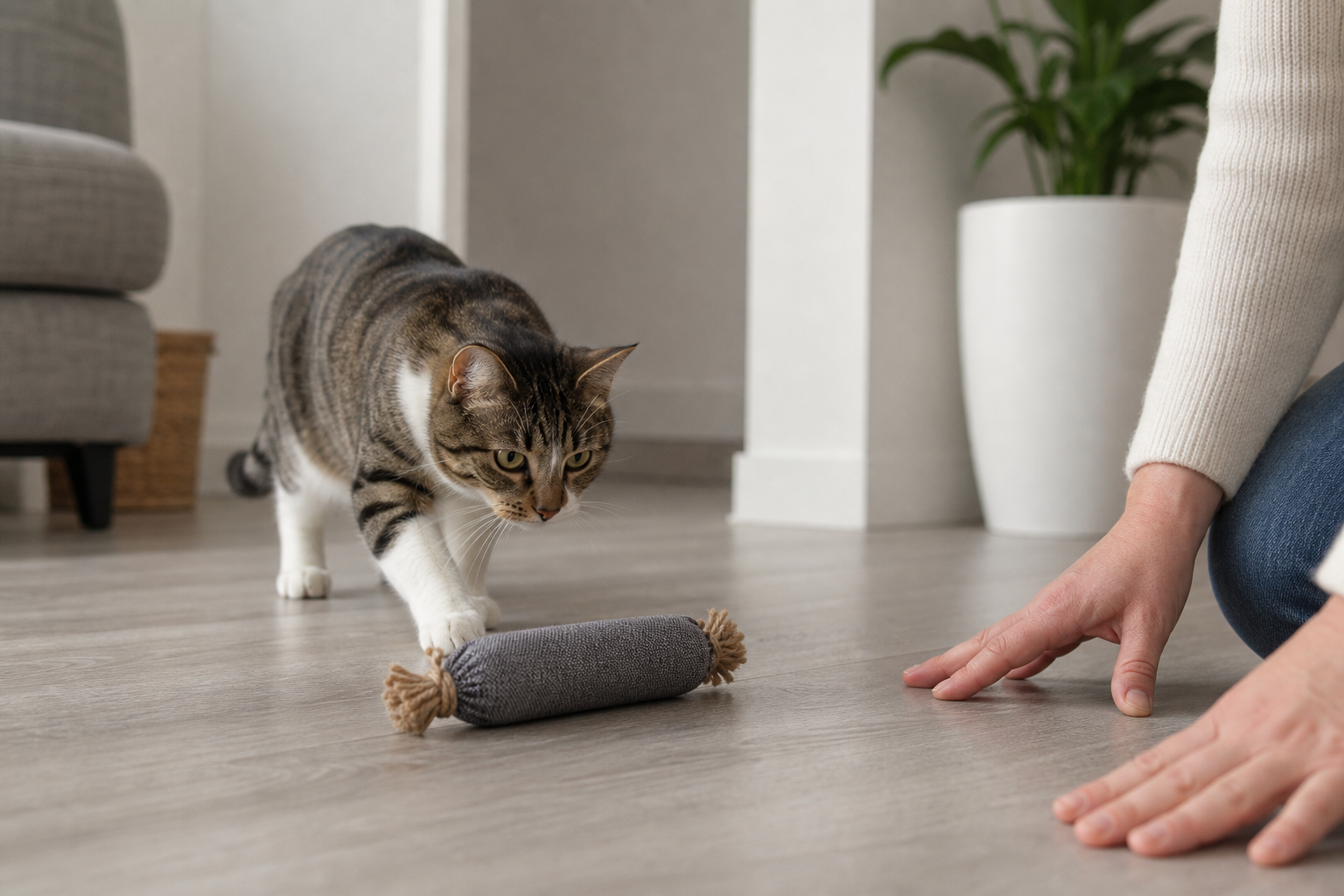
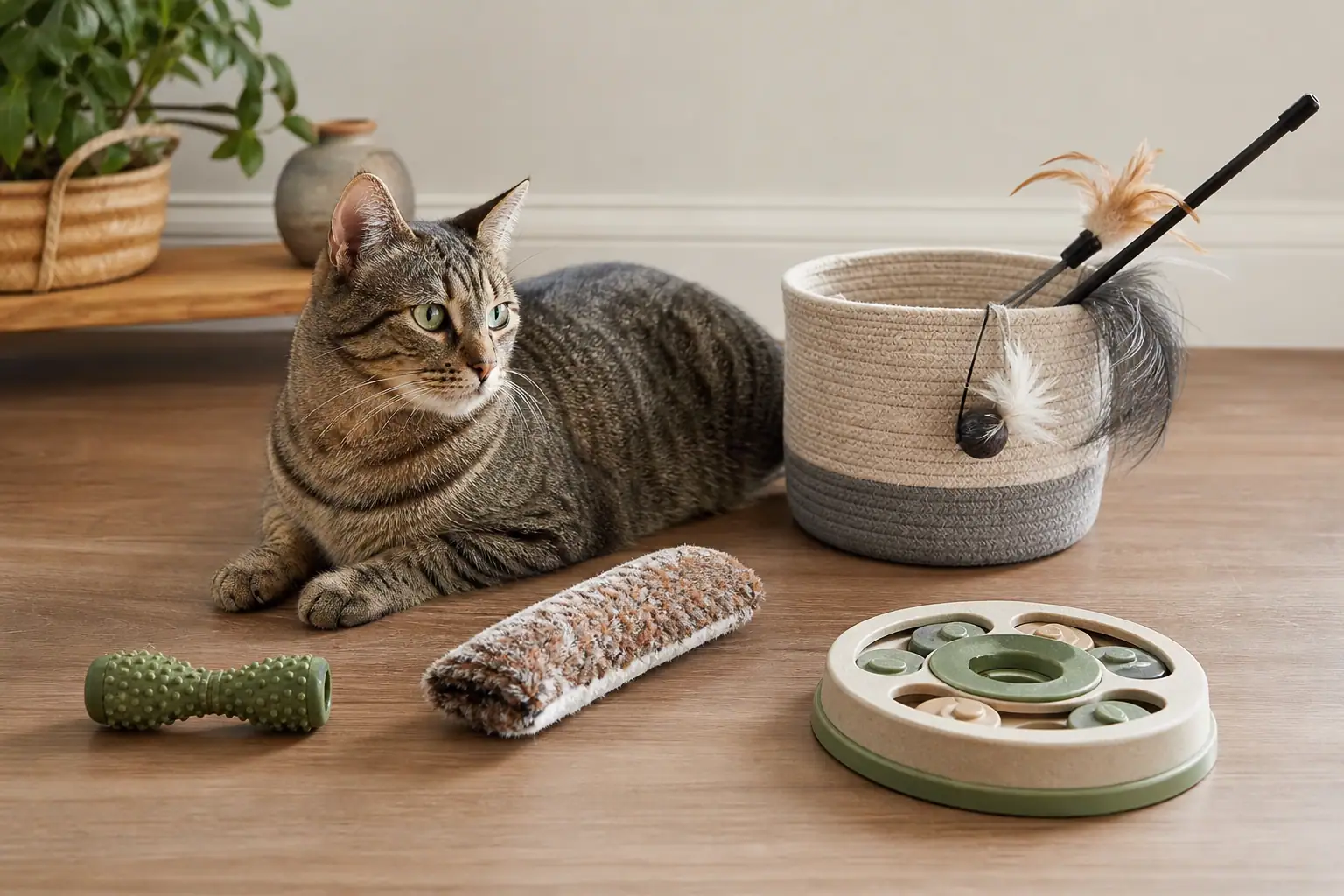
    Start with two short wand sessions each day. Move the lure away like prey, let your cat stalk and catch it, then put the wand away. Add a tough kicker or large fabric toy for grab-and-bite play, and keep a few solo-safe chase toys in rotation. Our guide to choosing safer cat toys for rough play explains how to match toys to chasing, pouncing, chewing, and kicking styles.

    If scratching spikes during high-energy moments, read it as useful information. The cat may need more active play before the usual furniture-scratching window, not another deterrent after the damage starts. For cats that cross into ankle attacks or hand biting, pair this article with durable toys that reduce play aggression and why cats destroy toys.
    When to Replace or Repair a Scratching Post

    A ragged scratching post is not automatically bad. Cornell and ASPCA both note that cats may prefer used posts because they smell familiar and give claws a good grip. Do not throw away a favorite post just because it looks worn.

    Replace or repair the post when wear changes the safety or function. Watch for wobbling bases, exposed staples, sharp broken plastic, loose screws, splintered wood, rope loops that can catch claws, long strands a cat can chew, and cardboard chunks that your cat might swallow. If the post is part of a cat tree, check platforms, bolts, wall straps, and seams too.

    For a cat that hits scratchers hard, inspect the post weekly. If your cat also chews fabric or cardboard, use the stricter toy-bin rule: anything that can come off in the mouth needs to be trimmed, repaired, supervised, or removed.

    Hands inspecting worn sisal rope on a cat scratching post
    Ragged can be useful, but loose rope, sharp hardware, and swallowable pieces need repair or replacement.

    Quick Buying Checklist

    • Orientation: does your cat need vertical, horizontal, angled, or corner scratching?
    • Height: can your cat stretch fully on the post?
    • Stability: does it stay planted when pulled, climbed, or kicked?
    • Surface: does it match the texture your cat already prefers?
    • Placement: can it sit beside the current scratching target at first?
    • Safety: are there no loose ropes, staples, sharp edges, dangling parts, or swallowable pieces?
    • Durability: can it handle your cat’s real strength, not just product-page photos?

    The Bottom Line

    The best cat scratching post is tall enough, stable enough, textured correctly, and placed where your cat already wants to scratch. Choose by behavior first: vertical or horizontal, stretch or rake, sisal or cardboard, furniture corner or hallway marker.

    For cats that destroy ordinary toys, use the post as one part of a bigger enrichment system. Give your cat an approved place to claw, a safe way to chase, a tougher outlet for biting and kicking, and a regular inspection routine. No post or toy is indestructible, but a better setup can protect your furniture while giving your cat a more satisfying indoor life.

  • Interactive Toys for Cats: Safer Play for Bored Indoor Hunters

    Interactive Toys for Cats: Safer Play for Bored Indoor Hunters

    The best interactive toys for cats are the toys that let your cat hunt in a safer, more satisfying way. For most homes, that means a mix of human-led wand play, a few solo-safe chase toys, one food puzzle or treat hunt, and a tougher bite-and-kick toy for cats that grab hard. Automatic toys can help, but they should not replace daily play with you or basic toy safety checks.

    If your cat destroys ordinary toys, choose interactive toys by the job they need to do: chase, pounce, wrestle, chew, forage, or burn off late-night energy. Then decide whether the toy is safe for unsupervised access. A wand with string is interactive, but it belongs in a closet after play. A sturdy ball track may be fine for solo play. A fabric kicker may work for rough play if it is large enough, tightly stitched, and inspected often.

    What Counts as an Interactive Cat Toy?

    An interactive cat toy is any toy that changes the game for the cat. Sometimes the interaction comes from you moving a wand or tossing a toy. Sometimes it comes from the toy itself, such as a puzzle feeder, rolling ball, track toy, motion-activated lure, or treat dispenser. The useful question is not whether the packaging says “interactive.” The useful question is what behavior the toy asks your cat to perform.

    Good interactive toys usually support one part of the hunting sequence: stalking, chasing, pouncing, grabbing, biting, bunny-kicking, carrying, searching, or eating. The AAFP and ISFM feline environmental needs guidelines recommend opportunities for play and predatory behavior, including toys cats can manipulate and food devices that let cats work for part of a meal. That is the heart of a good toy plan for indoor cats.

    For Titan Claws readers, the extra filter is durability. A toy that entertains a gentle cat for months may fail in one session with a strong chewer. If that sounds familiar, start with our broader guide to choosing safer cat toys for rough play, then use the sections below to build an interactive rotation.

    Match the Toy to Your Cat’s Play Style

    Before buying another toy, watch what your cat does when play gets intense. A chaser needs movement. A pouncer needs hiding and surprise. A wrestler needs something long enough to grip and kick. A chewer needs fewer detachable parts. A food-motivated cat may need a puzzle more than another plush mouse.

    • Chasers: wand toys, rolling balls, springs, track toys, and motion toys that move away from the cat.
    • Pouncers: tunnels, crinkle mats, toys hidden under a towel, and lures that vanish behind furniture.
    • Biters and kickers: larger kicker toys with dense fabric, tight seams, and minimal trim.
    • Problem solvers: puzzle feeders, treat balls, snuffle-style mats, and simple food hunts.
    • High-energy indoor cats: scheduled wand sessions plus safe solo toys between sessions.

    This is where many list-style articles fall short. They rank popular toys, but they do not help you diagnose why your cat ignores one toy and demolishes another. For a cat that attacks ankles or shreds small plush, the answer is rarely “more toys.” It is usually a better outlet for the specific behavior that is spilling over.

    Human-Led Toys: The Highest Value Play

    Wand and teaser toys are usually the best interactive toys because you can make them behave like prey. Move the lure away from your cat, pause it, hide it, let it dart, and let your cat catch it. Best Friends Animal Society’s enrichment guidance warns against frantic movements that startle cats and recommends wide, changing motions for wand play. In plain terms: do not jab the toy into your cat’s face. Make it flee.

    For rough players, two short sessions often work better than one long chaotic session. Try five to ten minutes in the morning and again in the evening. End with a catch and a small treat or meal so the hunt has a satisfying finish. If play aggression is part of the problem, pair this with our guide to durable toys that reduce play aggression.

    Wand toys need stricter storage than most owners expect. String, ribbon, elastic cord, feather bundles, bells, and glued-on pieces can become hazards when chewed. Use them while you are present, then put them away. For more detail on that risk, see our teaser wand safety tips.

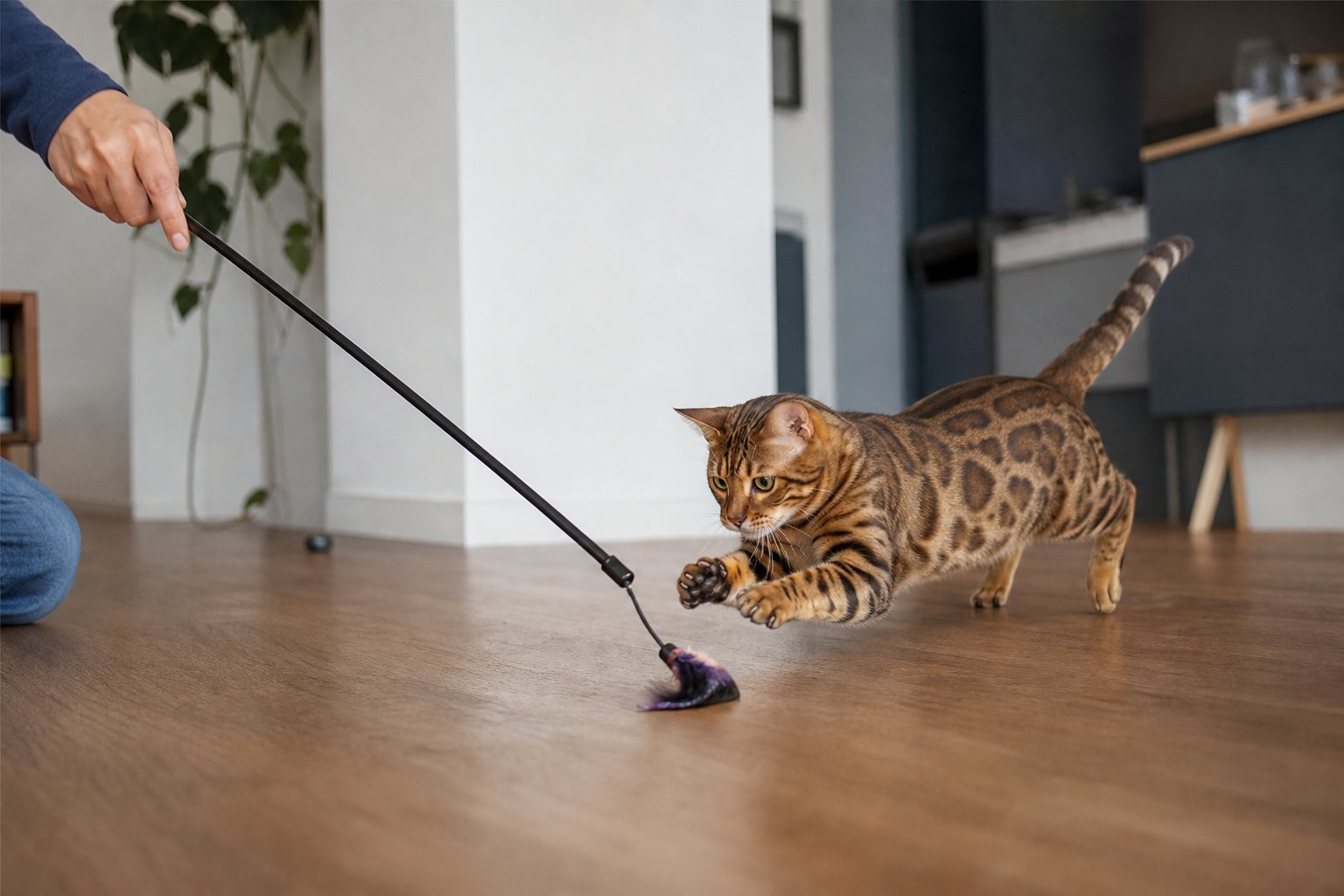
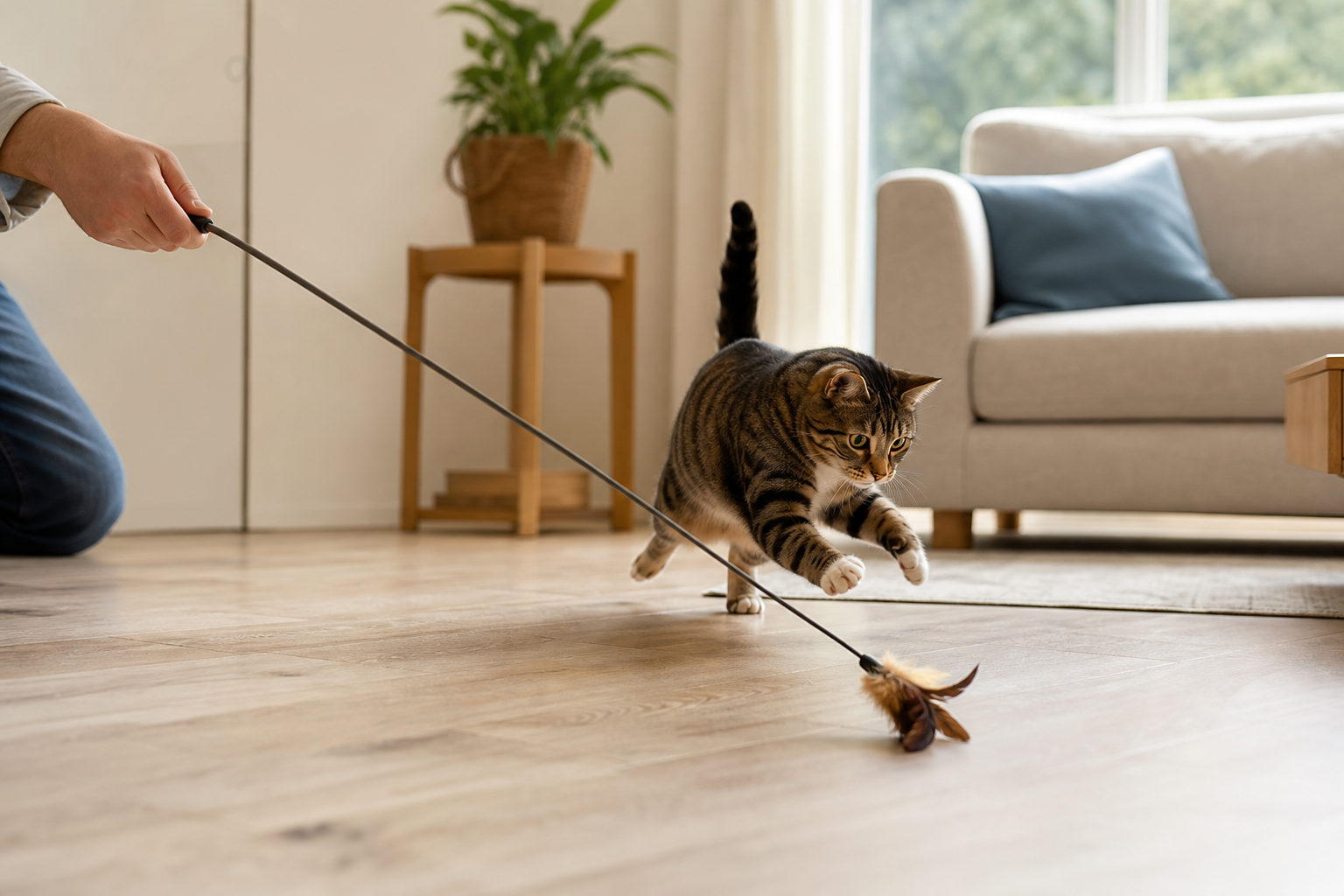
    Cat chasing a wand toy moved away like prey
    Human-led wand play is valuable because you can make the toy move like prey and then store it safely afterward.

    Automatic Toys: Helpful, but Not a Babysitter

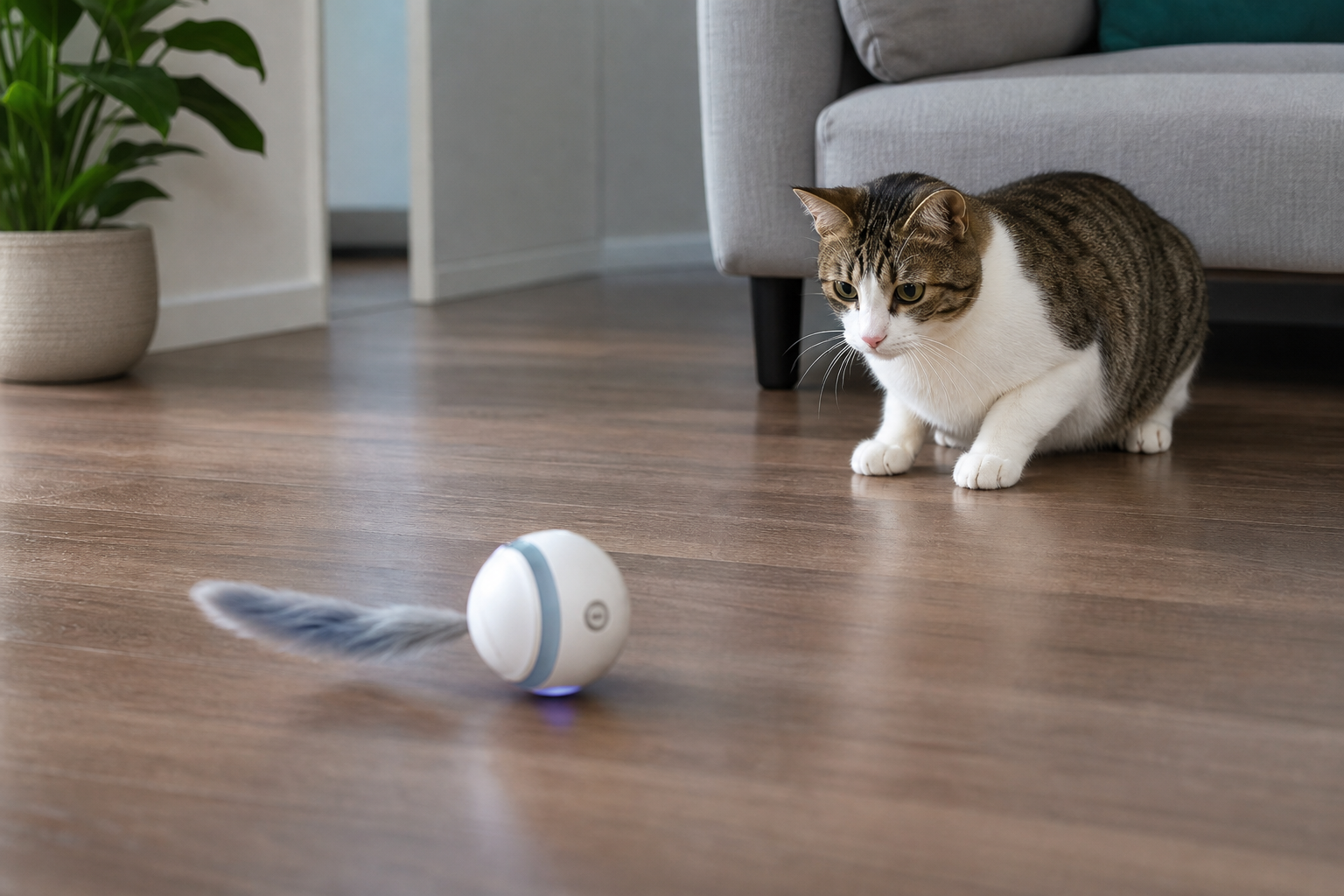
    Automatic interactive toys can be useful for cats that need movement when you are working, cooking, or away for a short stretch. The best candidates have enclosed mechanisms, secure battery compartments, no chewable wires, no loose tails or detachable lures, and an auto-shutoff so the cat does not become overstimulated or bored.

    Use automatic toys as a supplement, not the whole enrichment plan. Some cats love unpredictable motion. Others watch for a minute and walk away. A high-prey-drive cat may flip the toy over and start attacking the weakest part. That does not mean the toy is bad; it means the toy needs supervision until you know how your cat treats it.

    Before leaving any electronic toy out, inspect the shell, wheels, charging port, screws, battery door, and attachments. If plastic cracks, a lure loosens, or the battery area can be opened by teeth or claws, remove it. The safest automatic toy is the one that still looks boringly intact after your cat’s hardest play.

    Puzzle Toys and Food Hunts for Indoor Cats

    Puzzle toys are a strong choice because they turn feeding into work. The Cornell Feline Health Center notes that toys encourage stalking, pouncing, problem solving, exercise, and cognitive enrichment, and it also points out that simple items such as boxes and ping pong balls can be useful when chosen safely. A puzzle does not need to be expensive. It needs to be solvable, stable, and cleanable.

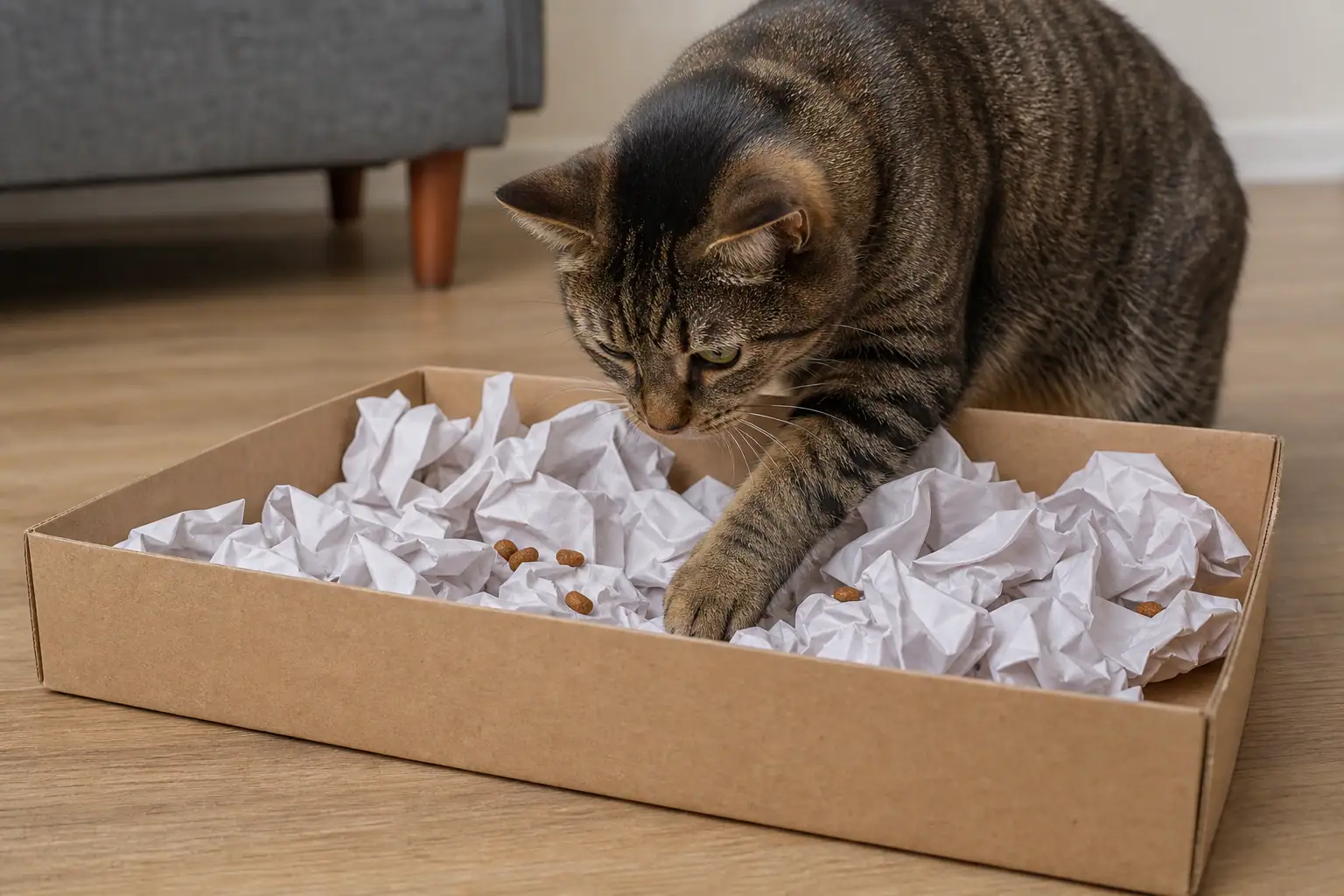
    Start easy. Put a few pieces of kibble or treats in open cups, a low-difficulty puzzle, or a cardboard tube with holes cut into it. Once your cat understands the game, make it slightly harder. If the cat gives up, the puzzle is not enriching; it is just frustrating. If your cat eats too fast, puzzle feeding can also slow the meal and add a calmer job between active play sessions.

    For cats that chew cardboard, supervise homemade puzzles and remove them when they get soggy, torn into small pieces, or covered in tape or staples. For plastic puzzles, check for cracked edges and trapped food. Wash them often enough that they do not become a stale-smelling object your cat avoids.

    Cat using a simple puzzle feeder for indoor enrichment
    Puzzle toys and food hunts give indoor cats a job between active play sessions.

    Rough-Play Rules for Cats That Destroy Toys

    Interactive toys for a gentle cat can have feathers, tiny plush parts, little tails, bells, and decorative trim. Interactive toys for a destroyer need a different standard. Avoid small detachable pieces. Prefer larger toys that cannot be swallowed. Choose simple shapes and stronger fabric over cute details. Check seams after hard sessions.

    Cornell’s safe toys and gifts guidance cautions against small pieces and strand-like parts such as feathers and string that may separate and be ingested. RSPCA Pet Insurance gives similar warnings about string-like or small sharp materials. Those warnings matter most for exactly the cats Titan Claws writes for: cats that bite, pull, shred, and keep going.

    Use this rough-play rule: if a part would worry you if it came off in your cat’s mouth, do not leave that toy out unsupervised. That includes feathers, yarn, ribbons, elastic, bells, plastic eyes, glued trim, dangling tails, and exposed stuffing. Our material-focused guide on what makes cat toys stronger and safer goes deeper on construction choices.

    A Simple Interactive Toy Rotation

    Most cats do better with a small active rotation than a pile of toys that never changes. The AAFP/ISFM guidelines recommend rotating toys to reduce habituation and boredom, and Cornell gives the same practical advice. Rotation also helps owners inspect toys before damage becomes a swallowing risk.

    Try this weekly setup:

    • One supervised wand toy: used daily, then stored away.
    • One durable kicker: offered when the cat wants to grab, bite, or bunny-kick.
    • Two solo-safe chase toys: a track toy, sturdy ball, spring, or oversized toy that has no loose parts.
    • One puzzle or food hunt: used for part of a meal several times a week.
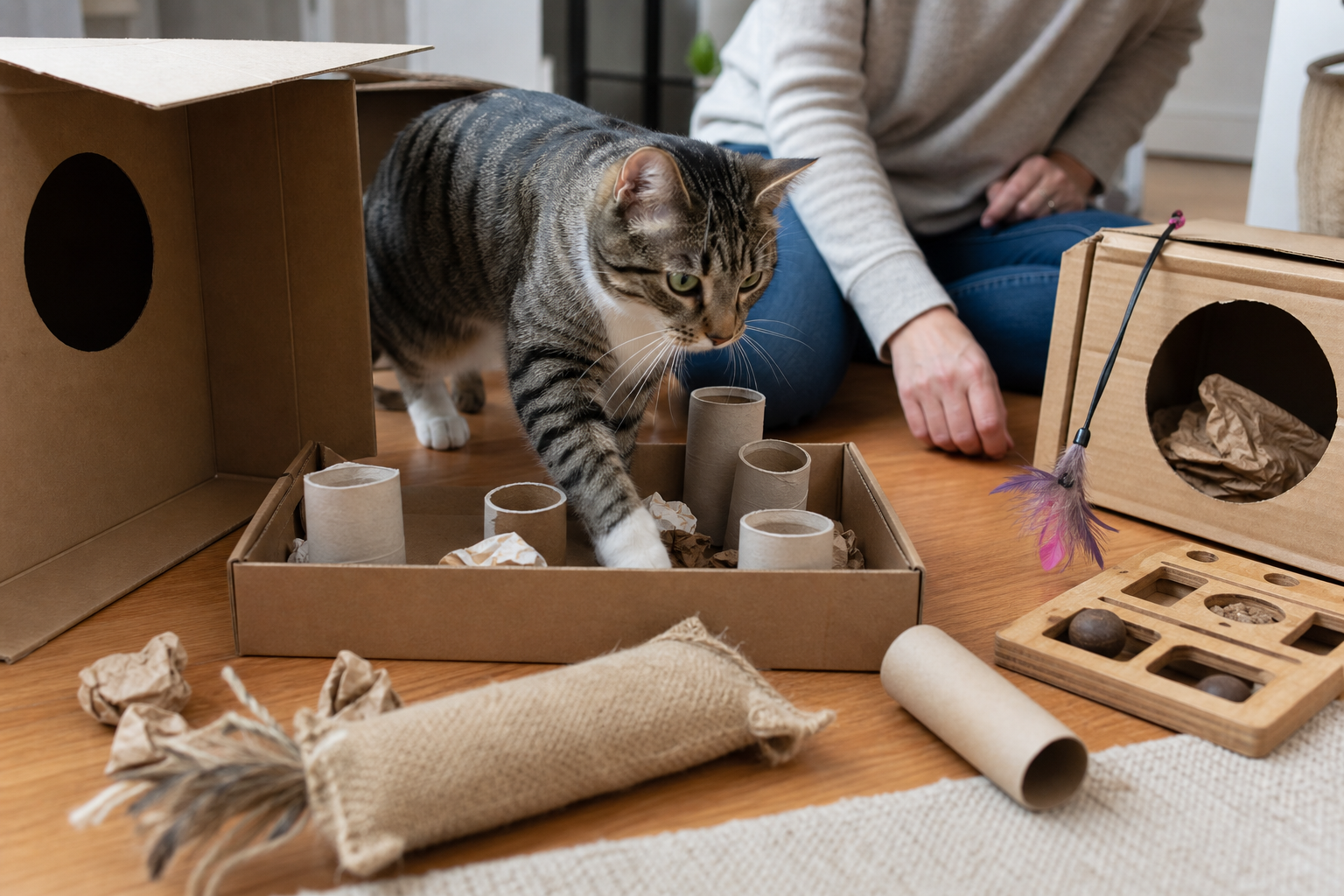
    • One environmental option: a tunnel, box, perch, window view, or paper bag with handles removed.

    Put a few toys away for a week, then bring them back. A toy that felt stale on Monday can become interesting again after absence. More importantly, rotation gives you a natural inspection rhythm: look for loosened seams, exposed stuffing, cracks, missing pieces, and long threads before the toy returns to play.

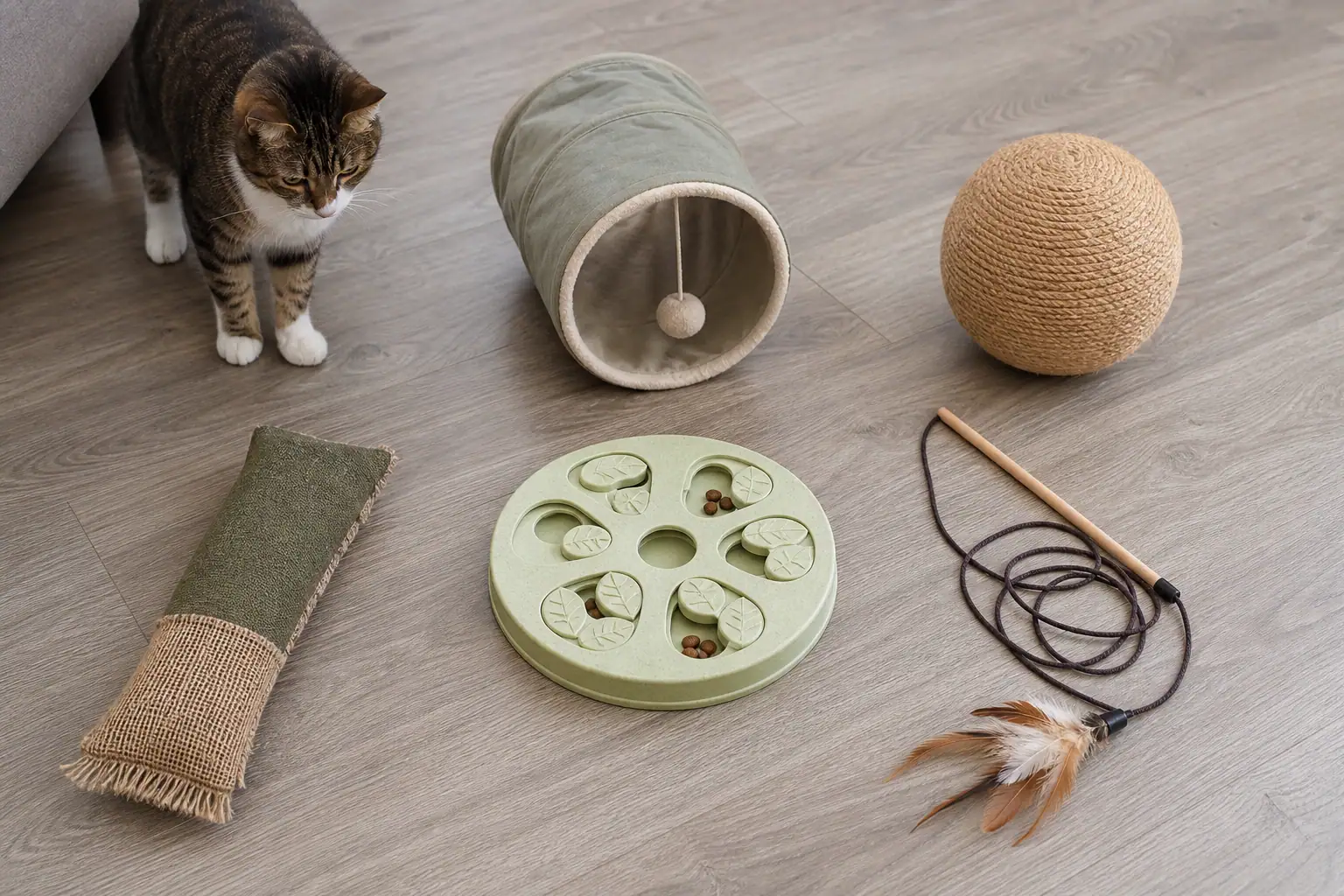
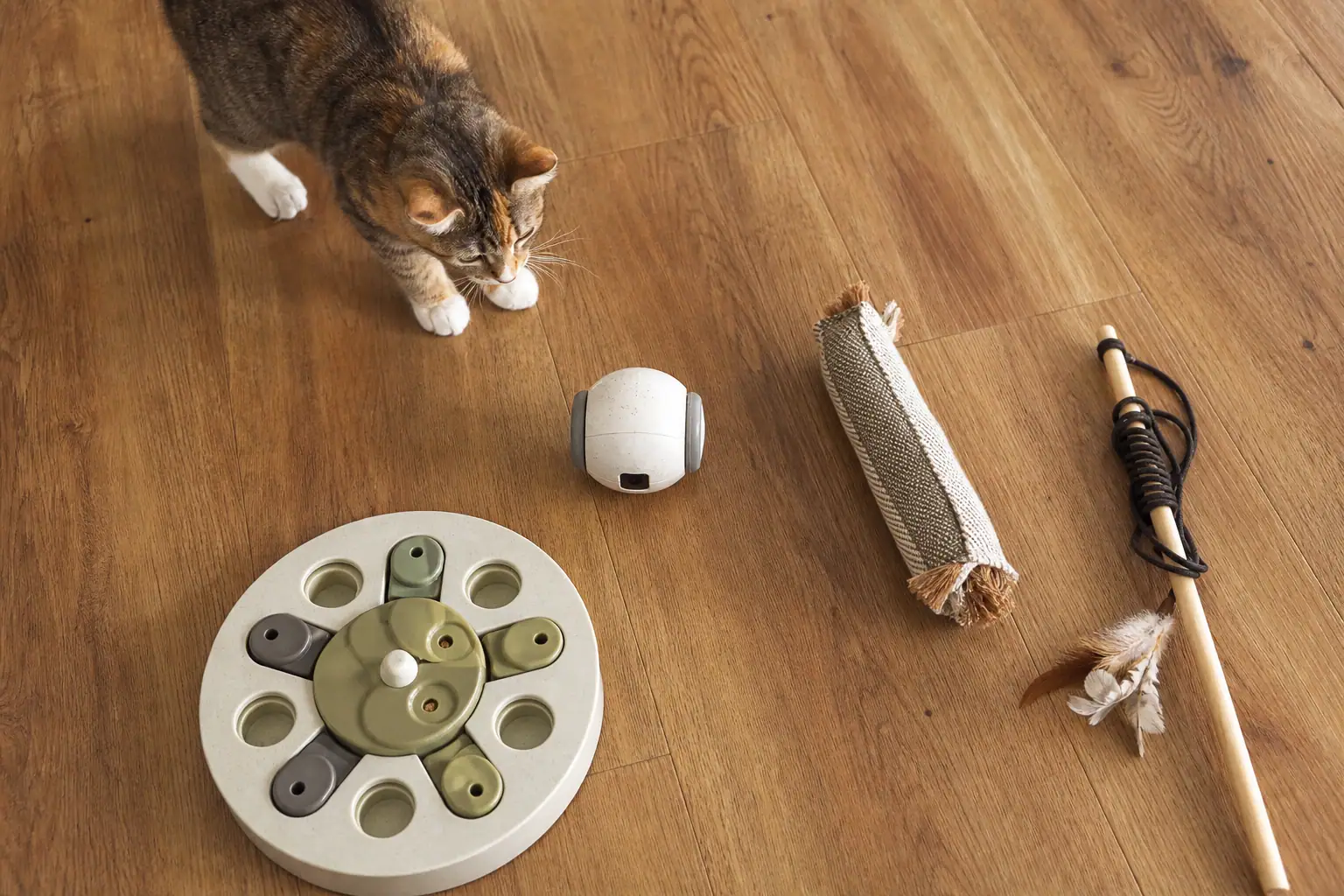
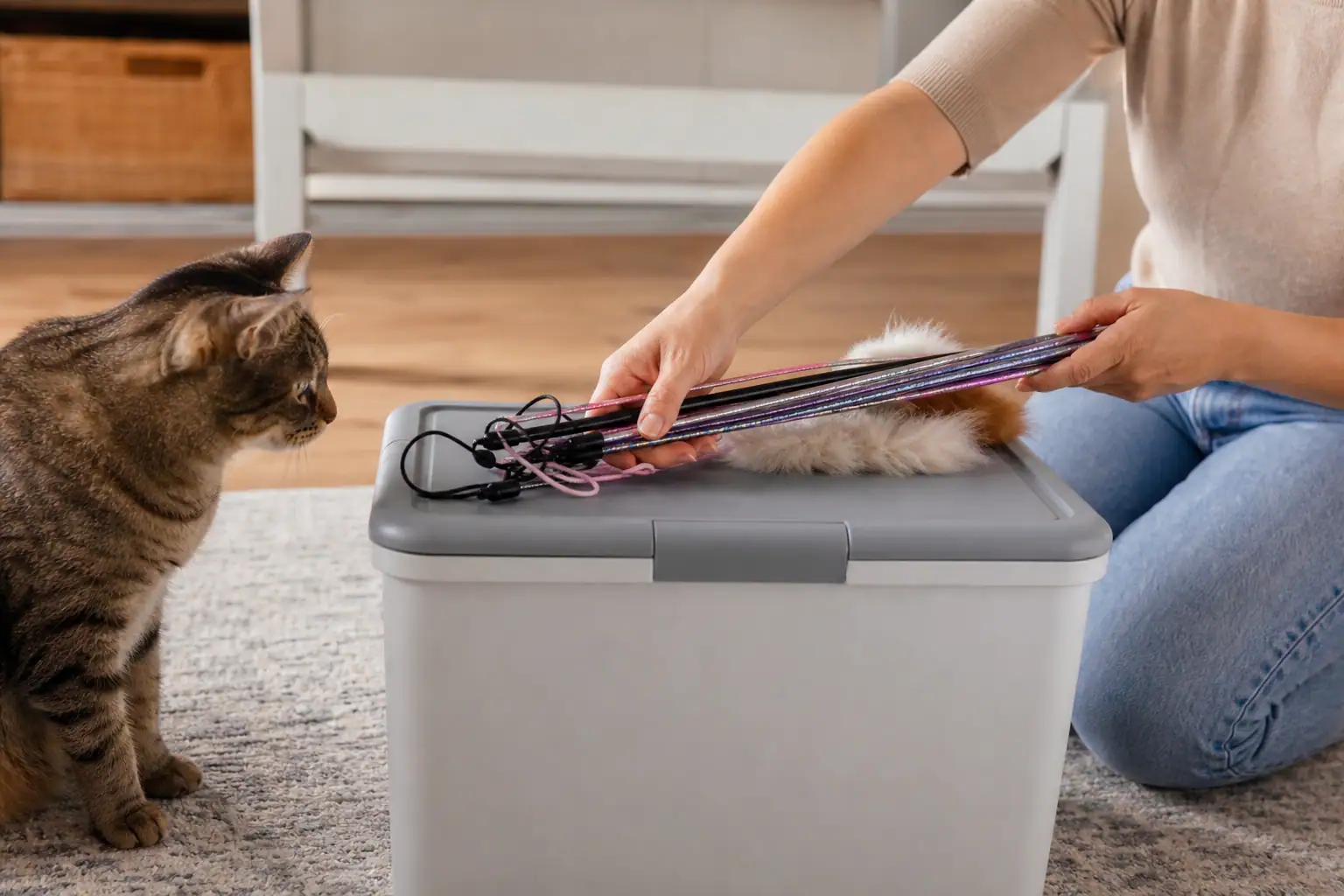
    Small rotation of cat toys including a wand, kicker, chase toy, and puzzle feeder
    A small rotation keeps toys interesting and gives you a regular chance to inspect damage.

    Safety Checklist Before You Leave a Toy Out

    • Is the toy too large to swallow?
    • Are seams tight, with no exposed stuffing or long threads?
    • Are there no feathers, strings, ribbons, bells, plastic eyes, or small detachable parts?
    • If it is electronic, is the battery compartment secure and undamaged?
    • Can the toy be cleaned or replaced before it gets gross or brittle?
    • Does your cat play with it without trying to eat pieces of it?
    • Would you still feel comfortable if your cat played with it for ten minutes while you were in another room?

    If the answer is no, treat it as a supervised toy. If your cat may have swallowed string, ribbon, elastic, a battery, stuffing, a bell, or another toy part, contact a veterinarian promptly. Do not pull visible string from a cat’s mouth or rear. Linear material can become anchored internally, and pulling can make an injury worse.

    The Bottom Line

    Interactive toys for cats should do more than keep a cat busy for a few minutes. They should give your cat a safe way to hunt, chase, solve, bite, and settle. Build the rotation around your cat’s play style, use wand toys with supervision, inspect automatic toys carefully, add puzzle feeding for mental work, and reserve the toughest designs for cats that destroy ordinary toys.

    No toy is truly indestructible. The better goal is a smarter system: active play with you, solo-safe options when you are busy, food puzzles for indoor enrichment, and regular replacement before worn toys become hazards.

  • Cat Toys That Last: How to Choose Safer Toys for Rough Play

    Cat Toys That Last: How to Choose Safer Toys for Rough Play

    The best cat toys are not just the toys a cat attacks first. They are the toys that fit the way your cat hunts, bites, carries, kicks, and rests after play. For a gentle cat, that might be a feather wand and a crinkle ball. For a rough player, it usually means sturdier fabric, fewer dangling parts, bigger chew-safe shapes, and a clear rule: some toys are for supervised play only.

    If your cat shreds ordinary toys, shop by play style before you shop by trend. Match wand toys to chasers, kicker toys to grab-and-bite cats, puzzle toys to food-motivated cats, and tough plush or fabric toys to cats that like to carry prey around the house. Then inspect the toy often. No cat toy is truly indestructible, and the safest setup is a rotation that gives your cat variety without leaving risky strings, feathers, bells, or loose stuffing available overnight.

    Start With the Way Your Cat Hunts

    Cats play in pieces of the hunting sequence: stalk, chase, pounce, grab, bite, bunny-kick, carry, and sometimes eat. A toy works better when it gives your cat one of those outlets without putting your hands, household cords, or fragile objects in the middle of the game.

    For chasers, use wand toys, track balls, springs, rolling toys, or battery-operated toys that move unpredictably. For pouncers, try tunnels, crinkle mats, paper bags with handles removed, and toys hidden partly under a blanket. For biters and kickers, choose a long kicker toy or sturdy plush that is large enough to grip with the front paws and kick with the back legs. For problem solvers, use puzzle feeders and treat hunts that make dinner feel more like foraging.

    The mistake many owners make is buying one popular toy and expecting it to solve boredom. A cat that ignores a plush mouse may still love a wand that moves like a bird. A cat that destroys a feather teaser may be asking for a tougher kicker, not more delicate feathers.

    The Main Types of Cat Toys and When to Use Them

    Wand and teaser toys are best for exercise, bonding, and redirecting play away from hands and ankles. They should usually be put away after the session because strings, cords, feathers, and small attachments can become chewing or swallowing hazards.

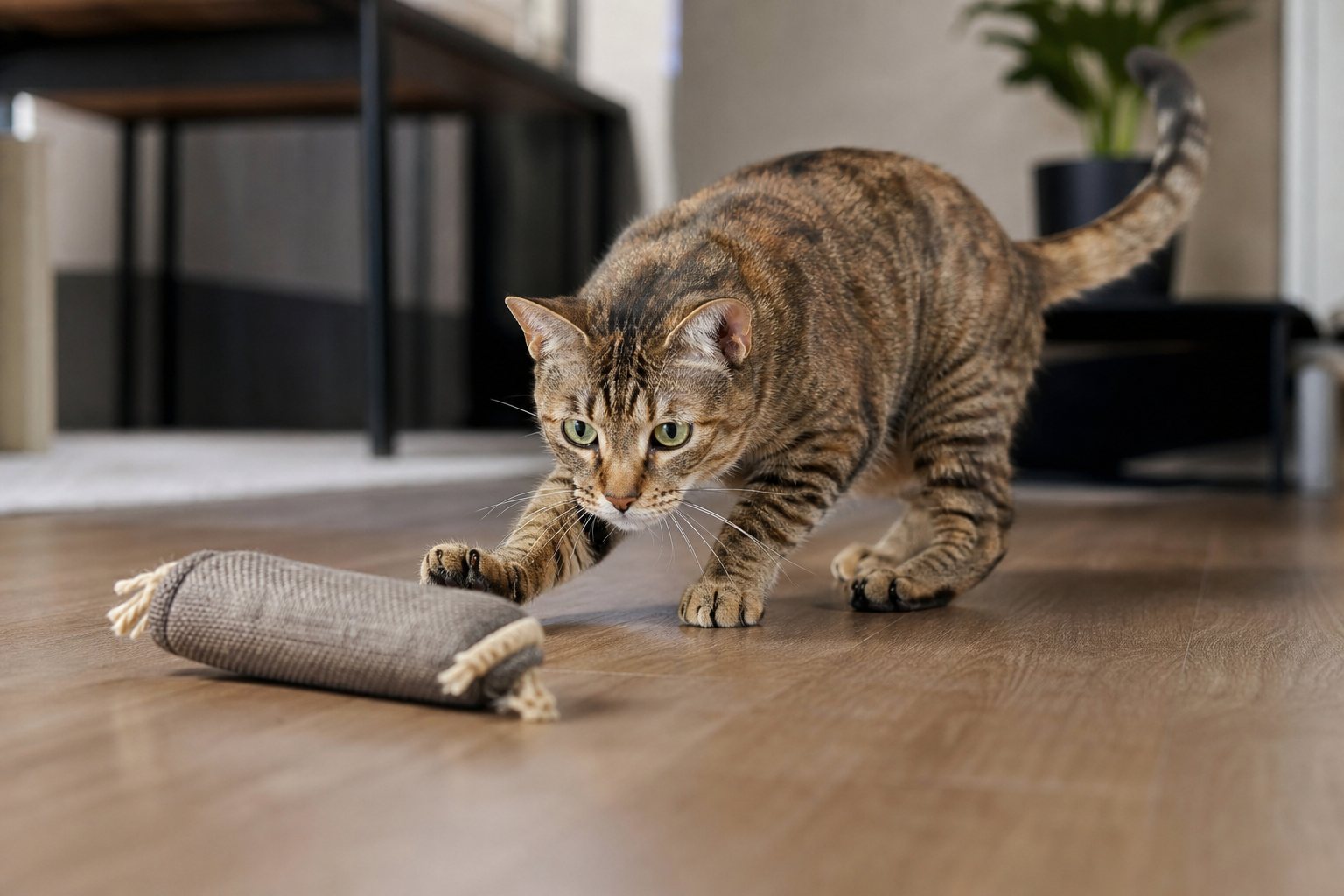
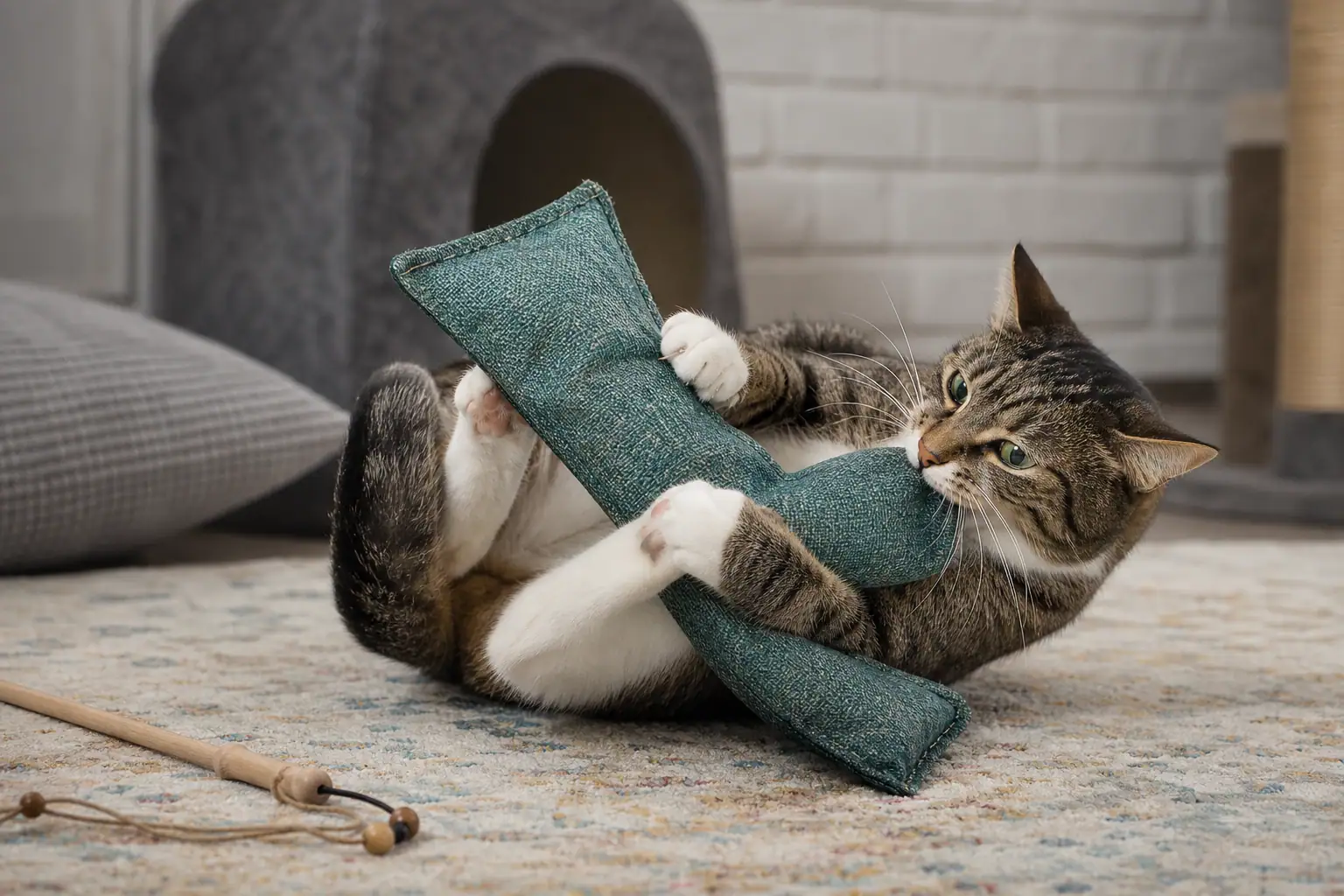
    Kicker toys are useful for cats that latch on and rake with their back feet. Look for dense fabric, reinforced stitching, a shape that is too large to swallow, and minimal decorative pieces. A good kicker lets a strong cat wrestle without tearing into tiny parts immediately.

    Chase toys such as balls, springs, and track toys give cats quick movement. For unsupervised use, favor toys that are too large to swallow, cannot splinter, and do not have detachable bells, pom-poms, or glued-on parts.

    Puzzle toys and food dispensers help indoor cats work for part of their meal. These are especially useful for cats that get bored between human play sessions. Start easy so the puzzle feels solvable, then make it harder once your cat understands the game.

    Electronic toys can be helpful when you are busy, but they need extra checking. Inspect battery compartments, charging ports, wheels, tails, and removable lures. Any battery-powered toy should have a secure compartment and should be removed if the case cracks or the battery area loosens.

    What Makes a Cat Toy More Durable

    Durability starts with construction, not marketing language. Look for tight stitching, smooth seams, layered or heavier fabric, and a body shape that spreads bite pressure instead of concentrating it on a thin tail or glued-on decoration. If a toy has a lure, feather bundle, bell, ribbon, or plastic eye, assume that part will be the first failure point.

    For cats that chew aggressively, simple designs are often safer. A plain fabric kicker can outlast a cute toy covered in trim. A ball track can be safer for solo play than a loose ball that disappears under furniture and gets chewed later. A cardboard box can be better enrichment than a flimsy novelty toy, as long as staples, tape, handles, and loose plastic labels are removed.

    Do not use the word durable as permission to leave a toy out forever. Use it as a reason to expect more play sessions before replacement, while still checking seams and parts after rough use.

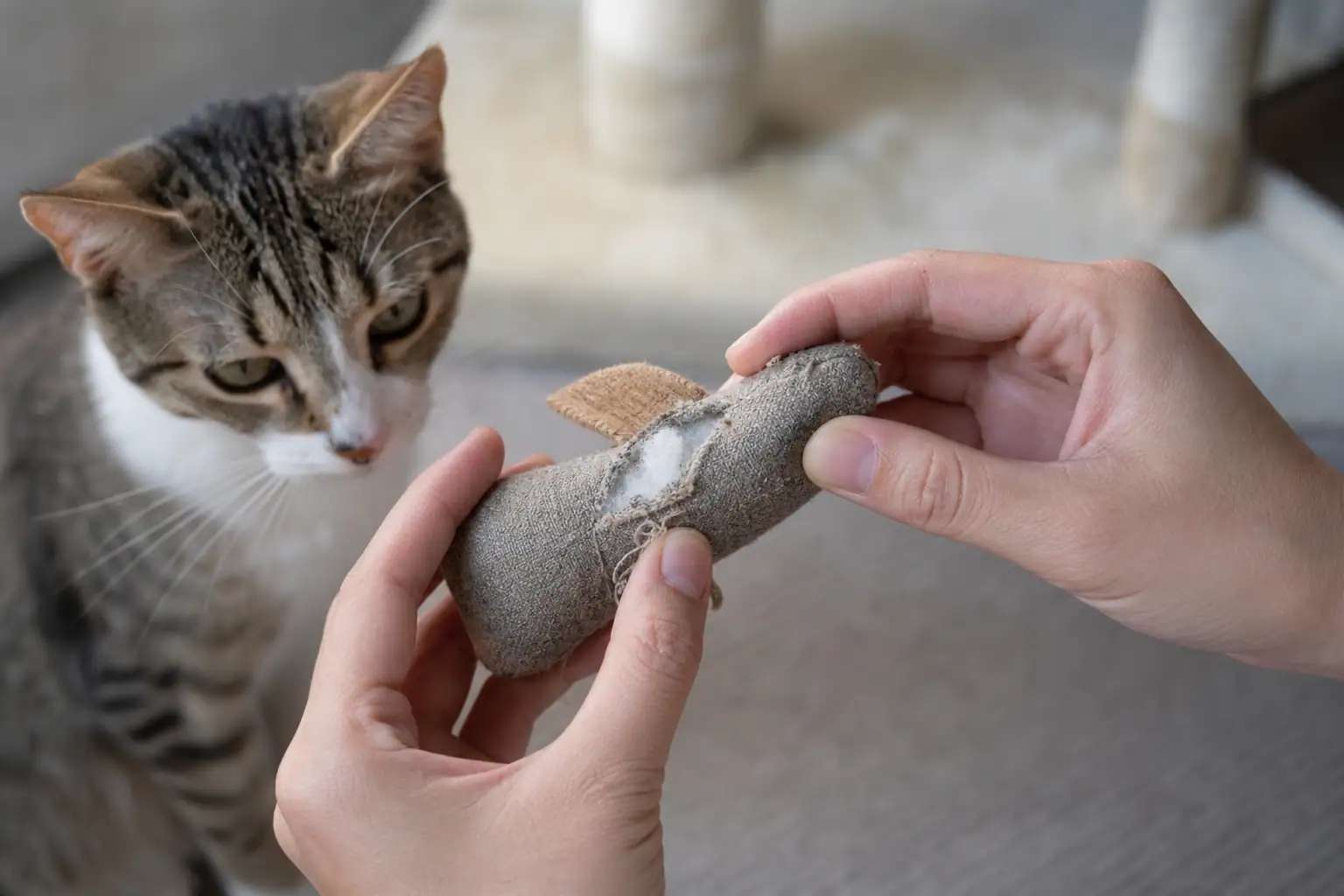
    Hands inspecting a cat toy for loose seams near a curious cat
    Inspect seams, attachments, and stuffing before leaving any toy in the rotation.

    Safety Checks Before You Hand Over a Toy

    Run every new cat toy through a quick inspection before the first play session. Pull gently on feathers, cords, bells, eyes, tails, and tags. If a piece moves easily in your fingers, it may come off in your cat’s mouth. Check that fabric does not shed long threads. Make sure the toy is not small enough for your cat to swallow, especially if your cat carries toys around or tries to eat them.

    • Remove loose tags, loops, and packaging strings before play.
    • Put wand toys, ribbon toys, and string toys away after supervised sessions.
    • Avoid leaving feathers, bells, small plastic parts, or tinsel-like material with a heavy chewer.
    • Check electronic toys for secure battery compartments and cracked plastic.
    • Throw away toys with exposed stuffing, sharp edges, loose seams, or missing parts.

    If you think your cat swallowed string, ribbon, a battery, stuffing, a bell, or another toy part, contact a veterinarian promptly. Do not pull string from a cat’s mouth or rear, because it may be caught internally. Treat repeated toy-eating as a safety issue, not as normal play.

    How Many Toys Does a Cat Need?

    Most cats do better with a small active rotation than a floor covered in every toy they own. Keep three or four solo-safe toys available, then store the rest and swap them every few days. Novelty matters: the same toy often becomes interesting again after it disappears for a week.

    A strong daily mix is one active play session, one solo-safe toy, one scent or food puzzle, and one environmental option such as a box, tunnel, perch, or window view. Indoor cats benefit from both physical movement and problem solving. A cat that tears toys apart may simply need a better outlet for the whole hunt, not just another object to bite.

    A small rotation of wand, kicker, chase, and puzzle toys for indoor cat enrichment
    A small toy rotation keeps play fresh without leaving every toy out all week.

    A Simple Play Plan for Cats That Destroy Toys

    Start with two supervised wand sessions a day, five to ten minutes each. Move the lure like prey: hide it, pause it, let it dart, then allow the cat to catch it. End with a small treat or meal so the sequence feels complete. This often reduces frantic chewing because the cat gets a full chase-and-catch routine instead of constant frustration.

    Next, add one tough kicker for bite-and-kick play. Offer it when your cat grabs your hand, attacks ankles, or redirects excitement onto furniture. Praise the toy choice by keeping the game going with the toy, not your skin. If the kicker starts losing fabric, seams, or stuffing, replace it.

    Finally, use puzzle feeding or hidden kibble for quiet enrichment. Put a portion of the meal in an easy puzzle, a treat ball, or a simple cardboard tube with holes cut into it. The goal is not to make eating difficult; it is to give the cat a safe job.

    When to Replace a Cat Toy

    Replace a cat toy when damage changes the risk. Faded color or flattened plush is usually cosmetic. Loose seams, dangling threads, broken plastic, exposed stuffing, detached feathers, missing bells, and chewed battery compartments are safety problems. For rough players, inspect favorite toys after every hard session and do a deeper toy-bin check once a week.

    It is also worth replacing toys that create bad habits. If a toy teaches your cat to chew string, swallow fabric, or attack hands, retire it and switch to a safer format. Good enrichment should make life calmer and more satisfying, not add a new hazard.

    Quick Buying Checklist

    • Play style: Does it match chasing, pouncing, kicking, chewing, carrying, or foraging?
    • Size: Is it too large to swallow and large enough for your cat’s body type?
    • Construction: Are seams tight, fabric sturdy, and decorations minimal?
    • Supervision: Is this a solo toy or a toy that must be put away after play?
    • Inspection: Can you easily spot wear before it becomes dangerous?
    • Rotation: Does it add something different from the toys your cat already has?

    The Bottom Line

    The right cat toys help your cat move, think, hunt, and relax without turning play into a safety problem. For cats that destroy ordinary toys, prioritize sturdy construction, simple shapes, supervised wand play, safe solo options, and regular inspection. The goal is not to find a magic toy that cannot fail. The goal is to build a smarter toy rotation that keeps rough play satisfying and safer.

  • Why Do Cats Destroy Toys? What It Means and What to Do

    Why Do Cats Destroy Toys? What It Means and What to Do

    Why do cats destroy toys?

    Cats destroy toys because they are doing what cats are built to do: stalk, pounce, bite, claw, and “kill” prey-shaped objects through play. In most cases, shredding a toy is a sign that your cat is engaged, not misbehaving. The toy is often acting as a stand-in for prey, so ripping seams, pulling out stuffing, and carrying the toy around are all normal parts of hunting-style play.

    That said, toy destruction is not always harmless. A cat that tears toys apart can swallow pieces, chew through strings, or expose stuffing, squeakers, or plastic parts that create a choking or intestinal blockage risk. The key is to tell the difference between normal rough play and unsafe wear.

    Think of toy destruction as a clue about your cat’s preferences. Some cats like to bunny-kick plush kickers. Others prefer to shred fabric, chew rope, or disassemble feather toys. Your job is not to stop the instinct. Your job is to channel it into safer play and pick toys that can handle your cat’s style.

    Why toy destruction is usually normal hunting behavior

    When cats attack toys, they are often practicing a complete prey sequence. They may stalk, freeze, chase, grab, bite, and then kick with their back feet. If the toy has a soft body, seams, or stuffing, the cat may rip it open during the “capture” phase.

    Natural cat play often includes:

    • Grabbing with front paws to hold the toy in place
    • Chewing or biting to simulate a kill bite
    • Bunny-kicking with back legs to tear at the toy
    • Shaking small prey-like toys
    • Carrying toys after a successful “hunt”

    This is especially common in younger cats and highly active adult cats. Some breeds and personalities are more intense about play, but any cat can be a serious toy destroyer if the toy matches their prey preferences too well.

    A destroyed toy can mean the toy was a good fit for your cat’s instincts. The goal is not to remove the instinct. The goal is to offer toys that satisfy it without creating unnecessary hazards.

    Common reasons cats rip, chew, and disassemble toys

    Cats do not all destroy toys for the same reason. Often, several factors are working together.

    Prey drive

    The most common reason is simple prey drive. A toy that moves like prey, fits in the mouth, or has feathers, fur, strings, or loose fabric can trigger a strong hunting response. Once the cat “catches” it, the toy may get torn apart.

    Boredom or under-stimulation

    Cats with not enough play, climbing, or enrichment may put more energy into the toys they do have. If the same toy is always available, some cats will also become more intense with it over time. Regular interactive play can reduce destructive over-focus on one item.

    Texture preferences

    Some cats are fabric shredders. Others prefer rope, paper, cardboard, or plush stuffing. If your cat repeatedly targets a certain texture, that preference can help you choose better toys. For example, a cat that loves plush may do better with reinforced stitching and minimal stuffing than with a light toy that opens easily.

    Chewing behavior

    Chewing is not as common in cats as it is in dogs, but some cats do chew toys, cords, and soft materials. This can be a form of play, teething in kittens, or a sign of boredom. If chewing seems excessive or your cat is chewing non-toy items, ask your veterinarian for advice to rule out dental pain or other health issues.

    Frustration during play

    Some cats become rougher if the toy does not “move right,” disappears too quickly, or is too small to hold securely. When play feels unsatisfying, they may bite harder or tear faster. Matching the toy to the cat’s preferred motion and size can make a big difference.

    When destruction becomes a safety problem

    Not all toy damage is equal. A torn toy is not automatically an emergency, but certain signs mean it is time to remove the toy immediately.

    • Loose strings, ribbons, or elastic that can be swallowed
    • Open seams with stuffing coming out
    • Detached parts such as eyes, bells, feathers, or squeakers
    • Small pieces that break off and fit in the mouth
    • Hard plastic edges after breakage
    • Any toy your cat is trying to eat rather than play with

    String-like items are especially risky because they can cause serious digestive problems if swallowed. If your cat has eaten part of a toy, is drooling, vomiting, hiding, not eating, or straining in the litter box, contact a veterinarian promptly.

    It is also wise to separate normal play from over-aggressive chewing. If toy destruction seems sudden, extreme, or paired with behavior changes, pain, stress, or appetite changes, get a veterinary check. Sudden changes in behavior can have medical causes.

    Safely checking toys after play helps you catch wear before it becomes a problem.

    Close view of a cat toy being inspected for loose seams

    How to choose toys for rough players

    If your cat destroys toys quickly, the answer is usually not “buy more of the same.” It is “buy better-matched toys.” Look for construction that fits rough play while still being safe.

    What to look for in tougher cat toys

    • Reinforced seams and tight stitching
    • Durable outer fabric that resists easy ripping
    • Minimal loose trim such as strings, tassels, or glued-on pieces
    • Oversized parts that are harder to swallow
    • Simple construction with fewer breakable attachments
    • Materials that stand up to pouncing and kicking

    For many rough players, the best toys are not the fanciest ones. They are the simplest ones made with better materials and stronger stitching. A well-made kicker toy, for example, can satisfy a cat that wants to grab, bite, and kick without immediately falling apart.

    What to avoid for power chewers and shredders

    • Fragile feathers attached with weak glue
    • Long ribbons or strings left unsupervised
    • Very small plush toys that can be swallowed
    • Toys with detachable eyes or buttons
    • Thin mesh or foil toys that tear easily

    No toy is indestructible, and no cat toy is safe forever. The best approach is choosing durable options, supervising the first few play sessions, and replacing worn items before they become risky.

    For cats that love rough play, rotating in a few sturdy options can keep interest high without overusing one toy.

    Several different cat toys arranged for toy rotation

    How to rotate toys and redirect the behavior

    Toy rotation is one of the easiest ways to reduce destruction and boredom. When all toys are available all the time, they can lose novelty. When toys are rotated, each one feels more interesting and play tends to be more focused.

    Simple rotation plan

    • Keep a small set of toys out at once
    • Store the rest out of sight
    • Swap toys every few days or once a week
    • Include different play styles, such as chase, kicker, and puzzle toys

    Rotation works best when you also use interactive play. Wand toys, for example, let you control the motion so your cat can stalk and chase without immediately shredding the toy itself. End the session with a toy your cat can safely “catch” so the hunting sequence feels complete.

    Redirecting destructive play

    If your cat starts targeting a toy too aggressively, try ending the session before the toy is ruined. Then offer a more suitable option, such as a sturdier kicker or a wand attachment used only under supervision. You can also redirect to puzzle feeding, climbing, or short training sessions if your cat seems restless.

    The goal is not to punish destruction. Punishment can increase stress and make play worse. Instead, offer a better outlet and make the safe option the most rewarding one.

    What to do after a toy breaks

    After a toy breaks, inspect it before leaving it out again. If the damage is minor and does not create a hazard, you may be able to set it aside for supervised use only. But if the toy has loose stuffing, broken pieces, or exposed inner material, it is usually time to discard it.

    When deciding whether to keep or replace a toy, ask:

    • Can my cat swallow any part of this?
    • Is anything sharp, loose, or frayed?
    • Can the toy still be safely supervised?
    • Has my cat already started chewing off pieces?

    If the answer to any of those questions is yes, replace the toy. Do not assume a damaged toy is safe just because your cat still likes it. Cats often prefer the toy most likely to fail, which is why inspection matters.

    A good habit is to keep a small “retire bin” for toys that are too worn for play. That makes it easier to remove damaged items before they become a problem.

    When to ask your vet about toy destruction

    Most toy destruction is normal, but a vet visit is a good idea if your cat’s chewing or shredding seems unusual. Check in with your veterinarian if you notice:

    • Sudden increase in chewing
    • Chewing non-food items like plastic, fabric, or cords
    • Drooling, vomiting, or trouble eating
    • Loss of appetite or weight loss
    • Signs of pain when chewing or playing
    • Behavior changes such as hiding or irritability

    These signs can point to dental disease, gastrointestinal trouble, stress, or other medical issues. A quick check can save you from guessing and help you choose the right next step.

    Quick checklist for safer durable play

    • Accept the instinct: toy destruction is often normal hunting behavior
    • Watch for hazards: loose strings, stuffing, and small parts mean it is time to remove the toy
    • Choose better construction: reinforced seams, simple design, and minimal detachable parts
    • Rotate toys: keep play fresh and reduce overuse
    • Supervise new toys: especially for cats that chew hard or shred fast
    • Replace worn toys promptly: no toy stays safe forever
    • Call your vet if behavior changes or your cat may have swallowed toy material

    In short, cats destroy toys because that is how they play, hunt, and release energy. Your best response is not to fight the instinct, but to guide it with safer, tougher toys, regular rotation, and a quick safety check after each play session.

  • How-to-Choose-Unbreakable-Cat-Toys-for-Heavy-Chewers

    How-to-Choose-Unbreakable-Cat-Toys-for-Heavy-Chewers

    Sick of buying toys that shred in one fling and leave your living room a shower of foam? You’re not alone. It’s the worst when your cat treats a plush like sushi. Check out our guide on Toys to Reduce Play Aggression.

    If your kitty chews like a tiny tiger, pick food-grade rubber (the same stuff used in kitchen spatulas) or solid nylon (hard, chew-proof plastic). Make the toy bigger than their mouth so they can’t swallow it. Think chunky, not dainty.

    Go for solid-molded shapes (one solid piece with no seams), welded metal parts (metal fused so bits won’t come loose), and absolutely no glued-on eyes or decorations. I once watched Luna chew through a plush mouse in five minutes, yikes. Oops, actually, make that avoid any glued bits at all.

    Quick checklist:

    • Material: food-grade rubber or solid nylon.
    • Size: bigger than your cat’s mouth.
    • Build: solid-molded, welded metal, no glued decorations.
    • Fillings: no loose stuffing or beads.
    • Cleanable: washable or wipeable.
    • Replace when torn or chewed through.

    Safety tips: check seams and joints before every play session. Toss toys that fray or split, because tiny bits can be a choking hazard. For string or ribbon toys, supervise play and put them away after, those are great for chase time, not for sleeping with.

    Worth every paw-print. Try a tough, simple toy and watch your cat go full pounce mode, satisfying.

    Quick Buy Checklist: Unbreakable Cat Toys for Heavy Chewers

    - Quick Buy Checklist Unbreakable Cat Toys for Heavy Chewers.jpg

    If you want one safe, durable pick right now, go for food-grade rubber (the kind used for kitchen tools) or solid nylon (a hard, chew-proof plastic) sized bigger than your cat’s mouth. Avoid antlers, rawhide, hooves and other brittle natural chews that can splinter. Skip soft foam that shreds into little bits. For gentler chewers or teething kittens, pick medical-grade silicone (soft, nonporous rubber used in medical gear) or tightly braided cotton (think rope-style weave). Look for solid-molded parts or welded metal components, clear non-toxic or BPA-free labeling, and real customer photos showing how the toy holds up. Then run the quick checklist below on the product page before buying. Ever watched your kitty try to swallow a toy? Don’t let that be a surprise.

    • Choose food-grade rubber or solid nylon (pick a size larger than your cat’s mouth).
    • For softer chewers or kittens, prefer medical-grade silicone or tightly braided cotton (both are less likely to tear).
    • Say no to antlers, rawhide, hooves, and other brittle chews that can splinter and cause injury.
    • No small, detachable parts like beads, stitched eyes, or glued decorations that can come off and be swallowed.
    • Favor solid-molded designs and welded metal components. No glued seams.
    • Confirm non-toxic, BPA-free, or medical-grade labeling on the packaging or product page.
    • Inspect product photos for smooth joints, reinforced stress points, and no exposed cores or visible fillers.
    • Make sure size and weight match your cat’s bite style: not small enough to swallow, not so heavy it hurts their mouth.
    • For plush or fabric toys, pick stuffing-free designs or double-reinforced seams to prevent quick shredding.
    • Favor treat-dispensing or compact, dense shapes made for heavy gnawers and long play sessions.
    • Check the seller’s warranty and return policy. See: Where to Buy/Warranty for terms.
    • Read several hands-on durability reviews and look for real wear photos or video clips from other buyers.

    Worth every paw-print when you pick the right one.

    Materials Comparison for Unbreakable Cat Toys

    - Materials Comparison for Unbreakable Cat Toys.jpg

    Material Durability Score (1–5) Tensile/Tear Test Result Fragmentation Risk Typical Use Cases Average Lifespan (observed)
    Natural rubber (elastic polymer from latex, like a stretchy balloon material) 4 20–28 MPa tensile (MPa = megapascals, a measure of pulling strength); 25–40 N/mm tear (N/mm = newtons per millimeter, how easily a tear grows). Lab: independent field tests with heavy chewers, typical failures were surface gouging and chunk loss. Medium , surface chunks can come off under extreme bite pressure Durable balls, chew rings, treat-dispensing shells 3–18 months (heavy chewers: 3–9 months)
    Food-grade silicone (medical-grade silicone, nonporous and soft but sturdy) 3 6–12 MPa tensile (stretch strength); 10–20 N/mm tear (resistance to ripping). Lab: fatigue bending tests showed hairline tears and edge splitting with repeated stress. Low–Medium, tends to tear before breaking into sharp fragments Teething chewables, flexible treat toys, soft gnaw pieces 1–12 months (kittens and gentle chewers last longer; aggressive gnawers shorter)
    Solid nylon (engineering thermoplastic, a hard dense plastic) 5 50–90 MPa tensile; 40–70 N/mm tear. Lab: puncture and crush tests , failures were mostly edge rounding and rare chipping. Low , mostly wear and tooth abrasion, fragments are uncommon Hard chews, long-life bone shapes, dense puzzle parts 6 months to several years (depends on bite intensity)
    Stainless steel components (corrosion-resistant metal used for cores and attachments) 5 400–600 MPa tensile; shear strength measured in weld tests. Lab: corrosion checks and weld fatigue testing , failures include weld break or corrosion on low-grade alloys. Very Low , metal fragments are rare if welding is done correctly Internal cores, welded attachments, joint reinforcements Years (typical structural parts >3–10 years)
    Braided cotton/linen rope (tight weave natural fibers) 2 30–50 MPa tensile in rope form; 5–15 N/mm tear. Lab: abrasion and pull tests showed fraying and fiber shedding as common failures. High , loose fibers and small bits appear as it wears Interactive tug toys, soft chew outlets, supervised fetch 1–6 months (heavy gnawers at the low end)
    Silvervine (natural chew stick, botanical stimulant that cats love) 2 Less than 1–5 MPa equivalent (organic twig tests); tear not really applicable. Field chew-rate trials showed rapid wear and occasional splintering if the stick is brittle. Medium , small splinters possible with aggressive biting Short-term chew sticks, teething relief, enrichment rewards 1–8 weeks (typical heavy-chewer use)

    Want the full test details and easy home checks? See Safety/Testing/Retirement for test methods and step-by-step home tests.
    Quick tip: if your cat is a heavy chewer, pick nylon or steel cores. If you just need gentle play or teething relief, silicone or silvervine can be fun and safe, um, with supervision.

    Construction & Design Features That Make Cat Toys Truly Tough

    - Construction  Design Features That Make Cat Toys Truly Tough.jpg

    Keep this tight. Look only at photos and label clues that actually show real-world toughness, not marketing fluff. Skip the general buying tips in the Quick Buy Checklist and zoom in on these specific construction details.

    Look for clear visual cues. Double-wall rubber (two-layer shell) means extra bite resistance and a squishy, solid feel when your cat chases it. Welded stainless cores (stainless steel inner rod welded into place) show up where anchors or rings attach, and they stop things from ripping out. Heat-sealed or whipped rope ends (sealed or wrapped to stop fraying) keep fibers from unraveling into a fluff storm. Any mention of ASTM-style testing notes (ASTM, standardized material testing) is a good sign the maker did formal checks. Close-up photos that show material thickness at stress points matter way more than a bold claim.

    Construction & Photo Checklist

    • Double-wall rubber at bite zones, two-layer shell. Example: zoom shows a thick rim around the ball, not a paper-thin lip.
    • Welded stainless cores for anchors or rings, stainless steel inner rod welded into place. Example: you can see the inner rod and a welded end cap, not just glued plastic.
    • Heat-sealed or whipped rope ends, sealed or wrapped ends that stop fraying. Example: rope tips look melted or tightly wrapped, no loose fibers.
    • Visible thickness at stress points like lips, seams, and joins. Thin edges usually mean early failure. Example: zoom reveals a thin seam that would split under tugging.
    • Close-ups of stitching, glue lines, or hollow vents. Big gaps, sloppy glue, or exposed hollow interiors are red flags.
    • Photos or teardown shots that show an interior core. Seeing a core means it’s more likely to survive rough play.
    • Attachments (rings, tags) with welded or molded joins, not flimsy clips that pop off.

    Quick pre-buy photo checklist:

    • Zoom the main seam and every stress point.
    • Hunt for third-party closeups or teardown photos.
    • Inspect seam detail for glue, stitches, or hollow vents.
    • Check if an interior core is shown or visible.
    • Scan attachments for welded or molded joins.

    See Safety/Testing/Retirement for how to validate these cues with simple home checks.

    How-to-Choose-Unbreakable-Cat-Toys-for-Heavy-Chewers

    - Safety, Durability Testing, and Retirement Rules.jpg

    Safety first. Below are easy at-home checks and clear retirement rules you’ll use before, during, and after the first play session so broken bits don’t surprise you or your cat. Think of it as a quick safety ritual , ten minutes that could save a lot of worry.

    1. Visual close inspection – Do this in good light. Look for seams, hairline cracks, soft spots, or anything that looks worn. Run your fingers over attachments and decorations so you can feel weak spots you might not see.
    2. Seam tug test – Give seams and attachment points a firm pull. This finds weak glue or stitching before your cat does. If it stretches or pops, retire it.
    3. Bite-pressure test – Press and twist rubber (elastic material that bounces back) or nylon (tough plastic) with your fingers to look for cracking or stress lines. This mimics a real bite and shows where it might split.
    4. Flex/fatigue test for silicone or rubber – Bend and flex the part repeatedly to reveal tiny fractures. Silicone is a soft, stretchy, rubber-like plastic; this test finds hairline splits that start small then grow.
    5. Fragment probe – Rub a damp cloth over soft surfaces to see if fibers shed or beads abrade. You’re checking for tiny bits that could come off during a chewing spree.
    6. Simulated chew pressure test – Use a safe tool (like pliers with a cloth cover) to press in at likely bite zones on hard toys. That concentrated pressure often reveals weak cores or cracking.
    7. Supervised first play session protocol – Let your cat play for 10 to 20 minutes while you watch closely. Look for loose bits, odd chewing behavior, or fast wear. Take a quick photo or video and note the time so you have a record if you need to decide retirement later.

    Watch for these red flags during tests and play:

    • Visible cracks or hairline fractures.
    • Loose fibers, threads, or fraying that make small pieces.
    • Exposed or broken hard core – metal, plastic, or wood.
    • Sharp, jagged, or pointy edges that could cut gums.
    • Missing chunks, beads, or pieces that can detach.
    • A new, persistent smell or a changed texture after use.

    Replacement-frequency norms for heavy chewers (expect variation):

    • Silvervine sticks (a cat-attracting plant like matatabi) – about 1 to 8 weeks.
    • Braided rope toys – about 1 to 6 months, depending on chew intensity.
    • Solid rubber pieces – commonly 6 to 24 months, depending on play style.
    • Solid nylon chews (hard, durable plastic) – from several months to years, depending on bite force.

    Quick tip: For busy days, toss an unbreakable ball before you head out , that’s ten minutes of safe play. I once watched my cat leap three feet for a rubber ball; worth every paw-print. Check Cleaning/Lifespan for sanitation steps and record keeping, and consult Quick Buy Checklist for immediate red-flag actions before you click buy.

    Cleaning, Care, and Lifespan Expectations for Unbreakable Cat Toys

    - Cleaning, Care, and Lifespan Expectations for Unbreakable Cat Toys.jpg

    Quick scope: this section helps you clean chew toys, sanitize rubber toys, wash rope toys, and set realistic expectations for how long toys usually last. It’s all about keeping playtime safe and smelling fresh without overthinking it. Ever watched your kitty drool all over a toy and wonder if it’s still okay? We got you.

    • After muddy or drooly play, rinse toys with warm water and a little mild soap. Give them a good shake and let them air-dry completely before sending them back into rotation. Your cat will thank you with dramatic head-butts.
    • Do a deeper clean weekly for food-grade rubber (rubber safe for kitchen tools) and medical-grade silicone (soft, nonporous rubber-like plastic used in medical gear). You can use the top rack of the dishwasher or a short boil if the toy’s label says it’s allowed. Don’t toss things in if the maker warns against it.
    • Machine-wash braided rope and fabric toys on a gentle cycle inside a mesh laundry bag (a see-through bag that keeps small items from tangling). Use mild detergent and then air-dry. Hand-wash fragile pieces and lay them flat to dry so they don’t lose shape.
    • Remove and empty treat housings (little compartments that hold treats) before washing. Scrub tight spots and crevices with a bottle brush so crumbs don’t hide and mold doesn’t invite itself over. Let everything dry fully.
    • Store toys dry in a sealed bin and rotate them weekly so each toy gets a rest between sessions. Rotation keeps toys interesting and helps moisture evaporate. Worth every paw-print.
    • After cleaning, do a simple visual wear check only. Look for frayed threads, thinning areas, soft spots, or sharp bits. If you spot damage, follow the steps in Safety/Testing/Retirement.

    Lifespan expectations vary a lot depending on your cat’s chomping style. Soft botanical toys (stuff made from plant fibers) can wear down in weeks. Woven rope toys (cotton or blended strands) often last months. Solid rubber toys usually hold up for many months to a couple years. Dense nylon (a hard synthetic material) can last years for some chewers. My cat once shredded a rope in two afternoons, so yes, it really depends.

    Sanitation checklist: disinfect rubber and silicone weekly if you use them with treats, wash rope toys every 1 to 2 weeks or after they get dirty, and wipe treat dispensers after each use. If cleaning reveals any damage, see Safety/Testing/Retirement before giving the toy back to your cat. Uh, better safe than sorry.

    Best Types and Top Picks for Unbreakable Cat Toys for Heavy Chewers

    - Best Types and Top Picks for Unbreakable Cat Toys for Heavy Chewers.jpg

    Quick note: I cleaned up duplicate how-to bits and moved them into Materials Comparison and the Quick Buy Checklist so you get one clear place for steps and checks. Below are short, handy notes to keep price bands and toy types front and center.

    Category Representative Example Types Typical Price Range
    Silvervine sticks Whole sticks, short chews, stick bundles (silvervine – a plant that attracts cats) $5–$15
    Braided rope toys Tug ropes, braided mice, looped chew rings (tight-weave cotton rope – sturdy cotton twisted tight) $6–$20
    Rubber treat-dispensing Treat puzzles, hollow chew balls, slow-feeders (food-grade rubber – dense, safe rubber used for kitchen items) $12–$40
    Solid nylon chews Bone shapes, rings, dense chews (nylon – hard, durable plastic) $8–$25
    Chew-resistant reinforced fabric Double-layer plush with no stuffing, sewn-in reinforcements (reinforced fabric – extra layers and stitching to resist ripping) $8–$30

    A few quick shopper notes you can drop into Materials Comparison or the Quick Buy Checklist:

    • Example line you can paste: "A $10 silvervine stick gave Luna a week of happy chewing." Short, true, and hits the point.
    • Mini-case: converting a dog rubber ball for your cat – pick one labeled food-grade rubber (non-toxic, used for kitchenware), make sure it’s too big to fit fully in your cat’s mouth, confirm BPA-free or medical-grade labeling, then do a seam and tug check before supervised play. I did that once – checked the label, sized the ball, and my cat batted it for days.
    • Size-fit and proof requests: ask sellers for photos of the toy next to a ruler or your hand, and check for any warranty or return policy before buying. Those tips are folded into the Quick Buy Checklist so you don’t have to hunt for them.

    Safety and shopping basics, short and sweet: choose non-toxic materials, avoid loose stuffing, and supervise new toys for the first few sessions. Ever watched your kitty decide a new toy is their life mission? Yeah, supervise.

    Worth every paw-print.

    Further reading

    How-to-Choose-Unbreakable-Cat-Toys-for-Heavy-Chewers

    - Matching Toys to Cat Age, Chewing Style, and Behavior.jpg

    Match the toy to why your cat chews – teething, boredom, dental pain, or just pure play drive. Add a concise "Match the toy to the chew reason" box into the Quick Buy Checklist or Materials Comparison so shoppers see the picks at a glance.

    • Kitten teething , flexible silicone (soft, food-safe rubber-like material), silvervine (a cat-attracting plant similar to catnip), and soft braided fabric (twisted fibers that give but don’t shred). These feel gentle on new teeth and encourage safe chewing.
    • Young aggressive chewer , solid nylon (a hard polymer used in chew-proof gear) and heavy rubber (dense rubber like you find in tough treat dispensers). Tough, resistant, and built to take a pounding.
    • Nibblers , braided rope (twisted natural or synthetic fibers) and reinforced fabric chewables. Good for light tugging and nibbling without falling apart.
    • Senior cats with dental issues , soft medical-grade silicone (gentle, non-toxic material made for comfort) and supervised chew sticks. Soft textures protect sore mouths; watch them while they chew.
    • Multi-cat household , keep multiple identical durable items and rotate them often. That cuts down on fights and keeps toys interesting.
    • Cat + dog households , choose size-appropriate dog rubber items that are vetted for cat use, and keep an eye on shared toys to avoid accidental swallowing.

    Rotation and pairing guidance has been moved to Cleaning/Care as a one-paragraph practical tip; see the Toys Rotation note there for a quick method and storage cues. It’s a simple swap-and-store routine that stretches toy life and keeps kitties curious.

    For supervised first-play and the stepwise intro protocol, see Safety/Testing/Retirement – we cover the supervised session, retirement triggers, and monitoring steps. Use a short, repeatable intro routine so your cat learns which toys are for chomping and which are for chasing: "This one's for chomping; that one's for zoomies."

    Where to Buy, Price Ranges, Warranties, and Return Policies

    - Where to Buy, Price Ranges, Warranties, and Return Policies.jpg

    Shop where the seller shows material details and real-life durability photos. Brands and specialty shops that post clear return rules are usually the safest. Spending a little more often means a toy that lasts longer, especially if your cat is a super chewer.

    • Direct from the manufacturer – look for lifetime or durability guarantees. Typical prices: $8 to $40 depending on materials. Verify the written warranty and ask what counts as a defect. If they list materials, check for things like polymer (a tough plastic mix) or puncture-proof fabric (woven to resist claws).
    • Specialist chew-toy retailers with hands-on testing – stores that publish field reviews and wear photos. Prices: $5 to $40. Look for independent testing notes and before-and-after photos so you know real-world performance.
    • Vetted marketplaces with customer photo reviews – search buyer photos and videos before you buy. Prices: $5 to $40. Make sure there are multiple hands-on reviews and good seller return ratings.
    • Local pet stores – you can touch the seams and feel the fabric before you buy. Prices: $5 to $40. Ask to see labels, ingredient lists, and packaging claims in person.
    • Vet-recommended brands – ask your clinic for their favorites, especially if dental safety matters. Prices: $8 to $40. Verify any clinical approval or dentist-tested claims and ask what tests were done.
    • Subscription boxes for chewers – curated durable items delivered on a schedule, good for rotation and boredom-busting. Monthly cost: $10 to $35. Check replacement policies and look for sample photos from other subscribers.

    When you contact customer service, ask these exact things: does the warranty cover chewing damage or only manufacturing defects; how long is coverage; what proof do you need – time-stamped photos, video of first play, or the receipt; and what is the return window plus who pays shipping. Keep your purchase receipt and the original packaging. Take a short video during the supervised first play and timestamp it. That little clip is gold when you file a claim.

    If you need to make a claim, present a clear timeline, your photos and the test video, and any notes from your own safety testing or retirement inspection (like when you decided the toy was worn out). For a quick pre-buy check, see the Quick Buy Checklist for the single warranty pointer you should never skip.

    Ever watched your kitty attack a new toy like it owes them rent? Yeah, me too. Little prep up front saves fuss later, and your cat gets more play time that actually lasts. Worth every paw-print.

    FAQ: Common Questions About Choosing Unbreakable Cat Toys for Heavy Chewers

    - FAQ Common Questions About Choosing Unbreakable Cat Toys for Heavy Chewers.jpg

    Are "indestructible" toys real?
    Short answer: no. There’s no toy that’s truly indestructible, but some last a lot longer than others. See Safety/Testing/Retirement for how we judge real-world toughness and when to retire a toy. Retirement (taking a toy away when it’s chewed or cracked) keeps your cat safe.

    Which materials perform best for heavy chewers?
    Check [Materials Comparison](Materials Comparison) for the full tested rankings, notes, and failure modes (how things break). In general, look for thick rubber or hard polymers (types of plastic), tightly woven puncture-proof fabric (strong nylon), and solid metal parts where appropriate. We explain each material there and show what to expect if it starts to fail.

    Can I use dog chew toys for my cat?
    Sometimes, yes. But size matters, and so does labeling. See How-to-Choose and [Materials Comparison](Materials Comparison) for tips on sizing, non-toxic labeling (means the product is made from materials safe if chewed), and avoiding toys with small or detachable parts that could come off when your cat chews.

    Where should I report an unsafe product?
    Start with the seller or the marketplace where you bought it. If that doesn’t resolve things, escalate to consumer protection agencies or the manufacturer. See [Where to Buy/Warranty](Where to Buy/Warranty) for links and warranty tips. Below is a quick copy-paste script and a simple checklist to make reporting faster.

    Sample reporting script (copy-paste):
    "Hi, I purchased [product name/model] on [date]. Attached are time-stamped photos and a short video showing the defect or damage during supervised use. Please advise on refund or recall steps."

    Required evidence checklist:

    Item
    Photo of the product with visible damage and a clear date or timestamp
    Short video (10–30 seconds) showing the failure during supervised use
    Proof of purchase (receipt, order number, or screenshot)
    Photo of the product label, model or lot number, and packaging
    Your contact info and a brief note about any pet injury

    Quick tip: keep one safe spare toy to swap in while you report or replace a damaged one. Ever watched your kitty fang the air after a broken toy? Not fun. Keeping toys in rotation helps them last and keeps playtime safe.

    Final Words

    If you need a buy-now answer: use the quick 12-item checklist, pick food-grade rubber or solid nylon, skip antlers and rawhide, check photos for smooth seams, and confirm warranty and return terms.

    Then use the materials comparison and photo/label cues to screen options, and run the seven-step home tests during that first supervised play session.

    Follow the toy-matching tips, clean on the schedule, and read hands-on reviews so you know how to choose unbreakable cat toys for heavy chewers. Worth every paw-print.

    FAQ

    Best how to choose unbreakable cat toys for heavy chewers?

    Pick food-grade rubber (durable, flexible) or solid nylon (tough plastic-like), choose a size larger than your cat’s mouth, and avoid antlers or rawhide.

    Cat Chew Toys for Aggressive Chewers — What is the best thing for aggressive chewers?

    Use solid nylon chews or heavy-duty food-grade rubber, and add active play and toy rotation to redirect gnawing.

    Can I use dog chew toys for my cat?

    Yes if the toy is sized to prevent swallowing, labeled non-toxic (BPA-free), has no small detachable parts, and you vet it with a quick safety checklist and tests.

    How do I test a toy’s durability at home?

    Do a close visual inspection, seam-tug and bite-pressure checks, flex/fatigue bends, a fragment rub test, then a short supervised play session watching for cracking or shedding.

    What signs mean a toy should be retired?

    Retire a toy if it has visible cracks, loose fibers or threads, exposed or broken cores, sharp jagged edges, missing chunks or beads, or a persistent odd smell or texture change.

    Cat chew toys for pica — what should I do?

    Get a vet check, remove dangerous items, offer safe alternatives like braided cotton and medical-grade silicone, and supervise chewing until behavior improves.

    Cat chew toys for teething — What to give teething kittens?

    Give medical-grade silicone, silvervine sticks, and braided fabric chews; keep sessions short, supervise closely, and rotate toys to limit wear.

    Rubber chew toys for cats — are rubber chew toys safe?

    They are safe when made of food-grade rubber, solid-molded with no glued bits, BPA-free, sized to avoid swallowing, and cleaned per the maker’s instructions.

    OrkaKat Wiggle Worm — is it good for heavy chewers?

    The OrkaKat Wiggle Worm is a soft teaser for swatting and light chewing; it’s fun but not built for heavy gnawers—use it supervised and pair with tougher chews.

    Chewy cat toys for indoor cats — what should I pick?

    Choose treat-dispensing rubber toys, braided rope, interactive teaser wands, and washable fabric options; rotate items and favor easy-to-clean materials.

    What annoys cats the most?

    Sudden loud noises, forced handling, prolonged staring, abrupt routine changes, and strong citrus or chemical smells—watch tail flicks, flattened ears, and vocal warnings.

    What is the absolute best cat toy?

    The best toy matches your cat’s play style—often an interactive teaser wand for chasing, or a durable treat-dispensing rubber ball for solo chewing.

    Cat chew toys for aggressive chewers reddit — can Reddit help?

    Reddit can provide starting recommendations, but verify durability photos, material labels, and seller warranty; cross-check picks against your safety checklist and testing steps.

    Where do I report unsafe or defective pet toys?

    Report to the seller and marketplace, keep photos and video, contact the manufacturer, and file with consumer protection or pet-safety groups if needed for warranty or safety claims.

  • How to Choose Unbreakable Balls for Multi-Cat Households

    How to Choose Unbreakable Balls for Multi-Cat Households

    Think every cat ball can survive a house with three determined stalkers? Nope.

    My two turned playtime into a tiny obstacle course: feathers pulled off, seams split, and the little sparkly eyes swallowed by the couch. Ever watched a furry missile launch across the living room? It’s loud, messy, and kind of hilarious.

    Picking a really tough ball is easier than it sounds. Read the material label , look for polymer (a kind of hard plastic), rubber, or fiberglass (like a strong fishing-rod core) , and check for reinforced seams (extra stitching or tape) and chew-resistant fabric (tight weave that won’t rip). Also trust chew-resistant claims, but match the ball size to each cat so nobody can choke or hog the toy.

    Do that and toys last longer, scuffles calm down, and everybody gets a fair chase. For busy days, toss an unbreakable ball before you head out – ten minutes of safe play and a much quieter home. Worth every paw-print.

    How to Choose Unbreakable Balls for Multi-Cat Households

    - Quick checklist to choose unbreakable balls that work in multi-cat homes.jpg

    Top three things to check: clear material labels, chew and puncture resistance, and the right size for each cat. Think of it like picking shoes for a busy household , comfort, toughness, and fit matter.

    1. Look for non-toxic and BPA-free labels on the box or product page. BPA-free means the plastic won’t leach nasty chemicals into your home.

    2. Buy one to two balls per cat. Multi-packs save money and stop fights over the same toy, especially when your house turns into a feline traffic jam.

    3. Verify a seam-strength or reinforced-seam claim before you buy. A seam (where two parts join) is often the first place to split, so scan product photos for visible stitching or molded joins.

    4. Favor chew-resistant or puncture-proof claims and double-check what real users say about breakage. Chew-resistant usually means tougher materials, like polymer (a tough plastic) or reinforced rubber.

    5. Match ball diameters to your cat: kittens about 1.0–1.5 in (25–38 mm); adult cats about 1.5–2.5 in (38–64 mm); large breeds about 2.5–3.5 in (64–89 mm). Big enough to avoid swallowing, small enough to be batted across the floor.

    6. Pick low-noise or foam-core balls for hardwood floors or shared spaces. Foam-core (a soft foam center) or felt balls keep noise down; use high-bounce rubber for carpeted chase sessions.

    7. Choose washable or dishwasher-safe toys for easy cleaning and check the label for care instructions. Nobody wants a smelly toy after a week.

    8. For battery-powered balls, confirm the enclosure is sealed and tamper-proof so batteries aren’t easy to access. Sealed means you or your cat can’t pop the battery door open mid-play.

    9. Reject toys with glued-on decorations or any bits that look like they could peel off. Tiny bells, beads, or glued eyes are choking hazards, so avoid them.

    10. For treat-dispensing balls, check hole size so kibble comes out but paws don’t get stuck. You want playful snacking, not a vet visit.

    11. Read the warranty and return policy closely. See whether the company covers chew damage or just factory defects, and prefer sellers who handle photo claims quickly.

    12. Do a quick durability check when you buy: inspect seams, squeeze to feel wall thickness, and fail any ball with gaps or thin spots. If it feels flimsy in-store, it’ll feel worse after a week of pouncing.

    Use this checklist when you’re comparing specs, reviews, and ratings in-store or online. Happy hunting , and may your floors be full of well-behaved, unbreakable joy.

    Materials and safety: narrow material guide and labeling to check before purchase

    - Materials and safety narrow material guide and labeling to check before purchase.jpg

    Before you buy a toy, give it a quick safety check. Think like a picky cat parent: you want something that survives a few zoomies and chews, not a shredded mess. Ever watched your kitty win a tug-of-war with a flimsy toy? Yeah, don’t buy that again.

    Look for these materials , they hold up best:

    • Food-grade silicone (soft, food-safe rubbery polymer used in kitchen tools). It’s squishy, easy to clean, and gentle on teeth.
    • Solid rubber (dense natural or synthetic rubber). Feels firm under a paw and resists punctures.
    • Polyurethane (tough, plastic-like polymer). Durable and often used in long-lasting pet gear.
    • Foam-core rubberized (soft foam center with a durable rubber skin). Gives a nice bounce without falling apart.

    Avoid brittle plastics, ceramics, or glass. Those can crack and make sharp bits. Also skip toys with glued-on decorations, scented coatings, toxic dyes, or paint that can flake off during play. If your cat can pull it off, they will.

    Battery-powered toys need extra attention. Look for sealed compartments with tamper-resistant screws or access that requires a tool. If the battery door is loose or wiring shows, put it back on the shelf. The ASPCA has a useful guide on toy-safety labeling and red flags: https://www.aspca.org/pet-care/general-pet-care/choosing-safe-toys-pets.

    Label examples to look for:

    • "Sealed compartment; tamper-resistant screws; tool required."

    Read material claims like a detective. "Non-toxic" should point to tests. "BPA-free" should be specific. "Food-grade silicone" means it meets food-contact standards. Check for dishwasher-safe max-temperature markings and any seam-strength or reinforced-seam claims. Prefer toys that publish manufacturer or third-party durability testing instead of fuzzy marketing words like "super tough" with no proof.

    Claim examples that make you nod and relax:

    • "Non-toxic: third-party tested"
    • "BPA-free" on the spec sheet

    I once bought a cute plush that looked indestructible and my cat turned it into confetti in ten minutes. Oops, lesson learned. Now I pick toys that list real tests or clear material specs.

    Worth every paw-print.

    Size, weight and bounce: concrete ranges to match each cat and room

    - Size, weight and bounce concrete ranges to match each cat and room.jpg

    Size really matters. For kittens, aim for about 1.0-1.5 in (25-38 mm); adult cats do best around 1.5-2.5 in (38-64 mm); and large breeds or extra-big options work at 2.5-3.5 in (64-89 mm). Do a quick jaw-width check: if your cat can almost close its mouth around the ball, pick the next size up to avoid any swallowing risk. Ever watched a kitten try to gulp a toy? Yeah, not great.

    Think about weight and bounce based on how your cat plays. For quick flicks and batting, choose balls under 15 g; for balanced rolling and fetch, go with 15-40 g; and for push toys that resist flying under the couch, pick over 40 g. High-bounce rubber (bouncy elastic material) cranks up the chase, while foam-core (soft foam center) or low-bounce silicone (soft, rubbery polymer) gives gentler, slower play that’s kinder to kittens and seniors.

    Match the ball’s bounce to your floors and noise tolerance. Hardwood and shared living spaces do best with quiet, low-bounce or rubberized balls that roll without clatter. Carpeted chase zones love springy, high-bounce rubber for thrilling sprints. Want peace during nap time? Keep low-bounce options out for everyday play and save the high-energy bouncers for supervised sessions. My cat once launched a high-bounce ball across the living room. Oops, chaos and giggles.

    Worth every paw-print.

    Cat category Recommended diameter (in / mm) Best weight & bounce
    Kittens 1.0-1.5 in / 25-38 mm Light, under 15 g; low- to mid-bounce (gentle)
    Adult cats 1.5-2.5 in / 38-64 mm Midweight, 15-40 g; mid- to high-bounce for chase
    Large breeds / seniors 2.5-3.5 in / 64-89 mm Heavier, over 40 g or sturdy midweight; low-bounce for low-impact play

    Durability, care, and inspection: home stress tests, cleaning routines, inspection cadence, and replacement cues

    - Durability, care, and inspection home stress tests, cleaning routines, inspection cadence, and replacement cues.jpg

    Toys last longer and stay safer when we give them a little love and a quick once-over. Think of these checks as a pre-play warmup , fast, hands-on, and a bit picky. Multi-cat households wear toys out faster, because personalities collide and toys get tossed around. So let’s keep things simple and practical.

    Quick home stress checks
    Ever watched your kitty launch at a toy like it’s the moon? Do these before playtime.

    1. Bite test – Press with a fingernail or mimic a tooth nip. Fail if the surface flakes, tears, or shows loose fibers.
    2. Crush / hand-squeeze – Squeeze firmly around seams and joins. Fail if seams gape, split, or the toy stays deformed.
    3. Puncture probe – Use a blunt probe shallowly (a pencil eraser works fine) to test the skin thickness. Fail if the skin tears or the inner core (the toy’s inner material, like foam or plastic) becomes exposed.
    4. Drop / roll – Drop from chair height (about 18 inches) onto a hard floor and roll it several times. Fail if seams split or panels separate on impact.
    Test How to do it Fail signs
    Bite test Press with a fingernail or simulate a nip Flaking, tears, exposed fibers
    Crush / squeeze Squeeze seams firmly Gapping seams, splits, permanent dents
    Puncture probe Probe shallowly with a blunt point (pencil eraser) Skin tears, exposed core
    Drop / roll Drop from chair height and roll Seams split, panels separate

    Cleaning made easy
    Keep it simple and follow the label.

    • Wash washable balls and soft toys with mild soap and warm water, rinse well, and make sure they’re fully dry before giving them back. Damp toys invite bacteria and mold.
    • Only use the dishwasher if the toy explicitly says dishwasher-safe on the label. Don’t guess.
    • Ignore vague “self-cleaning” or antibacterial claims unless the maker provides lab tests. If they list specific temperatures for dishwasher use, follow them.
    • Clean daily if toys get slobbery or gross; otherwise weekly for light use.

    Inspection cadence and replacement cues
    Find problems early and toss what’s unsafe. Your cat will thank you with a happier, less germy zoom.

    • Inspect all active toys at least once a week. Heavy chewers need checks every 2-3 days.
    • Replace immediately if you see: cracking, exposed core, loose seams, flaking paint, soft spots that don’t spring back, or any missing fragments. Those are classic choking or ingestion risks.
    • Store toys away from heat and direct sun to avoid warping and material breakdown.
    • Keep dirty or wet toys out of rotation until they’re bone-dry.

    A quick checklist before play

    • Bite, squeeze, puncture probe, drop test – done.
    • Fully dry and clean – check.
    • No exposed core, loose seams, or missing pieces – check.
    • Happy, safe cats – yes.

    For supervision tips and inspection best practices, see Toy safety for cats (VCA Hospitals): https://vcahospitals.com/know-your-pet/toy-safety-for-cats

    Worth every paw-print.

    Best unbreakable ball types and matching them to play-styles (with one-line durability caveats)

    - Best unbreakable ball types and matching them to play-styles (with one-line durability caveats).jpg

    Match a ball’s play mechanics to your cats’ favorite moves so everyone gets a turn and guarding is less likely. Think fast-rolling balls for zoomies, quiet foam for older kitties, and puzzle balls for snack-driven hunters. Ever watched your cat chase a lone dot of light? That same idea helps when you pick the right ball.

    Battery-powered or LED models can grab attention, but pick ones with sealed, tamper-proof enclosures (no loose panels or exposed batteries) and supervise the first few sessions so batteries don’t become a chew risk.

    • Solid silicone (flexible, durable rubber-like plastic). Best for rough chewers and fetch. Caveat: May show bite marks after months of heavy chewing.
    • Heavy-duty rubber chase ball (tough, elastic material). Best for high-speed group chases and crazy zoomies. Caveat: Can abrade under extreme, repeated bites.
    • Foam-core silent ball (soft, compressible foam around a core). Best for quiet rolling and seniors who prefer gentle play. Caveat: Foam can compress and eventually reveal the inner core with heavy use.
    • Treat-dispensing puzzle ball (hides kibble or small treats inside). Best for food-motivated cats who love a problem to solve. Caveat: Small treat openings can clog or wear, so check them often.
    • Multi-texture ball (felt, ridges, and rubber patches for varied feel). Best for tactile seekers and shy players who like a range of surfaces. Caveat: Stitched textures may fuzz or pull if a cat persistently chews.
    • Modular ball with replaceable skins (outer covers you can swap). Best for long-term multi-cat rotation and variety without replacing the whole toy. Caveat: Replacement skins vary in fit and quality and may loosen over time.
    Ball type Best-for (play-style) Durability caveat
    Solid silicone (flexible, durable rubber-like plastic) Rough chewers and fetch May show bite marks after months of heavy chewing
    Heavy-duty rubber chase ball (tough, elastic material) High-speed group chases Can abrade under extreme, repeated bites
    Foam-core silent ball (soft, compressible foam around a core) Quiet rolling and seniors Foam can compress and reveal the core after heavy use
    Treat-dispensing puzzle ball (hides kibble or small treats) Food-motivated cats Small treat holes can clog or wear, check often
    Multi-texture ball (felt, ridges, rubber patches) Tactile seekers and shy players Stitched textures may fuzz or pull with persistent chewing
    Modular ball with replaceable skins (swap-able outer covers) Long-term multi-cat rotation Replacement skins vary in quality and may fit loosely over time

    Introducing, rotating, and preventing conflict in multi-cat households

    - Introducing, rotating, and preventing conflict in multi-cat households.jpg

    Multi-cat homes are full of personality, so toy management is not optional. It’s how you keep the peace, spread playtime, and stop one bold cat from hogging every ball. Picture whiskers twitching as a ball skitters across the rug. Cute chaos, but manageable.

    When you bring a new ball home, let each cat inspect it alone in a favorite lounge spot. Give solo sniffing or solo play for about 5 to 15 minutes, then try a short supervised group session of 3 to 10 minutes so you can step in if things get tense. Keep identical spare balls handy to cut down on hoarding and guarding. Short, regular group sessions beat long free-for-alls because they focus attention and lower competition.

    Swap toy sets every 3 to 7 days to keep novelty high and rivalry low. Keep one to two identical balls per cat in the active rotation (see Checklist pack-count) so nobody feels shortchanged. Watch body language during joint play and pause or remove toys if one cat starts to dominate. Retire any toy at the first sign of damage to avoid fights over a prized, unsafe item.

    1. Place new balls in separate zones so each cat can find one without crowding.
    2. Allow solo sniffing and short solo play for 5 to 15 minutes before group exposure.
    3. Run a short supervised joint session (3 to 10 minutes) and step in if things escalate.
    4. Rotate sets every 3 to 7 days to preserve novelty and reduce guarding.
    5. Maintain 1 to 2 identical balls per cat in rotation (refer back to Checklist pack-count).
    6. Retire or remove any toy showing damage or causing repeated conflict.

    Signs of guarding and quick fixes:

    • Stiff posture. Remove the toy briefly and give space.
    • Blocking access. Offer a duplicate ball in another zone so everyone can play.
    • Growling or hissing. End the session and separate for a minute, then try calm reintroduction.
    • Swatting or redirected aggression. Distract with a wand toy away from the ball and reset the mood.
    • Persistent resource fixation. Split toys between rooms and supervise until tensions ease.

    Worth every paw-print. Keep it simple, watch the whiskers, and enjoy the pounces.

    Where to buy, pack sizes, pricing and warranty advice

    - Where to buy, pack sizes, pricing and warranty advice.jpg

    Want to hold the toy first? Head to a local pet store and give it a squeeze. Feel the wall thickness (how thick the toy's outer shell is), press the seam (where two pieces are joined), and roll it on your floor to hear the rattle or bounce, your cat’s whiskers will thank you. Online shops win on variety and real-world durability reports from other owners, plus sellers that accept photo-based return claims make refunds faster, so I usually mix both options.

    Read warranty language like it’s a short contract. Look for whether chew or durability claims are covered, or if the warranty only handles factory defects (flaws made during production). Favor sellers with clear return windows and a simple photo-claim process so you’re not waiting for weeks to get a replacement.

    Pack sizes matter. Common sets are 3, 6, and 12; bigger packs usually lower the cost-per-toy but think about storage and how many balls you need for rotation and multi-cat harmony. For busy days, toss an unbreakable ball before you head out, ten minutes of safe solo play.

    Quick checklist:

    • Check the seller’s return policy and the manufacturer warranty for chew/durability coverage versus manufacturing defects.
    • Read user breakage reports and timelines to see how toys hold up in real homes.
    • Inspect seams and wall thickness in person when you can; it’s worth touching the toy.
    • Start with a small multi-pack to test durability and rotation needs before committing to bulk.

    Worth every paw-print.

    Pack size Typical retail price (USD) Estimated cost per toy (USD)
    3-pack $9–$15 $3.00–$5.00
    6-pack $16–$30 $2.50–$5.00
    12-pack $28–$50 $2.30–$4.20

    Quick answers: top buyer questions

    - FAQ concise answers and pointers to detailed sections.jpg

    Short, one-line answers you can skim, scroll down the page for full guidance.

    • Best size for kittens: 1.0-1.5 in (25-38 mm) diameter. That’s small enough for tiny paws to bat and carry. See Size, Weight & Bounce for numeric ranges.
    • Are LED or battery balls safe: Only when the battery compartment is fully sealed (a closed casing that keeps the batteries inside) and you watch play time. If the case can pop open, skip it. See Materials and safety.
    • How many balls per cat: Aim for 1-2 balls per cat, plus at least one identical spare so there’s no “mine” meltdown. See Introducing, rotating, and preventing conflict.
    • Do treat-dispensing balls cause fights: They can spark guarding, yep. Supervise and give duplicates so everyone gets a fair turn. See Introducing, rotating, and preventing conflict.
    • Cleaning frequency: Wash slobbery toys every day, light-use toys about once a week. A quick rinse and air-dry keeps germs down. See Durability, Care & Inspection for cleaning routines.
    • Key failure signs: Look for cracks, exposed cores, or soft gummy spots where the surface has broken down. If a ball splits or feels squishy in a new way, toss it. See Durability, Care & Inspection for testing and replacement cues.
    • Materials for heavy chewers: Pick tough options like polymer (a hard plastic), silicone (soft rubber-like material), or metal where appropriate, check labels for chew resistance. See Materials and safety for chewer-friendly guidance.
    • What to do about a bully cat: Give duplicates in separate zones, rotate sets every 3-7 days, and offer play sessions one-on-one so everyone gets attention. See Introducing, rotating, and preventing conflict.

    Final Words

    In the action, you covered the quick checklist, material and safety labels, size/weight and bounce ranges, durability tests and care, ball types matched to play styles, and intro/rotation plus buying and warranty tips.

    Keep the 12-point checklist handy when you compare specs and reviews in-store or online.

    Follow size guidance, look for non-toxic and seam-strength claims, rotate toys every 3–7 days, and buy 1–2 balls per cat to reduce guarding and wear. How to choose unbreakable balls for multi-cat households becomes simple with those steps, and your crew will be happier and more active, happy pouncing!

    FAQ

    Frequently Asked Questions

    What is the 3-3-3 rule for cats?

    The 3-3-3 rule for cats describes typical adjustment stages after bringing a cat home: about 3 days of hiding, around 3 weeks of exploring and loosening up, and roughly 3 months to fully settle into routines and trust.

    What is the 3-3-3 rule for cats on Reddit?

    On Reddit the 3-3-3 rule echoes the same guidance: expect initial hiding for about 3 days, gradual comfort in roughly 3 weeks, and fuller settling by about 3 months.

    Are actual cat fights likely in multi-cat households?

    Actual cat fights can occur in multi-cat homes, especially with stress, scarce resources, or poor introductions. Reduce conflict by providing multiple separate resources (beds, litter boxes, food/water), supervising and slow introductions, offering identical toys, and rotating sets of toys or resources to prevent guarding.

    What is the N+1 rule for cats?

    The N+1 rule (N 1) is a playful meme meaning owners often add one more cat than they have. It’s not a care guide—consider your space, time, budget, and veterinary needs before adopting another cat.

    Related Articles

  • How Are Unbreakable Cat Balls Made: Materials & Safety

    How Are Unbreakable Cat Balls Made: Materials & Safety

    Think "unbreakable" cat ball is just clever marketing? Ever watched your kitty pounce on a toy and destroy it in seconds. Let’s dig into what those claims really mean, and have a little fun along the way.

    First, the materials and what they actually do. Silicone (soft, nonporous rubber-like material that resists grime) feels gentle on paws and is easy to clean. TPE (thermoplastic elastomer, a bendy plastic that springs back) gives a nice bounce and a slightly squishy texture. Vulcanized rubber (rubber made stronger with heat treatment) stands up to heavy chewers and takes a beating. Polycarbonate (very strong, impact-resistant plastic used in safety gear) adds durability and structural strength.

    Now, combos matter. A polycarbonate core with a silicone outer layer gives a paw-friendly feel and keeps the ball from cracking. All-rubber or vulcanized-rubber toys survive hardcore chewers, but they can be heavier and less bouncy. TPE layers make lightweight balls that zoom across carpet with a satisfying thud. Ever watched your cat chase a ball and stop to bat it with the perfect little nibble sound? That’s the texture you’re after.

    Safety checks you should look for. Sharp-edge testing (makes sure broken bits don't leave cutting edges) prevents accidental cuts. Toxicology screening (checks for harmful chemicals like BPA or heavy metals) keeps mouths and bodies safe. Also check seam strength, small-part/choking hazard tests, and whether the toy is truly washable or dishwasher-safe for easy cleanup. Oops, make that three must-check labels: tested materials, clear safety reports, and an easy-clean tag.

    Quick tips for busy people and kitten parents. For daily play pick a ball that’s easy to toss and clean, ten minutes of supervised play before you leave is gold. For heavy chewers choose vulcanized rubber or polycarbonate cores. For shy or older cats choose softer silicone or TPE textures that don’t hurt their paws.

    Pick a toy that’s been safety tested, feels right to your cat, and survives a few royal pounces. Worth every paw-print.

    How Are Unbreakable Cat Balls Made: Materials & Safety

    - What unbreakable cat balls are made of.jpg

    Think of an unbreakable cat ball like a tiny fortress of fun. Makers pick a few core materials to balance chew-resistance, how the ball feels under paw, and how easy it is to clean. The usual lineup: silicone (a soft, nonporous rubber-like material), TPE (thermoplastic elastomer, a bendy plastic that bounces back), vulcanized rubber (rubber treated to be tougher), polycarbonate (a very strong, impact-resistant plastic), polyurethane foam or PU foam (light, squishy core material), and nylon/fiber blends (strong synthetic threads for reinforcement). Each one plays a role in keeping the toy safe and fun.

    Material Key properties relevant to cat toys Common use in “unbreakable” balls
    Silicone (soft, nonporous rubber-like) Easy to wash, stretchy, gentle on teeth Outer shells and washable covers for chew-friendly designs
    TPE (thermoplastic elastomer) Resists chewing and rubbing, bonds well when molded Flexible shells, overmolded grips, soft-touch layers
    Vulcanized rubber (crosslinked, toughened rubber) High tear and abrasion resistance under repeated bites Solid chew cores and durable outer layers for heavy chewers
    Polycarbonate (impact-resistant plastic) Very strong, rigid without shattering Hard-core inserts or solid play-balls where stiffness is wanted
    Polyurethane (PU) foam (lightweight cushioning foam) Light, cushions impacts, adjusts weight and bounce Weighted or soft inner cores that change feel and bounce
    Nylon/fiber blends (synthetic reinforcement) Adds tear resistance and structure without metal Internal layers or embedded scrim to help stop punctures

    Design choices matter a lot. Some balls are hollow so they wobble and bounce, others are solid to survive the toughest chewers. Makers often use multi-layer shells by overmolding (pouring one material over another in the mold) to get a soft outside and a tough inside. Thicker walls usually last longer, but they feel heavier and bounce differently, so it’s a tradeoff. Shore A hardness (a simple scale that measures how soft or firm rubber is) helps pick a surface that resists claws but won’t hurt teeth.

    Cleaning and chemical resistance steer material picks, too. Nonporous silicone and stable TPEs stand up to repeated washing and drool better than soft foams, which can soak up gunk. That means easier cleanup and fewer stinky surprises.

    One more thing: metal inserts are usually avoided. Metal can rust, form sharp edges, or be dangerous if bitten free, so designers use nylon or fiber reinforcement instead (strong threads that don’t corrode). Safer, lighter, and still tough enough to handle most cat antics.

    So yeah, makers mix materials like a chef mixes ingredients to get the right taste and texture for play. The result: a ball that bounces, survives a pounce-fest, and cleans up when you need it, worth every paw-print.

    How Are Unbreakable Cat Balls Made: Materials & Safety

    - Production processes used to make unbreakable cat balls injection molding, rotational molding, compression and transfer molding.jpg

    Toy makers pick the manufacturing route that fits the design and how the toy will be used. Injection molding, rotational molding, and compression or transfer molding with vulcanization (heat and chemical cure that toughens rubber) are the big three. Those choices change how durable the ball is, whether seams show up, if a bell can be fully sealed inside, and how much mold-release residue (a lubricant that helps parts pop out of molds) needs cleaning so curious kitties do not lick anything yucky. Fun fact: the right process can mean the difference between a toy that survives a week of pouncing and one that still looks new after months.

    1. Clamp mold and ready the machine.
    2. Load resin or elastomer into the hopper (resin is a plastic material; elastomer is a rubber-like material).
    3. Inject or transfer material into the mold cavities under pressure.
    4. Hold so the material flows and fills the gates.
    5. Cool or cure the part, timing depends on the material.
    6. Open the mold and eject the parts.
    7. Trim flash and inspect visually.
    8. Post-process with overmold (adding a second material over a part), ultrasonic weld, or assemble inserts.

    Injection molding: basics and pitfalls

    Injection molding forces melted plastic into a machined mold. The molds are CNC-machined (cut by computer-controlled tools) from steel or aluminum, which helps hit repeatable cycle times for big runs. Where you put the gate and vents guides the melt so seams stay strong; a poor gate location makes a weak spot where a cat might chew. Mold-release agents are kept in tight control to avoid residues that pets could lick. And tooling cost is driven by how many cavities you need and the steel grade you pick. Watch out for defects like short shots (incomplete fills) and sink marks (dents that form as thick areas cool); they’re common but fixable with tweaks.

    Rotational molding and elastomer molding

    Rotational molding heats resin inside a rotating hollow mold to make seamless, hollow balls. It’s slower, but you get a wobble-and-roll toy with no seam for claws to catch. For chew-resistant, rubbery shells, compression or transfer molding followed by vulcanization makes a crosslinked material (chemical bonds that make rubber tougher) that stands up to biting. Small-batch makers often try 3D-printed molds or soft tooling for prototypes before investing in full steel molds, because testing is cheaper than learning the hard way. Ultrasonic welding, careful heat-sealing, or minimal-use hot-melt adhesives (quick-setting glue) join multi-part items without leaving loose bits that could be swallowed.

    Safety is a running priority. Encapsulating a bell or insert is great, but only if the seam and bonding method are solid. Clean mold-release residue off every surface. And test for common failure modes so the ball doesn’t come apart mid-pounce. Ever watched your cat launch at a toy and land with that proud, satisfied look? That’s the goal. Worth every paw-print.

    How Are Unbreakable Cat Balls Made: Design Features That Make Them Resist Chewing and Impact

    - Design features that make unbreakable cat balls resist chewing and impact.jpg

    Think of the inside of an unbreakable cat ball like a tiny fortress. Internal ribbing, lattices, or honeycomb supports (honeycomb core: a web-like pattern that spreads loads) act like little shock absorbers. When your cat gives one big chomp, that single hard bite is turned into lots of smaller impacts so the outer shell stays whole. Rounded gate locations (the mold entry point that’s trimmed after molding) smooth out the seam so you don’t get a weak spot where the plastic could crack. It’s not about adding bulk. It’s about clever structure that handles force.

    A honeycomb core really does the job – it breaks one fierce chomp into many small hits, so the shell keeps its shape.

    Surface texture matters too. Tiny ribs, dimples, or a cross-hatch pattern spread bite forces across many points instead of one sharp spot. That works together with the toy’s Shore A rating (Shore A: the common hardness scale for soft plastics) to balance grip and puncture resistance. A softer Shore A with a pronounced texture gives your cat something to sink teeth into without focusing pressure on one tiny point. A harder Shore A with subtle texture rolls better and lasts longer. You can almost hear the satisfying thud of a ball that rolls true.

    Before you buy, ask yourself:

    • Does the design include internal ribbing, a lattice, or a honeycomb core?
    • Is the surface texture described, and what Shore A hardness is listed – so the toy matches your cat’s chewing style?
    • Is there an internal foam core (foam core: a soft cushion layer inside the shell) – great for cushioning but tricky for recycling and deep cleaning?

    Internal foam cores lower peak bite stress by absorbing energy, so they help a lot with under-the-tooth durability. The trade-off is real: foam glued or molded to a different plastic makes recycling and thorough washing harder because the layers are tough to separate. If recyclability or easy cleaning matters to you, look for mono-material shells (all one material) or designs where the core can be removed and recycled separately.

    Worth every paw-print.

    Safety standards, testing protocols and compliance for unbreakable cat balls

    - Safety standards, testing protocols and compliance for unbreakable cat balls.jpg

    Safety standards help tell you what serious makers test for, and what labels actually mean for shoppers. Think of them as useful checkpoints. They don’t always apply to pet toys exactly, but many brands follow them to show they’re checking small parts, chemicals, and mechanical strength.

    Relevant standards and what they test

    ASTM F963 (a consumer toy safety standard) covers mechanical hazards, small-part tests, and chemical limits that toy makers often use as a guide when designing cat toys. CPSIA (the Consumer Product Safety Improvement Act) adds tracking labels and strict limits for lead and some phthalates (plastic softeners), so CPSIA testing or tracking info is a good sign the maker checks for heavy metals and regulated chemicals. EN71 (European toy safety rules) looks at mechanical safety and flammability and overlaps with pet-toy concerns like choking or sharp edges.

    These standards aren’t magic, but they’re a strong hint a product was built with safety in mind. Look for labels or test reports that reference them. They make it easier to trust a toy when you watch your cat pounce.

    Practical test protocols manufacturers use

    Bite tests use calibrated jaws or pendulum rigs that mimic a cat’s bite force, watching for punctures, tears, or layers coming apart. Small-part and choke tests mimic how cats mouth and chew things. Tensile and elongation testing measure strength and stretch (how much a material pulls before it rips), and Shore A checks measure surface hardness (a simple scale for how soft or firm a material feels).

    Drop tests, repeated impact cycles, and accelerated aging – heat and UV exposure to simulate months of sun and play – check long-term toughness and whether colors fade. Dishwasher-safe claims get checked with repeated wash cycles. Saliva resistance tests look for chemical leaching when a cat slobbers on a toy.

    Advanced quality control uses X-ray imaging (to spot hidden gaps) and ultrasonic inspection (to find poor bonds between layers). Automated visual systems scan seams and flash for cosmetic and safety flaws so nothing obvious gets missed.

    Want a quick way to shop safer? Look for third-party reports, CPSIA tracking details, or a phthalate-free label. Those are the short cuts to buying something that’s fun and less likely to fall apart mid-pounce. Worth every paw-print.

    Durability testing, quality control and common manufacturing defects in unbreakable cat balls

    - Durability testing, quality control and common manufacturing defects in unbreakable cat balls.jpg

    Start with the front-line QC steps, like you’re checking a new toy before letting your kitty loose. Incoming raw-material checks should include batch certificates and phthalate/BPA screening (phthalates and BPA are plastic-related chemicals often checked for safety). These papers and tests tell you if the plastic mix is what it should be, and if it’s safe for chewing and play.

    Next, do in-process checks while parts are being made. Use simple dimensional gauges and a wall-thickness gauge (a tool that measures how thick the toy walls are). Do quick visual checks for flash or seam problems while pieces are still on the line. Then follow a lot-sample testing plan so only some pieces go to functional rigs like controlled bite-simulation jaws (repeatable clamp-and-release machines that mimic a cat’s chomp). For example, the rig clamps the ball, holds for one second, then opens, and repeats that cycle many times. In higher-volume runs, add machine-vision (automated camera inspection) to flag flash, seam gaps, or drifting dimensions so human inspectors can focus on the tricky failures.

    Keep a designer’s eye on injection molding. Common defects show up again and again as real-world failure modes, so watch for these:

    • Weld-line weakness, where two molten flows meet and don’t bond well. That spot can split when a curious cat bites it.
    • Flash or thin-wall short shots, meaning extra thin plastic at the mold parting lines or areas that didn’t fill completely. Those feel flimsy and get chewed through fast.
    • Sink marks in thick sections, which look like small dents from uneven cooling. They aren’t just ugly, they can hide weak spots.
    • Trapped mold-release residues, leftover slick film from release agents that make surfaces slippery or tacky.
    • Poor encapsulation of bells or weights, when internal parts aren’t fully covered and might poke through. Nobody wants a bell suddenly exposed.
    • Color migration from unstable dyes, where color bleeds or fades after heat or wear.

    Catching these issues at material receipt and during inline checks saves rework and keeps toys safer for playtime. Worth every paw-print.

    How Are Unbreakable Cat Balls Made: Materials & Safety

    - DIY options, safe home materials and prototyping tips for unbreakable-style cat balls.jpg

    DIY cat balls are cheap and fast to make, and they can be a hoot for your kitty. But small choices change whether a toy is safe or risky, so let’s keep playtime fun and worry-free.

    One popular crinkle-pom trick uses yarn, metallic candy wrappers, a small pom-pom maker, dental floss, and tiny scissors to make a roughly 35 mm pom-pom. You cut foil into strips about 1 inch (2.5–3 cm) tall (a 70 mm wrapper usually gives two strips), trap those strips in yarn layers on each half of the maker, then tie and trim. The creator said their ball lasted about 30 minutes of normal play before showing wear, which is handy to know, but it also flags some hazards.

    Metallic foil cores (aluminum foil, thin metal that can fold and tear) can fold into sharp edges that nick gums or shred into little pieces a cat might swallow, so skip foil for toys your cat will play with alone. Dental floss (strong thread that can tangle) is risky if swallowed because long strands can knot inside a pet. Regular household tape peels, and then it becomes a chew-and-swallow hazard. For the same crinkle appeal, consider Mylar (a thin, crinkly plastic film) only when it’s fully enclosed inside a solid shell, or better yet, leave crinkle layers out of toys meant for unsupervised play.

    If you want safer, longer-lasting DIY options, try thick silicone casting with food-grade RTV silicone (RTV means room-temperature vulcanizing silicone that cures to a rubbery, washable part) for small batches. Or make two-part molds and cast TPE (TPE is a thermoplastic elastomer, basically a bendy plastic) for a springy shell. Use simple 3D-printed prototypes in durable filaments like PETG or ASA (filaments: strong plastics used for test prints) to check size, grip, and texture before you commit to casting; those prints are for fit-testing, not long-term chewing. Aim for mono-material shells or fully potted cores so nothing can pop out mid-pounce.

    Seal and bond with products labeled for food contact or potable-water use after they’ve fully cured, such as FDA-compliant silicone sealants or manufacturer-rated pet-safe adhesives, and follow cure times exactly. Prefer mechanical encapsulation – fully molding over a core – or potting a core inside a single material, rather than gluing on small parts that can peel off. Keep metal bits and removable pieces out of unsupervised toys. A well-sealed silicone ball or a properly cast TPE shell gives you durability and peace of mind while your cat has a blast.

    Worth every paw-print.

    How Are Unbreakable Cat Balls Made: Materials & Safety

    - Buying guide, lifecycle and end-of-life choices for unbreakable cat balls.jpg

    First thing, check the product page. Look for a clear material statement – for example silicone (a soft, nonporous rubber-like material), TPE (thermoplastic elastomer, a bendy plastic), or vulcanized rubber (rubber treated to be tougher). You might also see a Shore A number (Shore A is the simple scale that tells you how soft or firm something feels). That number gives a quick sense of how the ball will feel under paw and how it will bounce.

    Next, scan construction notes. Good listings call out seamless molding, overmolded layers (two or more layers molded together for strength), or fully encapsulated sound elements (a rattle sealed inside so nothing pokes out). If the brand says dishwasher-safe or sanitizable, there should be a note about repeated-wash testing or lab cycles to back that up. Ask for proof, and see the Safety/Standards section for which reports and certifications to request.

    Think about the toy’s end-of-life before you buy. Mixed-material toys with foam cores (soft inner filler), glued layers, or metal bits are hard to take apart and usually not recyclable. Brands that offer take-back or recycling programs get extra credit. Price can also hint at build quality – tooling, multi-material overmolding, and small production runs raise costs, while a very low price can mean cheaper materials or less testing. Sustainable packaging, like minimal plastic and recyclable cardboard, is a nice bonus if you care about waste.

    Quick buyer checklist – scan product pages for:

    • Material declaration and Shore A example, e.g. "100% food-grade silicone (nonporous and easy to clean), Shore A 45."
    • Construction features example, e.g. "Seamless overmold with fully encapsulated rattle."
    • Dishwasher/sanitizable claim verification, look for "wash-cycle tested for X cycles" or a lab wash report.
    • Test and certification references, e.g. "ASTM F963 report available / CPSIA tracking / EN71 compliance / independent lab report."

    Worth every paw-print when you pick the right one.

    Final Words

    Silicone (easy to clean, elastic), TPE (soft, chew-resistant), vulcanized rubber (tear-proof), polycarbonate (impact-strong), polyurethane foam (light cushioning) and nylon/fiber blends (fiber reinforcement) are the key players, each chosen for a simple, practical reason.

    We covered molding methods, hollow vs solid choices, overmolding and wall-thickness tradeoffs, plus the safety testing and QC steps that separate flimsy toys from truly durable ones.

    You’re ready to pick paw-some, long-lasting toys that keep multi-cat homes active and calm. Curious about how are unbreakable cat balls made? This guide gives what you need to shop smart and keep cats playful.

    FAQ

    How are unbreakable cat balls made?

    Unbreakable cat balls are made from tough materials like silicone (cleanable, elastic), TPE (thermoplastic elastomer, chewy), vulcanized rubber (tear-resistant), polycarbonate (impact-strong), PU foam (cushioning), and nylon/fiber blends. Parts are typically formed by molding or overmolding to create durable shapes.

    How are catnip balls made and how do I make a cat toy ball?

    Catnip balls are made by enclosing dried catnip in a sewn pouch or sealing it inside a durable shell like silicone (elastic) or TPE (soft, chew-tolerant). DIY options include stitching plush covers, casting small silicone rounds, or sealing catnip inside small fabric or silicone pouches—then closing or sealing the edges securely.

    Why are cat balls so fluffy?

    Cat balls are fluffy because plush fabrics and yarn trap texture and scent, which entices play. Faux fur or fiberfill add tactile appeal. Note: loose fibers can pose an ingestion risk for some cats, so check toys regularly and replace if damaged.

    Cat hacks

    Quick safety tips: avoid toys with foil cores, dental floss, or peeling tape. Make crinkle poms by trapping foil inside yarn, prototype shapes with 3D-printed parts, or cast small pieces in food-grade silicone (soft castable rubber) for durable, quiet bits.

    Evan and Katelyn cat treats

    “Evan and Katelyn cat treats” refers to DIY videos showing homemade cat treats. Use vet-approved recipes, avoid toxic foods (chocolate, onions, etc.), store treats safely, and check with your veterinarian about allergies and portion sizes.

    Why do cats do the ekekek thing?

    Cats make the “ekekek” or chattering sound when excited or frustrated during hunting. It mixes predatory reflexes, mimicry of bird calls, and arousal—whiskers often twitch and the chattering sharpens focus. It’s usually a playful or hunting-related behavior rather than a sign of distress.

    Related Articles

  • Are unbreakable cat balls safe for kittens

    Are unbreakable cat balls safe for kittens

    About those "unbreakable" cat balls , they’re not automatically safe for kittens. Labels are mostly marketing. So don’t skip the sniff test: size, materials, and how the inside is sealed matter more than the name on the box. Ever watched a kitten chew like it’s auditioning for a shredding contest? Yeah.

    Pick materials that actually hold up. Food-grade silicone (safe for contact with food) or natural rubber (chewy and springy) are better than thin, brittle plastics. Look for low-toxicity materials (unlikely to poison if a little gets in their mouth) and chew-resistant construction (hard to shred into tiny pieces). You want something with a nice bounce and no flaky edges.

    Size and sealed internals are deal-makers. The ball should be too big to swallow but comfy to bat around. Check that any seams are tightly sealed and there are no small parts that can pop out. And watch the first play sessions, supervise until you’re sure the toy won’t fall apart.

    I learned this the hard way. My kitten turned a "tough" ball into confetti in minutes. Oops. So trust testing over the label, and give new toys a short, supervised trial run. Worth the few minutes for peace of mind.

    Quick checklist:

    • Right size: not a choking hazard.
    • Good materials: food-grade silicone or natural rubber over brittle plastic.
    • Sealed well: no loose bits or holes.
    • Supervise early play: watch for chewing or breakage.

    Are unbreakable cat balls safe for kittens

    - Immediate verdict and quick-rules for kitten play.jpg

    Short answer: not automatically. "Unbreakable" is a marketing word, and whether a ball is safe comes down to size, what it’s made of, how it’s built, and if you keep an eye on playtime.

    • Size: about 1.25 to 2.0 in. in diameter for most kittens. Never use toys smaller than 1.0 in. or you risk choking.
    • Materials: look for food-grade silicone (safe, non-toxic), natural rubber (chew-resilient), or BPA-free plastics (plastic without bisphenol A, a chemical you want to avoid). If you see thin, brittle plastic, pass.
    • Age: most kittens can try small, sturdy balls around 8 weeks, but heavy chewers need extra caution.
    • Supervision: watch the first few sessions. Toss it, watch the chase, listen for weird crunches, and pull the toy if you see cracking or tiny bits.

    Before first use, inspect the toy closely and give it a sniff, odd smells can mean bad materials or chemicals. Toss it right away if it cracks, tears, or starts shedding pieces. Ask the maker for test reports or warranty info, and prefer toys with sealed internals rather than removable batteries or parts that can come loose. Also, check with your vet if you’re unsure about a specific material or if your kitten is a determined chewer.

    My kitten once went full ninja on a supposedly unbreakable ball, um, lesson learned: supervision matters. Worth every paw-print.

    Materials, testing, and verification methods

    - Materials, testing, and verification methods.jpg

    Calling a toy "unbreakable" is cute. It doesn't tell you much. The materials and real test data tell the real story.

    Food-grade silicone (silicone safe for contact with food) and natural rubber (rubber from plants, chewy and springy) are the top picks for low toxicity and bite resistance. Silicone is usually firmer. Rubber is softer and may smell at first. TPE (thermoplastic elastomer, a soft plastic that behaves like rubber) and composite rubbers sit in the middle. Thin, brittle hard plastics can crack and send out sharp shards under repeated chewing, so skip those for heavy chewers. Ever watched your cat try to eat a plastic toy? Not pretty.

    Surface coatings, paints, and glued seams are common weak spots. When they flake or wear off they can make sharp edges and add chemical risk. Internal bits like bells, LEDs, squeakers, and batteries bring extra ways to fail unless they are permanently encapsulated (fully sealed inside the toy). Battery housings are a special worry. Coin cells can be swallowed and cause chemical burns if punctured, so choose designs where batteries are not user-removable.

    Ask for these tests and what they measure. Tensile or tear testing shows how easily material rips. Puncture resistance tells you how well a surface stands up to a bite. Fatigue or chew-cycle testing simulates repeated biting over time. Accelerated aging (UV and heat) mimics long-term wear. Chemical assays check for phthalates, lead, and BPA. Third-party lab reports are more trustworthy than a vendor label. Look for ASTM or CPSIA references (ASTM is a standards group; CPSIA is U.S. consumer product safety rules often cited for small parts and chemical limits) or CE-style marks where they apply. A clear warranty or replacement policy is a practical sign the maker trusts their product.

    A quick checklist you can use when shopping or emailing a maker:

    1. Ask for named test reports and the lab that ran them. Request tensile, puncture, chew-cycle, and chemical assay results.
    2. Check product pages and packaging for ASTM, CPSIA, or CE marks and plain non-toxic pet toy labels.
    3. Search recall databases and user incident reports for the brand or model.
    4. Confirm internals are permanently sealed and battery housings are non-user-removable or child-proof.
    5. Prefer brands that offer an explicit warranty or replacement policy for early failure.

    Worth every paw-print.

    Design and age considerations: size, shape, teething, and hollow vs solid tradeoffs

    - Design and age considerations size, shape, teething, and hollow vs solid tradeoffs.jpg

    Pick a ball for the kitten’s mouth, not for a full-grown cat. The rule of thumb: if the ball can slip past the front teeth and move toward the throat, it’s the wrong size. You want a toy that’s easy to bat and pick up, but too big to swallow. Watch how your kitten carries a test toy in their mouth , that tells you more than any label ever will. Kittens get overexcited during mouthing and play, so size matters most then.

    Holes and openings can actually help , they let water drain and air get through if the toy covers a muzzle, which lowers the risk of suffocating. But poorly sized holes can catch whiskers or a toe, so check shapes and edges first. Holes need smoothed edges and sensible spacing to avoid snagging whiskers or digits (toes). For hollow versus solid toys, it’s a tradeoff: hollow ones can collapse or shred, while solid ones won’t, but they might be heavier.

    Teething kittens want softer, a little bouncy materials that give under a bite, like soft silicone (a rubbery, bendy material) or natural rubber (an elastic sap-based material). That eases pressure on new teeth and helps prevent splintering. Too hard and you risk dental stress. Too soft and bits can shear off. Thin-walled hollow balls feel light and fun, but they can crack, shred into strips, or lose internal parts. Thick-walled hollow designs resist collapse and stay lightweight. Solid balls don’t collapse, but they can be heavy and focus force on baby teeth during aggressive chewing.

    Keep an eye out for warning signs: hairline cracks, tiny flakes, pin-prick holes, a sudden loss of weight (missing innards), or rough edges after chewing. If you spot any of those, pull the toy and replace it , kitten mouths heal fast, and we want them to stay healthy. Worth every paw-print.

    Feature Rationale / Failure modes
    Diameter Fit-to-mouth and choking risk versus playability. Failure mode: toy small enough to be swallowed.
    Openings/Holes Allow airflow and drainage but can trap whiskers or digits (toes). Failure mode: entrapment or snagging.
    Hollow vs Solid Hollow can collapse or shred; solid avoids collapse but may strain jaws and teeth.
    Surface/Texture Smooth hard surfaces resist shredding; textured ones can trap saliva and need cleaning. Failure mode: abrasion, flaking, or buildup.

    Are unbreakable cat balls safe for kittens

    - Supervision, cleaning, rotation, and discard procedures.jpg

    Start every new ball with a short, watched play session. The first 10 to 20 minutes are the most important. Watch your kitten chew and carry the ball so you can spot intense chewing or any loose bits fast. Ever watched your kitty try to swallow a toy? Yeah, better safe than sorry.

    Only leave a ball out unsupervised if it’s clearly oversized and has no small, detachable parts (things a kitten could pull off and swallow). If a toy has a battery or small pieces, keep it for supervised play only.

    Wash toys after heavy use, or at least once a week. Use warm water, mild dish soap, rinse well, and let the toy air dry completely before storing. If the maker says the toy is dishwasher-safe (safe to run in the dishwasher), follow those instructions. Store toys dry to help prevent mold and mildew.

    Quick checklist , look over toys before and after play:

    • Check for cracks in hard plastic (sturdy polymer material).
    • Check for tears or soft spots in fabric.
    • Check seams and glue lines for separation.
    • Check for exposed internals (things inside the toy, like stuffing or motors).
    • Check for sharp or rough edges that could scratch a paw.
    • Check for odd chemical smells or strong odors.
    • Confirm no missing parts.
    • Confirm battery housings are intact and sealed (the place where batteries sit).

    Rotate toys weekly to spread out wear and keep play interesting. That also slows how fast any single ball breaks down. Keep a dry bin out of direct sun for storage so heat and moisture don’t weaken materials. When you’re supervising, watch how your kitten carries and chews the ball , that tells you if the design is too easy to shred.

    When to throw a toy away? Toss it right away if you see hairline cracks, sharp flakes, exposed stuffing, loose internals, or a strange chemical smell. Inspect toys before and after play; once you notice damage, don’t risk a small piece becoming a snack.

    Worth every paw-print.

    Are unbreakable cat balls safe for kittens

    - Safer alternatives and a cautious buying checklist.jpg

    Kittens mouth and chew everything with heroic enthusiasm, so tiny novelty balls can be risky. Choose toys that cut the swallowing hazard, or save small things for times you can watch them. Ever watched your kitty chase shadows? That’s play you don’t have to worry about.

    Good substitutes:

    • Larger non-swallowable balls that are too big to fit in a kitten’s mouth. They roll and bat like the real thing, without the choke risk.
    • Soft fabric or felt balls for supervised play. They feel cozy and make gentle thuds on the floor.
    • Track-and-ball toys where the ball stays inside the track. Your cat gets the chase, and the ball can’t escape.
    • Oversized treat-dispensing toys that won’t pull apart. Treats keep interest high and the parts stay put.
    • Wand or teaser toys that keep play at arm’s length. Think fishing rod for cats, easy for you, thrilling for them.

    Buying checklist – look for these before you click buy:

    • Confirm labeled materials, like food-grade silicone (silicone safe for contact with food), natural rubber (elastic plant-based rubber), or BPA-free plastics (plastic without bisphenol A). Ask the maker for test details if anything seems vague.
    • Prefer toys with permanently sealed internals and no user-removable batteries or coin cells (small flat round batteries). Those bits are the most dangerous if pulled out.
    • Favor brands that publish durability test methods or offer a warranty or replacement promise. That tells you they back their gear.
    • Check washability and whether the toy can be dried fully to prevent mold. A toy that stays damp is a no-go.
    • Avoid loose strings, glued-on trims, or small removable attachments that can pull off during play.
    • Look up user reports for breakage or ingestion incidents before buying. Reviews often flag problems fast.
    • Consider weight and balance so the toy rolls and bats well for a small kitten. Too heavy and it won’t move; too light and it flies off weirdly.
    • Pick simple designs with smooth finishes to reduce abrasion and places that trap saliva.

    Sealed internals really matter. If a bell, LED, or battery can be pried out, the toy should be for supervised play only. Washable toys that dry completely lower mildew risk; give fabric toys a quick sniff after washing to be sure.

    Simple shapes with fewer seams mean fewer places to split open, and lighter designs keep play fun without putting extra force on tiny teeth. My kitten once won a tug-of-war with a glued-on feather, oops, lesson learned: glued bits don’t last.

    Price and storage tip: expect about $3 to $20 for a single kitten-safe ball or $8 to $30 for small sets. Store toys in a dry container, rotate them weekly, and retire anything that shows wear.

    Worth every paw-print.

    Are unbreakable cat balls safe for kittens

    - Emergency signs and first actions if a kitten chokes or swallows part of a ball.jpg

    Watch your kitten closely for sudden signs that something is wrong. You might hear gagging or wheezy breaths, or see persistent coughing, pawing at the mouth, drooling, vomiting, trouble breathing, sudden sleepiness, or a kitten that won’t eat. Those are classic red flags that a toy piece could be stuck or partly blocking the airway (windpipe).

    If you can actually see the object and reach it easily, try to remove it gently with your fingers. Don’t stab or dig around blindly with tools, too easy to push it farther down. Keep the kitten calm. A quick wrap in a towel can help steady them while you work.

    If breathing sounds noisy or too fast, or if you can’t reach the object, call your emergency vet right away. Say it’s a choking emergency in a kitten so they know to help fast. They’ll tell you whether to head straight in or try first-aid steps on the phone.

    At the clinic, vets may use imaging like an x-ray (a quick scan that shows bones and dense objects inside) to find swallowed pieces. They’ll also watch for signs of an intestinal blockage (think of it like a traffic jam in the gut) such as repeated vomiting or no bowel movements. Depending on what they find, they might recommend close monitoring or surgery.

    1. If the object is visible and easy to reach, remove it gently with fingers.
    2. Keep the kitten calm, wrap in a towel if needed, and transport safely to your vet.
    3. If breathing is noisy, shallow, or the object isn’t reachable, get emergency veterinary care immediately.
    4. Follow your vet’s advice about imaging and watching stool and vomiting; report any new vomiting, extreme sleepiness, or lack of stool right away.

    Worth every paw-print to be prepared. Ever watched a kitten chase an unbreakable ball only to lose sight of it? Yeah, a few minutes of care now can save a lot of worry later.

    Final Words

    in the action: not inherently safe – "unbreakable" is a marketing claim; size, material, construction, and supervision decide safety.

    We covered quick rules (diameter, non-toxic materials (food-grade silicone, low chemical risk), age, supervision), testing and materials, design tradeoffs, cleaning and rotation, safer options, and emergency steps.

    Inspect new toys; toss at the first crack or odd smell; ask makers for test reports; see your vet if chewing's a worry. If you’re asking are unbreakable cat balls safe for kittens, use these checks and your multi-cat crew can stay playful and cared-for.

    FAQ

    FAQ

    Are unbreakable cat balls safe for kittens?

    Unbreakable cat balls aren’t automatically safe for kittens; safety depends on size, material, construction, and supervision. Choose a 1.25–2.0 inch diameter and materials like food-grade silicone (soft, durable plastic) or natural rubber (flexible tree rubber). Discard the toy if it becomes damaged.

    Are mylar or crinkle balls safe for kittens?

    Mylar and crinkle balls can be risky because mylar (thin metallic film) and crinkle layers may shred into small pieces that kittens can swallow. Supervise play and remove any torn or flaking toys immediately.

    Are felted or wool toys safe for cats, including DIY felt toys?

    Felt and wool toys can be safe when tightly felted (pressed wool) and free of loose fibers. Wool may shed, so supervise DIY felt toys and discard them if fibers begin to pull out.

    At what age should you give kittens toys and what should they avoid?

    Give kittens toys around eight weeks, adjusting for individual chewing habits. Avoid strings, small removable parts, glued trims, removable batteries, brittle plastics, or anything smaller than about 1.0 inch. Supervise first play sessions.

    What’s the number one killer for cats?

    The leading cause varies: outdoor cats most often die from trauma such as vehicle strikes, while older indoor cats commonly die from chronic diseases like kidney disease and cancer. Keeping cats indoors reduces trauma risk.

    Related Articles

  • Best Unbreakable Cat Balls for Aggressive Chewers

    Best Unbreakable Cat Balls for Aggressive Chewers

    Think any cat ball can survive a determined chewer? Most won’t. You know the one I mean , the sad, soggy toy in the corner that used to be round.

    We ran bite-and-hold trials (letting a cat grab and hang on the ball to test teeth), swat runs (fast floor hits to check impact), and real-cat sessions. My cat Luna was on staff for quality control, and yes she tried to eat everything. We tracked which balls kept their shape, which split open, and which turned into fluff after a few pounces. You’ll hear about the satisfying thud of a winner and the crinkle of a loser.

    This quick guide points you to the toughest picks, explains the best materials , rubber (bouncy, flexible stuff), silicone (soft, tough, rubber-like material), puncture-proof fabric (tightly woven fabric that resists tears) , and gives a simple durability rating (one-to-five scale showing toughness). We’ll also note the play styles each ball loves: solo roll, fetch, or rough-chew sessions. So you can pick a winner in seconds and stop buying chewed-up toys every month.

    Worth every paw-print.

    Best Unbreakable Cat Balls for Aggressive Chewers

    - Top-rated best unbreakable cat balls (quick roundup + durability snapshot).jpg

    Looking for a fast, reliable answer to keep a heavy chewer happy and safe? You’re in the right place. Below is a quick roundup that shows each top pick’s material, the kind of play it’s best for, a durability rating (1-5), where to buy with a rough price band, and a one-line durability note so you can decide in seconds.

    Our short testing checklist: bite-and-hold trials, repeated swat and impact runs, and real-cat play sessions with aggressive swat-and-chew styles. We checked chew resistance, seam strength, whether small parts can be removed by a determined mouth, and real-world features like dishwasher-safe designs, rechargeable runtime, and how noisy sound toys get.

    Read the ratings as quick guidance: higher means tougher against heavy chewing. The short badges in the durability notes are quick hooks like "Best for aggressive chewers" so you can pick fast. Ever watched your cat go after a rolling ball and forget everything else? This should help.

    Model Material/Construction Best for Durability rating (1-5) Where to buy + Price band Durability notes
    EVA chirping ball EVA foam (closed-cell foam that resists cuts and bounces) Sound-driven chasers 4 Amazon/Chewy – $10-$20 Emits lots of chirps and has a catnip pouch; stands up to hard swats but soft edges can compress over time. Badge: Best interactive sound ball
    YOFUN smart interactive ball Hard plastic shell + internal motor (auto-redirect collision sensor) Autonomous chase play 4 Online marketplaces – $25-$50 Charges in about 1.5 hours for up to 4 hours of play, redirects on impact; great on hard floors, struggles on thick carpet. Badge: Best rechargeable motion ball
    Kong Kitty Kong Natural rubber (durable, chew-friendly rubber) Aggressive chewers & treat play 5 Pet stores/Amazon – $10-$20 Two treat or catnip slots and built to take heavy biting. Badge: Best for aggressive chewers
    Petmate Double Treat Ball Extra-firm lightweight rubber (stiff but light for rolling) Treat-dispensing play 4 Petmate retailers/Chewy – $15-$25 Easy to fill and clean; halves are dishwasher-safe for simple maintenance. Badge: Best treat-dispensing
    Catit light-up ball (2-pack) Hard plastic with light module Night play / Speed Circuit compatible 3 Mass retailers/Amazon – $10-$20 Lights up on impact and fits Senses Speed Circuit; lighter build means less chew resistance. Badge: Best night players
    PetFavorites Mylar crinkle ball Mylar-wrapped core (crinkly foil over soft center) Short-session attention-grab 2 Multi-packs online – under $10 About 1.5 inch diameter; awesome noise but too small for unsupervised play with heavy chewers. Badge: Best budget snack for short play
    JW Pet Cataction feather ball Durable non-toxic rubber (grip holes) + feather tail Feather-chase and batting 4 Pet stores/Amazon – $8-$18 Rubber stands up to teeth, feather invites pounces; bell keeps interest. Badge: Best feather texture
    Simple textured sphere Dense polymer or silicone (smooth or raised textures) Daily toss-and-chase 4 Varied retailers – $5-$25 Reported to last about two years in typical use; chew resistance depends on polymer grade. Badge: Best long-lasting everyday ball

    Play-style picks, quick:

    • Aggressive chewers – Kong Kitty Kong.
    • Treat-seekers – Petmate Double Treat Ball.
    • Night players – Catit light-up ball.
    • Quiet apartment cats – simple textured sphere.

    Unbreakable cat ball buying guide: key features to pick the right ball

    - Unbreakable cat ball buying guide key features to pick the right ball.jpg

    This short guide helps you pick the right unbreakable cat ball by covering the main materials, three quick at-home durability tests, and simple safety rules. Use the sections below to compare materials and try the tests during first play. There’s a little safety note in here too, because nobody wants a vet visit over a rogue toy.

    Materials

    Rubber and silicone are the go-to choices for cats that bite. Natural rubber (a dense, chew-friendly rubber) resists punctures and bends instead of breaking, so you don’t end up with sharp shards. Silicone (a flexible polymer, meaning a soft plastic-like material) is gentler on gums but still stands up to a lot of chewing. Look for non toxic labels and “BPA free” when you want chemical peace of mind.

    Hard plastic, EVA foam, and other dense polymers have different perks. EVA foam (closed-cell foam that bounces and resists water) can hide a sound module, so you get chirps or rustles that keep chase-happy cats interested. Hard plastic lets makers add motors or sensors , some smart balls like the YOFUN charge in 1.5 hours and can run about 4 hours , but cheap plastics may crack under steady chewing. Expect foam to slowly compress over months and plastics to first show stress at seams before they fail.

    Durability tests

    Try these three quick checks either before you buy or during the first supervised play session to judge chew resistance and seam strength.

    • Bite/chew observation: press and pull with your hands or let a supervised heavy chewer go at it. If the material tears or flakes within a few minutes of firm biting, it’s not chew resistant enough.
    • Roll/impact test: drop the ball from about 1 meter onto a hard floor. Hard plastics should not crack. EVA should bounce back without splitting. Foam may squash a little but shouldn’t rip.
    • Long-press flex test: squeeze and bend the ball for 10 seconds, watching for seam splits or permanent dents that mean fast wear.

    Safety quick rules: minimum safe ball diameter for unsupervised adult play is at least 1.75 to 2.0 inches. Smaller items, like thin Mylar balls around 1.5 inches, need supervised play. Inspect toys weekly if your cat is an active chewer, and at least monthly for light users. Replace the ball if you see split seams, chewed holes, loose insides, or any sharp edges.

    Match the ball to play style: rubber treat dispensers for aggressive chewers, EVA or sound balls for chase-crazy cats, and dishwasher-safe treat balls for messy treat sessions. For kittens, pick softer options and keep an eye on them. Ever watched a kitten pounce and then flop over in triumph? Worth every paw-print.

    Cleaning, maintenance and expected lifespan of best unbreakable cat balls

    - Cleaning, maintenance and expected lifespan of best unbreakable cat balls.jpg

    Keeping your cat balls clean is easy if you make it a quick habit. Ever watched your kitty bat a ball across the floor and then decide it needs a rinse? Try this simple routine:

    1. Rinse with warm water and a mild soap soak.
    2. Put dishwasher-safe parts on the top rack (the upper shelf) for a gentle cycle.
    3. Let everything air-dry completely before giving it back to your cat.
    4. Check seals and any moving parts for wear before reuse.

    If a toy has machine-washable fabric, follow the care tag like a mini rulebook. For hard plastic parts, some designs, like the Petmate Double Treat Ball, list top-rack dishwasher-safe pieces to make cleaning painless.

    Quick upkeep tips that actually help: remove batteries from rechargeable toys during long storage, or give them short charge cycles so the battery stays healthy. Some sound toys, like the Babble Ball, use replaceable batteries you swap out; others recharge. For example, YOFUN will charge in about 1.5 hours and give up to 4 hours of play.

    Swap out worn replaceable pieces as soon as you spot them. That might mean a new cardboard center (the paper core inside some toys) or a fresh bell. Small fixes keep a toy in the game and keep your cat safer.

    About how long they last: simple textured spheres usually get you around two years with normal play. Natural rubber (stretchy, chew-resistant material) holds up well and resists odors better than foam (soft, spongy material), so it’s a smart pick if your cat likes to chew.

    Worth every paw-print. Keep it simple, check for wear, and your cat’s favorite ball will keep giving chase.

    Best use scenarios: which best unbreakable cat balls match play styles

    - Best use scenarios which best unbreakable cat balls match play styles.jpg

    Match the toy to how your cat likes to play. Check the quick-pick table above for model recommendations tied to behavior and activity level. If your cat lunges at anything that squeaks, pick a motion-and-sound chase ball. Rotate toys every few days so they feel fresh , your cat will come back to play more.

    Sometimes less is more. Short bursts win: a quick 5–15 minute session is often better than an hour of bored batting. And yes, supervise the rough-and-tumble stuff. Especially with teething kittens and power chewers.

    Play style Session length Supervision
    Aggressive chewers (heavy biting) 10–15 minutes Always supervise chew sessions
    Kittens / teething cats 5–10 minutes Close supervision; watch for small parts
    Senior / low-energy cats 5–10 minutes daily Short, gentle sessions; slow-rolling treat options work well
    • Note common triggers that get kitties going: motion, sound, feathers, and food rewards. Treat-dispensing (toy that drops kibble or treats as it rolls) is huge for food-motivated cats.
    • For multi-cat homes try multi-access track towers (tall toys with multiple lanes so several cats can play at once) and ring toys like Petstages Chase Meowtain or the Upsky 3-level turntable to cut down on toy-guarding.
    • For slow-rolling, low-effort reward play pick feeder-style balls such as the PetSafe SlimCat (feeder-style ball: nudged gently it releases kibble). Toss one before you leave for work and enjoy a calmer evening.

    Ever watched your cat ignore a toy after a week? Swap in a different texture or sound. It’s simple, and honestly, worth every paw-print.

    Where to buy & price guide

    - Where to buy, price ranges and brands for best unbreakable cat balls.jpg

    Amazon and Chewy have the biggest selection and lots of user photos, so you can see how toys look after real play. Local pet stores let you poke and prod toys in person. Many small makers sell direct from their sites – buy from verified sellers to avoid knockoffs or missing parts. Ever gotten a toy with a missing motor (tiny moving part)? Ugh. Buying direct makes replacement parts or warranty help way easier , I once got a spare motor in two days.

    Price usually falls into three simple bands:

    • Under $10: multi-packs and Mylar (crinkly metallic film) toys. Cheap, fun, and usually short-lived. Great for quick thrills and tossing into a go-bag.
    • $10 to $25: sturdy rubber (durable, bouncy) toys and simple treat-dispensers. Better build, minimal electronics, and a longer life. Good everyday choices.
    • $25 to $60: rechargeable (battery you can plug in to charge) motion- or sound-driven interactive balls (has sensors that make it move or make noise). Smarter and heavier, often more fun , and pricier to repair if something breaks.

    Regional stock can vary, so buy direct when you need spare parts or warranty help. Use marketplaces when you want a wider selection and quick reviews. Quick checklist: check seller ratings, ask if spare parts exist, and keep your receipt (you’ll thank me later, um, probably).

    Worth every paw-print.

    Final buyer's checklist and FAQ for best unbreakable cat balls

    - Final buyers checklist and FAQ for best unbreakable cat balls.jpg

    We removed this standalone section and folded its practical bits into the main Unbreakable cat ball buying guide. You’ll find everything in one place now, so it’s easier to browse.

    The canonical 10-point buyer checklist lives at the end of that guide so you can compare models quickly. Think of it as a quick scan before you buy.

    The short "How to use" note moved into the guide intro where it’s easy to spot. Ever watched your cat bat a ball and then look puzzled? That little how-to helps you get the most out of playtime.

    We didn’t throw away the FAQ. Instead we folded entries into two targeted troubleshooting spots. One covers cleaning, maintenance, and expected lifespan (vet and emergency actions are under Safety; battery and repair guidance is under Maintenance).

    The other spot handles where to buy and pricing info (warranty, returns, and dispute steps are under Buying). So if you hit a snag with a purchase or need a return, you’ll know exactly where to look.

    Model-specific runtime and carpet performance notes stay right next to each product in the product table. That way you can see how long a ball runs and how it behaves on carpet without hunting around.

    Worth every paw-print.

    Final Words

    Pouncing straight into the highlights: the quick roundup and comparison table puts tested picks side-by-side, from the EVA chirping ball (EVA foam-like polymer; 10,000 chirps) to the YOFUN smart ball (1.5 hr charge / up to 4 hr play) and Kong’s natural rubber (bouncy, chew-tough material).

    We ran chew, roll and washability checks, tracked battery life, and noted which toys held up best for heavy chewers, night play, or treat-dispensing, so you can pick faster and worry less.

    For chew power choose Kong, treat fans pick Petmate, night players grab Catit, and quiet apartments love Mylar packs, happy paws with the best unbreakable cat balls.

    FAQ

    FAQ

    Best unbreakable cat balls on Reddit or Amazon?

    The best unbreakable cat balls on Reddit and Amazon include KONG rubber (natural rubber, bouncy and chew-friendly), Petmate extra-firm treat balls, and YOFUN rechargeable smart balls for active chasers.

    Why do cats love crinkle balls so much?

    Cats love crinkle balls since the Mylar rustle mimics prey and sparks pouncing; Mylar crinkle balls (about 1.5 in diameter) are lightweight and great for short, supervised play.

    Are jumbo crinkle ball cat toys better for safety and play?

    Jumbo crinkle ball cat toys give fuller batting and lower choking risk; choose sizes at least 1.75-2.0 inches for safe unsupervised play, while smaller Mylar balls need supervision.

    What are catnip balls and cat lick balls, and when to use them?

    Catnip balls contain catnip (an herb that excites many cats) for short bursts of energetic play; cat lick balls hold flavored pastes for calm licking enrichment and should be supervised for intake.

    What are “magic” cat balls?

    Magic cat balls are self-rolling, motion-activated or light-up toys that mimic unpredictable prey movement; models like YOFUN and Catit light-up balls keep chasers engaged with motion and glow features.

    What is the absolute best cat toy and which toys prevent boredom?

    The absolute best cat toy matches your cat’s play style: moving balls for chasers, treat-dispensers for problem-solvers, and crinkle or feather toys for pouncers; rotate toys to keep interest high.

    What should I buy for a cat who has everything?

    For a cat who has everything, pick interactive treat-dispensers, a rechargeable smart ball like YOFUN, or a subscription box with fresh toys and refillable catnip for steady novelty and engagement.

    How do I choose the right ball toy for my cat?

    To choose cat balls, match material and size to play style: rubber (durable chewer), EVA (foam-like, chirping sound), Mylar (light, crinkly); prefer dishwasher-safe or replaceable parts for easy cleaning.

    What toys do cats never get bored with?

    Toys cats rarely tire of are motion toys, treat-dispensers, and small noisy crinkle items that trigger hunting instincts; brief supervised sessions and toy rotation keep the play fresh.

    Related Articles

  • how to test the durability of cat toys at home

    how to test the durability of cat toys at home

    Let’s be honest, most cat toys are glorified confetti , tiny fluff, cheap fabric, and a squeak that disappears in a day. They look fun until your cat turns them into a stuffing explosion. I want to help you stop buying duds and keep your kitty safe.

    This quick at-home test routine shows you what to check before a toy becomes a hazard. You’ll run six simple checks: pull (tensile – how much pulling force a seam can take), seam and stitch (how seams are sewn and held together), bite simulation (chew test to see if stuffing or parts come loose), abrasion (wear from rubbing), drop/shock (impact resistance), and wash test (how it stands up to machine or hand washing). Each one takes just a minute or two.

    Take a few before-and-after photos as you test, follow the step-by-step moves, and you’ll know when to repair a toy or retire it for good. Think of it as toy triage , quick fixes for the keepers, and a polite goodbye for the shredded ones!

    Ever watched your kitty pick a favorite toy only to shred it in a day? Yeah, me too. I once saw Luna leap, snag, and unstuff a mouse in under sixty seconds , hilarious and annoying all at once!

    Quick-reference: fast durability checks for your cat toys

    - Quick-reference fast durability checks for your cat toys.jpg

    This quick checklist helps you decide in minutes if a toy can stay, needs a repair, or should be retired. Focus on keeping loose stuffing, glued-on bits, tiny fragments, and exposed batteries away from your cat. Before you start, snap a clear before photo with the date, and plan to take an after photo with the date for your records. Ever watched your kitty pick a favorite toy only to shred it in a day? Yeah, me too.

    1. Pull test (tensile test)
      Clamp the toy (a holder that keeps the toy steady) and pull steadily with a luggage or hand scale (a small portable scale for measuring force). Pull until you feel resistance. Fail if seams gap, threads snap, or stuffing peeks out. Repeat three times to be sure.

    2. Seam and stitch check
      Run your fingers along all seams, tug corners, and gently wiggle glued-on eyes or noses. Fail if stitches loosen, glue peels, or parts wobble free. Do this check three times; small loosening can get worse fast.

    3. Bite and chew simulation
      Wearing a glove, give short, controlled bites or tugs to the surface like your cat would. Fail if the surface breaks, small pieces come off, or stuffing shows. Repeat this three times. Caution: gloves protect your fingers but don’t assume the toy is safe for unsupervised play.

    4. Abrasion test
      Rub a small hidden area with sandpaper (rough paper used to wear material) or an old toothbrush to mimic chewing. Fail if the fabric thins, tears, or stuffing appears. Try this test three times so you catch slow wear. Think of it as a mini stress test.

    5. Drop and shock check
      Drop the toy onto carpet from waist height and let it roll or tumble a few times. Fail if plastics crack, seams split, or batteries shift. Repeat five times to simulate real play. If batteries move, retire the toy right away.

    6. Wash and dryer test
      Run a gentle cold cycle in the washer (follow the label if there is one) and inspect after drying. Fail if adhesives loosen, stuffing compacts, or any odor or mildew shows up. Repeat one to three times depending on how often you plan to wash the toy.

    7. Stuffing escape and puncture probe
      Press a blunt probe (a rounded tool like the eraser end of a pencil) at three points to test puncture resistance. Fail if the probe makes holes or exposes filling. Repeat three times. If stuffing can escape, you don’t want that near a curious cat.

    Tools: clamp (holds items steady), luggage/hand scale (portable force scale), sandpaper, towel, washer and dryer, blunt probe (rounded tool like a pencil eraser).

    See the detailed sections below for full step-by-step protocols, safety notes, and repair tips. Worth every paw-print.

    DIY pull, seam and bite tests for plush and stuffed cat toys at home

    - DIY pull, seam and bite tests for plush and stuffed cat toys at home.jpg

    Below you’ll find a friendly seam-strength test and simple repair tips so your toys stay safe and fun.

    Seam-strength test method

    Step-by-step protocol:

    • Secure one end of the toy in a clamp (a tool that grips fabric firmly).
    • Attach a luggage or hand scale (a pocket-sized force scale that measures pulling force) to the other end.
    • Pull steadily along the seam until it gives. Pay attention to the feel and sound , you might hear a tiny pop , and watch for threads fraying, stitches popping, or stuffing peeking out.
    • Repeat three times on the same seam area to check consistency.
    • Record the peak force reading on the scale (or mark pass/fail) and write a short note about where it failed.

    Suggested data log format:

    Toy ID Date Trial 1 (lb/kg) Trial 2 (lb/kg) Trial 3 (lb/kg) Failure type Notes
    Mouse-01 2026-01-17 6 lb 6.5 lb 6 lb Stitch popped Seam at tail; needs repair

    Bite simulation and stuffing escape check

    Put on a thick glove (leather or a heavy work glove) and give short, controlled tugs and light biting motions to the toy surface to mimic chewing. Look for surface breakdown, loose fibers, or exposed stuffing (the fluffy filler inside). If glued-on eyes or noses loosen, remove them before any unsupervised play.

    Count how many tugs or bites until something fails and note the exact failure point (seam, eye, limb). Run three trials for repeatability. Example log line: "Trial 2 – stuffing exposed at neck after 8 tugs."

    Repairs

    Quick how-to tips:

    • Backstitch (a strong overlapping stitch for durability): stitch along the seam, lock the first and last stitches, then trim threads. Use polyester thread (strong and less likely to snap).
    • Ladder stitch (invisible seam stitch): weave the needle through folded edges so the repair hides on the outside. Great for keeping toys looking tidy.
    • Trim stray threads close to the knot and double-knot repaired ends so they don’t snag.
    • For loose glued-on bits, remove glue residue, then either embroider the feature (thread-made eyes or nose) or sew on a replacement securely.

    A few quick safety notes: test repairs by hand before giving a toy back to a chewer, and keep suspicious toys out of unsupervised reach.

    Worth every paw-print.

    Abrasion, chewing simulation and puncture testing you can do at home

    - Abrasion, chewing simulation and puncture testing you can do at home.jpg

    Want a quick, hands-on way to check if your cat toy will survive playtime? Try this simple at-home protocol. Take dated before-and-after photos so you can see what changed. Ever watched your kitty attack a toy and wondered if it will last? This helps answer that.

    Tools list:

    • Sandpaper (120-240 grit) (coarse paper used to wear a surface).
    • Blunt probe (rounded pencil eraser or short plastic rod).
    • Spray bottle with water or a cat-safe saliva substitute (a water-based spray that mimics moisture).
    • Camera or phone for dated photos.
    • Small towel for handling during dry cycles.

    Step-by-step checks

    1. Take a before photo. Name it like "2026-01-17_before.jpg" so your files are easy to sort. Snap a clear shot of the test spot and note the date.
    2. Abrasion test: Give 20-50 consistent sandpaper strokes on a hidden seam or the underside. Keep the strokes even and in one direction. Count them so you can repeat the same number next time.
    3. Puncture test: At three separate spots, press the blunt probe straight in with steady pressure. Don’t twist. Just press as if a curious paw were poking it.
    4. Saliva-soak cycles: Spray the same test spots quickly three times, letting the moisture sit for a few seconds each time. Think of this like a quick lick session, then let the toy dry completely in open air or sunlight.
    5. Dry and sniff: After the toy is fully dry, sniff each sample for any lingering odor. Yep, give it a little whiff. It tells you if moisture got trapped inside.

    Log what you see
    Take an after photo named "2026-01-17_after.jpg". Write a short note for each spot, for example: "thinned fabric," "small hole at probe 2," or "no change." Keep the before-and-after photos together so you can compare over time and decide if the toy is still safe to play with.

    Quick tips

    • Test on a hidden area so your cat still loves the toy.
    • Do the checks in the order above for a consistent record.
    • If stuffing leaks or fabric keeps thinning, retire the toy. Worth every paw-print.

    Washing machine, dryer and water-resistance tests for cat toy durability at home

    - Washing machine, dryer and water-resistance tests for cat toy durability at home.jpg

    A quick washing machine test shows if plush and fabric toys actually survive the laundry or start shedding tiny, dangerous bits. Use a gentle cycle for plush, cold water for toys with adhesives (glue), and skip dryer heat for glued or stuffed toys unless the label explicitly says it’s okay. Wipe rubber and plastic toys clean to remove grime and bacteria; wet testing can reveal mold or mildew, so let toys dry completely before storing.

    Run one wash cycle first as a trial. For tougher toys try one to three cycles, and inspect after each run. Take a date-stamped before photo and an after photo with your phone so you can compare, and jot down any loose threads, torn seams, stuffing compaction (stuffing that’s flattened or packed), softened glue, or lingering smells. Food-dispensing toys need a thorough rinse and full drying so moisture does not hide in crevices and cause mildew.

    For a safe dryer check, use a short low-heat tumble only if the toy label allows it, and watch for trim or glue coming loose. A simple water-resistance test is to spray seams and hidden pockets, then feel inside for trapped dampness after the toy dries. Air-dry plush toys in the sun or on a rack, and store clean toys in a dry bin between play sessions so they stay fresh.

    A few practical tips: pop small fabric toys into a mesh laundry bag to protect them and your machine, use mild detergent, and never use bleach. Inspect rubber or silicone (flexible, non-toxic material) toys for cracking or sticky breakdown after wetting, and check plastic toys for loose small parts and battery compartment leaks. Your cat’s whiskers will twitch when a toy still looks and smells like playtime , that’s the goal, right?

    Worth every paw-print.

    Material Wash setting Dryer allowed? Notes
    Plush / fabric Gentle cycle, cold water Low heat only if label says safe Check seams, remove glued bits (adhesives), air-dry to avoid mildew; use mesh bag
    Rope / sisal Hand wash or gentle cycle in mesh bag Air-dry recommended Sisal (natural fiber) may fray or shrink; inspect for loose strands and loose knots
    Rubber / silicone Wipe or rinse with warm soapy water No dryer Check for cracking or sticky breakdown after wetting; avoid high heat
    Plastic / hard toys Wipe clean or top-rack dishwasher if label allows Air-dry Inspect small parts and battery compartments for leaks or looseness; rinse food-holding crevices

    Testing electronics, noise-makers and battery compartments in cat toys at home

    - Testing electronics, noise-makers and battery compartments in cat toys at home.jpg

    Electronic toys need a quick safety check before they ever meet your cat’s paws. Start with simple checks for loose batteries, wobbling motors, and scary buzzes because those things can hurt or frighten a kitty. Take a dated before photo (phone photo with the date visible), run the tests, then take an after photo so you’ve got proof if anything fails , or if you need to return it.

    Battery compartment and fastener safety check

    1. Shake test: give the toy a firm shake and listen for rattles. If you hear parts moving, that’s a red flag.
    2. Tug test: gently pull on the battery-cover edge and any snaps or clips. If something pulls free, don’t give it to your cat.
    3. Screw check: make sure covers are screw-locked (screws holding the cover) or snap-locked (clips that click closed); toss the toy if the cover opens or a battery (power cell) is exposed.

    Motor/noise and drop-cycle durability

    Run the toy through about 10 on/off cycles and listen closely. Use a smartphone sound meter app to spot high-pitched or very loud noises; watch the decibel readout (decibels, dB, measure sound level) and trust your ears, if it makes a sharp whining or buzzing your cat might bolt. Ever watched your kitty freeze at a high whine? Not fun.

    Next, do five light drops onto carpet to mimic real play. Look for plastic cracks, loose screws, rattling insides, or any change in how the motor sounds. The motor (the tiny spinning part that makes things move) should stay steady and quiet.

    Fasteners, glue, and wire routing matter. Glue that peels or tabs that stick out invite chewing and can let fingers reach batteries. Store wand toys and electronic toys between play sessions so strings and wires aren’t left out, and retire any toy that shows exposed batteries, persistent rattling, or sharp plastic edges. Trust me, it’s nicer to replace a toy than to deal with a scared or hurt cat.

    Durability scorecard, documentation methods and when to retire cat toys

    - Durability scorecard, documentation methods and when to retire cat toys.jpg

    Keep a tiny log so you can compare toys over time and have proof if a maker asks for a refund. Take a clear before photo and date it, run three repeatable trials per test, then take an after photo with the date and a one-line note about what changed. Use simple pass/fail rules: retire toys with loose stuffing, glued-on bits coming off, open seams (where fabric is stitched together), small pieces that could be swallowed, or exposed batteries.

    Make a quick scorecard – a simple points checklist works great. Give each test a max score, record what you saw, and write one short note. Run pull, bite, abrasion (surface wear from rubbing), wash, and final safety checks three times, then average the scores so you’ve got repeatable data to compare toys or share with manufacturers. Keep a field note like “neck seam opened after 2 pulls.” Rotate a core collection weekly so favorites don’t wear out too fast, and plan at least two 15-minute play sessions a day for active cats , that helps spread the wear.

    How often to test depends on the cat. Heavy chewers get weekly checks. Toys used outdoors or in multi-cat homes get checked every two weeks or monthly. Kitten toys should be checked before every solo-play session. Record dates, trial counts, and photo filenames in a tiny spreadsheet or a notebook so trends jump out fast.

    Test Max points Observed points Notes
    Pull 20 ____ Seam strength (where pieces are stitched together), stitch type
    Bite 20 ____ Surface break, stuffing exposure (loose filling)
    Abrasion 20 ____ Fabric thinning, fray – abrasive wear
    Wash 20 ____ Glue softening, odor, compaction (stuffing packing down)
    Final safety check 20 ____ Loose bits, batteries, sharp edges, long strings

    Retire toys right away if you see stuffing that can be pulled out and swallowed, glued bits coming loose, brittle plastic fragments, exposed batteries, persistent mildew or odd smells, or long strings and cords that could tangle a curious kitty. Worth every paw-print.

    Special considerations for heavy chewers, kittens, senior cats and material choices to test at home

    - Special considerations for heavy chewers, kittens, senior cats and material choices to test at home.jpg

    By cat profile:

    • Heavy chewers: raise the bar. Do more pulls and deeper bite trials, and run a full check each week that includes pull, bite, and abrasion tests. Quick example: "Give it 10 firm tugs, then try a 5-second bite hold to see if seams or edges split." Worth the extra minutes if your cat is a chew monster.

    • Multi-cat or outdoor: inspect every two weeks. More mouths and rougher weather speed wear, so toys need more frequent checks and tougher tests.

    • Low-use or display: check once a month. Less play means slower wear, but sunlight, dust, and old glue can still make things unsafe.

    • Kittens: do a visual inspect before every solo session. Tiny bits become big problems fast. Ever watched a kitten harvest every fuzz from a toy? Yeah.

    Seniors need softer, low-impact play. Pick plush or foam (soft, spongy material) toys that cushion joints, keep sessions short, and avoid hard, noisy toys that can startle reduced-mobility cats. Three minutes of gentle batting, then a nap. Cozy and calm wins.

    Material notes are in the Washing machine/Material table, but here are the highlights to keep in mind: sisal (coarse plant fiber, like a rough rope), cardboard (stiff layers of paper), cork (light, slightly springy bark), and tightly braided rope tend to fray into harmless fibers instead of shattering. Watch plastics. Brittle plastic can fragment into sharp bits, so give those tougher puncture and abrasion checks. Quick check: press edges, look for hairline cracks, then bend slightly to see if it flakes.

    Repairs are covered in the Repairs section. The key moves: reinforce seams with strong stitches, trim loose threads, and use pet-safe glue on non-electronic parts. Repair example: "Sew three tight stitches across a split seam, knot, and tuck the thread." If a toy has batteries or wiring, replace the part or retire the toy instead of gluing it back together.

    Safety first, but also fun. A tiny check now can save a big scare later.

    Final Words

    In the action: run the quick pull, seam, bite, abrasion (rubbing) and wash checks, take before/after photos with dates, and tick the scorecard, fast decisions keep cats safe.

    We covered clamp + luggage-scale tensile (pull) testing, safe bite checks, sandpaper abrasion, wash/dryer trials, battery compartment and noise checks, plus repair tips and rotation for heavy chewers, kittens, and seniors.

    Use these steps to practice how to test the durability of cat toys at home and enjoy longer, happier play sessions, worth every paw-print.

    FAQ

    Frequently Asked Questions — Cat Toys

    How long do cat toys last?

    The lifespan of cat toys depends on material and play style. Plush toys often wear out in weeks to months; rope, sisal (natural fiber), or rubber toys can last months to years with regular checks and rotation.

    What materials are unsafe for cat toys?

    Unsafe materials include brittle plastic (hard plastic that flakes), small glued-on parts like eyes or noses, loose stuffing (polyester fill), small magnets, and exposed batteries—these can be swallowed or cause choking.

    Why does my cat keep breaking his toys?

    Your cat may break toys because of play style (chewing, pouncing), weak construction (poor seams, glued parts), or old wear. Choose tougher materials, supervise rough play, and inspect, repair, or retire damaged toys regularly.

    Do catnip toys lose their potency?

    Yes. Catnip toys lose potency as essential oils evaporate. Store toys airtight, refresh by adding fresh catnip or crumbled leaves, and replace toys after a few months if your cat’s reaction fades.

    Related Articles