Category: Cat Toys

  • Puzzle Cat Toys: How to Choose, Introduce, and Inspect Them

    Puzzle Cat Toys: How to Choose, Introduce, and Inspect Them

    Puzzle cat toys are interactive toys or feeders that make a cat paw, nose, lick, roll, slide, or search to reach food, treats, catnip, or another reward. The best ones give indoor cats a small problem to solve without turning mealtime into frustration or creating loose parts for a determined chewer.

    For Titan Claws readers, the real question is not just which puzzle looks clever. It is whether the toy matches your cat’s skill level, food style, bite strength, and supervision routine. A gentle grazer may love a slow feeder tray. A rough player who flips bowls and chews plastic needs sturdier construction, fewer removable parts, and a shorter inspection loop.

    This guide covers how to choose puzzle cat toys, how to introduce them, and how to decide when a puzzle feeder should be repaired, cleaned, retired, or replaced.

    What Puzzle Cat Toys Are Good For

    A good puzzle toy turns passive eating into a small hunting sequence: notice the reward, investigate, paw or lick, adjust, and succeed. That matters because many indoor cats eat from a bowl in a few minutes, then spend the rest of the day with fewer chances to stalk, pounce, forage, and problem-solve.

    The Cornell Feline Health Center notes that toys can encourage exercise and cognitive enrichment by motivating cats to stalk, pounce, and problem solve. Texas A&M Veterinary Medicine also recommends mealtime enrichment for indoor cats and describes puzzle feeders as a way to add mental stimulation, physical activity, and stress relief to routine feeding.

    Puzzle toys can help with:

    • Boredom: the cat has to work through a repeatable challenge instead of waiting for the next big play session.
    • Fast eating: many feeders spread out kibble or wet food so the cat cannot inhale a whole meal at once.
    • Food motivation: cats that ignore plush toys may care a lot more when the reward is part of their measured daily food.
    • Rough play outlets: some cats need a legal target for batting, wrestling, pushing, and problem-solving.
    • Routine: a predictable puzzle after breakfast or before bedtime can lower the pressure on furniture, ankles, or other pets.

    Puzzle toys are not a cure-all. They work best as one part of an enrichment plan that also includes wand play, scratchers, resting places, vertical space, and toy rotation.

    The Main Types of Puzzle Cat Toys

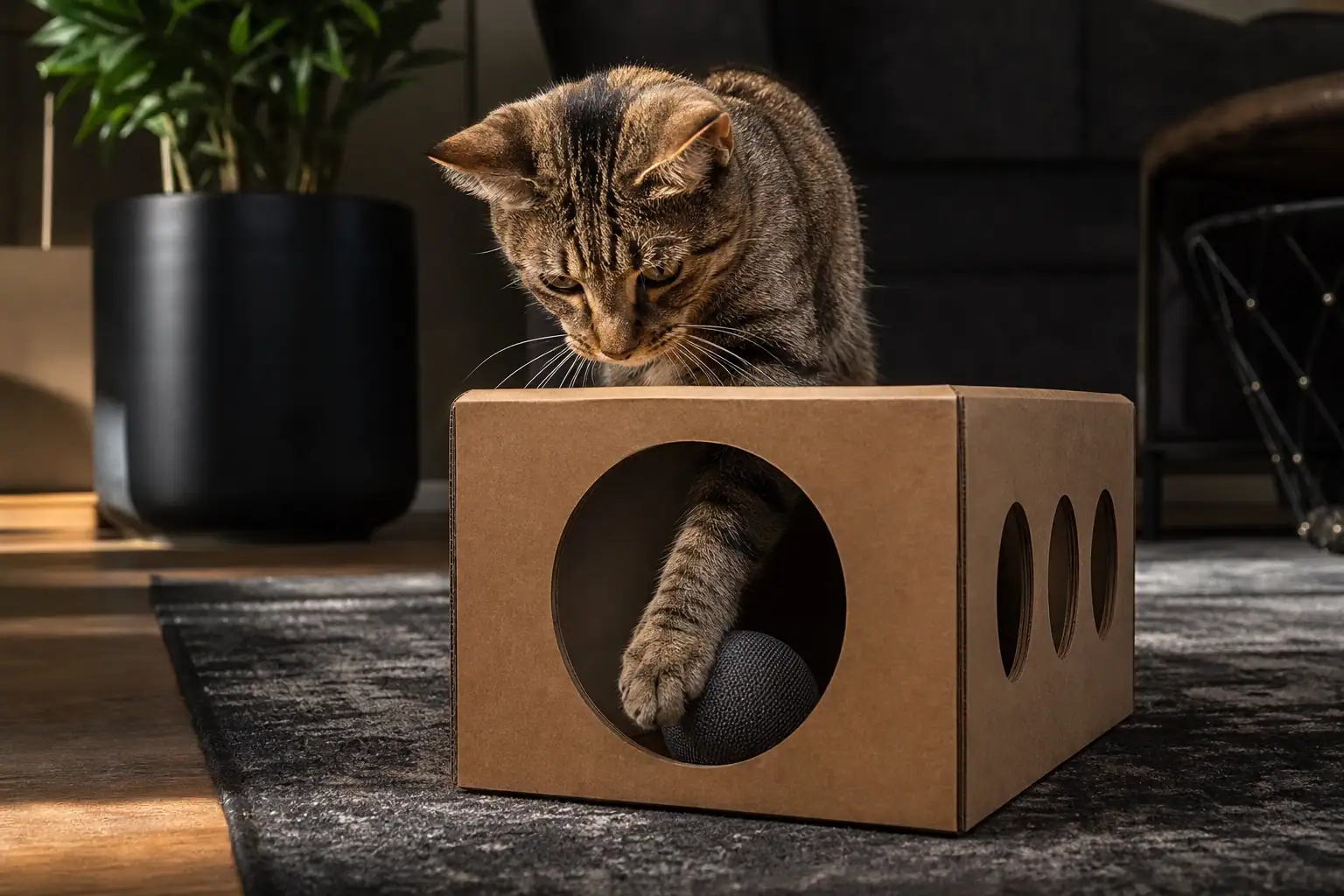
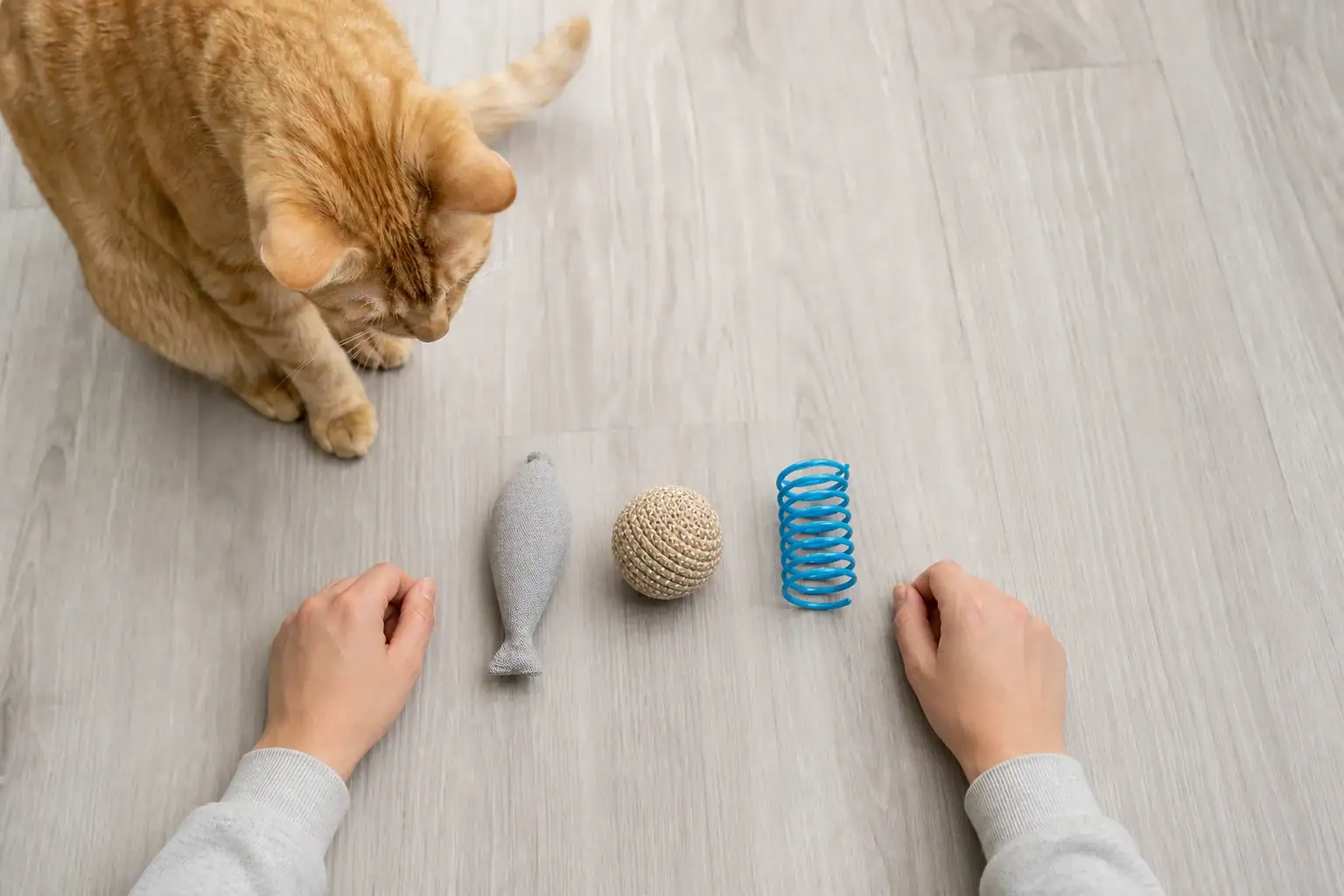
    Simple, medium, and harder cat puzzle toys arranged by difficulty

    Most puzzle cat toys fall into a few practical categories. Choosing by category is more useful than choosing by novelty, because each type solves a different problem.

    Rolling Treat Balls and Tubes

    These release dry food or treats as the cat bats the toy around. They are useful for confident cats, cats who like chase games, and cats who need more movement. For rough players, look for a ball that cannot be bitten open easily and does not have brittle doors, sharp seams, or tiny removable sliders.

    Stationary Puzzle Feeders

    These use cups, channels, pegs, covers, or sliding compartments. They are good for cats who prefer pawing and fishing over chasing. A wide, stable base is important for cats that flip bowls or attack toys with both front paws.

    Lick Mats and Wet-Food Puzzles

    Lick mats and shallow wet-food puzzles slow down pate, mousse, broths, and soft treats. They are usually easier than hard plastic compartment puzzles, but they need careful cleaning after every use. Choose food-safe materials and avoid designs with deep cracks that trap food.

    DIY Cardboard Puzzles

    Egg cartons, paper towel tubes, small boxes, and folded towels can make excellent starter puzzles. Cats Protection suggests simple feeding puzzles because they let cats express natural hunting behaviors indoors. DIY puzzles are cheap and flexible, but they are not ideal for cats who eat cardboard, tear tape loose, or chew pieces into swallowable chunks.

    How to Match the Puzzle to Your Cat

    The right puzzle is the one your cat can solve with effort, not the one that looks hardest. If the first session feels impossible, many cats walk away and never trust the object again.

    Start with your cat’s current style:

    • Fast eater: use a shallow slow feeder, lick mat, or easy stationary feeder before trying a complicated slider puzzle.
    • High prey drive: try a rolling feeder, treat mouse, or puzzle placed at the end of a wand-play sequence.
    • Shy or cautious cat: begin with an open tray or egg carton where the food is visible.
    • Senior cat: choose stable, low puzzles with easy paw access and no need for big jumps or hard pushing.
    • Rough player: prioritize one-piece construction, rounded edges, thick walls, and parts that cannot be snapped off during chewing.
    • Multi-cat home: offer more than one puzzle station so a confident cat cannot block the reward from everyone else.

    If your cat destroys ordinary toys, read the material and seam guidance in what materials make cat toys unbreakable and safe before buying a puzzle with hinges, glued-on feet, feathers, bells, or thin plastic tabs. For broader toy selection, the Titan Claws guide to unbreakable cat toys for aggressive chewers explains why no toy should be treated as truly indestructible.

    A Simple Introduction Plan

    The first goal is not difficulty. The first goal is confidence. Make the puzzle almost too easy, then increase the challenge only after your cat has a few quick wins.

    1. Use part of a normal meal. Do not add a pile of extra treats unless your veterinarian has cleared it. Take the puzzle food from the cat’s daily allowance.
    2. Place the puzzle near the usual feeding area. Familiar territory lowers suspicion.
    3. Leave rewards visible. Put a few pieces on top or in open compartments so your cat can succeed immediately.
    4. Demonstrate once. Slide a cover, roll the ball, or tap the tray with your finger. Then let the cat try.
    5. Stop before frustration. Five calm minutes beats twenty irritated minutes.
    6. Raise difficulty slowly. Add lids, reduce opening sizes, or move the puzzle farther from the bowl only after the easy version is boring.

    For many cats, one puzzle meal per day is plenty at first. If your cat eats prescription food, needs strict calorie control, has dental pain, or has a medical condition affecting appetite, ask your veterinarian before changing the feeding routine.

    Safety Checks for Rough Players

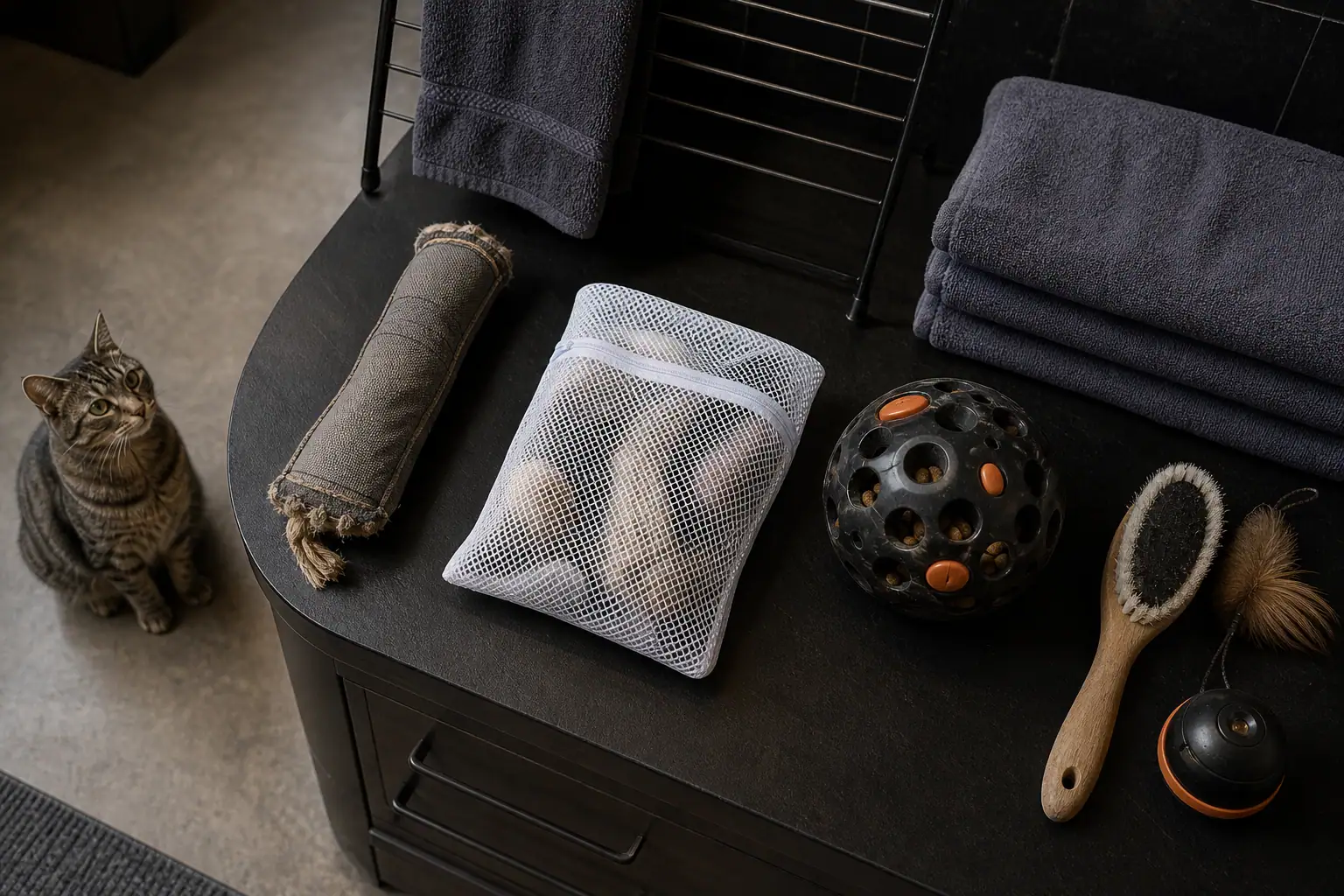
    Hands inspecting a cat puzzle feeder for cracks and loose pieces

    Puzzle toys invite pushing, biting, flipping, and prying. That is exactly why they need stricter inspection than a plain bowl. Cornell advises avoiding toys with small pieces or string-like parts that can separate and be ingested, and the same thinking applies to puzzle feeders.

    Before each session, check for:

    • Cracks in hard plastic, especially near hinges, sliding tracks, and treat openings.
    • Loose rubber feet, caps, pegs, bells, feathers, or decorative pieces.
    • Sharp edges where a cat has chewed or snapped a corner.
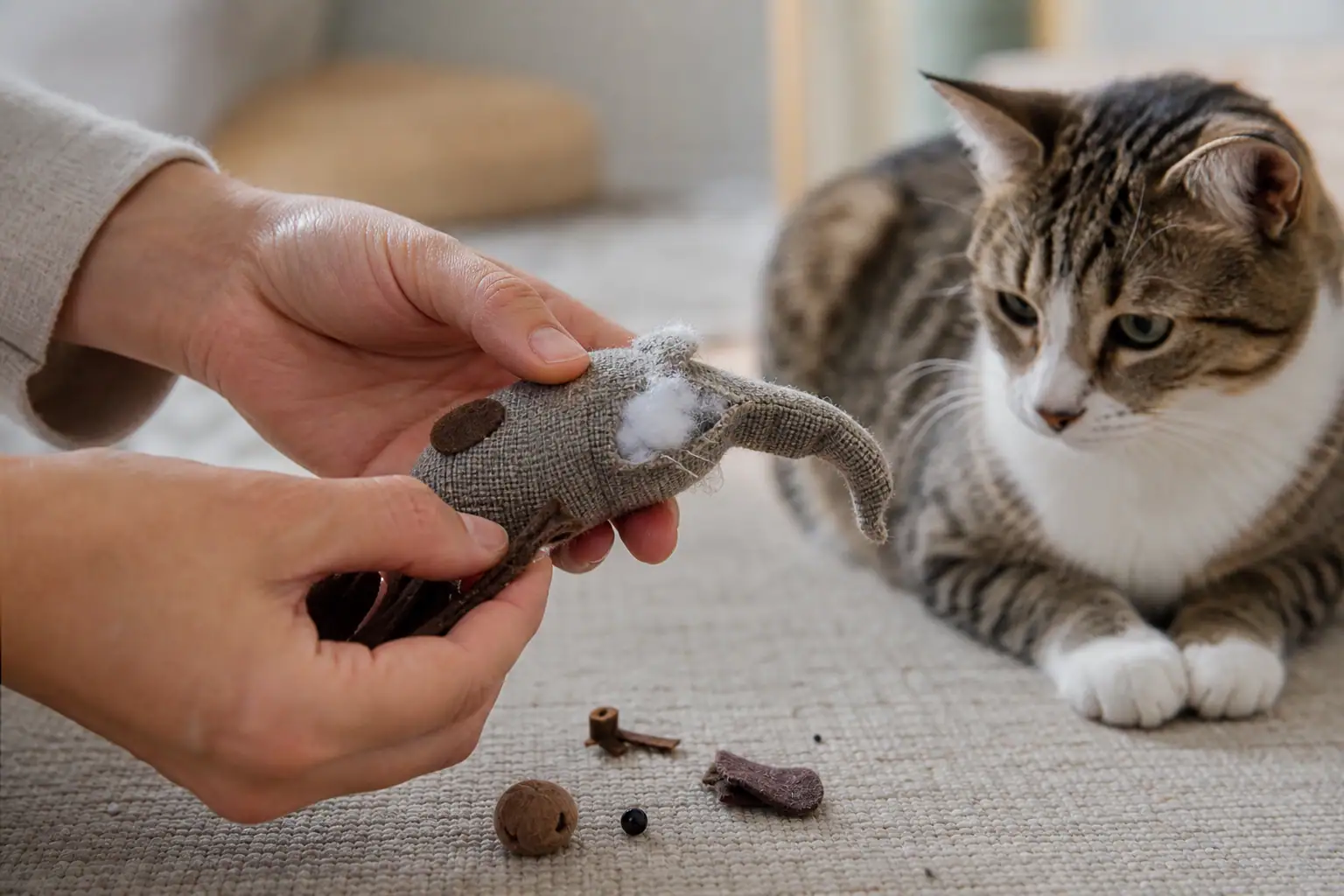
    • Frayed fabric, loose stitching, or exposed filling on soft puzzle toys.
    • Trapped food residue, mold, odor, or sticky buildup.
    • A puzzle that is small enough for your cat to carry off and chew unsupervised.

    Retire the puzzle if you can pull off a piece with your fingers, if a crack creates a sharp edge, or if your cat focuses on eating the toy instead of working for the food. Supervise new puzzle toys until you know how your cat interacts with them.

    Wet Food, Cleaning, and Hygiene

    Cat licking wet food from a washable silicone puzzle mat

    Wet-food puzzles are useful for cats who do not eat kibble, cats who need more moisture, and cats who prefer licking over pawing. They are also less noisy than rolling hard-plastic feeders in a small apartment.

    The tradeoff is cleaning. Texas A&M’s mealtime enrichment guidance warns that puzzles and bowls should be cleaned after each use to avoid bacterial or unwanted pathogen buildup. For wet food, choose a dishwasher-safe or easy hand-wash design, then inspect grooves and corners after cleaning.

    Skip wet food in porous cardboard, cracked plastic, or any puzzle that cannot dry fully. If the puzzle still smells after washing, treat it as done.

    What Current Product Lists Often Miss

    Search results for puzzle cat toys are heavy on shopping grids, star ratings, and broad claims about boredom. Those are useful starting points, but they often miss the owner decisions that matter after the box arrives.

    A stronger buying decision asks:

    • Can my cat solve the easiest version within a few minutes?
    • Can this toy survive my cat’s actual bite and paw strength?
    • Are there removable parts that become swallowable if chewed?
    • Is the puzzle easy to clean with the food I actually feed?
    • Will this work in a multi-cat room without guarding or conflict?
    • Can I make it harder gradually, or is it one difficulty forever?

    If a product page does not answer those questions, use photos and reviews to inspect the construction: tabs, seams, feet, openings, and moving pieces. For rough cats, simple and sturdy usually beats clever and fragile.

    Quick Puzzle Cat Toy Checklist

    • Start with an easy puzzle and visible rewards.
    • Use measured food from the daily allowance.
    • Match puzzle type to food type: dry, wet, treat, or catnip.
    • Choose stable designs for cats that flip bowls.
    • Avoid small removable parts, string, feathers, and brittle tabs for chewers.
    • Inspect before and after sessions until you know the toy’s failure points.
    • Wash food puzzles after use, especially wet-food mats and trays.
    • Rotate puzzles with wand play, kicker toys, scratchers, and rest days.

    Bottom Line

    Puzzle cat toys are worth trying when your cat needs more challenge, slower meals, or a safer outlet for busy paws. The best puzzle is not the most complicated one. It is the one your cat can learn, repeat, and enjoy without chewing off pieces or becoming frustrated.

    Start easy, supervise closely, inspect like a rough-play owner, and keep the puzzle as one tool in a broader enrichment routine. That approach gives your cat the fun part of the hunt while keeping the boring safety work where it belongs: in your hands.

  • Cat Toys for Boredom: A Practical Guide for Indoor Cats and Rough Players

    Cat Toys for Boredom: A Practical Guide for Indoor Cats and Rough Players

    Cat toys for boredom work best when they give your cat a job: stalk, chase, pounce, bite, rake, solve a small problem, scratch, sniff, or watch from a safe perch. The goal is not to buy one magic toy that keeps a cat busy forever. The goal is to build a small rotation that matches how your cat actually plays.

    For bored indoor cats, start with five toy roles: a chase toy, a capture toy, a puzzle or food toy, a scratch-and-stretch station, and a solo toy your cat can safely use without you holding it. If your cat destroys ordinary toys, add a stricter safety habit: supervise strings and fragile lures, inspect seams after hard play, and retire toys before loose parts become swallowing hazards.

    What boredom looks like in cats

    Boredom is not always a cat staring sadly at an empty room. It can look like nighttime pacing, repeated meowing, ankle attacks, furniture scratching, over-focused chewing, food begging soon after meals, or a cat who seems restless but ignores the same old toy pile. Medical problems can cause some of these signs too, so sudden changes, overgrooming, appetite changes, pain, or aggression should be discussed with a veterinarian.

    The Cornell Feline Health Center describes toys as a way to encourage exercise and cognitive enrichment by letting cats stalk, pounce, and problem solve. That is the lens to use when shopping: ask what natural behavior the toy supports, not just whether it looks cute.

    The five toy roles that fight boredom

    Most bored cats do not need a bigger toy bin. They need more variety in the type of play available. Use this simple mix before buying another duplicate mouse.

    • Chase toy: A wand, rolling ball, moving mouse, or lure that gets your cat tracking motion and sprinting in short bursts.
    • Capture toy: A kicker, tough plush, rope toy, or rugged fabric toy your cat can grab, bite, and bunny-kick after the chase.
    • Puzzle or food toy: A treat ball, sliding puzzle, snuffle mat, lick mat, or DIY feeder that makes part of a meal take effort.
    • Scratch-and-stretch station: A vertical post, horizontal scratcher, cardboard pad, sisal surface, or sturdy cat tree near the play zone.
    • Solo boredom toy: A track toy, safe ball, tunnel, box setup, or timed electronic toy that can hold attention when you are busy.

    This mix matters because one toy rarely satisfies the whole hunting sequence. A wand creates motion but may be unsafe if left out. A kicker gives the satisfying catch but does not create much chase by itself. A puzzle feeder works the brain but does not replace running, climbing, or wrestling. Boredom drops when the routine covers more than one need.

    Match the toy to the boredom problem

    Before buying, identify the main problem you are trying to solve. A bored cat who wakes you at 4 a.m. may need a different setup than a cat who shreds soft toys in three minutes.

    • Night zoomies: Use two short evening chase sessions, then end with a capture toy or small measured food puzzle.
    • Ankle attacks: Use distance toys such as wands and rolling toys. Do not wrestle with hands or feet.
    • Fast food begging: Move part of the meal into a beginner puzzle feeder or treat ball instead of adding extra snacks.
    • Furniture scratching: Add scratchers where the cat already stretches or scratches, then pair that area with play.
    • Toy destruction: Use tougher capture toys, avoid glued-on parts, and inspect seams, tags, bells, feathers, and elastic after play.
    • Low interest in toys: Slow the movement down, hide the lure behind furniture, try dusk or dawn play, and rotate toys out of sight.

    For cats that play hard, Titan Claws’ guide to cat toys that last is useful because it focuses on failure points, material choices, and supervised rough play instead of treating durability as a vague marketing claim.

    Cat playing with a ball chaser toy for solo enrichment
    Photo: Jerry via Wikimedia Commons, CC BY-SA 2.0.

    Best toy types for bored indoor cats

    The best cat toys for boredom are usually categories, not single products. Choose one or two from the list below and test them in short sessions before building a bigger rotation.

    • Wand toys: Best for cats who need exercise, stalking, and owner-led play. Put string, ribbon, elastic, and feather lures away after use.
    • Kicker toys: Best for wrestlers and rough players who need a safe catch after chasing. Look for strong seams, dense fabric, and a size your cat cannot swallow.
    • Track toys: Best for solo batting and quick bursts. They work well for cats who like predictable movement and repeated paw taps.
    • Puzzle feeders: Best for food-motivated cats, indoor cats with stale routines, and cats that need mental work without overexcitement.
    • Electronic moving toys: Best as short novelty sessions, especially for cats left alone during part of the day. Choose rechargeable, enclosed designs and inspect charging ports, seams, and moving parts.
    • Tunnels and boxes: Best for stalkers, shy cats, and ambush play. They make ordinary wand movement more interesting because the toy can disappear and reappear.
    • Scratchers: Best for cats who need claw, shoulder, and scent-marking outlets. A scratcher is not a toy in the usual sense, but it is part of a boredom plan.

    If your cat chews aggressively, read the Titan Claws material guide on what materials make cat toys safer and tougher. The useful takeaway is that seams, glued parts, weak attachments, and exposed cores often fail before the main fabric or plastic does.

    How to use puzzle toys without overfeeding

    Puzzle toys are valuable because they turn eating into foraging. Use part of your cat’s normal measured meal, not a pile of bonus treats, especially for cats who need weight control. Start easy: a few pieces of kibble in a shallow muffin tin, a wide-opening treat ball, or a simple cardboard feeder supervised for chewing.

    Make the first few sessions almost too easy. Let the cat see and smell the food, then reward any pawing, nudging, or sniffing that moves the puzzle forward. Increase difficulty only after the cat understands the game. If your cat walks away, vocalizes in frustration, or tries to bite pieces off the puzzle, reset to an easier version.

    The AAFP and ISFM feline environmental needs guidelines include feeding devices, interactive play, toys cats can manipulate, and toy rotation as ways to support normal feline behavior. That is why a boredom plan should combine food puzzles with movement toys instead of relying on one category.

    A daily boredom routine that takes 20 minutes

    You do not need to entertain your cat for hours. Many cats do better with short, focused play that follows a predictable rhythm.

    1. Five minutes of stalking: Move a wand or lure like prey. Let it pause, hide, and escape instead of waving it in your cat’s face.
    2. Five minutes of chase: Use a hallway, tunnel, or open floor for short bursts. Stop before the cat becomes frantic or overheated.
    3. Three minutes of capture: Offer a kicker or tough fabric toy so the cat can bite and rake something physical.
    4. Five minutes of food puzzle or treat search: Use a few pieces from the normal meal allowance.
    5. Two minutes of reset: Put string toys away, inspect the capture toy, and leave out only toys that are safe for unsupervised access.

    Ohio State indoor cat enrichment guidance notes that play is tied to the predatory sequence of stalking, chasing, pouncing, and biting, and that toys should be rotated to maintain novelty. It also recommends using toys that keep distance between the cat and the owner’s body, because playing with hands and feet can teach unwanted biting and pouncing.

    Tabby cat resting with a toy mouse after play
    Photo: TudorTulok via Wikimedia Commons, CC BY-SA 4.0.

    Safety rules for cats that destroy toys

    A cat who tears toys apart is not being bad. The toy is telling you where it is weak. Keep the energy outlet, but tighten the safety system around it.

    • Put away wand strings, ribbons, elastic, feather lures, and thin cords after every session.
    • Skip toys with glued-on eyes, bells, sequins, loose tags, or small decorative parts for chewers.
    • Check seams, stuffing, cracked plastic, exposed wire, battery compartments, and sharp edges after hard play.
    • Choose capture toys large enough that your cat cannot swallow them whole.
    • Use electronic toys only as directed, and remove them if your cat targets the charging port or casing.
    • Retire any toy that leaks stuffing, sheds thread, smells burnt or chemical, or changes shape after chewing.

    Durable does not mean unsupervised forever. It means the toy is better matched to your cat’s force, claws, teeth, and play style. For rough players, the safest pattern is often owner-led chase plus a tougher capture toy at the end.

    What current toy roundups often miss

    Many ranking pages list products without explaining the routine around them. That leaves owners with a pile of toys and the same bored cat. The missing pieces are usually timing, rotation, toy roles, and inspection.

    A bored cat may ignore a great toy if it is always on the floor. Put most toys away, leave out only safe solo options, and rotate one or two back into view every few days. A cat may also ignore a fast toy because it moves like a frantic object instead of prey. Slow movement, hiding, pauses, and a final catch are often more interesting than constant speed.

    RSPCA NSW’s interactive string-toy play guidance makes a useful point: watching and stalking can be part of play, and a cat that does not pounce immediately may still be engaged. Be patient, reduce distractions, try the cat’s active hours, and change the toy or movement style before deciding your cat will not play.

    Quick buying checklist

    Use this checklist before adding another toy to the cart:

    • What boredom problem does this solve: chase, capture, food work, scratching, hiding, solo batting, or visual interest?
    • Can my cat use it safely with their actual bite strength and claw habits?
    • Are there small parts, strands, feathers, bells, batteries, or glued details that could detach?
    • Can I clean it, inspect it, and tell when it should be retired?
    • Does it pair with another toy to complete the hunt, such as wand chase followed by a kicker?
    • Will it still feel novel if I rotate it instead of leaving it out all week?

    The bottom line

    The best cat toys for boredom are the toys that give your cat the right kind of work. Build a rotation with chase, capture, puzzle, scratch, and safe solo play. Use short sessions. Let your cat catch something physical. Put risky lures away. Inspect toys after rough play.

    When the routine is right, boredom toys do more than distract your cat. They give indoor cats safer outlets for hunting, chewing, scratching, problem-solving, and settling down, which is exactly where durable toy choices and thoughtful enrichment belong together.

  • Cat Dancer Toy: How It Works, Safety, and Better Play for Rough Cats

    Cat Dancer Toy: How It Works, Safety, and Better Play for Rough Cats

    The Cat Dancer toy is a simple interactive cat toy made from spring steel wire with rolled cardboard lures. That plain design is the point: the wire creates quick, uneven movement that can look like a moth, beetle, or tiny prey animal, which is why many cats react to it even when they ignore heavier wand toys.

    For most cats, the original handheld Cat Dancer is best used as a supervised chase toy. It is inexpensive, light, and excellent for short hunting-style play. For cats that bite hard or shred toys, it should not be treated as a chew toy or an unsupervised toy. Use it to create the chase, then hand your cat a tougher kicker, ball, or fabric toy for the catch.

    What the Cat Dancer toy is

    The official Cat Dancer product page describes the original toy as spring steel wire and rolled cardboard. The listed product dimensions are small, and the toy weighs less than an ounce, so it behaves very differently from a rigid wand or plush teaser. Instead of you dragging a lure in a straight line, the wire rebounds and trembles with small motions from your hand.

    That movement is the main advantage. A tiny wrist flick can make the cardboard end bounce, hover, dip, and retreat. Cats that prefer watching before pouncing often like this because the lure does not simply rush at them. It can disappear behind a chair leg, skim the floor, or hang just above paw height.

    The common versions owners search for are the original handheld toy, the Cat Dancer Deluxe with a wall-mounted paw holder, and shorter or handled variations sold through pet retailers. The decision is less about which package is cutest and more about how your cat plays: supervised chase, solo batting, or rough bite-and-rake play.

    Why cats like the spring-wire motion

    Cats are built to notice small, irregular movement. A toy that pauses, twitches, and darts away can trigger the stalk-chase-pounce sequence better than a lure that moves in predictable circles. VCA’s guidance on cat play and play toys recommends predatory games where the cat can eventually catch and kill the toy. The Cat Dancer can cover the stalking and chasing part extremely well.

    Where owners often get stuck is the finish. The cardboard lure is small, and the wire is not a satisfying wrestling target. If your cat catches it and immediately tries to clamp down, shake, or chew, do not fight them for it. Pause the wire game and offer a bigger capture toy. That makes the session feel complete without asking a thin wire toy to do a kicker toy’s job.

    Is the Cat Dancer toy safe?

    The Cat Dancer can be a safe interactive toy when you supervise play, keep the wire out of mouths and eyes, inspect the cardboard, and put it away after the session. It is not a good free-access toy for cats that chew cardboard, bite metal, or work small parts loose.

    Cornell’s Feline Health Center advises owners to avoid toys with small pieces or strand-like parts that can detach and be swallowed, and to rotate toys so cats do not become bored. That advice applies here. The Cat Dancer has fewer string hazards than a ribbon wand, but it still has small cardboard pieces and a springy wire that needs owner control.

    Run this check before and after play:

    • Look for cracked, softened, or missing cardboard pieces.
    • Check the wire ends and bends for sharp points, kinks, or exposed rough spots.
    • Stop the session if your cat chews the wire instead of batting or pouncing.
    • Keep the lure away from eyes, whisker pads, and open mouths during high jumps.
    • Put the toy in a drawer or closet when you are done.

    If your cat swallows string, cardboard, wire, or any toy piece, call your veterinarian. PetMD’s veterinary guidance on cats eating string is especially blunt about linear material: do not pull it from the mouth, do not induce vomiting, and seek veterinary help promptly. A Cat Dancer is not string, but the same seriousness should apply to swallowed toy parts.

    How to use it without frustrating your cat

    The best Cat Dancer sessions are short, varied, and winnable. Start with the toy low to the ground, not whipping through the air. Let your cat watch it. Move it behind a table leg, along a rug edge, or under the lip of a cardboard box. Give pauses long enough for the cat to plan a pounce.

    Use this simple pattern:

    • Stalk: Hold the wire still with tiny tremors near cover.
    • Chase: Move the lure away in short bursts, not constant circles.
    • Pounce: Let your cat land paws on it every few passes.
    • Capture: After a few wins, switch to a larger toy your cat can bite and rake.
    • Settle: End with a treat, part of a meal, or a puzzle feeder if that suits your cat.

    Do not use your hands as the exciting target. If your cat starts tracking fingers, ankles, or sleeves, increase distance, slow the session, or stop. The toy should teach your cat where play belongs, not make human skin part of the game.

    Original vs. Deluxe wall mount

    The original handheld Cat Dancer gives you the most control. You decide speed, height, distance, and when the game ends. That makes it the better choice for kittens, high-jumpers, nervous cats, and rough players that need close supervision.

    The Deluxe version adds a wall-mounted holder so a cat can bat the toy without you holding it. That can work for gentle cats that like solo batting, but it is not the version I would leave out for a destructive chewer. A wall-mounted spring toy can still be bitten, bent, or worried at one weak point until something fails. If you try it, install it away from stairs, shelves, cords, food bowls, and tight corners, then watch several sessions before trusting it for independent play.

    For cats that need activity while you are busy, a safer setup is often a rotation: a scratcher, a sturdy rolling toy, a food puzzle, and a window perch, with the Cat Dancer saved for owner-led play. Titan Claws’ guide to automatic cat toys covers the same principle for powered toys: solo entertainment should be boringly safe, not just exciting.

    For cats that destroy ordinary toys

    A rough cat may love the Cat Dancer, but that does not mean the Cat Dancer should absorb the whole attack. Let it be the moving prey. Then offer something built for impact, teeth, and claws.

    Good handoff options include a larger fabric kicker, a molded rubber treat toy, a sturdy ball, or a rope-free plush made with reinforced stitching. The rough-player buying filter is simple: the toy your cat bites should be large enough to grip, easy to inspect, and free of tiny glued-on parts. The Titan Claws guide to unbreakable cat toys for aggressive chewers is useful for that capture-toy side of the routine, and the materials guide explains why reinforced fabrics, molded rubber, and safer hardware matter more than big durability claims.

    Kitten playing with a toy mouse during an indoor play session
    Photo: Andrew Gray via Wikimedia Commons, CC BY-SA 2.0.

    When to skip it

    Skip or retire the Cat Dancer if your cat focuses on eating the cardboard, biting the wire, attacking the wall mount, or jumping so wildly that the play space becomes unsafe. Also skip it for unsupervised access if your cat has a history of swallowing non-food items.

    Choose another toy if your cat needs one of these jobs instead:

    • Heavy chewing: Use a tougher chew-safe or treat-dispensing toy under supervision.
    • Wrestling: Use a larger kicker that keeps paws and teeth away from thin parts.
    • Food motivation: Use a puzzle feeder or treat hunt.
    • Solo play: Use passive toys with no wire, string, small loose pieces, or batteries your cat can reach.
    • Fearful cats: Use slower movement, boxes, tunnels, and lower-intensity sessions.

    Quick checklist before buying

    • Do you want a supervised chase toy rather than a chew toy?
    • Will you put it away after play?
    • Does your cat bat and pounce more than chew and swallow?
    • Do you have a larger capture toy ready for the finish?
    • Is your play area clear of shelves, cords, stairs, and fragile objects?
    • Can you inspect the cardboard and wire after hard sessions?

    The bottom line

    The Cat Dancer toy earns its popularity because it does one job very well: it creates small, erratic prey-like movement with almost no weight in your hand. For many cats, that is more interesting than a bulky wand or noisy electronic toy.

    For rough cats, the smart routine is supervised Cat Dancer chase followed by a tougher toy your cat is allowed to grab, bite, and kick. Keep the wire controlled, inspect the cardboard, retire damaged parts, and do not leave it out for destructive chewers. Used that way, it can be a low-cost, high-value part of a safer toy rotation.

  • Cat Toys for Enrichment: A Practical Rotation for Safer, Better Play

    Cat Toys for Enrichment: A Practical Rotation for Safer, Better Play

    Cat toys for enrichment should do more than keep a cat busy for a few minutes. The best toys help an indoor cat stalk, chase, pounce, bite, rake, solve problems, scratch, sniff, and rest in a rhythm that feels natural. For many cats, that means using a small rotation of toy types instead of leaving one overflowing toy bin on the floor all week.

    If your cat destroys ordinary toys, enrichment also needs a safety filter. Choose toys that match how your cat actually plays, inspect them after hard sessions, and separate fragile chase lures from tougher toys your cat is allowed to grab. A good enrichment setup is not an indestructible promise. It is a routine that gives your cat a satisfying hunt while reducing loose strings, swallowed stuffing, cracked plastic, and boredom.

    What enrichment toys are supposed to do

    Enrichment means giving a cat useful outlets for normal cat behavior. The AAFP and ISFM feline environmental needs guidelines describe play and predatory behavior as one of the core pillars of a healthy feline environment. Their guidance includes owner-led play, toys cats can manipulate, feeding devices that make cats work for food, and toy rotation to prevent habituation.

    That matters because a cat toy is not just an object. It is a job. A wand gives distance and moving prey. A kicker gives the bite-and-rake finish. A puzzle feeder turns part of a meal into problem-solving. A scratcher lets claws, shoulders, and scent marking work together. A tunnel or box creates hiding and ambush space. A window perch or safe video gives visual stimulation when the cat is not in a high-energy mood.

    The mistake many owners make is buying ten versions of the same toy. If every toy is a feather lure, the cat gets chase but not a safe catch. If every toy is a plush mouse, the cat may get a bite target but not enough movement. A stronger enrichment plan covers several behaviors across the day.

    The five-toy enrichment rotation

    Start with five categories. You do not need expensive gadgets in every category, and you do not need all five available at once. Keep two or three out, put the rest away, and swap them before they become background clutter.

    • Chase toy: A wand, rolling ball, moving mouse, or fabric lure that gets your cat tracking and sprinting.
    • Capture toy: A kicker, durable plush, or tough fabric toy your cat can grip, bite, and rake after the chase.
    • Food puzzle: A puzzle feeder, treat ball, snuffle mat, or simple DIY feeder that makes food more active.
    • Scratch and stretch station: A sturdy vertical post, horizontal scratcher, sisal surface, or cardboard scratch pad.
    • Sensory or environment toy: A tunnel, box, perch, bird-viewing window, cat-safe scent toy, or crinkle object.

    This mix closes the biggest gap in many product roundups: enrichment is not a ranking list. It is a sequence. A cat that stalks a wand for five minutes should also get a physical toy to catch. A cat that inhales meals may need a food puzzle more than another electronic mouse. A cat that attacks ankles in the evening may need predictable owner-led play before the household winds down.

    Match toys to your cat’s play style

    Watch one normal play session and label your cat’s strongest habit. Most cats use more than one style, but one or two usually dominate.

    • Stalkers crouch, stare, wiggle, and wait. They often like hidden-motion toys, tunnels, boxes, and wand lures that disappear behind furniture.
    • Sprinters need open lanes, rolling toys, fetch games, and short chase bursts. They may ignore slow puzzles until after exercise.
    • Wrestlers grab with front paws and kick with back legs. They need larger capture toys and should not be asked to wrestle thin strings or fragile feathers.
    • Chewers focus on seams, tags, elastic, and corners. They need tougher materials, closer inspection, and fewer plush electronics.
    • Problem-solvers paw, pry, tip, and repeat. They are good candidates for puzzle feeders and treat searches.
    • Watchers may seem uninterested, but watching can be part of hunting. Use slower movement, hiding places, and short sessions instead of forcing frantic play.

    For rough players, build the session around a handoff: use the wand or moving toy to create the chase, then offer a tougher kicker or fabric toy for the catch. Titan Claws’ guide to unbreakable cat toys for aggressive chewers is useful here because it focuses on failure points, size, and supervision instead of treating every toy as equally safe.

    Black kitten playing with a toy during an indoor play session
    Photo: Mike Barry via Wikimedia Commons, CC BY 2.0.

    Use food puzzles without overfeeding

    Food puzzles are enrichment toys, not extra snack machines. Use part of the cat’s normal measured meal, especially if your cat needs weight control. The ASPCA’s feline DIY enrichment guidance shows simple food enrichment ideas such as cardboard roll feeders and reach feeders, while also warning owners to supervise DIY items and remove them if a cat tries to ingest pieces.

    A beginner puzzle should be easy enough that the cat wins quickly. Scatter a few pieces of kibble in a shallow tray, use a treat ball with a wide opening, or place food in a muffin tin with a few loosely placed balls. Once your cat understands the game, make it slightly harder. If the cat quits, vocalizes in frustration, or starts chewing the puzzle apart, reset to an easier version.

    Food puzzles are especially helpful for cats that wake owners at night, beg from boredom, or need a calmer midday activity. They do not replace active play. A puzzle works best after a chase session, when the cat has already spent energy and is ready to forage.

    Safety checks for enrichment toys

    Cornell University’s Feline Health Center notes that toys can encourage exercise and cognitive enrichment, but it also recommends avoiding small pieces, strand-like parts such as feathers and string that may detach and be ingested, and electrical cords cats can chew. That is the right safety lens for any enrichment toy: ask what could come off, crack, fray, or be swallowed.

    Run this inspection before a new toy enters the rotation and after any hard play session:

    • Tug seams, tags, feathers, bells, eyes, knots, ribbons, and elastic.
    • Check for stuffing leaks, loose threads, sharp plastic, splinters, or exposed wire.
    • Confirm the toy is large enough that your cat cannot swallow it whole.
    • Put away wand strings, ribbons, feather lures, and elastic cords after play.
    • Remove DIY cardboard or paper items if your cat chews off pieces instead of batting them.
    • Retire any toy that changes shape, smells burnt or chemical, or sheds material during play.
    Tabby cat resting with a toy mouse on a cat tree
    Photo: TudorTulok via Wikimedia Commons, CC BY-SA 4.0.

    Durability is part of safety. The article on what materials make cat toys unbreakable and safe explains why reinforced fabrics, molded rubber, food-grade silicone, and secure hardware usually matter more than marketing language. Even strong materials need inspection because any toy can become unsafe after enough biting, dragging, moisture, or rough claw work.

    A one-week enrichment plan for indoor cats

    Use this as a starting point, then adjust around your cat’s age, fitness, confidence, and medical needs. Keep sessions short. Many cats do better with five to ten focused minutes than with one long session that ends in frustration.

    • Monday: Wand chase, then a durable kicker for the catch. Put the wand away when done.
    • Tuesday: Breakfast in a beginner puzzle feeder, then a window perch or bird-viewing session.
    • Wednesday: Tunnel or box ambush game, followed by a scratcher session near the play area.
    • Thursday: Treat search using a few pieces from the daily food allowance hidden in safe, reachable places.
    • Friday: Rolling ball or hallway chase, then quiet brushing or calm handling if your cat enjoys it.
    • Saturday: Longer owner-led play with two short rounds and a food puzzle finish.
    • Sunday: Toy inspection, wash or wipe safe toys, retire damaged items, and rotate in one toy your cat has not seen all week.

    The Ohio State Indoor Pet Initiative gives similar practical play advice: set aside daily play time, avoid using hands or body parts as toys, and rotate favorites instead of leaving them out all day. That last point is important. Constant access can make even a good toy boring.

    What to avoid with rough players

    Cats that destroy toys are not being difficult. They are showing you where the toy is weak. The answer is not to remove enrichment; it is to choose safer jobs for each toy.

    • Avoid leaving string toys out: Use them only when you are controlling the session.
    • Avoid glued-on parts: Eyes, bells, sequins, and decorative bits are common failure points.
    • Avoid fragile electronic plush toys: Chewers can reach seams, zippers, charging ports, or battery areas.
    • Avoid laser-only routines: If you use a laser, finish with a physical toy or food reward the cat can actually catch.
    • Avoid hand wrestling: Use distance toys so hands and feet do not become targets.
    • Avoid one giant toy pile: Too many always-available toys reduce novelty and make inspection harder.

    If play turns into repeated biting, stalking people, sudden aggression, obsessive chewing, or swallowing non-food material, pause the routine and talk with a veterinarian or qualified behavior professional. Enrichment should lower stress and give safer outlets, not intensify unsafe behavior.

    Quick buying checklist

    Before buying another toy, run through this checklist:

    • What behavior does this toy serve: chase, capture, puzzle, scratch, sensory, or rest?
    • Can my cat use it safely with their actual bite strength and play style?
    • Are there strings, feathers, bells, glued parts, or small pieces that can detach?
    • Can I clean it, inspect it, and tell when it should be retired?
    • Does it pair with another toy to complete the hunt, such as wand chase followed by a kicker?
    • Will it still be interesting if I rotate it instead of leaving it out every day?

    The bottom line

    The best cat toys for enrichment are the ones that fit your cat’s instincts and survive your cat’s reality. Build a rotation with chase, capture, puzzle, scratch, and sensory options. Keep fragile lures supervised. Give rough players tougher catch toys. Use food puzzles with measured meals. Inspect everything after hard play.

    When enrichment works, your cat gets more chances to hunt, solve, scratch, pounce, and settle without turning your hands, furniture, or unsafe toy parts into the outlet. That is the real goal: not more toys, but better play.

  • Automatic Cat Toys: What to Buy, What to Avoid, and How to Use Them Safely

    Automatic Cat Toys: What to Buy, What to Avoid, and How to Use Them Safely

    Automatic cat toys can help a bored indoor cat move, stalk, pounce, and reset between owner-led play sessions. The best ones are not magic babysitters. They are short-session enrichment tools: useful when they create prey-like movement, safe when they are inspected, and most effective when they are rotated with wand play, puzzle feeders, scratchers, and tough toys your cat can actually catch.

    If your cat destroys ordinary toys, shop with a stricter standard. Look for enclosed motors, sturdy housings, replaceable attachments, no loose bells or glued-on pieces, and a motion pattern that gives your cat a chase without letting them chew the electronics. Avoid any automatic toy that invites your cat to bite a battery compartment, swallow string, or work one weak seam until stuffing comes out.

    What automatic cat toys are best for

    Automatic cat toys are most useful for three jobs: adding movement when you are busy, giving indoor cats more daily hunting-style activity, and keeping novelty in a toy rotation. They can be especially helpful for cats that stare at a toy before launching, cats that need short bursts of exercise, and cats that get bored when a toy moves the same way every time.

    Veterinary behavior guidance supports this general idea. The AAFP and ISFM environmental needs guidelines include play and predatory behavior as a core feline need, with toys, owner interaction, and feeding devices all used to help cats hunt, capture, and manipulate objects. That is the standard an automatic toy should serve.

    Think of the toy as one part of the sequence, not the whole routine. A good session may look like this: five minutes of automatic motion while your cat stalks, a wand or kicker toy they can grab, a small treat or meal puzzle, then rest. That final catch matters because endless chase without a capture can frustrate some cats, especially with lasers and toys that always escape.

    Choose by movement, not just by gadget features

    The toy’s motion matters more than the app, lights, or number of modes. Cats tend to respond to movement that resembles prey: quick starts, pauses, hiding, darting away, and occasional chances to pin the target. Smooth circles and repetitive buzzing may work once, then become furniture.

    • Randomized wand toys: Good for cats that like feather or fabric lures, but the attachment must be replaceable and put away if it frays.
    • Rolling balls or mice: Better for chasers, but only if the shell cannot crack into sharp pieces and the toy does not trap paws under furniture.
    • Peekaboo or hidden-motion toys: Useful for stalkers because the target appears and disappears instead of sitting in plain view.
    • Flopping fish and plush electronics: Often exciting at first, but rough chewers can focus on seams, zippers, or charging ports.
    • Laser toys: Use sparingly and end with a physical toy or treat so the hunt has a real finish.

    Product roundups often rank toys by entertainment value. That is useful, but rough-player households should add a second filter: where will this fail if a cat bites it hard for 30 seconds? If the answer is a feather glued to a wire, an exposed seam, or a thin plastic shell, treat it as supervised-only.

    Safety checks before the first session

    Before giving your cat any automatic toy, run a two-minute inspection. Open and close the battery compartment. Tug attachments. Press around seams. Check whether the toy has tiny parts, bells, exposed string, loose fabric, brittle plastic, or a charging port your cat can chew. If the toy smells strongly chemical or leaves residue on your hands, do not use it.

    The VCA guidance on cat play and toys recommends monitoring play so cats do not consume non-food toys. The AAFP/ISFM guidelines also advise putting away string-like toys after play and avoiding small ingestible parts for unsupervised access. Automatic does not cancel those rules.

    Tabby cat beside a feather toy after play
    Photo: Nervadura via Wikimedia Commons, CC BY-SA 4.0.

    Use this quick pass before and after rough play:

    • Battery door closes firmly and cannot be pried open by claws or teeth.
    • No loose string, elastic, ribbon, feather shaft, bell, eye, or plastic tab.
    • No exposed wires, cracked shell, sharp plastic edge, or hot motor smell.
    • Fabric covers have tight stitching and no stuffing leaks.
    • The toy shuts off reliably and does not keep running under furniture.
    • Your cat can walk away, hide, or decline the game without being chased by the toy.

    For cats that destroy toys, durability is a safety issue

    A tough cat does not need a louder motor. They need a toy that separates the chase part from the chew part. Let the automatic device create motion, then give your cat a durable kicker, ball, or fabric toy for the bite-and-rake finish. That keeps teeth away from batteries and moving parts.

    For chew-prone cats, avoid plush electronic toys with easily opened seams unless you can supervise every session. Choose hard housings with rounded edges, recessed fasteners, and replacement lures. When you want a toy your cat can grip hard, use a non-electronic option built for abuse. Titan Claws’ guide to unbreakable cat toys for aggressive chewers covers the rough-player side of that decision, and the materials guide explains why toy materials and failure modes matter.

    Be careful with the word indestructible. No cat toy deserves unlimited trust. Even strong materials can become unsafe when they crack, fray, shed fibers, or expose hardware. The better standard is durable enough for the play style, easy to inspect, and retired before failure becomes a swallowing risk.

    When automatic toys are useful while you are away

    Automatic cat toys for when you are away should be boringly safe. That means no strings, feathers, loose plush, elastic cords, or chewable battery doors. If your cat is a heavy chewer, do not leave electronic plush toys out unattended. Use a timed feeder, food puzzle, sturdy rolling toy without attachments, window perch, scratcher, or hidden treats instead.

    The safest away-from-home setup is usually a rotation, not one gadget running all day. Leave out two or three passive enrichment options and save the powered toy for a short supervised session when you return. Cats play in bursts, and many lose interest when a toy becomes predictable. More runtime is not always more enrichment.

    Build a better toy rotation

    Novelty keeps toys valuable. The AAFP/ISFM guidelines recommend rotating toys to prevent habituation, and an Ohio State veterinary enrichment resource describes play as part of the natural predatory sequence of stalking, chasing, pouncing, and biting. Use that sequence to organize your week.

    Cat reaching toward a spinning toy
    Photo via Pixabay.
    • Monday: Automatic peekaboo toy for stalking, then a kicker toy for biting and raking.
    • Tuesday: Wand play with swoops and pauses, then a puzzle feeder.
    • Wednesday: Sturdy rolling toy in an open hallway, then a scratcher session.
    • Thursday: Rest from powered toys; hide treats or kibble in safe locations.
    • Friday: Automatic wand toy under supervision, then retire any frayed attachment.
    • Weekend: Longer owner-led play, claw checks, and toy inspection.

    For cats that redirect play onto hands or ankles, add more distance between the cat and your body. Wand toys, rolling toys, and automatic devices can help, but do not use your hands or feet as the target. The 2021 AAHA/AAFP feline life stage guidelines warn that teaching cats to treat hands and feet as toys can lead to scratching or biting injuries.

    What to avoid

    Skip toys that make safety depend on optimism. A cheap automatic toy can be fine for a gentle watcher and wrong for a cat that bites, shakes, and disassembles things. The risk is not only that the toy breaks. The risk is that it breaks in a way your cat can swallow.

    • Open battery compartments, button batteries, or charging cables accessible during play.
    • String, elastic, ribbon, or feather toys left out after the session.
    • Small detachable parts, glued-on decorations, bells, or plastic eyes.
    • Hard shells that already show cracks or sharp seams.
    • Laser-only routines with no catchable reward.
    • Toys that chase a fearful cat, block escape routes, or keep activating near food and litter areas.

    Quick buying checklist

    Use this checklist before buying the next automatic toy:

    • The motion matches your cat: stalker, chaser, pouncer, kicker, or watcher.
    • The powered part is not the part your cat is expected to chew.
    • Attachments are replaceable, inspectable, and easy to remove after play.
    • The battery or charging system is enclosed and inaccessible during use.
    • The toy has an automatic shutoff or you can control session length.
    • The surface is easy to wipe clean, and fabric parts can be washed or replaced.
    • The toy works in your actual space without trapping itself under furniture.
    • You have a durable catch toy ready for the finish.

    The bottom line

    Automatic cat toys are worth using when they add safe movement and novelty to a richer play routine. They are not a replacement for owner-led play, and they are not a good unattended choice for every cat. For a gentle indoor cat, a motion-activated toy may be a useful boredom breaker. For a rough player, the smarter setup is supervised automatic motion plus a tough, inspectable toy your cat can capture without reaching batteries, wires, or weak seams.

    Start with one short session, watch how your cat attacks the toy, inspect it afterward, and adjust from there. The best automatic cat toy is not the one with the most modes. It is the one that lets your cat hunt safely, finish the game, and come back tomorrow still interested.

  • Safe Cat Chew Toys: What to Choose, Avoid, and Inspect

    Safe Cat Chew Toys: What to Choose, Avoid, and Inspect

    Safe cat chew toys are toys a cat can bite, gnaw, and wrestle during supervised play without quickly shedding strings, splinters, hard shards, stuffing, batteries, or tiny parts. That last phrase matters. A toy can be marketed for chewing and still be a poor match for a cat that actually tries to eat what they bite off.

    For most cats, the safest setup is not one magic chew toy. It is a small rotation: a tough fabric or rubber chew toy for mouth contact, a larger cat kicker toy for bunny-kicking and bite-and-hold play, a wand toy that is put away after use, and a puzzle or food toy for foraging. If your cat destroys toys, the goal is to redirect chewing into safer outlets while keeping the highest-risk items out of reach.

    This guide is written for owners of cats that chew hard, shred seams, attack cords, or turn ordinary plush toys into loose threads. It is not veterinary diagnosis. If chewing is new, intense, compulsive, or includes swallowing fabric, plastic, string, or litter, involve your veterinarian.

    What Makes a Cat Chew Toy Safer?

    A safer chew toy has three jobs: it must fit your cat’s mouth, survive normal biting long enough to inspect, and fail visibly instead of breaking into hidden hazards. No cat toy is truly chew-proof for every cat. Strong jaws, focused gnawing, and repeated clawing will eventually damage most materials.

    Look for these design signals before you buy:

    • One-piece or simple construction: fewer glued-on decorations, plastic eyes, bells, ribbons, feathers, and loose tails.
    • Cat-appropriate size: large enough that it will not disappear into the mouth, but not so large or stiff that it wedges behind the canine teeth.
    • Soft but resilient bite surface: sturdy fabric, flexible rubber, food-grade silicone, or tightly covered stuffing is usually safer than brittle plastic.
    • Reinforced seams: double stitching, hidden seams, or a cover that does not open when you tug lightly at the edges.
    • No linear parts for unsupervised access: strings, yarn, elastic, cords, long fringe, and ribbon belong in supervised play only.
    • Clear cleaning instructions: if your cat puts it in their mouth repeatedly, you need a realistic way to wash or wipe it.

    Cornell’s Feline Health Center notes that toys support exercise and cognitive enrichment, but warns owners to avoid toys with small pieces or string-like parts that can detach and be ingested, especially when chewed. That is the practical dividing line for chew toys: choose items that encourage natural biting without giving your cat easy pieces to swallow. Cornell’s cat toy safety guidance is worth reading if your cat is rough on toys.

    Best Types of Safe Cat Chew Toys

    Different cats chew for different reasons. Some want a satisfying bite after a chase. Some are teething kittens. Some are bored indoor hunters. Some are stress chewers. Match the toy to the behavior you are seeing, not just the product label.

    Durable fabric chew toys

    For many adult cats, tough fabric toys are the most useful starting point. A dense canvas, ballistic nylon-style shell, or tightly woven outer cover gives the cat something to grip without the tooth risk of a very hard chew. Choose toys with minimal decoration and no loose appendages. If your cat likes to clamp and rake with the back feet, a longer kicker is usually better than a tiny plush mouse.

    Fabric is not automatically safe. Retire it when seams gap, stuffing appears, threads pull loose, or the toy starts to flatten in one area from repeated chewing.

    Flexible rubber or silicone chew toys

    Flexible rubber and food-grade silicone can work well for cats that like a springy mouthfeel. The toy should flex under pressure instead of feeling rock-hard. Avoid thin fins, spikes, or raised details that your cat can shave off with focused chewing. If the surface develops gouges, cracks, sticky spots, or missing chunks, remove it.

    Do not assume dog chew toys are safe for cats. A small dog toy may still be too hard, too heavy, or shaped wrong for a cat’s mouth. If you test one, choose a soft, simple shape, supervise closely, and stop if your cat tries to remove pieces.

    Dental-style cat chew toys

    Some dental toys use mesh, nubs, or catnip scent to encourage chewing. They can be fine for cats that mouth toys without eating them. They are not a substitute for veterinary dental care, and they should not be treated as leave-out-all-day toys for determined biters. Watch the edges and the mesh. Once the toy starts to unravel, it has done its job and should go.

    Silvervine and catnip-scented toys

    Silvervine and catnip can make a safer chew toy more interesting, especially for cats that ignore plain rubber. Use the scent as an attractant, not as an excuse to hand over brittle sticks or bark pieces to a cat that splinters things. For heavy chewers, silvervine powder sprinkled on a durable fabric or rubber toy is usually a more controlled choice than loose sticks.

    Chew Toys to Avoid for Cats That Swallow Pieces

    The riskiest toy is not always the sharpest or toughest one. It is often the toy that slowly turns into swallowable material while nobody is watching. Cats can ingest thread, wool, paper, rubber bands, plant material, and small toys. VCA Animal Hospitals describes foreign body obstruction as a potentially life-threatening condition, with string-like objects being especially dangerous because they can anchor and pull through the digestive tract. See VCA’s overview of foreign body ingestion in cats for warning signs such as vomiting, appetite loss, lethargy, abdominal pain, and straining.

    Be cautious with:

    • String, yarn, ribbon, floss, elastic, and fringe: use only during active play, then put away.
    • Feathers and faux-fur tails: many cats love them, but hard chewers can pull them free.
    • Plastic eyes, bells, beads, and glued-on faces: cute details often become the first loose parts.
    • Hard plastic chews: repeated biting can create sharp edges or tooth risk.
    • Natural sticks with bark: some cats peel off bark or splinter the stick.
    • Battery toys with weak compartments: use only if the battery door is secure and screwed shut.
    • Household substitutes such as cotton swabs, hair ties, twist ties, and cord protectors: these are not chew toys.

    If your cat has a history of swallowing what they chew, every chew toy should be supervised. If you need safer independent play, choose larger track toys, puzzle feeders, or sturdy balls without chewable parts, then inspect them often.

    What to Give Cats That Chew on Wires

    Wire chewing is a safety problem first and a toy problem second. A chew toy can help redirect the behavior, but it should not be the only control. Restrict access to cords, route cables behind furniture, use cord covers where needed, and unplug or remove tempting cords in rooms where your cat is unsupervised.

    PetMD’s veterinary-reviewed guidance on cats chewing electrical cords points to several possible drivers, including boredom, stress, pica, dental disease, gum pain, and the natural stimulation cats get from chewing. That means the practical plan is layered:

    1. Block access to electrical cords and holiday light cords.
    2. Offer a safer chew toy before the cat reaches the cord.
    3. Add daily interactive play so the cat gets a chase, catch, bite, and settle routine.
    4. Use food puzzles or scatter feeding for foraging energy.
    5. Ask your veterinarian about dental pain, pica, anxiety, or nutritional issues if chewing is persistent or new.

    For cats that bite cords after high-energy play, end wand sessions by letting them catch and bite a safe target. A sturdy kicker or chew toy can act as the final capture. For more on redirecting mouthy play, see Titan Claws’ guide to cat bite toys.

    The Inspection Rule: Before, During, and After Play

    Safe cat chew toys are maintained, not just purchased. A toy that was safe last week can become risky after one rough session. Build inspection into the routine.

    Hands inspecting a cat toy seam for loose threads and bite damage
    A quick seam and surface check catches many problems before a toy becomes a swallowing risk.

    • Before play: check seams, edges, attachments, and any place your cat usually bites.
    • During play: watch whether your cat is chewing, shredding, or actually swallowing pieces.
    • After play: remove loose threads, count missing parts, and put string or wand toys away.
    • Weekly: wash washable toys, rotate stale toys out, and retire anything with holes, sharp edges, exposed stuffing, or sour odor.

    Preventive Vet gives a strict but sensible rule: chew toys should be supervised, and toys should be discarded when they unravel or pieces come loose that a cat could swallow. That is especially important for cats that gnaw seams, lick frayed fabric, or carry pieces away.

    How Chew Toys Fit Into Enrichment

    Chewing is only one part of feline play. Cats also need to stalk, chase, pounce, grab, bite, rake, forage, climb, scratch, and rest. The AAFP and ISFM environmental needs guidelines recommend giving cats opportunities for play and predatory behavior, including toys they can manipulate with paws or mouth, food puzzles, rotating toys, and avoiding hands and feet as play targets. The full guideline is available through the National Library of Medicine.

    A safe cat toy rotation with chew toy, kicker toy, wand toy, and puzzle feeder
    Chew toys work best as part of a rotation that also gives cats chasing, pouncing, and problem-solving outlets.

    A chew-focused rotation for a rough player might look like this:

    • Morning: five to ten minutes with a wand toy, ending with a catch on a kicker or chew toy.
    • Midday: puzzle feeder, treat hunt, or sturdy self-play toy without strings.
    • Evening: active chase play, then a fabric chew or kicker for the bite-and-hold finish.
    • Overnight: only leave out toys that have no cords, strings, loose parts, or damaged seams.

    If your cat destroys ordinary toys, read Toys for Cats That Chew for a broader setup, and use Cat Toys That Last when you want a general buying checklist.

    When Chewing Needs a Vet or Behavior Professional

    Some chewing is normal. Sudden, obsessive, or ingestion-focused chewing is different. VCA’s chewing and sucking guidance recommends ruling out medical causes such as gastrointestinal disorders before treating excessive chewing as only a behavior issue. It also recommends professional help when a cat persistently chews, sucks, or ingests material.

    Call your veterinarian if you notice any of these:

    • Chewing starts suddenly in an adult cat.
    • Your cat swallows fabric, plastic, rubber, string, litter, plants, or cords.
    • There is vomiting, appetite loss, weight loss, diarrhea, constipation, lethargy, drooling, or pawing at the mouth.
    • Your cat chews one material obsessively and cannot be redirected.
    • Your cat has bad breath, bleeding gums, broken teeth, or obvious mouth pain.
    • Chewing increases after a household change, conflict with another pet, or long periods alone.

    A safer toy can help, but it cannot fix dental pain, pica, anxiety, or a foreign body risk by itself.

    Quick Checklist for Safe Cat Chew Toys

    • Choose simple shapes with no detachable decorations.
    • Match the toy to your cat’s mouth size and chewing style.
    • Use flexible, resilient materials instead of brittle hard plastic.
    • Reserve strings, feathers, ribbons, and wand lures for supervised play.
    • Inspect before and after rough sessions.
    • Retire toys with holes, loose seams, missing chunks, exposed stuffing, or sharp edges.
    • Redirect wire chewing by blocking cords and adding enrichment, not by relying on one chew toy.
    • Ask a veterinarian when chewing is sudden, compulsive, or includes swallowing non-food items.

    The short version: safe cat chew toys are supervised, simple, appropriately sized, and easy to inspect. Pick toys that satisfy the bite without creating swallowable pieces, rotate them with chasing and foraging activities, and retire damaged toys early. For rough players, that is the difference between durable enrichment and a toy-bin hazard.

  • Cat Kicker Toy: How to Choose One for Rough Play

    Cat Kicker Toy: How to Choose One for Rough Play

    A cat kicker toy is a long, grab-able toy designed for the moment when a cat wraps the front paws around prey, bites, and kicks with the back legs. For rough players, the best kicker is long enough to keep teeth and claws away from your hands, sturdy enough to survive repeated wrestling sessions, and simple enough that there are no feathers, strings, bells, glued eyes, or tiny parts to pull loose.

    Kicker toys are especially useful for cats that bunny kick arms, attack ankles, clamp onto pillows, shred small plush mice, or get overstimulated during petting. They give that full-body wrestling behavior a better target. They are not magic behavior fixes, and they are not indestructible. A good kicker toy works because it matches a cat’s natural play pattern while giving you an object you can inspect, rotate, wash, and retire before it becomes unsafe.

    This guide explains what to look for in a cat kicker toy, how big it should be, which features help or hurt durability, and how to use one without teaching your cat that hands are toys.

    Why cats bunny kick in the first place

    Bunny kicking is normal feline behavior. During intense play, a cat may grab with the front paws, bite, roll to the side, and rake with the back legs. PetMD’s veterinary-reviewed guide describes bunny kicking as part play, part hunting practice, and sometimes a response to overstimulation or defense. That context matters: the same movement can mean happy play with a toy, too much petting, or a cat asking for space.

    The ASPCA also notes that play aggression includes stalking, chasing, pouncing, swatting, grasping, fighting, and biting. Kicker toys are helpful because they redirect those prey-play movements away from skin. They let the cat use the bite-and-kick sequence without your hand becoming the prey object.

    If your cat already destroys small toys, read this alongside Titan Claws’ guide to why cats destroy toys. The behavior is often normal hunting play, but the toy has to be chosen for the way your cat actually attacks it.

    What current search results get right and miss

    Most ranking results for cat kicker toy are product grids. They show that common kickers are long plush tubes, catnip-filled sticks, crinkle kickers, or novelty shapes. That is useful for shopping, but it leaves the owner with harder questions: what size is safer, which decorations are risky, whether crinkle and catnip are good for every cat, and how to tell when a kicker is too damaged to keep.

    Commercial pages often emphasize excitement: catnip, crinkle, feathers, and wild kicking. The missing Titan Claws angle is failure behavior. For a determined cat, ask how the toy will fail after repeated bites in the same spot. A kicker with a tough body but a feather tail can still become unsafe if the tail is the part your cat removes first. A soft toy with weak seams may be fun for ten minutes and then turn into stuffing, threads, or swallowed fabric.

    A better article should help you choose the right toy before you buy, test it during the first session, and build a routine that lowers rough play directed at hands and ankles.

    How big should a cat kicker toy be?

    For most adult cats, choose a kicker long enough for the cat to hug with the front paws while the back paws land on the toy instead of your wrist. Many useful kickers are roughly forearm-shaped: long, narrow, and firm enough not to collapse immediately. Tiny plush toys can be fun for batting, but they do not solve the full-body bunny-kick problem because the cat cannot anchor them with the front paws and rake safely with the hind legs.

    A cat kicker toy placed beside an adult cat to show safer sizing

    Use this sizing rule:

    • For kittens: start with a lightweight kicker that is longer than the kitten’s torso but soft enough to carry. Supervise because kittens also chew and explore.
    • For average adult cats: pick a toy long enough to span from chest to hind feet when the cat lies on its side.
    • For large cats or powerful kickers: size up to a longer, denser kicker with fewer seams and no dangling parts.
    • For cats that carry toys away: avoid small pieces that can fit fully in the mouth, especially if the cat hides with toys under furniture.

    The toy does not need to be heavy. In fact, a toy that is too heavy may be ignored. The goal is enough length and resistance for a satisfying grip, not a hard object your cat has to fight.

    Features that make a kicker safer for rough play

    Durability is not one feature. It is the combination of shape, material, stitching, stuffing, and attachments. For rough play, simple is usually safer.

    Feature Better choice Use caution with
    Shape Long tube, oval bolster, or simple rectangle Tiny novelty shapes with many weak edges
    Fabric Tight woven fabric, canvas-like outer, reinforced stress areas Loose fleece, thin felt, easily punctured plush
    Seams Hidden or reinforced seams, minimal panels Raised trim, glued seams, decorative stitching loops
    Stuffing Evenly filled, firm but compressible Loose stuffing that escapes through small holes
    Extras No extras, or removable tags cut off before play Feathers, strings, bells, sequins, glued eyes, elastic tails
    Scent Optional catnip or silvervine if your cat enjoys it Overstimulating scent for cats that become frantic or aggressive

    Cornell Feline Health Center advises avoiding toys with small parts or linear strand-like pieces such as feathers and string that can detach and be swallowed. That warning is especially relevant for kickers because a cat is meant to bite, pull, and rake them. Any decorative part should be treated as the first likely failure point.

    If you are comparing fabrics, Titan Claws’ guide to durable cat toy materials explains why no material is truly unbreakable and why visible, slow failure is safer than hidden damage.

    Catnip, crinkle, and scent: helpful or too much?

    Many kicker toys include catnip because it can make the toy instantly interesting. That is useful if your cat ignores plain toys, but it is not required. Some cats love catnip, some do not respond much, and some become too wound up to play safely. Silvervine can interest cats that do not react to catnip, but the same rule applies: observe the first session before leaving the toy out.

    Crinkle material can also help because it adds prey-like noise. The tradeoff is durability. If your cat chews until inner material is exposed, a crinkle layer becomes one more thing to remove and swallow. For rough chewers, a plain kicker with a washable fabric cover is often a better first choice than a toy packed with textures.

    A practical approach is to keep two types of kickers: one high-excitement toy for supervised play and one quieter, simpler kicker that has already passed inspection for short solo access. If your cat becomes frantic, growls, guards the toy, or redirects bites toward you, put the scented toy away and restart later with a lower-arousal setup.

    How to introduce a kicker toy so your cat uses it

    Do not just drop the kicker on the floor and expect your cat to understand the assignment. Many cats prefer moving prey, so a still tube may look boring until you make it part of the hunt.

    1. Start with wand play. Move a wand toy away from your cat like prey. Let the cat chase, stalk, and pounce.
    2. Offer the kicker at the catch moment. When your cat grabs the wand lure or gets ready to wrestle, slide the kicker against the chest or front paws.
    3. Keep hands out of range. Hold the far end or toss the toy; do not wrestle with your fingers near the cat’s mouth.
    4. Reward the correct target. Let your cat bite, kick, and hold the toy. Do not immediately take it away.
    5. End with food work. A small meal, treat scatter, or puzzle feeder can complete the hunt-catch-eat rhythm.
    Cat play setup with a wand toy, kicker toy, and puzzle feeder

    The AAFP and ISFM feline environmental needs guidelines describe opportunities for play and predatory behavior as a core part of a cat-friendly environment. A kicker toy works best inside that larger routine: chase, catch, grip, kick, then settle.

    If your cat is more interested in chasing than wrestling, pair this article with Titan Claws’ guide to wand cat toys. If boredom is the bigger issue, use interactive toys for cats to build a fuller rotation.

    When a kicker toy is the wrong answer

    A kicker toy is not the right fix for every rough-play problem. If your cat bites during petting, suddenly attacks without a play build-up, guards the toy, hisses, pins the ears back, has a stiff body, or seems unable to disengage, treat that as a behavior signal rather than a shopping problem. Stop the interaction, give space, and look for the trigger.

    Medical issues can also change behavior. The ASPCA notes that pain and medical conditions can contribute to aggression, including dental disease, arthritis, abscesses, thyroid issues, trauma, and sensory decline. Call your veterinarian if rough play appears suddenly, escalates sharply, breaks skin, or comes with drooling, hiding, appetite changes, limping, mouth pain, vomiting, or lethargy.

    For cats that bite hard enough to destroy toys or swallow pieces, Titan Claws’ guide to cat bite toys has more detail on toy construction and chew risk. If you suspect swallowed string, stuffing, fabric, or plastic, read the foreign body ingestion guide and contact a veterinarian promptly.

    Inspection and replacement rules

    The safest kicker toy is the one you inspect before it fails. Make inspection part of the routine, especially for cats that bite the same seam repeatedly.

    Hands inspecting the seams and fabric on a cat kicker toy
    • Check seams after the first ten-minute session.
    • Remove tags, loose threads, plastic fasteners, and packaging ties before play.
    • Retire the toy when stuffing shows, seams open, fabric thins, or a corner becomes stringy.
    • Retire crinkle toys when the inner layer is exposed.
    • Wash or wipe toys that become wet with saliva, food, or household debris.
    • Store scented or high-excitement toys between sessions if they trigger frantic play.
    • Separate supervised-only toys from toys that are safe enough for short solo access.

    Do not wait for a toy to be fully shredded. Cats that enjoy kicker toys are using teeth and hind claws exactly where the fabric is under stress. Replacement is part of the cost of safer play.

    Quick checklist before buying a cat kicker toy

    • Is it long enough for your cat to hug and kick without catching your hand?
    • Is the body simple, with minimal seams and no dangling parts?
    • Are there feathers, strings, bells, glued eyes, sequins, or elastic pieces you should avoid?
    • Does the fabric match your cat’s play style: soft for light wrestlers, tighter weave for rough players?
    • Can you inspect every likely failure point?
    • Will catnip or crinkle help, or will it overstimulate this cat?
    • Do you have a plan to pair it with wand play rather than hand wrestling?
    • Do you know exactly when you will retire it?

    A cat kicker toy is worth having when your cat wants to grab, bite, and rake. Choose a long, simple, inspectable toy; introduce it as the catch phase of play; keep hands out of the wrestling zone; and retire damaged toys early. That is how a kicker becomes more than another plush object on the floor: it becomes a safer outlet for the rough play cats are already built to do.

  • Wand Cat Toy: How to Choose and Use One Safely

    Wand Cat Toy: How to Choose and Use One Safely

    A wand cat toy is one of the best tools for interactive play because it lets your cat stalk, chase, pounce, catch, and bite a prey-like target while your hands stay away from teeth and claws. The safest choice is a sturdy wand with a secure attachment, a lure your cat can grab without swallowing pieces, and a strict rule that it goes away after supervised play.

    Most people searching for a wand cat toy see shopping pages first: feather teasers, retractable poles, wire dancers, suction-cup gadgets, and refillable lures. Those pages are useful for browsing, but they often skip the two decisions that matter most: how the toy will fail under rough play, and how you will use it so your cat finishes the hunt instead of getting more frustrated.

    This guide is for owners whose cats pounce hard, bite lures, chew strings, leap after feathers, or lose interest unless the toy moves like real prey. The goal is not to find an impossible indestructible wand. The goal is to choose a wand that fits your cat’s play style, use it in short satisfying sessions, inspect it often, and store it where your cat cannot chew the string or lure alone.

    What a wand cat toy is best for

    A wand cat toy is best for supervised chase play. The rod gives you distance, the string or wire gives the lure lifelike motion, and the lure gives your cat something safe to target instead of your hands. A good wand can help an indoor cat burn energy, practice natural hunting movements, and redirect rough play toward an appropriate object.

    The AAFP and ISFM feline environmental needs guidelines describe play and predatory behavior as a core environmental need for cats. Their play guidance specifically includes moving a rod or wand so the attached toy mimics flying or ground prey, then letting the cat catch it. That catch matters. Constant teasing without a capture can make some cats more frantic, not more satisfied.

    Use a wand when your cat needs movement, focus, and a clear outlet. Use a different toy when your cat needs solo chewing, quiet batting, food work, or a kicker to wrestle. If your cat destroys toys quickly, pair this guide with Titan Claws’ broader article on cat toys that last.

    What current ranking pages get right and miss

    The current results for “wand cat toy” are dominated by retailers and product roundups. They usually get one thing right: wand toys are excellent for activating hunting behavior. They also show the main options: feathers, felt strips, wire dancers, retractable handles, refill lures, crinkle attachments, and plush prey shapes.

    What they often miss is the owner’s risk assessment. A feather wand may be thrilling for a gentle chaser and risky for a cat that bites feathers off. A long elastic string may create beautiful motion and still be a bad fit for a cat that chews cords. A tiny lure may be fine during active play and unsafe if your cat carries it away. Titan Claws’ angle is simple: buy for the way your cat actually attacks the toy, not for the prettiest product photo.

    Cat’s play style Better wand direction Watch out for
    High jumper Long rod, open floor space, lightweight lure Slippery floors, hard landings, furniture edges
    Ground stalker Lure that drags, hides, and darts around corners Forcing aerial play when the cat wants cover
    Hard biter Replaceable fabric lure, visible stitching, no tiny parts Feathers, bells, glued eyes, weak clasps
    String chewer Short supervised sessions, immediate closed storage Leaving elastic, ribbon, or string accessible
    Shy watcher Slow movements behind pillows or boxes Swinging the lure toward the cat’s face

    How to choose a safer wand cat toy

    Start with construction. The wand should feel controlled in your hand, not flimsy or whippy. The connection between rod, line, clasp, and lure should be easy to inspect. If the toy has feathers, bells, beads, plastic eyes, ribbons, tassels, or glued-on trim, assume those parts can come off and supervise accordingly.

    Cornell’s Feline Health Center says toys can encourage exercise and natural behaviors, but it also advises owners to avoid toys with small pieces or linear strand-like parts such as feathers and string that may detach and be ingested. That does not mean every wand toy is bad. It means wand toys with dangly parts should be treated as active-play tools, not as objects left on the floor all day.

    • Choose a rod long enough to protect your hands. A longer wand keeps fingers away from teeth and helps prevent accidental scratches during pounces.
    • Prefer replaceable lures. Cats have prey preferences, and replaceable lures let you retire damaged pieces without throwing away the whole wand.
    • Inspect the attachment point. The clasp, knot, swivel, or wire connection should not have sharp edges or loose gaps.
    • Match the lure to the mouth. For hard biters, choose a larger fabric lure over tiny feathers or delicate parts.
    • Avoid mystery materials for chewers. If your cat bites through plastic, rubber, feathers, or string, do not rely on the label. Watch the first session closely.
    Human hands inspecting the string and clasp on a wand cat toy

    The safest way to play with a wand toy

    The best wand play looks less like random dangling and more like a small hunt. Make the lure move away from your cat, hide behind furniture, pause, dart, slow down, and let your cat catch it. Prey does not usually charge straight into a predator’s face, so avoid poking, tapping, or swinging the lure at your cat until they swat in irritation.

    Try this simple hunt-catch-eat routine:

    1. Clear the landing zone. Move sharp objects, unstable lamps, and clutter before your cat starts jumping.
    2. Start low and slow. Let your cat watch the lure before asking for big movement.
    3. Move away, not toward. Drag the lure across the floor, around a chair leg, or behind a box like prey trying to escape.
    4. Allow catches. Let your cat pin, bite, and hold the lure for a moment. That completes part of the game.
    5. Wind down. Make the lure slow and tired instead of ending at peak excitement.
    6. Finish with food or a kicker. A small treat, meal, puzzle feeder, or rugged kicker toy gives the hunt a natural ending.
    7. Put the wand away. Store it in a drawer, closet, or sealed bin after the session.

    For many cats, five to fifteen focused minutes is more useful than leaving toys scattered around the room. If your cat is intense, run shorter sessions twice a day. If your cat is older, cautious, or less mobile, watching, stalking, and one or two gentle swats still count as enrichment.

    Safety rules for string, feathers, and rough play

    Wand toys create the exact movements that cats love, but the same string and feather parts can become hazards if swallowed. PetMD’s veterinary guidance on cats eating string treats string ingestion as an emergency and warns owners not to induce vomiting or pull visible string from the mouth. If your cat swallows string, ribbon, elastic, or part of a wand lure, call your veterinarian or an emergency clinic right away.

    Use these rules every time:

    • Never leave a string wand out unattended. A bored cat can chew the line, wrap it around a limb, or swallow pieces.
    • Stop when the lure starts shedding. Loose feathers, dangling threads, exposed stuffing, cracked plastic, or a bent clasp mean the lure is done.
    • Do not use your hands as the target. If your cat redirects to skin, pause and restart with the lure farther away.
    • Keep jumps reasonable. Avoid repeated high leaps on slick floors, especially for kittens, seniors, heavy cats, or cats with mobility issues.
    • Supervise multi-cat sessions. Some cats guard the catch. Separate sessions may be calmer and safer.

    If your cat is already biting hands or ankles, a wand can help create distance, but it should be part of a routine. Titan Claws’ guide to stopping play aggression in cats covers the behavior side in more detail.

    When a wand is not enough

    A wand is an interactive tool, not the whole enrichment plan. Cats that destroy lures often need a second outlet for the bite-and-rabbit-kick phase. After your cat catches the lure, offer a larger kicker toy or durable fabric toy so the hardest biting happens on something built for wrestling.

    Cats that get bored quickly may need lure rotation. A bird-style feather lure, a mouse-like fabric lure, and a ground-dragging ribbon move differently. Rotate them instead of making the same lure do every job. Cats that chew strings should not get free access to any of them.

    Cats that need mental work may do better when wand play ends with food seeking. Scatter a few treats, use a puzzle feeder, or hide a small portion of dinner. Cornell also notes that rotating toys can help prevent boredom, which is especially useful for indoor cats that see the same objects every day.

    Wand cat toy, kicker toy, and treats arranged for a hunt-catch-eat play routine

    Common wand toy mistakes

    • Dangling the lure above the cat’s head the whole time. Some cats love aerial jumps, but many prefer stalking prey along the floor or from behind cover.
    • Never letting the cat catch it. Endless near-misses can frustrate a motivated hunter.
    • Ending abruptly. If you stop at peak excitement and hide the toy, some cats redirect that energy into ankles, furniture, or another pet.
    • Buying only delicate feather lures for a hard biter. Feathers can be fun, but they are often consumable parts for cats that chew.
    • Leaving the wand in a toy basket. A string toy in an open basket is still accessible when you are not watching.
    • Using the wand to tease or scare. The toy should build confidence, not chase the cat into hiding.

    Quick buying checklist

    • Is the wand long enough to keep your hands out of the strike zone?
    • Can you inspect the string, clasp, rod tip, and lure after every session?
    • Is the lure too large to swallow and sturdy enough for your cat’s bite style?
    • Are there feathers, bells, beads, ribbons, glued eyes, or tiny parts that could detach?
    • Can you replace damaged lures without replacing the whole wand?
    • Do you have a closed storage spot for the wand after play?
    • Does your room have enough clear floor space for safe chasing and landing?
    • Can the wand routine end with a catch, kicker, treat, meal, or puzzle feeder?

    A wand cat toy is worth owning because it lets you create the kind of movement most indoor cats cannot get from a toy lying still on the floor. Choose sturdy construction, supervise every session, let your cat complete the catch, and retire worn lures early. For cats that play rough, the safer setup is not one magic wand. It is a wand for chase, a tougher toy for biting, and an owner who puts risky parts away before the cat can turn play into ingestion.

  • Toys for Cats That Chew: Safer Picks for Determined Biters

    Toys for Cats That Chew: Safer Picks for Determined Biters

    The best toys for cats that chew are large enough not to swallow, simple enough not to shed parts, and interesting enough to redirect the chewing away from cords, plastic, fabric, and hands. For most determined biters, start with oversized fabric kickers, molded rubber or silicone pet toys, sturdy puzzle feeders, and wand toys used only during supervised play. Avoid toys with feathers, string, bells, glued eyes, thin elastic, sequins, loose rope strands, or tiny removable pieces.

    Chewing is not automatically a problem. Cats use their mouths to investigate, play, catch prey-like objects, relieve boredom, and sometimes seek comfort. The problem starts when the toy fails faster than you can inspect it, or when your cat moves from chewing toys to eating fabric, plastic, electrical cords, plants, hair ties, or string.

    This guide is for owners whose cats chew through ordinary toys, gnaw plastic springs, bite wand strings, shred plush mice, or keep trying to mouth unsafe household items. The goal is not to find an impossible indestructible toy. The goal is to choose better failure points, supervise the first sessions, rotate toys before they become boring, and retire damaged pieces before they become swallowed debris.

    What current search results miss

    Most ranking pages for cat chew toys are shopping pages or short product lists. They can help you discover categories, but many skip the decision that actually matters: how does this toy fail when your cat keeps chewing the same spot? A toy that looks durable in a product photo can become risky if it has a glued seam, a small squeaker, a thin rubber nub, or a rope end that frays into strands.

    A stronger Titan Claws approach starts with the cat’s behavior, not the product shelf. Watch one play session and decide whether your cat is a grab-and-kick chewer, a quiet seam picker, a plastic gnawer, a cord hunter, a fabric sucker, or a hand biter. Each type needs a different toy setup and a different supervision rule.

    If your cat is mostly destroying prey-style toys during normal play, read this with Titan Claws’ guide to why cats destroy toys. If the chewing is intense enough that you are worried about swallowed pieces, Titan Claws’ article on cat bite toys has a closer look at bite-focused toy choices.

    Match the toy to the way your cat chews

    Before buying another toy, sort the behavior. This keeps you from handing a seam-ripper a tiny plush mouse or leaving a cord-chewer alone with a battery toy.

    Chewing style Better toy direction Avoid
    Grabs, bites, and rabbit-kicks Large kicker toy, tough fabric tube, refillable catnip kicker Small plush toys, thin tails, dangling ribbons
    Chews plastic springs or bags Molded rubber or silicone pet toy, puzzle feeder, safe crinkle mat used under supervision Brittle plastic, tiny springs, packaging, shopping bags
    Picks at seams Simple shapes, reinforced stitching, fewer panels, no glued trim Stuffed faces, tags, bells, embroidered loops, weak seams
    Chews wand strings Wand play only while supervised, then closed storage Leaving string, elastic, feathers, or wire attachments out
    Bites hands or ankles Long wand, kicker redirect, scheduled hunt-catch-eat routine Hand wrestling, short toys that keep fingers near teeth

    The right toy often looks boring: one piece, no decorative bits, no exposed string, and no tiny openings. That is a good thing. The fewer parts there are, the fewer parts your cat can loosen and swallow.

    Safer materials for cats that chew

    Material choice is a tradeoff. Softer materials are usually gentler in the mouth but can tear. Harder materials may last longer but can crack, splinter, or damage teeth if they are too rigid. The best choice depends on how your cat bites and how closely you can supervise.

    • Reinforced fabric: Good for cats that wrestle and kick. Look for tight weave, hidden seams, doubled stress points, and no loose trim.
    • Molded rubber or silicone: Useful for cats that mouth objects. Choose pet-safe pieces too large to swallow and retire them if chunks, flaps, or deep tooth grooves appear.
    • Cardboard and paper bags: Cheap enrichment for supervised play. Remove bag handles and toss cardboard once it gets wet, shredded, or stringy.
    • Puzzle feeders: Better for cats that need work and food-seeking outlets. They redirect the mouth and paws without relying on feathers or dangling parts.
    • Wand toys: Excellent for chase and bite release, but they belong in a drawer or closet after play.

    For a deeper material breakdown, use Titan Claws’ guide to durable cat toy materials. Treat any claim like indestructible as marketing shorthand, not a safety guarantee. Cats with focused chewing can eventually damage almost anything.

    Close view of a cat toy being inspected for loose seams

    Safety rules that matter more than toughness

    Cornell’s Feline Health Center notes that toys support stalking, pouncing, problem solving, and exercise, but it also warns owners to avoid small pieces and linear strand-like parts such as feathers and string that can separate from a toy and be ingested. That is the central safety rule for chewing cats: do not only ask whether the toy is fun; ask what your cat can detach from it.

    Use these rules before a toy earns a place in the rotation:

    • Run the first session as a test. Sit nearby for ten minutes and watch where your cat bites, pulls, and worries the toy.
    • Size up. Choose toys that cannot fit fully in the mouth, especially if your cat carries toys away.
    • Cut off weak extras. Remove tags, loops, loose threads, and packaging ties before play.
    • Retire before failure. Exposed stuffing, cracked plastic, loose seams, deep punctures, dangling threads, and missing chunks all mean the toy is done.
    • Separate supervised toys from solo toys. String, feather, elastic, and battery toys should not be left out for a chewer.

    The University of Wisconsin School of Veterinary Medicine gives similar practical advice for aggressive chewers: many traditional toys include feathers, strings, or sparkly parts that can be ingested, so sturdy construction and removal of loose pieces matter. That advice is more useful than a brand promise. A toy is only safer while it remains intact.

    If your cat chews cords, solve the room first

    A chew toy can help redirect cord chewing, but it should not be your only safety plan. Electrical cords are a different risk category from plush toys. PetMD’s veterinary guidance warns that cats can swallow insulation or wire pieces, burn their mouths on exposed wires, or suffer electrical shock from chewing live cords.

    For a cord-chewing cat, set the room up before you test toys:

    1. Unplug and remove unnecessary cords from the cat’s favorite chewing zone.
    2. Route necessary cords behind furniture or through heavy cord covers.
    3. Block access to charging stations, holiday lights, and thin appliance cords.
    4. Offer a chew-safe toy in the same area only while you are watching.
    5. Add a play session before the time of day your cat usually seeks cords.
    Cat playing with a chew-safe toy away from protected electrical cords

    If the chewing is sudden, frantic, or paired with drooling, mouth pain, appetite changes, vomiting, hiding, or lethargy, stop treating it as a toy problem and call your veterinarian. Excessive chewing can be related to dental pain, skin irritation, stress, pica, or other medical and behavior issues.

    Build a routine around chewing outlets

    Chewing toys work better when they are part of a predictable enrichment routine. The AAFP and ISFM feline environmental needs guidelines describe play and predatory behavior as a core environmental need for cats. In plain terms: many indoor cats need to stalk, chase, catch, bite, and eat in a way that feels complete.

    Try this simple routine once or twice daily:

    1. Warm up with chase. Move a wand toy away from your cat, around furniture, and across the floor like prey.
    2. Let the cat catch it. Constant teasing without a catch can create frustration and harder biting.
    3. Switch to a kicker. Offer a large chew-resistant kicker for the bite-and-rabbit-kick phase.
    4. End with food work. Use a small meal, treat scatter, or puzzle feeder to complete the hunt-catch-eat pattern.
    5. Put risky toys away. Leave out only the toys that passed supervised testing.

    If your cat needs more movement than chewing, Titan Claws’ guide to interactive cat toys can help you build a better active-play setup. For many cats, chewing decreases when daily play becomes more predictable and satisfying.

    Several different cat toys arranged for toy rotation

    When chewing may be more than play

    Cornell’s destructive behavior handout explains that fabric chewing and sucking is relatively rare in cats, may be comfort-seeking or investigative, and can be harmful when swallowed fabric causes gastrointestinal obstruction. It also notes that kittens may chew while exploring and that some cats continue the behavior for life.

    Call your veterinarian if your cat swallows toy pieces, eats string or fabric, vomits after chewing, has appetite loss, drools, paws at the mouth, hides, becomes lethargic, or suddenly starts chewing as an adult. Also call if your cat fixates on one risky material such as wool, plastic bags, rubber, cords, plants, or hair ties.

    For ingestion-specific warning signs, keep Titan Claws’ foreign body ingestion guide handy. String and fabric are especially serious because they can move from toy damage to emergency care quickly.

    Quick checklist before buying toys for cats that chew

    • Is the toy too large to swallow, even after damage?
    • Does it avoid string, feathers, bells, glued eyes, sequins, and tiny parts?
    • Can you inspect every seam, edge, and attachment point?
    • Does the material fit your cat’s bite style rather than just the product label?
    • Will it be supervised-only, solo-tested, or put away after every session?
    • Can it be washed or wiped clean after slobbery play?
    • Do you have a replacement rule before stuffing, chunks, threads, or sharp edges appear?

    For cats that chew, the best toy is not the hardest object on the shelf. It is the toy that gives your cat a satisfying outlet while failing slowly, visibly, and safely enough for you to remove it in time. Choose simple construction, supervise the first sessions, rotate toys before boredom sets in, and take medical warning signs seriously.

  • Cat Bite Toys: Safer Choices for Cats That Chew Hard

    Cat Bite Toys: Safer Choices for Cats That Chew Hard

    Cat bite toys should give a chewing cat something satisfying to grab, gnaw, kick, and carry without breaking into swallowable parts. For most cats, the safest choices are oversized fabric kickers with reinforced seams, molded rubber or silicone pieces made for pets, sturdy puzzle feeders, and wand toys used only during supervised play. The wrong choices are tiny plush toys, loose feathers, elastic loops, bells, glued-on eyes, fraying rope, and string toys left out after play.

    The goal is not to find a magic toy your cat can never damage. Cats have sharp teeth, strong jaws for their size, and a hunting play style built around grabbing and biting. The real goal is to match the toy to the way your cat bites, inspect it before it fails, and give high-chew cats safer outlets than cords, plastic bags, plants, or your hands.

    This guide is for owners whose cats bite toys hard, chew plastic, shred plush, carry toys around, or redirect play bites onto people. If your cat swallows non-food items, vomits after chewing, has a sudden change in chewing behavior, or seems unable to stop eating fabric, plastic, rubber, or string, treat that as a health and behavior question for your veterinarian, not just a shopping problem.

    What toys do cats like to bite?

    Cats usually like to bite toys that behave like prey: something that moves away, gives a little under the teeth, can be pinned with the front paws, and can be kicked with the back feet. That is why many cats prefer kicker toys, wand attachments, crinkly fabric, small stuffed shapes, and rolling puzzle toys over hard objects that do nothing.

    For a cat that chews hard, useful bite toys usually fall into five groups:

    • Large kicker toys: long enough for the cat to hug and rabbit-kick, with seams that are not easy to pry open.
    • Molded rubber or silicone toys: satisfying for cats that mouth objects, as long as the piece is too large to swallow and does not shed chunks.
    • Puzzle feeders: good for cats that need to work, paw, and bite lightly for food, especially indoor cats with pent-up hunting energy.
    • Wand toys: excellent for bite-and-chase play, but they should be put away when the session ends.
    • Simple household options: cardboard boxes, paper bags with handles removed, and ping-pong balls can be useful when supervised and replaced once damaged.

    Cornell’s Feline Health Center notes that toys help cats stalk, pounce, problem solve, exercise, and avoid boredom-related behavior problems, but it also warns owners to avoid small pieces, string-like parts, and anything electrical that a cat can chew. That is the right balance: encourage the hunting pattern, but remove the parts that can turn play into ingestion risk.

    Choose the toy by bite style

    Before buying more cat bite toys, watch one five-minute play session and name what your cat actually does. A toy that works for a cat that grabs and kicks may be wrong for a cat that quietly saws through seams in a corner.

    Bite style Better toy direction Avoid
    Grabs, wrestles, and kicks Oversized kicker, tough fabric tube, refillable catnip kicker Small plush mice, thin seams, dangling ribbons
    Chews plastic or cords Molded rubber or silicone pet chew, puzzle feeder, managed cord protection Thin plastic springs, brittle hard-plastic toys, exposed charging cords
    Shreds fabric seams Reinforced kicker, denim-like fabric, fewer stitched-on decorations Stuffed toys with eyes, tails, tags, bells, or glued trim
    Bites hands during play Long wand toy, kicker redirect, scheduled play before meals Hand wrestling, teasing with fingers, short toys that keep hands near teeth
    Gets bored at night Ball track, puzzle feeder, safe solo toys after supervised testing String, feather, elastic, or battery toys that can be chewed open

    If rough play is the larger pattern, pair this guide with Titan Claws’ article on why cats destroy toys. If you are building a full toy box rather than solving one chewing habit, start with how to choose cat toys that last.

    Safety rules for cats that chew aggressively

    The safest cat bite toy is not just a tougher toy. It is a toy with fewer failure points. Every charm, feather, bell, plastic eye, loop, fringe, tassel, and glued seam is another place where a determined cat can create a swallowable piece.

    The University of Wisconsin School of Veterinary Medicine gives especially practical advice for young, active cats that chew: many traditional toys include feathers, strings, or sparkly pieces that aggressive chewers may ingest, so those parts are best avoided. The same guidance recommends sturdy construction, no loose decorations, cutting off loops or tags, and removing pieces immediately when they are chewed off.

    Use these rules for any cat that really bites toys:

    • Size up. Choose toys too large to fit fully in your cat’s mouth. Small toys can become choking or swallowing risks once damaged.
    • Prefer one-piece construction. Molded toys and simple sewn shapes usually have fewer weak points than toys with many glued-on features.
    • Supervise new toys. The first session tells you how fast your cat can puncture, peel, or shred that material.
    • Put string toys away. Wand toys are valuable, but string and ribbon are not safe solo toys for cats that chew.
    • Retire early. If stuffing, a hard core, a battery compartment, sharp plastic, or loose threads appear, the toy is done.

    For material-level detail, see Titan Claws’ guide to safer durable cat toy materials. The short version: softer materials can be kinder to the mouth but wear faster; harder materials may last longer but can become dangerous if they crack. Inspection matters either way.

    Close view of a cat toy being inspected for loose seams

    What to leave out for solo play

    Not every bite toy should be available at 2 a.m. when no one is watching. Solo toys need a higher safety bar because you will not be there to stop a chewing session when the toy starts to fail.

    Better solo options, after supervised testing, include ball tracks, large intact kickers, sturdy puzzle feeders, and simple balls too large to swallow. These are not risk-free, but they do not rely on loose strings or tiny parts to be fun.

    Keep these in a closet between supervised sessions:

    • Wand toys with string, wire, elastic, feathers, or ribbon.
    • Any toy with bells, plastic eyes, glued faces, sequins, or tiny ornaments.
    • Battery toys your cat can pry open or bite through.
    • Catnip plush toys that already show seam stress.
    • Rope or fabric toys that produce loose strands when chewed.

    This is especially important if your cat likes to chew on wires. Cornell’s holiday hazard guidance warns that chewing bulbs, phone cords, and electrical cords is dangerous and recommends tying cords up or using heavy cord protectors. A chew toy can help redirect the mouth, but it does not replace cord management.

    Build a bite-toy routine, not a toy pile

    Cats often chew because the object is available, interesting, and part of a bigger need: hunting, food seeking, teething, attention, stress relief, or boredom. A pile of toys on the floor can go stale quickly. A routine keeps the toys valuable.

    1. Start with movement. Use a wand toy for five to ten minutes and move it like prey: away from the cat, behind furniture, around corners, and across the floor.
    2. Let the cat catch and bite. If the toy is always just out of reach, some cats get frustrated and redirect onto hands or ankles.
    3. Switch to a kicker. Once the cat is aroused, offer a large kicker so the bite and back-foot kicking land on the toy.
    4. End with food or a puzzle. A small meal or measured puzzle feeder completes the hunt-catch-eat pattern.
    5. Put high-risk toys away. Leave out only the toys that passed your solo-play inspection.

    The AAFP and ISFM environmental needs guidelines describe play and predatory behavior as part of a cat’s environmental needs, including feeding devices that let cats work for food and wand movement that mimics prey. That supports a practical point: bite toys work better when they are part of enrichment, not just objects scattered around the room.

    If your cat mainly needs active chasing, Titan Claws has a deeper guide to interactive toys for indoor cats. If the behavior includes biting people, also read why cats bite owners so you can separate play biting from fear, pain, petting sensitivity, or overstimulation.

    Several different cat toys arranged for toy rotation

    When chewing points to a bigger problem

    Some chewing is normal investigation and play. Persistent chewing, sucking, or eating non-food material can be different. Cornell’s destructive behavior handout explains that chewing fabric or houseplants can be part of normal investigation and play, but destructive behaviors can also harm a cat’s health and may require management changes or veterinary behavior help.

    Call your veterinarian promptly if you see any of these signs:

    • Your cat swallows toy pieces, string, fabric, rubber, hair ties, plastic, or paper.
    • There is vomiting, gagging, drooling, appetite loss, belly pain, constipation, diarrhea, hiding, or lethargy after chewing.
    • Chewing starts suddenly in an adult cat, especially with bad breath, pawing at the mouth, dropped food, or visible dental discomfort.
    • Your cat obsessively seeks one risky material, such as plastic bags, elastic, wool, cords, or plant leaves.
    • Chewing gets worse with stress, schedule changes, conflict with another pet, or long periods alone.

    Titan Claws also has a focused safety article on foreign body ingestion in cats. Read it before you need it, because string and fabric ingestion can become urgent quickly.

    Quick checklist before you buy a cat bite toy

    • Is it larger than your cat can swallow, even after chewing?
    • Are there any feathers, strings, bells, eyes, tags, loops, or decorations to remove?
    • Can your cat puncture, peel, or shred it in the first supervised session?
    • Does the material fail softly, or could it crack into sharp edges?
    • Can you wash it or wipe it clean after slobbery play?
    • Does it match your cat’s actual bite style: kicker, chewer, chaser, puzzle solver, or hand biter?
    • Will it be a supervised toy, a solo toy, or a toy that gets retired after one session?

    For cats that chew hard, the best cat bite toys are boring in the best way: simple shapes, sturdy materials, few loose parts, and easy inspection. Let your cat bite, kick, chase, and work. Just make sure the toy is built for the job, and remove it before your cat turns play into swallowed debris.