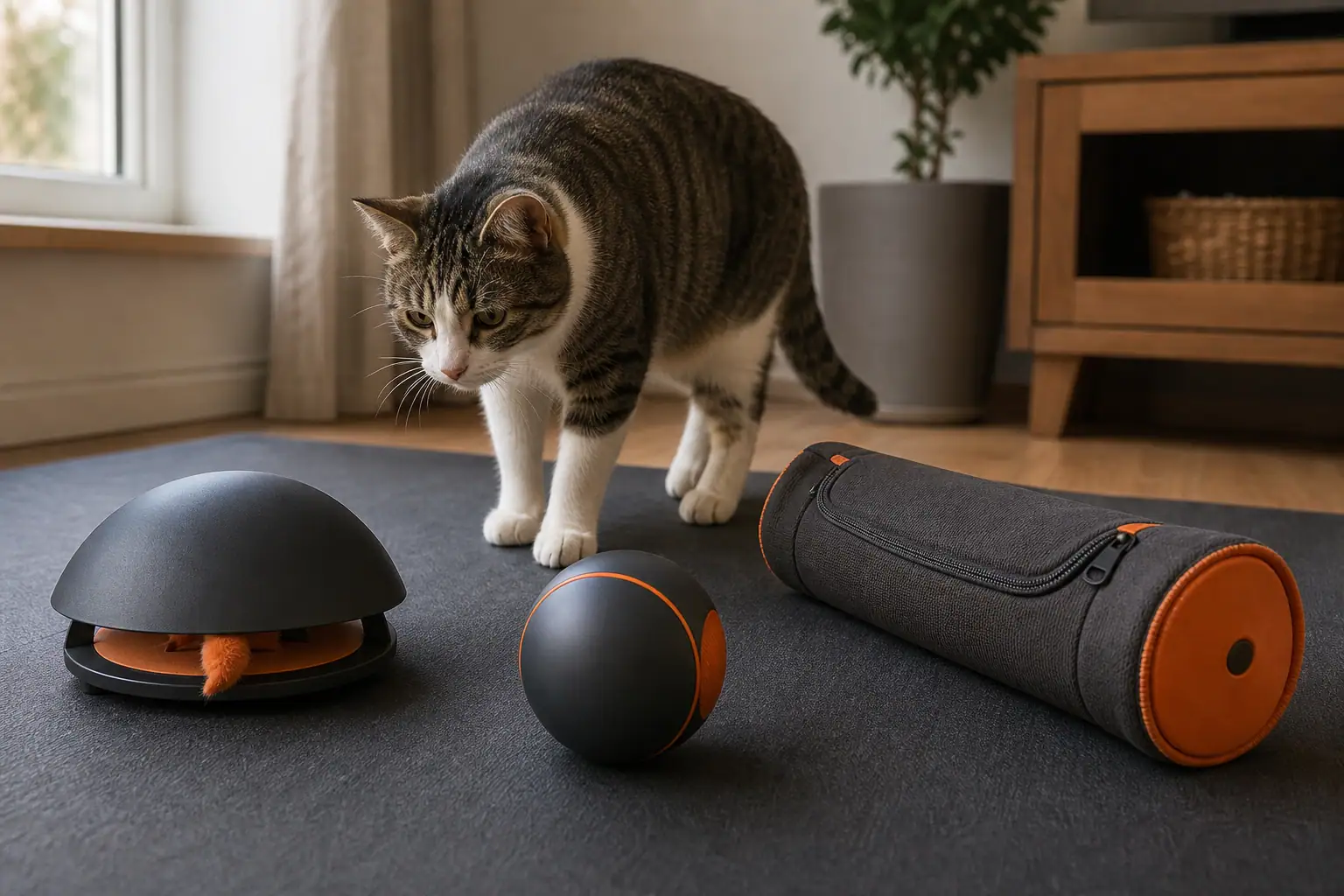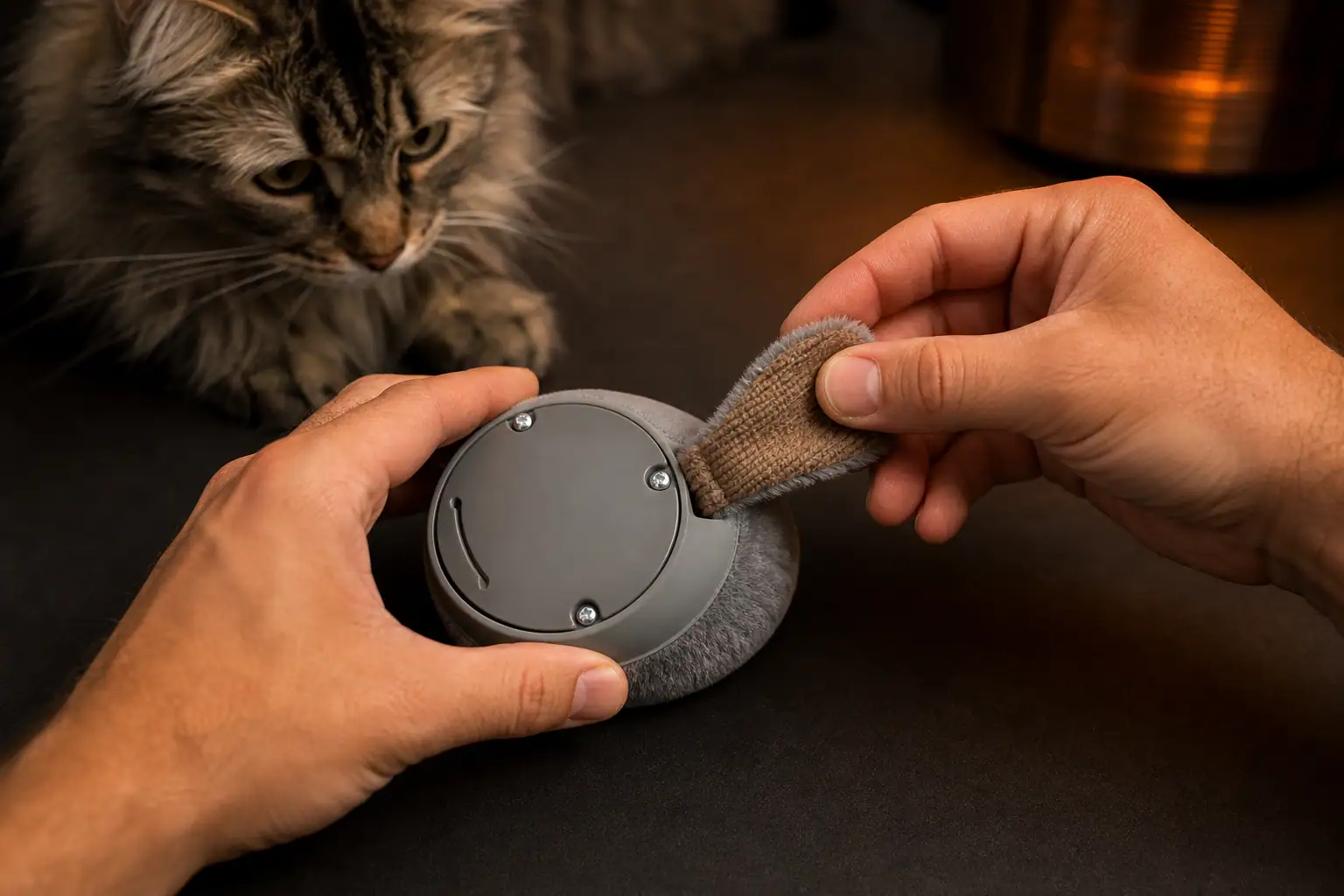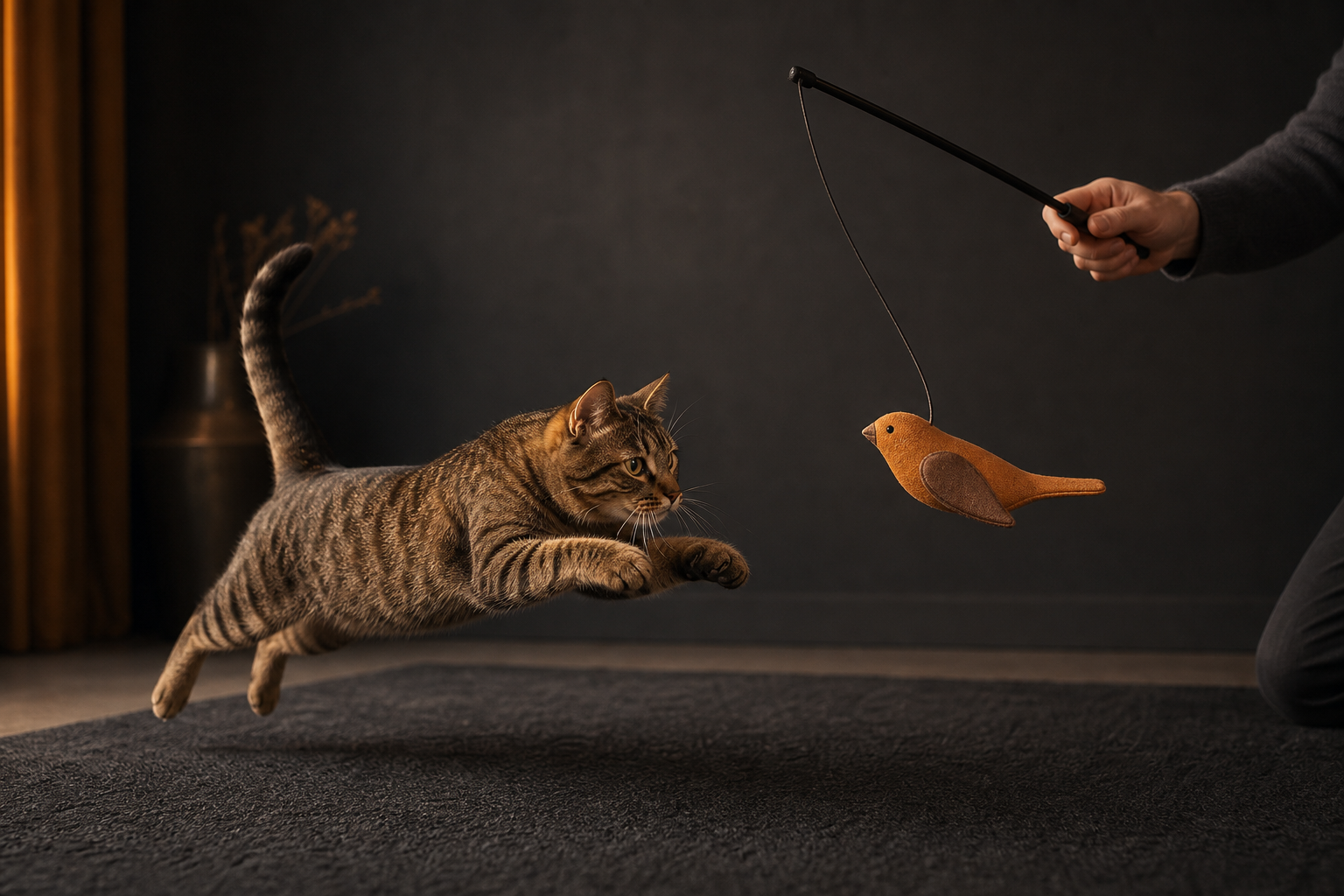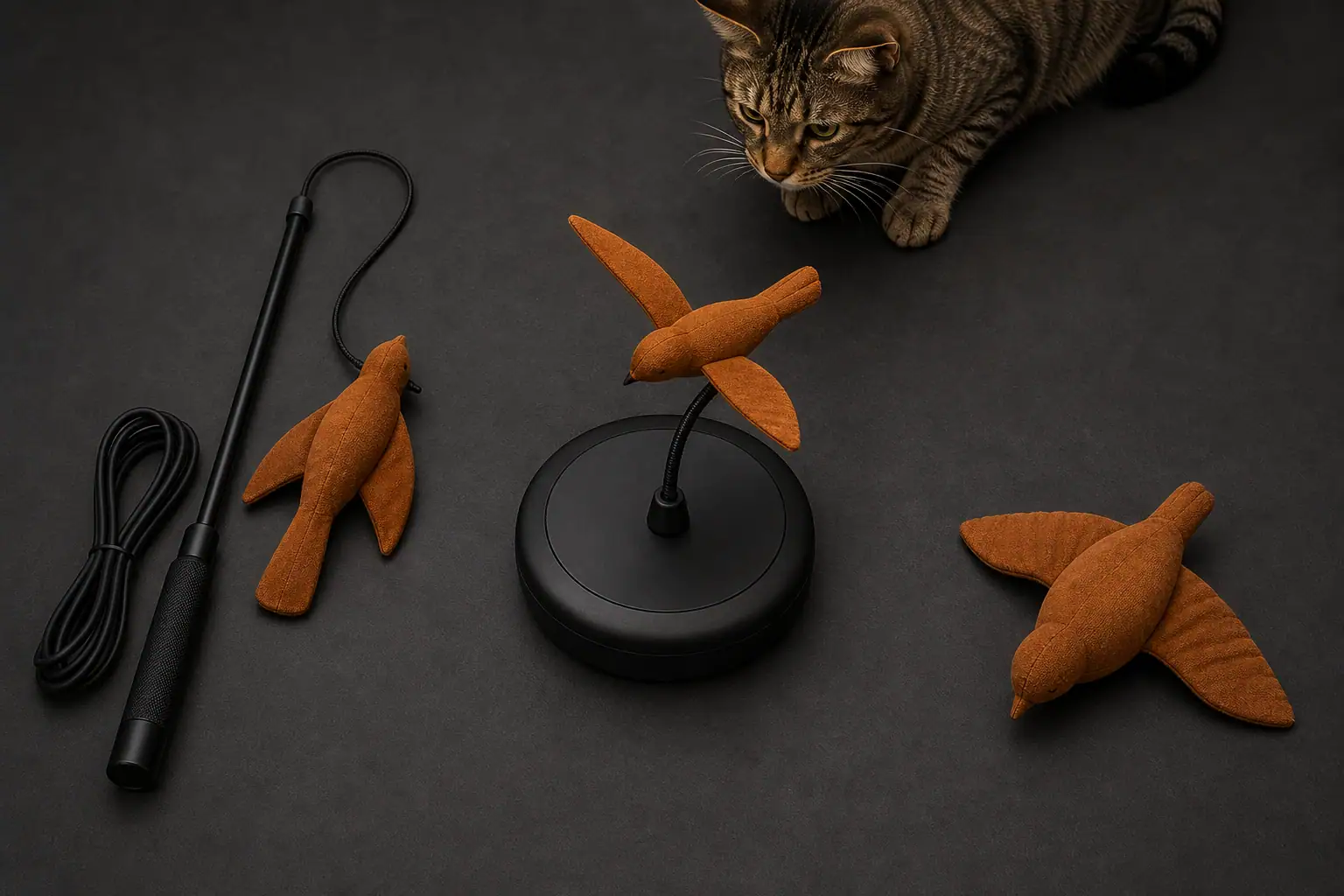
Tag: durable cat toys

  • Cat Play Aggression Towards Owner: How to Stop Rough Attacks Safely

    Cat Play Aggression Towards Owner: How to Stop Rough Attacks Safely

    Cat play aggression towards an owner usually means the cat is treating a person like moving prey: stalking ankles, pouncing from behind furniture, grabbing hands, biting, scratching, or escalating during play. The safest first response is not punishment. Stop moving like prey, calmly end contact, and redirect future attacks into toys that keep teeth and claws away from skin.

    This behavior is common in young, energetic, under-stimulated, or rough-playing cats, but adult cats can do it too. It can also overlap with fear, pain, redirected aggression, petting intolerance, or territorial stress, so the plan has two jobs: give your cat better play outlets and watch for signs that this is more than rough play.

    What Cat Play Aggression Looks Like

    Play aggression is built from normal hunting behaviors pointed at the wrong target. A cat may hide, stare, crouch, wiggle, chase, pounce, wrap the front paws around an arm or leg, bite, and rake with the back feet. The cat may seem excited rather than angry, but the scratches and bites are still real.

    Common patterns include:

    • Ankle ambushes: your cat waits behind a doorway, sofa, bed skirt, or stair and launches as you walk by.
    • Hand attacks: the cat grabs during petting, typing, bed-making, or any movement that looks like prey.
    • Play that tips over: a wand or chase session starts well, then the cat redirects onto your arm when the toy gets too close.
    • Evening surges: the cat becomes more intense at dawn, dusk, or after a quiet day with too little activity.
    • Single-person targeting: one household member gets attacked more often because of movement, routine, play history, or access.

    Cornell Feline Health Center describes play-aggressive cats as cats that may stalk and pounce on human targets, often with dilated pupils and tail movement before the attack. The San Francisco SPCA also notes that lack of scheduled, appropriate playtime is a major contributor for many play-aggressive cats.

    First, Rule Out the Wrong Kind of Aggression

    Do not assume every bite is play. A play plan is useful only when the behavior is truly playful, predictable, and connected to movement or under-stimulation. If aggression appears suddenly, gets severe, happens when the cat is touched, includes hissing or defensive postures, or follows a stressful event, slow down and involve your veterinarian.

    ASPCA guidance on feline aggression emphasizes that medical conditions can contribute to aggressive behavior, and Cornell recommends ruling out medical causes before relying on behavior modification alone. Pain, dental disease, arthritis, thyroid disease, sensory decline, wounds, and neurological issues can all change how a cat responds to people.

    Call your veterinarian or a qualified behavior professional promptly if:

    • the aggression is new, escalating, or hard to interrupt;
    • bites break skin or the cat repeatedly holds on;
    • your cat growls, hisses, hides, limps, or guards part of the body;
    • attacks happen after seeing outdoor cats, hearing loud sounds, or conflict with another pet;
    • children, older adults, immunocompromised people, or guests are at risk;
    • you feel unsafe moving around your own home.

    What to Do During an Attack

    The moment teeth or claws land, your goal is to make the person boring without adding fear. Fast jerking, yelling, swatting, chasing, or rough wrestling can make the situation worse because those responses either look like prey movement or teach the cat that humans play roughly.

    1. Freeze for a beat. Stop the moving target. If the cat is latched on, avoid pulling away quickly.
    2. Go neutral. Keep your voice low and your body still. Do not punish, scruff, spray, or hit.
    3. Disengage calmly. Once the cat releases, step behind a door, baby gate, or barrier if needed.
    4. End the session. Do not immediately reward the bite by presenting a toy after contact has already happened.
    5. Reset the environment. After the cat is calm, start a planned toy session away from the ambush spot.

    That timing matters. Redirecting before a pounce teaches the cat what to attack. Offering a toy after your skin has already been grabbed can accidentally teach the cat that biting you starts the game.

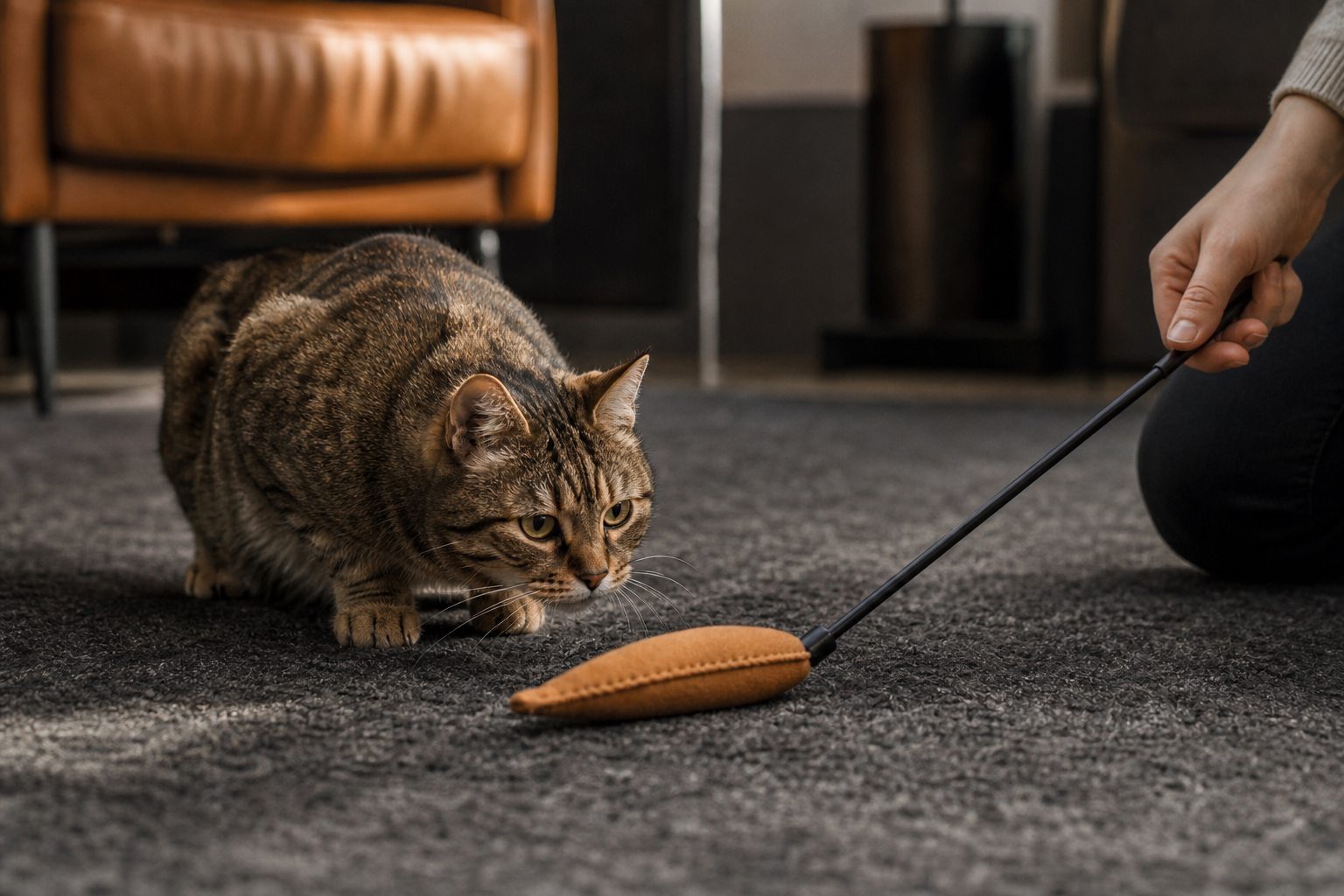
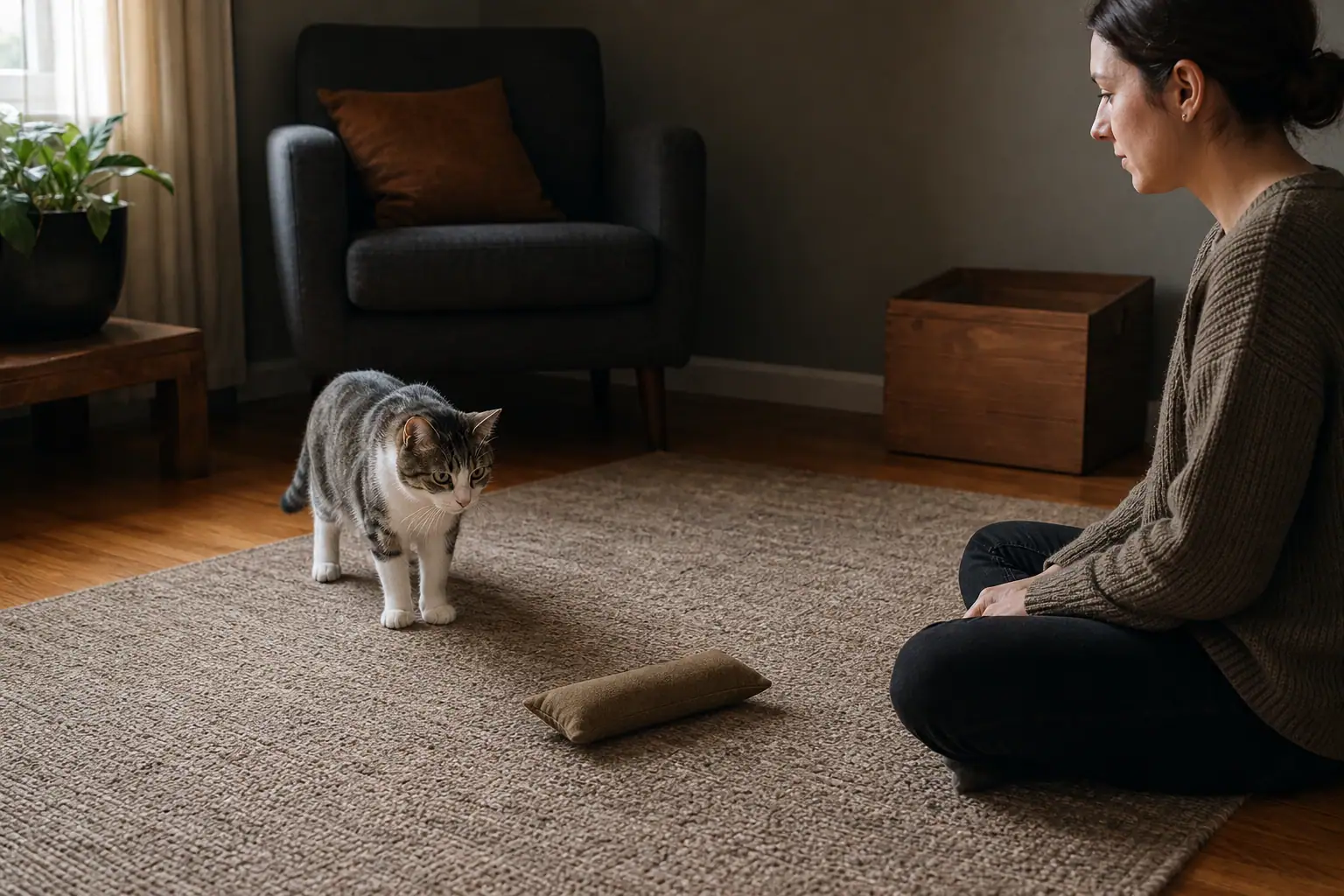
    Alert cat crouching near a toy before a play pounce
    Crouching, dilated pupils, tail lashing, and corner ambushes are cues to redirect before your hands or ankles become the target.

    Redirect Before the Pounce

    The best moment to stop cat play aggression towards an owner is the moment before it happens. Watch for the setup: fixed stare, tail twitching, crouching, rear-end wiggle, hiding around corners, pupils widening, and tracking your feet or hands.

    When you see those cues, redirect with distance:

    • Toss a soft, safe chase toy away from your body.
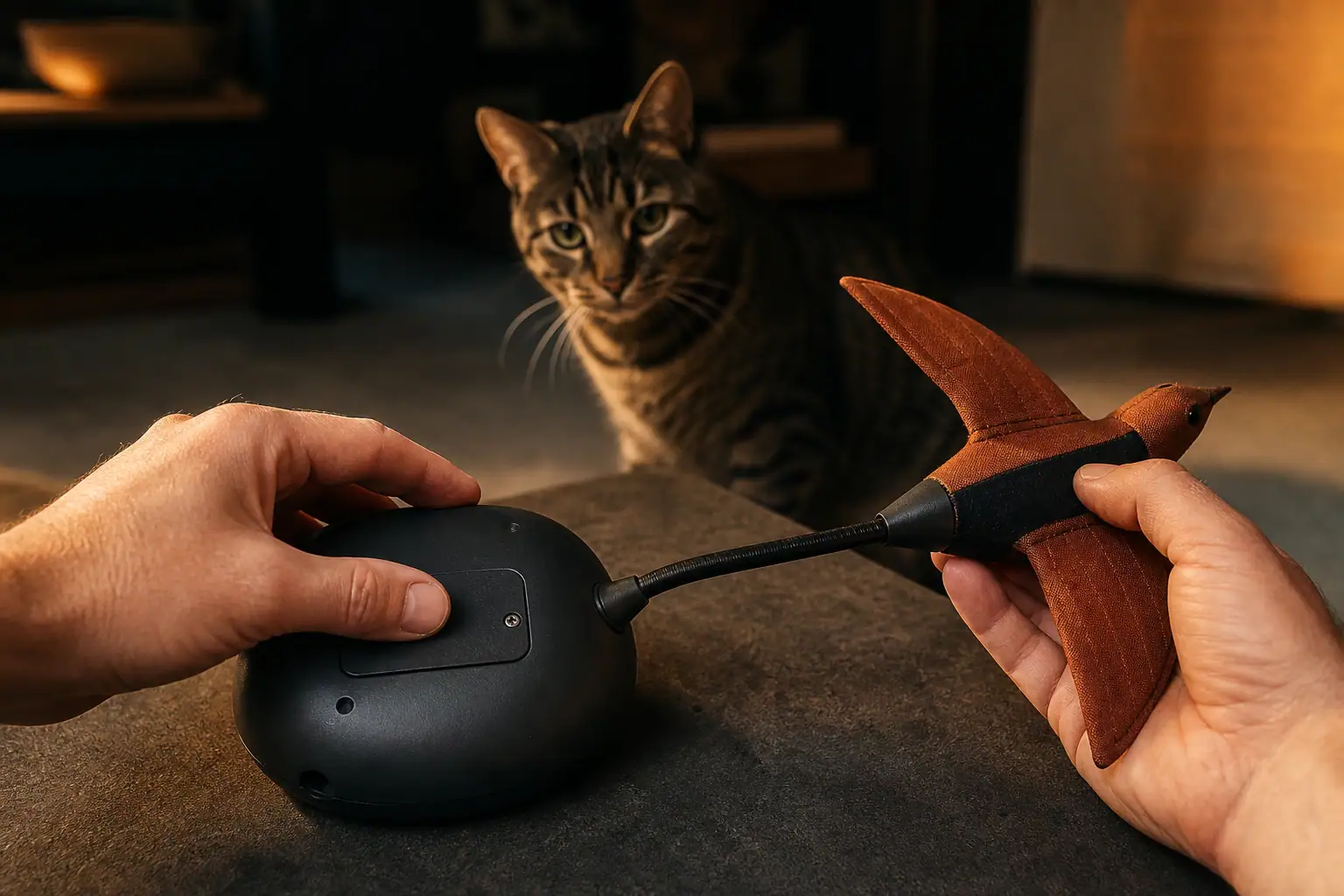
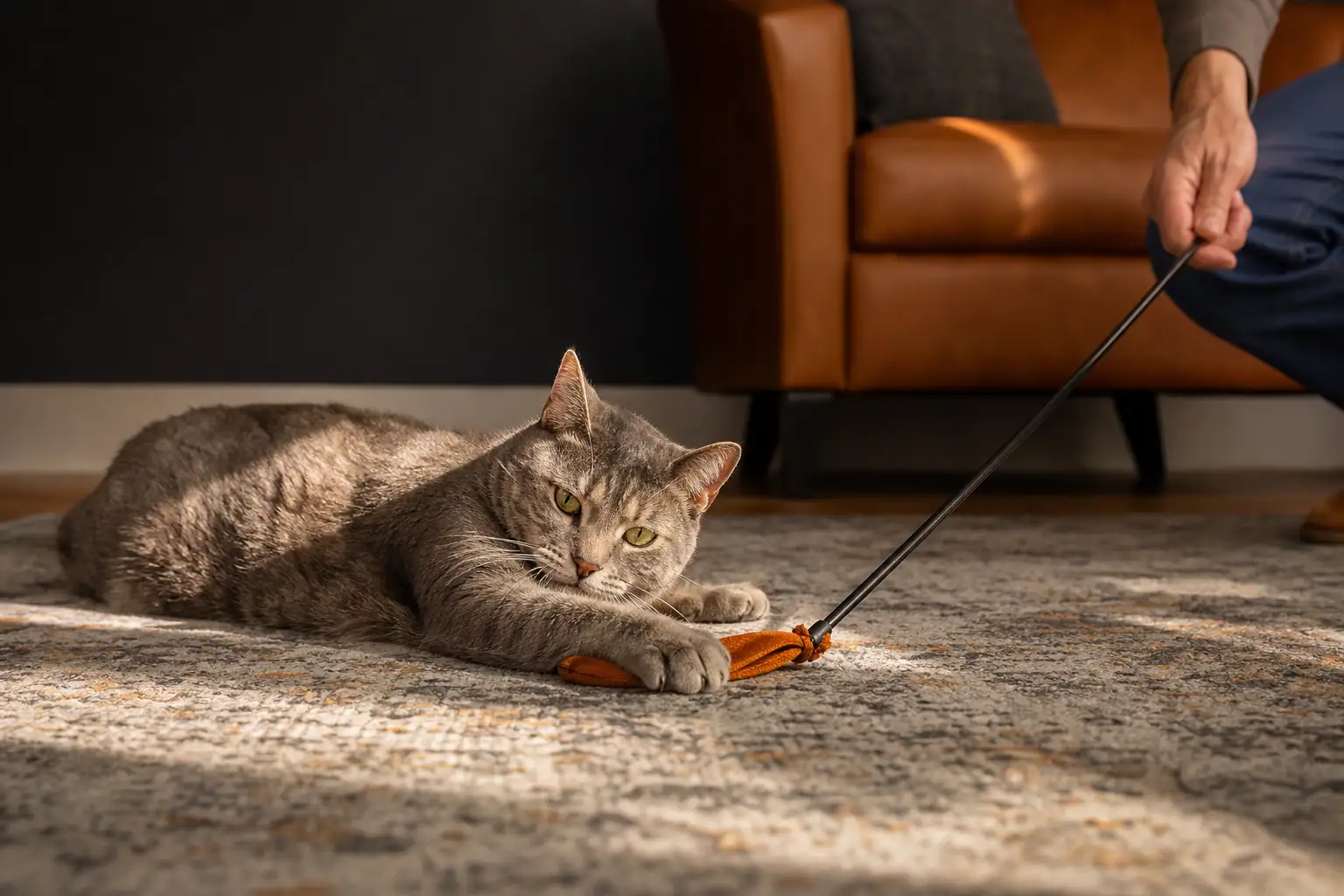
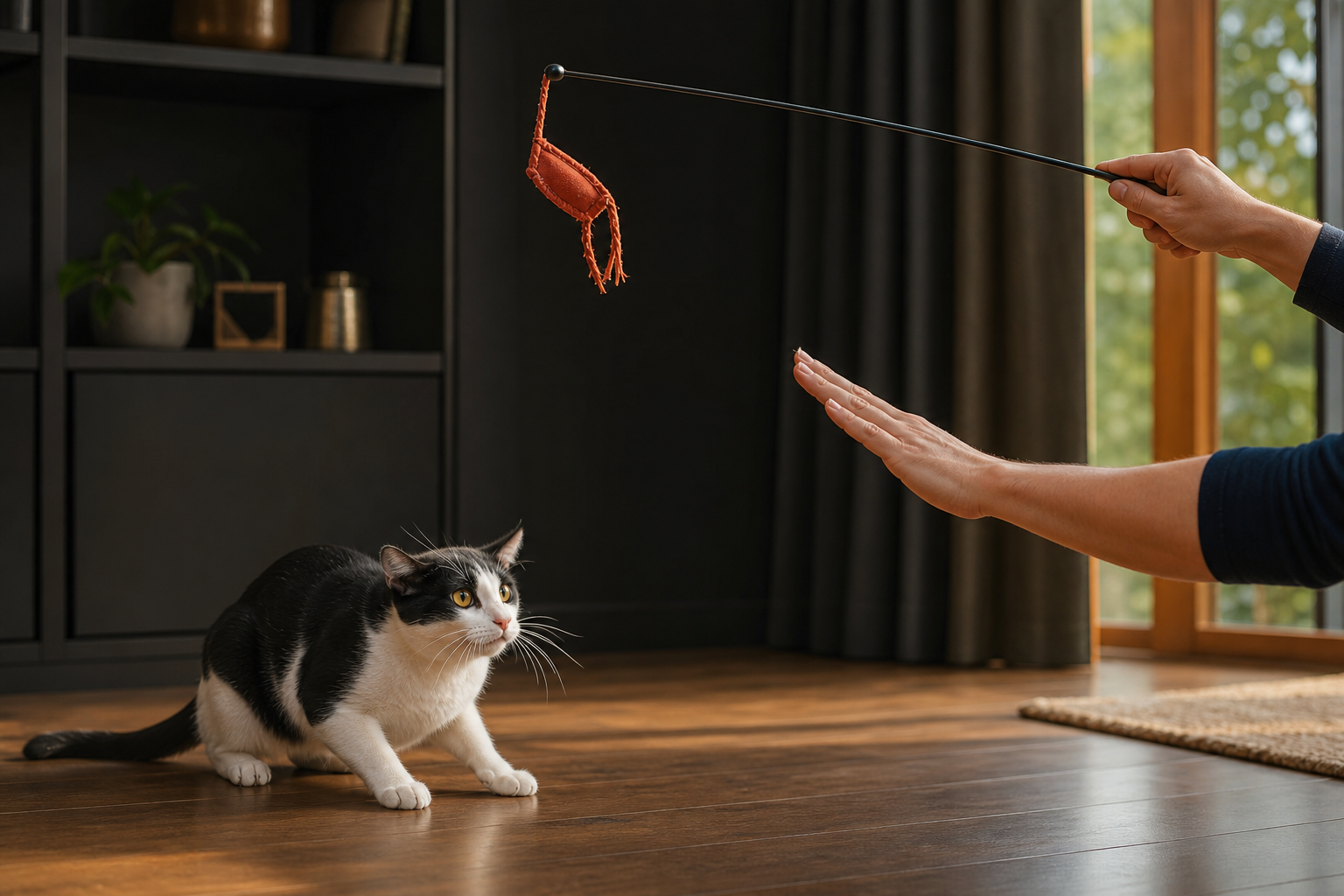
    • Use a wand so the lure moves away from you, not across your ankles.
    • Send the cat through a tunnel, around a chair, or up a cat tree to create a chase path.
    • End with a kicker toy the cat can grab, bite, and rake.
    • Follow with a small meal or treat puzzle if the cat settles better after a hunt-eat rhythm.

    If the ambush happens in the same place every day, change the setup. Block under-bed launch spots, leave a toy station near the hallway, carry a toss toy when walking through the danger zone, or schedule play before the usual attack window.

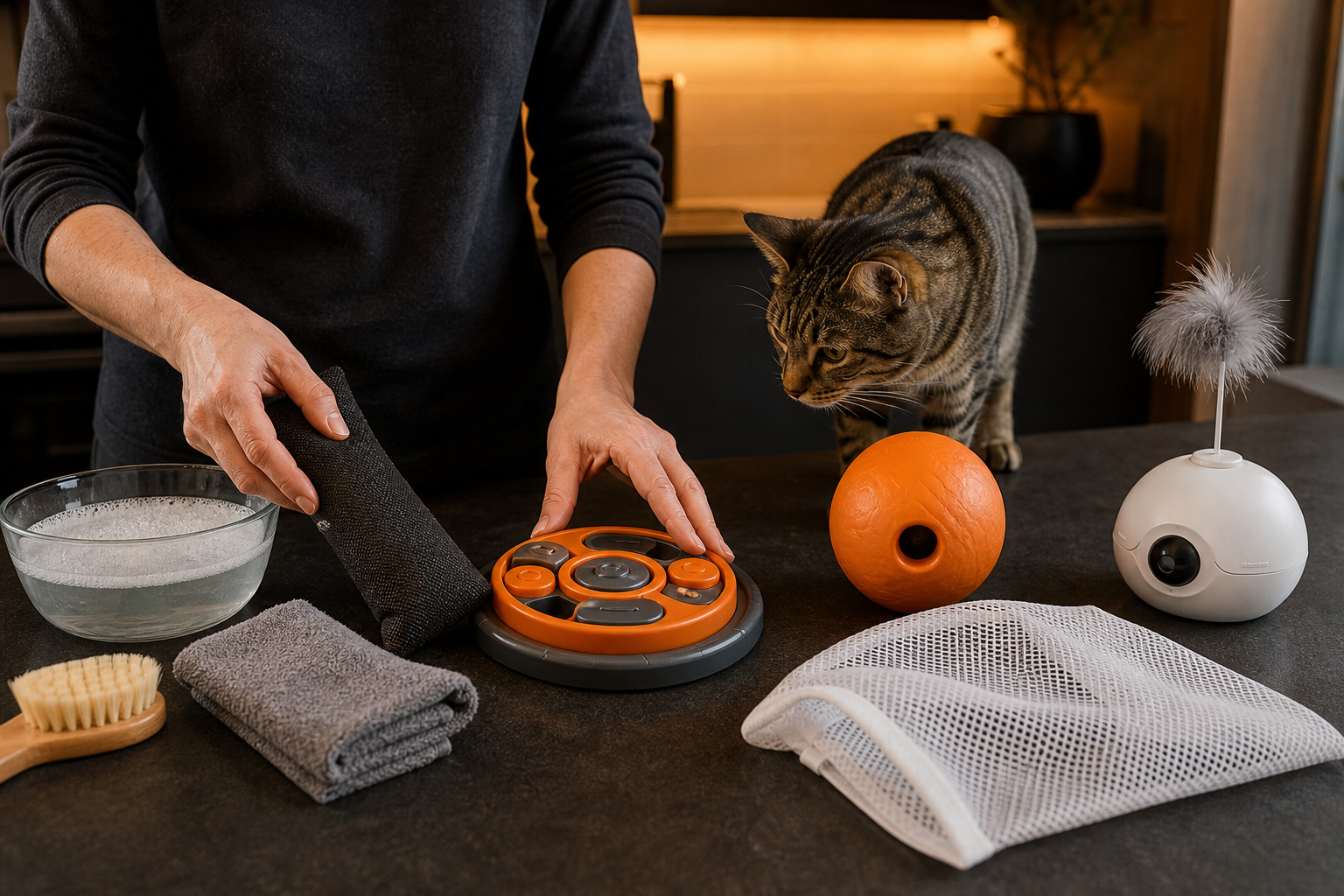
    Build a Safer Rough-Play Kit

    Owners of hard-biting cats need more than a cute toy basket. They need legal targets for each part of the hunting sequence: chase, pounce, grab, bite, kick, and settle. A strong setup uses different toy types for different jobs.

    • Wand toy for distance: use it for chase and pounce, then store it after play. Do not leave string, ribbon, elastic, or feather lures out for a cat that chews.
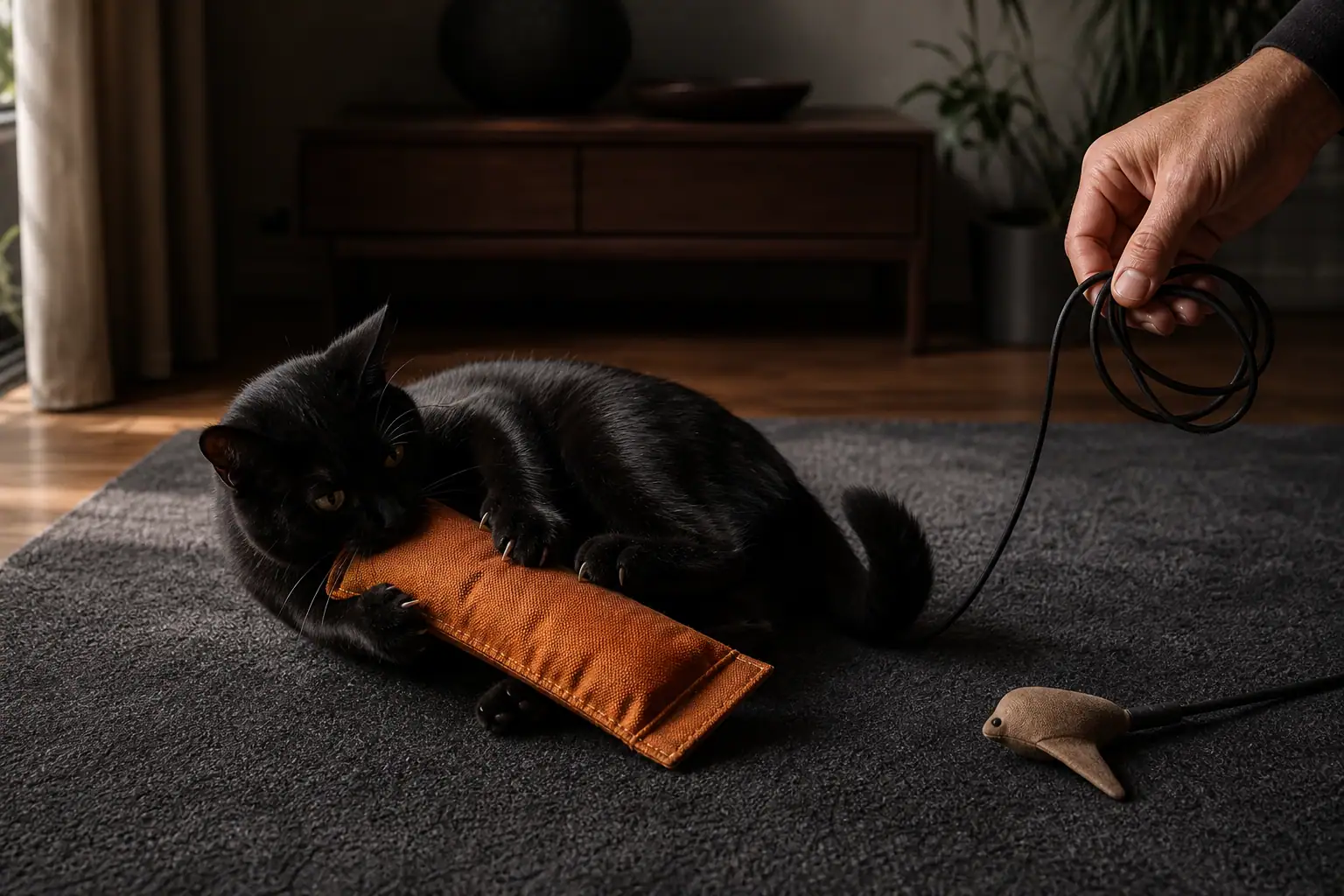
    • Large kicker toy for impact: choose a long, dense toy that keeps your hands out of range while the cat bites and bunny-kicks.
    • Toss toys for ambush redirection: keep a few simple toys in rooms where the cat stalks feet.
    • Puzzle or food toy for the finish: give the cat a way to settle after the chase instead of immediately restarting the attack.
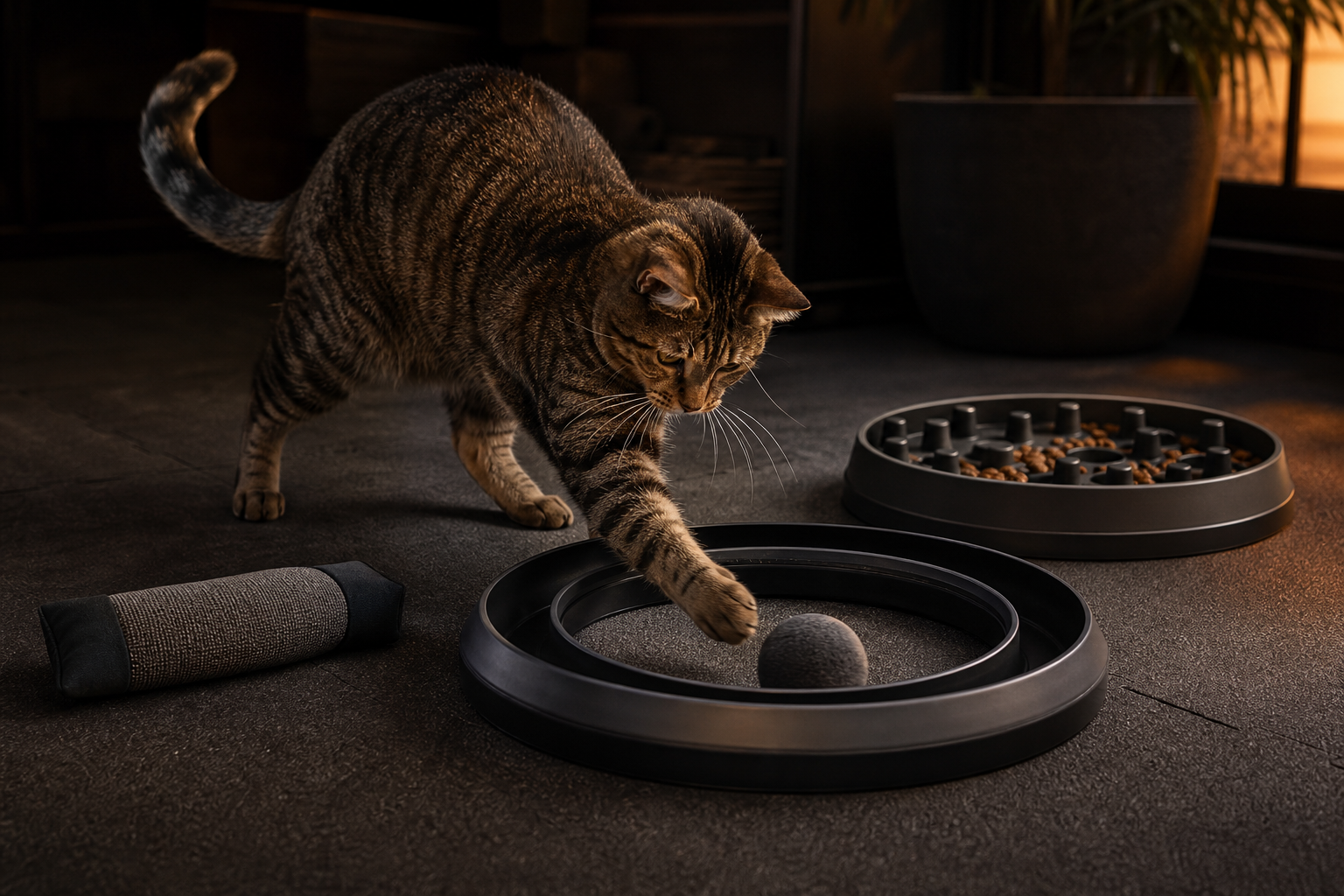
    • Solo toys for off-hours: use sturdy balls, tracks, tunnels, and safe enrichment items that do not have swallowable parts.

    For deeper toy selection, see Titan Claws’ guides to cat toys for play aggression, cat stick and wand toys, and indoor cat enrichment toys. If your cat destroys plush or chews through fabric, the cat chew toys for aggressive chewers guide is a useful next step.

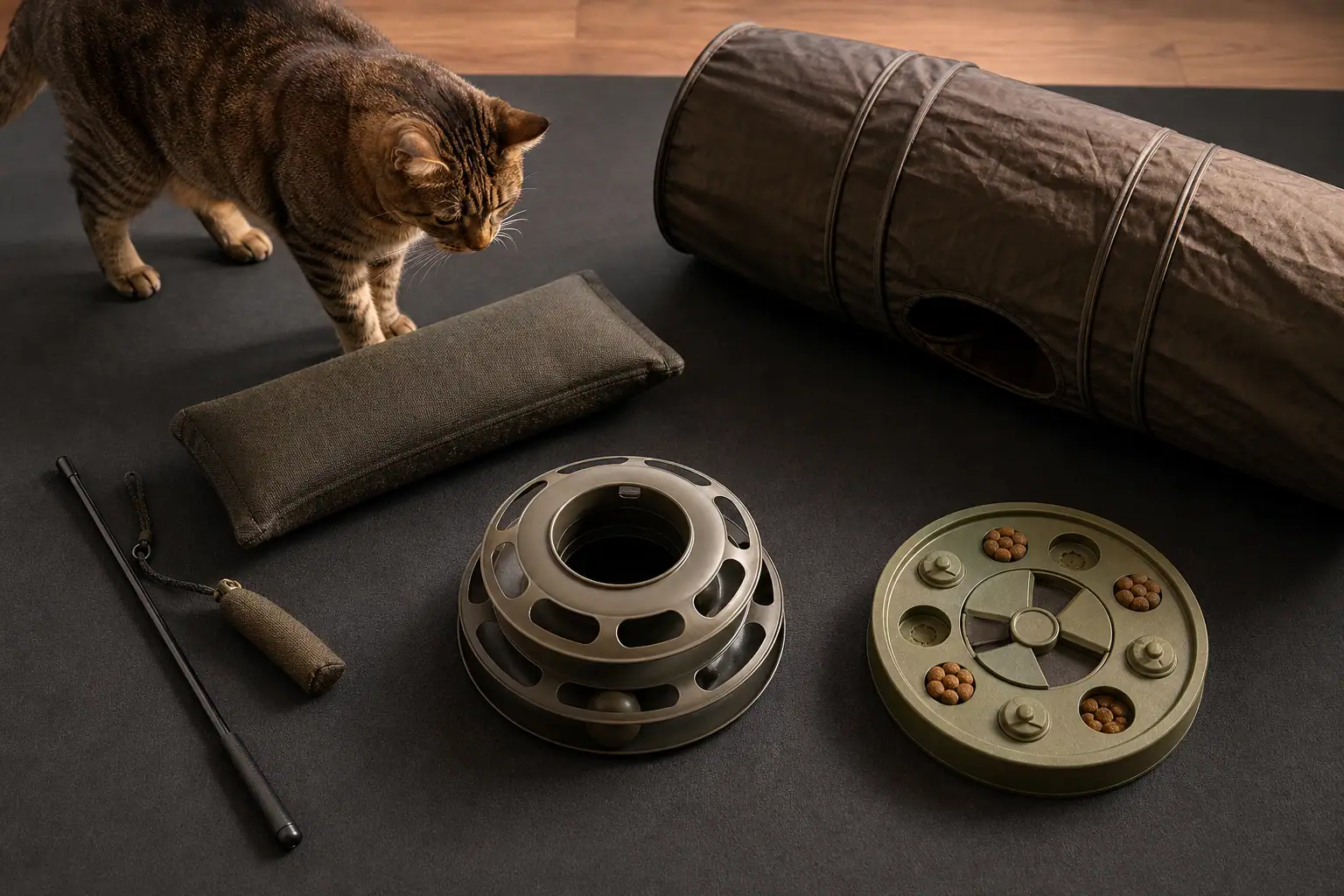
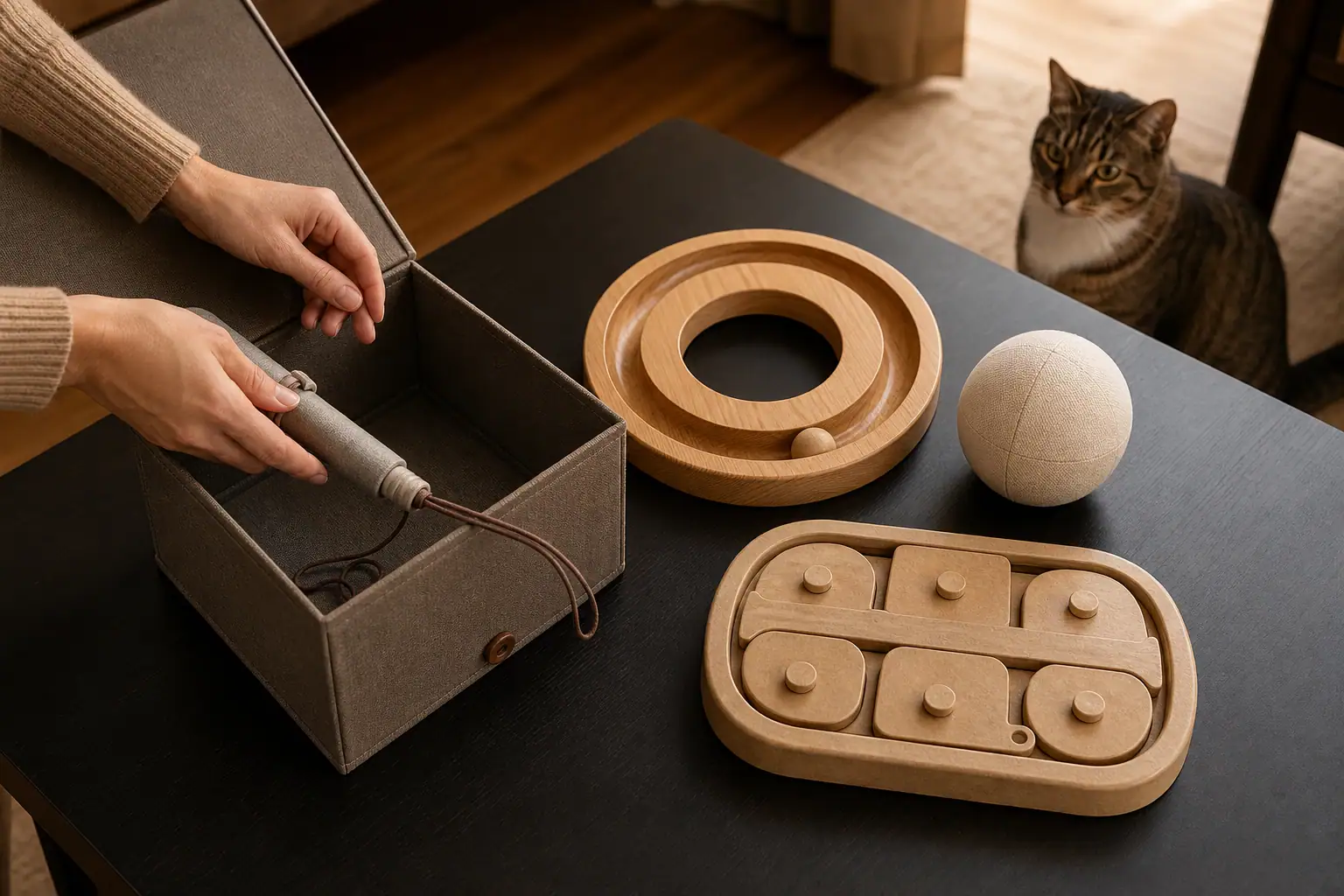
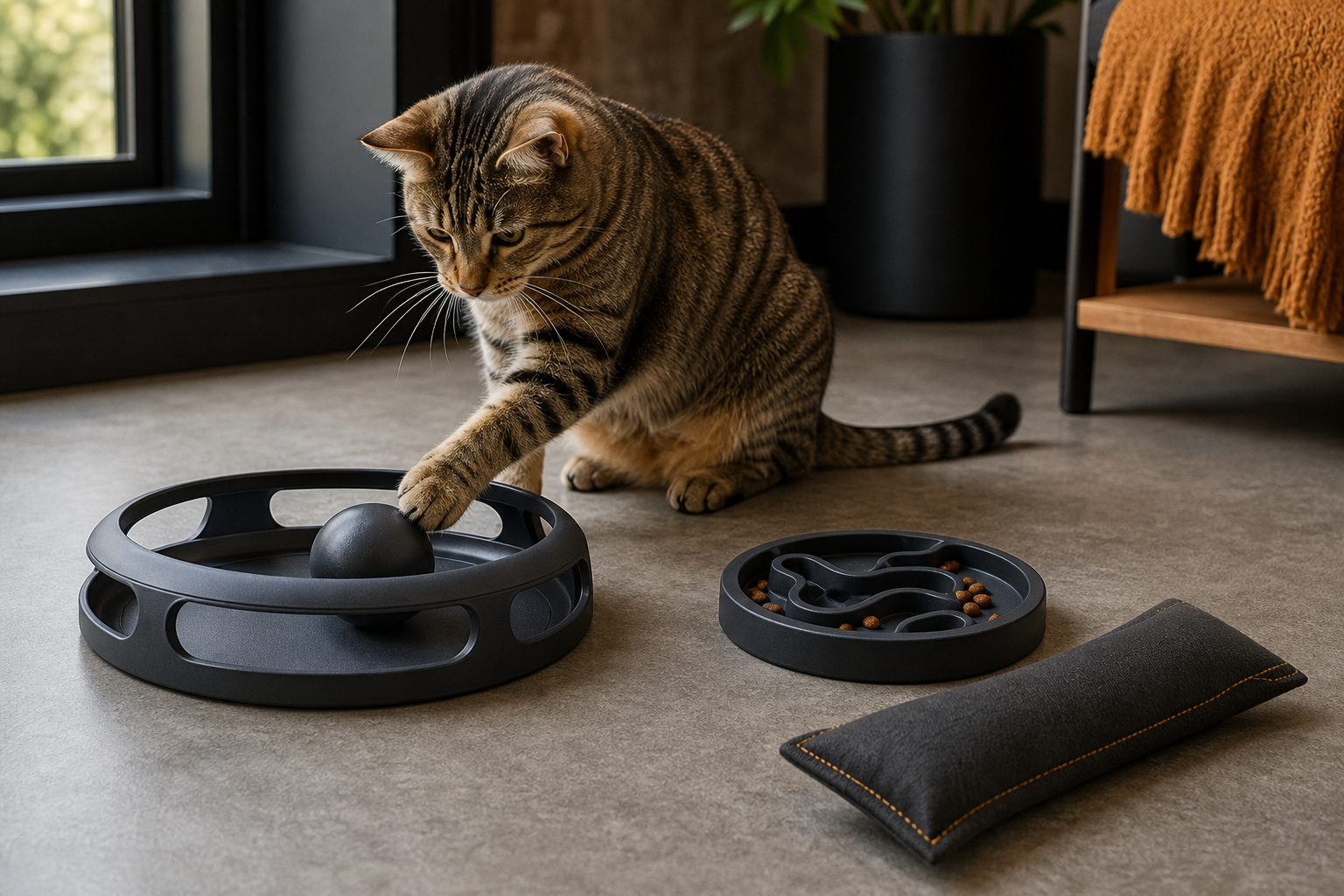
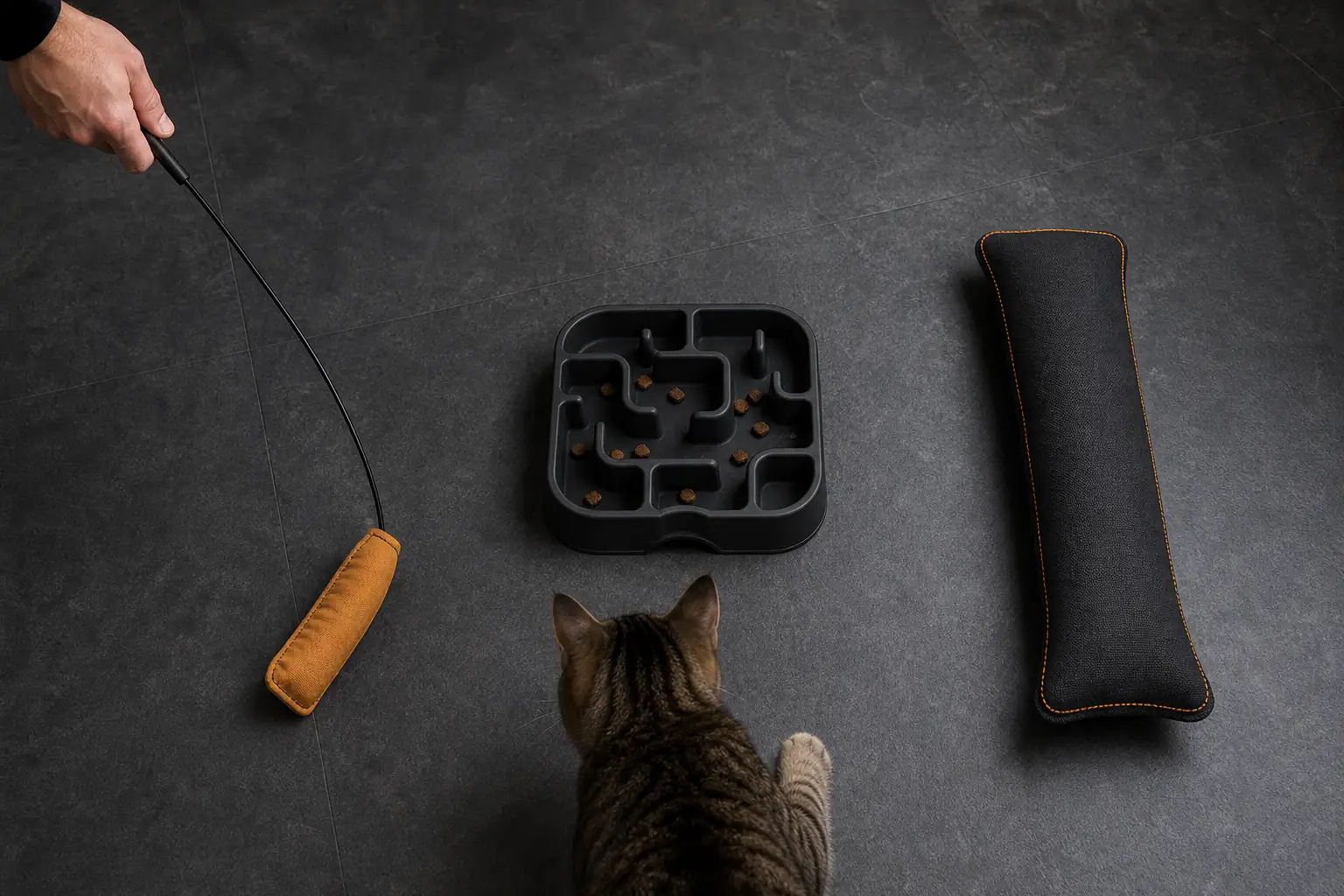
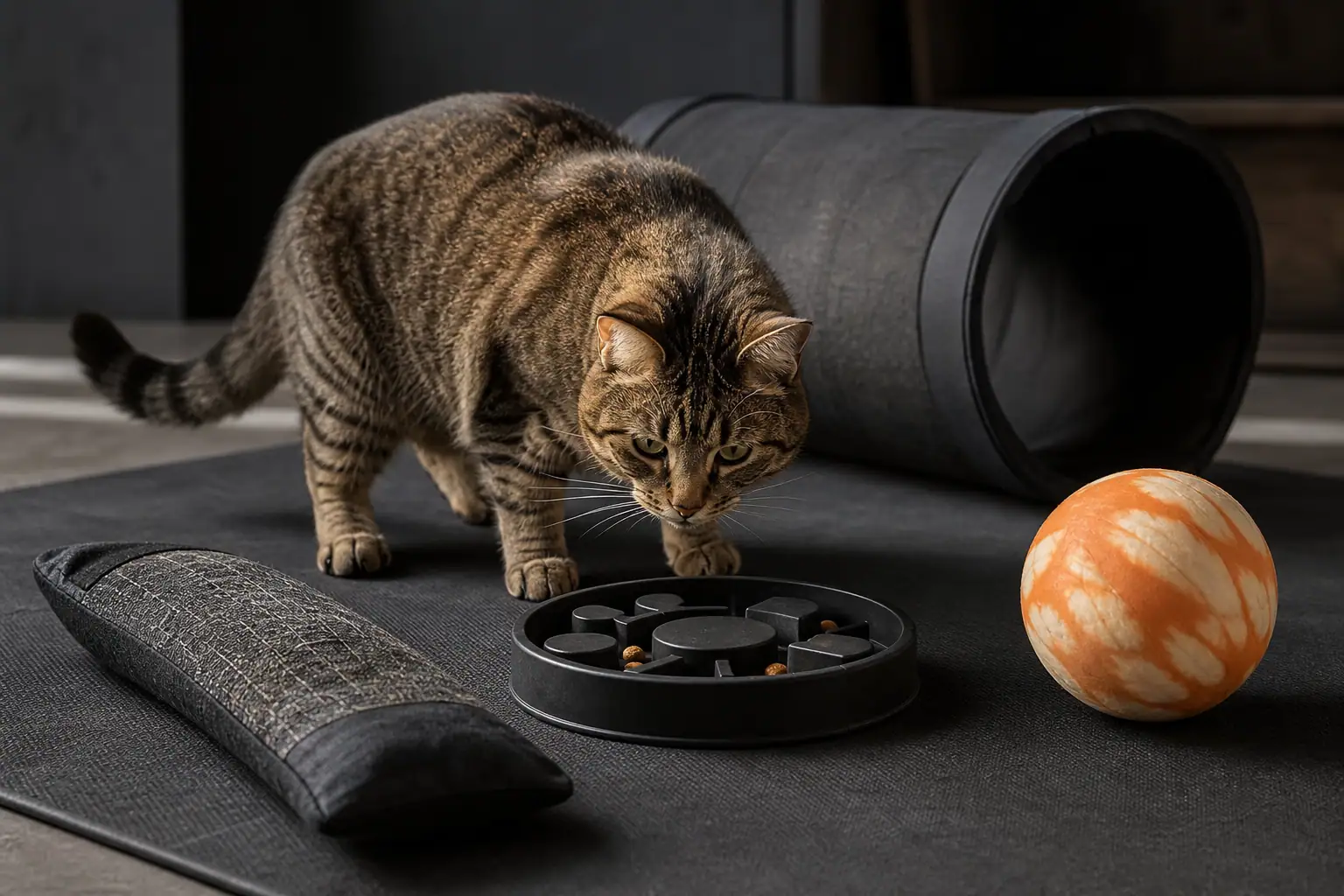
    Cat play redirection kit with wand toy, kicker toy, and treat puzzle
    A simple redirection kit gives your cat legal targets for stalking, chasing, grabbing, and biting.

    A Daily Plan for Owner-Directed Play Aggression

    Most cats do better with predictable outlets than with random emergency play. Start with two or three short sessions each day and adjust around your cat’s peak attack times.

    Morning: drain the first surge

    Give your cat 10 to 15 minutes of interactive play before the household becomes busy. Move the lure like prey: away, behind furniture, briefly hidden, then catchable. Let the cat succeed. Finish with a kicker, breakfast, or a small food puzzle.

    Midday or after work: prevent boredom

    Rotate solo enrichment while you are busy. Put out one or two safe options, not the entire bin. Boxes with handles removed, tunnels, sturdy ball tracks, and puzzle feeders can help without teaching your cat to attack people for entertainment.

    Evening: play before the ambush window

    If your cat attacks ankles at 8 p.m., do not wait until 8:05. Start play at 7:45, before the cat chooses the target. Use a wand at distance, then a kicker, then food or a calm routine.

    Overnight: remove risky toys

    Store wand toys, string toys, feather toys, elastic, yarn, and damaged toys behind a closed door. Leave only toys that are appropriate for your specific cat without supervision.

    What Not to Do

    Several common reactions make owner-directed play aggression harder to fix. Avoid these even when the bite surprises you.

    • Do not use hands as toys. Wrestling with kittens teaches them that skin is a legal target when they grow stronger.
    • Do not punish physically. Cornell warns that physical punishment can increase fear or anxiety and worsen aggression.
    • Do not chase the cat after an attack. That can become part of the game or add fear.
    • Do not rely on one automatic toy. Movement helps, but rough cats need interaction, inspection, and varied outlets.
    • Do not leave string-like toys out. Cornell’s safe-toy guidance cautions against small pieces and strand-like parts that may detach and be swallowed.
    • Do not keep using damaged toys. Tougher does not mean safe forever.

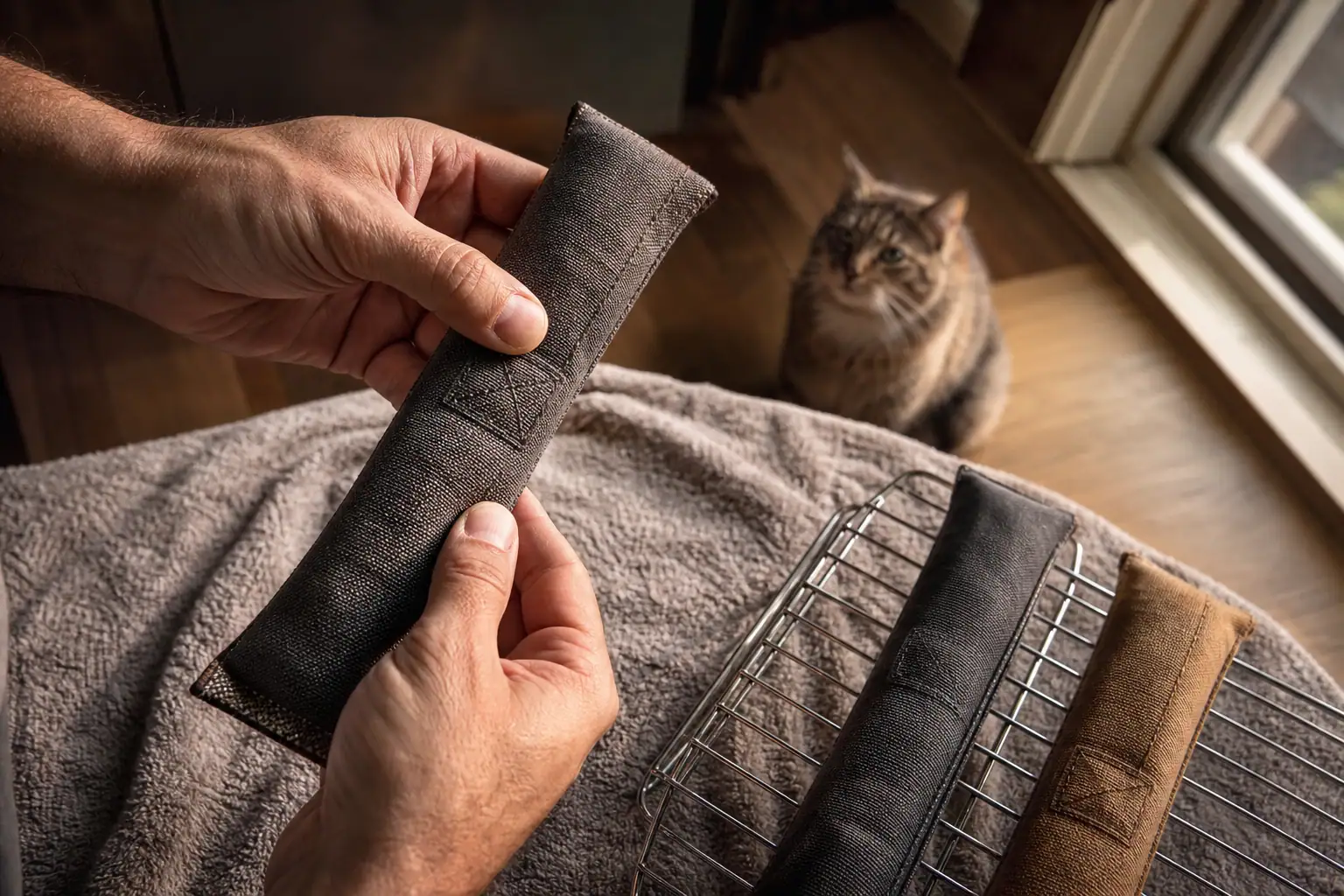
    Inspect Toys After Rough Sessions

    A cat that redirects onto toys may bite, rake, drag, and chew those toys hard. That is better than skin, but it means inspection becomes part of the behavior plan.

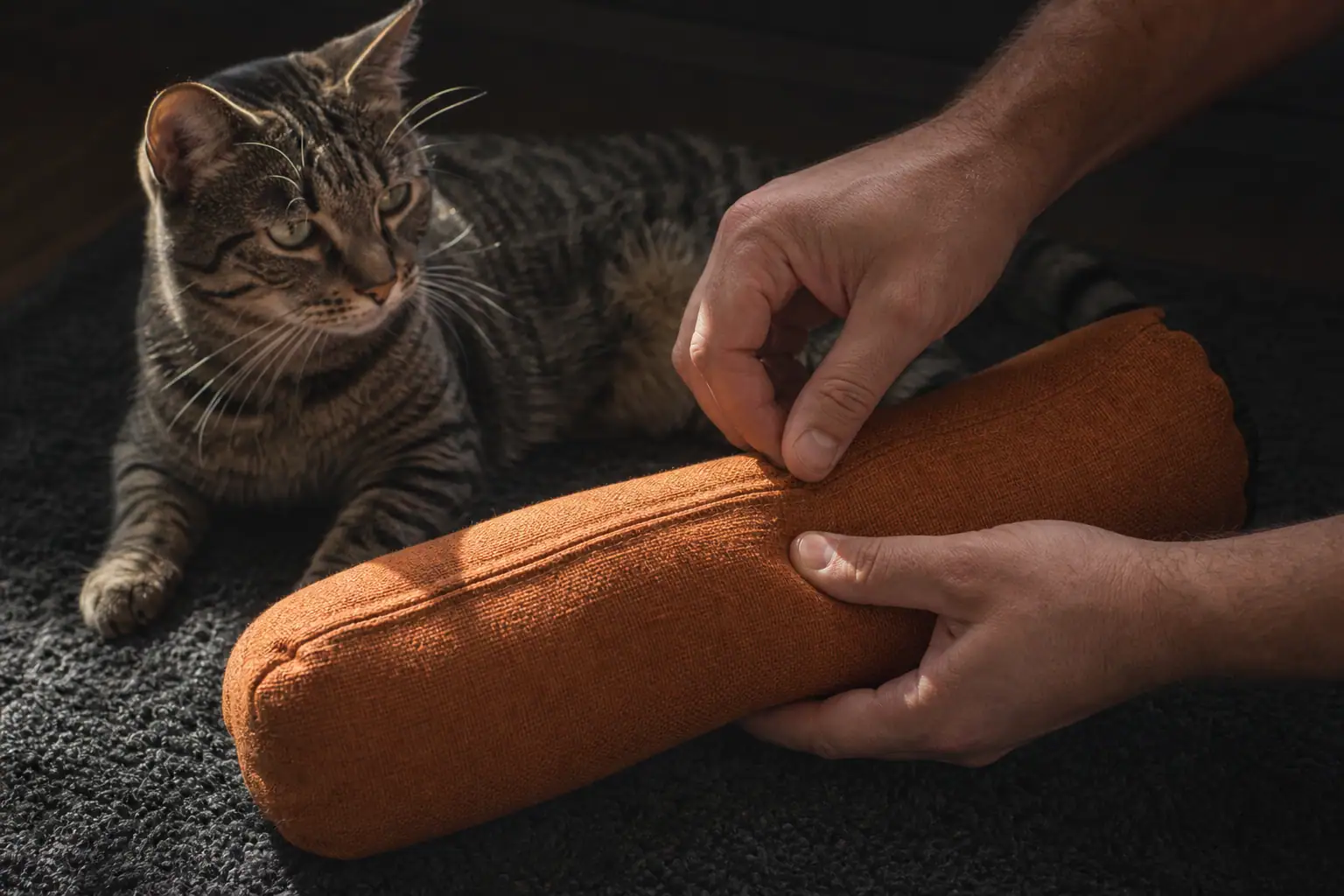
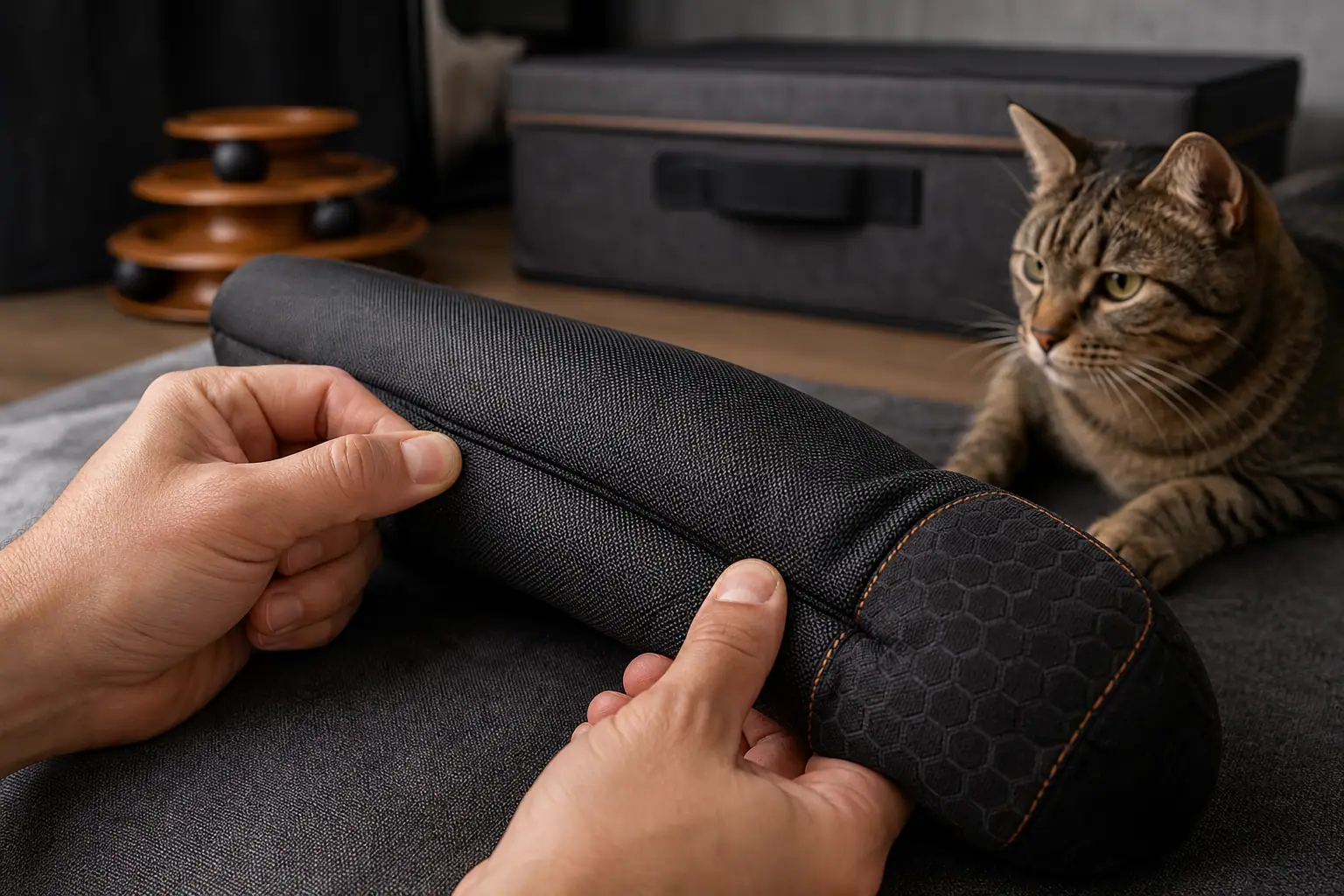
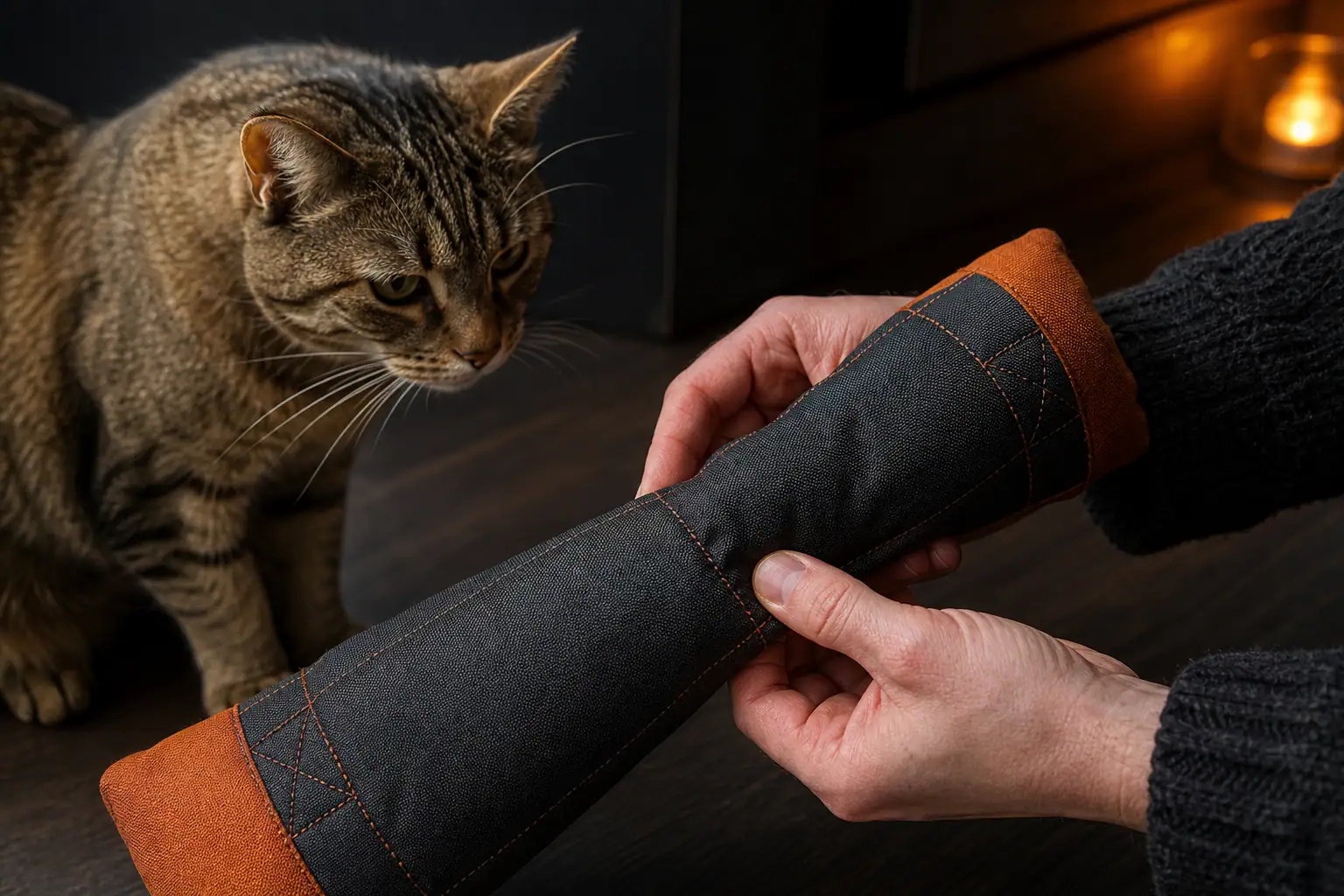
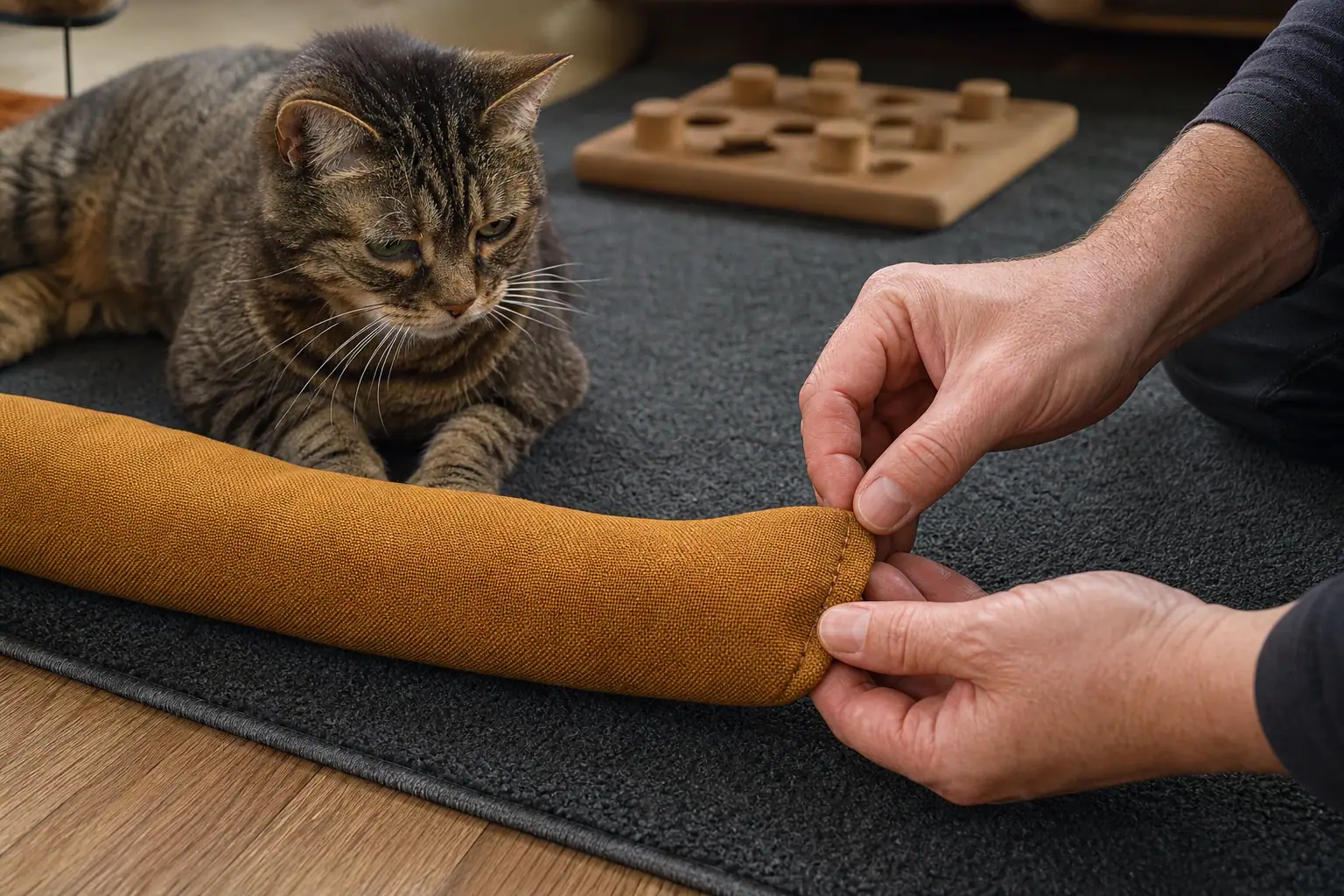
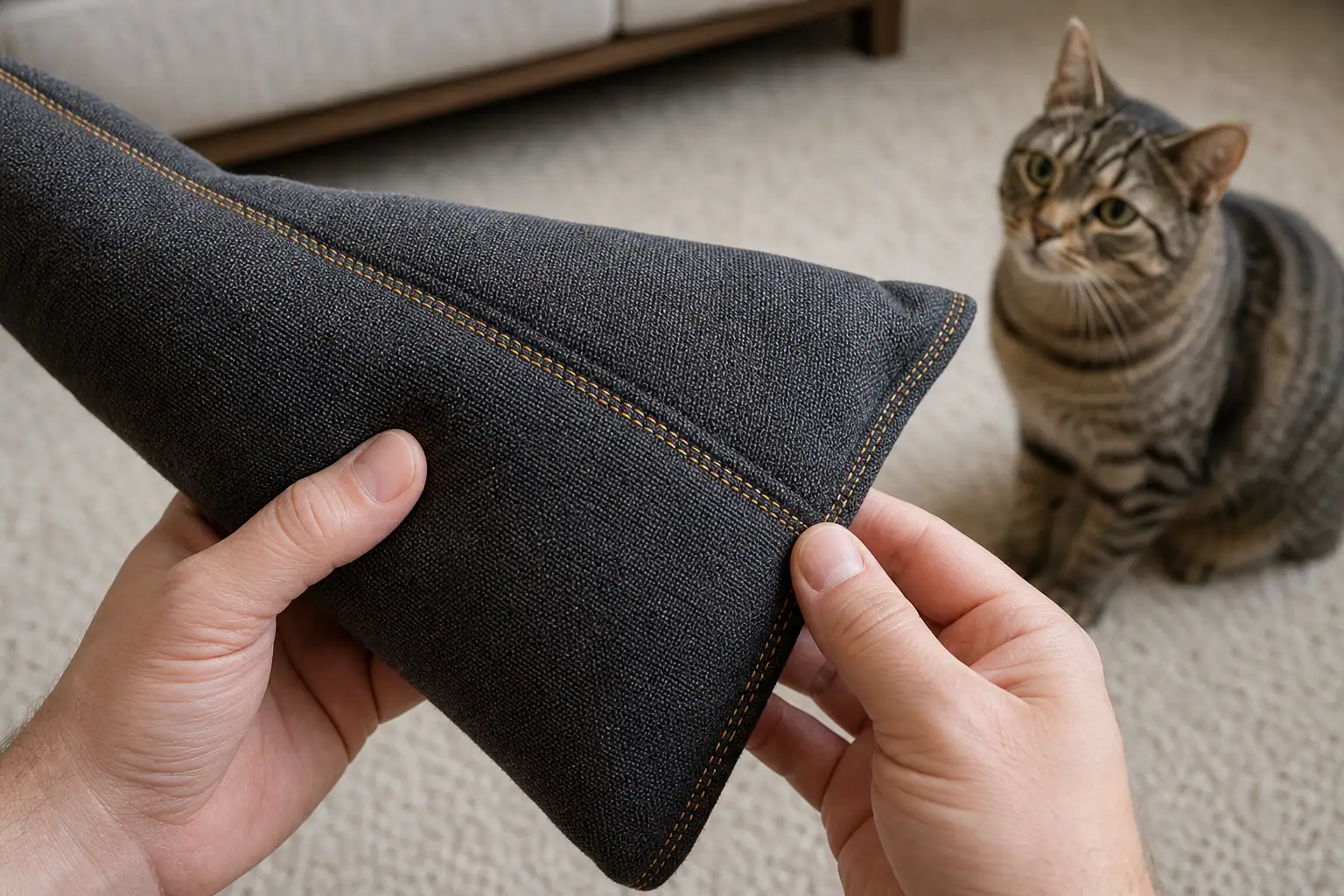
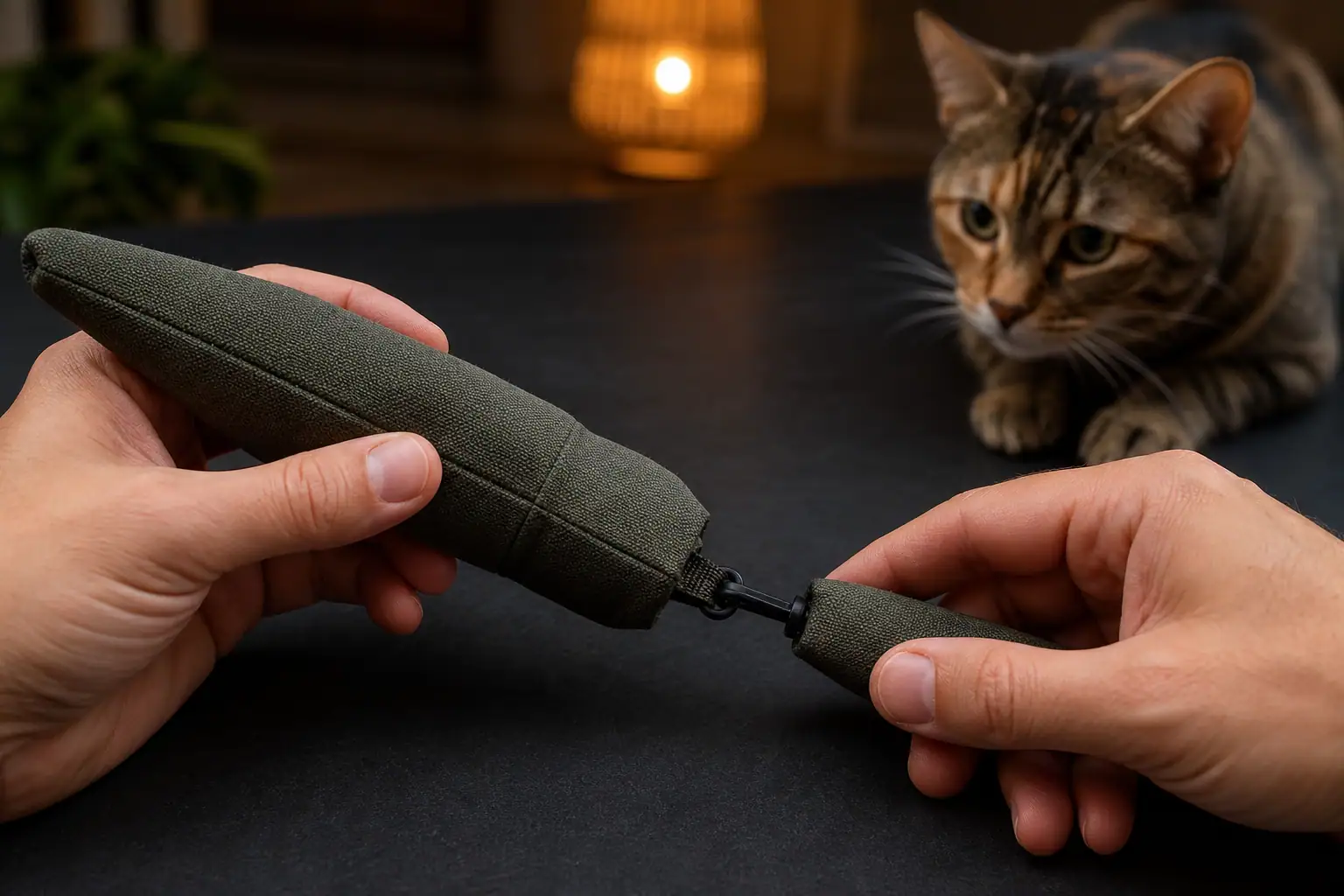
    Hands inspecting a cat kicker toy seam after rough play
    Rough-play toys need inspection. Retire toys when seams open, stuffing appears, or small parts loosen.

    After rough play, check:

    • open seams, loose threads, exposed stuffing, and thin fabric;
    • detached feathers, bells, eyes, tails, knots, or plastic caps;
    • cracked plastic, sharp edges, bent clips, and broken wand connectors;
    • deep tooth marks in rubber or foam-like materials;
    • battery doors, charging ports, and moving parts on electronic toys;
    • wet, dirty, or smelly toys that need washing or retirement.

    Retire a questionable toy before it becomes an ingestion hazard. Titan Claws avoids calling any cat toy indestructible because the safer standard is more practical: choose durable construction, supervise the first sessions, inspect damage, and replace the toy before failure gets dangerous.

    Quick Checklist

    • Does the behavior look like stalking, chasing, grabbing, and biting during high-energy moments?
    • Have you ruled out pain, fear, redirected aggression, and sudden medical changes?
    • Are all household members avoiding hand wrestling and rough body play?
    • Do you redirect before the pounce instead of rewarding after a bite?
    • Does your cat have a wand toy for distance, a large kicker for biting, and safe solo enrichment?
    • Are string, feather, ribbon, and wand toys stored after supervised play?
    • Are you playing before the usual attack window?
    • Are damaged toys retired immediately?
    • Do you have a vet or behavior professional involved if bites are severe, sudden, or escalating?

    Cat play aggression towards an owner is frustrating, but it is often workable when you stop making people part of the game. Read the warning signs, redirect early, give your cat durable legal targets, schedule play before the attack window, and treat safety as the measure of success.

    Sources

  • Cat Enrichment Toys for Indoor Cats: A Safer, Smarter Setup

    Cat Enrichment Toys for Indoor Cats: A Safer, Smarter Setup

    Cat enrichment toys for indoor cats should do more than fill a toy basket. The best setup gives your cat safe ways to stalk, chase, pounce, grab, kick, chew, solve, climb, hide, and rest. For most homes, that means a small mix of interactive chase toys, puzzle feeders, sturdy kickers, safe chew outlets, cardboard or tunnel play, and a rotation plan that keeps the toys interesting.

    If your indoor cat destroys ordinary toys, choose enrichment by job and failure point, not by cuteness. A feather wand may be perfect for supervised chase, but risky if left out. A rugged kicker may be better for biting and bunny-kicking. A puzzle feeder may do more for a bored food-motivated cat than another plush mouse. No toy is a complete enrichment plan by itself.

    What Indoor Cat Enrichment Toys Need to Do

    Indoor cats still have predatory behavior, curiosity, food-seeking drive, scent interest, climbing needs, and social preferences. Good enrichment toys let those needs show up in safe household ways. The AAFP and ISFM environmental needs guidelines describe play and predatory behavior as a core part of a healthy feline environment, including toys, owner play, compatible-cat play, and feeding devices that make cats work for food.

    That is why the best answer to this keyword is not a single best toy. It is a toy system. A healthy indoor setup usually covers these jobs:

    • Chase: wand toys, large balls, rolling toys, tunnels, and floor lures.
    • Capture: kickers, soft prey toys, and toys the cat can grab after a chase.
    • Forage: puzzle feeders, treat balls, snuffle-style mats, food hunts, and DIY cardboard puzzles.
    • Investigate: boxes, paper bags with handles removed, tunnels, scent-safe objects, and rotated textures.
    • Climb and watch: cat trees, shelves, window perches, and safe vertical routes.
    • Chew or wrestle: simple sturdy toys that are large enough, inspectable, and matched to the cat’s mouth and claws.

    For a broader activity plan beyond toys, Titan Claws has a practical guide to cat enrichment activities. For a product-focused angle, pair this article with interactive cat enrichment toys.

    What Current Ranking Articles Get Right and Miss

    The current results for cat enrichment toys for indoor cats are a mix of Reddit threads, shopping pages, product roundups, shelter guidance, and a recent Guardian buying guide. They get several things right: indoor cats need novelty, puzzle feeding can help, cardboard is underrated, and owner-led play often matters more than expensive gear.

    The gap is durability and safety for real rough players. Many lists recommend feather toys, strings, plush mice, electronic toys, catnip toys, and puzzle feeders without helping the owner decide what can be left out, what must be supervised, and what should be retired after damage. For Titan Claws readers, that distinction is the article.

    Think of each toy as either a leave-out toy, a supervised toy, or a test-only toy. Leave-out toys must be simple, stable, larger than swallowable, and proven safe for your specific cat. Supervised toys can be more exciting because you control the session. Test-only toys are new or higher-risk toys that need short sessions until you know how your cat damages them.

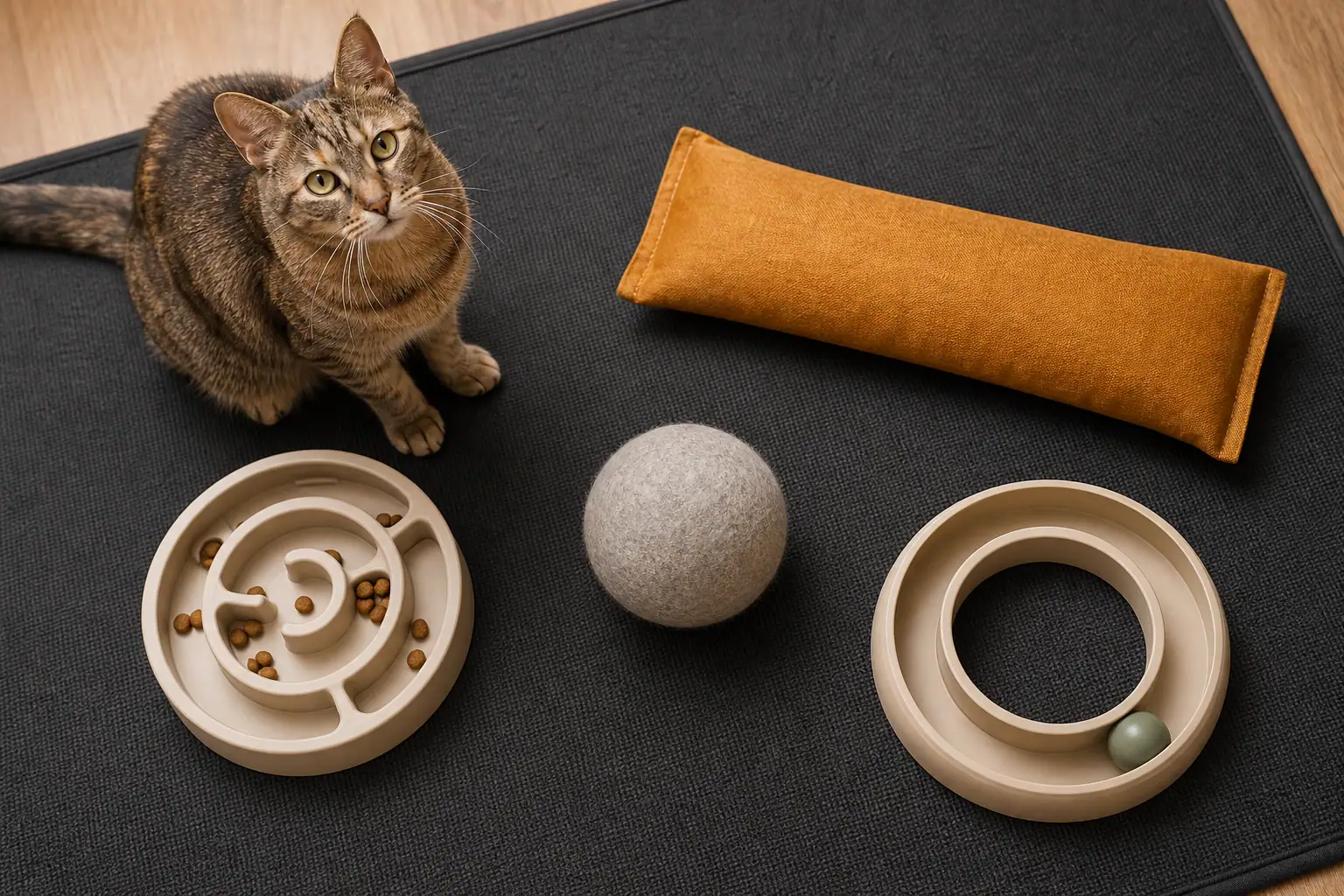
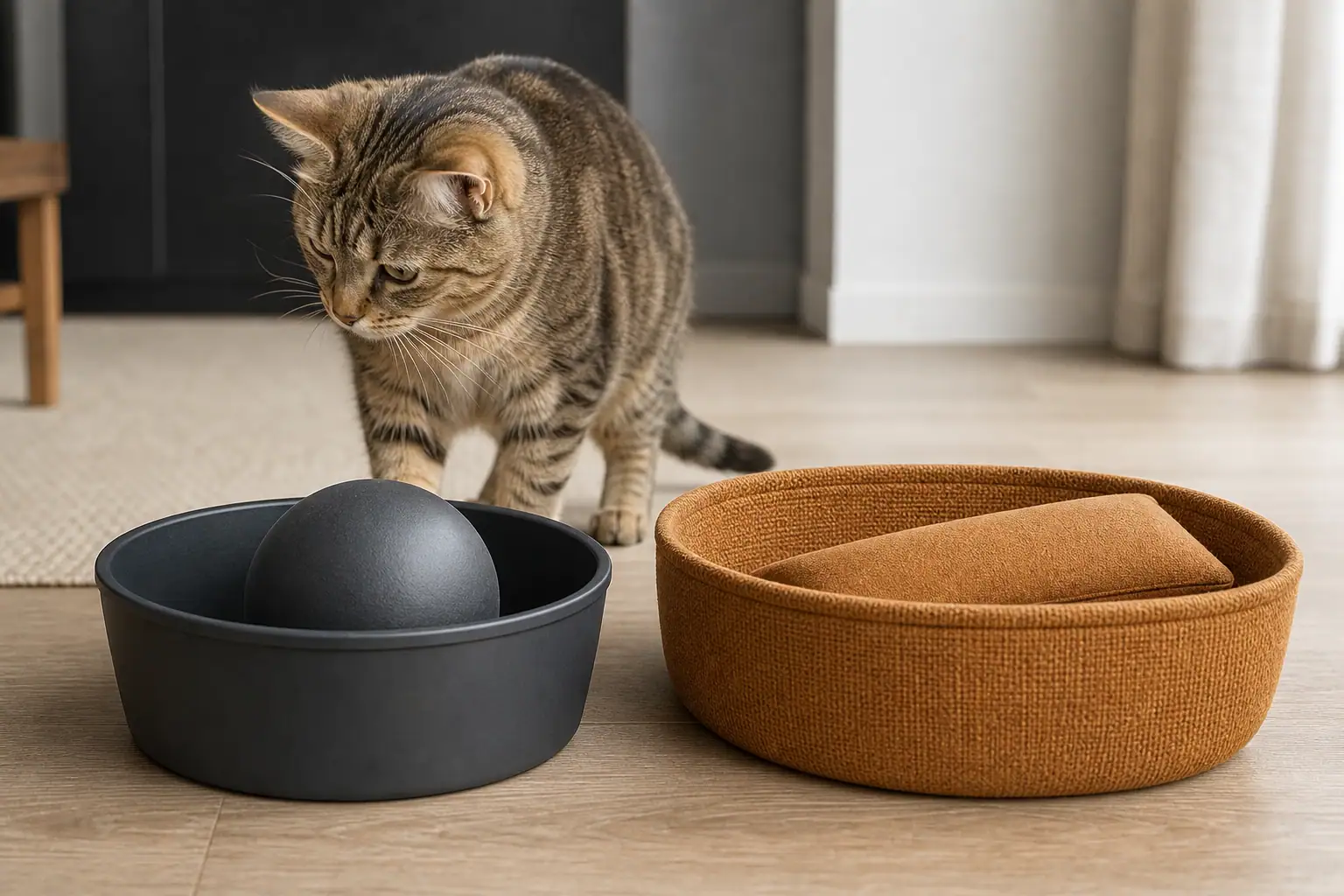
    Indoor cat enrichment toys arranged into chase, puzzle, kicker, and chew zones
    A useful enrichment setup gives each toy a job: chase, solve, kick, chew, hide, climb, or rest.

    The Best Toy Types for Indoor Enrichment

    A strong indoor enrichment setup covers multiple play styles without leaving risky pieces everywhere. Start with one or two toys from each category instead of buying a giant mixed pack.

    Wand toys for chase and confidence

    Wand toys are excellent because you can mimic prey. Move the lure away from the cat, around furniture edges, behind a box, under a towel edge, or in short pauses. Do not jab the toy at the cat’s face. Let the cat watch, stalk, sprint, and catch. Store string, ribbon, elastic, and feather lures after the session.

    If your cat escalates into biting hands or ankles, use longer reach and a clearer handoff to a kicker. Titan Claws’ guide to cat toys for play aggression can help redirect that energy.

    Puzzle feeders for bored food-motivated cats

    Puzzle feeders turn part of a meal into problem solving. They work best when the difficulty is adjustable. Start easy: loose kibble in an open egg carton, a few treats in a paper towel tube with large holes, or a shallow puzzle tray. Increase difficulty only after the cat understands the game.

    The ASPCA’s feline DIY enrichment guidance includes simple food puzzles made from household cardboard items. That is useful because enrichment does not have to be expensive, but DIY toys still need safety checks: remove tape, staples, handles, sharp edges, and tiny pieces your cat might eat.

    Kicker toys for cats that grab and bunny-kick

    Kickers are a good match for indoor cats that latch on with the front paws and rake with the back feet. Choose a length that keeps your hands away from the kicking zone, dense fabric, reinforced seams, and minimal decorations. A rough cat can turn weak plush into exposed stuffing quickly, so inspect kickers after hard sessions.

    For heavy players, read Titan Claws’ durable cat toys guide before buying by marketing words like tough, premium, or indestructible. The important question is how the toy fails under teeth and claws.

    Boxes, tunnels, and hiding toys for ambush play

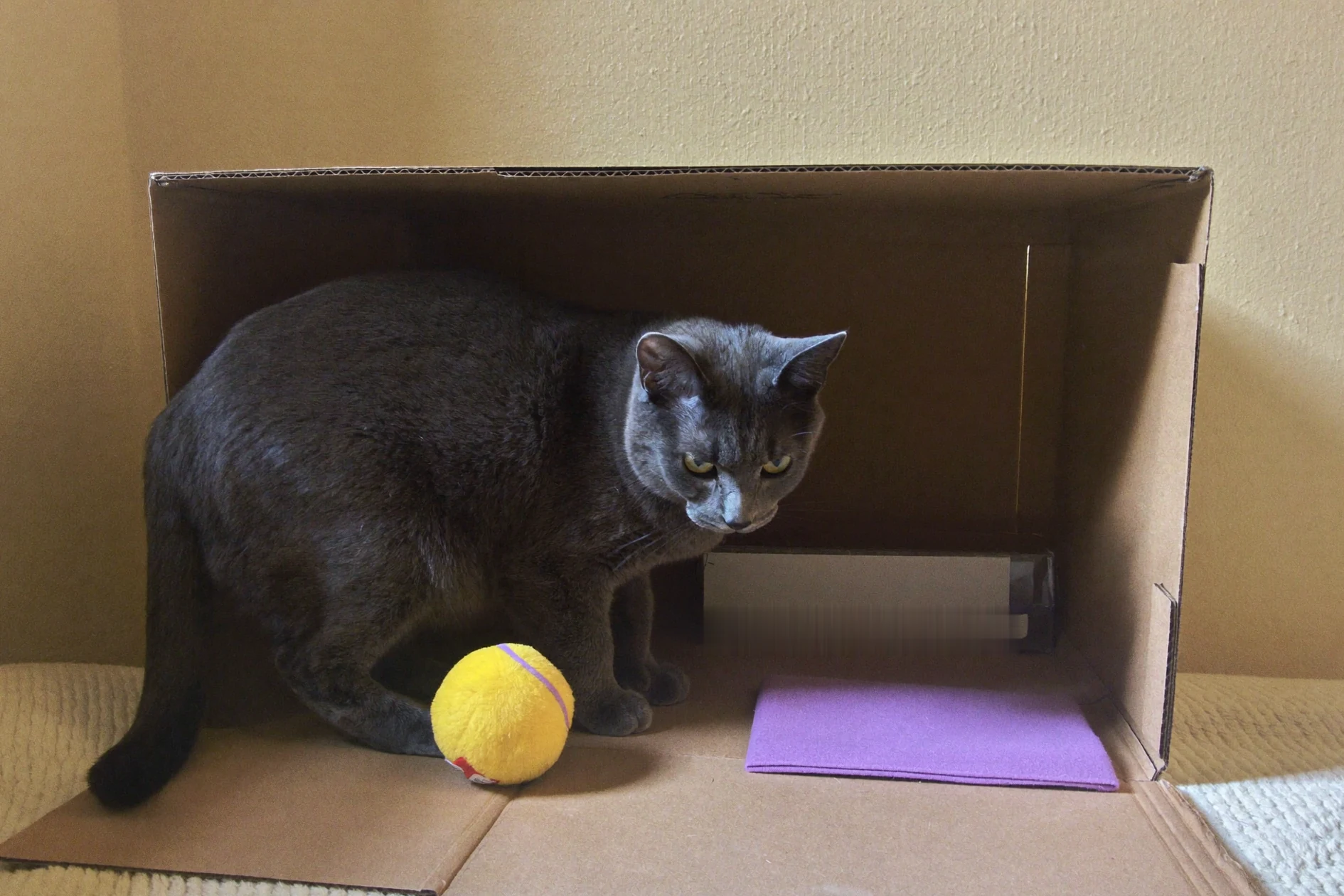
    Boxes and tunnels let an indoor cat hide, watch, burst out, and reset. A plain cardboard box can become a hunting blind, puzzle feeder, scent station, or nap spot. Cut large openings, remove tape and loose flaps, and replace cardboard when it gets soggy, shredded, or snack-sized.

    For budget options, Titan Claws’ homemade cat enrichment toys article goes deeper on cardboard, paper, and household-object ideas.

    Chew and carry toys for mouthy cats

    Some indoor cats need to bite and carry. Give those cats simple, sturdy toys that are too large to swallow, easy to inspect, and free from loose bells, eyes, ribbons, feathers, and glued trim. If your cat eats fabric, thread, foam, rubber, or plastic, treat that as a veterinary and management issue, not just a shopping problem.

    For cats that target strings specifically, use the safety guidance in Titan Claws’ cat string toys article before leaving any strand-like toy accessible.

    How to Build a Simple Enrichment Rotation

    Indoor cats often ignore toys that never change. Rotation helps the same few toys feel fresh, and it gives you a natural inspection rhythm. Cornell Feline Health Center also recommends rotating toys to prevent boredom, while warning owners to avoid small parts and strand-like pieces that can detach and be swallowed.

    Try this simple weekly rotation:

    1. Daily supervised chase: one wand or moving lure session, 5 to 10 minutes, ending with a real catch.
    2. Daily food puzzle: part of one meal in an easy puzzle, treat ball, scatter hunt, or cardboard feeder.
    3. Two leave-out toys: one sturdy object for batting or carrying, plus one safe hide or tunnel option.
    4. One rough-play outlet: a kicker or chew-safe toy used when your cat grabs, bites, or bunny-kicks.
    5. One environment upgrade: a box, perch, paper bag with handles removed, window view, or safe scent object.

    Do not rotate everything at once if your cat is timid. Change one piece, watch the response, and keep the routine predictable. For cats that are already restless, destructive, or demanding attention, Titan Claws’ best cat toys for bored indoor cats article can help you troubleshoot the boredom side.

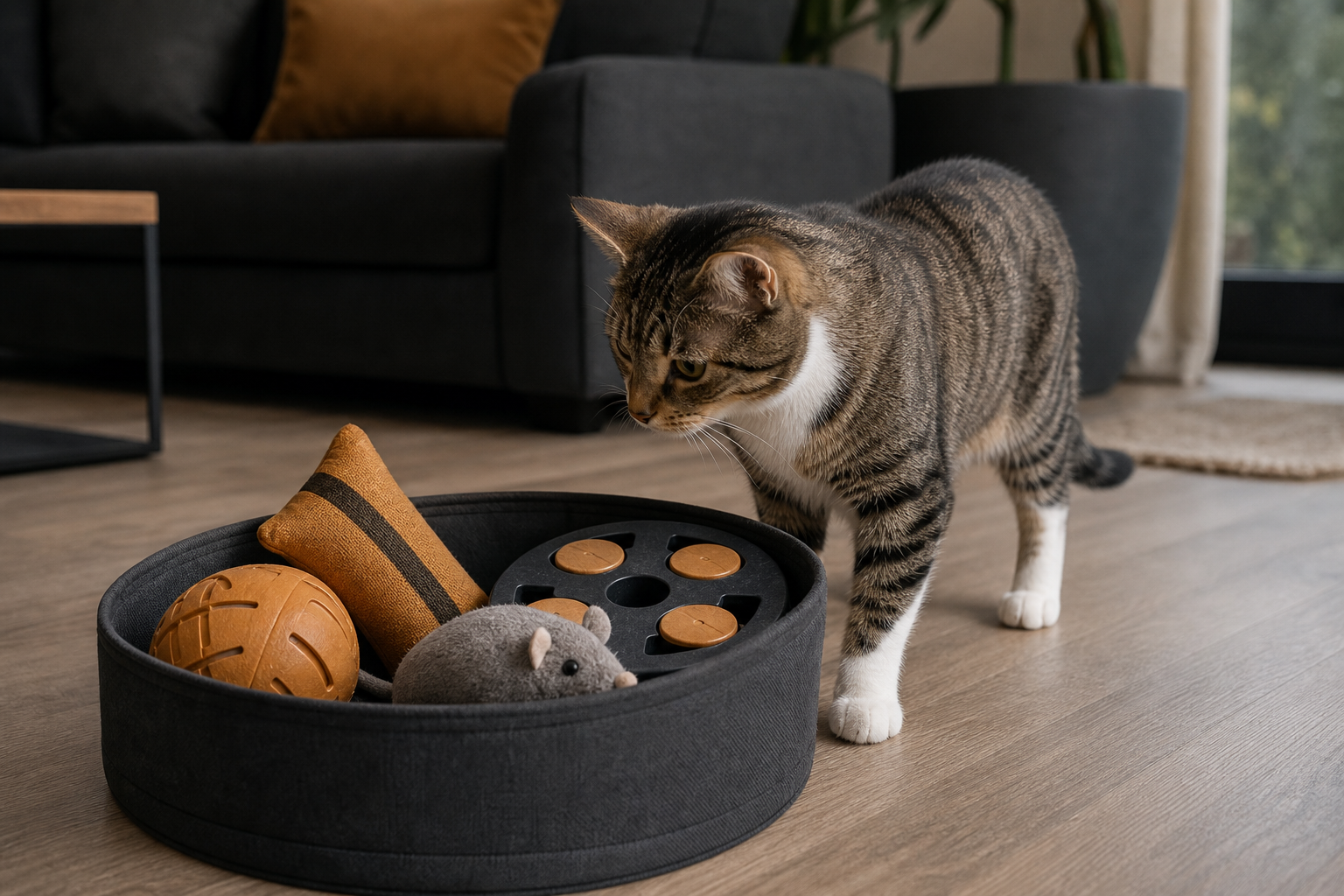
    Small weekly cat toy rotation with puzzle feeder, box, kicker, wand, and balls
    Rotation keeps indoor toys fresh and makes it easier to notice which toy is wearing out.

    Safety Rules for Rough-Playing Indoor Cats

    Enrichment should lower risk, not add hidden hazards. The University of Wisconsin School of Veterinary Medicine warns that aggressive chewers may ingest feathers, strings, sparkly bits, and similar toy materials, and that intestinal obstruction can be serious. Cornell gives similar cautions about toys with small pieces or linear strand-like parts, especially when those parts separate during chewing.

    Use these rules for any indoor cat toy:

    • Store string toys after play. Wand cords, ribbons, yarn, elastic, and feather lures are supervised-only.
    • Remove weak decorations. Avoid or remove bells, beads, glued eyes, small tails, loose feathers, tassels, and brittle plastic pieces.
    • Inspect the toy’s failure points. Check seams, stuffing, caps, battery doors, crinkle layers, refill openings, and attachment points.
    • Separate leave-out toys from session toys. The toy that makes a great chase session may be unsafe at 2 a.m.
    • Retire damaged toys early. Exposed stuffing, loose threads, sharp plastic, missing parts, and flaking surfaces are stop signs.
    • Call a veterinarian for ingestion concerns. Vomiting, appetite loss, lethargy, straining, or suspected swallowed string or toy parts should not be watched casually.
    Hands inspecting an indoor cat toy for loose seams after rough play
    Rough players need inspection built into the routine. Retire toys before loose parts, stuffing, or sharp edges become swallow risks.

    How to Match Toys to Your Cat’s Play Style

    Owners often buy the wrong enrichment toy because they shop for the behavior they want instead of the behavior the cat already shows. Watch one play session and choose from the pattern.

    • The stalker: likes hiding, watching, and slow buildup. Use boxes, tunnels, low wand movement, and corner peeks.
    • The sprinter: wants fast movement. Use hallway rolls, wand chases, ball tracks, and short high-energy sessions.
    • The wrestler: grabs and bunny-kicks. Use long kickers, sturdy fabric toys, and supervised handoffs after chase.
    • The solver: paws at cabinets, cups, or food containers. Use puzzle feeders, treat hunts, and cardboard feeders.
    • The chewer: mouths fabric, cords, plastic, or toy seams. Use fewer, tougher, inspectable toys and remove strand-like hazards.
    • The watcher: prefers observing before joining. Use slow prey movement, window perches, quiet puzzles, and predictable routines.

    Age matters too. Kittens may need short frequent motion games and teething-safe options. Senior cats may prefer slower ground play, easier puzzles, and stable surfaces. Multi-cat homes may need separate sessions so one cat does not monopolize the toy or guard the puzzle feeder.

    Quick Buying and Setup Checklist

    • Does this toy have a clear job: chase, capture, forage, chew, hide, climb, or rest?
    • Is it safe to leave out, or is it supervised-only?
    • Is the smallest piece too large to swallow?
    • Are there strings, feathers, bells, beads, glued eyes, tassels, caps, or battery doors to inspect?
    • Can you clean it or replace it before it gets dirty, soggy, or shredded?
    • Does the toy match how your cat actually plays?
    • Do you have a way to let your cat catch something at the end of chase play?
    • Will rotation make the toy more interesting without flooding the floor with hazards?

    The best cat enrichment toys for indoor cats are not the flashiest toys. They are the toys that give your cat a safe outlet for a specific behavior, survive long enough to be useful, and get inspected before damage becomes dangerous. Start with a small balanced setup, play with purpose, rotate thoughtfully, and replace anything your cat is beginning to defeat.

    Sources

  • Homemade Cat Enrichment Toys: Safe Ideas for Indoor Cats and Rough Players

    Homemade Cat Enrichment Toys: Safe Ideas for Indoor Cats and Rough Players

    Homemade cat enrichment toys are simple DIY setups that give a cat something useful to do: hunt, forage, paw, climb, hide, sniff, chase, grab, or kick. The safest homemade toys are not elaborate crafts. They are plain, inspectable objects that match your cat’s actual play style and can be thrown away before they become swallowing hazards.

    If your cat is gentle, a cardboard tube puzzle or paper foraging box may last several sessions. If your cat destroys ordinary toys, treat homemade enrichment as supervised play first. Rough players can chew through cardboard, pull tape loose, swallow string, or turn a food puzzle into a shredding project. The goal is not to make a homemade toy that lasts forever. The goal is to create a better outlet, watch the first use, and retire weak materials early.

    Start with one clear job for the toy, use clean materials, skip risky add-ons, and pair fragile DIY puzzles with sturdier supervised toys when your cat needs to bite and bunny-kick hard.

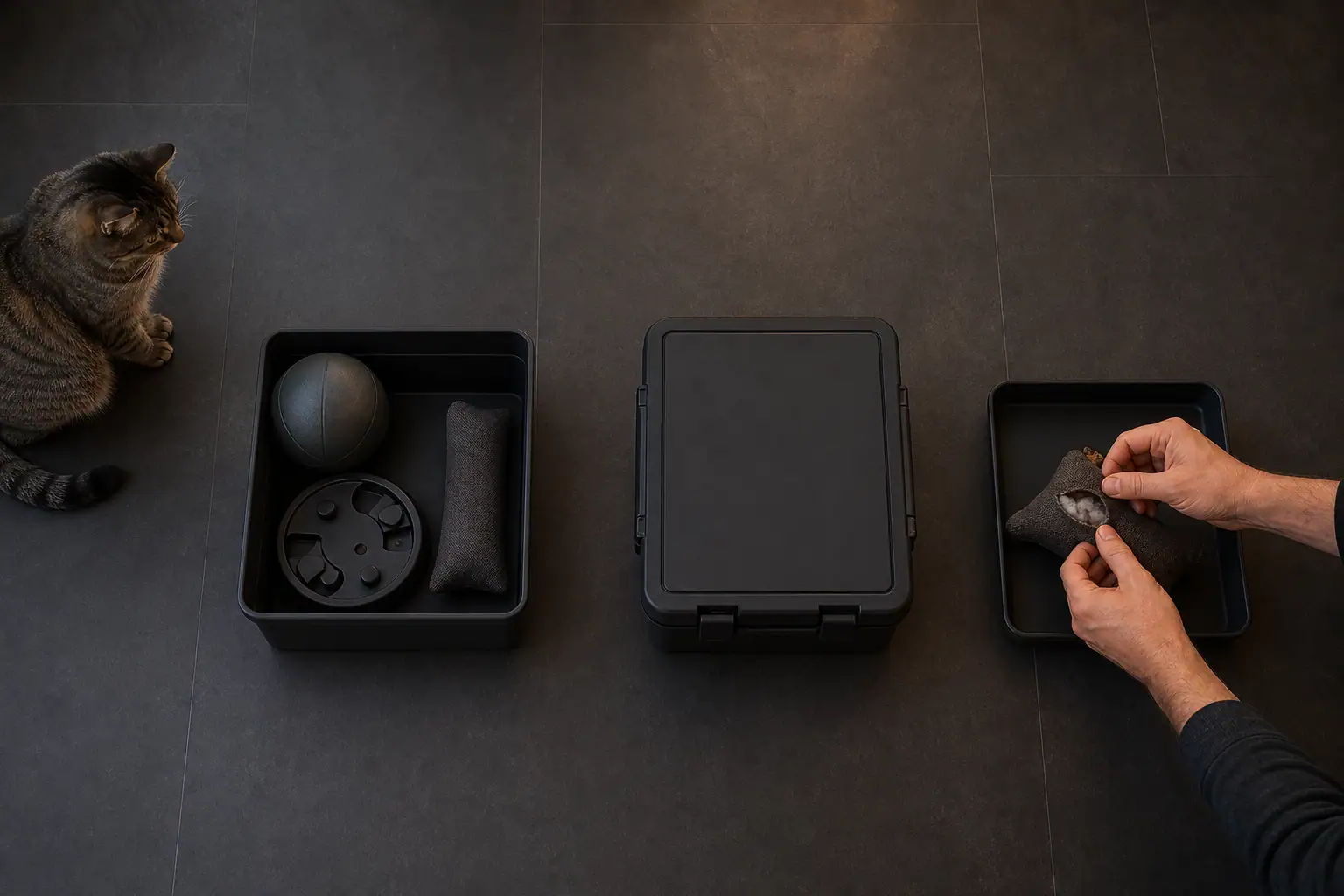
    Safe homemade cat enrichment materials arranged for inspection
    The best homemade enrichment materials are plain, easy to inspect, and simple to replace before they fail.

    What Current Homemade Enrichment Guides Get Right

    The top results for homemade cat enrichment toys usually get one big thing right: enrichment does not have to be expensive. The ASPCA shows food enrichment and cardboard projects such as reach feeders, slow feeders, houses, tunnels, and mazes. Humane shelter resources commonly recommend puzzle feeders, treat dispensers, cardboard hideouts, sensory games, and simple hide-and-seek. Those are useful ideas because they turn normal household materials into hunting and problem-solving opportunities.

    The gap is safety for forceful cats. Many lists tell you what to make, but they spend less time on what happens when a cat bites the tube flat, eats paper, pulls apart glued seams, or attacks a string attachment after the person leaves the room. Titan Claws readers often need that second layer: how to choose the right homemade idea for a rough player, how to supervise the risky parts, and when to switch from DIY cardboard to a tougher toy built for wrestling.

    Use the One-Job Rule

    Before building anything, decide what job the enrichment toy should perform. A vague toy that is supposed to “keep the cat busy” is harder to judge and easier to overcomplicate. A one-job toy is easier to make safely and easier to inspect afterward.

    • Foraging: the cat sniffs, paws, rolls, or searches for part of a meal.
    • Chasing: the cat stalks and pursues a moving target under supervision.
    • Catching and kicking: the cat grabs a legal target and rakes with the back feet.
    • Hiding and ambushing: the cat uses cover, boxes, tunnels, or furniture edges.
    • Scratching and shredding: the cat works claws against an appropriate surface.
    • Climbing and perching: the cat moves vertically and surveys the room.
    • Sniffing and investigating: the cat explores safe novelty, texture, or scent.

    The AAFP and ISFM environmental needs guidelines describe play and predatory behavior as part of a healthy feline environment. That includes toys, owner interaction, and feeding practices that require a cat to actively acquire food. Homemade enrichment works best when it supports those natural behaviors instead of dumping random objects on the floor.

    Five Homemade Cat Enrichment Toys to Try

    1. Cardboard reach feeder

    Use a shallow shoe box or drink box, several clean toilet paper tubes, and a small amount of kibble or treats. Cut snug holes in the lid, place the tubes upright, and drop food into the tubes so your cat has to reach and scoop. Start with just a few loaded tubes so the cat succeeds quickly.

    Safety notes: cut smooth openings, avoid staples, and do not use heavy tape where your cat can chew it loose. If your cat pulls out the tubes and eats cardboard, stop using this as a puzzle and try a washable commercial puzzle feeder or simple scatter feeding instead.

    2. Shallow foraging box

    Take a low cardboard box, remove handles, tape loops, staples, plastic windows, and loose labels, then fill it loosely with crumpled plain paper. Scatter a small portion of dry food or treats inside. The cat has to sniff, paw, and search, which turns food into work without much construction.

    Use a shallow box so you can see what your cat is doing. Avoid glossy mailers, plastic packing material, rubber bands, twist ties, scented packaging, dryer sheets, and anything that carried cleaners or chemicals.

    Cat pawing through a homemade foraging box with paper and kibble
    A shallow foraging box can turn part of a meal into sniffing, pawing, and searching.

    3. Paper tube treat roller

    Cut several kibble-sized holes into a paper towel tube, fold the ends inward, and add a few pieces of dry food. The tube should release food when your cat bats or rolls it. Make the first version easy. A cat that gets frustrated may chew the tube instead of solving it.

    This is a supervised toy for many rough players. Retire it when it becomes crushed, soggy, torn, or flattened by teeth. If your cat tries to eat the tube, skip this category entirely.

    4. Box-and-wand ambush course

    Place two or three boxes, a tunnel, or a paper bag with handles removed around the room. Move a wand lure around the edges so it disappears, pauses, and reappears. Cover makes the game feel more like a hunt and less like frantic swatting.

    Store the wand after play. String, elastic, feathers, clips, and detachable lures should not become unattended floor toys. For a deeper look at supervised chase toys, use Titan Claws guides to wand cat toys and cat toys for hunting.

    5. Towel wrinkle hunt

    Lay a towel flat, hide a few treats or pieces of kibble inside loose folds, and let your cat search. This is quieter than an electronic toy and easier than a hard puzzle. It can be useful for shy cats, older cats, or food-motivated cats that need a low-impact job.

    Use a towel without loose fringe. Wash it regularly. Stop if your cat chews fabric, pulls threads, or tries to swallow fibers.

    How to Build for Rough Players

    Cats that destroy toys need a different homemade enrichment plan. Do not ask cardboard to be the main bite-and-kick target. Use DIY items for foraging, hiding, stalking, and novelty, then offer a sturdier supervised toy for the hard catch.

    A practical rough-play sequence looks like this: set up a box ambush course, use a wand toy for a short chase, let the cat land on a longer kicker toy, then finish with a small foraging puzzle. The cat gets the full predatory pattern without turning every homemade object into something to shred.

    For cats that chew through soft toys or attack seams, compare homemade ideas with Titan Claws guides to durable cat toys, cat kicker toys, and toys for cats that chew. Durable does not mean indestructible. It means the toy is better matched to the force your cat puts into play and is easier to inspect before failure becomes dangerous.

    Materials to Avoid

    Homemade does not automatically mean safe. Many household materials are fine for one cat and risky for another. Use the strictest version of this list for kittens, known chewers, and cats that swallow non-food objects.

    • Avoid string-like materials: yarn, ribbon, thread, tinsel, dental floss, elastic, and loose cord.
    • Skip small hard parts: bells, beads, buttons, googly eyes, clips, sequins, and small plastic pieces.
    • Do not use sharp fasteners: staples, pins, needles, exposed wire, twist ties, or broken plastic.
    • Use tape carefully: loose tape can become a chew target, and heavy tape can hide torn cardboard.
    • Keep chemicals out: avoid scented packaging, food wrappers, treated outdoor wood, cleaner containers, dryer sheets, and anything greasy.
    • Watch edible incentives: treats, catnip, and silver vine can increase excitement. Use small amounts and stop if your cat gets frantic or aggressive.

    Cornell Feline Health Center warns against toys with small pieces or strand-like parts that can separate and be ingested, especially when chewed. Oregon Humane Society gives similar practical advice for cat-proofing and toy safety. For homemade toys, apply those warnings before you build, not after the toy breaks.

    Hands checking a homemade cat toy for loose tape and torn cardboard
    Inspect homemade toys after play. Retire anything with loose tape, bite-sized pieces, open seams, or string-like parts.

    A 15-Minute Homemade Enrichment Routine

    A routine usually beats a pile of DIY toys. Use this once a day for an active indoor cat, or shorten it for kittens, seniors, and cats that get overstimulated.

    1. Two minutes: prepare the room. Pick up fragile objects, remove loose cords, and place one box or tunnel for cover.
    2. Four minutes: chase. Move a wand lure around box edges, away from your cat, with pauses for stalking.
    3. Three minutes: catch. Let the cat grab a sturdy kicker or safe catch toy. Keep hands away from teeth and back claws.
    4. Four minutes: forage. Offer a reach feeder, tube roller, towel wrinkle hunt, or shallow foraging box with part of a meal.
    5. Two minutes: inspect and reset. Store the wand, throw away torn cardboard, and leave out only toys that are safe for your specific cat.

    If your cat turns play into biting people, pair this routine with the Titan Claws guide to cat toys for play aggression. If boredom is the main issue, build a wider rotation with cat enrichment activities, cat toys for enrichment, and free cat enrichment ideas.

    When to Replace or Stop

    Replace a homemade toy when cardboard gets soggy, paper tears into bite-sized pieces, a tube collapses, tape loosens, fabric threads appear, or your cat changes from playing with the object to eating it. Stop immediately if your cat tries to swallow pieces, pants during ordinary play, limps afterward, vomits after chewing toy material, guards the toy aggressively, or redirects hard bites onto people or pets.

    Ask a veterinarian if your cat repeatedly eats non-food material, suddenly loses interest in play, seems painful, changes appetite, or vomits after toy sessions. Ask a qualified feline behavior professional if play routinely escalates into serious aggression. Enrichment can support normal behavior, but it should not be used to explain away pain, fear, illness, or dangerous ingestion habits.

    Quick Safety Checklist

    Before giving your cat a homemade enrichment toy, run this checklist:

    • Does the toy have one clear job?
    • Can my cat succeed without getting frustrated?
    • Have I removed handles, staples, string, loose tape, sharp edges, and small parts?
    • Is this supervised-only for my cat?
    • What will my cat bite and kick when excitement rises?
    • Can I inspect the toy in under 30 seconds?
    • Will I throw it away as soon as it starts to fail?

    Homemade cat enrichment toys work best when they are simple, safe for your cat’s real habits, and part of a thoughtful rotation. Build for one behavior at a time, supervise the first sessions, give rough players a tougher legal target for biting and kicking, and retire homemade materials early. That is how DIY enrichment stays useful instead of becoming another avoidable risk.

    Sources

  • Cat Aggressive Play: How to Read It, Redirect It, and Keep Play Safer

    Cat Aggressive Play: How to Read It, Redirect It, and Keep Play Safer

    Cat aggressive play is rough play that uses normal hunting behaviors in the wrong place, at the wrong intensity, or toward the wrong target. It can look like ankle ambushes, hard biting, bunny-kicking arms, stalking another cat that wants to leave, or sudden pounces from behind furniture. The cat is not necessarily being spiteful, but the behavior still needs a plan because teeth and claws can injure people, stress other pets, and teach the cat that bodies are acceptable prey.

    The safest approach is to read the body language early, stop using hands or feet as toys, schedule play before the usual attack window, redirect the cat onto appropriate toys before contact happens, and get veterinary or behavior help if the aggression is sudden, severe, painful, escalating, or directed at vulnerable people or pets.

    What Cat Aggressive Play Looks Like

    Play aggression often borrows the same sequence cats use for hunting: watch, stalk, chase, pounce, grab, bite, and kick. In a healthy play session, those actions are directed at toys and the cat can recover quickly. In aggressive play, the target may be your ankle, your hand, a child running through the room, or another pet that is no longer enjoying the interaction.

    Cat crouching near a toy with alert body language before pouncing
    The best moment to redirect aggressive play is before contact: watch for crouching, wide pupils, tail swishes, and corner ambushes.

    Common signs include:

    • crouching behind furniture, then launching at passing feet;
    • wide pupils, tail swishing, focused staring, and a wiggling rear end before the pounce;
    • grabbing hands or sleeves during play;
    • biting harder as the session gets faster;
    • bunny-kicking arms, legs, or another cat’s body;
    • repeatedly chasing a cat that is trying to retreat;
    • morning or evening bursts that line up with natural high-energy periods.

    The San Francisco SPCA notes that play aggression can happen in cats of any age and can become intense when people become the target. Cornell Feline Health Center describes classic pre-pounce signals such as tail thrashing, pinned ears, dilated pupils, stalking, and pouncing from hiding places. Those cues are useful because they give you a chance to redirect before contact.

    Is It Play or Real Aggression?

    Normal rough play and unsafe aggression can overlap, so focus on risk and recovery rather than trying to guess the cat’s intention. Play usually has loose movement, pauses, role changes, and quick recovery. More concerning aggression often includes sustained pursuit, growling, hissing, defensive crouching, blocked escape routes, puncture bites, repeated targeting of one individual, or a cat that stays aroused long after the incident.

    ASPCA separates aggressive body language into offensive and defensive patterns, and it cautions people not to touch, reassure, or punish cats that are showing those postures. Cornell also emphasizes that aggression can have different causes, including play, fear, pain, territorial conflict, petting intolerance, and redirected arousal. That matters because the right response for play aggression may be wrong for fear or pain.

    Use this practical distinction: if the cat is playful but misdirected, redirect with distance toys and a routine. If the cat is scared, painful, cornered, or unable to calm down, create space and get help instead of trying to play through it.

    Why Cats Get Too Rough During Play

    Several patterns show up again and again:

    • Too little structured play: VCA Animal Hospitals links under-stimulation, unused energy, and lack of appropriate play opportunities with play-related aggression.
    • Hands became toys: wrestling with kittens teaches the cat that skin is a legal target when adult teeth and claws arrive.
    • No complete catch: chasing a laser or feather forever without a real capture can leave some cats more frustrated.
    • Young or high-drive cats: kittens, adolescents, and energetic indoor cats often need more frequent outlets.
    • Solo early history: Cornell notes that young cats raised without littermates may miss some bite-inhibition lessons learned during kitten play.
    • Overstimulation: play can tip from fun into frantic when the session gets too long, too fast, or too repetitive.
    • Another trigger nearby: a cat watching an outdoor cat, hearing a loud noise, or arguing with another pet may redirect that arousal onto whoever approaches.

    The fix is rarely one magic toy. It is usually a better pattern: predictable play, better distance, legal bite-and-kick targets, calmer finishes, and clear rules from every person in the home.

    Redirect Before the Pounce

    Timing matters. If you toss a toy after your cat has already bitten your ankle, the cat may learn that biting starts an exciting game. If you redirect when you see the pre-pounce signs, the cat learns that toys are the outlet.

    Keep a few appropriate redirect toys in the rooms where rough play starts. When you see crouching, corner stalking, wide pupils, or tail swishes, move a wand lure along the floor away from your body or toss a larger toy away from your feet. Make the toy act like prey: away, around a corner, under the edge of a box, pause, move again. Do not wave it into the cat’s face.

    If contact already happened, become boring. Freeze if you can, calmly remove attention, step behind a barrier if needed, and wait for the arousal to drop. Restart a structured play session after a reset, not at the exact second teeth hit skin.

    A Safer Play Routine for Rough Cats

    Use this once or twice daily, especially before the time your cat usually gets rough. For many cats that means morning and evening.

    Wand toy and kicker toy set up for a structured cat play routine
    A structured routine gives the cat a chase, a catch, and a calmer finish instead of letting rough energy spill onto hands or ankles.
    1. Warm up for two minutes. Let the cat watch and stalk. Move the toy slowly along the floor, behind a chair leg, or around a box.
    2. Chase for five minutes. Move the lure away from the cat in short bursts. Pause so the cat can plan.
    3. Catch for three minutes. Let the cat land on a longer kicker toy, bite it, and bunny-kick that instead of you.
    4. Repeat at lower intensity. Give one more easier chase and catch so the session winds down instead of spikes.
    5. Cool down. Offer a small food puzzle, a few pieces of kibble to forage for, or quiet distance. Avoid immediate petting if the cat is still in hunt mode.

    For toy-specific help, use Titan Claws guides to cat toys for play aggression, cat kicker toys, and wand cat toys. This article is the behavior plan; those guides help you choose the tools.

    What to Do When Cats Play Too Rough With Each Other

    Cat-to-cat aggressive play needs a different standard because one cat may enjoy the chase while the other feels trapped. Maddie’s Fund, using San Francisco SPCA guidance, notes that play aggression between cats can involve biting, clawing, stalking, and attacking other cats, and that it can be especially common when a younger cat is introduced to an older cat with a different energy level.

    Two indoor cats near separate toys with enough space between them
    Between cats, rough play becomes a problem when one cat keeps pursuing and the other cannot leave, hide, or reset.

    Intervene when one cat is always the pursuer, the other cat hides or avoids rooms, hissing and growling increase, fur flies, litter box habits change, or one cat blocks food, water, doorways, resting places, or escape paths. Add vertical space, separate resting zones, multiple resources, and separate play sessions so the high-energy cat has an outlet that does not depend on the other cat participating.

    Do not punish either cat. Interrupt early with distance and management: move a toy away from the victim cat before the chase starts, close a door for a calm reset, and reintroduce with positive associations if the relationship has become tense.

    Toys That Help, and Toys to Supervise

    For aggressive play, the best toy is the one that creates distance, gives a legal target, and survives inspection after rough contact. A useful setup includes a wand or teaser for chase, a long kicker for the grab-and-kick phase, and safe solo enrichment such as a puzzle feeder, sturdy track toy, tunnel, or box with handles and loose parts removed.

    Supervise or avoid toys that become risky under hard biting:

    • hands, feet, sleeves, and blankets moved like prey;
    • string, yarn, ribbon, elastic, and feather lures left out after play;
    • tiny plush toys that fit fully in the mouth;
    • glued-on eyes, bells, sequins, thin tails, and removable parts;
    • fragile plastic or electronic toys with weak battery doors or exposed cords;
    • catnip toys if catnip makes your cat noticeably more intense.

    For cats that destroy ordinary toys, start with Titan Claws on durable cat toys, toys for cats that chew, and cat enrichment activities. Avoid treating any toy as indestructible. The safer standard is matched size, fewer weak points, supervision when needed, and early replacement.

    The After-Play Safety Check

    Aggressive play puts more force into toys than casual batting. After a hard session, inspect before the toy goes back in the basket.

    Hands inspecting a cat toy for loose seams after rough play
    Aggressive play is harder on toys. Retire anything with open seams, exposed stuffing, loose parts, chewed cords, or sharp damage.
    • Are seams opening or threads hanging?
    • Is stuffing visible?
    • Are feathers, bells, eyes, clips, tags, or plastic pieces loosening?
    • Is a cord, ribbon, or elastic section chewed?
    • Are there cracks, sharp edges, exposed wire, or battery-door problems?
    • Can your cat fit the whole toy in their mouth?
    • Did your cat try to eat fabric, fuzz, cardboard, or plastic instead of just playing?

    Retire questionable toys early. Cornell Feline Health Center’s safe-toy guidance is especially relevant for rough players because small pieces and strand-like materials can become ingestion hazards. If your cat repeatedly eats non-food material, ask your veterinarian for guidance.

    When to Call a Veterinarian or Behavior Professional

    Get professional help if aggression is sudden, escalating, breaking skin, targeting children or vulnerable adults, injuring another pet, or happening outside obvious play contexts. Also call your veterinarian if the cat seems painful, hides more, eats less, avoids jumping, reacts to touch, changes litter box habits, or is older and newly irritable. Cornell lists medical issues such as hyperthyroidism, osteoarthritis, dental disease, and central nervous system problems as possible contributors to aggression, so a health check belongs early in the plan.

    A qualified feline behavior consultant or veterinary behaviorist can help if the pattern is complex, especially with fear, redirected aggression, multi-cat conflict, or attacks that feel unpredictable. Medication is sometimes part of a veterinary behavior plan, but it works alongside environmental changes and training, not instead of them.

    Quick Checklist

    • Stop using hands, feet, and sleeves as toys.
    • Watch for pre-pounce signs: crouching, tail swishing, wide pupils, hiding, and focused staring.
    • Redirect before contact, not as an instant reward after a bite.
    • Schedule play before the usual rough-play window.
    • Use distance toys for chase and longer kickers for the hard catch.
    • Give multi-cat households more space, vertical routes, and separate resources.
    • Inspect toys after rough sessions and retire damaged pieces early.
    • Do not punish, yell, wrestle, or grab an aroused cat.
    • Get veterinary help for sudden, severe, painful, or unsafe aggression.

    Cat aggressive play improves when the household stops practicing the wrong game. Read the warning signs early, give the cat a legal target, finish with a real catch, and keep damaged toys out of rotation. You are not trying to erase hunting behavior. You are teaching it where to go.

    Sources

  • How to Stop Cat Aggression Towards Humans: A Safer Play and Behavior Plan

    How to Stop Cat Aggression Towards Humans: A Safer Play and Behavior Plan

    To stop cat aggression towards humans, first make everyone safe, then work out why the aggression is happening. Do not punish, wrestle, yell, or use your hands as toys. Pause direct contact, track the trigger, schedule safer play before the usual attack time, and call your veterinarian if the aggression is sudden, severe, painful, escalating, or breaking skin.

    Cat aggression toward people can come from play, fear, pain, petting overstimulation, redirected arousal, territorial stress, maternal behavior, or a mix of causes. The plan that helps an ankle-ambushing kitten may be wrong for a painful senior cat or a cat that just saw an outdoor cat through the window. The useful goal is not to label the cat as bad. The goal is to reduce injury risk, stop rehearsing the unwanted behavior, and give the cat safer ways to move, hunt, retreat, and calm down.

    Start With Safety, Not Discipline

    If a cat is actively attacking, give space. Move slowly, use a barrier such as a door, chair, blanket, or piece of cardboard if needed, and avoid grabbing the cat with bare hands. If two animals are fighting, do not put your hands between them. Once the cat is separated, let the arousal drop before trying to pet, pick up, train, or examine them.

    Physical punishment is a poor tool for cat aggression. Cornell Feline Health Center warns that punishment can increase fear or anxiety and worsen aggression. Best Friends Animal Society also advises avoiding punishment because it can damage trust and make aggression more likely. For the owner, the practical rule is simple: if the response makes the cat more frightened, more aroused, or more likely to defend themselves, it is not a fix.

    Use management first. Close blinds if outdoor cats are a trigger. Give the cat a safe room when visitors arrive. Stop petting before the cat’s tolerance runs out. Keep children away from a cat with a bite history unless an adult can actively supervise. Put wand toys, string toys, and fragile toys away after play so they do not become a new hazard.

    Get a Veterinary Check for Sudden or Serious Aggression

    A medical check matters because pain and illness can change behavior fast. ASPCA lists painful conditions, thyroid problems, neurological issues, sensory decline, trauma, and other medical problems as possible contributors to aggression. Cornell similarly notes that hyperthyroidism, osteoarthritis, dental disease, and central nervous system problems can cause or contribute to aggressive behavior.

    Book a veterinary exam promptly if the aggression is new, worse than usual, directed at a normally trusted person, associated with hiding or appetite changes, linked to touch on a certain body area, or causing puncture wounds. A toy routine can help normal rough play, but it should not be used to explain away pain.

    Seek urgent professional help if your cat repeatedly breaks skin, attacks children or vulnerable adults, remains highly aroused for long periods, or seems dangerous to handle. A qualified feline behavior professional or veterinary behaviorist can build a plan around the specific trigger instead of guessing.

    Identify the Type of Aggression

    Before changing toys or routines, write down what happened in the 30 minutes before each incident. ASPCA recommends looking at who was targeted, where it happened, what was happening beforehand, and what was about to happen to the cat. That log can reveal patterns you will miss from memory alone.

    Notebook for tracking cat aggression triggers beside a calm cat
    A simple incident log helps separate play attacks from fear, pain, petting intolerance, and redirected aggression.

    Use these common patterns as a starting point:

    • Play aggression: stalking ankles, ambushing from corners, grabbing hands, pouncing with little or no hissing, often around high-energy times.
    • Petting-induced aggression: biting or swatting after a period of touch, often after tail twitching, skin rippling, head turning, flattened ears, or restlessness.
    • Fear aggression: hissing, crouching, hiding, flattened ears, defensive swatting, or biting when approached, cornered, picked up, or exposed to a scary trigger.
    • Redirected aggression: a cat becomes aroused by something else, such as an outdoor cat, a loud noise, or a fight, then attacks the nearest person or pet.
    • Pain-related aggression: sudden intolerance of handling, guarding a body part, biting when lifted, or reacting around joints, mouth, ears, abdomen, or tail.

    Today’s Veterinary Practice notes that redirected aggression is a major owner-directed category and can be hard for owners to identify because the first trigger may be out of sight. That is one reason a diary is useful: it helps connect attacks with windows, noises, visitors, another pet, feeding time, or handling routines.

    Build a No-Hands Play Rule

    Many owner-directed bites start as normal hunting behavior aimed at the wrong target. If your cat stalks feet, launches at sleeves, or grabs hands during games, stop using body parts as prey. This is especially important with kittens. What feels cute at twelve weeks can become painful when the cat is stronger and faster.

    Use distance toys instead. A wand or stick toy lets you move the lure like prey without putting fingers in the strike zone. A longer kicker toy gives the cat something legal to bite and rake with the back feet. A food puzzle or foraging setup can move the cat into a calmer finish after the hunt.

    Cat playing with a wand toy at a safe distance from human hands
    Distance matters. Wand and kicker toys let the cat chase, catch, bite, and kick without practicing on skin.

    For a deeper toy-specific plan, pair this article with Titan Claws guides to cat toys for play aggression, cat stick toys, and durable cat toys. The short version is: chase at a distance, let the cat catch a real toy, keep hands still and boring after mistakes, and inspect the toy when the session ends.

    Use a Predictable Play Routine

    Play aggression often improves when the cat gets structured outlets before the usual ambush window. Many cats are most active in the morning and evening. If your cat attacks ankles at 8 p.m., start play at 7:50 p.m. rather than waiting for the pounce.

    1. Warm up for two minutes. Move a wand lure slowly along the floor, behind a chair leg, or around a box. Let the cat stalk.
    2. Chase for five minutes. Move the toy away from the cat in short bursts. Do not wave it into the cat’s face.
    3. Catch and kick for three minutes. Let the cat land on a longer kicker toy. Keep your hands out of reach.
    4. Repeat with lower intensity for three minutes. Let the cat win again, but slow the movement.
    5. Cool down for two minutes. Offer a few pieces of kibble to forage, a puzzle feeder, or quiet distance. Do not immediately pet a cat that is still in hunt mode.

    This routine gives the cat a complete sequence: stalk, chase, catch, bite, kick, and settle. Laser-only sessions can leave some cats frustrated because there is no physical catch. If you use a laser, end with a toy or food target the cat can actually reach.

    Redirect Early, Then Make Attacks Boring

    Timing is the difference between redirecting and rewarding. If you see pre-pounce signs such as crouching, tail swishing, wide pupils, corner hiding, or a focused stare at your feet, move play onto a toy before contact happens. Toss a safe toy away from your body or move a wand lure along the floor so the cat turns toward the legal target.

    If the cat has already bitten or grabbed you, avoid producing the most exciting toy as an instant prize. Freeze if you can, calmly disengage, step behind a barrier if needed, and give a short reset. Restart structured play after the cat has settled. The lesson should be that toys start games; biting people ends them.

    Everyone in the home needs the same rule. One person wrestling with hands can keep the problem alive for everyone else. Children should be taught to use wand toys from a safe distance or to leave play to adults until the cat has a reliable routine.

    Reduce Fear, Frustration, and Overstimulation

    Not every aggressive cat needs more play. Some need fewer forced interactions and better control over their space. A cat that lashes out when cornered, picked up, petted too long, or approached by guests may need predictable handling, escape routes, and shorter sessions below their threshold.

    Try these changes:

    • Let the cat approach instead of reaching into hiding spots.
    • Pet briefly, then stop before the tail starts twitching or the head turns toward your hand.
    • Give the cat vertical space, hiding spots, scratching surfaces, and quiet resting areas.
    • Block window views or outdoor-cat access if they trigger redirected aggression.
    • Use food rewards for calm behavior and voluntary approach.
    • Separate pets during high-arousal periods and reintroduce slowly if conflict is part of the pattern.

    Today’s Veterinary Practice frames treatment around identifying triggers, rebuilding a positive relationship, providing enrichment and tools, using behavior modification, and adding medication when needed. Most owners can start with the first three: know the trigger, make interactions predictable, and give the cat better outlets.

    Choose Toys That Can Handle Rough Redirection

    When toys are part of the behavior plan, durability and safety matter. A toy used to redirect aggression may be bitten harder than a casual toy. It needs to be large enough, easy to inspect, and free of weak decorative parts.

    • Use long kicker toys for cats that grab, bite, and bunny-kick. The toy should take the back feet instead of your arm.
    • Use wand toys only under supervision if they include string, feathers, elastic, or detachable lures.
    • Avoid tiny plush toys for cats that chew or swallow pieces.
    • Inspect electronic toys for battery doors, cords, moving pieces, and cracked plastic.
    • Retire damaged toys early when stuffing, loose seams, frayed cords, or small parts appear.
    Hands inspecting a cat toy for loose seams after rough play
    Rough play needs inspection. Retire toys with open seams, loose parts, exposed stuffing, or chewed cords.

    For cats that destroy ordinary toys, read Titan Claws on cat chew toys for aggressive chewers and DIY cat enrichment toys. Homemade enrichment can be useful, but rough players need stricter supervision around cardboard, tape, paper tubes, string, and small parts.

    When to Stop the Home Plan and Get Help

    Stop relying on home management alone if the attacks break skin, the cat stalks or attacks people outside play contexts, the aggression is sudden, the cat cannot calm down, another pet is being injured, or you feel unsafe. Also get help if your cat is older and newly irritable, because pain and sensory changes can show up as aggression.

    A veterinarian should rule out medical causes first. After that, a certified feline behavior consultant, certified applied animal behaviorist, or veterinary behaviorist can help with desensitization, counterconditioning, safety setup, and medication when appropriate. Medication is not a substitute for environment and behavior work, but it can help some cats become calm enough to learn.

    Quick Checklist

    • Separate safely during active aggression; do not grab with bare hands.
    • Do not punish, yell, spray, or wrestle.
    • Book a vet exam for sudden, severe, painful, or escalating aggression.
    • Track each incident: time, place, target, body language, trigger, and what happened afterward.
    • Use wand and kicker toys instead of hands and feet.
    • Schedule play before the usual ambush window.
    • Redirect before contact; make successful attacks boring.
    • Reduce triggers such as outdoor cats, forced handling, long petting, noisy rooms, and pet conflict.
    • Inspect and retire rough-play toys before they become ingestion hazards.
    • Bring in a qualified professional when safety risk is high or progress stalls.

    The best plan to stop cat aggression towards humans is calm, specific, and consistent. Rule out pain, identify the trigger, stop using people as prey, give the cat better outlets, and keep toys safe enough for the way your cat actually plays. You are not trying to overpower the cat. You are changing the setup so the safer behavior is easier to choose.

    Sources

  • Teazys Cat Toy: Worth It for Rough-Playing Cats?

    Teazys Cat Toy: Worth It for Rough-Playing Cats?

    The Teazys cat toy people usually mean is Teazys Speedy Tail 2.0: a small rechargeable rolling ball with a tail attachment that darts, stops, changes direction, and reactivates when touched in smart mode. For many cats, that can be a useful motion toy. For cats that chew, pry at parts, or destroy ordinary toys, it should be treated as a supervised electronic toy until you know exactly how your cat interacts with it.

    Short version: Teazys Speedy Tail may be worth trying for cats that love chase play, tolerate motor noise, and do not obsessively chew tails, ports, or moving parts. It is less ideal as a leave-out toy for rough chewers, cats that swallow feathers or string, cats that attack electronics, or cats that need a toy they can grab and kick hard. This guide explains what the toy does, what current search results miss, and how to decide whether it belongs in your cat’s rotation.

    What Is the Teazys Cat Toy?

    Teazys sells several cat products, but the ranking result for this search is Speedy Tail 2.0. The official page describes it as a rolling interactive toy with unpredictable prey-like movement, slow and fast speeds, and a standby mode that wakes when a cat touches it. Teazys also says it uses USB-C charging, a silicone-covered body, ABS/silicone materials, a lithium polymer battery, and replaceable tail accessories.

    The official instruction page gives more practical details. Normal mode runs for five minutes and then shuts off. Smart mode runs for five minutes, enters standby, and can restart for another five-minute session when touched. Teazys also tells owners to charge it fully before first use, use it indoors, remove hair and debris from the body, clean the removable body, and replace worn feather accessories to prevent accidental ingestion.

    Those details matter because this is not a simple plush mouse. It is a powered toy with a motor, port cover, rolling body, tail attachment, and small parts warning. That does not make it bad. It means the buying decision should be about your cat’s behavior, not only the product video.

    What Search Results Get Right and Miss

    The Teazys product page does a good job showing the appeal: motion, surprise, touch activation, carpet use claims, and the promise of easier play when the owner is busy. Shopping listings and social videos show the same basic idea. Review pages add a mixed signal: some owners report strong interest, while others mention shipping, battery, product-source, or value concerns.

    What most results do not answer clearly is the question a rough-cat owner has: will this toy survive my cat, and is it the right kind of play? A cat that watches rolling toys from a distance needs a different plan than a cat that grabs the tail, chews the accessory, or tries to pry open the body. A motion toy can create excitement, but it does not replace a safe catch object, a kicker for wrestling, or a chew-aware toy for cats that need to bite.

    If you are comparing this toy against other moving products, read Titan Claws’ broader guide to cat toys that move. If you are specifically shopping for powered toys, the guide to automatic cat toys explains the battery, cord, motor, and supervision checks in more detail.

    Who the Teazys Toy Fits Best

    Speedy Tail is most likely to fit cats that enjoy ground prey: things that scurry, pause, reverse, and escape along the floor. It may be a good match if your cat already chases balls, track toys, skittering plush mice, or moving shadows without chewing parts off.

    It is also more promising for cats that need short bursts. The five-minute run cycle can be useful because many cats play in intense, brief sessions rather than long workouts. A toy that stops can prevent the constant overstimulation some cats get from an always-on gadget.

    It is a weaker fit for cats that mainly want to wrestle. If your cat’s favorite move is hugging a toy and bunny-kicking with the back feet, a small rolling ball may start the chase but fail to give a satisfying capture. Pair it with a larger kicker or prey toy the cat is allowed to grab. Titan Claws’ durable cat toys guide is the better starting point for cats that shred plush and seams.

    Automatic cat toy placed beside a kicker, wand, and puzzle feeder for toy rotation
    A rolling electronic toy works best as one part of a rotation, not as the only outlet for hunting, chewing, and wrestling.

    Safety Checks Before You Leave It Out

    Do not treat any new electronic cat toy as automatically safe for solo use on day one. Watch the first several sessions and look for what your cat targets. The highest-risk cats are not always the strongest cats; they are the cats that chew, swallow, pry, or carry small parts away.

    Run this checklist before and after play:

    • Tail attachment: look for fraying, looseness, exposed string, feathers, or pieces your cat can pull free.
    • Port cover: check that the USB-C flap sits flush and is not becoming a chew target.
    • Outer body: inspect for deep bite marks, cracks, sharp edges, loose silicone, or places where claws can catch.
    • Wheels and rolling surface: remove hair and debris so the toy does not drag, overheat, or move unpredictably.
    • Battery behavior: stop using it if it smells odd, feels hot, will not charge normally, or the port looks damaged.
    • Room setup: use it away from stairs, water bowls, fragile objects, loose cords, and places where it can get trapped under heavy furniture.

    The University of Wisconsin School of Veterinary Medicine warns that cats who chew aggressively may ingest feathers, strings, sparkly bits, and similar toy materials, and that obstruction can be serious. That advice applies directly to any moving toy with a tail or lure. If your cat chews the attachment instead of chasing it, stop the session and choose a different toy type.

    Hands inspecting a motorized cat toy tail attachment and charging port
    Motorized toys need a different inspection routine: check the tail attachment, port cover, housing, wheels, and debris after play.

    Is Teazys Safe for Cats?

    The official Teazys page says Speedy Tail uses non-toxic, bite-resistant materials and no visible screws. That is useful product information, but it is not the same as a universal safety guarantee. Cats use toys differently. One cat may chase politely; another may pin the ball, chew the tail, and work at the charging flap.

    A safer standard is this: the toy is appropriate only if it remains intact under your cat’s actual play style. Retire or restrict it if the tail accessory sheds, the port cover loosens, the body cracks, the cat starts eating pieces, or the toy encourages frantic play that your cat cannot settle from.

    AAFP and ISFM environmental guidelines describe the importance of meeting cats’ environmental needs and allowing natural behaviors. Motion toys can help with stalking and pouncing, but they still need to be part of a complete routine: scratching, climbing, hiding, food work, owner-led play, and safe rest areas.

    How to Introduce It Without Scaring or Frustrating Your Cat

    Many cats do not instantly chase a fast electronic toy. Some sit back and study it. Some swat once and retreat. That is normal. Let your cat decide the distance.

    1. Start in slow mode. Use a familiar room with good footing and no tight clutter.
    2. Keep the first session short. One five-minute cycle is enough for the first test.
    3. Do not drive it into the cat. Predatory play works better when the target escapes, pauses, and hides.
    4. Add cover. Let it move partly behind a box, tunnel, or light blanket edge so the cat can stalk.
    5. End with a catch. Offer a kicker, plush prey toy, or small food puzzle after the chase so the session has a satisfying finish.
    6. Store it after play if your cat chews. A toy can be fun during active play and still be wrong for unsupervised access.

    If your cat is bored indoors but not interested in powered toys, that does not mean you failed. Try food puzzles, cardboard ambush spots, wand play, scent rotation, window perches, and short daily sessions. Titan Claws’ cat toys for enrichment guide can help you build a broader mix.

    Teazys vs. Lookalikes, Amazon Listings, and Discount Codes

    Searchers often ask whether Teazys is legit, whether there is a Teazys cat toy on Amazon, or whether discount codes are available. The important distinction is seller identity. Teazys says Speedy Tail 2.0 is sold exclusively through Teazys.com and warns that lookalikes elsewhere are not from the company. Marketplace listings may use similar names, photos, or product descriptions, so compare the seller, return policy, materials, charging details, and replacement-part availability before buying.

    Do not let a discount code override safety checks. A cheaper rolling toy is not a good deal if the tail sheds, the plastic cracks, the battery compartment is weak, or the seller gives no usable support. For rough-playing cats, the boring details matter: material, size, charging port, warranty, replacement attachments, cleaning instructions, and what low-star reviews say broke first.

    Better Choices for Cats That Destroy Toys

    If your cat destroys ordinary toys, Teazys may be useful as a chase starter, but it probably should not be the only toy. Build a rotation around the behavior your cat is trying to express.

    • For chewers: use larger, simple toys with fewer detachable parts. Start with Titan Claws’ chewy cat toys guide.
    • For wrestlers: choose long kickers with dense fabric, reinforced seams, and no glued-on decorations.
    • For hunters: use wand sessions that end in a physical catch, then store strings and feather lures afterward.
    • For boredom: rotate motion toys with puzzle feeders, tunnels, scratchers, boxes, and perch-based watching.
    • For solo play: choose toys your individual cat has already proven they will not chew apart, swallow, or trap under furniture.

    Oregon Humane recommends rotating cat toys and providing a variety of uses, including toys to carry, kill, roll, and cuddle. That is the right lens for Speedy Tail: it is mainly a roll-and-chase toy. It does not cover every play need by itself.

    Quick Buying Verdict

    Consider the Teazys cat toy if your cat likes ground chase, you can supervise early sessions, you want a rechargeable moving toy, and your cat does not chew tails, feathers, ports, or small parts.

    Skip it or use it only under close supervision if your cat eats feathers or string, attacks cords and electronics, destroys plastic, pries at seams and flaps, or needs a toy they can grab and kick hard.

    Use it as part of a system if your goal is real enrichment. Pair the chase with a safe capture toy, inspect the attachment and body after play, rotate it with non-electronic options, and retire it as soon as damage creates a swallowing, sharp-edge, battery, or choking risk.

    Teazys Speedy Tail can be a fun automatic toy for the right cat. For Titan Claws readers, the deciding question is not whether the video looks exciting. It is whether the toy still looks safe after your cat has played the way your cat actually plays.

    Sources

  • Cat Stick Toy: How to Choose and Use Wand Toys Safely

    Cat Stick Toy: How to Choose and Use Wand Toys Safely

    A cat stick toy is usually a wand, teaser, or fishing-pole-style toy that lets you move a lure like prey while keeping your hands out of the bite zone. The best ones are interactive toys, not leave-out toys. Use the stick to create stalking, chasing, pouncing, and catching, then put the cord, ribbon, feather, or lure away when the session ends.

    For cats that destroy ordinary toys, the buying decision is not just “which wand is fun?” It is “where will this fail when my cat bites, twists, and bunny-kicks the lure?” A safer cat stick toy has enough reach, a controllable line, replaceable attachments, fewer swallowable parts, and a routine for inspection and storage.

    What Is a Cat Stick Toy Called?

    Owners use several names for the same basic category: cat stick toy, cat wand toy, teaser wand, feather wand, fishing pole toy, ribbon teaser, and interactive cat teaser. The exact design varies, but most have a handle or rod with a cord, wire, ribbon, or flexible strip attached to a lure.

    That design matters because it gives you control over distance and movement. A good wand lets you drag the lure along the floor, hide it behind furniture, pause it like prey, and let your cat catch it without putting your fingers near claws. That is why stick toys are often better than hand wrestling for cats that get overexcited. If play already turns into biting people, pair this guide with Titan Claws’ cat toys for play aggression article.

    What Current Product Pages Get Right and Miss

    The search results for cat stick toy are dominated by marketplace pages, wand product pages, and best-of lists. They are useful for seeing common formats: telescoping rods, feather bundles, fleece ribbons, cardboard wire toys, plush mouse lures, worm lures, and replacement attachment packs.

    The weak spot is that many pages rank products before they explain fit. A wand that is excellent for a gentle kitten can be wrong for a powerful adult cat that chews off feathers. A very long telescoping pole can create big movement in a wide room but feel flimsy or hard to control in a small apartment. A lure with bells may excite one cat and scare another. For a rough-player household, judge the whole system before you judge the product photo.

    Cat stick toy parts including wand handle cord clip and fabric lure
    A good cat stick toy is a system: handle, wand, cord, connector, lure, storage habit, and replacement plan.

    How to Choose the Right Wand, Cord, and Lure

    Start with the part your cat will actually attack: the lure. Then work backward to the connector, cord, wand, and storage plan.

    • Wand length: Choose enough reach to keep hands away from teeth and claws. Short sticks can work for couch play, but active cats usually need more distance.
    • Wand control: A flexible rod can make lifelike motion, but a pole that is too whippy may be hard to steer or may snap under a strong grab.
    • Cord type: Woven cord or a broad fabric ribbon is easier to see and inspect than thin elastic, thread, fishing line, or wire. Avoid cords your cat can chew through quickly.
    • Connector: A sturdy clip makes lure replacement easier. Check for sharp edges, bent wire, or a clip small enough to swallow if it detaches.
    • Lure material: Fabric worms, fleece strips, and simple plush lures are often easier to inspect than feather clusters. Feathers can be exciting, but they shed and should be supervised closely.
    • Replacement parts: If the lure is meant to be destroyed eventually, buy a wand with replaceable attachments instead of replacing the whole toy every week.

    If your cat tends to chew instead of only chase, read Titan Claws’ durable cat chew toys guide before choosing feather, ribbon, or plush attachments. The right answer may be a wand for movement plus a separate chew-safe or kicker toy for the catch.

    Are Cat Stick Toys Safe?

    Cat stick toys can be safe and useful when they are used as supervised interactive toys. They become riskier when the string, ribbon, feathers, elastic, or lure is left out for unsupervised chewing.

    Cornell Feline Health Center says toys can support exercise, cognitive enrichment, stalking, pouncing, and problem solving, but it also advises avoiding small pieces and strand-like parts such as feathers and string that can detach and be ingested. The University of Wisconsin School of Veterinary Medicine gives similar advice for aggressive chewers: feathers, strings, sparkly pieces, loose decorations, loops, tags, and chewed-off parts should be avoided or removed.

    The AAFP and ISFM environmental needs guidelines describe play and predatory behavior as a core feline need. A wand toy serves that need well because it creates a hunt you control. The safety rule is simple: the wand creates the chase; it does not become an all-day chew object.

    Hands inspecting a cat teaser wand lure and cord for fraying
    Inspect the lure, cord, knots, clip, and wand tip before a rough-play session becomes a swallowing risk.

    The Safer Way to Play With a Cat Stick Toy

    Many cats lose interest when the lure flops in front of their face. Move it like prey instead. Prey usually moves away, hides, pauses, darts, and makes mistakes. It does not repeatedly slap the cat in the nose.

    1. Start low and slow. Drag the lure along the floor or around a chair leg so your cat can stalk.
    2. Move away from the cat. Let the lure escape across the room instead of charging directly at your cat.
    3. Use cover. Hide the lure under a blanket edge, around a box, or behind a table leg.
    4. Build short bursts. Mix pauses with quick darts so the cat can plan a pounce.
    5. Let the cat catch it. A hunt with no capture can frustrate some cats. Let your cat pin the lure briefly.
    6. Hand off to a tougher toy. If your cat bites hard, offer a durable kicker for the grip-and-rake finish.
    7. End before exhaustion. Stop while the session is still controlled, then store the wand out of reach.

    For a fuller weekly routine, use wand play as one part of a broader cat toys for enrichment rotation. Wands are excellent for chase. They do not replace scratching surfaces, puzzle feeding, solo-safe batting toys, climbing space, or rest.

    Best Stick Toy Features for Rough Cats

    Rough cats need fewer weak points, not more decorations. A toy that looks exciting in the package may fail fast if it relies on glued feathers, tiny bells, thin elastic, exposed knots, brittle plastic, or a lure that can be swallowed whole.

    • Use a larger lure: tiny attachments are easier to swallow and harder to inspect.
    • Prefer simple shapes: skip glued eyes, beads, plastic noses, and dangling mini-parts.
    • Look for reinforced connection points: the cord-to-lure joint and wand tip usually take the most force.
    • Choose washable or replaceable lures: saliva-soaked fabric weakens faster and should not live permanently on the floor.
    • Watch telescoping joints: they are convenient, but strong cats can bend or collapse cheap sections.
    • Avoid elastic for chewers: elastic can snap, fray, or invite chewing if the cat likes rubbery textures.

    No stick toy is indestructible. Titan Claws’ durable cat toys guide explains the broader standard: match the toy to the failure mode, inspect early, and retire it before damage becomes a swallowing hazard.

    Cat finishing wand play by gripping a durable kicker toy
    For hard players, use the wand for the chase and a tougher kicker or chew-safe toy for the catch.

    When to Replace the Lure or Retire the Toy

    Replacement lures are normal. A wand toy is meant to take high-speed strikes, twisting, chewing, and clawing. The mistake is waiting until a damaged lure becomes confetti.

    Replace the attachment or retire the whole toy if you see any of these signs:

    • feathers, fabric strips, strings, or stuffing are coming loose;
    • the cord is frayed, stretched thin, knotted badly, or partly chewed through;
    • the clip bends open, rusts, or develops a sharp edge;
    • the wand tip cracks or exposes wire, splinters, or sharp plastic;
    • your cat tries to swallow pieces instead of only biting and releasing;
    • the lure becomes small enough to fit fully in your cat’s mouth;
    • the toy smells burnt, chemical, musty, or dirty after cleaning.

    If your cat swallows string, ribbon, feather shafts, elastic, stuffing, plastic, or any other toy part, contact your veterinarian. Do not pull a visible string from the mouth or rear end unless your veterinarian tells you to; linear material can be dangerous if it is caught inside.

    Quick Buying Checklist

    • The wand is long enough to keep your hands out of the play zone.
    • The lure matches your cat’s style: feather chaser, fabric grabber, ribbon swatter, or wrestler.
    • The attachment is replaceable or clearly durable enough for your cat’s bite.
    • The cord is visible, inspectable, and not tempting for unsupervised chewing.
    • The toy has no tiny bells, beads, eyes, loose tags, sharp clips, or weak glued parts.
    • You have a place to store it behind a door, drawer, or sealed bin after play.
    • You can inspect the wand tip, cord, connector, and lure in under a minute.
    • You have a tougher catch toy ready for cats that need to bite and kick hard.

    The Bottom Line

    A cat stick toy is one of the most useful interactive toys you can own because it lets you move prey, create distance, and give your cat a satisfying hunt. For destructive cats, choose sturdier parts, simpler lures, and replaceable attachments. Use the wand for active supervised play, hand off to a tougher toy when the cat needs to bite, and store the string or ribbon when the session ends.

    The best cat stick toy is not the fanciest one. It is the one that fits your room, your cat’s play style, your inspection habits, and your willingness to retire damaged parts early.

    Sources

  • Cat String Toys: Safer Play for Cats Who Love to Chase

    Cat String Toys: Safer Play for Cats Who Love to Chase

    Cat string toys can be excellent for interactive play because they let you mimic prey: darting, hiding, pausing, and escaping just out of reach. They are also one of the cat toy categories that needs the clearest safety rules. A string toy should be used while you are actively controlling it, then inspected and stored away after the session.

    The short answer is this: choose cat string toys with sturdy attachments, short supervised sessions, no loose or fraying strands, and a real catch toy at the end. Do not leave string, yarn, ribbon, elastic, or wand toys out for unsupervised play, especially if your cat chews, swallows non-food items, or destroys ordinary toys.

    Why cats like string toys so much

    String toys appeal to the hunting sequence cats are built to perform: watch, stalk, chase, pounce, grab, bite, and reset. The value is not the string itself. The value is movement you can control. A good wand or teaser can slip behind a box, rustle under tissue paper, pause near a doorway, or move away from the cat like a small animal trying not to be caught.

    That is why many cats ignore a toy dragged toward their face but launch after the same toy when it disappears around a corner. Prey does not charge the predator. It hides, hesitates, runs, and makes mistakes. The RSPCA NSW guide to interactive string-toy play gives the same practical advice: create ambush cover, move the toy like prey, let the cat succeed, and keep sessions short enough that the cat winds down.

    For Titan Claws readers, the important distinction is control. String is a good connector while you are directing the game. It is not a good chew target, capture toy, or overnight boredom toy.

    The main safety risk: swallowed string

    The hazard with cat string toys is not that every supervised wand is dangerous. The hazard is loose linear material getting chewed, swallowed, wrapped, or left where a cat can work on it alone. VCA Animal Hospitals explains linear foreign bodies in cats as long, thin objects such as string, yarn, and tinsel. If one end anchors in the mouth, stomach, or intestine, the intestines can bunch around it and serious injury can follow.

    Cornell Feline Health Center gives a simple shopping rule in its safe toys and gifts guidance: avoid toys with small pieces or strand-like parts such as feathers and string that can detach and be ingested. The University of Wisconsin School of Veterinary Medicine makes the same point for aggressive chewers, warning that feathers, strings, sparkly parts, loose decorations, loops, and tags should be avoided or removed when a cat is likely to ingest them.

    Those warnings do not mean you can never use a string wand. They mean the string should stay in your hand, stay in view, and go into closed storage when the game is over.

    How to choose safer cat string toys

    Most shopping results for cat string toys show wands, feather teasers, elastic cords, ribbons, suction-cup toys, door-hanging toys, and automatic string devices. They may all look similar on a product page, but they fail in different ways. For a rough player, look at the failure point before you look at the color or novelty.

    • Choose a sturdy handle. A longer wand keeps hands away from claws and lets you move the lure without dangling it in the cat’s face.
    • Prefer strong, visible cord over thin thread. Very thin string, fraying yarn, fishing line, and elastic strands are harder to inspect and easier to chew through.
    • Check the connector. Clips, knots, swivels, and glued points should not open, splinter, or shed small pieces under tugging.
    • Use replaceable attachments. A lure that can be removed and replaced is safer than one weak feather bundle you keep using after it starts to fail.
    • Avoid bells and tiny decorations for chewers. They add little to the game and create extra parts to swallow.
    • Skip unattended door or suction toys for cats that chew cord. A toy mounted to a doorway may still leave the string accessible when you are not watching.

    If your cat is known for shredding plush, opening seams, or eating pieces, use the string toy only for chase. Then hand off to a larger toy built for biting and raking. Titan Claws has deeper material and rough-play guidance in durable cat toys, cat kicker toys, and cat toys for play aggression.

    Set up the room before you start

    The easiest way to make string-toy play better is to stop waving the toy in open air with no plan. Cats are ambush hunters. Give them places to stalk from and places for the toy to hide.

    1. Clear the floor of cords, hair ties, rubber bands, and fragile objects.
    2. Add simple cover: a box, tunnel, scratcher, chair leg, paper bag with handles removed, or folded towel.
    3. Keep the string length controlled so it cannot wrap around the cat’s neck, legs, or tail.
    4. Move the lure away from the cat, not toward the cat’s face.
    5. Pause often. Watching and stalking are part of the game.
    6. Let the cat catch the lure sometimes, then trade to a safer bite toy if the cat starts chewing the string.

    Short sessions are usually better than one long frantic session. Two to fifteen minutes is plenty for many cats, depending on age, fitness, and interest. Stop before the cat is panting, frustrated, or grabbing at your hands.

    Use a safer play sequence

    A strong string-toy routine has a beginning, middle, and finish. That matters for behavior as much as safety. A cat that only chases and never catches can become frustrated. A cat that catches the string and starts chewing needs a better target.

    Try this sequence:

    1. Stalk: Drag the lure slowly behind furniture or a box. Let the cat watch.
    2. Chase: Add short bursts across the floor, then pause.
    3. Pounce: Let the cat catch the lure on the ground. Avoid high jumps on slippery floors.
    4. Trade: If the cat bites down hard, move to a larger kicker, plush, or chew-appropriate toy.
    5. Reward: End with a small meal, treat, or food puzzle if it fits the cat’s diet.
    6. Store: Inspect the string, clip off loose threads only if the toy remains structurally sound, and put it in a closed bin or drawer.
    Cat biting a larger fabric kicker toy after chasing a wand toy
    End chase play with something your cat can safely grab, bite, and kick.

    This is especially useful for cats that attack ankles or hands. The string toy creates distance. The catch toy gives the cat something legal to bite. For cats that redirect onto people, see the Titan Claws guide to cat toys for play aggression.

    What to avoid with string toys

    Some string toy habits are risky even when the toy is marketed for cats. Treat these as red flags:

    • Leaving wand toys, ribbons, yarn, tinsel, sewing thread, dental floss, or elastic cords out after play.
    • Letting a cat chew the string as the reward at the end of the session.
    • Using one string toy with multiple cats at the same time, which can create conflict and tangles.
    • Draping string over a sleeping cat or wrapping it around paws, tail, neck, or body.
    • Using damaged feather clusters, loose knots, detached bells, cracked clips, or frayed elastic.
    • Using laser play as the whole routine with no physical catch at the end.
    • Buying an automatic string toy for unsupervised use when your cat already chews cords or eats fabric.

    The VCA summary of AAFP and ISFM environmental needs guidance notes that cats need opportunities for play and predatory behavior, but also says toys with strings or ingestible parts should be put away after play. That is the balance: meet the hunting need, then remove the hazard.

    What if your cat only wants string?

    Some cats reject plush mice, balls, and electronic toys but go wild for a simple string. Usually, they are responding to the movement rather than needing string as the material. You can often keep the motion while reducing the risk.

    • Use a wand with a wider fabric ribbon or fleece strip instead of thin yarn.
    • Try a worm-style lure that is larger and easier to inspect.
    • Drag the lure under tissue paper or a towel so the cat chases movement, not the cord itself.
    • Use a tunnel or box so the toy disappears and reappears.
    • End on a kicker, larger plush, food puzzle, or treat search so the cat has a non-string finish.

    If your cat compulsively eats string, fabric, plastic, hair ties, or other non-food materials, stop experimenting with string toys and ask your veterinarian for guidance. Toy choice can help, but repeated ingestion deserves a health and behavior conversation.

    Inspection and storage checklist

    Owner placing string wand toys into a closed storage bin after cat play
    The safest string toy habit is simple: inspect it, then put it away.

    Run this check before and after each string-toy session:

    • Is the string intact, with no fraying, thinning, or bite marks?
    • Is the lure still firmly attached?
    • Are feathers, fabric strips, bells, knots, clips, and tags secure?
    • Is the wand smooth, with no splinters or cracked plastic?
    • Can your cat fit any detached piece fully in their mouth?
    • Did the cat try to chew or swallow the string during play?
    • Is there a closed drawer, cabinet, or bin ready for storage?
    • Do you have a safer catch toy ready for the end of the session?

    Retire the toy if the answer makes you hesitate. A string toy does not need to be used until it completely breaks. For a cat that plays rough, retirement before failure is part of responsible enrichment.

    When to call a veterinarian

    Call your veterinarian promptly if you know or suspect your cat swallowed string, ribbon, elastic, yarn, dental floss, thread, a feather shaft, a bell, or any toy part. Also call if your cat vomits, stops eating, becomes lethargic, hides unusually, drools, paws at the mouth, seems painful, strains, or has a string visible from the mouth or rectum.

    Do not pull on visible string from the mouth or rectum. Linear material can be anchored internally, and pulling can make injury worse. Keep the cat calm, remove other toys from reach, and get veterinary instructions.

    The bottom line

    Cat string toys are best treated as supervised hunting tools. They can give indoor cats excellent movement, focus, and owner-led enrichment, but they should not become chew toys or solo toys. Choose stronger designs, move the toy like prey, let your cat catch something safe, inspect the toy, and store it where your cat cannot reach it.

    For rough players, the winning setup is not a supposedly unbreakable string. It is a controlled chase toy plus a tougher catch toy, clear storage habits, and a willingness to retire anything that starts to fail.

  • Cat Chew Toys for Dental Health: What Helps, What Does Not, and What to Avoid

    Cat Chew Toys for Dental Health: What Helps, What Does Not, and What to Avoid

    Cat chew toys for dental health can be useful, but they are not a substitute for tooth brushing, veterinary dental exams, or products with real oral-health evidence. The best way to think about them is simple: a good dental chew toy may add texture, chewing time, and enrichment. It should not be trusted to clean below the gumline, fix bad breath, remove heavy tartar, or solve dental pain.

    For Titan Claws readers with rough players, the safety filter matters as much as the dental claim. Choose toys that are large enough, simple in construction, easy to inspect, and tough enough for your cat’s first supervised chewing sessions. Avoid any toy that sheds pieces, exposes stuffing, splinters, traps teeth, or depends on strings, feathers, glued decorations, or tiny parts to stay interesting.

    Do Cat Dental Chew Toys Actually Work?

    Some textured cat toys can rub against the outer surface of teeth while a cat bites them. That mechanical contact may help with soft debris on the parts of the tooth the toy actually reaches. The problem is that many cats chew only a few times, chew with one side of the mouth, or focus on carrying and batting rather than grinding. Even a motivated chewer will not evenly clean every tooth.

    That is why dental chew toys should sit in the support category, not the treatment category. The American Veterinary Medical Association notes that many products claim to improve dental health, but not all are effective, and owners should talk with their veterinarian about dental products, treats, diets, and brushing. The Veterinary Oral Health Council maintains a list of accepted cat products that have earned its seal for plaque or tartar claims; most toy-style products sold as dental toys are not the same thing as a VOHC-accepted dental diet, treat, wipe, or oral-care product.

    The practical answer: a dental chew toy can be worth using if it gives your cat a safe chewing outlet and supports a broader dental routine. It is a weak plan if it is the whole routine.

    What Current Ranking Pages Miss

    The search results for this topic lean heavily toward retailer categories, marketplaces, and short product lists. Those pages are useful for discovery, but many of them move too quickly from dental promise to shopping choice. A cat that gently mouths a mesh banana is a different risk profile from a cat that rips seams, pulls out stuffing, and eats loose parts.

    A better buying decision starts with two questions:

    • What dental job are you expecting? A chew toy may encourage chewing and surface abrasion. It should not replace brushing, veterinary exams, or treatment for dental disease.
    • What damage does your cat create? If your cat punctures, shreds, peels, or swallows toy material, durability and inspection rules matter more than the word dental on the package.

    If your cat destroys ordinary toys quickly, read the Titan Claws guide to durable cat toys before buying a dental-specific option. If the bigger issue is constant gnawing, our guide to cat chewing toys covers the broader behavior and safety picture.

    Dental Toys vs. Dental Treats, Brushing, and Vet Care

    Not every dental product works the same way. A toy is mainly an enrichment object. A dental treat is eaten and may be designed to abrade teeth as the cat bites through it. A dental diet uses kibble shape and texture to change chewing mechanics. Tooth brushing physically disrupts plaque at the gumline when the cat accepts it. A veterinary dental cleaning lets the mouth be examined and cleaned thoroughly, including areas owners cannot see.

    For most homes, the hierarchy looks like this:

    1. Veterinary exam first if there are symptoms. Bad breath, drooling, pawing at the mouth, bleeding, loose teeth, refusal to eat hard food, or sudden chewing changes deserve a call to the vet.
    2. Brushing is the gold-standard home habit when possible. It takes training and patience, but it reaches the daily plaque problem more directly than toys.
    3. VOHC-accepted products are better evidence-based add-ons. Use them as directed and ask your vet which fit your cat’s health and diet.
    4. Dental chew toys are enrichment plus light support. They can encourage legal chewing, but they should be judged by safety, engagement, and damage resistance.

    Cornell’s Feline Health Center lists warning signs such as bad breath, red or swollen gums, pawing at the mouth, and refusal to eat hard food in cats with dental problems. It also points out that cats may hide pain, which is one reason a toy should not be used to wait out a mouth problem.

    How to Choose a Safer Dental Chew Toy

    Start with the cat in front of you, not the packaging. Dental texture only helps if the toy survives use and the cat actually wants to chew it. For rough players, the safest options are usually boring-looking: fewer parts, fewer seams, fewer detachable details, and a shape you can inspect in seconds.

    Use this filter before the first play session:

    • Size: the toy should not fit entirely inside your cat’s mouth, and no part should be easy to swallow whole.
    • Texture: mesh, ridges, woven fabric, or flexible rubber-like surfaces can create chewing interest, but they should not peel, splinter, or shed fibers under pressure.
    • Construction: prefer one-piece designs, protected seams, reinforced stitching, or dense fabric over glued-on eyes, bells, beads, feathers, ribbons, and thin tails.
    • Firmness: avoid very hard objects that could risk tooth damage and very brittle materials that crack into sharp edges.
    • Cleanability: drool, catnip, treat dust, and moisture can weaken material. If it cannot be cleaned, it needs closer inspection and faster retirement.
    • Use case: decide whether it is a supervised chew toy, a short-session toy, or a toy safe enough for limited solo access after several successful checks.
    Hands inspecting a textured cat chew toy for fraying and loose seams

    Good Options to Consider

    The best dental chew toy type depends on your cat’s chewing style. Do not buy a category blindly; match it to what your cat already does during play.

    Textured fabric dental toys

    Mesh or woven fabric toys can appeal to cats that like soft mouth-feel. They are often light enough to bat and carry. Check the edges closely, because a toy that works for a gentle chewer may fray quickly with a determined shredder. Retire it when fabric lifts, seams open, stuffing shows, or the cat starts eating threads.

    Flexible chew shapes

    Rubber-like or silicone-style cat chew toys can work for cats that prefer pressure and bounce. They should flex rather than crack, and they should be sized so the cat cannot wedge them deep in the mouth. Watch for deep tooth grooves, sticky surfaces, peeling, or missing pieces.

    Catnip or silvervine chew sticks

    Plant-based sticks can encourage gnawing in some cats, especially silvervine-responsive cats. Use only products intended for cats, remove sharp splinters, and stop if your cat tries to swallow chunks. These are not a universal dental solution; they are a supervised chewing outlet for the right cat.

    Kickers used after active play

    A kicker is not usually sold as a dental toy, but it can reduce destructive chewing by giving a rough player something legal to bite after a chase session. For cats that grab, bite, and rake, pair wand play with a sturdy kicker at the end. Then inspect the toy before putting it back in rotation. The Titan Claws guide to cat toys for play aggression explains this redirect pattern in more detail.

    What to Avoid for Rough Chewers

    Dental marketing does not make a toy safe. If your cat is a destroyer, skip designs that create obvious failure points.

    • String, ribbon, yarn, and elastic: these are high-risk materials if swallowed and should be stored after supervised play.
    • Feathers, tassels, and sparkly trim: fun for chase games, poor choices for cats that eat pieces.
    • Small plush shapes with hard details: glued eyes, bells, noses, and tails often fail before the body of the toy does.
    • Brittle plastic: cracks can produce sharp edges and swallowable fragments.
    • Dog chews: many are too hard, too large, too calorie-dense, or made for a different chewing style.
    • Household substitutes: hair ties, foam earplugs, twist ties, cords, and children’s toys do not become safe just because a cat likes chewing them.

    The University of Wisconsin School of Veterinary Medicine’s guidance on safe toys for cats is especially relevant for rough chewers: avoid pieces that can be ingested, remove loops or tags, and take damaged toy parts away rather than letting the cat keep working on them.

    A 60-Second Dental Chew Toy Inspection

    Make inspection part of the routine. It is faster than dealing with a swallowed piece later.

    1. Look at every likely bite point. Check corners, ridges, knots, seams, caps, and any textured dental surface.
    2. Press the seams and edges. If stuffing, foam, pellets, or inner material appears, remove the toy.
    3. Flex firm material. Search for cracks, sharp edges, deep channels, peeling, and pieces that lift under a fingernail.
    4. Check for missing material. Missing chunks matter even if the toy still looks usable.
    5. Smell and feel it. Sour odor, sticky residue, damp stuffing, or odd chemical smell means wash or discard.
    6. Choose a status. Keep, wash, supervised-only, or trash. Do not put a questionable dental toy back into solo rotation.
    Dental chew toy, kicker toy, and wand toy arranged for a safe cat toy rotation

    Build a Dental-Friendly Play Routine

    A chew toy works best as part of a routine that gives your cat movement, hunting, biting, and rest. Cats with high prey drive often chew harder when they are under-stimulated or when play ends before the catch-and-bite phase.

    Try this simple structure:

    • One active hunt session daily: use a wand or chase toy, let the cat catch it, then offer a safe bite target.
    • One dental support habit: brush if your cat is trained for it, or ask your veterinarian about VOHC-accepted options that fit your cat.
    • One rotation bin: keep only a few inspected toys available and rotate others to preserve novelty.
    • One no-access sweep: remove cords, string toys, hair ties, rubber bands, and damaged toys before bedtime.

    For more low-cost ways to keep a chewing cat busy, see free cat enrichment ideas. If you are waiting for Titan Claws product drops built around harder play, the shop waitlist is the right place to follow along.

    When to Call the Vet

    Call your veterinarian if your cat has bad breath that does not improve, red or bleeding gums, drooling, pawing at the mouth, dropped food, refusal to eat hard food, swelling, broken teeth, sudden one-sided chewing, or any sign that toy material was swallowed. Dental pain can change how a cat chews, and cats often hide discomfort until the problem is advanced.

    Also call if your cat repeatedly eats non-food material. Chewing a textured toy is different from consuming fabric, rubber, plastic, string, or wood. UC Davis School of Veterinary Medicine describes unusual eating habits such as pica as a pattern that can involve medical, anxiety, boredom, or compulsive factors. That needs a health and environment plan, not just a new toy.

    Quick Buying Checklist

    • Am I buying this as enrichment support, not as a replacement for dental care?
    • Is the toy too large to swallow whole?
    • Does it avoid string, feathers, ribbons, bells, beads, tiny tails, and glued parts?
    • Can the material bend or compress without cracking?
    • Can I inspect the dental texture and seams in under a minute?
    • Will my cat chew it, or only bat it once and ignore it?
    • Does the product make realistic claims, or does it imply too much dental benefit?
    • Is there a plan to brush, use vet-recommended products, or schedule dental checks?
    • Will this be supervised-only until it proves safe with my cat?

    The right cat dental chew toy is not the one with the loudest plaque promise. It is the toy that your cat will actually chew, that survives your cat’s real play style, that you can inspect easily, and that fits into a broader dental-care routine. Treat it as enrichment with possible surface-cleaning support, stay skeptical of oversized claims, and replace it the moment damage changes the safety equation.

    Sources

  • Cat Toys to Chew On: Safer Choices for Cats That Gnaw Everything

    Cat Toys to Chew On: Safer Choices for Cats That Gnaw Everything

    Good cat toys to chew on are large enough not to swallow, simple enough not to shed parts, and interesting enough to redirect your cat away from cords, plastic, fabric, plants, and hands. For most cats, the safest starting points are flexible rubber or silicone cat chew toys, rugged fabric kickers, silvervine-style chew sticks, cardboard scratchers, puzzle feeders, and supervised wand-to-catch play.

    The wrong answer is handing over the strongest-looking object and hoping it survives. A chew toy needs to match how your cat chews. A rubber gnawer, a seam picker, a teething kitten, a bunny-kicking wrestler, and a cat that swallows non-food objects all need different rules. No cat toy should be treated as indestructible.

    This guide is for owners who are tired of finding shredded fluff, bitten cords, or tooth marks in household objects. It explains what cats can chew on, what to avoid, when chewing may point to a health problem, and how to build a chew-safe toy rotation.

    Safe cat chew toy options arranged by material
    The best chew outlet depends on whether your cat gnaws rubber, picks seams, wrestles toys, or tries to swallow pieces.

    What Current Search Results Get Right and Miss

    Current results for this topic are useful for discovering product categories: rubber chew wheels, dental mesh toys, catnip pouches, silvervine sticks, stuffed kickers, and marketplace chew-toy pages. Reddit threads add real owner frustration, especially for cats that chew wires or plastic. The weak spot is that many pages jump straight to products without helping owners diagnose the chewing pattern first.

    That pattern matters more than the label on the package. A toy marketed as a dental chew can unravel in front of a seam picker. A silvervine stick can be fine for a gentle gnawer and a poor fit for a cat that splinters plant material. A small rubber toy can be fun until a hard biter removes nubs. The better question is not just, “What toy can my cat chew?” It is, “What toy can my specific cat chew without turning it into swallowable pieces?”

    Titan Claws covers the same safety-first approach in safe cat chew toys, toys for cats that chew, and cat chew toys for aggressive chewers. Use those companion guides if your cat is already destroying ordinary toys.

    First, Figure Out Why Your Cat Wants to Chew

    Chewing can be normal play, teething, exploration, boredom relief, stress behavior, prey behavior, or a response to mouth discomfort. Watch one full session before buying more toys. Look at what your cat chooses, how hard they bite, and whether they spit out or swallow what comes loose.

    • Rubber and cord gnawer: seeks springy, semi-firm textures such as wires, silicone, plastic edges, or rubber feet. Offer flexible rubber or silicone cat toys and block access to cords.
    • Fabric shredder: opens seams, removes labels, or eats thread. Use fewer plush toys, choose stronger fabric, and supervise closely.
    • Wrestler: grabs, bites, holds, and bunny-kicks. A longer rugged kicker may work better than a tiny chew toy.
    • Teething kitten: chews because the mouth is changing. Use softer kitten-sized textures and avoid hard adult chews.
    • Sensory chewer: likes scent, crinkle, cardboard, or plant material. Rotate safe sensory outlets instead of relying on one item.
    • Pica-risk cat: swallows fabric, plastic, rubber, string, litter, or other non-food items. This is a veterinary and household-management issue, not only a toy issue.

    If your cat is young, start with kitten chew toys or kitten teething toys. If the chewing is intense in an adult cat, treat a sudden change as a reason to check teeth, stress, diet, and environment.

    Best Cat Toys to Chew On by Situation

    No single chew toy type is safest for every cat. The best option is the one that gives your cat a satisfying bite while staying intact, visible, and easy to inspect.

    Flexible Rubber or Silicone Toys

    Flexible rubber and silicone can work well for cats that like a springy mouthfeel. Choose cat-sized toys that flex under pressure but do not have thin fins, tiny raised nubs, brittle edges, or small detachable parts. If your cat leaves deep gouges, sticky spots, cracks, or missing chunks, retire the toy. For a deeper material guide, see rubber chew toys for cats.

    Rugged Fabric Kickers

    Some cats described as chewers are really rough players. They want to bite and hold a target while kicking with the back legs. A longer fabric kicker gives that energy a legal target, especially after wand play. Keep it simple: dense fabric, strong stitching, no glued-on eyes, no loose tails, no long ribbons, and no exposed stuffing.

    Silvervine or Catnip-Scented Chew Toys

    Silvervine and catnip can make a safer toy more interesting, but scent also raises excitement. That means construction matters more, not less. Use silvervine sticks only under supervision until you know how your cat breaks them down. Remove loose bark, splinters, softened fragments, or pieces small enough to swallow. For more detail, read cat chew sticks.

    Dental-Marked Cat Toys

    Dental mesh toys, chew wheels, and textured toys may help some cats chew a legal surface. They are not a substitute for veterinary dental care. If you see bad breath, red gums, drooling, blood on toys, dropped food, chewing on one side, or a sudden new chewing habit, schedule a dental exam instead of trying to solve it with a toy.

    Cardboard, Scratchers, and Puzzle Feeders

    For many indoor cats, chewing improves when the day contains more work. Cardboard scratchers, paper bags with handles removed, puzzle feeders, treat scatters, and food-dispensing toys can satisfy hunting and foraging without asking one chew toy to carry the whole routine. If your cat eats cardboard or plastic parts, use these only while supervised.

    Protected electrical cords beside cat chew toys
    For wire chewers, the toy plan and the room plan have to work together: block the hazard, then offer a better chewing target.

    If Your Cat Chews Wires, Fix the Room Before the Toy Bin

    Wire chewing is not just annoying. PetMD notes that cats may chew cords because of texture, prey-like movement, boredom, stress, pica, nutritional issues, or dental disease, and that exposed wires can cause mouth burns, shock, swallowed material, and other serious injuries. Cornell’s Feline Health Center also warns that chewing wires and plugged-in cords is dangerous and recommends tying cords up or using heavy plastic cord protectors.

    Use this order:

    1. Remove the immediate hazard. Unplug accessible cords when possible, route them behind furniture, bundle loose sections, or use rigid cord covers.
    2. Offer a legal texture. Place a flexible rubber or silicone chew toy, kicker, or scratcher near the old chewing zone.
    3. Add daily prey play. Use a wand toy or tossed toy so the cat can stalk, chase, catch, and bite something appropriate. Store string toys afterward.
    4. Check health triggers. Ask your veterinarian about dental pain, pica, stress, nutritional issues, or compulsive behavior if chewing is persistent or sudden.
    5. Reward the better choice. Praise, treats, or a short play burst can reinforce using the chew toy instead of the cord.

    Do not rely on bitter sprays alone. They may help some cats, but they do not remove the electrical risk, and they do not explain why the cat wants that texture in the first place.

    What Not to Give a Cat to Chew On

    The University of Wisconsin School of Veterinary Medicine specifically warns that aggressive chewers may ingest feathers, strings, sparkles, and loose decorations, and that intestinal obstruction can be serious. That is the lens to use for every toy, even toys sold for cats.

    • Avoid string, yarn, ribbon, tinsel, elastic, and rope for unsupervised chewing. Linear material can be especially dangerous if swallowed.
    • Avoid feathers and sparkly decorations for cats that grind toys in their mouth. They are exciting, but they are also easy to remove.
    • Avoid tiny bells, glued eyes, hard beads, and plastic charms. A determined cat can turn cute details into choking or swallowing risks.
    • Avoid brittle plastic. Cracks can create sharp edges or chewable shards.
    • Avoid rock-hard chews. If it does not give under pressure, it may be a poor match for feline teeth.
    • Avoid dog chews by default. Some are too hard, too heavy, chemically treated, or shaped wrong for a cat’s mouth.
    • Avoid plush toys after seams open. Exposed stuffing is a retirement sign.

    The safer standard is simple: large enough, soft enough to protect teeth, strong enough not to shed pieces quickly, and plain enough that you can inspect every part.

    A Better Chew Toy Routine for Rough Cats

    A single chew toy left on the floor all week usually gets boring or gets destroyed. Build a small rotation that gives your cat several ways to use the mouth without turning one object into a project.

    1. Start with chase. Use a wand or tossed toy for short bursts of stalking and pouncing.
    2. End with a catch target. Let the cat grab a kicker or chew-safe toy when excitement peaks.
    3. Offer the chew outlet. Give a flexible rubber toy, silvervine-style item, or rugged fabric toy for a short supervised chew session.
    4. Add foraging. Use a puzzle feeder, treat scatter, or cardboard hide-and-seek setup.
    5. Inspect before storage. Check bite zones, seams, attachments, and missing pieces before the toy goes back in the bin.

    If boredom is driving the chewing, pair this plan with cat toys for enrichment and free cat enrichment ideas. If your cat bites hands and ankles during play, use cat toys for play aggression as the companion guide.

    Hands inspecting a cat chew toy for bite damage and loose seams
    A chew toy stays safe only while it remains intact, inspectable, and too large to swallow.

    Inspection Rules: When to Retire a Chew Toy

    The safest chew toy is not the one that looks new forever. It is the one that fails slowly and visibly enough for you to remove it before your cat swallows part of it.

    • Missing chunks, nubs, bark, fabric, rubber, or cardboard.
    • Open seams, exposed stuffing, or leaking catnip.
    • Long threads, rope strands, elastic loops, or loose tags.
    • Sharp edges, cracks, splinters, sticky spots, or brittle areas.
    • Small pieces on the floor after play.
    • A toy that has become small enough to fit deep in your cat’s mouth.
    • Strong odor, dampness, grime, or residue that cannot be cleaned.
    • Your cat switches from chewing the surface to trying to eat the toy.

    For hard chewers, inspect before and after play. For new toys, supervise the first several sessions. If a toy fails in a risky way once, do not buy the same design again just because your cat liked it.

    When Chewing Needs a Veterinarian

    Normal play chewing is common. Eating non-food objects, chewing suddenly, chewing obsessively, or chewing along with mouth symptoms deserves more attention. AAHA lists dental warning signs such as bad breath, red or swollen gums, drooling, blood on chew toys, dropped food, and eating on only one side of the mouth. Those signs should not be treated as a toy-shopping problem.

    Call your veterinarian promptly if your cat swallows toy pieces, string, fabric, rubber, plastic, or wire coating, or if you see vomiting, gagging, appetite loss, lethargy, belly pain, drooling, oral burns, blood, or straining. For cats that chew and swallow objects repeatedly, combine veterinary input with a stricter room setup: closed closets, protected cords, no loose hair ties, no unattended fabric piles, and supervised enrichment only.

    Quick Checklist

    • Have I identified whether my cat gnaws, wrestles, picks seams, or swallows pieces?
    • Is the chew toy too large to swallow and simple enough to inspect?
    • Does the material flex without cracking, splintering, or shedding small parts?
    • Have I removed or avoided ribbons, bells, feathers, loops, tags, and glued decorations?
    • Did I supervise the first sessions and check how the toy actually fails?
    • Are cords, plastic, fabric, and string-like household hazards blocked or stored?
    • Does my cat also get chase, catch, scratch, forage, climb, and rest outlets?
    • Will I retire the toy as soon as it creates loose or swallowable pieces?

    The best cat toys to chew on are not magic objects. They are better outlets inside a safer routine. Match the toy to your cat’s chewing style, block the household hazards, inspect honestly, and replace early. That is how chewing becomes enrichment instead of another emergency risk.

    Sources