Tag: durable cat toys

  • Rubber Chew Toys for Cats: Safety, Materials, and Better Choices

    Rubber Chew Toys for Cats: Safety, Materials, and Better Choices

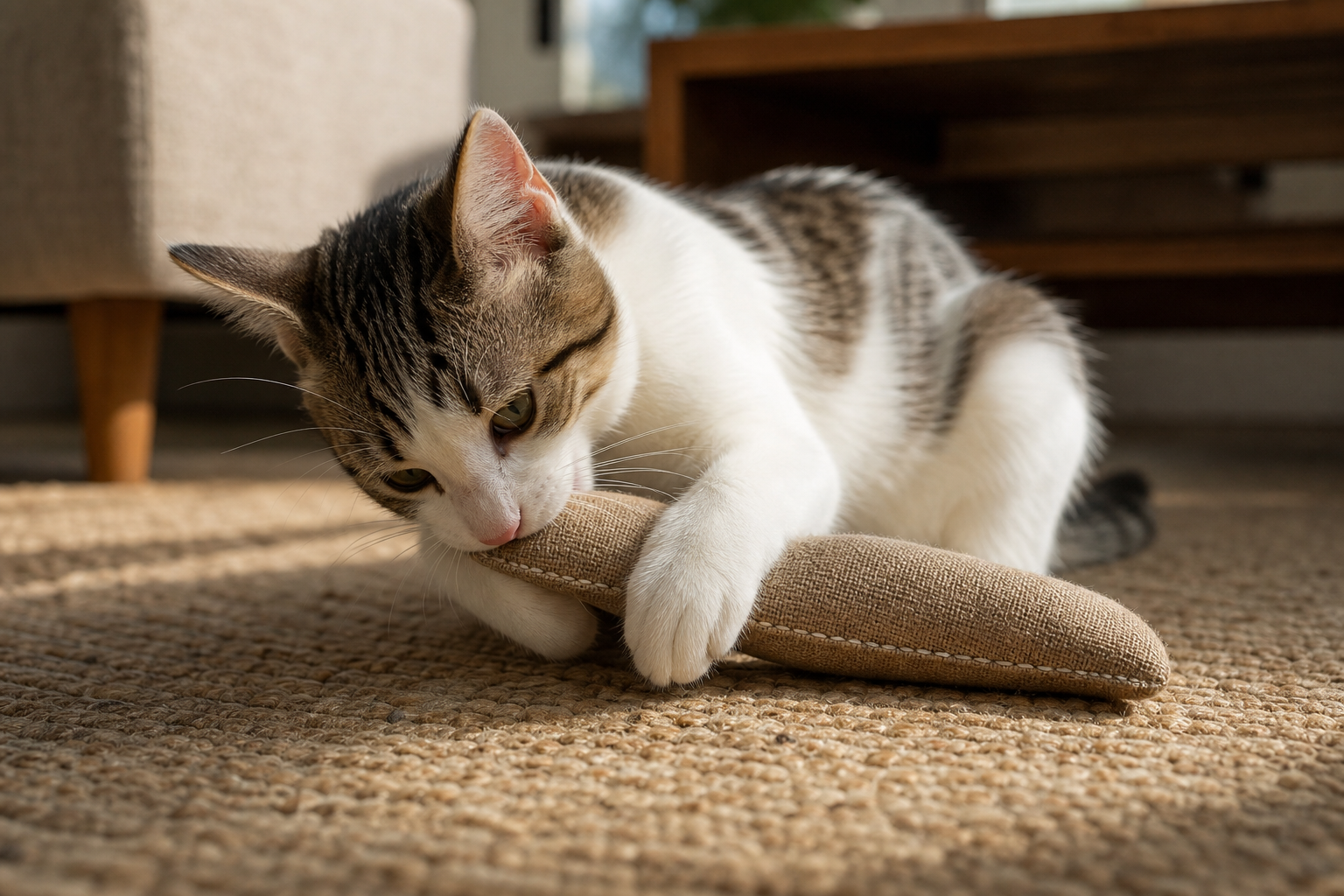
    Rubber chew toys for cats can be useful when a cat wants to gnaw, but they are not automatically safe just because they are rubber. The best options are flexible, cat-sized, easy to wash, free of loose parts, and tough enough that your cat cannot quickly bite off chunks. They should be inspected often and removed as soon as cracks, missing pieces, sticky surfaces, exposed inserts, or loose decorations appear.

    The bigger question is why your cat is chewing. A teething kitten, a bored indoor hunter, a cat redirecting stress, and a cat swallowing rubber bands are different problems. A rubber toy may help the first two. A cat that eats rubber, plastic, fabric, hair ties, or string needs tighter prevention and, in many cases, a veterinary conversation.

    Are Rubber Chew Toys Safe for Cats?

    Some rubber chew toys are reasonable for supervised cat play. The safer ones are made for cats or small pets, have a softer bite than hard dog chews, and are large enough that your cat cannot swallow them whole. They give cats a legal target for chewing instead of cords, shoelaces, plastic packaging, or toy parts.

    The risk is ingestion. A cat who only mouths and gnaws a toy is different from a cat who bites pieces off and swallows them. Cornell Feline Health Center’s safe toy guidance warns against small pieces and strand-like parts that can separate during chewing and be ingested. That warning applies directly to rubber toys with feathers, ribbons, bells, glued-on shapes, fabric streamers, or thin nibs that can tear away.

    Use this rule: if the toy is becoming smaller, sharper, sticky, flaky, or easier to tear, it is done. A durable toy is still a consumable object when a rough chewer is involved.

    When Rubber Makes Sense

    Rubber or silicone-style chew toys can be a good fit for cats who like pressure on the gums, bat small objects around, carry toys in the mouth, or gnaw lightly after chase play. They are especially worth trying for kittens who are teething, cats who chew fabric seams, and cats who show interest in plastic texture but do not swallow pieces.

    They are less useful for cats who want to bunny-kick with the back legs. Those cats often need a longer fabric kicker or rugged plush target they can grab, bite, and rake without wrapping around your arm. If your cat destroys soft toys too quickly, use the rubber chew as one part of a rotation, then pair it with guidance from Titan Claws on durable cat toys and cat chewing toys.

    Rubber also should not be treated as dental care by itself. Nubs and ridges may help some cats enjoy chewing, but they do not replace tooth brushing, veterinary dental exams, or a veterinarian’s advice for bad breath, inflamed gums, drooling, tooth pain, or reduced appetite.

    How to Choose a Better Rubber Chew Toy

    Start with the material and shape, then judge the toy against your actual cat. Product pages often say durable, dental, or non-toxic. Those claims are not enough. The toy still has to survive your cat’s mouth.

    • Choose flexible over hard. A cat chew should compress under firm finger pressure. Avoid rock-hard nylon or hard dog chews that are built for a much stronger jaw and heavier bite.
    • Avoid detachable extras. Skip glued eyes, bells, plastic beads, feather tufts, fabric streamers, elastic loops, ribbons, and thin rubber spikes that your cat can shear off.
    • Size up thoughtfully. The toy should be easy to carry and bat, but not small enough to disappear fully into the mouth. For large cats and aggressive chewers, err larger.
    • Look for simple surfaces. Gentle ridges are easier to inspect than complicated crevices. Deep holes can trap food, saliva, and grime unless the toy is designed to be cleaned thoroughly.
    • Check odor and surface feel. A strong chemical smell, sticky coating, peeling paint, or greasy residue is a reason to skip the toy.
    • Match the toy to supervision. If you would not trust it while you shower, do not leave it out overnight.
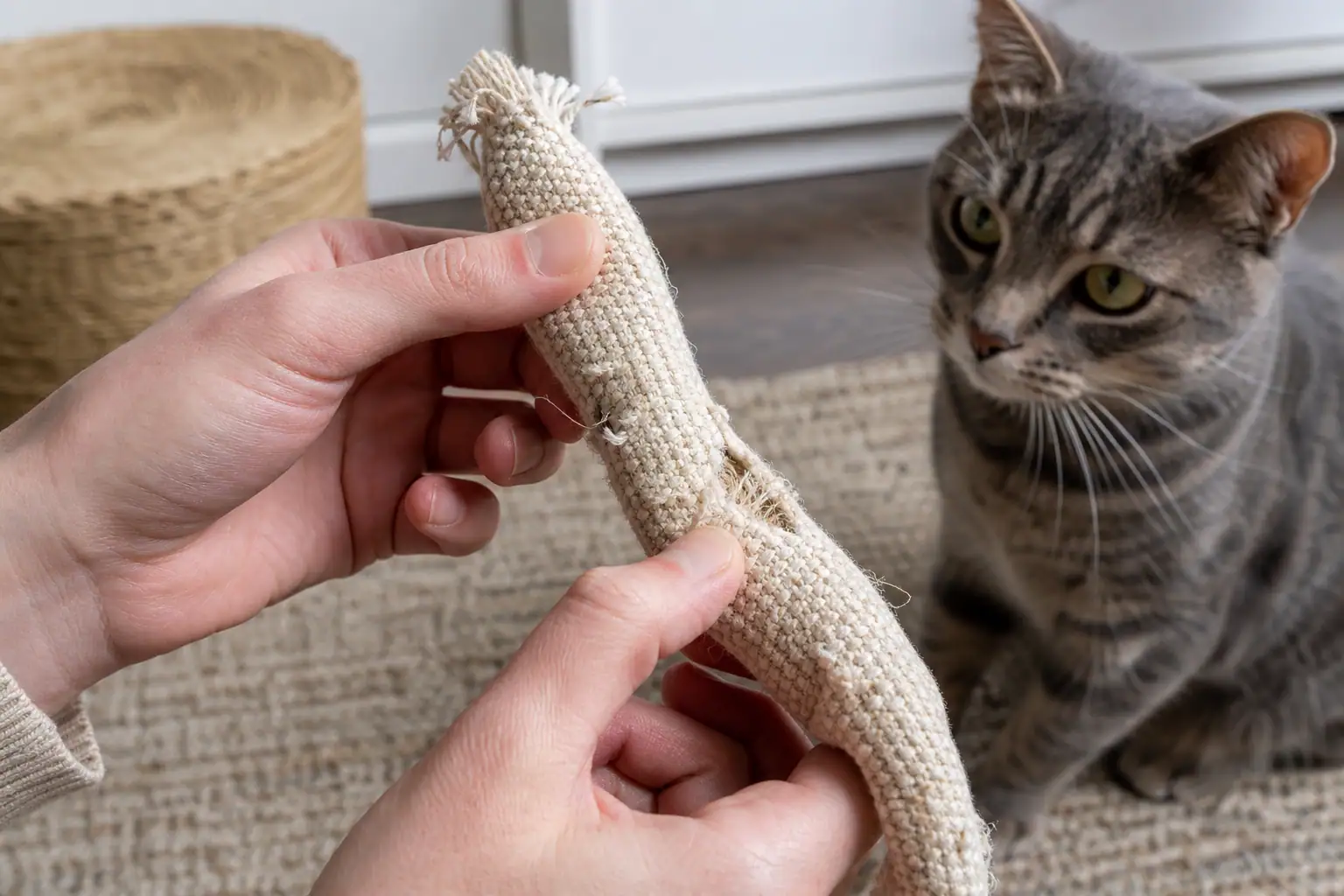
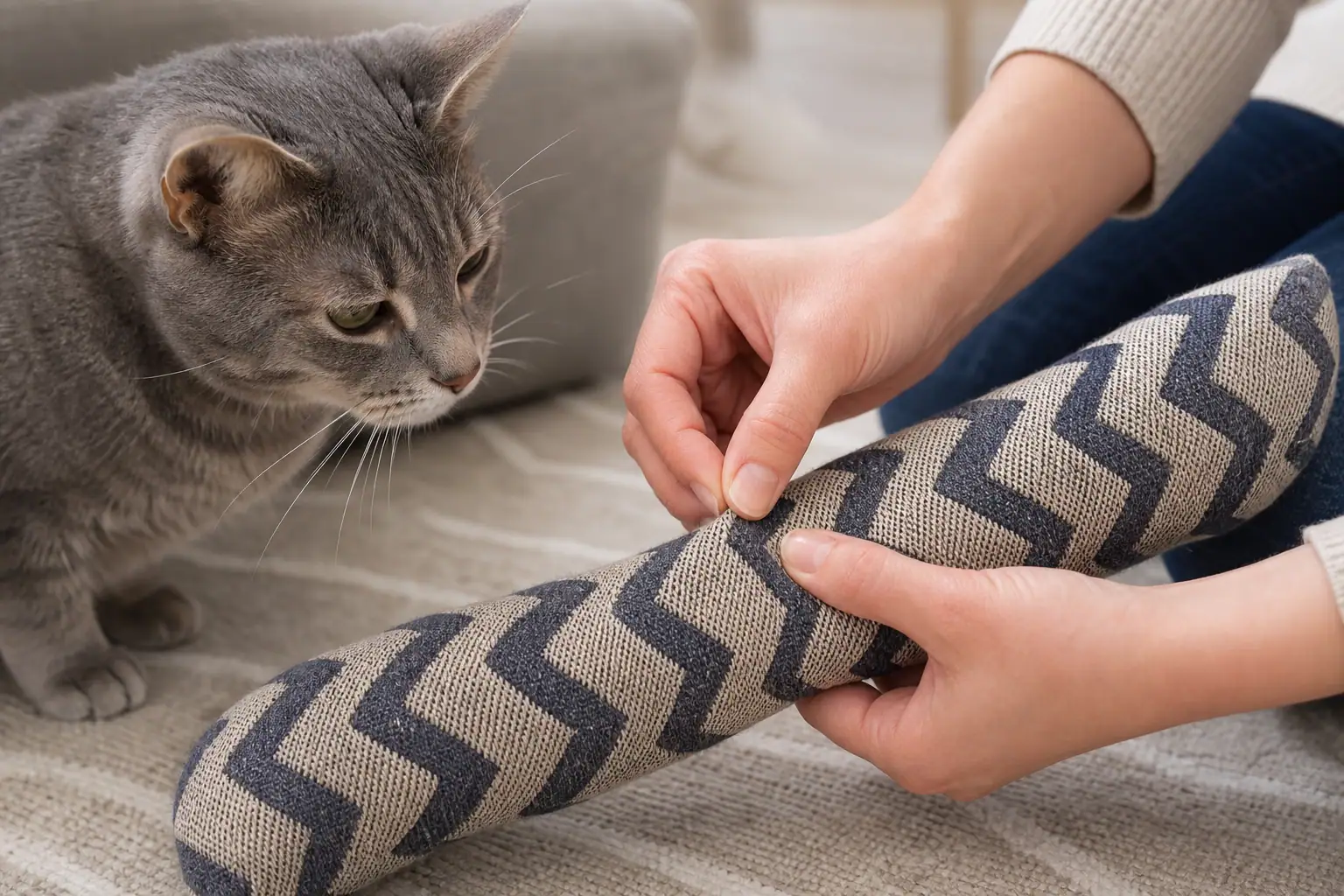
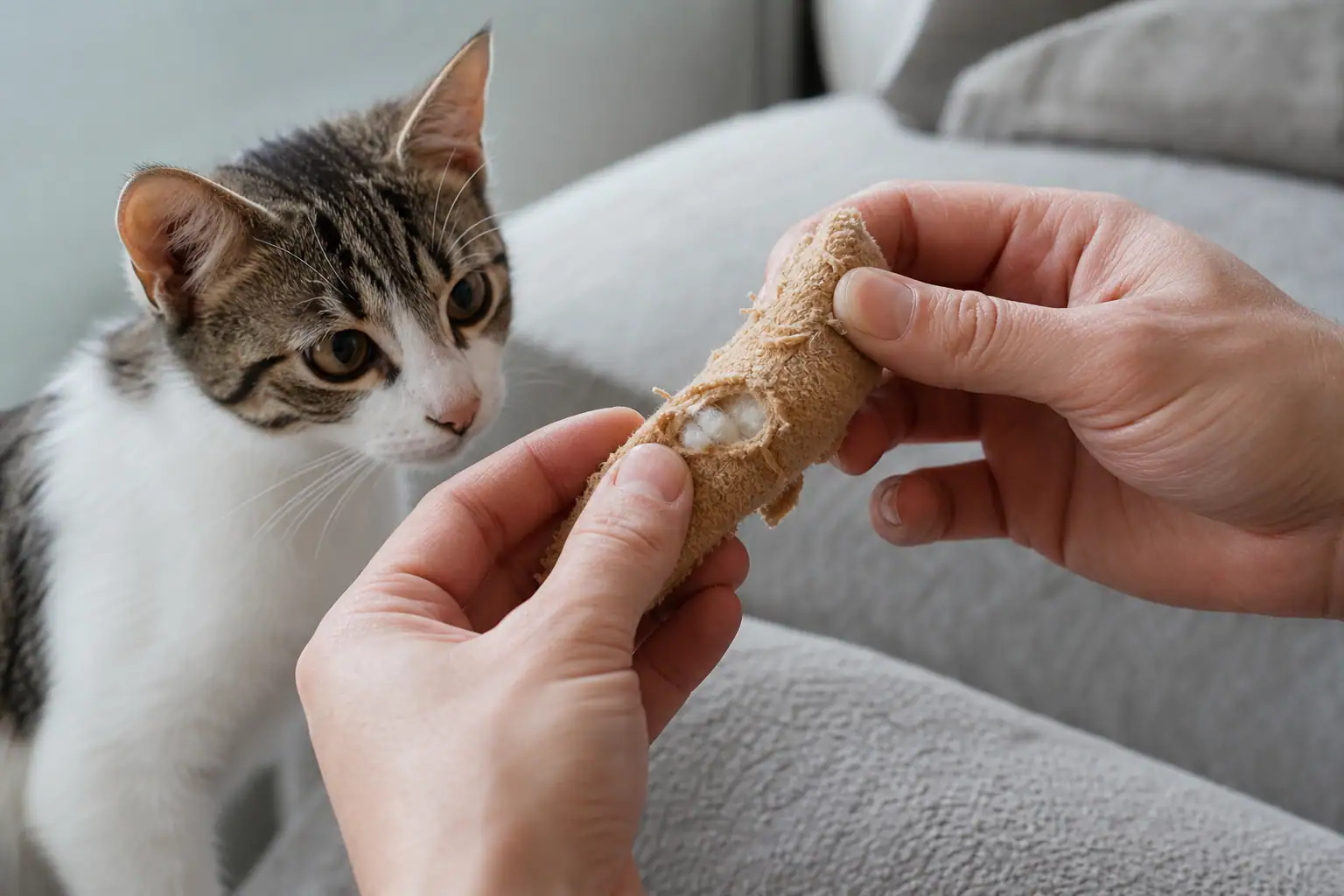
    Hands checking the flex and surface of a rubber cat chew toy
    A good rubber chew toy for a cat should flex under pressure, stay intact after gnawing, and be easy to inspect for cracks or missing pieces.

    For kittens, read Titan Claws’ kitten teething toys guide before giving anything firm. Kitten teeth and gums need gentler materials, and young cats are more likely to explore objects with their mouths.

    Rubber, Silicone, TPR, and Natural Rubber

    Owners often use the word rubber for several materials. Natural rubber comes from latex-bearing plants. Silicone is a different flexible material that is common in kitchenware and some pet products. TPR, or thermoplastic rubber, is a rubber-like plastic blend used in many inexpensive pet toys. Any of these can be acceptable or poor depending on the formula, design, quality control, and how your cat chews.

    Because labels vary, focus on what you can verify. Is the toy marketed for cats or small pets? Is it flexible? Does the manufacturer state that it is free of BPA, phthalates, and lead? Is it one solid molded piece rather than rubber plus dangling decorations? Can it be washed? Does it stay intact after several supervised sessions?

    Be careful with dog toys. A small dog toy can be useful for some cats if it is soft enough and too large to swallow, but many dog chews are too heavy, too hard, or shaped for a dog mouth. If a toy hurts when you press it against your own fingernail, it may be too unforgiving for a cat’s teeth.

    If Your Cat Chews Cords, Plastic, or Rubber Bands

    A chew toy is not the first safety step for cord chewing. First remove access. Use cord covers, route cables behind furniture, unplug tempting cords when practical, and keep rubber bands, hair ties, twist ties, earbud tips, silicone bands, and packaging out of reach. Cornell’s safe-toy guidance specifically warns against electrical cords that a cat can chew, which is the practical starting point: block the hazard before you offer the redirect.

    Then give your cat a more acceptable outlet. Place the rubber chew toy near a play area, not beside the forbidden cord. Make it interesting with movement: roll it, hide it partly under a towel, toss it down a hallway, or use it as the catch at the end of a wand session. If your cat ignores rubber but loves plant textures, supervised cat chew sticks or silvervine may be a better match.

    Cat redirected away from electrical cords toward a safe chew toy
    If your cat chews cords, remove access first. A chew toy is a redirect, not a substitute for cord covers and supervision.

    If your cat actually eats non-food items, treat that as a different level of concern. UC Davis describes pica as persistent chewing and consumption of non-nutritional substances and notes that it can be linked to medical or behavioral causes, including boredom, anxiety, or nutritional problems. The article also flags possible poisoning, dental problems, and gastrointestinal obstruction. A case-control study on feline pica and chewing behavior found that pica cats commonly targeted shoelaces or threads, plastic, fabric, and also rubber among other materials, which matches what many chew-toy shoppers are trying to manage.

    A Safer Chew Routine for Rough Cats

    The best routine gives your cat several legal textures without leaving the riskiest objects available all day. Try this for one week:

    1. Pick one supervised rubber chew. Use it for 5 to 10 minutes while you watch how your cat bites it.
    2. Add one bite-and-kick toy. A longer kicker helps cats who need to grab and rake, not just gnaw.
    3. Add one food or puzzle outlet. A puzzle feeder can reduce boredom chewing by making part of dinner more active.
    4. Rotate, do not flood. Leave out only the toys that are safe for that cat. Store higher-risk toys between sessions.
    5. Inspect before and after play. Look for missing chunks, cracks, loose fibers, sharp edges, and changes in texture.

    This routine lines up with enrichment principles: cats need stalking, pouncing, biting, problem-solving, and novelty. The University of Wisconsin School of Veterinary Medicine advises toy rotation and warns that aggressive chewers may ingest feathers, strings, sparkles, or loose pieces. That is why Titan Claws treats durability and inspection as part of play, not an afterthought.

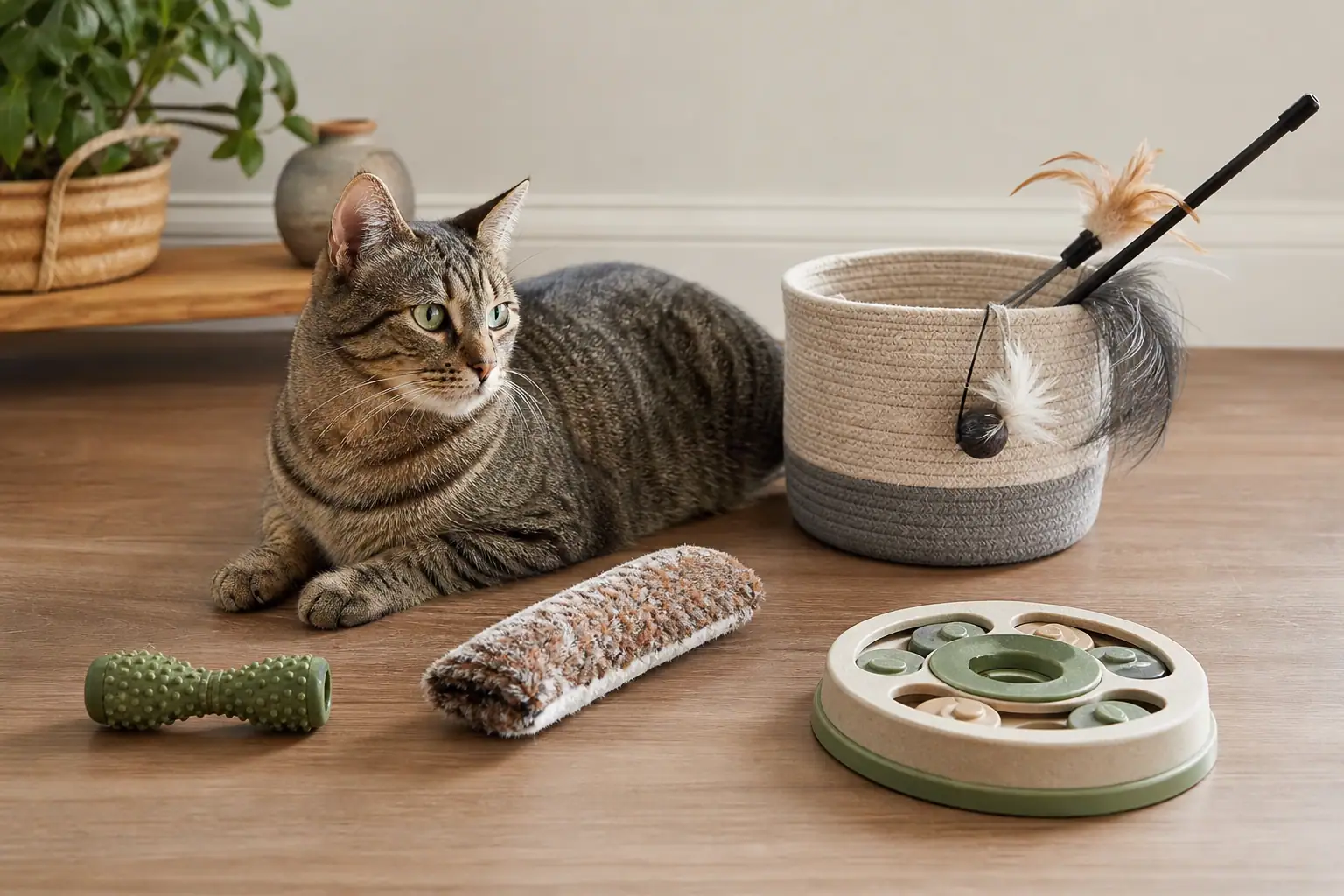
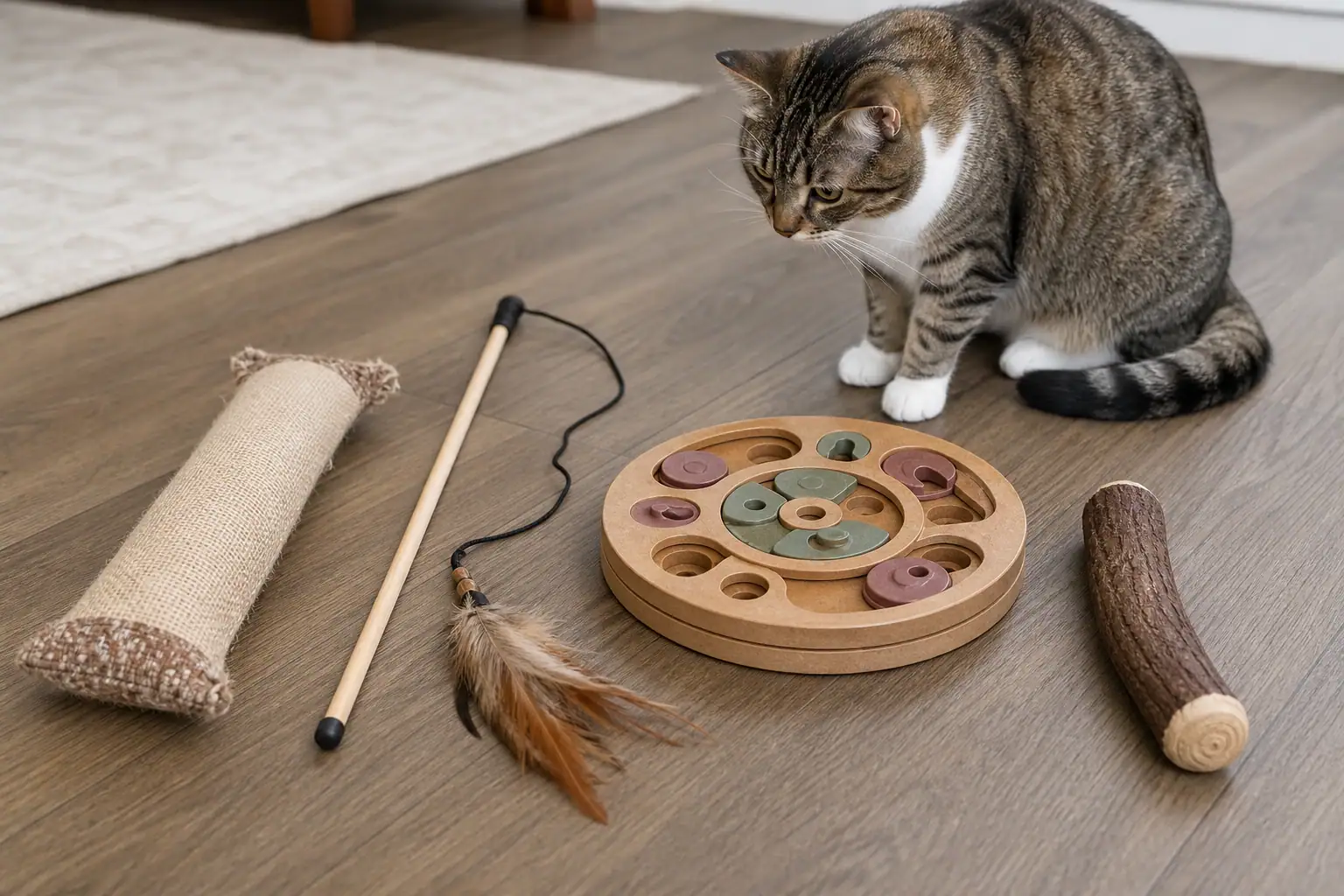
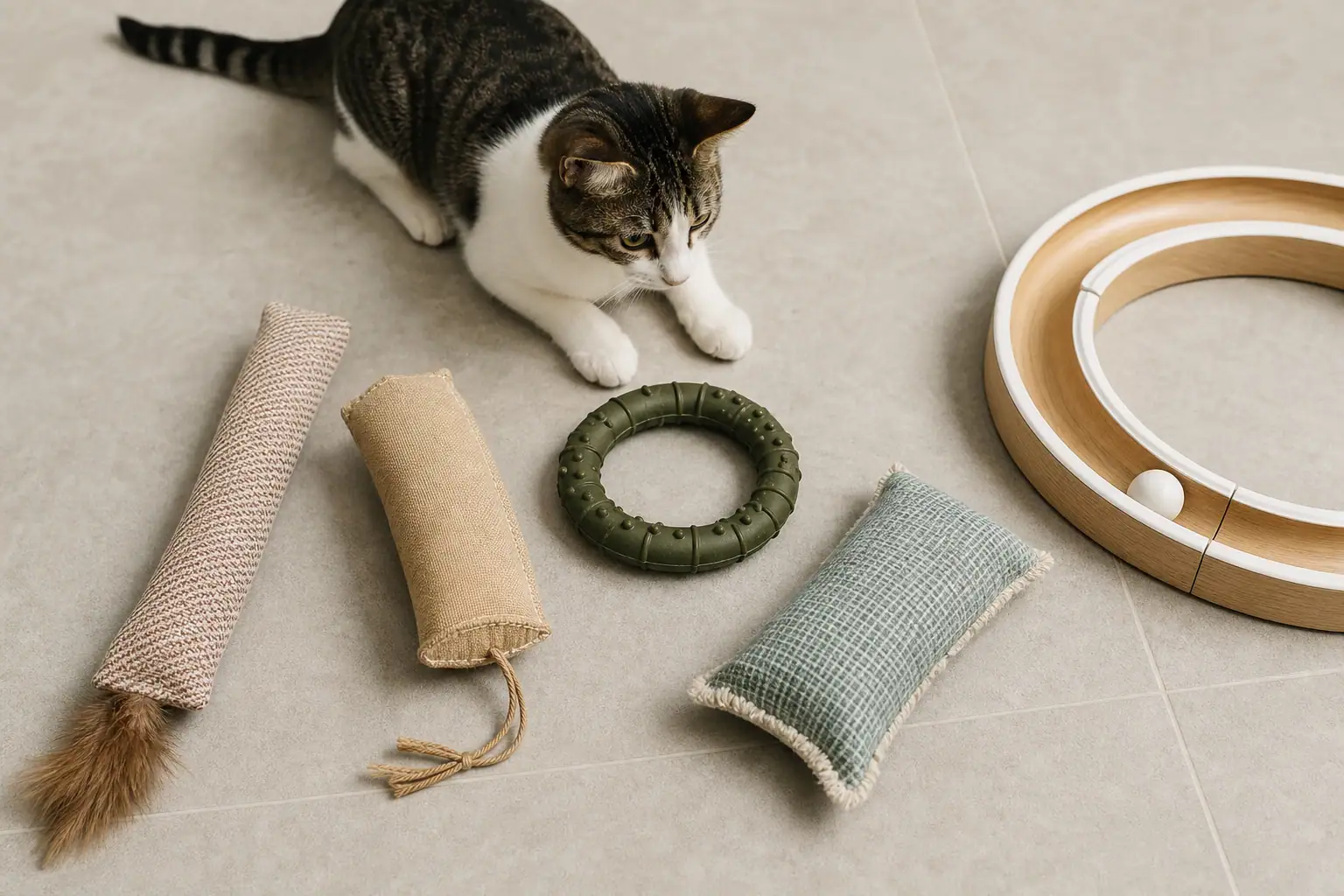
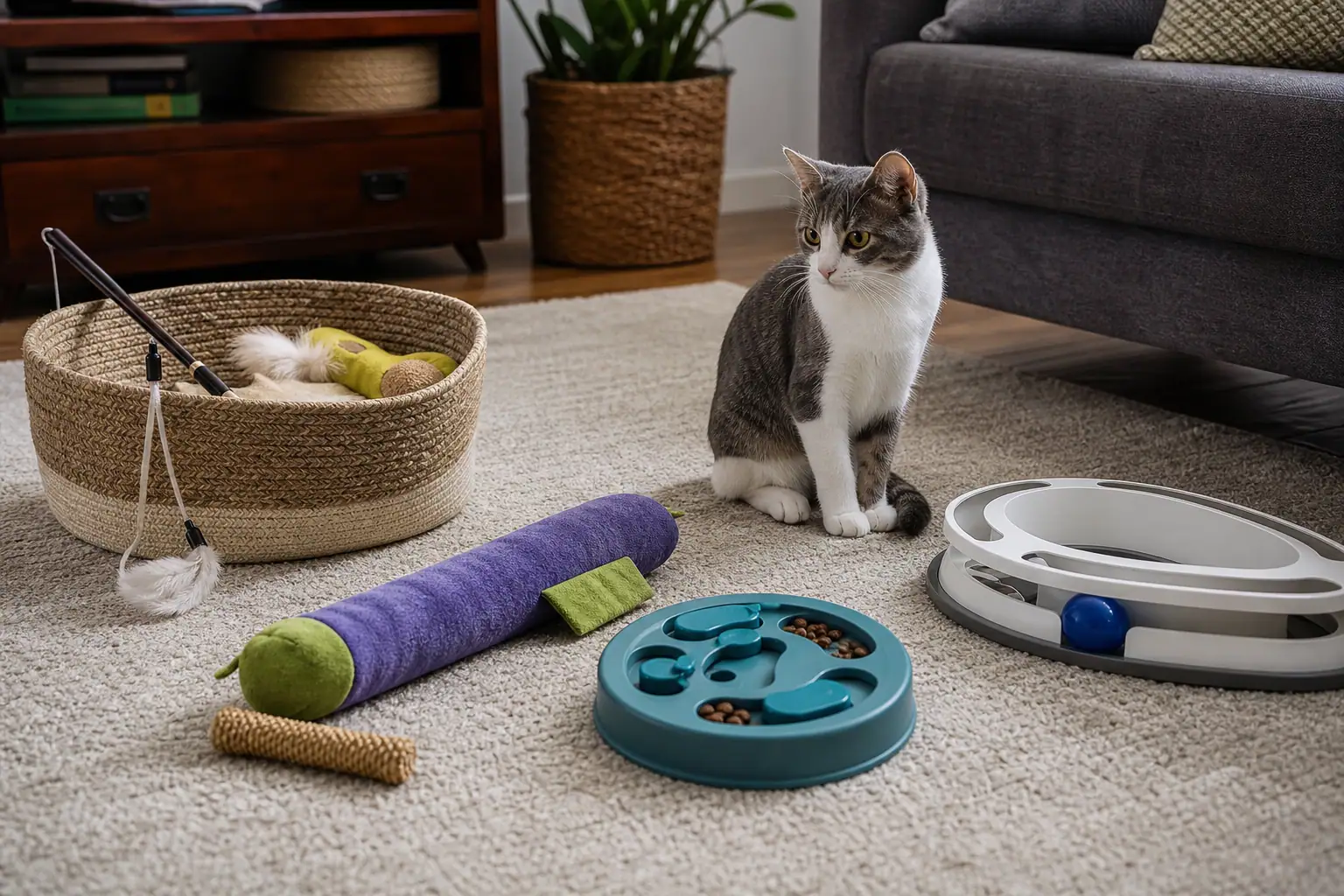
    A cat chew station with rubber toy, fabric kicker, and silvervine sticks
    Rubber is only one chew outlet. Many cats do better with a small rotation of textures, including a flexible chew, a fabric kicker, and supervised silvervine.

    For a fuller rotation, combine this article with Titan Claws guides to cat toys for enrichment, cat toys for play aggression, and crinkly cat toys. Cats who chew hard often need a system, not one miracle toy.

    When to Throw a Rubber Toy Away

    Retire the toy immediately if any of these appear:

    • Pieces are missing or you find rubber flakes on the floor.
    • The toy has a crack, split seam, sharp edge, or stretched hole.
    • Your cat can fit the whole toy in their mouth.
    • Ridges, spikes, bells, streamers, or attachments are loosening.
    • The surface becomes sticky, brittle, oily, or crumbly.
    • Your cat guards it intensely and tries to swallow pieces.
    • Your cat vomits, drools, paws at the mouth, stops eating, strains in the litter box, or seems lethargic after chewing.

    If you suspect your cat swallowed part of a rubber toy, call your veterinarian. Do not wait for an obstruction to become obvious. Signs can be subtle at first, and the right next step depends on the object, timing, symptoms, and your cat’s health history.

    Quick Buying Checklist

    Before buying rubber chew toys for cats, run through this checklist:

    • Is it made for cats or clearly appropriate for a cat-sized mouth?
    • Does it flex instead of feeling rock-hard?
    • Is it too large to swallow whole?
    • Are there no feathers, strings, bells, beads, ribbons, tags, loops, or glued-on decorations?
    • Can you wash and inspect every surface?
    • Does the manufacturer identify the material and safety claims clearly?
    • Does your cat chew without removing pieces?
    • Will you supervise the first several sessions?
    • Do you have a backup texture if your cat ignores rubber?
    • Have cords, rubber bands, hair ties, and plastic packaging already been removed from reach?

    Rubber chew toys are best seen as one tool for cats who need to bite something appropriate. Choose flexible, simple, inspectable toys; supervise rough chewers; rotate textures; and retire damaged toys early. If your cat is swallowing rubber or other non-food items, the safer answer is not a tougher toy. It is prevention, enrichment, and veterinary guidance.

    Sources

  • Cat Toys for Play Aggression: What to Use and What to Avoid

    Cat Toys for Play Aggression: What to Use and What to Avoid

    The best cat toys for play aggression are toys that let your cat chase, catch, bite, kick, and cool down without using your hands, ankles, or other pets as the target. Start with an interactive wand or teaser for controlled chasing, a longer kicker toy for the bite-and-kick part of the hunt, and a few solo toys such as puzzle feeders or larger skitter toys for off-hours energy. Avoid hand-wrestling, tiny swallowable toys, loose strings left out, fragile plush, and anything your cat can shred into parts.

    Play aggression is not the same as a cat being mean. It is usually normal hunting and rough play aimed at the wrong target, especially in kittens, adolescent cats, high-energy indoor cats, and cats that do not get enough structured play. The toy choice matters, but the routine matters just as much. A toy that is perfect during a supervised session can be risky if it is left on the floor all day.

    What Play Aggression Looks Like

    Play aggression often shows up as stalking feet, ambushing ankles from behind furniture, biting hands during petting, grabbing arms when a toy is nearby, or launching at people during morning and evening energy spikes. Some cats give clear warning signs: wide pupils, crouching, a swishing tail, a tucked body, a wiggling rear end, or repeated hiding around corners.

    The practical goal is not to stop your cat from hunting. Cats need appropriate outlets for predatory play. The goal is to move that energy onto toys, schedule play before the rough behavior usually starts, and choose toys that can handle a hard catch without becoming a hazard. The VCA guidance on play and predatory aggression makes the same core point: appropriate play opportunities have to be part of the solution, not an afterthought.

    The Toy Setup That Works Best

    For most play-aggressive cats, one toy is not enough. Use a small kit with three jobs:

    • A chase toy: a wand, fishing-pole toy, or teaser used only while you are supervising.
    • A catch toy: a longer kicker or rugged plush that the cat can grab, bite, and rake with the back feet.
    • A solo outlet: a puzzle feeder, treat ball, sturdy track toy, larger skitter toy, tunnel, or box setup that is safe for that individual cat when you are not actively playing.
    A play aggression redirect kit with a wand toy, kicker toy, and puzzle feeder
    A useful play-aggression setup separates chase toys, bite-and-kick toys, and calming solo outlets instead of asking one toy to do every job.

    This combination works because it follows the cat’s play sequence. First the toy runs away, hides, and reappears. Then the cat gets a real catch. Then the cat has something calmer to do after the main session. If your cat only gets a laser dot or a toy they never capture, the session may leave them more frustrated instead of more settled.

    For a broader toy foundation, pair this article with Titan Claws guides to wand cat toys, cat kicker toys, and puzzle cat toys. Those articles go deeper on specific toy types; this guide is about using them together for rough play.

    Best Cat Toys for Play Aggression by Situation

    If your cat attacks ankles

    Use a wand toy or tossable toy before the ambush happens. Keep one or two safe redirect toys in the rooms where attacks usually occur. If your cat crouches near a hallway corner at 7 p.m. every night, start a short chase session at 6:55 p.m. instead of waiting for the pounce.

    Choose toys that move away from the cat. Drag a lure around a corner, skim it along a baseboard, let it disappear behind a box, pause, then move again. Prey does not run into a cat’s face. The East Bay SPCA play-aggression handout recommends making the toy act like prey and redirecting before the pounce whenever possible, which is a useful rule for ankle attackers.

    Cat crouching near a toy with alert play body language
    Redirect before the pounce when possible. Dilated pupils, crouching, tail swishes, and corner ambushes are your cue to move play onto a toy.

    If your cat grabs hands during play

    Increase distance. Use a wand, pole, or long lure instead of a tiny toy held between your fingers. End each chase with the cat landing on a kicker toy or larger plush, not your sleeve. If claws or teeth hit skin, freeze, calmly stop the game, and give the cat a moment to reset. Do not jerk away dramatically; fast movement can make your hand act even more like prey.

    The San Francisco SPCA play-aggression resource is blunt about this: hands are not toys. That is especially important in multi-person homes because one person roughhousing with hands can undo everyone else’s training.

    If your cat bites and bunny-kicks hard

    Prioritize a longer kicker toy. The toy should be long enough for your cat to hug with the front paws and kick with the back legs without wrapping around your arm. Look for secure stitching, a cover that does not shed fibers easily, and a shape that is easy to inspect after play. Avoid glued-on eyes, thin ribbon tails, brittle crinkle pods, exposed bells, and decorative parts that can detach.

    Rough kickers need a higher safety standard than gentle cuddle toys. Titan Claws has more material and sizing guidance in durable cat toys and toys for cats that chew. No soft toy is truly indestructible, so inspection is part of the routine.

    If your cat gets wild when you are busy

    Use food puzzles and self-play toys as pressure valves, not as the whole plan. A puzzle feeder can make part of dinner slower and more engaging. A track toy, tunnel, cardboard box, or larger skitter toy can give your cat an appropriate target while you work. These are useful because they give the cat something to do before the behavior spills onto people.

    Still, many play-aggressive cats need interactive play with a person. Solo toys cannot fully replace the movement and timing you create with a wand. The East Bay SPCA handout recommends daily scheduled play and notes that cats often get more out of toys controlled by a person than toys they must animate by themselves.

    Toys to Avoid or Supervise Closely

    Some toys are fine for calm cats and poor choices for cats that launch, chew, or shred. Be stricter if your cat has already destroyed toys, swallowed pieces, or redirected bites onto people.

    • Hands, feet, and sleeves: never use body parts as prey, even with kittens.
    • Loose string, yarn, ribbon, and elastic: use only during active supervision, then store away.
    • Tiny plush mice: avoid anything your cat can fit fully in the mouth or tear open quickly.
    • Feathers and bells: supervise closely and retire the toy if parts loosen.
    • Fragile electronic toys: inspect battery doors, moving attachments, wires, and plastic housings.
    • Catnip toys for over-aroused cats: catnip is not harmful for most cats, but it can make some play-aggressive cats more intense.
    • Laser-only sessions: if you use a laser, finish with a physical toy or treat the cat can actually catch.

    Cornell Feline Health Center’s safe toys guidance is useful here because it emphasizes the risk of small pieces and strand-like materials. With play aggression, the same risks are amplified by harder biting and faster pouncing.

    A 15-Minute Play Routine for Rough Cats

    Use this routine once or twice daily, especially before the times your cat usually attacks. Morning and evening are common high-energy windows.

    1. Two minutes: warm up. Move the wand slowly along the floor, behind a chair leg, or around a box. Let the cat stalk.
    2. Five minutes: chase. Move the lure away from the cat in short bursts. Use pauses so the cat can plan the pounce.
    3. Three minutes: catch and kick. Let the cat land on a kicker toy. Keep your hands away from the strike zone.
    4. Three minutes: repeat, but easier. Run a shorter chase so the cat wins again.
    5. Two minutes: cool down. Offer a small food puzzle, a few pieces of kibble to forage for, or calm distance. Do not immediately pet a cat that is still in hunt mode.

    The routine should feel predictable, not frantic. If the cat starts panting, limping, hiding in fear, or escalating toward people, stop and reassess. For more enrichment structure, see Titan Claws on cat toys for enrichment, cat enrichment activities, and cat toys for boredom.

    How to Redirect Without Rewarding the Attack

    Timing is the hard part. If you see the pre-pounce signs, redirect immediately with a toy thrown away from your body or a wand lure moved along the floor. That teaches the cat that toys are the target.

    If the cat has already bitten or grabbed you, do not instantly produce the most exciting toy as a prize. Calmly stop interaction, become still and boring, step out of reach if needed, then restart a structured toy session after a short reset. This distinction matters: preempting with a toy is useful; rewarding a successful ambush can make the ambush more likely.

    A small bell on a breakaway collar can help some households notice ambushes earlier, but it is not a fix by itself. The fix is still scheduled play, appropriate toys, calm disengagement after mistakes, and consistent rules from every person in the home.

    Safety Checks for Durable Play

    Durability is not a promise that a toy can be ignored. It is a way to buy more time, better structure, and fewer obvious failure points. After rough sessions, check the toy before it goes back into the basket.

    • Are seams opening or threads hanging loose?
    • Is stuffing visible?
    • Are feathers, bells, eyes, clips, or tags loosening?
    • Has the surface started shedding fuzz or small plastic pieces?
    • Can your cat fit the whole toy in their mouth?
    • Is a cord, ribbon, or elastic section chewed?
    • Does a battery compartment still close securely?
    • Would you trust this toy unsupervised with this specific cat?
    Hands checking a cat toy for torn seams and loose parts
    Rough play increases wear. Inspect seams, cords, feathers, stuffing, bells, and chew marks before the next session.

    If the answer worries you, retire the toy. A tough cat toy should be easy to inspect, large enough for the cat, and matched to the way the cat actually plays. For heavy chewers, read safe cat chew toys before leaving any chew-target toy out alone.

    When Toys Are Not Enough

    Ask your veterinarian or a qualified feline behavior professional for help if bites break skin, the behavior is sudden or escalating, the cat targets children or vulnerable adults, the cat seems fearful rather than playful, another pet is being injured, or your cat also shows signs of pain, illness, hiding, appetite change, or litter box changes. A toy routine can help normal play aggression, but it should not be used to explain away medical pain, fear aggression, or serious household safety risk.

    Also be careful with punishment. Physical punishment, yelling, and dramatic reactions can increase fear or make the game more exciting. The better pattern is predictable play, better toy targets, calm disengagement after rough contact, and early redirection before the pounce.

    Quick Buying Checklist

    Before buying cat toys for play aggression, run through this checklist:

    • Does this toy solve a specific job: chase, catch, kick, forage, or solo play?
    • Can I use it without putting my hands near teeth and claws?
    • Is it large enough for my cat’s mouth and play style?
    • Are strings, feathers, bells, batteries, and small parts supervised only?
    • Can I inspect the toy quickly after rough play?
    • Does the cat get a real catch at the end of the game?
    • Do I have a calmer follow-up, such as a food puzzle or foraging activity?
    • Will everyone in the home follow the same no-hands rule?

    The right toys for play aggression give your cat legal targets for normal hunting behavior. Use wand toys for distance, kicker toys for the hard catch, puzzle toys for mental work, and durable construction for rough players. Then keep the routine consistent: play before the ambush, let the cat catch something real, inspect the toy, and retire damaged pieces early.

    Sources

  • Cat Chew Sticks: Safe Use, Silvervine, and Better Choices

    Cat Chew Sticks: Safe Use, Silvervine, and Better Choices

    Cat chew sticks can be a useful enrichment tool when a cat wants to sniff, rub, lick, bite, and carry something plant-based. Most cat chew sticks are made from silvervine, also called matatabi, and some cats respond to it more strongly than they respond to catnip. They are not a magic dental treatment, and they are not automatically safe for every cat.

    The right way to use them is simple: choose sticks made for cats, supervise the first sessions, remove bark dust and broken pieces, and stop if your cat tries to swallow chunks. If your cat is a hard chewer that destroys toys quickly, treat chew sticks as a supervised enrichment item, not a leave-out toy.

    What Are Cat Chew Sticks?

    Cat chew sticks are usually small dried sections of silvervine wood, silvervine gall fruit, honeysuckle wood, or a wrapped combination of silvervine, gall fruit, raffia, sisal, or catnip. The appeal is partly texture and partly scent. Many cats sniff, rub their cheeks, roll, drool, lick, bite, or kick after contact with the plant material.

    Silvervine has stronger evidence behind it than most cat-stick marketing pages explain. A 2017 BMC Veterinary Research study tested silvervine, catnip, Tatarian honeysuckle, and valerian in domestic cats. Almost 80% of the cats responded to silvervine, and many cats that did not respond to catnip still responded to silvervine. That makes silvervine sticks worth considering for cats that ignore catnip toys.

    Chew sticks are best thought of as scent-and-chew enrichment. They can give a cat a legal object to mouth, but they do not replace tooth brushing, veterinary dental exams, daily play, or safer chew toys for cats that gnaw hard enough to break pieces off.

    Are Cat Chew Sticks Safe?

    For many cats, a clean cat-specific silvervine stick used under supervision is a reasonable toy. The safety question is not only whether silvervine is toxic. The bigger issue is how your individual cat handles the physical stick: does the cat lick it, shave the bark, crunch it into chunks, or try to eat it?

    Use these rules for the first few sessions:

    • Supervise at first. Watch how your cat bites, holds, and breaks down the stick before deciding whether it can stay out.
    • Choose cat-specific products. Do not hand over random yard sticks, treated wood, craft sticks, skewers, or wood from unknown plants.
    • Remove loose wraps. Raffia, rope, sisal, string, and dangling trim can become ingestion risks for cats that chew aggressively.
    • Stop if chunks come off. A cat that bites off swallowable pieces needs a different toy type.
    • Keep water available. Some cats drool heavily or get very excited around silvervine.
    • Use a short session. Ten to fifteen minutes is enough for most cats, especially when you are still learning their reaction.

    Cornell Feline Health Center’s safe toy guidance warns owners to avoid small pieces and linear parts such as feathers and string that may detach and be swallowed. The same logic applies to chew-stick bundles: the stick may be the point, but the extras can be the hazard.

    Hands checking a cat chew stick for sharp splinters and loose pieces
    Chew sticks should be inspected like any other toy. Remove sharp splinters, loose wraps, and pieces small enough to swallow.

    What Current Product Pages Usually Miss

    Search results for cat chew sticks lean heavily toward marketplaces and product listings. Those pages are useful for seeing what exists, but they often blur together three very different cats: the gentle sniffer, the bored chewer, and the destructive cat that crushes toys. Those cats need different rules.

    Most product pages also overstate dental value. Chewing a stick may rub some tooth surfaces, but it does not clean every tooth, reach below the gumline, remove established tartar, or diagnose mouth pain. If your cat has bad breath, red gums, loose teeth, drooling, pawing at the mouth, dropping food, or chewing on one side, that is a veterinary dental issue, not a reason to buy a bigger bundle of sticks.

    A better buying decision starts with your cat’s failure mode. If the stick stays mostly intact and your cat rubs, licks, and briefly gnaws it, it may be a good enrichment item. If the stick splinters, the cat swallows bark, or the wrapped parts unravel, retire it immediately.

    How to Choose Better Cat Chew Sticks

    Look for plain, simple construction. The best stick for a rough player is often the least decorative one.

    • Simple ingredient list: silvervine, matatabi, or clearly named cat-safe plant material is easier to evaluate than vague natural wood blends.
    • Appropriate diameter: very thin sticks can snap quickly; very small pieces are easier to swallow.
    • Smooth but not painted: skip dyes, varnish, glitter, fragrance, glue-heavy decorations, and unknown coatings.
    • Minimal attachments: avoid bells, beads, feathers, elastic, ribbons, plastic caps, and long string-like pieces for chewing cats.
    • Clean packaging: choose dry, clean sticks without mold, dampness, odd chemical smells, or excessive dust.
    • Clear usage guidance: responsible products tell you to supervise, inspect, and replace damaged pieces.

    If your cat wants a softer bite target, pair this guide with Titan Claws’ chewy cat toys guide. If the real problem is toy destruction, start with durable cat toys and the newer cat chewing toys safety guide.

    How to Introduce a Chew Stick

    Do not rub the stick all over your cat’s face or force interest. Let the cat choose. Silvervine and similar plant attractants work through scent, and forced handling can turn enrichment into annoyance.
    1. Start on a clear floor. Remove string toys, food bowls, cords, and fragile items before the first session.
    2. Offer one stick. Place it near the cat and allow sniffing, rubbing, licking, or walking away.
    3. Watch the mouth. Gentle gnawing is different from crushing, splintering, or gulping.
    4. End while it is still intact. Put the stick away after a short session and inspect it under good light.
    5. Store it dry. Keep used sticks away from moisture, litter dust, and loose household items.
    6. Rotate, do not flood. Bring the stick out occasionally so novelty remains useful.

    Some cats only rub and roll. Some only sniff. Some become playful for a few minutes and then lose interest. All of those are normal outcomes. A cat does not need to chew the stick for the stick to have enrichment value.

    When Chew Sticks Are the Wrong Tool

    Skip chew sticks or keep them strictly supervised if your cat has a history of swallowing non-food material, chewing electrical cords, eating fabric, vomiting after chewing, or breaking toys into pieces. The University of Wisconsin School of Veterinary Medicine’s safe toys advice notes that aggressive chewers may ingest feathers, strings, sparkly parts, and similar toy materials, and that pieces chewed off should be removed right away.

    Also be cautious with kittens, cats with known dental disease, cats on restricted diets, cats recovering from oral surgery, and multi-cat homes where one cat guards or gulps toys. If a stick causes coughing, gagging, repeated vomiting, belly pain, appetite loss, lethargy, constipation, or suspected swallowing of a sharp piece, stop using it and call your veterinarian.

    If your cat persistently eats non-food material, look beyond toys. UC Davis School of Veterinary Medicine’s overview of unusual eating habits in cats describes pica as chewing and consuming non-nutritional substances, with possible medical, stress, boredom, or compulsive causes. That pattern deserves a veterinary conversation.

    Cat chew sticks arranged with sturdy kicker toys and puzzle feeders
    For cats that crush sticks or swallow pieces, rotate toward larger bite targets, food puzzles, and supervised chase play.

    Better Alternatives for Hard Chewers

    Some cats are simply too destructive for stick-style toys. That does not mean they should get no chewing outlet. It means the outlet should be larger, simpler, and easier to inspect.

    • Large fabric kickers: good for cats that grab, bite, and rake; choose dense fabric and reinforced seams.
    • Flexible chew-safe cat toys: useful for cats that like pressure on the teeth, as long as the material does not crack or peel.
    • Food puzzles: better for cats chewing from boredom or frustration.
    • Ball tracks: good independent play when loose pieces cannot come out.
    • Supervised wand sessions: burn off hunt energy, then end with a safe bite target.
    • Cardboard boxes: remove handles, tape, staples, and loose packing material; do not let the cat eat cardboard.

    For a wider routine, use Titan Claws’ cat toys for enrichment and cat enrichment activities guides. Chew sticks work better as one controlled option in a rotation, not as the whole enrichment plan.

    Quick Safety Checklist

    • Is the stick made specifically for cats?
    • Do you know the plant material, such as silvervine or matatabi?
    • Is it free from dyes, fragrance, glitter, varnish, and unknown coatings?
    • Are there no bells, beads, feathers, elastic, long strings, or loose wraps?
    • Is it large enough that your cat cannot swallow it whole?
    • Did the first session happen under supervision?
    • Did the stick stay intact without sharp splinters or missing chunks?
    • Did your cat chew without gulping pieces?
    • Can you store it clean and dry between sessions?
    • Do you have a safer alternative ready if your cat chews too hard?

    The best cat chew sticks are simple, clean, cat-specific, and matched to a cat that rubs, licks, and gently gnaws rather than crushes and swallows. Use them for enrichment, inspect them like any other toy, and be willing to switch to larger durable toys when your cat’s chewing style makes sticks a poor fit.

    Sources

  • Cat Chewing Toys: Safer Picks for Cats That Gnaw Everything

    Cat Chewing Toys: Safer Picks for Cats That Gnaw Everything

    Cat chewing toys can help when a cat gnaws plush mice, cardboard corners, shoelaces, cords, or the tags off every toy in the house. The right toy gives the cat a safer outlet for biting and carrying. The wrong toy adds new hazards: loose string, cracked plastic, exposed stuffing, small bells, feathers, or pieces a determined cat can swallow.

    The safest approach is not to look for an indestructible chew toy. Look for a toy that fits why your cat is chewing, is too large to swallow, has simple construction, survives the first supervised sessions, and can be inspected easily. If your cat eats non-food material rather than just chewing it, treat that as a veterinary and safety issue, not a shopping problem.

    Close view of cat chewing toy materials and reinforced seams
    A good chewing toy is not just tougher. It is large enough, simple enough, and easy to inspect after teeth get involved.

    Why Cats Chew Toys

    Cats chew for different reasons, and the reason changes what you should offer. A kitten may mouth objects while teething. A young adult may bite hard during prey play because the toy is finally close enough to catch. A bored indoor cat may chew cardboard, plastic, fabric, or cords because the environment is not giving enough work to do. Some cats lick, chew, and consume non-food objects in a pattern that looks like pica.

    That distinction matters. Normal play biting can often be redirected into better toys and routines. Repeatedly eating fabric, string, rubber bands, plastic, wood, or other non-food objects needs a stricter plan and a veterinarian’s input. UC Davis School of Veterinary Medicine describes pica as persistent chewing and consumption of non-nutritional substances, and notes that it can be associated with medical problems, anxiety, boredom, or compulsive behavior.

    Before buying more toys, write down what your cat actually does:

    • Mouths and carries toys: choose larger soft toys, sturdy kickers, and supervised catch-and-bite games.
    • Gnaws seams and tags: avoid thin plush, labels, loops, glued decorations, and dangling parts.
    • Chews cords or strings: remove access first; do not try to solve this with more string-like toys.
    • Eats pieces: stop giving destructible toys unattended and speak with a veterinarian.
    • Chews when bored: add rotation, food puzzles, active play, hiding places, and window or climbing enrichment.

    What Makes a Cat Chewing Toy Safer?

    A safer chewing toy is built around damage control. It should still be interesting to bite, but it should not invite the cat to pull off swallowable parts. For Titan Claws readers, the best choices are usually simple, sturdy, and easy to inspect.

    Look for these traits:

    • Large enough sizing: the toy should not fit fully inside your cat’s mouth, and it should not have small removable parts.
    • Simple construction: fewer eyes, beads, bells, feather plugs, tails, strings, ribbons, and glued accents means fewer failure points.
    • Dense outer material: tightly woven fabric, durable fleece, canvas-style covers, and flexible rubber-like materials often handle chewing better than thin plush.
    • Reinforced seams: inspectable stitching, protected seams, or one-piece molded construction is better than single stitching and glue.
    • Safe shape: choose a toy the cat can bite and carry without wedging a tooth, trapping a claw, or breaking off a point.
    • Washability: drool, food dust, catnip, and moisture can weaken fabric and stitching, so cleaning instructions matter.

    If your cat destroys ordinary toys quickly, start with the broader Titan Claws guide to durable cat toys. For cats that like softer mouth-feel, compare the tradeoffs in our guide to chewy cat toys.

    Good Toy Types for Cats That Like to Chew

    No toy type is automatically safe for every cat. Use these categories as starting points, then judge by your own cat’s first few supervised sessions.

    Large soft chew toys and kickers

    A long kicker can work well for cats that grab, bite, and rake with the back feet. Choose dense fabric, firm stuffing, and reinforced ends. Avoid thin appendages and decorative pieces. The toy should be long enough that your hand is not part of the target. Retire it when seams open, stuffing appears, or the cat starts removing fabric instead of only biting the surface.

    Flexible rubber-like chew toys

    Some cats enjoy flexible rubber or silicone-style chew toys, especially when the texture gives their teeth something to press. These should bend rather than splinter, and they should be too large to swallow whole. Watch for deep bite marks, cracks, sticky surfaces, or pieces starting to peel. If a cat can shave off bits, the toy is no longer a good match.

    Cat chew sticks

    Silvervine, matatabi, and other cat chew sticks can interest cats that like plant-based textures. Use them only if the product is sized appropriately, clean, and intended for cats. Remove sharp splinters, broken pieces, and worn-down ends. If your cat tries to swallow chunks, stop using sticks and choose a different outlet.

    Food puzzles and foraging toys

    Some chewing is really frustration or boredom. A puzzle feeder can make part of a meal take longer and give the cat a job. Choose sturdy designs without tiny caps or brittle parts. Start easy, wash food-contact surfaces, and supervise until you know the cat will not pry off pieces.

    Supervised wand play followed by a bite target

    Wands are not chewing toys, but they can reduce unwanted chewing by giving the cat a proper hunt. Move the lure like prey, let the cat catch it sometimes, then end with a kicker or chew-aware toy the cat can bite. Store the wand afterward. A cat that chews string should not have unsupervised access to wand cords, feathers, ribbon, or elastic.

    Cat chew toys arranged with kicker toys and food puzzles for enrichment
    Chewing is only one outlet. Rotate chew-safe toys with kickers, chase play, puzzle feeding, boxes, and supervised wand sessions.

    What to Avoid for Chewing Cats

    Many ranking pages show long product lists, but they do not always separate cats that gently mouth toys from cats that dismantle them. If your cat chews aggressively, be strict about what stays out.

    • String, yarn, thread, ribbon, and elastic: these can be dangerous if swallowed, especially when one end anchors in the mouth or digestive tract.
    • Feathers and sparkly trim: they are fun in supervised play, but many chewers ingest them.
    • Small plush mice with hard parts: glued eyes, noses, bells, and tails are common failure points.
    • Thin plastic or brittle toys: cracks can create sharp edges or swallowable fragments.
    • Battery toys left unattended: battery doors, charging ports, moving lures, and replacement parts all need inspection.
    • Human household items: hair ties, rubber bands, foam ear plugs, twist ties, shoelaces, and cords are not safe chew toys.
    • Children’s plush or collectibles: they are not built around feline teeth, drool, hiding, and ingestion risk.

    The University of Wisconsin School of Veterinary Medicine gives especially useful guidance for this topic: cats that chew aggressively may ingest feathers, strings, sparkly bits, and similar toy materials, so those are best avoided. It also recommends sturdy construction, no loose decorations, removing loops or tags, and taking away pieces that get chewed off.

    The 60-Second Chew Toy Inspection

    For a chewing cat, inspection is part of the product. Do it after rough sessions and before returning a toy to the bin.

    Hands checking a chewed cat toy for loose pieces
    Inspect chewing toys after play. Retire them before loose fabric, cracked material, or exposed stuffing becomes an ingestion risk.
    1. Check the mouth-sized parts. Look at bells, eyes, knots, caps, tags, feathers, tails, and any glued or sewn-on detail.
    2. Press every seam. If stuffing, pellets, foam, or inner material is visible, retire the toy.
    3. Flex hard material. Watch for cracks, sharp edges, deep bite channels, or pieces that are lifting.
    4. Look for swallowed evidence. Missing chunks matter even if the toy still looks mostly intact.
    5. Smell and feel the toy. Sticky surfaces, chemical odor, battery heat, or leaking residue mean immediate removal.
    6. Decide now. Keep, wash, move to supervised-only use, or throw it away. Do not put a questionable chew toy back on the floor.

    A small replacement bin helps. If you have a fresh safe option ready, you will be less tempted to stretch one more session out of a damaged toy.

    Build a Chewing-Safe Daily Routine

    A single chew toy cannot carry the whole enrichment plan. The AAFP and ISFM environmental needs guidelines describe opportunities for play and predatory behavior as part of a healthy feline environment. For a chewing cat, that means offering legal outlets while reducing access to risky objects.

    Try this daily structure:

    • Morning: five to ten minutes of wand or chase play, then a safe bite target or breakfast puzzle.
    • Daytime: leave out only toys your cat has already proven safe with, such as a sturdy ball track, large kicker, or inspected chew toy.
    • Evening: a more intense hunt session, followed by a meal, then toy inspection.
    • Overnight: store strings, wands, feather toys, electrical cords, hair ties, and anything your cat has tried to eat.

    For more ideas beyond chewing, see Titan Claws’ cat enrichment activities guide and the guide to cat toys for enrichment. If your cat is still a kitten, our kitten teething toys guide can help separate normal mouthing from risky object chewing.

    When Chewing Needs Veterinary Help

    Call your veterinarian if your cat swallows toy parts, repeatedly eats fabric or plastic, chews electrical cords, vomits after chewing, stops eating, hides, drools, gags, strains in the litter box, has belly pain, or seems lethargic. Do not pull string or thread from a cat’s mouth or rear end; ask a veterinarian what to do.

    The ASPCA Animal Poison Control Center warns that yarn and thread can pull the intestines together like a drawstring when swallowed. That is why the safest advice is boring but important: supervise string-like toys, store them after play, and treat suspected ingestion as urgent.

    Chewing can also point to dental pain, stress, anxiety, lack of enrichment, or compulsive behavior. A veterinarian can check teeth and health first, then help you decide whether behavior support or environmental changes are needed.

    Quick Buying Checklist

    • Is this toy intended for cats, not children, dogs, or general decor?
    • Is it too large to swallow whole?
    • Are there any strings, ribbons, feathers, loops, tags, or elastic parts?
    • Can your cat pull off eyes, bells, beads, caps, tails, or glued decorations?
    • Does the material bend or compress without cracking into sharp pieces?
    • Can you inspect every seam and likely bite point?
    • Can you clean it after drool and catnip dust?
    • Do reviews mention the same failure mode your cat creates?
    • Will this be a supervised toy, a solo toy, or a toy that never belongs in your home?

    The best cat chewing toys are not the toughest-looking products on a retailer page. They are the toys that match your cat’s real chewing pattern, avoid swallowable parts, support daily enrichment, and get retired the moment they stop being safe. Choose for the cat in front of you, supervise the first sessions, inspect damage, and keep risky household items out of reach.

    Sources

  • Gabby Cat Toys: A Cat Owner Safety Guide

    Gabby Cat Toys: A Cat Owner Safety Guide

    If you searched for Gabby cat toys, you are probably seeing a mix of Gabby’s Dollhouse toys for children, plush characters such as Pandy Paws or Cakey Cat, retailer pages at Amazon, Target, and Walmart, and a few results that look cat-themed but are not made for real cats. The short answer for cat owners is this: most Gabby’s Dollhouse toys are children’s pretend-play toys, not cat toys. They can be cute in a cat-loving home, but they should not be handed to a cat unless you have checked the size, seams, small parts, batteries, strings, and how your cat chews.

    That distinction matters. A toy that is safe enough for a supervised preschooler may still be wrong for a cat that bites, bunny-kicks, drags toys under furniture, or tries to eat fabric. This guide explains what the current results get right, what they leave out for pet owners, and how to choose safer alternatives if your goal is enrichment for an actual cat.

    What Are Gabby Cat Toys?

    In search results, “Gabby cat toys” usually means Gabby’s Dollhouse merchandise: dollhouses, figures, plush toys, books, and playsets based on the DreamWorks show. The official shop points families to major retailers, and retailer pages commonly feature products for children ages 3 or 4 and up. Walmart’s Gabby’s Dollhouse page, for example, lists LEGO playsets, figures, plush toys, books, and dollhouse accessories rather than pet products.

    Those toys are designed around pretend play, collecting, cuddling, display, and compatibility with other playsets. That is different from a cat toy designed around teeth, claws, pouncing, drool, loose-thread inspection, and safe supervised prey play.

    There is nothing wrong with a Gabby’s Dollhouse plush sitting on a shelf or bed in a cat household. The problem starts when a real cat is allowed to treat it like prey. A cat does not know the difference between a collectible plush, a child’s figure set, a dangling accessory, and a purpose-built kicker toy. Your job is to make that distinction before the cat does.

    Why Ranking Pages Miss the Cat-Owner Question

    The top results for this keyword are mostly stores and videos. They help shoppers find official characters, playsets, and where to buy them. They do not usually answer the cat-owner questions that matter:

    • Can my cat chew this plush safely?
    • Are the eyes, bows, ears, tails, wheels, stickers, or accessories easy to pull off?
    • Does the toy have batteries, magnets, lights, sound modules, or hard plastic parts?
    • Is it washable after cat drool?
    • Will it survive kicking without opening a seam?
    • Should it be stored away from pets after a child is done playing?

    That is the useful gap for Titan Claws readers. Cute cat-themed products can belong in the home, but rough-playing cats need toys chosen for the way they actually attack, carry, and destroy things. If your cat has already shredded ordinary plush mice, a licensed character plush is usually a display item, not an upgrade.

    Can Cats Play With Gabby’s Dollhouse Toys?

    Sometimes a cat can safely bat at a large, intact plush for a brief supervised moment. That does not make the toy a good cat toy. Before allowing any interaction, assume the toy was not designed for feline chewing and run through a safety check.

    Be especially cautious with these formats:

    • Small figures and accessories: tiny food pieces, furniture, shoes, clips, charms, and plastic accessories can be choking or ingestion hazards.
    • Plush toys with sewn-on details: eyes, noses, ears, tails, bows, appliques, tags, and decorative stitching can become targets for chewing cats.
    • Interactive toys: lights, sound boxes, battery compartments, moving parts, and charging ports add failure points.
    • Building sets: small bricks and mini figures are not appropriate for cats to carry or chew.
    • Strings, elastics, hair-like fibers, ribbons, and cords: these are high-risk around cats that chew or swallow strands.

    If the toy is important to a child, that is another reason to keep it out of the cat’s toy rotation. A cat can damage a favorite plush quickly, and the damaged toy can become less safe for both the child and the pet.

    Hands inspecting a cat toy seam and attachment for loose parts
    Treat any child-focused toy as a household item to inspect before a cat can chew, carry, or hide it.

    The Safety Check Before Any Cat Gets Near One

    The U.S. Consumer Product Safety Commission’s toy guidance focuses on hazards such as small parts, sharp edges, points, cords, batteries, magnets, and seams for children’s products. Nemours KidsHealth also tells parents to read age labels, supervise play, check toys regularly, and remove broken toys. Those are child-safety standards, but the same categories are useful when a pet may steal or chew a toy.

    Run this check before a Gabby-themed toy is left anywhere your cat can reach:

    1. Read the age grade and warnings. If the toy warns about small parts, treat it as unsafe for unsupervised pet access.
    2. Look for detachable pieces. Tug gently on eyes, bows, tags, tails, ears, stickers, charms, clips, and accessories.
    3. Check seams and stuffing. Do not let a cat chew a plush with weak seams, exposed stuffing, pellets, or hard internal parts.
    4. Find every battery or sound module. Battery compartments should be secured, but secured for a child is not the same as safe for a chewing cat.
    5. Remove packaging immediately. Plastic ties, bags, labels, and fasteners are not toys.
    6. Watch the first interaction. If the cat bites, gnaws, shakes, or tries to carry it away, end the session and store the toy.

    For cats that are known chewers, the safer default is simple: do not use children’s franchise toys as cat toys. Choose purpose-made cat toys and reserve the Gabby merchandise for the humans in the home.

    Better Alternatives for Cats That Like the Gabby Look

    If the appeal is bright color, cute characters, or a playful cat theme, you can keep that mood without giving your cat a toy built for a different user. Match the replacement to your cat’s play style.

    For cats that hug and kick

    Choose a long fabric kicker that is too large to swallow and long enough to keep your hands out of the target zone. Look for dense fabric, reinforced seams, minimal decorations, and stuffing that stays contained. Titan Claws has a practical guide to banana cat toys if your cat likes cute kicker shapes but plays rough.

    For cats that chase characters across the floor

    Use sturdy balls, track toys, tunnels, or a wand session that moves like prey. Avoid tiny figures and hard accessories that can disappear under furniture. If the cat loves motion, compare options in the Titan Claws guide to cat toys that move.

    For cats that chew plush

    Skip collectible plush and choose chew-aware toys with fewer details. A chew toy should be inspectable, washable, and large enough that the cat cannot swallow it whole. The Titan Claws chewy cat toys guide covers what to inspect when your cat gnaws instead of only batting.

    For cats that need a daily routine

    Use a toy rotation rather than one special toy left out all week. Rotate chase toys, kickers, puzzle feeders, tunnels, and cardboard play. For a fuller plan, start with cat toys for enrichment or cat enrichment activities.

    Durable cat toys arranged as safer substitutes for rough play
    If the theme is cute, keep the look. If the user is a real cat, choose the construction around chewing, kicking, and inspection.

    How to Store Kids’ Toys in a Cat Household

    Storage matters because cats often find toys after the child has moved on. A small plastic accessory on the floor, a plush with a loose tag, or a playset part under the couch can become a midnight chew session.

    • Keep small figures, bricks, furniture pieces, and accessories in lidded bins.
    • Store plush collectibles on shelves, beds, or closed-room spaces if your cat chews fabric.
    • Make a simple rule: children’s toys go away before wand toys or catnip toys come out.
    • Check under sofas, beds, and play tables for missing small parts.
    • Throw away broken pieces instead of leaving them in a mixed toy bin.
    • Keep electronic toys, batteries, and charging cables away from cats.

    This is not only about protecting the cat. It also protects the child from finding a favorite toy wet, torn, or missing an accessory after the cat has treated it like prey.

    When a Gabby-Themed Plush Might Be Okay

    A large, simple plush with no small hard parts may be acceptable as a household cuddle item, but only if your cat ignores it or interacts gently. Even then, inspect it like you would inspect a cat toy. Look for loose seams, exposed stuffing, detached tags, surface damage, and parts that can be bitten off.

    The University of Wisconsin School of Veterinary Medicine warns that cats who chew aggressively may ingest feathers, strings, sparkly bits, and similar toy materials, and that intestinal obstruction can be serious. That guidance applies well beyond traditional cat toys. If your cat eats fabric, thread, ribbon, foam, stuffing, or plastic, do not experiment with children’s plush toys.

    Veterinary environmental guidelines from AAFP and ISFM describe play and predatory behavior as a core feline environmental need. The goal is not to remove play. The goal is to give cats play that satisfies stalking, chasing, pouncing, grabbing, and problem solving without handing them parts they can swallow.

    Quick Decision Checklist

    • Buying for a child who likes Gabby’s Dollhouse? Use the official shop and major retailers, follow the age grade, and store small parts away from pets.
    • Buying for a real cat? Choose a purpose-made cat toy instead of a children’s playset, figure, or collectible plush.
    • Cat steals the child’s Gabby toy? Take it back, inspect for damage, and replace the cat’s interest with a safer kicker, chase toy, or puzzle feeder.
    • Cat chews fabric or string? Do not allow access to plush characters, ribbons, tags, yarn-like details, or dangling accessories.
    • Cat only likes the cute look? Pick cute cat toys with stronger seams and fewer removable parts. See Titan Claws’ guide to cute cat toys for that balance.

    Gabby cat toys are easy to find, but the search phrase points to two different shoppers: families buying Gabby’s Dollhouse merchandise and cat owners looking for cat-themed enrichment. Keep those use cases separate. Let the licensed toys be for kids and collectors, and give rough-playing cats toys built for teeth, claws, supervision, rotation, and regular inspection.

    Sources

  • Cat in the Hat Toys: A Cat Owner Safety Guide

    Cat in the Hat Toys: A Cat Owner Safety Guide

    Cat in the Hat toys are usually plushes, figurines, story-machine accessories, hand puppets, or party favors made for children, collectors, classrooms, and Dr. Seuss fans. They are not automatically cat toys just because the character is a cat. If your real cat wants to grab, chew, kick, or carry one, treat it as a novelty object first and inspect it before any supervised play.

    The short answer for cat owners is this: keep collectible, electronic, tiny, or heavily decorated Cat in the Hat toys away from cats that chew. If you want a red-and-white, bookish, or whimsical play theme, choose a purpose-built cat toy with safer sizing, stronger seams, fewer detachable parts, and a clear inspection routine. Cute should never outrank swallowing risk.

    What Searchers Usually Mean by Cat in the Hat Toys

    Most ranking results for this keyword are shopping pages. Target listings show character plushes such as hand puppets, armature plushes, palm-size plush toys, and themed stuffed animals. Little Tikes and Walmart results also show Story Dream Machine-style products that light up, talk, play music, or pair with story content. Amazon, eBay, and Oriental Trading results add figurines, party favors, action figures, and reading reward items.

    That search intent matters because many of those products were designed for people, not pets. A classroom plush might be fine in a reading corner. A talking plush may be fine for a child within the age guidance on the product. A tiny figure may be fine on a shelf. None of that means the same item should be left on the floor with a cat that likes to bite seams, pull tags, shred stuffing, or chew plastic.

    This is the gap most shopping pages leave open. They can help you find a Cat in the Hat plush, but they usually do not tell you whether your cat should be allowed to attack it. Titan Claws looks at the question from the cat’s end: mouth size, prey drive, chewing style, supervision, damage inspection, and whether the toy can fail safely.

    Are Cat in the Hat Plush Toys Safe for Cats?

    Sometimes, but only under narrow conditions. A large, simple plush may be acceptable for a brief supervised photo or gentle interaction if your cat only sniffs and bats. It becomes a poor cat toy if your cat chews fabric, opens seams, removes tags, swallows stuffing, targets embroidered details, or tries to drag the toy away.

    Before letting a cat touch any novelty plush, check these details:

    • Size: avoid anything small enough for your cat to mouth deeply, carry by a tiny limb, or swallow in part.
    • Seams: skip toys with weak stitching, thin fabric, open edges, or stuffing that shifts toward corners.
    • Decorations: remove access to plastic eyes, buttons, beads, bow ties, ribbons, bells, glued-on patches, and loose thread.
    • Tags and loops: tags, hang loops, display cords, and packaging ties are not play features.
    • Stuffing: retire the item immediately if stuffing appears or the fabric thins under teeth.
    • Electronics: do not let a cat chew any plush with batteries, speakers, wires, charging ports, light modules, or sound buttons.

    For cats that destroy ordinary toys, a novelty plush should usually stay on a shelf. The safer play object is a real cat toy built around how the cat bites, kicks, chases, or wrestles. If chewing is the main issue, start with Titan Claws’ guide to safe cat chew toys instead of handing over a collectible plush.

    Hands inspecting a cat toy seam and attachment for loose threads
    Novelty plush toys should be checked for weak seams, loose stitching, plastic parts, tags, batteries, and anything a cat could chew off.

    Why Human Plush Toys Fail Differently Than Cat Toys

    A cat toy and a children’s plush can both be soft, but they are built for different abuse. A child may hug, carry, press, or display a toy. A cat may clamp with canine teeth, rake with back claws, shake the toy like prey, lick seams until they loosen, and focus on the smallest part that moves.

    That difference exposes weak points fast. Thin appendages become chew handles. Hat brims, bow ties, tails, tags, and stitched corners become tug points. Small plushes can become mouth-sized. Electronic story toys add hard modules and battery compartments that are not appropriate for chewing. Even a non-electronic plush can become dangerous once a cat opens the seam and reaches stuffing.

    Cornell Feline Health Center advises avoiding toys with small pieces and linear strand-like parts, including feathers and string, that may separate when chewed and be ingested. That guidance applies directly to novelty toys with ribbons, thread loops, loose yarn-like trim, or detachable details. The University of Wisconsin School of Veterinary Medicine gives similar practical guidance for aggressive chewers: avoid feathers, strings, and sparkly pieces that can be ingested, and choose sturdy construction instead.

    When a Cat in the Hat Toy Should Be Display Only

    Some toys should never become cat toys, even for a funny video. Keep the item out of reach if any of these are true:

    • It talks, lights up, plays music, projects images, or contains batteries.
    • It is a figurine, action figure, party favor, or small collectible.
    • It has a long hat brim, wire armature, rigid internal parts, or hard accessories.
    • It includes ribbons, yarn, elastic, string, cords, feathers, or loops.
    • It has plastic eyes, small buttons, beads, glued-on pieces, or removable clothes.
    • It is valuable, sentimental, vintage, or not washable.
    • Your cat has a history of eating fabric, string, foam, plastic, stuffing, or toy parts.

    If you are buying for a child in a home with cats, plan storage at the same time as the gift. A high shelf, closed bin, closet, or child-only room is more realistic than hoping a prey-driven cat ignores a soft, dangling, new-smelling object.

    What to Choose Instead for a Cat Who Likes the Theme

    You can still make play feel whimsical without giving your cat a fragile character toy. Aim for the movement or texture your cat wants, then choose a cat-safe format.

    For cats that hug and kick

    Use a long kicker toy with dense fabric, firm stuffing, and reinforced ends. The toy should be long enough that your hand stays out of the rake zone. If your cat likes plush texture, choose a simple shape without loose limbs, ribbons, or tiny details.

    For cats that chase hats, pom-poms, or small objects

    Use sturdy balls, larger soft chase toys, or enclosed ball tracks. Avoid tiny party favors or figurines. A hard object that is small enough to fit in the mouth is not a good substitute for a cat ball.

    For cats that love dangling movement

    Use a wand toy only while you are present. Let the cat catch the lure sometimes, then put the wand away. Do not leave string, ribbon, or elastic toys out after play. The ASPCA warns that swallowed yarn and string-type items can damage the intestines when they catch and pull like a drawstring.

    For cats that need brain work

    Use puzzle feeders, treat balls, hide-and-seek games, or a rotation of toys. The AAFP and ISFM feline environmental needs guidelines describe play and predatory behavior as part of a healthy feline environment. The goal is not one perfect themed toy. It is a routine that lets your cat stalk, chase, pounce, grab, chew appropriately, and settle.

    Durable cat toys arranged as a safe rotation for chase, kicking, and puzzle play
    A safer rotation gives cats the movement and prey play they want without leaving risky plush, string, or electronic toys available all day.

    A 60-Second Safety Test Before Any Novelty Toy Play

    If you still want to let your cat interact with a Cat in the Hat plush for a short supervised session, run this check first.

    1. Remove packaging completely: cut away plastic ties, hang tags, sticker tabs, and display hooks before the cat enters the room.
    2. Look for the first part your cat would bite: hat brim, bow, tag, tail, hand, foot, cord, seam corner, or embroidered patch.
    3. Pinch and tug seams: if a seam opens under your fingers, it will not survive a rough cat.
    4. Check for hidden hard parts: avoid sound modules, battery doors, wires, armatures, pellets, or hard plastic frames.
    5. Match the toy to your cat’s mouth: if the cat can mouth a piece deeply, carry it away, or chew off a small appendage, stop.
    6. Supervise the whole session: no leaving the room, no overnight access, no toy bin storage with real cat toys.
    7. Inspect again afterward: retire or display the toy if you see wet seams, loose threads, bite holes, exposed stuffing, or missing pieces.

    This test is deliberately strict. Cats that play rough do not need many chances to find the weak point. Titan Claws’ broader safety guidance uses the same principle: durable still means supervised, inspected, and retired when damaged.

    Better Toy Rotation for Cats That Destroy Plush

    If your cat keeps targeting human plush toys, the problem may be unmet play needs rather than the specific object. Build a rotation that gives the cat legal outlets throughout the week.

    • One wrestling option: a rugged kicker or larger soft toy for biting and back-foot kicking.
    • One chase option: a ball, track, tunnel game, or tossed toy that moves away from the cat.
    • One interactive option: a wand or teaser that gets stored after supervised play.
    • One food-work option: a puzzle feeder or treat search game.
    • One quiet option: a scratcher, cardboard box with handles removed, or perch near a window.

    Rotate instead of leaving everything out. Novelty keeps toys interesting, and stored toys last longer. For a full weekly setup, read Titan Claws’ cat toys for enrichment guide. If you are trying to make safe toys from household materials, use the homemade cat toys checklist before turning craft supplies into cat bait.

    Close view of durable cat toy materials including dense fabric, rubber, and stitched seams
    If a toy was designed for a child, shelf display, or story system, treat it differently from a purpose-built cat toy.

    Quick Decision Guide

    Use this quick rule set when a Cat in the Hat toy, plush, puppet, or figurine enters a cat home:

    • Display it if it is collectible, electronic, sentimental, small, decorated, or not built for chewing.
    • Supervise briefly only if it is large, simple, non-electronic, free of small parts, and your cat is a gentle sniffer or light batter.
    • Replace it with a real cat toy if your cat bites hard, bunny-kicks, removes tags, opens seams, chews fabric, or carries toys away.
    • Call your veterinarian if your cat swallows stuffing, string, plastic, batteries, fabric, or any piece of a toy, or if you see vomiting, gagging, appetite loss, lethargy, painful behavior, or trouble passing stool.

    Cat in the Hat toys can be fun gifts for people, but your cat does not know the difference between a collectible and prey. Keep risky human toys out of reach, use purpose-built cat toys for real play, supervise the first sessions with anything new, and retire damaged toys before cute becomes costly.

    Sources

  • Banana Cat Toy: Why Cats Love Them and How to Choose a Safer Kicker

    Banana Cat Toy: Why Cats Love Them and How to Choose a Safer Kicker

    A banana cat toy is usually a curved, fabric catnip kicker shaped like a banana. The shape looks funny to people, but it makes sense to cats: it is long enough to hug, curved enough to grab, and soft enough for biting and bunny-kicking. That is why the classic catnip banana has become one of the most recognizable cat toys online.

    The best banana cat toy is not the cutest one. It is the one that fits your cat’s play style, stays intact through biting and raking, and gives you a clear way to inspect seams before the next session. For cats that destroy ordinary toys, treat a banana kicker as a supervised enrichment tool, not a permanent chew object.

    What Is a Banana Cat Toy?

    Most banana cat toys are plush or fabric kickers filled with catnip, stuffing, or a mix of both. The search results are dominated by the well-known Yeowww banana, retail listings, and owner videos because this shape has become shorthand for a catnip kicker toy. Yeowww describes its Chi-CAT-a Banana as a 7-inch cotton twill toy filled with organically grown catnip. Other brands copy the general idea with different fabrics, sizes, stuffing, refill pockets, crinkle layers, or lower-cost plush shells.

    The useful feature is the format. A banana toy gives a cat a legal target for the grab-bite-rake sequence: front paws wrap around the toy, teeth land on fabric, and back feet kick the body of the toy instead of your wrist. That makes it especially relevant for high-energy indoor cats and cats that escalate quickly during hand play.

    If you are comparing banana toys with other rough-play formats, read Titan Claws’ guide to cat kicker toys. If your cat shreds soft toys quickly, the broader durable cat toys guide explains how to judge fabric, size, seams, and failure points.

    Why Do Cats Like Banana Cat Toys?

    Cats do not care that the toy looks like fruit. They care about what the toy lets them do. The banana shape works because it is easy to pin, wrestle, carry, and bite. Many cats also respond strongly to catnip, so a catnip-filled banana can trigger rolling, rubbing, kicking, licking, and short bursts of intense play.

    The AAFP/ISFM feline environmental needs guidelines recommend giving cats outlets for pseudo-predatory play and feeding behavior. That includes toys and owner-guided play that let cats search, chase, capture, bite, and rake. A banana kicker covers the capture, bite, and rake part of that sequence well, especially after a wand or chase game has already warmed the cat up.

    Not every cat responds to catnip. A 2017 study on feline responses to cat attractants found that silver vine, Tatarian honeysuckle, and valerian root can appeal to some cats that do not respond to catnip. If your cat ignores a catnip banana, the problem may be the attractant, the freshness, the setting, or simply your cat’s preferences.

    What Ranking Product Pages Miss

    Most pages ranking for banana cat toy are shopping pages. They tell you the price, size, star rating, shipping details, and sometimes the outer material. That is useful, but it leaves out the owner decision that matters most: will this toy fail safely for your cat?

    A toy can be popular and still be the wrong fit for a specific rough player. A cat that gently rubs and carries a banana may keep one for months. A cat that bites seams and eats fabric may open it in one afternoon. Product photos rarely show stitching under stress, how much stuffing is inside, whether the catnip is loose, or whether the toy has small decorative pieces that can detach.

    When you read reviews, look for patterns instead of single dramatic stories. Useful review details include how long the toy lasted, whether stuffing or catnip leaked, whether the fabric pilled or shredded, and whether cats chewed pieces off. Ignore any claim that implies a soft toy is indestructible. Fabric toys are consumables for some cats.

    Hands inspecting the seams of a banana-shaped cat toy
    A banana cat toy should be checked like any other kicker: seams, fabric, stuffing, and loose parts matter more than the cute shape.

    How to Choose a Safer Banana Cat Toy

    Use the same standard you would use for any toy your cat will bite with enthusiasm. The banana shape is a bonus; construction is the buying decision.

    • Size: choose a toy long enough for hugging and back-foot kicking, and too large for your cat to swallow or wedge deeply in the mouth.
    • Outer fabric: dense cotton twill, canvas-like fabric, or tightly woven material usually survives better than thin fuzzy plush for rough cats.
    • Seams: inspectable seams are better than hidden weak points. Avoid toys with gaps, loose thread, or edges your cat can peel open immediately.
    • Fill: catnip-only toys can be exciting, but leaked loose catnip may encourage chewing and licking. Stuffed toys need strict inspection if your cat pulls filling out.
    • Attachments: skip glued eyes, ribbons, bells, plastic leaves, sparkle pieces, and tiny add-ons for cats that chew.
    • Cleanability: washable or wipeable shells are useful for cats that drool, carry toys to food bowls, or drag toys near litter areas.
    • Smell: avoid toys with a strong chemical odor. A catnip smell is expected; solvent, perfume, or rubbery smells are not.

    Cornell Feline Health Center advises avoiding toys with small pieces or linear strand-like parts, such as feathers and string, that can separate and be ingested. The University of Wisconsin School of Veterinary Medicine gives similar advice for cats that chew aggressively, noting that feathers, strings, and sparkly pieces are risky for cats likely to ingest them.

    Is the Banana Shape Better Than a Straight Kicker?

    Sometimes. A curved banana can be easier for a cat to clamp against the body, especially if the toy is firm enough to keep its shape. The curve also gives a cat multiple angles to bite and rake. That can make the toy feel more alive than a flat plush shape.

    A straight kicker may be better for very large cats, long-bodied cats, or cats that need more distance between their teeth and your hands during play. The right length depends on the cat. If your cat wraps around the toy and back feet land on the toy instead of your arm, the size is doing its job.

    For cats that play rough, do not buy by novelty shape alone. Compare banana toys against long kickers, sturdy fabric tubes, refillable catnip kickers, and larger dog-style soft toys that are safe for cats and have no hard parts. The better toy is the one that handles your cat’s actual bite pressure and is easy for you to check.

    How to Use a Banana Cat Toy in a Play Routine

    A banana toy works best as the catch-and-wrestle finish to a short hunting game. Start with movement, then hand off the kicker when your cat is ready to grab something. This helps redirect teeth and claws away from people.

    1. Start with stalking: move a wand lure slowly around a corner, box, tunnel, or chair leg.
    2. Add a chase: let the lure move away from the cat instead of poking the cat in the face.
    3. Let the cat catch: allow a real capture so the game has a satisfying finish.
    4. Swap to the banana: slide the banana toy into the kicking zone and let the cat bite and rake the toy.
    5. Wind down: end with a small meal, treat scatter, or puzzle feeder.
    6. Inspect: check the banana before putting it away or leaving it out.

    VCA Animal Hospitals recommends toy rotation to keep play interesting, suggesting owners keep a larger assortment but offer only a few toys at a time. That approach also makes safety easier because the active toys are easier to inspect. For rotation ideas, see Titan Claws’ guides to cat toys for enrichment and cat toys for boredom.

    Banana cat toy with other enrichment toys in a rotation
    Use the banana toy as one job in the rotation: a legal target for biting, hugging, and back-foot kicking.

    When to Replace a Banana Cat Toy

    Replace or retire the toy when it stops being an intact play object and starts becoming loose material your cat can swallow. That line comes sooner for hard chewers than for gentle cats.

    • Seams are opening or threads are loosening.
    • Stuffing, catnip, plastic, crinkle film, or filler is leaking.
    • Your cat is pulling fabric fibers out and swallowing them.
    • The toy has hardened, cracked, sharp, or dirty areas you cannot clean.
    • Decorative pieces are loose or missing.
    • The toy is small enough to become a choking or swallowing risk.
    • Your cat guards the toy and redirects bites toward people or other pets.
    • The toy smells sour, moldy, or heavily soiled.

    If you think your cat swallowed part of a toy, string, stuffing, fabric, plastic, or a banana peel, contact your veterinarian. Do not pull on string or strand-like material if it is visible from the mouth or rectum. Linear material can create serious internal injury and needs veterinary guidance.

    What About Real Bananas?

    A banana cat toy is not the same thing as feeding your cat banana. The ASPCA lists the banana plant as non-toxic to cats, but fruit is still not a meaningful part of a cat’s diet. If your cat steals a tiny bite of peeled banana, that is different from letting the cat chew peel, strings, stickers, wrappers, or large pieces.

    For play, use a cat toy rather than real fruit. Banana peels are slippery, fibrous, dirty once they hit the floor, and not designed for chewing. Wrappers, produce stickers, and loose peel strings are exactly the kind of household debris that rough players may try to swallow.

    Quick Checklist Before Buying

    Before you buy a banana cat toy, answer these questions:

    • Does my cat need a kicker for wrestling, or a chase toy for running?
    • Is the toy large enough for hugging and too large to swallow?
    • Can I see and inspect the seams?
    • Are there any glued, dangling, shiny, or strand-like pieces?
    • Is the fabric tougher than ordinary thin plush?
    • Will this be supervised-only for my cat’s chewing style?
    • Do I have a plan to rotate it so the catnip stays interesting?
    • Am I willing to retire it as soon as it starts leaking or shredding?

    For many cats, a banana cat toy is a smart, simple enrichment buy. For destructive cats, it is a useful tool with a short inspection loop: play, check, rotate, replace when damaged. That mindset gives your cat the fun part of the banana without pretending any soft toy can survive every set of teeth and claws.

    Sources

  • Feather Wand Cat Toy: How to Choose, Use, and Inspect One Safely

    Feather Wand Cat Toy: How to Choose, Use, and Inspect One Safely

    A feather wand cat toy is one of the best tools for giving an indoor cat a real chase. The wand keeps your hands away from teeth and claws, the feather lure moves like prey, and you can control the speed, distance, hiding places, and final catch. For cats that shred ordinary toys, that control matters as much as the toy itself.

    The safest feather wand is not the flashiest one. Look for a comfortable wand, a cord that is not fraying, a secure lure attachment, feathers that do not shed sharp quills or loose pieces, and a design you can inspect after every rough session. Use feather wands for supervised play, then put them away. Strings, clips, feathers, and elastic cords are not good leave-out toys.

    What a Feather Wand Cat Toy Does Well

    Feather wands work because they let you imitate parts of the hunting sequence: hiding, watching, stalking, chasing, pouncing, catching, biting, and raking. That is why many cats ignore a feather dragged in a straight line but explode with interest when it disappears behind a chair leg, pauses under a paper bag edge, or flutters just out of reach.

    The AAFP and ISFM feline environmental needs guidelines describe play as a way for cats to express predatory behavior, including stalking, chasing, pouncing, and biting. A wand toy is useful because it lets the owner create that sequence without inviting the cat to hunt hands or feet.

    For Titan Claws readers, the main benefit is controlled intensity. A hard-playing cat can sprint, jump, and catch the lure while you keep fragile parts off the floor between sessions. That is different from leaving a feather toy out all day, where the same cat may chew the feathers apart, swallow thread, or work a clip loose.

    What Current Product Pages Often Miss

    The search results for feather wand cat toy are mostly product pages, marketplace grids, and best-of roundups. They are useful for seeing options, but many skip the owner decisions that prevent problems: how long sessions should be, how to let the cat catch the lure, what to inspect, and when feather toys are a poor match for a destructive chewer.

    A good feather wand is a routine, not just an object. You need a chase toy, a way to end the chase, a storage habit, and a replacement plan. If a ranking page only tells you that a lure spins, chirps, sparkles, or includes extra attachments, it has not answered the safety question for a cat that plays hard.

    Titan Claws already covers adjacent decisions in Cat Toy on Stick: How to Choose and Use Wand Toys Safely and Cat Feather Toys: How to Choose and Use Them Safely. This guide narrows in on feather wands: the handle, cord, lure, play pattern, and inspection points that matter most.

    How to Choose a Better Feather Wand

    Start with your cat’s play style. A gentle chaser can use a light feather teaser. A jumper needs more wand length so the lure can move without your hand entering the landing zone. A cat that grabs and bites needs sturdier attachments, shorter supervised sessions, and a separate capture toy for the finish.

    • Wand length: choose enough reach to keep hands and arms away from the pounce zone. Very short teasers are harder to use safely with intense cats.
    • Handle and shaft: look for a wand that flexes without splintering, cracking, or whipping unpredictably.
    • Cord: avoid frayed string, thin elastic that snaps back sharply, or cord long enough to wrap around a cat during chaotic play.
    • Attachment point: inspect swivels, clips, knots, crimps, and glue points. A removable lure is convenient only if the connector stays secure.
    • Feathers: skip lures that shed pieces before play even starts. Feathers should be firmly bound and easy to replace once damaged.
    • Noise parts: bells and crinkle details can add interest, but they are also small parts. Chewers need stricter supervision and faster retirement.

    Do not buy based on the number of replacement attachments alone. A bulk pack of weak lures can be worse than one sturdier wand paired with a safer end-of-play toy.

    Hands inspecting a feather wand cat toy clip string and feathers for damage
    Check the cord, clip, knot, feathers, and wand tip after hard sessions, especially if your cat bites or pulls the lure.

    Are Feather Wands Safe for Cats?

    Feather wands can be safe when they are used as supervised interactive toys. They become risky when cats are left alone with string, elastic, wire, clips, bells, feathers, or small lure parts that can be chewed off and swallowed.

    Cornell Feline Health Center advises avoiding toys with small pieces or strand-like parts that can separate and be swallowed. VCA Animal Hospitals also warns that wand or fishing-pole toys should not be left with cats unattended because string can tangle or be ingested.

    Use extra caution if your cat has a history of eating non-food objects, pulling stuffing, chewing cords, or swallowing fabric. Those cats may still enjoy feather wand play, but the wand belongs in your hands during the session and in a closed drawer afterward.

    How to Run a Better Wand Session

    Many owners move the wand too fast for too long. That can frustrate a cat because prey does not usually sprint in circles forever. A better session alternates movement and stillness.

    1. Wake up interest: let the feather twitch from behind a chair, tunnel, box, or blanket edge.
    2. Build the chase: move away from the cat in short bursts, then pause. Let the cat stalk.
    3. Offer a fair catch: let the cat pin the lure every few passes. Constant misses can create frustration.
    4. Redirect the bite: if your cat clamps down hard, trade the lure for a sturdy kicker or plush capture toy.
    5. Wind down: slow the movement near the end rather than stopping abruptly at peak arousal.
    6. Store it: inspect the lure, remove loose pieces, and put the wand away.

    Short sessions are often better than one exhausting marathon. Two or three five-to-ten-minute sessions can fit a high-energy cat better than a single long session that ends with panting, frustration, or rough handling.

    Feather wand lure moving around a tunnel with a sturdy kicker toy nearby
    A good wand session has a chase, a pause, a catch, and then a safer capture target your cat can grip and kick.

    Best Feather Wand Types by Cat

    For jumpers

    Choose a longer wand with enough flex to create sweeping movement while keeping your body clear. Keep jumps low and controlled on slick floors, and avoid repeated high leaps for kittens, seniors, overweight cats, or cats with mobility concerns.

    For stalkers

    Use a quieter feather lure and move it through cover. Stalkers often prefer hiding, pausing, and ambush angles over constant flying motion. Pair the wand with a tunnel, cardboard box, or paper bag with handles removed.

    For grabbers and chewers

    Prioritize replaceable lures, strong attachment points, and quick inspection. Let the cat catch the feather, but do not let the session turn into unsupervised chewing. Finish with a tougher toy designed for gripping and kicking, such as the styles discussed in Titan Claws’ cat kicker toy guide.

    For timid cats

    Keep movement low, slow, and farther away. A feather flying directly over a timid cat’s head can feel threatening. Start at the edge of the room, let the cat watch, and reward any relaxed approach with an easy catch.

    Inspection Checklist for Rough Play

    Check feather wands before and after play. Retire the lure or the whole toy if you see any of these problems:

    • frayed cord, exposed elastic, or loose thread;
    • feathers pulling free, snapping, or exposing sharp quill ends;
    • a cracked wand tip, splintered shaft, or loose handle;
    • a clip, swivel, bell, crimp, or knot that is loosening;
    • glue residue or tape that your cat can chew;
    • missing pieces after a session;
    • your cat chewing the cord instead of chasing the lure;
    • your cat guarding the lure and redirecting bites toward people or other pets.

    If you think your cat swallowed string, feather pieces, plastic, metal, or fabric, contact your veterinarian promptly. Do not pull on strand-like material if it is coming from the mouth or rectum; that situation needs veterinary guidance.

    How Feather Wands Fit a Durable Toy Rotation

    A feather wand should usually be the chase part of the system, not the entire system. For rough cats, build a rotation with one supervised chase toy, one tougher capture toy, one safe solo batting toy, one food puzzle, and one hiding or stalking setup.

    That rotation keeps the feather wand special and reduces the temptation to leave risky string toys on the floor. It also gives your cat different kinds of work: running, stalking, grabbing, chewing, problem-solving, and settling down. For more rotation ideas, use Titan Claws’ guides to durable cat toys, cat toys for enrichment, and cat toys for boredom.

    Quick Buying Decision

    Choose a feather wand cat toy if your cat likes chasing, stalking, jumping, or owner-led play and you are willing to supervise and store it. Pick a longer wand for intense cats, a quieter lure for timid cats, and replaceable attachments for grabbers. Avoid weak cords, loose bells, shedding feathers, and tiny parts for cats that chew.

    Skip feather wands as leave-out toys. They are best as interactive tools: bring the prey to life, let your cat win, inspect the toy, and put it away. That routine is what makes a feather wand useful for serious play without pretending any feather toy is indestructible.

    Sources

  • Cardboard Cat Toy Guide: Safe Ideas, Smart Picks, and When to Upgrade

    Cardboard Cat Toy Guide: Safe Ideas, Smart Picks, and When to Upgrade

    A cardboard cat toy can be a great low-cost enrichment tool when it is clean, simple, stable, and matched to the way your cat plays. Boxes, paper tubes, corrugated scratch pads, cardboard tunnels, and treat puzzles can encourage stalking, pouncing, scratching, hiding, and foraging. The catch is that cardboard is not a durable chew material. If your cat eats paper, rips off tape, swallows loose pieces, or shreds every toy into confetti, cardboard should be a supervised play material rather than a leave-out toy.

    For most cats, the best cardboard toy is not the most elaborate one. It is the one with the fewest risky extras: no staples, no long string, no rubber bands, no loose tape, no hot-glue blobs where a cat can chew them, no tiny bells, and no small parts that can come free. Use cardboard for enrichment, inspect it often, and upgrade to tougher toys when your cat’s play style turns cardboard into a swallowing risk.

    Long-haired cat resting inside a cardboard box
    A simple cardboard box can be excellent enrichment when it is clean, stable, and inspected. Photo: Windell Oskay, CC BY 2.0, via Wikimedia Commons.

    Why Cats Like Cardboard Toys

    Cardboard works because it supports several normal cat behaviors at once. A box can be a hiding spot, ambush point, scratch surface, and scent-marking object. A toilet paper tube can become a bat-and-chase toy or a simple food puzzle. Corrugated cardboard gives many cats a satisfying texture for clawing and cheek rubbing.

    That fits the broader veterinary view of feline enrichment. The AAFP and ISFM environmental needs guidelines describe play and predatory behavior as a core part of a healthy cat environment, including toys, owner interaction, and feeding practices that make the cat work for food. Cardboard is useful because it can support those behaviors without requiring expensive gear.

    It also solves a common boredom problem. The ASPCA’s DIY enrichment guidance points owners toward cardboard boxes, paper rolls, cat houses, tunnels, and mazes as ways to make a cat’s environment more stimulating. The important part is the safety instruction that often gets skipped in quick DIY lists: supervise homemade items and remove them if the cat tries to ingest the material.

    Best Cardboard Cat Toy Ideas

    Start with simple designs. The more complex the project, the more failure points you need to inspect.

    Clean cardboard box

    A plain box is often the best cardboard cat toy. Remove packing tape where possible, cut off handles from paper shopping bags or box inserts, and avoid boxes with food residue, chemical smells, heavy ink, or loose labels. Cut one or two entry holes if the box is large enough for your cat to enter and turn around comfortably. Keep the edges broad rather than sharp and narrow.

    Corrugated scratch pad

    Corrugated cardboard scratchers are good for cats that want to rake rather than chew. Choose a stable shape that does not flip easily. Retire it when the surface collapses, sheds heavily, smells bad, or becomes damp. If your cat eats the shredded flakes, switch to a different scratch surface such as sisal, carpet-style material, or a heavier supervised scratcher.

    Paper tube treat puzzle

    A paper towel or toilet paper tube can become a beginner puzzle. Put a few pieces of kibble inside, fold the ends loosely, and make holes large enough for food to fall out when the cat bats the tube. Use part of the cat’s normal meal, not an unlimited treat pile. If the cat chews and swallows the tube instead of working for the food, remove it.

    Cardboard hide-and-seek tray

    Place several paper tubes upright in a shallow box and drop kibble or toys between them. This creates a simple pawing puzzle. Do not glue loose tubes if your cat is a chewer; a non-glued version is easier to break down and inspect. If you do glue a project, use a minimal amount of non-toxic glue and keep the toy out of reach until it is fully dry.

    Cardboard tunnel or fort

    Two or three boxes can become a tunnel system. Keep the structure low, wide, and stable. Avoid tall towers unless you can make them genuinely load-bearing, because cardboard bends and tears under repeated jumping. For rough cats, a low maze is safer than a wobbly castle.

    What Current Cardboard Toy Guides Often Miss

    Many ranking pages do a useful job showing DIY project ideas or product examples. The weakness is that they often treat cardboard as universally safe because it is cheap and familiar. For Titan Claws readers, that is not enough. Cats that destroy ordinary toys need a decision system, not just a craft list.

    Ask these questions before you build or buy:

    • Will my cat bat it, scratch it, hide in it, or chew it? Chewing and ingestion change the risk level.
    • Does it contain string, rubber bands, staples, metal, tape, glued decorations, or tiny parts? Remove or redesign those pieces.
    • Can I inspect every surface after play? If not, the toy is too complex for rough unsupervised use.
    • Will the toy collapse, trap a paw, or tip over? Bigger is not better if the structure is unstable.
    • Is this a solo toy or a supervised session toy? Decide before your cat gets attached to it.

    That last question is the most important. A plain box may be fine to leave out for one cat and a bad idea for another cat that eats cardboard. Your cat’s behavior decides the rule.

    Cardboard Cat Toy Safety Rules

    Cardboard is not automatically dangerous, but it is easy to make dangerous by adding the wrong parts. The University of Wisconsin School of Veterinary Medicine advises avoiding feathers, strings, and sparkly parts for cats that chew aggressively, because those cats may ingest them. It also recommends sturdy construction, no loose decorations, cutting off loops or tags, and removing any pieces that get chewed off.

    The ASPCA Animal Poison Control Center also warns that yarn and thread can be dangerous when swallowed because string-like material can damage the intestines. That applies directly to cardboard projects that use string, shoelaces, yarn, elastic, ribbon, or rubber bands as moving parts.

    Use these rules for every cardboard toy:

    • Use clean, dry cardboard with no chemical odor, grease, mold, or heavy residue.
    • Remove staples, tape, labels, plastic windows, twist ties, packing straps, handles, and loose adhesive.
    • Avoid long string, yarn, ribbon, rubber bands, elastic, pipe cleaners, bells, beads, and loose feathers.
    • Make holes large enough that your cat cannot get stuck and smooth enough that edges do not scrape.
    • Supervise the first sessions, especially with kittens, heavy chewers, and cats that eat non-food material.
    • Throw away cardboard that becomes damp, heavily shredded, sharp-edged, unstable, or dirty.
    • Stop using the toy if your cat swallows pieces, gags, vomits, coughs, hides, refuses food, strains, or acts painful.

    If you know your cat swallowed string, rubber, plastic, or a substantial amount of cardboard, call your veterinarian. Do not wait for an article checklist to make the decision for you.

    When Cardboard Is Not Enough

    Cardboard is enrichment, not armor. It can be perfect for a cat that likes scratching, sitting, hiding, or gentle batting. It is a poor main toy for a cat that bites through material, eats shredded pieces, or needs a toy to grip and kick hard.

    Upgrade away from cardboard when you see these patterns:

    • Your cat eats the cardboard instead of just tearing or scratching it.
    • The toy is destroyed in one short session.
    • Your cat targets tape, glue, string, labels, or attachments.
    • Shredded bits spread across the room every time you leave the toy out.
    • Your cat needs a larger object to hug and bunny-kick.
    • Your cat becomes frustrated by puzzle toys and starts chewing the structure.

    For those cats, cardboard can still be useful as a supervised box, tunnel, or food puzzle, but it should not be the only enrichment plan. Pair it with sturdier toy categories: large kicker toys, ball tracks, wand play that gets stored after use, puzzle feeders made from washable materials, and scratchers that fit your cat’s preferred angle.

    Titan Claws has deeper guides on durable cat toys, chewy cat toys, and cat enrichment activities if your cat needs more than a box. For brand safety principles, the Titan Claws safety page is also worth bookmarking.

    How to Choose a Store-Bought Cardboard Cat Toy

    Store-bought cardboard toys are usually scratchers, lounger-scratchers, accordion toys, pop-up houses, or ball-and-track hybrids. Do not choose only by cuteness. Choose by structure.

    Look for:

    • Stable base: the toy should not fold, tip, or pinch when the cat jumps on it.
    • Plain materials: corrugated cardboard, paper, and minimal non-toxic adhesive are easier to evaluate than mixed mystery parts.
    • Appropriate size: the cat should be able to scratch, sit, or enter without squeezing into a risky opening.
    • Replaceable design: cardboard wears out, so easy replacement is a strength, not a flaw.
    • Few detachable parts: skip toys with tiny bells, beads, loose balls that can be swallowed, thin strings, or glued decorations.
    • Clear cleaning and disposal guidance: cardboard cannot be sanitized like hard plastic or washable fabric.

    Read reviews for failure patterns. Search review text for words such as chewed, ate, swallowed, tape, glue, staples, collapsed, sharp, flimsy, and shredded. A toy with great photos can still be wrong for a destructive cat if multiple owners report the same weak point.

    How to Make Cardboard Toys Last Longer

    Cardboard wears out quickly when it is available all day. Rotation makes it safer and more interesting.

    • Keep one cardboard item out at a time instead of filling the room with shreddable material.
    • Use cardboard puzzles for short food sessions, then put them away.
    • Rotate boxes every few days so novelty stays high.
    • Keep cardboard away from water bowls, litter boxes, damp floors, and messy food areas.
    • Pair cardboard with active wand play, a kicker toy, or a scratch post so one object does not carry the whole enrichment job.
    • Inspect after every intense session and throw away questionable pieces immediately.

    For a high-drive cat, a cardboard box can be the stage, not the whole performance. Hide a toy behind it, drag a wand lure around it, place a puzzle beside it, or use it as a break spot after chase play. Then store the higher-risk toys when the session ends.

    Quick Cardboard Cat Toy Checklist

    • Is the cardboard clean, dry, and free of chemical smells?
    • Have you removed tape, staples, handles, labels, plastic, and loose adhesive?
    • Are there no strings, rubber bands, ribbons, bells, beads, or tiny parts?
    • Are holes wide and smooth enough for your cat’s body and paws?
    • Is the toy stable under your cat’s weight and play style?
    • Does your cat scratch or bat cardboard rather than eat it?
    • Can you inspect all surfaces after play?
    • Do you know whether this is a supervised-only toy or a safe leave-out item for your specific cat?
    • Will you throw it away as soon as it becomes damp, dirty, sharp, unstable, or heavily shredded?

    A cardboard cat toy is worth using when it creates safe novelty without pretending to be indestructible. Keep the design simple, supervise chewers, avoid string-like parts, retire damage early, and use tougher toys when your cat’s play style demands them. Cardboard can be one of the best enrichment tools in the house, but only when the owner’s inspection habit is part of the toy.

    Sources

  • Best Cat Toys 2025: What Still Holds Up in 2026

    Best Cat Toys 2025: What Still Holds Up in 2026

    If you searched for the best cat toys 2025, the useful answer in 2026 is this: the winners are not just cute mice, electronic gadgets, or whatever topped last year’s shopping list. The best cat toys are the ones that let your cat stalk, chase, pounce, bite, wrestle, and solve problems without giving them loose parts to swallow.

    For most homes, a strong toy setup includes five categories: an interactive wand used only with supervision, a rugged kicker for gripping and bunny-kicking, a puzzle feeder for food-motivated play, a safe solo toy such as a ball track, and a rotating stash of simple low-risk toys like ping-pong balls or cardboard boxes. If your cat destroys ordinary toys, put durability and inspection ahead of novelty.

    This guide updates the 2025 conversation for June 2026. Product roundups change quickly, but the decision rules hold up: match the toy to the play job, remove damaged toys early, and avoid treating any cat toy as indestructible.

    What Changed Since 2025?

    The 2025 and early 2026 search results are crowded with tested product lists, retailer category pages, Reddit recommendations, and expert enrichment roundups. Those pages are useful for discovering specific brands, but they often skip the question rough-play owners care about most: what happens after a cat bites, tugs, chews, and wrestles the same toy for weeks?

    That is the Titan Claws lens. A toy can be fun on day one and still be a poor choice for an aggressive chewer if it has glued-on eyes, thin elastic, loose feathers, bells, brittle plastic, or seams that open quickly. For cats who shred toys, the best pick is usually the toy that fails slowly and visibly, not the toy that looks exciting in packaging.

    The Best Cat Toy Categories for 2026

    1. Wand toys for supervised hunting. Wands are still one of the best ways to trigger stalking, chasing, leaping, and pouncing. Use them actively, let your cat catch the target, then put the wand away when the session is over. The AAFP/ISFM environmental needs guidelines describe play and predatory behavior as a core part of a healthy feline environment, not a luxury.

    2. Kicker toys for cats who wrestle. A good kicker is long enough for your cat to hug with the front paws and kick with the back legs. Look for dense fabric, reinforced seams, minimal decorations, and no tiny pieces. If your cat chews through plush toys, read our deeper guide to choosing durable cat toys for rough play.

    3. Puzzle feeders for food-motivated cats. Puzzle feeders turn part of a meal into a hunting task. They are especially useful for indoor cats who get bored between human-led play sessions. Start easy so your cat wins quickly, then increase difficulty only after they understand the game.

    4. Ball tracks and contained motion toys for solo play. The safest solo toys are usually the ones that keep the moving part contained. Ball tracks, sturdy rollers, and timer-based electronic toys can help when you are working or asleep, but they still need inspection. Avoid leaving out string, feather attachments, or anything your cat can dismantle and swallow.

    5. Simple household enrichment. Some of the best cat toys are not premium products. Cornell’s Feline Health Center notes that bags, boxes, and ping-pong balls can be entertaining when used safely. Rotate them, supervise the first few sessions, and remove anything your cat starts eating rather than batting.

    Safety Rules That Matter More Than the Label

    A package can say interactive, durable, natural, premium, or tough. None of those words replaces a safety check. Cornell’s safe toys guidance warns against toys with small pieces or strand-like parts that may detach and be ingested, especially when chewed.

    Hands inspecting a cat toy seam before letting a cat play
    For cats who chew hard, inspection matters as much as the toy category.

    Use this quick inspection before a new toy becomes part of the rotation:

    • Pull gently on seams, tails, tabs, feathers, bells, ribbons, and glued decorations.
    • Check whether the toy is small enough to be swallowed or lodged in the mouth.
    • Look for loops that could catch a paw, jaw, or claw.
    • Press hard plastic parts to see whether they flex, crack, or expose sharp edges.
    • After each rough session, check for wet spots, stuffing leaks, loose threads, and torn seams.

    The University of Wisconsin School of Veterinary Medicine gives similar advice for cats who chew aggressively: avoid feathers, strings, and sparkly pieces that can be ingested, choose sturdy construction, remove loops or tags, and take away pieces as soon as they are chewed off.

    Best Picks by Cat Play Style

    The ambusher: Choose a wand, tunnel, or hide-and-pounce setup. Move the lure like prey: away from the cat, behind furniture, around corners, and across the floor. Do not wave it in the cat’s face. End with a catch so the session feels complete.

    The wrestler: Choose a long kicker with tough fabric and few decorations. If the toy has catnip or silvervine, make sure the seams can handle extra biting and rolling. Retire it when the fabric thins or the stuffing shifts toward a tear.

    The chewer: Choose larger soft toys with simple construction, food puzzles designed for pets, and supervised chew-safe options. Skip thin strings, rubber bands, yarn, tinsel, and small plastic accessories. For a focused buying checklist, see our guide to chewy cat toys.

    The bored indoor cat: Combine a daily wand session with a puzzle feeder and two or three rotating solo toys. Indoor boredom is rarely fixed by one gadget. It usually takes a routine. Our bored indoor cat toy rotation gives a practical setup if your cat loses interest fast.

    The gadget fan: Electronic toys can be useful, but they are not automatically safer or more enriching than manual play. Check battery compartments, charging cords, exposed moving parts, and whether the toy creates frustration by never letting the cat catch anything. Our guide to electronic interactive cat toys covers that tradeoff in detail.

    A Better Toy Rotation Than Buying More

    Many cats get bored because every toy is available all the time. Instead of leaving a full basket on the floor, keep most toys stored and rotate a small set every few days. A simple weekly plan can look like this:

    A rotation of wand, kicker, puzzle, and ball-track cat toys on a floor
    A small rotation usually beats a basket full of toys that stay out all week.
    • Daily: one or two short interactive wand sessions, ending with a catch.
    • Most meals: a small puzzle feeder or scatter-feeding game when appropriate for your cat’s diet.
    • Solo time: one safe contained-motion toy, ball track, or sturdy batting toy.
    • Rough play: one inspected kicker or wrestle toy, removed when damaged.
    • Reset day: wash or air out toys, inspect seams, discard damaged pieces, and bring back a toy your cat has not seen for a week.

    Rotation also makes safety easier. When you handle each toy before it goes back into circulation, you notice damage earlier.

    What Current Roundups Still Miss

    The best current roundups are good at product discovery. They compare wand toys, tunnels, electronic toys, puzzle feeders, and catnip toys. But many do not separate supervised toys from leave-out toys clearly enough, and very few explain how to choose for a cat who destroys plush toys.

    For Titan Claws readers, that distinction is the whole point. A feather wand may be excellent during a five-minute session with you holding the handle. The same feather attachment may be a bad idea on the floor overnight. A plush mouse may be fine for a gentle batter, but a poor fit for a cat who opens seams and eats stuffing. The best cat toy is context-specific.

    When to Replace a Cat Toy

    Replace or repair a toy before it becomes a swallowing risk. Retire it when you see torn seams, exposed stuffing, loose bells, broken plastic, detached feathers, fraying string, sharp edges, or any piece small enough to ingest. If your cat has swallowed string, ribbon, toy stuffing, plastic, or another foreign object, contact your veterinarian promptly rather than waiting to see what happens.

    Also reconsider the toy if play consistently turns into redirected biting at hands or ankles. In that case, increase distance with a wand, use toys that keep your body out of the bite zone, and end sessions before your cat tips from excited to frantic.

    Quick Buying Checklist

    • Does this toy support a real behavior: chase, pounce, wrestle, forage, scratch, or solve?
    • Is it sized so my cat cannot swallow it?
    • Are there detachable strings, feathers, bells, glued eyes, tags, or loops?
    • Can I inspect the seams and see damage before the toy fails?
    • Is this a supervised toy, a solo toy, or a toy that should be stored after play?
    • Does it fit my cat’s actual play style, not just the trend of the year?

    Bottom Line

    The best cat toys from 2025 that still deserve attention in 2026 are the ones built around natural feline behavior and realistic safety limits. Buy a balanced rotation, not a pile of novelty toys: wand for supervised hunting, kicker for wrestling, puzzle feeder for food-based problem solving, contained motion toy for solo play, and simple household enrichment for variety.

    If your cat is the kind who destroys ordinary toys, treat every new toy as a test. Supervise first, inspect often, and retire damaged toys early. Durable is a useful goal. Indestructible is not a promise worth trusting.