Tag: durable cat toys

  • Interactive Cat Toys for Bored Cats: A 7-Day Play Reset

    Interactive Cat Toys for Bored Cats: A 7-Day Play Reset

    The best interactive cat toys for bored cats are not necessarily electronic. Start with one owner-guided chase toy, one safe object the cat can catch and bite, and one self-directed puzzle or track toy. Match each choice to what your cat actually enjoys—stalking, sprinting, batting, solving, chewing, or bunny-kicking—then rotate a small set instead of leaving every toy out all day.

    A useful interactive toy makes the cat do something and produces an outcome: the lure hides, the ball rolls, food appears, or the prey can finally be grabbed. A gadget that flashes while your cat watches from the doorway is not more enriching just because it has a motor. The seven-day reset below helps you identify the play your cat wants, rebuild novelty, and decide which toys are safe enough for supervised or solo use.

    Choose the Toy by the Job Your Cat Wants

    Many shopping lists treat all boredom as one problem. It is more useful to watch the first move your cat makes. Does the cat crouch and wait, race after motion, fish under doors, wrestle with both back feet, chew the catch, or work patiently for food? Use that behavior to choose a toy category.

    What your cat does Try first Why it may work Access rule
    Watches, crouches, then ambushes Wand lure moved behind a box or through a tunnel Creates hiding, waiting, and a timed pounce Supervise; store all corded toys afterward
    Sprints after anything that rolls Large rolling ball or enclosed track Turns batting into movement without requiring high jumps Test size, shell, and room hazards before solo use
    Hooks paws into gaps Box puzzle or sturdy puzzle board Rewards searching and controlled paw work Remove if the cat eats cardboard, foam, or small parts
    Grabs, bites, and bunny-kicks Long, firmly stuffed kicker with simple construction Gives teeth and back feet an appropriate capture target Inspect seams after hard play; retire exposed filling
    Is strongly food-motivated Easy puzzle feeder or food-dispensing ball Adds searching and manipulation to part of a meal Count food toward the daily ration and clean after use
    Loses interest when motion repeats Human-guided lure or tested irregular-motion toy Changes speed, direction, hiding place, and pause length Supervise powered toys until their failure points are known

    Watching is part of hunting behavior. A cat that studies a lure for thirty seconds before pouncing is not necessarily bored by it. Look for focused ears, forward whiskers, a low crouch, stillness, and a tail-tip twitch. Change the game when the cat walks away repeatedly, grooms instead, startles, or shows no interest across several low-pressure attempts.

    Build a Three-Part Boredom Kit

    You do not need a floor full of gadgets. A balanced starter kit covers three different jobs and keeps the highest-risk piece under your control.

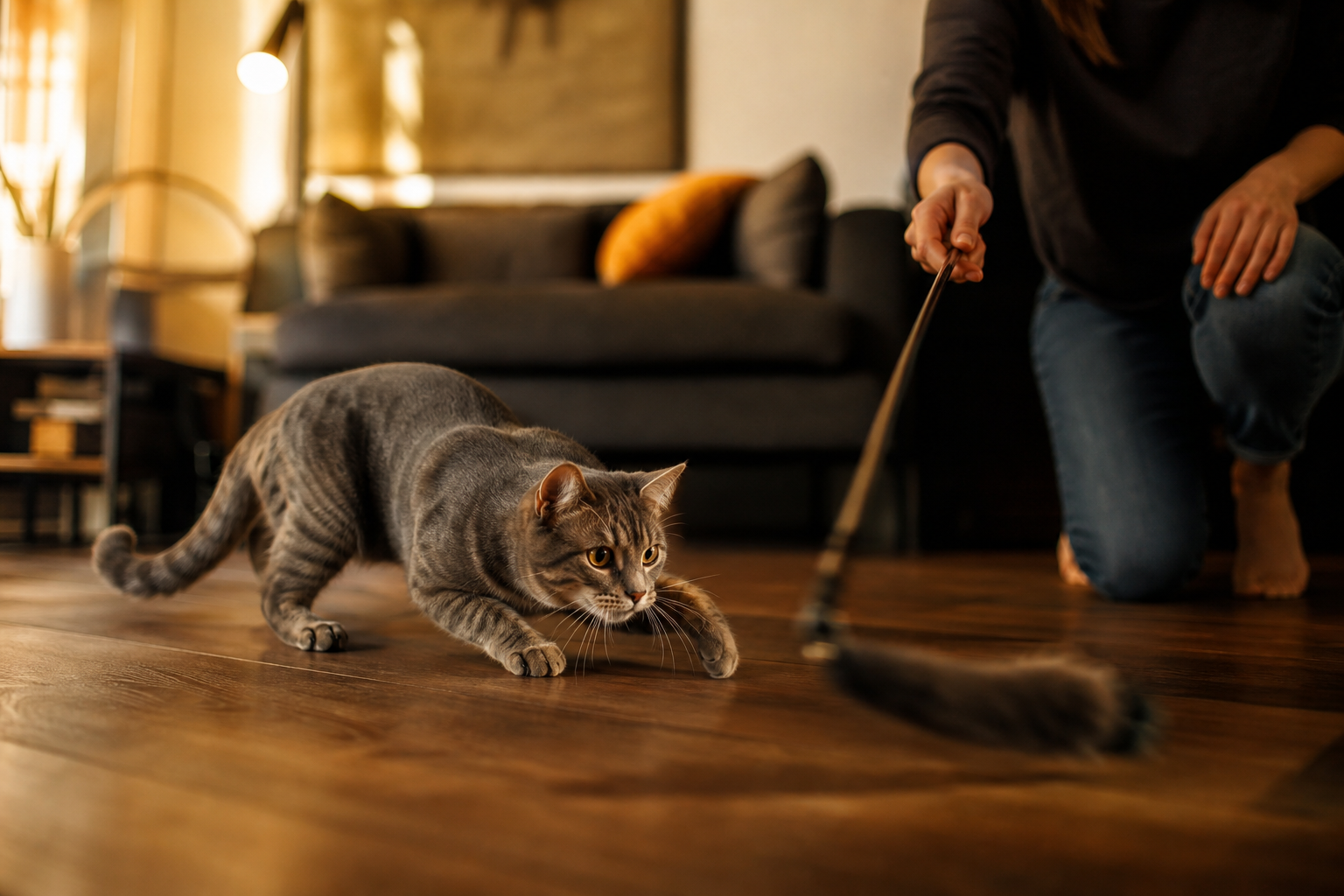
    1. Chase: use a wand, teaser, tossed toy, or another owner-guided target. Move it away from the cat, let it disappear behind cover, pause, and allow frequent catches. For detailed lure and storage checks, see the Titan Claws guide to using a cat toy on a stick.
    2. Capture: offer a sturdy kicker or larger prey toy the cat can hold, bite, and rake. This matters for rough players that otherwise grind their teeth into a delicate feather attachment or motorized shell.
    3. Solve: use an easy food puzzle, enclosed track, treat hunt, or stable cardboard puzzle. Start with an obvious reward. A puzzle that is too difficult is not enrichment; it is an object the cat may ignore or attack.

    This mix works because each item has a clear role. The wand creates lifelike movement, the capture toy allows a physical win, and the puzzle creates a quieter independent task. Add a scratcher, perch, hiding place, and window view to improve the environment rather than expecting toys to carry the entire load.

    The Feline Veterinary Medical Association and International Cat Care environmental-needs guide recommends opportunities for predatory play, intermittent capture, food puzzles, toy rotation, and individual play in multi-cat homes. Those principles are more durable than any one product recommendation.

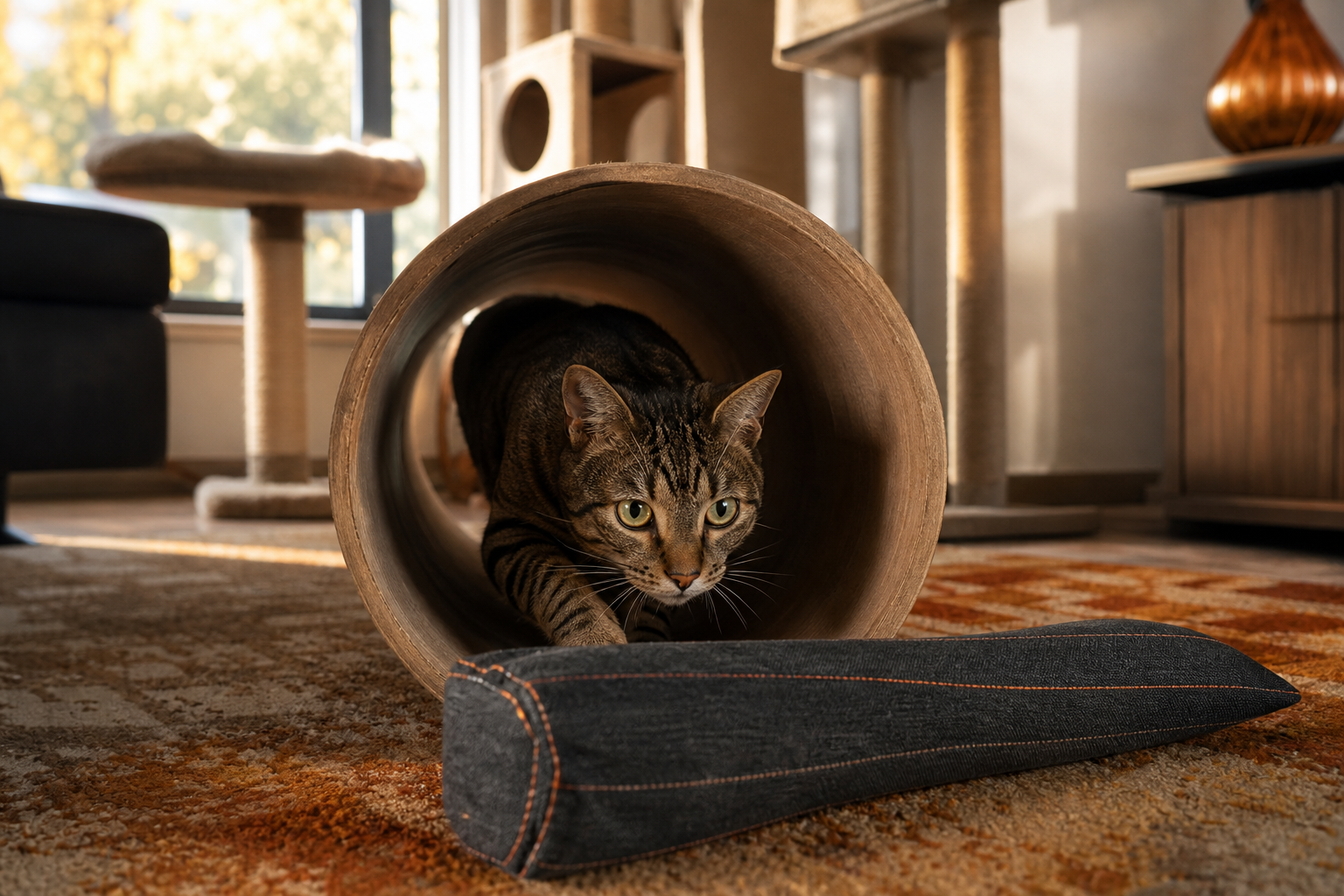
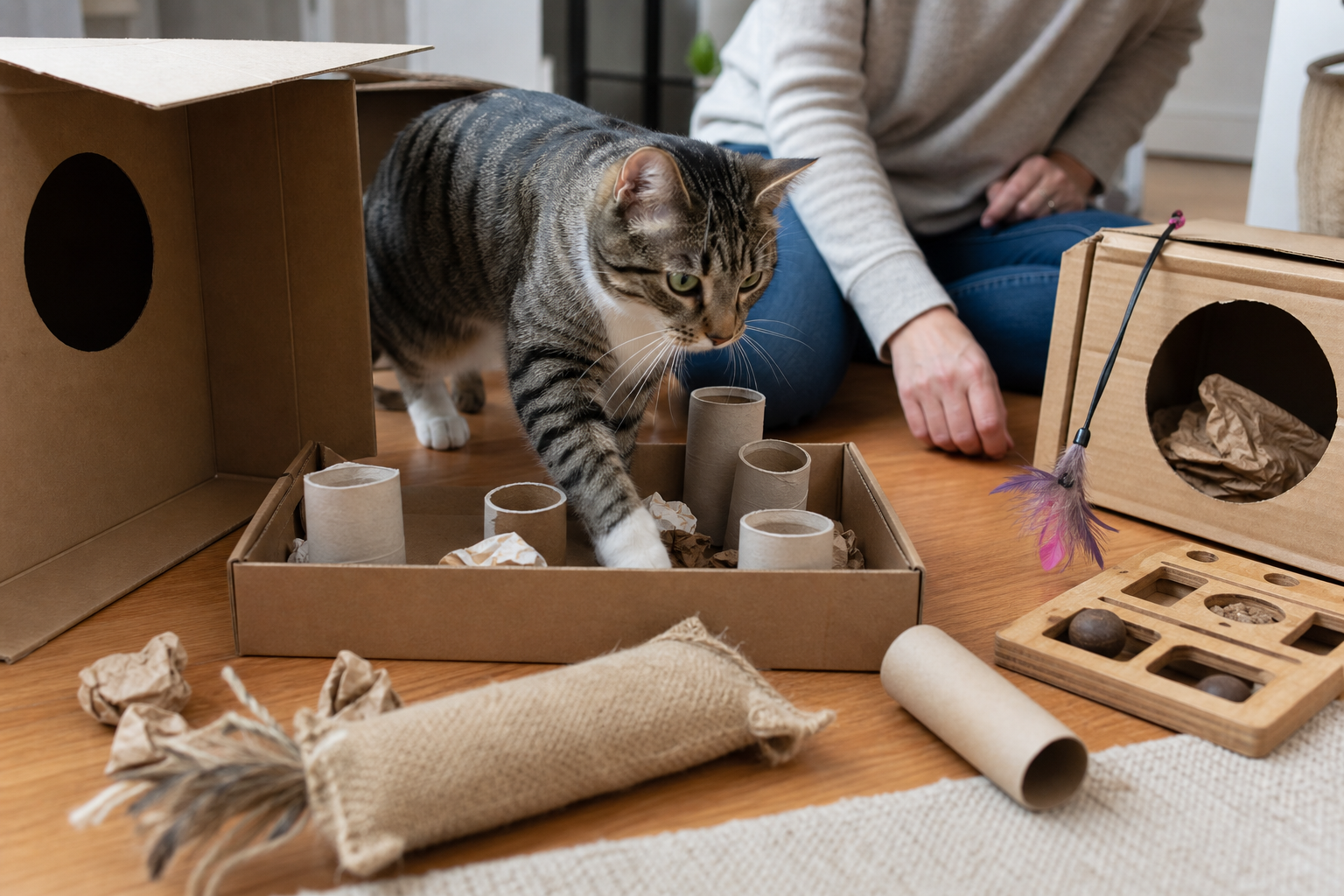
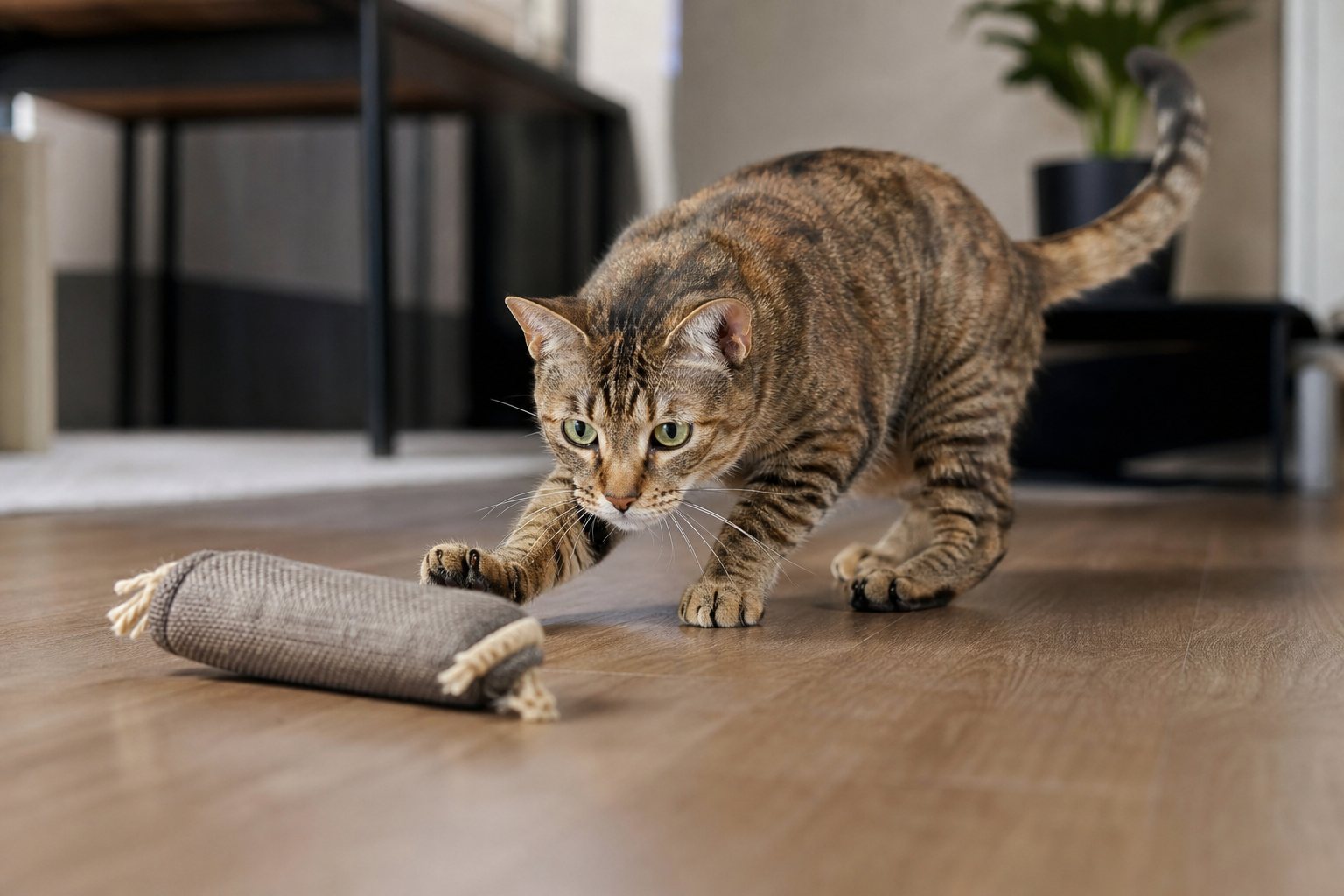
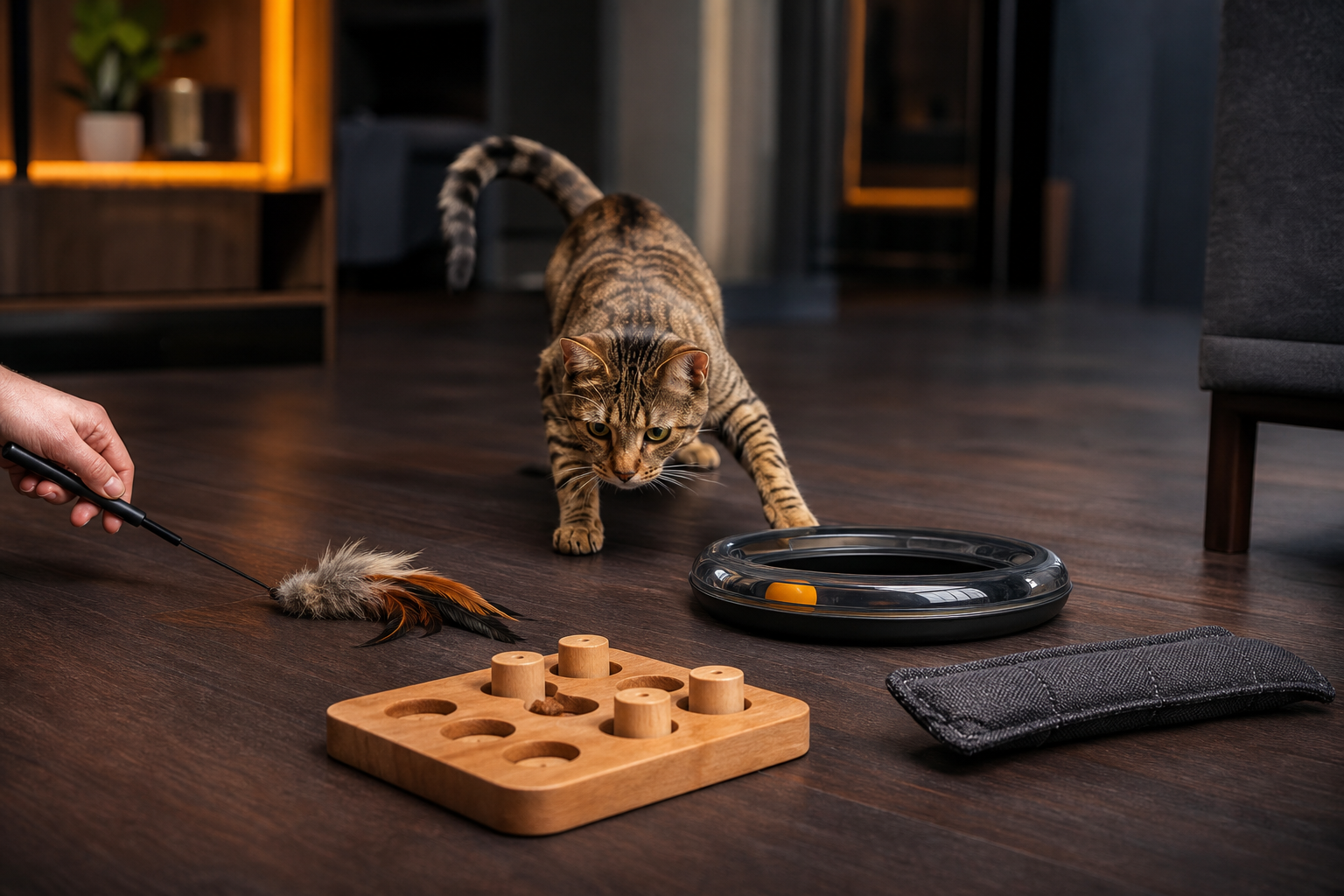
    Cat moving through a safe indoor play course with a box, tunnel, wand toy, and kicker
    A cardboard box and tunnel can change how familiar toys move, hide, and reappear without requiring a new purchase.

    Run This Seven-Day Play Reset

    Use the reset when your cat has a full toy basket but acts unimpressed. Store most toys first, leaving only proven-safe basics available. Keep a one-line note after each session: approached, watched, chased, caught, bit, solved, or walked away. You are looking for a pattern, not a perfect performance.

    1. Day 1—observe: offer a fabric lure moving slowly along the floor for five to ten minutes. Try hiding it behind a box. Note whether your cat prefers watching, chasing, or grabbing.
    2. Day 2—change the prey: switch texture and movement. If yesterday looked like a mouse, make today’s lure flutter briefly like an insect or bird, while keeping jumps appropriate for the cat’s age and mobility.
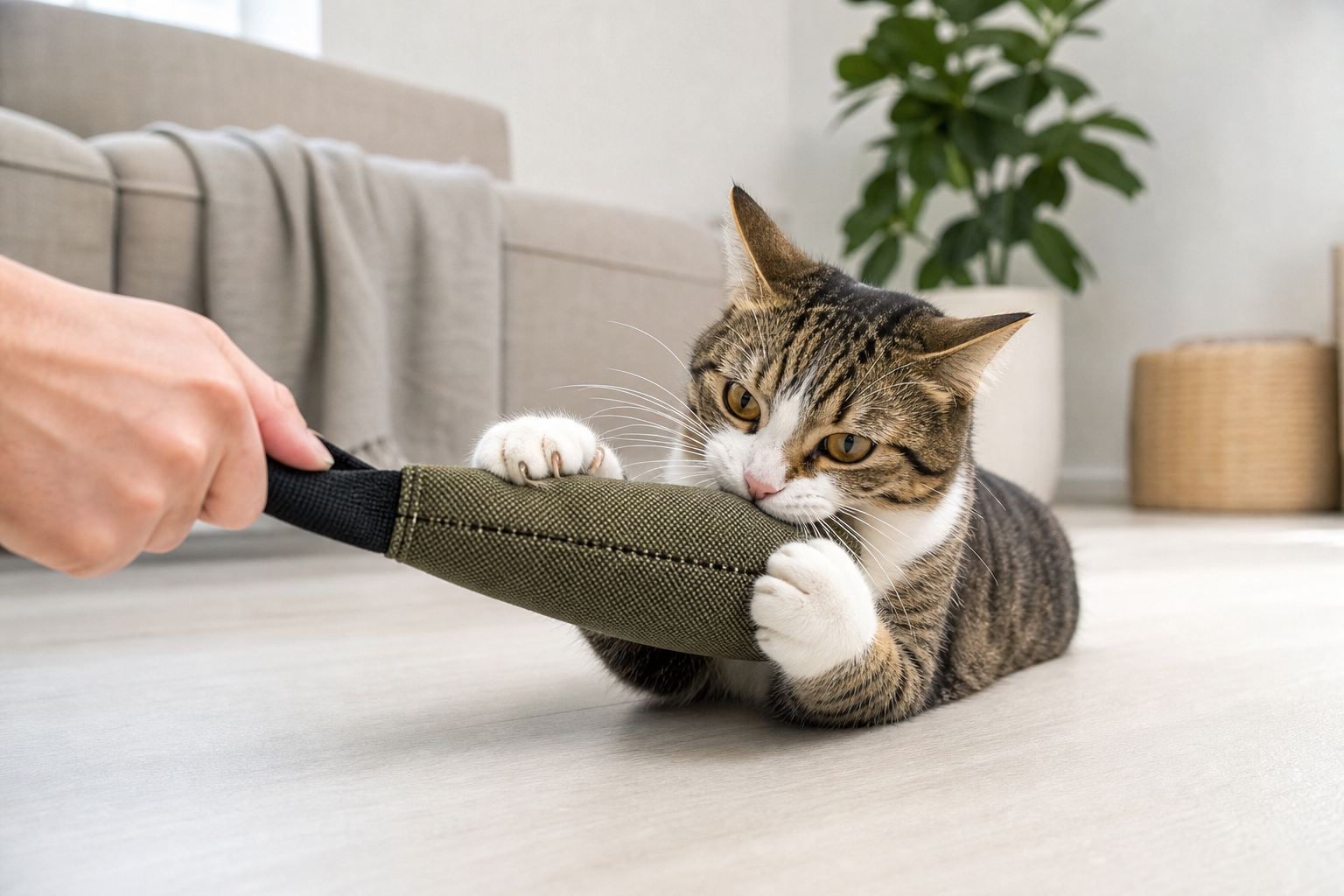
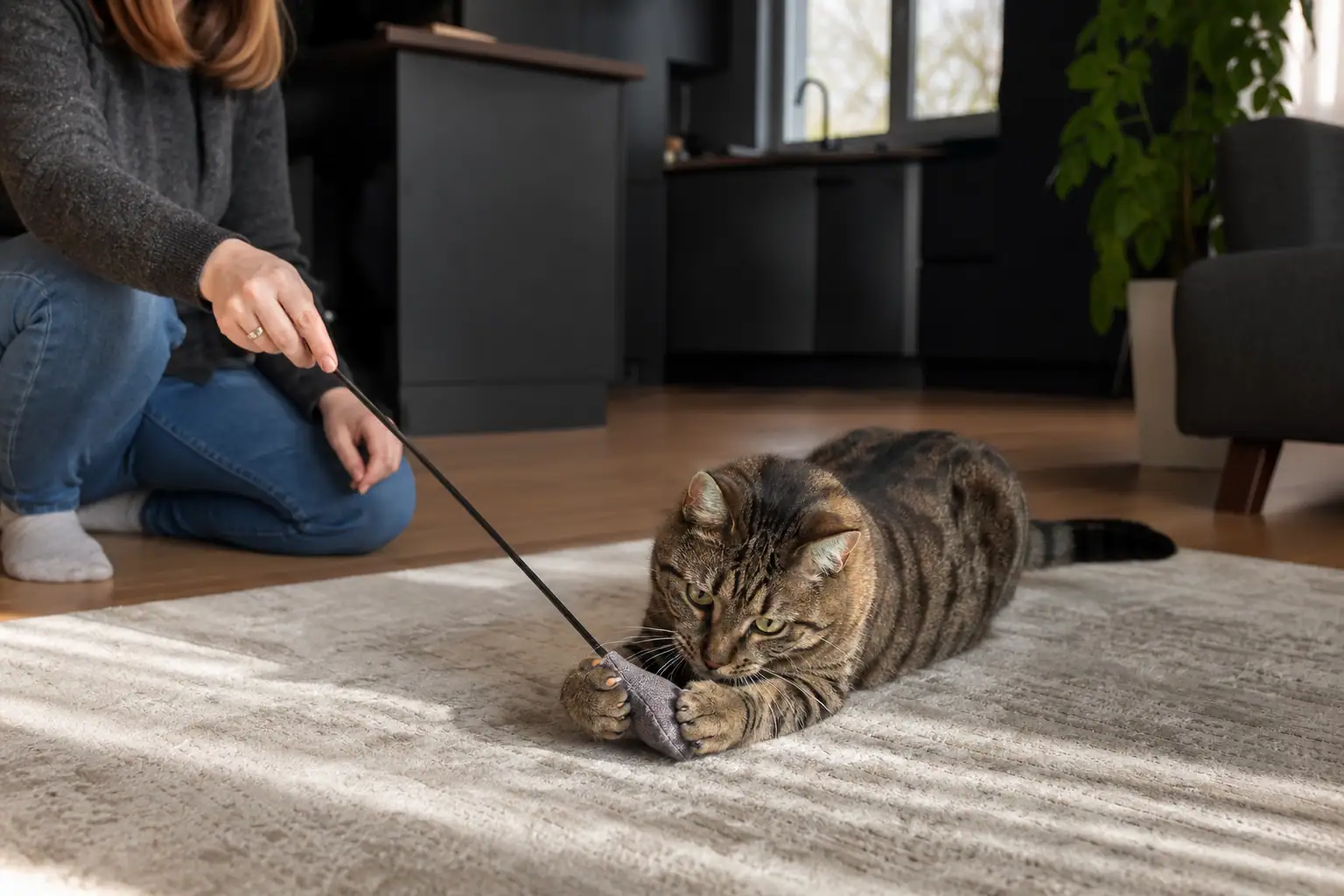
    3. Day 3—add a physical finish: after several catches, trade the chase lure for a larger kicker. Let the cat grip and kick; never wrestle with hands or feet.
    4. Day 4—make food work: place a small portion of the normal ration in an easy puzzle or several visible search locations. If your cat becomes frustrated, make the task simpler immediately.
    5. Day 5—redesign the room: add a box, paper bag with handles removed, tunnel, or furniture corner as cover. Familiar toys often become interesting when the hunting route changes.
    6. Day 6—test independent play: offer an enclosed track, large ball, or previously supervised puzzle in a cleared room. Watch the entire session and note chewing, dismantling, wedging, fear, and loss of interest.
    7. Day 7—repeat the winner: combine the two strongest responses into a short sequence: stalk, chase, catch, bite or kick, then finish with part of a meal or a small food search.

    After the week, keep three to five active options that cover different behaviors and store the rest in a closed cat toy box. Swap one or two items when interest fades. Rotation restores contrast; it does not make a poor toy safe or guarantee that every cat will like it.

    Automatic Toys Are Helpers, Not Babysitters

    Automatic balls, concealed moving lures, flopping plush toys, and pop-up feather devices can add unpredictable motion, especially when your hands are busy. They also add motors, charging ports, battery doors, seams, and detachable pieces. Test a powered toy switched off first, then run several short supervised sessions before deciding where it belongs.

    • Choose a screw-secured battery compartment and a housing without sharp edges or bite-sized decorations.
    • Remove charging cables before play and stop using a device that becomes hot, smells unusual, rattles, or exposes wiring.
    • Watch whether the cat targets the moving element as intended or tries to pry open the shell and chew the motor area.
    • Clear stairs, blind cords, water, unstable furniture, and gaps where the device or a paw could become trapped.
    • Prefer auto-off timers, but remember that a timer limits runtime; it does not inspect damage.

    A toy marketed for use while you are away is not automatically safe for your particular cat. The stricter guide to automatic cat toys for when you are away explains how to earn solo access. If motion is the main attraction, compare owner-guided, self-moving, and small-motion choices in our guide to cat toys that move.

    Safety Rules for Cats That Destroy Toys

    Durability is not a claim printed on a package; it is how a specific toy holds up to a specific cat over repeated sessions. Rough play exposes seams, glued decorations, feather shafts, elastic, split rings, thin plastic, and battery covers quickly. No toy is indestructible, and a toy that survives one cat may fail fast for another.

    Cornell Feline Health Center advises avoiding small pieces and strand-like parts such as feathers and string that can separate and be swallowed. It also recommends checking the play area and rotating toys. Apply that guidance before every new toy graduates from supervised testing.

    • Before play: pull gently at attachments, press seams, flex hard shells, confirm every piece is present, and check that the toy is too large to swallow.
    • During play: stop if the cat chews cord or elastic, pries at a battery door, eats material, becomes tangled, pants, limps, or seems frightened.
    • After play: look for gaps, frays, missing pieces, tooth-sharpened plastic, exposed filling, moisture, heat, or a new odor.
    • Store: put wands, string, ribbon, elastic, feathers, and easily dismantled toys behind a closed door or lid.
    • Retire: remove any toy with exposed internals, a cracked shell, a sharp edge, loose hardware, failing seams, or parts you cannot account for.
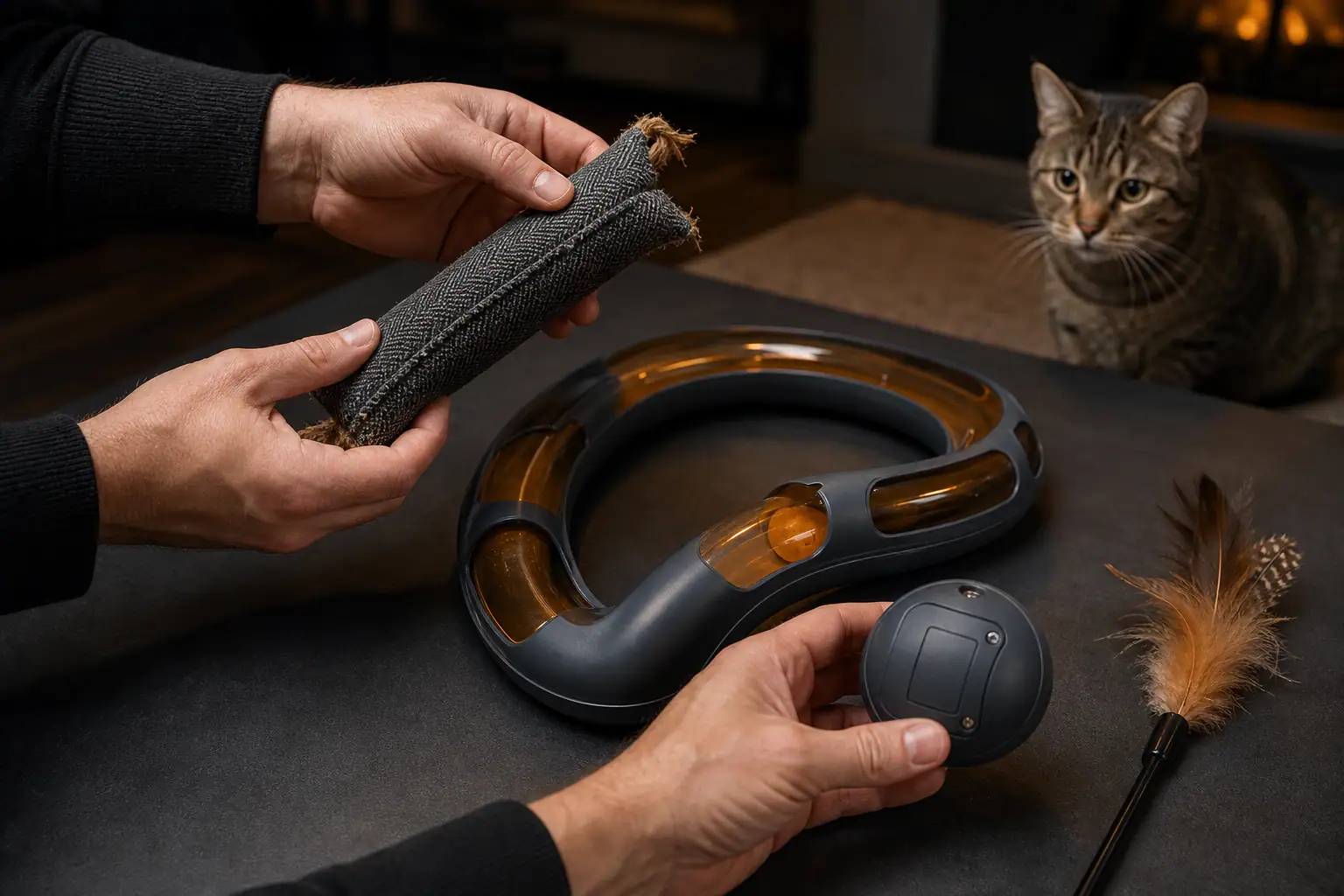
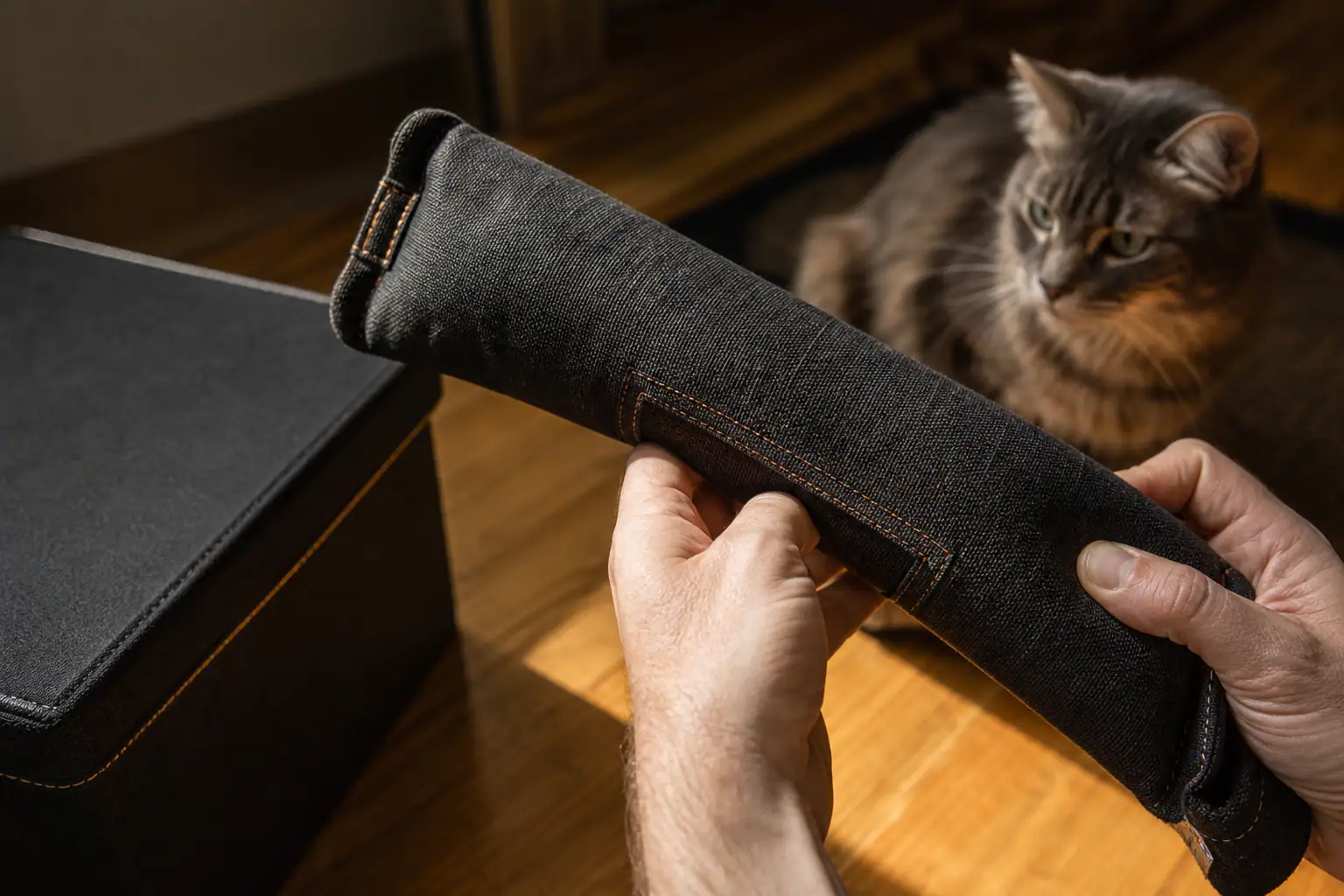
    Hands checking cat toys for loose seams, cracked plastic, and an insecure battery cover
    For rough players, inspect the exact failure points your cat targets before and after a new toy earns solo access.

    If you suspect your cat swallowed string or another toy piece, contact a veterinarian promptly. Do not pull string from the mouth or anus. Vomiting, repeated retching, loss of appetite, abdominal pain, lethargy, hiding, straining, or trouble breathing needs urgent veterinary advice.

    When Boredom Might Be Something Else

    Extra play can help a healthy under-stimulated cat, but “bored” behavior is not a diagnosis. A sudden change in activity, sleep, appetite, vocalizing, grooming, litter-box use, aggression, or willingness to jump can reflect pain, illness, stress, or conflict with another cat.

    Arrange a veterinary check when the change is sudden, persistent, severe, or paired with physical signs. A senior cat that stops chasing may need lower, slower play—or may be uncomfortable. A cat that attacks housemates may need separated resources and individual sessions, not a more exciting shared toy. The FVMA guide specifically notes that behavior concerns can involve unmet resources, social relationships, or an underlying medical problem.

    Quick Buying and Play Checklist

    • The toy matches a behavior you have actually seen: stalk, chase, bat, solve, grab, or chew.
    • Your set includes chase, capture, and problem-solving rather than three versions of one gadget.
    • The cat can catch the target regularly instead of pursuing an unwinnable game.
    • Strings, elastic, feathers, cords, and small attachments are supervised and stored.
    • A rough player gets a larger, simpler bite-and-kick target with inspectable seams.
    • Powered toys have secure battery access, covered charging areas, and no heat, odor, or damage.
    • The play area is clear and appropriate for the cat’s age, confidence, and mobility.
    • You rotate a small selection and keep a record of what actually earns engagement.
    • You inspect before and after hard sessions and replace toys at the first unsafe failure.

    What is the best interactive toy for a bored cat?

    For many cats, the best starting point is an owner-guided wand session with hiding, pauses, and frequent catches, followed by a sturdy capture toy. Add a simple puzzle or enclosed track for independent work. The best individual choice depends on the cat’s preferred hunting behavior and chewing strength.

    How long should I play with my cat?

    Start with five to ten focused minutes and let the cat’s response guide you. Some cats prefer several short bursts; others stay engaged longer. Stop before exhaustion, keep jumps suitable for age and mobility, and favor a repeatable daily routine over an occasional marathon.

    Can I leave interactive toys out while I am away?

    Only leave out a toy after it has passed repeated supervised sessions with your cat and the room itself is safe. Wands, loose string, ribbon, elastic, fragile feathers, and easily dismantled or chewable electronic toys should be stored. Reinspect every leave-out toy regularly.

    Bottom line: boredom is better solved with a varied routine than a pile of novelty gadgets. Give your cat prey to search for, motion to chase, something safe to catch, and a puzzle that can be won. Watch the response, protect the weak points, rotate what works, and let the cat—not the package—tell you which toy is genuinely interactive.
    Sources

  • How Often Should You Play With Your Cat? A Practical Daily Plan

    How Often Should You Play With Your Cat? A Practical Daily Plan

    For most healthy adult cats, start with two or three interactive play sessions a day, about 10–15 minutes each. That is a practical starting point, not a rigid quota. A kitten may want many shorter bursts; a senior or cat with arthritis may prefer gentler five-minute games; a high-energy indoor cat may ask for another round.

    Frequency matters more than forcing one long workout. Spread play across the day, let your cat stalk and catch the toy, and stop when their interest or comfortable movement fades. Judge the routine by your cat’s behavior and recovery—not only by the clock.

    How Much Playtime Do Cats Need?

    There is no scientifically proven daily number that fits every cat. A detailed review of domestic-cat play research concluded that important questions—including how much and what kind of play pet cats need—remain understudied. The AAFP/ISFM Feline Environmental Needs Guidelines recommend opportunities for play and predatory behavior, but they do not prescribe one universal minute target.

    That is why competing answers such as 15, 30, 45, or 60 minutes should be treated as starting ideas, not pass–fail standards. A focused eight-minute hunt with several catches can be more satisfying than 30 minutes of waving a toy after the cat has checked out.

    Cat Starting frequency Typical session How to adjust
    Healthy adult 2–3 times daily 10–15 minutes Add or shorten sessions according to engagement and recovery
    Kitten Several opportunities throughout the day 5–10 minutes Use frequent short bursts; stop before panting or loss of coordination
    Senior cat 2–3 gentle sessions daily 3–10 minutes Keep toys low, reduce jumping, and follow veterinary mobility advice
    High-energy indoor cat 3 or more varied sessions 5–15 minutes Add foraging, training, climbing, and solo enrichment rather than only longer chasing
    Multi-cat home Daily individual turns plus compatible group play 5–15 minutes per cat Prevent one cat from monopolizing the toy or blocking another cat

    The table describes owner-led, interactive play. A ball left on the floor, a puzzle feeder, climbing, scratching, and play with a compatible cat all add value, but they do not always replace the control and social contact of a game with you. Our broader cat enrichment plan can help you balance play with foraging, climbing, exploration, scratching, and rest.

    Adjust the Schedule to Your Cat

    Age is useful, but it is not the whole answer. Health, temperament, play history, indoor or outdoor access, time of day, toy preference, and the presence of other cats all change what a good schedule looks like.

    Kittens: more chances, shorter games

    Kittens often switch rapidly between sprinting, wrestling, eating, and sleeping. Offer several supervised play opportunities instead of trying to exhaust a kitten in one marathon. Use appropriately sized toys, keep strings and small parts out of solo reach, and never encourage attacks on hands or feet. A kitten who learns that skin is the target can carry that painful habit into adulthood.

    Adult cats: build a repeatable rhythm

    Many adults do well with a brief game before breakfast, another in the late afternoon or evening, and an optional wind-down session before bed. Cats are often naturally active around dawn and dusk, but your cat’s reliable alert periods matter more than forcing an exact time. If they consistently walk away at minute seven, make seven good minutes the plan.

    Senior cats and cats with medical conditions: preserve choice

    Older cats still benefit from play, even when running and jumping are uncomfortable. Slide a lure slowly across a rug, offer a kicker while the cat is lying down, or use an easy food puzzle. Keep the target close and low, add nonslip footing, and provide an easy exit. Ask your veterinarian for activity limits if your cat has arthritis, heart or breathing disease, neurologic problems, recent surgery, obesity, or another condition that affects exercise.

    A sudden decrease in play is not automatically aging or boredom. Pain, dental disease, illness, impaired vision, and stress can all change activity. Arrange veterinary care when a normally playful cat abruptly stops, hides more, moves stiffly, misses jumps, loses appetite, breathes differently, or shows another new symptom.

    High-energy and rough-playing cats: add variety, not just minutes

    A cat who destroys ordinary toys may need several outlets: a wand for stalking and chasing, a larger sturdy kicker for catching and bunny-kicking, a food puzzle for problem-solving, and safe climbing or exploration. Match the object to the behavior instead of asking one toy to survive every job. The Titan Claws guide to durable cat toys explains how to match toys to biting, seam-ripping, string-chewing, and impact.

    How to Run a Satisfying 10-Minute Play Session

    Quality play resembles a small hunt. It changes speed, includes cover and pauses, and gives the cat real chances to catch. Constantly circling a lure above the cat’s head is exercise for the human wrist, but often a poor hunt.

    1. Invite; do not insist. Choose a time when your cat is awake and scanning the room. Move the toy at a distance and let the cat decide whether to engage.
    2. Make the toy act like prey. Move it away from the cat, around a box, or briefly behind furniture. Small ground-level movements are often more convincing than repeatedly pushing the lure toward the cat’s face.
    3. Use pauses. Give the cat time to watch, listen, crouch, and plan. Stalking is part of play; a still cat is not necessarily bored.
    4. Allow frequent catches. Let the cat pin and hold the lure. Do not yank every catch away immediately. If the cat bites or bunny-kicks hard, transfer the action to a sturdy capture toy rather than your hand.
    5. Lower the intensity. After several chase-and-catch cycles, make the movements smaller and slower. Finish with a final catch instead of making the toy vanish mid-pursuit.
    6. Close the routine. A small portion of the cat’s normal meal or an easy foraging task can follow play. Count any food toward the daily diet rather than adding unmeasured treats.
    Cat catching a sturdy wand lure at the end of a short play session
    Build in pauses and successful catches. A satisfying session is about the hunting sequence, not nonstop sprinting.

    A wand keeps your hands away from teeth and creates better prey-like movement, but it is not a leave-out toy. See our cat wand safety guide for lure choices, technique, storage, and replacement points.

    How to Tell Whether Your Cat Needs More Play

    No single behavior proves that a cat is underplayed. Nighttime activity can be normal, scratching is a normal feline behavior, and vocalizing may have medical or social causes. Look for a pattern and change one part of the routine at a time.

    • Possible signs to offer more or better-targeted play: repeated ankle ambushes, persistent toy-carrying invitations, restless attention-seeking during usual active periods, rough attacks on another cat who is trying to leave, or destructive hunting of household objects.
    • Signs the current game is not working: the cat watches but never pursues, leaves immediately, startles from the toy, becomes defensive, or can never catch it. Try a different size, texture, sound, speed, or location before simply adding time.
    • Signs to end or lower intensity: the cat lies down and no longer tracks the toy, walks away, becomes irritable, moves less smoothly, or begins open-mouth breathing. Never chase a cat to continue the session.
    • Signs for veterinary advice: sudden behavior change, persistent panting, labored breathing, coughing, collapse, limping, pain, unusual aggression, or a marked increase or decrease in activity.

    A 2022 survey of 1,591 cat guardians found that more games and greater daily play were associated with some higher reported quality-of-life and cat–guardian relationship scores. The authors also reported behavior changes when play was absent, while emphasizing that more research is needed. This observational study on play and cat welfare supports making play a regular part of care; it does not prove that a particular minute total causes a particular outcome.

    Three Realistic Cat Play Schedules

    The best schedule is one you can repeat. Attach short sessions to existing routines, keep one backup game for busy days, and do not try to “make up” a missed day with an exhausting workout.

    A standard adult routine: about 25–30 minutes

    • Morning: 8–10 minutes of wand play before part of breakfast.
    • Evening: 10–15 minutes of chase, catch, and kicking with two toy types.
    • Before bed: optional five-minute low-key hunt or food puzzle.

    A genuinely busy day: about 15 minutes

    • Morning: five focused minutes with a lure, including two or three catches.
    • After work: five minutes of fetch, a track toy, or hallway chase.
    • Evening: five minutes of hunting followed by a measured food puzzle.

    Five good minutes count. Veterinary Partner’s play guidance suggests thinking of a ten-minute session as several two-minute bursts if that makes daily play easier to provide.

    A high-energy indoor routine: 35 minutes plus enrichment

    • Morning: 10 minutes of fast-and-slow wand play.
    • Midday: measured food puzzle, hidden kibble, or short training session.
    • Evening: 15 minutes alternating chase with a sturdy catch toy.
    • Before bed: 10 minutes of lower, slower hunting and a calm finish.

    If your cat is still restless, change the game before extending it indefinitely. A cardboard hide, new route, different lure, scent-free paper to rustle, or simple training task may add more than another 20 minutes of the same movement. Rotate only a few toys into service at once; our cat toy box and rotation system separates supervised toys, safe leave-out options, and retired items.

    Play Safely With Cats That Bite and Destroy Toys

    Play frequency increases toy wear. A cord that survives one session can fray after ten; a bell that was secure yesterday can loosen after repeated impacts. “Durable” describes relative resistance, not a guarantee that a toy cannot fail.

    • Use strings, ribbons, feathers, wires, and detachable lures only with active supervision, then store them behind a closed door or in a secure container.
    • Choose capture toys too large to swallow and free of glued eyes, loose bells, brittle plastic, exposed knots, or easy-to-remove decorations.
    • Keep the play area clear of unstable furniture, open stairs, breakables, and slippery landing zones.
    • Never use hands or feet as prey. Freeze and redirect to a toy if teeth or claws contact skin.
    • Inspect seams, fabric, cord, attachment points, battery doors, and every component after hard play.
    • Retire a toy when stuffing, foam, wire, sharp edges, batteries, or small parts become accessible; do not wait for a piece to disappear.
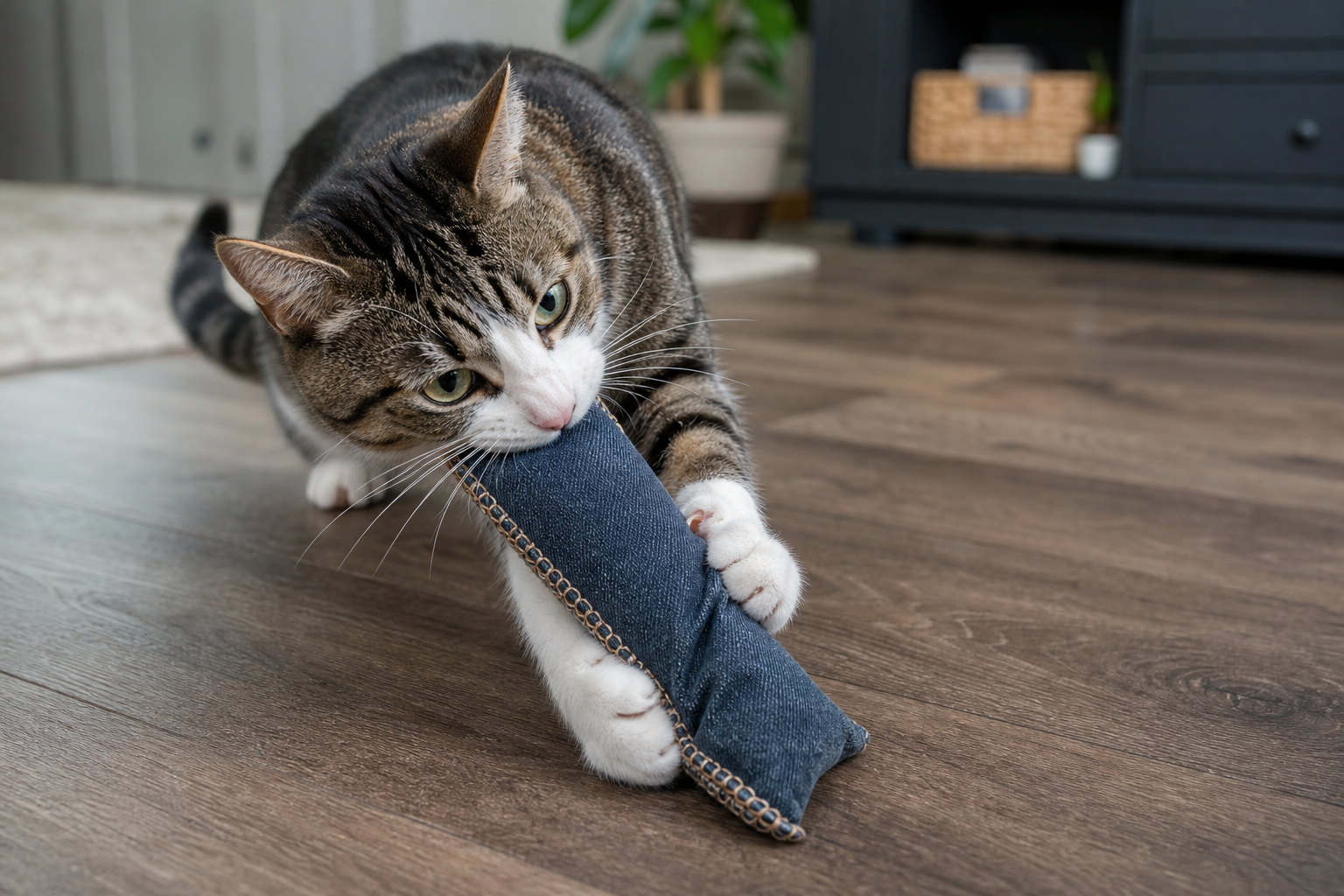
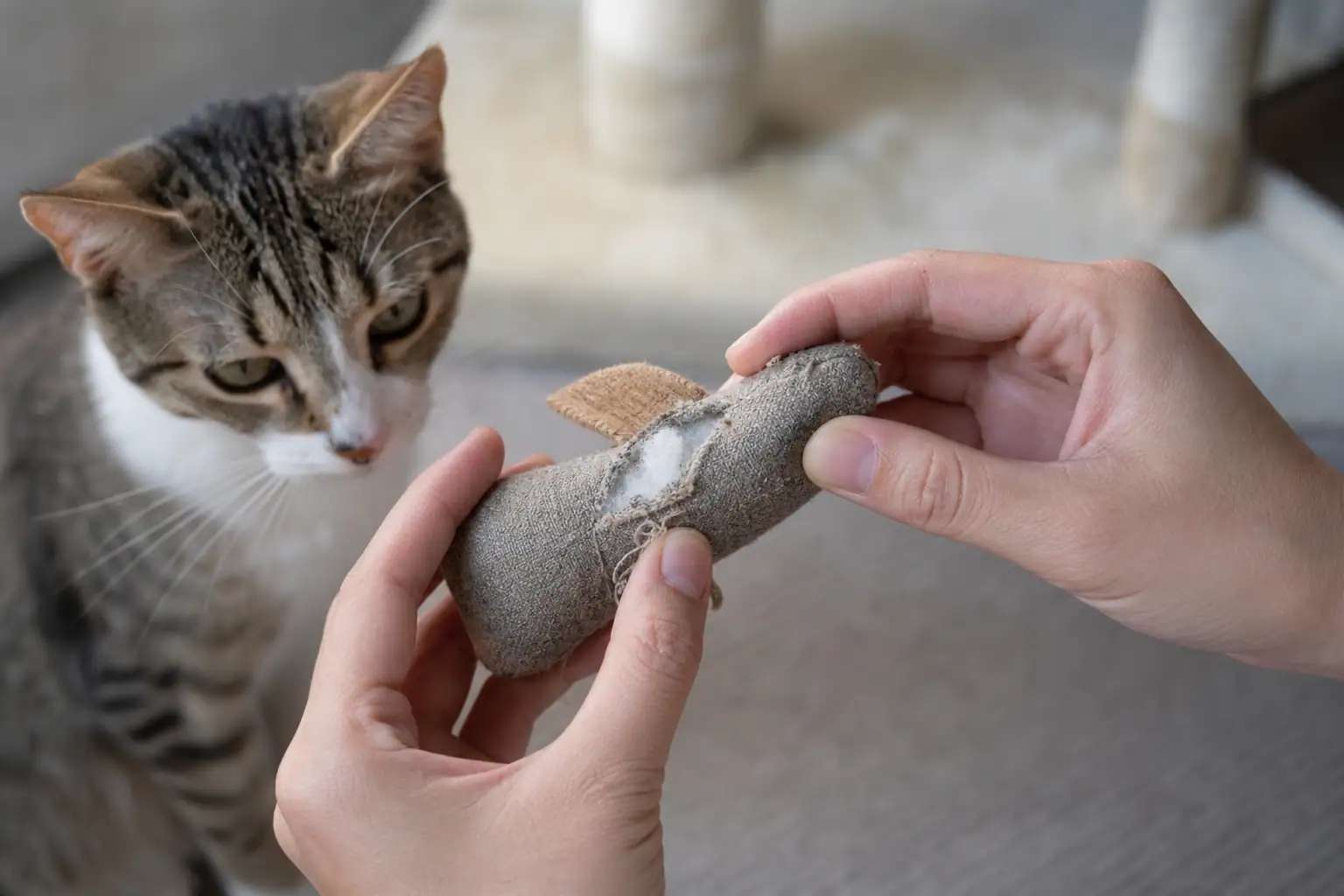
    Owner inspecting a durable fabric cat toy after play
    For cats that bite and bunny-kick hard, every play session should end with a seam-and-parts check before the toy is stored.

    The Cornell Feline Health Center advises avoiding small pieces and linear parts such as string or feathers that may separate and be swallowed, checking the play environment for falling and fall hazards, and rotating toys to reduce boredom. For a rough player, supervision and inspection are part of the play session—not optional maintenance for later.

    Quick Checklist and FAQs

    • Start most healthy adults at two or three interactive sessions daily.
    • Aim for roughly 10–15 minutes, but stop sooner when the cat is done.
    • Give kittens more frequent short opportunities and seniors gentler, lower games.
    • Include stalking, pauses, pursuit, and successful catches.
    • Offer each cat an individual turn in a multi-cat home.
    • Add foraging, climbing, scratching, training, and exploration instead of relying on chase alone.
    • Inspect and store toys after every rough session.
    • Ask a veterinarian about sudden activity changes, pain, or breathing problems.

    Is 15 minutes of play enough for a cat?

    Fifteen minutes can be a valuable daily minimum on a busy day, especially when it is focused and paired with other enrichment. Many healthy adults will benefit from a second or third short session. Watch whether your cat settles comfortably, continues to seek play, or redirects hunting toward people, other pets, and household objects.

    Can you play with a cat too much?

    Yes, if you force participation, continue through fatigue or pain, encourage unsafe jumping, or create nonstop high arousal without catches and a calm finish. Let the cat opt in and out. Stop for open-mouth breathing, poor coordination, irritability, or loss of interest, and seek veterinary advice for persistent panting or any breathing difficulty.

    Do two cats still need playtime with their owner?

    Usually, yes. Compatible cats may chase and wrestle together, but their relationship and preferences can differ. Individual owner-led turns prevent a bolder cat from controlling the toy and let you observe each cat’s movement, confidence, and appetite for play.

    Should you play with your cat before meals?

    It can be a useful routine: hunt-like play, a final catch, then part of the cat’s measured meal. It is not mandatory, and cats with medical diets or feeding plans should follow veterinary guidance. Avoid adding extra calories every time you play.

    What if my cat does not want to play?

    Try when the cat is naturally alert, use smaller movements and longer pauses, and test different safe sounds, textures, sizes, and locations. Some cats prefer food puzzles or training to vigorous chase. Do not force it. A sudden loss of interest—especially with hiding, appetite change, stiffness, or other symptoms—deserves a veterinary check.

    Bottom line: begin with two or three short daily sessions, then let your cat show you whether the routine needs more frequency, a different game, or less intensity. Consistent, prey-like play with safe catches beats chasing an arbitrary number on a timer.

    Sources

  • Cat Enrichment: A Practical Guide and 7-Day Starter Plan

    Cat Enrichment: A Practical Guide and 7-Day Starter Plan

    Cat enrichment means giving a cat safe opportunities to perform natural behaviors and make meaningful choices. It is more than buying toys. A useful enrichment setup lets a cat hide, climb, scratch, watch, sniff, search for food, stalk, chase, catch, and rest without being forced into constant activity.

    Start small: create one secure perch or hiding place, offer one appropriate scratching surface, and schedule one or two short hunting-style play sessions. Add a simple food-search activity if it suits your cat’s diet. Watch what your cat chooses, then keep, move, simplify, or retire each activity based on that response.

    What counts as cat enrichment?

    Enrichment changes a cat’s environment or routine in a way that encourages species-typical behavior. A window perch supports watching and resting. A sturdy scratcher supports stretching, claw maintenance, and scent marking. A wand game supports stalking and capture. A puzzle feeder supports searching and manipulating. A familiar box supports hiding and observation.

    The AAFP and ISFM feline environmental needs guidelines organize a healthy cat environment around five pillars: a safe place; multiple, separated key resources; opportunities for play and predatory behavior; positive, consistent human interaction; and respect for a cat’s sense of smell. That framework is more useful than treating enrichment as a shopping list.

    Novelty can help, but novelty is not the goal by itself. Moving a favorite bed every day, starting a motorized toy beside a sleeping cat, or introducing several new scents at once may create uncertainty rather than interest. Predictability and choice form the base; small, reversible challenges sit on top.

    Audit your home before adding more toys

    Walk through the rooms your cat uses and score each area below as available, needs improvement, or missing. Fix missing basics before adding complicated puzzles.

    Need What to look for A practical improvement
    Safety and retreat A quiet place where the cat can hide or rest without being followed Open a carrier, clear a shelf, or place a box with two exits in a calm room
    Separated resources Food, water, litter, scratching, play, and rest are not crowded into one station Move one resource so the cat has choices and does not need to pass a rival cat
    Vertical space Stable, reachable perches with a safe route up and down Clear a window ledge or anchor a cat tree that does not wobble
    Scratching At least one stable surface in the cat’s preferred angle and material Put a tall vertical scratcher or wide horizontal pad near a resting or marking area
    Hunting and play Chances to watch, stalk, chase, catch, bite, and kick an appropriate target Use a wand for the chase and finish with a large capture toy
    Foraging Some safe opportunity to search or work for part of a normal meal Start with kibble in an open egg carton or wet food spread in a shallow textured feeder
    Social choice The cat can request, accept, or leave interaction Pause during play or petting and continue only when the cat re-engages
    Sensory comfort Familiar scents remain; strong fragrance and unpredictable noise are limited Keep familiar bedding and introduce new scent items one at a time
    Indoor cat enrichment setup with a perch, hiding box, scratcher, puzzle feeder, and play mat
    Think in zones: safety, vertical space, scratching, foraging, and interactive play serve different needs.

    In a multi-cat home, count access rather than objects. A single premium cat tree in a narrow hallway can be controlled by one cat. Several modest perches, water points, litter boxes, and resting areas on different routes often provide more real choice.

    Match enrichment to the behavior your cat already offers

    Your cat’s current behavior is the best starting brief. Do not begin with the product that looks most impressive; begin with what the cat repeatedly tries to do.

    • Stalks ankles or ambushes from corners: schedule floor-level wand play before the usual ambush time. Move the lure away like prey, pause behind cover, allow frequent catches, and redirect the final grab to a long kicker. If attacks are frequent or painful, use the step-by-step plan in our cat play aggression guide.
    • Climbs cabinets or watches from door tops: add a stable legal high route with more than one way down. Do not punish climbing while leaving no acceptable vertical option.
    • Shreds small plush toys: choose a larger, densely constructed capture toy with minimal attachments, supervise the first sessions, and inspect after play. Our durable cat toy guide explains seams, fabrics, sizing, and retirement signs.
    • Wakes people for food: try a measured food hunt or an easy puzzle using part of the normal daily ration. Start simple; do not make every meal difficult on day one.
    • Scratches one sofa corner: place a stable scratcher beside that exact location and match the angle and texture. Reward investigation; move it gradually only after the cat uses it reliably.
    • Watches birds for long periods: provide a secure perch and a way to leave the view. If outdoor cats at the window trigger crouching, tail lashing, spraying, or redirected aggression, block the lower sightline instead of calling the view enriching.
    • Ignores toys left on the floor: rotate a small set and change how you animate it. Our cat enrichment activities guide has games for chase, forage, scent, climbing, and training.

    A 2023 survey of 1,591 cat guardians found that a greater variety of games was associated with higher reported feline quality-of-life scores, while longer daily play and more games were associated with stronger guardian-reported relationships. The study on play and welfare shows associations, not proof that a particular schedule causes those outcomes, but it supports offering varied games and letting both cat and person initiate play.

    A 7-day cat enrichment starter plan

    This plan is an assessment week, not a permanent quota. Keep sessions brief enough that your cat remains interested. For many adult cats, five to ten minutes of interactive play is a sensible starting window; kittens and highly active cats may ask for more frequent sessions, while seniors or cats with pain may prefer slower, shorter work. Stop before the activity becomes frantic or exhausting.

    1. Day 1: establish safety. Add or improve one quiet retreat and one elevated observation point. Make sure each is stable and easy to exit. Leave the cat to discover them; do not place or hold the cat inside.
    2. Day 2: run a prey-style game. Drag a wand lure away along the floor, let it hide, pause, and allow several catches. Finish with a holdable toy or a small portion of the cat’s normal meal. Store the wand securely afterward.
    3. Day 3: make food easy to find. Put a small measured portion in an open puzzle, scatter it across a clean mat, or hide a few pieces in obvious locations. If the cat walks away, make the task easier rather than withholding the meal. See our puzzle cat toy guide for a gradual difficulty ladder.
    4. Day 4: offer texture and scent. Present a cardboard scratcher, paper packing without tape or staples, or a sturdy toy with a small amount of catnip or silvervine. Use only cat-appropriate plants and remove material the cat tries to swallow.
    5. Day 5: add a tiny training game. Mark and reward one voluntary behavior, such as touching a target, stepping onto a mat, or entering an open carrier. Use a few repetitions and end on an easy success. Never force the cat into position.
    6. Day 6: create a new route. Arrange a stable box, tunnel, chair, or low perch so the cat can explore a short path with at least two exits. Keep it away from stairs and do not build with tape loops, staples, or collapsing stacks.
    7. Day 7: rotate and review. Put away ignored or fragile items, return one successful activity, and record what produced relaxed attention, repeated approaches, stalking, scratching, foraging, or restful use.

    Free enrichment is still enrichment. Boxes, a cleared windowsill, a towel food search, a paper ball too large to swallow, and five attentive minutes with a familiar lure can be more useful than a crowded toy basket. For more low-cost options, use our list of free cat enrichment ideas.

    How to set the right difficulty

    A good challenge sits between instant completion and repeated failure. Look for orientation, approach, investigation, and small progress. Then change only one variable at a time: distance, height, movement speed, number of covered food wells, or how long the target disappears.

    • Too easy: the cat completes it immediately and leaves. Add one small step, change the route, or rotate it out while it is still intact.
    • About right: the cat investigates, pauses, tries again, succeeds, and voluntarily returns later.
    • Too hard or intense: the cat freezes, startles, flattens the ears, lashes the tail, bites the equipment, looks repeatedly toward an exit, gives up, or avoids the area afterward. Simplify or stop.

    Food puzzles deserve special care because failure can interfere with eating. A review of food puzzles for cats recommends matching mobile or stationary designs to the individual and introducing them gradually. Keep water freely available and count puzzle food within the cat’s regular diet. Ask a veterinarian before changing feeding routines for a cat with a medical condition, prescription diet, low appetite, or a history of food conflict.

    Safety for cats that bite, kick, and destroy toys

    Rough play is not a reason to remove enrichment; it is a reason to choose targets and supervision more carefully. No cat toy is indestructible. Durability buys inspection time, but a strong cat can still open a seam, pull off an attachment, crack plastic, expose a battery, or chew a piece small enough to swallow.

    Owner inspecting the seams and surface of a cat toy after rough play
    Inspection is part of enrichment: check the whole toy after hard biting, kicking, or chewing.

    Use a three-stage check:

    1. Before play: tug attachments, flex plastic, press battery doors, and check the toy’s size against your cat’s open mouth. Remove loose bells, ribbon, elastic, glued decorations, sharp edges, and exposed stuffing.
    2. During play: watch how the cat uses the object. A toy that is safe for batting may not be safe for sustained chewing. Keep strings, wire, feathers, motors, and small components within active supervision.
    3. After play: inspect the entire surface, not just the obvious bite area. Retire the toy if a seam gaps, the shape changes, fabric becomes wet and thin, stuffing shows, a rattle moves toward an opening, or any component loosens.

    Store wand toys and fragile lures in a closed cabinet or container, not on a high open shelf a determined cat can reach. Choose only thoroughly tested items for independent access, and reconsider anything that tangles, sheds, heats up, tips, traps a paw, or breaks into mouth-sized pieces. Our guide to automatic cat toys for when you are away separates supervised gadgets from safer solo options.

    DIY does not automatically mean harmless. Remove bag handles; avoid yarn, thread, rubber bands, hair ties, foil, splintering wood, staples, tape loops, and brittle plastic. Supervise cardboard and paper projects if your cat chews or eats non-food material. The ASPCA likewise advises close, active supervision of DIY enrichment and immediate removal if a cat tries to ingest it.

    Adapt the plan for age, ability, and multiple cats

    • Kittens: provide frequent short outlets for chase and wrestling, but use large targets without detachable parts. Protect hands by directing bites and kicks to toys from the beginning.
    • Senior cats: use warm resting places, low stable steps, nonslip surfaces, slower lures, and food tasks that do not require painful crouching or forceful pawing. A sudden reduction in play can signal pain or illness.
    • Blind cats: keep the room layout predictable and use sound, scent, texture, and toys that remain in a known area. Our guide to toys for blind cats covers setup and safety in detail.
    • Deaf cats: use floor vibration, visible motion, scent, and gentle visual cues. Approach within sight so play does not begin with a startling touch.
    • Multi-cat homes: offer parallel play stations and separate feeding puzzles. Watch for blocking, staring, displacement, and one cat finishing another’s food. Not all housemates want to play together.
    • Shy or newly adopted cats: prioritize hiding, predictable routines, and choice. Place enrichment near a secure retreat and let distance decrease gradually.

    Do not assume that adopting another cat will enrich the first one. Cats vary in sociability, and an incompatible introduction can create competition and chronic stress. Add another cat only because you can support both individuals and manage a slow introduction—not as a substitute for play or environmental improvements.

    How to tell whether enrichment is working

    Judge the cat’s behavior, not the price of the item. Useful signs include voluntary approach, relaxed ears and body, focused watching, stalking, scratching, foraging, successful capture, returning after a pause, and resting in a new safe place. Some cats engage intensely; others investigate for thirty seconds and return later.

    Keep a simple one-week note with four fields: activity, time offered, what the cat did, and what you will change. This prevents the common mistake of buying more when the real issue is timing, location, motion, difficulty, or a mismatch with the cat’s preferred behavior.

    Contact a veterinarian if play or exploration drops suddenly, or if you notice hiding, appetite change, weight change, limping, reluctance to jump, overgrooming, house-soiling, disorientation, or new aggression. Enrichment can support well-being, but it cannot diagnose or treat pain, dental disease, urinary problems, cognitive change, anxiety, or other medical conditions. A qualified feline behavior professional can help after medical causes have been assessed.

    One intriguing real-world trial found that introducing five to ten minutes of daily object play was associated with a 25% reduction in prey animals brought home by hunting cats compared with controls and the pre-treatment period. The 2021 controlled trial does not prove that indoor games replace every motivation to hunt, but it shows how a small, repeatable play routine can matter beyond simply keeping a cat busy.

    Cat enrichment quick checklist

    • Does your cat have a secure retreat and a stable elevated option?
    • Are food, water, litter, scratching, play, and rest resources separated where possible?
    • Can your cat choose to approach, continue, pause, or leave?
    • Does play include stalking, chasing, catching, and a physical finish?
    • Is the challenge easy enough to produce success?
    • Are food rewards measured as part of the normal diet?
    • Do multiple cats have separate routes and stations?
    • Are strings, feathers, motors, and small parts supervised and stored afterward?
    • Do you inspect toys before and after rough play?
    • Are you changing one variable at a time and recording what your cat actually chooses?

    A strong enrichment routine is not a perfect room or a mountain of products. It is a safe environment that gives your cat choices, supports normal behavior, and changes in response to what the cat tells you.

    Research and guidance used

  • Cat Toys for Blind Cats: A Practical Guide to Safer Play

    Cat Toys for Blind Cats: A Practical Guide to Safer Play

    The best cat toys for blind cats are easy to locate without sight, satisfying to catch, and safe for that cat’s bite and play style. Start with an enclosed rattling ball track, a crinkle or rattle toy that is too large to swallow, a scented kicker, a shallow puzzle feeder, and a supervised wand lure that makes a soft, consistent sound close to the floor.

    Blind cats do not need a pile of special gadgets. They need clear sensory clues, a predictable play area, and time to investigate. Some will chase a rolling ball by sound; others prefer to wrestle a scented kicker or search a food puzzle. The right choice is the one your cat can find, capture, and use confidently without loose parts, sharp edges, or surprise obstacles.

    Quick picks: the best toy types for blind cats

    A good starter set covers more than one sense and more than one part of the hunting sequence. You can build it with ordinary cat toys; the label does not need to say “for blind cats.”

    Toy type Why it can work Main safety check
    Enclosed ball track The ball stays in a known area and gives repeatable sound and vibration. Confirm the base does not tip and the ball cannot be removed or swallowed.
    Large rattle or crinkle ball Sound continues as the toy rolls, helping the cat follow and recapture it. Avoid thin foil, exposed bells, glued pieces, and any ball that fits fully in the mouth.
    Catnip or silvervine kicker Scent helps the cat find it; length gives room to grip, bite, and bunny-kick. Inspect seams, stuffing, plant material, tags, and wet or shredded fabric.
    Textured wand lure Your movement creates sound while the long handle keeps claws away from hands. Supervise every session and store the cord and lure afterward.
    Shallow puzzle feeder Food scent and paw contact reward slow exploration and problem-solving. Start easy, count food as part of the normal meal, and prevent tipping or chewing.
    Large soft kicker or capture toy A predictable target lets a rough player finish the catch with the whole body. Choose dense fabric, strong seams, no hard decorations, and no loose stuffing.
    Blind cat exploring a ball track, textured mat, puzzle feeder, and kicker toy
    A predictable play station can combine sound, scent, touch, and a satisfying catch.

    How blind cats find and follow toys

    Vision is only one part of feline play. A blind cat can use hearing to place a rustle or rattle, scent to locate catnip or food, paw pads and whiskers to investigate nearby surfaces, and memory to move through a familiar room. Cats Protection notes that blind cats often adapt well and use whiskers, scent, and a familiar layout to navigate.

    The useful design principle is feedback: when your cat touches or moves the toy, something predictable should happen. A track ball rolls and rattles. A crinkle toy answers a paw tap. A puzzle releases one piece of food. A kicker stays in place long enough to bite and rake. That feedback tells the cat where the target went and makes another attempt worthwhile.

    Sound does not have to mean loud. In fact, a sudden squeal or motor starting beside a resting cat may be startling. Favor soft rattles, rustling fabric, floor vibration, and noises that begin because the cat or owner moves the toy. If your cat is partly sighted, contrast and gentle light may help too, but do not assume a flashing toy is useful to every visually impaired cat.

    Match the toy to how your cat likes to play

    Blind cats are individuals first. Watch what your cat does after locating a target, then choose for that behavior.

    • Chaser: try a large rattling ball, an enclosed track, or a softly rustling lure dragged along the floor. Keep the route short and free of furniture legs.
    • Ambusher: move a wand lure around the edge of a familiar box or tunnel, letting sound disappear and return. Keep entrances in their usual positions.
    • Wrestler: offer a long, densely stuffed kicker with a recognizable texture or scent. This is often a better finish than asking a rough cat to grab a small bell toy.
    • Forager: begin with treats in an open egg-cup-style puzzle or a few pieces of kibble on a textured mat, then add difficulty gradually. Our guide to puzzle cat toys explains how to prevent frustration and chewing.
    • Chewer or shredder: prioritize size, visible seams, dense construction, and supervised sessions. Use the inspection rules in our durable cat toys guide; no toy is indestructible.
    • Cautious explorer: start with stationary scent and texture rather than fast motion. Let the cat approach, sniff, and leave without being pursued by the toy.

    A six-step play routine that builds confidence

    1. Use the same safe zone. Clear bags, shoes, cords, and movable stools from a rug or open floor area. Put the cat down at floor level rather than on an unfamiliar raised surface.
    2. Announce yourself. Say the cat’s name or use the same short cue before you touch the toy. This reduces surprise and becomes a signal that play is starting.
    3. Present the clue. Rustle the lure, roll the ball a few inches, or tap the track. Pause long enough for your cat to turn, sniff, and orient.
    4. Move like catchable prey. Use short movements away from the cat, then stop. Avoid whipping the toy overhead or repeatedly touching the cat with it.
    5. Let the cat catch and hold. Pause after every short chase. A real capture gives tactile feedback and prevents a session made of endless searching.
    6. Finish predictably. End with a final catch, a small food reward if appropriate, and the same verbal cue. Return solo-safe toys to a consistent location and store wand cords immediately.
    Owner guiding a textured wand lure along the floor for a blind cat
    Keep the lure low, make its location easy to follow, and pause often so the cat can catch it.

    One or two focused minutes can be enough at first. Cats Protection recommends short, regular games, rotating toys, and replacing worn items. If your cat wants more, repeat later rather than turning the first session into an exhausting test. For more ways to combine chase, forage, scratch, and sensory play, see our cat toys for enrichment guide.

    Set up the room so play stays predictable

    A clever toy cannot compensate for a confusing play space. Keep food, water, litter boxes, beds, scratching surfaces, and major furniture in consistent locations. Cats Protection advises avoiding unexpected obstacles and talking before approaching a blind cat. A stable layout lets the cat spend attention on the game instead of remapping the room.

    • Use a nonslip rug or textured mat to mark the play zone.
    • Block unsafe stairs, open balconies, fireplaces, and drops while the cat is learning the space.
    • Do not scatter toys through walking routes. Keep a small number in fixed stations.
    • Choose low, stable scratchers and platforms before tall equipment; introduce new climbing areas slowly.
    • Keep the cat indoors or use a secure enclosure, and make sure identification details are current.
    • For a newly blind or anxious cat, keep sessions calm and avoid moving several household objects at once.

    Automatic toys deserve extra caution. Unpredictable motion can collide with a cat, disappear under furniture, or startle them, while motors, wheels, charging cables, and battery doors add failure points. If you use one, test it while supervising in a clear zone and read our automatic cat toy safety guide before deciding whether it belongs in solo play.

    Safety rules for bells, strings, scents, and rough play

    Many ranking pages recommend bells, crinkle toys, and scented plush without discussing what happens when those features break. A sound cue is useful only while the sound-making part remains securely enclosed. An exposed bell, broken plastic capsule, thin metallic film, or loose crinkle sheet can become a swallowing or cutting hazard.

    • Size for the whole mouth, not just the paw. Retire any loose toy your cat can swallow or compress into the back of the mouth.
    • Keep strings interactive. Wand cords, elastic, ribbon, and yarn should be used with a person and stored in a closed place after play.
    • Inspect sound makers. Squeeze and bend the toy before and after play. Stop if the internal rattle shifts toward an opening or a seam begins to gap.
    • Use scent lightly. Catnip and silvervine work for many cats, not all. Remove heavily soaked, shredded, or splintered material and give the cat space if scent triggers frantic play.
    • Check electronics. Battery doors must remain secured; remove a toy with cracks, exposed wiring, heat, an unusual smell, or erratic movement.
    • Never use hands as prey. A blind cat may strike toward sound or movement. Use a long handle and an appropriate capture target.

    For supervised wand sessions, keep the lure on the floor and easy to capture. Our cat stick toy guide covers cord length, lure choice, storage, and replacement in more detail.

    If your blind cat will not play

    Do not keep making the toy louder. A cat who freezes, flattens their ears, lashes the tail, leaves, or hides is asking for less intensity. Try the same toy while stationary, use food scent instead of sound, shorten the session, or offer play at the cat’s naturally active time.

    Newly blind cats may need time to rebuild a mental map and confidence. Senior cats may also have arthritis, dental pain, hearing loss, cognitive changes, or medical fatigue that changes how they play. Keep targets close, routes flat, and sessions brief. Ask your veterinarian about a sudden drop in play, appetite, mobility, or social behavior rather than attributing every change to blindness.

    If a previously interested cat repeatedly cannot locate sound, startles unusually, circles, tilts the head, seems painful, or becomes disoriented, arrange a veterinary assessment. A toy guide cannot diagnose vision, hearing, neurologic, or blood-pressure problems.

    Quick buying and setup checklist

    • Does the toy offer a clear sound, scent, texture, vibration, or food cue?
    • Can the cat catch and hold it, not just search for it?
    • Is every loose toy too large to swallow whole?
    • Are bells, rattles, batteries, stuffing, and crinkle material fully enclosed?
    • Are there no glued eyes, loose tags, feathers, ribbons, or accessible loops?
    • Will the toy stay in a predictable zone rather than vanish under furniture?
    • Does it match your cat’s play style: chase, ambush, wrestle, forage, or explore?
    • Can you supervise the first several sessions and inspect after each one?
    • Do you know where cords and fragile toys will be stored?
    • Will you retire it as soon as a seam opens, a piece loosens, or the shape changes?

    The best toy is not the noisiest or most complicated. It is a safe, readable target that lets your blind cat make choices, complete the hunt, and come back for another confident round.

    Sources

  • Cat Fetch Toy: How to Choose One and Teach the Game

    Cat Fetch Toy: How to Choose One and Teach the Game

    The best cat fetch toy is light enough for your cat to carry, large enough that it cannot be swallowed whole, and simple enough to inspect after every game. A sturdy fabric prey toy, a soft woven ball, or another favorite carry toy can work. Avoid loose strings, detachable feathers, tiny bells, brittle plastic, and anything your cat can chew into swallowable pieces.

    You may not need to teach the whole game. Many cats begin fetching on their own: they chase an object, carry it back, and discover that dropping it near a person makes it move again. If your cat only chases—or returns the toy halfway—you can shape the missing step with short tosses and rewards. This guide covers the toy, the training, and the extra safety decisions that matter for rough players.

    What Makes a Good Cat Fetch Toy?

    A fetch toy has to pass two tests. First, your cat must want to chase and pick it up. Second, it must remain safe through repeated impact, carrying, biting, and dropping. A toy that passes only one test is not a good fetch object.

    Look for these features:

    • Carryable without being swallowable: your cat should be able to grip part of the toy comfortably, but the entire object should not disappear behind the teeth. There is no universal safe diameter; judge the toy against your own cat’s mouth, chewing style, and determination.
    • Lightweight: choose something that lands softly and does not require a hard throw. Heavy balls and dense household objects add unnecessary impact risk.
    • A simple shape: fewer tails, glued decorations, clips, bells, and seams mean fewer failure points.
    • Visible construction: you should be able to check the surface, stitching, stuffing, and any molded joints before the next toss.
    • Enough texture to grip: slick balls may be exciting to chase but impossible to retrieve. A shallow fabric shape or textured ball is often easier to lift.
    • A proven preference: begin with an intact toy your cat already carries. Do not assume a product labeled “fetch toy” will outrank your cat’s individual taste.

    Cornell Feline Health Center advises avoiding toys with small pieces or strand-like parts such as string and feathers that can separate when chewed and be swallowed. That warning is especially relevant to fetch because the game repeatedly puts the object in the cat’s mouth.

    Three safer cat fetch toy options being checked beside a curious cat
    Start with a few simple, carryable shapes. The winner is the safe toy your cat chooses repeatedly—not the one with the most features.

    Which types of fetch toys work best?

    Use your cat’s behavior as the first filter, then apply a safety check. These common options have different strengths and failure points:

    • Simple fabric prey toy: often the best starting point for cats that like to carry and wrestle. Choose reinforced seams, minimal decoration, and no exposed stuffing. Retire it when fabric thins, a seam opens, or threads loosen.
    • Soft woven or fabric ball: useful for cats that chase rolling movement but need more grip than a smooth ball provides. It still needs to be too large to swallow and resistant to shedding fibers.
    • Light plastic cat spring: skitters unpredictably and attracts many chasers. Use only if it is broad enough for your cat, with smooth intact ends, and remove it if chewing creates cracks, sharp edges, or missing pieces.
    • Ping-pong-style ball: light, lively, and inexpensive, but better for batting than carrying. It is not a good choice for a cat that punctures or crushes thin plastic. Check it before and after use.
    • Plain paper ball: a supervised way to test whether your cat likes the game before buying anything. Use clean, unscented paper with no staples, tape, adhesive, foil, or string, make it too large to swallow, and discard it when it becomes wet or torn.
    • Rugged kicker: useful as a reward and physical finish for a rough player, but usually too large for true fetch. Keep it nearby as a handoff if your cat wants to grab and bunny-kick after the chase.

    A 2023 Scientific Reports survey of owners of 1,154 fetching cats found that dedicated cat toys were the most frequently named favorite fetch objects, followed by spherical objects and cosmetics. That is a description of preference, not a safety list. Hair ties, rubber bands, makeup items, bottle parts, and other tempting household objects can be swallowed, chewed apart, or contain materials never designed for pet play. Replace an unsafe favorite with a safe toy that mimics its movement, size, or texture without copying its hazards.

    If your cat destroys plush toys quickly, use the seam and attachment checks in our durable cat toys guide. Durable means better suited to repeated play—not indestructible or safe to leave out after damage.

    Do Cats Naturally Play Fetch?

    Fetching is more common than the stereotype suggests, but the available studies measure it in different ways. A 2024 PLOS ONE analysis of 8,224 owner questionnaires classified 40.9% of the cats as fetching sometimes, usually, or always. The authors found that fetching correlated with play and activity, and reports became less likely with age. That percentage describes responses in a large behavior-questionnaire dataset; it should not be treated as a perfect census of every pet cat.

    The 2023 Scientific Reports study asked people specifically about cats known to fetch, so it cannot estimate prevalence. It does tell us how the behavior often develops: owners said 94.4% of those cats began fetching without explicit training, the median age when it was first noticed was seven months, and cats initiated and ended sessions more often than people did. Some cats fetched only one specific object, in one location, or with one person.

    The practical lesson is to follow the cat’s lead. A cat that carries toys, drops one near you, or runs back after a short toss is already offering part of the behavior. Build on that. A cat that consistently walks away is not failing a test and does not need to be pushed into a dog-style routine.

    If your cat already delivers toys while vocalizing, our guide to why cats carry toys and meow can help you read the surrounding body language and decide whether the cat is inviting play, following a learned routine, or showing a change worth discussing with a veterinarian.

    How to Teach a Cat to Fetch in Seven Short Steps

    Train in a closed, quiet room with a clear floor and no stairs. Keep the first sessions to a few minutes. Choose a reward your cat values—one tiny food reward, praise, petting, or another toss—and stop while the cat still wants more.

    1. Let the cat choose the object. Place two or three safe options on the floor one at a time. Use the toy your cat repeatedly sniffs, paws, bites, or carries. Too many toys at once can make the choice unclear.
    2. Reward interest and pickup. Move the toy a few inches away from the cat. The instant the cat touches or lifts it, mark the moment with a clicker or a consistent word such as “yes,” then give the reward. Do not put the object into the cat’s mouth.
    3. Roll or toss it one to two feet. Send it away from the cat along the floor. A low roll is easier to track and safer than throwing overhead. Mark a chase, then a pickup, as the cat progresses.
    4. Stay where you are. When the cat picks up the toy, crouch or sit low and invite the cat toward you in a calm voice. Moving toward the cat can turn retrieval into keep-away.
    5. Reward any movement back. At first, one step toward you counts. Mark and reward that step. Over several repetitions, wait for two steps, then halfway, then a return within arm’s reach.
    6. Trade for the toy. Reward when the toy reaches you or drops nearby. Never pry it from the cat’s mouth or start a tug match. If the cat keeps possession, pause and offer the reward beside you; end the session if the cat guards the object.
    7. Add distance slowly. Increase the roll by a foot only after the short return is reliable. Use the same location and cue at first. A hallway can create a simple route, provided it has traction and does not lead toward stairs, doors, people, or other pets.
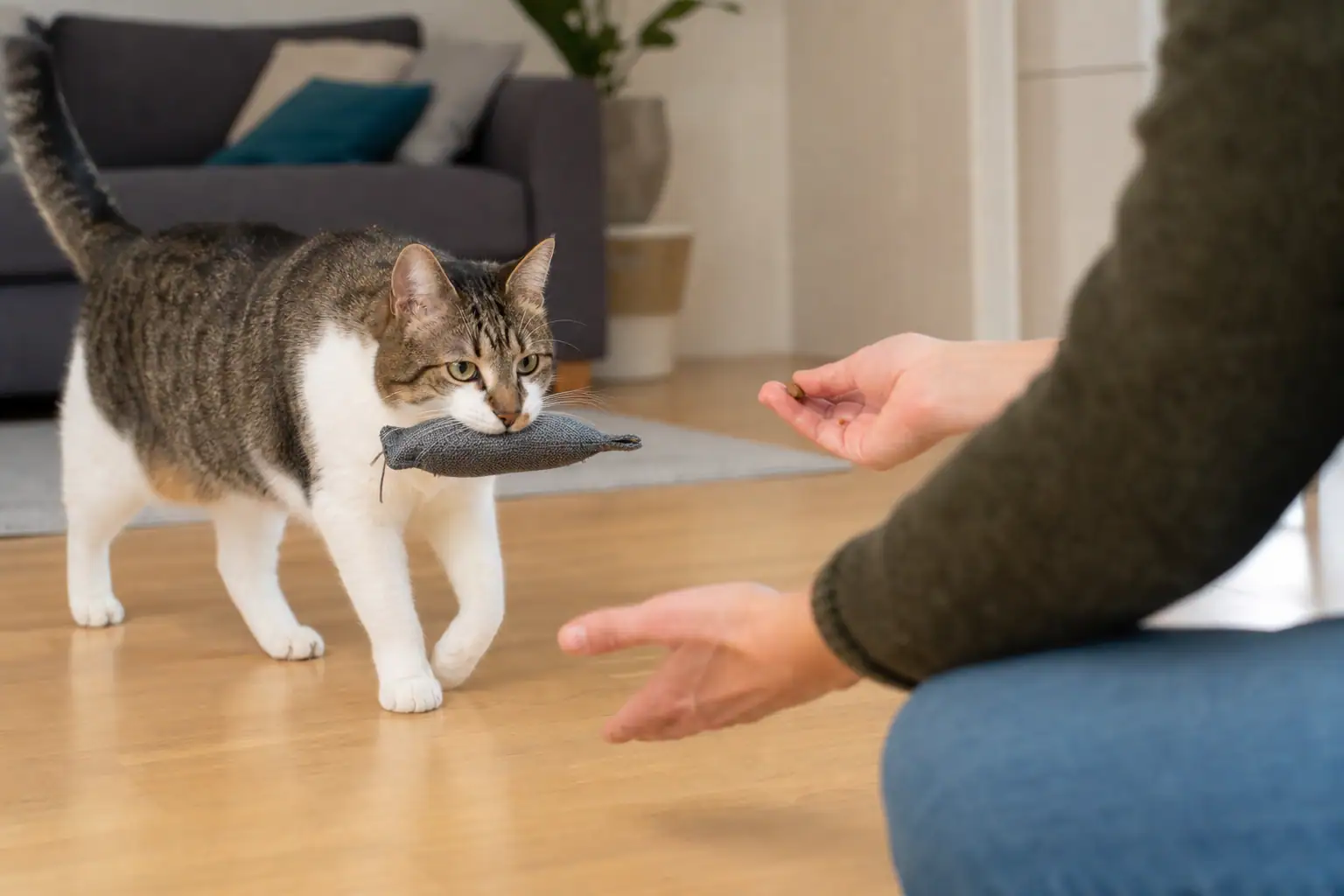
    Cat returning a fabric toy during a short indoor fetch lesson
    Teach the return at very short range. Mark and reward movement toward you before asking for a longer throw.

    The Feline Veterinary Medical Association’s environmental-needs guidance recommends interactive play that lets cats capture simulated prey intermittently, toy rotation, and positive reinforcement with treats. Fetch can meet part of that need when the cat chooses to participate and gets a real capture. It does not need to become obedience work.

    Fix the Part of Fetch That Is Missing

    Most cats do not need the entire sequence taught at once. Watch where the chain stops and reward the next small piece:

    • Cat watches but does not chase: try a different safe object, make a shorter low roll, add one irregular bounce, or switch surfaces. If interest does not appear, end the attempt.
    • Cat chases but does not pick up: reward touching first. Try a shallower fabric toy with an edge that is easier to grip.
    • Cat picks up but stays there: remain still and reward a head turn or single step toward you. Do not walk over and repeatedly restart the throw from the landing spot.
    • Cat drops it halfway: go to the dropped point after the repetition, shorten the next toss, and reward the shorter complete return. Gradually move your reward location back toward you.
    • Cat brings it back but will not release: offer a calm trade. Do not chase, pull, or turn hands into part of the game. Some cats prefer dropping the toy a foot away; that is functional fetch even if it is not a perfect hand delivery.
    • Cat fetches only one object or in one room: accept the preference. The research documents highly specific object, place, and partner preferences. Generalizing to a new toy is optional.
    • Cat demands fetch at night: end the game with a predictable cue, store the toy out of reach, and schedule an active play session earlier. Do not throw it from bed if you do not want that routine reinforced.

    What About Cat Fetch Toy Guns and Automatic Launchers?

    Products sold as a “cat fetch toy gun” usually launch a soft disc or propeller for a cat to chase. They may create an exciting chase, but they do not teach retrieval by themselves. Treat them as supervised projectile toys: point away from every person and animal, launch only into a clear floor-level zone, never aim toward the face, and inspect each disc for bite damage or missing pieces after use.

    An automatic fetch toy can mean two very different devices:

    • An automatic ball launcher throws an object. Many are designed around dog-sized balls, higher forces, or independent loading and may be unsuitable for a cat or an indoor room. Do not use one merely because a marketplace title includes the word “cat.” Confirm the projectile size, weight, range, shutoff, and intended species, and supervise every launch.
    • An automatic rolling ball moves under its own power. It can support chase and pounce play, but it is not really a fetch trainer. Check the shell and battery compartment, keep it away from stairs and water, and stop if your cat bites through the casing or becomes overaroused.

    For a fuller breakdown of motors, battery doors, collision risks, and rough-player inspection, see our guide to cat toys that move. A hand-rolled toy is the better starting point for fetch because you control the distance, can read the cat’s response, and can stop immediately.

    Fetch Safety for Cats That Play Rough

    Fetch adds speed and repeated mouthing, so inspect both the route and the toy—not just the cat’s enthusiasm.

    • Clear the runway: remove breakables, cords, unstable furniture, and access to stairs. Use a surface with traction and throw away from walls, windows, and other animals.
    • Keep the toss low: roll or skim the toy along the floor. Do not make a cat leap blindly toward shelving or furniture.
    • Play cats separately: one cat’s chase can become another cat’s ambush or resource conflict. Give each cat an individual turn if competition appears.
    • Count food rewards: use tiny pieces and include them in the cat’s normal daily food allowance, especially during repeated training.
    • Inspect after every rough session: look for opened seams, wet or thinning fabric, exposed stuffing, loose thread, cracks, sharp edges, and missing pieces. If you cannot account for a missing piece, contact a veterinarian for advice rather than waiting for symptoms.
    • Stop before exhaustion: end when movement becomes uncoordinated, the cat loses interest, the tail lashes, ears flatten, or play redirects onto hands. Never use panting as a fitness target.

    Stop the game and contact your veterinarian if fetch is followed by limping, persistent open-mouth breathing, collapse, coughing, obvious pain, or a sudden change in willingness to run or carry objects. A cat that compulsively chews or swallows non-food objects also needs individual guidance; a tougher toy does not solve the cause of pica-like behavior.

    For broader chase-and-capture options, use the selection framework in our cat toys for hunting guide. Fetch is one enrichment game, not a requirement. A cat that prefers stalking, batting, foraging, or wrestling can get an equally valuable play session without returning anything.

    Quick Cat Fetch Toy Checklist

    • Does my cat already choose, carry, or chase this object?
    • Can my cat grip it without fitting the entire toy in the mouth?
    • Is it lightweight enough to land softly?
    • Is it free of string, feathers, bells, glued eyes, clips, and other detachable parts?
    • Can I inspect every seam, surface, joint, and battery door?
    • Is the floor route clear, stable, and away from stairs and other pets?
    • Am I using a short low toss instead of throwing toward the cat?
    • Will I reward one small return step instead of forcing a full retrieve?
    • Does my cat remain relaxed and willing to continue?
    • Will I store or retire the toy as soon as damage appears?

    A good cat fetch toy is not the flashiest launcher or the object that travels farthest. It is the safe, inspectable toy your cat wants to bring back. Start with one or two feet, reward the part your cat offers, and let the cat decide when the game is over.

    Sources

  • Indoor Cat Enrichment Toys: A Practical Guide for Bored, Rough-Playing Cats

    Indoor Cat Enrichment Toys: A Practical Guide for Bored, Rough-Playing Cats

    Indoor cat enrichment toys should do more than keep a cat busy for five minutes. The best choices let an indoor cat stalk, chase, pounce, grab, bite, kick, forage, climb, hide, or solve a small problem in a way that is safe for that cat’s body and play style. If your cat gets bored fast or destroys ordinary toys, the answer is usually not one expensive gadget. It is a small rotation of toys with clear jobs and clear safety rules.

    For Titan Claws readers, the important distinction is simple: some toys are safe to leave out, some are for supervised play only, and some should be retired as soon as they show damage. This guide explains how to choose indoor cat enrichment toys for bored indoor cats, high-prey-drive cats, and rough players that chew, wrestle, or shred softer toys.

    What Indoor Cat Enrichment Toys Are For

    Enrichment means giving a cat appropriate ways to express natural behavior indoors. Cornell Feline Health Center describes toys as a way to encourage exercise and cognitive enrichment while letting cats stalk, pounce, and problem-solve. The AAFP and ISFM feline environmental needs guidelines go further: cats need opportunities for play and predatory behavior, including toys, owner interaction, and feeding practices that make the cat actively acquire food.

    That does not mean every toy has to be complicated. A cardboard box, a ping pong ball, a food puzzle, a sturdy kicker, and a wand toy can all be enrichment tools when they are matched to the cat. The useful question is not “What is the best indoor cat toy?” It is “What behavior does this toy support, and is it safe for my cat’s level of intensity?”

    The Main Types of Indoor Cat Enrichment Toys

    A balanced indoor setup usually includes toys from several categories. You do not need every option, but you do need enough variety that your cat can complete more of the hunting sequence instead of only staring at a toy that never gets caught.

    Chase toys

    Wands, teasers, skitter balls, springs, tunnels, and some automatic toys work because they move away from the cat. Move the target like prey: away, around a corner, behind a chair leg, under a tunnel edge, then pause. VCA recommends predatory games with toys the cat can eventually catch, which matters for intense cats that become frustrated by endless misses.

    Most chase toys are supervised toys. Strings, elastic cords, feathers, clips, and ribbon tails should be put away after play. For a deeper comparison of this category, see Titan Claws’ guide to wand cat toys and the related guide to cat toys on sticks.

    Catch and kick toys

    Kicker toys give the cat something to grab with the front paws and rake with the back feet. They are especially useful for rough players, cats that redirect play onto hands, and cats that need a satisfying finish after a wand session. Choose a kicker long enough that your cat can hug it without your hand being in the bite zone.

    For cats that destroy plush toys, skip tiny mice, glued eyes, thin tails, weak seams, and loose bells. Look for simple shapes, durable fabric, visible stitching, and enough size that the toy cannot be swallowed whole. Titan Claws’ cat kicker toy guide goes deeper on sizing and failure points.

    Foraging and puzzle toys

    Puzzle feeders, treat balls, snuffle-style mats, lick mats, scatter feeding, and hidden kibble trails turn part of a meal into work. Best Friends Animal Society notes that foraging toys can satisfy a cat’s instinct to search for food, and VCA describes puzzle feeders as enrichment and exercise for indoor cats.

    Start easy. If a puzzle is too hard, the cat may walk away. Begin with a few pieces of kibble scattered on a rug, a towel fold, a toilet paper roll with safe openings, or a beginner puzzle with wide access points. Then increase difficulty only after your cat understands the game. Titan Claws’ puzzle cat toys article gives more detail on beginner, intermediate, and advanced options.

    Solo batting toys

    Large balls, track toys, plastic springs, crinkle balls, and sturdy rolling toys can help cats burn short bursts of energy without constant human input. The Ohio State Indoor Pet Initiative points out that cats are drawn to toys that squeak, chirp, jitter, swing, vibrate, roll, or otherwise act like moving prey.

    For solo use, size and construction matter. Avoid brittle plastic, toys small enough to swallow, loose caps, exposed batteries, and anything your cat can chew into sharp pieces. If a toy is electronic, inspect the battery compartment and moving parts regularly.

    Environmental toys

    Boxes, tunnels, paper bags with handles removed, scratchers, perches, window views, and safe hiding spots make ordinary toys more interesting. A spring rolling past a tunnel opening is more engaging than the same spring sitting in the middle of the floor. Enrichment is often the relationship between the toy and the room, not just the object itself.

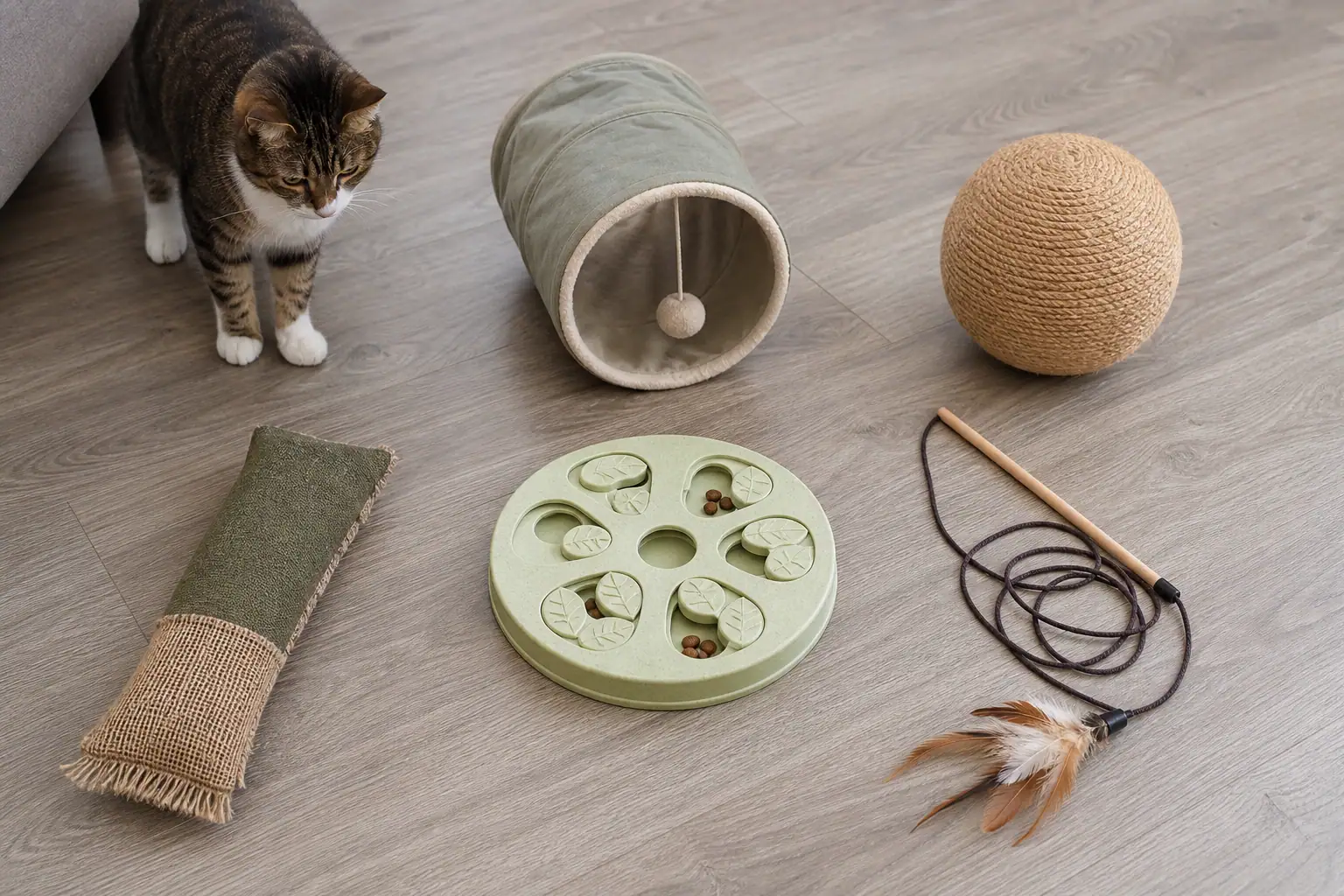
    Indoor cat enrichment toy rotation with kicker, puzzle feeder, wand, tunnel, and ball
    A useful enrichment setup gives each toy a job: chase, catch, kick, forage, hide, or bat.

    Match Toys to Your Cat’s Play Style

    Before buying more indoor cat enrichment toys, watch two or three play sessions and write down what your cat actually does. The pattern will tell you what kind of enrichment is missing.

    • The chaser runs after movement and may prefer wands, skitter toys, rolling balls, tunnels, and short hallway games.
    • The ambusher hides, waits, and pounces. Add boxes, tunnels, rug edges, and toys that disappear behind furniture.
    • The wrestler grabs and bunny-kicks. Use larger kickers and end chase games with a physical catch.
    • The chewer attacks seams, tags, feathers, and stuffing. Choose simpler, tougher toys and inspect them after every session.
    • The forager works for food. Use puzzle feeders, treat balls, scatter feeding, and hidden kibble searches.
    • The watcher enjoys lower-impact enrichment. Try window perches, bird-safe window views, slow wand movement, gentle food puzzles, and scent novelty.

    If your cat plays hard enough to ruin ordinary toys, pair this article with Titan Claws’ guides to durable cat toys, toys for cats that chew, and safe cat chew toys. The goal is durability plus inspection, not an impossible claim that any toy is indestructible.

    Solo Toys vs Supervised Toys

    One competitor gap in many enrichment lists is that they recommend toys without separating leave-out toys from supervised toys. That difference matters most for indoor cats that chew, swallow pieces, or get very excited during play.

    • Usually leave-out friendly: sturdy track toys, larger-than-mouth balls, simple tunnels, boxes, scratchers, durable kickers your cat does not chew open, and puzzles your cat cannot dismantle.
    • Supervised only: wands, string toys, ribbon toys, feathers, elastic cords, laser sessions, battery toys with removable attachments, catnip toys that trigger frantic chewing, and anything new until you know how your cat handles it.
    • Retire immediately: torn plush, exposed stuffing, loose thread, detached feathers, cracked plastic, chewed cords, loose bells, damaged battery doors, or any toy missing a piece.

    Cornell warns against toys with small pieces or strand-like parts that can detach and be swallowed, especially when chewed. The AAFP and ISFM guidelines also recommend putting away toys with string or other ingestible parts after play and avoiding small ingestible parts and bells for unsupervised access.

    Hands inspecting a cat enrichment toy for loose seams and chew damage
    Rough players need short sessions and quick inspections. Retire toys before loose parts become swallowable.

    A Simple Indoor Toy Rotation Plan

    Novelty helps, but novelty does not require constant shopping. VCA suggests keeping a larger assortment available while offering only a few toys at a time, then rotating them weekly. Cornell also recommends rotating toys to prevent boredom.

    Use this five-part rotation as a starting point:

    • One chase toy: a wand, teaser, or moving toy used in short supervised sessions.
    • One catch toy: a kicker or larger prey-shaped toy for grabbing and kicking.
    • One batting toy: a spring, ball, track toy, or crinkle toy for quick solo bursts.
    • One food puzzle: a beginner puzzle, treat ball, towel fold, or scatter-feeding game.
    • One environment piece: a box, tunnel, perch, scratcher, or paper bag with handles removed.

    Keep the active set small enough that you notice damage. Store the rest in a closed bin. If your cat responds well to catnip or silvervine, reserve scented toys for short sessions instead of leaving them on the floor until they become stale or chewed apart.

    How to Use Enrichment Toys Better

    Many owners buy more toys when the real fix is changing how the toy is used. Try these adjustments before replacing the whole toy basket:

    • Move prey away from the cat. Dragging a lure toward the face is less natural than letting it flee.
    • Add pauses. Stop behind a tunnel, box, chair leg, or rug edge so your cat can stalk.
    • Let the cat catch it. End some passes with a real grab, kicker handoff, or food reward.
    • Shorten rough sessions. A cat that shreds toys may need five focused minutes, an inspection break, and a calmer activity.
    • Change the surface. A ball behaves differently on carpet, hardwood, tile, and inside a box.
    • Match intensity to the cat. Kittens need size-appropriate toys. Seniors may need lower jumps, slower movement, and softer landing zones.

    Laser pointers need extra care. Some cats enjoy them, but the light cannot be caught. If you use one, keep it out of the eyes and finish with a physical toy or treat the cat can actually capture.

    Best Choices for Cats That Destroy Toys

    Rough players need a stricter filter. Choose indoor cat enrichment toys with fewer decorative parts, stronger seams, thicker fabric, larger shapes, and surfaces that are easy to inspect. Avoid tiny plush toys that fit fully in the mouth, yarn, ribbon tails, glued-on eyes, brittle plastic, weak bells, and toys that shed fibers during the first session.

    Do not leave a new toy out while you are gone until it has survived supervised play. Watch where your cat attacks first: seam, tag, corner, feather stem, tail, or stuffing area. That first failure point tells you what to avoid next time.

    If your cat repeatedly swallows non-food objects, tears toys open in minutes, guards toys aggressively, redirects hard bites onto people, or cannot settle after play, talk with your veterinarian or a qualified behavior professional. Enrichment helps many cats, but persistent chewing, pica-like behavior, aggression, or sudden behavior change can need individual medical or behavioral guidance.

    Quick Buying Checklist

    Use this checklist before buying or leaving out an enrichment toy:

    • What behavior does it support: chase, pounce, kick, bat, chew, carry, forage, hide, climb, or watch?
    • Is it too large to swallow whole?
    • Are there strings, feathers, bells, clips, eyes, tags, or decorations that could detach?
    • Can you inspect the seams, battery compartment, and surface after play?
    • Is this safe for solo access, or should it be stored after each session?
    • Does your cat get a real catch, food reward, or satisfying finish?
    • Can it be cleaned or replaced before it gets dirty or damaged?
    • Has your cat destroyed similar toys before?

    The best indoor cat enrichment toys are not just busywork. They give your cat controlled ways to hunt, solve, move, rest, and explore inside the home. Build a small rotation, separate supervised toys from leave-out toys, and retire damaged pieces early. For cats that play rough, that system will do more than another random basket of toys.

    Sources

  • Cat Play Aggression Towards Owner: How to Stop Rough Attacks Safely

    Cat Play Aggression Towards Owner: How to Stop Rough Attacks Safely

    Cat play aggression towards an owner usually means the cat is treating a person like moving prey: stalking ankles, pouncing from behind furniture, grabbing hands, biting, scratching, or escalating during play. The safest first response is not punishment. Stop moving like prey, calmly end contact, and redirect future attacks into toys that keep teeth and claws away from skin.

    This behavior is common in young, energetic, under-stimulated, or rough-playing cats, but adult cats can do it too. It can also overlap with fear, pain, redirected aggression, petting intolerance, or territorial stress, so the plan has two jobs: give your cat better play outlets and watch for signs that this is more than rough play.

    What Cat Play Aggression Looks Like

    Play aggression is built from normal hunting behaviors pointed at the wrong target. A cat may hide, stare, crouch, wiggle, chase, pounce, wrap the front paws around an arm or leg, bite, and rake with the back feet. The cat may seem excited rather than angry, but the scratches and bites are still real.

    Common patterns include:

    • Ankle ambushes: your cat waits behind a doorway, sofa, bed skirt, or stair and launches as you walk by.
    • Hand attacks: the cat grabs during petting, typing, bed-making, or any movement that looks like prey.
    • Play that tips over: a wand or chase session starts well, then the cat redirects onto your arm when the toy gets too close.
    • Evening surges: the cat becomes more intense at dawn, dusk, or after a quiet day with too little activity.
    • Single-person targeting: one household member gets attacked more often because of movement, routine, play history, or access.

    Cornell Feline Health Center describes play-aggressive cats as cats that may stalk and pounce on human targets, often with dilated pupils and tail movement before the attack. The San Francisco SPCA also notes that lack of scheduled, appropriate playtime is a major contributor for many play-aggressive cats.

    First, Rule Out the Wrong Kind of Aggression

    Do not assume every bite is play. A play plan is useful only when the behavior is truly playful, predictable, and connected to movement or under-stimulation. If aggression appears suddenly, gets severe, happens when the cat is touched, includes hissing or defensive postures, or follows a stressful event, slow down and involve your veterinarian.

    ASPCA guidance on feline aggression emphasizes that medical conditions can contribute to aggressive behavior, and Cornell recommends ruling out medical causes before relying on behavior modification alone. Pain, dental disease, arthritis, thyroid disease, sensory decline, wounds, and neurological issues can all change how a cat responds to people.

    Call your veterinarian or a qualified behavior professional promptly if:

    • the aggression is new, escalating, or hard to interrupt;
    • bites break skin or the cat repeatedly holds on;
    • your cat growls, hisses, hides, limps, or guards part of the body;
    • attacks happen after seeing outdoor cats, hearing loud sounds, or conflict with another pet;
    • children, older adults, immunocompromised people, or guests are at risk;
    • you feel unsafe moving around your own home.

    What to Do During an Attack

    The moment teeth or claws land, your goal is to make the person boring without adding fear. Fast jerking, yelling, swatting, chasing, or rough wrestling can make the situation worse because those responses either look like prey movement or teach the cat that humans play roughly.

    1. Freeze for a beat. Stop the moving target. If the cat is latched on, avoid pulling away quickly.
    2. Go neutral. Keep your voice low and your body still. Do not punish, scruff, spray, or hit.
    3. Disengage calmly. Once the cat releases, step behind a door, baby gate, or barrier if needed.
    4. End the session. Do not immediately reward the bite by presenting a toy after contact has already happened.
    5. Reset the environment. After the cat is calm, start a planned toy session away from the ambush spot.

    That timing matters. Redirecting before a pounce teaches the cat what to attack. Offering a toy after your skin has already been grabbed can accidentally teach the cat that biting you starts the game.

    Alert cat crouching near a toy before a play pounce
    Crouching, dilated pupils, tail lashing, and corner ambushes are cues to redirect before your hands or ankles become the target.

    Redirect Before the Pounce

    The best moment to stop cat play aggression towards an owner is the moment before it happens. Watch for the setup: fixed stare, tail twitching, crouching, rear-end wiggle, hiding around corners, pupils widening, and tracking your feet or hands.

    When you see those cues, redirect with distance:

    • Toss a soft, safe chase toy away from your body.
    • Use a wand so the lure moves away from you, not across your ankles.
    • Send the cat through a tunnel, around a chair, or up a cat tree to create a chase path.
    • End with a kicker toy the cat can grab, bite, and rake.
    • Follow with a small meal or treat puzzle if the cat settles better after a hunt-eat rhythm.

    If the ambush happens in the same place every day, change the setup. Block under-bed launch spots, leave a toy station near the hallway, carry a toss toy when walking through the danger zone, or schedule play before the usual attack window.

    Build a Safer Rough-Play Kit

    Owners of hard-biting cats need more than a cute toy basket. They need legal targets for each part of the hunting sequence: chase, pounce, grab, bite, kick, and settle. A strong setup uses different toy types for different jobs.

    • Wand toy for distance: use it for chase and pounce, then store it after play. Do not leave string, ribbon, elastic, or feather lures out for a cat that chews.
    • Large kicker toy for impact: choose a long, dense toy that keeps your hands out of range while the cat bites and bunny-kicks.
    • Toss toys for ambush redirection: keep a few simple toys in rooms where the cat stalks feet.
    • Puzzle or food toy for the finish: give the cat a way to settle after the chase instead of immediately restarting the attack.
    • Solo toys for off-hours: use sturdy balls, tracks, tunnels, and safe enrichment items that do not have swallowable parts.

    For deeper toy selection, see Titan Claws’ guides to cat toys for play aggression, cat stick and wand toys, and indoor cat enrichment toys. If your cat destroys plush or chews through fabric, the cat chew toys for aggressive chewers guide is a useful next step.

    Cat play redirection kit with wand toy, kicker toy, and treat puzzle
    A simple redirection kit gives your cat legal targets for stalking, chasing, grabbing, and biting.

    A Daily Plan for Owner-Directed Play Aggression

    Most cats do better with predictable outlets than with random emergency play. Start with two or three short sessions each day and adjust around your cat’s peak attack times.

    Morning: drain the first surge

    Give your cat 10 to 15 minutes of interactive play before the household becomes busy. Move the lure like prey: away, behind furniture, briefly hidden, then catchable. Let the cat succeed. Finish with a kicker, breakfast, or a small food puzzle.

    Midday or after work: prevent boredom

    Rotate solo enrichment while you are busy. Put out one or two safe options, not the entire bin. Boxes with handles removed, tunnels, sturdy ball tracks, and puzzle feeders can help without teaching your cat to attack people for entertainment.

    Evening: play before the ambush window

    If your cat attacks ankles at 8 p.m., do not wait until 8:05. Start play at 7:45, before the cat chooses the target. Use a wand at distance, then a kicker, then food or a calm routine.

    Overnight: remove risky toys

    Store wand toys, string toys, feather toys, elastic, yarn, and damaged toys behind a closed door. Leave only toys that are appropriate for your specific cat without supervision.

    What Not to Do

    Several common reactions make owner-directed play aggression harder to fix. Avoid these even when the bite surprises you.

    • Do not use hands as toys. Wrestling with kittens teaches them that skin is a legal target when they grow stronger.
    • Do not punish physically. Cornell warns that physical punishment can increase fear or anxiety and worsen aggression.
    • Do not chase the cat after an attack. That can become part of the game or add fear.
    • Do not rely on one automatic toy. Movement helps, but rough cats need interaction, inspection, and varied outlets.
    • Do not leave string-like toys out. Cornell’s safe-toy guidance cautions against small pieces and strand-like parts that may detach and be swallowed.
    • Do not keep using damaged toys. Tougher does not mean safe forever.

    Inspect Toys After Rough Sessions

    A cat that redirects onto toys may bite, rake, drag, and chew those toys hard. That is better than skin, but it means inspection becomes part of the behavior plan.

    Hands inspecting a cat kicker toy seam after rough play
    Rough-play toys need inspection. Retire toys when seams open, stuffing appears, or small parts loosen.

    After rough play, check:

    • open seams, loose threads, exposed stuffing, and thin fabric;
    • detached feathers, bells, eyes, tails, knots, or plastic caps;
    • cracked plastic, sharp edges, bent clips, and broken wand connectors;
    • deep tooth marks in rubber or foam-like materials;
    • battery doors, charging ports, and moving parts on electronic toys;
    • wet, dirty, or smelly toys that need washing or retirement.

    Retire a questionable toy before it becomes an ingestion hazard. Titan Claws avoids calling any cat toy indestructible because the safer standard is more practical: choose durable construction, supervise the first sessions, inspect damage, and replace the toy before failure gets dangerous.

    Quick Checklist

    • Does the behavior look like stalking, chasing, grabbing, and biting during high-energy moments?
    • Have you ruled out pain, fear, redirected aggression, and sudden medical changes?
    • Are all household members avoiding hand wrestling and rough body play?
    • Do you redirect before the pounce instead of rewarding after a bite?
    • Does your cat have a wand toy for distance, a large kicker for biting, and safe solo enrichment?
    • Are string, feather, ribbon, and wand toys stored after supervised play?
    • Are you playing before the usual attack window?
    • Are damaged toys retired immediately?
    • Do you have a vet or behavior professional involved if bites are severe, sudden, or escalating?

    Cat play aggression towards an owner is frustrating, but it is often workable when you stop making people part of the game. Read the warning signs, redirect early, give your cat durable legal targets, schedule play before the attack window, and treat safety as the measure of success.

    Sources

  • Cat Enrichment Toys for Indoor Cats: A Safer, Smarter Setup

    Cat Enrichment Toys for Indoor Cats: A Safer, Smarter Setup

    Cat enrichment toys for indoor cats should do more than fill a toy basket. The best setup gives your cat safe ways to stalk, chase, pounce, grab, kick, chew, solve, climb, hide, and rest. For most homes, that means a small mix of interactive chase toys, puzzle feeders, sturdy kickers, safe chew outlets, cardboard or tunnel play, and a rotation plan that keeps the toys interesting.

    If your indoor cat destroys ordinary toys, choose enrichment by job and failure point, not by cuteness. A feather wand may be perfect for supervised chase, but risky if left out. A rugged kicker may be better for biting and bunny-kicking. A puzzle feeder may do more for a bored food-motivated cat than another plush mouse. No toy is a complete enrichment plan by itself.

    What Indoor Cat Enrichment Toys Need to Do

    Indoor cats still have predatory behavior, curiosity, food-seeking drive, scent interest, climbing needs, and social preferences. Good enrichment toys let those needs show up in safe household ways. The AAFP and ISFM environmental needs guidelines describe play and predatory behavior as a core part of a healthy feline environment, including toys, owner play, compatible-cat play, and feeding devices that make cats work for food.

    That is why the best answer to this keyword is not a single best toy. It is a toy system. A healthy indoor setup usually covers these jobs:

    • Chase: wand toys, large balls, rolling toys, tunnels, and floor lures.
    • Capture: kickers, soft prey toys, and toys the cat can grab after a chase.
    • Forage: puzzle feeders, treat balls, snuffle-style mats, food hunts, and DIY cardboard puzzles.
    • Investigate: boxes, paper bags with handles removed, tunnels, scent-safe objects, and rotated textures.
    • Climb and watch: cat trees, shelves, window perches, and safe vertical routes.
    • Chew or wrestle: simple sturdy toys that are large enough, inspectable, and matched to the cat’s mouth and claws.

    For a broader activity plan beyond toys, Titan Claws has a practical guide to cat enrichment activities. For a product-focused angle, pair this article with interactive cat enrichment toys.

    What Current Ranking Articles Get Right and Miss

    The current results for cat enrichment toys for indoor cats are a mix of Reddit threads, shopping pages, product roundups, shelter guidance, and a recent Guardian buying guide. They get several things right: indoor cats need novelty, puzzle feeding can help, cardboard is underrated, and owner-led play often matters more than expensive gear.

    The gap is durability and safety for real rough players. Many lists recommend feather toys, strings, plush mice, electronic toys, catnip toys, and puzzle feeders without helping the owner decide what can be left out, what must be supervised, and what should be retired after damage. For Titan Claws readers, that distinction is the article.

    Think of each toy as either a leave-out toy, a supervised toy, or a test-only toy. Leave-out toys must be simple, stable, larger than swallowable, and proven safe for your specific cat. Supervised toys can be more exciting because you control the session. Test-only toys are new or higher-risk toys that need short sessions until you know how your cat damages them.

    Indoor cat enrichment toys arranged into chase, puzzle, kicker, and chew zones
    A useful enrichment setup gives each toy a job: chase, solve, kick, chew, hide, climb, or rest.

    The Best Toy Types for Indoor Enrichment

    A strong indoor enrichment setup covers multiple play styles without leaving risky pieces everywhere. Start with one or two toys from each category instead of buying a giant mixed pack.

    Wand toys for chase and confidence

    Wand toys are excellent because you can mimic prey. Move the lure away from the cat, around furniture edges, behind a box, under a towel edge, or in short pauses. Do not jab the toy at the cat’s face. Let the cat watch, stalk, sprint, and catch. Store string, ribbon, elastic, and feather lures after the session.

    If your cat escalates into biting hands or ankles, use longer reach and a clearer handoff to a kicker. Titan Claws’ guide to cat toys for play aggression can help redirect that energy.

    Puzzle feeders for bored food-motivated cats

    Puzzle feeders turn part of a meal into problem solving. They work best when the difficulty is adjustable. Start easy: loose kibble in an open egg carton, a few treats in a paper towel tube with large holes, or a shallow puzzle tray. Increase difficulty only after the cat understands the game.

    The ASPCA’s feline DIY enrichment guidance includes simple food puzzles made from household cardboard items. That is useful because enrichment does not have to be expensive, but DIY toys still need safety checks: remove tape, staples, handles, sharp edges, and tiny pieces your cat might eat.

    Kicker toys for cats that grab and bunny-kick

    Kickers are a good match for indoor cats that latch on with the front paws and rake with the back feet. Choose a length that keeps your hands away from the kicking zone, dense fabric, reinforced seams, and minimal decorations. A rough cat can turn weak plush into exposed stuffing quickly, so inspect kickers after hard sessions.

    For heavy players, read Titan Claws’ durable cat toys guide before buying by marketing words like tough, premium, or indestructible. The important question is how the toy fails under teeth and claws.

    Boxes, tunnels, and hiding toys for ambush play

    Boxes and tunnels let an indoor cat hide, watch, burst out, and reset. A plain cardboard box can become a hunting blind, puzzle feeder, scent station, or nap spot. Cut large openings, remove tape and loose flaps, and replace cardboard when it gets soggy, shredded, or snack-sized.

    For budget options, Titan Claws’ homemade cat enrichment toys article goes deeper on cardboard, paper, and household-object ideas.

    Chew and carry toys for mouthy cats

    Some indoor cats need to bite and carry. Give those cats simple, sturdy toys that are too large to swallow, easy to inspect, and free from loose bells, eyes, ribbons, feathers, and glued trim. If your cat eats fabric, thread, foam, rubber, or plastic, treat that as a veterinary and management issue, not just a shopping problem.

    For cats that target strings specifically, use the safety guidance in Titan Claws’ cat string toys article before leaving any strand-like toy accessible.

    How to Build a Simple Enrichment Rotation

    Indoor cats often ignore toys that never change. Rotation helps the same few toys feel fresh, and it gives you a natural inspection rhythm. Cornell Feline Health Center also recommends rotating toys to prevent boredom, while warning owners to avoid small parts and strand-like pieces that can detach and be swallowed.

    Try this simple weekly rotation:

    1. Daily supervised chase: one wand or moving lure session, 5 to 10 minutes, ending with a real catch.
    2. Daily food puzzle: part of one meal in an easy puzzle, treat ball, scatter hunt, or cardboard feeder.
    3. Two leave-out toys: one sturdy object for batting or carrying, plus one safe hide or tunnel option.
    4. One rough-play outlet: a kicker or chew-safe toy used when your cat grabs, bites, or bunny-kicks.
    5. One environment upgrade: a box, perch, paper bag with handles removed, window view, or safe scent object.

    Do not rotate everything at once if your cat is timid. Change one piece, watch the response, and keep the routine predictable. For cats that are already restless, destructive, or demanding attention, Titan Claws’ best cat toys for bored indoor cats article can help you troubleshoot the boredom side.

    Small weekly cat toy rotation with puzzle feeder, box, kicker, wand, and balls
    Rotation keeps indoor toys fresh and makes it easier to notice which toy is wearing out.

    Safety Rules for Rough-Playing Indoor Cats

    Enrichment should lower risk, not add hidden hazards. The University of Wisconsin School of Veterinary Medicine warns that aggressive chewers may ingest feathers, strings, sparkly bits, and similar toy materials, and that intestinal obstruction can be serious. Cornell gives similar cautions about toys with small pieces or linear strand-like parts, especially when those parts separate during chewing.

    Use these rules for any indoor cat toy:

    • Store string toys after play. Wand cords, ribbons, yarn, elastic, and feather lures are supervised-only.
    • Remove weak decorations. Avoid or remove bells, beads, glued eyes, small tails, loose feathers, tassels, and brittle plastic pieces.
    • Inspect the toy’s failure points. Check seams, stuffing, caps, battery doors, crinkle layers, refill openings, and attachment points.
    • Separate leave-out toys from session toys. The toy that makes a great chase session may be unsafe at 2 a.m.
    • Retire damaged toys early. Exposed stuffing, loose threads, sharp plastic, missing parts, and flaking surfaces are stop signs.
    • Call a veterinarian for ingestion concerns. Vomiting, appetite loss, lethargy, straining, or suspected swallowed string or toy parts should not be watched casually.
    Hands inspecting an indoor cat toy for loose seams after rough play
    Rough players need inspection built into the routine. Retire toys before loose parts, stuffing, or sharp edges become swallow risks.

    How to Match Toys to Your Cat’s Play Style

    Owners often buy the wrong enrichment toy because they shop for the behavior they want instead of the behavior the cat already shows. Watch one play session and choose from the pattern.

    • The stalker: likes hiding, watching, and slow buildup. Use boxes, tunnels, low wand movement, and corner peeks.
    • The sprinter: wants fast movement. Use hallway rolls, wand chases, ball tracks, and short high-energy sessions.
    • The wrestler: grabs and bunny-kicks. Use long kickers, sturdy fabric toys, and supervised handoffs after chase.
    • The solver: paws at cabinets, cups, or food containers. Use puzzle feeders, treat hunts, and cardboard feeders.
    • The chewer: mouths fabric, cords, plastic, or toy seams. Use fewer, tougher, inspectable toys and remove strand-like hazards.
    • The watcher: prefers observing before joining. Use slow prey movement, window perches, quiet puzzles, and predictable routines.

    Age matters too. Kittens may need short frequent motion games and teething-safe options. Senior cats may prefer slower ground play, easier puzzles, and stable surfaces. Multi-cat homes may need separate sessions so one cat does not monopolize the toy or guard the puzzle feeder.

    Quick Buying and Setup Checklist

    • Does this toy have a clear job: chase, capture, forage, chew, hide, climb, or rest?
    • Is it safe to leave out, or is it supervised-only?
    • Is the smallest piece too large to swallow?
    • Are there strings, feathers, bells, beads, glued eyes, tassels, caps, or battery doors to inspect?
    • Can you clean it or replace it before it gets dirty, soggy, or shredded?
    • Does the toy match how your cat actually plays?
    • Do you have a way to let your cat catch something at the end of chase play?
    • Will rotation make the toy more interesting without flooding the floor with hazards?

    The best cat enrichment toys for indoor cats are not the flashiest toys. They are the toys that give your cat a safe outlet for a specific behavior, survive long enough to be useful, and get inspected before damage becomes dangerous. Start with a small balanced setup, play with purpose, rotate thoughtfully, and replace anything your cat is beginning to defeat.

    Sources

  • Homemade Cat Enrichment Toys: Safe Ideas for Indoor Cats and Rough Players

    Homemade Cat Enrichment Toys: Safe Ideas for Indoor Cats and Rough Players

    Homemade cat enrichment toys are simple DIY setups that give a cat something useful to do: hunt, forage, paw, climb, hide, sniff, chase, grab, or kick. The safest homemade toys are not elaborate crafts. They are plain, inspectable objects that match your cat’s actual play style and can be thrown away before they become swallowing hazards.

    If your cat is gentle, a cardboard tube puzzle or paper foraging box may last several sessions. If your cat destroys ordinary toys, treat homemade enrichment as supervised play first. Rough players can chew through cardboard, pull tape loose, swallow string, or turn a food puzzle into a shredding project. The goal is not to make a homemade toy that lasts forever. The goal is to create a better outlet, watch the first use, and retire weak materials early.

    Start with one clear job for the toy, use clean materials, skip risky add-ons, and pair fragile DIY puzzles with sturdier supervised toys when your cat needs to bite and bunny-kick hard.

    Safe homemade cat enrichment materials arranged for inspection
    The best homemade enrichment materials are plain, easy to inspect, and simple to replace before they fail.

    What Current Homemade Enrichment Guides Get Right

    The top results for homemade cat enrichment toys usually get one big thing right: enrichment does not have to be expensive. The ASPCA shows food enrichment and cardboard projects such as reach feeders, slow feeders, houses, tunnels, and mazes. Humane shelter resources commonly recommend puzzle feeders, treat dispensers, cardboard hideouts, sensory games, and simple hide-and-seek. Those are useful ideas because they turn normal household materials into hunting and problem-solving opportunities.

    The gap is safety for forceful cats. Many lists tell you what to make, but they spend less time on what happens when a cat bites the tube flat, eats paper, pulls apart glued seams, or attacks a string attachment after the person leaves the room. Titan Claws readers often need that second layer: how to choose the right homemade idea for a rough player, how to supervise the risky parts, and when to switch from DIY cardboard to a tougher toy built for wrestling.

    Use the One-Job Rule

    Before building anything, decide what job the enrichment toy should perform. A vague toy that is supposed to “keep the cat busy” is harder to judge and easier to overcomplicate. A one-job toy is easier to make safely and easier to inspect afterward.

    • Foraging: the cat sniffs, paws, rolls, or searches for part of a meal.
    • Chasing: the cat stalks and pursues a moving target under supervision.
    • Catching and kicking: the cat grabs a legal target and rakes with the back feet.
    • Hiding and ambushing: the cat uses cover, boxes, tunnels, or furniture edges.
    • Scratching and shredding: the cat works claws against an appropriate surface.
    • Climbing and perching: the cat moves vertically and surveys the room.
    • Sniffing and investigating: the cat explores safe novelty, texture, or scent.

    The AAFP and ISFM environmental needs guidelines describe play and predatory behavior as part of a healthy feline environment. That includes toys, owner interaction, and feeding practices that require a cat to actively acquire food. Homemade enrichment works best when it supports those natural behaviors instead of dumping random objects on the floor.

    Five Homemade Cat Enrichment Toys to Try

    1. Cardboard reach feeder

    Use a shallow shoe box or drink box, several clean toilet paper tubes, and a small amount of kibble or treats. Cut snug holes in the lid, place the tubes upright, and drop food into the tubes so your cat has to reach and scoop. Start with just a few loaded tubes so the cat succeeds quickly.

    Safety notes: cut smooth openings, avoid staples, and do not use heavy tape where your cat can chew it loose. If your cat pulls out the tubes and eats cardboard, stop using this as a puzzle and try a washable commercial puzzle feeder or simple scatter feeding instead.

    2. Shallow foraging box

    Take a low cardboard box, remove handles, tape loops, staples, plastic windows, and loose labels, then fill it loosely with crumpled plain paper. Scatter a small portion of dry food or treats inside. The cat has to sniff, paw, and search, which turns food into work without much construction.

    Use a shallow box so you can see what your cat is doing. Avoid glossy mailers, plastic packing material, rubber bands, twist ties, scented packaging, dryer sheets, and anything that carried cleaners or chemicals.

    Cat pawing through a homemade foraging box with paper and kibble
    A shallow foraging box can turn part of a meal into sniffing, pawing, and searching.

    3. Paper tube treat roller

    Cut several kibble-sized holes into a paper towel tube, fold the ends inward, and add a few pieces of dry food. The tube should release food when your cat bats or rolls it. Make the first version easy. A cat that gets frustrated may chew the tube instead of solving it.

    This is a supervised toy for many rough players. Retire it when it becomes crushed, soggy, torn, or flattened by teeth. If your cat tries to eat the tube, skip this category entirely.

    4. Box-and-wand ambush course

    Place two or three boxes, a tunnel, or a paper bag with handles removed around the room. Move a wand lure around the edges so it disappears, pauses, and reappears. Cover makes the game feel more like a hunt and less like frantic swatting.

    Store the wand after play. String, elastic, feathers, clips, and detachable lures should not become unattended floor toys. For a deeper look at supervised chase toys, use Titan Claws guides to wand cat toys and cat toys for hunting.

    5. Towel wrinkle hunt

    Lay a towel flat, hide a few treats or pieces of kibble inside loose folds, and let your cat search. This is quieter than an electronic toy and easier than a hard puzzle. It can be useful for shy cats, older cats, or food-motivated cats that need a low-impact job.

    Use a towel without loose fringe. Wash it regularly. Stop if your cat chews fabric, pulls threads, or tries to swallow fibers.

    How to Build for Rough Players

    Cats that destroy toys need a different homemade enrichment plan. Do not ask cardboard to be the main bite-and-kick target. Use DIY items for foraging, hiding, stalking, and novelty, then offer a sturdier supervised toy for the hard catch.

    A practical rough-play sequence looks like this: set up a box ambush course, use a wand toy for a short chase, let the cat land on a longer kicker toy, then finish with a small foraging puzzle. The cat gets the full predatory pattern without turning every homemade object into something to shred.

    For cats that chew through soft toys or attack seams, compare homemade ideas with Titan Claws guides to durable cat toys, cat kicker toys, and toys for cats that chew. Durable does not mean indestructible. It means the toy is better matched to the force your cat puts into play and is easier to inspect before failure becomes dangerous.

    Materials to Avoid

    Homemade does not automatically mean safe. Many household materials are fine for one cat and risky for another. Use the strictest version of this list for kittens, known chewers, and cats that swallow non-food objects.

    • Avoid string-like materials: yarn, ribbon, thread, tinsel, dental floss, elastic, and loose cord.
    • Skip small hard parts: bells, beads, buttons, googly eyes, clips, sequins, and small plastic pieces.
    • Do not use sharp fasteners: staples, pins, needles, exposed wire, twist ties, or broken plastic.
    • Use tape carefully: loose tape can become a chew target, and heavy tape can hide torn cardboard.
    • Keep chemicals out: avoid scented packaging, food wrappers, treated outdoor wood, cleaner containers, dryer sheets, and anything greasy.
    • Watch edible incentives: treats, catnip, and silver vine can increase excitement. Use small amounts and stop if your cat gets frantic or aggressive.

    Cornell Feline Health Center warns against toys with small pieces or strand-like parts that can separate and be ingested, especially when chewed. Oregon Humane Society gives similar practical advice for cat-proofing and toy safety. For homemade toys, apply those warnings before you build, not after the toy breaks.

    Hands checking a homemade cat toy for loose tape and torn cardboard
    Inspect homemade toys after play. Retire anything with loose tape, bite-sized pieces, open seams, or string-like parts.

    A 15-Minute Homemade Enrichment Routine

    A routine usually beats a pile of DIY toys. Use this once a day for an active indoor cat, or shorten it for kittens, seniors, and cats that get overstimulated.

    1. Two minutes: prepare the room. Pick up fragile objects, remove loose cords, and place one box or tunnel for cover.
    2. Four minutes: chase. Move a wand lure around box edges, away from your cat, with pauses for stalking.
    3. Three minutes: catch. Let the cat grab a sturdy kicker or safe catch toy. Keep hands away from teeth and back claws.
    4. Four minutes: forage. Offer a reach feeder, tube roller, towel wrinkle hunt, or shallow foraging box with part of a meal.
    5. Two minutes: inspect and reset. Store the wand, throw away torn cardboard, and leave out only toys that are safe for your specific cat.

    If your cat turns play into biting people, pair this routine with the Titan Claws guide to cat toys for play aggression. If boredom is the main issue, build a wider rotation with cat enrichment activities, cat toys for enrichment, and free cat enrichment ideas.

    When to Replace or Stop

    Replace a homemade toy when cardboard gets soggy, paper tears into bite-sized pieces, a tube collapses, tape loosens, fabric threads appear, or your cat changes from playing with the object to eating it. Stop immediately if your cat tries to swallow pieces, pants during ordinary play, limps afterward, vomits after chewing toy material, guards the toy aggressively, or redirects hard bites onto people or pets.

    Ask a veterinarian if your cat repeatedly eats non-food material, suddenly loses interest in play, seems painful, changes appetite, or vomits after toy sessions. Ask a qualified feline behavior professional if play routinely escalates into serious aggression. Enrichment can support normal behavior, but it should not be used to explain away pain, fear, illness, or dangerous ingestion habits.

    Quick Safety Checklist

    Before giving your cat a homemade enrichment toy, run this checklist:

    • Does the toy have one clear job?
    • Can my cat succeed without getting frustrated?
    • Have I removed handles, staples, string, loose tape, sharp edges, and small parts?
    • Is this supervised-only for my cat?
    • What will my cat bite and kick when excitement rises?
    • Can I inspect the toy in under 30 seconds?
    • Will I throw it away as soon as it starts to fail?

    Homemade cat enrichment toys work best when they are simple, safe for your cat’s real habits, and part of a thoughtful rotation. Build for one behavior at a time, supervise the first sessions, give rough players a tougher legal target for biting and kicking, and retire homemade materials early. That is how DIY enrichment stays useful instead of becoming another avoidable risk.

    Sources

  • Cat Aggressive Play: How to Read It, Redirect It, and Keep Play Safer

    Cat Aggressive Play: How to Read It, Redirect It, and Keep Play Safer

    Cat aggressive play is rough play that uses normal hunting behaviors in the wrong place, at the wrong intensity, or toward the wrong target. It can look like ankle ambushes, hard biting, bunny-kicking arms, stalking another cat that wants to leave, or sudden pounces from behind furniture. The cat is not necessarily being spiteful, but the behavior still needs a plan because teeth and claws can injure people, stress other pets, and teach the cat that bodies are acceptable prey.

    The safest approach is to read the body language early, stop using hands or feet as toys, schedule play before the usual attack window, redirect the cat onto appropriate toys before contact happens, and get veterinary or behavior help if the aggression is sudden, severe, painful, escalating, or directed at vulnerable people or pets.

    What Cat Aggressive Play Looks Like

    Play aggression often borrows the same sequence cats use for hunting: watch, stalk, chase, pounce, grab, bite, and kick. In a healthy play session, those actions are directed at toys and the cat can recover quickly. In aggressive play, the target may be your ankle, your hand, a child running through the room, or another pet that is no longer enjoying the interaction.

    Cat crouching near a toy with alert body language before pouncing
    The best moment to redirect aggressive play is before contact: watch for crouching, wide pupils, tail swishes, and corner ambushes.

    Common signs include:

    • crouching behind furniture, then launching at passing feet;
    • wide pupils, tail swishing, focused staring, and a wiggling rear end before the pounce;
    • grabbing hands or sleeves during play;
    • biting harder as the session gets faster;
    • bunny-kicking arms, legs, or another cat’s body;
    • repeatedly chasing a cat that is trying to retreat;
    • morning or evening bursts that line up with natural high-energy periods.

    The San Francisco SPCA notes that play aggression can happen in cats of any age and can become intense when people become the target. Cornell Feline Health Center describes classic pre-pounce signals such as tail thrashing, pinned ears, dilated pupils, stalking, and pouncing from hiding places. Those cues are useful because they give you a chance to redirect before contact.

    Is It Play or Real Aggression?

    Normal rough play and unsafe aggression can overlap, so focus on risk and recovery rather than trying to guess the cat’s intention. Play usually has loose movement, pauses, role changes, and quick recovery. More concerning aggression often includes sustained pursuit, growling, hissing, defensive crouching, blocked escape routes, puncture bites, repeated targeting of one individual, or a cat that stays aroused long after the incident.

    ASPCA separates aggressive body language into offensive and defensive patterns, and it cautions people not to touch, reassure, or punish cats that are showing those postures. Cornell also emphasizes that aggression can have different causes, including play, fear, pain, territorial conflict, petting intolerance, and redirected arousal. That matters because the right response for play aggression may be wrong for fear or pain.

    Use this practical distinction: if the cat is playful but misdirected, redirect with distance toys and a routine. If the cat is scared, painful, cornered, or unable to calm down, create space and get help instead of trying to play through it.

    Why Cats Get Too Rough During Play

    Several patterns show up again and again:

    • Too little structured play: VCA Animal Hospitals links under-stimulation, unused energy, and lack of appropriate play opportunities with play-related aggression.
    • Hands became toys: wrestling with kittens teaches the cat that skin is a legal target when adult teeth and claws arrive.
    • No complete catch: chasing a laser or feather forever without a real capture can leave some cats more frustrated.
    • Young or high-drive cats: kittens, adolescents, and energetic indoor cats often need more frequent outlets.
    • Solo early history: Cornell notes that young cats raised without littermates may miss some bite-inhibition lessons learned during kitten play.
    • Overstimulation: play can tip from fun into frantic when the session gets too long, too fast, or too repetitive.
    • Another trigger nearby: a cat watching an outdoor cat, hearing a loud noise, or arguing with another pet may redirect that arousal onto whoever approaches.

    The fix is rarely one magic toy. It is usually a better pattern: predictable play, better distance, legal bite-and-kick targets, calmer finishes, and clear rules from every person in the home.

    Redirect Before the Pounce

    Timing matters. If you toss a toy after your cat has already bitten your ankle, the cat may learn that biting starts an exciting game. If you redirect when you see the pre-pounce signs, the cat learns that toys are the outlet.

    Keep a few appropriate redirect toys in the rooms where rough play starts. When you see crouching, corner stalking, wide pupils, or tail swishes, move a wand lure along the floor away from your body or toss a larger toy away from your feet. Make the toy act like prey: away, around a corner, under the edge of a box, pause, move again. Do not wave it into the cat’s face.

    If contact already happened, become boring. Freeze if you can, calmly remove attention, step behind a barrier if needed, and wait for the arousal to drop. Restart a structured play session after a reset, not at the exact second teeth hit skin.

    A Safer Play Routine for Rough Cats

    Use this once or twice daily, especially before the time your cat usually gets rough. For many cats that means morning and evening.

    Wand toy and kicker toy set up for a structured cat play routine
    A structured routine gives the cat a chase, a catch, and a calmer finish instead of letting rough energy spill onto hands or ankles.
    1. Warm up for two minutes. Let the cat watch and stalk. Move the toy slowly along the floor, behind a chair leg, or around a box.
    2. Chase for five minutes. Move the lure away from the cat in short bursts. Pause so the cat can plan.
    3. Catch for three minutes. Let the cat land on a longer kicker toy, bite it, and bunny-kick that instead of you.
    4. Repeat at lower intensity. Give one more easier chase and catch so the session winds down instead of spikes.
    5. Cool down. Offer a small food puzzle, a few pieces of kibble to forage for, or quiet distance. Avoid immediate petting if the cat is still in hunt mode.

    For toy-specific help, use Titan Claws guides to cat toys for play aggression, cat kicker toys, and wand cat toys. This article is the behavior plan; those guides help you choose the tools.

    What to Do When Cats Play Too Rough With Each Other

    Cat-to-cat aggressive play needs a different standard because one cat may enjoy the chase while the other feels trapped. Maddie’s Fund, using San Francisco SPCA guidance, notes that play aggression between cats can involve biting, clawing, stalking, and attacking other cats, and that it can be especially common when a younger cat is introduced to an older cat with a different energy level.

    Two indoor cats near separate toys with enough space between them
    Between cats, rough play becomes a problem when one cat keeps pursuing and the other cannot leave, hide, or reset.

    Intervene when one cat is always the pursuer, the other cat hides or avoids rooms, hissing and growling increase, fur flies, litter box habits change, or one cat blocks food, water, doorways, resting places, or escape paths. Add vertical space, separate resting zones, multiple resources, and separate play sessions so the high-energy cat has an outlet that does not depend on the other cat participating.

    Do not punish either cat. Interrupt early with distance and management: move a toy away from the victim cat before the chase starts, close a door for a calm reset, and reintroduce with positive associations if the relationship has become tense.

    Toys That Help, and Toys to Supervise

    For aggressive play, the best toy is the one that creates distance, gives a legal target, and survives inspection after rough contact. A useful setup includes a wand or teaser for chase, a long kicker for the grab-and-kick phase, and safe solo enrichment such as a puzzle feeder, sturdy track toy, tunnel, or box with handles and loose parts removed.

    Supervise or avoid toys that become risky under hard biting:

    • hands, feet, sleeves, and blankets moved like prey;
    • string, yarn, ribbon, elastic, and feather lures left out after play;
    • tiny plush toys that fit fully in the mouth;
    • glued-on eyes, bells, sequins, thin tails, and removable parts;
    • fragile plastic or electronic toys with weak battery doors or exposed cords;
    • catnip toys if catnip makes your cat noticeably more intense.

    For cats that destroy ordinary toys, start with Titan Claws on durable cat toys, toys for cats that chew, and cat enrichment activities. Avoid treating any toy as indestructible. The safer standard is matched size, fewer weak points, supervision when needed, and early replacement.

    The After-Play Safety Check

    Aggressive play puts more force into toys than casual batting. After a hard session, inspect before the toy goes back in the basket.

    Hands inspecting a cat toy for loose seams after rough play
    Aggressive play is harder on toys. Retire anything with open seams, exposed stuffing, loose parts, chewed cords, or sharp damage.
    • Are seams opening or threads hanging?
    • Is stuffing visible?
    • Are feathers, bells, eyes, clips, tags, or plastic pieces loosening?
    • Is a cord, ribbon, or elastic section chewed?
    • Are there cracks, sharp edges, exposed wire, or battery-door problems?
    • Can your cat fit the whole toy in their mouth?
    • Did your cat try to eat fabric, fuzz, cardboard, or plastic instead of just playing?

    Retire questionable toys early. Cornell Feline Health Center’s safe-toy guidance is especially relevant for rough players because small pieces and strand-like materials can become ingestion hazards. If your cat repeatedly eats non-food material, ask your veterinarian for guidance.

    When to Call a Veterinarian or Behavior Professional

    Get professional help if aggression is sudden, escalating, breaking skin, targeting children or vulnerable adults, injuring another pet, or happening outside obvious play contexts. Also call your veterinarian if the cat seems painful, hides more, eats less, avoids jumping, reacts to touch, changes litter box habits, or is older and newly irritable. Cornell lists medical issues such as hyperthyroidism, osteoarthritis, dental disease, and central nervous system problems as possible contributors to aggression, so a health check belongs early in the plan.

    A qualified feline behavior consultant or veterinary behaviorist can help if the pattern is complex, especially with fear, redirected aggression, multi-cat conflict, or attacks that feel unpredictable. Medication is sometimes part of a veterinary behavior plan, but it works alongside environmental changes and training, not instead of them.

    Quick Checklist

    • Stop using hands, feet, and sleeves as toys.
    • Watch for pre-pounce signs: crouching, tail swishing, wide pupils, hiding, and focused staring.
    • Redirect before contact, not as an instant reward after a bite.
    • Schedule play before the usual rough-play window.
    • Use distance toys for chase and longer kickers for the hard catch.
    • Give multi-cat households more space, vertical routes, and separate resources.
    • Inspect toys after rough sessions and retire damaged pieces early.
    • Do not punish, yell, wrestle, or grab an aroused cat.
    • Get veterinary help for sudden, severe, painful, or unsafe aggression.

    Cat aggressive play improves when the household stops practicing the wrong game. Read the warning signs early, give the cat a legal target, finish with a real catch, and keep damaged toys out of rotation. You are not trying to erase hunting behavior. You are teaching it where to go.

    Sources