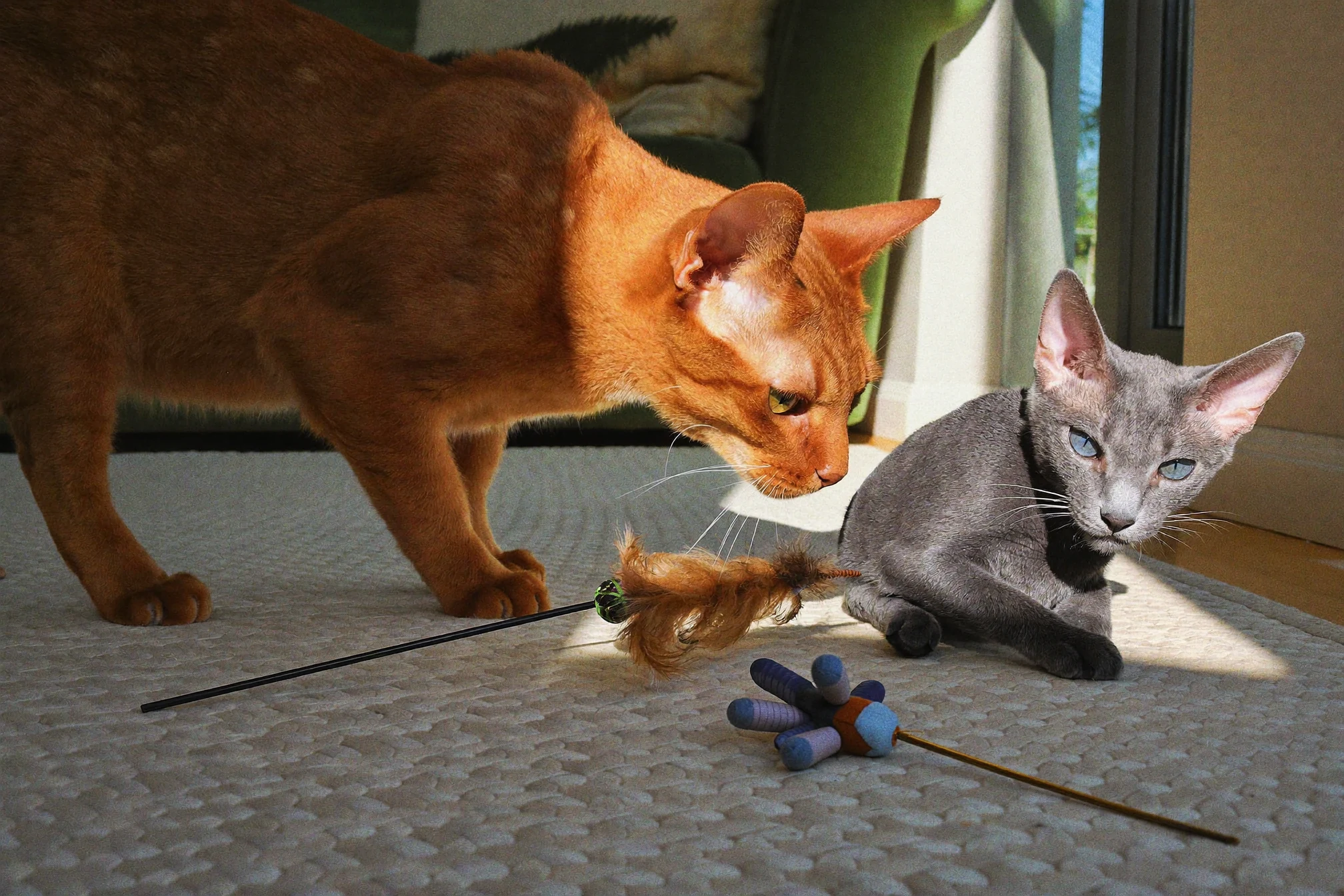
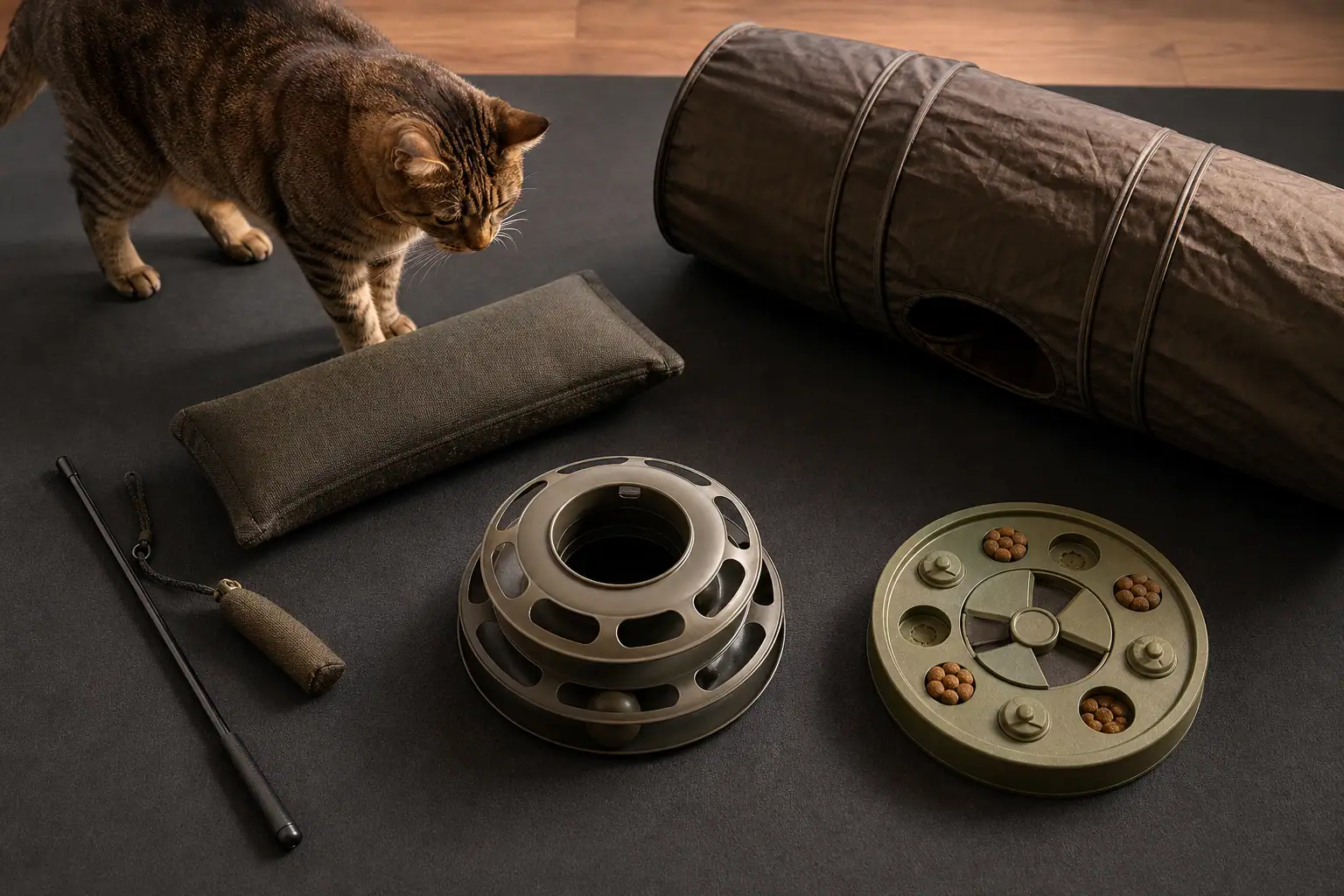
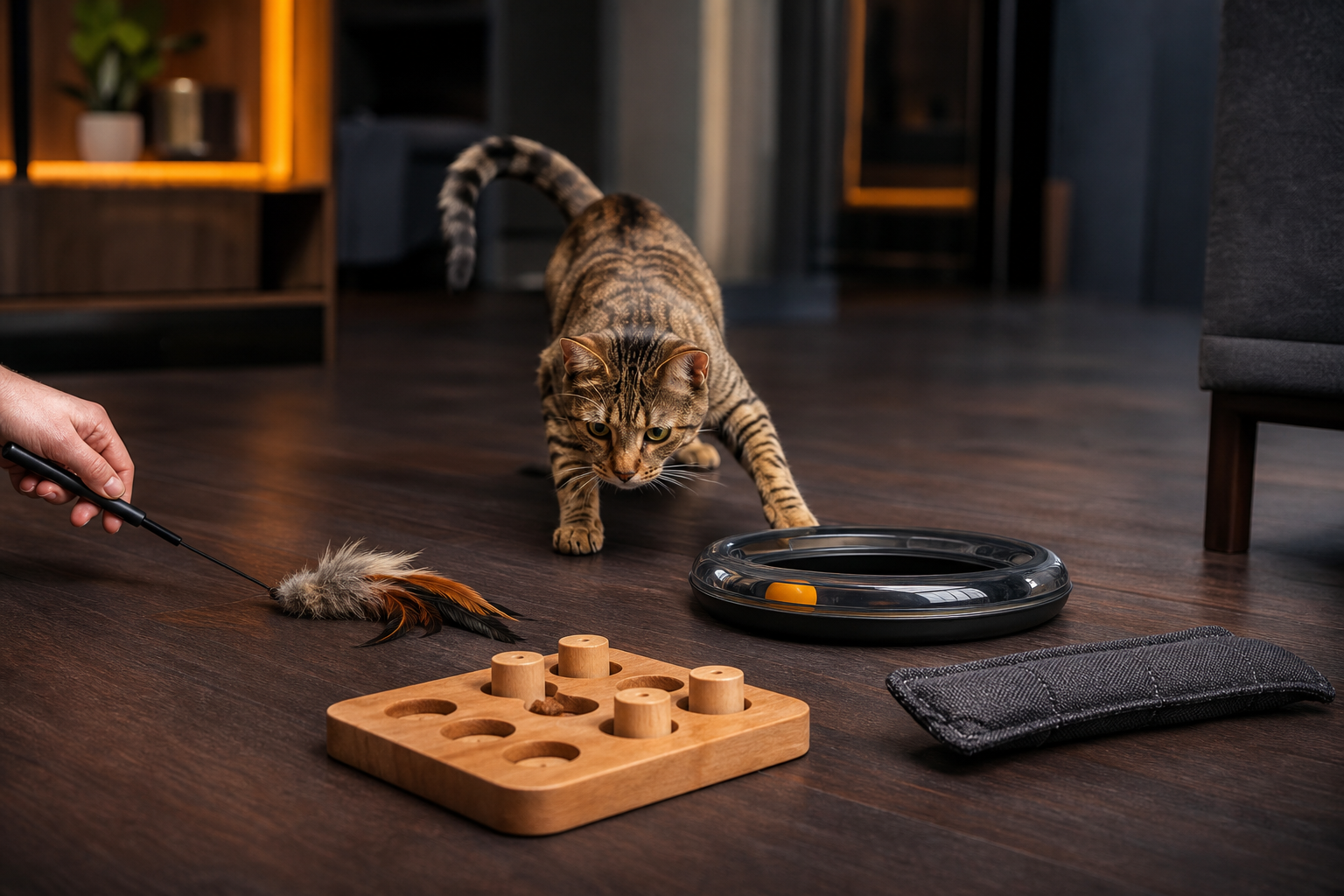
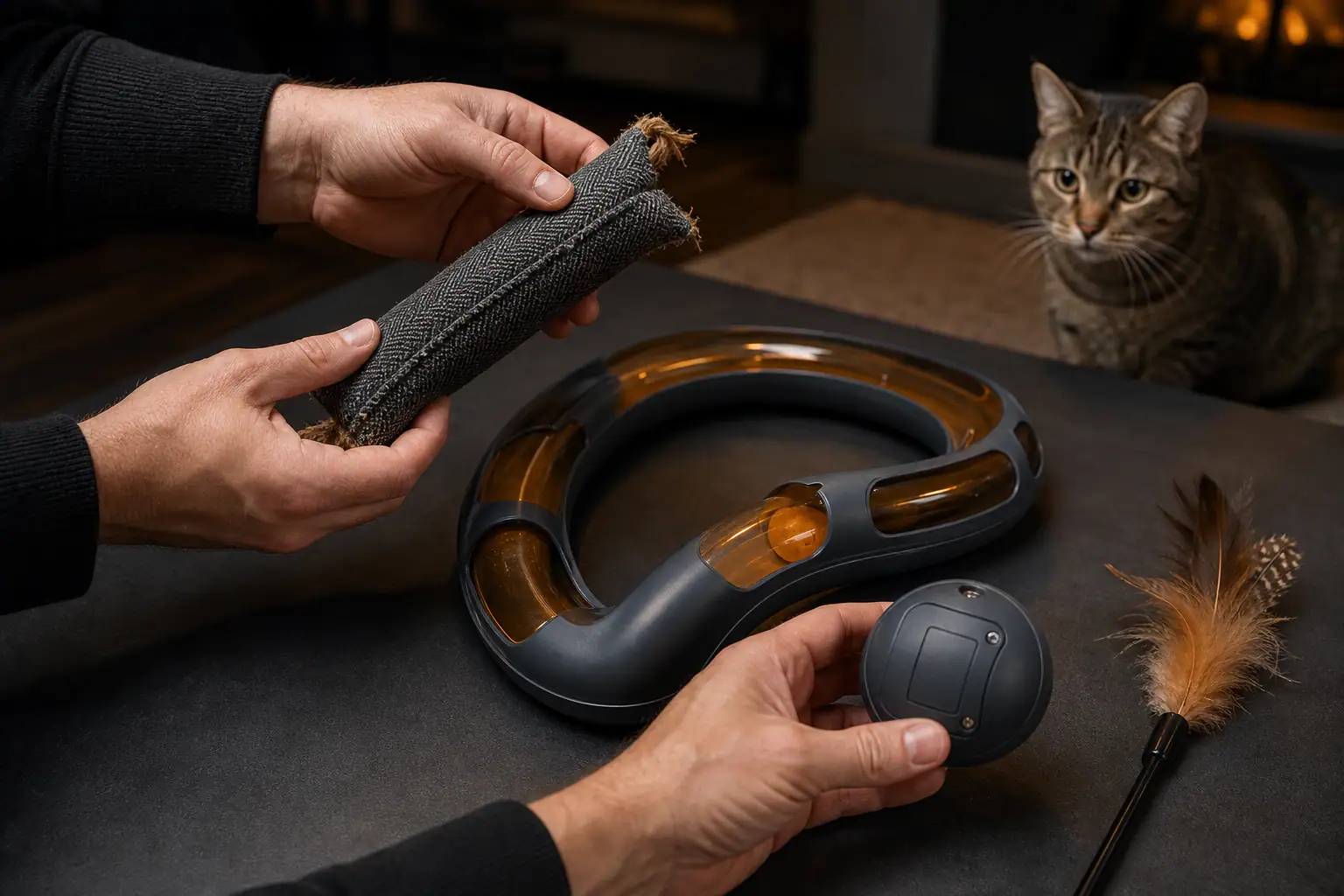
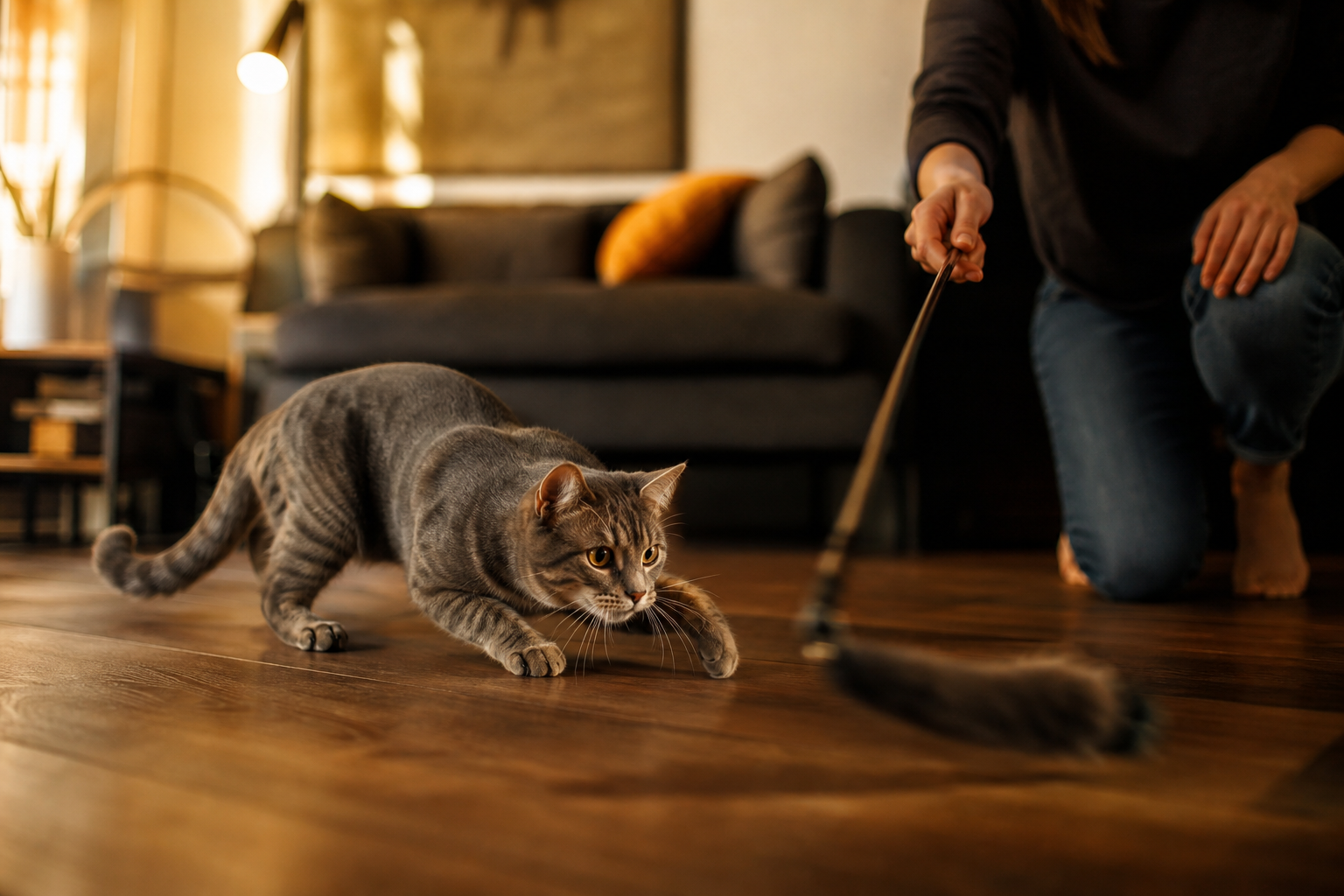
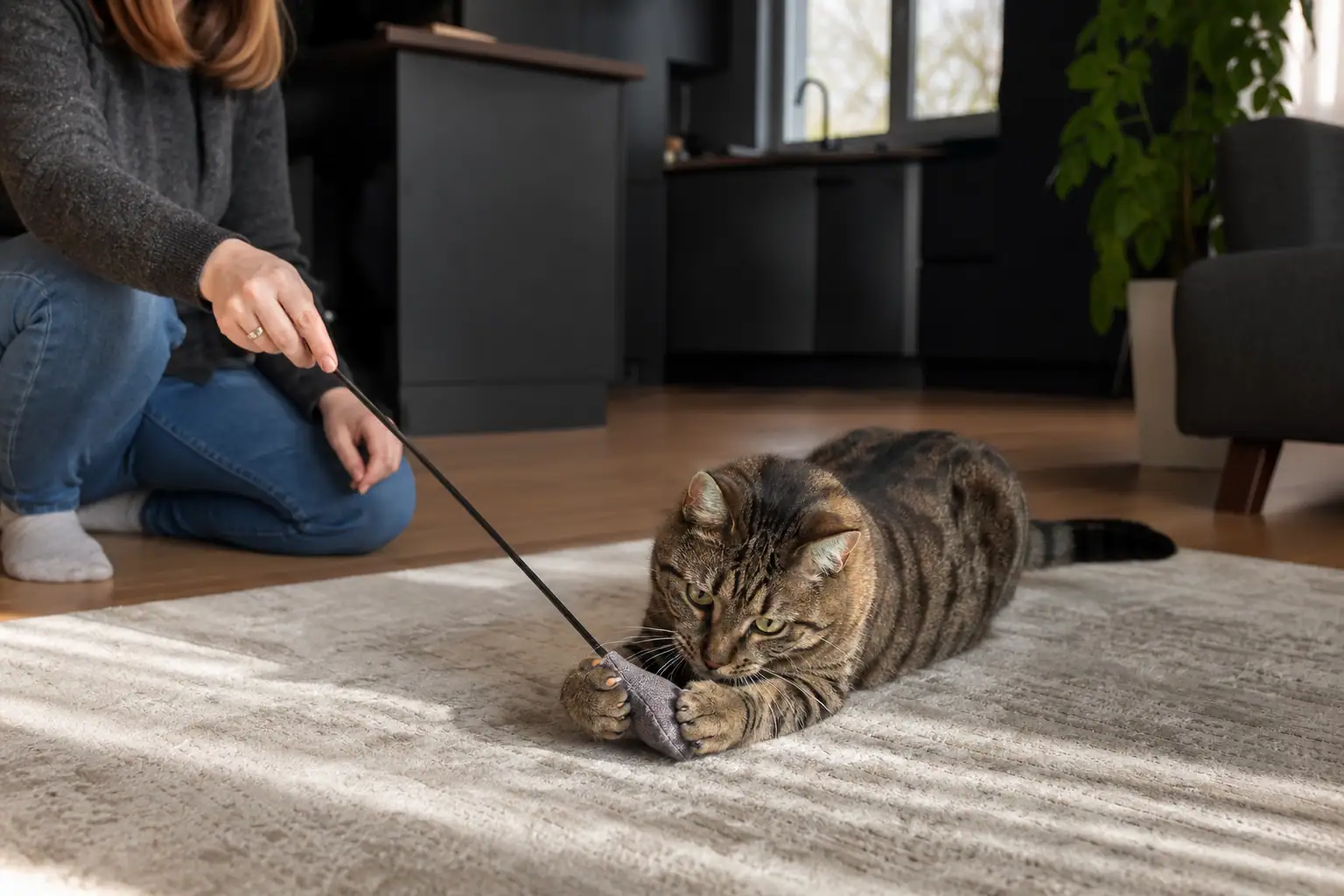
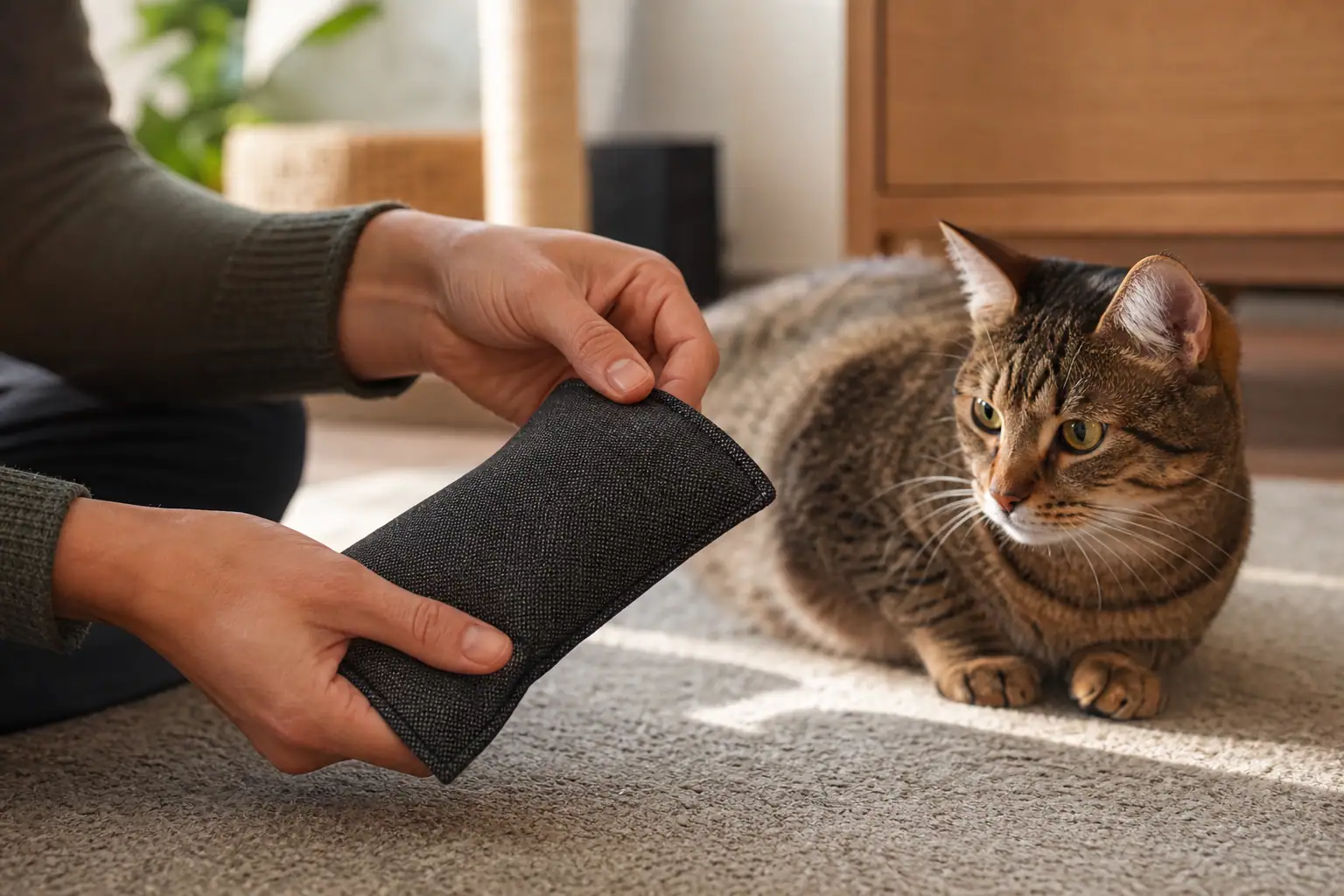
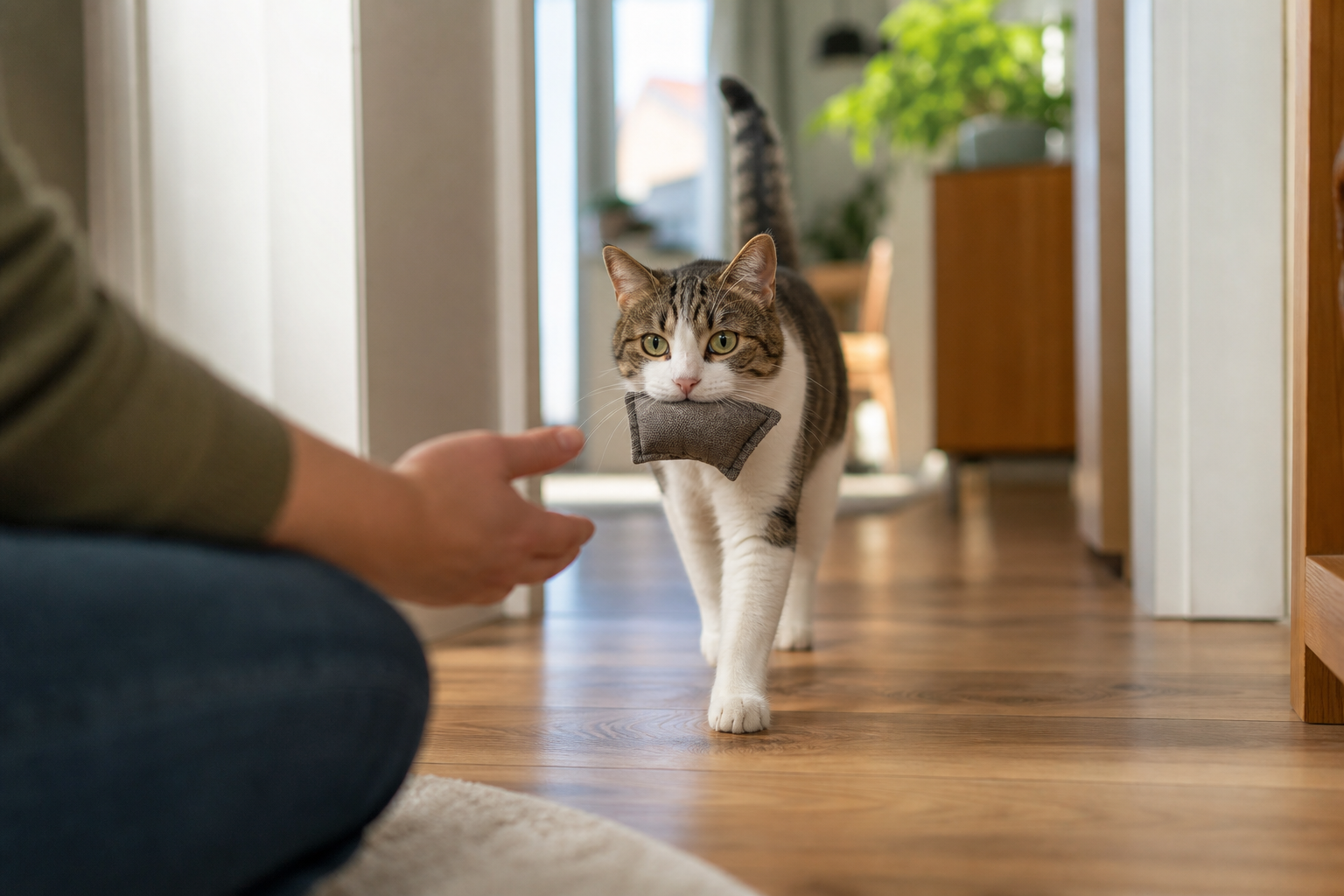
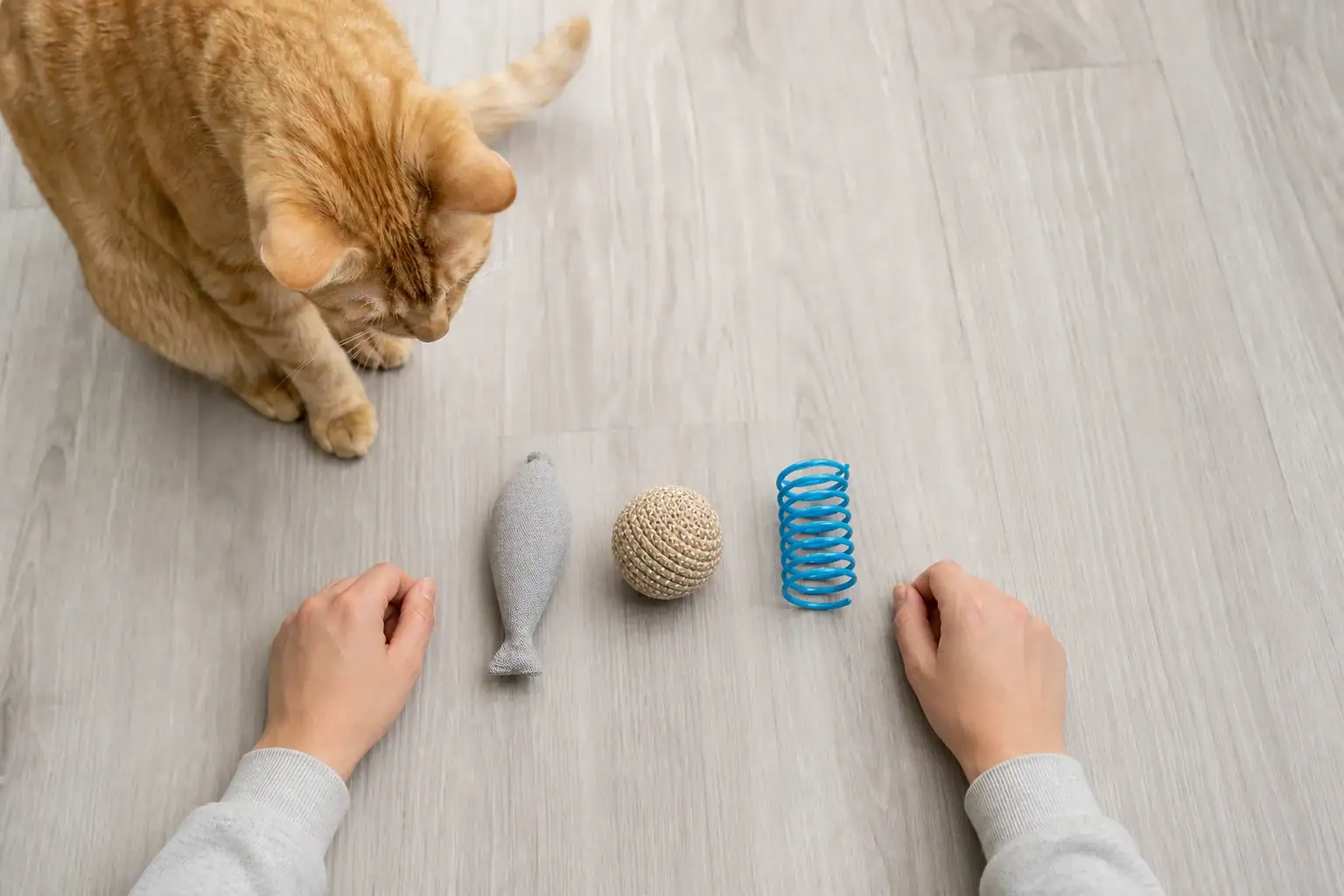
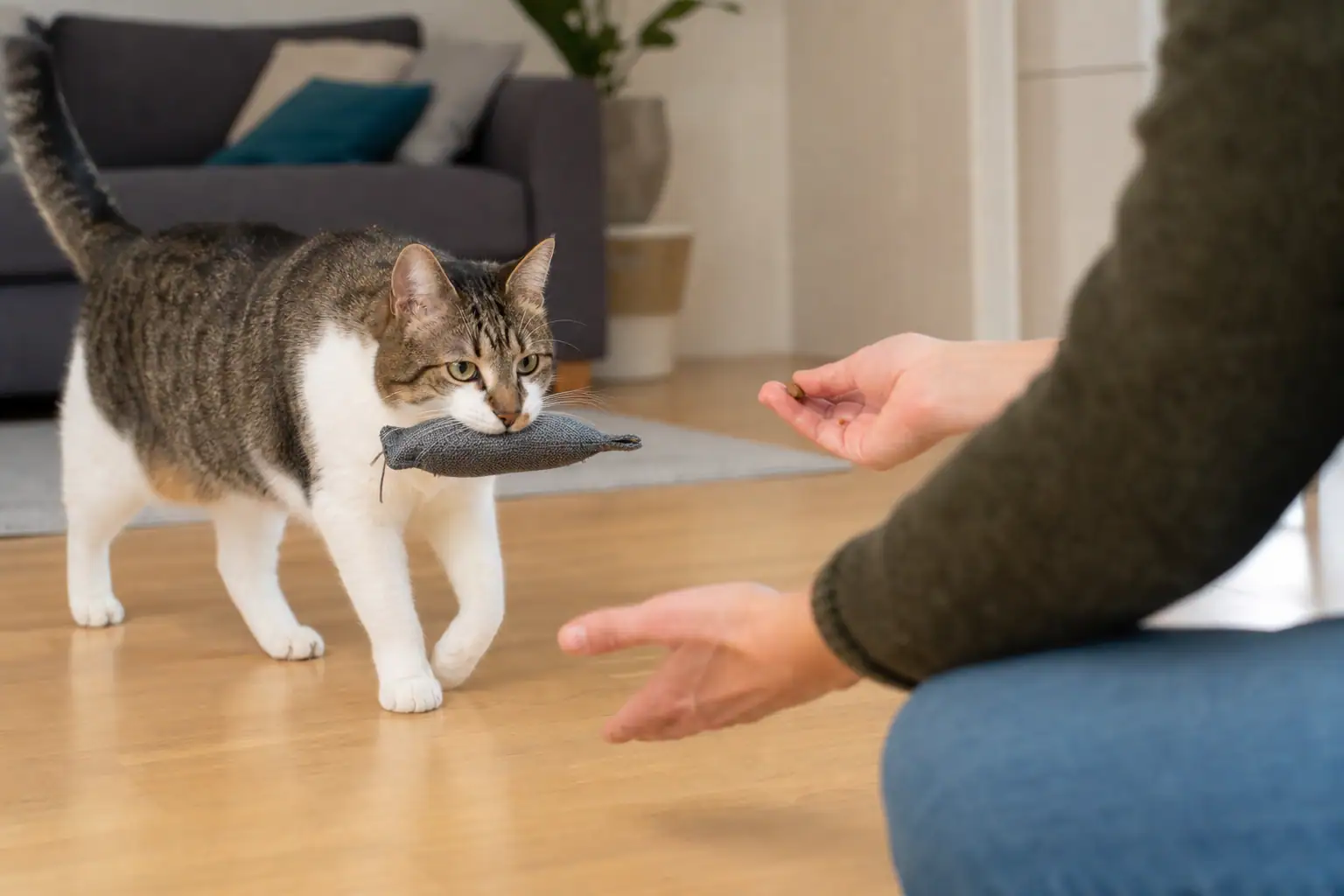
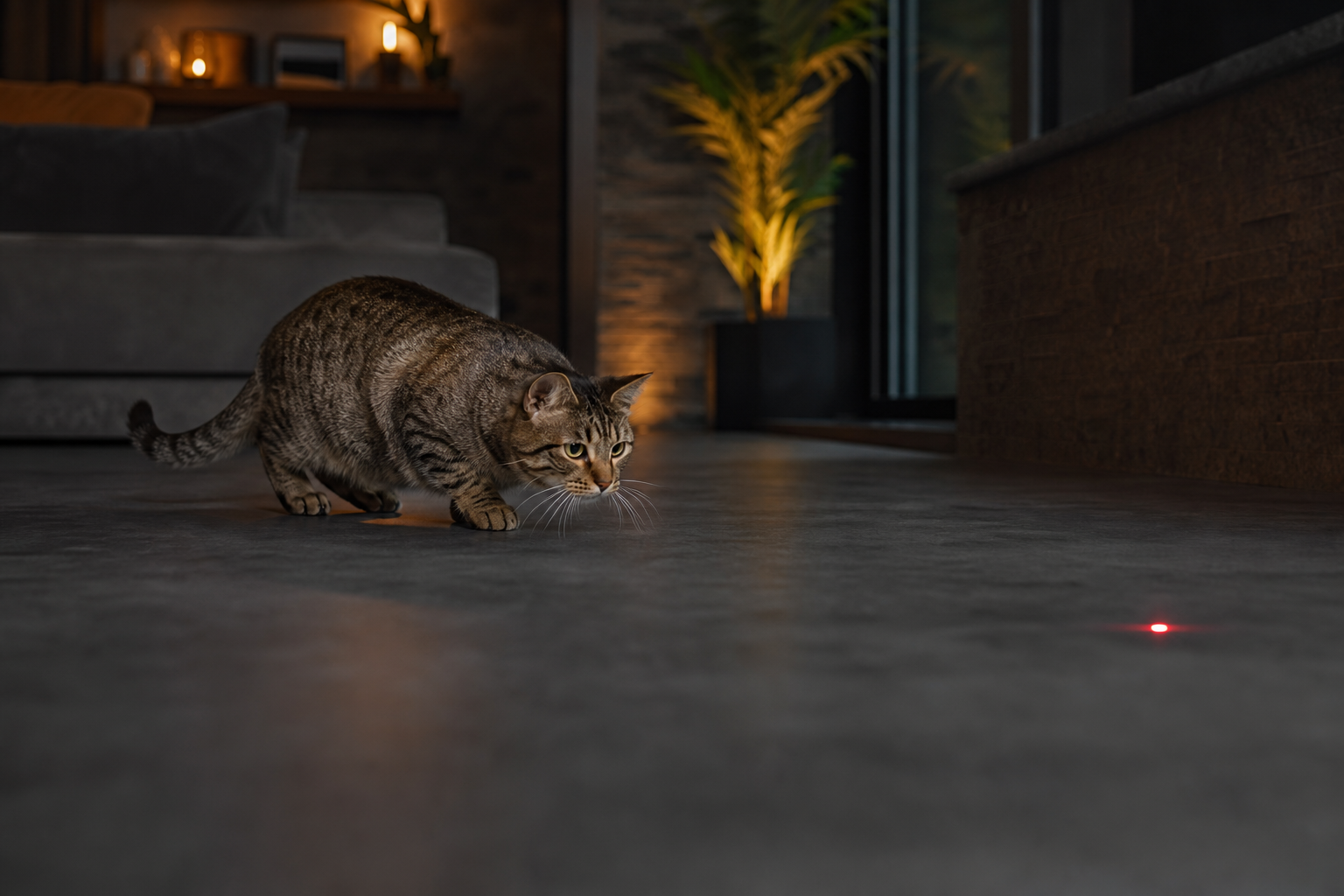
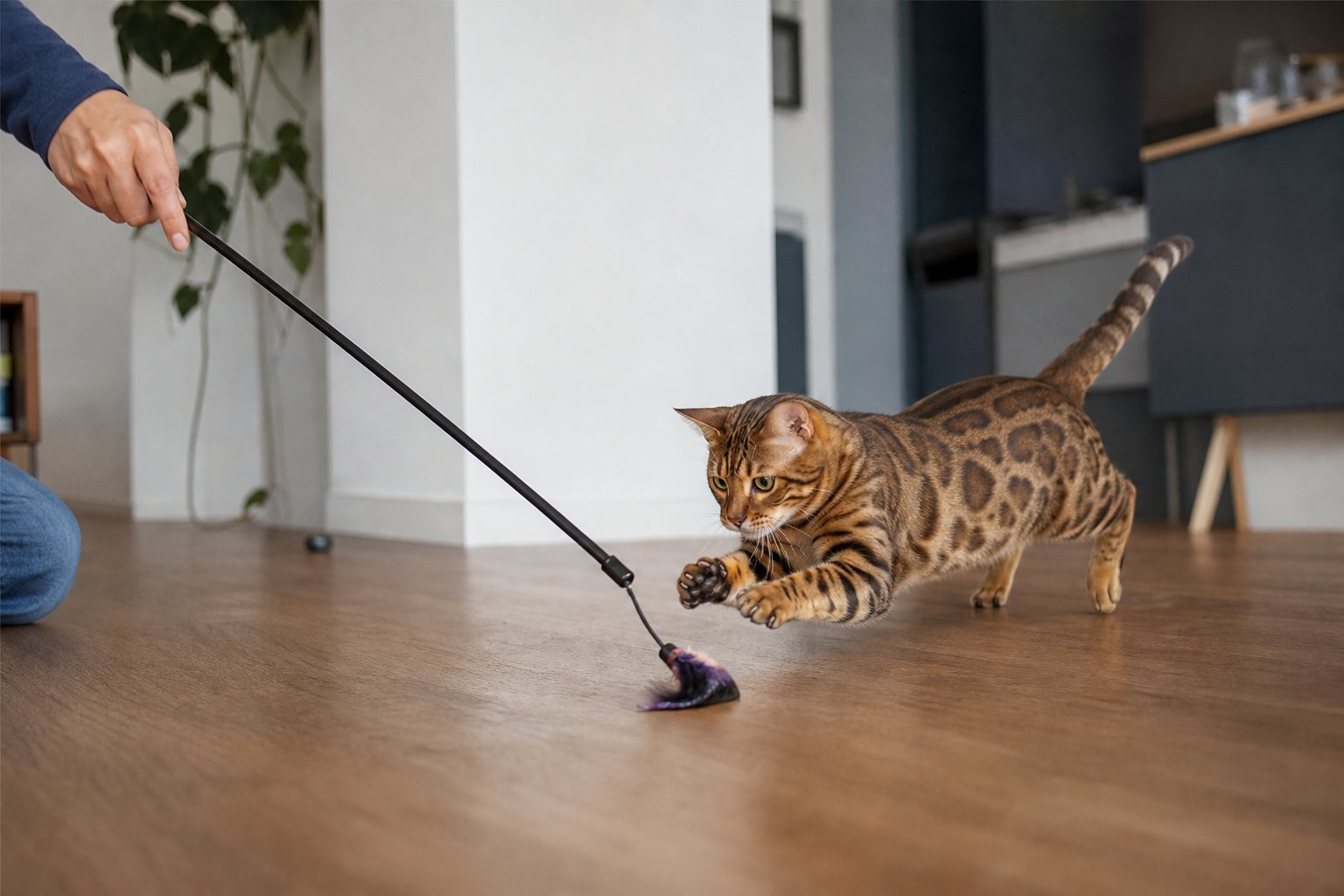
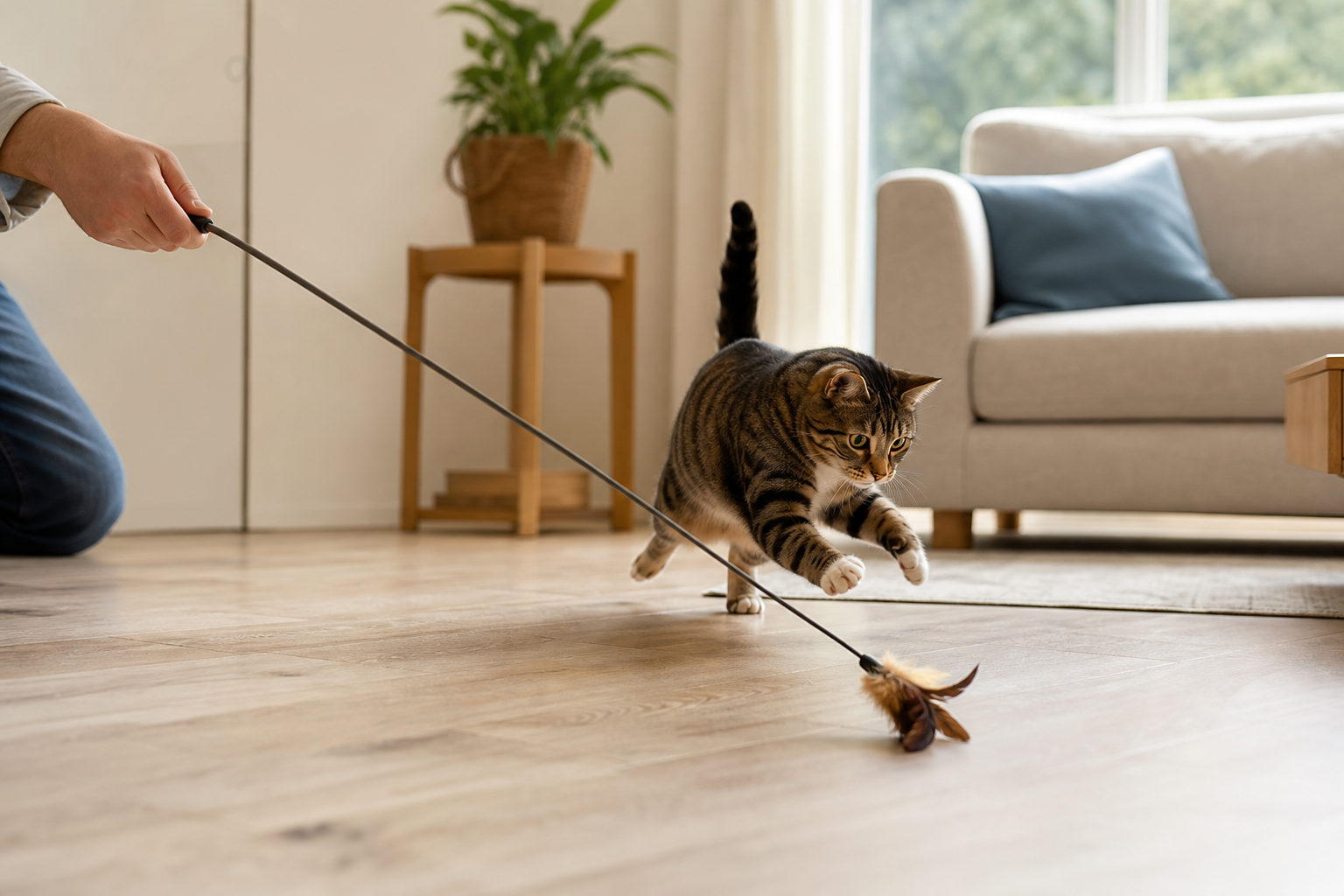
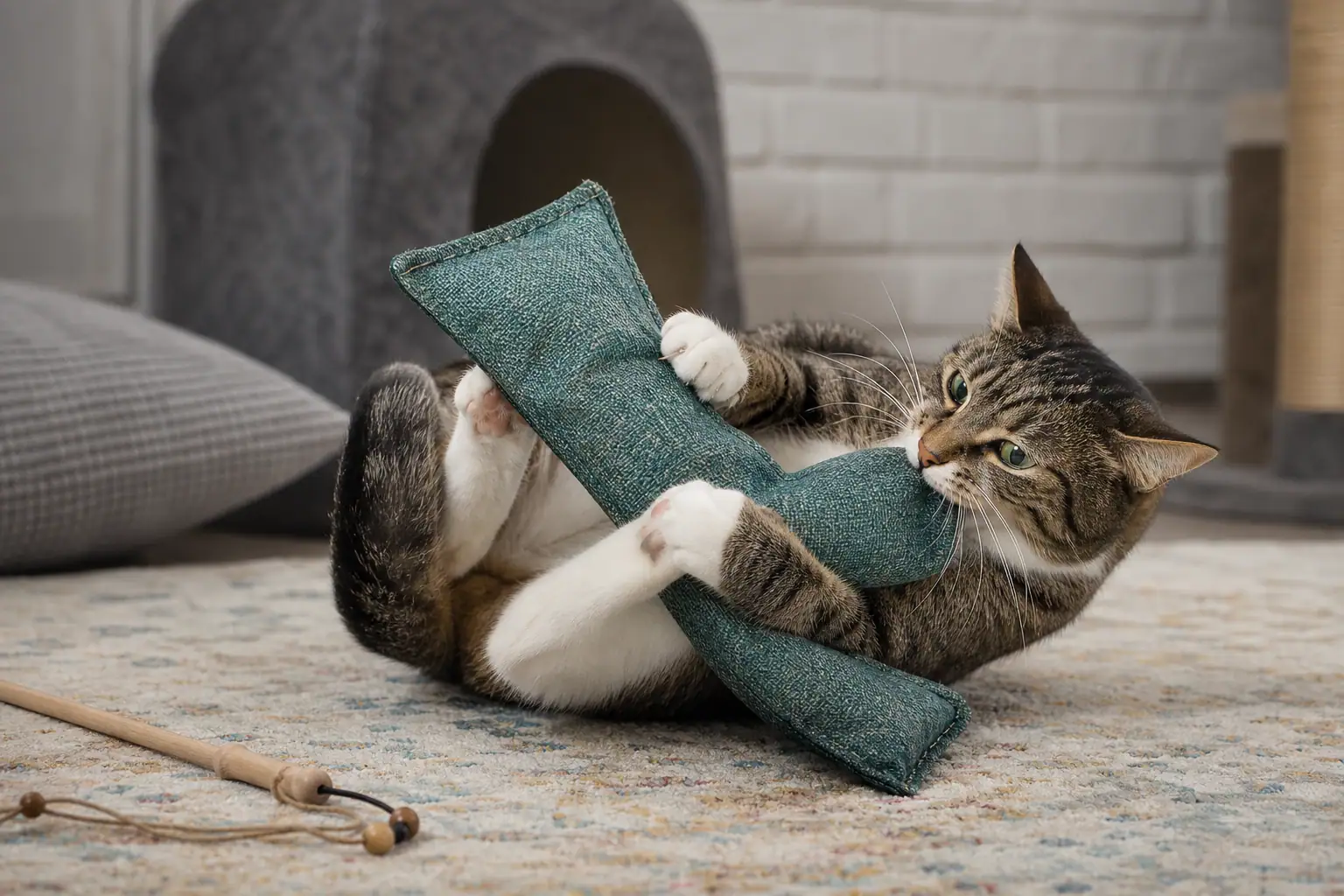
A realistic cat toy for a real cat should behave like prey without adding fragile details that make it unsafe. The useful realism is in the movement: a mouse-sized target that slips behind cover, a lure that flutters and lands, or a catch that pauses long enough to stalk and grab. Photographic fur, plastic eyes, thin tails, and decorative feathers may look convincing to a person while giving a rough-playing cat weak points to chew.
This guide is specifically about prey-style toys for cats. It does not cover lifelike plush or robotic companion pets made for people. Choose the format by the way your cat hunts, insist on a satisfying physical catch, and inspect the toy before and after every hard session.
For a real cat, movement matters more than perfect looks
Cats do not need a museum-quality mouse. A useful realistic cat toy behaves like catchable prey: it appears at the edge of cover, pauses, moves away rather than charging at the cat, and eventually gets caught. Texture and size should support grabbing without adding easily swallowed decoration.
VCA Animal Hospitals’ play guidance recommends predatory games with toys a cat can ultimately catch and “kill,” while monitoring play so non-food items are not consumed. That makes catchability a more valuable form of realism than painted eyes, plastic feet, or a fragile feather tail.
Your cat does this
Try this realistic cue
Better toy format
Watches from cover, then pounces
Small movements and long pauses near a box
Large fabric mouse or wand lure used under supervision
Chases along the floor
Movement away with changes in direction
Rolling or remote-controlled ground toy
Leaps for airborne targets
Short flutter, dip, and landing
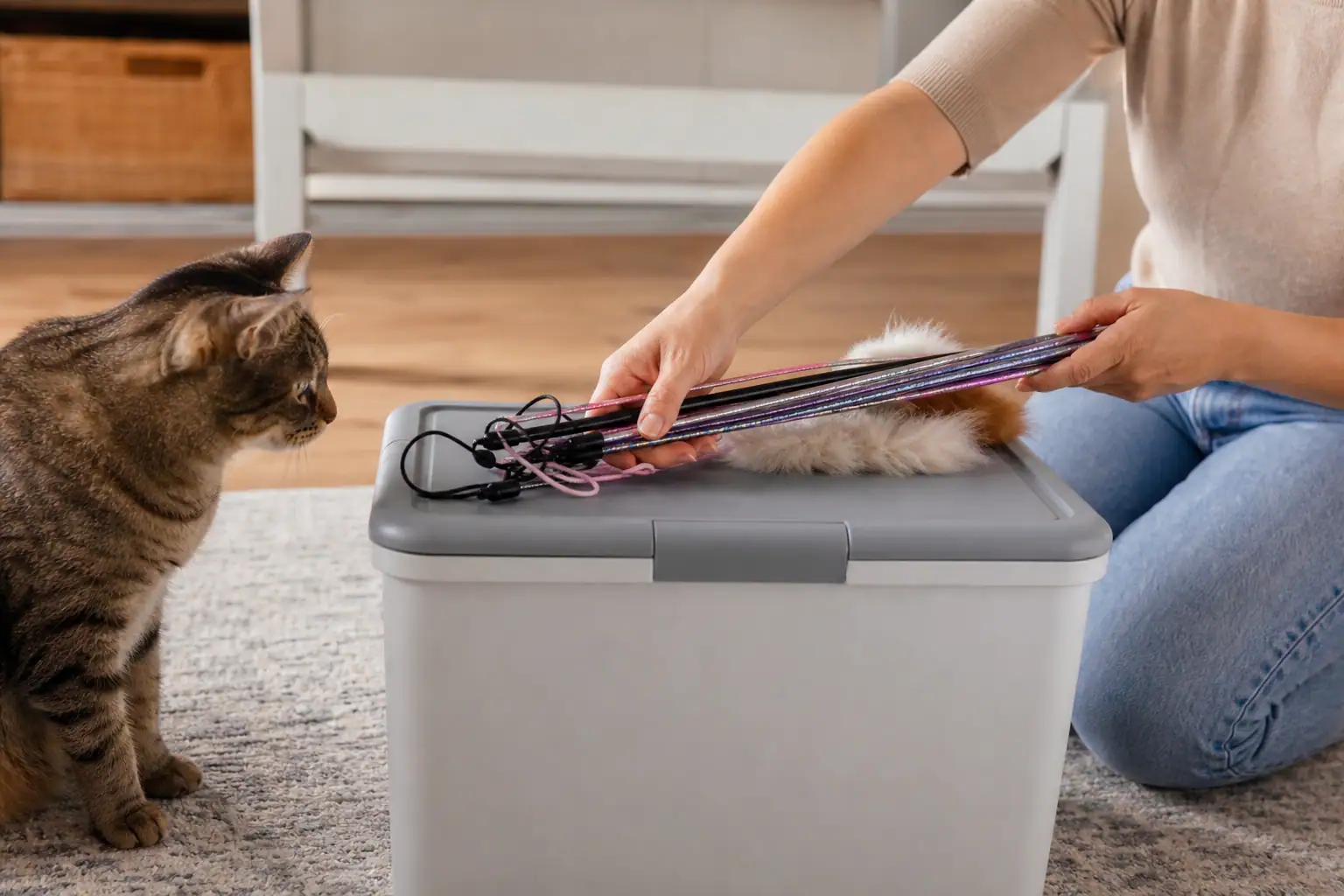
Wand toy stored after play
Grabs and rabbit-kicks
A catch that stays put
Large reinforced kicker
Sniffs and searches
Partly hidden toy or food scent trail
Hide-and-seek toy or food puzzle
Match the motion to the cat rather than choosing the fastest motor. Our guide to cat toys that move compares covered motion, rolling toys, wands, kickers, and electronic options. For owner-controlled ground chases, see the remote control cat toy guide.
For a real cat, convincing movement and a safe catch usually matter more than photographic detail.
Durability and safety for rough-playing cats
A realistic shape can add weak points. Thin tails, glued ears, hard eyes, feathers, elastic, plastic feet, and sound modules give determined cats something to pull, chew, or swallow. Do not assume a toy sold for cats is safe for unattended use, and do not describe any toy as indestructible.
The before-and-after inspection
Count attached parts and check that each one is present.
Press seams and look for widening stitches or exposed stuffing.
Tug lightly on ears, tails, eyes, feathers, and lures.
Check hard shells for cracks, tooth gouges, and new gaps.
Confirm battery doors and charging-port covers sit flush.
Listen for a loose internal piece or a changed motor sound.
Stop using the toy if it becomes hot, wet, misshapen, or difficult to switch off.
Retire the toy when stuffing or electronics become accessible, an attachment loosens, a seam repeatedly reopens, the casing cracks, or a piece is missing. Do not rely on tape or household glue where a cat can bite. If you suspect your cat swallowed string, a battery, stuffing, plastic, or another part, contact a veterinarian promptly rather than waiting for obvious symptoms.
Cats that dismantle ordinary toys need simpler shapes, larger catches, and closer supervision. The Titan Claws guide to durable cat toys for rough play explains how to assess seams, attachments, size, and failure points before buying.
A 10-minute prey-realism test for your cat
You can make a plain, sturdy toy feel more realistic through movement. This short test also reveals whether your cat prefers stalking, chasing, or wrestling before you spend money on a complex model.
Prepare: clear cords, breakables, and narrow gaps. Choose a large intact toy and, if using a wand, keep the string in your hand.
Show, then hide: move the toy once across the cat’s view and let it disappear partly behind a box or furniture leg.
Wait: pause for several seconds. Watching, crouching, and shifting weight can all be part of the hunt.
Move away: use two or three short motions away from the cat. Do not jab the toy toward the face.
Offer a catch: let the cat pin and grab it. Switch off any motor during the catch and redirect biting from hard electronics to a fabric kicker.
Reset twice: repeat a short hide, chase, and catch sequence rather than creating one endless pursuit.
Finish clearly: end after a successful catch, put string or electronic toys away, and inspect every part.
If your cat only watches, slow down and lengthen the pauses. If the cat retreats, make the toy quieter and farther away or choose a nonmotorized option. If the cat immediately chews decorations or attacks the mechanism, the design is a poor match no matter how realistic it looks.
Realistic cat toy buying checklist
The movement matches how my cat prefers to stalk, chase, pounce, or wrestle.
The toy offers a physical catch instead of an endless chase.
The complete toy and any detachable part are too large for my cat to swallow.
Eyes, tails, feathers, covers, and other attachments stay secure under light pressure.
Seams, shells, wheel gaps, and moving parts do not expose stuffing, wires, gears, or pinch points.
Any battery door or charging-port cover closes securely and remains inaccessible during play.
I can supervise the first sessions and store risky string, feather, elastic, or electronic toys afterward.
The toy can be inspected and cleaned according to its materials and instructions.
I will retire it when a part goes missing, a seam opens, a casing cracks, or its sound, heat, smell, or motion changes.
Realistic cat toy FAQs
What makes a cat toy feel realistic to a cat?
Stop-start movement, partial concealment, changes of direction, quiet pauses, and a catchable finish matter more than exact colors or facial details. Move the toy away from the cat rather than pushing it toward the face.
Are realistic mouse and bird toys safe to leave out?
Only after the exact toy and the individual cat have been tested under supervision. Store toys with string, feathers, elastic, loose tails, exposed mechanisms, or chewable batteries after the session.
Is a faster electronic prey toy better?
No. The best speed is one that creates interest without fear or frantic, unrewarded pursuit. A slower toy with pauses and a safe catch often produces a better play sequence.
Can a lifelike plush made for a person be used as a cat toy?
Do not assume so. Human plush and companion products may contain glued features, rigid frames, motors, or battery compartments that were not designed for claws and teeth. Use products intended for pet play and supervise according to your cat’s chewing habits.
Editorial note: This article provides general product-selection and safety guidance. Contact a veterinarian promptly for a suspected ingestion, battery exposure, or injury.
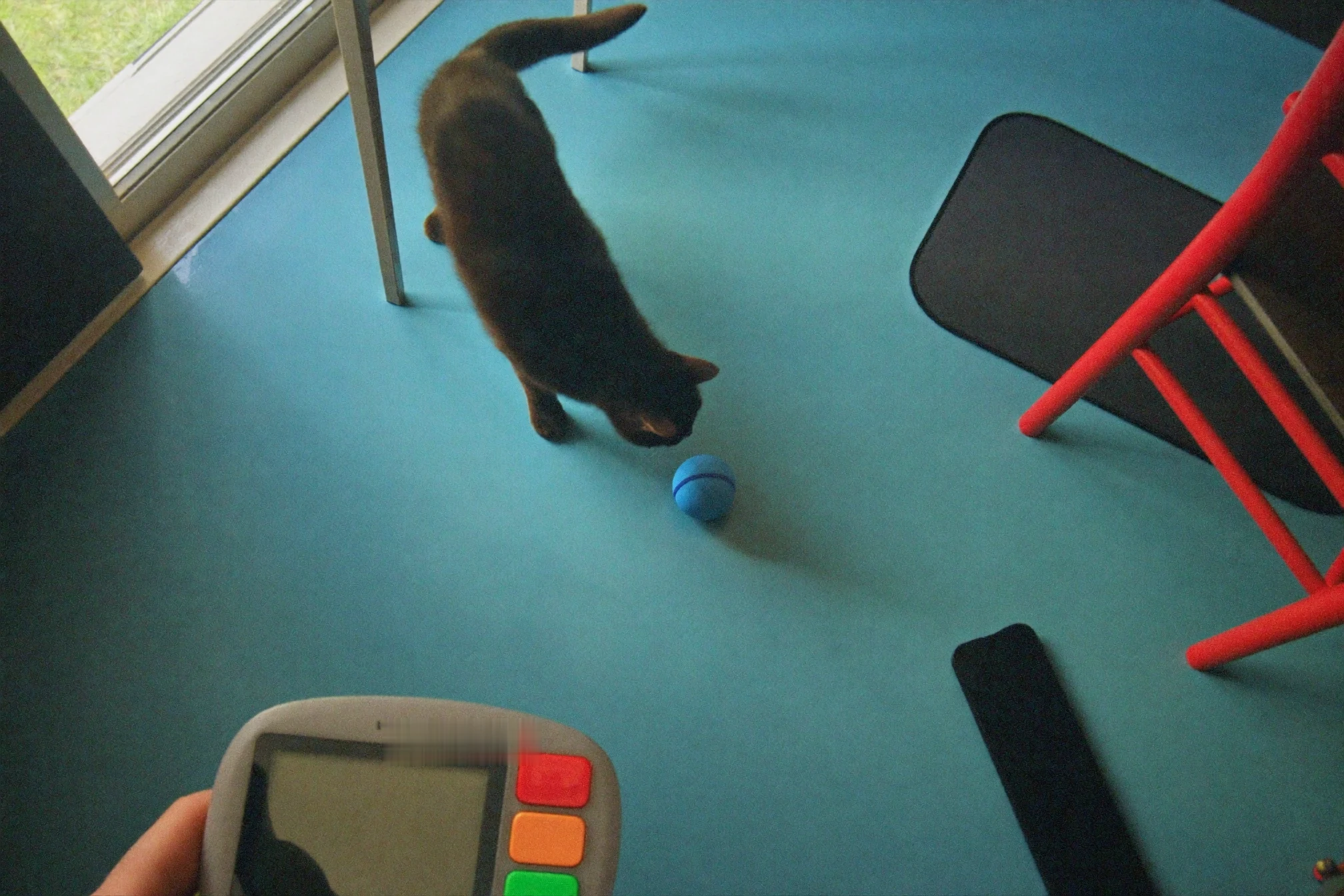
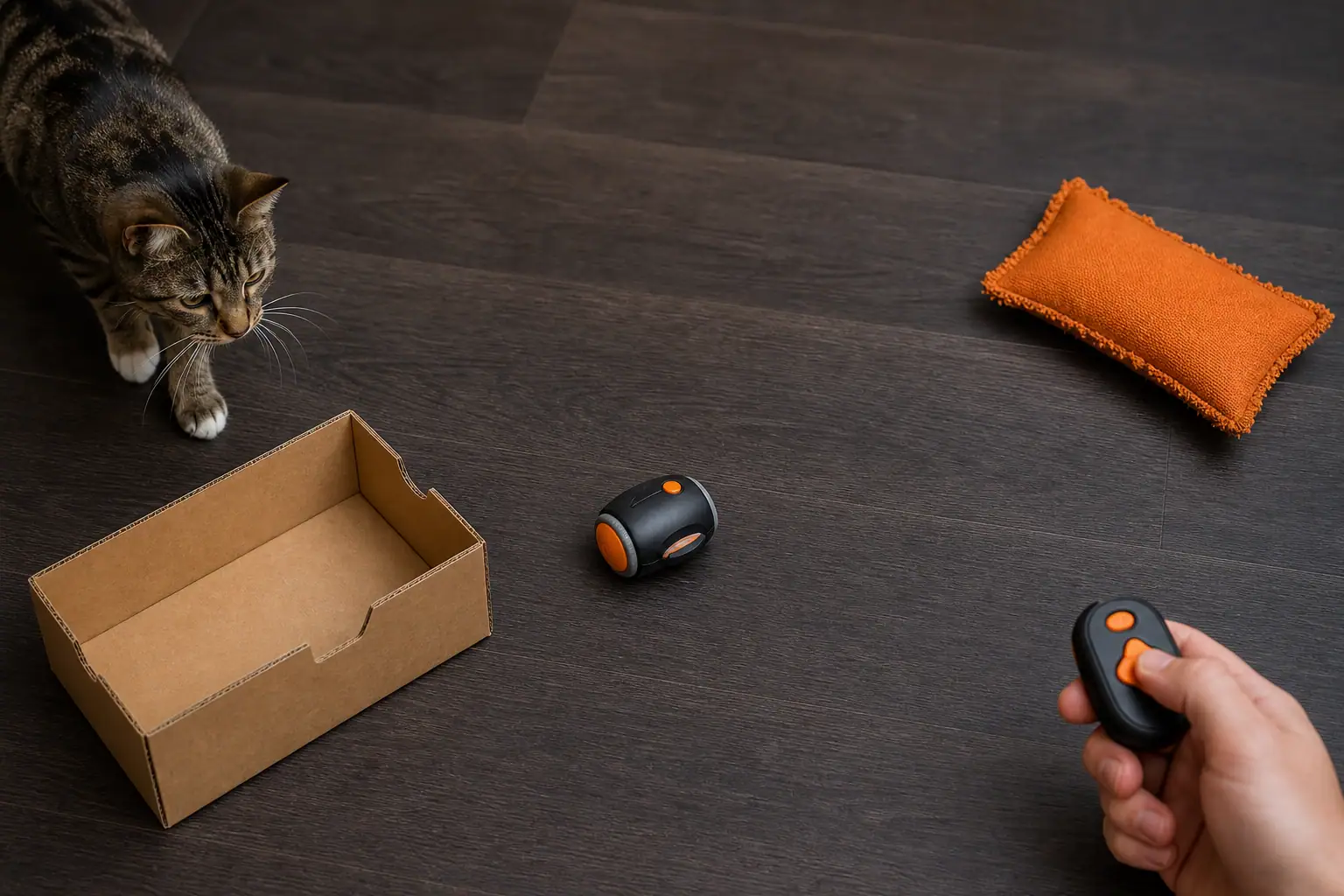
A remote control cat toy can be a good choice when your cat loves ground chases and you want a more responsive game than an automatic toy can provide. The best designs let you start, stop, turn, hide, and offer frequent catches while keeping batteries, wheels, and small attachments beyond a cat’s teeth and claws. Choose for your cat’s play style and your flooring—not for the longest feature list.
For a rough player, treat every motorized mouse, ball, or wheeled creature as supervised-only. Inspect it before and after play, put the charging cable and remote away, and end the session if your cat starts chewing the housing or prying at its seams. No remote control cat toy is indestructible.
This guide focuses on owner-controlled toys rather than generic automatic gadgets. You’ll learn which type fits your cat, what to check before buying, how to steer it like prey, and exactly when to stop using it.
Remote control cat toys at a glance
Remote control is useful because you—not a fixed program—can respond to your cat. You can slow down for a cautious stalker, pause when the cat loses sight of the target, and stop the motor as soon as the toy is caught. That makes the controller more than a novelty; used well, it turns a motorized object into interactive play.
Type
Often suits
Main advantage
Main caution
Remote-control mouse
Ground stalkers on hard floors
Prey-like size and turns
Small tail, ears, wheel gaps, or button batteries
Large rolling or wheeled toy
Fast chasers and hard pouncers
Easier to see and harder to swallow
Plastic chewing, high speed, furniture collisions
Remote plus automatic mode
Cats that enjoy varied movement
Manual play and optional preset cycles
Automatic mode can hide poor control or unsafe behavior
App-controlled camera toy
Owners who want remote check-ins
Live view and distance control
Blind spots, latency, privacy, no physical supervisor
Remote laser
Some visually driven cats
Movement without a chewable moving unit
No physical catch and potential eye exposure
For most cats, start with a physical rolling target you can stop instantly. A laser needs a stricter beam-safety and catch plan; see our guide to whether laser toys are bad for cats before choosing that route. If you are comparing all motorized formats, the broader electronic cat toys guide covers covered-motion toys, kickers, rotating lures, and automatic options too.
Use cover, pauses, and a physical catch to create a hunt rather than an endless chase.
Seven checks before you buy
A product page may emphasize speed, range, or app features. Those details matter only after the toy passes the physical and practical checks below.
Stop control: the toy should stop promptly when you release a button or press stop. A delayed response is a problem when a paw, tail, or toy is pinned.
Battery security: prefer a rigid compartment that requires a tool to open. A sliding cover, flexible tab, or decorative flap is not enough for a cat that bites and kicks.
Reachable parts: look closely at tails, ears, eyes, antennae, wheel hubs, axle gaps, and charging-port covers. Skip anything you could pull off with light finger pressure.
Size and shell: choose a unit too large to swallow, with a smooth casing that does not flex or separate when pressed. Tiny realism is not a benefit if it creates tiny parts.
Floor fit: small wheels may work only on hard floors; deep carpet can stall them. Check turning radius, traction, clearance, and whether the unit can climb a rug edge unexpectedly.
Sound and speed: the lowest setting should be slow enough for stalking. A loud gearbox or instant full-speed launch can frighten a cautious cat.
Cleaning and replacement: dirt and hair collect around axles. You should be able to clean the exterior and wheel area without wetting electronics, and replace a lure without exposing the drive system.
Read the manual before buying when one is available. Specifications can expose compromises that a product photo hides. For example, the manufacturer page for one popular remote-control mouse says it works only on hard surfaces, uses four button batteries, contains small parts, and requires supervised play. That does not make the product automatically right or wrong; it shows why the manual and warnings belong in the buying decision.
How to use a remote control cat toy like prey
The goal is not to see how fast you can drive. Cats commonly hunt through watching, stalking, chasing, pouncing, grabbing, and biting. A satisfying game includes pauses and successful catches; a toy that always escapes can become boring or frustrating.
A 10-minute first session
Prepare the route (2 minutes): close off stairs and appliance gaps. Move drinks, breakables, cords, and unstable objects. Place a cardboard box, tunnel, or chair leg along the route as cover, and set a large fabric kicker near the finish.
Introduce it switched off (1 minute): place the toy several feet away. Let your cat approach, sniff, retreat, or ignore it. Do not drive it directly at the cat.
Start small (2 minutes): make one slow movement across the cat’s field of view, then stop. Move away from the cat rather than chasing the cat. Let the toy disappear partly behind cover.
Build a hunt (3 minutes): alternate a few seconds of movement with longer pauses. Turn only when needed. Let the cat catch and pin the toy several times, switching the motor off during each catch.
Offer the bite (1 minute): if the hard housing is not appropriate for biting, stop beside the kicker and shift the cat’s attention to that physical target.
End and inspect (1 minute): finish after a catch, offer a small food reward if suitable, then check the toy for heat, cracks, loosened parts, hair around the axles, and a changed motor sound.
The timing should flex with the cat. A senior or hesitant cat may only watch two slow passes. A young, athletic cat may want several short rounds. Stop while your cat is still comfortable rather than running the battery down. The practical play-sequence advice from Preventive Vet likewise emphasizes behaving like prey, letting the cat catch it, and slowing the game to a clear finish.
Use the room as part of the game. A toy that vanishes behind a box and peeks out is often more interesting than one circling in an empty space. Our guide to cat toys that move explains how different motion patterns fit stalkers, sprinters, and wrestlers.
Make the room and hardware safe
Remote control reduces some risks because you can intervene, but it does not remove them. You still need a clear sightline and a reachable off switch. Do not drive near stairs, balconies, fireplaces, water bowls, floor vents, reclining furniture, or gaps where the toy can enter but the cat cannot.
Cornell Feline Health Center advises avoiding small pieces, feathers, string, and accessible electrical cords, and recommends checking the play environment for falling and fall hazards. For a remote-controlled toy, apply that guidance to both the moving unit and everything around its route.
The 60-second pre-drive check
Switch the toy off and press every casing seam.
Confirm the battery door is rigid and its screw is present and snug.
Spin each wheel by hand; remove hair only according to the manual.
Check axles and wheel wells for a paw-sized pinch or trapping gap.
Pull lightly on the lure and every decorative part.
Confirm the remote’s stop command works before the cat enters.
Remove the charging cable, loose batteries, packaging, and tools.
Run one complete test lap without the cat.
Count parts before play so you can recognize a missing piece afterward.
Button and coin batteries deserve special attention because some compact mice and handheld remotes use them. The U.S. Consumer Product Safety Commission warns that swallowed button or coin cells require immediate medical attention. Keep new and spent batteries inaccessible. If a battery is missing or you suspect your cat chewed or swallowed one, contact a veterinarian or emergency veterinary service immediately; do not wait for symptoms.
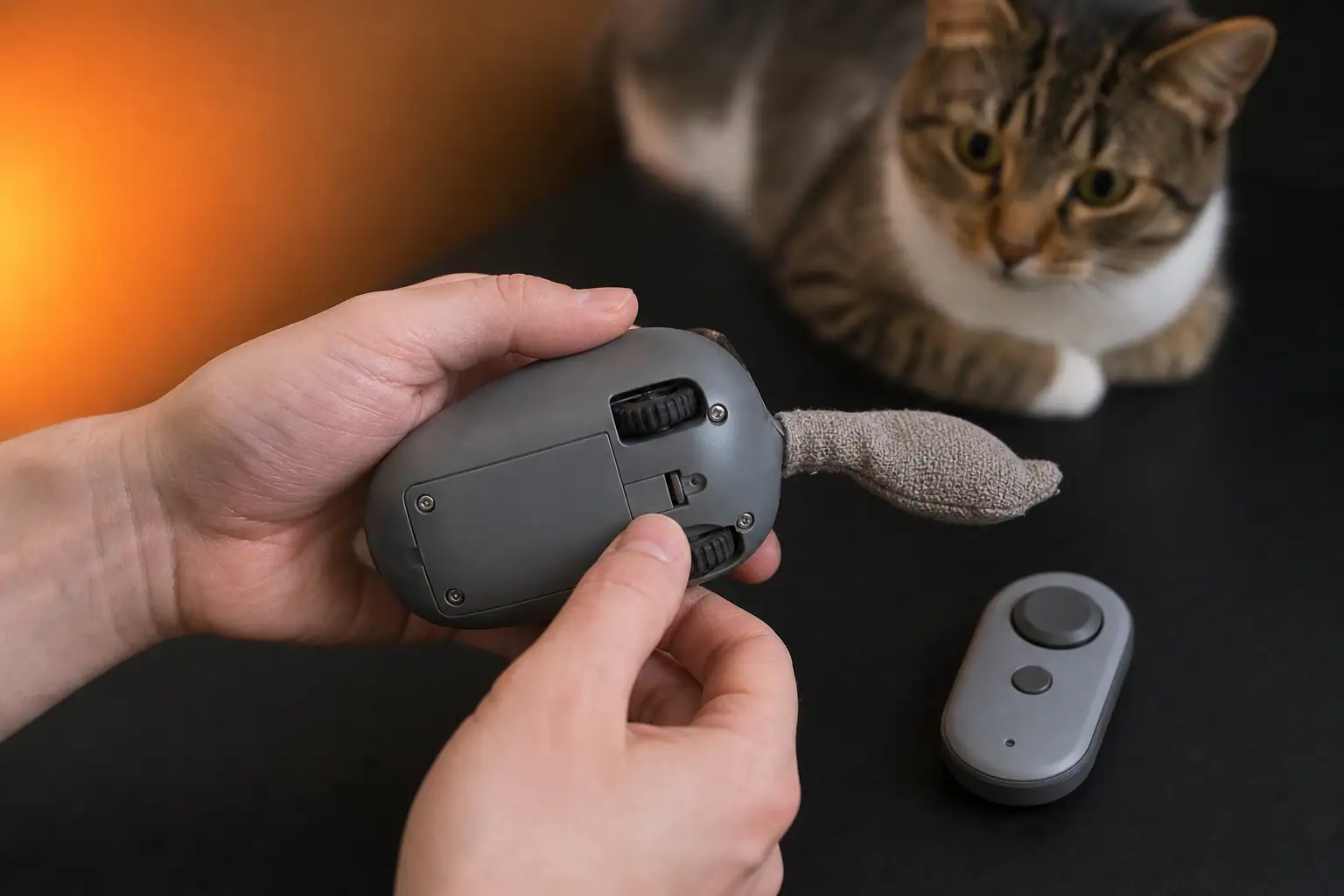
Check the battery closure, wheels, seams, lure, and stop control before the cat joins the game.
Durability rules for cats that play rough
Electronics introduce failure points that ordinary balls do not have: battery doors, switches, ports, axles, motors, and removable lures. A toy can survive a collision yet become unsafe after a cat holds it and rabbit-kicks the shell. Judge durability after catches, not only while the toy is moving.
For plastic gnawers: choose a smooth, thick housing without raised controls. End the catch immediately if teeth stay on the casing.
For attachment pullers: avoid feathers, thin tails, elastic, rubber whiskers, and snap-on pieces. Use the motorized unit for the chase and a separate rugged kicker for the grab.
For crushers: favor a low, broad body and inspect for stress whitening, new gaps, internal rattles, or a changed wheel angle after every tackle.
For carriers: choose a unit too large to lift easily or wedge behind an appliance. Recover and store it after every session.
For wet players: stop if the toy is drooled on, carried to a water bowl, or exposed to a spill. Follow the manual before cleaning or restarting it.
Retire the toy when the housing cracks or flexes, a wheel loosens, the battery door will not stay closed, a lure frays, the unit becomes hot, a rechargeable cell swells, liquid gets inside, or the motor suddenly sounds different. Tape and glue are not reliable repairs for a compartment or part your cat can reach. For a deeper material and failure-point framework, use our durable cat toys guide.
Remote control is not the same as unattended play
A handheld remote normally means you are in the room. An app-controlled camera toy may let you steer from another building, but that does not provide hands-on supervision. Video can miss a detached part, a warm battery compartment, a paw caught behind the unit, another pet entering the room, or the cat carrying the toy out of frame.
If a toy has a camera, microphone, speaker, cloud account, or shared app access, also check the manufacturer’s support history, update policy, permissions, password controls, and data settings. Use a unique password and enable multi-factor authentication when available. A pet camera is a connected device inside your home, not merely a toy.
Do not use a long-distance app to test an unfamiliar toy. First complete multiple in-person sessions on the same flooring and in the same cleared room. If your cat chews housings, removes parts, carries devices, or becomes highly aroused, keep remote play in-person. When you actually need solo enrichment, compare options in our guide to automatic cat toys for when you are away; remote control and automatic operation solve different problems.
If your cat ignores, fears, or attacks the toy
Your cat watches but does not chase
Watching can be part of the game. Slow the toy down, move it across rather than toward the cat, let it disappear behind cover, and wait longer between movements. Try at a time when your cat naturally becomes active. Do not keep increasing speed to force a response.
Your cat leaves when the motor starts
Turn it off and create distance. Over several sessions, pair the silent toy with treats or calm play, then briefly run it farther away at the lowest speed. If your cat continues to hide, flatten the ears, crouch tightly, or avoid the room, choose a quieter nonmotorized toy. Our guide to introducing toys to shy cats uses the same choice-first approach.
Your cat tackles the housing instead of the lure
Switch off immediately and trade for a large fabric kicker. On the next round, shorten the chase and finish at the kicker before the cat catches the hard unit. If the housing itself remains the target, this toy is a poor fit.
Your cat becomes frantic or redirects onto another pet
Stop the motion, separate animals calmly, and let arousal fall. Future sessions should be shorter and one cat at a time. Ask a veterinarian about a sudden or severe behavior change, especially when it comes with pain, appetite changes, or reduced activity.
Remote control cat toy checklist
The movement matches your cat’s preferred ground-hunting style.
The toy stops promptly and predictably.
The complete unit is too large to swallow and difficult to carry into a hazard.
The battery compartment requires a tool and does not flex open.
No tail, ear, lure, cap, or wheel part loosens under light pressure.
The wheels and turning radius suit your actual flooring.
The lowest speed supports stalking rather than only sprinting.
The motor and gearbox are quiet enough for your cat.
You can clean hair from the wheel area without opening the electronics.
You have a clear route, physical catch toy, inspection routine, and storage place.
You will supervise every session if your cat chews, dismantles, or plays rough.
Are remote control cat toys good for indoor cats?
They can be useful for indoor cats that enjoy chasing ground prey, especially when the person uses responsive starts, pauses, cover, and catches. They should add variety alongside wand play, climbing, scratching, food puzzles, exploration, and rest—not replace those outlets.
What is the best remote control cat toy for carpet?
Look for larger wheels, adequate ground clearance, a wide stable body, and a return policy that lets you test your carpet. Check the manual and owner reviews for the same pile height you have. Small mouse wheels often stall on carpet, and a stronger motor does not fix poor clearance.
Can I use a remote control car as a cat toy?
A children’s or hobby RC car is not automatically pet-safe. Exposed axles, hard edges, removable body clips, antennas, accessible batteries, higher speed, and pinch points can make it a poor choice. Use a product designed and labeled for pet play, then inspect and supervise it as carefully as any other motorized toy.
How long should a remote-control play session last?
Start with a few minutes and let your cat’s body language set the limit. Short rounds with several catches are more useful than one continuous high-speed chase. End if the cat disengages, becomes fearful, pants, redirects aggression, or starts attacking the mechanism.
Editorial note: This article provides general toy-selection and enrichment guidance. It does not replace advice from a veterinarian who knows your cat or emergency care after a suspected ingestion, battery exposure, injury, or sudden behavior change.
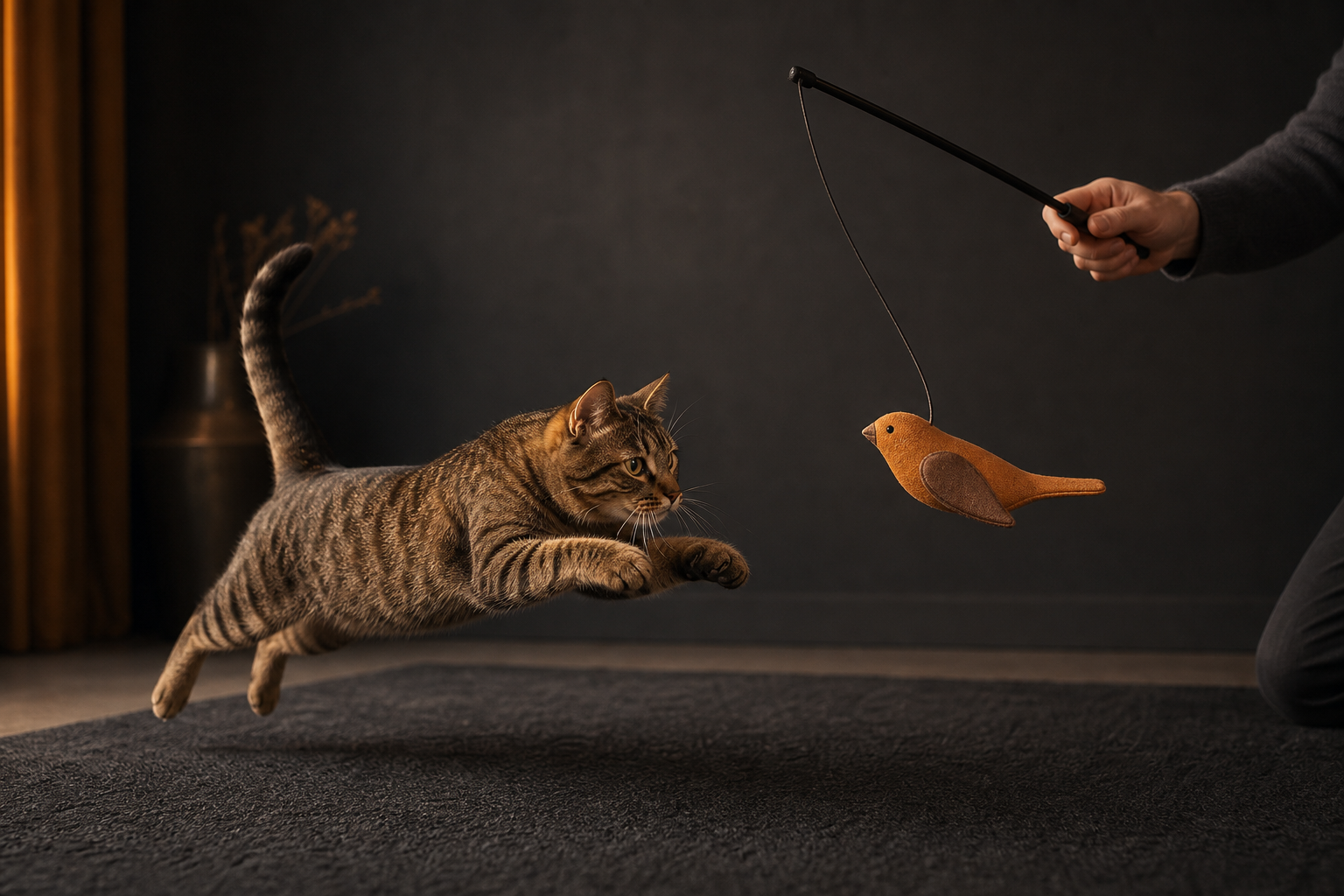
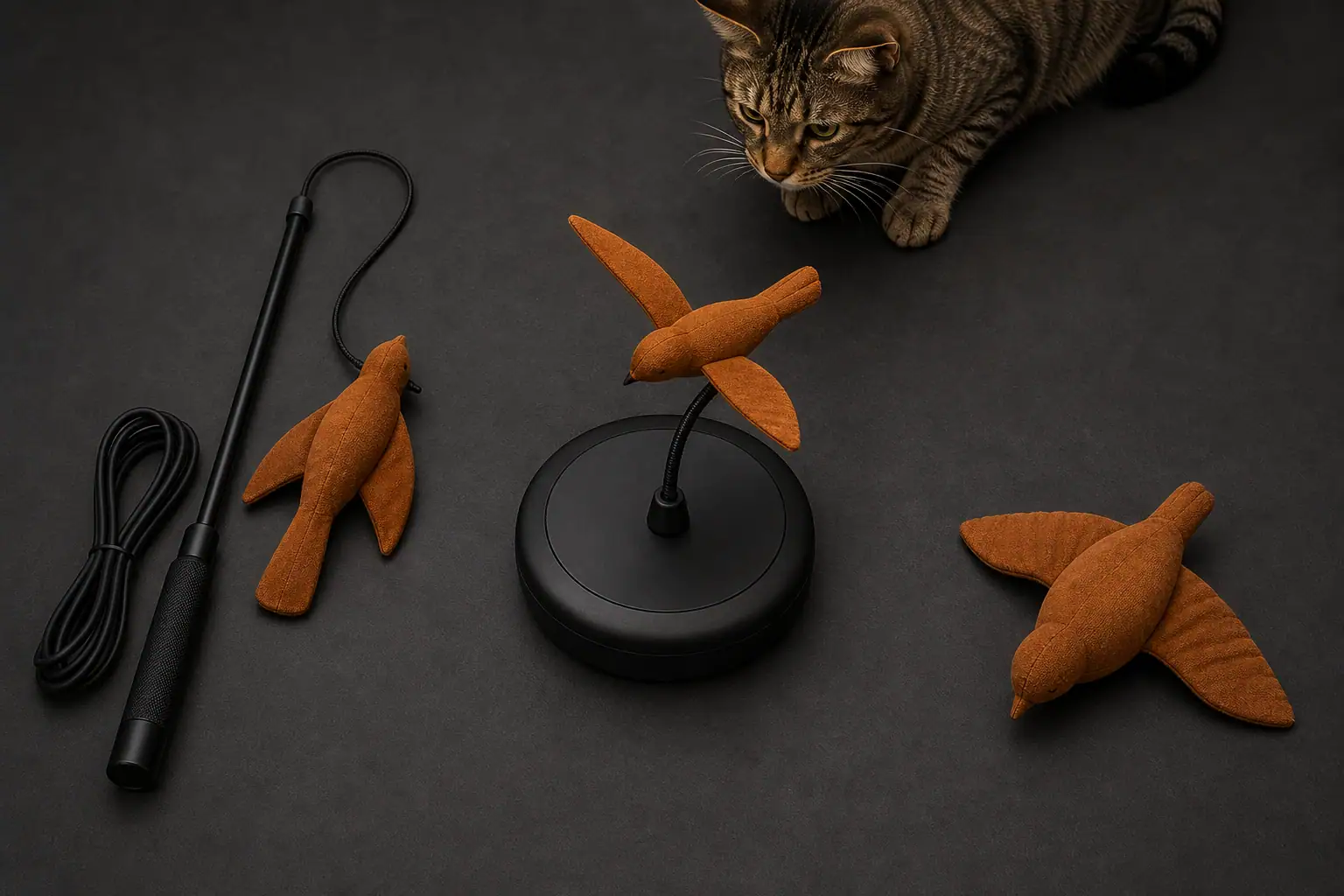
A flying cat toy is usually one of four things: a hand-controlled wand lure, a bird that circles from a fixed base, a hanging or door-mounted toy that bounces through the air, or an electronic plush bird that flaps on the floor. Only a small subset truly flies freely. Product listings often use flying to describe bird-like motion, so check the mechanism before you buy.
For most cats, the best choice is not the gadget that reaches the most altitude. It is the toy that lets the cat stalk, chase, catch, and release without exposing teeth or paws to propellers, loose string, weak feathers, or an accessible battery. A sturdy wand with a large fabric lure gives you the most control. A tethered motorized toy can add variety, but it still needs supervision and inspection.
This guide explains what flying bird toys actually do, how to choose one for your cat and room, and where rough players tend to break them. No cat toy is indestructible. The goal is useful movement, visible wear, and a routine that ends before a loose part becomes a swallowed part.
Flying cat toy types at a glance
Type
How it ‘flies’
Best use
Main risk
Wand or teaser
You sweep a fabric, feather, or plush lure through the air
Controlled interactive play and bonding
String, elastic, feathers, clips, and hard catches
Fixed-base circling bird
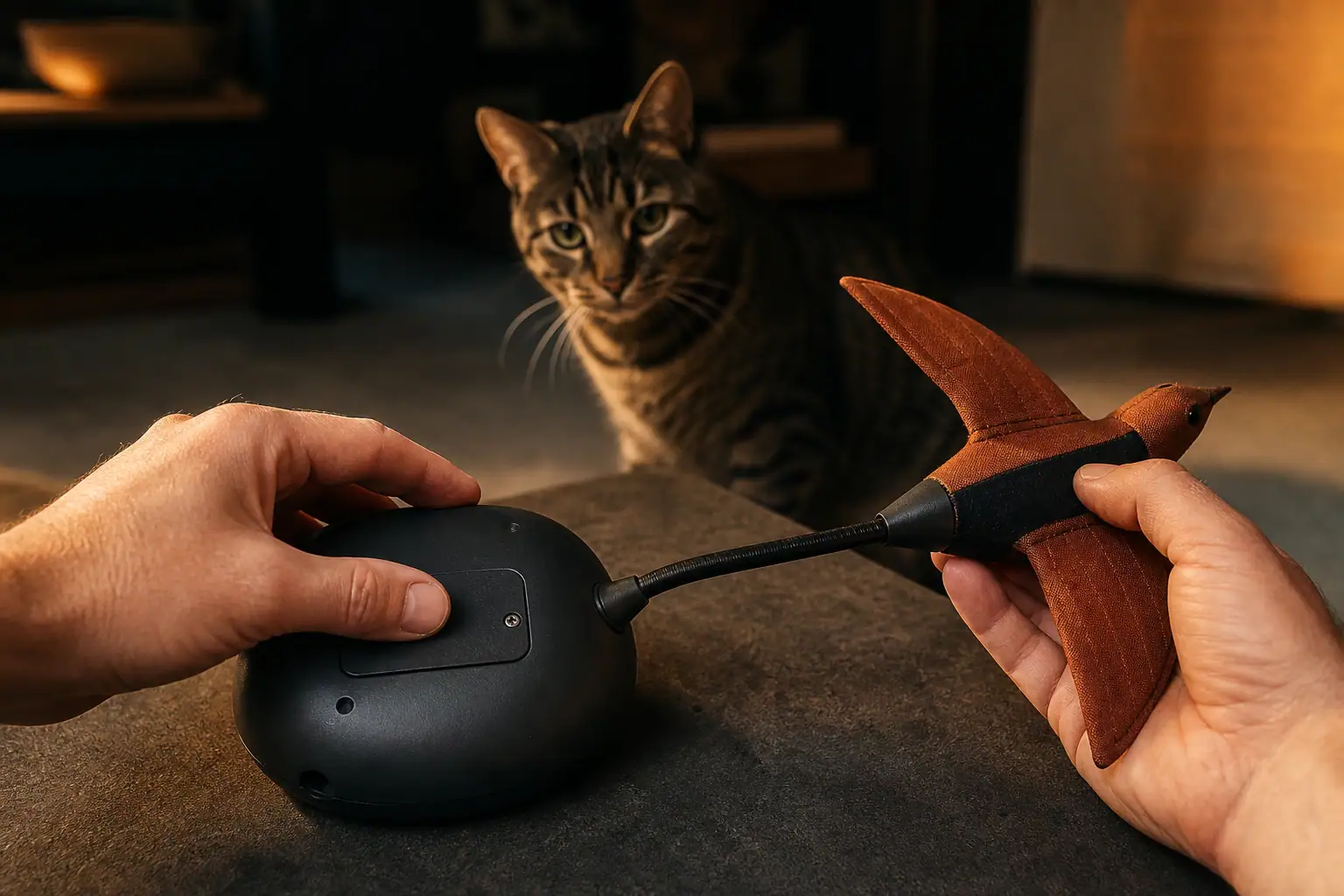
A motorized arm, wire, or tether moves a lure around a base
An elastic or tether makes the lure bounce, flutter, or orbit
Vertical tracking without a handheld wand
Entanglement, weak mount, snapback, damaged cord
Flapping plush bird
A motion sensor activates wings while the toy stays on the floor
Grab, bite, and bunny-kick play
Seams, wing pieces, motor pocket, charging port, battery
Free-flying remote toy
A powered device moves through open air
Owner-operated novelty in a large clear room
Propellers, impact, hard housing, charging parts, frightened cats
That last category is the rarest and the hardest to recommend as a direct-contact cat toy. If a device has exposed rotors, is built as a human hobby drone, or is not intended to be caught and bitten, keep the cat separated from it. A product that can fly is not automatically a product a cat should catch.
‘Flying cat toy’ is a label, not one mechanism. A wand lure, tethered motorized bird, and floor-flapping plush create very different movement and risks.
Do flying bird cat toys actually fly?
Most do not fly freely. Many popular ‘flying bird’ toys are plush birds with internal motors. They flap, chirp, and kick after a cat touches them, but they remain on the floor unless you attach them to a wand or tether. Others rotate in a circle from a fixed motor, bounce from a doorway, or glide only because a person moves the wand.
This matters because the mechanism changes both play value and safety. A floor-flapping bird is really a motorized kicker: its fabric, seams, wings, motor cover, and charging port must survive the catch. A circling bird behaves more like an automated teaser: the base, arm, connector, and lure are all failure points. A wand is human-powered and easier to interrupt, but its cord and attachment must be stored after play.
Seller pages often blur these differences. Some describe flapping plush toys as taking flight or recommend adding ordinary string to make them airborne. Treat those claims cautiously. If you add an attachment the manufacturer did not design, you change the load on the seam and create a new linear-object hazard. Use the supplied mechanism, follow its instructions, and do not improvise a dangling setup with yarn, ribbon, or elastic.
What is the cat toy that flies like a real bird?
A well-handled wand lure usually creates the most convincing bird-like path because you can skim, pause, hide, rise, and land in response to the cat. Fixed-base toys repeat a smaller route. Free-flying powered toys may cover more space, but realistic flight is less important than a safe catch. Cats need opportunities to capture the ‘prey’ intermittently; the Feline Veterinary Medical Association’s environmental-needs guidance specifically recommends prey-like interactive play, successful captures, toy rotation, and individual play for cats in multi-cat homes.
Choose by cat, room, and failure pattern
Ignore the demo video for a moment and picture the first catch. Does your cat tap and release, or clamp down, twist, and carry the toy away? Does the room have a rug and open floor, or tile, glass tables, and narrow gaps? The right mechanism is the one you can control after the excitement begins.
For an athletic cat who loves aerial chase
Use a longer wand with a broad fabric lure in a cleared room. Start near the floor and build small rises instead of repeated maximum-height jumps. Keep the route away from stairs, counters, hard corners, people, and other pets. Let the cat land on the rug rather than twisting in midair for a lure above the head.
For a cat who destroys the catch
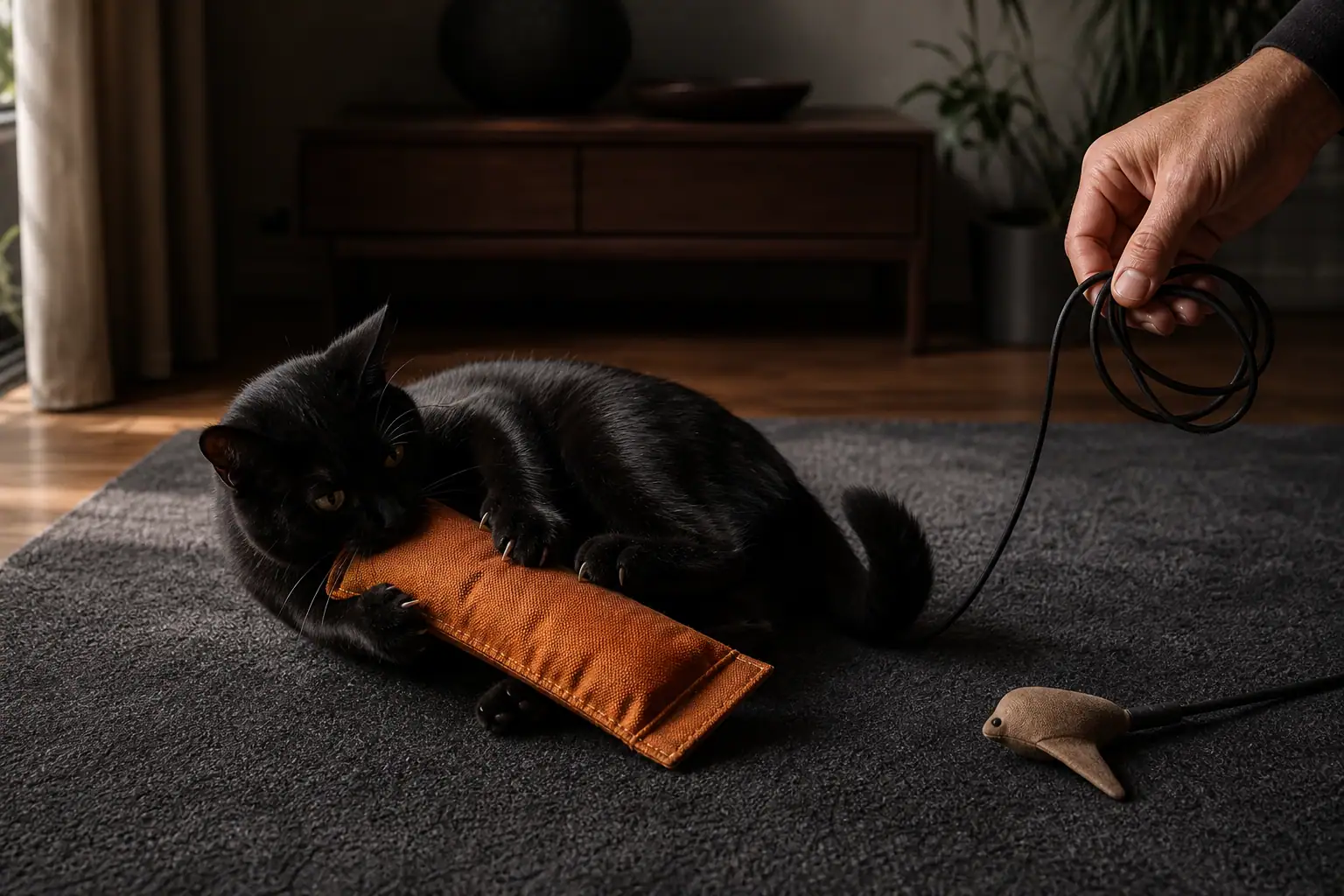
Separate chase equipment from capture equipment. Fly a simple lure, allow a brief pin, then transfer the finish to a large reinforced kicker. A flapping plush bird can fill both jobs only if your cat cannot open its motor pocket, bite through its wings, or expose its electronics. Our guide to cat toys that move compares other motion systems for rough players, including covered-motion, track, rolling, and food-dispensing toys.
For a cautious or noise-sensitive cat
Begin with the toy switched off and motionless. Let the cat approach, sniff, and leave. Add one gentle movement at floor level; introduce sound or motor motion later, not at the same time. A cat who crouches tightly, flattens the ears, hides, flees, lashes the tail, or cannot settle is not being enriched by the novelty. Stop and make the next attempt quieter and farther away.
For kittens, seniors, and cats with limited mobility
Keep the path low and the landing soft. A kitten does not need dramatic jumps to practice stalking and pouncing. A senior may prefer a lure that disappears behind a box, moves across a rug, or pauses within paw reach. New reluctance to jump, limping, pain, open-mouth breathing, or a marked change in play deserves veterinary attention rather than a more stimulating toy.
For a multi-cat home
Run individual sessions first. One fast moving target can turn into competition, blocking, or redirected chasing. Give each cat a clear route and real catches. If two cats play together comfortably, use a wide room and stop when one cat repeatedly takes every catch or the other withdraws.
Safety checks before the toy takes off
The Cornell Feline Health Center’s toy guidance advises avoiding small pieces and linear strand-like parts that can separate and be swallowed, and it recommends checking the play area for fall and impact hazards. Flying toys combine both problems: they attract hard pursuit, and many depend on cords, feathers, connectors, electronics, or moving hardware.
The 60-second preflight check
Clear the flight path: move glassware, lamps, unstable furniture, floor cords, plastic bags, and sharp-edged objects. Close unsafe stairs or balconies.
Pull-test the lure: check wings, feathers, fabric tabs, eyes, bells, knots, clips, and seams. If a part shifts by hand, it does not get one more pounce.
Inspect every linear part: look for frayed string, stretched elastic, kinked wire, weak tether points, and cord long enough to loop around a limb or neck.
Check the mechanism: the base should not tip; moving arms should not expose gears or pinch gaps; guards and covers should be secure.
Secure the power source: the battery compartment should require a tool or otherwise resist a cat’s teeth and claws. The charging port and cable stay inaccessible during play.
Match the size: the catchable part should not fit wholly in the cat’s mouth, and hard housing should not strike the face when it swings or falls.
Stay present: test every new toy and every new setup under active supervision. An automatic shutoff protects a motor, not a cat.
Inspect the whole system—not just the bird: housing, battery cover, moving arm, tether, connector, fabric, and seams all count.
Durability is a system, not a fabric adjective. A heavy shell attached to a weak plastic clip is still a weak toy. A strong base with an exposed wire is still a poor catch target. Judge the path from motor or handle to lure, then judge the lure after it has been wet, twisted, bitten, and kicked.
Prefer simple capture surfaces. Large woven-fabric or tightly constructed plush lures are easier to inspect than layered wings, glued eyes, decorative beaks, loose feathers, and multiple dangling legs.
Look for replaceable wear parts. On a wand or fixed-base toy, the lure is supposed to wear before the handle or motor. A clear replacement system is useful only when the connector remains secure and smooth.
Choose visible seams. You should be able to find thinning fabric, skipped stitches, or a lifting edge before filling or electronics appear.
Keep hard parts out of the bite zone. Motors, charging modules, clips, and rotating housings are not chew targets. If the cat can pin the mechanism, the design is wrong for unsupervised use.
Favor stable, cleanable construction. A base that walks across the floor, a suction cup that releases under load, or plush that cannot be cleaned and dried becomes a short-lived system.
Buy for replacement, not permanence. No feather, fabric wing, string, or plush body is indestructible. Retiring a cheap lure early is better than testing whether the next bite reaches the motor.
For a broader material and construction check, use Titan Claws’ guide to choosing so-called unbreakable cat toys. The useful question is not whether a listing says ‘tough.’ It is where the product will fail and whether you can see that failure coming.
How to use a flying cat toy in a better play session
Good flying play looks less like constant buzzing and more like a hunt. Prey appears, moves away, pauses, hides, escapes briefly, and gets caught. The person or device should not hover the toy in the cat’s face or make every pass impossible.
Inspect and clear. Check the toy, choose a nonslip landing area, and remove hazards.
Introduce the object. Let the cat see and sniff a new toy while it is still and silent.
Start low. Skim the lure across the floor or a few inches above it. Movement away from the cat is usually more prey-like than movement toward the face.
Use cover and pauses. Slip behind a box edge, stop, then make a short burst. Constant motion becomes predictable.
Offer a real catch. Every few passes, let the cat pin the lure. Stop the motor or relax the wand instead of pulling against teeth.
Transfer the hard finish. If the cat grips and bunny-kicks, offer a larger kicker before teeth move to string, clips, or electronics.
Cool down. Make the final chase shorter and slower, allow one easy catch, then use part of the normal meal or a simple food search if appropriate for the cat.
Inspect and store. Count removable parts, check every wear point, clean as directed, charge away from the cat, and put supervised equipment behind a closed door.
For a hard catcher, transfer the finish to a larger kicker so teeth and hind feet work on a sturdier target—not the cord or motor housing.
A wand is especially good for this sequence because you can respond instantly to the cat. Read the Titan Claws cat toy on a stick guide for lure, cord, storage, and play-technique details. If you use an automated model, interrupt it yourself for catches rather than assuming the programmed path supplies a satisfying finish.
When to stop, replace, or call a veterinarian
Stop the session if the cat begins panting, breathing with the mouth open, limping, crashing into objects, hiding, growling, or redirecting onto a person or another animal. Also stop if the toy changes sound, slows unexpectedly, smells hot, sheds a piece, opens at a seam, exposes a wire, or develops a loose battery cover.
Replace the lure or whole toy when:
a feather, wing, tail, bell, eye, connector, or decorative piece is loose or missing;
fabric thins, a seam opens, stuffing appears, or saliva-soaked material cannot be cleaned and dried;
string frays, elastic stretches, wire kinks, a clip bends, or the mounting point loosens;
plastic cracks, a hard edge forms, the base tips, or a guard no longer stays closed;
the motor runs hot, smells unusual, sounds rough, or its housing can be reached by teeth;
the charging port, cable, battery, or internal module becomes accessible;
your cat stops chasing the lure and starts methodically dismantling the mechanism.
Suspected swallowing of string, feathers, fabric, plastic, a battery, or any toy part needs prompt veterinary advice. Repeated vomiting, loss of appetite, drooling, trouble swallowing, abdominal pain, lethargy, or straining after a piece goes missing can signal an urgent problem. Do not wait for the toy part to reappear and do not induce vomiting unless a veterinary professional directs you.
Quick buying checklist
I know whether the toy truly flies, circles from a base, hangs from a tether, or only flaps on the floor.
The intended catch point is soft, large, simple, and easy to inspect.
The toy has no exposed propeller, gear, wire, battery, charging cable, or pinch gap.
Strings, elastic, feathers, bells, clips, and other attachments stay supervised and get closed storage.
The base or mount stays stable under the force my cat actually uses.
I can buy or make a manufacturer-approved lure replacement before the original fails.
The motion and sound can start gently, pause, and stop quickly.
The play area has a nonslip landing and no fall, impact, or entanglement hazards.
My cat gets regular catches and a sturdy target for biting and bunny-kicking.
I am prepared to retire the toy at the first unsafe wear—not after total failure.
What is the best flying cat toy?
For most households, a sturdy wand with a large, simple fabric lure is the best starting point. It produces convincing aerial movement while giving you direct control over speed, height, direction, pauses, and catches. Store it after every session. If you prefer a motorized toy, choose an enclosed, stable mechanism with a replaceable lure and supervise it like a wand—not like furniture.
How do you charge a flying cat toy?
Follow the specific manufacturer’s instructions. Turn the toy off, remove it from the play area, inspect the port and cable, and charge where the cat cannot chew either one. Close the charging-port cover before play and do not use the toy while it is plugged in. Retire a device with swelling, heat, odor, leakage, damaged cable, or a battery compartment that will not stay secure.
Can I leave an interactive flying cat toy on while I am away?
Do not assume so. A timer or motion sensor does not remove cord, attachment, battery, pinch, or breakage risks. Only consider unattended access after repeated supervised sessions and only when the manufacturer explicitly permits it, the mechanism is fully enclosed, the toy has no reachable linear or detachable parts, and your cat has never tried to dismantle it. For a rough player, flying toys are supervised equipment.
The best flying cat toy earns attention without asking you to ignore physics. Choose the mechanism honestly, keep the flight path low and clear, let the cat catch, transfer hard biting to a sturdier target, and inspect every link between the power source and the prey. Exciting movement starts the game; a safe finish makes it worth repeating.
Editorial note: This article provides general enrichment and toy-safety information. It does not replace instructions for a specific product or advice from a veterinarian who has examined your cat.
The best cat toys for adult cats are a mix of interactive chase toys, large capture toys, simple batting toys, food puzzles, and hiding or ambush toys. You do not need a basket full of novelty. Start with five different jobs: a wand for stalking and chasing, a sturdy kicker for the catch, an enclosed track or oversized ball for solo movement, an easy puzzle for foraging, and a tunnel or box for hiding and ambushing.
Choose the exact toy by what your cat does—not by the age printed on a package. An adult cat who waits behind furniture needs a different target from one who charges, grabs, and bunny-kicks. Let the cat catch the moving lure, keep risky parts under supervision, rotate a small selection, and inspect every toy that receives hard bites.
Best cat toys for adult cats at a glance
This table is a starting kit, not a universal ranking. Watch two or three play sessions before deciding which category deserves a permanent place in your home.
Toy type
What it lets the cat do
Best fit
Access rule
Wand or fishing-pole toy
Watch, stalk, chase, leap, and catch
Most adult cats; especially social hunters
Supervised; store the entire toy after play
Large fabric kicker
Grab, bite, wrestle, and bunny-kick
Physical cats and rough players
Supervise until seams and chewing habits are proven
Enclosed ball track or oversized ball
Swat, chase, and repeat a cause-and-effect action
Independent batters and short-burst players
May be suitable to leave out after testing
Stable food puzzle
Search, paw, manipulate, and eat a reward
Food-motivated cats and indoor cats needing variety
Use measured food; begin with an easy stationary design
Wide tunnel or handle-free box
Hide, investigate, ambush, and retreat
Cautious stalkers and cats that like cover
Remove wire, loops, handles, staples, tape, and torn material
The categories work together. A wand creates distance and prey-like movement; a kicker gives the adult cat something substantial to hold when the chase ends. A track or ball allows a quick game without a person. A puzzle turns part of a normal meal into a search. A tunnel changes the room itself by adding cover and a route.
Adult cats do not outgrow play. VCA’s veterinary behavior guidance notes that adult cats retain the ability and motivation to hunt and benefit from regular playful interaction. The important change from kittenhood is not that play becomes optional; it is that individual preferences, strength, health, and learned habits become clearer.
A balanced five-toy kit covers social chase, physical capture, solo movement, foraging, and hiding without turning the room into a toy pile.
Match toys to your adult cat’s hunting style
Ignore what a toy is called for a moment and watch your cat’s first move. That first move is a better buying guide than a long list of “best” products.
The watcher: crouches, freezes, and tracks small motion before acting. Drag a wand lure slowly along the floor, let it disappear behind a box, and pause. A tunnel or low cardboard barrier makes the game more convincing.
The chaser: accelerates after rolling or fleeing objects. Use an oversized ball on a clear floor or a wand moving away from the cat. Do not wave the lure repeatedly into the cat’s face.
The leaper: follows airborne movement and uses vertical space. Use a wand with controlled low arcs and safe landings. Avoid high repetitive jumps on slippery floors.
The grabber: closes distance, wraps the front legs around the target, bites, and kicks. Finish a chase with a long kicker that keeps teeth and rear claws away from hands.
The fisher: reaches under doors, rugs, and furniture. Try a stable puzzle board, hunt box, or toy moving partly behind cover. Openings must not trap the head or paw.
The forager: investigates food scents and persists at small problems. Start with food visible in a shallow puzzle, then increase difficulty one step at a time.
Many cats combine styles. Use the sequence they naturally offer: a watcher may stalk for two minutes, sprint for ten seconds, then become a grabber. A satisfying toy session should allow those transitions instead of demanding nonstop running.
The joint AAFP and ISFM feline environmental-needs guidelines recommend opportunities for play and predatory behavior, including searching, stalking, chasing, pouncing, catching, and manipulating. That is the reason to build a small system rather than look for one magical toy.
Build a five-toy adult cat kit
Use this order if you are starting from scratch or replacing a pile of ignored toys.
Choose one interactive lure. Look for a comfortable handle, enough distance between hands and claws, and a lure that can be replaced or inspected. Reserve it for owner-led play and lock it away afterward.
Add one physical catch. Pick a kicker long and wide enough for your cat to hold against the chest while kicking. Favor simple shapes, dense construction, reinforced seams, and minimal decoration.
Add one tested solo mover. An enclosed ball track is often easier to assess than a motorized gadget. An oversized smooth ball can work if it is too large to swallow and the cat cannot peel its material.
Add one easy food problem. Use a stable, washable puzzle with food visible at first. Load it with part of the cat’s measured meal—not bonus calories that silently accumulate.
Add one piece of cover. A wide tunnel or plain cardboard box can support hiding, ambush, rest, and route changes. Remove bag handles and any material your cat tries to eat.
This kit can be inexpensive. Movement, size, placement, and timing matter more than electronics. A paper ball too large to swallow, an open box without tape or staples, and kibble placed in an easy egg-carton puzzle can reveal a preference before you spend more. Supervise homemade items, especially if your cat chews cardboard, foam, paper, fabric, or glue.
For more solo options and a detailed leave-out test, see our guide to self-play cat toys. If the cat opens seams or dismantles plush toys, use the construction criteria in our durable cat toy guide. “Durable” means better matched to the cat’s force and attack style; it never means damage-proof.
Run a satisfying 10-minute play session
A short session can be useful if it has structure. The goal is not to exhaust the cat. It is to make the target behave like something worth hunting and let the cat succeed.
Minute 0–2: wake the hunt. Begin when the cat is already alert. Move the lure away at floor level, pause behind furniture, and wait for orientation. Do not poke or corner the cat.
Minute 2–6: alternate pursuit and pause. Use short escapes, cover, and direction changes. Let the cat watch between bursts. Keep jumps low enough for safe landings.
Minute 6–8: allow several catches. Relax the lure when caught. Do not yank it instantly from the cat’s mouth or paws. Restart only when the cat releases and remains interested.
Minute 8–9: offer the final capture. End at a kicker, fabric prey toy, or small portion of the normal meal so the cat can hold or consume the result.
Minute 9–10: cool down and inspect. Let movement fade, put corded toys in closed storage, and check the catch toy for damage.
Ten minutes is a format, not a prescription. Some adult cats want three focused minutes; others want several rounds. Stop when the cat walks away, hides, pants, becomes frantic, or stops re-engaging. Our cat play schedule guide explains how to adjust session number and length for energy, age, health, and response.
Do not use hands, feet, or moving toes as prey. Redirect stalking and grabbing to a toy with distance. Always let a cat physically catch a wand lure; if you use a laser, transition to a tangible target or food reward instead of ending with an uncatchable dot.
Rotate toys without constantly buying new ones
Adult cats often stop responding to an unchanged object even when they still want to play. A controlled study of object play and habituation in adult domestic cats found that play declined across repeated presentations of the same toy and increased when sensory features changed. Rotation creates renewed contrast without requiring a stream of purchases.
Try a simple three-bin system:
Active: two or three toys available now, each with a different job.
Interactive storage: wands, strings, feathers, elastic, and fragile lures used only with a person.
Resting: cleaned, intact toys kept out of sight for several days before returning.
Swap one active toy every three to seven days, or sooner if your cat ignores it. Change only one variable when an old toy returns: location, time of day, movement, or the cover around it. A track beside a box may be interesting even if the same track in an empty room was not.
A large survey of cat guardians found that offering a greater variety of games was associated with higher guardian-reported feline quality-of-life scores, although the design cannot prove that variety alone caused the difference. The study on play and cat welfare supports a practical point: pay attention to both the number of minutes and the range of experiences you offer.
Clean food-contact toys after use and inspect fabric, plastic, fasteners, and openings as you rotate. Our cat toy cleaning guide separates washable items from toys that should be retired rather than scrubbed back into service.
Safety rules for adult cats that play rough
An adult cat can apply more force and use a more practiced attack sequence than a kitten. A toy that survives gentle batting may fail when pinned, chewed, twisted, and raked. Safety depends on the exact cat-toy interaction, not on a package claim.
Inspection is part of play for adult cats that bite and kick hard: check before, watch during, and inspect again after.
Use three checks every time a new toy enters the rotation:
Before play: tug attachments, flex plastic, press battery doors, check seams from end to end, and remove packaging. Reject sharp edges, exposed wire, loose thread, glued-on eyes, easy-to-remove bells, and pieces small enough to swallow.
During play: watch whether the cat bats, carries, chews, saws at one seam, or tries to reach the mechanism. A toy safe for chasing may not be safe for sustained biting.
After play: account for every part. Retire the toy if its shape changes, a seam gaps, fabric thins, stuffing appears, plastic cracks, a rattle moves toward an opening, or a component becomes loose.
Store string, ribbon, yarn, elastic, feathers, wire, tinsel, and wand toys in a closed container after use. Cat Friendly Homes, an initiative of the Feline Veterinary Medical Association, specifically warns that string-like items are easily swallowed and can cause serious intestinal injury.
If a piece is missing and ingestion is possible, call a veterinarian promptly. Do not wait for a dramatic symptom and never pull visible string from a cat’s mouth or rear. Vomiting, appetite loss, lethargy, hiding, abdominal discomfort, straining, or changes in stool after access to a damaged toy require urgent veterinary advice.
When a toy problem may be a health problem
Do not label an adult cat lazy because a popular toy fails. The toy may move too quickly, make an unpleasant sound, sit in an exposed location, demand painful jumping, or compete with another cat. Make the game slower and easier, add cover and traction, and offer individual play in a calm room.
A sudden or sustained decline in play is different. Contact a veterinarian if reduced play appears with limping, stiffness, reluctance to jump, hiding, irritability, weight or appetite change, vomiting, increased thirst, litter-box changes, overgrooming, or difficulty gripping food and toys. Dental pain, arthritis, vision change, illness, and stress can all change play; a new gadget cannot diagnose the cause.
Adult and senior are not interchangeable. If your cat has become slower, less flexible, or more easily startled, choose stable floor-level targets, nonslip surfaces, gentle arcs, and large easy-to-grip toys. Our senior cat toy guide offers a comfort-first selection process and signs that merit a veterinary visit.
Adult cat toy checklist
Start with five jobs: chase, capture, solo movement, foraging, and cover.
Match toys to the cat’s first move: watch, chase, leap, grab, fish, or forage.
Let the cat stalk, pause, catch, and walk away; do not force constant motion.
Keep hands and feet out of predatory games.
Store all string-like and fragile toys after supervised use.
Use measured food and easy success when introducing puzzles.
Rotate two or three active toys instead of leaving the whole collection out.
Inspect before, during, and after rough play.
Retire damaged toys immediately; durability is never a lifetime guarantee.
Ask a veterinarian about sudden play changes or signs of pain or illness.
What toys do adult cats like most?
Many adult cats respond best to prey-like movement they can stalk and catch, but the preferred movement varies. Watch whether your cat waits, chases, leaps, grabs, fishes, or works for food, then choose a toy that rewards that behavior. A wand plus a substantial catch toy is the most versatile starting pair.
How many toys should an adult cat have?
A collection of five distinct toy types is enough to build a useful rotation. Leave out only two or three tested options at once and store interactive or fragile toys. Variety of function matters more than the total number in the basket.
What is the best toy for an indoor adult cat?
There is no single best toy. A balanced indoor setup combines owner-led hunting, a safe physical catch, a simple self-play option, and a food-search activity. Add cover, climbing, scratching, and rest to support the wider environment; our cat enrichment guide shows how those pieces fit together.
Why does my adult cat ignore new toys?
The toy may not match the cat’s preferred movement, may be too exposed or noisy, or may never produce a catch. Introduce one item at a time, make the first success easy, and change timing or location before buying again. If loss of interest is sudden or broad, arrange a veterinary check.
Bottom line: the best cat toys for adult cats form a small, flexible system. Choose by behavior, give every chase a catch, separate supervised toys from leave-out options, rotate for novelty, and treat inspection as part of every hard play session.
Editorial note: This guide provides general enrichment and toy-safety information. It does not replace advice from a veterinarian who knows your cat’s health, diet, mobility, and ingestion history.
The best interactive cat toys for bored cats are not necessarily electronic. Start with one owner-guided chase toy, one safe object the cat can catch and bite, and one self-directed puzzle or track toy. Match each choice to what your cat actually enjoys—stalking, sprinting, batting, solving, chewing, or bunny-kicking—then rotate a small set instead of leaving every toy out all day.
A useful interactive toy makes the cat do something and produces an outcome: the lure hides, the ball rolls, food appears, or the prey can finally be grabbed. A gadget that flashes while your cat watches from the doorway is not more enriching just because it has a motor. The seven-day reset below helps you identify the play your cat wants, rebuild novelty, and decide which toys are safe enough for supervised or solo use.
Choose the Toy by the Job Your Cat Wants
Many shopping lists treat all boredom as one problem. It is more useful to watch the first move your cat makes. Does the cat crouch and wait, race after motion, fish under doors, wrestle with both back feet, chew the catch, or work patiently for food? Use that behavior to choose a toy category.
What your cat does
Try first
Why it may work
Access rule
Watches, crouches, then ambushes
Wand lure moved behind a box or through a tunnel
Creates hiding, waiting, and a timed pounce
Supervise; store all corded toys afterward
Sprints after anything that rolls
Large rolling ball or enclosed track
Turns batting into movement without requiring high jumps
Test size, shell, and room hazards before solo use
Hooks paws into gaps
Box puzzle or sturdy puzzle board
Rewards searching and controlled paw work
Remove if the cat eats cardboard, foam, or small parts
Grabs, bites, and bunny-kicks
Long, firmly stuffed kicker with simple construction
Gives teeth and back feet an appropriate capture target
Inspect seams after hard play; retire exposed filling
Is strongly food-motivated
Easy puzzle feeder or food-dispensing ball
Adds searching and manipulation to part of a meal
Count food toward the daily ration and clean after use
Loses interest when motion repeats
Human-guided lure or tested irregular-motion toy
Changes speed, direction, hiding place, and pause length
Supervise powered toys until their failure points are known
Watching is part of hunting behavior. A cat that studies a lure for thirty seconds before pouncing is not necessarily bored by it. Look for focused ears, forward whiskers, a low crouch, stillness, and a tail-tip twitch. Change the game when the cat walks away repeatedly, grooms instead, startles, or shows no interest across several low-pressure attempts.
Build a Three-Part Boredom Kit
You do not need a floor full of gadgets. A balanced starter kit covers three different jobs and keeps the highest-risk piece under your control.
Chase: use a wand, teaser, tossed toy, or another owner-guided target. Move it away from the cat, let it disappear behind cover, pause, and allow frequent catches. For detailed lure and storage checks, see the Titan Claws guide to using a cat toy on a stick.
Capture: offer a sturdy kicker or larger prey toy the cat can hold, bite, and rake. This matters for rough players that otherwise grind their teeth into a delicate feather attachment or motorized shell.
Solve: use an easy food puzzle, enclosed track, treat hunt, or stable cardboard puzzle. Start with an obvious reward. A puzzle that is too difficult is not enrichment; it is an object the cat may ignore or attack.
This mix works because each item has a clear role. The wand creates lifelike movement, the capture toy allows a physical win, and the puzzle creates a quieter independent task. Add a scratcher, perch, hiding place, and window view to improve the environment rather than expecting toys to carry the entire load.
A cardboard box and tunnel can change how familiar toys move, hide, and reappear without requiring a new purchase.
Run This Seven-Day Play Reset
Use the reset when your cat has a full toy basket but acts unimpressed. Store most toys first, leaving only proven-safe basics available. Keep a one-line note after each session: approached, watched, chased, caught, bit, solved, or walked away. You are looking for a pattern, not a perfect performance.
Day 1—observe: offer a fabric lure moving slowly along the floor for five to ten minutes. Try hiding it behind a box. Note whether your cat prefers watching, chasing, or grabbing.
Day 2—change the prey: switch texture and movement. If yesterday looked like a mouse, make today’s lure flutter briefly like an insect or bird, while keeping jumps appropriate for the cat’s age and mobility.
Day 3—add a physical finish: after several catches, trade the chase lure for a larger kicker. Let the cat grip and kick; never wrestle with hands or feet.
Day 4—make food work: place a small portion of the normal ration in an easy puzzle or several visible search locations. If your cat becomes frustrated, make the task simpler immediately.
Day 5—redesign the room: add a box, paper bag with handles removed, tunnel, or furniture corner as cover. Familiar toys often become interesting when the hunting route changes.
Day 6—test independent play: offer an enclosed track, large ball, or previously supervised puzzle in a cleared room. Watch the entire session and note chewing, dismantling, wedging, fear, and loss of interest.
Day 7—repeat the winner: combine the two strongest responses into a short sequence: stalk, chase, catch, bite or kick, then finish with part of a meal or a small food search.
After the week, keep three to five active options that cover different behaviors and store the rest in a closed cat toy box. Swap one or two items when interest fades. Rotation restores contrast; it does not make a poor toy safe or guarantee that every cat will like it.
Automatic Toys Are Helpers, Not Babysitters
Automatic balls, concealed moving lures, flopping plush toys, and pop-up feather devices can add unpredictable motion, especially when your hands are busy. They also add motors, charging ports, battery doors, seams, and detachable pieces. Test a powered toy switched off first, then run several short supervised sessions before deciding where it belongs.
Choose a screw-secured battery compartment and a housing without sharp edges or bite-sized decorations.
Remove charging cables before play and stop using a device that becomes hot, smells unusual, rattles, or exposes wiring.
Watch whether the cat targets the moving element as intended or tries to pry open the shell and chew the motor area.
Clear stairs, blind cords, water, unstable furniture, and gaps where the device or a paw could become trapped.
Prefer auto-off timers, but remember that a timer limits runtime; it does not inspect damage.
A toy marketed for use while you are away is not automatically safe for your particular cat. The stricter guide to automatic cat toys for when you are away explains how to earn solo access. If motion is the main attraction, compare owner-guided, self-moving, and small-motion choices in our guide to cat toys that move.
Safety Rules for Cats That Destroy Toys
Durability is not a claim printed on a package; it is how a specific toy holds up to a specific cat over repeated sessions. Rough play exposes seams, glued decorations, feather shafts, elastic, split rings, thin plastic, and battery covers quickly. No toy is indestructible, and a toy that survives one cat may fail fast for another.
Cornell Feline Health Center advises avoiding small pieces and strand-like parts such as feathers and string that can separate and be swallowed. It also recommends checking the play area and rotating toys. Apply that guidance before every new toy graduates from supervised testing.
Before play: pull gently at attachments, press seams, flex hard shells, confirm every piece is present, and check that the toy is too large to swallow.
During play: stop if the cat chews cord or elastic, pries at a battery door, eats material, becomes tangled, pants, limps, or seems frightened.
After play: look for gaps, frays, missing pieces, tooth-sharpened plastic, exposed filling, moisture, heat, or a new odor.
Store: put wands, string, ribbon, elastic, feathers, and easily dismantled toys behind a closed door or lid.
Retire: remove any toy with exposed internals, a cracked shell, a sharp edge, loose hardware, failing seams, or parts you cannot account for.
For rough players, inspect the exact failure points your cat targets before and after a new toy earns solo access.
If you suspect your cat swallowed string or another toy piece, contact a veterinarian promptly. Do not pull string from the mouth or anus. Vomiting, repeated retching, loss of appetite, abdominal pain, lethargy, hiding, straining, or trouble breathing needs urgent veterinary advice.
When Boredom Might Be Something Else
Extra play can help a healthy under-stimulated cat, but “bored” behavior is not a diagnosis. A sudden change in activity, sleep, appetite, vocalizing, grooming, litter-box use, aggression, or willingness to jump can reflect pain, illness, stress, or conflict with another cat.
Arrange a veterinary check when the change is sudden, persistent, severe, or paired with physical signs. A senior cat that stops chasing may need lower, slower play—or may be uncomfortable. A cat that attacks housemates may need separated resources and individual sessions, not a more exciting shared toy. The FVMA guide specifically notes that behavior concerns can involve unmet resources, social relationships, or an underlying medical problem.
Quick Buying and Play Checklist
The toy matches a behavior you have actually seen: stalk, chase, bat, solve, grab, or chew.
Your set includes chase, capture, and problem-solving rather than three versions of one gadget.
The cat can catch the target regularly instead of pursuing an unwinnable game.
Strings, elastic, feathers, cords, and small attachments are supervised and stored.
A rough player gets a larger, simpler bite-and-kick target with inspectable seams.
Powered toys have secure battery access, covered charging areas, and no heat, odor, or damage.
The play area is clear and appropriate for the cat’s age, confidence, and mobility.
You rotate a small selection and keep a record of what actually earns engagement.
You inspect before and after hard sessions and replace toys at the first unsafe failure.
What is the best interactive toy for a bored cat?
For many cats, the best starting point is an owner-guided wand session with hiding, pauses, and frequent catches, followed by a sturdy capture toy. Add a simple puzzle or enclosed track for independent work. The best individual choice depends on the cat’s preferred hunting behavior and chewing strength.
How long should I play with my cat?
Start with five to ten focused minutes and let the cat’s response guide you. Some cats prefer several short bursts; others stay engaged longer. Stop before exhaustion, keep jumps suitable for age and mobility, and favor a repeatable daily routine over an occasional marathon.
Can I leave interactive toys out while I am away?
Only leave out a toy after it has passed repeated supervised sessions with your cat and the room itself is safe. Wands, loose string, ribbon, elastic, fragile feathers, and easily dismantled or chewable electronic toys should be stored. Reinspect every leave-out toy regularly.
Bottom line: boredom is better solved with a varied routine than a pile of novelty gadgets. Give your cat prey to search for, motion to chase, something safe to catch, and a puzzle that can be won. Watch the response, protect the weak points, rotate what works, and let the cat—not the package—tell you which toy is genuinely interactive.
For most healthy adult cats, start with two or three interactive play sessions a day, about 10–15 minutes each. That is a practical starting point, not a rigid quota. A kitten may want many shorter bursts; a senior or cat with arthritis may prefer gentler five-minute games; a high-energy indoor cat may ask for another round.
Frequency matters more than forcing one long workout. Spread play across the day, let your cat stalk and catch the toy, and stop when their interest or comfortable movement fades. Judge the routine by your cat’s behavior and recovery—not only by the clock.
How Much Playtime Do Cats Need?
There is no scientifically proven daily number that fits every cat. A detailed review of domestic-cat play research concluded that important questions—including how much and what kind of play pet cats need—remain understudied. The AAFP/ISFM Feline Environmental Needs Guidelines recommend opportunities for play and predatory behavior, but they do not prescribe one universal minute target.
That is why competing answers such as 15, 30, 45, or 60 minutes should be treated as starting ideas, not pass–fail standards. A focused eight-minute hunt with several catches can be more satisfying than 30 minutes of waving a toy after the cat has checked out.
Cat
Starting frequency
Typical session
How to adjust
Healthy adult
2–3 times daily
10–15 minutes
Add or shorten sessions according to engagement and recovery
Kitten
Several opportunities throughout the day
5–10 minutes
Use frequent short bursts; stop before panting or loss of coordination
Senior cat
2–3 gentle sessions daily
3–10 minutes
Keep toys low, reduce jumping, and follow veterinary mobility advice
High-energy indoor cat
3 or more varied sessions
5–15 minutes
Add foraging, training, climbing, and solo enrichment rather than only longer chasing
Multi-cat home
Daily individual turns plus compatible group play
5–15 minutes per cat
Prevent one cat from monopolizing the toy or blocking another cat
The table describes owner-led, interactive play. A ball left on the floor, a puzzle feeder, climbing, scratching, and play with a compatible cat all add value, but they do not always replace the control and social contact of a game with you. Our broader cat enrichment plan can help you balance play with foraging, climbing, exploration, scratching, and rest.
Adjust the Schedule to Your Cat
Age is useful, but it is not the whole answer. Health, temperament, play history, indoor or outdoor access, time of day, toy preference, and the presence of other cats all change what a good schedule looks like.
Kittens: more chances, shorter games
Kittens often switch rapidly between sprinting, wrestling, eating, and sleeping. Offer several supervised play opportunities instead of trying to exhaust a kitten in one marathon. Use appropriately sized toys, keep strings and small parts out of solo reach, and never encourage attacks on hands or feet. A kitten who learns that skin is the target can carry that painful habit into adulthood.
Adult cats: build a repeatable rhythm
Many adults do well with a brief game before breakfast, another in the late afternoon or evening, and an optional wind-down session before bed. Cats are often naturally active around dawn and dusk, but your cat’s reliable alert periods matter more than forcing an exact time. If they consistently walk away at minute seven, make seven good minutes the plan.
Senior cats and cats with medical conditions: preserve choice
Older cats still benefit from play, even when running and jumping are uncomfortable. Slide a lure slowly across a rug, offer a kicker while the cat is lying down, or use an easy food puzzle. Keep the target close and low, add nonslip footing, and provide an easy exit. Ask your veterinarian for activity limits if your cat has arthritis, heart or breathing disease, neurologic problems, recent surgery, obesity, or another condition that affects exercise.
A sudden decrease in play is not automatically aging or boredom. Pain, dental disease, illness, impaired vision, and stress can all change activity. Arrange veterinary care when a normally playful cat abruptly stops, hides more, moves stiffly, misses jumps, loses appetite, breathes differently, or shows another new symptom.
High-energy and rough-playing cats: add variety, not just minutes
A cat who destroys ordinary toys may need several outlets: a wand for stalking and chasing, a larger sturdy kicker for catching and bunny-kicking, a food puzzle for problem-solving, and safe climbing or exploration. Match the object to the behavior instead of asking one toy to survive every job. The Titan Claws guide to durable cat toys explains how to match toys to biting, seam-ripping, string-chewing, and impact.
How to Run a Satisfying 10-Minute Play Session
Quality play resembles a small hunt. It changes speed, includes cover and pauses, and gives the cat real chances to catch. Constantly circling a lure above the cat’s head is exercise for the human wrist, but often a poor hunt.
Invite; do not insist. Choose a time when your cat is awake and scanning the room. Move the toy at a distance and let the cat decide whether to engage.
Make the toy act like prey. Move it away from the cat, around a box, or briefly behind furniture. Small ground-level movements are often more convincing than repeatedly pushing the lure toward the cat’s face.
Use pauses. Give the cat time to watch, listen, crouch, and plan. Stalking is part of play; a still cat is not necessarily bored.
Allow frequent catches. Let the cat pin and hold the lure. Do not yank every catch away immediately. If the cat bites or bunny-kicks hard, transfer the action to a sturdy capture toy rather than your hand.
Lower the intensity. After several chase-and-catch cycles, make the movements smaller and slower. Finish with a final catch instead of making the toy vanish mid-pursuit.
Close the routine. A small portion of the cat’s normal meal or an easy foraging task can follow play. Count any food toward the daily diet rather than adding unmeasured treats.
Build in pauses and successful catches. A satisfying session is about the hunting sequence, not nonstop sprinting.
A wand keeps your hands away from teeth and creates better prey-like movement, but it is not a leave-out toy. See our cat wand safety guide for lure choices, technique, storage, and replacement points.
How to Tell Whether Your Cat Needs More Play
No single behavior proves that a cat is underplayed. Nighttime activity can be normal, scratching is a normal feline behavior, and vocalizing may have medical or social causes. Look for a pattern and change one part of the routine at a time.
Possible signs to offer more or better-targeted play: repeated ankle ambushes, persistent toy-carrying invitations, restless attention-seeking during usual active periods, rough attacks on another cat who is trying to leave, or destructive hunting of household objects.
Signs the current game is not working: the cat watches but never pursues, leaves immediately, startles from the toy, becomes defensive, or can never catch it. Try a different size, texture, sound, speed, or location before simply adding time.
Signs to end or lower intensity: the cat lies down and no longer tracks the toy, walks away, becomes irritable, moves less smoothly, or begins open-mouth breathing. Never chase a cat to continue the session.
Signs for veterinary advice: sudden behavior change, persistent panting, labored breathing, coughing, collapse, limping, pain, unusual aggression, or a marked increase or decrease in activity.
A 2022 survey of 1,591 cat guardians found that more games and greater daily play were associated with some higher reported quality-of-life and cat–guardian relationship scores. The authors also reported behavior changes when play was absent, while emphasizing that more research is needed. This observational study on play and cat welfare supports making play a regular part of care; it does not prove that a particular minute total causes a particular outcome.
Three Realistic Cat Play Schedules
The best schedule is one you can repeat. Attach short sessions to existing routines, keep one backup game for busy days, and do not try to “make up” a missed day with an exhausting workout.
A standard adult routine: about 25–30 minutes
Morning: 8–10 minutes of wand play before part of breakfast.
Evening: 10–15 minutes of chase, catch, and kicking with two toy types.
Before bed: optional five-minute low-key hunt or food puzzle.
A genuinely busy day: about 15 minutes
Morning: five focused minutes with a lure, including two or three catches.
After work: five minutes of fetch, a track toy, or hallway chase.
Evening: five minutes of hunting followed by a measured food puzzle.
Five good minutes count. Veterinary Partner’s play guidance suggests thinking of a ten-minute session as several two-minute bursts if that makes daily play easier to provide.
A high-energy indoor routine: 35 minutes plus enrichment
Morning: 10 minutes of fast-and-slow wand play.
Midday: measured food puzzle, hidden kibble, or short training session.
Evening: 15 minutes alternating chase with a sturdy catch toy.
Before bed: 10 minutes of lower, slower hunting and a calm finish.
If your cat is still restless, change the game before extending it indefinitely. A cardboard hide, new route, different lure, scent-free paper to rustle, or simple training task may add more than another 20 minutes of the same movement. Rotate only a few toys into service at once; our cat toy box and rotation system separates supervised toys, safe leave-out options, and retired items.
Play Safely With Cats That Bite and Destroy Toys
Play frequency increases toy wear. A cord that survives one session can fray after ten; a bell that was secure yesterday can loosen after repeated impacts. “Durable” describes relative resistance, not a guarantee that a toy cannot fail.
Use strings, ribbons, feathers, wires, and detachable lures only with active supervision, then store them behind a closed door or in a secure container.
Choose capture toys too large to swallow and free of glued eyes, loose bells, brittle plastic, exposed knots, or easy-to-remove decorations.
Keep the play area clear of unstable furniture, open stairs, breakables, and slippery landing zones.
Never use hands or feet as prey. Freeze and redirect to a toy if teeth or claws contact skin.
Inspect seams, fabric, cord, attachment points, battery doors, and every component after hard play.
Retire a toy when stuffing, foam, wire, sharp edges, batteries, or small parts become accessible; do not wait for a piece to disappear.
For cats that bite and bunny-kick hard, every play session should end with a seam-and-parts check before the toy is stored.
The Cornell Feline Health Center advises avoiding small pieces and linear parts such as string or feathers that may separate and be swallowed, checking the play environment for falling and fall hazards, and rotating toys to reduce boredom. For a rough player, supervision and inspection are part of the play session—not optional maintenance for later.
Quick Checklist and FAQs
Start most healthy adults at two or three interactive sessions daily.
Aim for roughly 10–15 minutes, but stop sooner when the cat is done.
Give kittens more frequent short opportunities and seniors gentler, lower games.
Include stalking, pauses, pursuit, and successful catches.
Offer each cat an individual turn in a multi-cat home.
Add foraging, climbing, scratching, training, and exploration instead of relying on chase alone.
Inspect and store toys after every rough session.
Ask a veterinarian about sudden activity changes, pain, or breathing problems.
Is 15 minutes of play enough for a cat?
Fifteen minutes can be a valuable daily minimum on a busy day, especially when it is focused and paired with other enrichment. Many healthy adults will benefit from a second or third short session. Watch whether your cat settles comfortably, continues to seek play, or redirects hunting toward people, other pets, and household objects.
Can you play with a cat too much?
Yes, if you force participation, continue through fatigue or pain, encourage unsafe jumping, or create nonstop high arousal without catches and a calm finish. Let the cat opt in and out. Stop for open-mouth breathing, poor coordination, irritability, or loss of interest, and seek veterinary advice for persistent panting or any breathing difficulty.
Do two cats still need playtime with their owner?
Usually, yes. Compatible cats may chase and wrestle together, but their relationship and preferences can differ. Individual owner-led turns prevent a bolder cat from controlling the toy and let you observe each cat’s movement, confidence, and appetite for play.
Should you play with your cat before meals?
It can be a useful routine: hunt-like play, a final catch, then part of the cat’s measured meal. It is not mandatory, and cats with medical diets or feeding plans should follow veterinary guidance. Avoid adding extra calories every time you play.
What if my cat does not want to play?
Try when the cat is naturally alert, use smaller movements and longer pauses, and test different safe sounds, textures, sizes, and locations. Some cats prefer food puzzles or training to vigorous chase. Do not force it. A sudden loss of interest—especially with hiding, appetite change, stiffness, or other symptoms—deserves a veterinary check.
Bottom line: begin with two or three short daily sessions, then let your cat show you whether the routine needs more frequency, a different game, or less intensity. Consistent, prey-like play with safe catches beats chasing an arbitrary number on a timer.
The best cat fetch toy is light enough for your cat to carry, large enough that it cannot be swallowed whole, and simple enough to inspect after every game. A sturdy fabric prey toy, a soft woven ball, or another favorite carry toy can work. Avoid loose strings, detachable feathers, tiny bells, brittle plastic, and anything your cat can chew into swallowable pieces.
You may not need to teach the whole game. Many cats begin fetching on their own: they chase an object, carry it back, and discover that dropping it near a person makes it move again. If your cat only chases—or returns the toy halfway—you can shape the missing step with short tosses and rewards. This guide covers the toy, the training, and the extra safety decisions that matter for rough players.
What Makes a Good Cat Fetch Toy?
A fetch toy has to pass two tests. First, your cat must want to chase and pick it up. Second, it must remain safe through repeated impact, carrying, biting, and dropping. A toy that passes only one test is not a good fetch object.
Look for these features:
Carryable without being swallowable: your cat should be able to grip part of the toy comfortably, but the entire object should not disappear behind the teeth. There is no universal safe diameter; judge the toy against your own cat’s mouth, chewing style, and determination.
Lightweight: choose something that lands softly and does not require a hard throw. Heavy balls and dense household objects add unnecessary impact risk.
A simple shape: fewer tails, glued decorations, clips, bells, and seams mean fewer failure points.
Visible construction: you should be able to check the surface, stitching, stuffing, and any molded joints before the next toss.
Enough texture to grip: slick balls may be exciting to chase but impossible to retrieve. A shallow fabric shape or textured ball is often easier to lift.
A proven preference: begin with an intact toy your cat already carries. Do not assume a product labeled “fetch toy” will outrank your cat’s individual taste.
Cornell Feline Health Center advises avoiding toys with small pieces or strand-like parts such as string and feathers that can separate when chewed and be swallowed. That warning is especially relevant to fetch because the game repeatedly puts the object in the cat’s mouth.
Start with a few simple, carryable shapes. The winner is the safe toy your cat chooses repeatedly—not the one with the most features.
Which types of fetch toys work best?
Use your cat’s behavior as the first filter, then apply a safety check. These common options have different strengths and failure points:
Simple fabric prey toy: often the best starting point for cats that like to carry and wrestle. Choose reinforced seams, minimal decoration, and no exposed stuffing. Retire it when fabric thins, a seam opens, or threads loosen.
Soft woven or fabric ball: useful for cats that chase rolling movement but need more grip than a smooth ball provides. It still needs to be too large to swallow and resistant to shedding fibers.
Light plastic cat spring: skitters unpredictably and attracts many chasers. Use only if it is broad enough for your cat, with smooth intact ends, and remove it if chewing creates cracks, sharp edges, or missing pieces.
Ping-pong-style ball: light, lively, and inexpensive, but better for batting than carrying. It is not a good choice for a cat that punctures or crushes thin plastic. Check it before and after use.
Plain paper ball: a supervised way to test whether your cat likes the game before buying anything. Use clean, unscented paper with no staples, tape, adhesive, foil, or string, make it too large to swallow, and discard it when it becomes wet or torn.
Rugged kicker: useful as a reward and physical finish for a rough player, but usually too large for true fetch. Keep it nearby as a handoff if your cat wants to grab and bunny-kick after the chase.
A 2023 Scientific Reports survey of owners of 1,154 fetching cats found that dedicated cat toys were the most frequently named favorite fetch objects, followed by spherical objects and cosmetics. That is a description of preference, not a safety list. Hair ties, rubber bands, makeup items, bottle parts, and other tempting household objects can be swallowed, chewed apart, or contain materials never designed for pet play. Replace an unsafe favorite with a safe toy that mimics its movement, size, or texture without copying its hazards.
If your cat destroys plush toys quickly, use the seam and attachment checks in our durable cat toys guide. Durable means better suited to repeated play—not indestructible or safe to leave out after damage.
Do Cats Naturally Play Fetch?
Fetching is more common than the stereotype suggests, but the available studies measure it in different ways. A 2024 PLOS ONE analysis of 8,224 owner questionnaires classified 40.9% of the cats as fetching sometimes, usually, or always. The authors found that fetching correlated with play and activity, and reports became less likely with age. That percentage describes responses in a large behavior-questionnaire dataset; it should not be treated as a perfect census of every pet cat.
The 2023 Scientific Reports study asked people specifically about cats known to fetch, so it cannot estimate prevalence. It does tell us how the behavior often develops: owners said 94.4% of those cats began fetching without explicit training, the median age when it was first noticed was seven months, and cats initiated and ended sessions more often than people did. Some cats fetched only one specific object, in one location, or with one person.
The practical lesson is to follow the cat’s lead. A cat that carries toys, drops one near you, or runs back after a short toss is already offering part of the behavior. Build on that. A cat that consistently walks away is not failing a test and does not need to be pushed into a dog-style routine.
If your cat already delivers toys while vocalizing, our guide to why cats carry toys and meow can help you read the surrounding body language and decide whether the cat is inviting play, following a learned routine, or showing a change worth discussing with a veterinarian.
How to Teach a Cat to Fetch in Seven Short Steps
Train in a closed, quiet room with a clear floor and no stairs. Keep the first sessions to a few minutes. Choose a reward your cat values—one tiny food reward, praise, petting, or another toss—and stop while the cat still wants more.
Let the cat choose the object. Place two or three safe options on the floor one at a time. Use the toy your cat repeatedly sniffs, paws, bites, or carries. Too many toys at once can make the choice unclear.
Reward interest and pickup. Move the toy a few inches away from the cat. The instant the cat touches or lifts it, mark the moment with a clicker or a consistent word such as “yes,” then give the reward. Do not put the object into the cat’s mouth.
Roll or toss it one to two feet. Send it away from the cat along the floor. A low roll is easier to track and safer than throwing overhead. Mark a chase, then a pickup, as the cat progresses.
Stay where you are. When the cat picks up the toy, crouch or sit low and invite the cat toward you in a calm voice. Moving toward the cat can turn retrieval into keep-away.
Reward any movement back. At first, one step toward you counts. Mark and reward that step. Over several repetitions, wait for two steps, then halfway, then a return within arm’s reach.
Trade for the toy. Reward when the toy reaches you or drops nearby. Never pry it from the cat’s mouth or start a tug match. If the cat keeps possession, pause and offer the reward beside you; end the session if the cat guards the object.
Add distance slowly. Increase the roll by a foot only after the short return is reliable. Use the same location and cue at first. A hallway can create a simple route, provided it has traction and does not lead toward stairs, doors, people, or other pets.
Teach the return at very short range. Mark and reward movement toward you before asking for a longer throw.
The Feline Veterinary Medical Association’s environmental-needs guidance recommends interactive play that lets cats capture simulated prey intermittently, toy rotation, and positive reinforcement with treats. Fetch can meet part of that need when the cat chooses to participate and gets a real capture. It does not need to become obedience work.
Fix the Part of Fetch That Is Missing
Most cats do not need the entire sequence taught at once. Watch where the chain stops and reward the next small piece:
Cat watches but does not chase: try a different safe object, make a shorter low roll, add one irregular bounce, or switch surfaces. If interest does not appear, end the attempt.
Cat chases but does not pick up: reward touching first. Try a shallower fabric toy with an edge that is easier to grip.
Cat picks up but stays there: remain still and reward a head turn or single step toward you. Do not walk over and repeatedly restart the throw from the landing spot.
Cat drops it halfway: go to the dropped point after the repetition, shorten the next toss, and reward the shorter complete return. Gradually move your reward location back toward you.
Cat brings it back but will not release: offer a calm trade. Do not chase, pull, or turn hands into part of the game. Some cats prefer dropping the toy a foot away; that is functional fetch even if it is not a perfect hand delivery.
Cat fetches only one object or in one room: accept the preference. The research documents highly specific object, place, and partner preferences. Generalizing to a new toy is optional.
Cat demands fetch at night: end the game with a predictable cue, store the toy out of reach, and schedule an active play session earlier. Do not throw it from bed if you do not want that routine reinforced.
What About Cat Fetch Toy Guns and Automatic Launchers?
Products sold as a “cat fetch toy gun” usually launch a soft disc or propeller for a cat to chase. They may create an exciting chase, but they do not teach retrieval by themselves. Treat them as supervised projectile toys: point away from every person and animal, launch only into a clear floor-level zone, never aim toward the face, and inspect each disc for bite damage or missing pieces after use.
An automatic fetch toy can mean two very different devices:
An automatic ball launcher throws an object. Many are designed around dog-sized balls, higher forces, or independent loading and may be unsuitable for a cat or an indoor room. Do not use one merely because a marketplace title includes the word “cat.” Confirm the projectile size, weight, range, shutoff, and intended species, and supervise every launch.
An automatic rolling ball moves under its own power. It can support chase and pounce play, but it is not really a fetch trainer. Check the shell and battery compartment, keep it away from stairs and water, and stop if your cat bites through the casing or becomes overaroused.
For a fuller breakdown of motors, battery doors, collision risks, and rough-player inspection, see our guide to cat toys that move. A hand-rolled toy is the better starting point for fetch because you control the distance, can read the cat’s response, and can stop immediately.
Fetch Safety for Cats That Play Rough
Fetch adds speed and repeated mouthing, so inspect both the route and the toy—not just the cat’s enthusiasm.
Clear the runway: remove breakables, cords, unstable furniture, and access to stairs. Use a surface with traction and throw away from walls, windows, and other animals.
Keep the toss low: roll or skim the toy along the floor. Do not make a cat leap blindly toward shelving or furniture.
Play cats separately: one cat’s chase can become another cat’s ambush or resource conflict. Give each cat an individual turn if competition appears.
Count food rewards: use tiny pieces and include them in the cat’s normal daily food allowance, especially during repeated training.
Inspect after every rough session: look for opened seams, wet or thinning fabric, exposed stuffing, loose thread, cracks, sharp edges, and missing pieces. If you cannot account for a missing piece, contact a veterinarian for advice rather than waiting for symptoms.
Stop before exhaustion: end when movement becomes uncoordinated, the cat loses interest, the tail lashes, ears flatten, or play redirects onto hands. Never use panting as a fitness target.
Stop the game and contact your veterinarian if fetch is followed by limping, persistent open-mouth breathing, collapse, coughing, obvious pain, or a sudden change in willingness to run or carry objects. A cat that compulsively chews or swallows non-food objects also needs individual guidance; a tougher toy does not solve the cause of pica-like behavior.
For broader chase-and-capture options, use the selection framework in our cat toys for hunting guide. Fetch is one enrichment game, not a requirement. A cat that prefers stalking, batting, foraging, or wrestling can get an equally valuable play session without returning anything.
Quick Cat Fetch Toy Checklist
Does my cat already choose, carry, or chase this object?
Can my cat grip it without fitting the entire toy in the mouth?
Is it lightweight enough to land softly?
Is it free of string, feathers, bells, glued eyes, clips, and other detachable parts?
Can I inspect every seam, surface, joint, and battery door?
Is the floor route clear, stable, and away from stairs and other pets?
Am I using a short low toss instead of throwing toward the cat?
Will I reward one small return step instead of forcing a full retrieve?
Does my cat remain relaxed and willing to continue?
Will I store or retire the toy as soon as damage appears?
A good cat fetch toy is not the flashiest launcher or the object that travels farthest. It is the safe, inspectable toy your cat wants to bring back. Start with one or two feet, reward the part your cat offers, and let the cat decide when the game is over.
Laser toys are not automatically bad for cats, but they are easy to use badly. The main risks are accidental eye exposure, unsafe sprinting or jumping, and a chase that never gives the cat anything real to catch. Some cats finish a brief laser game and move on. Others become frustrated or begin searching for lights and reflections after the pointer is gone.
If you use a laser, keep the light on a clear floor, never aim it at any person or animal’s eyes, and finish every session with a physical capture: guide the dot onto a sturdy toy, switch the light off as your cat pounces, and let your cat grab, bite, or kick that toy. If your cat stays fixated on light after play, skip the laser and use a wand, tossed toy, or kicker instead.
The Short Answer: When a Cat Laser Is and Is Not a Good Toy
A laser can be a useful movement cue for a healthy cat that enjoys chasing, remains relaxed, and readily switches to a real toy. It can get a sedentary cat moving without asking the person to run around the room. The dot also mimics one feature that attracts cats to prey: small, quick, irregular movement.
But a dot is not prey. It has no texture, scent, resistance, or body to capture. A cat can stalk and chase it but cannot complete the satisfying grab-and-bite portion of play unless you supply a real target. That makes a laser better as a short opening act than as the entire game.
Choose another form of play when your cat:
keeps searching walls, floors, reflections, or your hand after the light is off;
paces, vocalizes, lashes the tail, or cannot settle after a session;
ignores the physical toy or food you use to finish the game;
collides with furniture or makes reckless jumps during pursuit;
has pain, limited mobility, heart or breathing disease, or exercise restrictions from a veterinarian;
guards the play area or redirects biting and swatting toward people or other cats.
A cat does not need to learn to tolerate laser play. If a wand lure, rolling toy, food puzzle, or sturdy kicker produces calmer and more complete play, use the option your cat handles best.
Can a Laser Pointer Hurt a Cat’s Eyes?
Yes. A laser beam should never be aimed into a cat’s eyes—or a person’s eyes. The eye focuses laser light onto a small area of the retina. The U.S. Food and Drug Administration’s laser guidance explains that hazard depends on the laser’s class and output, and that brightness or color alone does not tell you how powerful a pointer is.
For laser products sold as toys, the FDA recommends radiation levels no higher than Class 1, its lowest-risk category. The agency also advises consumers not to buy or use lasers above 5 milliwatts or products that do not state their output. A vague listing that says only “pet safe” is not a substitute for a readable class, output, manufacturer, and compliance label.
Keep the dot below the cat’s shoulder level. Move it across a matte floor, never across the cat’s face or body.
Avoid reflective targets. Mirrors, polished metal, glass, and glossy surfaces can redirect a beam unpredictably.
Control the device yourself. Do not let children handle a laser around pets.
Do not modify the laser. Discard a damaged device and follow local battery or electronic-waste rules.
Be cautious with unknown products. Do not use an unlabeled pointer or assume a dim-looking beam is low power.
If a beam enters your cat’s eye or you notice squinting, a suddenly enlarged or uneven pupil, apparent vision trouble, bumping into objects, or unusual reluctance to move in dim light, stop play and contact a veterinarian promptly. Eye injury may not be obvious from the outside, so describe the product and exposure as accurately as you can.
Do Laser Toys Cause Frustration or Obsessive Behavior?
The concern is plausible, but the evidence needs careful wording. A 2021 peer-reviewed survey of 618 cat guardians found that more frequent laser-pointer play was associated with more owner-reported abnormal repetitive behaviors, except overgrooming. The strongest patterns involved chasing lights or shadows, staring at lights or reflections, and fixating on a particular toy.
That study was cross-sectional and based on an online owner survey. It cannot show that lasers caused the behaviors. Cats already attracted to lights may be more likely to receive laser play, and other differences in age, indoor lifestyle, stress, and enrichment can matter. The authors explicitly described the result as correlational and called for more research.
This means two common claims go too far: it is not accurate to say every laser game causes a disorder, and it is not responsible to say lasers are harmless for every cat. “Laser pointer syndrome” is also not a diagnosis you should make from an online checklist. What you can do is watch your own cat for a repeatable change in behavior and remove the trigger early.
Stop laser play if your cat repeatedly hunts sun glints, phone reflections, or blank walls; waits tensely at the drawer where the pointer is stored; seems unable to disengage; or redirects arousal into aggression. Record a short video and note when the behavior occurs. If it persists after the laser is retired, disrupts sleep or normal activity, causes injury, or is difficult to interrupt, ask your veterinarian for an assessment. Medical causes and environmental stress should be considered before labeling a behavior compulsive.
How to Use a Laser Toy More Safely
Prepare the ending before you switch on the light. Place a sturdy capture toy on the floor and keep a few pieces of your cat’s normal food or treats within reach. The capture toy should be large enough not to swallow, simple enough to inspect, and free of loose feathers, bells, ribbons, plastic eyes, or exposed stuffing.
Clear a low-risk route. Remove breakables, close access to stairs, and provide traction. Do not send the dot up walls, across furniture, or toward another animal.
Begin close and slow. Move the dot away from the cat in short, prey-like bursts with pauses for stalking. Endless fast circles create exercise but little hunting structure.
Allow pauses and apparent catches. Stop the dot under a paw briefly rather than making it escape every pounce.
Keep the session short. End while your cat is still coordinated and responsive—not after panting, frantic sprinting, or loss of interest.
Lead to a real target. Move the dot onto the prepared kicker or tossed toy. Turn the laser off at the instant your cat lands on it.
Let the cat finish physically. Give time to grip, bite, rake, or carry the toy. A small food reward can follow if it fits the cat’s diet.
Put the laser away. Store it securely, then check that your cat shifts into normal grooming, resting, eating, or another ordinary activity.
Guide the dot onto a physical toy, switch it off as the cat pounces, and allow time to grab and kick the real toy.
Turning the dot off beside a toy is not enough if your cat ignores the toy and immediately resumes searching. That cat is telling you the handoff did not work. Retire the laser rather than repeating a game that consistently ends in agitation.
For a physical chase with built-in capture, use Titan Claws’ guide to choosing and handling a cat toy on a stick. A wand still requires supervision and secure storage, but its lure gives the cat something tangible to seize.
How Often Should You Play With a Cat Using a Laser?
There is no evidence-based schedule that makes laser play safe for every cat. Frequency matters less than the cat’s response, the device, the environment, and whether the game includes a successful physical finish. A few controlled minutes within a varied play routine is more sensible than making an automated laser the cat’s main daily activity.
Do not use panting as a fitness goal. Some cats may briefly pant after intense exertion, but open-mouth breathing can also signal overheating, respiratory trouble, heart disease, pain, or distress. Stop immediately, move the cat to a calm area, and seek urgent veterinary advice if breathing does not quickly return to normal or if there is weakness, collapse, pale or blue-tinged gums, or obvious distress.
Automated lasers deserve extra caution. A random moving dot can send a cat into furniture, involve an unwilling housemate, or continue after the cat becomes overstimulated. It also cannot reliably judge body language or perform a physical handoff. If you use one at all, supervise it in a cleared room and end with a real catch; do not treat it as unattended enrichment.
Better Alternatives for Cats That Need to Catch
Physical toys make the outcome easier to understand: the cat can touch, capture, and manipulate the target. They also let you match the toy to the cat’s preferred part of the hunting sequence.
For stalkers and chasers: drag a wand lure low and away from the cat, pause behind furniture, and allow frequent captures.
For pouncers: toss a sturdy, appropriately sized fabric mouse or rolling toy across a clear floor.
For grab-and-kick players: hand off to a larger kicker that keeps teeth and back claws away from hands.
For food-motivated hunters: scatter part of a measured meal or use a puzzle feeder so searching produces a real result.
For cats that tire quickly: use slow ground movement, short distances, tunnels, and several brief opportunities rather than one exhausting chase.
Physical toys provide something to stalk, capture, bite, and kick—and are often a better default for rough players.
The Feline Veterinary Medical Association’s indoor-cat guidance identifies play and predatory behavior as an essential environmental need. Its caregiver materials advise allowing cats to capture simulated prey intermittently to prevent frustration. A laser can imitate movement, but physical toys do more of that job.
Build variety with these cat toys for hunting, then use a small rotation instead of leaving every toy out all the time. For cats that bite, pull, and shred ordinary toys, the construction checklist in our durable cat toys guide helps you compare seams, attachments, materials, and failure points. Durable never means indestructible: supervise hard play and retire damaged toys early.
Laser Toy Safety Checklist
Readable manufacturer, laser class, output, and compliance labeling?
No direct beam exposure to eyes, faces, people, or animals?
Matte floor free of stairs, mirrors, traffic, and collision hazards?
Adult actively controlling and supervising the entire session?
Short, prey-like movement with stalking pauses—not frantic nonstop circles?
Sturdy physical toy ready before the laser turns on?
Dot switched off as the cat captures the real toy?
Cat disengages and returns to normal behavior afterward?
No persistent searching for lights, reflections, or the stored pointer?
Laser retired immediately if the session causes fixation, fear, conflict, or unsafe movement?
So, are laser toys bad for cats? They can be when the device is questionable, the beam is aimed unsafely, or the game creates chase after chase without a catch. A carefully labeled, adult-controlled laser used briefly on a clear floor may work for a cat that transitions easily to a physical toy. But it is optional—not essential enrichment. When in doubt, choose a game your cat can actually win.
A cat stick toy is usually a wand, teaser, or fishing-pole-style toy that lets you move a lure like prey while keeping your hands out of the bite zone. The best ones are interactive toys, not leave-out toys. Use the stick to create stalking, chasing, pouncing, and catching, then put the cord, ribbon, feather, or lure away when the session ends.
For cats that destroy ordinary toys, the buying decision is not just “which wand is fun?” It is “where will this fail when my cat bites, twists, and bunny-kicks the lure?” A safer cat stick toy has enough reach, a controllable line, replaceable attachments, fewer swallowable parts, and a routine for inspection and storage.
What Is a Cat Stick Toy Called?
Owners use several names for the same basic category: cat stick toy, cat wand toy, teaser wand, feather wand, fishing pole toy, ribbon teaser, and interactive cat teaser. The exact design varies, but most have a handle or rod with a cord, wire, ribbon, or flexible strip attached to a lure.
That design matters because it gives you control over distance and movement. A good wand lets you drag the lure along the floor, hide it behind furniture, pause it like prey, and let your cat catch it without putting your fingers near claws. That is why stick toys are often better than hand wrestling for cats that get overexcited. If play already turns into biting people, pair this guide with Titan Claws’ cat toys for play aggression article.
What Current Product Pages Get Right and Miss
The search results for cat stick toy are dominated by marketplace pages, wand product pages, and best-of lists. They are useful for seeing common formats: telescoping rods, feather bundles, fleece ribbons, cardboard wire toys, plush mouse lures, worm lures, and replacement attachment packs.
The weak spot is that many pages rank products before they explain fit. A wand that is excellent for a gentle kitten can be wrong for a powerful adult cat that chews off feathers. A very long telescoping pole can create big movement in a wide room but feel flimsy or hard to control in a small apartment. A lure with bells may excite one cat and scare another. For a rough-player household, judge the whole system before you judge the product photo.
A good cat stick toy is a system: handle, wand, cord, connector, lure, storage habit, and replacement plan.
How to Choose the Right Wand, Cord, and Lure
Start with the part your cat will actually attack: the lure. Then work backward to the connector, cord, wand, and storage plan.
Wand length: Choose enough reach to keep hands away from teeth and claws. Short sticks can work for couch play, but active cats usually need more distance.
Wand control: A flexible rod can make lifelike motion, but a pole that is too whippy may be hard to steer or may snap under a strong grab.
Cord type: Woven cord or a broad fabric ribbon is easier to see and inspect than thin elastic, thread, fishing line, or wire. Avoid cords your cat can chew through quickly.
Connector: A sturdy clip makes lure replacement easier. Check for sharp edges, bent wire, or a clip small enough to swallow if it detaches.
Lure material: Fabric worms, fleece strips, and simple plush lures are often easier to inspect than feather clusters. Feathers can be exciting, but they shed and should be supervised closely.
Replacement parts: If the lure is meant to be destroyed eventually, buy a wand with replaceable attachments instead of replacing the whole toy every week.
If your cat tends to chew instead of only chase, read Titan Claws’ durable cat chew toys guide before choosing feather, ribbon, or plush attachments. The right answer may be a wand for movement plus a separate chew-safe or kicker toy for the catch.
Are Cat Stick Toys Safe?
Cat stick toys can be safe and useful when they are used as supervised interactive toys. They become riskier when the string, ribbon, feathers, elastic, or lure is left out for unsupervised chewing.
Cornell Feline Health Center says toys can support exercise, cognitive enrichment, stalking, pouncing, and problem solving, but it also advises avoiding small pieces and strand-like parts such as feathers and string that can detach and be ingested. The University of Wisconsin School of Veterinary Medicine gives similar advice for aggressive chewers: feathers, strings, sparkly pieces, loose decorations, loops, tags, and chewed-off parts should be avoided or removed.
The AAFP and ISFM environmental needs guidelines describe play and predatory behavior as a core feline need. A wand toy serves that need well because it creates a hunt you control. The safety rule is simple: the wand creates the chase; it does not become an all-day chew object.
Inspect the lure, cord, knots, clip, and wand tip before a rough-play session becomes a swallowing risk.
The Safer Way to Play With a Cat Stick Toy
Many cats lose interest when the lure flops in front of their face. Move it like prey instead. Prey usually moves away, hides, pauses, darts, and makes mistakes. It does not repeatedly slap the cat in the nose.
Start low and slow. Drag the lure along the floor or around a chair leg so your cat can stalk.
Move away from the cat. Let the lure escape across the room instead of charging directly at your cat.
Use cover. Hide the lure under a blanket edge, around a box, or behind a table leg.
Build short bursts. Mix pauses with quick darts so the cat can plan a pounce.
Let the cat catch it. A hunt with no capture can frustrate some cats. Let your cat pin the lure briefly.
Hand off to a tougher toy. If your cat bites hard, offer a durable kicker for the grip-and-rake finish.
End before exhaustion. Stop while the session is still controlled, then store the wand out of reach.
For a fuller weekly routine, use wand play as one part of a broader cat toys for enrichment rotation. Wands are excellent for chase. They do not replace scratching surfaces, puzzle feeding, solo-safe batting toys, climbing space, or rest.
Best Stick Toy Features for Rough Cats
Rough cats need fewer weak points, not more decorations. A toy that looks exciting in the package may fail fast if it relies on glued feathers, tiny bells, thin elastic, exposed knots, brittle plastic, or a lure that can be swallowed whole.
Use a larger lure: tiny attachments are easier to swallow and harder to inspect.
Look for reinforced connection points: the cord-to-lure joint and wand tip usually take the most force.
Choose washable or replaceable lures: saliva-soaked fabric weakens faster and should not live permanently on the floor.
Watch telescoping joints: they are convenient, but strong cats can bend or collapse cheap sections.
Avoid elastic for chewers: elastic can snap, fray, or invite chewing if the cat likes rubbery textures.
No stick toy is indestructible. Titan Claws’ durable cat toys guide explains the broader standard: match the toy to the failure mode, inspect early, and retire it before damage becomes a swallowing hazard.
For hard players, use the wand for the chase and a tougher kicker or chew-safe toy for the catch.
When to Replace the Lure or Retire the Toy
Replacement lures are normal. A wand toy is meant to take high-speed strikes, twisting, chewing, and clawing. The mistake is waiting until a damaged lure becomes confetti.
Replace the attachment or retire the whole toy if you see any of these signs:
feathers, fabric strips, strings, or stuffing are coming loose;
the cord is frayed, stretched thin, knotted badly, or partly chewed through;
the clip bends open, rusts, or develops a sharp edge;
the wand tip cracks or exposes wire, splinters, or sharp plastic;
your cat tries to swallow pieces instead of only biting and releasing;
the lure becomes small enough to fit fully in your cat’s mouth;
the toy smells burnt, chemical, musty, or dirty after cleaning.
If your cat swallows string, ribbon, feather shafts, elastic, stuffing, plastic, or any other toy part, contact your veterinarian. Do not pull a visible string from the mouth or rear end unless your veterinarian tells you to; linear material can be dangerous if it is caught inside.
Quick Buying Checklist
The wand is long enough to keep your hands out of the play zone.
The lure matches your cat’s style: feather chaser, fabric grabber, ribbon swatter, or wrestler.
The attachment is replaceable or clearly durable enough for your cat’s bite.
The cord is visible, inspectable, and not tempting for unsupervised chewing.
The toy has no tiny bells, beads, eyes, loose tags, sharp clips, or weak glued parts.
You have a place to store it behind a door, drawer, or sealed bin after play.
You can inspect the wand tip, cord, connector, and lure in under a minute.
You have a tougher catch toy ready for cats that need to bite and kick hard.
The Bottom Line
A cat stick toy is one of the most useful interactive toys you can own because it lets you move prey, create distance, and give your cat a satisfying hunt. For destructive cats, choose sturdier parts, simpler lures, and replaceable attachments. Use the wand for active supervised play, hand off to a tougher toy when the cat needs to bite, and store the string or ribbon when the session ends.
The best cat stick toy is not the fanciest one. It is the one that fits your room, your cat’s play style, your inspection habits, and your willingness to retire damaged parts early.
Cat string toys can be excellent for interactive play because they let you mimic prey: darting, hiding, pausing, and escaping just out of reach. They are also one of the cat toy categories that needs the clearest safety rules. A string toy should be used while you are actively controlling it, then inspected and stored away after the session.
The short answer is this: choose cat string toys with sturdy attachments, short supervised sessions, no loose or fraying strands, and a real catch toy at the end. Do not leave string, yarn, ribbon, elastic, or wand toys out for unsupervised play, especially if your cat chews, swallows non-food items, or destroys ordinary toys.
Why cats like string toys so much
String toys appeal to the hunting sequence cats are built to perform: watch, stalk, chase, pounce, grab, bite, and reset. The value is not the string itself. The value is movement you can control. A good wand or teaser can slip behind a box, rustle under tissue paper, pause near a doorway, or move away from the cat like a small animal trying not to be caught.
That is why many cats ignore a toy dragged toward their face but launch after the same toy when it disappears around a corner. Prey does not charge the predator. It hides, hesitates, runs, and makes mistakes. The RSPCA NSW guide to interactive string-toy play gives the same practical advice: create ambush cover, move the toy like prey, let the cat succeed, and keep sessions short enough that the cat winds down.
For Titan Claws readers, the important distinction is control. String is a good connector while you are directing the game. It is not a good chew target, capture toy, or overnight boredom toy.
The main safety risk: swallowed string
The hazard with cat string toys is not that every supervised wand is dangerous. The hazard is loose linear material getting chewed, swallowed, wrapped, or left where a cat can work on it alone. VCA Animal Hospitals explains linear foreign bodies in cats as long, thin objects such as string, yarn, and tinsel. If one end anchors in the mouth, stomach, or intestine, the intestines can bunch around it and serious injury can follow.
Cornell Feline Health Center gives a simple shopping rule in its safe toys and gifts guidance: avoid toys with small pieces or strand-like parts such as feathers and string that can detach and be ingested. The University of Wisconsin School of Veterinary Medicine makes the same point for aggressive chewers, warning that feathers, strings, sparkly parts, loose decorations, loops, and tags should be avoided or removed when a cat is likely to ingest them.
Those warnings do not mean you can never use a string wand. They mean the string should stay in your hand, stay in view, and go into closed storage when the game is over.
How to choose safer cat string toys
Most shopping results for cat string toys show wands, feather teasers, elastic cords, ribbons, suction-cup toys, door-hanging toys, and automatic string devices. They may all look similar on a product page, but they fail in different ways. For a rough player, look at the failure point before you look at the color or novelty.
Choose a sturdy handle. A longer wand keeps hands away from claws and lets you move the lure without dangling it in the cat’s face.
Prefer strong, visible cord over thin thread. Very thin string, fraying yarn, fishing line, and elastic strands are harder to inspect and easier to chew through.
Check the connector. Clips, knots, swivels, and glued points should not open, splinter, or shed small pieces under tugging.
Use replaceable attachments. A lure that can be removed and replaced is safer than one weak feather bundle you keep using after it starts to fail.
Avoid bells and tiny decorations for chewers. They add little to the game and create extra parts to swallow.
Skip unattended door or suction toys for cats that chew cord. A toy mounted to a doorway may still leave the string accessible when you are not watching.
If your cat is known for shredding plush, opening seams, or eating pieces, use the string toy only for chase. Then hand off to a larger toy built for biting and raking. Titan Claws has deeper material and rough-play guidance in durable cat toys, cat kicker toys, and cat toys for play aggression.
Set up the room before you start
The easiest way to make string-toy play better is to stop waving the toy in open air with no plan. Cats are ambush hunters. Give them places to stalk from and places for the toy to hide.
Clear the floor of cords, hair ties, rubber bands, and fragile objects.
Add simple cover: a box, tunnel, scratcher, chair leg, paper bag with handles removed, or folded towel.
Keep the string length controlled so it cannot wrap around the cat’s neck, legs, or tail.
Move the lure away from the cat, not toward the cat’s face.
Pause often. Watching and stalking are part of the game.
Let the cat catch the lure sometimes, then trade to a safer bite toy if the cat starts chewing the string.
Short sessions are usually better than one long frantic session. Two to fifteen minutes is plenty for many cats, depending on age, fitness, and interest. Stop before the cat is panting, frustrated, or grabbing at your hands.
Use a safer play sequence
A strong string-toy routine has a beginning, middle, and finish. That matters for behavior as much as safety. A cat that only chases and never catches can become frustrated. A cat that catches the string and starts chewing needs a better target.
Try this sequence:
Stalk: Drag the lure slowly behind furniture or a box. Let the cat watch.
Chase: Add short bursts across the floor, then pause.
Pounce: Let the cat catch the lure on the ground. Avoid high jumps on slippery floors.
Trade: If the cat bites down hard, move to a larger kicker, plush, or chew-appropriate toy.
Reward: End with a small meal, treat, or food puzzle if it fits the cat’s diet.
Store: Inspect the string, clip off loose threads only if the toy remains structurally sound, and put it in a closed bin or drawer.
End chase play with something your cat can safely grab, bite, and kick.
This is especially useful for cats that attack ankles or hands. The string toy creates distance. The catch toy gives the cat something legal to bite. For cats that redirect onto people, see the Titan Claws guide to cat toys for play aggression.
What to avoid with string toys
Some string toy habits are risky even when the toy is marketed for cats. Treat these as red flags:
Leaving wand toys, ribbons, yarn, tinsel, sewing thread, dental floss, or elastic cords out after play.
Letting a cat chew the string as the reward at the end of the session.
Using one string toy with multiple cats at the same time, which can create conflict and tangles.
Draping string over a sleeping cat or wrapping it around paws, tail, neck, or body.
Using damaged feather clusters, loose knots, detached bells, cracked clips, or frayed elastic.
Using laser play as the whole routine with no physical catch at the end.
Buying an automatic string toy for unsupervised use when your cat already chews cords or eats fabric.
The VCA summary of AAFP and ISFM environmental needs guidance notes that cats need opportunities for play and predatory behavior, but also says toys with strings or ingestible parts should be put away after play. That is the balance: meet the hunting need, then remove the hazard.
What if your cat only wants string?
Some cats reject plush mice, balls, and electronic toys but go wild for a simple string. Usually, they are responding to the movement rather than needing string as the material. You can often keep the motion while reducing the risk.
Use a wand with a wider fabric ribbon or fleece strip instead of thin yarn.
Try a worm-style lure that is larger and easier to inspect.
Drag the lure under tissue paper or a towel so the cat chases movement, not the cord itself.
Use a tunnel or box so the toy disappears and reappears.
End on a kicker, larger plush, food puzzle, or treat search so the cat has a non-string finish.
If your cat compulsively eats string, fabric, plastic, hair ties, or other non-food materials, stop experimenting with string toys and ask your veterinarian for guidance. Toy choice can help, but repeated ingestion deserves a health and behavior conversation.
Inspection and storage checklist
The safest string toy habit is simple: inspect it, then put it away.
Run this check before and after each string-toy session:
Is the string intact, with no fraying, thinning, or bite marks?
Is the lure still firmly attached?
Are feathers, fabric strips, bells, knots, clips, and tags secure?
Is the wand smooth, with no splinters or cracked plastic?
Can your cat fit any detached piece fully in their mouth?
Did the cat try to chew or swallow the string during play?
Is there a closed drawer, cabinet, or bin ready for storage?
Do you have a safer catch toy ready for the end of the session?
Retire the toy if the answer makes you hesitate. A string toy does not need to be used until it completely breaks. For a cat that plays rough, retirement before failure is part of responsible enrichment.
When to call a veterinarian
Call your veterinarian promptly if you know or suspect your cat swallowed string, ribbon, elastic, yarn, dental floss, thread, a feather shaft, a bell, or any toy part. Also call if your cat vomits, stops eating, becomes lethargic, hides unusually, drools, paws at the mouth, seems painful, strains, or has a string visible from the mouth or rectum.
Do not pull on visible string from the mouth or rectum. Linear material can be anchored internally, and pulling can make injury worse. Keep the cat calm, remove other toys from reach, and get veterinary instructions.
The bottom line
Cat string toys are best treated as supervised hunting tools. They can give indoor cats excellent movement, focus, and owner-led enrichment, but they should not become chew toys or solo toys. Choose stronger designs, move the toy like prey, let your cat catch something safe, inspect the toy, and store it where your cat cannot reach it.
For rough players, the winning setup is not a supposedly unbreakable string. It is a controlled chase toy plus a tougher catch toy, clear storage habits, and a willingness to retire anything that starts to fail.