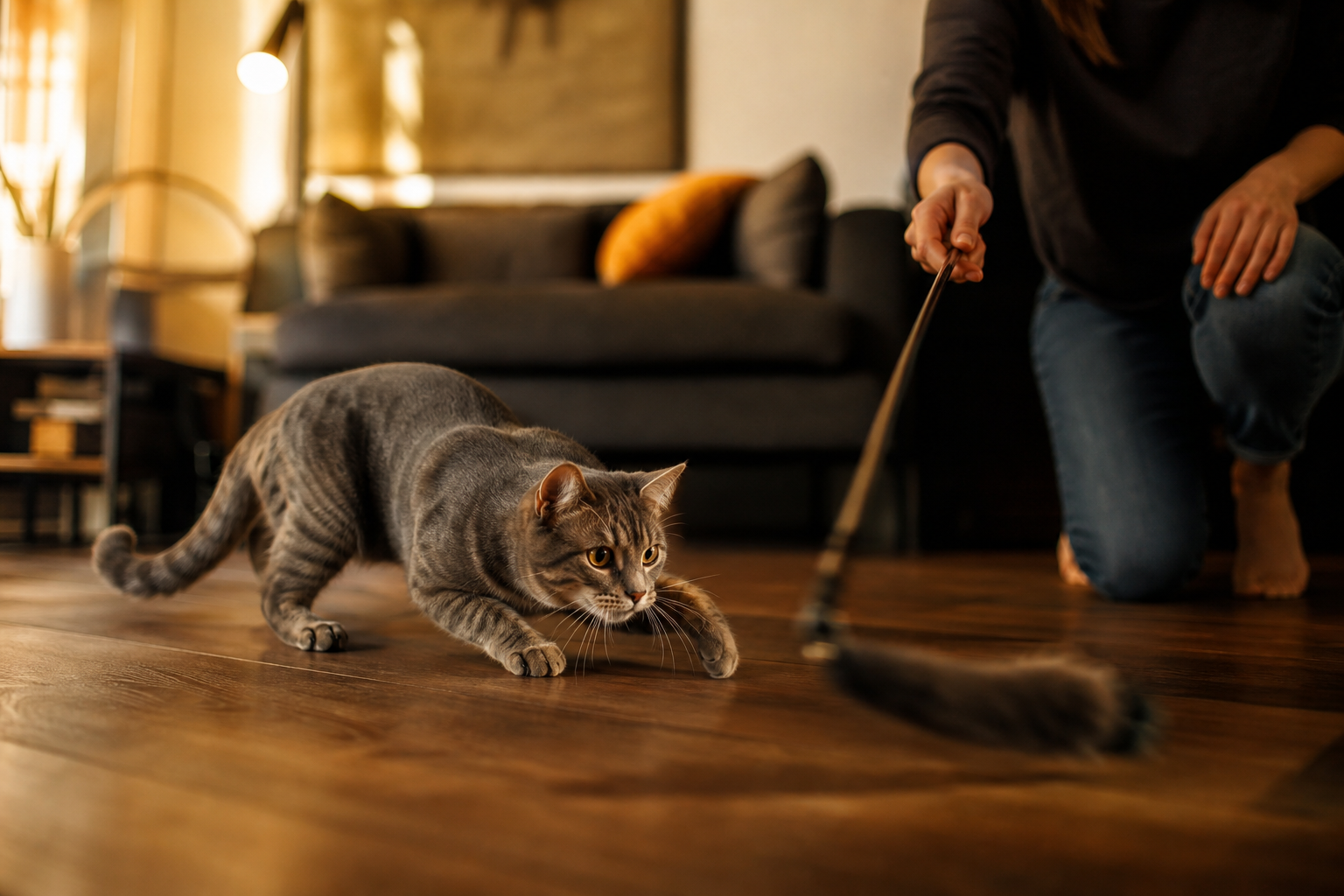
For most healthy adult cats, start with two or three interactive play sessions a day, about 10–15 minutes each. That is a practical starting point, not a rigid quota. A kitten may want many shorter bursts; a senior or cat with arthritis may prefer gentler five-minute games; a high-energy indoor cat may ask for another round.
Frequency matters more than forcing one long workout. Spread play across the day, let your cat stalk and catch the toy, and stop when their interest or comfortable movement fades. Judge the routine by your cat’s behavior and recovery—not only by the clock.
How Much Playtime Do Cats Need?
There is no scientifically proven daily number that fits every cat. A detailed review of domestic-cat play research concluded that important questions—including how much and what kind of play pet cats need—remain understudied. The AAFP/ISFM Feline Environmental Needs Guidelines recommend opportunities for play and predatory behavior, but they do not prescribe one universal minute target.
That is why competing answers such as 15, 30, 45, or 60 minutes should be treated as starting ideas, not pass–fail standards. A focused eight-minute hunt with several catches can be more satisfying than 30 minutes of waving a toy after the cat has checked out.
| Cat | Starting frequency | Typical session | How to adjust |
|---|---|---|---|
| Healthy adult | 2–3 times daily | 10–15 minutes | Add or shorten sessions according to engagement and recovery |
| Kitten | Several opportunities throughout the day | 5–10 minutes | Use frequent short bursts; stop before panting or loss of coordination |
| Senior cat | 2–3 gentle sessions daily | 3–10 minutes | Keep toys low, reduce jumping, and follow veterinary mobility advice |
| High-energy indoor cat | 3 or more varied sessions | 5–15 minutes | Add foraging, training, climbing, and solo enrichment rather than only longer chasing |
| Multi-cat home | Daily individual turns plus compatible group play | 5–15 minutes per cat | Prevent one cat from monopolizing the toy or blocking another cat |
The table describes owner-led, interactive play. A ball left on the floor, a puzzle feeder, climbing, scratching, and play with a compatible cat all add value, but they do not always replace the control and social contact of a game with you. Our broader cat enrichment plan can help you balance play with foraging, climbing, exploration, scratching, and rest.
Adjust the Schedule to Your Cat
Age is useful, but it is not the whole answer. Health, temperament, play history, indoor or outdoor access, time of day, toy preference, and the presence of other cats all change what a good schedule looks like.
Kittens: more chances, shorter games
Kittens often switch rapidly between sprinting, wrestling, eating, and sleeping. Offer several supervised play opportunities instead of trying to exhaust a kitten in one marathon. Use appropriately sized toys, keep strings and small parts out of solo reach, and never encourage attacks on hands or feet. A kitten who learns that skin is the target can carry that painful habit into adulthood.
Adult cats: build a repeatable rhythm
Many adults do well with a brief game before breakfast, another in the late afternoon or evening, and an optional wind-down session before bed. Cats are often naturally active around dawn and dusk, but your cat’s reliable alert periods matter more than forcing an exact time. If they consistently walk away at minute seven, make seven good minutes the plan.
Senior cats and cats with medical conditions: preserve choice
Older cats still benefit from play, even when running and jumping are uncomfortable. Slide a lure slowly across a rug, offer a kicker while the cat is lying down, or use an easy food puzzle. Keep the target close and low, add nonslip footing, and provide an easy exit. Ask your veterinarian for activity limits if your cat has arthritis, heart or breathing disease, neurologic problems, recent surgery, obesity, or another condition that affects exercise.
A sudden decrease in play is not automatically aging or boredom. Pain, dental disease, illness, impaired vision, and stress can all change activity. Arrange veterinary care when a normally playful cat abruptly stops, hides more, moves stiffly, misses jumps, loses appetite, breathes differently, or shows another new symptom.
High-energy and rough-playing cats: add variety, not just minutes
A cat who destroys ordinary toys may need several outlets: a wand for stalking and chasing, a larger sturdy kicker for catching and bunny-kicking, a food puzzle for problem-solving, and safe climbing or exploration. Match the object to the behavior instead of asking one toy to survive every job. The Titan Claws guide to durable cat toys explains how to match toys to biting, seam-ripping, string-chewing, and impact.
How to Run a Satisfying 10-Minute Play Session
Quality play resembles a small hunt. It changes speed, includes cover and pauses, and gives the cat real chances to catch. Constantly circling a lure above the cat’s head is exercise for the human wrist, but often a poor hunt.
- Invite; do not insist. Choose a time when your cat is awake and scanning the room. Move the toy at a distance and let the cat decide whether to engage.
- Make the toy act like prey. Move it away from the cat, around a box, or briefly behind furniture. Small ground-level movements are often more convincing than repeatedly pushing the lure toward the cat’s face.
- Use pauses. Give the cat time to watch, listen, crouch, and plan. Stalking is part of play; a still cat is not necessarily bored.
- Allow frequent catches. Let the cat pin and hold the lure. Do not yank every catch away immediately. If the cat bites or bunny-kicks hard, transfer the action to a sturdy capture toy rather than your hand.
- Lower the intensity. After several chase-and-catch cycles, make the movements smaller and slower. Finish with a final catch instead of making the toy vanish mid-pursuit.
- Close the routine. A small portion of the cat’s normal meal or an easy foraging task can follow play. Count any food toward the daily diet rather than adding unmeasured treats.
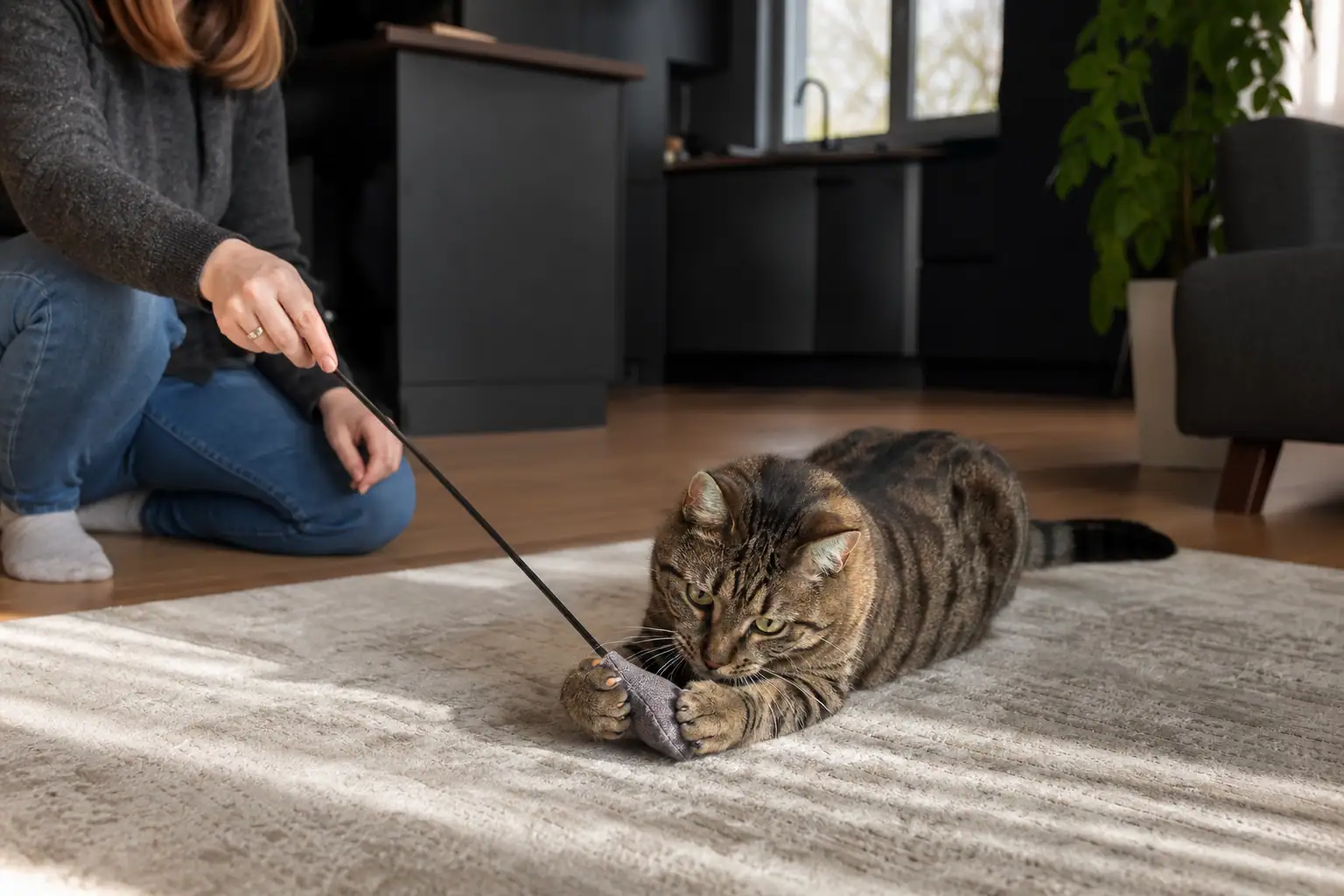
A wand keeps your hands away from teeth and creates better prey-like movement, but it is not a leave-out toy. See our cat wand safety guide for lure choices, technique, storage, and replacement points.
How to Tell Whether Your Cat Needs More Play
No single behavior proves that a cat is underplayed. Nighttime activity can be normal, scratching is a normal feline behavior, and vocalizing may have medical or social causes. Look for a pattern and change one part of the routine at a time.
- Possible signs to offer more or better-targeted play: repeated ankle ambushes, persistent toy-carrying invitations, restless attention-seeking during usual active periods, rough attacks on another cat who is trying to leave, or destructive hunting of household objects.
- Signs the current game is not working: the cat watches but never pursues, leaves immediately, startles from the toy, becomes defensive, or can never catch it. Try a different size, texture, sound, speed, or location before simply adding time.
- Signs to end or lower intensity: the cat lies down and no longer tracks the toy, walks away, becomes irritable, moves less smoothly, or begins open-mouth breathing. Never chase a cat to continue the session.
- Signs for veterinary advice: sudden behavior change, persistent panting, labored breathing, coughing, collapse, limping, pain, unusual aggression, or a marked increase or decrease in activity.
A 2022 survey of 1,591 cat guardians found that more games and greater daily play were associated with some higher reported quality-of-life and cat–guardian relationship scores. The authors also reported behavior changes when play was absent, while emphasizing that more research is needed. This observational study on play and cat welfare supports making play a regular part of care; it does not prove that a particular minute total causes a particular outcome.
Three Realistic Cat Play Schedules
The best schedule is one you can repeat. Attach short sessions to existing routines, keep one backup game for busy days, and do not try to “make up” a missed day with an exhausting workout.
A standard adult routine: about 25–30 minutes
- Morning: 8–10 minutes of wand play before part of breakfast.
- Evening: 10–15 minutes of chase, catch, and kicking with two toy types.
- Before bed: optional five-minute low-key hunt or food puzzle.
A genuinely busy day: about 15 minutes
- Morning: five focused minutes with a lure, including two or three catches.
- After work: five minutes of fetch, a track toy, or hallway chase.
- Evening: five minutes of hunting followed by a measured food puzzle.
Five good minutes count. Veterinary Partner’s play guidance suggests thinking of a ten-minute session as several two-minute bursts if that makes daily play easier to provide.
A high-energy indoor routine: 35 minutes plus enrichment
- Morning: 10 minutes of fast-and-slow wand play.
- Midday: measured food puzzle, hidden kibble, or short training session.
- Evening: 15 minutes alternating chase with a sturdy catch toy.
- Before bed: 10 minutes of lower, slower hunting and a calm finish.
If your cat is still restless, change the game before extending it indefinitely. A cardboard hide, new route, different lure, scent-free paper to rustle, or simple training task may add more than another 20 minutes of the same movement. Rotate only a few toys into service at once; our cat toy box and rotation system separates supervised toys, safe leave-out options, and retired items.
Play Safely With Cats That Bite and Destroy Toys
Play frequency increases toy wear. A cord that survives one session can fray after ten; a bell that was secure yesterday can loosen after repeated impacts. “Durable” describes relative resistance, not a guarantee that a toy cannot fail.
- Use strings, ribbons, feathers, wires, and detachable lures only with active supervision, then store them behind a closed door or in a secure container.
- Choose capture toys too large to swallow and free of glued eyes, loose bells, brittle plastic, exposed knots, or easy-to-remove decorations.
- Keep the play area clear of unstable furniture, open stairs, breakables, and slippery landing zones.
- Never use hands or feet as prey. Freeze and redirect to a toy if teeth or claws contact skin.
- Inspect seams, fabric, cord, attachment points, battery doors, and every component after hard play.
- Retire a toy when stuffing, foam, wire, sharp edges, batteries, or small parts become accessible; do not wait for a piece to disappear.
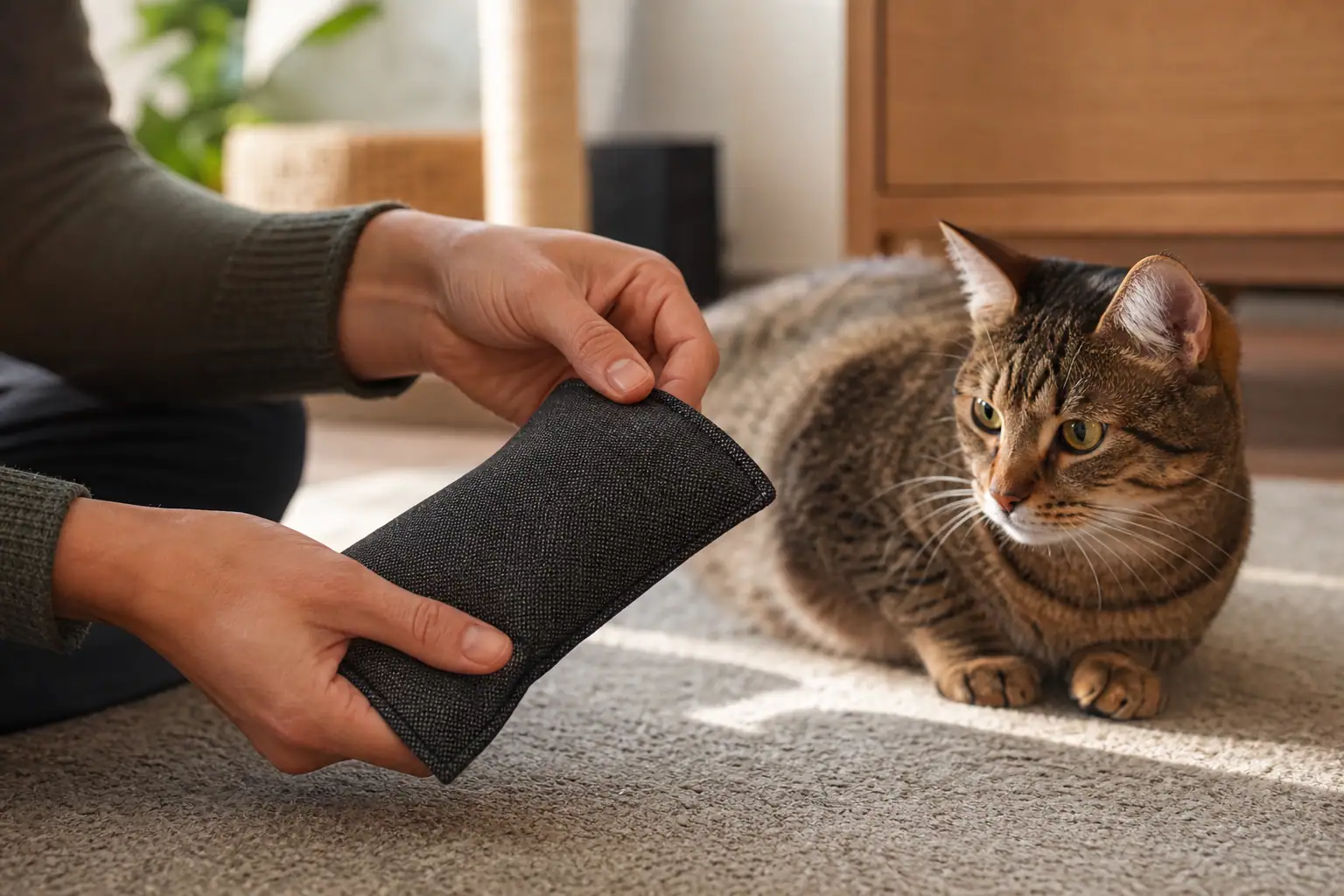
The Cornell Feline Health Center advises avoiding small pieces and linear parts such as string or feathers that may separate and be swallowed, checking the play environment for falling and fall hazards, and rotating toys to reduce boredom. For a rough player, supervision and inspection are part of the play session—not optional maintenance for later.
Quick Checklist and FAQs
- Start most healthy adults at two or three interactive sessions daily.
- Aim for roughly 10–15 minutes, but stop sooner when the cat is done.
- Give kittens more frequent short opportunities and seniors gentler, lower games.
- Include stalking, pauses, pursuit, and successful catches.
- Offer each cat an individual turn in a multi-cat home.
- Add foraging, climbing, scratching, training, and exploration instead of relying on chase alone.
- Inspect and store toys after every rough session.
- Ask a veterinarian about sudden activity changes, pain, or breathing problems.
Is 15 minutes of play enough for a cat?
Fifteen minutes can be a valuable daily minimum on a busy day, especially when it is focused and paired with other enrichment. Many healthy adults will benefit from a second or third short session. Watch whether your cat settles comfortably, continues to seek play, or redirects hunting toward people, other pets, and household objects.
Can you play with a cat too much?
Yes, if you force participation, continue through fatigue or pain, encourage unsafe jumping, or create nonstop high arousal without catches and a calm finish. Let the cat opt in and out. Stop for open-mouth breathing, poor coordination, irritability, or loss of interest, and seek veterinary advice for persistent panting or any breathing difficulty.
Do two cats still need playtime with their owner?
Usually, yes. Compatible cats may chase and wrestle together, but their relationship and preferences can differ. Individual owner-led turns prevent a bolder cat from controlling the toy and let you observe each cat’s movement, confidence, and appetite for play.
Should you play with your cat before meals?
It can be a useful routine: hunt-like play, a final catch, then part of the cat’s measured meal. It is not mandatory, and cats with medical diets or feeding plans should follow veterinary guidance. Avoid adding extra calories every time you play.
What if my cat does not want to play?
Try when the cat is naturally alert, use smaller movements and longer pauses, and test different safe sounds, textures, sizes, and locations. Some cats prefer food puzzles or training to vigorous chase. Do not force it. A sudden loss of interest—especially with hiding, appetite change, stiffness, or other symptoms—deserves a veterinary check.
Bottom line: begin with two or three short daily sessions, then let your cat show you whether the routine needs more frequency, a different game, or less intensity. Consistent, prey-like play with safe catches beats chasing an arbitrary number on a timer.
Sources
- AAFP and ISFM Feline Environmental Needs Guidelines
- Delgado and Hecht: Review of the development and functions of cat play
- Foreman-Worsley et al.: Associations between play and welfare in domestic cats
- Cornell Feline Health Center: Safe toys and gifts
- Veterinary Partner: The importance of play in cats
Leave a Reply