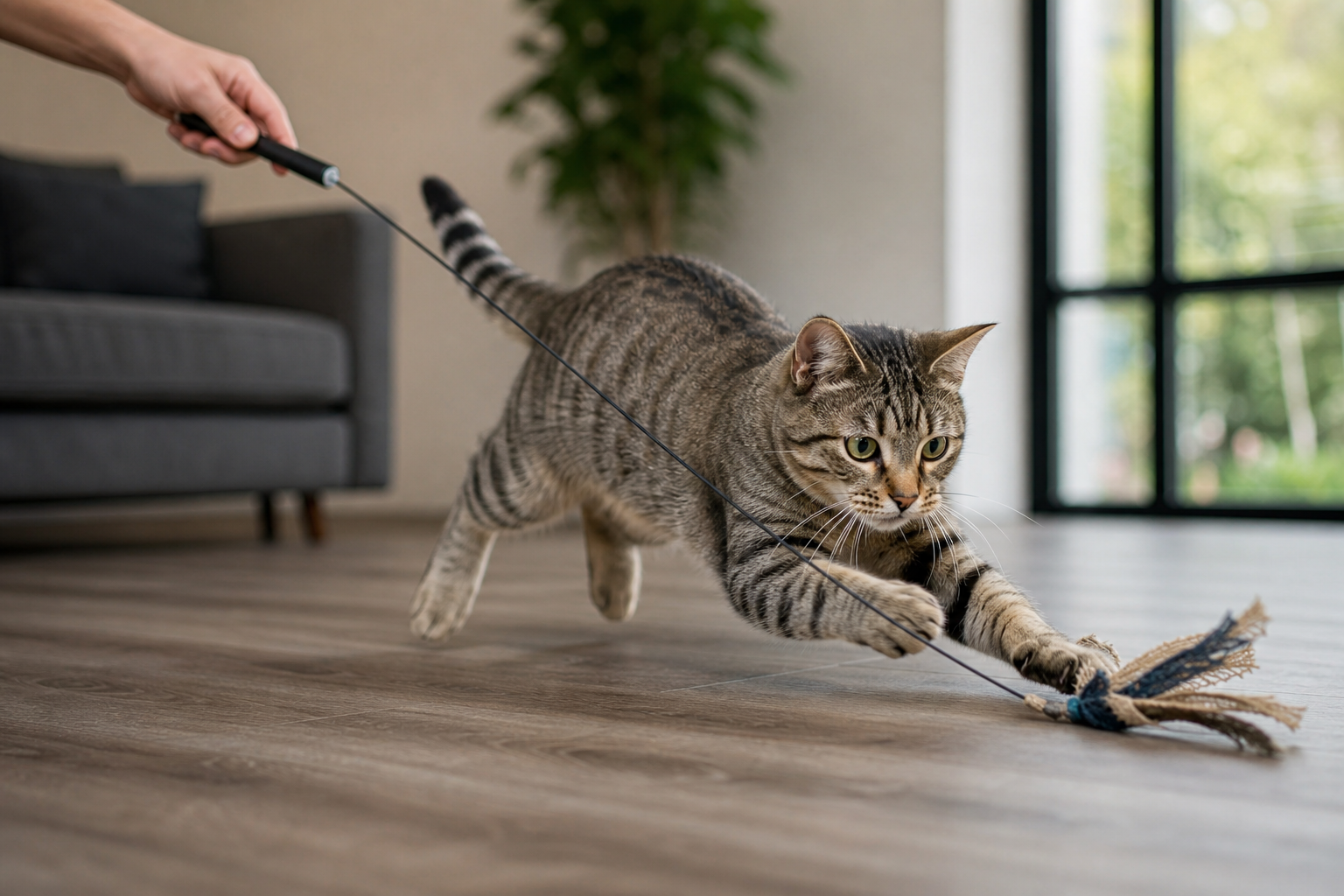
A cat toy on a stick is usually a wand, teaser, or fishing-pole style toy: a handle with a string, wire, ribbon, feather, plush lure, fabric strip, or interchangeable attachment at the end. It can be one of the best toys for indoor cats because it lets you create prey-like movement from a safe distance. It can also be one of the easiest toys to misuse if it is left out, frays, or has small parts your cat can chew off.
The right approach is simple: use wand toys for supervised play, choose attachments that match how your cat bites and pulls, let your cat catch the lure during the game, inspect the toy after every hard session, and store it where your cat cannot chew the string. For Titan Claws readers with rough players, that last part matters. A stick toy is not a set-it-and-forget-it toy. It is play equipment.
Why Cats Like Toys on Sticks
Wand toys work because they let you act like prey. A good stick toy can skim across the floor like a mouse, flutter behind a chair like a bird, dart around a cardboard box, or disappear under a towel edge. That movement gives your cat a chance to stalk, chase, pounce, grab, bite, and kick without targeting your hands.
Veterinary behavior guidance supports this kind of play. The AAFP and ISFM feline environmental needs guidelines recommend opportunities for play and predatory behavior, including owner-led play, toys, and food puzzles. Their play examples include moving a rod or wand so the toy mimics flying or ground prey, then letting the cat catch it.
That catch is not optional for many cats. If the lure always escapes, some cats get frustrated, over-aroused, or start redirecting onto ankles, hands, or another pet. A better session includes a chase, a real capture, a brief bite-and-kick moment, and a calm finish.
What Current Search Results Get Right and Miss
Most results for “cat toy on stick” are shopping pages. They are useful for comparing feathers, retractable poles, replacement lures, clips, and prices, but they usually do not help you decide what is safe for your specific cat. A product grid cannot see whether your cat chews string, swallows feathers, snaps elastic, cracks plastic, or drags the wand under the bed.
Chewy’s wand toy category gives the basic definition well: wand toys have a handle and dangling toy, such as feathers, strings, or plush critters, and they mimic prey movements. Some specialty brands, including Repounce’s Forever Stick, compete around longer-lasting handles and replaceable setups. Those details can help, but handle durability is only one part of the decision.
The stronger buying question is: what happens when my cat catches it hard? For a gentle swatter, many feather teasers are fine under supervision. For a cat that clamps down, twists, and tries to eat the cord, you need stricter rules: shorter sessions, tougher lures, fewer tiny attachments, careful storage, and fast replacement when wear appears.
How to Choose a Better Cat Toy on a Stick
Start with your cat’s failure pattern. Durable does not mean impossible to break. It means the toy should fail visibly, slowly, and in a way you can catch before your cat swallows pieces.
- For cats that chew string: avoid thin elastic, yarn, ribbon, and long loose cords. Choose a wand with a heavier cord, short fabric lure, or clip-on attachment you can remove and store.
- For cats that shred feathers: use feathers only during close supervision, or switch to fabric, fleece, canvas, or a larger plush lure without glued decorations.
- For cats that pull hard: look for a solid handle, secure connection point, and replaceable lure. Retire the toy when the clip bends, knot loosens, or cord sheath frays.
- For cats that leap: choose a longer wand so your hand stays away, and play in a room without sharp furniture edges, breakables, or unstable shelves.
- For kittens: keep the toy lightweight, avoid high jumps, and focus on short sessions. Growing cats do not need big aerial moves to get value from play.
Cornell Feline Health Center advises avoiding toys with small pieces or linear strand-like parts, such as feathers and string, that may separate when chewed and be ingested. That warning is especially relevant for stick toys because the exciting part of the toy is often a cord or feather attachment.
Feather, Ribbon, Plush, or Interchangeable Wand?
Different wand styles solve different jobs. The safest choice depends less on what looks exciting online and more on how your cat plays after the catch.
Feather wand toys
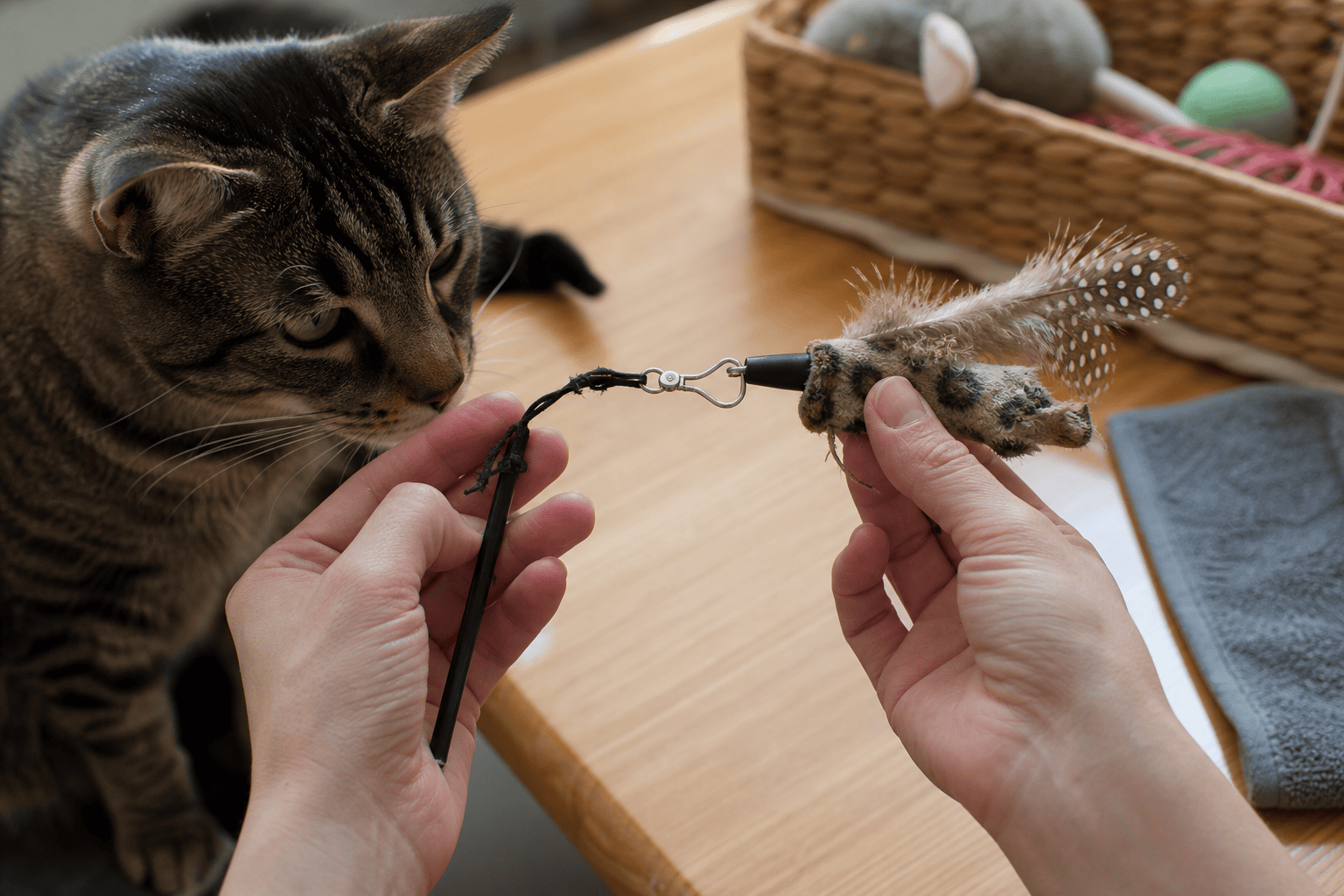
Feathers are excellent for chase and pounce because they flutter unpredictably. They are not ideal for cats that chew and swallow pieces. Use them for active sessions, inspect the quills and attachment point, and put them away immediately afterward. Titan Claws has a deeper guide to cat feather toys and a product-specific safety guide for the Da Bird cat toy.
Ribbon and fabric strip toys
Ribbon-style toys can be great for cats that like flowing movement, but they are a poor fit for cats that chew string-like material. If your cat bites through fabric strips or tries to swallow ribbon, retire that style and use a larger lure instead.
Plush or fabric lures
Plush lures are often better for rough players because they give the cat something larger to grab and kick. Choose simple construction: no glued eyes, bells, weak tails, loose stuffing, or tiny plastic parts. A fabric lure should be large enough to catch, but not so heavy that whipping it through the air becomes unsafe.
Interchangeable wand toys
Interchangeable systems are useful if your cat gets bored or destroys one lure faster than the handle. The tradeoff is the connector. Check clips, swivels, knots, split rings, and snap points often. If a connector bends or starts catching fur, replace it before the next session.
How to Play With a Wand Toy Without Creating Bad Habits
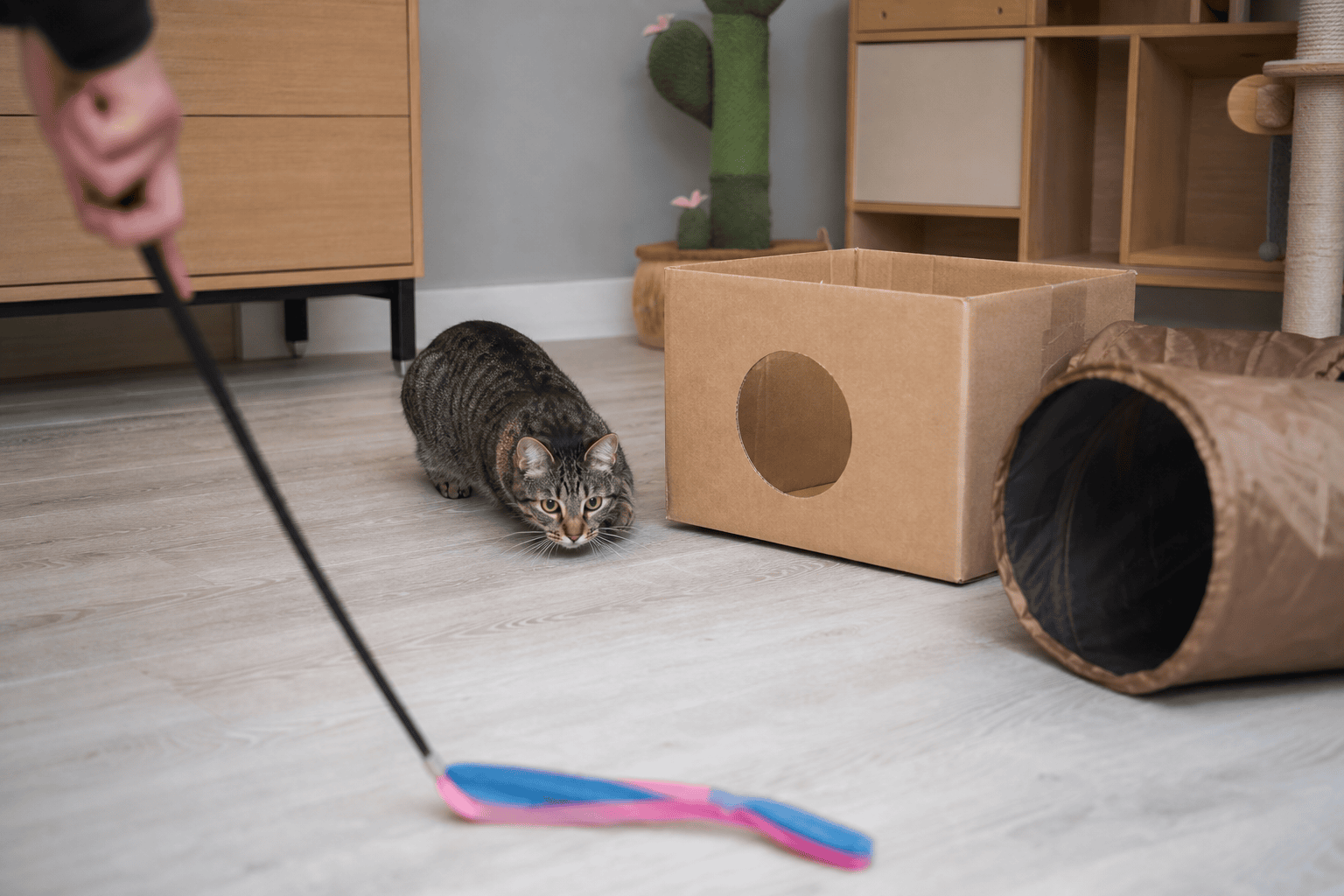
The most common mistake is dangling the lure in the cat’s face. Real prey does not hover over a cat’s nose begging to be hit. Better wand play moves away from the cat, hides, pauses, and changes speed.
- Clear the room: remove cords, breakables, food wrappers, loose plastic, and unstable objects.
- Start low: drag the lure along the floor or behind furniture instead of making your cat leap immediately.
- Move away: prey runs away from the hunter. Pull the lure across the room, around a corner, or behind a box.
- Use pauses: stop the lure for a second so your cat can stalk and plan.
- Let the catch happen: every few passes, let your cat grab the lure and hold it.
- Trade into a kicker: if your cat bites hard, let the cat transfer that energy onto a larger kicker toy rather than the cord.
- Cool down: finish with a small food puzzle, meal portion, or calm treat so the hunting sequence has an ending.
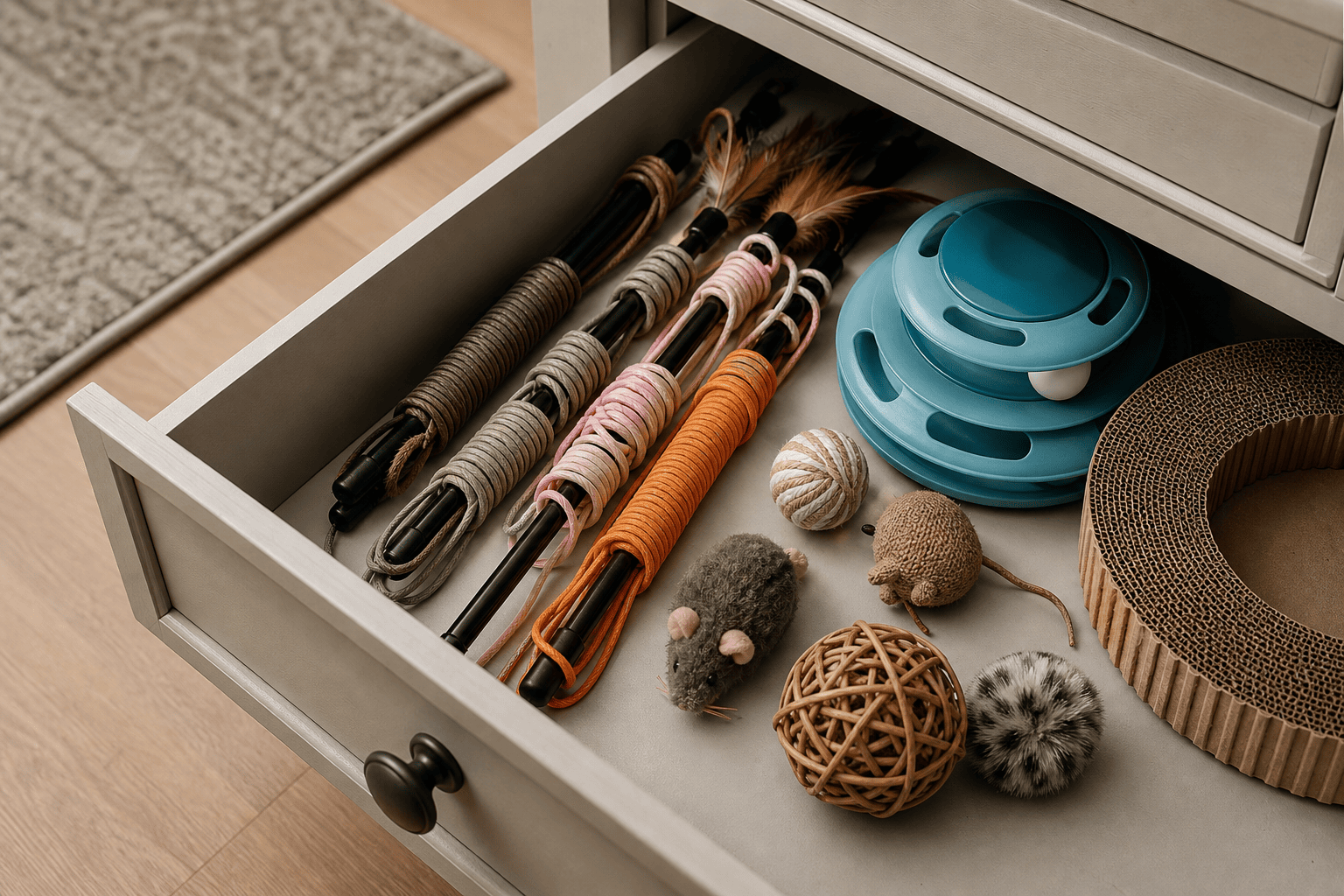
- Inspect and store: check the lure, string, handle, and connector before putting the toy away.
For indoor cats that need more structure, pair wand play with enrichment routines from Titan Claws guides on cat toys for hunting, interactive cat toys for indoor cats, and cat toys for enrichment.
Safety Rules for Cats That Destroy Wand Toys
Stick toys deserve stricter safety rules than many solid toys because they often combine a long handle, a moving cord, and a lure designed to be bitten. That is a great recipe for exercise, but not for unsupervised access.
- Do not leave wand toys out after play. Cats Protection recommends not leaving cats alone with toys that could be shredded and eaten or that they could get tangled in.
- Retire damaged lures early. Loose feathers, exposed stuffing, frayed cord, cracked plastic, and weak knots are not worth one more session.
- Do not pull string from a cat’s mouth or rear. If you think your cat swallowed string, ribbon, elastic, or any linear toy part, contact a veterinarian or emergency clinic.
- Avoid hand wrestling. Use the wand to keep your hands out of the strike zone. If your cat grabs your hand, freeze, redirect to a toy, and shorten the next session.
- Keep jumps reasonable. High leaps look dramatic, but hard landings can be rough on kittens, seniors, overweight cats, and cats with mobility issues.
- Store cords wrapped and closed away. A hook on the wall is fine only if the cat cannot reach the cord or lure.
If your cat repeatedly eats non-food material, talk with your veterinarian. The toy decision may be only part of the issue. Stress, pain, dental discomfort, diet, gastrointestinal disease, and compulsive chewing can all change what is safe to leave within reach.
When to Replace a Cat Wand Toy
Replace a cat toy on a stick before it fails completely. Waiting until a lure snaps off or a string breaks turns a cheap replacement into a safety problem.
- The cord is frayed, thinning, unraveling, or sticky.
- The lure has exposed stuffing, broken seams, sharp quills, or missing pieces.
- The clip, swivel, or connector bends open or no longer closes cleanly.
- The handle splinters, cracks, or flexes unpredictably.
- Your cat has started chewing the cord instead of chasing the lure.
- The toy smells musty, has been soaked with saliva, or cannot be cleaned.
- You cannot inspect the damage clearly in under a minute.
A replaceable wand can be a good value, but only if replacement parts are treated as consumables. For cats that hit hard, the lure is the wear item. The handle should last longer; the prey end should be retired whenever it stops being inspectable.
Quick Buying Checklist
Use this checklist before buying or keeping a wand toy for a rough-playing cat:
- Is the lure large enough that my cat cannot swallow it whole?
- Are there feathers, bells, beads, glued eyes, rubber bands, or thin strings my cat could remove?
- Can I replace the lure without replacing the whole wand?
- Is the connector smooth, secure, and easy to inspect?
- Does the handle keep my hand safely away from claws and teeth?
- Can I clean or retire the lure before it becomes crusty or torn?
- Do I have a closed storage spot for the toy after play?
- Does this toy match my cat’s real behavior, not just the product photo?
The best cat toy on a stick is not the flashiest one. It is the one that lets your cat hunt, catch, bite, and release while you stay in control of the movement and the risk. Choose simple materials, supervise closely, build in real captures, inspect every wear point, and put the wand away when the game ends.
Leave a Reply