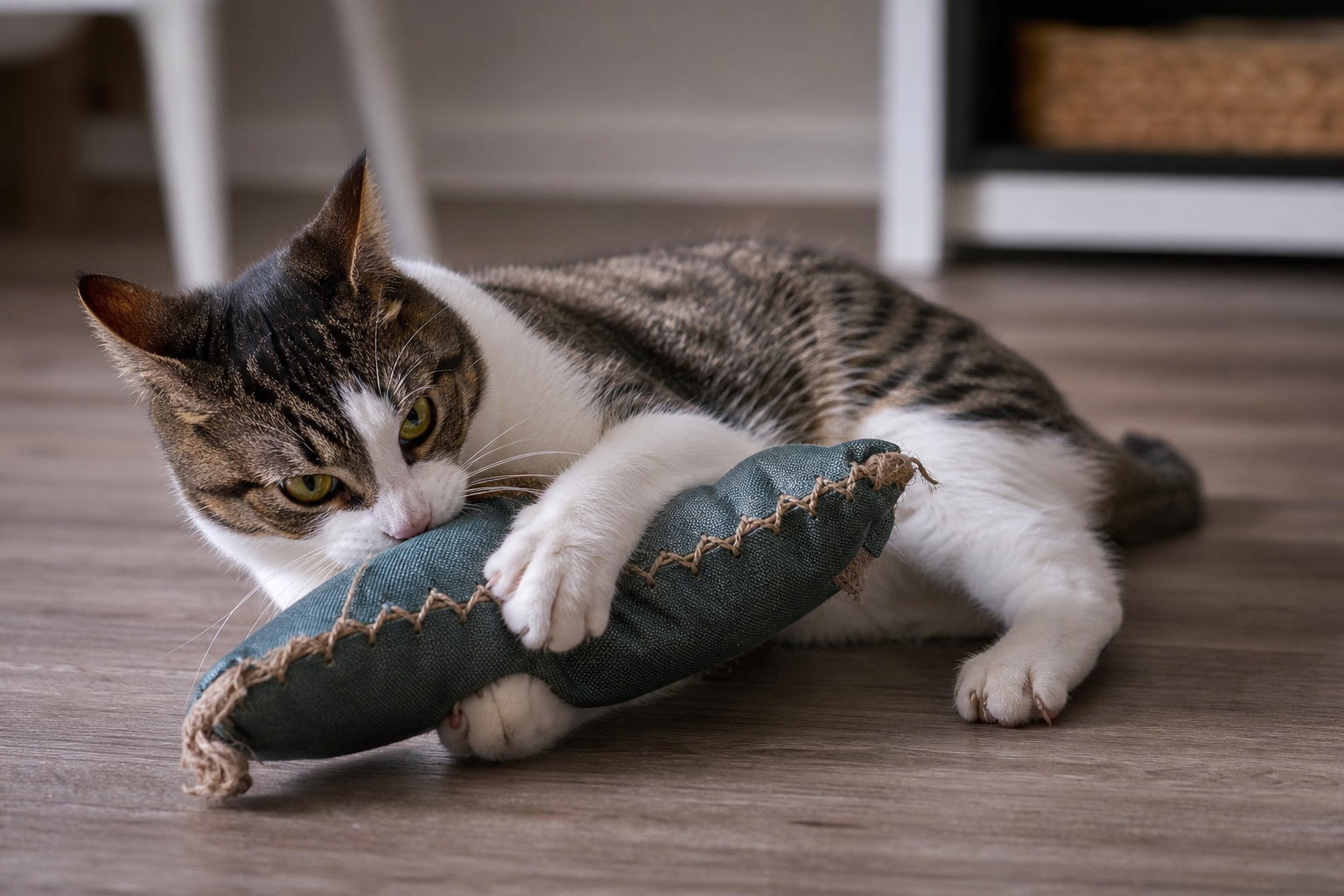
Tag: rough play

  • Automatic Cat Toys for When You Are Away: What Is Safe to Leave Out?

    Automatic Cat Toys for When You Are Away: What Is Safe to Leave Out?

    Automatic cat toys can help when you are away, but they should not be treated as a full-day babysitter. The safest choices are short-session, low-risk toys that add movement without exposing your cat to string, feathers, charging cords, loose plush, weak seams, or chewable battery compartments. For many cats, the best away setup is a mix of one carefully tested automatic toy, passive enrichment, food puzzles, scratchers, window viewing, and owner-led play before or after you leave.

    If your cat destroys ordinary toys, be stricter. Do not leave out an electronic plush fish, spinning feather, elastic tail, wand attachment, or battery toy just because the package says interactive. Watch several supervised sessions first, inspect the toy after hard bites, and reserve anything with removable or chewable parts for when you are home. Automatic should mean less hands-on effort, not less judgment.

    What Automatic Toys Can Do While You Are Away

    Automatic toys are useful for adding unpredictable movement to an indoor cat’s day. A motion-activated ball, enclosed peekaboo toy, or timed electronic teaser may prompt stalking, pouncing, batting, and short bursts of exercise. That matters because cats need outlets for normal predatory behavior, not just a bowl of food and a place to nap.

    The AAFP and ISFM feline environmental needs guidelines describe play, predatory behavior, owner interaction, and feeding devices as part of a healthy feline environment. The same guidelines recommend letting cats catch toys, using food puzzles, rotating toys to reduce boredom, and putting away string-like or ingestible toys after play. That is the standard automatic toys need to fit.

    In practice, automatic toys are best for short bursts. Most cats do not need a gadget running for eight hours. They need novelty, a safe room, enough resources, and a routine that includes real capture and rest. A toy that activates occasionally can be helpful. A toy that runs constantly, gets trapped under furniture, or teaches your cat to chew electronics is not.

    The Safer Away-From-Home Rule

    Before leaving any automatic cat toy available, ask one question: if my cat attacks this hard while I am gone, what can come loose? If the answer is string, feathers, bells, plastic eyes, elastic, stuffing, a battery door, a charging cover, or a glued-on decoration, treat that toy as supervised-only.

    For unattended time, look for fewer failure points:

    • Enclosed movement: moving parts are inside a tunnel, track, or sturdy housing instead of dangling from a string.
    • Secure power: battery doors screw shut, charging ports are covered, and no cord is available during play.
    • Automatic shutoff: the toy stops after a short session instead of overheating, draining, or overstimulating your cat.
    • Simple materials: no feathers, ribbons, small bells, thin elastic, exposed foam, or loose fabric edges.
    • Easy inspection: you can see cracks, opened seams, bite marks, and missing pieces quickly.

    Cornell Feline Health Center’s safe toys guidance warns against small pieces, strand-like parts such as feathers and string, electrical cords, and unsafe play areas where cats could fall or knock heavy objects over. Those points matter more when you are not there to interrupt the session.

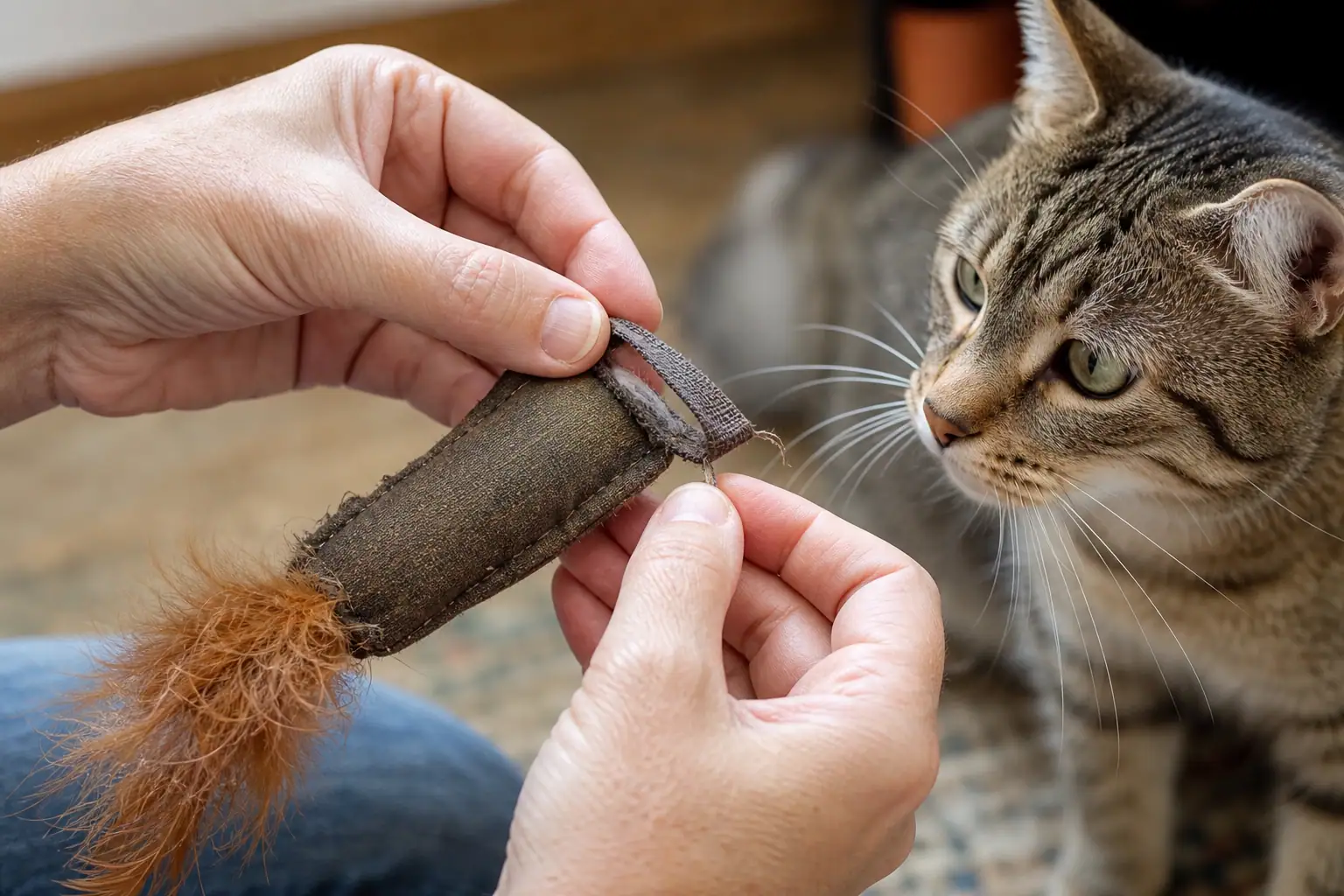
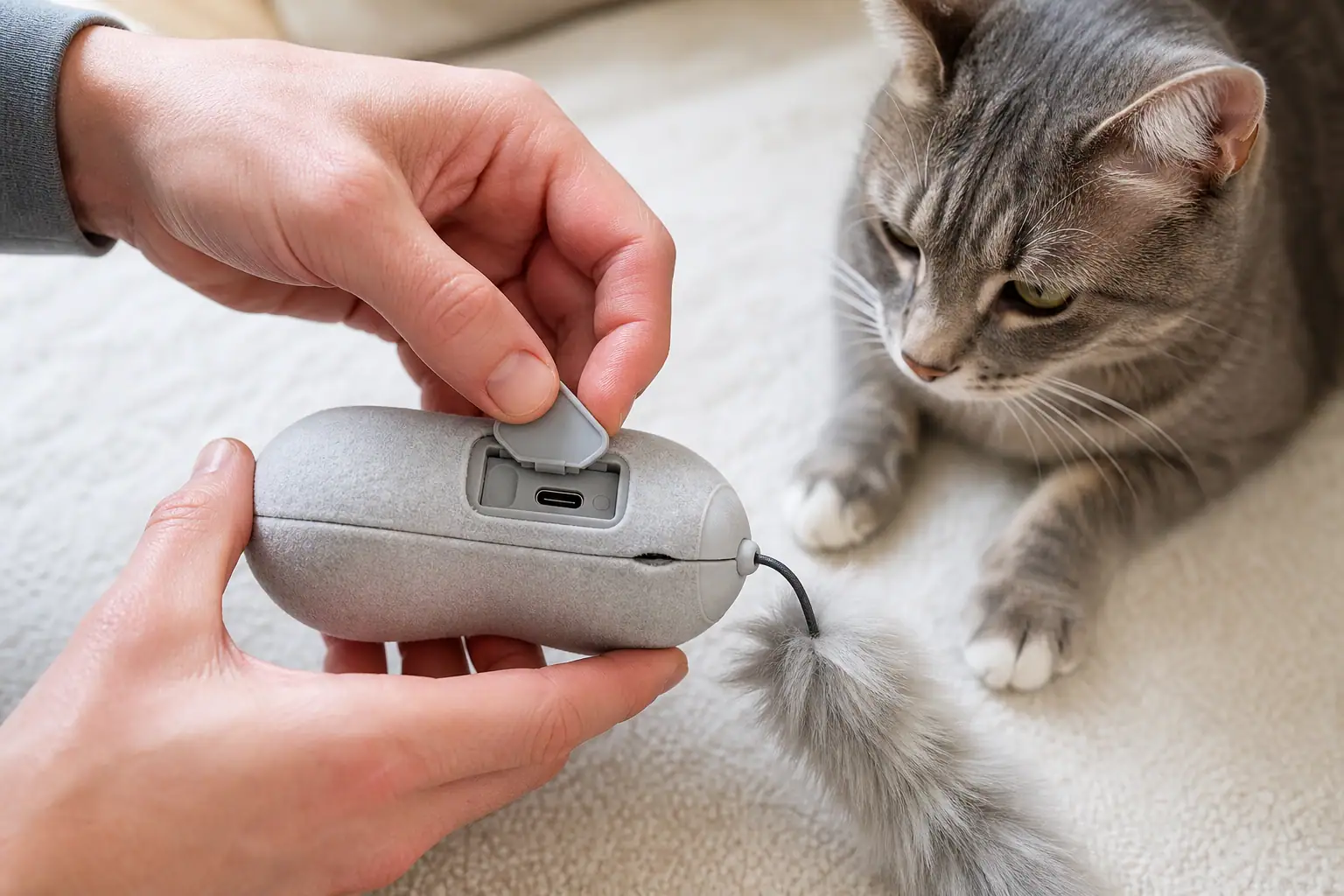
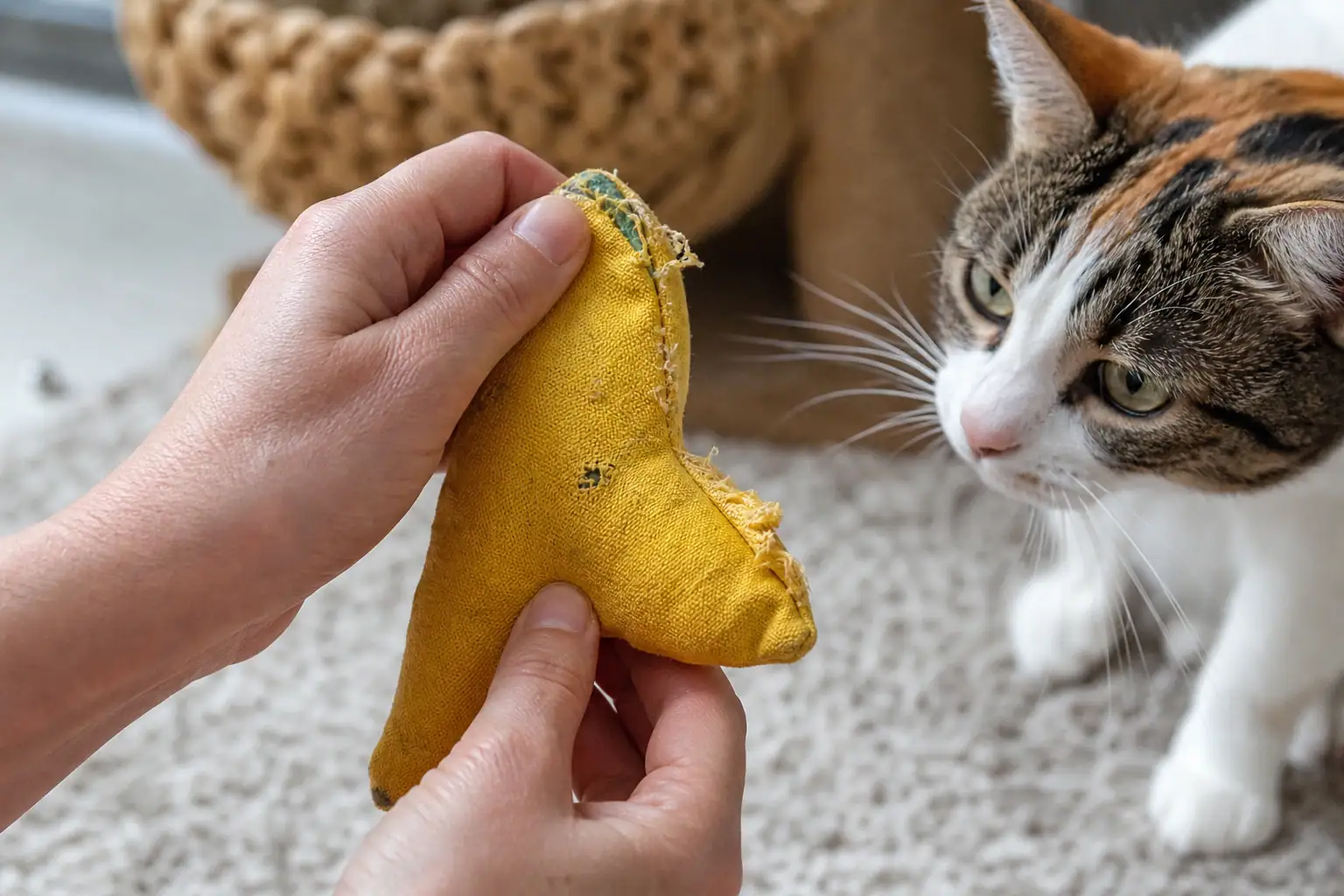
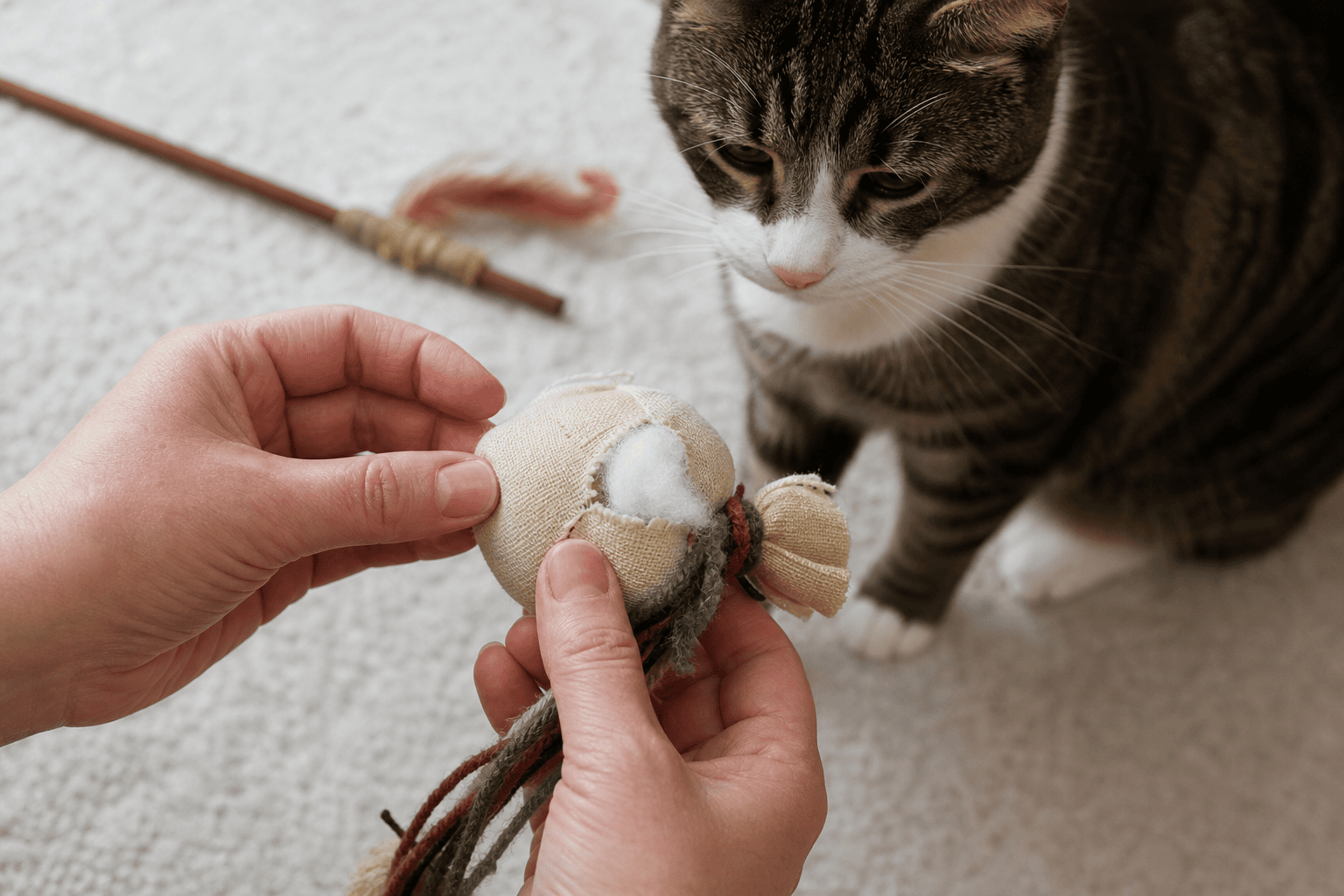
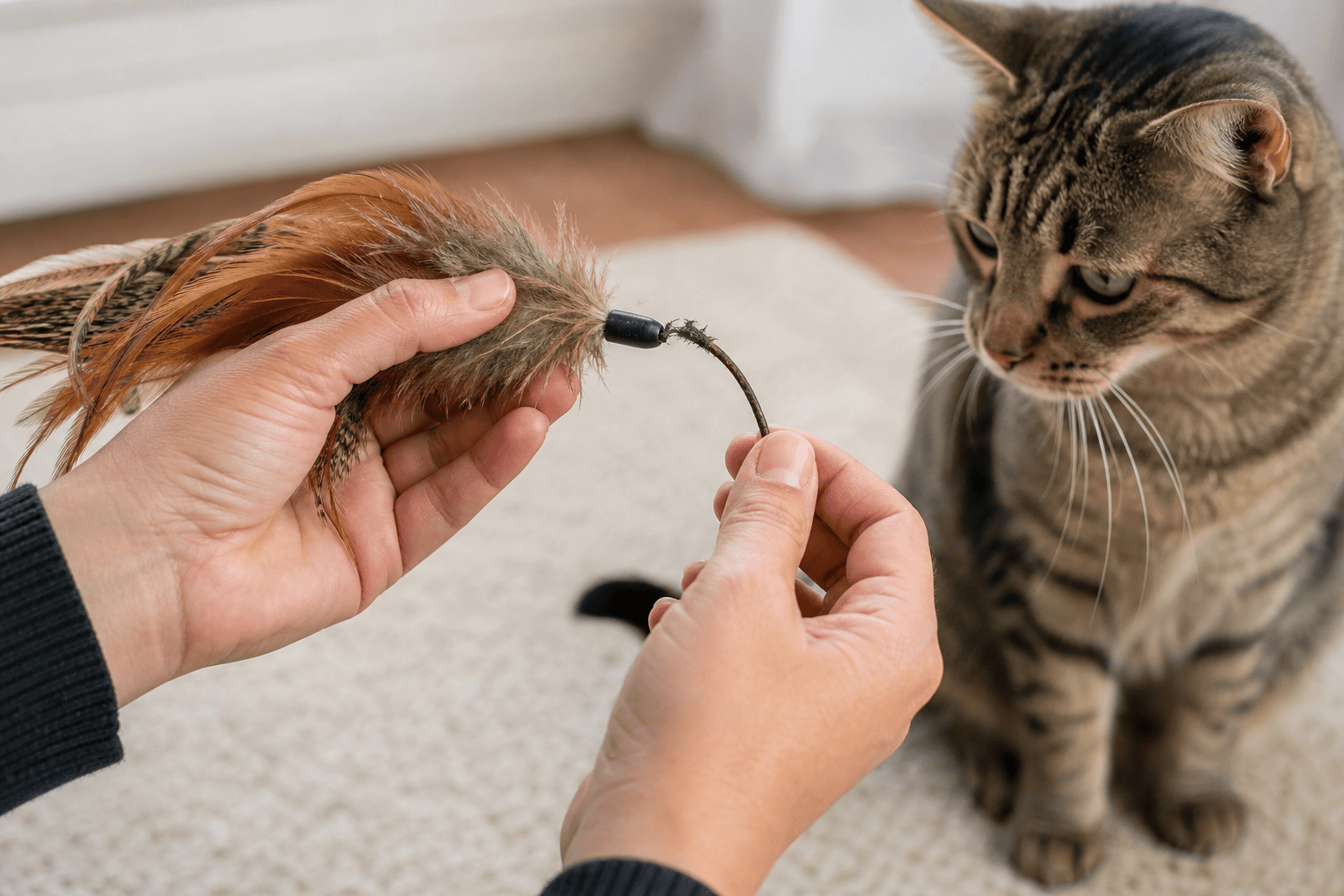
    Hands inspecting the battery door and seams of an automatic cat toy
    Before a toy becomes an away option, inspect the battery door, seams, shell, attachments, and charging area after real play.

    Best Types of Automatic Cat Toys for When You Are Away

    No category is automatically safe for every cat, but some designs are easier to justify for short unsupervised access after testing.

    • Enclosed track toys: A ball inside a track or covered raceway gives batting movement without loose attachments. Check that the ball cannot pop out and that the track cannot pinch paws.
    • Peekaboo toys with protected lures: Toys that hide movement under a cover can trigger stalking. Use only if the cover is tough and your cat does not chew through fabric to reach the mechanism.
    • Sturdy rolling toys: Hard-shell rolling toys can work for chasers in open rooms. Avoid thin shells that crack, fuzzy covers that peel, or toys small enough to wedge under appliances.
    • Timed feeders and food puzzles: These are not always sold as toys, but they are often safer away enrichment because they make your cat work for food without chasing electronics.
    • Smart camera or treat devices: These can be useful if you actively monitor them, but treat launchers, cords, wheels, and moving attachments still need the same inspection standards.

    Product roundups often focus on which gadget is most entertaining. For owners of rough players, the better ranking question is: which toy fails least dangerously? A toy your cat ignores is a waste. A toy your cat dismantles while you are at work is worse.

    What Not to Leave Out When You Are Gone

    Some toys can be excellent during supervised play and poor choices for unsupervised time. Put them away before you leave.

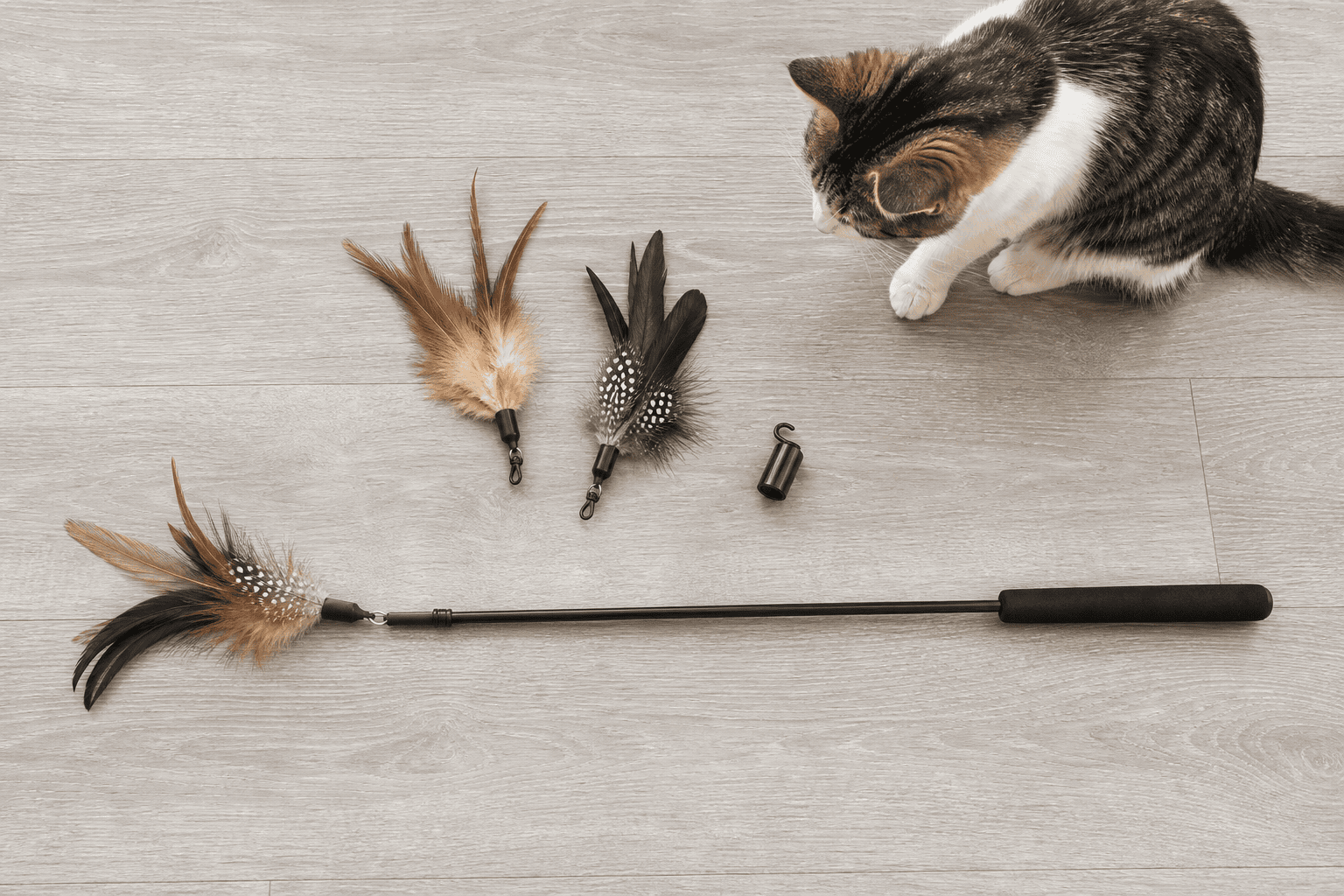
    • Wand toys and automatic string toys: String, ribbon, elastic, and lure cords can be swallowed or wrapped around a cat.
    • Feather spinners: Feathers, wire arms, and plastic connectors can break loose, especially with cats that grab and kick.
    • Electronic plush toys for chewers: Soft covers can hide batteries, zippers, seams, charging modules, and stuffing.
    • Laser-only toys: Lasers can trigger chase without capture. Save them for supervised sessions that end with a physical toy or treat.
    • Cheap toys with glued parts: Bells, eyes, tails, thin plastic tabs, and decorative pieces are common failure points.
    • Anything already damaged: A cracked shell, loose seam, exposed stuffing, missing screw, or weak battery door means the toy is done.

    For more detail on powered toys in general, use Titan Claws’ broader guide to automatic cat toys. If the problem is chewing rather than boredom, start with toys for cats that chew and safe cat chew toys before adding electronics.

    Build an Away Routine, Not a Gadget Pile

    The best automatic cat toys for when you are away work as part of a routine. Cats are more likely to use toys safely when their day includes a predictable play rhythm, places to rest, and several low-risk enrichment options instead of one overstimulating machine.

    Try this setup on a normal workday:

    1. Before you leave: five to ten minutes of wand play, ending with a catch, treat, or breakfast.
    2. While you are away: one tested automatic toy in a clear area, plus a scratcher, window perch, puzzle feeder, and a few sturdy solo toys.
    3. When you return: inspect the automatic toy, pick up anything damaged, and offer a short capture game with a kicker or wand.
    4. At night: store high-risk toys and rotate one or two options for the next day.

    This approach closes a gap in many automatic-toy articles: the question is not only which product moves. It is what happens before the motion starts, what your cat can safely do after catching it, and whether the toy is still intact when you get home.

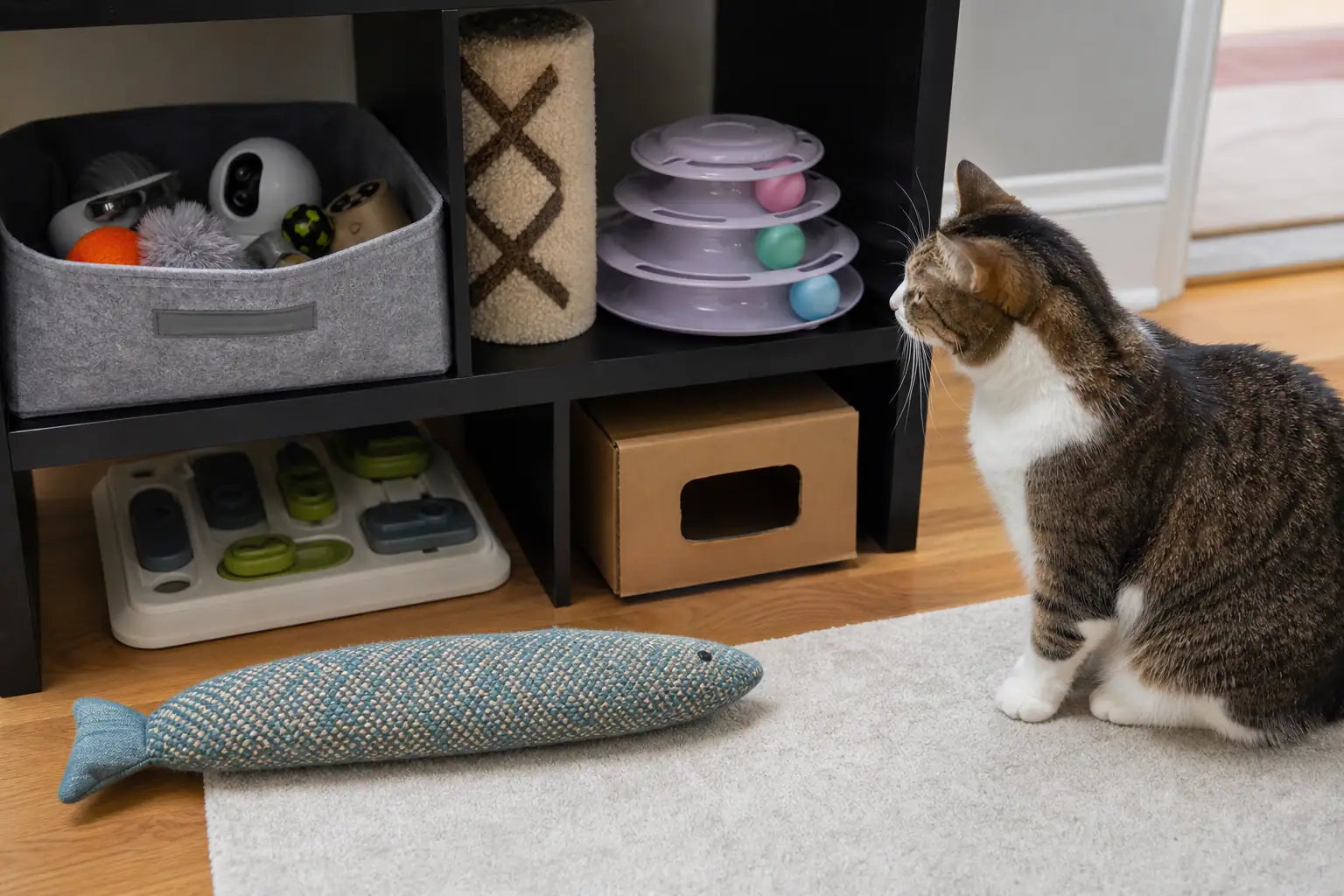
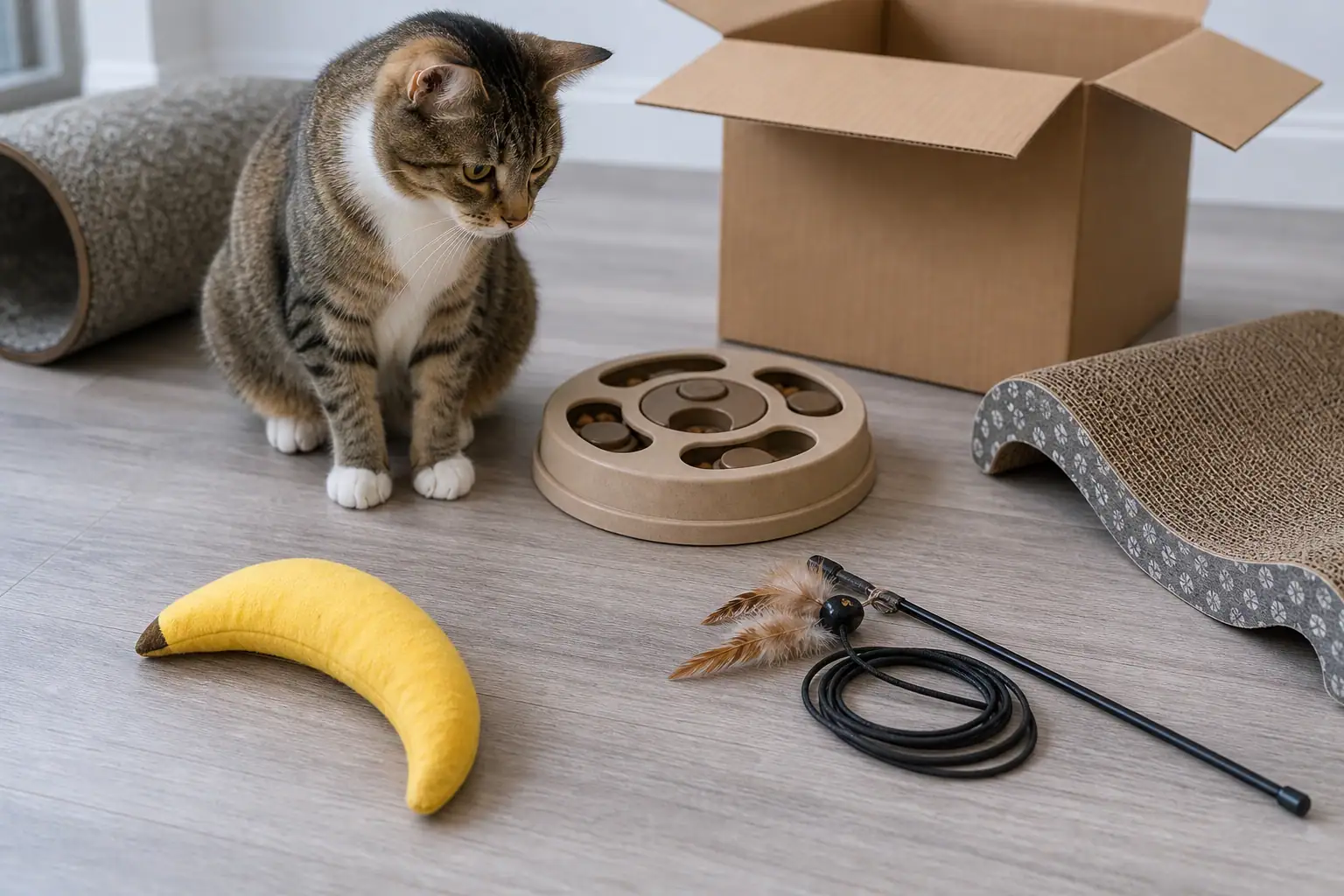
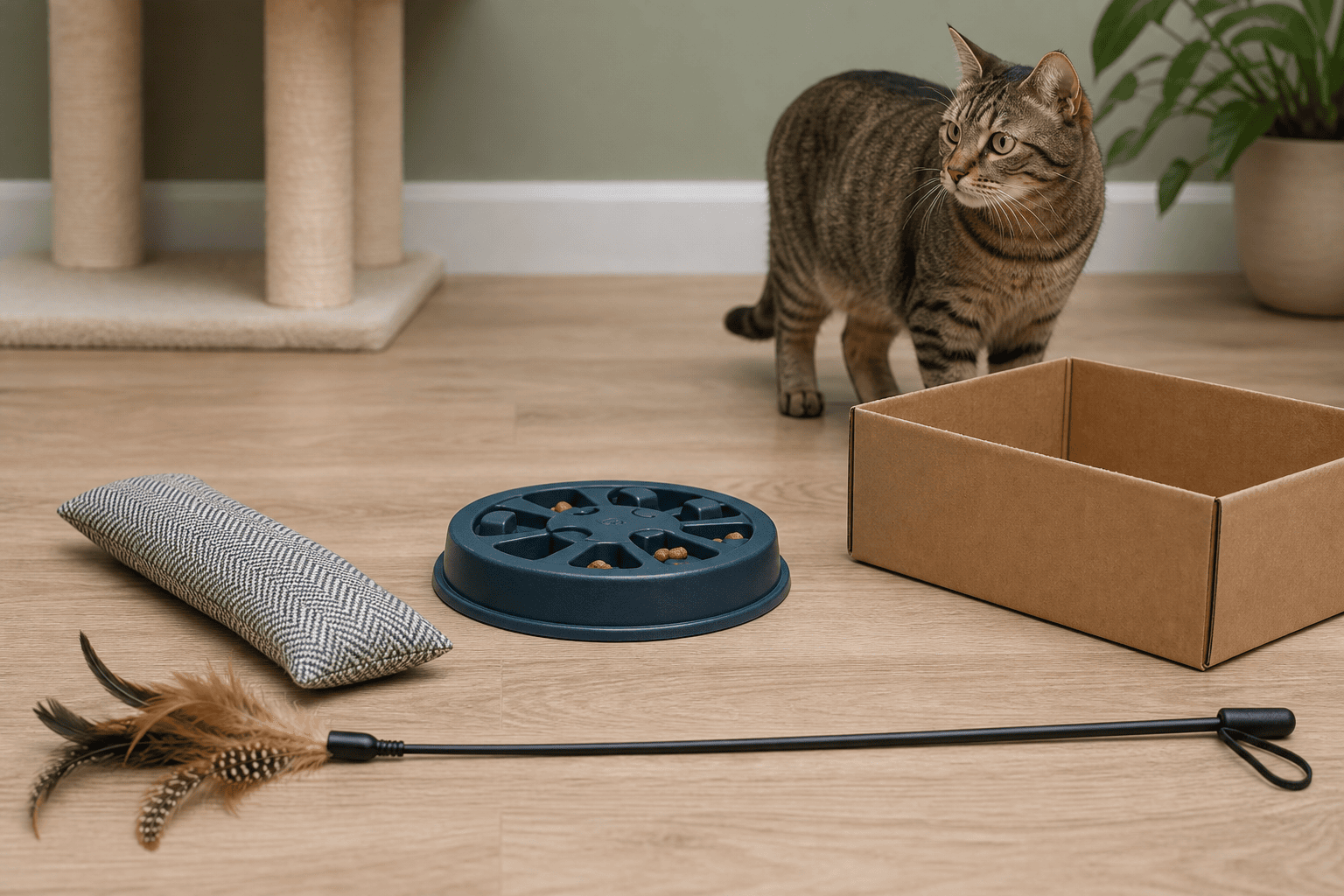
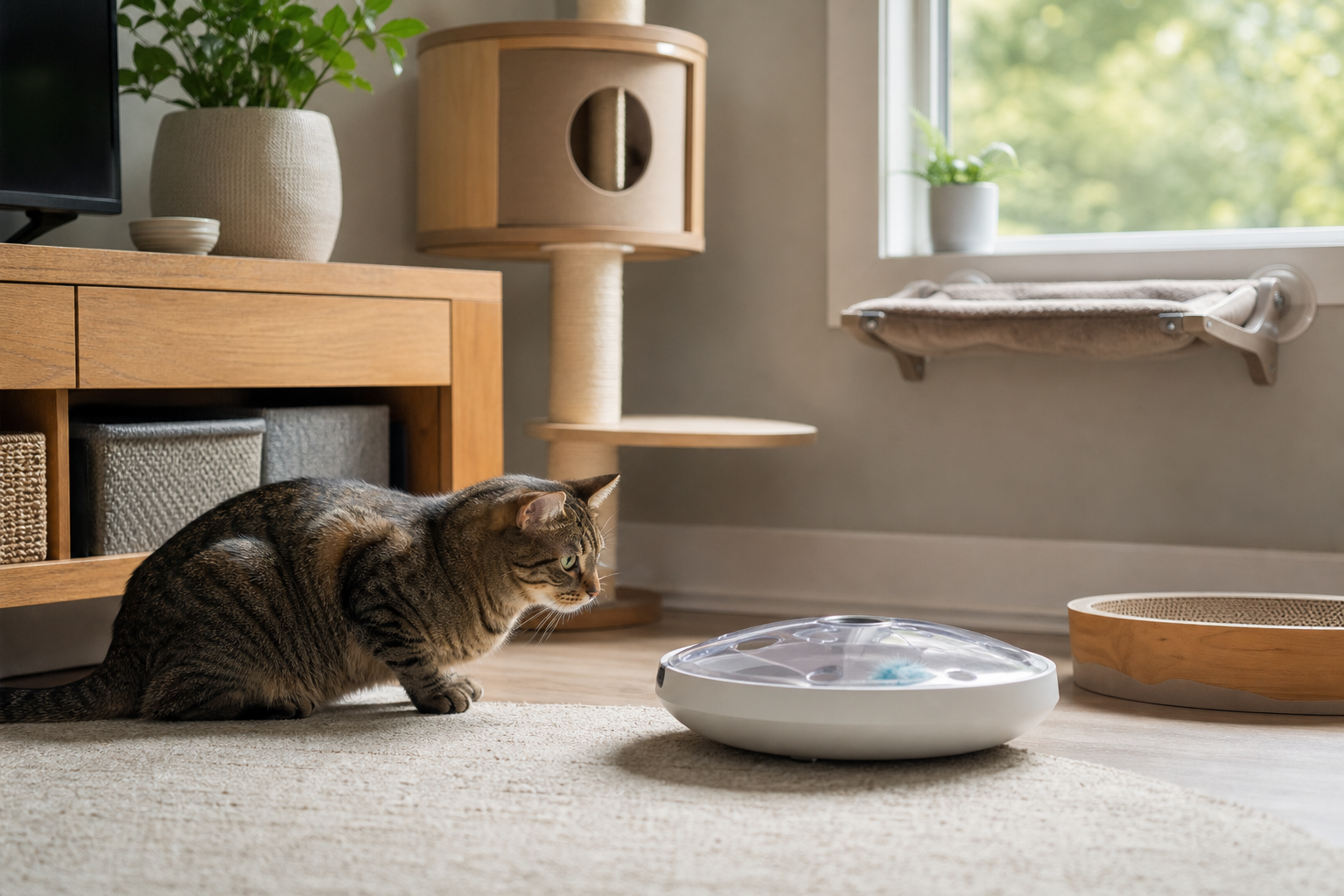
    Away-from-home cat enrichment setup with automatic toy puzzle feeder scratcher and window perch
    A safer away routine combines limited automatic movement with passive enrichment instead of relying on one powered gadget.

    How to Test a Toy Before Leaving It Out

    Do not make the first unsupervised trial the long workday. Test the toy in stages.

    • Session 1: Place the toy off. Let your cat smell it, paw it, and walk away.
    • Session 2: Turn it on while you sit nearby. Watch for fear, obsessive biting, paw trapping, chewing, or attempts to open covers.
    • Session 3: Run the toy in the exact room where it might be left. Check whether it jams under furniture, hits stairs, blocks food or litter access, or startles your cat near resting spots.
    • Session 4: Leave the room for ten minutes, then inspect the toy. Look for bite marks, loosened parts, heat, broken plastic, frayed fabric, and missing pieces.
    • Short errand test: Only after it passes supervised checks, try it while you are gone briefly. Inspect again when you return.

    If your cat carries the toy by a weak attachment, chews the battery area, flips it aggressively, or fixates on a seam, move that toy to supervised-only status. The toy may still be fun. It is just not an away toy for that cat.

    Better Alternatives for Rough Players

    Some cats should not be left with powered toys at all. That does not mean they need an empty room. It means the enrichment should shift toward passive, inspectable, and durable options.

    • A sturdy scratcher placed where your cat already stretches or patrols.
    • A window perch with safe access and no blind cords nearby.
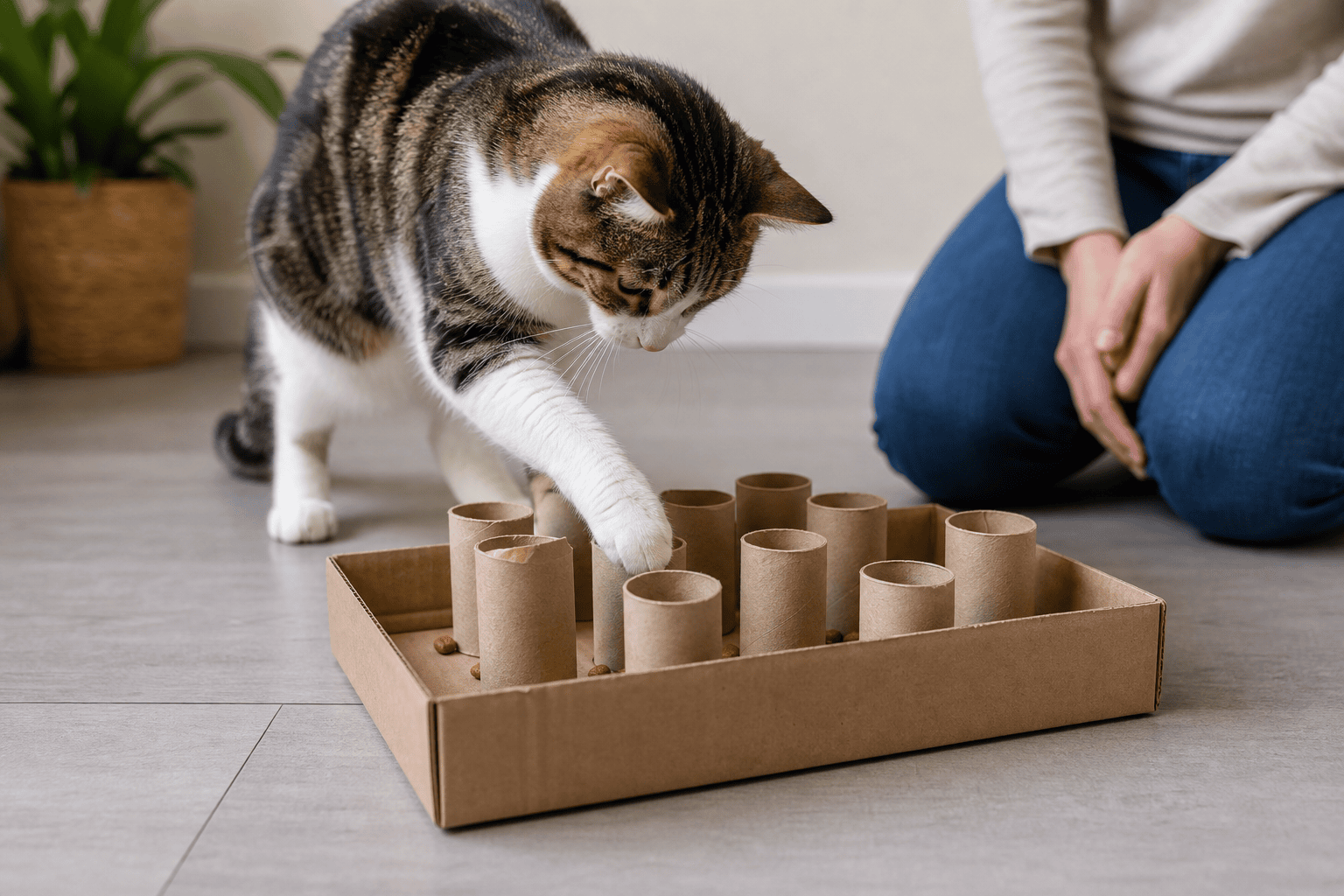
    • A beginner puzzle feeder or scatter-feeding game using part of a measured meal.
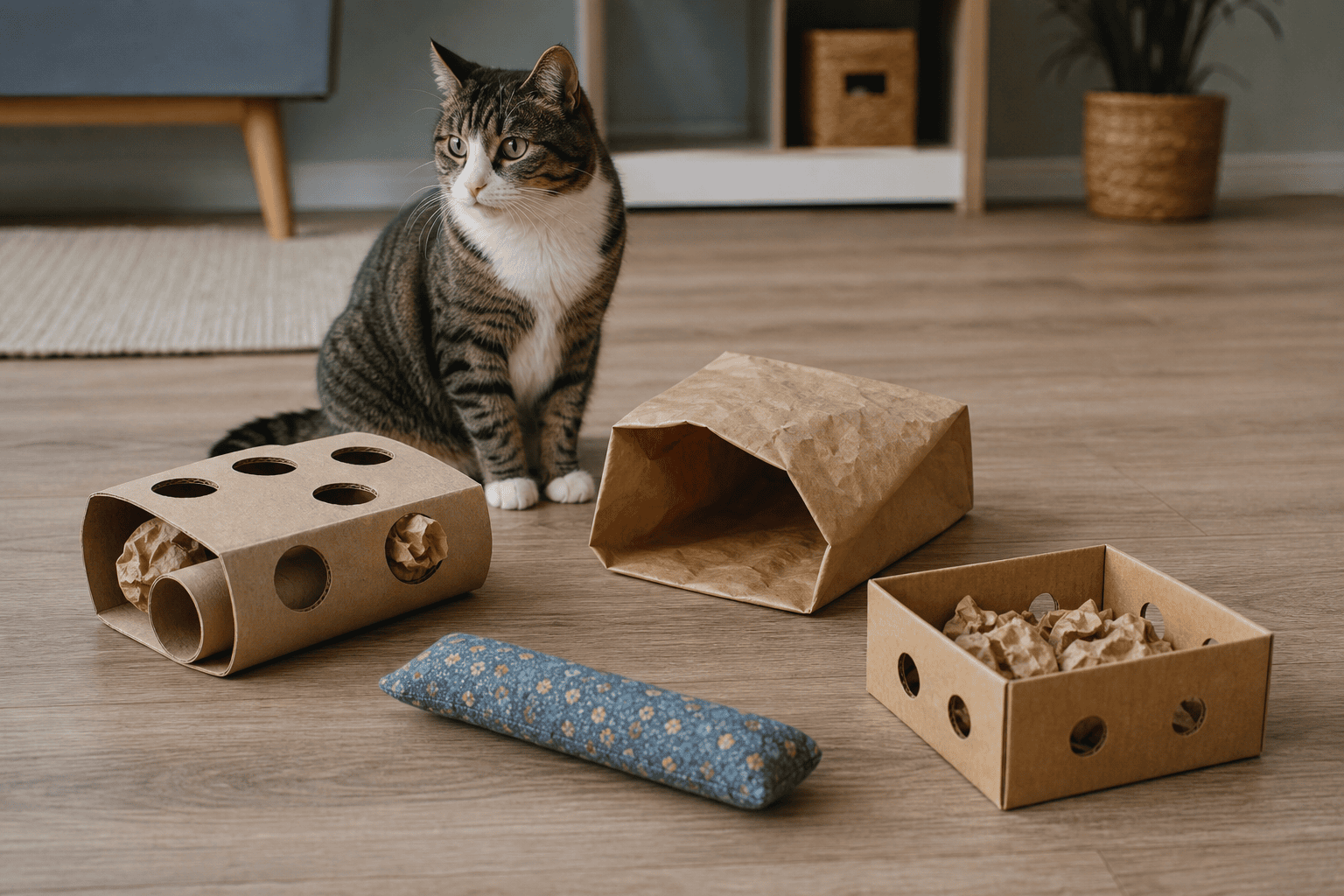
    • Cardboard boxes or paper bags with handles removed, checked for staples and tape.
    • Large, simple solo toys that are too big to swallow and easy to inspect.
    • A durable kicker reserved for supervised capture play before or after you leave.

    For broader ideas, see Titan Claws’ cat enrichment activities guide and best cat toys for bored indoor cats. If your cat attacks ordinary plush toys, the guide to unbreakable cat toys for aggressive chewers explains why durable still needs inspection and supervision.

    Multi-Cat Homes Need Extra Planning

    Automatic toys can create competition in multi-cat homes. One cat may guard the toy, another may get chased away, and a nervous cat may avoid the room entirely. The AAFP and ISFM guidelines advise separating key resources and using separate play locations for cats when needed. Apply that same thinking to toys.

    If you have more than one cat, test the toy with each cat individually first. Then watch the group. Place resources in more than one area, keep escape routes open, and avoid a toy that corners cats near food, water, litter boxes, or favorite resting spaces. If an automatic toy creates tension, save it for supervised sessions with one cat at a time.

    Quick Checklist Before You Leave

    • The toy has passed multiple supervised sessions with this cat.
    • No string, feather, ribbon, elastic, bell, small plastic part, or exposed stuffing is available.
    • The battery door, charging port, screws, shell, and seams are intact.
    • The toy has a shutoff or limited activation pattern.
    • The play area is away from stairs, cords, fragile objects, water bowls, and unstable furniture.
    • Your cat can leave the toy and reach food, water, litter, and resting spots without being chased or blocked.
    • You have safer passive enrichment available, not only one powered gadget.
    • You will inspect the toy when you get home and retire it at the first real damage.

    The Bottom Line

    Automatic cat toys for when you are away are best used as limited enrichment tools, not replacements for human play or safety checks. Choose enclosed, sturdy, inspectable designs. Avoid loose parts and chewable electronics. Test every toy while you are home before trusting it during an errand or workday.

    For gentle cats, a tested motion toy can add welcome movement to the day. For cats that destroy toys, the safer plan may be passive enrichment while you are gone and tougher supervised play when you return. Either way, the goal is not to keep the toy running all day. The goal is to help your cat hunt, solve, scratch, rest, and stay safe until you are back.

  • Running Cat Toys: What Actually Gets Indoor Cats Moving Safely

    Running Cat Toys: What Actually Gets Indoor Cats Moving Safely

    Running cat toys are toys and play setups that make a cat chase, sprint, dart, leap, or run in a controlled indoor space. The best options are not always motorized. A good running setup can be a cat exercise wheel, a wand toy moved like prey, a tunnel-and-ball game, a rolling electronic toy, a track toy, or a hallway chase routine that ends with a safe catch.

    If your cat destroys ordinary toys, choose running cat toys with two goals in mind: movement and a safe finish. Fast chase without a catch can frustrate some cats, while fragile moving toys can become chew hazards for rough players. Build a routine that lets your cat stalk, chase, capture, bite, kick, and then wind down.

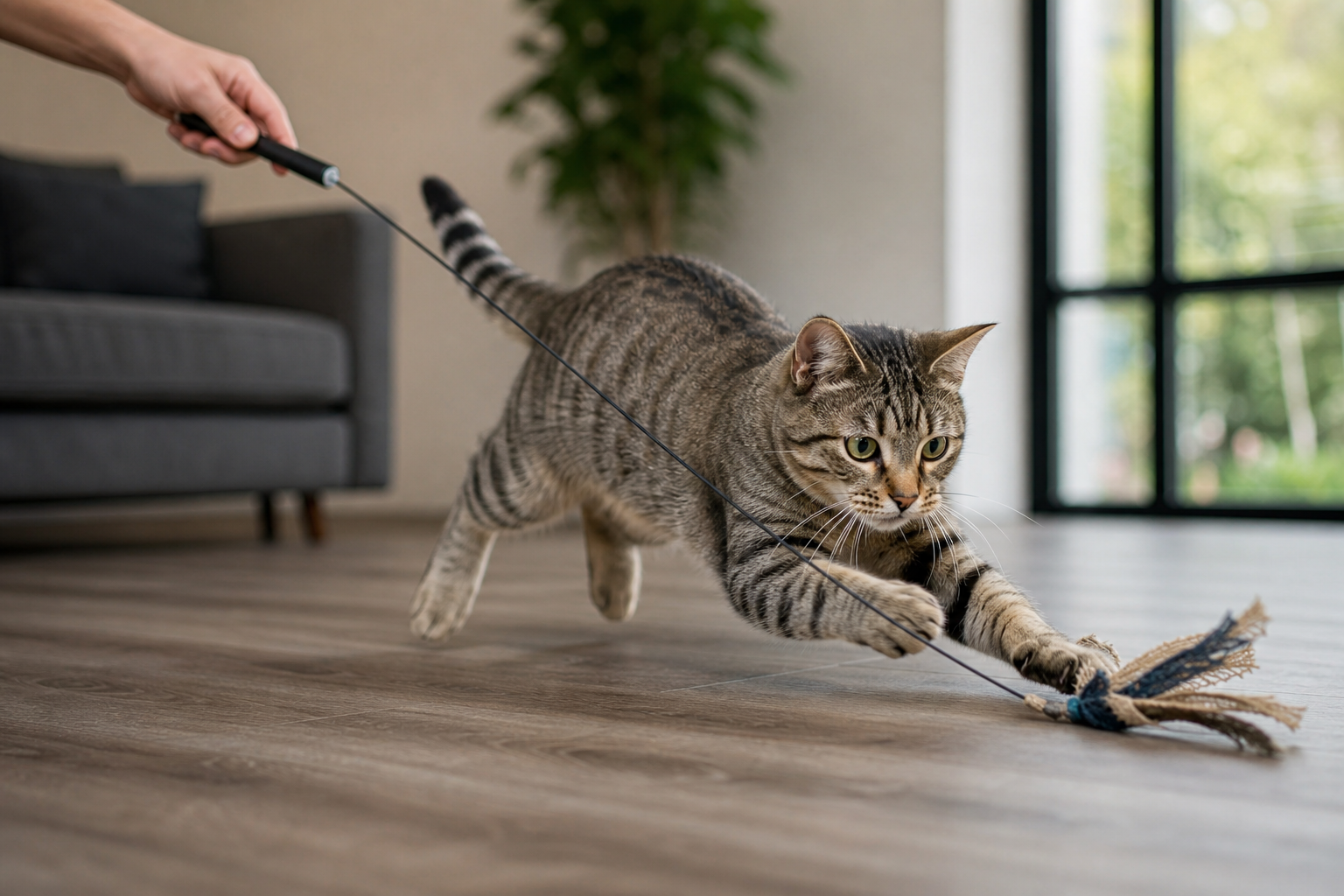
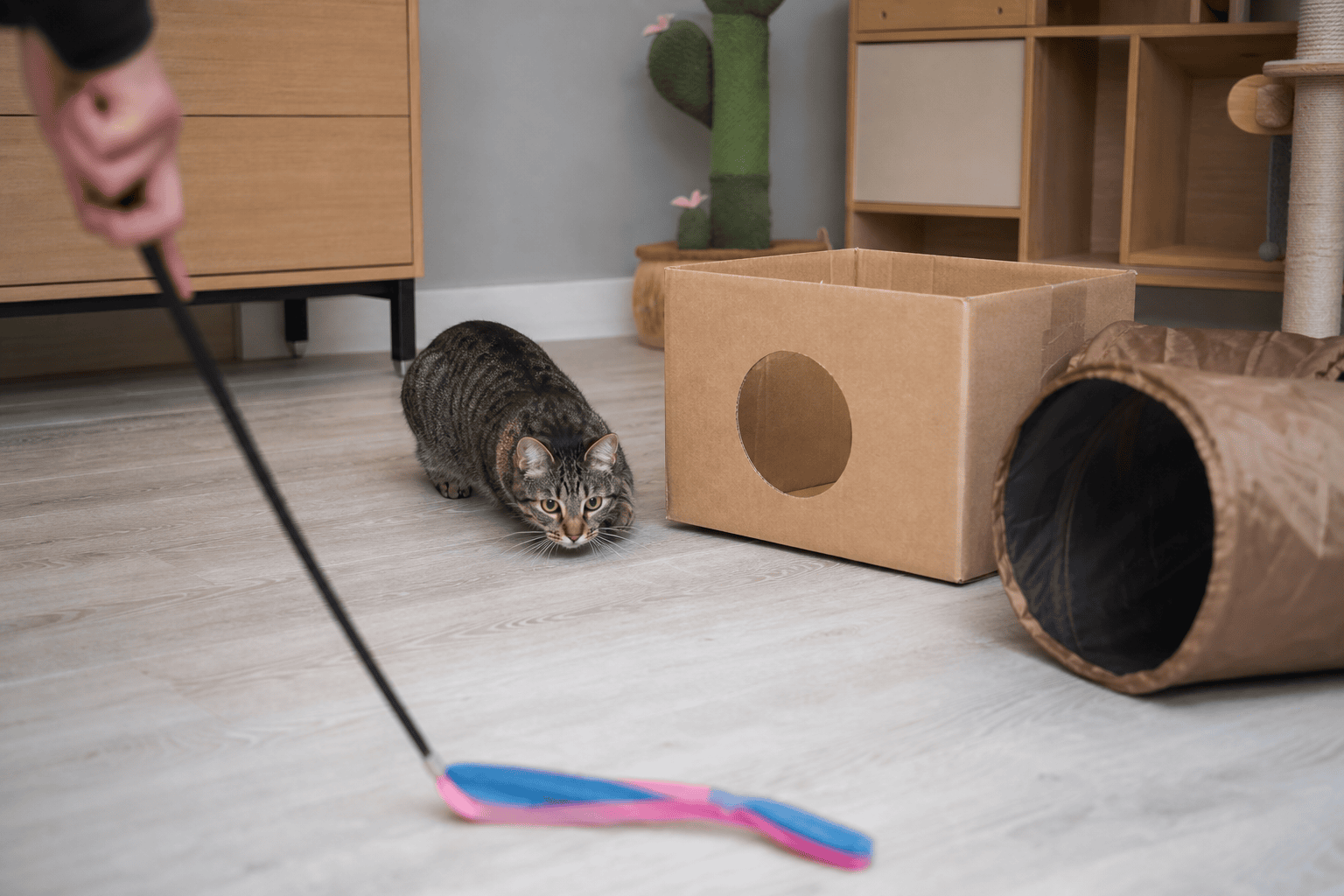
    Cat play area with tunnel wand toy ball and durable kicker toy
    The best running setup gives the cat a clear path, a chase target, and a satisfying capture toy at the end.

    What Counts as a Running Cat Toy?

    Most search results for running cat toys lead to shopping pages for exercise wheels, rolling mice, electronic balls, lasers, tracks, and general exercise toys. Those can all help, but they solve different problems. A cat wheel gives repetitive cardio. A wand toy creates short chase bursts. A rolling toy triggers pursuit. A tunnel creates ambush and sprint lanes. A kicker toy gives the cat something physical to grab after the run.

    That distinction matters because cats are not just trying to burn calories. The AAFP and ISFM feline environmental needs guidelines recommend play and feeding activities that let cats express predatory behavior, including chasing, locating, capturing, and manipulating toys. A running toy is strongest when it fits that whole sequence instead of only making the cat dash back and forth.

    For a broader exercise plan, pair this guide with Titan Claws articles on cat toys for exercise, cat enrichment activities, and best cat toys for bored indoor cats.

    The Best Running Cat Toys by Play Style

    Start with your cat’s play style, not the trendiest gadget. A toy that makes one cat sprint may make another cat stare, hide, or chew the moving part.

    • For sprinters: wand toys, tunnels, hallway toss games, and rolling balls can create fast bursts without requiring a large room.
    • For high-stamina cats: a cat exercise wheel may help if the cat enjoys repetitive motion and you have space for a stable wheel.
    • For ambush hunters: tunnels, boxes, paper bags with handles removed, and peekaboo wand play are often better than open-floor chasing.
    • For rough players: end the chase with a durable kicker or larger capture toy so the cat can bite and kick something appropriate.
    • For food-motivated cats: scatter feeding, treat trails, and puzzle feeders can add movement without relying on motors or lasers.

    If you do not know your cat’s style yet, start with a wand toy and a clear floor path. You can change speed, direction, height, and distance, which makes it easier to learn what your cat actually wants.

    Cat Exercise Wheels: Useful, But Not for Every Cat

    A cat exercise wheel is the most literal running cat toy. It can be a good fit for young, athletic, curious cats that like repeated movement, especially in homes where safe sprint space is limited. It is less useful for cats that dislike unstable surfaces, have mobility limits, are easily startled by noise, or prefer stalking and pouncing over steady running.

    Choose a wheel for stability before style. Look for a wide running surface, a solid base, smooth rotation, and a size that lets your cat move without a cramped arch in the back. Place it away from stairs, cords, water bowls, fragile objects, and tight traffic areas. If the wheel wobbles, tips, pinches, or moves unpredictably, stop using it.

    Indoor cat stepping onto a cat exercise wheel during supervised training
    A cat wheel can be useful for some high-energy cats, but it works best with patient training and a stable setup.

    Training should be voluntary. Put treats or a favorite toy near the wheel, reward tiny steps, and let the cat leave whenever they want. Do not place a cat on the wheel and force movement. Short, positive sessions are better than trying to make the cat run because you bought the equipment.

    Rolling, Automatic, and Electronic Running Toys

    Rolling toys and electronic running toys can be useful for quick movement, especially when your cat likes objects that dart, vibrate, hide, or change direction. They are also where rough-play safety matters most. A cat that catches the toy may bite the casing, pull off a tail, pry at a battery door, or chew a charging port.

    Test any automatic toy under supervision before treating it as a solo option. Watch for paw trapping, stress, obsessive chasing, hard biting, loose attachments, exposed wires, cracked plastic, overheating, and detachable parts. Store charging cables out of reach. If your cat is a determined chewer, many electronic toys should stay supervised only.

    For deeper buying guidance, read Titan Claws articles on automatic cat toys, electronic interactive cat toys, and interactive cat toys for indoor cats.

    Wands, Lasers, Tunnels, and Tracks

    Many cats run harder for simple toys than for expensive machines. A wand toy can mimic prey by moving away from the cat, disappearing behind furniture, pausing, and then darting into view. Let the cat catch the lure several times. That catch is not optional for many cats. It is what turns chasing into a satisfying hunt.

    Lasers can create fast running, but they need a finish. Because the cat cannot physically catch the dot, end laser play by landing the light on a real toy, treat, or food puzzle. Stop if your cat becomes frantic, confused, or keeps searching long after the session ends.

    Tunnels and track toys are helpful when your cat likes repeatable games. Tunnels create hiding and sprint lanes. Tracks keep a ball contained. They are not automatically better than a hallway, but they can make a small room feel more interesting.

    A Safer Running Routine for Rough Players

    For cats that hit hard, the safest running routine has a beginning, a chase, a capture, and an inspection. Do not rely on a fragile motorized toy to absorb the final bite. Use the running toy to trigger movement, then direct the cat onto a larger kicker or tough fabric toy for the grab-and-kick part.

    1. Clear the path: remove cords, breakables, shoes, bags, and unstable furniture from the running area.
    2. Warm up: start with slow stalking movements before asking for full sprints.
    3. Build short bursts: use 30 to 90 seconds of movement, then give a catch.
    4. Offer a capture toy: let the cat bite, hold, and kick a larger toy instead of your hands or the electronic toy.
    5. Wind down: end with a small meal, treat, puzzle feeder, or calm grooming if your cat likes it.
    6. Inspect: check toys before storing them or leaving any solo toys out.

    This approach fits Titan Claws readers because the problem is rarely just boredom. It is bored energy plus strong jaws, claws, and prey drive. For more rough-play choices, see cat kicker toy, toys for cats that chew, and safe cat chew toys.

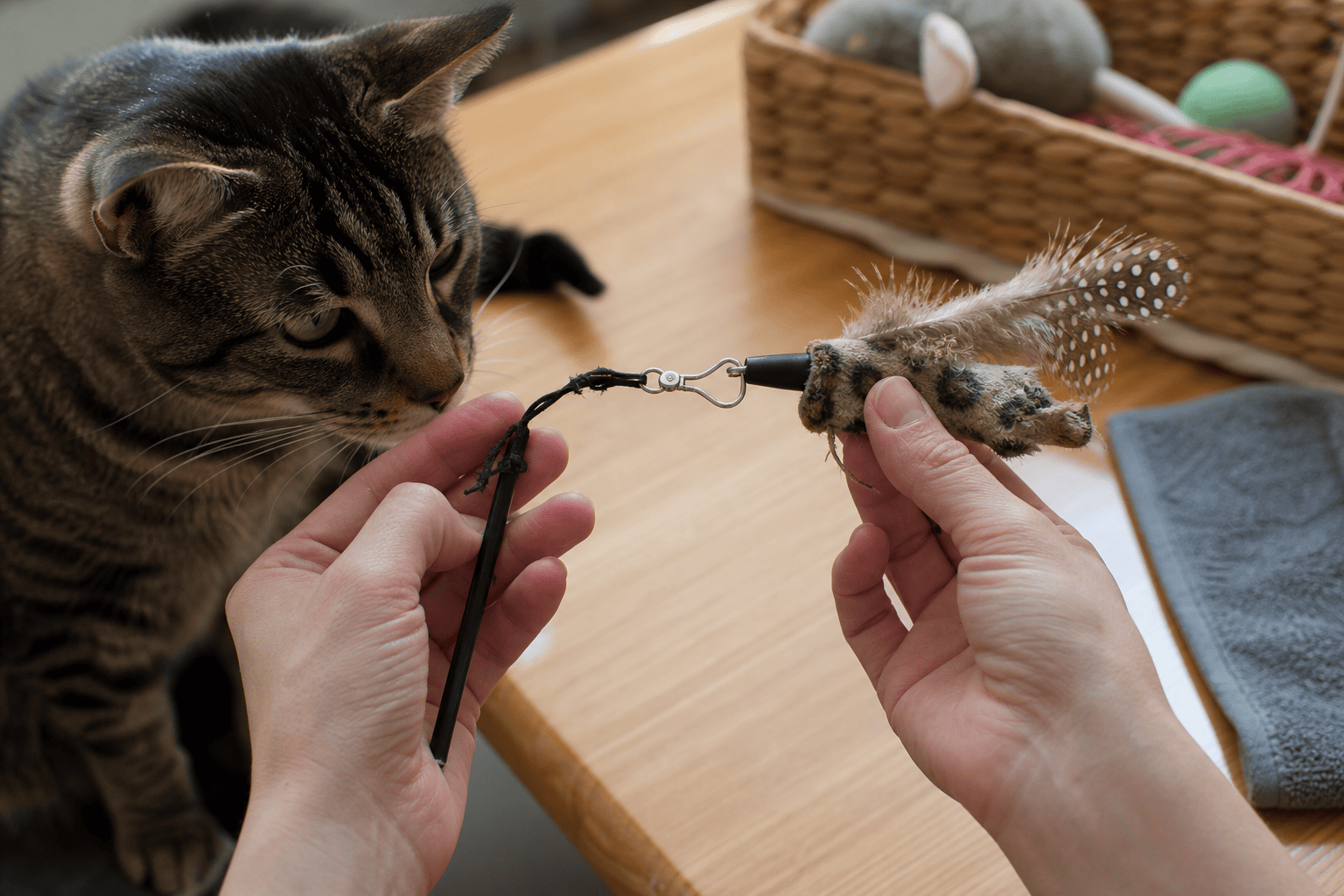
    Hands checking a cat toy for loose seams after active play
    Fast play turns small defects into real hazards, so inspect moving toys and capture toys after hard sessions.

    Safety Checks Before You Let a Cat Run

    Fast play raises the stakes. A toy that is only mildly annoying during slow play can become dangerous when a cat is sprinting, grabbing, twisting, or chewing hard. Cornell Feline Health Center’s safe toys guidance warns owners to watch for small pieces, string-like parts, feathers, electrical cords, and other parts that can separate or be swallowed.

    • Put away string, ribbon, elastic, feather, and wand toys after supervised play.
    • Retire toys with open seams, exposed stuffing, cracked plastic, loose bells, detachable tails, or broken battery doors.
    • Avoid hard running near stairs, slick floors, blind cords, water bowls, glass tables, or unstable shelves.
    • Keep jumps low for kittens, seniors, overweight cats, and cats with past injuries.
    • Stop play if your cat pants heavily, limps, hides, growls, coughs, gags, or seems disoriented.
    • Call a veterinarian promptly if you think your cat swallowed string, stuffing, plastic, feathers, or any toy part.

    Older cats and cats with known medical issues may still enjoy running games, but the intensity should match the cat. Shorter routes, slower wand work, flatter surfaces, and more frequent rests are usually better than forcing athletic play.

    What Current Running Toy Lists Often Miss

    Most ranking pages name the familiar categories: lasers, wands, balls, springs, tunnels, tracks, wheels, and electronic toys. That is useful, but it leaves out the harder owner decisions. Is the cat chasing because they are engaged or because the toy is making them frantic? Can they catch something at the end? What happens when they bite the toy? Is the room safe for sprinting? Will the toy still be safe after ten hard sessions?

    The better question is not simply, “Which toy makes my cat run?” Ask, “Which running game can my cat repeat safely and enjoyably?” For some cats, that is a wheel. For many, it is a wand, tunnel, rolling ball, and kicker routine that costs less, takes less space, and gives the cat more control.

    Quick Buying Guide

    Use this order if you are building a running setup from scratch:

    1. Start with a wand toy because it gives you the most control over movement and difficulty.
    2. Add a durable capture toy for biting and kicking after the chase.
    3. Create a sprint lane with a hallway, tunnel, box setup, or open rug area.
    4. Try a rolling or track toy if your cat likes independent batting and chasing.
    5. Consider a cat exercise wheel only if your cat has the temperament, space, and training patience for it.
    6. Use electronic toys carefully for short supervised sessions before any solo use.

    The best running cat toys do more than make a cat move. They let your cat hunt in a way that fits your home, your cat’s body, and your cat’s bite strength. Start simple, keep sessions short, finish with a real catch, and inspect the toys that take the hit.

  • Best Cat Toys for Bored Indoor Cats: A Practical Rotation That Works

    Best Cat Toys for Bored Indoor Cats: A Practical Rotation That Works

    The best cat toys for bored indoor cats are not one magic gadget. They are a small rotation that covers the whole hunt: chase, pounce, grab, bite, kick, search for food, scratch, climb, and rest. For most bored indoor cats, start with a wand toy for owner-led movement, a durable kicker for capture, a puzzle feeder for foraging, a few safe solo toys, and a scratcher or box setup that changes the room.

    If your cat destroys ordinary toys, choose fewer toys and inspect them more often. Avoid claims like indestructible, watch hard chewers closely, and retire toys with loose strings, exposed stuffing, cracked plastic, detached feathers, or seams your cat can open. A bored cat needs stimulation, but a rough player also needs safer materials, supervision, and a plan for what happens when the toy starts to fail.

    Cat toy rotation with wand toy puzzle feeder ball and kicker toy
    A useful boredom setup mixes movement, capture, food work, and rest instead of relying on one novelty toy.

    What Bored Indoor Cats Actually Need From Toys

    Indoor cats can live rich, comfortable lives, but the home has to give them acceptable outlets for normal cat behavior. The AAFP and ISFM feline environmental needs guidelines emphasize that a healthy feline environment should let cats express natural behaviors and reduce stressors that contribute to unwanted behavior. Toys are one part of that environment, along with safe resting places, scratching surfaces, vertical space, predictable routines, and positive interaction.

    That is why the strongest toy setup is a routine, not a shopping list. A toy that only rolls around may trigger chase but never gives your cat a satisfying catch. A plush mouse may be fun for biting but boring if it never moves. A puzzle feeder may be excellent for food work but will not replace the sprint-and-pounce part of play. Boredom usually improves when you combine these jobs in a way your cat can understand.

    For a broader routine, pair this article with Titan Claws guides on cat enrichment activities and cat toys for bored cats. This guide focuses on choosing the actual toy mix.

    The Best Toy Categories for Bored Indoor Cats

    Instead of asking which single toy is best, build a compact rotation from five categories. Each one solves a different boredom problem.

    • Wand toys: best for interactive chase, jumping, direction changes, and bonding with you.
    • Kicker toys: best for cats that need to grab, bite, hold, and bunny-kick something physical.
    • Puzzle feeders: best for food-motivated cats, fast eaters, and cats that need a calmer mental task.
    • Solo chase toys: best for short independent sessions, especially balls, springs, tracks, and sturdy toss toys.
    • Environmental toys: best for changing the room, including boxes, tunnels, scratchers, paper bags with handles removed, and perch-based play.

    This mix beats most generic top-ten lists because it covers more of the cat’s day. Your cat gets movement, capture, chewing or kicking, problem solving, and environmental novelty without needing a pile of fragile toys on the floor.

    Best First Pick: A Wand Toy for Chase and Control

    If you only add one owner-led toy, make it a wand or teaser that lets you control speed, distance, and difficulty. Wand play is useful because you can make the toy move like prey: hide behind a corner, pause, dart away, crawl slowly, then let your cat catch it. That is much more interesting than waving the lure in your cat’s face.

    Use wand toys in short sessions of about five to fifteen minutes. Let your cat catch the lure several times, then end with a kicker, treat, or meal if it fits your feeding plan. If your cat is a leaper, keep jumps low and controlled. If your cat is a hard biter, choose replaceable lures and put the wand away after play. Strings and feathers should not be left out for unsupervised chewing.

    For a deeper setup, use the Titan Claws wand cat toy guide and the indoor movement advice in cat toys for exercise.

    Best for Rough Players: A Durable Kicker Toy

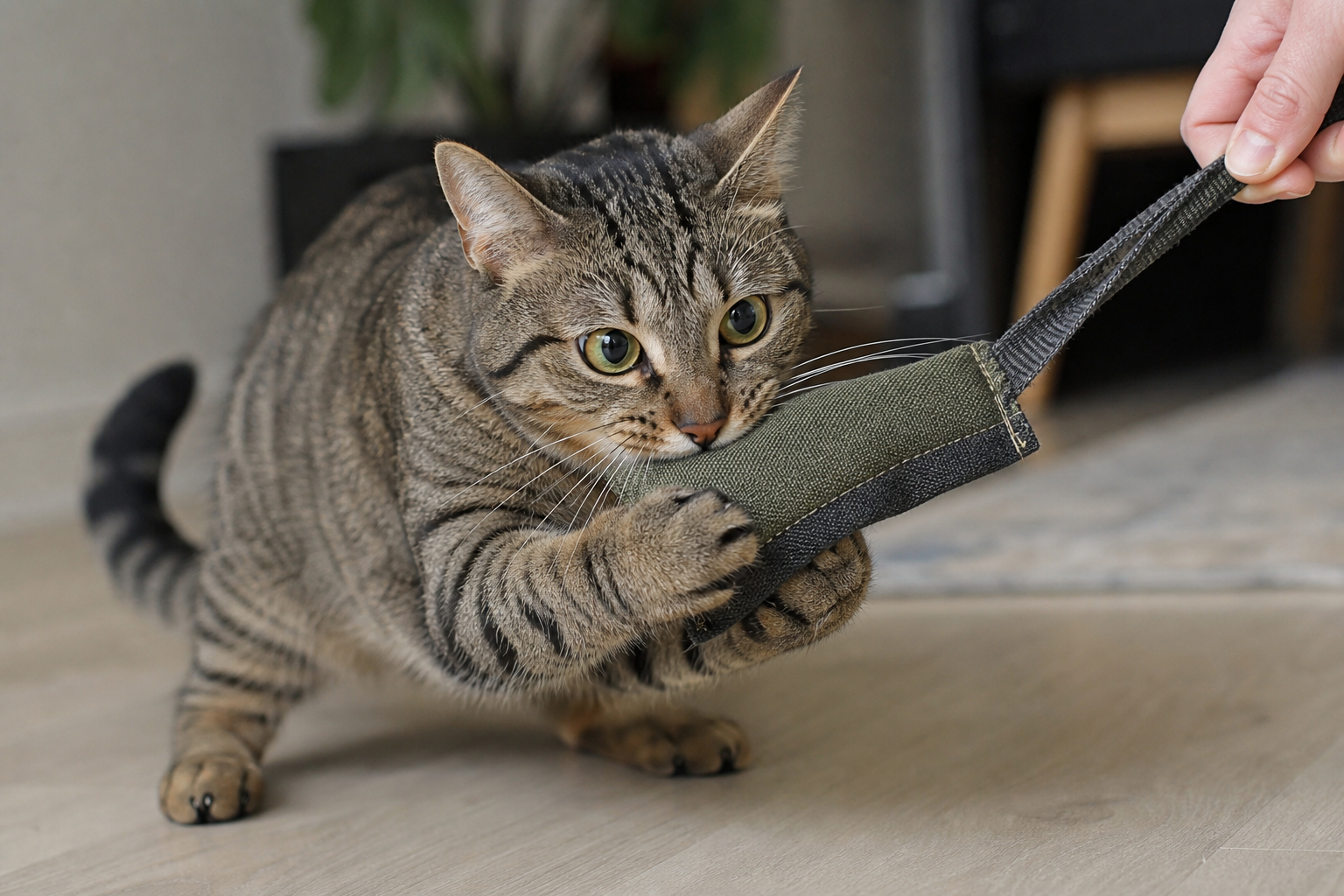
    Many bored indoor cats do not just want to chase. They want to grab hard, bite, clamp down, and kick. A kicker toy gives that energy a legal target. This is especially helpful if your cat attacks soft plush toys, grabs your arm during play, or tries to wrestle moving gadgets after the chase.

    Look for a size your cat can hold with the front paws while kicking with the back legs. Check for tough fabric, tight seams, limited small parts, and a shape that does not invite your cat to swallow loose pieces. Bigger is often safer than tiny for hard players because the toy is easier to wrestle and harder to gulp.

    Even a tough kicker needs supervision and inspection. Titan Claws is built around durable play, but no fabric toy should be treated as chew-proof. If you are choosing for a cat that shreds toys, read cat kicker toy, toys for cats that chew, and safe cat chew toys before buying another soft toy.

    Hands inspecting a cat toy for loose seams and damaged parts
    For cats that play hard, inspection is part of the toy routine, not an afterthought.

    Best for Food-Motivated Cats: Puzzle and Foraging Toys

    Puzzle feeders are useful for bored indoor cats because they turn food into a job. Instead of receiving every bite in a bowl, the cat has to paw, roll, nudge, lick, or search. Best Friends Animal Society recommends food puzzles and simple foraging ideas as part of indoor cat enrichment, including scatter feeding and hiding small food portions around the home.

    Start easier than you think. A puzzle that is too hard can frustrate a cat and make them quit. Use a clear, simple feeder at first, put a few treats or kibble pieces where your cat can smell them, and let the cat succeed. Increase difficulty only after your cat understands the task.

    Puzzle toys are not automatically safe for rough players. Inspect hard plastic for cracks, remove broken lids or sliding parts, and avoid tiny removable pieces. For more detail, see the Titan Claws guide to puzzle cat toys.

    Indoor cat using a puzzle feeder after active play
    Puzzle and foraging toys help turn play energy into calmer problem solving after the chase.

    Best Solo Toys: Simple, Sturdy, and Easy to Rotate

    Solo toys are useful between owner-led play sessions, but they should be chosen carefully. Good options often include sturdy balls, springs, soft toss toys, track toys, cardboard boxes, tunnels, and paper bags with handles removed. The best solo toy is one your cat uses safely without you having to hope a fragile part survives.

    Cornell Feline Health Center’s safe toys guidance warns owners to avoid small pieces, string-like parts, feathers, electrical cords, and other parts that can separate and be swallowed. That advice matters even more for bored indoor cats, because bored cats may chew, pry, and test toys longer than they would during a brief supervised session.

    Do not leave out every toy all the time. Keep a small active set and store the rest. Rotate toys every few days, refresh scent with catnip or silvervine if your cat responds to it, and change the play location. A spring in the hallway, a ball in a dry bathtub, and a box beside a scratcher can feel like three different games.

    Where Automatic and Electronic Toys Fit

    Automatic toys can help bored indoor cats, but they work best as one tool in the rotation. A rolling toy, moving mouse, or concealed wand can create quick bursts of movement when you are busy. The risk is treating the gadget as a babysitter. Many electronic toys have small attachments, battery doors, charging ports, tails, feathers, or moving parts that deserve inspection.

    Use electronic toys after supervised testing. Watch whether your cat bites the casing, traps paws, removes attachments, carries the toy by a fragile part, or becomes stressed by sound and movement. If the toy passes, use it for short sessions and then give your cat a real capture toy or food puzzle so the hunt has an ending.

    The Titan Claws guides to interactive cat toys for indoor cats, automatic cat toys, and electronic interactive cat toys cover those decisions in more detail.

    A Simple Seven-Day Toy Rotation

    Use this rotation as a starting point, then adjust based on what your cat actually chooses.

    1. Day 1: wand chase, then kicker capture, then dinner or a small food puzzle.
    2. Day 2: tunnel or box game with a toss toy hidden inside.
    3. Day 3: puzzle feeder for part of a meal plus short wand play at night.
    4. Day 4: solo balls or springs in a hallway, then inspect and store them.
    5. Day 5: high-energy wand session with low, controlled jumps.
    6. Day 6: kicker toy, scratcher, and scent refresh with catnip or silvervine if appropriate.
    7. Day 7: quiet foraging game: scatter a few food pieces or hide them in easy locations.

    The point is not to follow a strict calendar forever. The point is to stop asking one toy to do every job. Most bored indoor cats do better when the week has variety, predictable interaction, and a few toys that disappear before they become stale.

    Safety Checklist Before You Leave Toys Out

    • Remove string, feather, ribbon, elastic, and wand toys after supervised play.
    • Retire toys with exposed stuffing, open seams, cracked plastic, loose bells, or detached parts.
    • Use larger toys for cats that try to swallow small plush toys.
    • Keep battery toys, charging cords, and electronic parts away from hard chewers unless supervised.
    • Place active toys away from stairs, blind cords, water bowls, fragile objects, and unstable furniture.
    • Watch new toys for several sessions before treating them as solo-play options.
    • Stop using any toy that causes fear, obsessive searching, gagging, coughing, limping, or swallowed pieces.
    • Ask a veterinarian promptly if you suspect your cat swallowed string, stuffing, plastic, feathers, or any toy part.

    Quick Buying Guide

    For a bored indoor cat, buy in this order:

    1. One good wand toy for daily interactive chase.
    2. One durable kicker for biting, holding, and bunny kicking under supervision.
    3. One beginner puzzle feeder for food work and calmer problem solving.
    4. Three to five simple solo toys that can be rotated, inspected, and stored.
    5. One room-changing item such as a scratcher, tunnel, perch, or box setup.

    That small kit is usually more useful than a large bundle of fragile novelty toys. The best cat toys for bored indoor cats are the ones that match your cat’s play style, survive reasonable supervised use, and fit into a routine you can repeat. Build the rotation first. Then upgrade individual toys as your cat shows you what kind of hunter they are.

  • Cat Toys for Exercise: Build a Better Workout for Indoor Cats

    Cat Toys for Exercise: Build a Better Workout for Indoor Cats

    The best cat toys for exercise are the ones that make your cat move through a complete mini-hunt: watch, stalk, chase, pounce, grab, bite, kick, eat, and rest. For most indoor cats, that means a small rotation of wand toys, tossable toys, kicker toys, tunnels, puzzle feeders, scratchers, and safe climbing or jumping setups. The goal is not to exhaust your cat. The goal is to give short, repeatable outlets for movement and hunting behavior.

    If your cat destroys ordinary toys, exercise play needs an extra safety layer. A toy that gets your cat sprinting is not a good choice if it sheds string, exposes wire, cracks plastic, or turns into swallowable pieces after one hard session. Use the routines below to build better activity while keeping supervision and inspection part of the workout.

    Cat exercise toy setup with wand toy, kicker toy, tunnel, puzzle feeder, and scratcher
    A good exercise setup covers several movement jobs: chase, jump, grab, kick, forage, scratch, and cool down.

    What Counts as Exercise for a Cat?

    Cat exercise does not look like dog exercise. Most cats are built for short bursts, not long steady workouts. A good play session might be only five to fifteen minutes, but it should include real movement: stalking around furniture, sprinting after a lure, jumping from a stable surface, wrestling a larger toy, batting a rolling object, climbing to a perch, or working food out of a puzzle.

    The Cornell Feline Health Center describes toys as a way to encourage exercise and cognitive enrichment by letting cats stalk, pounce, and problem solve. That is the standard to use: the toy should ask your cat to do something natural, not simply sit in a pile on the floor.

    A practical exercise routine should cover four jobs:

    • Chase: wand toys, lures, rolling toys, and moving toys that travel away from the cat like prey.
    • Capture: larger toys the cat can grab, bite, and bunny-kick after the chase.
    • Forage: puzzle feeders, treat balls, scatter feeding, and hidden food searches that turn eating into work.
    • Climb, stretch, and reset: scratchers, shelves, cat trees, tunnels, boxes, and perches that change the room.

    Why Product Lists Miss the Point

    Many ranking pages for cat exercise toys are useful product roundups. They mention wands, lasers, wheels, tunnels, balls, puzzle toys, and electronic toys. The gap is that product type alone does not tell you how to use the toy, when to stop, or whether it fits a cat that bites through fabric and strings.

    A wand toy can be excellent exercise, but it becomes risky if the string is left out for chewing. A laser can make a cat sprint, but it can also frustrate some cats if the game never ends with a physical catch. A cat wheel can help a cat who chooses to use it, but it is not a cure for boredom by itself. A kicker can be perfect for a rough player, but only if it is large enough and inspected after use.

    Think of toys as tools inside a routine. If boredom is the main problem, pair this guide with Titan Claws’ article on cat toys for boredom. If your cat needs a fuller daily setup, our cat enrichment activities guide covers the broader mix of play, food work, climbing, scent, and rest.

    A 15-Minute Cat Exercise Routine

    Use this routine once or twice a day, especially near dawn or dusk if that is when your cat is naturally active. Keep it short enough that your cat finishes interested, not panting or irritated.

    1. Two minutes of warm-up: drag a wand lure slowly around furniture, a box, or a tunnel. Let your cat watch and stalk before asking for speed.
    2. Five minutes of chase: move the lure away from your cat in quick bursts. Let it hide, pause, and escape. Avoid waving it directly in your cat’s face.
    3. Three minutes of jumping or climbing: use low, controlled jumps over a rug or direct the toy up a stable cat tree. Skip jumps if your cat is older, recovering, heavy, limping, or unsure.
    4. Three minutes of capture: switch to a kicker or tough soft toy so your cat can grab, bite, and rake something physical.
    5. Two minutes of food work and cleanup: end with a small portion of the normal meal in a puzzle feeder or hidden in easy spots, then store string toys and inspect anything your cat chewed.

    PetMD’s veterinarian-reviewed exercise guidance also emphasizes short sessions and notes that play should stop if a cat pants or breathes too heavily. That is a useful rule for owners who feel pressure to make an inactive cat work hard. Build conditioning gradually and ask your veterinarian before changing activity for a cat with obesity, arthritis, heart or breathing concerns, recent surgery, or sudden changes in play behavior.

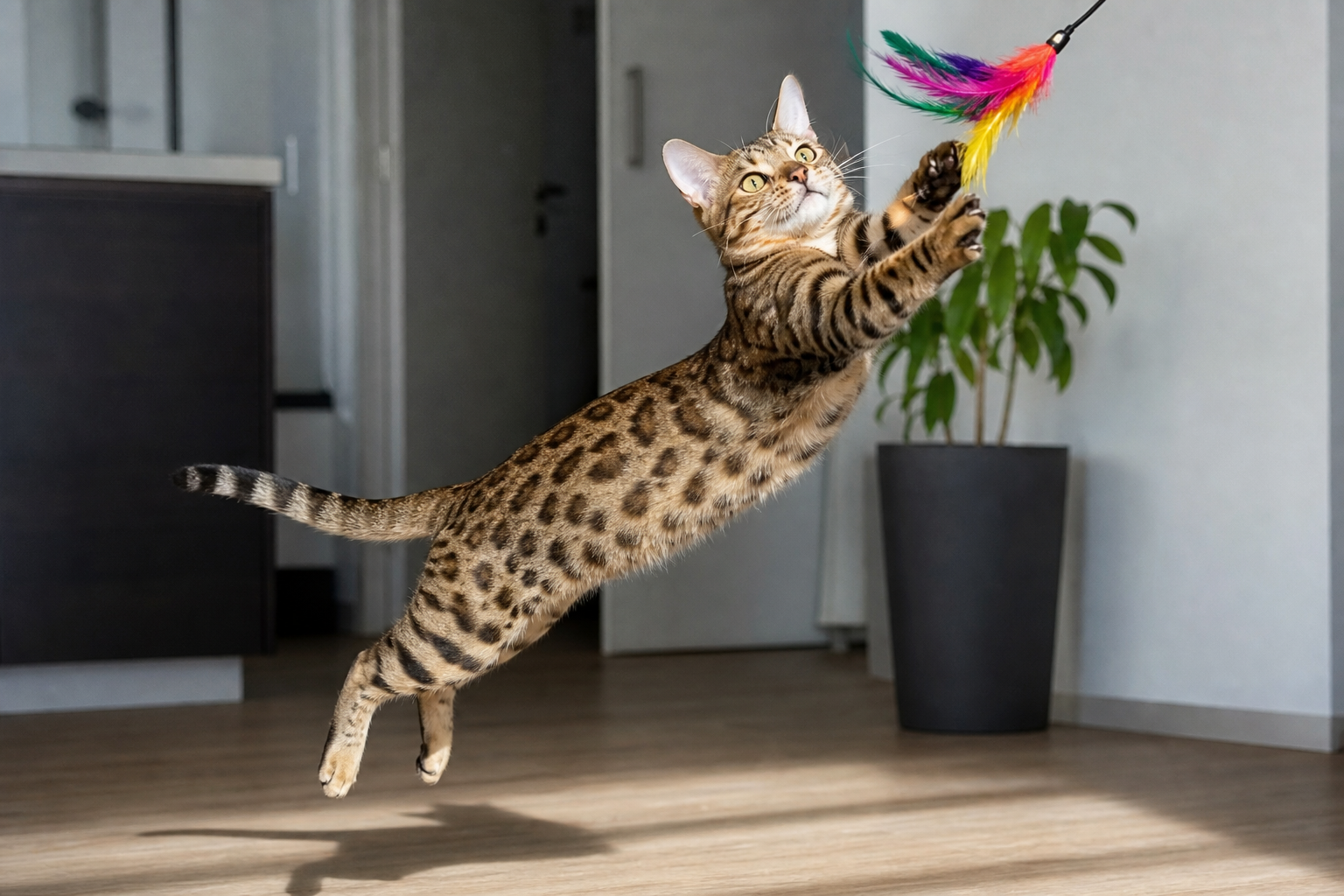
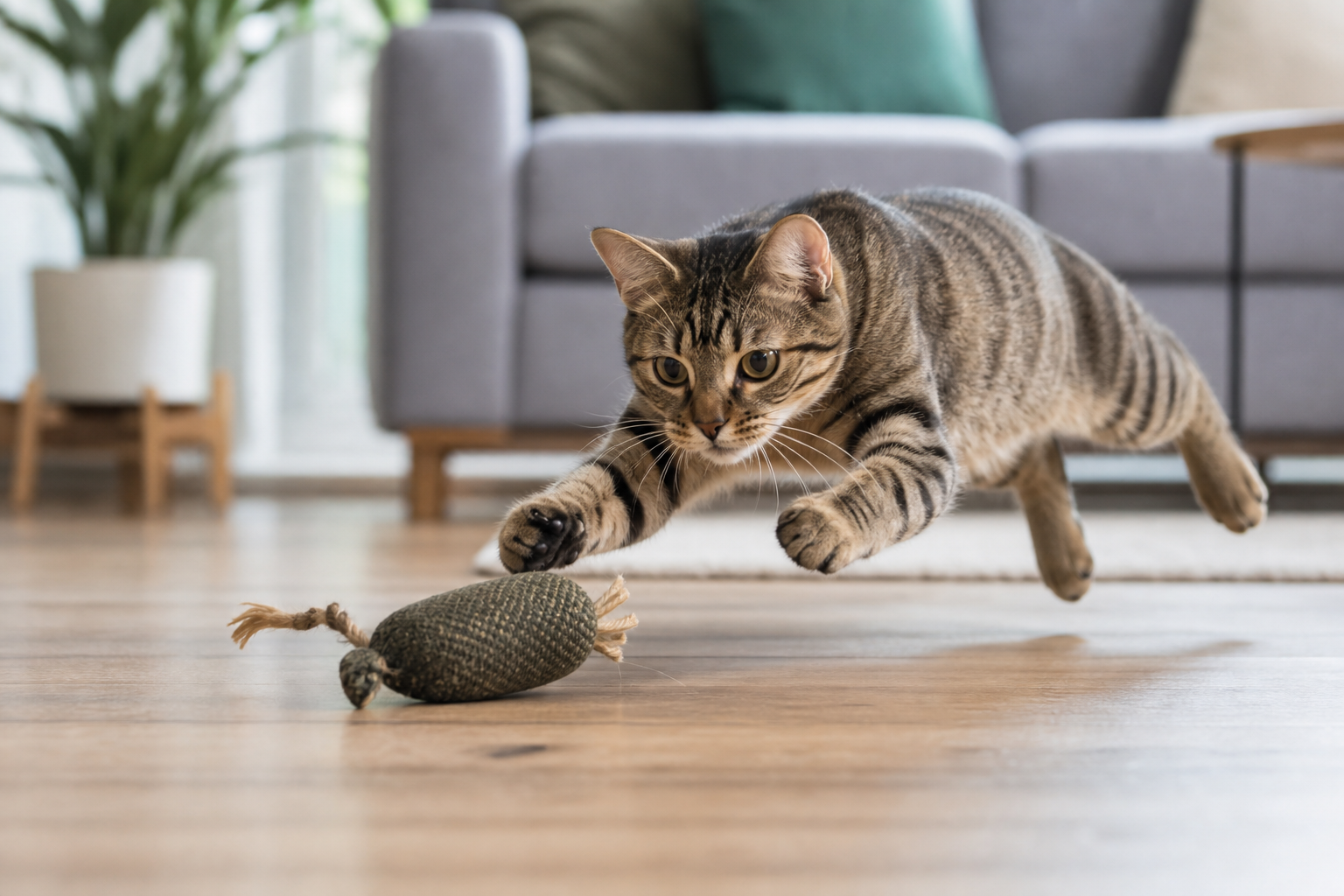
    Indoor cat leaping safely after a wand toy on a rug
    Use short bursts and soft landings for jumping games, especially with young, heavy, older, or less conditioned cats.

    Best Exercise Toy Types by Movement Goal

    Instead of buying every toy with the word exercise in the listing, choose the movement you need first.

    Movement goal Toy types that help How to use them well
    Short sprints Wand toys, lures, rolling balls, remote or automatic movers Move the toy away from the cat, add pauses, and give real catches.
    Jumping and agility Wands, feather lures, tunnels, low platforms, cat trees Keep jumps low and landings stable. Avoid slick floors and clutter.
    Wrestling and kicking Kicker toys, larger plush toys, dense fabric toys Use after chase so the cat can complete the hunt without biting hands.
    Food-motivated movement Puzzle feeders, treat balls, slow feeders, hidden kibble searches Use part of the normal meal and start with an easy puzzle.
    Solo batting Track toys, sturdy balls, springs, tunnels, safe self-play toys Leave out only toys that are safe for your cat without strings or loose parts.
    Stretching and climbing Scratchers, cat trees, shelves, window perches Place them near play zones so the cat can reset between bursts.

    For cats that love grabbing and raking, a capture toy is not optional. It keeps teeth and claws away from your hands and gives the exercise session a satisfying end. Titan Claws’ cat kicker toy guide explains how to size and use that style of toy for cats that play with force.

    How to Exercise a Cat That Seems Lazy

    A cat who seems lazy may be bored, under-conditioned, overweight, stressed, sore, older, or simply uninterested in the toy style you keep offering. Start with easy wins instead of trying to force a workout.

    • Lower the difficulty: use slow ground movement before jumps, and make food puzzles easy enough to solve.
    • Change the timing: try short sessions before meals or during your cat’s normal active windows.
    • Use hiding and corners: many cats chase harder when the toy disappears behind a box, rug edge, or chair leg.
    • Reward small movement: one hallway chase or two puzzle-feeder minutes is progress for a sedentary cat.
    • Check health first: sudden low activity, limping, hiding, appetite changes, or reluctance to jump deserve veterinary attention.

    Do not label a cat lazy and keep escalating toy intensity. If a cat wants to play but quits quickly, the issue may be fitness, pain, fear, slippery flooring, or a toy that asks for the wrong kind of movement.

    Laser Pointers, Wheels, and Electronic Toys

    Laser pointers can create movement, but they need an ending. Use a laser briefly, never shine it in eyes, and finish by directing your cat to a physical toy or food reward. Both PetMD and product-review competitors note the same practical issue: a red dot cannot be caught, so the session can feel incomplete for some cats.

    Cat exercise wheels can be useful for cats who voluntarily enjoy them, especially energetic indoor cats in smaller homes. Choose a stable wheel sized for your cat’s stride, introduce it slowly, and do not force use. Watch for overexcitement, slipping, fear, or repeated jumping off.

    Electronic and automatic toys can add movement while you work, but they should not replace human-led play. Inspect battery doors, charging ports, detachable tails, feathers, strings, and cracked plastic. Our automatic cat toys guide goes deeper on what to avoid when a toy runs without your hand on it.

    Safety Rules for Rough Exercise Play

    Exercise toys create speed and impact. That makes safety checks more important, especially for cats that chew seams, pull feathers, swallow bits, or slam toys into furniture.

    Hands inspecting a cat toy seam after rough exercise play
    For rough players, the workout is not finished until strings are stored and chewed toys are checked.
    • Put away wand strings, ribbons, yarn, elastic cords, and feather lures after every supervised session.
    • Retire toys with exposed wire, loose bells, torn seams, leaking stuffing, cracked plastic, sharp edges, or detached pieces.
    • Avoid toys small enough for your cat to swallow whole.
    • Use rugs or carpet for chase and jump games if hard floors make your cat slide.
    • Keep exercise routes clear of glass, unstable lamps, sharp furniture corners, and shelves with objects that can fall.
    • Do not use hands or feet as prey. Use a wand or larger toy to create distance.
    • Separate cats if one cat guards food puzzles or overwhelms the other during chase games.

    The AAFP and ISFM feline environmental needs guidelines recommend opportunities for play and predatory behavior, including wand play, food-containing toys, large soft toys for raking and biting, hidden toys, and rotating toys to prevent boredom. That same logic supports a Titan Claws-style rule: exercise should satisfy the hunt, but the toy still has to survive inspection well enough to remain safe.

    How Often Should You Use Cat Toys for Exercise?

    Most households should start with one or two short sessions per day. High-energy kittens and young adults may want more brief rounds. Seniors, overweight cats, and cats with medical concerns may need gentler, shorter sessions with more rest. Consistency matters more than one intense weekend workout.

    A realistic weekly plan can be simple:

    • Daily: one wand chase, one capture toy, one food puzzle or hidden-food search.
    • Three times a week: add tunnel play, low jumping, or a short climbing route.
    • Weekly: wash washable toys, rotate stale toys out, and retire damaged ones.
    • Monthly: reassess whether your cat is moving better, tiring too fast, or avoiding certain surfaces or jumps.

    If your cat already has plenty of toys but does not use them, rotation may matter more than shopping. See Titan Claws’ guide to cat toys for enrichment for a broader rotation framework.

    Quick Checklist Before You Buy

    • Which movement does this toy support: chase, jump, capture, forage, solo batting, scratching, or climbing?
    • Can your cat catch something physical at the end of the session?
    • Does the toy have strings, feathers, bells, small parts, batteries, charging ports, or weak seams?
    • Can you inspect, clean, and store it easily?
    • Is it large enough for your cat’s bite and kick style?
    • Will it work on your actual floor surface without causing sliding or frustration?
    • Does it add a role your current toy rotation is missing?

    The Bottom Line

    Cat toys for exercise work best as a routine, not a random product pile. Use chase toys to start movement, kicker toys to finish the hunt, puzzle feeders to make food active, and scratch or climb outlets to let your cat reset. Keep sessions short, watch your cat’s breathing and body language, and end before the game turns frantic.

    For cats that destroy ordinary toys, durability is only part of the answer. The better habit is supervised play, toy roles that match the cat’s real bite strength, and a post-play inspection every time. That gives your indoor hunter more movement without pretending any toy is indestructible.

  • Cat Enrichment Activities: A Practical Routine for Indoor Hunters

    Cat Enrichment Activities: A Practical Routine for Indoor Hunters

    Good cat enrichment activities let an indoor cat hunt, chase, scratch, climb, sniff, solve small problems, and rest in secure places. The best routine is not a pile of random toys. It is a repeatable mix of short active play, food-finding work, vertical space, scent novelty, and safe solo options that match your cat’s energy and bite strength.

    For cats that destroy ordinary toys, enrichment also has to include durability and inspection. A toy can be exciting and still be a bad fit if it sheds pieces, exposes wire, has loose bells, or turns into a swallowing hazard after one hard session. Use the ideas below to build variety without treating any toy as chew-proof or safe without supervision.

    A cat enrichment rotation with wand toy, kicker toy, puzzle feeder, and scratching surface
    A useful enrichment setup covers more than one instinct: chase, bite, forage, scratch, climb, and rest.

    Start With the Instinct, Not the Toy

    Most enrichment lists begin with products. A better starting point is the behavior you want to satisfy. Cats are built for short bursts: watching, stalking, chasing, pouncing, grabbing, biting, bunny-kicking, eating, grooming, and resting. If your routine gives them only one piece of that sequence, many cats get frustrated or bored quickly.

    Build each day around a few behavior categories:

    • Chase and pounce: wand toys, lure toys, rolling toys, and tossable soft toys.
    • Grab, bite, and kick: larger fabric kickers or plush toys sized so the cat can hold them without reaching your hands.
    • Forage and solve: puzzle feeders, treat hunts, snuffle-style mats made for pets, or small portions hidden around a room.
    • Scratch and stretch: vertical and horizontal scratchers with stable bases.
    • Climb and watch: cat trees, shelves, window perches, and safe high resting spots.
    • Sniff and explore: cat-safe herbs, rotated toys, paper bags with handles removed, boxes, tunnels, and new textures.

    This is why a cat may ignore a new toy but spend ten minutes hunting a kibble under a towel. Enrichment is about giving the cat a job that feels natural.

    A 20-Minute Daily Enrichment Routine

    You do not need to entertain your cat all day. Most households do better with predictable, short sessions. A practical routine for a high-energy indoor cat looks like this:

    1. Two minutes of setup: put away damaged toys, choose one chase toy, one bite-safe toy, and one food activity.
    2. Five to seven minutes of chase: move the wand or lure like prey. Let it hide behind furniture, pause, dart away, and get caught.
    3. Three minutes of capture: switch to a kicker or soft toy the cat can bite and rake without contacting your hand.
    4. Five minutes of food work: place part of a meal in a puzzle feeder, scatter a few pieces in safe hiding spots, or toss single kibbles down a hallway.
    5. Two minutes of cool-down: let the cat eat, groom, and settle near a perch or bed.

    If your cat is older, nervous, recovering from illness, or has mobility limits, shorten the active portion and ask your veterinarian what level of activity is appropriate. Enrichment should leave the cat satisfied, not panting, limping, hiding, or irritated.

    Best Cat Enrichment Activities by Need

    Use this section as a menu. Pick two or three activities, then rotate them instead of introducing everything at once.

    For bored indoor cats

    Try a morning food hunt, a window perch with safe outdoor viewing, and one evening wand session. If your cat already has many toys but ignores them, read our guide to cat toys for bored cats; the issue is often rotation and play style, not the number of toys.

    For rough players

    Use bigger toys that keep teeth and claws away from your skin. Kicker toys, dense fabric toys, and supervised chase sessions are better than letting the cat wrestle hands or feet. Our cat kicker toy guide explains how to size a toy for cats that grab and rake hard.

    For food-motivated cats

    Replace one bowl meal with a puzzle feeder or scatter-feeding session. Start easy: put visible food in shallow wells or an open egg carton, then increase difficulty only after the cat understands the task. Food puzzles should not block access to enough calories, water, or prescribed diets.

    Indoor cat using a simple food puzzle for foraging enrichment
    Food puzzles and treat hunts turn part of a meal into a short problem-solving session.

    For cats that need more exercise

    Use short, frequent sessions. Toss a toy up stairs only if the stairs are safe and your cat moves comfortably. Drag a lure away from the cat rather than waving it in the cat’s face. Give real captures so the game has an ending.

    For smart cats that get bored fast

    Hide the same toy in a box, under tissue paper, behind a chair leg, or inside a tunnel. Novelty can come from the setup, not constant buying. Rotate toys out of sight for several days so they return with some freshness.

    What Veterinary and Welfare Guidance Says

    The AAFP and ISFM feline environmental needs guidelines describe play and predatory behavior as a core environmental need, alongside safe resting places, separated key resources, positive human interaction, and respect for the cat’s sense of smell. That framework is useful because it prevents enrichment from becoming only toy shopping.

    A survey published in the Journal of Veterinary Behavior found that many indoor-cat owners provided toys, but most left toys available all the time. The same abstract reports that owners who played for at least five minutes had fewer reported behavior problems than owners whose sessions lasted one minute. That does not prove play fixes every issue, but it supports a practical point: active, owner-involved play matters.

    For DIY ideas, the ASPCA feline DIY enrichment resource and Best Friends Animal Society indoor enrichment guide both emphasize simple household activities such as food puzzles, boxes, and interactive toys. The gap for rough-play cats is safety: homemade and lightweight items need closer supervision because determined cats can chew, shred, or swallow pieces.

    Safety Rules for Enrichment Toys

    Enrichment should add choice and healthy activity, not new hazards. Check toys before and after hard play, especially if your cat bites seams, chews strings, pulls feathers, or tries to eat stuffing.

    Hands checking a cat toy seam for loose threads before play
    For rough players, enrichment works best when toy inspection is part of the routine.
    • Put away wand toys, strings, ribbons, yarn, and elastic cords after supervised play.
    • Retire toys with exposed wire, loose bells, detached eyes, cracked plastic, sharp edges, or leaking stuffing.
    • Avoid toys small enough for your cat to swallow whole.
    • Remove paper bag handles before letting a cat explore the bag.
    • Use laser pointers only as a brief chase tool, then end with a physical toy the cat can catch.
    • Separate cats during high-value food puzzles if one cat guards food or crowds the other.
    • Do not use hands or feet as prey. It teaches the exact target you do not want bitten.

    If your cat repeatedly eats non-food material, breaks teeth on hard objects, coughs after play, vomits toy pieces, or has sudden behavior changes, stop the activity and contact a veterinarian.

    How to Rotate Enrichment Without Buying More

    Rotation keeps familiar objects interesting and reduces clutter. Put most toys in a closed bin. Each day, choose one chase toy, one wrestling toy, one food activity, and one passive environment change. After play, inspect and store the toys again.

    A simple weekly pattern:

    • Monday: wand chase, kicker capture, kibble scatter.
    • Tuesday: tunnel chase, puzzle feeder, window perch time.
    • Wednesday: box maze, hidden toy search, scratcher refresh with catnip if your cat enjoys it.
    • Thursday: hallway tosses, soft toy wrestling, food hidden in several easy spots.
    • Friday: feather-style lure under supervision, climbing route, scent novelty.
    • Weekend: one longer play session, toy wash or inspection, and setup changes.

    For a deeper toy-specific setup, see our guide to cat toys for enrichment. If you use electronic toys, pair them with human-led play and inspect moving parts; our automatic cat toys article covers what to avoid when a toy runs without your hand on it.

    Small-Space Cat Enrichment

    A small apartment can still be rich if you use vertical and temporary setups. Add a stable perch, rotate boxes, hide a few food pieces around one room, and use a wand toy that moves around furniture instead of across a huge floor. For renters, freestanding scratchers, tension-mounted trees, washable mats, and removable window perches are easier than permanent installations.

    The key is to create zones: a chase path, a scratch station, a lookout, a hiding place, and a feeding puzzle spot. Even a studio can support those zones if they are compact and rotated.

    Quick Checklist

    • Can your cat chase, catch, bite, scratch, climb, sniff, and forage every week?
    • Do you play actively for at least a few minutes instead of only leaving toys out?
    • Are string, wand, feather, and elastic toys stored after use?
    • Do rough-play toys keep teeth and claws away from your hands?
    • Are puzzle feeders easy enough that your cat does not give up?
    • Do you inspect seams, stuffing, bells, eyes, and plastic parts after hard sessions?
    • Does each play session end with a catch, food, or calm cool-down?

    Good enrichment is not about making your home look like a pet store. It is about giving your cat a safer daily outlet for the behaviors already built into them. Start with one chase session, one food puzzle, and one inspection habit. Then rotate from there.

  • Cat Toys for Hunting: How to Build a Safer Indoor Prey Routine

    Cat Toys for Hunting: How to Build a Safer Indoor Prey Routine

    Good cat toys for hunting are not just toys that move. They help an indoor cat run through a safer version of the prey sequence: watch, stalk, chase, pounce, grab, bite, kick, and sometimes eat a treat afterward. The best setup usually combines a wand or teaser for active chase, a kicker or plush prey toy for the catch, and a puzzle or food toy for the final reward.

    For Titan Claws readers, the durability question matters too. A cat with a strong hunting drive may hit toys with full claws, teeth, and bunny kicks. That does not mean you need to chase an impossible “indestructible” label. It means choosing toys that match the way your cat attacks, supervising higher-risk play, and replacing toys before seams, strings, bells, or stuffing become hazards.

    What hunting-style play should actually do

    A hunting toy should give your cat a job. It should move away from the cat like prey, pause long enough for stalking, then offer a clean capture. That capture matters. VCA Animal Hospitals notes that predatory games should use toys the cat can eventually catch and “kill,” not human hands or feet. The AAFP and ISFM environmental needs guidelines also recommend play that mimics flying or ground prey, lets the cat capture the toy, and uses toy rotation to prevent boredom.

    That is where many generic toy lists fall short. They name feather wands, toy mice, lasers, and electronic toys, but they rarely explain how to combine them into a routine that satisfies a cat instead of winding the cat up. A laser that never turns into a physical catch can frustrate some cats. A wand toy left on the floor can become a string-ingestion risk. A plush mouse may be perfect for one cat and too small for another cat that swallows loose parts.

    The best cat toys for hunting by prey style

    Start by watching what your cat naturally targets. A cat that launches upward at feathers wants different play than a cat that crouches behind furniture and ambushes ground movement.

    • Bird-style hunters: Use a supervised wand cat toy with controlled swoops, short flights, and landings. Avoid endless overhead circles that make the cat jump awkwardly or miss every time.
    • Mouse-style hunters: Drag a lure along baseboards, around chair legs, or under the edge of a blanket. Let it freeze, twitch, and escape in short bursts.
    • Insect-style hunters: Try springy wire toys, small crinkle balls, or quick skittering movements. Our Cat Dancer toy guide covers that style in more detail.
    • Wrestlers and biters: Add a larger cat kicker toy so the cat has something long enough to grab with the front paws and kick with the back legs.
    • Food-motivated hunters: Use puzzle cat toys, treat balls, or scattered kibble games so the cat has to search, paw, and work for part of the meal.

    A simple hunting routine for indoor cats

    You do not need a complicated training plan. Use a short, repeatable routine that lets the cat succeed.

    1. Warm up with stalking. Move the toy slowly at the edge of your cat’s attention. Let your cat watch and plan before you ask for speed.
    2. Create one clean chase. Move the lure away from the cat, not into the cat’s face. Prey generally flees; it does not attack head-on.
    3. Let the cat catch it. Every few passes, make the toy available. Let your cat pin it, bite it, or kick it.
    4. Switch to a bite-safe object. If the cat grabs the wand lure hard, trade to a kicker or plush prey toy before teeth reach string, wire, or feathers.
    5. End with food or calm. A small treat, part of dinner in a puzzle feeder, or a quiet grooming session can help finish the hunt instead of stopping at peak arousal.

    Many cats do well with several short play sessions instead of one long marathon. VCA notes that cats often have short bursts of play followed by rest, and that morning and evening often match natural active periods. If your cat only plays hard for five minutes, that can still be a real session.

    Hunting-style cat toys arranged for a weekly indoor toy rotation
    A useful hunting rotation includes chase, pounce, wrestle, and food-search options instead of one toy doing every job.

    What to avoid with rough hunting cats

    Rough players need more structure, not fewer toys. The risk is not that hunting play is bad. The risk is leaving the wrong object available at the wrong time.

    • Do not use hands or feet as prey. It teaches the cat that skin is part of the game and can make adult bites and scratches harder to manage.
    • Do not leave wand toys out unsupervised. Strings, ribbons, feathers, and flexible wires belong in put-away storage after play.
    • Be careful with tiny parts. Cornell Feline Health Center warns against toys with small pieces or strand-like parts that may separate and be swallowed.
    • Do not rely on lasers alone. If you use a laser, transition to a physical toy or treat the cat can actually capture.
    • Retire toys before they fail. Loose seams, exposed stuffing, cracked plastic, detached bells, and chewed cords are stop signs.

    If your cat chews through fabric, rubber, or feathers quickly, read our guide to safe cat chew toys before leaving any toy available for solo play.

    How to choose tougher hunting toys without overclaiming safety

    Durability is a design choice, but no cat toy is safe in every mouth forever. For hunting cats, look for construction that buys you more supervised play time and clearer failure signs.

    • For kickers: choose a body long enough to keep teeth and back claws on the toy instead of your arm, with dense fabric and reinforced seams.
    • For plush prey toys: avoid hard eyes, loose bells, and decorative bits that can come off during chewing.
    • For wand attachments: check the connection point, string, feathers, and wire before each session.
    • For electronic toys: inspect battery compartments, wheels, fabric covers, and cords. Our automatic cat toys guide covers those tradeoffs.
    • For food toys: make sure holes and edges are smooth, the toy can be cleaned, and the food used fits your cat’s diet.
    Cat toy being inspected for loose seams before another play session
    A fast seam check before play helps catch damage before a rough cat turns it into an ingestion risk.

    Build a weekly toy rotation

    Rotation keeps familiar toys interesting and helps you notice damage. Keep a small active set available and store the rest. Cornell also recommends toy rotation as a way to prevent boredom.

    A practical hunting rotation might look like this:

    • Daily supervised toy: wand, teaser, or spring-style toy for chase and pounce.
    • Daily capture toy: kicker, plush mouse, or bite-safe prey toy used after the chase.
    • Solo-safe option: sturdy ball, larger soft toy, or simple object your cat does not chew apart.
    • Food-search option: puzzle feeder, treat ball, snuffle-style mat, or hidden kibble trail.
    • Rest day swap: cardboard box, paper bag with handles removed, or a tunnel for ambush play.

    For a broader enrichment plan, pair this routine with our cat toys for enrichment guide.

    When hunting play needs a different plan

    Ask your veterinarian or a qualified behavior professional for help if your cat redirects hard bites onto people, guards toys, swallows non-food items, pants heavily during play, limps after jumping, or seems unable to settle after chase games. Those signs may point to pain, stress, compulsive behavior, unsafe toy choice, or a routine that is too intense.

    Also adjust for age and health. Kittens often need frequent short play and firm rules against hand-chasing. Seniors may still want the hunt, but with lower jumps, slower movement, and softer landings. Cats with mobility issues can still stalk, paw, forage, and catch toys without high-impact leaps.

    Quick checklist

    • Choose the toy by prey style: bird, mouse, insect, wrestler, or food-search hunter.
    • Move the toy like prey that escapes, hides, pauses, and gets caught.
    • Give the cat a physical capture instead of endless chasing.
    • Store wand toys, strings, ribbons, and feather attachments after supervised play.
    • Inspect seams, stuffing, small parts, wires, and cords before repeat use.
    • Rotate toys weekly and retire damaged toys early.
    • Use food puzzles or a small treat to finish some sessions with a satisfying reward.

    The best cat toys for hunting are the toys your cat can stalk, chase, catch, and safely attack under the right level of supervision. Build the routine first, then buy or rotate toys to fill each role. That approach gives high-drive indoor cats a better outlet than another random toy tossed on the floor.

    Sources

  • Cat Dancer Toy: How It Works, Safety, and Better Play for Rough Cats

    Cat Dancer Toy: How It Works, Safety, and Better Play for Rough Cats

    The Cat Dancer toy is a simple interactive cat toy made from spring steel wire with rolled cardboard lures. That plain design is the point: the wire creates quick, uneven movement that can look like a moth, beetle, or tiny prey animal, which is why many cats react to it even when they ignore heavier wand toys.

    For most cats, the original handheld Cat Dancer is best used as a supervised chase toy. It is inexpensive, light, and excellent for short hunting-style play. For cats that bite hard or shred toys, it should not be treated as a chew toy or an unsupervised toy. Use it to create the chase, then hand your cat a tougher kicker, ball, or fabric toy for the catch.

    What the Cat Dancer toy is

    The official Cat Dancer product page describes the original toy as spring steel wire and rolled cardboard. The listed product dimensions are small, and the toy weighs less than an ounce, so it behaves very differently from a rigid wand or plush teaser. Instead of you dragging a lure in a straight line, the wire rebounds and trembles with small motions from your hand.

    That movement is the main advantage. A tiny wrist flick can make the cardboard end bounce, hover, dip, and retreat. Cats that prefer watching before pouncing often like this because the lure does not simply rush at them. It can disappear behind a chair leg, skim the floor, or hang just above paw height.

    The common versions owners search for are the original handheld toy, the Cat Dancer Deluxe with a wall-mounted paw holder, and shorter or handled variations sold through pet retailers. The decision is less about which package is cutest and more about how your cat plays: supervised chase, solo batting, or rough bite-and-rake play.

    Why cats like the spring-wire motion

    Cats are built to notice small, irregular movement. A toy that pauses, twitches, and darts away can trigger the stalk-chase-pounce sequence better than a lure that moves in predictable circles. VCA’s guidance on cat play and play toys recommends predatory games where the cat can eventually catch and kill the toy. The Cat Dancer can cover the stalking and chasing part extremely well.

    Where owners often get stuck is the finish. The cardboard lure is small, and the wire is not a satisfying wrestling target. If your cat catches it and immediately tries to clamp down, shake, or chew, do not fight them for it. Pause the wire game and offer a bigger capture toy. That makes the session feel complete without asking a thin wire toy to do a kicker toy’s job.

    Is the Cat Dancer toy safe?

    The Cat Dancer can be a safe interactive toy when you supervise play, keep the wire out of mouths and eyes, inspect the cardboard, and put it away after the session. It is not a good free-access toy for cats that chew cardboard, bite metal, or work small parts loose.

    Cornell’s Feline Health Center advises owners to avoid toys with small pieces or strand-like parts that can detach and be swallowed, and to rotate toys so cats do not become bored. That advice applies here. The Cat Dancer has fewer string hazards than a ribbon wand, but it still has small cardboard pieces and a springy wire that needs owner control.

    Run this check before and after play:

    • Look for cracked, softened, or missing cardboard pieces.
    • Check the wire ends and bends for sharp points, kinks, or exposed rough spots.
    • Stop the session if your cat chews the wire instead of batting or pouncing.
    • Keep the lure away from eyes, whisker pads, and open mouths during high jumps.
    • Put the toy in a drawer or closet when you are done.

    If your cat swallows string, cardboard, wire, or any toy piece, call your veterinarian. PetMD’s veterinary guidance on cats eating string is especially blunt about linear material: do not pull it from the mouth, do not induce vomiting, and seek veterinary help promptly. A Cat Dancer is not string, but the same seriousness should apply to swallowed toy parts.

    How to use it without frustrating your cat

    The best Cat Dancer sessions are short, varied, and winnable. Start with the toy low to the ground, not whipping through the air. Let your cat watch it. Move it behind a table leg, along a rug edge, or under the lip of a cardboard box. Give pauses long enough for the cat to plan a pounce.

    Use this simple pattern:

    • Stalk: Hold the wire still with tiny tremors near cover.
    • Chase: Move the lure away in short bursts, not constant circles.
    • Pounce: Let your cat land paws on it every few passes.
    • Capture: After a few wins, switch to a larger toy your cat can bite and rake.
    • Settle: End with a treat, part of a meal, or a puzzle feeder if that suits your cat.

    Do not use your hands as the exciting target. If your cat starts tracking fingers, ankles, or sleeves, increase distance, slow the session, or stop. The toy should teach your cat where play belongs, not make human skin part of the game.

    Original vs. Deluxe wall mount

    The original handheld Cat Dancer gives you the most control. You decide speed, height, distance, and when the game ends. That makes it the better choice for kittens, high-jumpers, nervous cats, and rough players that need close supervision.

    The Deluxe version adds a wall-mounted holder so a cat can bat the toy without you holding it. That can work for gentle cats that like solo batting, but it is not the version I would leave out for a destructive chewer. A wall-mounted spring toy can still be bitten, bent, or worried at one weak point until something fails. If you try it, install it away from stairs, shelves, cords, food bowls, and tight corners, then watch several sessions before trusting it for independent play.

    For cats that need activity while you are busy, a safer setup is often a rotation: a scratcher, a sturdy rolling toy, a food puzzle, and a window perch, with the Cat Dancer saved for owner-led play. Titan Claws’ guide to automatic cat toys covers the same principle for powered toys: solo entertainment should be boringly safe, not just exciting.

    For cats that destroy ordinary toys

    A rough cat may love the Cat Dancer, but that does not mean the Cat Dancer should absorb the whole attack. Let it be the moving prey. Then offer something built for impact, teeth, and claws.

    Good handoff options include a larger fabric kicker, a molded rubber treat toy, a sturdy ball, or a rope-free plush made with reinforced stitching. The rough-player buying filter is simple: the toy your cat bites should be large enough to grip, easy to inspect, and free of tiny glued-on parts. The Titan Claws guide to unbreakable cat toys for aggressive chewers is useful for that capture-toy side of the routine, and the materials guide explains why reinforced fabrics, molded rubber, and safer hardware matter more than big durability claims.

    Kitten playing with a toy mouse during an indoor play session
    Photo: Andrew Gray via Wikimedia Commons, CC BY-SA 2.0.

    When to skip it

    Skip or retire the Cat Dancer if your cat focuses on eating the cardboard, biting the wire, attacking the wall mount, or jumping so wildly that the play space becomes unsafe. Also skip it for unsupervised access if your cat has a history of swallowing non-food items.

    Choose another toy if your cat needs one of these jobs instead:

    • Heavy chewing: Use a tougher chew-safe or treat-dispensing toy under supervision.
    • Wrestling: Use a larger kicker that keeps paws and teeth away from thin parts.
    • Food motivation: Use a puzzle feeder or treat hunt.
    • Solo play: Use passive toys with no wire, string, small loose pieces, or batteries your cat can reach.
    • Fearful cats: Use slower movement, boxes, tunnels, and lower-intensity sessions.

    Quick checklist before buying

    • Do you want a supervised chase toy rather than a chew toy?
    • Will you put it away after play?
    • Does your cat bat and pounce more than chew and swallow?
    • Do you have a larger capture toy ready for the finish?
    • Is your play area clear of shelves, cords, stairs, and fragile objects?
    • Can you inspect the cardboard and wire after hard sessions?

    The bottom line

    The Cat Dancer toy earns its popularity because it does one job very well: it creates small, erratic prey-like movement with almost no weight in your hand. For many cats, that is more interesting than a bulky wand or noisy electronic toy.

    For rough cats, the smart routine is supervised Cat Dancer chase followed by a tougher toy your cat is allowed to grab, bite, and kick. Keep the wire controlled, inspect the cardboard, retire damaged parts, and do not leave it out for destructive chewers. Used that way, it can be a low-cost, high-value part of a safer toy rotation.

  • Cat Bite Toys: Safer Choices for Cats That Chew Hard

    Cat Bite Toys: Safer Choices for Cats That Chew Hard

    Cat bite toys should give a chewing cat something satisfying to grab, gnaw, kick, and carry without breaking into swallowable parts. For most cats, the safest choices are oversized fabric kickers with reinforced seams, molded rubber or silicone pieces made for pets, sturdy puzzle feeders, and wand toys used only during supervised play. The wrong choices are tiny plush toys, loose feathers, elastic loops, bells, glued-on eyes, fraying rope, and string toys left out after play.

    The goal is not to find a magic toy your cat can never damage. Cats have sharp teeth, strong jaws for their size, and a hunting play style built around grabbing and biting. The real goal is to match the toy to the way your cat bites, inspect it before it fails, and give high-chew cats safer outlets than cords, plastic bags, plants, or your hands.

    This guide is for owners whose cats bite toys hard, chew plastic, shred plush, carry toys around, or redirect play bites onto people. If your cat swallows non-food items, vomits after chewing, has a sudden change in chewing behavior, or seems unable to stop eating fabric, plastic, rubber, or string, treat that as a health and behavior question for your veterinarian, not just a shopping problem.

    What toys do cats like to bite?

    Cats usually like to bite toys that behave like prey: something that moves away, gives a little under the teeth, can be pinned with the front paws, and can be kicked with the back feet. That is why many cats prefer kicker toys, wand attachments, crinkly fabric, small stuffed shapes, and rolling puzzle toys over hard objects that do nothing.

    For a cat that chews hard, useful bite toys usually fall into five groups:

    • Large kicker toys: long enough for the cat to hug and rabbit-kick, with seams that are not easy to pry open.
    • Molded rubber or silicone toys: satisfying for cats that mouth objects, as long as the piece is too large to swallow and does not shed chunks.
    • Puzzle feeders: good for cats that need to work, paw, and bite lightly for food, especially indoor cats with pent-up hunting energy.
    • Wand toys: excellent for bite-and-chase play, but they should be put away when the session ends.
    • Simple household options: cardboard boxes, paper bags with handles removed, and ping-pong balls can be useful when supervised and replaced once damaged.

    Cornell’s Feline Health Center notes that toys help cats stalk, pounce, problem solve, exercise, and avoid boredom-related behavior problems, but it also warns owners to avoid small pieces, string-like parts, and anything electrical that a cat can chew. That is the right balance: encourage the hunting pattern, but remove the parts that can turn play into ingestion risk.

    Choose the toy by bite style

    Before buying more cat bite toys, watch one five-minute play session and name what your cat actually does. A toy that works for a cat that grabs and kicks may be wrong for a cat that quietly saws through seams in a corner.

    Bite style Better toy direction Avoid
    Grabs, wrestles, and kicks Oversized kicker, tough fabric tube, refillable catnip kicker Small plush mice, thin seams, dangling ribbons
    Chews plastic or cords Molded rubber or silicone pet chew, puzzle feeder, managed cord protection Thin plastic springs, brittle hard-plastic toys, exposed charging cords
    Shreds fabric seams Reinforced kicker, denim-like fabric, fewer stitched-on decorations Stuffed toys with eyes, tails, tags, bells, or glued trim
    Bites hands during play Long wand toy, kicker redirect, scheduled play before meals Hand wrestling, teasing with fingers, short toys that keep hands near teeth
    Gets bored at night Ball track, puzzle feeder, safe solo toys after supervised testing String, feather, elastic, or battery toys that can be chewed open

    If rough play is the larger pattern, pair this guide with Titan Claws’ article on why cats destroy toys. If you are building a full toy box rather than solving one chewing habit, start with how to choose cat toys that last.

    Safety rules for cats that chew aggressively

    The safest cat bite toy is not just a tougher toy. It is a toy with fewer failure points. Every charm, feather, bell, plastic eye, loop, fringe, tassel, and glued seam is another place where a determined cat can create a swallowable piece.

    The University of Wisconsin School of Veterinary Medicine gives especially practical advice for young, active cats that chew: many traditional toys include feathers, strings, or sparkly pieces that aggressive chewers may ingest, so those parts are best avoided. The same guidance recommends sturdy construction, no loose decorations, cutting off loops or tags, and removing pieces immediately when they are chewed off.

    Use these rules for any cat that really bites toys:

    • Size up. Choose toys too large to fit fully in your cat’s mouth. Small toys can become choking or swallowing risks once damaged.
    • Prefer one-piece construction. Molded toys and simple sewn shapes usually have fewer weak points than toys with many glued-on features.
    • Supervise new toys. The first session tells you how fast your cat can puncture, peel, or shred that material.
    • Put string toys away. Wand toys are valuable, but string and ribbon are not safe solo toys for cats that chew.
    • Retire early. If stuffing, a hard core, a battery compartment, sharp plastic, or loose threads appear, the toy is done.

    For material-level detail, see Titan Claws’ guide to safer durable cat toy materials. The short version: softer materials can be kinder to the mouth but wear faster; harder materials may last longer but can become dangerous if they crack. Inspection matters either way.

    Close view of a cat toy being inspected for loose seams

    What to leave out for solo play

    Not every bite toy should be available at 2 a.m. when no one is watching. Solo toys need a higher safety bar because you will not be there to stop a chewing session when the toy starts to fail.

    Better solo options, after supervised testing, include ball tracks, large intact kickers, sturdy puzzle feeders, and simple balls too large to swallow. These are not risk-free, but they do not rely on loose strings or tiny parts to be fun.

    Keep these in a closet between supervised sessions:

    • Wand toys with string, wire, elastic, feathers, or ribbon.
    • Any toy with bells, plastic eyes, glued faces, sequins, or tiny ornaments.
    • Battery toys your cat can pry open or bite through.
    • Catnip plush toys that already show seam stress.
    • Rope or fabric toys that produce loose strands when chewed.

    This is especially important if your cat likes to chew on wires. Cornell’s holiday hazard guidance warns that chewing bulbs, phone cords, and electrical cords is dangerous and recommends tying cords up or using heavy cord protectors. A chew toy can help redirect the mouth, but it does not replace cord management.

    Build a bite-toy routine, not a toy pile

    Cats often chew because the object is available, interesting, and part of a bigger need: hunting, food seeking, teething, attention, stress relief, or boredom. A pile of toys on the floor can go stale quickly. A routine keeps the toys valuable.

    1. Start with movement. Use a wand toy for five to ten minutes and move it like prey: away from the cat, behind furniture, around corners, and across the floor.
    2. Let the cat catch and bite. If the toy is always just out of reach, some cats get frustrated and redirect onto hands or ankles.
    3. Switch to a kicker. Once the cat is aroused, offer a large kicker so the bite and back-foot kicking land on the toy.
    4. End with food or a puzzle. A small meal or measured puzzle feeder completes the hunt-catch-eat pattern.
    5. Put high-risk toys away. Leave out only the toys that passed your solo-play inspection.

    The AAFP and ISFM environmental needs guidelines describe play and predatory behavior as part of a cat’s environmental needs, including feeding devices that let cats work for food and wand movement that mimics prey. That supports a practical point: bite toys work better when they are part of enrichment, not just objects scattered around the room.

    If your cat mainly needs active chasing, Titan Claws has a deeper guide to interactive toys for indoor cats. If the behavior includes biting people, also read why cats bite owners so you can separate play biting from fear, pain, petting sensitivity, or overstimulation.

    Several different cat toys arranged for toy rotation

    When chewing points to a bigger problem

    Some chewing is normal investigation and play. Persistent chewing, sucking, or eating non-food material can be different. Cornell’s destructive behavior handout explains that chewing fabric or houseplants can be part of normal investigation and play, but destructive behaviors can also harm a cat’s health and may require management changes or veterinary behavior help.

    Call your veterinarian promptly if you see any of these signs:

    • Your cat swallows toy pieces, string, fabric, rubber, hair ties, plastic, or paper.
    • There is vomiting, gagging, drooling, appetite loss, belly pain, constipation, diarrhea, hiding, or lethargy after chewing.
    • Chewing starts suddenly in an adult cat, especially with bad breath, pawing at the mouth, dropped food, or visible dental discomfort.
    • Your cat obsessively seeks one risky material, such as plastic bags, elastic, wool, cords, or plant leaves.
    • Chewing gets worse with stress, schedule changes, conflict with another pet, or long periods alone.

    Titan Claws also has a focused safety article on foreign body ingestion in cats. Read it before you need it, because string and fabric ingestion can become urgent quickly.

    Quick checklist before you buy a cat bite toy

    • Is it larger than your cat can swallow, even after chewing?
    • Are there any feathers, strings, bells, eyes, tags, loops, or decorations to remove?
    • Can your cat puncture, peel, or shred it in the first supervised session?
    • Does the material fail softly, or could it crack into sharp edges?
    • Can you wash it or wipe it clean after slobbery play?
    • Does it match your cat’s actual bite style: kicker, chewer, chaser, puzzle solver, or hand biter?
    • Will it be a supervised toy, a solo toy, or a toy that gets retired after one session?

    For cats that chew hard, the best cat bite toys are boring in the best way: simple shapes, sturdy materials, few loose parts, and easy inspection. Let your cat bite, kick, chase, and work. Just make sure the toy is built for the job, and remove it before your cat turns play into swallowed debris.

  • Cat Scratching Post: How to Choose One Your Cat Will Actually Use

    Cat Scratching Post: How to Choose One Your Cat Will Actually Use

    A good cat scratching post gives your cat a legal place to stretch, mark territory, maintain claws, and release energy without turning your sofa into the target. The best choice is not always the cutest post or the tallest cat tree. It is the post that matches how your cat already scratches: vertical or horizontal, rope or cardboard, carpet or wood, high stretch or low rake.

    For cats that destroy ordinary toys, the scratching post also has a second job. It should absorb serious claw work while the rest of the play plan gives your cat safe outlets for chasing, biting, kicking, and carrying. A sturdy post helps with furniture damage, but it will not replace active play, toy rotation, and regular inspection.

    Why Cats Need a Scratching Post

    Scratching is normal cat behavior, not spite. Cornell Feline Health Center explains that cats scratch to mark territory with scent from paw glands, remove the outer claw sheath, and leave visible marks. The Cornell destructive behavior guide also points out that cats can be redirected to better scratching objects when owners match the cat’s preferences and use patience.

    The AAFP and ISFM feline environmental needs guidelines include scratching areas among the key resources cats need in the home, along with feeding, water, resting, toileting, and play areas. In practical terms, a scratching post is not decor. It is part of the indoor cat’s territory map.

    If a cat scratches furniture, carpet, door frames, or curtains, the goal is not to stop scratching. The goal is to make the approved scratching surface more satisfying than the forbidden one.

    Start by Reading Your Cat’s Current Scratching Style

    Before buying a cat scratching post, look at the damage your cat has already made. The pattern tells you what your cat is trying to do.

    • Vertical scratches on sofa arms, curtains, or door trim: choose a tall, upright post or wall-mounted scratcher.
    • Horizontal scratches on carpet or rugs: add a flat scratch pad, low board, or horizontal cardboard scratcher.
    • Corner scratching: try a corner-mounted surface beside the target area.
    • Deep claw marks in rough fabric: test sisal, woven fabric, or a sturdy nubby surface.
    • Shredded cardboard everywhere: cardboard may be satisfying, but the cat may need a heavier-duty backup and closer cleanup.

    This is where many product pages are thin. They show attractive scratching posts, prices, and materials, but they rarely help you diagnose why one cat ignores a post and another cat destroys it in a month. Your cat’s existing damage is better information than a generic bestseller list.

    Height and Stability Matter More Than Style

    A vertical scratching post should let your cat stretch with the front legs extended. For many adult cats, that means a post around 30 inches tall or taller, and large cats may need more. A short post can work for kittens or low scratchers, but it often fails for cats that want the full body stretch they get from furniture.

    Stability is just as important. If the post wobbles, slides, or tips the first time your cat digs in, your cat learns that the sofa is safer. Look for a wide, heavy base; wall attachment; a low center of gravity; or a cat tree that does not rock under your cat’s body weight. If you build a DIY cat scratching post, test it hard before calling it finished.

    For rough players, avoid flimsy novelty posts with tiny bases, dangling pieces, lightweight cardboard towers, or thin tubes that twist under pressure. A scratching post for a powerful cat should feel boringly solid.

    Stable cat scratching post with a wide base beside a sofa
    A post that wobbles teaches many cats to go back to the sofa. Stability matters more than decorative style.

    Choose the Right Scratching Surface

    Common scratching surfaces include sisal rope, sisal fabric, corrugated cardboard, carpet, wood, and upholstery-style fabric. None is best for every cat. The right surface is the one your cat consistently chooses and can use safely.

    • Sisal fabric: often grips well and may wear more evenly than rope on some posts.
    • Sisal rope: popular and satisfying, but inspect for loose coils and long frays.
    • Corrugated cardboard: inexpensive and loved by many cats, but messy and not ideal for cats that eat pieces.
    • Carpet: useful for carpet scratchers, though it can confuse cats if it feels too much like household carpet.
    • Wood: a good option for cats that like rough natural textures, especially in catios or supervised areas.

    If your cat chews or swallows torn material, treat the scratcher like a toy safety issue. Remove loose rope, staples, tacks, tape, splinters, and chunks of cardboard. For cats that bite and pull, simple construction is safer than a post covered in trim, pom-poms, feathers, or glued-on decorations.

    Where to Put a Cat Scratching Post

    Placement decides whether the post becomes part of your cat’s routine. Put the first post next to the object your cat already scratches. Once the cat is using it reliably, you can move it a few inches at a time toward a better spot.

    Good locations include beside a favorite sofa arm, near a sleeping area, close to a window perch, at a room entrance, or along a path your cat already travels. Scratching is partly communication, so hiding the post in a spare room usually fails. Cats often scratch after waking, after play, and when they enter a socially important area.

    Multi-cat homes may need more than one post. The AAFP/ISFM environmental guidance recommends multiple separated resources so cats do not have to compete for key areas. A single beautiful post in the living room may not help the cat who wants to mark the hallway, bedroom, or office.

    Cat scratching post placed beside the sofa arm a cat used to scratch
    Put the post beside the current scratching target first, then move it gradually after the habit is established.

    How to Get Your Cat to Use the Post

    Make the post easy to choose and reward your cat for using it. Place it where the scratching already happens, play near it, sprinkle a little catnip or silvervine if your cat responds to those, and praise or treat the cat when claws hit the right surface. Keep the tone calm. You are building a habit, not winning an argument.

    The ASPCA destructive scratching guidance recommends providing varied scratching surfaces, placing posts beside forbidden targets, and avoiding force. Do not grab your cat’s paws and drag them down the post. That can make the post feel threatening.

    Make the old target less convenient while the new target becomes rewarding. Cover the sofa arm temporarily, use furniture-safe double-sided tape where appropriate, block access when you cannot supervise, or rearrange the room so the post sits in the prime scratching spot. Avoid punishment. Cornell warns that punishment can teach a cat to fear the owner or scratch only when the owner is absent.

    Pair Scratching With a Better Play Plan

    A scratching post handles clawing and marking. It does not fully handle prey drive. If your cat sprints through the house, attacks ankles, shreds plush toys, or bites the post cover, add a play plan that gives the cat a better job.

    Start with two short wand sessions each day. Move the lure away like prey, let your cat stalk and catch it, then put the wand away. Add a tough kicker or large fabric toy for grab-and-bite play, and keep a few solo-safe chase toys in rotation. Our guide to choosing safer cat toys for rough play explains how to match toys to chasing, pouncing, chewing, and kicking styles.

    If scratching spikes during high-energy moments, read it as useful information. The cat may need more active play before the usual furniture-scratching window, not another deterrent after the damage starts. For cats that cross into ankle attacks or hand biting, pair this article with durable toys that reduce play aggression and why cats destroy toys.

    When to Replace or Repair a Scratching Post

    A ragged scratching post is not automatically bad. Cornell and ASPCA both note that cats may prefer used posts because they smell familiar and give claws a good grip. Do not throw away a favorite post just because it looks worn.

    Replace or repair the post when wear changes the safety or function. Watch for wobbling bases, exposed staples, sharp broken plastic, loose screws, splintered wood, rope loops that can catch claws, long strands a cat can chew, and cardboard chunks that your cat might swallow. If the post is part of a cat tree, check platforms, bolts, wall straps, and seams too.

    For a cat that hits scratchers hard, inspect the post weekly. If your cat also chews fabric or cardboard, use the stricter toy-bin rule: anything that can come off in the mouth needs to be trimmed, repaired, supervised, or removed.

    Hands inspecting worn sisal rope on a cat scratching post
    Ragged can be useful, but loose rope, sharp hardware, and swallowable pieces need repair or replacement.

    Quick Buying Checklist

    • Orientation: does your cat need vertical, horizontal, angled, or corner scratching?
    • Height: can your cat stretch fully on the post?
    • Stability: does it stay planted when pulled, climbed, or kicked?
    • Surface: does it match the texture your cat already prefers?
    • Placement: can it sit beside the current scratching target at first?
    • Safety: are there no loose ropes, staples, sharp edges, dangling parts, or swallowable pieces?
    • Durability: can it handle your cat’s real strength, not just product-page photos?

    The Bottom Line

    The best cat scratching post is tall enough, stable enough, textured correctly, and placed where your cat already wants to scratch. Choose by behavior first: vertical or horizontal, stretch or rake, sisal or cardboard, furniture corner or hallway marker.

    For cats that destroy ordinary toys, use the post as one part of a bigger enrichment system. Give your cat an approved place to claw, a safe way to chase, a tougher outlet for biting and kicking, and a regular inspection routine. No post or toy is indestructible, but a better setup can protect your furniture while giving your cat a more satisfying indoor life.

  • Interactive Toys for Cats: Safer Play for Bored Indoor Hunters

    Interactive Toys for Cats: Safer Play for Bored Indoor Hunters

    The best interactive toys for cats are the toys that let your cat hunt in a safer, more satisfying way. For most homes, that means a mix of human-led wand play, a few solo-safe chase toys, one food puzzle or treat hunt, and a tougher bite-and-kick toy for cats that grab hard. Automatic toys can help, but they should not replace daily play with you or basic toy safety checks.

    If your cat destroys ordinary toys, choose interactive toys by the job they need to do: chase, pounce, wrestle, chew, forage, or burn off late-night energy. Then decide whether the toy is safe for unsupervised access. A wand with string is interactive, but it belongs in a closet after play. A sturdy ball track may be fine for solo play. A fabric kicker may work for rough play if it is large enough, tightly stitched, and inspected often.

    What Counts as an Interactive Cat Toy?

    An interactive cat toy is any toy that changes the game for the cat. Sometimes the interaction comes from you moving a wand or tossing a toy. Sometimes it comes from the toy itself, such as a puzzle feeder, rolling ball, track toy, motion-activated lure, or treat dispenser. The useful question is not whether the packaging says “interactive.” The useful question is what behavior the toy asks your cat to perform.

    Good interactive toys usually support one part of the hunting sequence: stalking, chasing, pouncing, grabbing, biting, bunny-kicking, carrying, searching, or eating. The AAFP and ISFM feline environmental needs guidelines recommend opportunities for play and predatory behavior, including toys cats can manipulate and food devices that let cats work for part of a meal. That is the heart of a good toy plan for indoor cats.

    For Titan Claws readers, the extra filter is durability. A toy that entertains a gentle cat for months may fail in one session with a strong chewer. If that sounds familiar, start with our broader guide to choosing safer cat toys for rough play, then use the sections below to build an interactive rotation.

    Match the Toy to Your Cat’s Play Style

    Before buying another toy, watch what your cat does when play gets intense. A chaser needs movement. A pouncer needs hiding and surprise. A wrestler needs something long enough to grip and kick. A chewer needs fewer detachable parts. A food-motivated cat may need a puzzle more than another plush mouse.

    • Chasers: wand toys, rolling balls, springs, track toys, and motion toys that move away from the cat.
    • Pouncers: tunnels, crinkle mats, toys hidden under a towel, and lures that vanish behind furniture.
    • Biters and kickers: larger kicker toys with dense fabric, tight seams, and minimal trim.
    • Problem solvers: puzzle feeders, treat balls, snuffle-style mats, and simple food hunts.
    • High-energy indoor cats: scheduled wand sessions plus safe solo toys between sessions.

    This is where many list-style articles fall short. They rank popular toys, but they do not help you diagnose why your cat ignores one toy and demolishes another. For a cat that attacks ankles or shreds small plush, the answer is rarely “more toys.” It is usually a better outlet for the specific behavior that is spilling over.

    Human-Led Toys: The Highest Value Play

    Wand and teaser toys are usually the best interactive toys because you can make them behave like prey. Move the lure away from your cat, pause it, hide it, let it dart, and let your cat catch it. Best Friends Animal Society’s enrichment guidance warns against frantic movements that startle cats and recommends wide, changing motions for wand play. In plain terms: do not jab the toy into your cat’s face. Make it flee.

    For rough players, two short sessions often work better than one long chaotic session. Try five to ten minutes in the morning and again in the evening. End with a catch and a small treat or meal so the hunt has a satisfying finish. If play aggression is part of the problem, pair this with our guide to durable toys that reduce play aggression.

    Wand toys need stricter storage than most owners expect. String, ribbon, elastic cord, feather bundles, bells, and glued-on pieces can become hazards when chewed. Use them while you are present, then put them away. For more detail on that risk, see our teaser wand safety tips.

    Cat chasing a wand toy moved away like prey
    Human-led wand play is valuable because you can make the toy move like prey and then store it safely afterward.

    Automatic Toys: Helpful, but Not a Babysitter

    Automatic interactive toys can be useful for cats that need movement when you are working, cooking, or away for a short stretch. The best candidates have enclosed mechanisms, secure battery compartments, no chewable wires, no loose tails or detachable lures, and an auto-shutoff so the cat does not become overstimulated or bored.

    Use automatic toys as a supplement, not the whole enrichment plan. Some cats love unpredictable motion. Others watch for a minute and walk away. A high-prey-drive cat may flip the toy over and start attacking the weakest part. That does not mean the toy is bad; it means the toy needs supervision until you know how your cat treats it.

    Before leaving any electronic toy out, inspect the shell, wheels, charging port, screws, battery door, and attachments. If plastic cracks, a lure loosens, or the battery area can be opened by teeth or claws, remove it. The safest automatic toy is the one that still looks boringly intact after your cat’s hardest play.

    Puzzle Toys and Food Hunts for Indoor Cats

    Puzzle toys are a strong choice because they turn feeding into work. The Cornell Feline Health Center notes that toys encourage stalking, pouncing, problem solving, exercise, and cognitive enrichment, and it also points out that simple items such as boxes and ping pong balls can be useful when chosen safely. A puzzle does not need to be expensive. It needs to be solvable, stable, and cleanable.

    Start easy. Put a few pieces of kibble or treats in open cups, a low-difficulty puzzle, or a cardboard tube with holes cut into it. Once your cat understands the game, make it slightly harder. If the cat gives up, the puzzle is not enriching; it is just frustrating. If your cat eats too fast, puzzle feeding can also slow the meal and add a calmer job between active play sessions.

    For cats that chew cardboard, supervise homemade puzzles and remove them when they get soggy, torn into small pieces, or covered in tape or staples. For plastic puzzles, check for cracked edges and trapped food. Wash them often enough that they do not become a stale-smelling object your cat avoids.

    Cat using a simple puzzle feeder for indoor enrichment
    Puzzle toys and food hunts give indoor cats a job between active play sessions.

    Rough-Play Rules for Cats That Destroy Toys

    Interactive toys for a gentle cat can have feathers, tiny plush parts, little tails, bells, and decorative trim. Interactive toys for a destroyer need a different standard. Avoid small detachable pieces. Prefer larger toys that cannot be swallowed. Choose simple shapes and stronger fabric over cute details. Check seams after hard sessions.

    Cornell’s safe toys and gifts guidance cautions against small pieces and strand-like parts such as feathers and string that may separate and be ingested. RSPCA Pet Insurance gives similar warnings about string-like or small sharp materials. Those warnings matter most for exactly the cats Titan Claws writes for: cats that bite, pull, shred, and keep going.

    Use this rough-play rule: if a part would worry you if it came off in your cat’s mouth, do not leave that toy out unsupervised. That includes feathers, yarn, ribbons, elastic, bells, plastic eyes, glued trim, dangling tails, and exposed stuffing. Our material-focused guide on what makes cat toys stronger and safer goes deeper on construction choices.

    A Simple Interactive Toy Rotation

    Most cats do better with a small active rotation than a pile of toys that never changes. The AAFP/ISFM guidelines recommend rotating toys to reduce habituation and boredom, and Cornell gives the same practical advice. Rotation also helps owners inspect toys before damage becomes a swallowing risk.

    Try this weekly setup:

    • One supervised wand toy: used daily, then stored away.
    • One durable kicker: offered when the cat wants to grab, bite, or bunny-kick.
    • Two solo-safe chase toys: a track toy, sturdy ball, spring, or oversized toy that has no loose parts.
    • One puzzle or food hunt: used for part of a meal several times a week.
    • One environmental option: a tunnel, box, perch, window view, or paper bag with handles removed.

    Put a few toys away for a week, then bring them back. A toy that felt stale on Monday can become interesting again after absence. More importantly, rotation gives you a natural inspection rhythm: look for loosened seams, exposed stuffing, cracks, missing pieces, and long threads before the toy returns to play.

    Small rotation of cat toys including a wand, kicker, chase toy, and puzzle feeder
    A small rotation keeps toys interesting and gives you a regular chance to inspect damage.

    Safety Checklist Before You Leave a Toy Out

    • Is the toy too large to swallow?
    • Are seams tight, with no exposed stuffing or long threads?
    • Are there no feathers, strings, ribbons, bells, plastic eyes, or small detachable parts?
    • If it is electronic, is the battery compartment secure and undamaged?
    • Can the toy be cleaned or replaced before it gets gross or brittle?
    • Does your cat play with it without trying to eat pieces of it?
    • Would you still feel comfortable if your cat played with it for ten minutes while you were in another room?

    If the answer is no, treat it as a supervised toy. If your cat may have swallowed string, ribbon, elastic, a battery, stuffing, a bell, or another toy part, contact a veterinarian promptly. Do not pull visible string from a cat’s mouth or rear. Linear material can become anchored internally, and pulling can make an injury worse.

    The Bottom Line

    Interactive toys for cats should do more than keep a cat busy for a few minutes. They should give your cat a safe way to hunt, chase, solve, bite, and settle. Build the rotation around your cat’s play style, use wand toys with supervision, inspect automatic toys carefully, add puzzle feeding for mental work, and reserve the toughest designs for cats that destroy ordinary toys.

    No toy is truly indestructible. The better goal is a smarter system: active play with you, solo-safe options when you are busy, food puzzles for indoor enrichment, and regular replacement before worn toys become hazards.