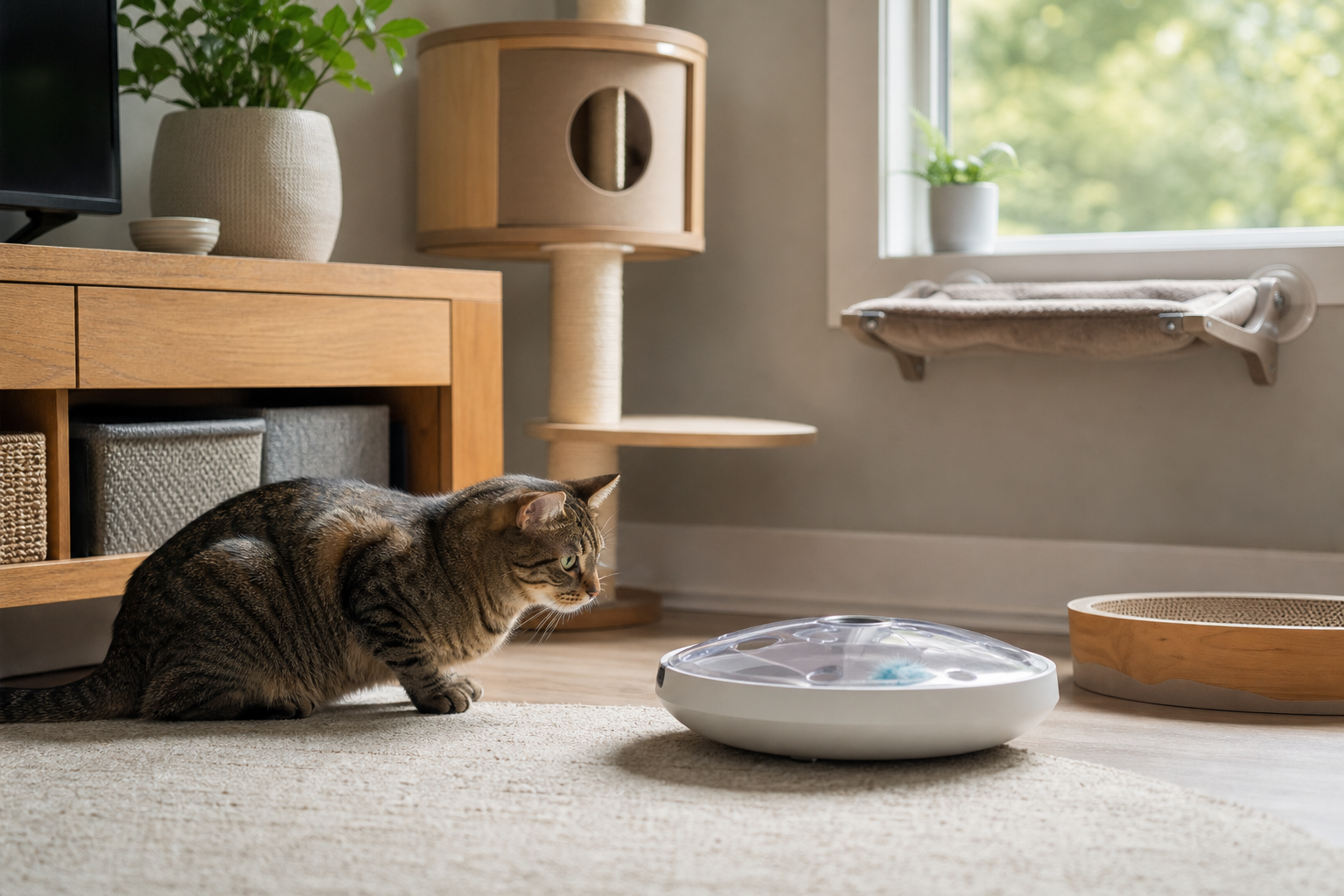
Automatic cat toys can help when you are away, but they should not be treated as a full-day babysitter. The safest choices are short-session, low-risk toys that add movement without exposing your cat to string, feathers, charging cords, loose plush, weak seams, or chewable battery compartments. For many cats, the best away setup is a mix of one carefully tested automatic toy, passive enrichment, food puzzles, scratchers, window viewing, and owner-led play before or after you leave.
If your cat destroys ordinary toys, be stricter. Do not leave out an electronic plush fish, spinning feather, elastic tail, wand attachment, or battery toy just because the package says interactive. Watch several supervised sessions first, inspect the toy after hard bites, and reserve anything with removable or chewable parts for when you are home. Automatic should mean less hands-on effort, not less judgment.
What Automatic Toys Can Do While You Are Away
Automatic toys are useful for adding unpredictable movement to an indoor cat’s day. A motion-activated ball, enclosed peekaboo toy, or timed electronic teaser may prompt stalking, pouncing, batting, and short bursts of exercise. That matters because cats need outlets for normal predatory behavior, not just a bowl of food and a place to nap.
The AAFP and ISFM feline environmental needs guidelines describe play, predatory behavior, owner interaction, and feeding devices as part of a healthy feline environment. The same guidelines recommend letting cats catch toys, using food puzzles, rotating toys to reduce boredom, and putting away string-like or ingestible toys after play. That is the standard automatic toys need to fit.
In practice, automatic toys are best for short bursts. Most cats do not need a gadget running for eight hours. They need novelty, a safe room, enough resources, and a routine that includes real capture and rest. A toy that activates occasionally can be helpful. A toy that runs constantly, gets trapped under furniture, or teaches your cat to chew electronics is not.
The Safer Away-From-Home Rule
Before leaving any automatic cat toy available, ask one question: if my cat attacks this hard while I am gone, what can come loose? If the answer is string, feathers, bells, plastic eyes, elastic, stuffing, a battery door, a charging cover, or a glued-on decoration, treat that toy as supervised-only.
For unattended time, look for fewer failure points:
- Enclosed movement: moving parts are inside a tunnel, track, or sturdy housing instead of dangling from a string.
- Secure power: battery doors screw shut, charging ports are covered, and no cord is available during play.
- Automatic shutoff: the toy stops after a short session instead of overheating, draining, or overstimulating your cat.
- Simple materials: no feathers, ribbons, small bells, thin elastic, exposed foam, or loose fabric edges.
- Easy inspection: you can see cracks, opened seams, bite marks, and missing pieces quickly.
Cornell Feline Health Center’s safe toys guidance warns against small pieces, strand-like parts such as feathers and string, electrical cords, and unsafe play areas where cats could fall or knock heavy objects over. Those points matter more when you are not there to interrupt the session.

Best Types of Automatic Cat Toys for When You Are Away
No category is automatically safe for every cat, but some designs are easier to justify for short unsupervised access after testing.
- Enclosed track toys: A ball inside a track or covered raceway gives batting movement without loose attachments. Check that the ball cannot pop out and that the track cannot pinch paws.
- Peekaboo toys with protected lures: Toys that hide movement under a cover can trigger stalking. Use only if the cover is tough and your cat does not chew through fabric to reach the mechanism.
- Sturdy rolling toys: Hard-shell rolling toys can work for chasers in open rooms. Avoid thin shells that crack, fuzzy covers that peel, or toys small enough to wedge under appliances.
- Timed feeders and food puzzles: These are not always sold as toys, but they are often safer away enrichment because they make your cat work for food without chasing electronics.
- Smart camera or treat devices: These can be useful if you actively monitor them, but treat launchers, cords, wheels, and moving attachments still need the same inspection standards.
Product roundups often focus on which gadget is most entertaining. For owners of rough players, the better ranking question is: which toy fails least dangerously? A toy your cat ignores is a waste. A toy your cat dismantles while you are at work is worse.
What Not to Leave Out When You Are Gone
Some toys can be excellent during supervised play and poor choices for unsupervised time. Put them away before you leave.
- Wand toys and automatic string toys: String, ribbon, elastic, and lure cords can be swallowed or wrapped around a cat.
- Feather spinners: Feathers, wire arms, and plastic connectors can break loose, especially with cats that grab and kick.
- Electronic plush toys for chewers: Soft covers can hide batteries, zippers, seams, charging modules, and stuffing.
- Laser-only toys: Lasers can trigger chase without capture. Save them for supervised sessions that end with a physical toy or treat.
- Cheap toys with glued parts: Bells, eyes, tails, thin plastic tabs, and decorative pieces are common failure points.
- Anything already damaged: A cracked shell, loose seam, exposed stuffing, missing screw, or weak battery door means the toy is done.
For more detail on powered toys in general, use Titan Claws’ broader guide to automatic cat toys. If the problem is chewing rather than boredom, start with toys for cats that chew and safe cat chew toys before adding electronics.
Build an Away Routine, Not a Gadget Pile
The best automatic cat toys for when you are away work as part of a routine. Cats are more likely to use toys safely when their day includes a predictable play rhythm, places to rest, and several low-risk enrichment options instead of one overstimulating machine.
Try this setup on a normal workday:
- Before you leave: five to ten minutes of wand play, ending with a catch, treat, or breakfast.
- While you are away: one tested automatic toy in a clear area, plus a scratcher, window perch, puzzle feeder, and a few sturdy solo toys.
- When you return: inspect the automatic toy, pick up anything damaged, and offer a short capture game with a kicker or wand.
- At night: store high-risk toys and rotate one or two options for the next day.
This approach closes a gap in many automatic-toy articles: the question is not only which product moves. It is what happens before the motion starts, what your cat can safely do after catching it, and whether the toy is still intact when you get home.

How to Test a Toy Before Leaving It Out
Do not make the first unsupervised trial the long workday. Test the toy in stages.
- Session 1: Place the toy off. Let your cat smell it, paw it, and walk away.
- Session 2: Turn it on while you sit nearby. Watch for fear, obsessive biting, paw trapping, chewing, or attempts to open covers.
- Session 3: Run the toy in the exact room where it might be left. Check whether it jams under furniture, hits stairs, blocks food or litter access, or startles your cat near resting spots.
- Session 4: Leave the room for ten minutes, then inspect the toy. Look for bite marks, loosened parts, heat, broken plastic, frayed fabric, and missing pieces.
- Short errand test: Only after it passes supervised checks, try it while you are gone briefly. Inspect again when you return.
If your cat carries the toy by a weak attachment, chews the battery area, flips it aggressively, or fixates on a seam, move that toy to supervised-only status. The toy may still be fun. It is just not an away toy for that cat.
Better Alternatives for Rough Players
Some cats should not be left with powered toys at all. That does not mean they need an empty room. It means the enrichment should shift toward passive, inspectable, and durable options.
- A sturdy scratcher placed where your cat already stretches or patrols.
- A window perch with safe access and no blind cords nearby.
- A beginner puzzle feeder or scatter-feeding game using part of a measured meal.
- Cardboard boxes or paper bags with handles removed, checked for staples and tape.
- Large, simple solo toys that are too big to swallow and easy to inspect.
- A durable kicker reserved for supervised capture play before or after you leave.
For broader ideas, see Titan Claws’ cat enrichment activities guide and best cat toys for bored indoor cats. If your cat attacks ordinary plush toys, the guide to unbreakable cat toys for aggressive chewers explains why durable still needs inspection and supervision.
Multi-Cat Homes Need Extra Planning
Automatic toys can create competition in multi-cat homes. One cat may guard the toy, another may get chased away, and a nervous cat may avoid the room entirely. The AAFP and ISFM guidelines advise separating key resources and using separate play locations for cats when needed. Apply that same thinking to toys.
If you have more than one cat, test the toy with each cat individually first. Then watch the group. Place resources in more than one area, keep escape routes open, and avoid a toy that corners cats near food, water, litter boxes, or favorite resting spaces. If an automatic toy creates tension, save it for supervised sessions with one cat at a time.
Quick Checklist Before You Leave
- The toy has passed multiple supervised sessions with this cat.
- No string, feather, ribbon, elastic, bell, small plastic part, or exposed stuffing is available.
- The battery door, charging port, screws, shell, and seams are intact.
- The toy has a shutoff or limited activation pattern.
- The play area is away from stairs, cords, fragile objects, water bowls, and unstable furniture.
- Your cat can leave the toy and reach food, water, litter, and resting spots without being chased or blocked.
- You have safer passive enrichment available, not only one powered gadget.
- You will inspect the toy when you get home and retire it at the first real damage.
The Bottom Line
Automatic cat toys for when you are away are best used as limited enrichment tools, not replacements for human play or safety checks. Choose enclosed, sturdy, inspectable designs. Avoid loose parts and chewable electronics. Test every toy while you are home before trusting it during an errand or workday.
For gentle cats, a tested motion toy can add welcome movement to the day. For cats that destroy toys, the safer plan may be passive enrichment while you are gone and tougher supervised play when you return. Either way, the goal is not to keep the toy running all day. The goal is to help your cat hunt, solve, scratch, rest, and stay safe until you are back.
Leave a Reply