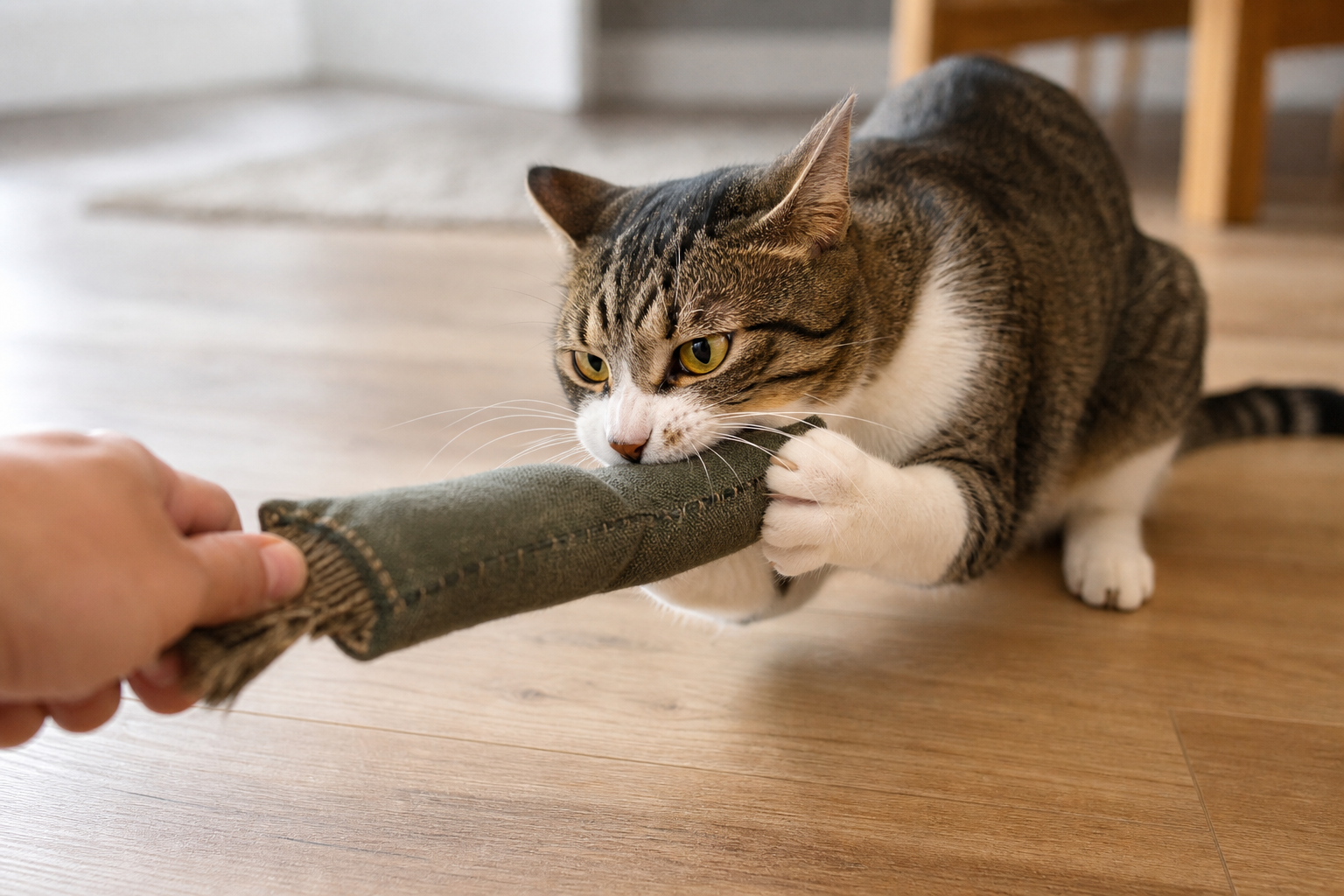
Safe cat chew toys are toys a cat can bite, gnaw, and wrestle during supervised play without quickly shedding strings, splinters, hard shards, stuffing, batteries, or tiny parts. That last phrase matters. A toy can be marketed for chewing and still be a poor match for a cat that actually tries to eat what they bite off.
For most cats, the safest setup is not one magic chew toy. It is a small rotation: a tough fabric or rubber chew toy for mouth contact, a larger cat kicker toy for bunny-kicking and bite-and-hold play, a wand toy that is put away after use, and a puzzle or food toy for foraging. If your cat destroys toys, the goal is to redirect chewing into safer outlets while keeping the highest-risk items out of reach.
This guide is written for owners of cats that chew hard, shred seams, attack cords, or turn ordinary plush toys into loose threads. It is not veterinary diagnosis. If chewing is new, intense, compulsive, or includes swallowing fabric, plastic, string, or litter, involve your veterinarian.
What Makes a Cat Chew Toy Safer?
A safer chew toy has three jobs: it must fit your cat’s mouth, survive normal biting long enough to inspect, and fail visibly instead of breaking into hidden hazards. No cat toy is truly chew-proof for every cat. Strong jaws, focused gnawing, and repeated clawing will eventually damage most materials.
Look for these design signals before you buy:
- One-piece or simple construction: fewer glued-on decorations, plastic eyes, bells, ribbons, feathers, and loose tails.
- Cat-appropriate size: large enough that it will not disappear into the mouth, but not so large or stiff that it wedges behind the canine teeth.
- Soft but resilient bite surface: sturdy fabric, flexible rubber, food-grade silicone, or tightly covered stuffing is usually safer than brittle plastic.
- Reinforced seams: double stitching, hidden seams, or a cover that does not open when you tug lightly at the edges.
- No linear parts for unsupervised access: strings, yarn, elastic, cords, long fringe, and ribbon belong in supervised play only.
- Clear cleaning instructions: if your cat puts it in their mouth repeatedly, you need a realistic way to wash or wipe it.
Cornell’s Feline Health Center notes that toys support exercise and cognitive enrichment, but warns owners to avoid toys with small pieces or string-like parts that can detach and be ingested, especially when chewed. That is the practical dividing line for chew toys: choose items that encourage natural biting without giving your cat easy pieces to swallow. Cornell’s cat toy safety guidance is worth reading if your cat is rough on toys.
Best Types of Safe Cat Chew Toys
Different cats chew for different reasons. Some want a satisfying bite after a chase. Some are teething kittens. Some are bored indoor hunters. Some are stress chewers. Match the toy to the behavior you are seeing, not just the product label.
Durable fabric chew toys
For many adult cats, tough fabric toys are the most useful starting point. A dense canvas, ballistic nylon-style shell, or tightly woven outer cover gives the cat something to grip without the tooth risk of a very hard chew. Choose toys with minimal decoration and no loose appendages. If your cat likes to clamp and rake with the back feet, a longer kicker is usually better than a tiny plush mouse.
Fabric is not automatically safe. Retire it when seams gap, stuffing appears, threads pull loose, or the toy starts to flatten in one area from repeated chewing.
Flexible rubber or silicone chew toys
Flexible rubber and food-grade silicone can work well for cats that like a springy mouthfeel. The toy should flex under pressure instead of feeling rock-hard. Avoid thin fins, spikes, or raised details that your cat can shave off with focused chewing. If the surface develops gouges, cracks, sticky spots, or missing chunks, remove it.
Do not assume dog chew toys are safe for cats. A small dog toy may still be too hard, too heavy, or shaped wrong for a cat’s mouth. If you test one, choose a soft, simple shape, supervise closely, and stop if your cat tries to remove pieces.
Dental-style cat chew toys
Some dental toys use mesh, nubs, or catnip scent to encourage chewing. They can be fine for cats that mouth toys without eating them. They are not a substitute for veterinary dental care, and they should not be treated as leave-out-all-day toys for determined biters. Watch the edges and the mesh. Once the toy starts to unravel, it has done its job and should go.
Silvervine and catnip-scented toys
Silvervine and catnip can make a safer chew toy more interesting, especially for cats that ignore plain rubber. Use the scent as an attractant, not as an excuse to hand over brittle sticks or bark pieces to a cat that splinters things. For heavy chewers, silvervine powder sprinkled on a durable fabric or rubber toy is usually a more controlled choice than loose sticks.
Chew Toys to Avoid for Cats That Swallow Pieces
The riskiest toy is not always the sharpest or toughest one. It is often the toy that slowly turns into swallowable material while nobody is watching. Cats can ingest thread, wool, paper, rubber bands, plant material, and small toys. VCA Animal Hospitals describes foreign body obstruction as a potentially life-threatening condition, with string-like objects being especially dangerous because they can anchor and pull through the digestive tract. See VCA’s overview of foreign body ingestion in cats for warning signs such as vomiting, appetite loss, lethargy, abdominal pain, and straining.
Be cautious with:
- String, yarn, ribbon, floss, elastic, and fringe: use only during active play, then put away.
- Feathers and faux-fur tails: many cats love them, but hard chewers can pull them free.
- Plastic eyes, bells, beads, and glued-on faces: cute details often become the first loose parts.
- Hard plastic chews: repeated biting can create sharp edges or tooth risk.
- Natural sticks with bark: some cats peel off bark or splinter the stick.
- Battery toys with weak compartments: use only if the battery door is secure and screwed shut.
- Household substitutes such as cotton swabs, hair ties, twist ties, and cord protectors: these are not chew toys.
If your cat has a history of swallowing what they chew, every chew toy should be supervised. If you need safer independent play, choose larger track toys, puzzle feeders, or sturdy balls without chewable parts, then inspect them often.
What to Give Cats That Chew on Wires
Wire chewing is a safety problem first and a toy problem second. A chew toy can help redirect the behavior, but it should not be the only control. Restrict access to cords, route cables behind furniture, use cord covers where needed, and unplug or remove tempting cords in rooms where your cat is unsupervised.
PetMD’s veterinary-reviewed guidance on cats chewing electrical cords points to several possible drivers, including boredom, stress, pica, dental disease, gum pain, and the natural stimulation cats get from chewing. That means the practical plan is layered:
- Block access to electrical cords and holiday light cords.
- Offer a safer chew toy before the cat reaches the cord.
- Add daily interactive play so the cat gets a chase, catch, bite, and settle routine.
- Use food puzzles or scatter feeding for foraging energy.
- Ask your veterinarian about dental pain, pica, anxiety, or nutritional issues if chewing is persistent or new.
For cats that bite cords after high-energy play, end wand sessions by letting them catch and bite a safe target. A sturdy kicker or chew toy can act as the final capture. For more on redirecting mouthy play, see Titan Claws’ guide to cat bite toys.
The Inspection Rule: Before, During, and After Play
Safe cat chew toys are maintained, not just purchased. A toy that was safe last week can become risky after one rough session. Build inspection into the routine.
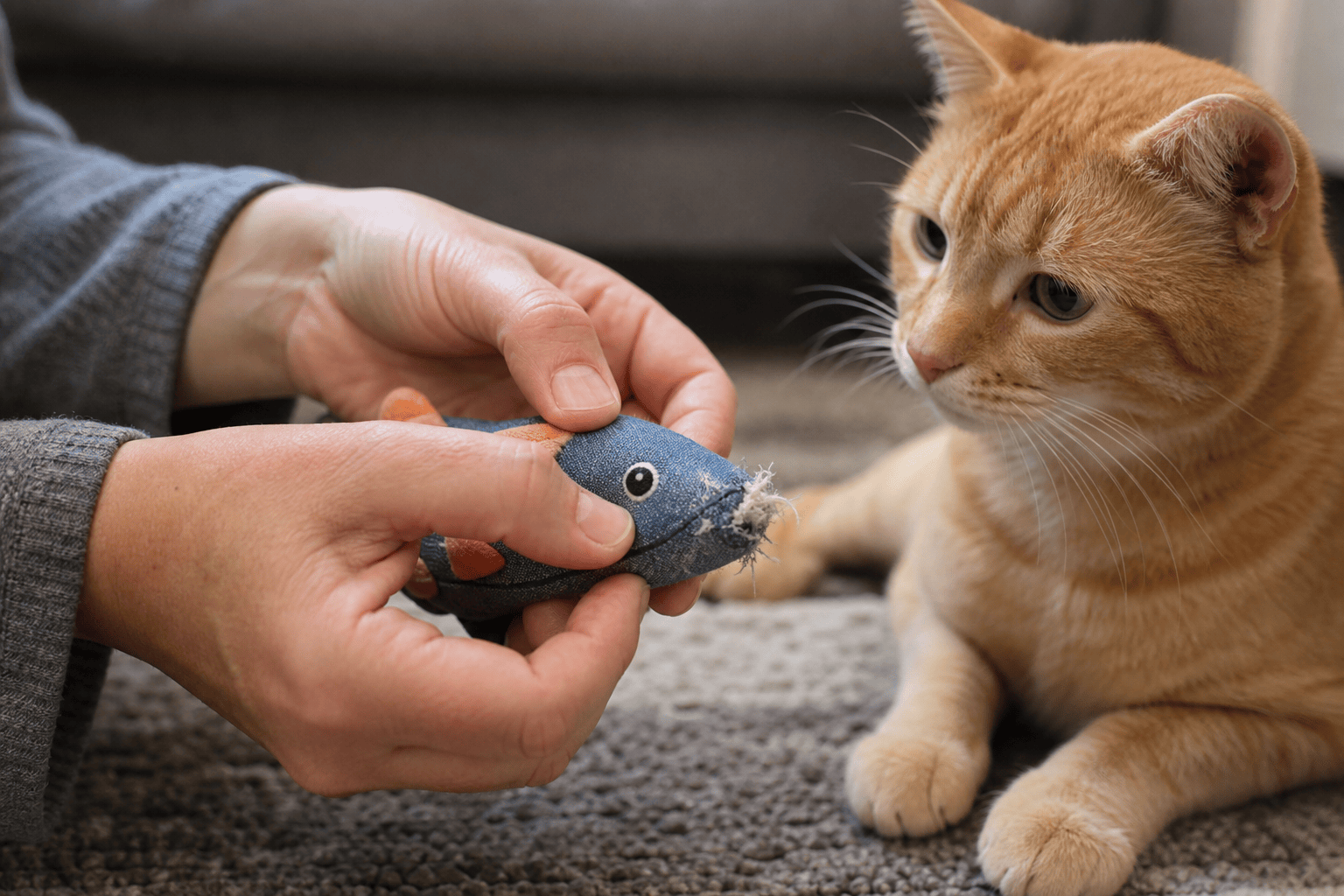
- Before play: check seams, edges, attachments, and any place your cat usually bites.
- During play: watch whether your cat is chewing, shredding, or actually swallowing pieces.
- After play: remove loose threads, count missing parts, and put string or wand toys away.
- Weekly: wash washable toys, rotate stale toys out, and retire anything with holes, sharp edges, exposed stuffing, or sour odor.
Preventive Vet gives a strict but sensible rule: chew toys should be supervised, and toys should be discarded when they unravel or pieces come loose that a cat could swallow. That is especially important for cats that gnaw seams, lick frayed fabric, or carry pieces away.
How Chew Toys Fit Into Enrichment
Chewing is only one part of feline play. Cats also need to stalk, chase, pounce, grab, bite, rake, forage, climb, scratch, and rest. The AAFP and ISFM environmental needs guidelines recommend giving cats opportunities for play and predatory behavior, including toys they can manipulate with paws or mouth, food puzzles, rotating toys, and avoiding hands and feet as play targets. The full guideline is available through the National Library of Medicine.
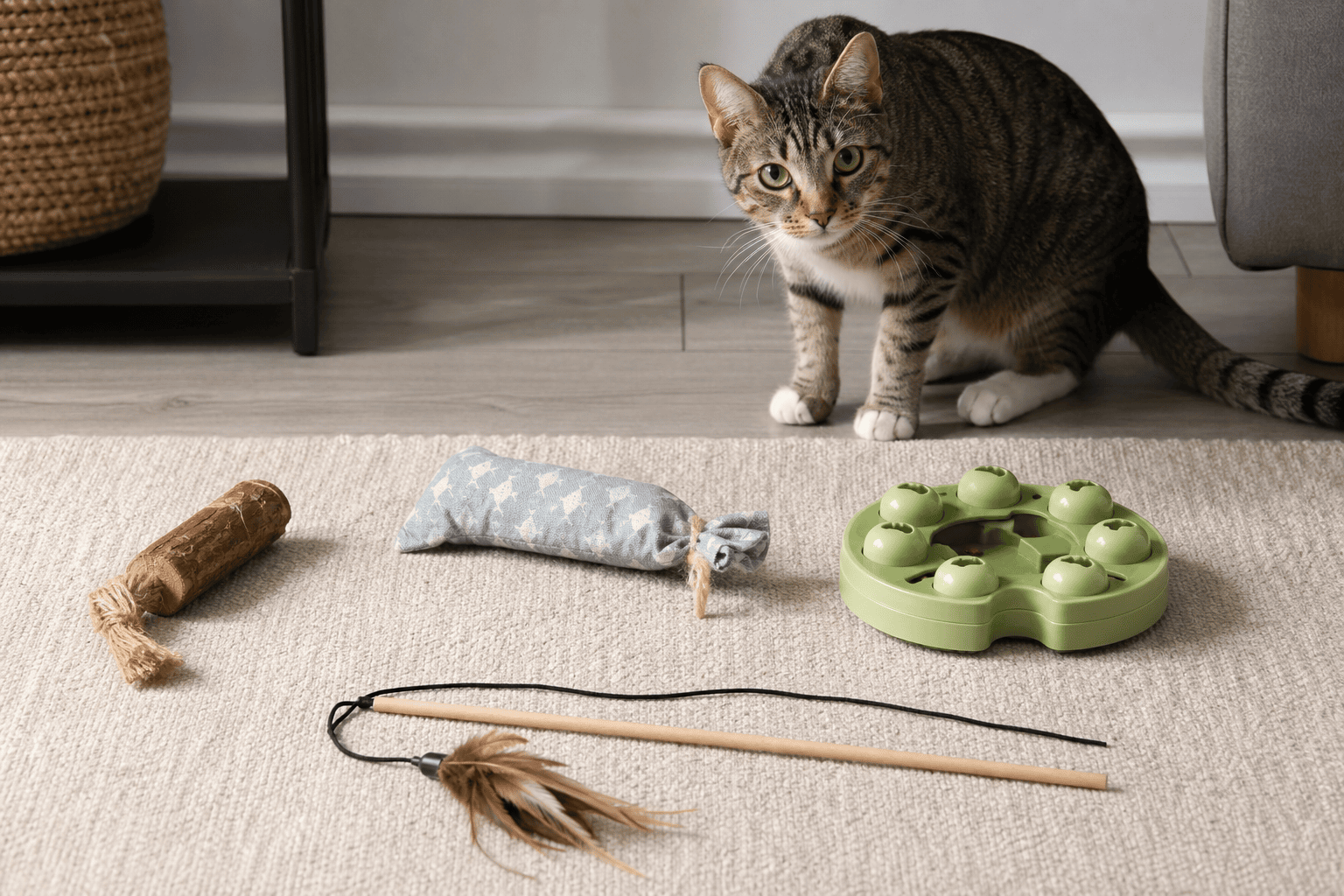
A chew-focused rotation for a rough player might look like this:
- Morning: five to ten minutes with a wand toy, ending with a catch on a kicker or chew toy.
- Midday: puzzle feeder, treat hunt, or sturdy self-play toy without strings.
- Evening: active chase play, then a fabric chew or kicker for the bite-and-hold finish.
- Overnight: only leave out toys that have no cords, strings, loose parts, or damaged seams.
If your cat destroys ordinary toys, read Toys for Cats That Chew for a broader setup, and use Cat Toys That Last when you want a general buying checklist.
When Chewing Needs a Vet or Behavior Professional
Some chewing is normal. Sudden, obsessive, or ingestion-focused chewing is different. VCA’s chewing and sucking guidance recommends ruling out medical causes such as gastrointestinal disorders before treating excessive chewing as only a behavior issue. It also recommends professional help when a cat persistently chews, sucks, or ingests material.
Call your veterinarian if you notice any of these:
- Chewing starts suddenly in an adult cat.
- Your cat swallows fabric, plastic, rubber, string, litter, plants, or cords.
- There is vomiting, appetite loss, weight loss, diarrhea, constipation, lethargy, drooling, or pawing at the mouth.
- Your cat chews one material obsessively and cannot be redirected.
- Your cat has bad breath, bleeding gums, broken teeth, or obvious mouth pain.
- Chewing increases after a household change, conflict with another pet, or long periods alone.
A safer toy can help, but it cannot fix dental pain, pica, anxiety, or a foreign body risk by itself.
Quick Checklist for Safe Cat Chew Toys
- Choose simple shapes with no detachable decorations.
- Match the toy to your cat’s mouth size and chewing style.
- Use flexible, resilient materials instead of brittle hard plastic.
- Reserve strings, feathers, ribbons, and wand lures for supervised play.
- Inspect before and after rough sessions.
- Retire toys with holes, loose seams, missing chunks, exposed stuffing, or sharp edges.
- Redirect wire chewing by blocking cords and adding enrichment, not by relying on one chew toy.
- Ask a veterinarian when chewing is sudden, compulsive, or includes swallowing non-food items.
The short version: safe cat chew toys are supervised, simple, appropriately sized, and easy to inspect. Pick toys that satisfy the bite without creating swallowable pieces, rotate them with chasing and foraging activities, and retire damaged toys early. For rough players, that is the difference between durable enrichment and a toy-bin hazard.
Leave a Reply