Category: Cat Behavior

  • Why Do Cats Destroy Toys? What It Means and What to Do

    Why Do Cats Destroy Toys? What It Means and What to Do

    Why do cats destroy toys?

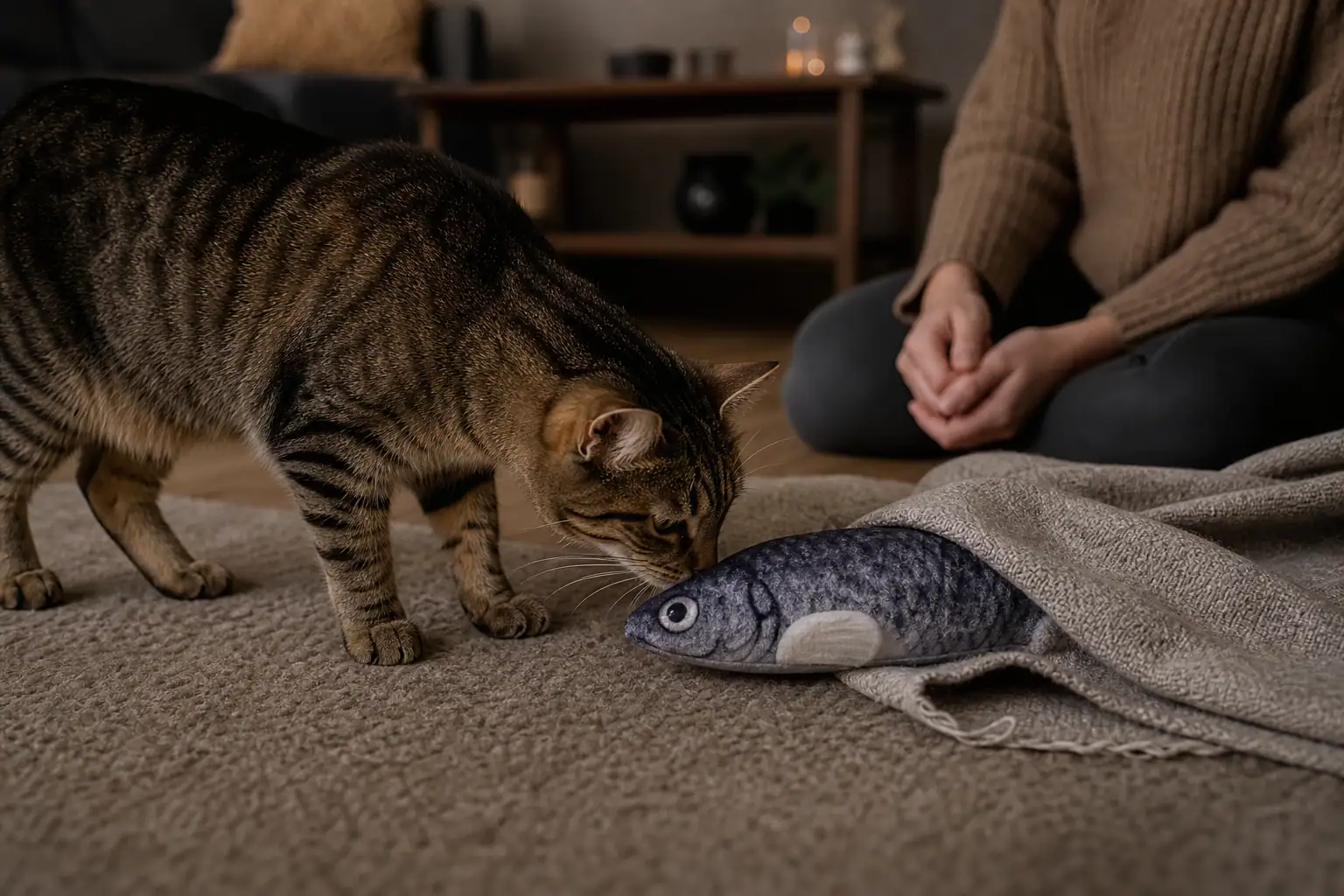
    Cats destroy toys because they are doing what cats are built to do: stalk, pounce, bite, claw, and “kill” prey-shaped objects through play. In most cases, shredding a toy is a sign that your cat is engaged, not misbehaving. The toy is often acting as a stand-in for prey, so ripping seams, pulling out stuffing, and carrying the toy around are all normal parts of hunting-style play.

    That said, toy destruction is not always harmless. A cat that tears toys apart can swallow pieces, chew through strings, or expose stuffing, squeakers, or plastic parts that create a choking or intestinal blockage risk. The key is to tell the difference between normal rough play and unsafe wear.

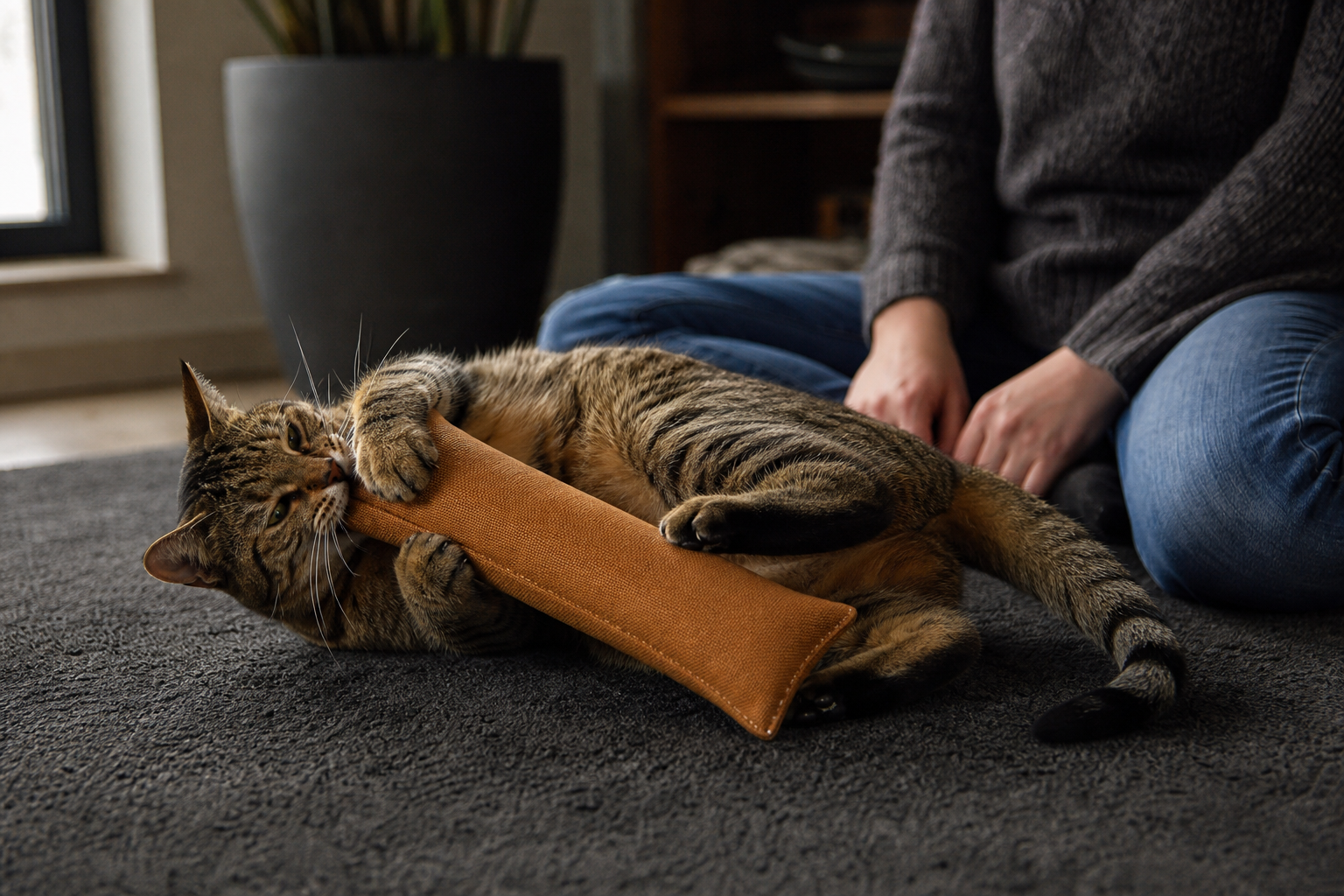
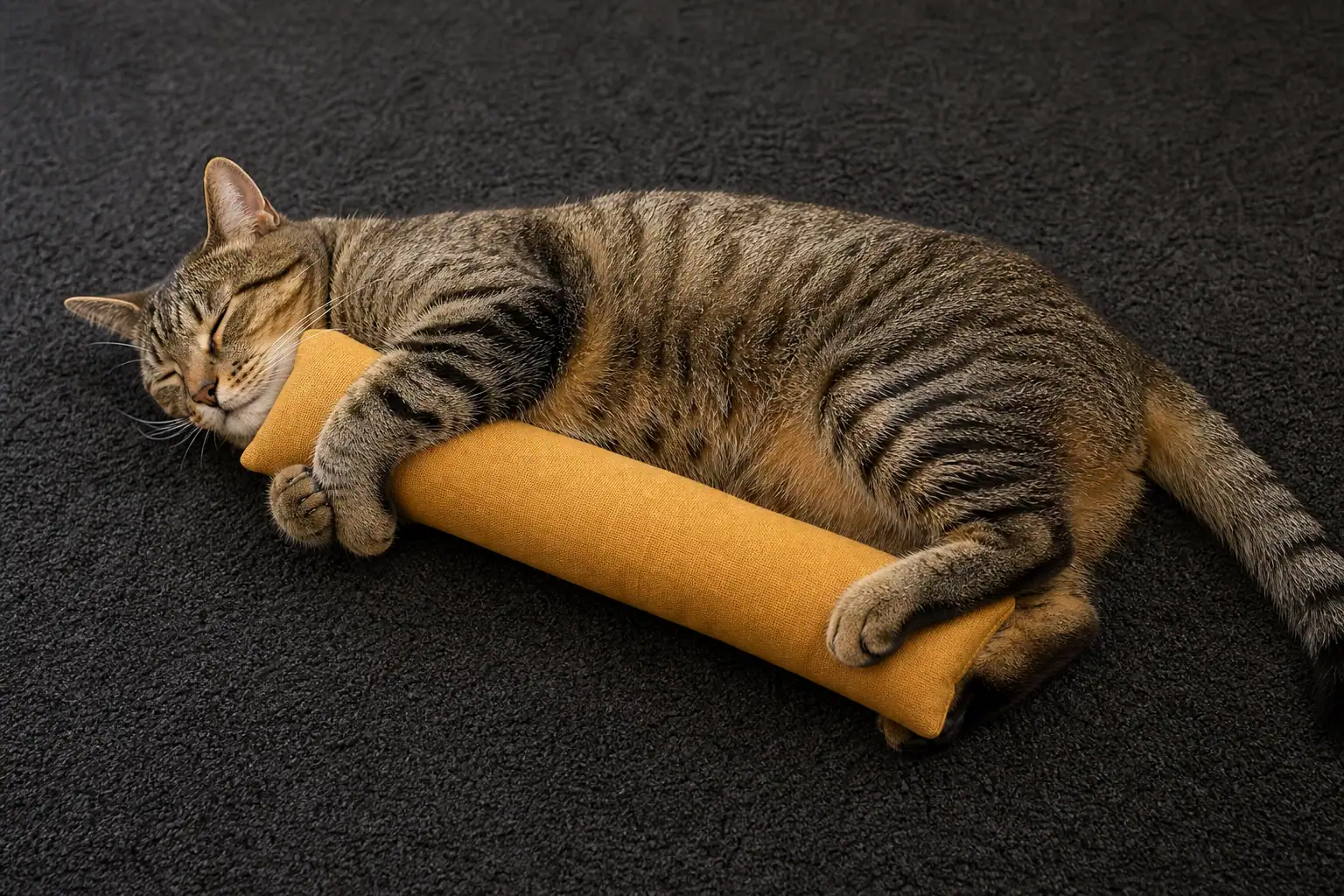
    Think of toy destruction as a clue about your cat’s preferences. Some cats like to bunny-kick plush kickers. Others prefer to shred fabric, chew rope, or disassemble feather toys. Your job is not to stop the instinct. Your job is to channel it into safer play and pick toys that can handle your cat’s style.

    Why toy destruction is usually normal hunting behavior

    When cats attack toys, they are often practicing a complete prey sequence. They may stalk, freeze, chase, grab, bite, and then kick with their back feet. If the toy has a soft body, seams, or stuffing, the cat may rip it open during the “capture” phase.

    Natural cat play often includes:

    • Grabbing with front paws to hold the toy in place
    • Chewing or biting to simulate a kill bite
    • Bunny-kicking with back legs to tear at the toy
    • Shaking small prey-like toys
    • Carrying toys after a successful “hunt”

    This is especially common in younger cats and highly active adult cats. Some breeds and personalities are more intense about play, but any cat can be a serious toy destroyer if the toy matches their prey preferences too well.

    A destroyed toy can mean the toy was a good fit for your cat’s instincts. The goal is not to remove the instinct. The goal is to offer toys that satisfy it without creating unnecessary hazards.

    Common reasons cats rip, chew, and disassemble toys

    Cats do not all destroy toys for the same reason. Often, several factors are working together.

    Prey drive

    The most common reason is simple prey drive. A toy that moves like prey, fits in the mouth, or has feathers, fur, strings, or loose fabric can trigger a strong hunting response. Once the cat “catches” it, the toy may get torn apart.

    Boredom or under-stimulation

    Cats with not enough play, climbing, or enrichment may put more energy into the toys they do have. If the same toy is always available, some cats will also become more intense with it over time. Regular interactive play can reduce destructive over-focus on one item.

    Texture preferences

    Some cats are fabric shredders. Others prefer rope, paper, cardboard, or plush stuffing. If your cat repeatedly targets a certain texture, that preference can help you choose better toys. For example, a cat that loves plush may do better with reinforced stitching and minimal stuffing than with a light toy that opens easily.

    Chewing behavior

    Chewing is not as common in cats as it is in dogs, but some cats do chew toys, cords, and soft materials. This can be a form of play, teething in kittens, or a sign of boredom. If chewing seems excessive or your cat is chewing non-toy items, ask your veterinarian for advice to rule out dental pain or other health issues.

    Frustration during play

    Some cats become rougher if the toy does not “move right,” disappears too quickly, or is too small to hold securely. When play feels unsatisfying, they may bite harder or tear faster. Matching the toy to the cat’s preferred motion and size can make a big difference.

    When destruction becomes a safety problem

    Not all toy damage is equal. A torn toy is not automatically an emergency, but certain signs mean it is time to remove the toy immediately.

    • Loose strings, ribbons, or elastic that can be swallowed
    • Open seams with stuffing coming out
    • Detached parts such as eyes, bells, feathers, or squeakers
    • Small pieces that break off and fit in the mouth
    • Hard plastic edges after breakage
    • Any toy your cat is trying to eat rather than play with

    String-like items are especially risky because they can cause serious digestive problems if swallowed. If your cat has eaten part of a toy, is drooling, vomiting, hiding, not eating, or straining in the litter box, contact a veterinarian promptly.

    It is also wise to separate normal play from over-aggressive chewing. If toy destruction seems sudden, extreme, or paired with behavior changes, pain, stress, or appetite changes, get a veterinary check. Sudden changes in behavior can have medical causes.

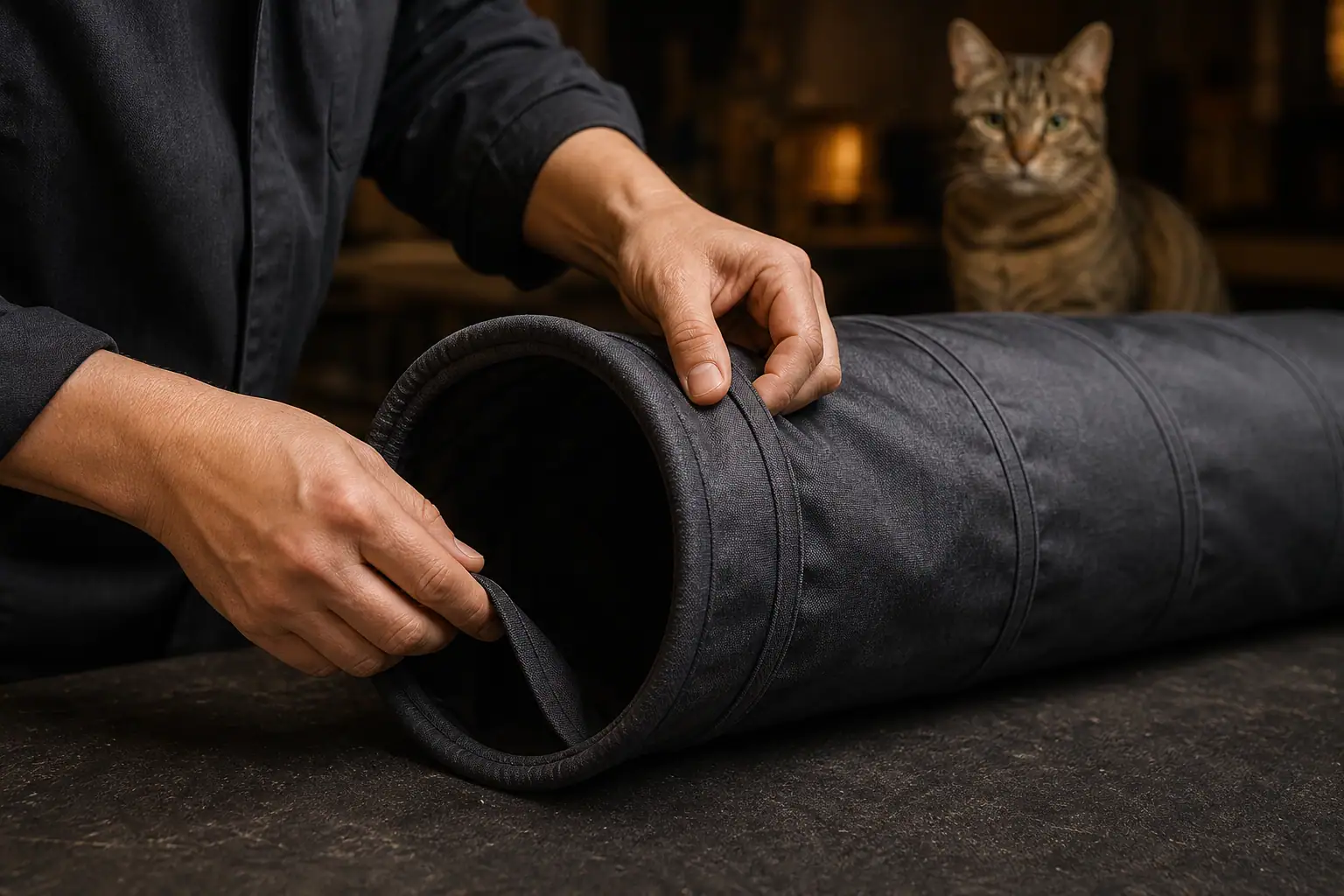
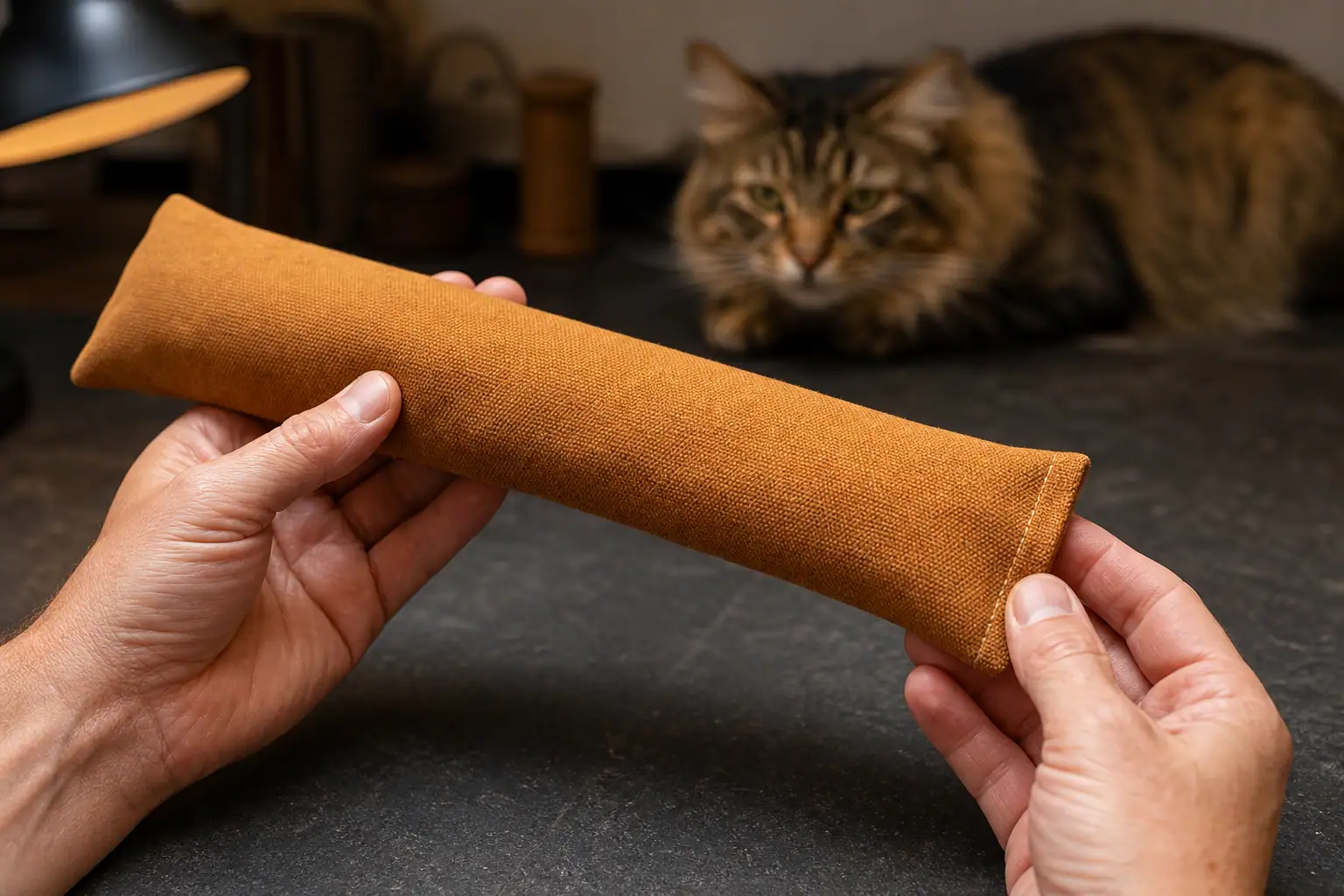
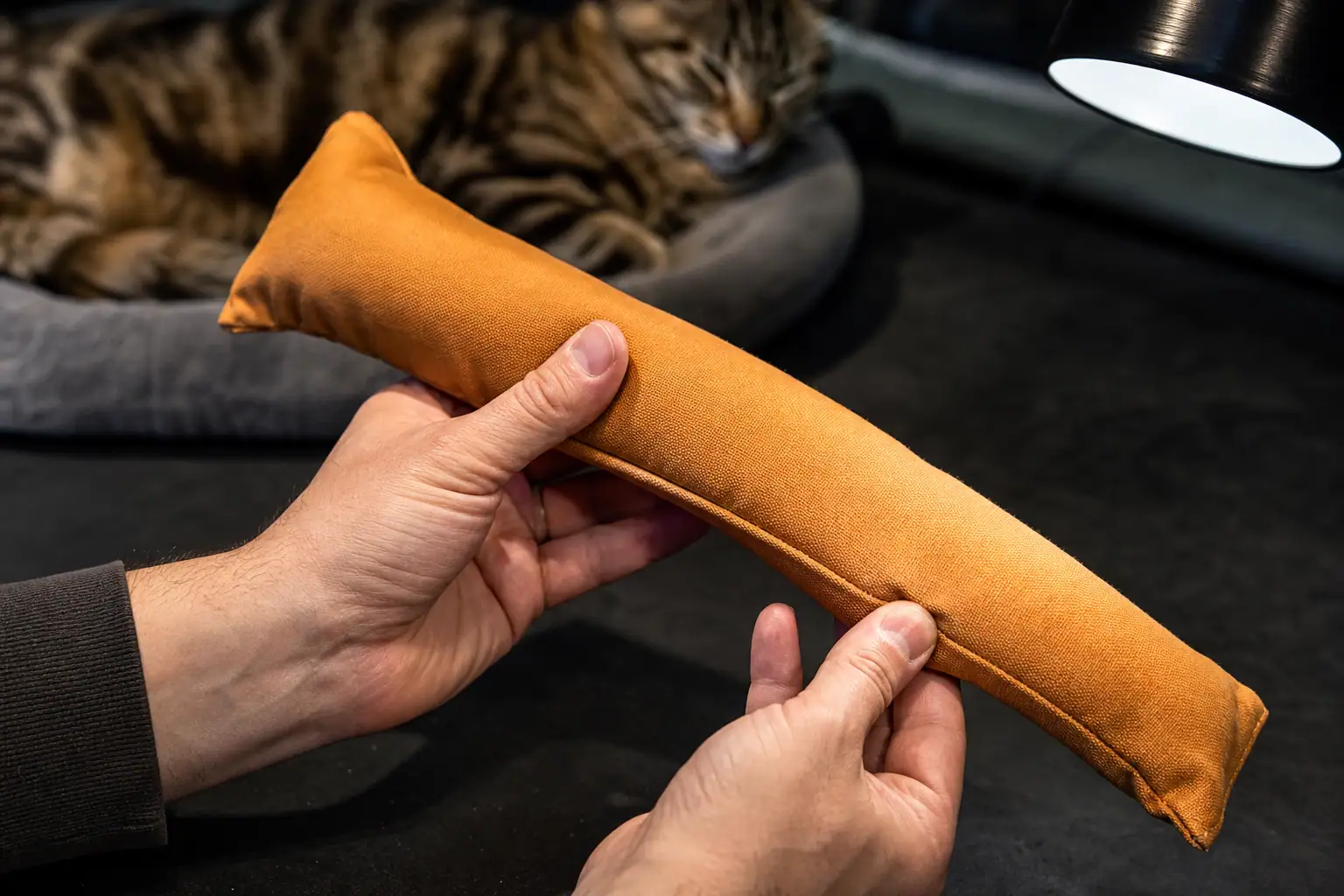
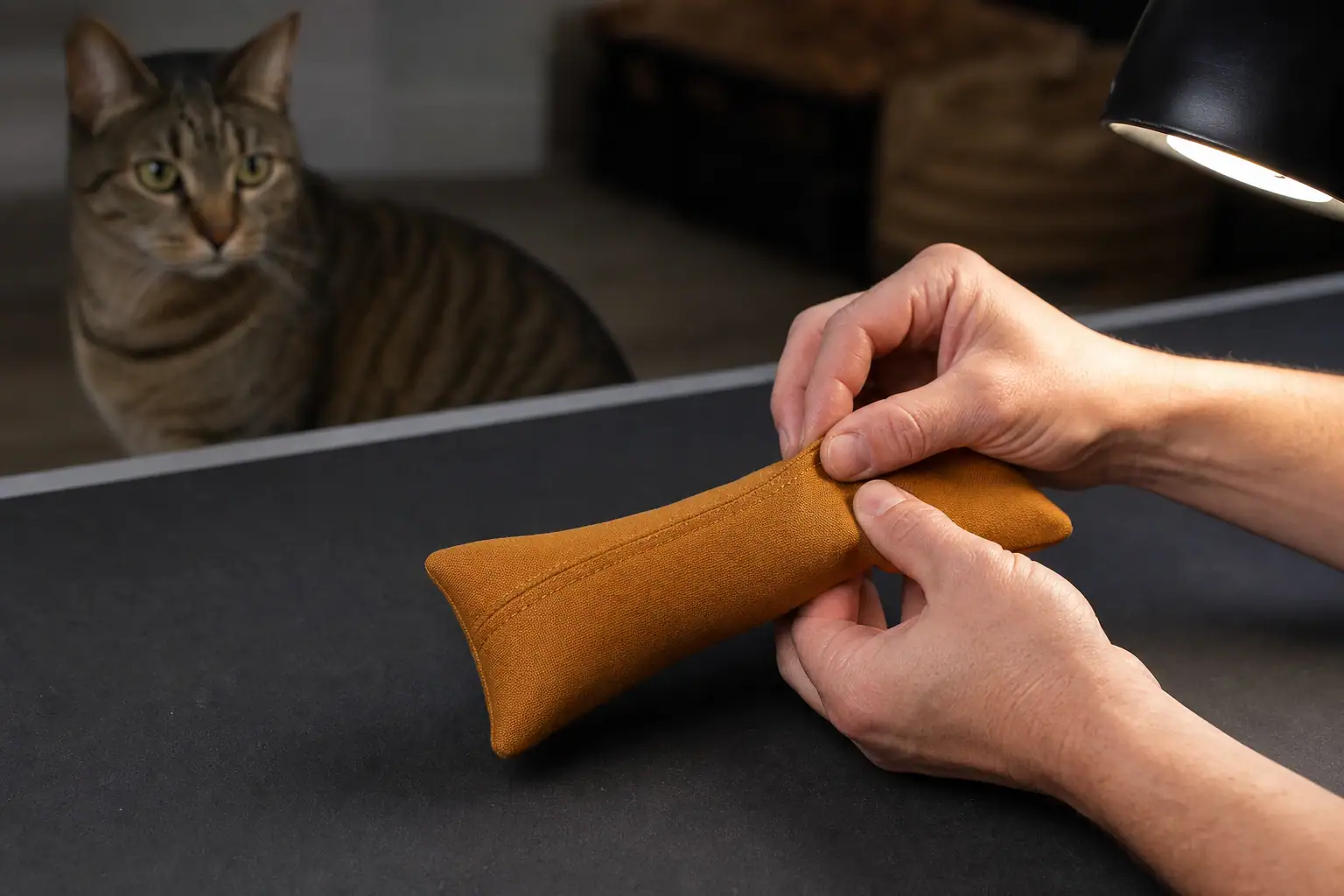
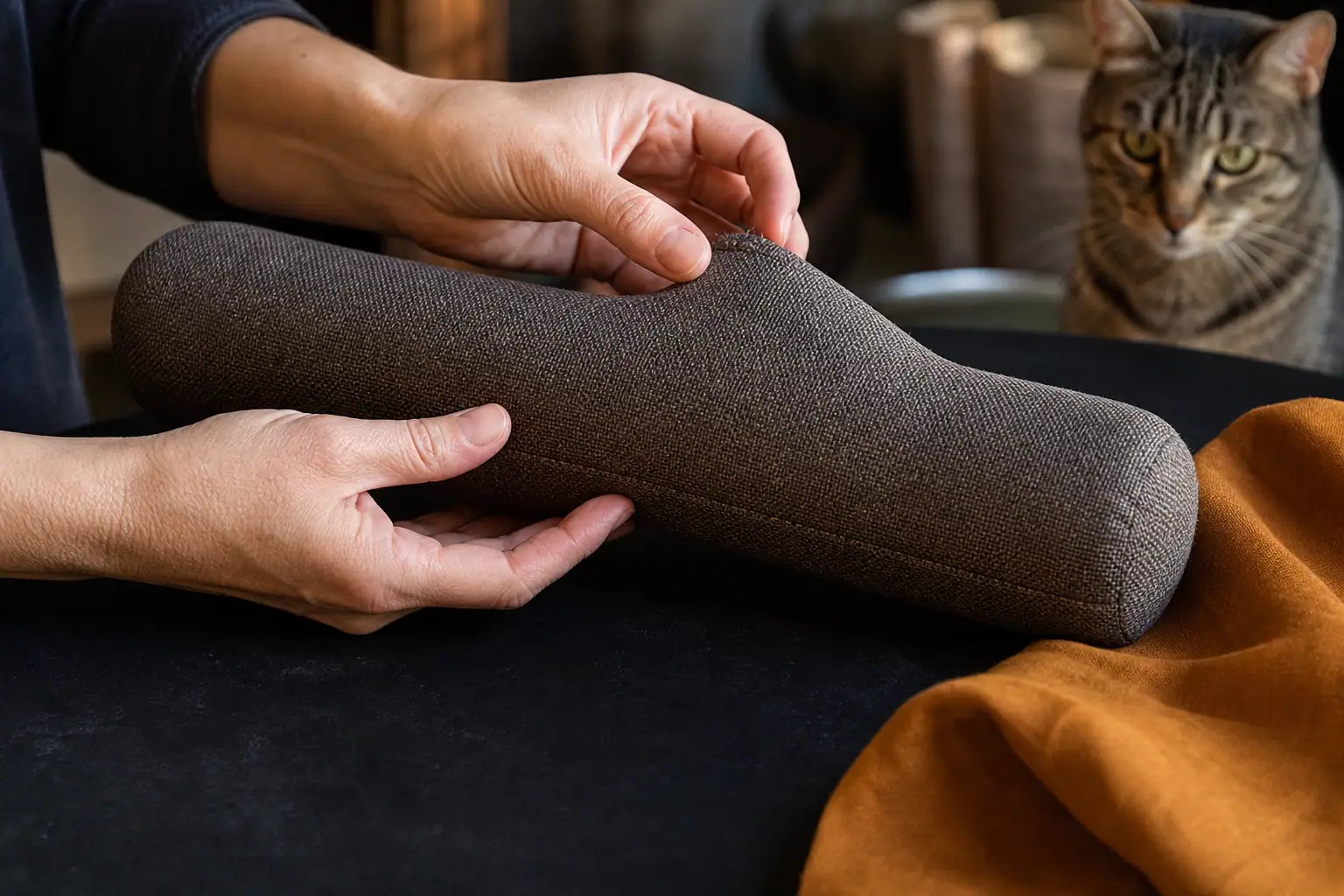
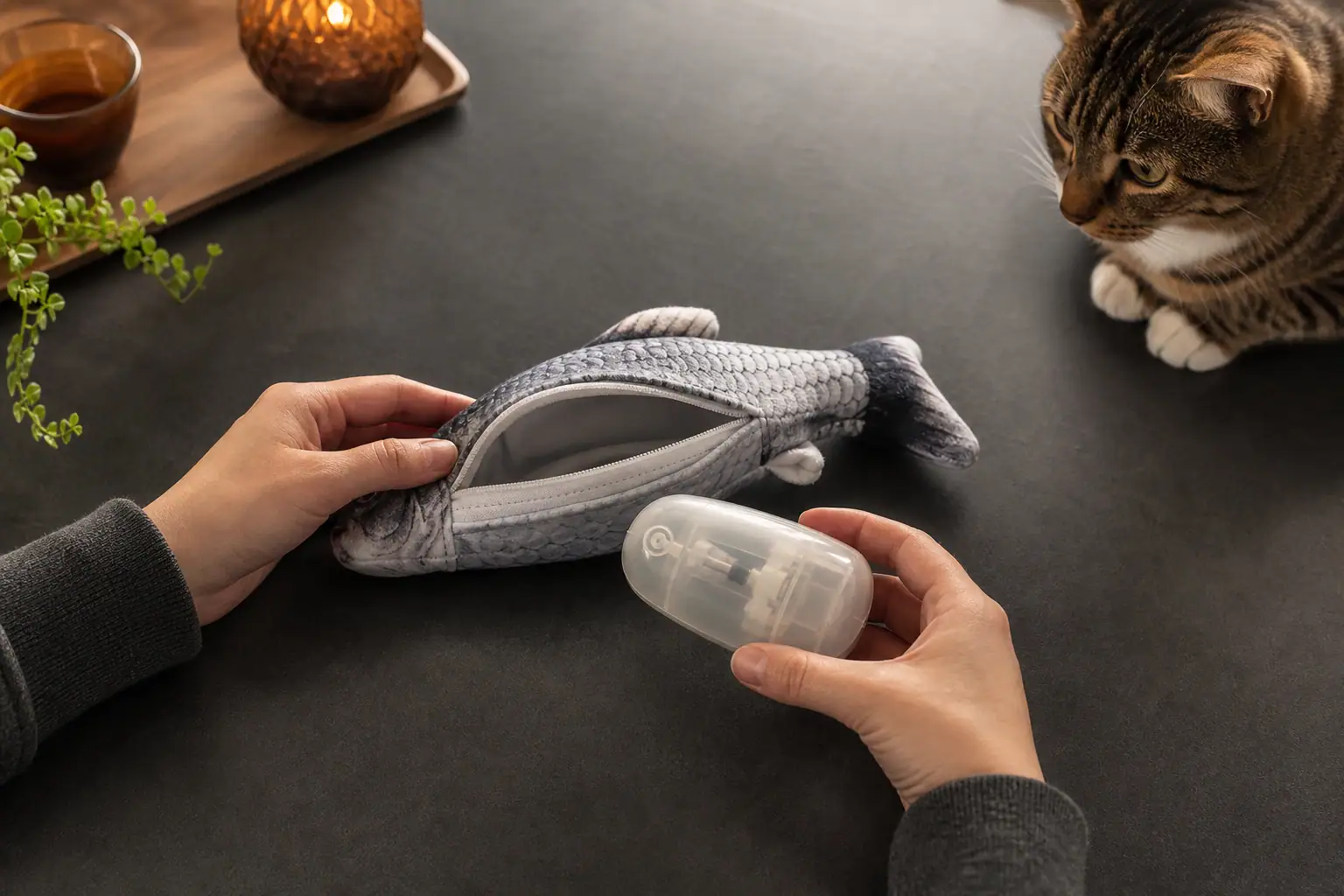
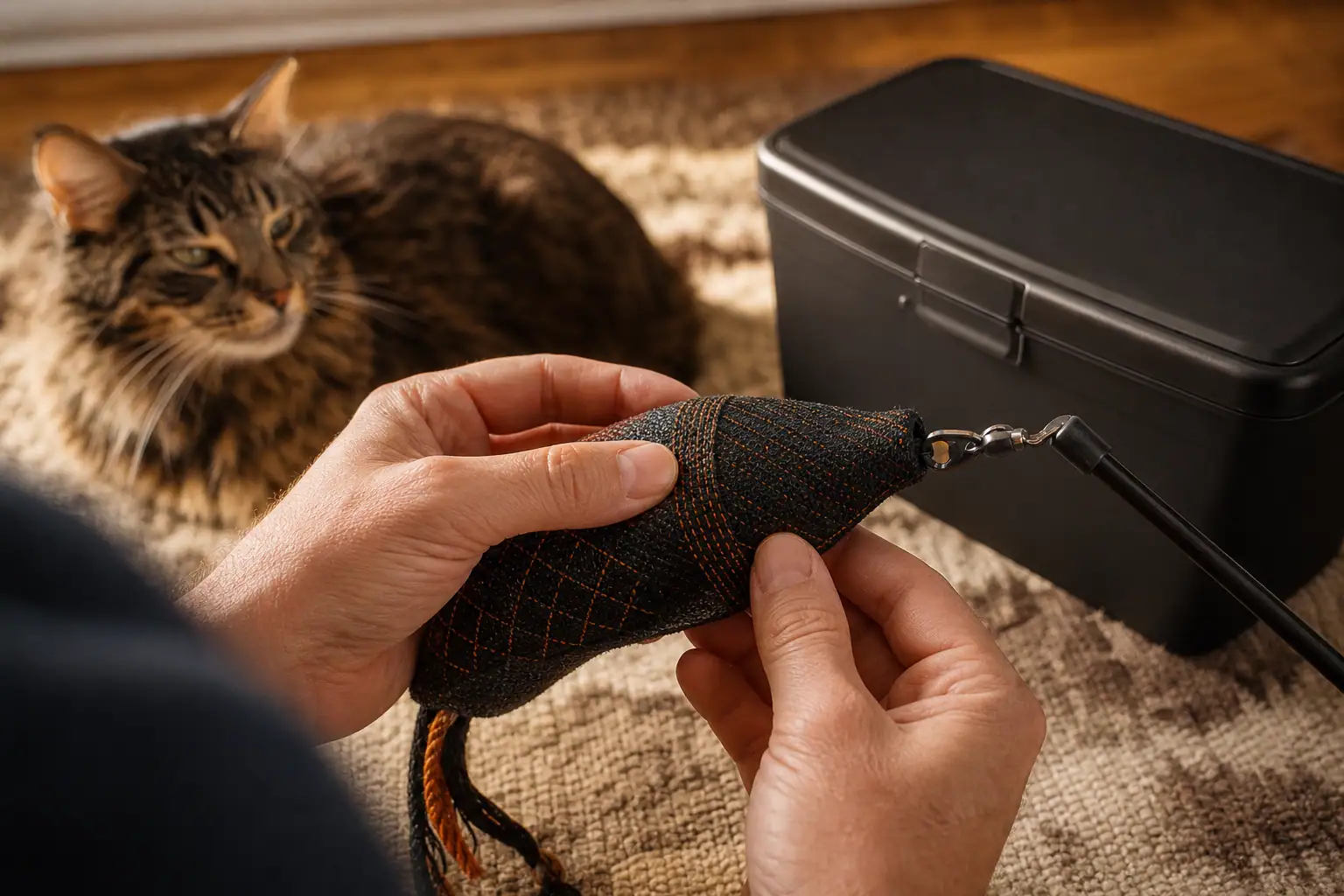
    Safely checking toys after play helps you catch wear before it becomes a problem.

    Close view of a cat toy being inspected for loose seams

    How to choose toys for rough players

    If your cat destroys toys quickly, the answer is usually not “buy more of the same.” It is “buy better-matched toys.” Look for construction that fits rough play while still being safe.

    What to look for in tougher cat toys

    • Reinforced seams and tight stitching
    • Durable outer fabric that resists easy ripping
    • Minimal loose trim such as strings, tassels, or glued-on pieces
    • Oversized parts that are harder to swallow
    • Simple construction with fewer breakable attachments
    • Materials that stand up to pouncing and kicking

    For many rough players, the best toys are not the fanciest ones. They are the simplest ones made with better materials and stronger stitching. A well-made kicker toy, for example, can satisfy a cat that wants to grab, bite, and kick without immediately falling apart.

    What to avoid for power chewers and shredders

    • Fragile feathers attached with weak glue
    • Long ribbons or strings left unsupervised
    • Very small plush toys that can be swallowed
    • Toys with detachable eyes or buttons
    • Thin mesh or foil toys that tear easily

    No toy is indestructible, and no cat toy is safe forever. The best approach is choosing durable options, supervising the first few play sessions, and replacing worn items before they become risky.

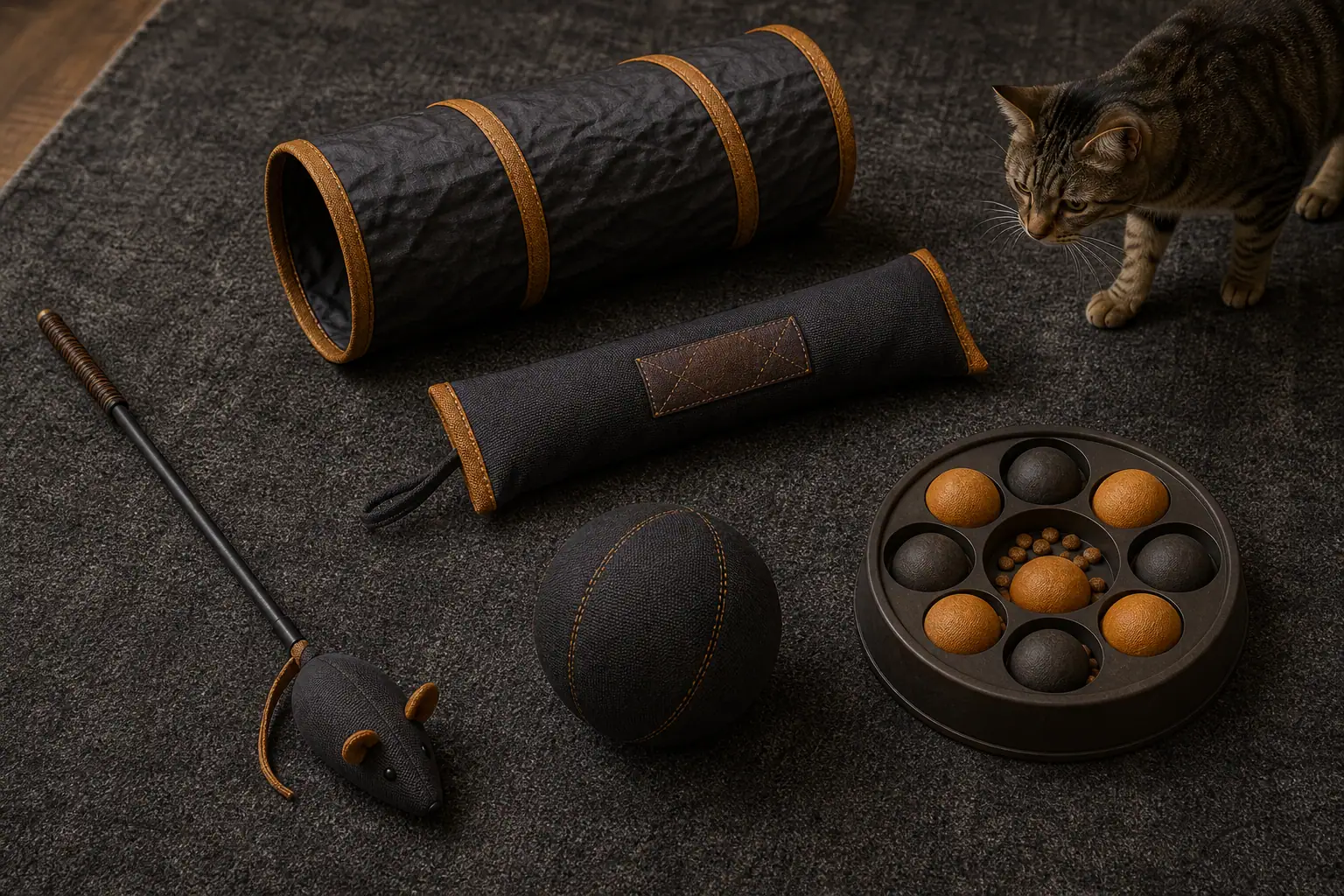
    For cats that love rough play, rotating in a few sturdy options can keep interest high without overusing one toy.

    Several different cat toys arranged for toy rotation

    How to rotate toys and redirect the behavior

    Toy rotation is one of the easiest ways to reduce destruction and boredom. When all toys are available all the time, they can lose novelty. When toys are rotated, each one feels more interesting and play tends to be more focused.

    Simple rotation plan

    • Keep a small set of toys out at once
    • Store the rest out of sight
    • Swap toys every few days or once a week
    • Include different play styles, such as chase, kicker, and puzzle toys

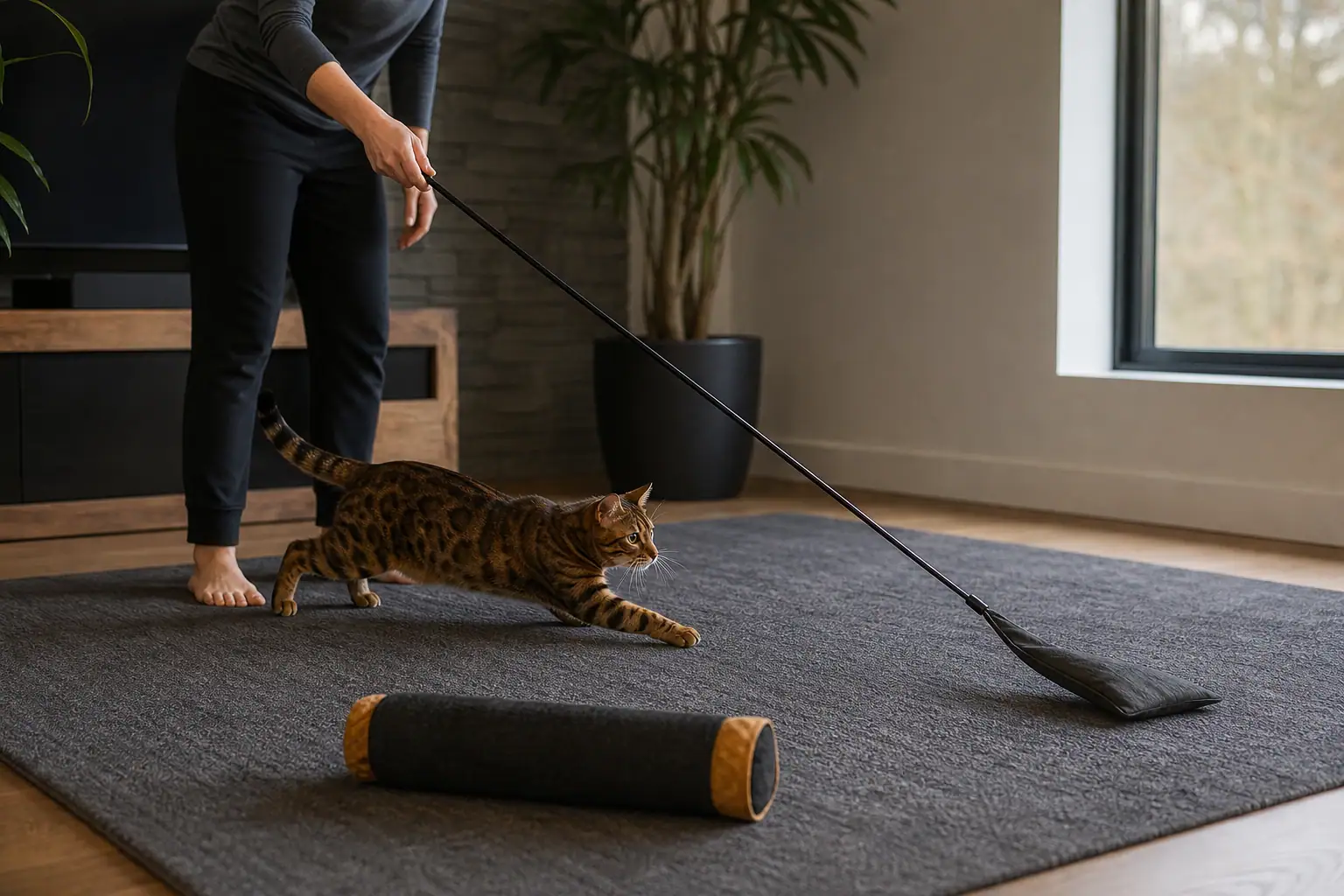
    Rotation works best when you also use interactive play. Wand toys, for example, let you control the motion so your cat can stalk and chase without immediately shredding the toy itself. End the session with a toy your cat can safely “catch” so the hunting sequence feels complete.

    Redirecting destructive play

    If your cat starts targeting a toy too aggressively, try ending the session before the toy is ruined. Then offer a more suitable option, such as a sturdier kicker or a wand attachment used only under supervision. You can also redirect to puzzle feeding, climbing, or short training sessions if your cat seems restless.

    The goal is not to punish destruction. Punishment can increase stress and make play worse. Instead, offer a better outlet and make the safe option the most rewarding one.

    What to do after a toy breaks

    After a toy breaks, inspect it before leaving it out again. If the damage is minor and does not create a hazard, you may be able to set it aside for supervised use only. But if the toy has loose stuffing, broken pieces, or exposed inner material, it is usually time to discard it.

    When deciding whether to keep or replace a toy, ask:

    • Can my cat swallow any part of this?
    • Is anything sharp, loose, or frayed?
    • Can the toy still be safely supervised?
    • Has my cat already started chewing off pieces?

    If the answer to any of those questions is yes, replace the toy. Do not assume a damaged toy is safe just because your cat still likes it. Cats often prefer the toy most likely to fail, which is why inspection matters.

    A good habit is to keep a small “retire bin” for toys that are too worn for play. That makes it easier to remove damaged items before they become a problem.

    When to ask your vet about toy destruction

    Most toy destruction is normal, but a vet visit is a good idea if your cat’s chewing or shredding seems unusual. Check in with your veterinarian if you notice:

    • Sudden increase in chewing
    • Chewing non-food items like plastic, fabric, or cords
    • Drooling, vomiting, or trouble eating
    • Loss of appetite or weight loss
    • Signs of pain when chewing or playing
    • Behavior changes such as hiding or irritability

    These signs can point to dental disease, gastrointestinal trouble, stress, or other medical issues. A quick check can save you from guessing and help you choose the right next step.

    Quick checklist for safer durable play

    • Accept the instinct: toy destruction is often normal hunting behavior
    • Watch for hazards: loose strings, stuffing, and small parts mean it is time to remove the toy
    • Choose better construction: reinforced seams, simple design, and minimal detachable parts
    • Rotate toys: keep play fresh and reduce overuse
    • Supervise new toys: especially for cats that chew hard or shred fast
    • Replace worn toys promptly: no toy stays safe forever
    • Call your vet if behavior changes or your cat may have swallowed toy material

    In short, cats destroy toys because that is how they play, hunt, and release energy. Your best response is not to fight the instinct, but to guide it with safer, tougher toys, regular rotation, and a quick safety check after each play session.

  • Best Toys to Reduce Play Aggression (Durable Options)

    Best Toys to Reduce Play Aggression (Durable Options)

    Play aggression is normal feline behavior, but it still needs structure. The goal is not to punish your cat for pouncing or biting during play. The goal is to redirect that energy into toys that are durable, safe, and satisfying enough to keep hands and ankles out of the game.

    The best toys for reducing play aggression let your cat stalk, chase, grab, kick, and chew without rewarding rough contact with people. Durable wand toys, kicker toys, puzzle feeders, and track-style chase toys usually do the most work here because they channel hunting energy into predictable routines.

    Dark cinematic photography of a large Bengal cat mid-pounce on a rugged rope toy with dramatic orange rim lighting

    Quick Picks for Reducing Play Aggression

    • Long wand toys: Best for keeping distance between your hands and your cat while still giving them a fast-moving target.
    • Kicker toys: Best for cats that grab with the front paws and bunny-kick with the back legs.
    • Treat puzzles and food balls: Best for turning restless energy into slower, focused problem-solving.
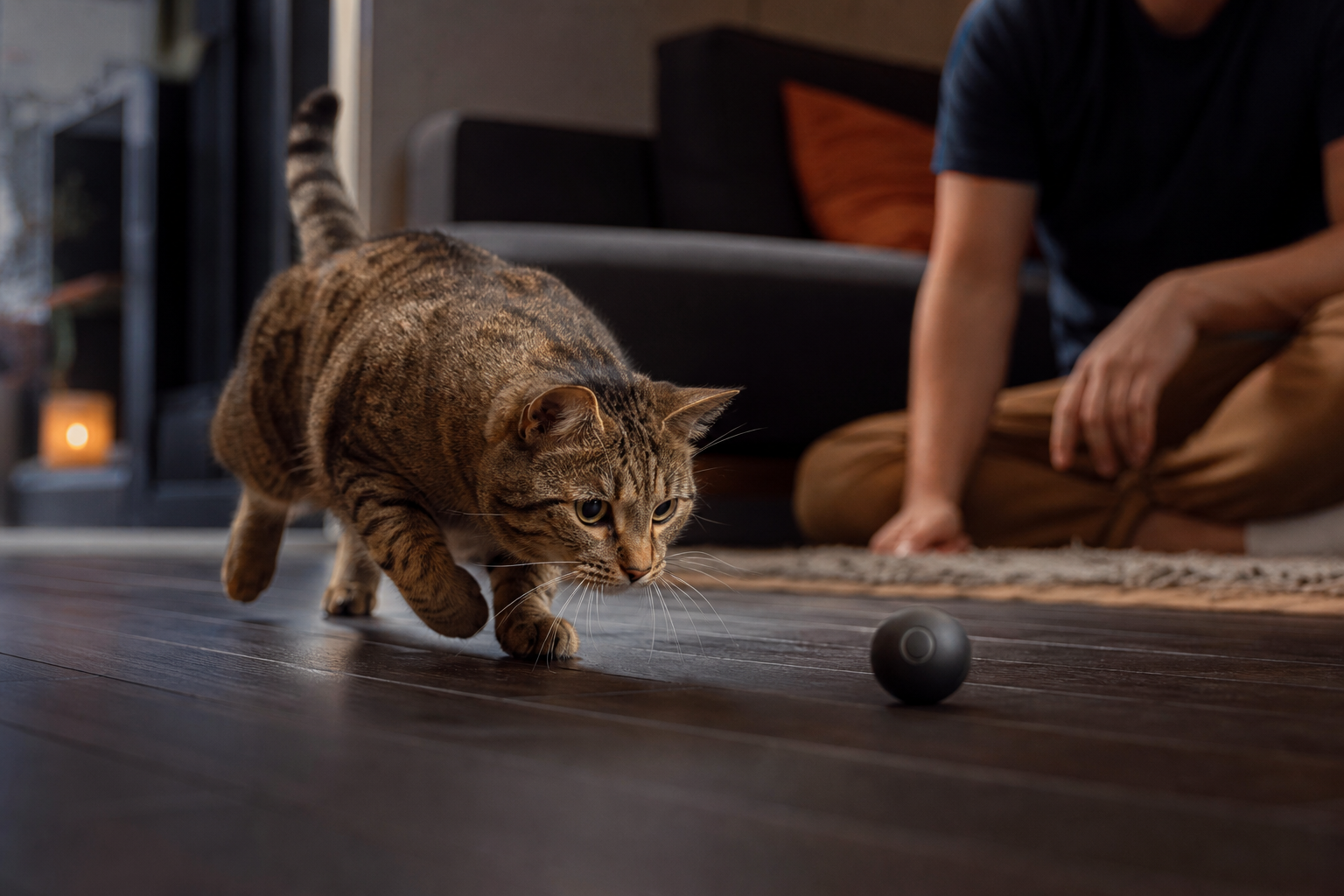
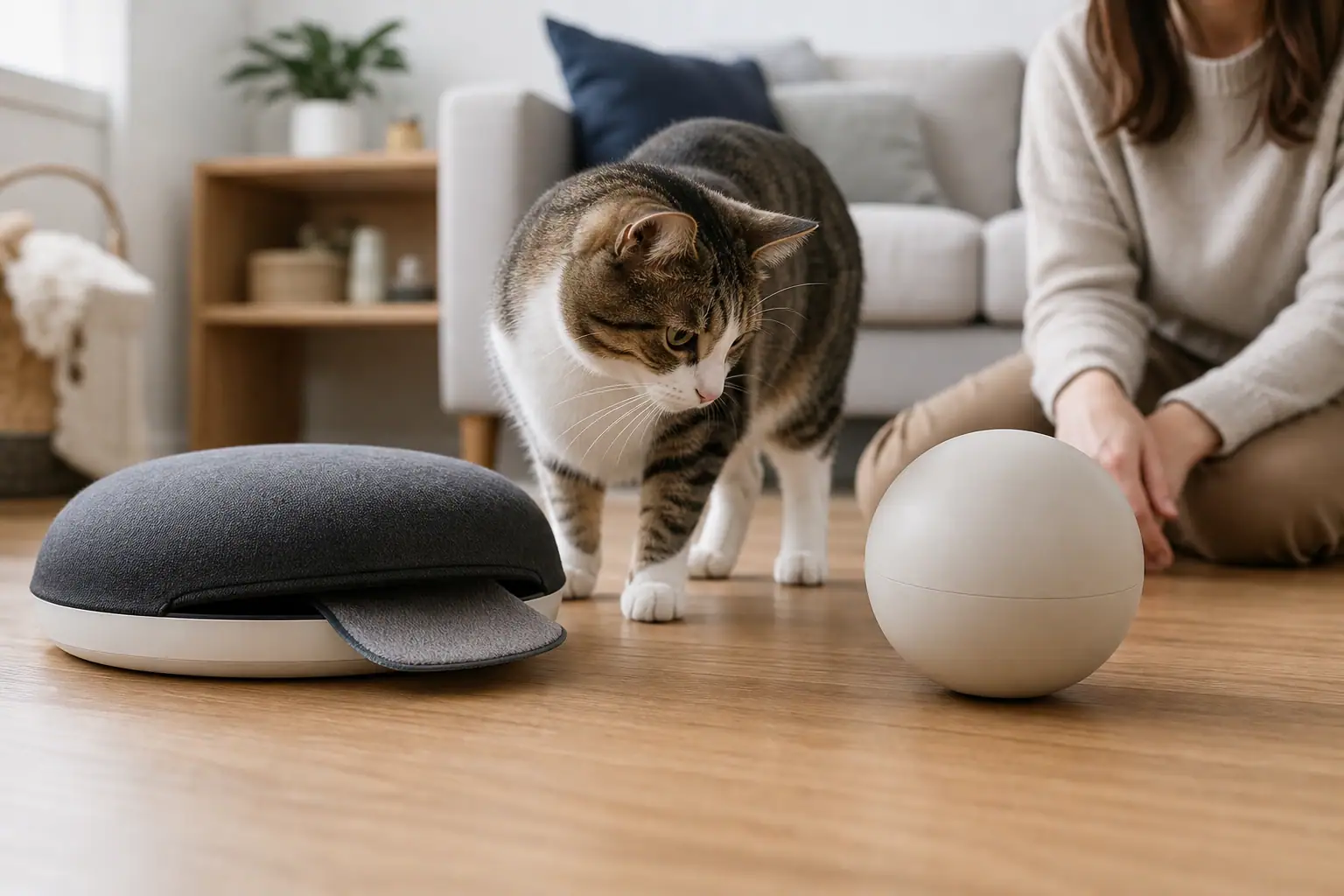
    • Track toys and chase balls: Best for solo play between interactive sessions.
    • Chew-safe rubber toys: Best for cats that bite hard at the end of play sessions.
    Single durable rope cat toy on a worn dark workbench surface, dramatic single-source warm light casting deep shadows

    How to Choose the Right Toy

    Match the toy to the behavior you want to redirect. If your cat attacks feet under blankets, use a long wand toy so the prey stays away from your body. If your cat grabs arms and kicks, offer a larger kicker toy they can hold and wrestle safely. If your cat gets overstimulated quickly, switch from high-speed chase games to treat puzzles or slower batting toys before frustration builds.

    • Choose toys large enough that they cannot be swallowed.
    • Avoid toys with glued decorations, loose feathers, or small plastic parts that can break off.
    • Retire any toy with torn seams, exposed stuffing, cracked plastic, or loose cord.
    • Rotate toys every few days so play stays novel without turning chaotic.

    Best Toy Types for Play-Aggressive Cats

    1. Durable Wand Toys

    Wand toys are usually the fastest way to lower play aggression because they create distance. Use sturdy rods, strong cord, and replaceable lures. Keep the toy moving like prey across the floor instead of waving it in your cat’s face. End the session before your cat starts grabbing at you instead of the toy.

    Cat mid-pounce attacking a rope toy with blurred motion, dark studio background, dramatic orange side lighting

    2. Kicker Toys

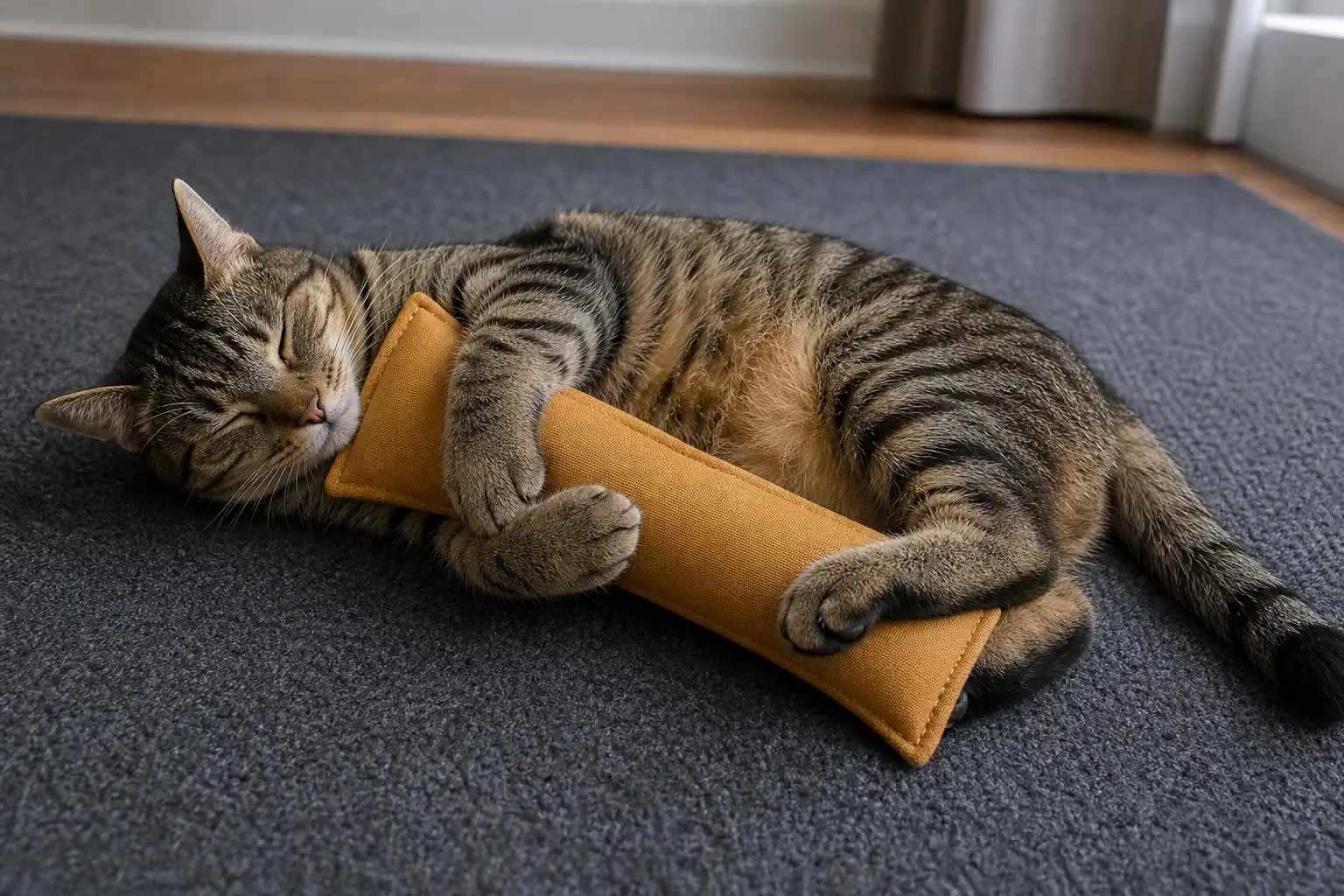
    A long, heavily stitched kicker toy gives your cat a safe target for grab-and-kick behavior. If your cat tends to latch onto sleeves, blankets, or hands, a kicker toy is one of the simplest substitutions you can make.

    Cat in peak play mode with claws extended attacking a toy, ears pinned back, tail raised, mid-action with warm orange rim lighting

    3. Puzzle Feeders and Treat Toys

    Puzzle toys reduce arousal by slowing the game down. They work especially well after an active play session, when your cat still wants an outlet but needs something calmer than another chase round.

    4. Track Toys and Durable Balls

    These are good for independent follow-up play. They will not replace interactive sessions, but they can help burn off extra energy during the day and keep boredom from spilling into rough behavior.

    Simple Play Routine That Lowers Aggression

    1. Start with 5 to 10 minutes of wand play that makes your cat chase, stalk, and pounce.
    2. Switch to a kicker toy for the grab-and-kick phase.
    3. Finish with a puzzle feeder, treat toy, or small meal so the session ends on a calm reward.
    4. Repeat one to three times daily depending on your cat’s age and energy level.

    This sequence matters. High-energy chase first, physical capture second, calm reward last. That pattern is much more effective than letting play spiral until your cat bites the nearest moving person.

    Safety Checklist

    • Do not use your hands as toys.
    • Stop the session if your cat starts targeting skin instead of the toy.
    • Store string-based toys away after play.
    • Inspect toys weekly and replace damaged items immediately.
    • Choose tougher materials for strong chewers, but avoid anything so hard it could damage teeth.
    Four destroyed cat toys arranged in a flat lay on a dark surface, including a shredded feather wand, scratched scratcher, deflated plush mouse, and chewed rope toy

    When to Get Extra Help

    If play aggression is escalating into true aggression, breaking skin, or happening without clear play signals, pair the toy changes with a behavior plan. Start with these guides: How to Stop Play Aggression in Cats and Cat Play Aggression: Causes and Solutions. If the behavior is intense, sudden, or paired with pain signs, talk to your veterinarian.

    The Toy Rotation System: Keeping Your Cat Engaged

    One of the most overlooked strategies for reducing play aggression is toy rotation. Cats get bored with the same toys week after week, and boredom leads to frustration and increased destructive play behaviors. By rotating your cat’s toys every few days or weekly, you create the illusion of “new” toys without spending more money.

    Why rotation works: The novelty factor keeps your cat mentally stimulated and excited about play sessions. A toy that sat in the corner for two weeks feels brand new when you reintroduce it, triggering fresh hunting instincts and engagement.

    How to implement a rotation system:

    • Keep 8-12 toys total (3-4 at a time in rotation)
    • Rotate every 3-5 days or weekly depending on your cat’s interest
    • Store toys in a basket or container so they’re out of sight (out of sight = out of mind = more exciting when reintroduced)
    • Watch your cat’s responses to each toy and remove ones they ignore consistently
    • Introduce one “new” (previously stored) toy every few days to maintain interest

    Pro tip: Indoor enrichment activities and outdoor training can complement toy rotation by providing multiple outlets for play energy.

    DIY Cat Toy Ideas: Safe, Budget-Friendly Options

    Not every cat toy needs to come from a pet store. Many household items can become excellent play objects when constructed safely. DIY toys are perfect for testing what your cat responds to before investing in expensive options.

    Safe DIY toy ideas:

    • Crinkle balls: Wrap aluminum foil loosely in paper or fabric, leaving small crinkle sounds. Cats love the texture and sound.
    • String toys: Tie safe fabric scraps or cotton string to a stick or dowel (never leave unsupervised string-based toys unattended)
    • Puzzle feeders from cardboard: Hide treats inside a cardboard box with cut-out holes for your cat to fish treats through
    • Paper bag toys: Crumpled paper bags create crinkling sounds and satisfy hunting instincts. Remove handles for safety.
    • Toilet paper roll balls: Stuff empty rolls with crumpled paper and leave open for safe batting and chewing
    • Ping pong ball in a bathtub: The unpredictable bouncing mimics prey movement without breaking or becoming a choking hazard

    Safety first: Always supervise DIY toy play, avoid small parts that could be swallowed, and never leave string or elastic items unattended.

    Structuring Play Sessions for Maximum Engagement

    How you play with your cat matters as much as what toys you use. Unstructured, chaotic play can actually escalate aggression rather than reduce it. By using intentional play sessions with clear beginnings and endings, you teach your cat when it’s appropriate to be aggressive and when to settle down.

    The ideal play session structure:

    • For kittens: 3-5 minute sessions, 3-4 times daily. Young cats have short bursts of energy.
    • For adult cats: 10-15 minute sessions, 2-3 times daily. This matches natural hunting cycles and keeps them engaged without overstimulation.
    • For senior cats: 5-10 minute sessions, 2 times daily. Gentle, slower-paced play prevents injury and joint strain.

    During play:

    • Let your cat “win” sometimes (catch the toy) to satisfy the hunting instinct
    • Gradually slow movements toward the end of the session to wind your cat down
    • Avoid sudden stops that trigger frustrated pouncing
    • End on a satisfied note, not when your cat is still highly aroused

    After play: Offer a small treat or their next meal to signal the end of play and create a satisfying conclusion to the session. This also takes the “edge off” hunting energy.

    Age-Specific Toy Recommendations

    Your cat’s age significantly affects which toys will reduce aggression most effectively. Here’s how to match toys to your cat’s life stage:

    Kittens (2-6 months): Bouncy, fast-moving toys that respond to their unpredictable energy. String wands, bouncy balls, and small feather toys work best. Kittens are learning hunting skills, so interactive play is crucial for teaching boundaries.

    Junior cats (6 months-2 years): High-energy interactive toys. Wand toys, kicker toys, laser pointers, and fetch toys. This age group has intense play aggression—redirect it with durable, engaging options.

    Adult cats (2-7 years): Varied toys including puzzle feeders, chase toys, and wand toys. Mix interactive and solo play. Mental engagement becomes increasingly important.

    Senior cats (7+ years): Gentler toys that don’t require jumping or rough contact. Soft kicker toys, treat puzzles (slower-paced), and low-energy wand toys. Avoid toys that strain joints.

    When Toys Aren’t Enough: Recognizing Behavioral and Medical Issues

    In some cases, even the best toys won’t reduce play aggression if there’s an underlying behavioral or medical issue. Knowing when to escalate beyond toy-based solutions is important for your cat’s wellbeing.

    Signs that toys alone won’t solve the problem:

    • Your cat targets people obsessively, ignoring toys
    • Play sessions consistently end with your cat biting or scratching aggressively
    • Aggression is increasing despite more toys and play time
    • Your cat shows signs of pain during play (limping, hesitation, excessive grooming)
    • Aggression is accompanied by other behavioral changes (litter box issues, excessive vocalization, hiding)

    Next steps: Schedule a vet check-up to rule out medical issues like pain, hyperthyroidism, or neurological problems. If medical issues are cleared, consult with a certified feline behaviorist who can identify whether the aggression is playful, redirected, or something else entirely.

    Cat training and behavior guides on our site also cover other enrichment strategies beyond toys that can complement your toy rotation and play sessions.

    FAQ

    What toys help most with play aggression?

    Long wand toys, kicker toys, and treat puzzles do the most to redirect play aggression because they match the way cats chase, grab, kick, and wind down.

    Should I let my cat wrestle my hands if they are young?

    No. Hand play teaches your cat that human skin is part of the game. Use toys every time so the target stays consistent.

    How often should I replace toys?

    Replace them as soon as seams split, stuffing shows, cords fray, or hard parts crack. A durable toy is only useful while it stays intact and safe.

  • How to Stop Play Aggression in Cats

    How to Stop Play Aggression in Cats

    Think your cat is "just playing" when it suddenly nips, claws, and treats your hand like a moving toy? That quick pounce is often play aggression (when play turns rough and your cat bites or claws), and the good news is it’s teachable. Start by stopping play at the first sign of trouble , tail twitch, whiskers rippling, flattened ears, or big pupils. Ever notice those little signals? They mean, hey, pause. Check out our guide on Toys to Reduce Play Aggression.

    Calmly swap your hand for a wand (a stick with a string and feathers) or toss a pocket toy (a small fabric mouse or ball) so ambushes land on fabric, not skin. Think of a wand like a fishing rod for cats , irresistible from a distance. I once watched Luna leap three feet for a feather, and nobody lost a finger.

    If your cat bites, get up and walk away so they learn rough play ends the fun. Keep sessions short and regular, like five minutes a few times a day, and always trade your hand for a toy before things get too wild. With steady swaps and consistent timing, most cats learn to play gentler.

    Worth every paw-print.

    Immediate Steps to Stop Play Aggression Now

    - Immediate Steps to Stop Play Aggression Now.jpg

    When your cat gets too rough, stop play, redirect to a toy, and take away attention. Do it calmly so your cat learns the rule without getting more hyped. Ever watched your kitty go from purring to pounce in seconds? Yeah, same.

    Catch the warning signs early. Look for tail twitching, ears flattening, or dilated pupils (big black centers of the eye). Stopping play the moment you see one of those cues breaks the reward cycle that makes rough play feel like a win. If you walk away right when the cue appears, your cat learns that fun ends when it gets too rough.

    Give biting a safe outlet by swapping your hand for a toy. Wand toys (a stick with string and feathers) keep your fingers out of reach and let cats stalk, pounce, and “capture” a moving target. Tossing a small toy or using a pocket toy (tiny stuffed mouse or crinkle ball) redirects ambushes fast. If your cat has been using your hands as toys, it’ll take repetition and patience to change the habit , steady, consistent swaps win the day.

    When a bite or scratch happens, withdraw attention so your cat links the action to losing playtime. Don’t punish physically , that makes fear and aggression worse. Calmly stop interaction, turn away, or leave the room for a minute to reset both of you.

    1. Stop play at the first warning sign: tail twitch, flattened ears, or dilated pupils.
    2. Switch to a wand toy or toss a toy away from you to redirect attention.
    3. Never use hands or feet as toys; don’t reinforce the behavior.
    4. If bitten, push your hand gently toward the cat so it loosens its grip (do not yank), then withdraw.
    5. Keep pocket toys handy for instant redirection of surprise attacks.
    6. Keep sessions short and intense , about 10 to 15 minutes , and aim for several sessions a day.
    7. Reward calm behavior after play with a tiny treat or brief gentle petting once play is over.
    8. Seek veterinary or behaviorist help if attacks are frequent, intense, sudden, or cause injury , see "When to Consult" for details.

    Schedule play around your cat’s natural peaks, like dawn and dusk. Short bursts of focused chase followed by a capture and a meal help your cat feel satisfied , think of it as a tiny hunt that finishes with dinner. I once watched Luna leap six feet to snag a wand toy and then flop down, totally content. Worth every paw-print.

    If aggressive incidents keep happening, get professional help right away so medical or deeper behavioral issues aren’t missed. See "When to Consult" for what to look for and who to call.

    Causes of Play Aggression in Cats: Why Biting and Rough Play Happen

    - Causes of Play Aggression in Cats Why Biting and Rough Play Happen.jpg

    Kittens come wired to hunt , they love stalking, pouncing, and chasing anything that moves. If they miss the socialization window (3-16 weeks, when they learn how to play nicely with littermates and people) they might not learn bite inhibition (how hard is too hard). Early weaning or being hand-raised (mostly by humans instead of a mom and siblings) often means nobody showed them the limits of rough play, so they can grow up a bit bite-happy.

    Living indoors can turn that hunting motor inward. Without interactive play at dawn and dusk, or enough toys and vertical space (cat shelves or tall trees for climbing), all that predatory energy looks for a target , your waving hand, dangling toes, or the ankle that walks by. Picture whiskers twitching as a cat launches at a moving sock; young cats under three tend to do this more since they’re burning lots of energy and still learning self-control.

    Sometimes rough play is actually pain talking. Sudden or worsening aggression can mean dental trouble, arthritis, or neurologic issues (problems with the brain or nerves) are making even a chill cat snap. If rough episodes start quickly or get worse, check "When to Consult" for a red-flag checklist and then see your vet so medical causes can be ruled out , better safe than shredded, right?

    Recognizing Overstimulation and Play-Aggression Body Language

    - Recognizing Overstimulation and Play-Aggression Body Language.jpg

    Quick reads of posture and eyes help you step in before play gets too rough. If you want a short checklist of early signals, see Immediate Steps to Stop Play Aggression Now so the cue list lives in one place and we avoid repeating it here. Think of this as spotting the first little twitches before things escalate.

    Recognizing Overstimulation vs. Fear-Based Aggression

    Overstimulation (when play gets too exciting and a cat’s nerves spike) usually shows as short, punchy bursts , a rapid pounce, a quick shake, then right back to chasing. It’s noisy and brief. Your cat resets fast and often wants to jump right back in.

    Fear-based aggression (when the cat feels threatened or unsafe) gives clearer, longer warnings , prolonged hissing, turning away or backing off, or frantic escape attempts. These are not quick bursts; they’re avoidance and panic. When you see those, separate and calm the cat instead of trying to lure them back to play. Ever watched a cat bolt and hide after a hiss? That’s fear. Short, twitchy bursts are usually play.

    Stop Immediately
    Bites that break the skin
    Repeated lunges without pause
    Sustained growling or yowling
    Long, frozen crouch right before an ambush

    If you notice early signals (check Immediate Steps to Stop Play Aggression Now), stop or slow play right away. Pause movement. Switch to a calmer toy, or end the session so your cat can reset , ten minutes of quiet can work wonders.

    If any Stop Immediately signs show up, separate calmly and give space. Let the cat retreat, and avoid forcing comfort. If the behavior repeats or causes injury, get help from your vet or a behavior professional. Worth the peace of mind.

    How to Stop Play Aggression in Cats

    and H3 4 No lists or tables.jpg

    Redirecting play biting onto toys lets your cat use its hunting instincts without turning your hand into the target. Wand toys, plush prey, and little tossable toys give your cat a clear target and teach it to aim at objects, not people , see Immediate Steps for the triage and capture rationale. Ever had your sleeve treated like dinner? Yep, we’ve all been there.

    Wand toys are especially handy for bouncy kittens. A wand toy (a stick with a string, feather, or plush at the end) copies quick prey movement and keeps your fingers out of the danger zone. Do short chases, pause so your cat can stalk, then let it win with a capture so it feels satisfied. Soft plush prey (a soft stuffed toy) and lightweight balls (plastic or foam, easy to carry) help teach gentle mouthing. Be strict about safety: toss anything with loose eyes, strings, or stuffing , replace or retire ragged toys.

    Toy Why it works Safety & usage technique
    Wand toy (stick with string/feather) Keeps your hands safe and recreates stalk – pounce – capture play Move unpredictably, pause so the cat stalks, let it “catch” the toy at the end. Store out of reach after play.
    Furry mouse / plush prey (soft stuffed toy) Feels like real prey to bite and carry; great for solo cuddling or post-chase reward Supervise if small parts exist, replace when ragged, give after interactive play so the cat can carry a prize.
    Lightweight ball (plastic or foam) Encourages chasing and batting without heavy impact Pick balls without small detachable bits, toss away from you to redirect ambushes, swap if chewed through.
    Crushed paper / foil Cheap, noisy, and delightfully unpredictable Watch for ingestion of foil, retire when torn, use in short supervised bursts only.
    Puzzle feeder / treat ball (toy that hides food) Turns meal time into a hunt and stretches playtime Use near the end of a session to calm energy, pick sizes that fit kibble, clean regularly.
    Laser pointer (pair with a capture toy) Triggers fast stalking and pouncing without hand contact Short bursts only, never shine in eyes, and always finish by tossing a tangible toy so the cat gets a real capture.

    Rotate toys weekly so they feel fresh , tuck some away for a few weeks, then bring them back like new. Wash plush and puzzle feeders per the label, and toss anything with loose stuffing or chewed plastic. Keep a small pocket toy for quick redirection when an ambush starts , see Immediate Steps for when to swap toys during an escalation.

    Worth every paw-print. Um, actually , make that every playful pounce.

    training-shaping-gentle-play-clicker-microplans-and-time-out-theory”>Training: Shaping Gentle Play, Clicker Microplans, and Time-out Theory

    - Redirecting Play to Appropriate Toys Types, Safety, and Usage Techniques.jpg

    Training nudges your cat toward gentler play over days to weeks, not overnight. Follow the Immediate Steps during a session so you can stop rough behavior fast and keep things safe and useful. Think of this as triage: quick actions first, then practice.

    Mechanics of shaping gentle play

    Watch for tiny calm moments during play and reward them right away. Mark the quiet action with a clicker (a small handheld device that makes a short click) or a short verbal cue, then give a reward within about 0.5 to 1 second so your cat links the calm with the treat. Start tiny: reward a two second gentle paw touch or a soft mouth on a toy, then slowly raise the goal to five seconds of relaxed focus before you reward again. Keep each step obvious and repeatable; cats learn in small bites, so make success easy.

    Clicker microplans

    Plan A (kitten): three 5-minute sessions per day. Aim to mark the first calm pause in a chase and reward with the toy or a pea-sized kibble (tiny, tasty bite). Short, frequent wins speed learning in young cats.
    Plan B (adult or rescue): several 2-minute mark-and-reward microbursts, done 6 to 8 times a day. Use very small treats (pea-sized or a crumb), mark the exact quiet behavior, then reward within 0.5 to 1 second. Slowly increase the time between marks, and swap treats for brief petting or a prized plush prey as the behavior steadies. Keep sessions predictable and stop while your cat is succeeding so they feel satisfied.

    Time-out theory and applied examples

    A time-out removes the social reward of play so rough actions stop leading to fun. Keep time-outs short and calm; 30 to 60 seconds usually works best, then go back to normal interaction without drama. Three simple options: close a bedroom door and wait silently; step out of the room for a full minute and return calmly; or place the cat in a neutral safe spot, like an empty carrier or a quiet crate, for 30 to 60 seconds so the message is clear but not scary. Kittens often shift in days to weeks. Adults or rescued cats may need several weeks to a few months of steady repetition. If time-outs don’t reduce escalation or things get worse, see "When to Consult" for next steps.

    Worth every paw-print.

    Daily Play Schedules, Enrichment Setups, and Multi-Cat Perch Counts

    - Training Shaping Gentle Play, Clicker Microplans, and Time-out Theory.jpg

    Plan short, predictable play windows around your cat’s natural energy peaks so that zoomies get used up before they turn into misdirected pouncing. Short 10-15 minute bursts work best – they match a cat’s attention span and end with a satisfying capture. See Immediate Steps to Stop Play Aggression Now for the quick triage that explains the session-length logic we’re using here.

    1. Schedule A – Single adult indoor cat

      • 6:00–6:15 AM: Dawn interactive session with a wand toy. Fast chases, big swoops, ending in a capture. Your cat’s whiskers will tell you when they’re keyed up.
      • 11:30 AM: Midday slow mental play with a puzzle feeder (a toy that makes your cat work for food). Keeps the brain busy while you’re at your desk.
      • 6:30–6:45 PM: Dusk play-before-meal. Short, intense chase that finishes with a capture, then dinner. It’s the classic hunt-then-eat sequence cats love.
      • 9:00 PM: Gentle wind-down. Low-intensity toys or window-watching time for bird TV and soft batting.
    2. Schedule B – Multi-cat household

      • 6:00 AM: Staggered dawn sessions. Cat A gets a wand burst while Cat B watches from a perch (a raised resting spot), then swap. Keeps jealousy down and gives each cat solo fun.
      • 12:30 PM: Shared puzzle feeders in separate rooms so everyone eats without drama. One feeder per space reduces competition.
      • 6:30 PM: Paired short sessions in different rooms. Different toys so each cat gets a winning capture and doesn’t feel left out.
      • 8:30 PM: Individual calm-down periods. Quiet room or high perch for the cat that needs a break. Give shy cats solo time, confident cats can patrol the top spots.
    3. Schedule C – Kitten schedule

      • 7:00 AM: Three 5-7 minute micro-sessions after naps. Short, high-focus play while they’re fresh. Tiny bursts = big learning.
      • 11:00 AM: Supervised solo play with plush prey or crumpled paper. Safe, simple, and wildly entertaining.
      • 4:00 PM: Two quick micro-sessions before the evening nap and again before dinner. Keeps their energy curve steady.
      • Bedtime: Low-key petting and a small puzzle snack to help them settle into sleep.

    Set up vertical and hiding options to lower tension. Aim for about 1.5-2 perches (a mix of window perches, shelves, and a tall cat tree – a vertical climbing structure) per cat so every cat can choose a view or a top spot. Provide at least N+1 litter and water stations (N = number of cats) so no one has to wait or feel crowded. Offer roughly 1-2 hiding boxes or tunnels per cat, spread across different rooms, so shy cats have retreats and bold cats can claim higher real estate.

    Spread perches so access isn’t all in one place. High spots near windows make great solo-viewing posts, while ground-level cozy boxes are perfect for naps and quick escapes. Think of it like house zoning for cats – multiple neighborhoods, less drama.

    Use puzzle feeders as part of the play rhythm: do a play-before-meal burst so the cat “captures” and then eats, or give a treat ball (a toy that rolls out treats) right after an active session to stretch the reward. If these schedule changes don’t reduce aggression, see When to Consult for red-flag next steps.

    Worth every paw-print.

    Managing Multi-Cat Play Interactions and Safe Introductions

    - Daily Play Schedules, Enrichment Setups, and Multi-Cat Perch Counts.jpg

    Multi-cat homes are a joy and sometimes a little chaos. Cats test spaces, swap smells, and now and then play gets too rough. A slow, staged approach helps everyone feel safer and keeps kittens and resident adults from getting spooked.

    Safe introduction steps:

    Start with a sanctuary room. Give the newcomer its own quiet space with litter, food, water, and a couple hiding spots for several days. Let them stretch out and explore without pressure. Your resident cat can sniff under the door , let that happen.

    Do scent swapping for a few days. Swap bedding or rub a soft cloth on one cat and then the other, placing it with its counterpart twice a day so they learn each other’s smell. It’s like passing notes in class, but with whiskers.

    Move to short supervised visual sessions next. Use a baby gate (a portable barrier) or a cracked door so they can see each other but not touch. Keep these visits brief and calm. Watch body language: slow blinks and relaxed tails are good signs.

    Try brief supervised play sessions once they seem curious but calm. Use wand toys – think fishing-rod for cats – to keep hands out of reach. End each session with a capture and a meal so both cats leave happy and satisfied. Let sessions grow slowly over days to weeks, depending on how relaxed everyone stays.

    Spread out resources to reduce competition. Follow the N+1 rule for litter boxes – one per cat plus one extra – so nobody has to wait. Offer 1.5 to 2 vertical perches per cat (shelves or tall posts) and several hiding boxes or tunnels so each cat has choices. More places to climb and hide means fewer squabbles.

    Step in when play turns serious. If you see prolonged hissing or growling, chasing with intent, or any injuries, that’s a cue to redirect them. Use Immediate Steps for redirection tactics and consult When to Consult if problems keep happening.

    Worth every paw-print.

    When to Consult a Veterinarian or Behaviorist About Play Aggression

    - Managing Multi-Cat Play Interactions and Safe Introductions.jpg

    If your cat’s play turns suddenly into real aggression, pay attention. That kind of change can be a medical red flag. Look for new limping, avoiding the litter box, changes in appetite, or signs that your cat flinches or feels pain when you touch the mouth or joints.

    There are a few medical causes to consider. Dental pain (hurt teeth or gums) can make a kitty snap. So can injuries or neurologic issues (brain or nerve problems). Intact cats , ones not spayed or neutered , may also show different arousal or activity levels, and your vet will note that.

    Start with your regular vet if the behavior is new or getting worse. A clinic visit usually includes a physical exam, checking for pain, and questions about when the episodes happen and what seems to trigger them. Bring video clips that show the escalation, a short written timeline of episodes, photos of any injuries, and notes on how often it happens and what you tried. For tracking play-fight injuries, keep a simple log with dates, what happened, and any treatment you gave.

    Pros may recommend a mix of medical care and behavior work. If pain is the cause, treatment might mean dental care, anti-inflammatory meds (medications that reduce swelling and pain), or other pain management so your cat isn’t snapping from discomfort. A behaviorist will usually give a step-by-step plan with safe play schedules, toy strategies, and controlled time-outs to teach better boundaries.

    Ask about synthetic pheromones like Feliway (a diffuser that mimics calming cat scents) as part of the plan , some cats do calm down with them used alongside behavior change. And if a bite breaks skin, wash it, seek medical care, tell your vet, and take photos of the wounds to bring to appointments.

    Final Words

    Stop play at the first warning, redirect to a wand or toss a toy, and finish sessions with a capture so your cat calms down. Quick, consistent moves make a big difference.

    We ran through causes, body language to watch, safe toy choices and rotation, shaping gentle play, daily schedules for single or multi-cat homes, and when to call a pro if bites escalate. Use the Immediate Steps for fast triage and the training plans for lasting change.

    Stick with short, lively sessions and small rewards. With patience and smart redirection, you’ll master how to stop play aggression in cats and enjoy calmer, happier felines.

    FAQ

    How do I stop play aggression in my cat toward people?

    Stopping play aggression in a cat toward people starts by halting play at first warning signs, redirecting to a wand or toy, and withdrawing attention so biting loses its reward.

    How do I stop play aggression between cats?

    Stopping play aggression between cats means interrupting at escalation signs, redirecting with toys, providing extra perches and resources, and using staged reintroductions with scent swaps and short supervised play sessions.

    What is play aggression in cats?

    Play aggression in cats is predatory-style rough play—stalking, pouncing, biting, or scratching—driven by hunting instinct or overstimulation, common in kittens and under-stimulated indoor cats.

    What is the 3-3-3 rule for cats?

    The 3-3-3 rule for cats describes adoption adjustment phases: three days hiding and settling, three weeks exploring and routine building, and three months to fully relax and form lasting bonds.

    Do cats outgrow play aggression?

    Cats often mellow with age; many kittens outgrow intense play aggression by around three years when given regular interactive play, training to redirect bites, and varied enrichment.

    How can I tell if my cat is being playful or aggressive?

    You can tell play from true aggression by body language: play has quick pounces, soft vocalizing, then recovery; aggression includes hissing, sustained growling, biting that breaks skin, and hard lunges.

    Why do cats play-attack their owners?

    Cats play-attack owners when hunting instinct, pent-up predatory energy, poor early socialization, or overstimulation makes hands and feet feel like small, moving prey during exciting play moments.

  • Understanding Cats Play Fighting vs Aggression

    Understanding Cats Play Fighting vs Aggression

    Is that wrestling between your cats just silly play or a fight that could end in vet bills? Ever watch them tumble and wonder which it is? Check out our guide on Best Toys to Reduce Play Aggression.

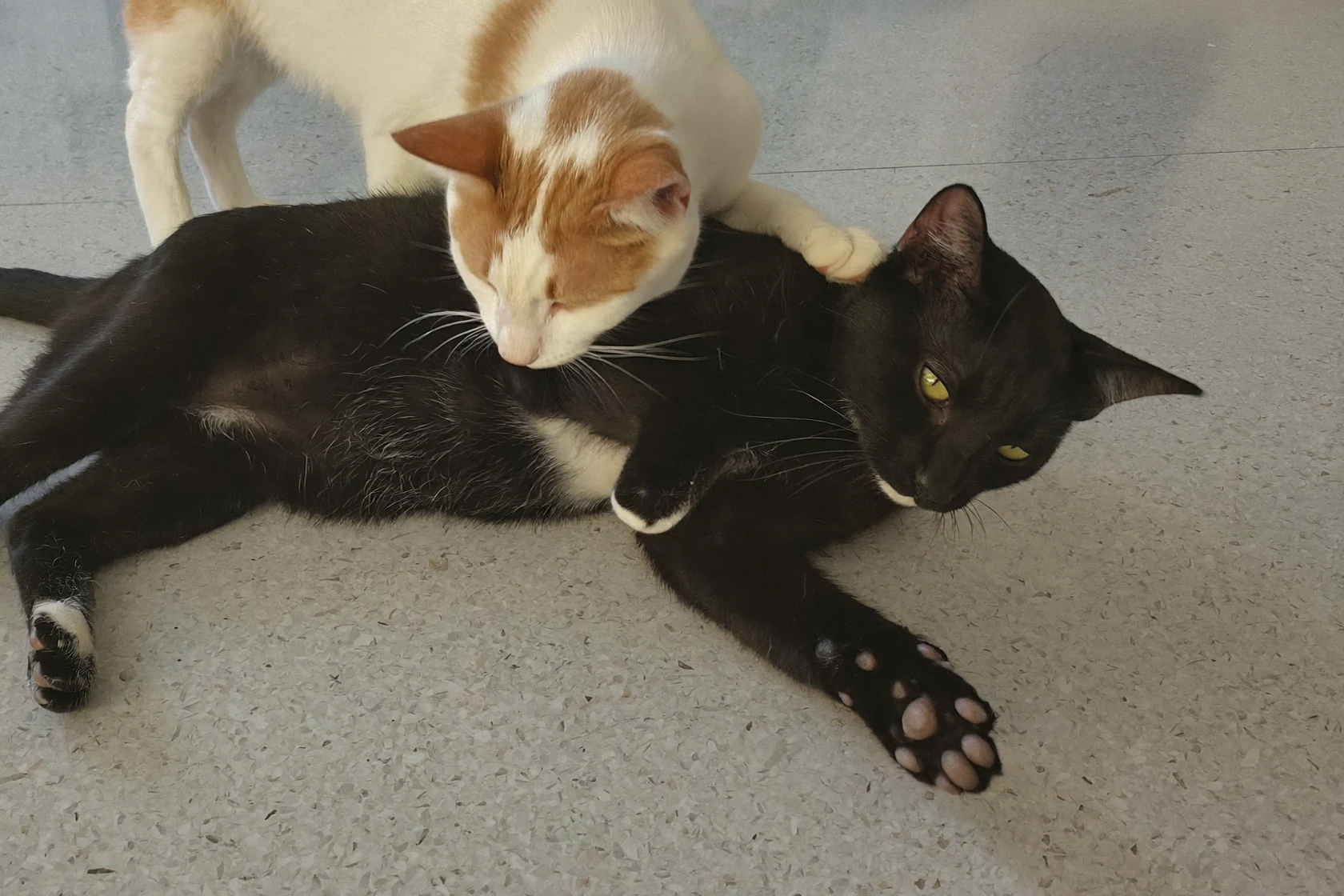
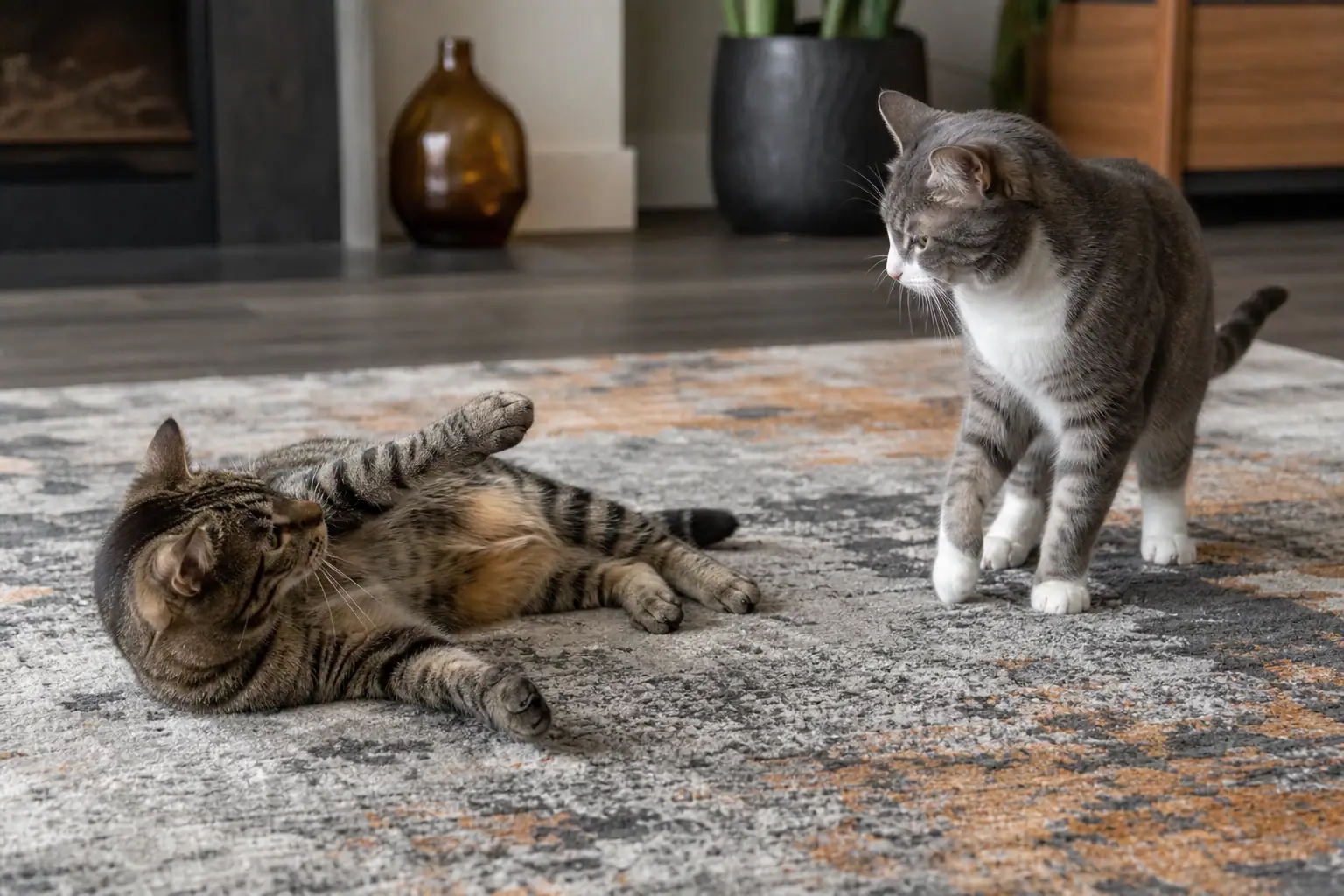
    Play is mutual. Claws tucked (sheathed: hidden inside the paw), ears loose, soft nips, and both cats taking turns chasing like kittens after a toy. Your cat’s whiskers might twitch, and there’s a bouncy rhythm to it.

    Aggression looks sharper. You’ll see claws out (unsheathed: extended), ears pinned back, and fur standing up (piloerection: raised fur). Add loud hissing, long, angry yowls, or bites that break the skin, and it’s time to step in.

    I’ll walk you thplay rough easy-to-spot body language, give quick checklists, and share safe, simple steps to break up a fight or call for help, so you’ll know when to smile and when to act fast. Worth every paw-print.

    Understanding Cats Play Fighting vs Aggression

    - Quick lede two-sentence distinction, short checklist, and emergency DODO NOTs.jpg

    Play fighting feels gentle and mutual. You’ll see claws retracted (sheathed – tucked away), ears relaxed, no piloerection (raised fur), and soft nips that don’t break the skin. They take turns being the chaser or the one on top, and there’s lots of switching roles. Ever watch whiskers twitch as a toy mouse rolls? Play looks a bit like that, but with another cat.

    Aggression is sharper and one-sided. Claws come out (unsheathed – extended and ready to scratch), ears are flattened or pinned back, fur stands up (piloerection), and you’ll hear loud hissing or growling. Bites that break skin or cause yelping mean it’s gone past play, and repeated pinning or nonstop chasing is a red flag.

    Quick checklist of reliable markers to watch:

    • Sheathed claws, relaxed ears, soft vocalizing, turn-taking = play.
    • Unsheathed claws, pinned ears, raised fur (piloerection), loud hissing/growling = aggression.
    • Bites that break skin or cause yelping are beyond play – those are injurious bites.
    • Reciprocal chasing and role swaps suggest normal play; repeated pinning does not.

    Safety DO / DO NOT:

    • DO make a loud distraction out of sight – clap lids together or bang a pan to break their focus. It works more often than you’d think.
    • DO use a barrier or a blanket to gently guide one cat into a quiet room and dim the lights so things calm down.
    • DO NOT put your hands between fighting cats. You will get hurt.
    • DO NOT assume a scuffle will safely "work itself out" if it’s loud, bloody, or keeps happening.

    When to get help:
    If behavior changes suddenly, fights leave deep puncture wounds, or the cats keep fighting despite separation, call your vet right away and ask about a behaviorist. If in doubt, get professional help , it’s worth the peace of mind and the paws.

    Feline play body language: micro-signals, thresholds, examples, and the canonical comparison table

    Feline play body language for the full table).jpg

    Tiny moves tell the story – watch patterns, not single frames. Spend 30 to 60 seconds watching an interaction to see if the same signals repeat. One flick or one hiss isn’t the whole picture. If you see a loop like "bat, chase, swap" happen three times in a row, that’s a repeating play loop you can trust.

    Can’t tell by eye? Record it. Capture 30 to 60 seconds of video with audio, hold the phone horizontally, and note what happened right before play started (toy toss, doorbell, treat). Example clip: Record 45 seconds – "toy thrown, Cat A stalks, Cat B chases, soft chittering" – that short clip tells a pro more than a long description.

    Kittens and adults read the rules differently. Kittens (roughest around 8 to 10 weeks) swap roles fast and tolerate harder mouthing. Adults switch roles less and may escalate sooner when space or resources are tight. Example: Kitten Luna, 9 weeks, switches roles every 6 to 10 seconds; Buddy, 3 years, stops after one long pin. Ever watch a kitten pounce and then immediately offer its belly? Cute chaos.

    If signals escalate, act fast and keep it simple. Pause play. Separate calmly. Give them a low-light, quiet break, then reintroduce with a wand toy or extra distance. Short cue: "Pause, separate, wait 5 minutes, try a wand toy."

    Feature Play (what to expect) Aggression (what to expect)
    Tail movements Short, rhythmic flicks or loose sways during back-and-forth play Rapid thrashing, lashing, or a puffed tail showing high arousal
    Whisker position (vibrissae) Forward when focused and stalking; relaxed after a role switch Pushed forward with a hard stare, or pulled back when the cat is scared
    Role reciprocity / turn-taking thresholds Frequent swaps – roughly every 5 to 15 seconds; mutual breaks expected One-sided pinning repeated (more than 3 times) or constant pursuit

    Quick action – interrupt now if any of these happen:

    • Skin-breaking bites, loud yelps, or visible blood – stop and separate immediately.
    • One cat pins another more than three times in a row or never gives turns – pause play.
    • Tail thrashing with growls or fur standing up along the spine (piloerection) – separate and calm the area.
    • Continuous chasing with no escape route for the pursued cat – create space and training redirect.

    For full marker definitions (claws sheathed/unsheathed, pinned ears, piloerection (fur standing up), biting that breaks skin, normal turn-taking), see the Understanding Cats Play Fighting vs Aggression section. If wounds happen or behavior keeps escalating, record the footage and consult your vet or a behavior specialist for help. Worth every paw-print.

    Context, age, and causes: when play among kittens or adults becomes aggression

    - Feline play body language micro-signals, thresholds, examples, and the canonical comparison table.jpg

    Kittens have a short, important social window, about 2 to 9 weeks, when meeting littermates and other cats teaches them how to bite gently and take turns. Play usually peaks around 8 to 10 weeks, with quick role switches and rougher mouthing that’s still normal, think of tiny teeth and tumbling that look fierce but aren’t meant to hurt. Kittens that miss those lessons, like hand-raised ones (raised by people without littermates), often struggle later and may bite harder or have trouble sharing playtime as adults. Ever watched a kitten pounce and then suddenly go too far? That’s often the missing practice talking.

    Adult cats follow different rules. Resource competition, like one food bowl, one litter box, or one sunny perch, raises tension fast; shared resources make a cat feel cornered. Hormones matter too, intact males (not neutered) can be more driven to fight, and neutering before one year often helps reduce that risk. Other common triggers are redirected aggression (a cat sees something outside, gets wound up, then lashes out at a housemate), pain-driven aggression (a sore hip or tooth makes a cat snap), and status or territory disputes (who gets top shelf, who guards the window). Genetics and ongoing household stress, loud noises, unpredictable routines, also push cats from playful wrestling toward real fights.

    Quick context check , a three-step mini-protocol to figure out whether a scuffle is medical, environmental, or social:

    1. Rule out medical causes. Look for limping, sudden changes in appetite or grooming, or any recent vet issues; if in doubt, a vet visit can spot pain or illness that makes a kitty short-tempered.
    2. Check resource distribution. Aim for one litter box per cat plus one, plus several feeding stations and perches so nobody feels trapped or forced to share.
    3. Review recent changes. New pets, guests, remodeling, or sudden noisy street activity can trigger redirected aggression or stress, think of everyday disruptions that might have set them off.

    (For core behavioral markers see the canonical comparison table in ‘Feline play body language.’)

    Emergency & Follow-up: combined immediate protocol, wound care, and when to call a vet or behaviorist

    - Context, age, and causes when play among kittens or adults becomes aggression (see micro-signals table).jpg

    If cats start fighting, don’t stick your bare hands or arms between them. Ever. You will get hurt. Picture fur flying and a terrified yowl, your instinct might be to grab, but don’t. Instead, use low-risk moves that break their focus and get them apart without you becoming a bandage.

    Quick, low-risk interrupts

    • Make a loud noise out of sight: clap pot lids, bang a pan lid, or shake coins in a closed jar to surprise them and break eye contact.
    • Toss a big, soft object near (not at) the cats , a blanket or pillow works , so they look at the thing instead of each other.
    • Hold up a blanket, towel, or piece of cardboard as a visual barrier to guide one cat away calmly. Think of it like a temporary wall.
    • After they separate, scoop a cat up wrapped in a towel (towel as shield) and move it to a quiet room with food, water, a litter box, and a hiding spot; close the door and dim the lights to lower arousal.
    • Short rough play pause? Wait about 5 minutes before checking on them. After a serious scuffle, give them 10 to 20 minutes alone before trying any reintroduction steps.

    Immediate actions (short checklist)

    1. Don’t put bare hands between cats.
    2. Create an out-of-sight loud distraction , lids, a shaken coin jar, anything noisy.
    3. Toss a large soft item near, not at, the cats (blanket, pillow).
    4. Use a barrier (blanket, cardboard, towel) to block view and steer one cat away calmly.
    5. Wrap and scoop a separated cat with a towel as a shield; move it to a quiet room with food, water, litter, and a hiding box; close door and dim lights.
    6. Wait ~5 minutes for brief play bursts; wait 10–20 minutes after a real fight.

    Wound care and when to call a vet
    Cat bites are risky. A bite often makes a deep puncture (a narrow hole that can trap bacteria), so even if it looks small, it can hide infection. Superficial scratches can be cleaned at home with soap and water, but puncture wounds need a vet check.

    • Deep punctures or wounds that gape (open widely) require immediate veterinary care and often antibiotics (drugs that fight bacterial infection).
    • Watch both cats for swelling, warmth, redness, limping, fever, or loss of appetite , those can mean infection or hidden injury.
    • Humans who get bitten by a cat should see a doctor and check their tetanus status.
    • Keep dated photos and simple notes about wounds and treatments; short video clips of the incident are very helpful for vets and behaviorists.
    • If you’re unsure, err on the side of care. It’s nicer to get checked and feel relieved than to worry.

    When to call for help , medical and behavioral
    Call your vet right away if you see any deep puncture bite, heavy bleeding, a wound that opens, or signs of infection. Also call if fighting keeps happening, if a previously calm cat becomes suddenly aggressive, or if a cat is limping or clearly in pain. Get a medical exam first to treat wounds and rule out illness or pain. After medical issues are addressed, consult a behaviorist if the fights continue; bring short video clips and photos of incidents to help them understand what’s happening.

    Concise medical checklist (for follow-up)

    • Cat bites are often deep and infection-prone; punctures need vet assessment.
    • Gaping wounds or heavy bleeding = immediate vet visit.
    • Antibiotics may be prescribed for deep bites or infected wounds.
    • Humans with cat bites should get medical attention and a tetanus check.
    • Monitor both cats for fever, swelling, heat, limping, or appetite loss.
    • Keep dated photos, short notes, and videos of incidents for vets and behaviorists.

    See the "Feline play body language" canonical table for diagnostic markers used during follow-up assessments.

    Understanding Cats Play Fighting vs Aggression

    - Emergency  Follow-up combined immediate protocol, wound care, and when to call a vet or behaviorist (merged cluster).jpg

    Give every cat a way out so nobody feels cornered. Put litter boxes in separate rooms (one per cat plus one extra) and spread feeding spots, water bowls, and beds around the house so shy kitties can slip away. Add vertical territory (cat trees, window perches, wall shelves) so they can sit up high and watch without bumping into roommates.

    Use toys that steer energy away from real fights. Try wand or fishing-pole toys (a human-led teaser, like a fishing rod for cats) for supervised chases, toss ping-pong balls for quick redirection, and leave puzzle feeders (food-dispensing toys) when you’re out so mealtime becomes brain work. Schedule short, focused play sessions two or three times a day, 10 to 15 minutes each, to burn off twitchy energy and get that satisfying pounce practice.

    Make solo play safe and fun. Provide boxes and tunnels with multiple exits so a cat never feels trapped, and pick heavier balls that roll in odd ways to keep play interesting. Pheromone diffusers (a device that releases a calming cat scent) can lower background tension, and spaying or neutering (surgical sterilization) often helps reduce fighting drives.

    Small, practical swaps give big results. Think measurable changes, not vague fixes, more boxes, more perches, staggered meal times, and record short video clips to track behavior over weeks. Use the canonical comparison table in ‘Feline play body language’ when you’re checking whether interactions are play or something more serious. Ever watched your kitty chase shadows and then suddenly remember it’s dinner time? Yep, those little cues matter.

    Worth every paw-print.

    Numbered priority changes to implement:

    1. Add one litter box per cat plus one extra, spread through the home (easy escape routes).
    2. Create at least three vertical spots (trees, shelves, window perches).
    3. Place two or more feeding stations in different rooms to reduce face-offs.
    4. Schedule 2 to 3 interactive play sessions of 10 to 15 minutes daily to burn energy.
    5. Add puzzle feeders (food-dispensing toys) for meal-time enrichment and slow eating.
    6. Set up boxes and tunnels with multiple exits for safe solo play.
    7. Use a pheromone diffuser (calming scent device) and complete spay/neuter (surgical sterilization) if not already done.

    Understanding Cats Play Fighting vs Aggression

    - Prevention and household management to reduce play escalation and aggression (reference micro-signals table).jpg

    Play fighting usually looks rough but isn’t the same as real aggression. Your cat’s whiskers might twitch, paws bat at the air, and you’ll hear soft chuffs or little growls , that’s play. But when bites are hard, tails puff up, or one cat freezes and hides, it’s time to step in. We’re teaching softer mouths, not punishing natural play.

    A simple, gentle plan works best. Try clicker/treat pairing (a clicker is a small handheld tool that makes a short click) to mark calm choices: click when a cat mouths softly, then give a tiny treat so they learn calm equals rewards. If a nip gets too hard, stop play right away and offer a toy instead , redirect the bite to something okay to chew. Never hit or shake a cat after a scuffle; that just makes things scary and can make biting worse.

    Reintroductions should move slowly. Start with scent swapping: rub a cloth on one cat, then let the other sniff it so they get used to each other’s smell. Then try short, supervised visual sessions behind a baby gate or glass door so they can see each other without full contact. Gradually increase supervised time and shared activities over weeks or months , patience really helps. Reward calm moments with quiet praise or a tiny treat so the calm choice gets repeated.

    Keep sessions short and predictable so cats don’t get overstimulated. Ten minutes of focused play is better than an hour of chaos. Scheduled interactive play before free time helps burn energy so kitties are less likely to turn rough during play. For busy days, toss a safe ball or use a wand toy (think fishing rod for cats) before you head out , that’s ten minutes of peaceful downtime.

    Practical steps that actually work:

    • Clicker/treat pairing to mark calm choices (short, frequent sessions).
    • Immediate redirection: swap your hand for a wand toy when a nip happens , it teaches what’s okay to bite.
    • Teach a timeout: stop play and remove attention for 20 to 60 seconds after hard bites (a clear, calm break so they learn cause and effect).
    • Scheduled interactive play for 10 to 15 minutes to burn excess energy before free play.
    • Scent swapping and supervised visual contact before full meetings.
    • Reward calm interactions with treats or a quiet petting session; avoid punishment.

    Watch for progress and keep a simple log. A few short video clips and a note of dates/behaviors help you spot trends , you’ll usually see measurable change over weeks to months. If you’re unsure about scary signs, see Emergency & Follow-up for red flags and check the canonical comparison table in “Feline play body language” for diagnostic markers.

    Worth every paw-print. Keep it calm, keep it kind, and you’ll help your cats play nice , or at least be politely rough.

    Troubleshooting common scenarios: actions per scenario (scenario-driven only; reference prior sections)

    - Training and behavior modification to teach bite inhibition and reduce rough play (reference micro-signals table).jpg

    Quick, action-focused tips for six real-world cat clashes. Find the row that fits your household, do the Immediate action, then follow the short-term steps. Check Emergency & Follow-up for safety protocol and the 'Feline play body language' canonical table for diagnostic markers and micro-signals (tiny cues like ear flicks, tail twitches, or pupil changes). Ever watched your kitty’s whiskers go from calm to twitchy? That’s the sort of thing we want you to spot.

    Scenario Immediate action & next steps (references)
    Sibling kittens wrestling but still grooming each other Let them keep playing but watch closely for one-sided chasing or pinned behavior. Pause play if a kitten yelps. Short-term: add short, supervised wand sessions to burn extra energy and give the overwhelmed kitten separate nap spots. See Emergency & Follow-up for pause protocol and the ‘Feline play body language’ table for micro-signals (tiny body cues).
    New adult introduced with repeated one-sided chasing and growling Stop interactions and separate the cats into different rooms. Begin a slow reintroduction plan. Short-term: do scent swaps, have visual meetings behind a barrier, and run very short supervised encounters over days to weeks. Consult Emergency & Follow-up and the canonical table for signs of escalation.
    One cat repeatedly blocks another from food (resource guarding) Intervene right away by moving food bowls farther apart and adding another feeding station. Short-term: stagger mealtimes so the guarded cat can eat in peace, add high perches (vertical spaces help cats feel safe), and watch for territorial posturing. See prevention tips and the micro-signals table for status cues.
    Play escalates to skin-breaking bites or loud yelps Separate immediately using a loud out-of-sight distraction or a barrier; do not use your bare hands. Short-term: follow the wound-care steps in Emergency & Follow-up and get a vet check if there are punctures; bring video of the incident. Safety first. Really.
    One cat corners another with no escape route Interrupt safely and create exits – open a door, lift a box lid, or slide in a tall object to break sight lines. Give the chased cat a quiet room to recover. Short-term: add boxes and tunnels with multiple exits, spread out resources, and reduce choke points. Reference prevention strategies and the micro-signals table.
    Sudden aggression from a previously calm cat Separate the cats safely and book a vet visit to rule out pain or illness. Short-term: log changes in appetite, litter box use, and behavior; pause any reintroductions and consult a behaviorist if medical causes are cleared. Use the Emergency & Follow-up checklist and record clips for micro-signals review.

    Record short clips of incidents: 30 to 60 seconds with clear audio, hold the phone horizontally, note the trigger and exact timestamps, and zoom in on any wounds if it’s safe to do so. Bring or upload these clips to your vet or behaviorist appointments as outlined in Emergency & Follow-up, and use the 'Feline play body language' canonical table when you review signs. Little videos are worth a thousand meows.

    When to consult a veterinarian or certified behaviorist

    See Veterinary & Behaviorist resources below.

    If your cat is hissing, hiding, or suddenly fighting more than usual, it’s time to get help. Don’t wait until fur flies every day. A vet can rule out pain or illness, and a certified behaviorist can help change the way your cat acts (so you both sleep better).

    Practical referral details:

    • How to find a board-certified veterinary behaviorist: check your national veterinary specialty board (the official list of veterinary specialists in your country) or ask your regular vet for names. A board-certified veterinary behaviorist is a veterinarian with extra training and a specialty certificate in animal behavior (think of them as a behavior expert who’s also a vet).

    • What to bring to the first appointment:

      • Short video clips (30–60 seconds) that show the behavior from a couple of angles. Close-ups and the wider room view both help.
      • A simple timeline of incidents (dates and one-line notes).
      • Recent medical records and vaccination history.
      • A list of past interventions and any current medications.
      • Photos of wounds or of the room where fights happen.
      • Video caption example: "0:05: cat hisses; 0:12: chases sibling into kitchen." Little notes like that make things clear.
    • What to expect at the visit: first they’ll do a medical exam to check for pain or illness. Then you’ll get a behavior plan. Medication may be part of that plan – adjunctive medication (drugs used alongside behavior training to lower fear or aggression). Sometimes meds help your cat feel calm enough to learn new habits.

    • Timeline expectations: expect weeks to months for steady improvement. You might see small wins early, but full change usually takes time and consistency. Be patient. Your cat will thank you with slow blinks.

    • Telemedicine and phone options: many specialists offer remote consults or phone intakes if you can’t get in person. Telemedicine (video or phone visits) is common now. Ask if they’ll do follow-up video check-ins so you can show progress.

    Short timeline example – "Week 1: medical check and baseline video. Week 4: start behavior exercises and medication review."

    Prevention of infection and wound-care first aid

    This is a short, friendly wound-care reminder that puts medical and behavior tips in one place. For the full protocol, see the Emergency & Follow-up section , it has step-by-step first aid, infection risks, and human medical checks like tetanus (a bacterial infection causing muscle stiffness) and antibiotics.

    We removed duplicate "Understanding Cats Play Fighting vs Aggression" content – see the Feline play body language and When to call vet sections for behavior signs and when to escalate. That keeps this page focused on quick, practical care.

    Practical first-aid steps (do these right away):

    1. Stop bleeding by applying gentle pressure with a clean cloth or gauze. Hold for a few minutes until it slows.
    2. Rinse the wound under running water to flush out dirt and saliva. Punctures (deep skin breaks) need extra rinsing.
    3. Clean shallow scratches with mild soap and water, but don’t scrub deep wounds.
    4. Cover minor wounds with a clean bandage to keep them protected.
    5. Separate the biting cat from the other animal until both pets are checked by a vet or behaviorist.

    Keep dated photos, a short written note, and video of the incident for your vet or behaviorist. Example note: "2026-03-05 2:17 PM – backyard skirmish, puncture on left shoulder, bleeding stopped after 2 minutes, cat separated, photos taken." Those little records help your vet see what happened and make the right call.

    Follow local reporting rules if they apply, and check Emergency & Follow-up for the complete wound-care and follow-up checklist. Worth every paw-print.

    Appendix: video-capture best practices and what to show professionals

    - Prevention of infection and wound-care first aid (short cross-reference to Emergency  Follow-up).jpg

    Short checklist below. The full how-to steps moved into Feline play body language, Troubleshooting (recording paragraph), Emergency & Follow-up, and When to consult a veterinarian or certified behaviorist.

    Note: baseline solo clips and wound photos with a ruler or coin for scale were moved into the "What to bring to the first appointment" bullets in When to consult.

    • Record 30 to 60 seconds showing the whole event from start to finish, with audio (a little voice note saying what happened is fine). Example: "0:00-0:45: toy tossed, play escalates." Ever watched your cat go from chill to ninja in seconds? Catch that.

    • Start with a wide horizontal shot (landscape orientation so you see the whole room), then get a close-up (tight view of the cat or action). Also include a 20-30 second solo baseline for each cat – a quiet clip of them alone and calm. Example: "15s Luna alone, calm."

    • Photograph or film any wounds up close and place a ruler or coin next to them for scale (coin shows size clearly – like a quarter). Take a few angles and keep the images sharp.

    • Note exact timestamps and the trigger briefly in a text file or voice memo – for example, "0:05 – knock at door." That helps pros link the moment to the behavior.

    • Save copies and bring or upload the files to your vet or behaviorist appointment. USB, phone files, or secure uploads all work.

    Worth mentioning: even shaky phone footage helps. If you can, steady the phone for a moment or ask someone to film. It makes it easier to read body language, and honestly, your vet will thank you.

    Final Words

    Straight into action: this post gave a crisp two-sentence distinction between play and aggression, a quick checklist, and life-saving DO/DO NOTs for the moment things heat up.

    We then unpacked micro-signals (tiny body cues) with a canonical table, explained age and context, shared an immediate separation protocol and wound-care steps, offered prevention and training tips, and gave scenario-based troubleshooting plus video-capture guidance.

    Use these tools to spot signals faster, act calmly, and protect peace at home. This helps with understanding cats play fighting vs aggression. Happy, safer play ahead.

    FAQ

    Cat play vs. aggression — FAQs

    How can I tell if my cats are play fighting or being aggressive?

    Watch claws, ears, fur, vocal tone, bite force, and role‑taking. Play usually shows sheathed claws, neutral ears, no piloerection (hair standing up), and light bites.

    Is my cat playing or being aggressive with me?

    Look at bite pressure, claws, and vocal cues. Play has sheathed claws, soft nibbles, and quick role switches; aggression has unsheathed claws, hard bites, hissing, or pinned ears.

    Do cats like play fighting with humans and when is it too rough?

    Cats often enjoy play fighting with humans but prefer toys instead of hands. It’s too rough when claws or teeth break skin, the cat freezes or bites repeatedly, or play becomes one-sided.

    What does a wagging tail mean during cat play or fights?

    A wagging tail can mean different things: short, rhythmic flicks or gentle thumps often signal play or focus; rapid flagging, bristling, or hard thrashing signals agitation, fear, or aggression.

    What’s the difference between play biting and aggressive biting?

    The difference is bite intensity and outcome. Play biting is soft and rarely breaks skin, with role swaps; aggressive biting breaks skin, can cause deep punctures (high infection risk), and is usually one-sided.

    Why do cats play fight with each other, and when should I worry?

    Cats play fight to practice hunting and social skills, especially kittens. Worry when interactions are one-sided, repeatedly injure a cat, or cause hiding, blood, or persistent fear.

    What is the 3-3-3 rule of cats?

    The 3-3-3 rule describes three days of hiding, three weeks of cautious sniffing and swapping scents, and three months for most cats to feel fully settled in a new home.

    What are red-flag behaviors that mean I should get professional help?

    Red-flag behaviors include sudden aggression in a previously calm cat, deep puncture wounds or continuous fighting, repeated blocking of resources, and limping or clear signs of pain—contact a vet or behaviorist.

  • Why Does My Cat Bite Me: Causes, Fixes

    Why Does My Cat Bite Me: Causes, Fixes

    Think your cat bit you out of spite? Think again. Most nips come from simple stuff: play or hunting practice, too much petting that ends in a snap, fear or self-defense, redirected irritation, or hidden pain. Ever had a soft purr turn into a sudden pinch? Yeah, me too. I’ll show you how to spot the kind of bite, what to do right then, and easy fixes so you can get back to cozy cuddles. Check out our guide on Play Aggression Toys.

    Play bites are usually gentle, little teeth, no growl, and they happen when your cat’s batting at your hand or pouncing on a moving sock. Hunting-practice bites feel firmer and come with stalking body language, low crouch, focused eyes, tail twitching. Petting-overload bites tend to come mid-pet: you’ll feel the skin ripple, a quick tail-flick, maybe a hard stare just before the nip. Fear or defense bites are fast and loud, ears flat, pupils wide, and your cat wants distance. Redirected irritation is weird but common: your cat gets mad about something else and bites whoever’s closest. Pain bites are different, your cat may cry, avoid being touched in one spot, or bite suddenly when you touch a painful area.

    So what do you do in the moment? Stay calm. Don’t yank your hand away, slowly pull back so teeth don’t catch more skin. Speak softly, then distract with a toy so the bite target moves: a teaser wand (think fishing-rod-for-cats) works great. Check the spot for broken skin; wash gently and keep an eye on it, see a doc if it’s deep, swollen, or red. And don’t punish your cat, that just makes fear and confusion worse.

    Want to cut down on nips? Schedule short, intense play sessions daily so they get out hunting energy, five to ten minutes of active chasing can help. Watch body language: stop petting when the tail flicks or the skin ripples. Swap hands for toys during play so your fingers aren’t the target. Use chew-safe toys made of puncture-proof fabric (tough cloth that won’t tear when a cat bites) for rougher play. Train gentle play with treats and praise, reward calm paws, not bouncy teeth. For sudden aggression or pain-related bites, a vet check is smart.

    Worth every paw-print.

    Quick answers about why cats bite people , TL;DR

    Cats bite for a few common reasons: play or predatory mouthing (treating your hand like a toy or prey), petting-induced overstimulation (too much touch makes them snap), fear or defense, redirected aggression (they get mad at something else and bite the nearest thing), or pain and illness. Ever had a sudden sharp nip when your cat was purring one second and tiny-murder-monster the next? Yeah, that.

    The first thing to do is stop interaction calmly and give the cat space. Move away, or gently put the cat in a quiet room until both of you have cooled down. Don’t yank your hand or shout , that can make things worse. If the skin is broken, wash the area with soap and water and apply a clean bandage.

    See a doctor or vet right away if the bite breaks skin, punctures deeply, bleeds a lot, or if you notice swelling, increasing redness, warmth, or fever. Cat mouths can carry bacteria like Pasteurella (a common bacteria from cat mouths that can cause fast infections), so bites that look small can still get serious. Also call a doctor sooner if you have diabetes, a weak immune system, or take blood thinners.

    Worth a quick vet or doctor call. Better safe than sorry, and your cat will probably be back to goofy zoomies soon.

    why does my cat bite me: telltale differences , love nibbles, play bites, and aggressive bites

    - why does my cat bite me telltale differences  love nibbles, play bites, and aggressive bites.jpg

    If you've been wondering "why does my cat bite me?" chances are it falls into one of three buckets: a love nibble, a play bite, or an aggressive/fear bite. A love nibble is a tiny, gentle mouth-press you might feel after grooming or a long cuddle. It’s more of a soft kiss than a real bite, and your cat usually looks relaxed and satisfied.

    Play bites are part of the predatory sequence (a hunting-style set of behaviors like stalk, pounce, and grab). Kittens practice these on their littermates, so they can be pretty rough during play. You’ll often see pouncing, grabbing with the front paws, and bunny-kicking (kicking back with the hind legs), plus excited, wide pupils.

    An aggressive or fear bite is a hard, defensive response meant to stop a threat. That one can break skin and cause injury. When a cat bites like this, they usually look tense, may hiss or growl, and try to make a fast getaway afterward.

    Licking then nipping is a useful clue. If your cat licks you and then gives a quick nip, they might have shifted from calm to overstimulated. Pay attention to the lead-up , where you were touching, how long you petted, recent play, and whether the tail was flicking or the ears were turning back. Often the body language gives you a heads-up.

    Bite Type Common behavior Context Key Body Language Cues Severity
    Love nibble After grooming or cuddling Gentle mouthing, relaxed body, soft or closed eyes Low
    Play bite Rough play, chasing, toy sessions Pouncing, grabbing with front paws, bunny-kicking (kicking back with hind legs), dilated pupils Mild–moderate
    Aggressive/fear bite Fear, threat, redirected aggression, territory fights Hair standing up (piloerection), very wide pupils, stiff body, flattened ears, loud hisses or growls High

    Red flags that mean the bite could be harmful:

    • A hard clamp that breaks skin or leaves a puncture.
    • Repeated or escalating bites aimed at the same spot.
    • Bites that come with extreme body tension, loud vocal threats, or full-on aggression.
    • Bites after being cornered, surprised, or during redirected aggression.

    If you see any of those signs, get prompt veterinary care or consult a certified cat behaviorist. Better safe than sorry, right?

    Worth every paw-print.

    why does my cat bite me after petting , overstimulation and petting-induced aggression

    - why does my cat bite me after petting  overstimulation and petting-induced aggression.jpg

    Ever been mid-rub and felt your cat go from purr to a quick bite? That sudden nip is often petting-induced aggression (when touch becomes too much and your cat’s nervous system flips from relaxed to defensive). It can happen in seconds. One moment they’re soft and warm. The next , ouch.

    Kittens that miss the socialization window (about weeks 2 to 7, when they learn to enjoy handling) can grow up with lower tolerance for touch. So early gentle handling matters. But even well-socialized adults have limits.

    Watch for the little warning signs. Tail twitching or a sharp tail lash, skin rippling, ears turning back, a sudden freeze, or visible skin tension usually mean “that’s enough.” Ever noticed whiskers go rigid right before a nip? Yeah, that’s a clue.

    When you see a cue, stop. Give space. Let the cat come back to you on their terms. Don’t try to push through a warning, even if they seemed happy a second ago. It just trains the opposite of trust.

    Avoid repeated belly pats or fussing at the base of the tail for many cats. Those spots are loaded with sensitive nerves, and what feels playful to us can feel invasive to them. Respect the no-go zones.

    Want to build tolerance? Go tiny and predictable. A few seconds of gentle strokes, then a treat or a pause. Repeat this over days or weeks, slowly lengthening the contact while keeping the mood calm and steady. Consistency wins. Think of it like training your cat to love longer cuddles, one short, positive session at a time.

    It’s okay to be human about it. Oops, try again. Watch the signals, reward calm behavior, and give your cat control. You’ll get more petting, and fewer surprise nips. Worth every paw-print.

    why does my cat bite me during play , kitten teething, learned hand-play, and redirection

    - why does my cat bite me during play  kitten teething, learned hand-play, and redirection.jpg

    Play biting is just the hunting sequence in tiny form. Stalk. Pounce. Grab. A quick mouth clamp at the end. It’s normal. Kittens practice that on their littermates, so when your hand looks like something to chase, that’s why.

    If your kitten treated human hands like toys during the socialization window (about weeks 2 to 7, when they learn to accept touch and play with people), they’re more likely to see fingers as prey later on. Ever watched your kitty snap at a sleeve? Same instinct, different target.

    Teething makes it worse. Teething (baby teeth erupting and being replaced by adult teeth) causes more mouthing (using the mouth to nibble or chew). Young cats chew and nibble more until adult teeth settle in. Good news: it usually eases up as they grow.

    How to fix it. Never use your hands as toys. Oops, let me rephrase that. Don’t let playtime turn into hand time. Swap your fingers for a teaser wand (a stick with string and feathers, like a fishing rod for cats), a kicker toy (a long stuffed toy they can grab with front and back paws), or small chase toys they can catch and carry. Keep play short and frequent. Several 2 to 10 minute sessions a day meets that hunting drive and wears them out in a good way.

    When biting starts, stop play for a very short, calm pause. Freeze for a beat or make a single soft noise that says, “Hey, no.” Then immediately hand over a toy. Repeat that pattern so your cat learns toys, not skin, finish the hunt. If you’re busy, toss an unbreakable ball before you leave for ten minutes of safe solo play.

    Praise gentle play and give attention when they use toys. Don’t yell or swat. If biting is hard or aggressive, check with your vet or a cat behaviorist. Worth every paw print.

    why does my cat bite me suddenly: pain, medical issues, and neurological causes

    - why does my cat bite me suddenly pain, medical issues, and neurological causes.jpg

    If your cat starts biting out of the blue, especially in one spot, think medical first. Sudden, focused bites usually mean your cat is hurting or a nerve is bothering them, not that they’re being naughty. It can happen in a heartbeat after a tiny touch that suddenly feels awful to them.

    Common medical triggers include:

    • Dental disease , tooth or gum pain that makes jaw pressure unbearable (like a sore spot in your mouth).
    • Degenerative joint disease , arthritis, painful joints that flare when handled.
    • Intervertebral disk disease , spinal disc problems that make being picked up or petted painful.
    • Feline idiopathic cystitis , bladder pain and discomfort, which can make a cat snap if you touch their belly.
    • Wounds, abscesses, or oral ulcers , tender spots that react when touched.
    • Fleas or severe skin irritation , annoying, itchy skin that makes any touch too much.
    • Hyperesthesia , a skin-sensitivity syndrome where touch can feel like a jolt or electric shock.
    • Neurological disease , nerve pain or focal seizures that change how much a cat tolerates handling.

    Bring a few quick notes to the vet: when the bites started, the time of day, exactly what you did or touched, and the exact body spot involved. A short video or photo can help a lot, too.

    Treating pain or the underlying illness often stops the biting. Once the medical issue is under control, a gentle behavior plan or slow desensitization can help rebuild tolerance , think tiny, calm touch sessions paired with treats, gradually increasing time. I once watched a cat go from full-on snappy to nudging for pets after a few careful sessions. Worth every paw-print.

    why does my cat bite me at night or bite my feet , redirected hunting and environmental fixes

    - why does my cat bite me at night or bite my feet  redirected hunting and environmental fixes.jpg

    Nighttime nips and ankle ambushes usually come from a hunting instinct that didn’t get used up during the day. Cats are crepuscular (most active at dawn and dusk), so when toes peek out from under the covers or feet twitch in sleep, your cat sees moving "prey" and the whole stalk-pounce-capture routine kicks in. Ever wonder, “Why does my cat bite me?” Yup, often it’s an unmet hunt drive.

    Try a short, lively play session right before bed, five to fifteen minutes with a teaser wand (think fishing rod for cats) that mimics a real hunt. Then give a small meal to simulate a successful catch. It helps if play ends with a tangible reward. Also, be careful with laser-only play; some kitties get frustrated because there’s nothing to actually grab.

    Add daytime enrichment so your cat uses energy during the day: puzzle feeders (toys that make your cat work for food), safe solo toys to bat around, high perches for snooping, and hiding spots for ambush practice. Rotate toys every few days so they stay exciting. Your cat’s whiskers will twitch when a new toy rolls across the carpet.

    Make your bedroom less tempting. Tuck your feet fully under blankets, shut the door if you can, or offer a cozy cat bed with a warm blanket set away from your bed. A timed feeder or overnight puzzle toy can give them something to do while you sleep. Keep a simple bedtime routine, play, meal, lights low, and stick with it.

    Don’t give attention when your cat bites you at night. Even a shove or a shout can be a reward. Ignore the behavior and redirect to play the next evening instead. Worth every paw-print.

    why does my cat bite me and what to do after a bite , safe response, wound care, and infection risk

    - why does my cat bite me and what to do after a bite  safe response, wound care, and infection risk.jpg

    Stop the interaction calmly. Freeze and stay still until the cat lets go. Then step back slowly, give the cat some space or close a door. Don’t shout or yank your hand, keeping the moment quiet helps it not escalate and protects both of you.

    Immediate care after a bite. Rinse the wound under running water with mild soap for at least five minutes to wash out germs. You’ll feel the cool stream and it really helps. Gently press with a clean cloth to slow bleeding, then cover with a clean bandage. Deeper puncture wounds (a small, deep hole made by teeth) can drive bacteria into the tissue and often need a clinician’s look and maybe antibiotics (medicines that kill bacteria). A common mouth germ is Pasteurella (a common mouth bacterium). Your provider may also suggest a tetanus shot (a vaccine that prevents the serious infection tetanus) depending on your shots history.

    Head to urgent care or the ER if you notice any of these:

    • a puncture wound or a cut that won’t stop bleeding
    • redness that spreads, warmth, swelling, red streaks, or pain that gets worse
    • fever, chills, or just feeling generally unwell
    • a bite near the face, on the hands, or over a joint (these areas are trickier)
    • if you have diabetes, a weakened immune system, or take blood thinners (your risk is higher)

    Also ask about a rabies evaluation (a check to see if rabies is a possible risk) if the cat’s vaccination status is unknown, or if the animal was acting strange or showing nervous-system signs.

    Quick documentation helps. Take a photo of the wound, note the date and time, what happened, and any symptoms you get, keep that with your records. If your cat bites more than once, log every incident; the full incident-logging checklist for repeat biters is in the repeated-biting section.

    why does my cat bite me repeatedly , behavior modification plans, record keeping, and when to consult a specialist

    - why does my cat bite me repeatedly  behavior modification plans, record keeping, and when to consult a specialist.jpg

    Start with the vet. If your cat suddenly starts biting more, or keeps biting in the same spot, pain or illness is the most likely cause. Tell your vet when the change began, where the cat was touched, and whether the bite is predictable. Have them check teeth, joints (where two bones meet), skin, and nerves (nerve pain) first, because fixing a medical problem often makes the biting stop.

    Once the vet rules out medical causes, use a step-by-step training plan for a chronic biter. Expect slow, steady progress over weeks to months, not an overnight fix. Keep a simple incident log while you work , the record usually reveals patterns and often answers the question, why does my cat bite me? Little wins add up.

    For body-touch work, do very short, low-intensity sessions that pair a tiny touch with a super-high-value treat. This is desensitization and counter-conditioning (retraining your cat to like or tolerate touch by pairing it with treats). One-second touches, immediate treat, short break, repeat. Start at a distance your cat tolerates, increase touch time by a hair when they’re calm, and only move forward after lots of calm repeats over several days. Use tiny soft treats your cat loses their mind for, keep sessions under five minutes, and stop the moment you see warning signs.

    Watch for those warning signs: tail flicking, ears flattening, skin rippling, a hard stare. If you see them, back up and give the cat space. And hey, ever watched a whisker-studded face go from relaxed to ready-to-pounce in a second? Yeah. That’s why slow is smart.

    Lower your cat’s baseline arousal with daily enrichment and clear structure. Give several short interactive hunts each day (teaser wands, kicker toys), add puzzle feeders so meals take longer, rotate toys for novelty, and offer high perches and hiding boxes. Teach gentle boundaries about where and when petting happens. Consider a pheromone diffuser (a plug-in that releases a calming cat scent) or a short medication trial if stress stays high while you train. Oops, make that three mini hunts if your cat still seems restless.

    If bites get worse, draw blood, or don’t improve after 6 to 12 weeks of steady, recorded work, ask for professional help. Seek a certified applied animal behaviorist (advanced certification in animal behavior) or a veterinary behaviorist (a veterinarian with extra behavior training). A specialist can tailor a plan, suggest medication when useful, and help with risk management. In rare, persistent cases where safety can’t be managed at home, talk with professionals about rehoming options that protect both people and the cat.

    I once watched Luna leap six feet for a toy and then calmly accept a one-second touch with a treat. It felt like a small miracle, and those tiny steps are often what change things.

    Keep this log for every bite or near-bite:

    • Date and time of the incident
    • Precise trigger or context (what happened right before)
    • Exact body area touched or approached
    • Sequence of pre-bite behaviors and body language signs
    • Any vocalizations (hiss, growl, yowl)
    • Duration and severity of the bite (soft nip, hard clamp, broken skin)
    • Whether skin was broken and photos of wounds if present
    • Who was present and what interventions were tried (toy redirection, pause, isolation)

    Final Words

    Jump straight in: play, love-nibbles, overstimulation, redirected hunting, and pain are the usual reasons a cat bites.

    If a bite happens, stop calmly and give space, move away or place the cat in a quiet room, wash any skin breaks with soap and water, cover the wound, and seek medical care for punctures, heavy bleeding, swelling, or fever.

    With short play sessions, puzzle feeders, and timely vet checks, most biting fades. If you’re still asking why does my cat bite me, try these steps and expect more purrs than teeth.

    FAQ

    Why does my cat bite me all of a sudden?

    Sudden or random biting usually means pain, fear, redirected frustration, overstimulation, or play drive. Stop interaction calmly, put space between you and the cat, and seek a vet if the change persists.

    Why does my cat bite me aggressively?

    A cat bites aggressively when it feels threatened, cornered, or redirected; watch for hissing, flattened ears, a stiff body, or piloerection (raised fur). Back away calmly and consult a vet or behaviorist if it keeps happening.

    What does it mean when cats gently bite you or bite me while purring?

    Gentle nibbles or biting while purring usually mean a love bite or grooming mouthing—low-intensity, social behavior. Look for a relaxed posture and soft eyes, and gently redirect if it becomes uncomfortable.

    Why does my cat bite me when I pet him?

    A cat may bite when you pet him because of overstimulation, sensitivity, or touching a disliked zone. Watch for tail twitching or skin rippling and stop at the first warning sign.

    Why does my cat bite me when I walk by, at night, or bite my feet?

    Biting when you walk by, at night, or at feet is often redirected hunting or play—moving feet look like prey. Add evening interactive play, a small meal after play, and daytime enrichment like puzzle feeders.

    How should I discipline or respond when my cat bites me?

    Stop interaction calmly, withdraw attention, and redirect to a toy; never hit or shout. Use short time-outs and reward gentle behavior. Seek professional help for repeated or dangerous bites.

    When should I see a vet after a cat bite?

    See a vet if the skin is broken, there’s a deep puncture, heavy bleeding, redness, swelling, fever, the cat’s vaccination status is unknown, or the wound worsens.

    What is the 3-3-3 rule for cats?

    The 3-3-3 rule describes settling in: three days hiding and adjusting, three weeks exploring your home, and three months to feel fully comfortable and settled into routine.

  • how to rotate cat toys to prevent boredom

    how to rotate cat toys to prevent boredom

    Think more toys mean more fun? Think again. Cats get bored when everything's always out. A small, hand-picked stash you swap every two to three days keeps their hunting spark alive and cuts down on chaotic shredding. Ever watched your cat's whiskers twitch as a toy rolls across the floor? It’s the best.

    This simple, eight-step rotation shows you how to mix chase toys (fast toys that dart), wrestling toys (for batting and tackling), soft carry toys (small plush toys they can carry), and a scent toy (a toy with a smell cats love). It also walks you through hiding and reintroducing favorites so each toy feels new again. Quick wins: more focused playtime, fewer shredded cushions, and toys that actually last. Try it. Your cat will pounce like it's brand new again.

    Quick 8-step rotation protocol for immediate results

    - Quick 8-step rotation protocol for immediate results.jpg

    Keep a small, hand-picked group of toys out and swap them every 48 to 72 hours to keep things feeling new. Cats love novelty. When a toy becomes too familiar, their hunting spark dulls and they move on, so a compact set that includes chase toys, wrestling toys, soft carry toys, and a scent toy (something with a smell like catnip) keeps play exciting.

    Reintroducing an older favorite often works better than a shiny new gadget. The surprise of a returned toy can spark big pounces. Try nudging it, tapping it, wiggling it, or talking to your cat, and hide toys in different spots , the sofa edge, behind a curtain, a low shelf , to copy the angles of real hunting and get them curious again. Ever watched your kitty sniff a toy like it’s a tiny treasure? Cute, right.

    1. Take inventory of all toys and toss anything broken or dangerous, especially choking hazards.
    2. Sort toys into 3 to 4 sets, and try to give each set a mix: chase, wrestling, soft carry, and a scent toy.
    3. Pick Set A to start and leave a small, curated selection out for daily play.
    4. Stash the rest in a closed bin or drawer to keep them smelling new.
    5. After the baseline cycle (48 to 72 hours , see above), swap Set A for Set B and repeat on that schedule.
    6. When you bring a toy back, show your cat how it moves, and optionally refresh scent with catnip or silvervine (silvervine is a plant many cats love).
    7. Include a short, 5-minute interactive session with one returned toy so your cat remembers how fun it is.
    8. Watch interest over several cycles and shorten or lengthen rotation if needed. Look for boredom signs like ignoring toys, sleeping a lot, overgrooming, or losing interest mid-play.

    Expect fast wins: more playtime, fewer bored antics, and toys that last longer because wear is spread out. Worth every paw-print. For step-by-step wash instructions, retirement rules, and repair tips see Storage/Cleaning/Safety; for longer reintroduction scripts and clever hiding spots see Reintroduction.

    Toy rotation schedules: sample templates and decision rules

    - Toy rotation schedules sample templates and decision rules.jpg

    Start with the baseline protocol from the lede as your timing guide, then pick a template that matches your household rhythm and your cat’s energy. Think about when you have time for short play bursts and when toys need to hold the fort on their own. That helps you set a sensible schedule and decide how often to rotate (swap toys in and out).

    Schedule Name Cycle description Toys per Set Best for
    Brief-cycle template Quick swaps to keep things fresh; short gaps between changes Small curated set (2-4 toys) Very high-energy cats or kittens who love new things
    Moderate-cycle template Regular swaps with enough time for your cat to explore Moderate curated set (4-6 toys) Typical adult indoor cats with mixed activity levels
    Themed-swap template Rotate by theme, like chase week, plush week, or puzzle week Themed sets (grouped by play style) Multi-cat homes or owners who want clear variety
    Low-touch template Long tuck-away storage, fewer returns, focus on puzzle feeders Larger tucked-away stash (8+ toys) Busy owners using puzzle feeders (food-dispensing toys) and occasional play

    Short decision rules: shorten cycles when your cat’s attention drops fast or toys get ignored. Lengthen cycles when a cat digs in and studies a toy for a while. Keep quick notes or a tiny log of engagement scores (how much your cat plays) to guide adjustments. Try one template for several cycles before switching so you can see real trends and fine-tune your schedule.

    Ever watched your kitty sniff a toy like it’s a mystery prize, then pounce? Use that curiosity. Swap novelty and familiar objects, add a short play burst before you leave, and you’ll probably get better engagement. Worth every paw-print.

    How many toys to rotate and how to group them by toy type

    - How many toys to rotate and how to group them by toy type.jpg

    Aim for 2 to 6 toys per active set, with 3 or 4 as a sweet spot for most homes, because that gives variety without overwhelming your cat. Keep each set focused and simple so your cat can learn the game and stay curious. Ever watched a kitty ignore a pile of toys? Less is often more.

    Mix play roles in every set: chase, tug or wrestle, carry, scent, and puzzle (treat-dispensing toy). That way a single rotation hits different instincts, stalking, grabbing, chewing, sniffing, problem-solving. Three toys can cover a lot: a bouncing ball, a crinkle mouse (thin, crunchy material), and a short tug rope make a lively trio.

    Copy-and-play set ideas:
    Set A: 2 chase + 1 scent (two zip-balls and a scent sachet (small pouch with cat-safe scent oils)).
    Set B: 1 tug + 2 plush (soft, fuzzy fabric).
    Set C: 1 puzzle (treat-dispensing toy) + 1 crinkle (thin, crunchy material) + 1 ball.

    Quick kit line you can use: "Set A keeps chasers busy: two zip-balls and a scent sachet make a fast, focused play session." Cute and useful, right?

    Two practical tips to keep rotations fresh:

    • Mix textures and sounds across sets so each rotation feels new. Try plush (soft, fuzzy fabric) + rubber (stretchy, chew-resistant material) + a rattle or a quiet felt ring (soft, dense fabric). Your cat will love the contrast of soft, bouncy, and noisy.
    • Rotate scent-heavy items less often so their oils last longer. Put scented pieces away for 48 to 72 hours between uses instead of swapping them every day, and the smell will stay interesting.

    A plush mouse, a rubber ball, and a quiet felt ring make a lively trio; stash scent sachets for longer breaks so the smell stays special. Worth every paw-print.

    Toy storage, cleaning, safety checks, and when to retire or repair toys

    - Toy storage, cleaning, safety checks, and when to retire or repair toys.jpg

    This is your quick, friendly guide for cleaning, storing, and retiring your cat’s toys. Keep the 48 to 72 hour swap timing from the lede in mind so you know when to pull a new set out of storage. Think of this as the toy rotation cheat sheet.

    Wash washable plush toys on a regular schedule, or sooner if they get slobbered or soiled. Machine-wash soft toys inside a mesh bag (a laundry net that stops tiny toys from snagging) on a gentle cycle, or hand-wash with mild fragrance-free soap (soap without perfumes). Air-dry completely before letting your cat play again so damp stuffing doesn’t grow mold. Keep scented items sealed in a fabric bin with a lid (a cloth storage cube with a cover) or a zip-top bag (plastic bag with a sealing strip) to preserve catnip and silvervine (a cat-attracting plant) oils.

    For electronic toys, battery-powered moving toys, wipe external surfaces with a damp cloth and remove batteries before any washing. Follow the maker’s care instructions for motors (tiny electric engines) and charging ports (where you plug in the charger). If a toy has a charging dock, keep that dry and clean so contacts don’t corrode.

    Do safety checks every swap. Inspect seams (the stitched edges) for loose threads, look for exposed stuffing (soft inner filling), and watch for loose beads or hard bits. Retire frayed strings, loose small parts, or failing motors right away so nothing becomes a choking hazard. Simple fixes that work: restitch seams, replace stuffing with clean fill, sew shut holes, or trim and securely remove dangling bits. If plastic is snapped, electronics are broken, or safety parts are missing and you can’t make it safe again, replace the toy and recycle what you can.

    At each swap, launder washable toys as needed and refresh sealed scent pouches before reintroducing them. Repair small wear or retire anything unsafe. Label containers by set or theme for quick swaps, catnip set, feather wands, fetch balls, so you can grab a ready-to-go box and start playtime fast. Worth every paw-print.

    How to reintroduce novelty when you rotate cat toys: play scripts and placement tactics

    - How to reintroduce novelty when you rotate cat toys play scripts and placement tactics.jpg

    Treat a tucked-away toy like a little happening. Pick a time when your cat is alert but not zonked, do a short demo of movement, and put the toy where it tempts them to poke and sniff. Remember the scent and wash tips from Storage/Cleaning/Safety before you bring anything back, and use staging, timing, and a tiny script so the toy feels brand new.

    Play-session scripts

    A) 5-minute pre-bed chase , tease the toy just out from under a blanket for 20 to 30 seconds, then flick it free so your cat makes a quick sprint. Slow the motion at the end and let them "catch" it. Finish with soft praise and a gentle pet. Your cat’s heart racing, whiskers forward, tail flicking, perfect.

    B) 10-minute tease-and-release , do 60 to 90 seconds of high-energy wand play (a teaser wand is a stick with dangling toys), then give 30 to 60 seconds of rest so your cat can reset. Repeat a few times. After the last burst, leave the toy partly visible on the floor for independent stalking.

    C) Staged ambush , place the toy half visible at a corner or tunnel entrance, drag it out slowly for a second or two, then stop. Wait quietly for your cat to investigate and strike. Use a calm voice and reward with a tiny treat to close the session.

    Advanced placement and hiding tactics

    • Tuck near a sunny window perch so light, sight, and sound help lure investigation.
    • Partially hide behind sofa edges or under a low blanket to create a peek-and-pounce angle.
    • Nest inside a tunnel entrance, a shoe, or a shallow box corner for a surprise find.
    • Set on a low bookshelf ledge or beside a favorite scratching post to mix elevation and scent.
      Vary height, concealment, and the toy’s approach angle to mimic real prey and trigger stalking.

    Try these quick combos: a short interactive chase that ends with the toy placed half-hidden as a hunt, and a mid-day solo enrichment where a returned toy is staged inside a puzzle feeder (a toy that drops kibble when nudged) for independent play.

    Stop and back off if your cat avoids contact, pins ears back, swats hard, or freezes. Those are signs of stress or overstimulation. Clean any toy first per Storage/Cleaning/Safety before it goes back into rotation.

    Worth every paw-print.

    Rotating toys for kittens, seniors, high-energy cats, and multi-cat households

    - Rotating toys for kittens, seniors, high-energy cats, and multi-cat households.jpg

    Match your toy rotation to your cat’s life stage and your home setup. Kittens want fast-changing, chew-safe play; seniors like easy-to-reach, gentle puzzles; and busy or multi-cat homes do best with duplicate favorites and zoned rotations to keep peace and movement.

    Kittens and teething

    Keep a small stash of chew-safe rubber (soft, chewable material) and reinforced fabric toys (seams that stand up to tiny teeth). Swap toys often because kittens get bored fast, and add small puzzle feeders (treat-dispensing toys that are easy to nudge) for brain work and snack motivation. Supervise wand play so a curious kitten doesn’t tangle in string, and retire or repair anything with torn fabric or exposed stuffing, little teeth can shred seams in no time. Your kitten’s whiskers will twitch as the toy skitters across the floor. Cute, chaotic, and educational.

    Multi-cat and high-energy household tactics

    Make duplicates of high-value toys so no one has to guard the prize. Zone your rotations by room and stagger when toys come back out, so multiple cats don’t all rush the same item at once. Set up a few play stations with different toy types, one room for chase, another for puzzle play, so activity spreads out and tension drops. For wand toys, always supervise active sessions to prevent tangles and damage, and swap in fresh toys before a session gets too intense.

    Try these quick templates:

    • Kitten template , frequent swaps with chew-safe bits, short supervised wand bursts, and small puzzle feeders for developmental play.
    • Senior template , longer windows for slow, curious investigation, low-effort puzzles at reachable heights, and soft toys that don’t need big jumps.
    • Multi-cat / high-energy template , duplicate high-value items, zone your returns across rooms, and stagger reintroductions to match each cat’s peak energy so play stays fun, not frantic.

    Worth every paw-print.

    DIY and budget-friendly toy rotation projects, tracking templates, and a quick rotation checklist

    - DIY and budget-friendly toy rotation projects, tracking templates, and a quick rotation checklist.jpg

    Rotate, repair, and repurpose before buying new. It saves money and, honestly, your cat often gets more excited by a refreshed toy than a shiny new gadget. Keep a tiny log so you can spot what really gets their whiskers twitching.

    Project A – Crinkle balls
    Make a noisy, irresistible ball by scrunching clean, food-safe paper into a tight ball, wrapping it with masking tape (low-tack adhesive tape), and tucking a small scrap of foam (soft padding) or folded cloth inside for a little give. Materials: clean paper, masking tape, small foam or cloth scrap. Safety note: toss at the first sign of tears. No loose bits that can be swallowed.

    Project B – Sock pouches
    Turn an old sock into a quick catnip pouch: stuff it with catnip or silvervine (a plant that many cats love), then stitch the opening closed with reinforced seams. Materials: clean sock, catnip or silvervine, needle and thread. Safety note: double-stitch the seam and retire the pouch if stitching comes undone.

    Project C – Cardboard puzzle box
    Cut sliding compartments into a shallow box and hide a favorite toy in each slot so your cat has to work to get it out. Materials: sturdy cardboard, box cutter (sharp utility knife), tape. Safety note: sand or cover any sharp edges and supervise the first few plays so your cat can’t chew off loose strips.

    Quick tracking tip
    Keep a simple log with these fields: date, set name, toy ID, engagement score (1–5), and a one-line behavior note. Use your phone notes or a tiny spreadsheet, whatever you’ll actually keep up with. Run each toy set for several cycles before deciding to repair, retire, or donate so real trends show up.

    Sample tracking template:

    Date Set Name Toy ID Engagement (1-5) Notes
    2026-02-01 Crinkle Pack CB-01 4 Chased across living room carpet
    2026-02-03 Sock Pouches SP-02 2 Lost interest after 3 plays

    Maintenance and safety checklist

    • Inspect toys weekly for frays, tears, or loose pieces. Toss anything unsafe.
    • Launder washable toys when they smell or after rough play.
    • Refresh sealed scent pouches (small fabric bags with cat-safe scents) if the smell fades.
    • Before putting a new set back in rotation, run a short 5-minute play test and record the engagement in your log.

    A tiny pro tip: for busy days, toss an unbreakable ball or two before you leave, that's ten minutes of safe, focused play. I once watched Luna leap six feet for a crinkle ball. Worth every paw-print.

    Final Words

    Start with a small, curated set and swap on a 48–72 hour cycle to keep toys feeling fresh. Balance chase, wrestling, soft-carry, and scent items so hunting instincts stay sparked.

    Tuck extras in sealed bins, run a quick 5-minute reintroduction, check for loose bits, and wash washable toys as needed. Your cat's whiskers will tell you if it’s working.

    Follow this quick protocol and you'll see more pouncing, calmer multi-cat flow, and longer-lasting toys. A simple routine that saves time and shows how to rotate cat toys to prevent boredom. Worth every paw-print.

    FAQ

    FAQ — Rotating Cat Toys

    How to rotate cat toys?

    Rotating cat toys means keeping a small curated set and swapping toys every 48–72 hours to preserve novelty. Mix chase, wrestling, soft-carry, and scent items; store extras in a closed bin and reintroduce with play.

    How often should I rotate cat toys?

    Rotating frequency should follow a 48–72 hour baseline, shorten cycles if attention fades quickly, or lengthen them when a cat investigates deeply; try several cycles to find the rhythm that keeps play lively.

    How many toys should a cat have?

    How many toys a cat should have is a small active set (about three to six varied toys per set) plus a tucked-away stash so each return feels fresh and interesting.

    How do I entertain my cat if he gets bored easily with toys?

    Entertaining a bored cat means rotating toys, short interactive sessions (five minutes), hiding returned toys, using puzzle feeders (food-dispensing toy), refreshing scent, and checking wear to keep play safe and fun.

    Are Da Bird, Cat Tunnel, Cat Dancer, or SnugglyCat Ripple Rug good for rotating?

    These toys work great in rotation: Da Bird for supervised wand chases, Cat Tunnel for ambush play, Cat Dancer for high-energy pounces, Ripple Rug for scent and search games; rotate and wash per materials.

    Where can I find rotation ideas on YouTube or Reddit?

    Finding rotation ideas on YouTube and Reddit means watching short demo videos for play scripts and hiding tricks, and reading community threads for DIY fixes, timing tips, and real-life test results.

    Do cats like spinning in circles?

    Cats spinning in circles is usually playful or tied to chasing tails; brief spins are normal, but repetitive or dizzy-seeming spinning can signal a problem and should prompt a vet check.

    Related Articles

  • How to Introduce Toys to Shy Cats

    How to Introduce Toys to Shy Cats

    Think shy cats won’t play? Think again. They often just need a gentler, slower invite to feel curious.

    Start with a scent-soak (rub the toy on a blanket or your shirt so it smells like home). Use distance play (play from across the room with a wand or laser so your hands stay safe). Celebrate tiny, slow practice wins. Short, calm sessions help them learn without pressure.

    Here’s a quick-start plan you’ll actually use: pick a quiet room, begin with a teaser wand (like a fishing rod for cats), then try gentle laser moves once they’re comfortable. Keep sessions tiny and sweet, two to five minutes, and finish with capture-plus-treat (let them catch the toy, then give a tiny treat). Ever watched whiskers twitch into full-on focus? It’s the best.

    Worth every paw-print.

    Step-by-step plan

    - Step-by-step plan.jpg

    Quick-start play plan: 1) set up a quiet room with a scented safe toy, 2) try distance play with a long wand (a pole with feathers or a dangling toy) or a laser pointer (the little red-dot toy), 3) finish with a small capture toy (something your cat can catch) and a treat. Simple. Fast. Fun.

    Expect this to take anywhere from a few days to several weeks for a shy or fearful cat. Go slow. Tiny wins every day beat one big, stressful session.

    1. Check temperament and health first with a quick checklist: appetite, mobility, any signs of pain. See Reading shy cat body language for red flags and vet cues.
    2. Put the new toy where the cat already feels safe so it soaks up familiar smells (see Using scent and placement for the full scent-soak procedure). Think of it like leaving a scarf in a new house so it smells like home.
    3. Place toys near comfort spots or feeding areas, not in busy hallways. That makes approaching voluntary and low-stress.
    4. Use distance play with wands or a laser. Keep your hands out of the cat’s space so they don’t feel threatened. See Slow-play techniques for wand progressions and sample plan.
    5. Keep sessions very short: 1 to 3 minutes, repeated 2 to 4 times a day. Short and frequent beats long and rare for gradual toy introduction.
    6. Always end with a capture toy and a treat reward to avoid laser frustration. Rewarding the catch helps them feel successful. See Training, treats, and reinforcement for reward schedules and treat-fading.
    7. Move closer only as the cat chooses to come forward. If you see stress, hold position and respect their pace. See Reading shy cat body language.
    8. Pause or step back when stress signals appear and check the troubleshooting list in Toy rotation, tracking progress, and troubleshooting if things stall.

    Quick checklist before the first session:

    • Quiet room set up
    • Chosen safe toy (no loose parts)
    • 2 to 4 minute timer
    • Small, high-value treats
    • Easy retreat route for the cat
    • Notebook or tracker to jot short notes

    For full procedures on scent, slow-play, training, body language cues, and milestones/troubleshooting, consult the linked detailed sections so this stepwise plan stays compact. Worth every paw-print.

    Choosing toys

    - Choosing toys.jpg

    Pick toys that move quietly, at a slow pace, and feel small and non-threatening in your cat’s paw. Look for simple designs made from tough, safe materials so the toy says "play" and not "surprise." Quiet motors are okay, think a tiny, gentle buzz, not a jackhammer.

    Toy Type Typical Movement Best For Safety Notes
    Wand / feather (like a fishing pole for cats) Slow flutter and twitch Timid cats who like distance play Supervise. No loose strings or bits that can detach.
    Plush mouse (soft fabric, cuddle-friendly) Soft bounce, optional crinkle (thin crunchy material) Comfort seekers and capture practice No button eyes; strong seams; washable fabric (easy to clean).
    Puzzle feeder (food puzzle that makes cats work for kibble) Slow dispense, foraging motion Food-motivated shy cats Easy-clean surface; no small removable pieces.
    Laser pointer Point-of-light dash Pressure-free stalking and energy burn Never shine in eyes; end sessions with a catch toy plus a treat.
    Quiet rolling toy Gentle roll, soft thud Curious trackers who follow motion Low noise; enclosed wheels; washable shell.
    Remote-controlled prey Slow skitter, variable speed Wary chasers who like lifelike motion Low-vibration motor (small motor that barely buzzes); sturdy casing.
    Soft batting toy Light nudge and tap Gentle pawers who bat tentatively No long strings; sized to avoid swallowing.

    Wands and lasers are great first steps because they keep your hands out of the kitty’s zone and let the cat choose how close to get. Plush mice are a sweet finish, something soft to catch and carry. Puzzle feeders add mental work, which can calm a nervous cat by giving them a job to do.

    Remote-controlled prey can be brilliant for cats who need a realistic target, but pick one with a low-vibration motor (small motor that barely buzzes) so it doesn’t startle. I once watched Luna leap six feet for a slow-skitter toy, worth every sigh.

    Older cats and vision-impaired cats often prefer toys with gentle sound or texture. A soft bell or crinkle helps them find the toy, but watch reactions, some cats find bells scary. Match toy type to comfort level: distance toys first, then grab-and-hold plush, then moving toys that encourage light chasing.

    Safety quick-check before first use:

    • No loose or detachable parts that could be swallowed.
    • Non-toxic materials (safe if chewed a bit) and washable fabric.
    • Secure battery hatch or sealed compartment so batteries stay put.
    • Size large enough to avoid swallowing, small enough to bat safely.
    • Smooth edges; no sharp bits that could snag fur or skin.

    Worth every paw-print.

    Using scent and placement

    - Using scent and placement.jpg

    Scent is a cat’s first language. A toy that smells like home suddenly feels less scary and more like a friendly thing to explore. Ever watched your kitty sniff a new object like it’s a tiny mystery? This is how we make shy cats come around, on their own terms.

    1. Make a scent soaker (an item that soaks up your cat’s smell). Pick a soft blanket, their bed, or a cardboard scratcher (thick corrugated pad). Leave it in the cat’s main area for 24 to 48 hours so it gathers those familiar smells.
    2. Let the new toy hang out with the soaker for 24 to 48 hours. Think of the toy borrowing the blanket’s “I live here” smell. It makes the toy feel like less of a stranger.
    3. Move the soaker and toy to a nearby neutral spot for 2 to 5 days to spread that familiar scent between rooms. Scent swapping (moving smells around) helps shy cats accept new spaces.
    4. Put the scented toy near the food bowls for 1 to 3 meals so the toy shows up during a good thing. Cats quickly learn to link the toy with positive moments.
    5. Warm plush toys in your hands for 5 to 10 minutes before offering them (warmth and your scent help). You’ll feel the toy go from chilly to cozy, your cat notices that small detail.
    6. If your cat is very fearful, leave the toy where they can see it but can’t reach it for several days, and just watch from a distance. Don’t force interaction; let them investigate at their pace. Site-swapping and scent swapping are especially useful when direct visual contact is too stressful.
    7. Keep a tiny tracker or notebook. Jot down sniffing, short approaches, bats, or full avoidance so you know when to try slow-play next (see Step-by-step and Slow-play techniques).

    Usually this scent work speeds up voluntary approach; a cat who sniff-sniffs and bats a toy a day or two later is on the right track. If you see dilated pupils (big, wide black circles), flattened ears (pinned back), or a full-body freeze (becomes a statue), back off and check the cues in Reading shy cat body language so you don’t push them into stress. Worth every paw-print.

    Slow-play techniques and distance control

    - Slow-play techniques and distance control.jpg

    Slow, steady moves and giving space help a shy cat feel safe and curious. Start with tiny, lure-like motions and let the cat choose when to join. This is all about building trust with short, frequent play sessions so your cat learns play is optional and fun.

    Ever watched whiskers twitch as a toy rolls by? That little signal means you’re on the right track. Keep sessions calm and repeat them through the day, your cat will learn the game on their own time.

    Using wand toys safely

    Long wands (think fishing-rod style shafts with a flexible core, like fiberglass (like a strong fishing-rod core)) keep your hands out of the kitty zone and let you control distance. Use soft, prey-like tugs and watch the cat’s body language for curiosity or stress.

    1. Start with your arm fully extended so the toy sits 3-5 feet away. The wand length controls how close you get.
    2. Keep motion low and parallel to the floor so the toy feels less threatening.
    3. Use tiny twitching moves, small, sharp jerks mimic real prey and help timid explorers engage.
    4. Pause after each motion and give the cat a beat to watch or sniff. Silence is part of the game.
    5. Don’t move your hand toward the cat; let the lure do the talking.
    6. Keep sessions short. Aim for 1-3 minutes, 2-4 times a day to build comfort slowly.
    7. End each playtime by leaving a capture toy nearby so your cat can snag something tangible. See Training, treats, and reinforcement for reward specifics.

    You’ll notice progress in tiny signs: a focused stare, a half-step forward, a soft paw swipe. Celebrate those little wins, totally worth every paw-print.

    Sample 2-week progression plan

    Treat this as a gentle template you can slow down or repeat. Cats set the tempo.

    1. Days 1-4: work at 3-5 feet, 1-3 minute sessions, 2-4 times a day. Keep moves tiny and quiet.
    2. Days 5-10: when your cat shows soft interest (a look or a sniff), try 2-3 feet while keeping pauses frequent.
    3. Days 11-14: attempt 1-2 foot approaches for brief touches or light pats with the toy; back off the moment stress appears. See Reading shy cat body language.

    If your cat hesitates, hold the distance steady and repeat shorter sessions instead of pushing forward. Log each session in a tracker, distance, length, and the cat’s response, so you can spot patterns and know when to consult Toy rotation, tracking progress, and troubleshooting for next steps.

    Worth every paw-print.

    Reading shy cat body language during toy introduction

    - Reading shy cat body language during toy introduction.jpg

    Cats talk with their bodies. Watch tiny cues so you can stop things before stress builds and keep play safe and fun. Ever watched a whisker twitch and known something’s up? That little signal matters.

    If you spot warning signs, stop or step back right away. A short pause can prevent a bad memory and keep your cat curious about toys. Worth every paw-print.

    Comfort signals:

    • Relaxed tail (tail down, loose) , move slowly and stay steady so curiosity can grow.
    • Slow blink , pause, praise softly or give a tiny treat to reward calm.
    • Soft purring or quiet chirps , keep things gentle; slow the motion if you want a calmer session.
    • Play-crouch (low, ready-to-pounce stance) , offer tiny, lure-like twitches to invite a pounce.
    • Ears neutral or forward , be predictable; avoid sudden reaches or fast moves.
    • Nose-touching or careful sniffing of the toy , that’s a win; mark it with a brief treat or praise and end on a high note.

    Stress signals:

    • Dilated pupils (large black centers) , slow down and give more distance; let their eyes settle.
    • Rapid tail flicking or thumping , pause play and offer a minute or two of space.
    • Flattened or sideways ears , stop and move back 1 to 2 feet; don’t force interaction.
    • Hissing, growling, spitting , end the session and let the cat go to a safe spot.
    • Full-body freeze or wide, fixed stare , remove the toy from view and wait for relaxed movement.
    • Hard swats or bites that hit skin , stop immediately, note the event, and watch for signs of pain.

    If you see sudden aggression, repeated avoidance, signs of pain, or behavior that worsens despite careful steps, get outside help. See Toy rotation, tracking progress, and troubleshooting for timelines and referral thresholds so you know when to call a vet or a behavior professional.

    Training, treats, and reinforcement

    - Training, treats, and reinforcement.jpg

    Pairing treats with toys, marking tiny wins, and ending every play session with a clear reward teaches shy cats that play is safe, predictable, and worth exploring. A little ritual, mark, reward, finish with a capture toy, can turn nervous sniffers into curious players. Ever watched a wary kitty suddenly pounce on a soft toy? Cute, right.

    1. Pair treats with a toy at first approach. Toss a small treat 6 to 12 inches from the toy when the cat sniffs or looks at it. Over several short sessions, move the treats a bit closer so the cat learns the toy means good things, without forcing contact.

    2. Basic clicker protocol: use a clicker (a small handheld sound marker) or a soft verbal marker like “yes” to mark the exact moment you want to reward. Click the instant the cat shows a micro-win (a tiny step toward the goal, like a look, sniff, nose-touch, or a light paw), then give a treat within one second. Micro-targets include: glance at the toy, step toward it, or bat with one paw.

    3. Use the clicker during wand sessions and keep your hands neutral. Hold the wand in one hand and click with the other, or use a remote clicker (a little device that makes the click sound from your pocket) so your hand motion never looks like reaching. That keeps the focus on the toy and not on you.

    4. End non-capture play with a real capture. After a laser or a distant lure, offer a small plush toy to grab and immediately give one or two treats. This avoids laser frustration and gives your cat a prey-like finish, which feels satisfying to them and to you.

    5. Reward schedule progression: start with continuous reinforcement (a treat every marked win) while the behavior is new. Once the behavior is steady, shift to intermittent rewards (variable ratio, meaning treats on a changing pattern) so the surprise treats keep them coming back.

    6. Treat-fading plan and alternatives: slowly reduce food treats over weeks. Replace some treats with praise, a brief chase of a favorite toy, or extra petting for cats who love touch. If you must cut calories, switch to tiny kibble pieces or freeze-dried bits so treats stay small.

    Sample daily routine: run 2 to 4 short sessions of 1 to 3 minutes, aim for 1 to 3 marked micro-wins per session, and finish each time with a capture toy plus treats on most days while you fade treats over weeks. Track distance to the toy, which marker you used, and the cat’s reaction in your tracker from Toy rotation, tracking progress, and troubleshooting so you can spot patterns and tweak the plan. Worth every paw-print.

    Adapting toy introductions for special cases

    - Adapting toy introductions for special cases.jpg

    Different life stages and household setups change how you bring toys into a cat’s world. A one-size-fits-all plan can stress a shy kitty, so tweak timing, toy choice, and how you handle play to match your cat’s age, history, and health. Think of it like meeting a new friend, soft steps work best.

    Newly adopted or rescued cats usually need more scent and space work before play feels safe. Let toys soak up familiar smells longer (scent means smell cues) and put new toys by the feeding spot so mealtime makes the toy seem friendly. Keep visibility controlled, like letting the cat see toys from across the room or behind a baby gate at first, and offer tiny, repeat exposures: short toy showings, soft praise, and treats tossed nearby. Let curiosity lead. Don’t force closer contact, your cat will come around when they’re ready.

    Senior or medically limited cats need gentler gear and gentler sessions. Choose slow-moving toys, soft batting pieces, or toys with a mild sound (a soft bell) so a cat with weaker sight can find them. Check with your vet for pain or arthritis (joint pain) before you step up activity, and shorten sessions or slow the motion if you see stiffness, limping, or sudden grumpiness. Puzzle feeders (food-dispensing toys) and tiny, low jumps give mental work without strain. Watch your cat’s body language for subtle pain signs and back off when needed. Worth every paw-print.

    Multi-cat household tips:

    • Introduce toys on neutral ground (a room none of them claim) so nobody feels their turf is threatened.
    • Supervise first playtimes to stop scuffles early.
    • Keep feeding and play stations separate to avoid competition.
    • Give short solo sessions to shy cats so they get one-on-one attention.
    • Swap toys between cats so each scent spreads and comfort grows.
    • Watch for resource guarding (protecting toys or food) and remove or split sessions if guarding shows up.

    Ever watched whiskers twitch when a toy finally wins a cat’s attention? Small changes make big differences, and patience usually pays off with loud purrs and big leaps.

    Toy rotation, tracking progress, and troubleshooting

    - Toy rotation, tracking progress, and troubleshooting.jpg

    Rotate toys to keep things fresh and to find what your shy cat likes. Try a simple rotation plan: pick 4-6 toys, swap them every 3-7 days, and keep a short milestone tracker (one page or note) so you can spot patterns. Log quick notes after each session , a sentence or two about what worked, what didn’t, and any body-language cues. This makes it easy to compare sessions and measure tiny wins.

    Milestone What to look for Typical timeline
    Approach / sniff Cat voluntarily sniffs or moves toward the toy Days (1-7)
    Touch / bat Tentative pawing or light batting Weeks (1-3)
    Chase small movement Follows or tracks a gently moving toy A few weeks (2-4)
    Capture / retrieve Takes and holds a small plush or batting toy Several weeks (3-6)
    Regular play sessions Engages without fear across multiple brief sessions Up to 4-8 weeks

    Troubleshooting checklist:

    1. No interest after scent and slow-play steps – try a different low-threat toy and repeat scent placement; note the response so you see patterns.
    2. Fear escalates during a session – stop right away, give distance, go back to scent work and very short sessions; check Reading shy cat body language for cues.
    3. Toy-related hazard or damage found – remove the toy, do a quick safety check, record what went wrong, and swap in a safer option.
    4. Unexpected aggression – end the session, write down what happened, compare notes with Reading shy cat body language; if it repeats, pause and get next-step help.
    5. Multi-cat interference – run separate sessions on neutral ground and rotate toys between cats so scents spread without pressure.
    6. Medical concerns – if your cat shows pain, sudden mobility changes, or signs of sensory loss, see your veterinarian before continuing play.
    7. No improvement after following steps and timelines – consider a certified behaviorist for a tailored plan.

    Calming aids can help. For example, a pheromone diffuser (a plug-in device that releases a calming cat scent) can lower background stress – plug it in a day before big changes and keep it running while you work the plan. They’re not a shortcut; they just make the stepwise approach easier.

    A quick success story: Gina, a senior cat who started out hissing and defensive, calmed after moving to a bigger room, gentle scent work, and lots of slow-play. Laser sessions followed by a small capture toy built her confidence. Worth every paw-print, honestly.

    When to seek professional help

    Call a certified behaviorist or your vet if fear stays severe for weeks to months, if you suspect pain or injury, or if aggression becomes dangerous to people or other pets. See Reading shy cat body language for the red-flag cues that mean it’s time to get help.

    Final Words

    Jump right in: use the quick-start 3-step plan, scent-soaker prep, slow-play wand work, short repeat sessions, and a simple tracker to get started today.

    We walked through choosing quiet, low-threat toys, warming new items with familiar scents, distance-based wand play, reading body language, reward-based training, rotation, and special-case tweaks for seniors or multi-cat homes. Ever watched your cat perk up at a tiny twitch? Cute.

    Follow the stepwise plan and log tiny wins. For tips on how to introduce toys to shy cats, keep going, this really works and it's fun.

    FAQ

    Frequently Asked Questions

    How to introduce toys to shy cats reddit

    Start by scent-soaking and distance play: place the toy near their safe spot, warm it in your hands, then use a wand from about 3-5 feet away. Keep sessions short (1-3 minutes), and repeat 2-4 times daily.

    What is the 3-3-3 rule for rescue cats?

    The 3-3-3 rule describes settling phases after adoption or a move: three days to adjust, three weeks to show personality, and three months to become fully comfortable.

    Cat Dancer toy, Ambush cat toy, Petfusion ambush interactive electronic cat toy instructions

    Cat Dancer is a simple wire wand that twitches for pouncing. Ambush-style toys provide gentle motorized (battery-powered) prey motion. For the PetFusion Ambush: secure the battery hatch, supervise short play sessions, and use low-vibration settings.

    Related Articles

  • How to Tell if Cat Play is Aggressive

    How to Tell if Cat Play is Aggressive

    Cats love to wrestle, but not every scuffle is play. Sometimes a pounce turns aggressive and can draw blood. Ever watched a friendly tumble go wrong? Yeah, it stings.

    Look for hard bites, claws out, ears pinned tight (flattened against the head), or a frozen, stalking stare. Also listen for loud hissing, deep growls, or frantic yowls. If you spot those signs, pause play and separate them calmly. Don’t put your hands near their faces, slide a blanket, toss a pillow, or set a big box between them to break it up.

    I’ll walk you through quick body-language clues, the sounds that matter, and easy, safe steps to step in so everyone stays okay. Think of it like learning cat-speak: read the signs fast and you’ll stop a fight before it starts.

    Worth every paw-print.

    How to Tell if Cat Play is Aggressive

    - Immediate Answer Is Your Cats Play Aggressive.jpg

    If one or both cats look tense and locked on each other, take a break from play right away. Stop them safely and don’t use your bare hands to separate them. Ever watched a friendly pounce turn sour? Yeah, that’s what we want to avoid.

    • A hard bite that actually hurts or draws blood, not gentle mouthing (soft nibbling that’s normal in play).
    • Repeated raking with claws out that tears skin or fur and causes wounds (raking means a back-and-forth scratch).
    • Long growling, hissing, or loud yowling during the interaction, not the quick chirps or trills of play.
    • A hard, fixed stare with a stiff, stalking body and no switching of roles between chaser and chased.
    • Piloerection (raised hackles, fur standing up) along the back or tail, which shows fear or readiness to attack.
    • Fast, violent tail-lashing that looks like an attack cue instead of an excited twitch.
    • Ears pinned flat against the head and staying there, not just a quick flick.
    • Very dilated pupils plus a tight, tense posture and focused, deliberate movements.
    • A quick escalation to full-on aggression or a long, one-sided fight with no pauses or role changes.

    If you spot any of these signs, act calmly. Don’t try to grab or hug them apart.

    1. Make a loud, sharp noise to break their focus, clap your hands or shake a can with coins in it.
    2. Put a sturdy barrier between them or toss a blanket over one cat, no hands. Use something that gives you distance.
    3. Close doors and separate them into different rooms. Give them quiet time, wait 20 to 60 minutes before reintroducing or checking on them.

    Worth every paw-print: staying calm and using distance keeps you and your cats safe.

    Cat Body Language: Reading Ears, Tail, Pupils and Posture for Aggressive Play

    - Cat Body Language Reading Ears, Tail, Pupils and Posture for Aggressive Play.jpg

    Posture and movement give you the fastest, clearest clues. A cat that rolls, pauses, swaps roles during a chase, or takes short back-and-forth bursts is usually playing and relaxed. If your cat stays locked-on, moves with tense, repeated strikes, or freezes before an approach, that’s risky tension. Think of posture as the stage that makes ear, tail, and pupil signals make sense.

    Ears, tail, and pupils matter, but only when you read them with the whole body. Wide eyes can mean happy, bouncy excitement during play. Only when wide eyes come with a stiff, unmoving body should you sound the alarm. Tail twitches, quick ear swivels, and short breaks between chases fit a playful rhythm if the body is loose and wiggly.

    Fur and how the cats interact add the final layer. Raised hackles, piloerection (raised fur), usually show fear or stress, especially with a stalking posture (body low and slow). Play tends to be short, turn-taking, and full of role changes; risky interactions go on longer, look one-sided, or escalate without pauses. Loose, wiggly, role switching points to play. Crouched, locked-on, stiff posture points to risk.

    Ever watched your kitty’s whiskers twitch as a toy skitters across the floor? That little scene tells you a lot. I’ve seen cats go from playful topple to tense stalk in seconds, so read the full picture, not just one signal.

    Worth every paw-print.

    What to watch Play pattern Risk pattern
    Posture & movement Rolling, pausing, short reciprocal bursts Stiff stalking, locked-on stillness
    Ears / Tail / Pupils Quick ear swivels, light tail twitching, dilated pupils with loose body Sustained rigid stare, violent tail lashing with tense body
    Fur & interaction pattern Role switching, brief exchanges, mutual chasing Raised hackles (piloerection), one-sided attacks, prolonged escalation

    Vocalizations, Bites and Claws: Distinguishing Playful Versus Harmful Contact

    - Vocalizations, Bites and Claws Distinguishing Playful Versus Harmful Contact.jpg

    Sounds and contact give you a lot of information in a single blink. Listen and look: vocal cues often tell you whether a romp is friendly or about to turn sour. Think of an intensity scale as your quick-scan tool, grouping chirps, hisses, gentle mouthing, and full-force bites so you can decide fast. Use it to know when to redirect play or when to stop completely.

    Vocal signs usually line up with how rough contact will get. Chirps and trills mean curiosity and play. Sustained hissing, low growling, or loud yowling tend to match harmful contact. The main difference between a play bite and an aggressive bite is pressure and intent, soft nibbles in turn-taking versus hard chomps meant to hurt. Claws matter too: batting with claws sheathed is normal; raking (back-and-forth claw strikes) raises the chance of wounds. Ever watched your kitty chirp while chasing a laser? That’s the good stuff.

    Here’s a simple six-level scale to guide you. I kept it short and practical.

    1. Level 1 , Quiet chirps, light mouthing (gentle chewing): kitten-style nibble that doesn’t hurt. Response: keep playing, or switch to a soft plush toy to protect hands.

    2. Level 2 , Short, sharp chatter or quick teeth clicks: mild arousal, no hard contact. Response: pause briefly and offer a wand toy or teaser; that refocuses energy.

    3. Level 3 , Brief yelp or harder nibble: noticeable pressure, but the cat stops when the partner reacts. Response: stop play for a minute, then resume using a toy as the buffer.

    4. Level 4 , Repeated rough bites or claws-out pats; raking may be visible: slipping into rougher play. Response: end the session and separate for a short break so everyone calms down.

    5. Level 5 , Hissing or sustained low growl with forceful bite: this is an agonistic signal (a clear sign of hostility). Response: interrupt immediately with a firm noise, create distance, and don’t try to soothe by hand.

    6. Level 6 , Injuring bite, sustained violent swipes, loud yowling: active aggression with real risk of harm. Response: safely separate, check for injuries, and follow first-aid steps or call your vet if needed.

    Always use body language as your tie-breaker. If the sound or contact sits at a mid-level but the cat’s body looks tense, fixed, or tail-thumping, stop play now. If the body stays loose, ears forward, and they’re taking turns pouncing, it’s usually okay to continue but keep an eye out.

    Small tip: when in doubt, redirect to a toy. Your hands will thank you, and your cat will still get all the fun. Worth every paw-print.

    Age and Social Context: How Kittens, Adult Cats and Multi-Cat Dynamics Change Play Aggression

    - Age and Social Context How Kittens, Adult Cats and Multi-Cat Dynamics Change Play Aggression.jpg

    Kitten Play vs Adult Play

    Kittens learn the rules of play by pouncing, chasing, and gentle mouthing. Those quick, soft nibbles and tiny struggles teach bite inhibition (learning to control how hard you bite) and socialization (learning safe play with people and other pets). Expect more tumble-and-rough behavior in the first weeks to months as they build motor skills and manners. Your kitten’s whiskers will twitch, their paws will bat the air, and it’s mostly harmless.

    Adults can play more roughly. If a cat is intact (not spayed or neutered) or under-socialized (didn’t learn play rules early), or is stressed, play may be harder and less forgiving. Watch for signs like persistent hard bites, repeated clawed swipes, or one-sided sessions that last longer than a few exchanges. If the back-and-forth feel is gone, redirect to toys and pause the session. It helps to toss a wand toy or an unbreakable ball to break the intensity. Worth the paw-prints.

    Multi-Cat Interactions and When Play Risks Escalation

    In homes with several cats, wrestling without loud yowls is often normal feline play. But context matters. Past relationships, where resources are placed, and each cat’s temperament change the risk of things escalating. Pay attention over time: who wins, who hides, and whether cats take natural breaks.

    Helpful fixes:

    • Offer extra essentials , more food bowls, litter boxes, and comfy beds cut down resource competition (fighting over food, litter, or space).
    • Spread out hiding spots and perches so cats can get away when they want space. Vertical space is gold.
    • Make clear escape routes (easy paths to leave a tense spot) so no one feels trapped.
    • Introduce newcomers slowly: scent swapping, short supervised visits, and gradual time together work best.
    • Check for medical problems , underlying medical issues (hidden pain or illness) can make a calm cat suddenly snappy, so see your vet if behavior changes.

    Keep watching patterns, not single moments. And hey, ever watched your cat suddenly pause mid-wrestle, clean a paw, then go back? That little reset is usually a good sign. If play looks mean rather than mutual, step in, give space, and try toys to shift the mood.

    Immediate Safety: How to Interrupt, Treat and Manage Aggressive Play Incidents

    - Immediate Safety How to Interrupt, Treat and Manage Aggressive Play Incidents.jpg

    Okay, think of this as a simple, calm playbook to stop a fight, treat wounds, and help your cats come back together with less risk. I’ll keep it practical and friendly, like a neighbor knocking on your door with a towel and some good advice.

    1. Use non-contact interruption tools. A loud clap, shaking a can with coins, or a quick rattle can snap them out of it. Slide a piece of cardboard between them or toss a blanket or towel over one cat to break eye contact and pause the fight. Don’t put your hands near faces. Really.

    2. Separate immediately and calmly. Close doors and put each cat in a different quiet room with food, water, and a litter box. If a cat is injured or panicked, use a carrier (hard-sided cat travel box) so they feel safer and you avoid more scratches.

    3. Human first-aid. If you get hurt, press clean gauze (clean cloth or sterile gauze) on the bleeding and wash minor scratches with soap and water. Seek medical care for deep bites or bleeding that won’t stop, cat bites can get infected fast.

    4. Cat first-aid triage and vet call triggers. Check the cat for puncture wounds (deep, narrow bite wounds), uncontrolled bleeding, limping, or unusual lethargy. Keep the injured cat calm in a carrier (hard-sided cat travel box) and call your veterinarian (vet) for punctures, deep lacerations (deep cuts), or obvious pain.

    5. Cool-down period and environment. Let each cat chill separately for 20 to 60 minutes in dim, quiet rooms with soft bedding and their own food and water. Low light and quiet help their heart rates drop and the claws relax.

    6. Stepwise reintroduction routine. Swap bedding or toys so they can smell each other’s scent, then offer visual-only contact (seeing but not touching) through a cracked door or a baby gate. Next try short, supervised play sessions with wand toys (stick with feather or string), two to five minutes at first, and slowly add time if both stay relaxed. Think of it like slow dating for kitties.

    7. Change layout to lower tension. Add extra food bowls, litter trays, and high perches (shelves or cat trees) so nobody feels cornered. Keep clear escape paths so a cat can get away and breathe.

    8. Record and follow up. Note the time, what started it, the sequence, and how long it lasted; save video if you can. This info helps a vet or a behavior expert if incidents repeat or someone gets hurt.

    Kids & visitors checklist:

    • Speak in a calm voice.
    • Keep a safe distance from the cats.
    • Do not chase or corner a cat.
    • Never put hands near fighting cats.
    • Tell an adult right away.
    • If someone is hurt, call for help or seek medical care.

    Worth every paw-print. Keep calm, take notes, and get help when needed, most cats can learn to live together again with patient, step-by-step care.

    Prevention and Management: Toys, Play Routines and Training to Reduce Aggressive Play

    - Prevention and Management Toys, Play Routines and Training to Reduce Aggressive Play.jpg

    Set up simple, predictable play routines and safe tools so your cat uses all that wild, zoomie energy on toys instead of your hands or other pets. Short, focused sessions – five to fifteen minutes – before meals mimic hunting and give your cat a clear outlet. Think of it like a tiny workout and snack combo. Ever watched your kitty stalk, pounce, and settle like they just finished a hunt? That’s the goal.

    Combine wand toys (a stick with a dangling lure), puzzle feeders (food-dispensing toys), and a bit of clicker training (a small sound device for timing rewards) to teach gentle play and cut down on biting over time. Start slow. Reward soft touches with tiny treats and quiet praise. Don’t yell. Yelling just makes things worse.

    Here are quick, practical tips you can use today:

    • How much play does a cat need? Aim for two to three short sessions a day, about five to fifteen minutes each, timed around meals.
    • Use wand toys to redirect sudden arousal and keep hands well out of reach. They’re your best safety net.
    • Rotate top interactive toys – wand, puzzle, and rolling prey imitators – so play stays fresh and exciting.
    • Give a soft plush or stuffed prey toy for supervised wrestling, not your hand. Let them bite the toy, not you.
    • Offer a puzzle feeder ten to twenty minutes after a short chase game to reward effort and slow their eating.
    • Try clicker training to teach gentle play. Click for calm approaches and tiny treats for soft paws.
    • Reward gentle behavior with quiet praise or small treats, not scolding. Positive reinforcement helps the fastest.
    • Provide multiple resources – extra food bowls, litter boxes, and perches – so cats don’t compete and stress drops.
    • Keep a simple behavior log noting time of day, toy used, and what triggered rough play. Patterns will show up fast.

    A little note from experience: I once watched Luna leap six feet for a fuzzy mouse and then curl up like she’d run a marathon. Worth every paw-print. Next, keep an eye on safety and replace damaged toys right away.

    Toy Type Best Use Safety Notes
    Wand toy (stick with dangling lure) Redirects chases and pouncing; mimics prey movement Keep handles long; stop play if claws or teeth aim at hands
    Puzzle feeder (food-dispensing toy) Mental work after play; slows eating Match difficulty to your cat’s skill to avoid frustration
    Soft prey toy (plush stuffed toy) Safe chewing and wrestling substitute for hands Replace when torn; supervise for loose stuffing
    Laser (laser pointer) High-energy chase in small spaces End with a physical toy catch so your cat wins
    Interactive ball (self-rolling toy) Independent play and stalking practice Choose unbreakable designs; remove small parts
    Scratching post (vertical post with rough surface) Outlet for scratching and stretching Stable base, varied textures; place near favorite spots

    Medical and Behavioral Red Flags: When to Consult a Vet or Behaviorist About Aggressive Play

    - Medical and Behavioral Red Flags When to Consult a Vet or Behaviorist About Aggressive Play.jpg

    If your cat suddenly gets more aggressive, or you notice changes in eating or litter-box habits, take a minute and consider calling a pro. These changes can mean medical trouble or a behavior issue that needs help. Ever watched your kitty go from purring to pounce in seconds? Yeah , that’s worth checking out.

    Think about medical causes first: injury, dental pain (tooth or gum pain), hyperthyroidism (an overactive thyroid), neurological issues (brain or nerve problems), hyperesthesia (skin sensitivity), or other body-wide illness (systemic illness). Watch for pain signs like limping, flinching when touched, less grooming, or sudden avoidance of things they used to do. Pain can make even the sweetest cat snap.

    Common red flags to call a vet or behaviorist:

    • Sudden change in aggression in a cat that was calm before.
    • Any visible injury, deep bite, or bleeding wound.
    • Play keeps escalating even after you stop and try safe redirection.
    • A person is bitten or scratched badly during play.
    • Repeated fighting in a multi-cat home with no cooling-off or role changes.
    • Signs of pain , limping, sensitivity to touch, or less grooming.
    • Home fixes fail again and again over days or weeks.

    When you call, bring anything that helps tell the story. Video clips from your phone are gold. Write down the time of day, what led up to the incident, how long it lasted, how severe it looked, and any injuries. Note appetite or litter-box changes too , those clues help professionals decide on tests or a behavior plan.

    Don’t feel bad about asking for help. Early checks can catch hidden pain or stop a pattern before it gets worse. Worth every paw-print.

    Final Words

    In the action, use the quick decision rule: tense, focused posture plus top aggressive cues means stop play now.

    We covered body language and vocal cues, bite and claw intensity, age and multi-cat dynamics, immediate safety steps, prevention with durable toys and play routines, and when to call a vet.

    Practice the checklist, keep a short log, and you'll be clearer on how to tell if cat play is aggressive.

    Worth every purr.

    FAQ

    How can I tell if my cat is playing or being aggressive with me?

    You can tell if your cat is playing or aggressive by posture and contact: loose role changes mean play; tense, focused posture with forceful bites, claws-out raking (repeated clawing motion), sustained growling or piloerection (raised hackles) means aggression.

    How can I tell if my cats are playing or fighting with each other?

    You can tell if your cats are playing or fighting by interaction patterns: quick, reciprocal role swaps and brief breaks mean play; sustained one-sided attacks, loud yowling, piloerection (raised hackles), or visible injuries signal fighting.

    What is play aggression in cats?

    Play aggression in cats is rough, predatory-style behavior used for practice—mouthing (soft nibbling), pouncing, and batting; it’s normal in kittens but may be a problem in stressed or under-socialized adults.

    Are my cat’s swats and bites playful or too rough?

    You can tell swats and bites are too rough when they draw blood, cause limping, use claws repeatedly or raking (repeated clawing motion), or come with sustained growling; gentle playbites are soft, controlled, and self-limiting.

    When should I intervene during play?

    You should intervene during play when you notice tense, focused posture with forceful injuring bites, repeated claws-out raking, sustained growling or hissing, hard stalking stare, piloerection (raised hackles), pinned ears, or violent tail-lashing.

    How can I safely stop aggressive play without getting hurt?

    You can safely stop aggressive play by using brief, non-contact moves: clap or make a sudden non-scary noise, toss a towel or blanket between them, place a barrier, then calmly separate cats into quiet rooms without touching.

    Related Articles

  • why does my cat pounce on toys: reasons

    why does my cat pounce on toys: reasons

    Ever watch your cat pounce on a toy and wonder if it’s hunting, showing off, or just being dramatic? Their whiskers twitch, their back legs coil, and then bam. It’s a tiny wild moment right in your living room.

    There are three simple reasons. First, instinct (the predatory sequence, the steps cats use to catch prey: stalk, set up, pounce, toss). Second, play for practice and pure joy. Third, they need to burn off extra energy. Toys become tiny training grounds for all three.

    Read on to see how that hunting script actually plays out, what normal pouncing looks like, and quick toy and timing tips to keep play safe, lively, and less sock-destroying. Ever timed a ten-minute toss before you leave? Works like a charm.

    why does my cat pounce on toys: reasons

    - Core reasons why my cat pounces on toys.jpg

    Your cat usually pounces on toys for three simple reasons: instinct, play, and to burn off extra energy. Instinct means the predatory sequence (the step-by-step hunting routine: stalk, position, pounce, toss). Play is practice and fun. And that extra energy needs an outlet, fast, focused bursts of action.

    If you want the mechanics, see The predatory sequence; for safety signs, see When pouncing is normal and when it needs attention; for toys and timing, see Best toys and Indoor enrichment.

    At the root is that predatory sequence (again: stalk, position, pounce, toss). Cats run that script on toys to rehearse hunting moves, conserve effort, and score short, intense exercise sessions. Procedural cues and timing (how cats learn the order and rhythm of those moves) are covered in The predatory sequence.

    Worth every paw-print.

    The predatory sequence that leads cats to pounce on toys

    - The predatory sequence that leads cats to pounce on toys.jpg

    Play pounces follow a short, repeatable hunting routine: alert and fixate, slow stalking, a hindquarter settle and wiggle, then a focused launch and capture or toss. Watch closely and you’ll see each beat, like a tiny performance that keeps your cat sharp and joyful.

    Stalking
    Stalking (the quiet, careful approach) is when your cat sizes up distance. Look for a low body posture, tiny forward steps, ears forward, and eyes locked on the target. This stage is where they decide how much energy to spend, so slow or still toys are perfect practice. Try hiding a plush or nudging a ball a little bit to invite that patient creep.

    The hindquarter wiggle and positioning
    Right before takeoff the back end settles and wiggles – a short power-load shimmy that lines up the hips and stores spring. Hindquarters (the cat’s back end that powers jumps) will shift, the tail may flick, and the hind feet dig in. Bigger or farther targets mean a deeper crouch and a longer wiggle, so those extra moves tell you your cat is setting up for a bigger leap.

    The pounce, toss and follow-up
    The actual pounce is an explosive burst: leap, bat or grab, then hold, bite, or toss the toy while testing the catch. Cats often bat and toss like real prey to reposition for a quick bite. Kittens usually master the basic mechanics by about nine weeks, and their accuracy improves over the next few months as muscle control and timing tune up.

    Match toys to each stage to keep play satisfying and safe. Low, slow-moving plush and hidden toys invite stalking. Feather and teaser wands (think fishing rod for cats) provoke the wiggle-and-launch rhythm with short, angled pulls. Stationary plush mice let cats practice capture and toss. Motion toys and lasers mimic erratic prey, but finish the session with a tangible toy so your cat gets a real catch. In short, supervised sessions cue small increases in distance or speed, praise or give a tiny treat for clean captures, and pause play when form slips to help build precision. Worth every paw-print.

    Ever watched Luna leap six feet for a toy? It’s the best. Keep it short, keep it fun, and your cat will stay sharp and feline fine.

    Why kittens vs adult cats pounce on toys differently

    - Why kittens vs adult cats pounce on toys differently.jpg

    Kittens pounce a lot because it’s practice and play all rolled into one. They’re roughhousing with littermates, learning timing and coordination, and testing bite-and-toss moves when they play with you. They’ll do the same hop-and-bat again and again, tiny lessons that build muscle and hunting instincts, and you can almost hear the satisfying thud when a plush mouse hits the floor.

    Adults follow the same hunting script, but the tempo changes. They do fewer repeats and prefer short, deliberate bursts of action. Think stalking-style toys (a slow, quiet approach to prey) over non-stop chase games, adults pick moments when they’re primed for a brief, intense sprint, not an all-day marathon. Ever wonder “Why does my cat pounce on toys?” Timing is the big clue.

    Senior cats still love to pounce, but tweak the setup a bit. Lower jumps, softer plush targets, and shorter sessions help limit joint stress (pressure on their joints). Gentle wand pulls, low-trajectory balls, and cushioned landing spots keep play safe and fun while helping mobility and weight control. Worth every paw-print.

    When pouncing on toys is normal and when why my cat pounces on toys could need veterinary attention

    - When pouncing on toys is normal and when why my cat pounces on toys could need veterinary attention.jpg

    Short, repeatable pouncing that follows the stalking sequence (stalk, pounce, grab, calm) is normal. Your cat is practicing hunting moves, getting a quick burst of exercise, and bonding with you. If the play is redirectable, stays brief, and your cat settles afterward, it’s healthy behavior , practice play, basically.

    Watch for warning signs that something’s off. These include sudden spikes in aggressive pouncing, biting that leaves marks, big changes in appetite or litter-box use (litter-box means where your cat pees or poops), and constant restlessness or pacing , that last one can sometimes point to hyperthyroidism (overactive thyroid gland). Also pay attention if pouncing seems tied to pain, like limping after a jump.

    If these actions show up suddenly or get worse over several days, get help. For a basic list of warning signs and simple steps you can try at home, see ASPCA – Common Cat Behavior Issues.

    Practical next steps you can do right now: keep a simple log with date, time, what happened right before the pounce, and how long it lasted. Video is huge when it’s safe to record , a short clip tells a vet so much. Note any recent household changes (new pet, loud noises) and list current meds.

    Try gentle de-escalation at home: stop play, put the toy down, give a quiet timeout, then redirect to a safe chewable or plush toy. If injuries happen, eating or litter habits change, or the behavior keeps escalating past a few days, call your vet sooner. Medical issues like hyperthyroidism (overactive thyroid gland) or pain can drive hyperactivity, so share your notes and clips with your clinician and ask about a behaviorist referral (trained animal behavior specialist) if they recommend one.

    Sometimes it’s nothing more than zoomies. Sometimes it’s a clue. Trust your gut, and bring the evidence , dates, videos, and a short rundown , to your vet. Worth every paw-print.

    Best toys and a toy comparison table for cats that pounce on toys

    - Best toys and a toy comparison table for cats that pounce on toys.jpg

    Feather and teaser wands, plush mice, laser pointers, motion-activated gadgets, puzzle feeders, and heavy-duty plushies are the go-to playthings for indoor pouncers. Pick wand toys and feather toys to train the full stalk-to-pounce rhythm. Look for durability and safe materials like tough nylon (a strong, scratch-proof fabric) or reinforced synthetic fiber (long-lasting, like a fishing-line weave). Watch small parts , loose eyes, bells, or glued-on bits can be swallowed by eager biters, so avoid them.

    Ever watched your kitty stalk a feather? It’s pure joy. Short, focused sessions are best , cats tire of endless chases, and you want each play to end in a win.

    Toy-specific session tips and endings

    Wand/feather – Play in short bursts. Let your cat stalk, then pull the toy fast so it wiggles and launches. Finish by dropping a plush or toy mouse so the hunt ends with a real catch and that satisfying thud.

    Plush mouse – Hide it under a towel or tuck it behind a box, then reveal it slowly. That slow, patient stalk before the pounce is great practice for hunting skills and very rewarding for kittens and indoor hunters.

    Laser pointer – Use for quick chase bursts only. Always end the session by letting your cat grab a tangible toy so they don’t get frustrated chasing an unreachable dot. You want fun, not feline confusion.

    Motion-activated toys – Limit continuous cycles to about 5 to 10 minutes. Rotate them in and out of the toy box so a once-boring toy feels new again. Great for solo play and mental sparks when you’re out.

    Puzzle feeders – Turn meal time into slow hunting by scattering kibble or treats inside. It slows eating, adds mental work, and rewards the hunt , perfect for bored or overweight cats.

    Durable plush (no small parts) – Choose toys with reinforced seams and no detachable bits for safe, vigorous pouncing and tossing. For rough players and seniors alike, a tough plush is worth every paw-print.

    Worth every paw-print.

    Toy Type Why it gets them pouncing Best use / age
    Wand / feather Mimics real prey movement so cats practice stalking then pouncing Interactive play for all ages
    Plush mouse Stationary target that invites slow stalking and a satisfying catch Kittens and indoor hunters
    Laser pointer High-energy chase bursts; super engaging but mentally tricky Use sparingly; best for adult cats
    Motion-activated toy Solo play that surprises and stimulates hunting instincts Great for alone time; rotate every few days
    Puzzle feeder Combines hunting with feeding for slow, rewarding play Overweight or bored cats
    Durable plush (no small parts) Safe target for rough pouncing and tossing; reinforced seams matter Senior-friendly and tough players

    How to stop rough or overstimulated pouncing on toys

    - How to stop rough or overstimulated pouncing on toys.jpg

    Play can flip from fun to frantic in a heartbeat. Ever watched your kitty go from soft chases to wild lunges? If play gets rough, act fast to calm them and teach gentle moves.

    How to de-escalate rough play

    • Watch for the warning signs. Tail lashing, flattened ears, a hard, fixed stare, or sudden nips mean it’s time to pause play now. Those little signals are your cat saying, “Too much.”

    • Stop play immediately. Put the toy down and turn away so your cat loses access to the reward. Don’t shout or grab, just remove the fun and stay calm.

    • Give a short, calm timeout. Thirty seconds to a few minutes in a quiet spot (lower the lights, move away from other pets) helps arousal drop. Keep things boring. That’s the point.

    • Redirect to a safe substitute. Offer a chewable (soft, durable toy) or a plush toy (like a tiny mouse) and never use your hands as toys, oops, I mean seriously, keep fingers off. Teach biting to happen on toys, not skin.

    • Bring play back slowly. When your cat looks relaxed, try very low-intensity play, gentle wiggles or a slow teaser. End the session with a clear catch or reward (a plush mouse or a tiny treat) so the last thing they remember is calm.

    If rough play keeps happening, start logging incidents, dates, triggers, what you were doing, videos if you can. Then check in with your vet or a behaviorist (a certified cat behavior specialist) to get targeted help.

    Indoor enrichment and long-term strategies for cats that pounce on toys

    - Indoor enrichment and long-term strategies for cats that pounce on toys.jpg

    Try a simple play schedule you can actually stick to: two active 5 to 10 minute wand sessions each day , one after you wake up and one before bed , plus a quick 3 to 5 minute sprint in the evening, or a tiny midday burst for really high-energy cats. The wand toy (a stick with feathers or ribbon you flick around) mimics prey and lets your cat leap, bat, and pounce in short, satisfying rounds. Predictable windows make it easier for you and your cat to know when playtime happens, so neither of you gets frustrated.

    These short, prey-like bursts are great for indoor hunting enrichment. Your cat’s whiskers will twitch as the toy zips past, and those mini-chases burn calories and help build lean muscle , good for weight control and keeping them sharp. Ever watched your kitty stalk a sock for five glorious minutes? That kind of focused play really helps.

    Rotate toys weekly so each one feels new again (toy rotation means swapping a few toys in and out). Add simple environmental perks: cardboard boxes for ambush spots, low fabric tunnels for quick sprints, and elevated perches for watching and stalking from above. Little changes make big differences , a new view or a hidden box can turn ho-hum into full-on pounce mode.

    Use puzzle feeders (a device that releases kibble when your cat bats or nudges it) to slow meals and add brain work to feeding. Motion-activated devices (battery toys that move on their own) are fun for solo hunting, but keep their run-time short and mix them with quiet, battery-off toys so your cat stays curious. Phase in new items slowly , one change every 3 to 7 days , so your cat learns to engage without getting overstimulated.

    For long-term behavior shaping, try clicker training (a small handheld clicker that marks the exact moment your cat did the right thing) and teach a "drop" cue for soft releases instead of biting. Reward small improvements and slowly increase or decrease the challenge over weeks. I once taught a rescue to drop a toy for a treat , took patience, but it worked, and the pride was real.

    In homes with multiple cats, stagger play sessions so one cat doesn’t redirect its excitement toward a roommate, and make sure there are multiple puzzle toys or feeding stations to avoid competition. Keep a simple log: play frequency, session length, and any rough incidents. If rough play or injuries continue after consistent training for several weeks, check in with your vet or a certified behaviorist for a tailored plan.

    Worth every paw-print.

    Quick FAQs about why my cat pounces on toys

    - Quick FAQs about why my cat pounces on toys.jpg

    Q: Why does my cat pounce on toys?
    A: Mostly instinct and the need to move. Cats have a predatory drive (their natural hunting instinct), so short, focused play helps them shine. Try 10–15 minutes of active play twice a day and you’ll see a calmer, happier kitty. See [The predatory sequence](The predatory sequence) for the mechanics.

    Q: What commonly triggers pouncing in the house?
    A: Movement that looks like prey, sudden noises, or something new in the room, like a new pet or piece of furniture, usually sets them off. Your cat’s eyes lock on tiny, quick motions; that’s all it takes. For a deeper list of triggers, check [When pouncing is normal and when it needs attention](When pouncing is normal and when it needs attention).

    Q: How can I tell play aggression from normal hunting play?
    A: Try this simple test. Stop the game and offer a wand toy (a stick with feathers or string) within 10 seconds. If your cat calms down and goes for the wand, it’s likely normal play and redirection worked. If your cat bites hard enough to break skin or keeps attacking after you redirect, that’s a problem and you should take action. More on this at [When pouncing is normal and when it needs attention](When pouncing is normal and when it needs attention).

    Q: What are the best toys to encourage healthy pouncing?
    A: Wand-and-feather toys (think fishing rod for cats), plush mice, and puzzle feeders (food-dispensing toys) are winners. Rotate toy types each week so play stays fresh and exciting. Your cat will love the chase, and you’ll love the quieter afternoons. See [Best toys and a toy comparison table](Best toys and a toy comparison table) for specifics.

    Q: When should I see a vet about pouncing behavior?
    A: Call your vet if pouncing causes injury, starts suddenly, comes with appetite or litter-box changes, or happens more than twice a day for several days. Those can be signs something else is going on. Better safe than sorry, your vet can help figure out why.

    Final Words

    In the action, we named the three main reasons cats pounce, instinct, play, and burning off extra energy, and walked through the predatory sequence: stalk, position, pounce, toss. (Quick, sensory, useful.)

    We compared kittens and adults, flagged red flags that mean a vet check might help, matched toys to each stage, and gave calm-down steps plus long-term play plans so toys last and cats stay busy.

    If you've been asking why does my cat pounce on toys, it’s usually normal, and with a little planning, it can be safe, satisfying, and downright fun.

    FAQ

    Frequently Asked Questions

    Why does my cat pounce on toys?

    Your cat pounces on toys because instinct (predatory sequence: stalk, position, pounce, toss), playful practice, and to burn off pent-up energy. See the predatory sequence; when pouncing is normal and when it needs attention; best toys and indoor enrichment.

    Why does my cat pounce on me, bite, or pounce then run away?

    When your cat pounces on you it’s usually play, overstimulation, redirected hunting, or attention-seeking. Stop play, withdraw, offer a toy, then reward calm. See how to stop rough or overstimulated pouncing on toys.

    How do you tell which of your cats is the alpha?

    Tell by watching resource control, who starts or wins conflicts, who eats first, and favored-spot claims. “Alpha” can oversimplify. See indoor enrichment for multi-cat adjustments.

    What is the 3-3-3 rule for new cats?

    The 3-3-3 rule means three days to settle, three weeks to start bonding, and three months to feel fully adjusted; it helps set expectations and patience. See indoor enrichment for schedules and tips.

    What is a red flag behavior in cats?

    A red flag behavior is a sudden change such as new aggression, repeated targeted biting, litter-box issues, appetite loss, or extreme restlessness; these may signal pain or illness. See when pouncing is normal and when it needs attention.

    What toys are best for pouncing?

    Best toys for pouncing are feather wands, plush mice, motion-activated devices, puzzle feeders, durable plushes, and short laser bursts that finish with a catchable toy. See best toys and a toy comparison table.

    Related Articles

  • Redirecting Play Aggression in Cats: Practical Steps

    Redirecting Play Aggression in Cats: Practical Steps

    Think play bites are harmless kitten fun? They teach your cat to treat your hands like toys, which ends in scratches, a sting, and owners who feel tense and frustrated. Ever watched a paw-eye pounce and felt your heart jump? Not exactly relaxing.

    Try this quick six-step interruption routine to stop the madness. Notice the tail twitch or the sudden laser-focus. Stop contact – pull your hand away calmly. Oops, let me rephrase that: remove your hand without yelling. Offer a toy, like a wand (a stick with a dangling lure) or a small ball, to redirect the hunt. Reward calm with soft praise or a tiny treat.

    Do two short sessions a day, just a few minutes each, and your cat will learn toys earn the prize, not fingers. It beats frantic wrestling and keeps both of you relaxed. Plus, no more bandages.

    Worth every paw-print.

    How redirecting play aggression in cats provides immediate, practical steps

    - How redirecting play aggression in cats provides immediate, practical steps (lede).jpg

    When play gets too rough or frantic, act fast. Here’s a simple interruption routine you can use right away to stop the “hands-as-toys” habit and keep everyone safe.

    1. Notice the warning signs: tail twitching (a quick flick at the tip), ears flattened against the head, pupils wide (dilated pupils , big, scared-looking eyes).
    2. Stop contact immediately. Pull your hands away.
    3. Offer a toy from a distance. Try a wand (a stick toy with feathers or a lure) or a rolling ball.
    4. Help the cat shift focus to the toy. Move it like prey so the hunting drive follows the toy, not your skin.
    5. Reward calm focus with a tiny treat or a short win of play.
    6. Only go back to supervised interaction once your cat is calm.

    Start that six-step sequence the instant you see those signs. For safety, step backward so you’re out of reach, use a soft, calm voice, then present a long-handled wand or a rolling ball to redirect the hunt. Aim for two 10-minute interactive sessions a day to burn energy , that’s a good baseline for most cats. Take short breaks whenever you spot warning signs so play never slides into overstimulation.

    Rewarding calm focus (a tiny treat or a quick, successful pounce) helps the cat learn that toys earn attention, not hands or feet. And please, don’t use your fingers as targets , teach toys to be the fun thing. Toys and rewards are part of this plan; full toy lists, rotation schedules, and training exercises live in the toys/enrichment and training sections.

    If the aggression is new, getting worse, or shows up with no clear trigger, check the "When to consult…" section for guidance on veterinary and behavior referrals.

    Recognizing signs of play aggression in cats: kittens versus adult cats

    ).jpg

    Play aggression looks like chasing, pouncing, batting, wrestling, mouthing, and sometimes biting or scratching, basically hunting practice that got a little too excited. Watch the early signals: a quick tail-tip flick, ears pinned back, or huge, wide pupils , that startled, big-eye look. Those clues mean the cat is nearing overstimulation (when a cat gets too excited or irritated and can’t keep playing safely). Pause play or switch to a long-handled toy (like a teaser wand, a stick with feathers or ribbons) before your hands become the target. Ever catch your cat mid-flinch? That’s your sign to stop.

    Kittens usually wrestle and explore with their mouths more, think sloppy, curious mouthing and tumbling play. Adults tend to give harder bites or fast, focused swipes once they hit that overstimulated zone. Fear-related aggression is different: that’s defensive, with hissing, a low crouch, and attempts to get away, not chasing you for fun. If attacks start suddenly, get more frequent, or you see puffed-up fur or long-lasting aggression, check the "When to consult…" section for vet and behavior thresholds and what to bring to an appointment.

    Worth every paw-print.

    Sign Kittens (typical) Adults (typical)
    Pouncing / wrestling Playful tumble sessions, rough-and-tumble practice Short, intense pounces; more focused strikes
    Mouthing / biting Exploratory mouthing, softer bites Harder, sharper bites that can hurt
    Tail / ear signals Quick tail flicks, ears may swivel back Tail lashes, ears pinned flat when overstimulated
    Vocalizations Excited chirps, playful squeaks Growls or short, sharp yowls if annoyed
    Escalation severity Often brief and calms with redirection Can escalate to painful swipes or repeat attacks without intervention

    Causes and triggers behind redirecting play aggression in cats

    - Recognizing signs of play aggression in cats kittens versus adult cats.jpg

    Play aggression shows up when a fun play session turns into biting, scratching, or pouncing on people. It’s usually because your cat gets overstimulated (too much excitement all at once) or frustrated and their arousal (physical-ready-to-hunt feeling) spikes. You’ll see whiskers pushed forward, pupils blown wide, and muscles coiled like a spring. The scene is almost cinematic, your cat’s ready to hunt, but there’s no proper target.

    When that build-up has no safe outlet, the closest moving thing becomes the target, often a hand or foot. That’s why a simple incident log helps so much: note the time, what you were doing, and any sounds or sights you noticed. Patterns pop up fast , certain toys, play styles, or times of day might be the problem. Once you see the pattern, you can change the setup.

    Redirected aggression happens when a cat can’t reach the original trigger (like another cat outside the window) and takes out the frustration on whoever’s nearby. Think of it as misdirected anger (aggression aimed at the wrong target). Visual triggers are a big one, passing outdoor cats, birds, or even reflections. Try closing blinds, using opaque window film, or moving your cat’s favorite perch away from the trouble spot. Give them an alternate lookout with a partially blocked view so they can still watch without fixating.

    Some background factors make overstimulation more likely: confinement, sudden loud noises, poor kitten social play (that’s when kittens learn bite strength and self-control), and pain or illness. So take medical causes seriously. Change how you play: short bursts, a long-handled wand toy (like a fishing pole for feathers), and clear pauses the moment warning signals appear, tail flicks, ears flattening, or growls.

    If this behavior is new, getting worse, or seems to come from nowhere, check the "When to consult…" section for veterinary and behavior referral. It’s better to rule out pain or health issues early. And hey, small changes often make huge differences, worth every paw-print.

    Expanded technique and safety details for handling play-aggressive episodes (references lede)

    - Causes and triggers behind redirecting play aggression in cats.jpg

    The lede gives a quick six-step interruption sequence you should use first. Think of that as your emergency script, then move on to these extra tips for keeping distance, relocating the cat, and helping them recover.

    Keep your body language calm and predictable while you interrupt. Step back slowly so you’re out of reach. Turn your body a little to the side (less confrontational than facing square-on) and don’t loom over the cat. Ever watched your kitty chase shadows? These little changes make a big difference.

    Watch the cat’s cues closely:

    • Rapid tail-lashing, ears pinned flat, big pupils, or a sudden freeze all mean back off and use a diversion.
    • If you can safely offer a toy from where you stand, do it. If not, move people and other pets away so the cat has space to de-escalate.

    When the cat calms, use a controlled relocation and a low-stimulation plan for the next 24 to 72 hours before any full reunion. If the cat keeps acting out, has repeated episodes, or the attacks seem stronger than usual, check the "When to consult…" section for vet and behavior-referral thresholds and prep.

    Safe diversion tools and methods

    Long-handled wand toys (a wand toy is a stick with a lure, like a fishing pole for feathers) are my top pick for interrupting play aggression because they let you stay out of reach. Motion-activated toys (battery-powered toys that start moving when they sense touch or motion) can grab attention across a room without a human nearby. Scent toys like catnip or silvervine (silvervine is a plant that excites many cats, similar to catnip) are nice for gentle redirection when movement-based play is too intense.

    Placement and angle tips:

    • Hold the wand about 2 to 3 feet away and a little to the side so the cat chases sideways motion, not your hands.
    • Present motion toys across the room, not toward people, so the cat runs away from household members.
    • Toss a scented toy gently ahead of the cat’s path to encourage a calm chase-and-capture.
    • Avoid fast, jerky flicks that mimic a prey ambush when the cat is already fired-up.

    Relocation steps for the offending cat

    1. Close off a quiet room with food, water, litter, and favorite bedding; open the door and lure the cat in with a toy or a trail of treats.
    2. If you need to pick up the cat, use a towel or blanket as a calm wrap (blanket over shoulders, gentle scoop). Never force the cat by grabbing.
    3. Leave the cat alone to cool down for a short period , minutes to a few hours depending on how intense things were , and check from outside the room quietly.
    4. Reintroduce calmly: offer a short play or treat session through the door or with a wand while supervising, then allow brief supervised freedom once the cat has been calm for at least 30 minutes.

    Detailed post-incident recovery

    Keep the environment low-stimulation for 24 to 72 hours: dim lights, speak softly, and avoid sudden handling. Offer short, supervised interactions only after you’ve seen at least 30 minutes of relaxed behavior. Rebuild positive associations with brief play-plus-treat sequences, and if multiple incidents happen, pause reintroduction for several days. If the problem keeps happening or gets worse, see the "When to consult…" section for next steps , vet checks or a behavior referral can really help.

    Redirecting Play Aggression in Cats: Practical Steps

    - Expanded technique and safety details for handling play-aggressive episodes (references lede).jpg

    Heads-up: we moved the basic toy tips and the "types of toys to prioritize" list into the Safe diversion tools and methods section, so I won't repeat them here. Toy maintenance and how to rotate toys (store toys out of sight, cycle groups every 3–7 days, repair or replace worn parts) now lives in the Toys & Enrichment reference, and the DIY repair link is over in the resources list.

    So what you get here are the fresh, practical bits you actually want: quick toy-rotation rules, a short checklist of toy features to look for, and concrete tips like how to finish a laser session with a real catch so your cat feels rewarded.

    Quick toy-rotation rules (toy rotation = switching toys to keep them novel)

    • Store toys out of sight between play sessions. Cats notice "new" things faster when everything else is hidden.
    • Cycle toy groups every 3 to 7 days. Keep 4 to 6 toys in rotation so each one feels special.
    • Repair or retire worn toys. If stuffing is coming out or seams are loose, fix it or toss it for safety.
    • Keep one “surprise” toy for emergency excitement. Your cat will go wild when it reappears.

    Toy features checklist (short, practical cues)

    • Durable materials: tough fabric or puncture-proof fabric (material that resists claws) so toys last.
    • Safe construction: no small loose bits or exposed wires that could be swallowed.
    • Tactile variety: feathers, crinkle, or soft fur for different textures your cat loves.
    • Right weight and size: heavy enough to pounce, light enough to carry in the mouth.
    • Replaceable parts: shafts, feathers, or tails you can swap out when worn.

    Finish the laser game (no endless dot)
    Laser pointers are great for chase reflexes, but they can frustrate a cat if there is never a catch. So end the session with something tangible (a plush toy or a crinkly ball). Try this exact move: "Stop the dot, toss a plush mouse, let your cat pounce and grab for the reward." Your cat will calm down happier and less likely to redirect that energy onto hands or ankles. My Luna races over every time, um, no joke.

    Quick recap: hide toys between sessions, swap groups every few days, aim for safe, textured toys, and always finish laser play with a real capture. Worth every paw-print.

    Training to reduce play biting: clicker work, bite inhibition, and cueing in cats

    - Redirecting play aggression in cats using toys, enrichment, and environmental design.jpg

    Play biting is normal kitty hunting practice, but ouch, when paws-turn-into-teeth we want safer fun. Reward-based training teaches your cat what gets treats or toys, not skin. Clicker work is great here: use a clicker (a small handheld device that makes a sharp click to mark the exact moment your cat does the right thing) plus a tiny tasty treat or a quick toy burst to say, "Yep, that was perfect."

    Start by pairing a clear cue like "leave it" or a recall cue (call-and-return) with rewards. When your cat disengages from your hand and goes for a toy, click and reward. That teaches bite inhibition (learning to soften or stop biting) and shifts hunting energy onto appropriate objects. Think of it like teaching impulse control with tiny, fun wins.

    Core drills mix click-and-reward with target training (teaching the cat to touch a small target, like a stick or a dot) to gently steer attention away from people. Fetch training is awesome too , it lets cats run the whole hunt sequence: chase, capture, deliver. We never start play with hands or feet. Ever. Use long-handled toys and tossable balls so the target is the toy, not your skin.

    If progress stalls, shorten sessions, lower the intensity, and take smaller steps. We want confidence and wins, not frustration. Swap to wand play at a distance and reward quick disengages. If biting suddenly gets worse, or you notice new aggression, pause and check with your vet or a certified behaviorist , could be pain, stress, or a medical issue.

    Ever watched your kitty stalk a feather and then pounce like a tiny tiger? Here’s how to turn that into safe, repeatable behavior.

    Step-by-step training exercises

    1. Click the instant your cat looks away from your hand or focuses on a toy.
    2. Reward immediately with a tiny treat or a short toy chase so the timing is clear.
    3. Hold a treat under your closed fist; when the cat sniffs but does not bite, click and reward from your other hand to shape "leave it."
    4. Move the treat a little farther away; click and reward when the cat picks the toy or target instead of your hand.
    5. Teach recall by calling the cat, clicking when they come, and rewarding away from the original target so they learn to leave the prey behind for a payoff.
    6. Gradually fade food into toy rewards so the play itself becomes the reward over time.

    Session structure and progress tracking

    Keep sessions short: 5 to 10 minutes, several times a day. Short bursts beat one long drill. Celebrate small wins: fewer bites per session, quicker cue responses, and calmer play.

    Track results simply. This helps spot patterns and triggers, like a particular toy or time of day that sparks rough play.

    Date Duration Trigger (toy, time) Action Result (bites, calm, disengage)

    Quick tips and reminders

    • Never use your hands as the main toy. Use teaser wands, balls, or fetch toys.
    • Reward the behavior you want, not the one you don’t. Click and reward when they choose the toy.
    • Short, frequent sessions build habits. Ten 1-minute wins beat one long, frustrating session.
    • If biting spikes or seems pain-related, contact your vet or a behaviorist. Better safe than sorry.

    Worth every paw-print. Try this for a week and you’ll likely see small, sweet changes , more calm play, fewer snaps, and more joyful cat pounces.

    Redirecting Play Aggression in Cats: Practical Steps

    - Training to reduce play biting clicker work, bite inhibition, and cueing in cats.jpg

    Right after an incident, separate the cat that lashed out calmly and give the startled cat a quiet chance to come back and sniff the room on its own. Close doors slowly, move other pets and people out of sight, and keep voices low so fur and nerves can settle. Let the offended cat decompress in its own safe spot with food, water, a litter box, and a favorite bed , sensory comfort helps them feel safe again.

    When you start reintroducing everyone, do it in stages. Let pets and people who weren’t involved interact first, then try one-on-one play and treats with each household member, and bring the previously targeted cat in last. Keep sessions short and upbeat , little play bursts, tasty treats , so each meeting ends on a positive note. Watch body language closely (flattened ears, tail flicks, low growls) and stop at the first sign of tension.

    If things don’t calm after a few tries, move to a full, slow reintroduction: separate cats into different parts of the house and give duplicate resources (extra food bowls, litter boxes, perches) so there’s no competition. Swap scents on towels or toys, and let visual contact return slowly over days through a cracked door or baby gate. Use pheromone diffusers (small devices that release calming cat scent signals) in known conflict areas and supervise every shared moment until you’re confident they’re safe together.

    Set up the long game to prevent repeats: add vertical space and hiding spots so cats can escape or observe from above, control sightlines by blocking windows or moving perches, and keep regular play sessions to burn off hunting energy. For busy days, toss an unbreakable ball before you head out , that’s ten minutes of safe play and a calmer house. Is your cat still redirecting aggression or repeating attacks? Check the "When to consult…" section for veterinary checks and behavior-referral thresholds.

    Worth every paw-print.

    When to consult a veterinarian or feline behaviorist about redirecting play aggression in cats

    - Preventing and managing redirected play aggression in multi-cat households.jpg

    If your cat’s aggression is new, is getting worse, seems to come from nowhere, or you notice signs of pain or illness, call your vet right away. A medical exam (to check for injury, infection, or pain) helps rule out physical causes before you start behavior work. Better to be safe than sorry.

    Clear referral thresholds:

    1. New-onset aggression or a big change in behavior.
    2. Attacks that happen more often over days.
    3. Aggression with no obvious trigger, those surprise swipes that come out of nowhere.
    4. Any signs of pain, limping, loss of appetite, or other medical changes.

    If home strategies aren’t helping, consider a certified feline behaviorist (a specialist trained in cat behavior science). Typical reasons to call one:

    • No steady improvement after 2 to 4 weeks of consistent steps – same redirection, play schedule, and safe separation routines.
    • Worsening intensity: harder bites, repeated incidents, or anyone getting hurt.
    • Ongoing multi-cat or household conflict that keeps flaring despite staged reintroductions.

    Severe cases sometimes need prescription medication (vet-prescribed drugs, like short-term anti-anxiety meds that help reduce fear or over-arousal) as part of a broader plan with your vet and a behaviorist.

    What to bring and what to expect at appointments
    Bring facts and short videos, not guesses. Video clips that show the body language and the situation are worth gold. A simple behavior diary helps a lot. Also bring recent medical records and a list of toys and when and where you usually play. Jot down recent changes in the home too – new people, pets, or things outside the windows.

    Checklist for visits:

    • Short video clips of incidents, showing context and body language.
    • Behavior diary/log with dates, times, triggers, what you tried, and what happened.
    • Recent medical records and vaccination history.
    • List of toys, play schedules, and usual play areas.
    • Notes about recent environmental changes (new people, pets, or sights outside windows).

    At the appointment expect a calm review of the history, a physical exam, and clear next steps. That might mean a behavior plan, training exercises, tests, or medicines. The vet and behaviorist will usually work together and follow up to tweak the plan as needed.

    Behavior diary template:

    Date Time Trigger Action taken Outcome

    Final Words

    in the action: you’ve got a fast emergency protocol, the six-step interruption sequence, timing tips (two 10-minute interactive sessions daily), and clear vet red flags.

    You learned how to spot warning signs, what triggers redirecting episodes, safe positioning and relocation steps, toy rotation and training routines, and multi-cat reintroduction plans.

    Stick with the plan. Keep toys handy and track progress. redirecting play aggression in cats really works, and your household will be calmer and happier. Worth every paw-print.

    FAQ

    How do I stop redirecting play aggression in cats?

    Spot warning signs (tail twitching, flattened ears, dilated pupils), stop contact, offer a toy at distance, encourage play, reward calm, then resume supervised interaction. Do two 10-minute interactive sessions daily.

    How can I redirect my cat’s play aggression away from my hands and toward toys?

    Stop hands-as-toys training, use long-handled wand toys (a teaser wand), try motorized toys, end laser play by giving a tangible catch, and reward calm focus to reinforce toys instead of hands.

    How do I redirect play aggression between cats?

    Separate cats immediately, let the victim explore alone, stage reintroduction with the offender last, provide separate resources, block sightlines, add vertical space, use pheromone diffusers, and supervise interactions.

    How long does redirected aggression last in cats?

    Episodes usually last minutes; calm often returns after about 30 minutes of quiet, but repeated incidents may persist for days. Consult a veterinarian or feline behaviorist if attacks are new, more frequent, or have no clear trigger.

    What is the 3-3-3 rule for cats?

    The 3-3-3 rule describes adjustment phases: three days of intense stress, three weeks to settle into routines, and three months to reach full comfort and trust in a new home.

    What are warning signs of play aggression in kittens versus adult cats?

    Kittens do more wrestling and mouthing; adults give harder bites or targeted swipes. Common overstimulation signals for both include tail twitching, flattened ears, and dilated pupils.

    When should I consult a veterinarian or feline behaviorist about redirected play aggression?

    Consult a veterinarian or certified feline behavior specialist when aggression is new, worsening, frequent, or shows signs of pain. Bring videos, a behavior diary, recent medical records, and your toy/play schedule to appointments.

    Related Articles