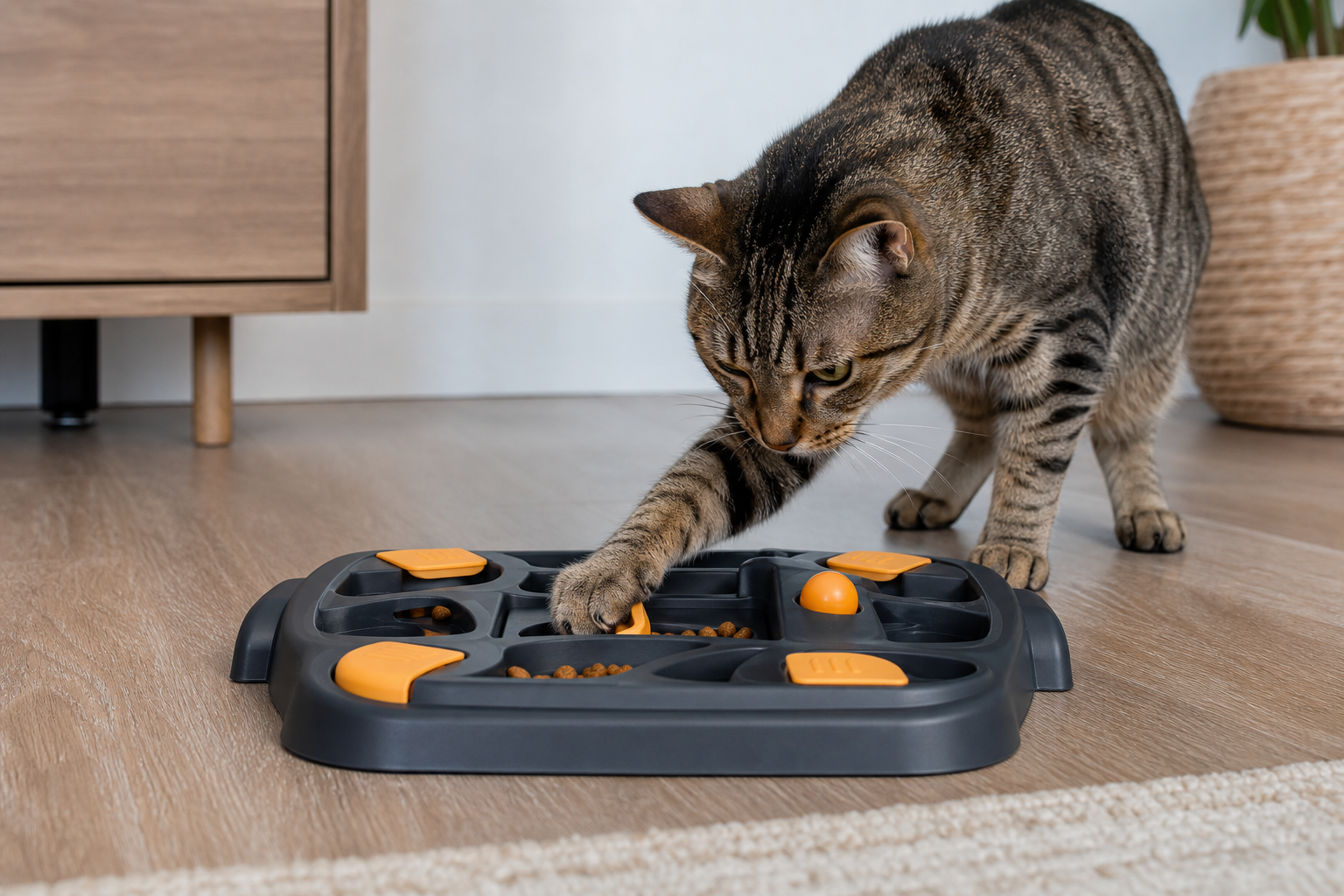
Puzzle cat toys are interactive toys or feeders that make a cat paw, nose, lick, roll, slide, or search to reach food, treats, catnip, or another reward. The best ones give indoor cats a small problem to solve without turning mealtime into frustration or creating loose parts for a determined chewer.
For Titan Claws readers, the real question is not just which puzzle looks clever. It is whether the toy matches your cat’s skill level, food style, bite strength, and supervision routine. A gentle grazer may love a slow feeder tray. A rough player who flips bowls and chews plastic needs sturdier construction, fewer removable parts, and a shorter inspection loop.
This guide covers how to choose puzzle cat toys, how to introduce them, and how to decide when a puzzle feeder should be repaired, cleaned, retired, or replaced.
What Puzzle Cat Toys Are Good For
A good puzzle toy turns passive eating into a small hunting sequence: notice the reward, investigate, paw or lick, adjust, and succeed. That matters because many indoor cats eat from a bowl in a few minutes, then spend the rest of the day with fewer chances to stalk, pounce, forage, and problem-solve.
The Cornell Feline Health Center notes that toys can encourage exercise and cognitive enrichment by motivating cats to stalk, pounce, and problem solve. Texas A&M Veterinary Medicine also recommends mealtime enrichment for indoor cats and describes puzzle feeders as a way to add mental stimulation, physical activity, and stress relief to routine feeding.
Puzzle toys can help with:
- Boredom: the cat has to work through a repeatable challenge instead of waiting for the next big play session.
- Fast eating: many feeders spread out kibble or wet food so the cat cannot inhale a whole meal at once.
- Food motivation: cats that ignore plush toys may care a lot more when the reward is part of their measured daily food.
- Rough play outlets: some cats need a legal target for batting, wrestling, pushing, and problem-solving.
- Routine: a predictable puzzle after breakfast or before bedtime can lower the pressure on furniture, ankles, or other pets.
Puzzle toys are not a cure-all. They work best as one part of an enrichment plan that also includes wand play, scratchers, resting places, vertical space, and toy rotation.
The Main Types of Puzzle Cat Toys
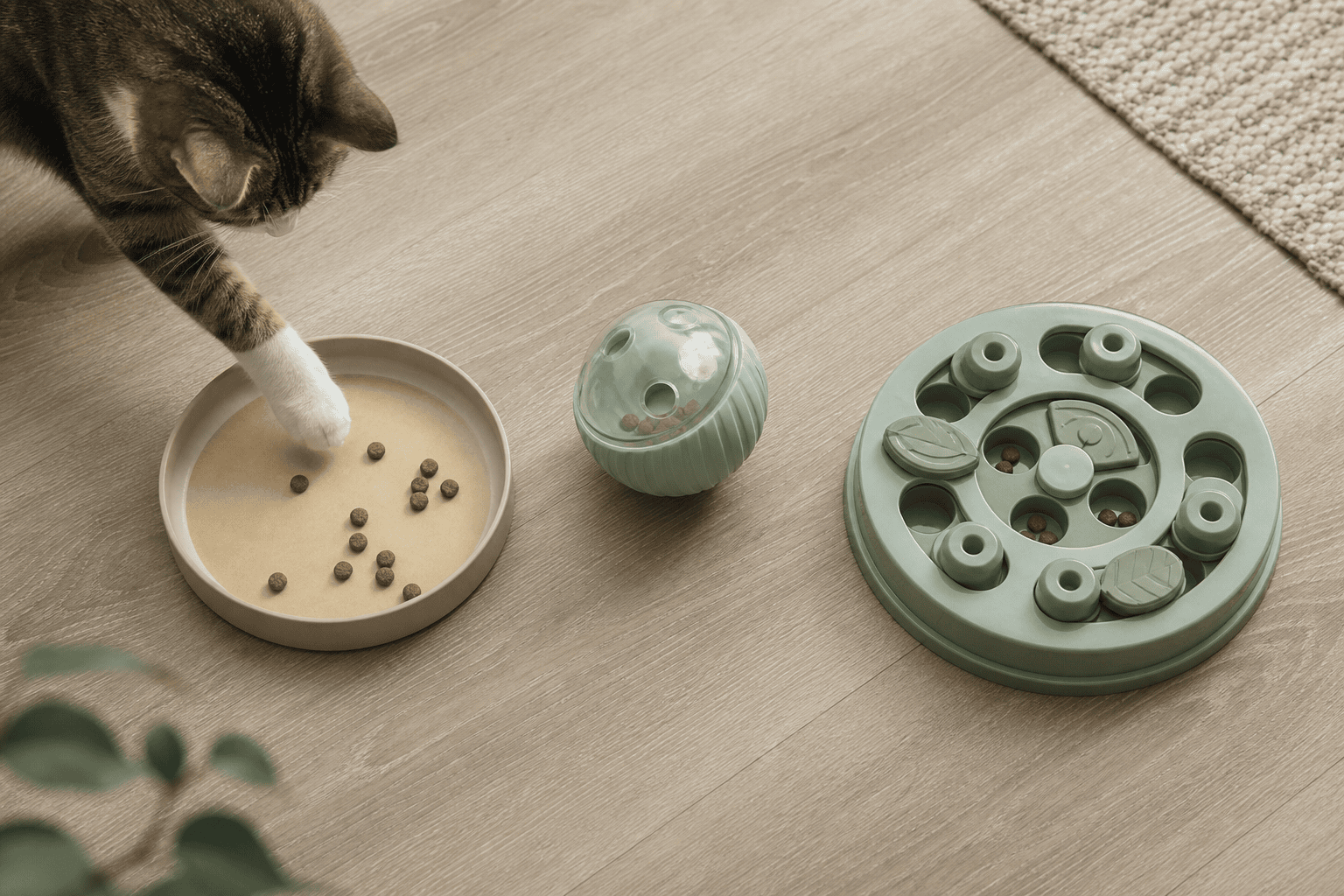
Most puzzle cat toys fall into a few practical categories. Choosing by category is more useful than choosing by novelty, because each type solves a different problem.
Rolling Treat Balls and Tubes
These release dry food or treats as the cat bats the toy around. They are useful for confident cats, cats who like chase games, and cats who need more movement. For rough players, look for a ball that cannot be bitten open easily and does not have brittle doors, sharp seams, or tiny removable sliders.
Stationary Puzzle Feeders
These use cups, channels, pegs, covers, or sliding compartments. They are good for cats who prefer pawing and fishing over chasing. A wide, stable base is important for cats that flip bowls or attack toys with both front paws.
Lick Mats and Wet-Food Puzzles
Lick mats and shallow wet-food puzzles slow down pate, mousse, broths, and soft treats. They are usually easier than hard plastic compartment puzzles, but they need careful cleaning after every use. Choose food-safe materials and avoid designs with deep cracks that trap food.
DIY Cardboard Puzzles
Egg cartons, paper towel tubes, small boxes, and folded towels can make excellent starter puzzles. Cats Protection suggests simple feeding puzzles because they let cats express natural hunting behaviors indoors. DIY puzzles are cheap and flexible, but they are not ideal for cats who eat cardboard, tear tape loose, or chew pieces into swallowable chunks.
How to Match the Puzzle to Your Cat
The right puzzle is the one your cat can solve with effort, not the one that looks hardest. If the first session feels impossible, many cats walk away and never trust the object again.
Start with your cat’s current style:
- Fast eater: use a shallow slow feeder, lick mat, or easy stationary feeder before trying a complicated slider puzzle.
- High prey drive: try a rolling feeder, treat mouse, or puzzle placed at the end of a wand-play sequence.
- Shy or cautious cat: begin with an open tray or egg carton where the food is visible.
- Senior cat: choose stable, low puzzles with easy paw access and no need for big jumps or hard pushing.
- Rough player: prioritize one-piece construction, rounded edges, thick walls, and parts that cannot be snapped off during chewing.
- Multi-cat home: offer more than one puzzle station so a confident cat cannot block the reward from everyone else.
If your cat destroys ordinary toys, read the material and seam guidance in what materials make cat toys unbreakable and safe before buying a puzzle with hinges, glued-on feet, feathers, bells, or thin plastic tabs. For broader toy selection, the Titan Claws guide to unbreakable cat toys for aggressive chewers explains why no toy should be treated as truly indestructible.
A Simple Introduction Plan
The first goal is not difficulty. The first goal is confidence. Make the puzzle almost too easy, then increase the challenge only after your cat has a few quick wins.
- Use part of a normal meal. Do not add a pile of extra treats unless your veterinarian has cleared it. Take the puzzle food from the cat’s daily allowance.
- Place the puzzle near the usual feeding area. Familiar territory lowers suspicion.
- Leave rewards visible. Put a few pieces on top or in open compartments so your cat can succeed immediately.
- Demonstrate once. Slide a cover, roll the ball, or tap the tray with your finger. Then let the cat try.
- Stop before frustration. Five calm minutes beats twenty irritated minutes.
- Raise difficulty slowly. Add lids, reduce opening sizes, or move the puzzle farther from the bowl only after the easy version is boring.
For many cats, one puzzle meal per day is plenty at first. If your cat eats prescription food, needs strict calorie control, has dental pain, or has a medical condition affecting appetite, ask your veterinarian before changing the feeding routine.
Safety Checks for Rough Players
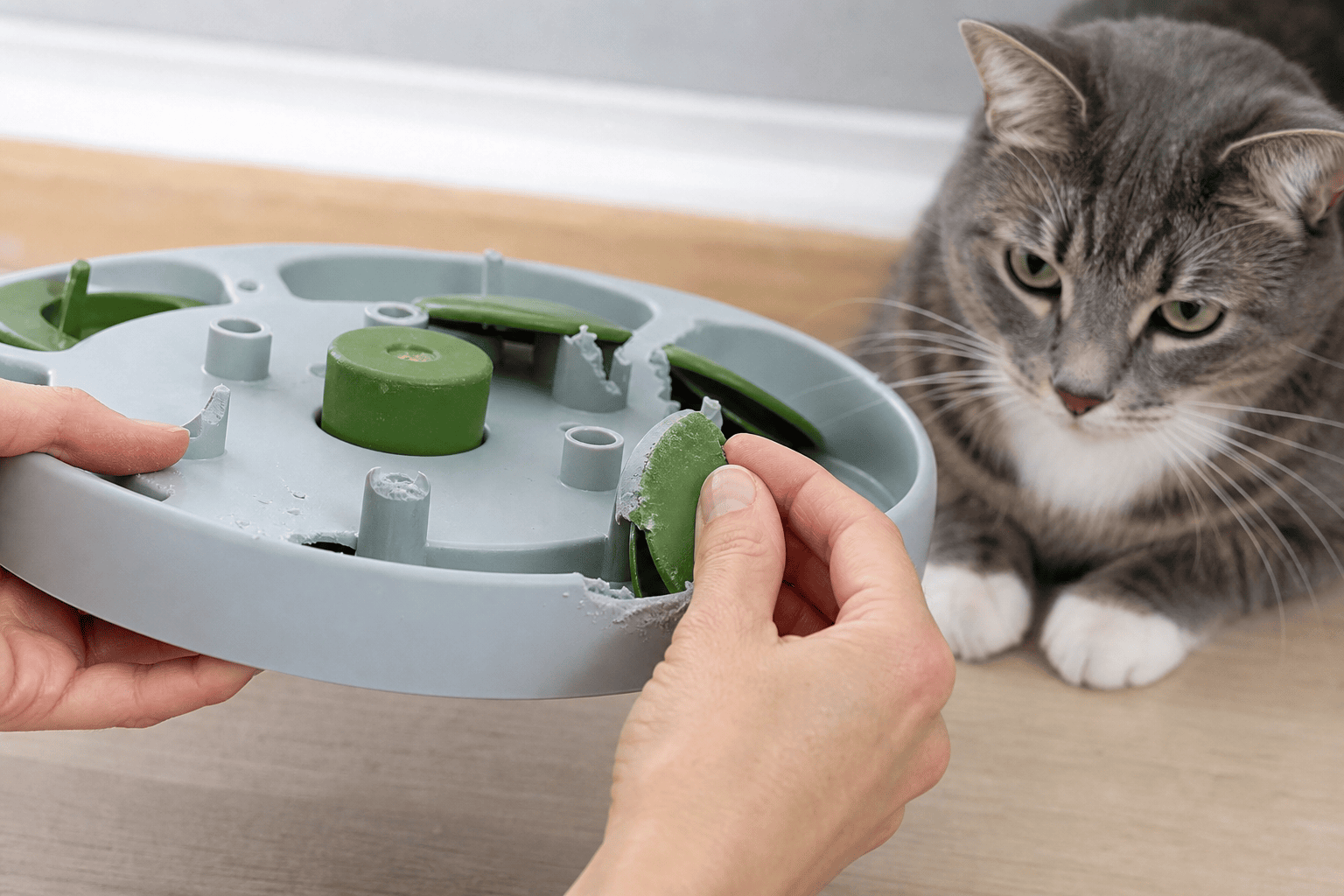
Puzzle toys invite pushing, biting, flipping, and prying. That is exactly why they need stricter inspection than a plain bowl. Cornell advises avoiding toys with small pieces or string-like parts that can separate and be ingested, and the same thinking applies to puzzle feeders.
Before each session, check for:
- Cracks in hard plastic, especially near hinges, sliding tracks, and treat openings.
- Loose rubber feet, caps, pegs, bells, feathers, or decorative pieces.
- Sharp edges where a cat has chewed or snapped a corner.
- Frayed fabric, loose stitching, or exposed filling on soft puzzle toys.
- Trapped food residue, mold, odor, or sticky buildup.
- A puzzle that is small enough for your cat to carry off and chew unsupervised.
Retire the puzzle if you can pull off a piece with your fingers, if a crack creates a sharp edge, or if your cat focuses on eating the toy instead of working for the food. Supervise new puzzle toys until you know how your cat interacts with them.
Wet Food, Cleaning, and Hygiene
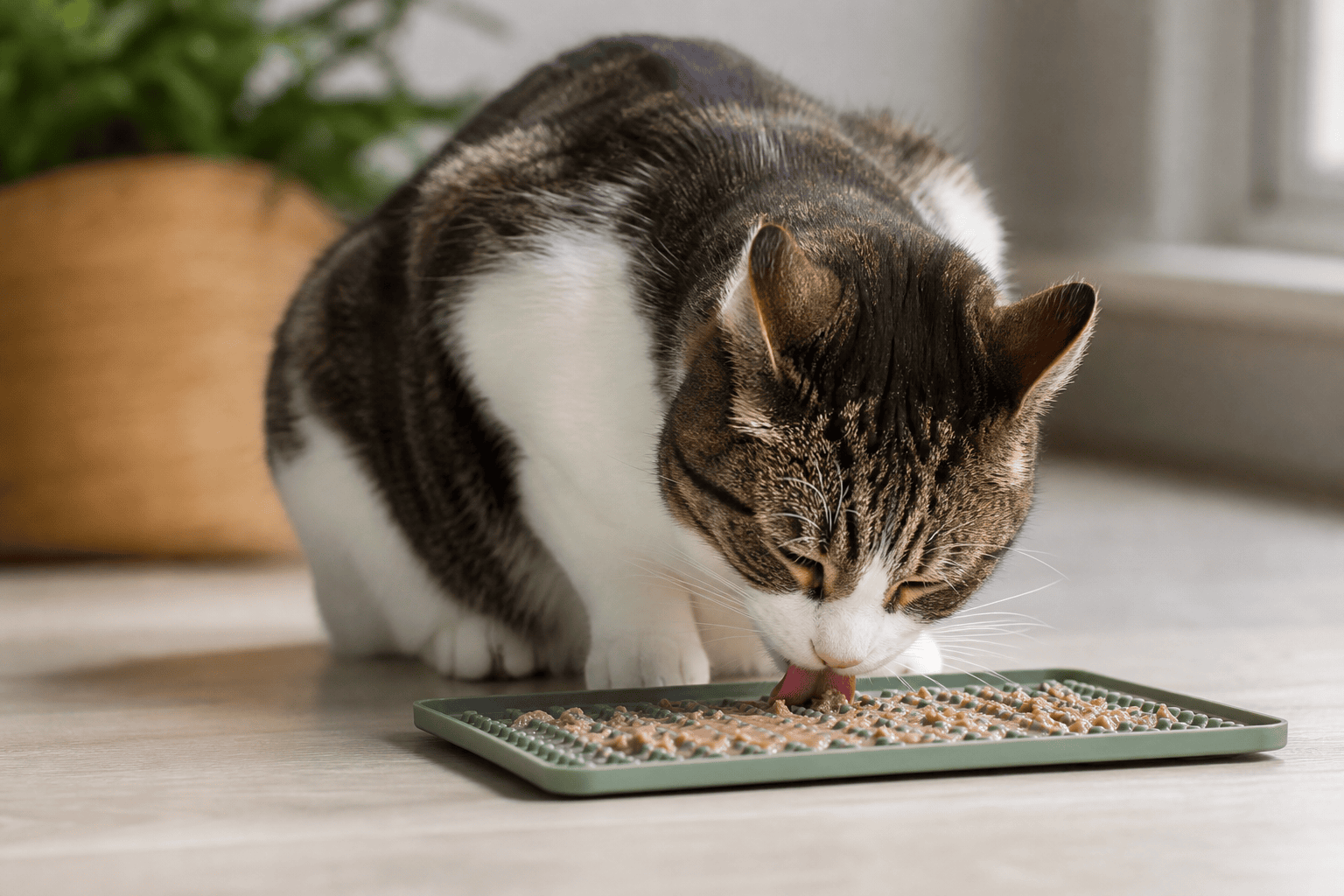
Wet-food puzzles are useful for cats who do not eat kibble, cats who need more moisture, and cats who prefer licking over pawing. They are also less noisy than rolling hard-plastic feeders in a small apartment.
The tradeoff is cleaning. Texas A&M’s mealtime enrichment guidance warns that puzzles and bowls should be cleaned after each use to avoid bacterial or unwanted pathogen buildup. For wet food, choose a dishwasher-safe or easy hand-wash design, then inspect grooves and corners after cleaning.
Skip wet food in porous cardboard, cracked plastic, or any puzzle that cannot dry fully. If the puzzle still smells after washing, treat it as done.
What Current Product Lists Often Miss
Search results for puzzle cat toys are heavy on shopping grids, star ratings, and broad claims about boredom. Those are useful starting points, but they often miss the owner decisions that matter after the box arrives.
A stronger buying decision asks:
- Can my cat solve the easiest version within a few minutes?
- Can this toy survive my cat’s actual bite and paw strength?
- Are there removable parts that become swallowable if chewed?
- Is the puzzle easy to clean with the food I actually feed?
- Will this work in a multi-cat room without guarding or conflict?
- Can I make it harder gradually, or is it one difficulty forever?
If a product page does not answer those questions, use photos and reviews to inspect the construction: tabs, seams, feet, openings, and moving pieces. For rough cats, simple and sturdy usually beats clever and fragile.
Quick Puzzle Cat Toy Checklist
- Start with an easy puzzle and visible rewards.
- Use measured food from the daily allowance.
- Match puzzle type to food type: dry, wet, treat, or catnip.
- Choose stable designs for cats that flip bowls.
- Avoid small removable parts, string, feathers, and brittle tabs for chewers.
- Inspect before and after sessions until you know the toy’s failure points.
- Wash food puzzles after use, especially wet-food mats and trays.
- Rotate puzzles with wand play, kicker toys, scratchers, and rest days.
Bottom Line
Puzzle cat toys are worth trying when your cat needs more challenge, slower meals, or a safer outlet for busy paws. The best puzzle is not the most complicated one. It is the one your cat can learn, repeat, and enjoy without chewing off pieces or becoming frustrated.
Start easy, supervise closely, inspect like a rough-play owner, and keep the puzzle as one tool in a broader enrichment routine. That approach gives your cat the fun part of the hunt while keeping the boring safety work where it belongs: in your hands.
Leave a Reply