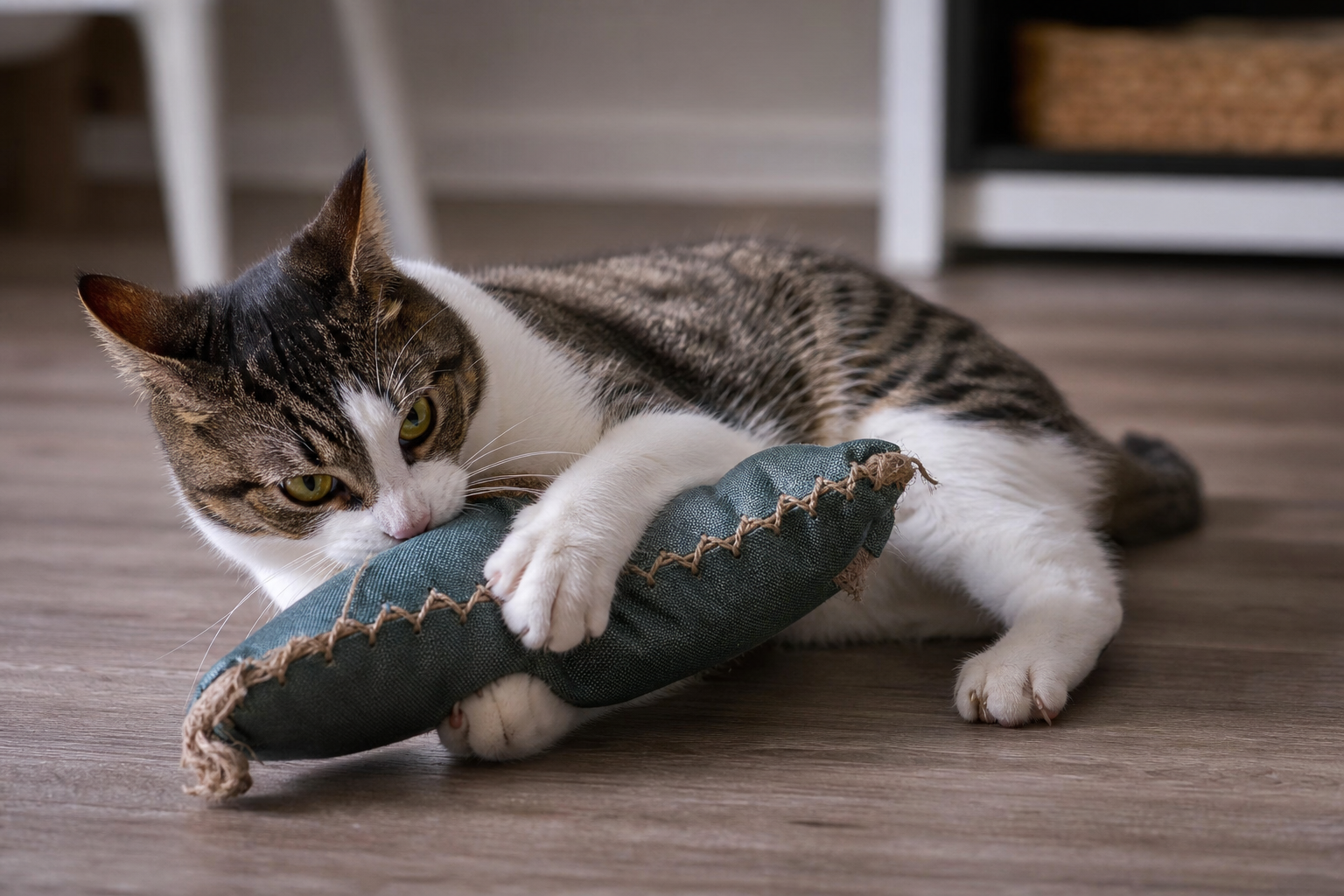
Cat in the Hat toys are usually plushes, figurines, story-machine accessories, hand puppets, or party favors made for children, collectors, classrooms, and Dr. Seuss fans. They are not automatically cat toys just because the character is a cat. If your real cat wants to grab, chew, kick, or carry one, treat it as a novelty object first and inspect it before any supervised play.
The short answer for cat owners is this: keep collectible, electronic, tiny, or heavily decorated Cat in the Hat toys away from cats that chew. If you want a red-and-white, bookish, or whimsical play theme, choose a purpose-built cat toy with safer sizing, stronger seams, fewer detachable parts, and a clear inspection routine. Cute should never outrank swallowing risk.
What Searchers Usually Mean by Cat in the Hat Toys
Most ranking results for this keyword are shopping pages. Target listings show character plushes such as hand puppets, armature plushes, palm-size plush toys, and themed stuffed animals. Little Tikes and Walmart results also show Story Dream Machine-style products that light up, talk, play music, or pair with story content. Amazon, eBay, and Oriental Trading results add figurines, party favors, action figures, and reading reward items.
That search intent matters because many of those products were designed for people, not pets. A classroom plush might be fine in a reading corner. A talking plush may be fine for a child within the age guidance on the product. A tiny figure may be fine on a shelf. None of that means the same item should be left on the floor with a cat that likes to bite seams, pull tags, shred stuffing, or chew plastic.
This is the gap most shopping pages leave open. They can help you find a Cat in the Hat plush, but they usually do not tell you whether your cat should be allowed to attack it. Titan Claws looks at the question from the cat’s end: mouth size, prey drive, chewing style, supervision, damage inspection, and whether the toy can fail safely.
Are Cat in the Hat Plush Toys Safe for Cats?
Sometimes, but only under narrow conditions. A large, simple plush may be acceptable for a brief supervised photo or gentle interaction if your cat only sniffs and bats. It becomes a poor cat toy if your cat chews fabric, opens seams, removes tags, swallows stuffing, targets embroidered details, or tries to drag the toy away.
Before letting a cat touch any novelty plush, check these details:
- Size: avoid anything small enough for your cat to mouth deeply, carry by a tiny limb, or swallow in part.
- Seams: skip toys with weak stitching, thin fabric, open edges, or stuffing that shifts toward corners.
- Decorations: remove access to plastic eyes, buttons, beads, bow ties, ribbons, bells, glued-on patches, and loose thread.
- Tags and loops: tags, hang loops, display cords, and packaging ties are not play features.
- Stuffing: retire the item immediately if stuffing appears or the fabric thins under teeth.
- Electronics: do not let a cat chew any plush with batteries, speakers, wires, charging ports, light modules, or sound buttons.
For cats that destroy ordinary toys, a novelty plush should usually stay on a shelf. The safer play object is a real cat toy built around how the cat bites, kicks, chases, or wrestles. If chewing is the main issue, start with Titan Claws’ guide to safe cat chew toys instead of handing over a collectible plush.

Why Human Plush Toys Fail Differently Than Cat Toys
A cat toy and a children’s plush can both be soft, but they are built for different abuse. A child may hug, carry, press, or display a toy. A cat may clamp with canine teeth, rake with back claws, shake the toy like prey, lick seams until they loosen, and focus on the smallest part that moves.
That difference exposes weak points fast. Thin appendages become chew handles. Hat brims, bow ties, tails, tags, and stitched corners become tug points. Small plushes can become mouth-sized. Electronic story toys add hard modules and battery compartments that are not appropriate for chewing. Even a non-electronic plush can become dangerous once a cat opens the seam and reaches stuffing.
Cornell Feline Health Center advises avoiding toys with small pieces and linear strand-like parts, including feathers and string, that may separate when chewed and be ingested. That guidance applies directly to novelty toys with ribbons, thread loops, loose yarn-like trim, or detachable details. The University of Wisconsin School of Veterinary Medicine gives similar practical guidance for aggressive chewers: avoid feathers, strings, and sparkly pieces that can be ingested, and choose sturdy construction instead.
When a Cat in the Hat Toy Should Be Display Only
Some toys should never become cat toys, even for a funny video. Keep the item out of reach if any of these are true:
- It talks, lights up, plays music, projects images, or contains batteries.
- It is a figurine, action figure, party favor, or small collectible.
- It has a long hat brim, wire armature, rigid internal parts, or hard accessories.
- It includes ribbons, yarn, elastic, string, cords, feathers, or loops.
- It has plastic eyes, small buttons, beads, glued-on pieces, or removable clothes.
- It is valuable, sentimental, vintage, or not washable.
- Your cat has a history of eating fabric, string, foam, plastic, stuffing, or toy parts.
If you are buying for a child in a home with cats, plan storage at the same time as the gift. A high shelf, closed bin, closet, or child-only room is more realistic than hoping a prey-driven cat ignores a soft, dangling, new-smelling object.
What to Choose Instead for a Cat Who Likes the Theme
You can still make play feel whimsical without giving your cat a fragile character toy. Aim for the movement or texture your cat wants, then choose a cat-safe format.
For cats that hug and kick
Use a long kicker toy with dense fabric, firm stuffing, and reinforced ends. The toy should be long enough that your hand stays out of the rake zone. If your cat likes plush texture, choose a simple shape without loose limbs, ribbons, or tiny details.
For cats that chase hats, pom-poms, or small objects
Use sturdy balls, larger soft chase toys, or enclosed ball tracks. Avoid tiny party favors or figurines. A hard object that is small enough to fit in the mouth is not a good substitute for a cat ball.
For cats that love dangling movement
Use a wand toy only while you are present. Let the cat catch the lure sometimes, then put the wand away. Do not leave string, ribbon, or elastic toys out after play. The ASPCA warns that swallowed yarn and string-type items can damage the intestines when they catch and pull like a drawstring.
For cats that need brain work
Use puzzle feeders, treat balls, hide-and-seek games, or a rotation of toys. The AAFP and ISFM feline environmental needs guidelines describe play and predatory behavior as part of a healthy feline environment. The goal is not one perfect themed toy. It is a routine that lets your cat stalk, chase, pounce, grab, chew appropriately, and settle.

A 60-Second Safety Test Before Any Novelty Toy Play
If you still want to let your cat interact with a Cat in the Hat plush for a short supervised session, run this check first.
- Remove packaging completely: cut away plastic ties, hang tags, sticker tabs, and display hooks before the cat enters the room.
- Look for the first part your cat would bite: hat brim, bow, tag, tail, hand, foot, cord, seam corner, or embroidered patch.
- Pinch and tug seams: if a seam opens under your fingers, it will not survive a rough cat.
- Check for hidden hard parts: avoid sound modules, battery doors, wires, armatures, pellets, or hard plastic frames.
- Match the toy to your cat’s mouth: if the cat can mouth a piece deeply, carry it away, or chew off a small appendage, stop.
- Supervise the whole session: no leaving the room, no overnight access, no toy bin storage with real cat toys.
- Inspect again afterward: retire or display the toy if you see wet seams, loose threads, bite holes, exposed stuffing, or missing pieces.
This test is deliberately strict. Cats that play rough do not need many chances to find the weak point. Titan Claws’ broader safety guidance uses the same principle: durable still means supervised, inspected, and retired when damaged.
Better Toy Rotation for Cats That Destroy Plush
If your cat keeps targeting human plush toys, the problem may be unmet play needs rather than the specific object. Build a rotation that gives the cat legal outlets throughout the week.
- One wrestling option: a rugged kicker or larger soft toy for biting and back-foot kicking.
- One chase option: a ball, track, tunnel game, or tossed toy that moves away from the cat.
- One interactive option: a wand or teaser that gets stored after supervised play.
- One food-work option: a puzzle feeder or treat search game.
- One quiet option: a scratcher, cardboard box with handles removed, or perch near a window.
Rotate instead of leaving everything out. Novelty keeps toys interesting, and stored toys last longer. For a full weekly setup, read Titan Claws’ cat toys for enrichment guide. If you are trying to make safe toys from household materials, use the homemade cat toys checklist before turning craft supplies into cat bait.

Quick Decision Guide
Use this quick rule set when a Cat in the Hat toy, plush, puppet, or figurine enters a cat home:
- Display it if it is collectible, electronic, sentimental, small, decorated, or not built for chewing.
- Supervise briefly only if it is large, simple, non-electronic, free of small parts, and your cat is a gentle sniffer or light batter.
- Replace it with a real cat toy if your cat bites hard, bunny-kicks, removes tags, opens seams, chews fabric, or carries toys away.
- Call your veterinarian if your cat swallows stuffing, string, plastic, batteries, fabric, or any piece of a toy, or if you see vomiting, gagging, appetite loss, lethargy, painful behavior, or trouble passing stool.
Cat in the Hat toys can be fun gifts for people, but your cat does not know the difference between a collectible and prey. Keep risky human toys out of reach, use purpose-built cat toys for real play, supervise the first sessions with anything new, and retire damaged toys before cute becomes costly.
Sources
- Target: Cat in the Hat toy listings
- Target: Little Tikes Story Dreamers Cat in the Hat Plush product details
- Walmart: Story Dream Machine licensed plush listing
- Cornell Feline Health Center: Safe toys and gifts
- University of Wisconsin School of Veterinary Medicine: Safe toys for cats
- AAFP/ISFM Feline Environmental Needs Guidelines
- ASPCA Animal Poison Control Center: string and yarn ingestion risks
Leave a Reply