If you searched for Gabby cat toys, you are probably seeing a mix of Gabby’s Dollhouse toys for children, plush characters such as Pandy Paws or Cakey Cat, retailer pages at Amazon, Target, and Walmart, and a few results that look cat-themed but are not made for real cats. The short answer for cat owners is this: most Gabby’s Dollhouse toys are children’s pretend-play toys, not cat toys. They can be cute in a cat-loving home, but they should not be handed to a cat unless you have checked the size, seams, small parts, batteries, strings, and how your cat chews.
That distinction matters. A toy that is safe enough for a supervised preschooler may still be wrong for a cat that bites, bunny-kicks, drags toys under furniture, or tries to eat fabric. This guide explains what the current results get right, what they leave out for pet owners, and how to choose safer alternatives if your goal is enrichment for an actual cat.
What Are Gabby Cat Toys?
In search results, “Gabby cat toys” usually means Gabby’s Dollhouse merchandise: dollhouses, figures, plush toys, books, and playsets based on the DreamWorks show. The official shop points families to major retailers, and retailer pages commonly feature products for children ages 3 or 4 and up. Walmart’s Gabby’s Dollhouse page, for example, lists LEGO playsets, figures, plush toys, books, and dollhouse accessories rather than pet products.
Those toys are designed around pretend play, collecting, cuddling, display, and compatibility with other playsets. That is different from a cat toy designed around teeth, claws, pouncing, drool, loose-thread inspection, and safe supervised prey play.
There is nothing wrong with a Gabby’s Dollhouse plush sitting on a shelf or bed in a cat household. The problem starts when a real cat is allowed to treat it like prey. A cat does not know the difference between a collectible plush, a child’s figure set, a dangling accessory, and a purpose-built kicker toy. Your job is to make that distinction before the cat does.
Why Ranking Pages Miss the Cat-Owner Question
The top results for this keyword are mostly stores and videos. They help shoppers find official characters, playsets, and where to buy them. They do not usually answer the cat-owner questions that matter:
- Can my cat chew this plush safely?
- Are the eyes, bows, ears, tails, wheels, stickers, or accessories easy to pull off?
- Does the toy have batteries, magnets, lights, sound modules, or hard plastic parts?
- Is it washable after cat drool?
- Will it survive kicking without opening a seam?
- Should it be stored away from pets after a child is done playing?
That is the useful gap for Titan Claws readers. Cute cat-themed products can belong in the home, but rough-playing cats need toys chosen for the way they actually attack, carry, and destroy things. If your cat has already shredded ordinary plush mice, a licensed character plush is usually a display item, not an upgrade.
Can Cats Play With Gabby’s Dollhouse Toys?
Sometimes a cat can safely bat at a large, intact plush for a brief supervised moment. That does not make the toy a good cat toy. Before allowing any interaction, assume the toy was not designed for feline chewing and run through a safety check.
Be especially cautious with these formats:
- Small figures and accessories: tiny food pieces, furniture, shoes, clips, charms, and plastic accessories can be choking or ingestion hazards.
- Plush toys with sewn-on details: eyes, noses, ears, tails, bows, appliques, tags, and decorative stitching can become targets for chewing cats.
- Interactive toys: lights, sound boxes, battery compartments, moving parts, and charging ports add failure points.
- Building sets: small bricks and mini figures are not appropriate for cats to carry or chew.
- Strings, elastics, hair-like fibers, ribbons, and cords: these are high-risk around cats that chew or swallow strands.
If the toy is important to a child, that is another reason to keep it out of the cat’s toy rotation. A cat can damage a favorite plush quickly, and the damaged toy can become less safe for both the child and the pet.

The Safety Check Before Any Cat Gets Near One
The U.S. Consumer Product Safety Commission’s toy guidance focuses on hazards such as small parts, sharp edges, points, cords, batteries, magnets, and seams for children’s products. Nemours KidsHealth also tells parents to read age labels, supervise play, check toys regularly, and remove broken toys. Those are child-safety standards, but the same categories are useful when a pet may steal or chew a toy.
Run this check before a Gabby-themed toy is left anywhere your cat can reach:
- Read the age grade and warnings. If the toy warns about small parts, treat it as unsafe for unsupervised pet access.
- Look for detachable pieces. Tug gently on eyes, bows, tags, tails, ears, stickers, charms, clips, and accessories.
- Check seams and stuffing. Do not let a cat chew a plush with weak seams, exposed stuffing, pellets, or hard internal parts.
- Find every battery or sound module. Battery compartments should be secured, but secured for a child is not the same as safe for a chewing cat.
- Remove packaging immediately. Plastic ties, bags, labels, and fasteners are not toys.
- Watch the first interaction. If the cat bites, gnaws, shakes, or tries to carry it away, end the session and store the toy.
For cats that are known chewers, the safer default is simple: do not use children’s franchise toys as cat toys. Choose purpose-made cat toys and reserve the Gabby merchandise for the humans in the home.
Better Alternatives for Cats That Like the Gabby Look
If the appeal is bright color, cute characters, or a playful cat theme, you can keep that mood without giving your cat a toy built for a different user. Match the replacement to your cat’s play style.
For cats that hug and kick
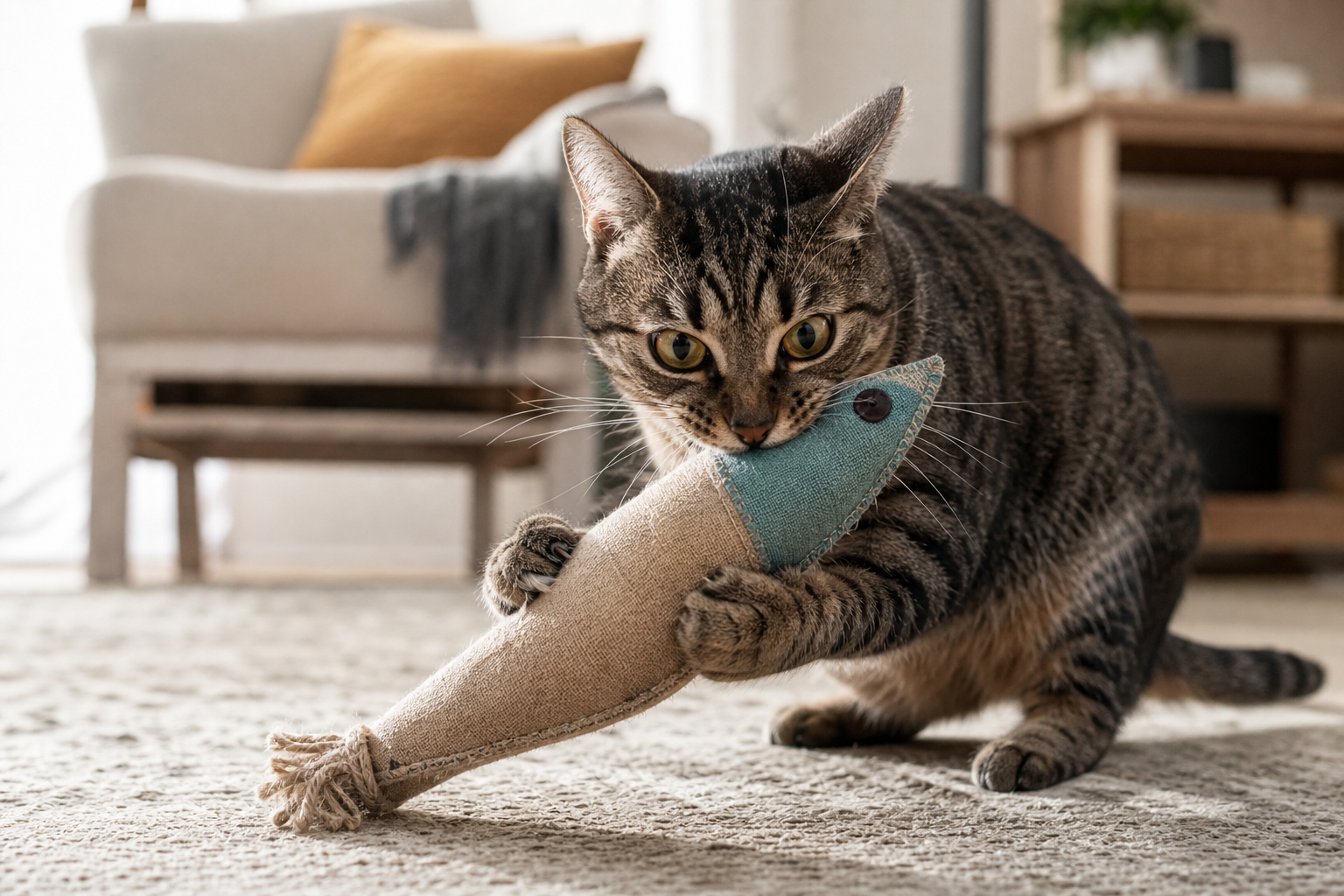
Choose a long fabric kicker that is too large to swallow and long enough to keep your hands out of the target zone. Look for dense fabric, reinforced seams, minimal decorations, and stuffing that stays contained. Titan Claws has a practical guide to banana cat toys if your cat likes cute kicker shapes but plays rough.
For cats that chase characters across the floor
Use sturdy balls, track toys, tunnels, or a wand session that moves like prey. Avoid tiny figures and hard accessories that can disappear under furniture. If the cat loves motion, compare options in the Titan Claws guide to cat toys that move.
For cats that chew plush
Skip collectible plush and choose chew-aware toys with fewer details. A chew toy should be inspectable, washable, and large enough that the cat cannot swallow it whole. The Titan Claws chewy cat toys guide covers what to inspect when your cat gnaws instead of only batting.
For cats that need a daily routine
Use a toy rotation rather than one special toy left out all week. Rotate chase toys, kickers, puzzle feeders, tunnels, and cardboard play. For a fuller plan, start with cat toys for enrichment or cat enrichment activities.

How to Store Kids’ Toys in a Cat Household
Storage matters because cats often find toys after the child has moved on. A small plastic accessory on the floor, a plush with a loose tag, or a playset part under the couch can become a midnight chew session.
- Keep small figures, bricks, furniture pieces, and accessories in lidded bins.
- Store plush collectibles on shelves, beds, or closed-room spaces if your cat chews fabric.
- Make a simple rule: children’s toys go away before wand toys or catnip toys come out.
- Check under sofas, beds, and play tables for missing small parts.
- Throw away broken pieces instead of leaving them in a mixed toy bin.
- Keep electronic toys, batteries, and charging cables away from cats.
This is not only about protecting the cat. It also protects the child from finding a favorite toy wet, torn, or missing an accessory after the cat has treated it like prey.
When a Gabby-Themed Plush Might Be Okay
A large, simple plush with no small hard parts may be acceptable as a household cuddle item, but only if your cat ignores it or interacts gently. Even then, inspect it like you would inspect a cat toy. Look for loose seams, exposed stuffing, detached tags, surface damage, and parts that can be bitten off.
The University of Wisconsin School of Veterinary Medicine warns that cats who chew aggressively may ingest feathers, strings, sparkly bits, and similar toy materials, and that intestinal obstruction can be serious. That guidance applies well beyond traditional cat toys. If your cat eats fabric, thread, ribbon, foam, stuffing, or plastic, do not experiment with children’s plush toys.
Veterinary environmental guidelines from AAFP and ISFM describe play and predatory behavior as a core feline environmental need. The goal is not to remove play. The goal is to give cats play that satisfies stalking, chasing, pouncing, grabbing, and problem solving without handing them parts they can swallow.
Quick Decision Checklist
- Buying for a child who likes Gabby’s Dollhouse? Use the official shop and major retailers, follow the age grade, and store small parts away from pets.
- Buying for a real cat? Choose a purpose-made cat toy instead of a children’s playset, figure, or collectible plush.
- Cat steals the child’s Gabby toy? Take it back, inspect for damage, and replace the cat’s interest with a safer kicker, chase toy, or puzzle feeder.
- Cat chews fabric or string? Do not allow access to plush characters, ribbons, tags, yarn-like details, or dangling accessories.
- Cat only likes the cute look? Pick cute cat toys with stronger seams and fewer removable parts. See Titan Claws’ guide to cute cat toys for that balance.
Gabby cat toys are easy to find, but the search phrase points to two different shoppers: families buying Gabby’s Dollhouse merchandise and cat owners looking for cat-themed enrichment. Keep those use cases separate. Let the licensed toys be for kids and collectors, and give rough-playing cats toys built for teeth, claws, supervision, rotation, and regular inspection.
Sources
- Official Gabby’s Dollhouse shop
- Walmart Gabby’s Dollhouse category page
- U.S. Consumer Product Safety Commission toy safety guidance
- Nemours KidsHealth: Choosing safe toys for toddlers and preschoolers
- University of Wisconsin School of Veterinary Medicine: Safe toys for cats
- AAFP and ISFM Feline Environmental Needs Guidelines
Leave a Reply