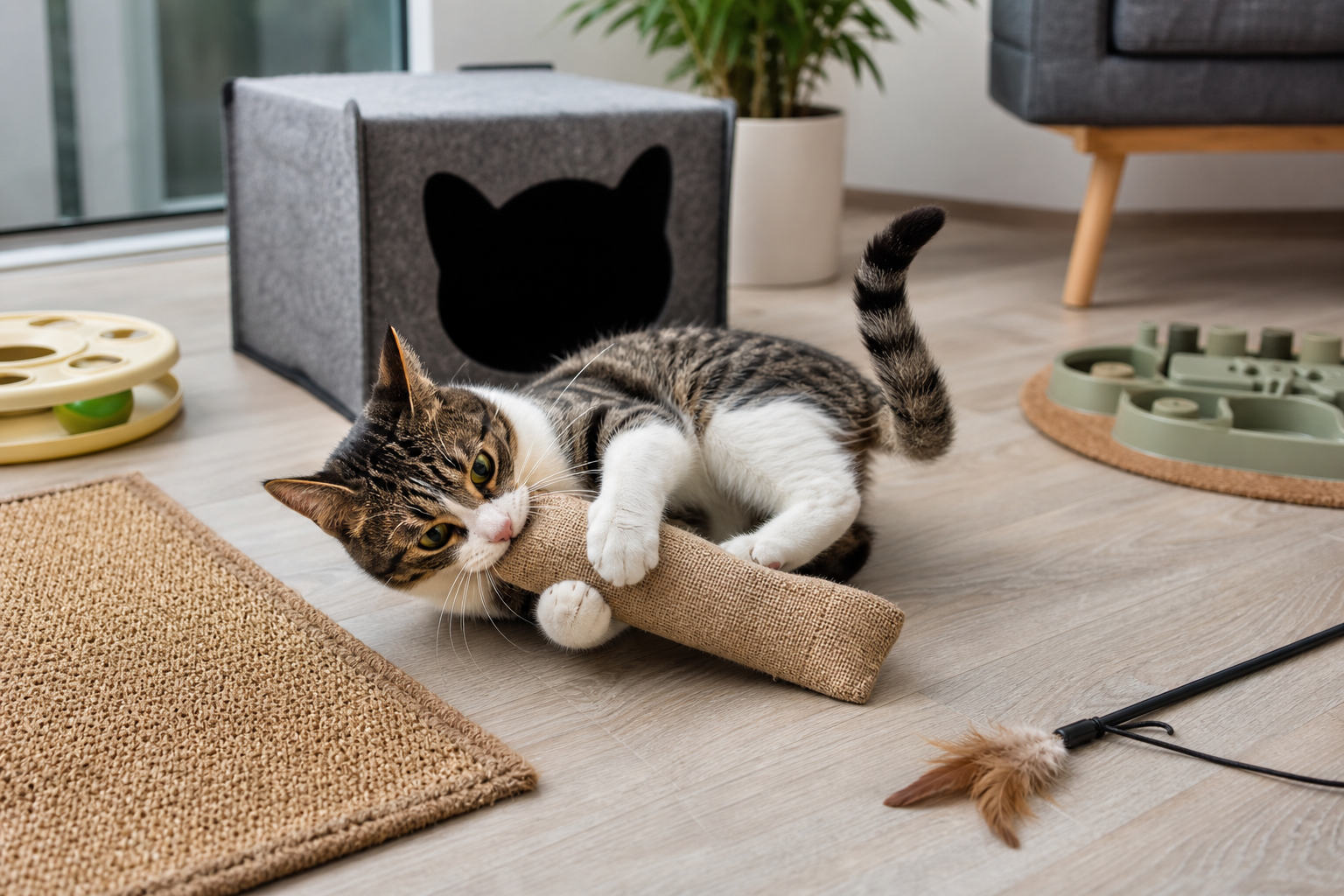
The best cat toys and accessories are not the biggest pile of cute objects. They are a small, intentional kit that lets your cat chase, stalk, pounce, bite, kick, forage, scratch, hide, climb, and rest without turning every play session into a safety problem.
If your cat destroys ordinary toys, shop by job and risk instead of by trend. Choose a few sturdy supervised toys for high-arousal play, a few lower-risk items for independent batting or foraging, and accessories that support normal cat behavior: scratchers, puzzle feeders, hideouts, perches, tunnels, and storage that keeps string toys out of reach.
This guide is written for owners who want a practical cat toys and accessories setup, especially for indoor cats, bored cats, and rough players that chew seams, pull feathers, or shred plush toys.
What the Current Search Results Get Right and Miss
The current results for cat toys and accessories are dominated by stores, marketplaces, and category pages. They are useful if you already know what to buy, but most of them do not help you decide which toys belong in the same home, which toys require supervision, or when an accessory is solving a real behavior need instead of adding clutter.
A better article has to answer the owner decision: what should be in a balanced kit, what should be avoided for a destructive cat, and how should the kit change for kittens, bored indoor cats, senior cats, multi-cat homes, and cats that bite hard during play?
The core rule is simple: each item should earn its place. If a toy does not support a specific behavior, survive the way your cat actually plays, or stay safe under the amount of supervision you can provide, it is not a good fit.

Build the Kit Around Play Jobs
Cats do not need ten versions of the same toy. They need outlets for different parts of the hunting and enrichment cycle. The 2013 AAFP and ISFM environmental needs guidance frames play and predatory behavior as part of a healthy feline environment, and VCA summarizes the same idea by recommending toys, play-based interaction, and feeding devices that make cats work for food.
Use these play jobs as the starting point for a cat toys and accessories kit:
- Chase: wand toys, teaser rods, rolling toys, and motion toys that move like prey.
- Catch and kick: kicker toys, larger plush toys, and tough fabric toys that keep teeth and back claws away from hands.
- Forage: puzzle feeders, treat balls, snuffle-style mats, scatter feeding, and cardboard reach feeders.
- Scratch: vertical posts, horizontal scratchers, sisal, cardboard, and carpet-style surfaces matched to your cat’s preference.
- Hide and ambush: tunnels, boxes, paper bags with handles removed, and low hideouts near play areas.
- Independent batting: ball tracks, larger lightweight balls, crinkle toys, and other toys without string or small detachable parts.
- Storage and rotation: a closed bin, hook, drawer, or cabinet that keeps risky toys unavailable when you are not playing.
For a rough player, the catch-and-kick category matters most. If the cat has no legal target to grab after the chase, teeth and claws often move to hands, ankles, furniture, or the fragile wand lure.
The Essential Cat Toys and Accessories List
Start smaller than a shopping cart suggests. A strong first kit can be six to nine items, rotated over time.
1. One wand toy for supervised chase
A wand toy is excellent for stalking, chasing, and pouncing because you control the movement. It is also a supervised-only accessory. Put it away after play, especially if it has string, elastic, wire, feathers, or small connector parts. For deeper buying notes, see Titan Claws on wand cat toys and feather wand cat toys.
2. One sturdy kicker for the catch phase
A kicker gives the cat something long enough to hug, bite, and rake with the back feet. Look for dense fabric, reinforced seams, no glued-on eyes, no loose bells, and a size that is too large to swallow but easy enough to grip. If your cat destroys plush, read Titan Claws on durable cat toys and cat chew toys for aggressive chewers.
3. One foraging toy or puzzle feeder
Food puzzles and treat-dispensing toys make part of a meal more active. They are useful for bored indoor cats because the reward comes through sniffing, pawing, rolling, and problem-solving rather than another bowl refill. Start easy, then increase difficulty only when your cat is succeeding without frustration.
4. Two scratch surfaces
Offer at least one vertical and one horizontal option if you do not yet know your cat’s preference. Scratching is not a bad habit; it is a normal behavior that stretches muscles, maintains claws, and leaves scent information. A scratcher belongs in the kit just as much as a toy does.
5. One hideout, tunnel, or box
A box or tunnel makes chase play more realistic because the lure can disappear, pause, and reappear. It also gives shy cats a place to observe before joining. Remove staples, tape loops, plastic windows, and bag handles. If your cat eats cardboard or paper, use hideouts only during supervised sessions.
6. One independent play item
For many cats, a ball track, large lightweight ball, or simple crinkle toy is safer to leave out than a wand or feather teaser. No toy is automatically safe for every cat, but independent toys should have no strings, no tiny parts, no loose tags, and no pieces your cat can bite off quickly.
7. A storage bin for rotation
Storage is not glamorous, but it is one of the most important accessories in the house. It keeps string toys away, helps toys feel fresh when they reappear, and makes inspection easier because you handle the toy before and after each session.
Safety Rules for Cats That Chew, Shred, or Swallow Pieces
For destructive cats, the safety question is not whether a toy looks durable in the package. It is how the toy fails after teeth, claws, saliva, and repeated kicking.
University of Wisconsin School of Veterinary Medicine warns that aggressive chewers may ingest feathers, strings, or sparkly parts and recommends sturdy construction, no loose decorations, cutting off loops or tags, and removing pieces that get chewed off. PAWS gives a similar rule: remove or avoid ribbons, feathers, strings, eyes, and other small parts that can be chewed or swallowed.

Use this rough-player filter before a toy joins the rotation:
- No string left out: wand strings, ribbons, yarn, dental floss, elastic, and similar materials are for active supervision only.
- No tiny detachable parts: skip glued eyes, bells, beads, buttons, charms, weak feather clusters, and decorative plastic pieces.
- No exposed hardware: avoid sharp clips, open rings, staples, pins, wires, and cracked plastic.
- No weak seams for chewers: if your cat opens plush toys quickly, prioritize heavier fabric, simpler shapes, and fewer decorative seams.
- No mystery filling: avoid toys with hard beads, nutshells, or polystyrene-style beads if the outer shell may fail.
- No unattended trial runs: supervise the first few sessions before deciding whether an item can stay out.
Small Door Veterinary notes that yarn, string, ribbons, and similar materials can cause serious gastrointestinal injury if swallowed, and recommends throwing damaged toys away promptly. PetMD also emphasizes durability, size, and storing string or wire toys after use.
How to Match Accessories to Your Cat
A good kit changes by cat. Age, bite strength, activity level, confidence, health, and household layout all matter.
Kittens
Kittens often need frequent short sessions, safe chew outlets, and strict storage because they explore with their mouths. Avoid tiny toys that can disappear under furniture and reappear damaged. Use wand play to burn energy, then redirect to a kicker instead of hands.
Bored indoor cats
Prioritize variety in motion, food work, and climbing. Use a wand or moving toy for chase, a puzzle feeder for meals, a window perch for watching, and a scratcher near the room where the cat already spends time. For more rotation ideas, see cat toys for boredom and cat toys for bored cats.
Rough players
Buy fewer, tougher toys and inspect them more often. Separate fragile enrichment from bite work: use a puzzle for foraging, a wand for chasing, and a sturdy kicker for catching. If the cat redirects onto people, use the guide to cat toys for play aggression.
Senior cats
Choose lower-impact chase games, easy-entry hideouts, soft but inspectable kickers, and puzzle feeders that do not require painful stretching or hard pawing. If a senior cat suddenly avoids play, misses jumps, limps, or seems reluctant to bite, ask a veterinarian rather than assuming the toy is boring.
Multi-cat homes
Use multiples of important resources. VCA’s environmental-needs summary recommends multiple separated resources, including play areas and scratching areas, especially in multi-cat homes. Do not force cats to share one tunnel, one scratcher, or one high-value puzzle if that creates guarding or tension.
What to Skip, Even If It Is Popular
Popular does not mean appropriate for your cat. Skip or tightly supervise these categories if your cat chews hard, eats non-food materials, or destroys toys quickly:
- Loose string toys: fun during active play, risky when left out.
- Tiny mouse toys with glued parts: check eyes, ears, tails, bells, and seams before use.
- Cheap feather clusters: many fail quickly under chewing and should not be used as catch toys.
- Laser-only routines: use sparingly and end with a physical toy the cat can catch, then a small food reward if appropriate.
- Noisy electronic toys with weak covers: inspect battery doors, screws, wheels, and moving parts.
- Decorative accessories: if the item is mostly cute for humans and not useful for the cat, it does not need floor time.
This does not mean every delicate toy is forbidden. It means you classify it honestly. A feather wand can be a great chase tool. It is not a safe chew toy. A cardboard box can be great enrichment. It is not safe for a cat that eats cardboard.
A Simple Weekly Rotation
Rotation prevents boredom and gives you a regular inspection habit. Try this pattern for one week, then adjust around what your cat actually uses.
- Daily: one short wand session, ending with a sturdy kicker or catch toy.
- Three meals per week: serve part of the meal through a puzzle feeder, treat ball, or scatter hunt.
- Two days per week: swap the hideout, tunnel, or cardboard box location.
- Every other day: rotate one independent toy out and one back in.
- Weekly: check scratchers, trim loose cardboard, wash soft toys if washable, and retire anything damaged.
If your cat gets overstimulated, shorten the chase and lengthen the foraging. If your cat gets bored, change the movement pattern before buying another toy. Many cats want the same object moved more like prey, not a new object every day.

When to Replace a Toy or Ask for Help
Replace or remove a toy when seams open, stuffing appears, feathers loosen, bells detach, elastic stretches, plastic cracks, cardboard gets soggy, fabric threads pull free, or the toy changes shape enough that your cat can bite off pieces.
Stop play and call your veterinarian if your cat swallows string, ribbon, elastic, toy stuffing, plastic, bells, beads, or unknown pieces. Also ask for veterinary guidance if play suddenly drops off, your cat seems painful, vomiting follows play, or your cat repeatedly eats non-food materials.
For behavior support, ask a qualified feline behavior professional if play routinely escalates into hard biting, guarding, stalking other pets, or aggression that cannot be redirected with toys and routine changes.
Quick Buying Checklist
Before buying cat toys and accessories, run this checklist:
- What job does this item serve: chase, kick, forage, scratch, hide, climb, bat, rest, or store?
- Is it appropriate for my cat’s size, bite strength, and chewing habits?
- Does it have string, ribbon, feathers, bells, plastic eyes, tags, or other parts that need removal or supervision?
- Can I inspect it in under 30 seconds?
- Will it still be safe after rough play, or only while new?
- Does it duplicate five toys my cat already ignores?
- Where will I store it when play is over?
- What will my cat be allowed to catch at the end of chase play?
A strong cat toys and accessories kit is not about buying everything. It is about covering the right behaviors with safer, inspectable tools. Give your cat a way to chase, catch, kick, forage, scratch, hide, and rest, then rotate the kit and retire damaged items early. That approach is more useful than a drawer full of cute toys that fail the first time your cat plays like a cat.
Sources
- University of Wisconsin School of Veterinary Medicine: Safe Toys for Cats
- FelineVMA: 2013 AAFP/ISFM Environmental Needs Guidelines
- VCA Animal Hospitals: Feline Environmental Needs Guidelines
- PAWS: Cat Toys and How to Use Them
- PetMD: The Ultimate Guide to Buying Cat Toys
- Small Door Veterinary: How to Choose the Right Toys for Your Cat
Leave a Reply