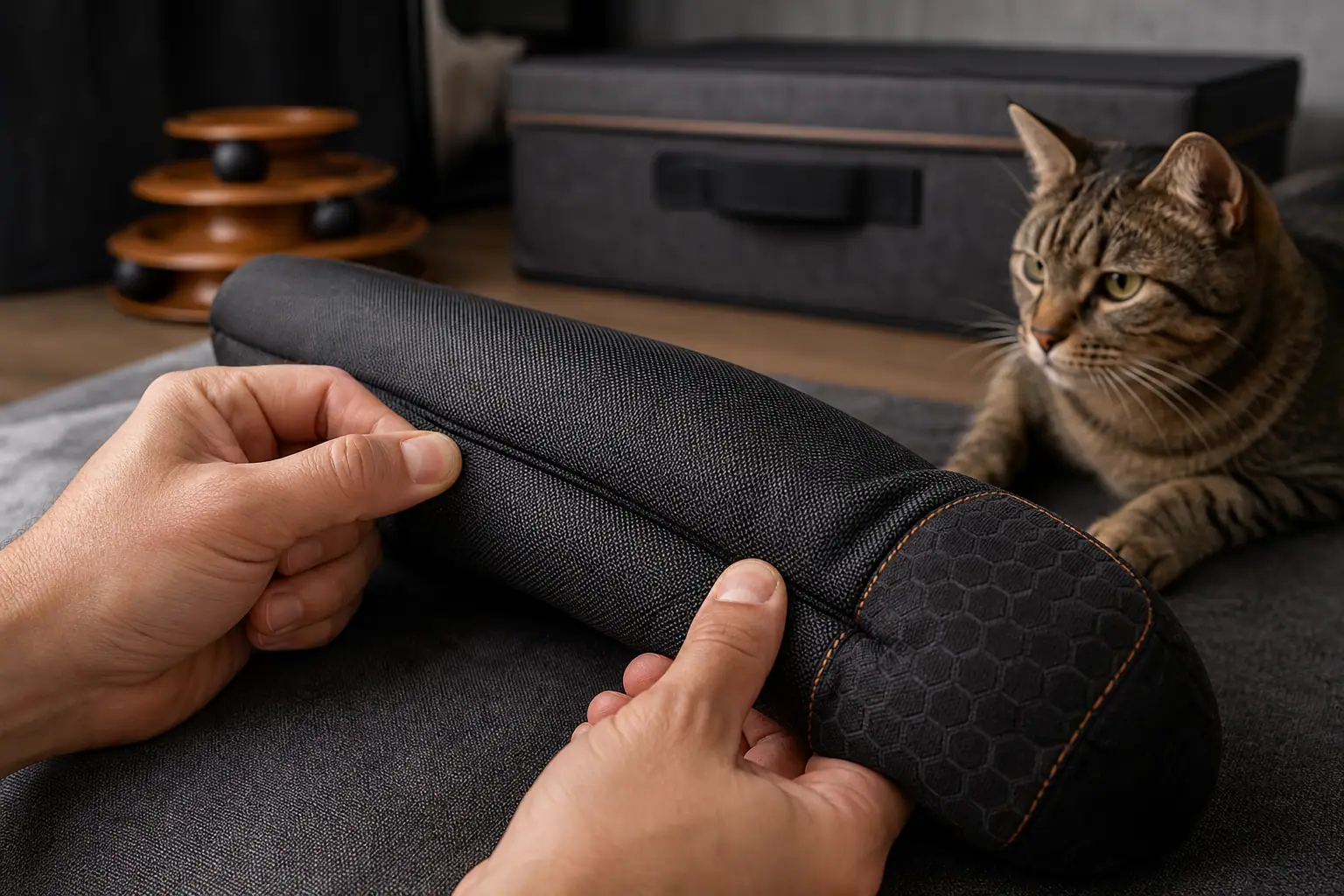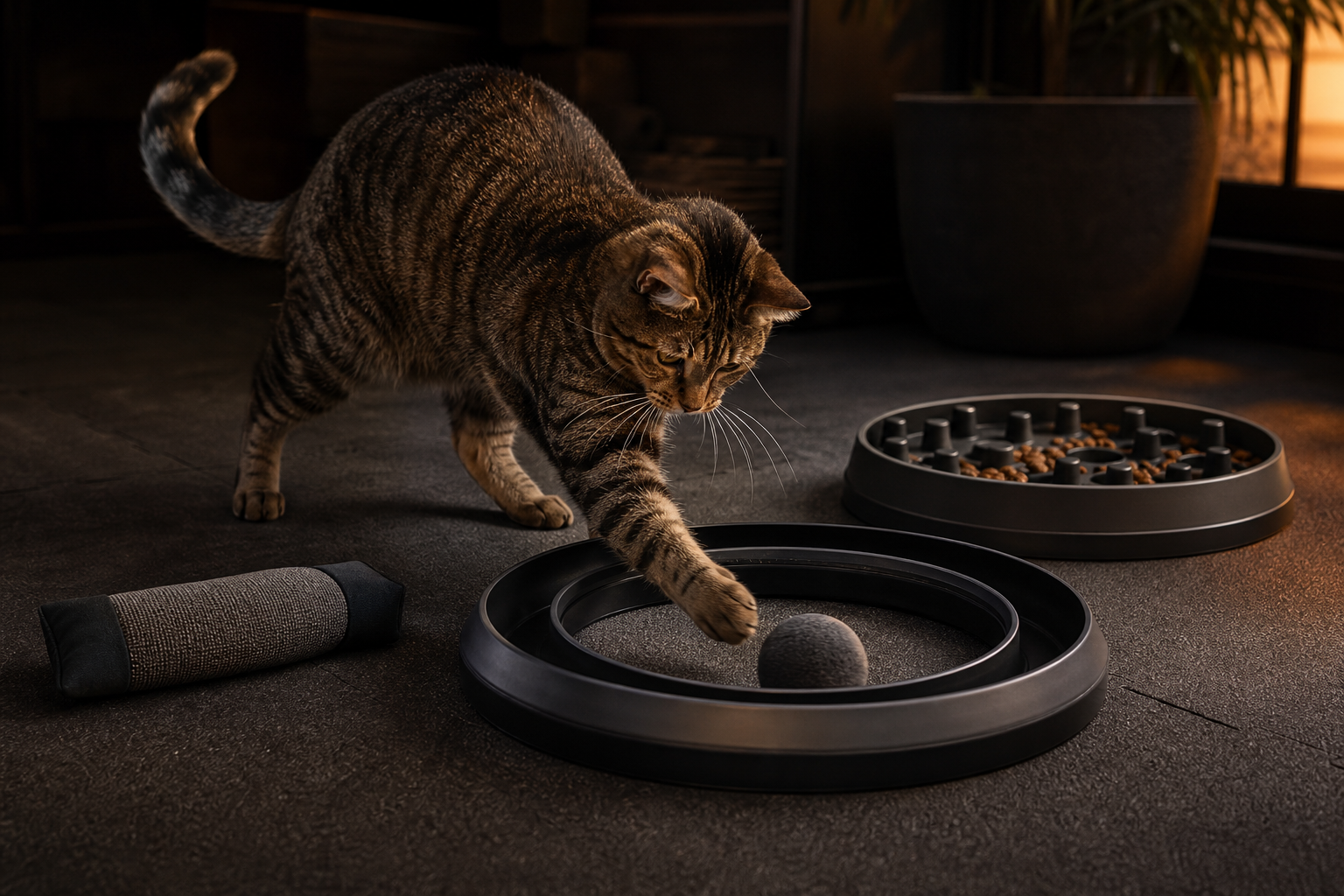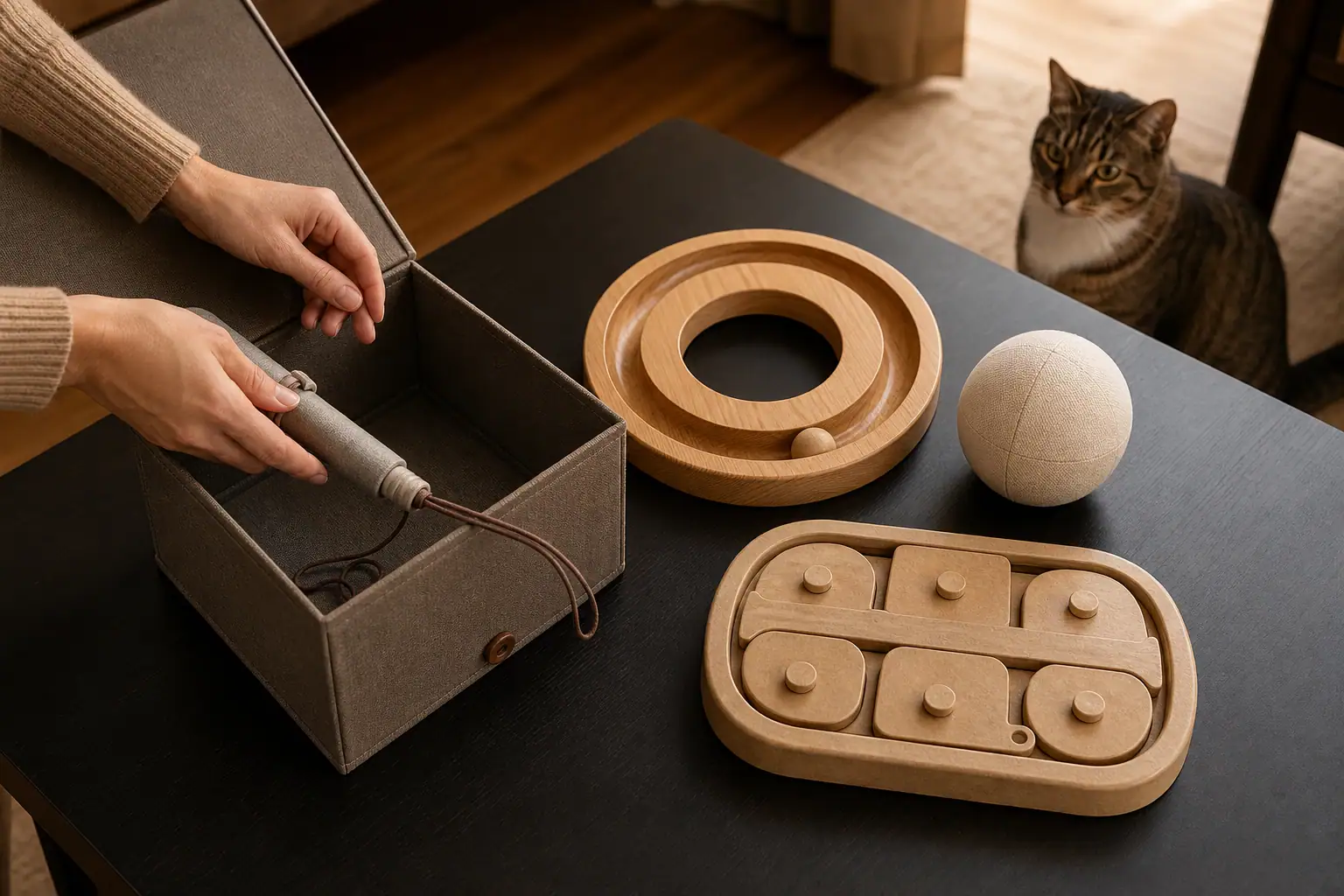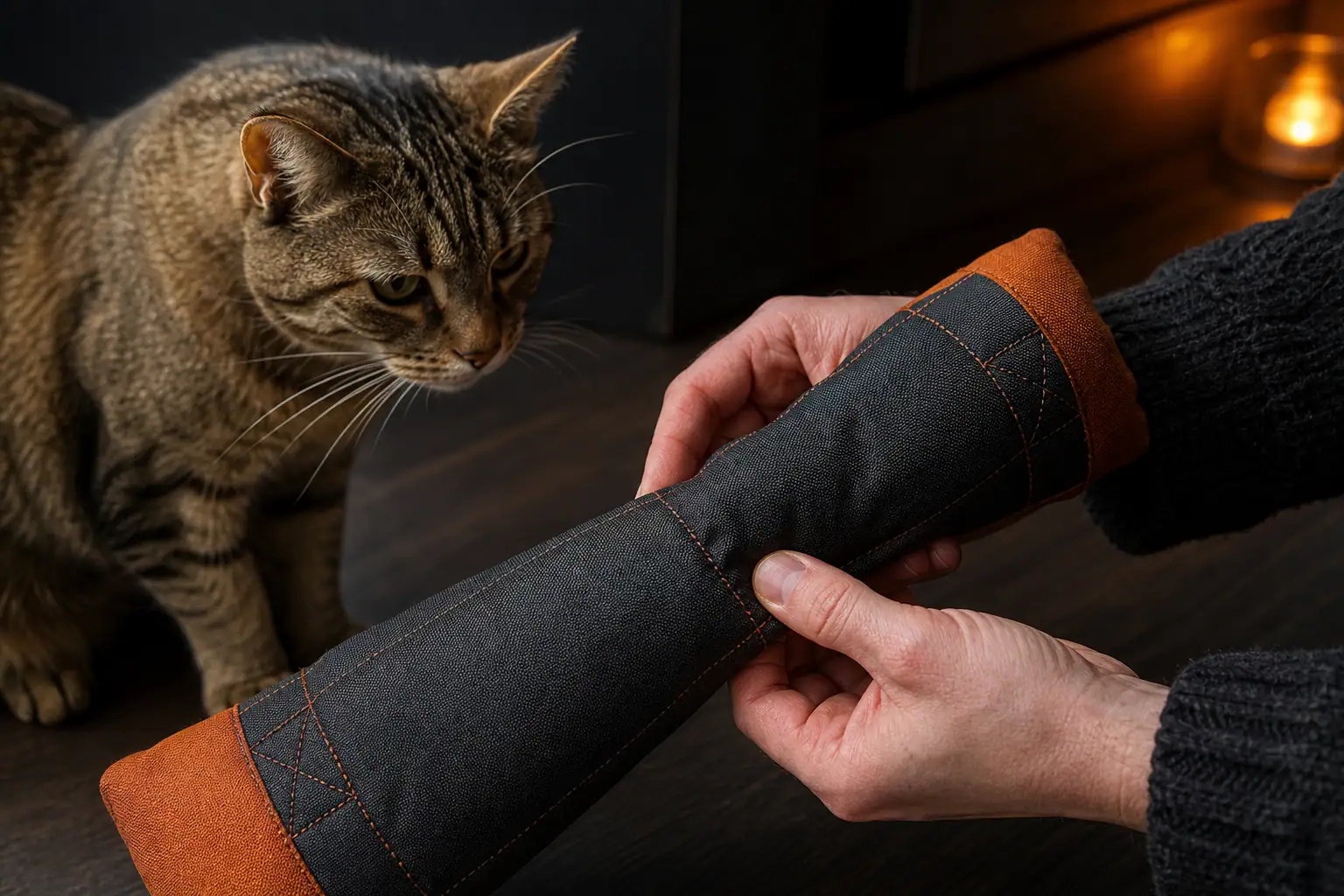
Category: Cat Behavior

  • Signs of Play Aggression in Cats and Prevention

    Signs of Play Aggression in Cats and Prevention

    Ever had your cat turn a cuddle into a surprise bite and you just stared like, what happened? That little nip feels sharp, and your hand might sting or bleed. Play aggression (when hunting instincts get aimed at you) is usually the culprit.

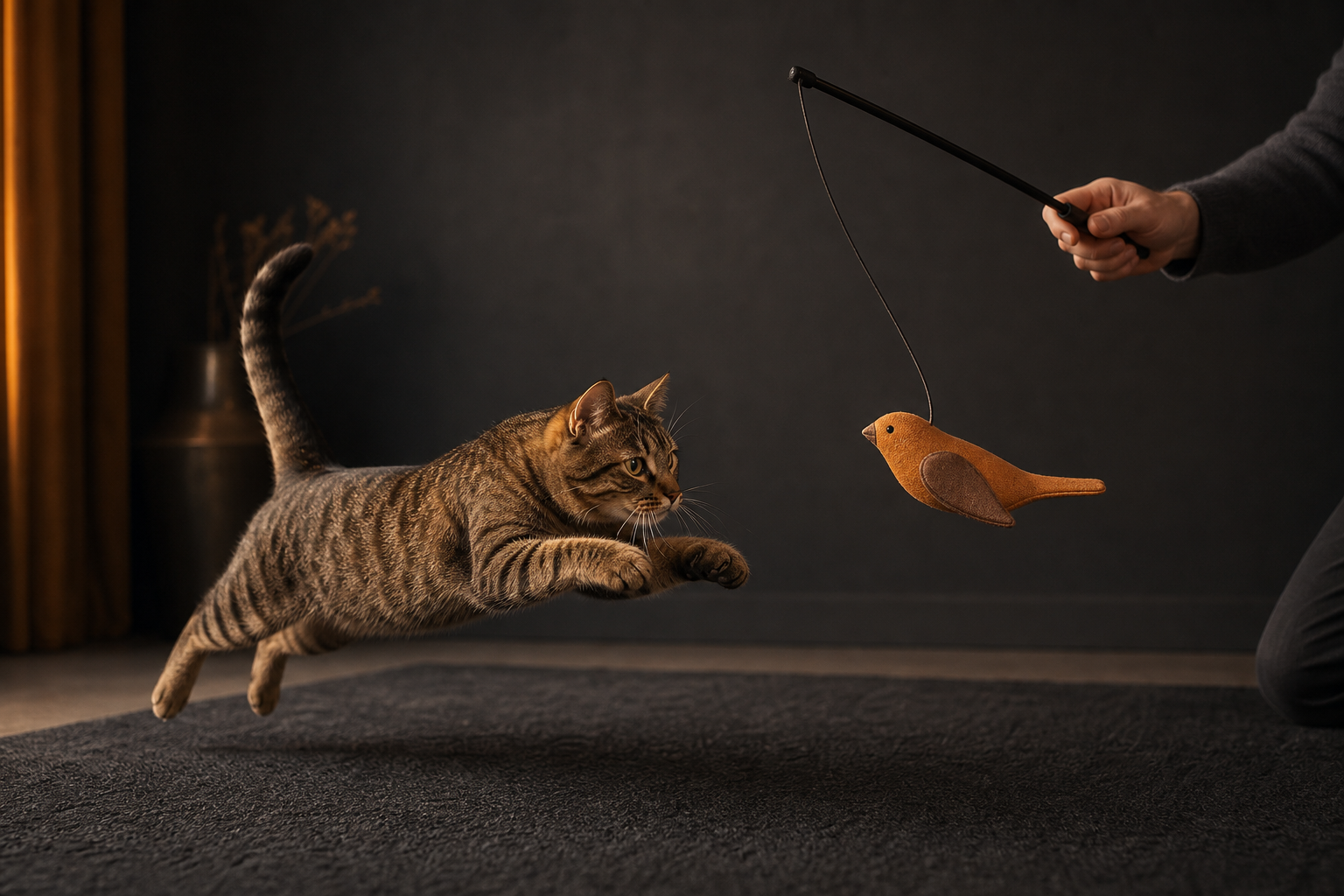
    You’ll see it in the hunt: your cat sneaks, stalks, pounces, gives soft nips and shows claws. Mostly kittens and young cats do this, especially if they missed the right play lessons with littermates. Ever watched whiskers flare and eyes narrow before a sudden pounce? Yep.

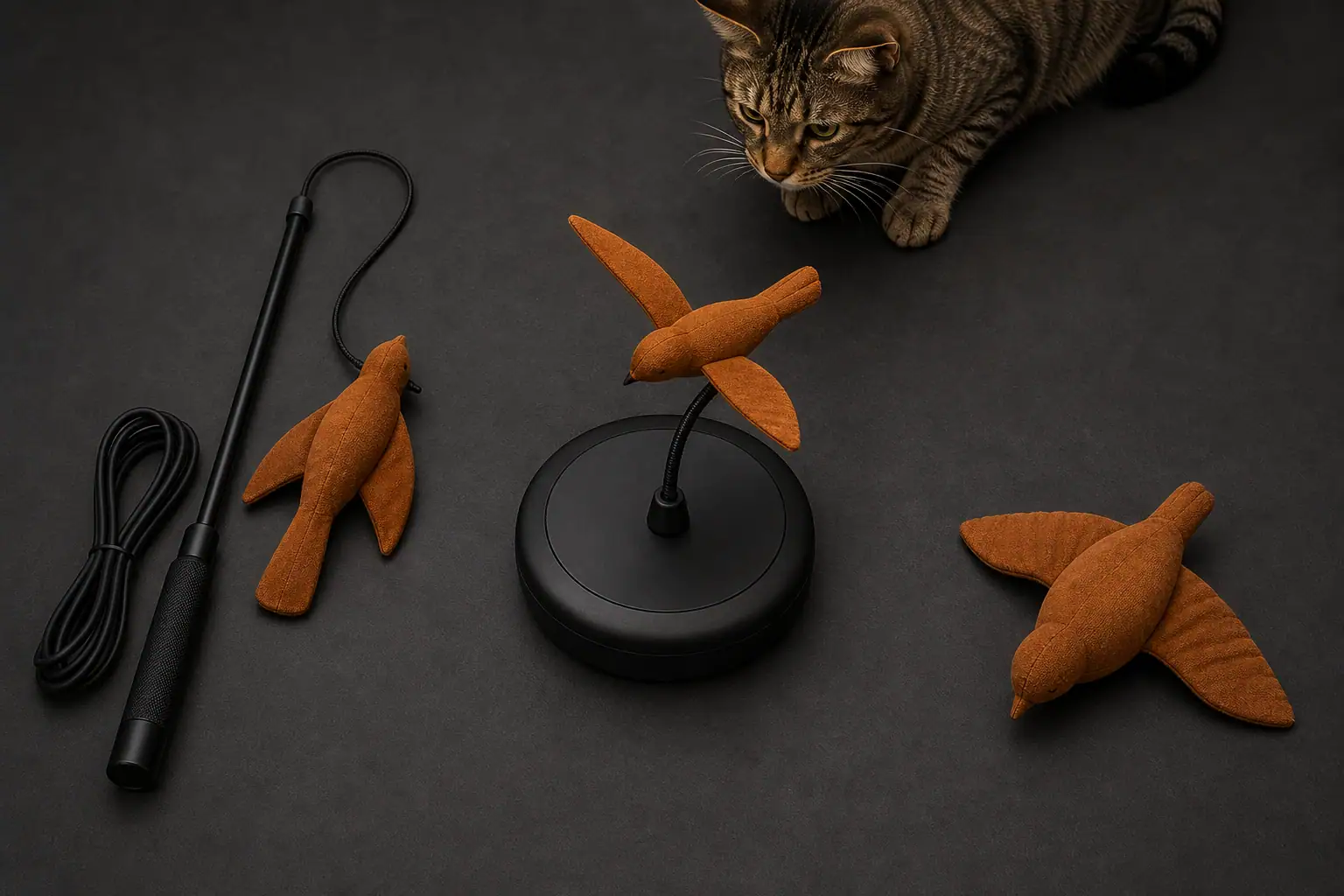
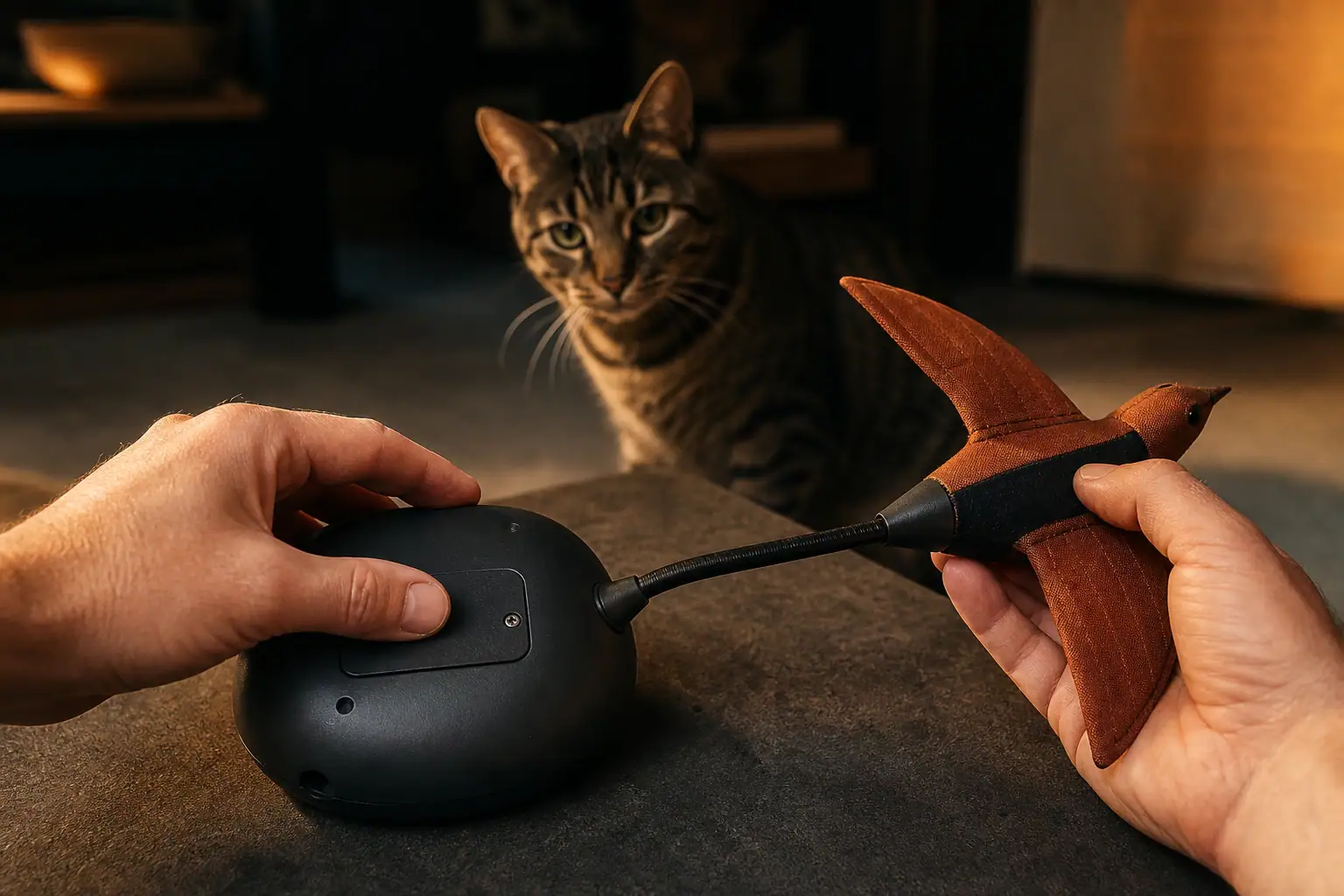
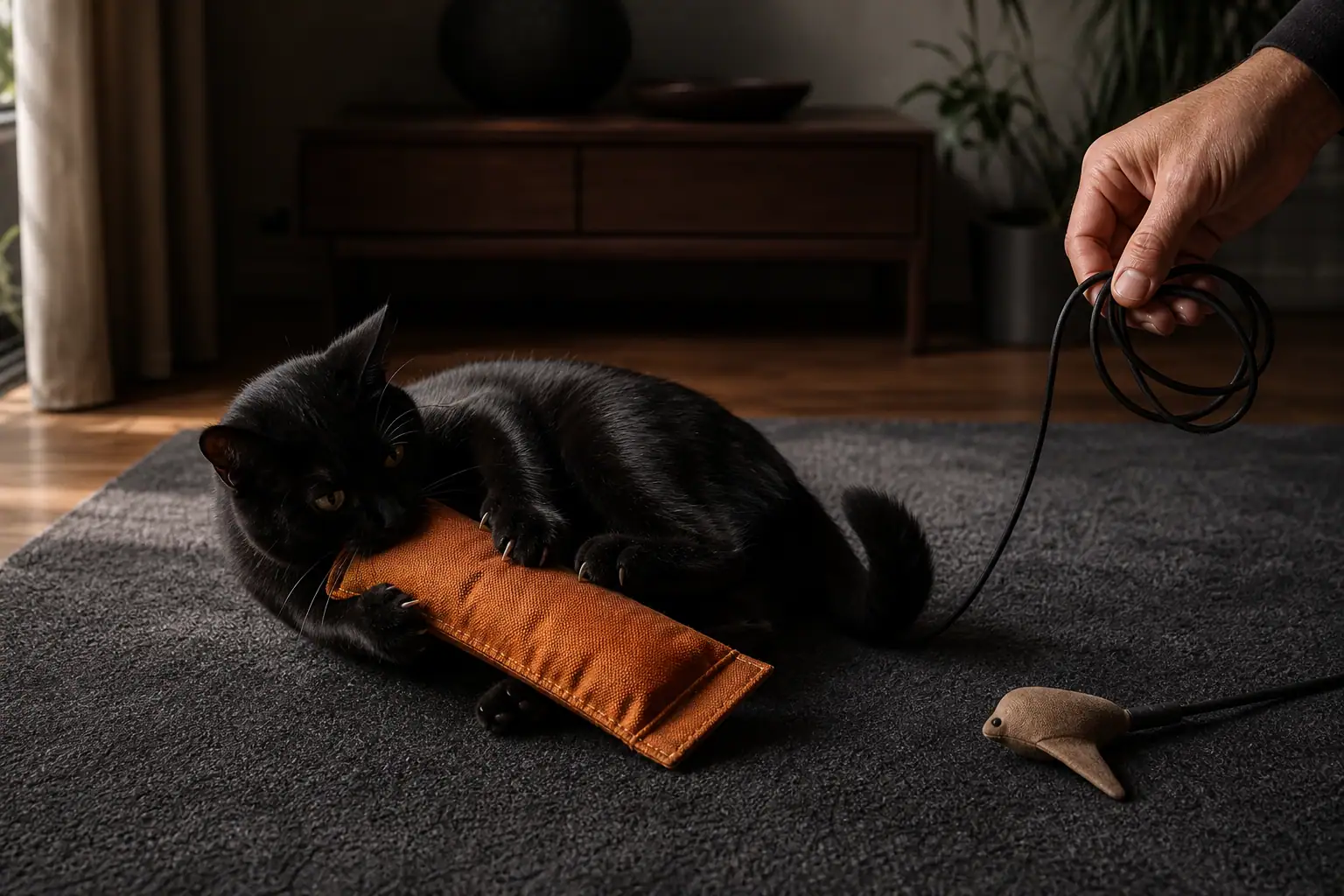
    Good news: you can stop a lot of it with a few simple swaps. Give a satisfying catch toy (a small toy they can grab and carry) at the end of play so they feel like they won. Put your hands away and use a wand toy (a stick with a toy on a string, like a fishing rod for cats) for chases. Keep sessions short and timed , five to ten minutes works great , and finish with a calm, rewarded landing, not you as the target.

    Try this combo for a week and you’ll notice less surprise biting and fewer zoomies (sudden bursts of energy). I once watched my Luna leap like a tiny tiger for a felt mouse and then flop, totally content. It’s kind of magic. Worth every paw-print.

    Immediate Diagnostic Checklist: Is This Play or Something More?

    - Immediate Diagnostic Checklist Is This Play or Something More.jpg

    Play aggression looks a lot like hunting. You’ll see predatory-style behaviors (like hunting actions) aimed at people or things, not at getting away or truly hurting anyone. Picture whiskers twitching, a low-body crouch, and that laser focus right before a pounce.

    You usually notice it during toy play or when you’re waving a hand or wand and your cat’s hunting instincts kick in. It’s most common in kittens and young cats under about three years, and in early-weaned kittens (separated from mom too soon) or hand-raised kittens (raised by humans, not their mother) that missed the socialization window (3–16 weeks, when kittens learn bite control and how to play with others).

    Most bouts stop if you give a toy the cat can “catch,” or if you pause and the cat loses interest. Ever tossed a plush mouse and watched your cat flop over it like it won the lottery? That’s the safe reset. If the play keeps getting rough, step back and try a different strategy.

    Common signs to watch for:

    • Pouncing
    • Stalking
    • Chasing
    • Biting (soft nips)
    • Swatting
    • Claws out (claws extended, ready to grip)
    • Dilated pupils (big black centers)
    • Tail twitching
    • Focused stare
    • Ears back or flattened

    For subtle body cues, see the Body Language section (H2). For step-by-step plans and ways to track progress, see the Behavior Modification section (H2).

    Reading Body Language and Distinguishing Fear from Play

    ) for nuance and to the Behavior Modification section (.jpg

    That quick checklist covers the basics, but the real difference between playful stalking and scary aggression lives in tiny bits of body language. Watch the tail movement, note the ear angle, and pay attention to the eyes and sounds. These little details tell most of the story, honestly.

    Look at the tail: short, eager twitches usually mean hunting-mode play; hard, continuous lashing often means agitation. Check the ears: softly turned or swiveling ears show curiosity, while ears pinned flat or turned back usually signal fear or anger. Eyes matter too: pupil dilation (when the black center of the eye gets larger) can happen in dim light or during excitement, so timing and context are key. Vocal tone helps: quick chirps and trills tend to say I want to play, while long hisses or growls mean back off.

    Context and timing make things clearer. A bouncy, loose body that pauses and comes back for more is probably playing. A stiff, frozen cat that hides or snaps when approached is more likely scared or defensive. Try a short pause or a tiny distraction and see what happens; if the cat returns, it was likely play. Uh, these little tests are low-risk and give fast clues.

    Quick visual cues

    • Tail: light, intermittent twitches during stalking versus sustained hard lashing when the cat is upset.
    • Ears: softly turned or swiveling toward sound during play; pinned flat or rotated back when scared or angry.
    • Eyes/pupils: quick dilation during bursts of excitement, but sudden wide pupils paired with a frozen stare can signal high stress.
    • Vocalizations: short trills, chirps, or quick chatters mean play interest; prolonged hissing, growling, or yowling usually means fear or a warning.
    1. Observe overall posture and movement to see if the cat looks loose or tense.
    2. Check vocal cues for playful chirps versus defensive hisses.
    3. Pause briefly or offer a small distraction to test re-engagement and see if the cat returns or withdraws.
    4. Offer a toy and watch whether the cat chases and captures it calmly or reacts aggressively.

    See the diagnostic checklist (first H2) for the simple sign list, and the Behavior Modification section (H2) for tracking and intervention plans.

    Common Triggers and Root Causes

    ) for long-term plans and tracking.jpg

    Young cats learn to hunt by playing, so pouncing and biting are usually practice, not nastiness. Kittens and younger cats , roughly under three years old , and cats that missed the socialization window (3–16 weeks, when kittens learn bite control and how to play with others) are more likely to use rough tactics. Your kitten’s wild little energy is normal. Really.

    Overstimulation (when your cat’s excitement keeps climbing until they suddenly snap) is a big one. Long, high-energy play sessions or repeated chase games can push arousal up and up, until play turns into grabby behavior. Think of it like a car revving with no finish line , eventually something gives.

    The home setup matters a lot. Single-cat houses with few toys or little variety leave some cats bored and hunting for intense outlets. Sudden movements , feet, ankles, swinging socks , teach a cat that human limbs are fair game. Toys that never let your cat win, like a laser pointer without a final plush catch (a toy they can actually grab), can do the same thing. Ever watched your kitty chase a dot for five minutes and then bite your ankle? Yep.

    Using your hands as toys, or leaving long unsupervised free-play sessions, can normalize rough play and make escalation more likely. That quick nip can become a full-on grab if it’s rewarded with a squeal, a chase, or even attention. So, tweak the routine and you’ll often curb the behavior.

    Common triggers to watch for:

    • playing with hands or fingers like they’re toys
    • long, unsupervised play sessions
    • lack of toy variety or toys that can’t be caught
    • late-night zoomies and high-energy bursts
    • solitary housing or boredom
    • laser pointers without a final, catchable toy

    For the observable signs, see the diagnostic checklist (first H2), and check the Body Language H2 for nuance when you’re deciding if it’s play or fear.

    Prevention and Redirection: Immediate Tactics and Example Sessions

    - Reading Body Language and Distinguishing Fear from Play.jpg

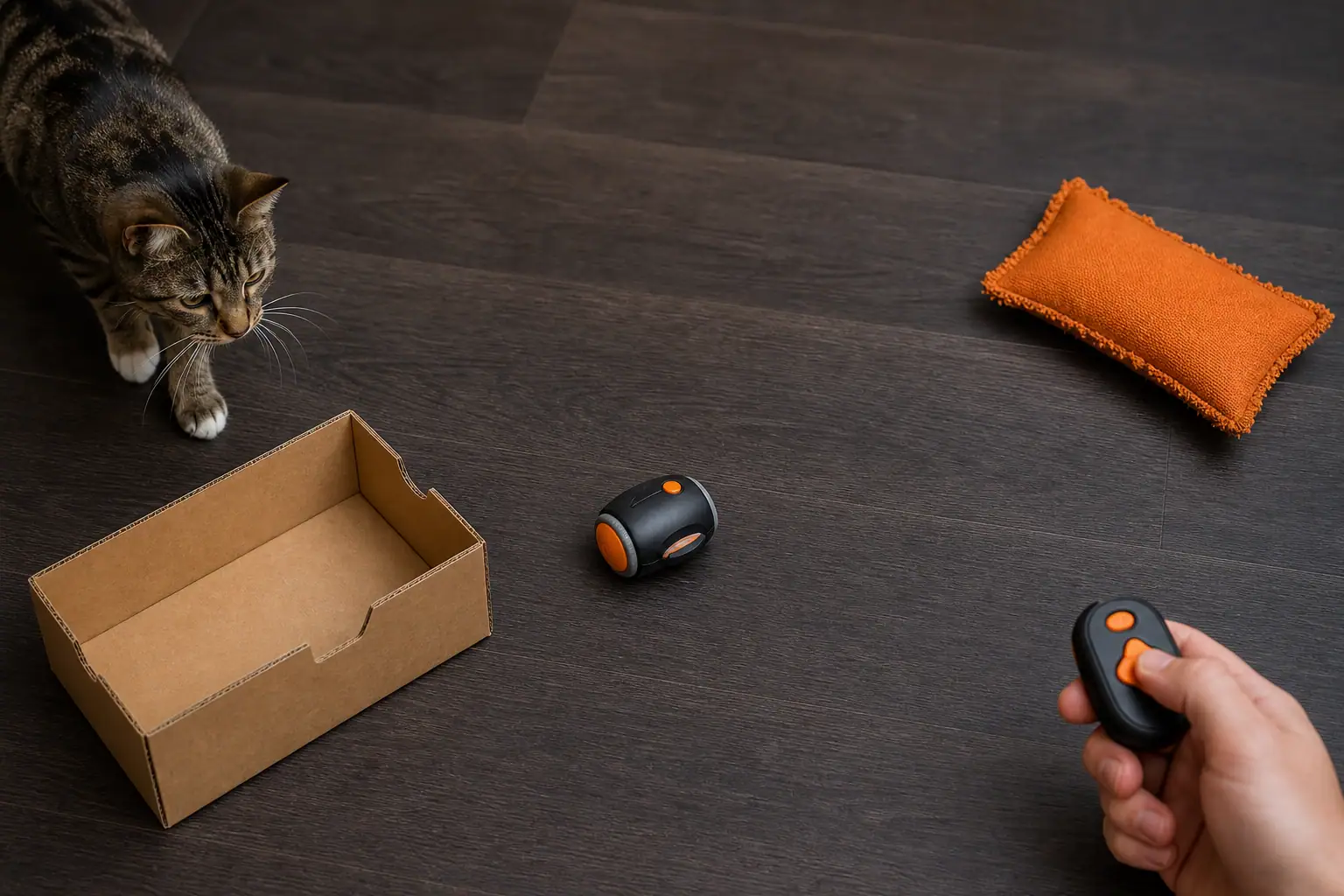
    Rule number one: don’t let your hands or feet be the toy. Seriously, never use your fingers or toes as play targets. Swap in an interactive toy instead, like a wand (a stick with a feather or lure) or stuffed prey (a plush mouse or bird). That way your skin stays out of the game and your cat still gets the thrill of the chase and the satisfying pounce.

    If play starts to get too rough, freeze for a beat, then calmly step away. That little pause often drops their arousal. Toss a toy away from your body so your cat chases something, not you. Then switch to a wand or plush that lets them actually catch their prey. Rotate toys and treats so the hunt feels real and fresh.

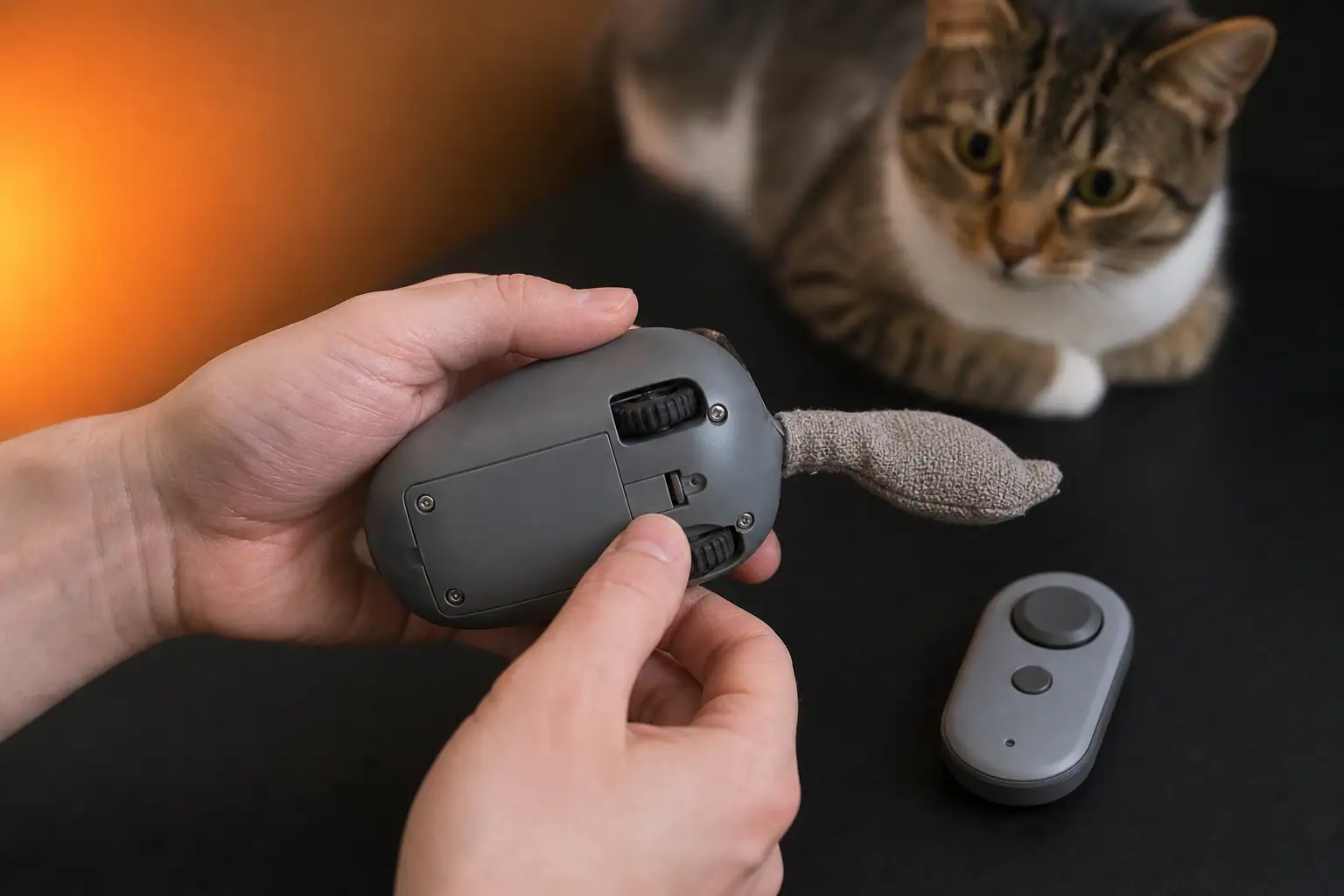
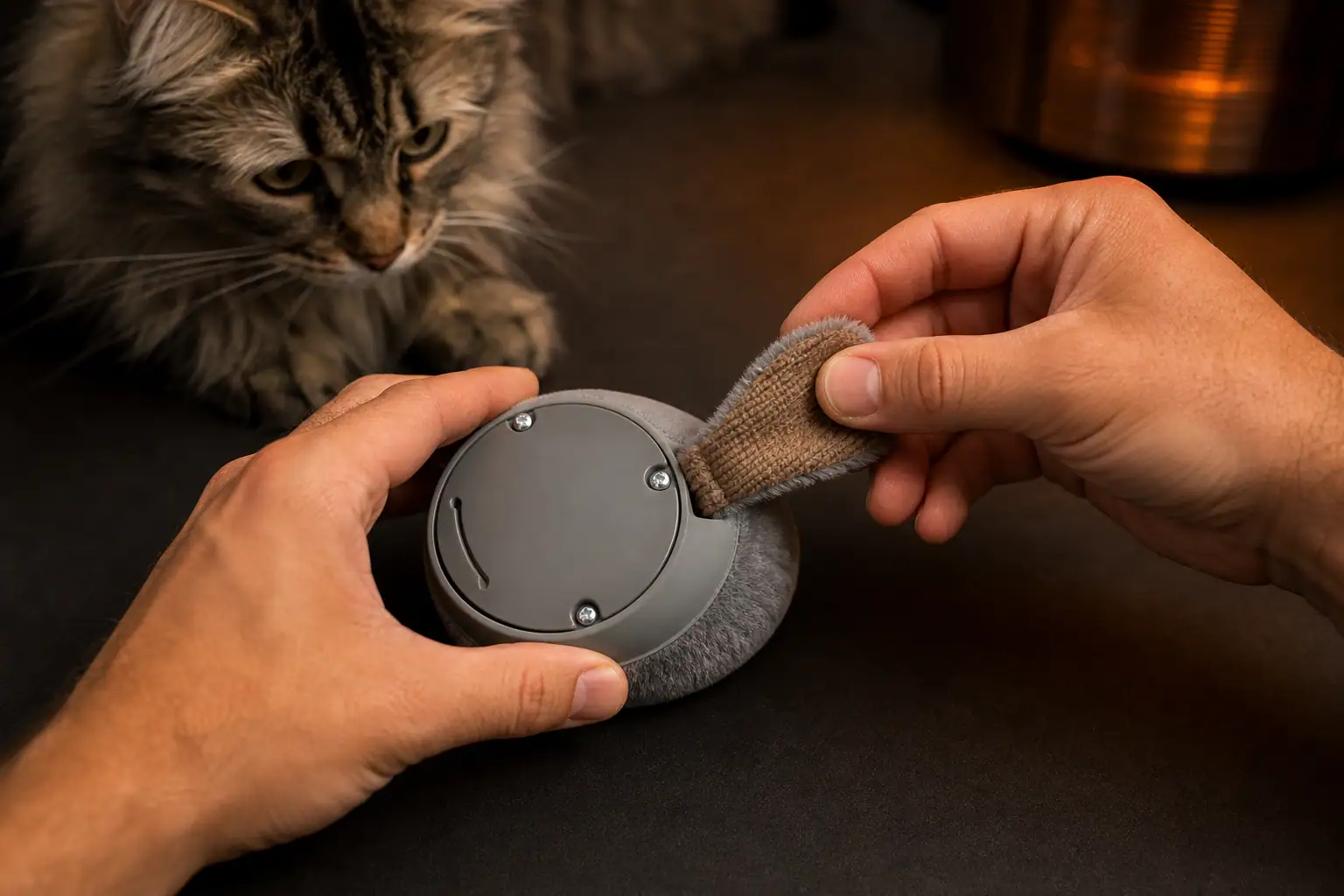
    Keep gear in good shape. Broken clips or frayed strings can change how your cat plays and lead to weird, unsafe habits. Check DIY replacement attachments for teaser wands for easy fixes (attachments means the clip or string that holds the lure).

    Try short, scheduled sessions that copy a hunting rhythm:

    • Morning active chase , 5 to 10 minutes of wand play, quick bursts and big leaps. Wake-up energy, the good kind.
    • Midday puzzle , 10 to 15 minutes with a food puzzle or slow feeder (a toy that dispenses kibble slowly). Mental work, lower intensity.
    • Evening wind-down chase-and-capture , 10 minutes that ends with a treat or a small meal piece so they get a real catch.

    Use the diagnostic checklist in the first H2 to confirm these are play signs. And if you’re unsure about the subtle cues, check the Body Language H2 before trying redirection tactics.

    Safety, First Aid, and When Injuries Occur

    ) and the Behavior Modification section for next steps if behavior repeats.jpg

    Cat bites usually make a narrow, deep hole that can trap bacteria and lead to infection. Puncture (a narrow, deep wound) wounds are sneaky that way. Wash the area with soap and warm water, press gently to slow bleeding, and put on a clean bandage. These quick steps cut the chance of infection and help you feel more in control. Scratches can scar; see do cat scratches scar for more on outcomes and follow-up care.

    If the wound is deep, won’t stop bleeding, or shows clear signs of infection, get medical care. Signs to watch for are growing redness, warmth, swelling, pus, or a fever. Also see a provider sooner if you have a weak immune system (trouble fighting infections) or if your tetanus shots aren’t up to date. A clinician may prescribe antibiotics or give a tetanus shot (a vaccine against tetanus bacteria).

    1. Clean: wash with soap and warm water. Feel the soap and warm rinse loosen debris.
    2. Stop bleeding: press firmly but gently with a clean cloth. Hold it steady until the bleeding slows.
    3. Dress: cover with a sterile bandage and change it every day or sooner if it gets wet or dirty.
    4. Monitor: watch for more redness, swelling, heat, drainage, or fever. Trust your gut if something looks off.
    5. Seek medical care: for deep punctures, lots of bleeding, worsening signs, or if you’re immunocompromised.

    If the bite happened during play, jot down what led up to it so you can change how you play next time. Ever watched your cat go from purr to pounce in a second? Little changes in toys or timing can stop repeat bites. See the diagnostic checklist (first H2) for behaviors that commonly lead to bites and the When to Consult H2 for clear referral thresholds.

    When to Consult a Veterinarian or Certified Behaviorist

    - Common Triggers and Root Causes.jpg

    If play stops being playful and starts hurting, don’t shrug it off. When you see more than gentle nips, sudden, unpredictable attacks, repeated wounds, or no clear improvement after you’ve tried consistent redirection and safer play routines, get help. If you ever feel unsafe, or the incidents are happening more often or getting worse, reach out sooner rather than later.

    Start with a vet exam. Some medical problems can look like behavior issues or actually cause aggression. Things to rule out include dental disease or injury (mouth pain), thyroid problems (gland that controls metabolism), hormonal imbalances (hormone level problems), and neurological conditions (brain or nerve issues). A vet can run tests to check for these before you jump into a behavior plan.

    Bring clear records so the specialist sees the whole story:

    1. Video clips of the incidents showing the behavior. Even short clips help.
    2. Exact dates and times for each episode.
    3. What was happening right before each event, and any identified triggers.
    4. A list of interventions you already tried and how your cat responded.

    Pros often use a mix of diagnostics, a step-by-step behavior plan, pheromone options (scent products that can help calm cats), and sometimes medication. When you talk to professionals, use the diagnostic checklist (first H2) and the Body Language quick cues (H2) to report what you observed, it speeds things up and makes the plan more accurate. Worth the effort.

    Behavior Modification Plan and Tracking: Long-Term Graded Approach

    for nuance.jpg

    Think of this as a simple scorecard to make playtime predictable and helpful. Give each play episode a 1-5 score based on arousal (how excited your cat is) and contact. Start with short, scheduled interactive play sessions, 5-15 minutes, that follow a hunt pattern: stalk, chase, capture. Ever watched your cat freeze, stalk the feather, then explode into a leap? That’s the pattern we want to mimic.

    When scores creep up toward 4 or 5, redirect to a safer target. Reward calm captures with treats or kibble (dry cat food) right away. If biting or sustained contact happens, give an immediate brief time-out (a calm, 1-2 minute removal of attention) so your cat learns that rough contact ends the fun.

    Record quick video clips of each session and keep a weekly incident log (short notes on what happened). Video helps you spot subtle cues and makes it easy to show a vet or a behaviorist if you need backup. Over a few weeks you should see fewer high scores and more calm catches as you tweak play intensity, timing, toys, and rewards.

    Step Action Intensity Grade (1-5) Duration / Timing Owner Notes
    Baseline assessment Record three short play sessions to note typical intensity and triggers Three short sessions over three days Initial frequency, common triggers
    Scheduled play session Structured wand play that ends with a gentle capture and a treat 1-3 5-15 minutes, 1-3 times daily Time of day, toy used, outcome
    Redirection tactic Toss a plush toy away from your body to change the target 2-4 Immediate when arousal rises Which toys work best
    Time-out procedure Calmly stop play and remove attention for 1-2 minutes 4-5 As needed Cat response after pause
    Reinforcement strategy Reward gentle capture with food, praise, or a brief cuddle 1-2 Immediate after calm behavior Which rewards are most effective
    Weekly summary Review videos and incident log to spot trends and adjust plan Average grade Weekly Plan adjustments for next week
    • 1 = calm interest (sits or watches, light paw reach)
    • 3 = stalking and pawing without contact (active but controlled)
    • 5 = full pounce with biting or sustained contact (stop and time-out)

    Refer to the diagnostic checklist for the original sign definitions and the Body Language H3 for nuance when grading episodes.

    Final Words

    Spotted a quick stalk, pounce, or a light nip? That’s play aggression as we defined: predatory-style moves aimed at play, not harm.

    You’ve got a ten-item diagnostic checklist for fast ID, a body-language guide to read tail, ear and pupil cues, common triggers, redirection tactics with short session templates, safety-first aid steps, and clear thresholds for when to seek professional help.

    Use the tools to spot signs of play aggression in cats, try the short sessions, and enjoy calmer, happier multi-cat days.

    FAQ

    Cat play aggression — FAQs

    Signs of play aggression in cats towards humans or other cats — what do they look like?

    Predatory-style behaviors like stalking, pouncing, chasing, light nips, swats, extended claws, dilated pupils, a focused stare, tail twitching, and ears pulled back.

    How do I tell the difference between play and real aggression in cats?

    Play is bouncy, loose, and often chirpy; the cat may pause and return. Fear or real aggression is stiff, may include hissing or growling, and the cat avoids re-engagement.

    What is the 3-3-3 rule for cats?

    The 3-3-3 rule is a settling timeline: about 3 days of initial shock, 3 weeks to learn routines, and up to 3 months to feel fully comfortable and settled.

    How can I stop play aggression toward humans right away?

    Stop using hands as toys. Use wand/toy-on-a-string toys, toss toys for capture, pause play when the cat is overstimulated, and give short daily play sessions.

    How do I stop play aggression between cats or handle inter-cat attacks?

    Separate the cats, provide each safe spaces, do a slow reintroduction with scent swapping, increase play and enrichment, and consult a vet or certified behaviorist—especially if they missed the socialization window (3–16 weeks).

    My cat viciously attacked me unprovoked — what should I do now?

    Clean and dress wounds; seek medical care for deep puncture wounds. Document the incident (video and notes), check for medical causes, and contact your vet or a certified behaviorist.

    Related Articles

  • Durable Cat Toys for Play Aggression

    Durable Cat Toys for Play Aggression

    Think your cat is attacking you on purpose? Nope, they usually aren’t. What you’re seeing is play aggression, a fierce hunt drive: sudden lunges, sharp little bites, and that swishing tail that screams “prey.” Ever felt a surprise nibble on your hand and wondered what just happened? Your cat is hunting, not holding a grudge.

    So, redirect that energy with toys built for battle. Pick tough stuff that survives hard bites and wild pounces, like a teaser wand that moves like a fishing pole for cats (a long stick with a lure at the end), chew-safe plush bite targets (plush means soft fabric toys that are still durable), and puzzle feeders (toys that hide food or treats and make your cat work a little). These let your cat finish the “hunt” without your skin taking the hit, and they save you money over time.

    Tip: rotate toys and give short, focused play sessions so they burn off drive, ten minutes of wild play before you leave can do wonders. I once watched Luna leap six feet for a wand; worth every paw-print.

    Immediate relief for play aggression: quick redirection steps

    - Immediate relief for play aggression quick redirection steps.jpg

    Toys give fast relief by turning your cat’s hunt drive toward something safe. Think of a wand like a fishing rod for cats – the exciting chase stays, your skin does not. You’ll hear the soft thump of a pounced toy, see whiskers flare, and breathe easier.

    Watch for the signs: sudden lunges, biting at hands, a swishing tail, flattened ears, hissing or growling. Those are high-arousal hunt cues. Your cat isn’t being mean on purpose. They’re basically saying, “Prey!”

    When it starts, move quick and stay calm. Use a nearby toy to change the focus and keep your hands out of the hunt. For a full plan and the twice-daily sessions recommended for long-term change, see the H2 titled "How to use cat toys for play aggression: step-by-step training routine" for the schedule and exact bout structure.

    1. Redirect immediately to a wand or teaser (feather-on-a-stick), a plush bite-target (soft toy made for biting), or a quick puzzle feeder (treat-dispensing toy). Make the toy the target, not your skin.
    2. If biting keeps happening, pause play calmly – step back, stop moving, and stay quiet. No shouting, no grabbing. Let the excitement drop.
    3. Swap the toy type to finish the hunt-catch-eat loop. Try active play first, then a food-based finish, or the other way around, so your cat gets the full reward.
    4. Resume later with a scheduled short session so play stays structured and predictable. Short sessions beat chaotic free-for-alls.

    Short, confident switches plus predictable follow-through give fast relief and teach better targets over time. Worth every paw-print.

    Durable Cat Toys for Play Aggression

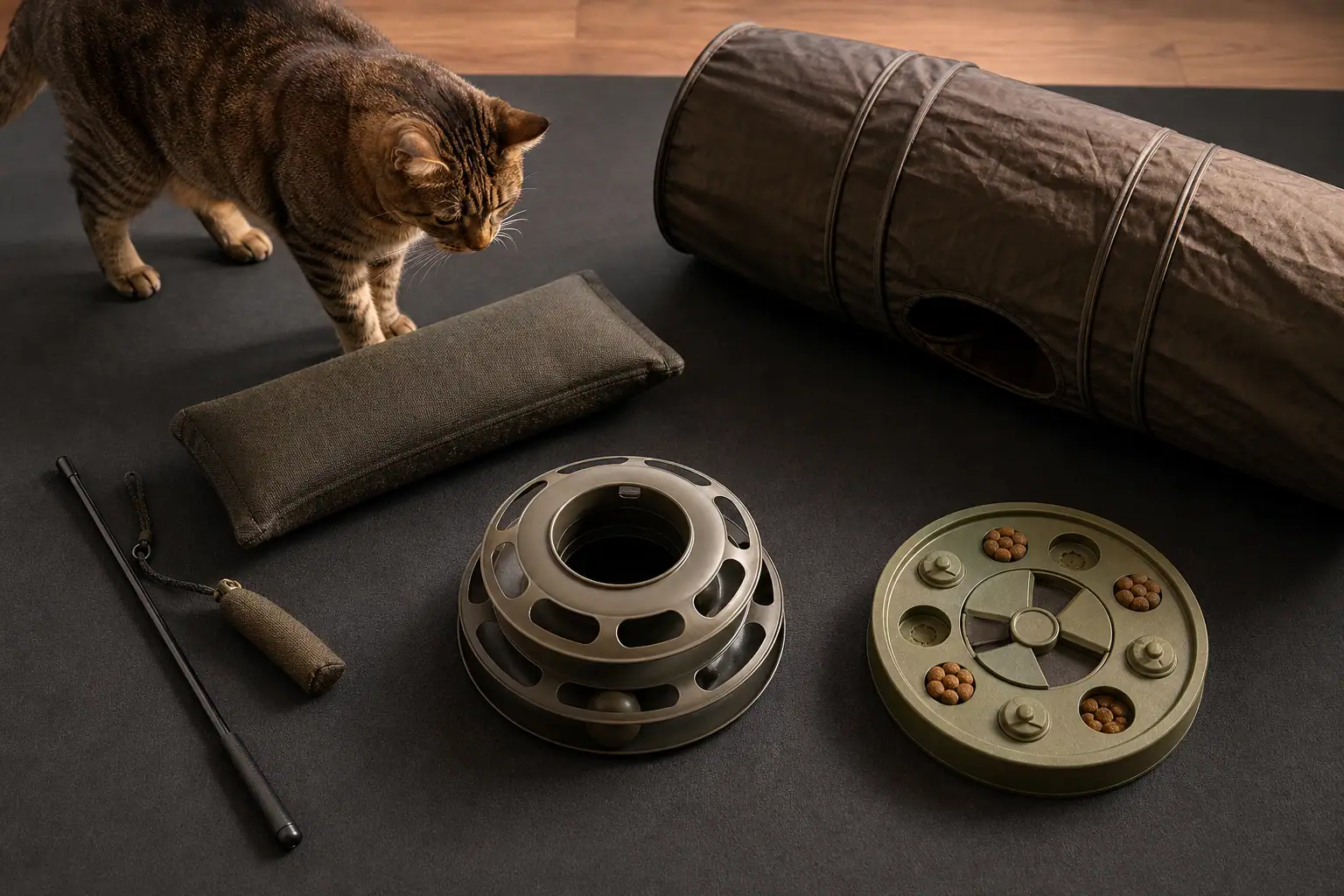
    A quick, friendly shopping guide to toys that survive rough play and help redirect your cat's hunting drive. Pick from active wands, puzzle feeders, chew-safe plush targets, or track and electronic toys based on how your cat likes to play. Ever watched your kitty stalk a sock? That same urge needs a safe outlet.

    Active / Wand & Teaser Toys

    Wands copy prey motion so your cat learns chase and bite control without your skin as the target. Use short, supervised bursts of play, three to seven minutes, to keep arousal healthy and teach stop cues.
    What it mimics: Fluttering birds or mice, and it redirects pounce-and-bite behavior.
    Best use: You are the lure, so always supervise and set the pace.
    Material notes: Look for reinforced stitching and lines that attach securely. Replace frayed lines and swap out worn attachments instead of sewing on risky threads.

    Puzzle Feeders & Treat-Dispensers

    These finish the hunt-catch-eat loop by giving food as a reward after work. They calm high-drive cats and add mental challenge, which cuts boredom-driven aggression.
    What it mimics: Foraging and problem-solving, so the cat earns its snack.
    Best use: Great for solo use after you’ve done active play, or supervised if your cat is new to it.
    Material notes: Prefer silicone (soft, durable, rubber-like material) or hard plastic that is dishwasher-safe; avoid toys with small removable parts.

    Durable Chewables & Plush Bite Targets

    Made for bitey cats, these stand in for hands, curtains, and couch corners. They give a safe sink-and-shake outlet so your cat can satisfy bite-and-hold instincts.
    What it mimics: Bite-and-hold behavior, very satisfying for cats that like to grip and shake.
    Best use: Supervise at first, then leave alone only if the toy stays intact and has no loose bits.
    Material notes: Heavy-denier plush (thick, tightly woven fabric), tight seams, or nylon chew sticks (nylon is a tough synthetic, like a chew bone) and solid rubber; avoid glued-on eyes or loose stuffing.

    Track, Rolling & Electronic Toys

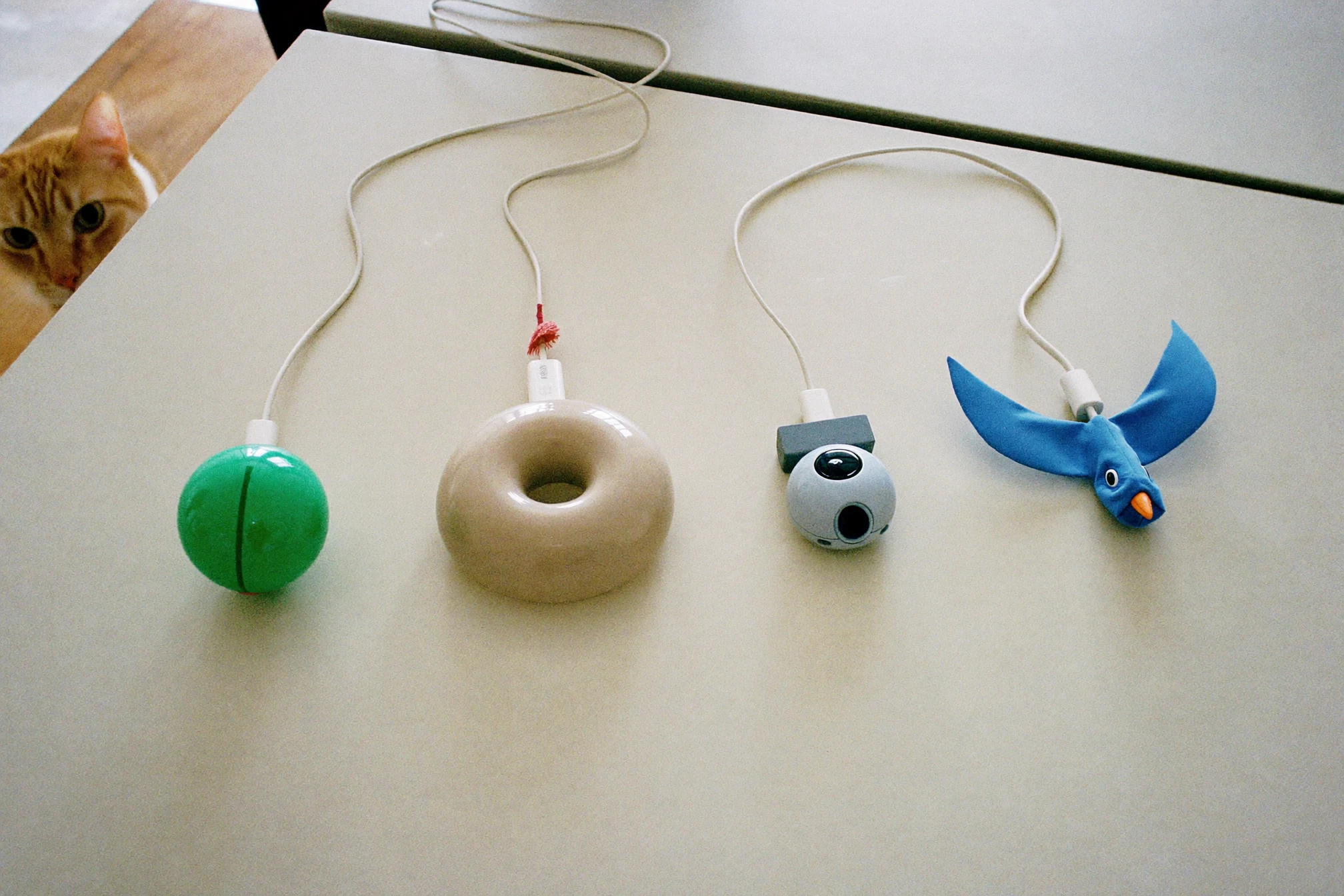
    Three-track balls, 360-ring systems, and motion-activated devices give unpredictable movement for solo play, but not every cat likes constant motion. Introduce these toys supervised to see if your cat gets overstimulated.
    What it mimics: Small, erratic prey movement for independent chase.
    Best use: Solo engagement for cats that handle motion, supervised at first for those who do not.
    Material notes: Check battery compartment security and prefer enclosed parts. A heavy base helps keep tracks from tipping or flying.

    Toy Category Typical Price Range Best For Notes/Safety
    Wand / Teaser $10 – $25 Chase training, bite inhibition Supervise; replace frayed lines; no loose attachments
    Puzzle Feeders $15 – $60 Finish hunt-catch-eat, mental work Prefer dishwasher-safe silicone/hard plastic; no small parts
    Durable Chewables / Plush $10 – $40 Heavy biters, bite-target replacement Heavy-denier fabric, reinforced seams; avoid glued bits
    Track / Electronic $20 – $150 Solo chase, novelty Introduce supervised; check battery cover security

    Durability checklist when buying or testing toys:

    1. Pull on seams and attachment points. No loose stitches.
    2. Bite-test material with fingernail pressure to simulate chewing; prefer solid rubber, silicone (soft, rubber-like), or thick nylon.
    3. Open and inspect battery compartments; lids must lock or screw closed.
    4. Favor enclosed parts over glued-on bits like eyes or beads.
    5. Weight and stability test for tracks and bases; give a vigorous shove to check tipping.
    6. Pick washable fabrics or dishwasher-safe plastics so you can clean them.

    Most heavy players do best with a combo: a wand for chase, a puzzle feeder to finish the hunt, and a durable chew target for biting. Rotate categories so toys feel new, and always follow simple safety and maintenance: clean, inspect, retire when worn. Worth every paw-print.

    How to use cat toys for play aggression: step-by-step training routine

    - Toy types, durability  buying guide.jpg

    Want to teach your cat where hunting stops and reward begins? This is a simple, repeatable plan to make play predictable, tiring in the right way, and satisfying for your cat. Think of it as a training recipe: timing, toy mix, and a calm finish so play stays fun and not scary.

    1. Daily timing windows
      Plan two interactive sessions each day. One within an hour of waking, and one about an hour before the evening wind-down. These regular play windows give your cat reliable outlets for peak energy. Ever watched them explode with zoomies right after a nap? Yeah, this helps.

    2. Session length and structure
      Aim for 10 to 15 minutes total. Break it into short, high-energy bursts of 3 to 7 minutes with 20 to 60 seconds of rest between bursts to avoid overstimulation. Short and punchy beats long and frantic.

    3. How to run a 10 to 15 minute session
      Start strong so the chase instinct wakes up. Repeat a few chase bursts, then slow the pace so your cat can settle before food. Keep your hands out of the hunt and use a bite-safe toy (tough chew toy made for cats) if your cat tries to bite the target. It teaches them toys are for catching, not your fingers.

    4. End with food
      Finish each session by switching to a puzzle feeder (a toy that hides treats so your cat has to work to get them) or a treat-dispensing toy. That completes the hunt-catch-eat sequence and helps your cat calm down after the chase.

    5. Handling escalations like biting or rough play
      Stop moving the toy and step back calmly. Wait for your cat’s arousal to drop; if biting happens again, pause the session and try in 20 to 30 minutes. Give lots of praise or a tiny treat when they choose the toy over your hand or the couch. Positive wins every time.

    6. Introducing electronic or motion toys
      Try new motion devices only in short supervised trials for the first week so you can spot overstimulation. An electronic toy (battery-powered moving toy) can be super engaging but some cats get too wound up. If a toy seems to push them over the edge, retire it and try a different type.

    7. Two-week rotating-toy plan
      Rotate toys so novelty stays high and play stays interesting. Below is a simple two-week pattern to follow. Swap in a different active toy on the second week to keep things fresh.

    Week Mon/Wed/Fri Tue/Thu/Sat Sun
    Week A Wand/Teaser Puzzle Feeder Durable Chewable or Plush
    Week B Track or Electronic Toy Puzzle Feeder Durable Chewable or Plush

    Example 10-minute session

    • Warm up 2 to 3 minutes with a wand, using slow teasing motions to get interest.
    • High-speed chase 3 to 4 minutes, with quick darts and erratic pulls.
    • Pause and settle 1 to 2 minutes; hold the toy still so your cat can catch their breath.
    • Finish 1 to 2 minutes with a puzzle feeder treat to complete the hunt sequence.

    Keep a simple progress log: date, toy used, session length, any incidents like bites or scratches, and your cat’s mood. With steady practice, most owners see improvement in a few weeks. I once watched my floof leap six feet for a wand, so worth it.

    Worth every paw-print.

    DIY redirecting toys and replacements

    - How to use cat toys for play aggression step-by-step training routine.jpg

    Quick, low-cost projects to keep play safe and fun. Safety and toy-inspection rules live in the Safety & maintenance section, so check there before you leave homemade toys out overnight. These are meant for supervised play at first, okay?

    1. Braided fabric tug toy
    • Materials: three strips from old cotton T-shirts (cotton = breathable, soft fabric).
    • Build: tie a firm knot at one end, braid the strips tight so it feels chunky in your hand, finish with another knot and triple-stitch the ends. It has a nice weight and the satisfying thud when your cat chases it.
    • First-use test: try a short supervised tug session, watch for loose strands, and re-tie or stitch any frays.
    1. Stuffed durable sock mouse
    • Materials: one thick sock, polyfill stuffing (polyfill = synthetic fiber), heavy thread and needle.
    • Build: stuff the toe to make a little body, shape a mouse with your fingers, and sew it closed using backstitches. No glued-on eyes, please; stitch the face so nothing peels off.
    • First-use test: give it a supervised five-minute pounce and check the seams right after play.
    1. Cardboard hunting box (peek and pounce)
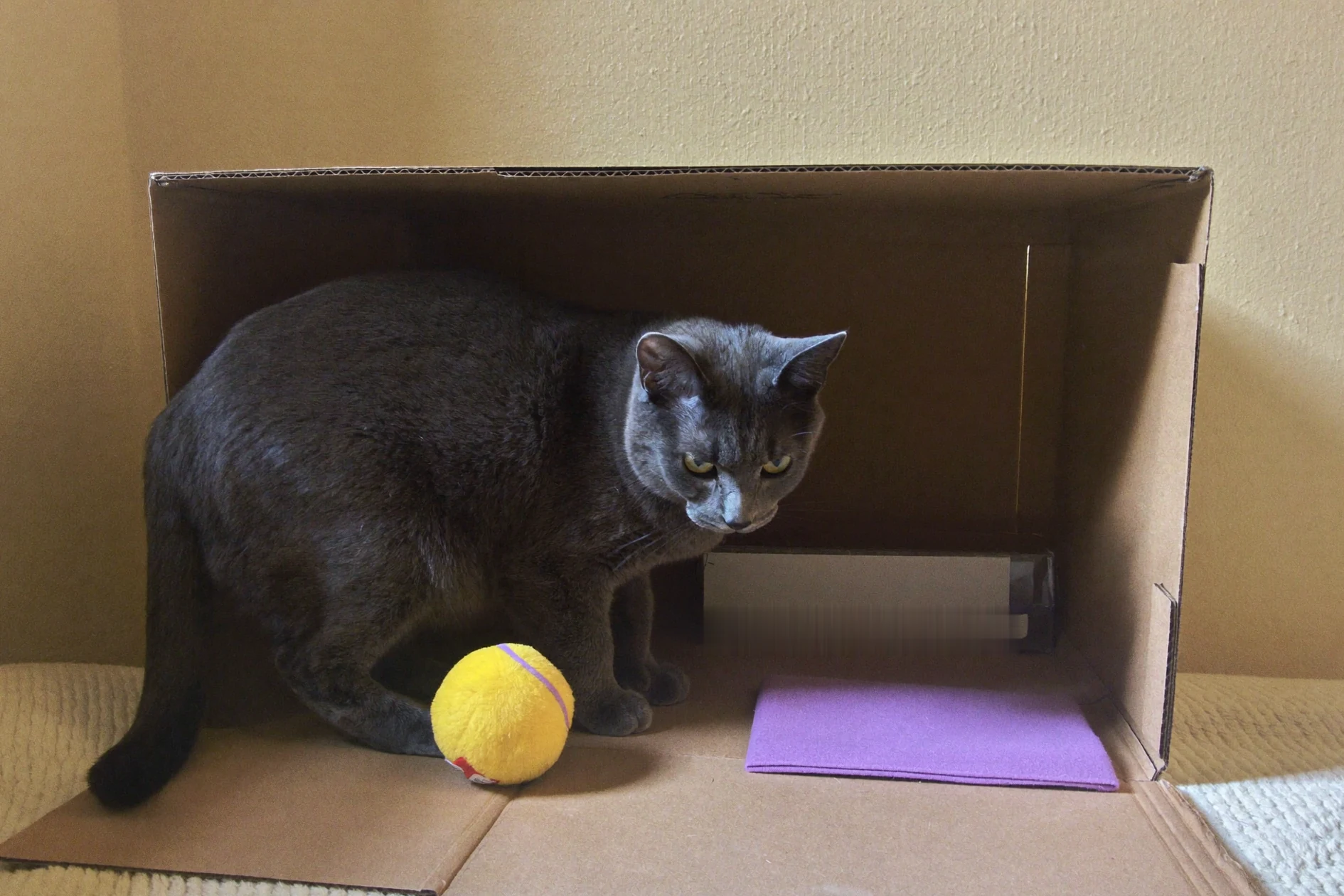
    • Materials: a sturdy box, scissors, a crinkly ball or ping-pong ball.
    • Build: cut small peek-holes and a top flap, toss the ball inside so it rolls and rustles. Trim any loose tape loops and make sure there are no tiny bits your cat could chew off.
    • First-use test: watch for chewing or tearing. If pieces start coming off, retire the box.
    1. Reinforced wand attachments
    • Materials: a short length of braided nylon cord (nylon = tough synthetic), heavy thread, lots of strong stitches.
    • Build: loop the cord through the wand attachment point, sew multiple passes and knot securely. Then give it a heavy tug and shake test. For step-by-step tips, follow DIY replacement attachments for teaser wands.
    • First-use test: do a forceful pull and a quick supervised play session to be sure it stays put.
    Project Risk Notes
    Braided tug toy Main risks: loose strands. Mitigation: make reinforced knots and trim frays.
    Sock mouse Main risks: seam failure or small bits. Mitigation: use strong backstitching and no glued parts.

    For full repair steps, a complete materials list, and stitch patterns for wand fixes, see DIY replacement attachments for teaser wands.

    Choosing toys by age, condition, and household type (kittens, seniors, multi-cat, declawed)

    - DIY redirecting toys and replacements.jpg

    Cats at different life stages and in different homes want different kinds of play. A kitten's tiny teeth and short attention span ask for quick, guided fun. An older cat needs gentler motion and softer textures. And when you have more than one cat, toys can become hot commodities. Match toy type, how long you play, and how many copies you own to each cat’s needs.

    Kittens

    Kittens are learning about bite control and how to play safely. Short, owner-led wand sessions teach them to chase and let go without using your hands. Try these habits early and you’ll save your fingers later.

    • Use wand play for bite inhibition. Keep it short and supervised, about 2 to 5 minutes.
    • Offer rubber teething toys (soft, chew-friendly rubber) so they can gnaw safely. Little teeth love something to nibble.
    • Rotate wand attachments and toss frayed bits right away so curious mouths don’t find hazards.

    Ever watched a kitten pounce and then fall asleep on the toy? Cute and useful.

    Seniors and Sensitive Cats (including declawed)

    Older or paw-sensitive cats need low-impact movement and short sessions so their joints don’t ache. Think gentle rolls and soft textures that let them pounce without strain.

    • Pick rolling balls and gentle puzzle feeders (treat-dispensing toy) that reward mild, easy foraging.
    • Go for plush with tight seams and soft surfaces; avoid sisal (rough plant fiber) edges if their paws hurt.
    • Keep playtime very short. A few minutes of interest-building play is perfect.

    It’s nice to see them chase something without wobbling, right?

    Multi-cat households

    When several cats live together, competition for toys can spark fights. Spread toys around, duplicate prized items, and stagger play so no one feels they must guard a toy.

    • Have multiple copies of high-value toys so sharing isn’t forced.
    • Run staggered play sessions so one cat isn’t guarding while another wants attention.
    • Offer separate puzzle feeders or timed dispensers to reduce resource tension.
    • Add vertical space and separate resting spots so cats can cool off after play.

    Sometimes a second copy of the feather wand is all the peace you need.

    Quick-reference checklist

    Cat type Recommended toys Session length How many copies
    Kittens Wand toys; rubber teething toys (soft, chew-friendly rubber) Short, supervised 2–5 minutes 1–2
    Young high-drive adults Active wand; puzzle feeder (treat-dispensing toy) Medium intensity sessions 2
    Seniors Rolling balls; gentle puzzle feeder (treat-dispensing toy) Low intensity, very short 1 each
    Declawed / paw-sensitive Soft plush with tight seams; low-impact chase toys Very short sessions 1–2
    Single indoor cat with aggression Mix of active toys + food puzzles + durable chew Twice-daily routine 2–3
    Multi-cat home with rivals Duplicate favorites; separate feeders Stagger playtimes One copy per cat for high-value items

    Safety & maintenance

    - Choosing toys by age, condition, and household type (kittens, seniors, multi-cat, declawed).jpg

    Let’s keep toy cleaning and retirement simple and regular. Wash washable toys every week or after a messy play session. Retire any toy that shows damage like exposed stuffing (the filling poking out), loose parts, cracked plastics (sharp edges or splinters), a persistent smell you can’t get out, or serious chew damage. Replace frayed strings, ribbons, or cords right away so your cat never finds a chewable hazard. And always choose toys labeled for pets made from non-toxic materials (safe if licked or nibbled).

    Battery-powered and motion toys need a little extra care. Pick devices built for pets with secure battery compartments (where the batteries sit and that snap or screw closed). Check those covers before every use, and take the batteries out when you retire or store a toy long-term. For ribbon or string play, always supervise. Put strings away out of sight after play so curious mouths and paws don’t get tangled.

    Maintenance schedule

    1. Quick pre-play check: before every session, give the toy a fast once-over for loose bits, frays, or wobble. If anything looks off, don’t use it.
    2. Weekly deeper inspect: run your fingers along seams (where pieces are stitched together), squeeze plush toys to find hidden splits, and flex hard plastic parts to spot hairline cracks.
    3. Cleaning cadence: wash washable toys weekly or after messy play; wipe down hard plastics and electronic housings (the casing around motors or circuits) with a damp cloth.
    4. Battery care: check battery compartments weekly for tightness, replace weak batteries, and remove batteries when storing or retiring toys.
    5. Safe storage: keep small parts, loose batteries, and strings in sealed containers; store string toys up high and out of sight.

    Warning signs that mean retire the toy now

    • Loose or opened seams
    • Exposed stuffing or loose filling
    • Cracked, splintered, or brittle hard plastic
    • Missing or loose battery cover, or loose batteries
    • Frayed strings, ribbons, or cords
    • Moving parts that stick, make odd noises, or get hot

    If you’re ever unsure, toss it. Your cat’s safety is worth a replacement.

    Refer to the durability checklist in the "Toy types, durability & buying guide" section for purchase-time tests like pull-on-seam checks, bite-test material, and battery-compartment security.

    Safety signs, progress tracking, and when toys aren’t enough

    - Safety  maintenance.jpg

    Play aggression usually shows up during playtime: high energy, chasing, swatting, then sudden lunges or bites. Ever watched your kitty go from gentle pounce to full-on nibble? That’s play arousal. Fear-driven aggression looks different , flattened posture, trying to run or hide, and striking without any playful cues. Watch the scene: is she chasing a teaser wand or cowering and striking from a hiding spot?

    Keep a simple log so you can spot patterns. Jot the date, which toy you used, how long you played, any bites or scratches, and mood notes like more grooming or hiding. With steady, twice-daily sessions and rotating toys, lots of cats calm down over weeks; the log helps you see what’s helping and what to swap. I once tracked Luna for a month and the bites dropped way down , worth every paw-print.

    Metric Tracked How to Record Goal
    Incidents per week Count bites or scratches during/after play Fewer incidents over several weeks
    Session adherence Mark days and session length followed Consistent twice-daily routine
    Mood / interaction quality Short note: relaxed, tense, avoids, engages More calm, toy-focused play
    1. See a vet or certified behaviorist if aggression is sudden or severe, seems linked to pain, or doesn’t get better after a few weeks of consistent toy-based training.
    2. Bring your log, a short video of the behavior, and notes on recent changes like new people, meds, or a move.
    3. Mention any injuries or ongoing avoidance, those clues can point to medical causes.
    4. Ask about adjuncts like pheromone support (synthetic calming scent) or a pain exam so you leave with clear next steps.

    Final Words

    Jump right in: when play gets rough, pick a wand, plush bite-target, or puzzle feeder (treat-dispensing toy) to guide the hunt into a safe game.

    We covered quick redirection steps, what to buy, durable materials and price bands, how to run a twice-daily training routine, DIY fixes and wand repairs, choosing toys by age/household, plus safety and tracking tips.

    Stick with short, regular sessions, log progress, swap toy types weekly, and you'll see calmer, happier cats. With the right cat toys for play aggression, your home will feel more peaceful and playtime will be claw-tastic.

    FAQ

    Frequently Asked Questions

    What toys are good for cats with play aggression?

    Toys that redirect the hunt are best: wand/teasers, plush bite-targets, and puzzle feeders. Choose durable materials such as solid rubber, heavy-denier plush, or nylon bite sticks for safety and longevity.

    How do I stop playful aggression in my cat and what toys can I give to help?

    Redirect the hunt using toys. Use a wand, plush bite-target, or quick puzzle feeder and train calmly—these give safe outlets and teach appropriate play.

    What toys work best for cats home alone or bored indoor cats?

    Puzzle feeders, rolling/track toys, and motion toys work well. Finish play with food rewards, rotate toys weekly, and keep sessions regular to lower rough play.

    Are electronic interactive cat toys safe for aggressive players?

    They can be safe for solo enrichment but may overstimulate some cats. Introduce them under supervision, ensure battery compartments are secure, and remove batteries when storing or retiring the toy.

    What should I look for when buying toys for aggressive chewers?

    Pick solid rubber or silicone, thick nylon chew sticks, tightly stitched heavy-denier plush, or sisal. Prices vary by category (roughly $10 up to $150).

    What are the signs of play aggression in cats?

    Look for sudden lunging, biting at hands, swishing tail, flattened ears, hissing, or growling—especially during high-energy play.

    What should I do when my cat bites during play?

    Redirect immediately to a wand, plush bite-target, or puzzle feeder. If biting continues, pause calmly, swap toy type to finish the hunt, and resume later with a scheduled session.

    How long before toys reduce play aggression?

    With twice-daily interactive sessions, toys can reduce play aggression over a few weeks. Keep a simple log of dates, toys, session length, and incidents to track progress.

    When should I consult a veterinarian or behaviorist about aggression?

    See a vet or behaviorist if aggression is sudden, severe, tied to pain, or not improving with consistent toy-based training. Bring your session log, note recent changes, and any signs of injury.

    Related Articles

  • environmental enrichment to reduce play aggression in cats

    environmental enrichment to reduce play aggression in cats

    Sick of getting tiny sharp nips when you try to cuddle or play with your cat? Your hand goes from warm to surprising little teeth, and ouch. Ever watched your kitty stalk a sock and think, huh, I wish that were my hand instead?

    Try environmental enrichment (small, easy changes to your cat’s world , perches [high spots they love], hiding spots [boxes or tunnels], wand toys [a stick with feathers or string], and puzzle feeders [toys that hide food so they have to figure it out]) to give them better ways to hunt, pounce, and burn off zoomies. Your cat’s whiskers will twitch as the toy rolls across the floor. It makes play feel safe and real.

    It’s not about buying every toy in the store. It’s about predictable play, short chase sessions, and letting them choose when to be wild so your hands stay off-limits. For busy days, toss an unbreakable ball before you leave , ten minutes of focused fun.

    This post gives a quick five-step start-now roadmap you can use today to cut biting and calm itchy paws. Ready to get your cat back to polite play? Worth every paw-print.

    Start-now roadmap: 5 immediate actions to reduce play aggression

    - Start-now roadmap 5 immediate actions to reduce play aggression.jpg

    Start with these five easy steps to calm itchy paws and build better play habits. Think of them as quick, practical moves you can do today to cut down biting and make playtime more fun for both of you.

    1. Get a vet exam, to rule out pain or medical causes. Sudden or new aggression can mean discomfort, and we want to be sure your kitty isn’t hurting.
    2. Run two 15-minute wand sessions each day, one in the morning and one before dinner. A wand (a stick with a string and toy on the end) is like a fishing rod for cats, perfect for safe pouncing and satisfying chases.
    3. Stop using hands-as-toys. Always redirect bites to a toy, especially the wand, so your hands stay off-limits. It’s tough at first, but your fingers will thank you.
    4. Add a perch and a hiding spot to the main room. A window perch (a cozy ledge) and a little hideaway let your cat watch, stalk, and decompress without needing to act out on you.
    5. Pair a short chase with a puzzle feeder before meals. A puzzle feeder (a toy that dispenses food) gives your cat the thrill of the hunt, then dinner, calming, mentally engaging, and yummy.

    Short-term goals to aim for in 2 to 4 weeks:

    Goal Target
    Weekly bite incidents Decrease by 50%
    Play sessions ending calmly At least 80% of sessions
    Human injuries requiring first aid Zero new incidents

    If the behavior starts suddenly, gets worse, seems linked to pain, or causes injury, book a vet appointment right away. If these steps don’t help after 4 to 6 weeks, or attacks escalate, contact a certified applied animal behaviorist (a credentialed specialist in animal behavior). Keep a daily log, time, what happened, what you were doing, and how severe the bite was. That record is gold for vets and behaviorists, and it helps you spot patterns fast.

    Worth every paw-print. Try this plan, tweak as you learn, and hey, watch those whiskers twitch when play finally clicks.

    Recognizing play aggression in cats: signs, causes, and differences from true aggression

    - Recognizing play aggression in cats signs, causes, and differences from true aggression.jpg

    Play aggression is your cat practicing hunting. Think pounce, quick bites that don’t stick, and fast chase-then-roll role play. Kittens and young cats do this a lot, and bored adults sometimes join the fun too. Ever watched whiskers twitch as a toy skitters away? That’s the vibe.

    Check the Start-now roadmap for the exact session timing and the hands-off wand rule so you can test whether enrichment fixes it. Enrichment (toys, play sessions, and puzzle feeders that satisfy hunting drive) usually calms this down.

    • Quick pounces with immediate breaks and little or no growling – usually playful stalking practice.
    • Soft-to-medium pressure bites that come and go, without a hard, fixed clamp (bite-inhibition gaps means they never learned to soften a bite).
    • Rapid chase-and-switch behavior, like rolling and role-play, often with relaxed whiskers and loose body language.
    • Prolonged hissing or growling, flattened ears, a rigid body, and a fixed, focused stare – these look more like real predatory or defensive aggression (serious attack or fear-based defense).
    • Sudden redirection – when a cat lashes out at whoever’s nearby after being startled; redirected arousal (excitement or fear gets shifted onto another target) is common if another pet or loud noise triggered it.
    • Tense tail twitching and wide-eyed hard stares that escalate instead of stopping when you interrupt – not playful.

    Common causes are pretty simple. Developmental bite-inhibition gaps (they didn’t learn to be gentle), under-stimulation, and inconsistent routines that leave hunting drive pent up. For busy people: a short, regular play session before you leave can buy you calm minutes at home.

    See your vet if aggression shows up suddenly, if wounds appear, or if your cat has other health changes like appetite loss or lethargy. And, uh, if you need help setting up safe play, ask a behavior pro or your vet – they can point you to good toys and timing tricks. Worth every paw-print.

    Toys, rotation, and redirection

    - Toys, rotation, and redirection.jpg

    Wand-style interactive toys are the cornerstone of play. Keep your fingers out of the action and let your cat practice stalking and pouncing from a safe distance. Think of the wand like a fishing pole for cats, just wiggle the lure and watch the whiskers twitch. Ever watched your kitty go full ninja? It’s the best.

    Mix supervised interactive sessions with toys your cat can use alone. That way they get to hunt, capture, and reset their focus without turning you into a moving toy. Keep about 5 to 8 active items out at a time and swap them every 3 to 7 days to keep things fresh. See the Start-now roadmap for the core session timing and the hands-off wand rule so those numbers stay consistent across the plan.

    • Wand teaser , great for kittens and adults. Check for frayed strings and split shafts (the stick part) and always supervise.
    • Plush mice , soft stuffed prey that help kittens learn bite inhibition; retire if seams open or stuffing shows.
    • Crinkle tunnels , noisy hide-and-seek fun; crinkle refers to a thin plastic layer that makes the sound, so watch for torn bits and exposed plastic.
    • Lightweight balls , perfect for solo chase; remove if paint chips or small pieces come loose.
    • Food-dispensing puzzle ball , a puzzle feeder (a toy that hides food so your cat works for treats) is great for slow feeding and brain work; clean often to prevent mold.
    • Lick mat , a rubbery mat with grooves (good for calming and enrichment); use with wet food or paste and wash after each use.
    • Catnip-stuffed toy , fun for playful adults and tolerant kittens; skip it if your cat gets overstimulated.
    • Safe chew/tug toy , helpful for bite-prone kittens learning limits; pick one with reinforced stitching (extra-strong thread) and non-toxic materials.
    Toy Type Primary Purpose Best Material/Size Session Recommendation
    Wand teaser Interactive stalking and ambush Light shaft (stick), soft lure, 12–18 in reach Use under supervision; replace frayed parts
    Plush prey Solo capture practice Small, machine-washable plush (soft stuffed), no small eyes Rotate often; retire if torn
    Puzzle feeder Extend hunt → reward sequence Durable plastic or rubber, food-safe Introduce slowly; watch first uses
    Ball/rolling toy Chase and pounce Lightweight, no small detachable bits Good for independent play; swap every few days
    Tunnel/box Hide, ambush, low-arousal play Sturdy fabric or cardboard, wide entry Keep clean; refresh to keep interest
    Chew/tug toy Mouthing outlet and gentle tug Reinforced fabric or rubber, no toxic fillers Supervise kittens; watch for wear

    Supervision guidance: watch new toys closely for the first few sessions, especially those with strings or small parts. Inspect toys weekly for loose pieces and weak stitching; repair or retire anything that looks unsafe. For low-cost wand repairs and replacement parts see DIY replacement attachments for teaser wands. Worth every paw-print.

    Play–feed sequencing and feeders

    - Playfeed sequencing and feeders.jpg

    Match play with mealtime so your cat gets the full hunt, catch, eat feeling. Start with a lively chase, wiggle a wand or roll a toy, and then give food right away from a puzzle feeder (a toy that drops kibble) or a regular bowl. It’s like a tiny hunting routine: wiggle, pounce, grab, snack. Your cat’s instincts get used, not frustrated.

    Safety first. Pick feeders made of food-safe materials (safe for mouths) and chew-resistant parts (won’t tear off easily). Wash them between uses. Watch new toys for small bits that could come loose. Supervise the first few sessions with any new feeder, and set up separate stations if you have more than one cat so meals don’t turn into contests. For exact play timing and capture counts, check the Start-now roadmap so your routine lines up with the rest of your plan.

    Session structure: hunt – chase – capture – reward

    Hunt: tease interest with a wand or rolling toy so your cat locks on.
    Chase: keep the motion varied and a little unpredictable so it feels like real prey.
    Capture: let your cat have a clear win, drop a plush mouse or slide a toy into a tunnel so they can grab it.
    Reward: give the food right after the catch, then finish with 1-2 minutes of calm petting so play ends gently and predictably.

    Feeder Type How It Reduces Arousal Average Session Duration Best For (kitten/adult/multi-cat)
    Slow-feed bowl Spaces out bites so the meal doesn’t spike excitement 5-15 minutes Kitten to adult
    Rolling treat ball (a ball that spills kibble when nudged) Encourages gentle chasing and active foraging 10-25 minutes Kitten and active adults
    Modular puzzle feeder (pieces you rearrange) Extends the hunt with problem-solving and paw work 15-40 minutes Adult and multi-cat (use multiple units)
    Snuffle mat (fabric mat with hidden pockets) Slows eating by making cats search by scent 10-30 minutes Shy cats and multi-cat homes
    Timed electronic feeder (battery-powered dispenser) Makes rewards predictable and spaces them out to lower anticipation Varies by setting Busy households, multi-cat with separate stations

    Introduce a new feeder over 7-14 days so your cat isn’t overwhelmed. Start with short, supervised bites at an easy level and slowly make it tougher. Watch the first few full meals for chasing, guarding, or frustration and move feeders apart if cats start to compete. Keep daily calories the same while spreading food across play sessions, and jot down which feeders calm your cat best so you can repeat what works. Ever watched your cat figure out a new toy and look so proud? Worth every paw-print.

    Resources & territory

    - Resources  territory.jpg

    Start by giving cats vertical real estate. Put in multi-tiered cat trees, wall shelves, and window perches so cats can climb and escape each other , heights around 20-60 inches work well. In shared rooms aim for 1-2 perches per cat so shy or low-ranking kitties can retreat without a face-off. Add 1-2 scratching posts per cat; sisal (a stiff natural fiber used for rope) and corrugated cardboard (layered paperboard like moving-box material) hit different scratch preferences, so mix and match.

    Ground-level hideaways matter just as much. Offer boxes, covered beds, and low tunnels as cozy retreats where a cat can tuck away and decompress; scatter these across rooms so hiding spots aren’t all in one corner. Litter box basics: one litter box per cat plus one extra, place boxes well away from feeding stations and noisy appliances, and scoop daily so they stay inviting and lower stress-driven redirected behavior.

    Multi-cat homes need deliberate resource spacing to curb guarding and rough play. Give each cat multiple feeding stations and separate perch clusters so mealtime and lookout duty aren’t centralized; spread hiding spots and toys across at least two rooms so competition drops. Quick checklist: one litter box per cat plus one extra, 1-2 scratching posts per cat, 1-2 perches per cat in shared rooms, and separate feeding zones. If fights or injuries keep happening after you try this, ask a pro for help.

    Staged introduction protocol

    Begin with a scent swap for about 3 days , swap bedding or rub each cat with a towel and leave it with the other so they learn each other’s scent. Next do visual-only separated interactions for roughly 4-10 days so they can watch and get used to signals without touching. Then move to short supervised meetings, slowly lengthening them; if hisses or growls keep showing up after 2 weeks, pause or go back a stage and try again. If aggression or injuries continue despite careful steps, contact your veterinarian or a certified behavior specialist (a pro trained in cat behavior) for the next steps.

    environmental enrichment to reduce play aggression in cats

    - Training gentle play and managing overstimulation.jpg

    Start with a tiny training loop: short targeting (teaching your cat to touch a spot on cue) or settling sessions that last about 3–5 minutes. Use a clear marker (a clicker, a small device that makes a sharp sound, or a short word like "yes") and give an immediate food reward, so your cat learns calm gets the good stuff. Time the marker to the exact moment your cat relaxes or touches the target, then reward with tiny treats (small, soft food bits). Think of it like teaching a polite finish: pounce, capture, then settle for a snack.

    Watch for early overheating signs: a stiff tail, flattened ears, a hard stare, or suddenly faster lunges. At the first sign, stop play, pull away attention briefly, and give the room a 10–20 minute cool-down. Then come back with a low-energy cue, like a gentle wand wiggle at chest level or a quiet target game. Don’t punish, okay? Physical corrections or scolding make your cat more fearful and can make reactive behavior (sudden aggressive responses) worse.

    If progress stalls, check common slip-ups: sessions that run too long, mixed or inconsistent cues, or sneaky hands-as-toys that erase your work. A simple 2–4 week plan usually gets things back on track. Week one: teach the marker and treat calm. Week two: practice ending play on a settle so calm becomes the routine. Week three: add short, predictable interruptions and reward fast recovery. Week four: stretch out calm periods and slowly switch to lower-value rewards. Oh, and no hands as toys, ever.

    If you’ve done this steadily and things still aren’t improving, get tailored help from your vet or a certified behavior specialist (a trainer with formal behavior certification). It’s worth it for your peace of mind and your cat’s safety. Worth every paw-print.

    Week Focus Simple Goal
    Week 1 Marker + treats Make calm predict treats
    Week 2 End-play settle Finish play with a calm cue
    Week 3 Brief interruptions Reward quick, calm recovery
    Week 4 Longer calm periods Phase in lower-value rewards

    Tracking progress, behavior logging, and referral criteria

    - Tracking progress, behavior logging, and referral criteria.jpg

    Keep this short, simple tracking plan in your Start-now roadmap. The goal is to have clear fields, follow a steady recording schedule, and watch for trends fast. Think of it like a habit tracker for your cat’s moods and mischief.

    What to log (keep it tidy)

    • Date/time (YYYY-MM-DD HH:MM).
    • Context (room, people, what was happening).
    • Pre-session activity (nap, meal, rough play).
    • Toys used (feather wand, laser, etc.).
    • Outcome (calm play, gentle pounce, nip, bite).
    • Wound presence (yes/no; photo if present – take a clear picture).
    • Vet notes (any medical advice).

    Example entry: "2025-01-02 19:15; living room; pre-session: nap; toy: feather wand; outcome: gentle pounce, no bite; wound: none; vet notes: n/a"

    What to measure (objective, quick)

    • Incidents per week.
    • Severity per incident on a 1-5 scale (1 = light nip, 5 = deep bite/attack).
    • Percent of sessions that end calmly.

    Example milestone: "50% drop in weekly bite incidents within 2-4 weeks; calm endings in at least 80% of sessions." Nice and clear.

    Recording item Schedule
    Daily entries Daily for first 2 weeks
    Weekly summaries Weekly after initial 2 weeks
    Milestone reviews At 2, 4, and 6 weeks

    If you see a sudden injury or signs of pain, contact your veterinarian right away. For ongoing behavior issues, reach out to a certified applied animal behaviorist (a pro trained in animal behavior) if your program shows no clear improvement after 4-6 weeks or if attacks are getting worse.

    Daily logging for the first 2 weeks. Then weekly summaries and milestone reviews at 2, 4, and 6 weeks. Worth every paw-print.

    Final Words

    In the action, we gave five immediate steps you can do today: rule out medical causes, run two short wand sessions, stop using hands-as-toys, add a perch and hiding spot, and follow play with a puzzle feeder. Easy to start between meetings.

    We also covered spotting play-aggression, smart toy rotation, play-feed sequencing, better territory setup, gentle training, and tracking progress with clear referral triggers.

    Stick with the plan, keep a brief log, and trust environmental enrichment to reduce play aggression in cats , calmer paws, happier home. Worth every paw-print.

    FAQ

    Frequently Asked Questions

    Why do my cats play so rough with each other?

    The reason your cats play so rough is usually normal social play or an unmet hunting drive. Common causes include bite-inhibition gaps, under-stimulation, redirected arousal, or adolescent energy. See a veterinarian if you notice sudden changes in behavior.

    How do I stop cats from playing rough with each other or reduce play aggression?

    Start with a veterinary check. Add structured play and environmental adjustments:

    • Run two short interactive wand sessions daily.
    • Never use your hands as toys; always use toys to redirect biting.
    • Provide perches and hiding places so cats can escape or observe.
    • End play sessions with a puzzle feeder or food-dispensing toy.

    What are some free, DIY, or indoor cat enrichment ideas?

    Free indoor enrichment ideas include:

    • DIY wand toys using string and a feather.
    • Cardboard-box forts and paper-bag hideouts.
    • Snuffle mats for foraging and window perches for watching outdoors.
    • Rotate a small stash of toys every 3–7 days and offer safe chew items.

    Do cats like to play rough with humans, and how can I stop a cat that plays too rough with me?

    Cats may play rough with humans because hands mimic prey. To stop it:

    • Use wand toys (teaser wands) so hands stay out of play.
    • Redirect bites and scratches to appropriate toys.
    • Pause or stop play immediately after a bite, then resume calmly later.
    • End sessions with a food reward to reinforce gentle play.

    How can I calm down an overly playful cat quickly?

    To calm an overly playful cat quickly: switch to low-intensity play, withdraw attention at the first sign of escalation, offer a food reward or puzzle feeder, and give a short quiet break so arousal subsides before resuming play.

    What is the 3-3-3 rule for cats?

    The 3-3-3 rule: three days of scent swapping or quiet room time, three weeks of gradual supervised interactions and exploration, and around three months for full settling. Extend this timeline if hisses or injuries continue.

    What is environmental enrichment for indoor cats and how does it help as prevention and therapy?

    Environmental enrichment provides daily interactive play, vertical perches, hiding spots, rotating toys, and puzzle feeders to reduce boredom and stress-driven rough play, and to improve cats’ overall quality of life.

    Related Articles

  • When-to-Seek-a-Behaviorist-for-Cat-Play-Aggression

    When-to-Seek-a-Behaviorist-for-Cat-Play-Aggression

    If playtime leaves you with nips, a bruised ego, or bleeding hands, that’s not just "kittens being kittens." It’s a warning sign. Your palm might sting and your heart sink, really.

    First step: see your veterinarian (a doctor for animals who checks for pain or illness). Cats are pros at hiding discomfort, and pain or sickness can make playful bites turn rough. Ever had a purr turn into a sudden snap? That could be pain talking.

    Next, use a quick checklist to decide if you need an expert. A certified feline behaviorist (a trained cat behavior specialist) helps with training and changing the home setup. A veterinary behaviorist (a veterinarian with extra behavior training) looks at medical and behavior issues together.

    If bites break the skin, attacks happen every day, or you feel unsafe at home, book a consult and start a short incident log (a simple record of date, time, what happened, what led up to it, and any injuries). Don’t wait, those notes make it much easier for a pro to help. Oops, let me rephrase that, a few clear entries can speed up the right fix.

    When-to-Seek-a-Behaviorist-for-Cat-Play-Aggression

    - Deciding if a behaviorist is needed for cat play aggression  clear signs, thresholds, and immediate steps (this section answers the searchers need).jpg

    Use this short checklist to figure out whether you need a behaviorist for cat play aggression. It’s quick, clear, and meant to help you go from worried to doing something useful.

    First things first: get a vet exam (veterinarian). Cats hide pain, and health problems can cause or make aggressive play worse, so rule out medical issues before you call a behaviorist.

    If any of the items below fit, contact a certified feline behaviorist (trained cat behavior specialist) or a veterinary behaviorist (a veterinarian with behavior training) for a consult.

    1. Any bite that breaks the skin or draws blood, even once.
    2. Repeated attacks every day, multiple times per day, on people or other pets.
    3. Episodes that get worse or happen more often over several weeks.
    4. Aggression that causes injury to household members or other animals.
    5. Aggressive events that come with appetite loss, litter box changes, big grooming changes, or major shifts in activity.
    6. Caregivers who are afraid of the cat, avoid interacting with it, or whose home life clearly worsens because of the behavior.

    If an event happens, do this now: stop interaction immediately and move your hands and body parts out of reach. If you need to keep everyone safe, put the cat in a secure room with a litter box, water, and a comfy bed.

    Start a short incident log (simple notes) with date, time, location, who was there, what may have triggered it (toy, another pet, a sudden noise), the exact behaviors you saw (biting, scratching, tail and ear cues), any injuries, and how long it lasted. If you can safely record video, do that too. Then arrange a prompt veterinary exam and bring the incident log, any videos, a current medication list, and notes about recent behavior or medical changes to the appointment.

    Other sections go into medical triage, emergency safety steps, and how behaviorist consults work, so you won’t need to repeat those details here. Worth every paw-print.

    Red flags and urgent clinical guidance for cat play aggression

    - Red flags and urgent clinical guidance for cat play aggression (quick-reference emergency page).jpg

    Yikes, cat bites are riskier than they look. Cat mouths commonly carry Pasteurella spp. (common cat-mouth bacteria) and anaerobes (bacteria that grow without oxygen). Puncture wounds often seal up and trap those germs inside. They usually need professional irrigation (thorough flushing) and sometimes antibiotics (medicines that kill bacteria).

    Seek emergency medical care for people if bleeding won’t stop, if there are signs of a spreading or systemic infection like fever or rapidly spreading redness, or for deep puncture wounds. Don’t wait to be sure.

    Get urgent veterinary care for the cat if the aggression is sudden and comes with collapse, stumbling, disorientation, or other neurologic signs (problems with balance, coordination, or awareness). Those can be medical emergencies and not just behavior issues.

    See the article’s central emergency/triage section for the simplified triage checklist. And please save any video or photo evidence with timestamps, plus witness names for clinicians and behaviorists. For example: "00:12 cat lunges; witness: Alex; clothing torn at sleeve."

    Vet-first checklist to prepare for a behavioral consult (what to report and diagnostics to request)

    - Vet-first checklist to prepare for a behavioral consult (what to report and diagnostics to request).jpg

    At triage say this exact line: "My cat has bitten [person/pet], this happened [dates/times], here are videos and the incident log; the behavior is new/worse; I’m worried about pain or neurologic disease." Bring the incident log, short video clips, current meds, and any recent vet notes – they make the exam much more useful.

    Quick note before we dive in: those videos and the timeline are pure gold. Ever watched your cat’s whiskers twitch before a bite? Yeah, footage helps.

    Medical red flags to report right away:

    • Appetite or weight change. Even small shifts matter.
    • Litter box accidents (peeing or pooping outside the box). That can signal pain or illness.
    • Marked lethargy or being unusually sleepy.
    • Vocalizing when handled or obvious pain spots when you touch them.
    • Changes in grooming, like overgrooming or matted, unkempt fur.
    • Stiffness, limping, or trouble jumping.
    • A sudden rise in how often or how hard they’re being aggressive.

    Expect these diagnostics during the visit:

    • Full physical exam and pain scoring with an orthopedic check (feel joints and spine for soreness or injury).
    • CBC/chemistry blood tests (CBC = complete blood count; chemistry checks liver, kidneys, electrolytes).
    • Urinalysis (simple urine test).
    • Neurologic exam (checks coordination, reflexes, and nerve responses).
    • Imaging like x-rays or ultrasound (sound-wave imaging for organs and soft tissues) if trauma or neurologic signs are suspected.
    • Thyroid or other endocrine testing (hormone checks) when indicated.
    • Regional infectious disease panels (tests for local infections, like tick-borne diseases) when relevant.

    Many vets will also try a short therapeutic pain or anti-inflammatory trial (a brief pain-med test) if pain seems likely. If the behavior improves, that’s a big clue it was pain-related.

    Bring patience and your notes. Short videos, a clear incident log, and the meds list turn a good exam into a great one. Worth every paw-print.

    When-to-Seek-a-Behaviorist-for-Cat-Play-Aggression

    - Failed home remedies and realistic timing for behaviorist referral on cat play aggression.jpg

    Start with the basics. Try short, scheduled play sessions to burn off chase drive, swap your fingers for toys, and give puzzle feeders (toys that make cats work for food). Set clear petting limits and add hiding spots or perches (high resting spots). You can try pheromone diffusers (scent signals that mimic feline comfort), too. Done consistently and with good timing, these moves often cut down on misdirected arousal (an excited state that turns into rough play).

    Call a certified behaviorist (a pro trained to read cat body language and change behavior) if those steps, done correctly, don’t shrink the problem after 4 to 8 weeks. “Done correctly” means you kept a clear routine, used appropriate toys and session lengths, and watched your cat’s cues. If the bites or swats get more frequent or harder, or if anyone’s getting hurt, reach out sooner. And please, skip punishment or scary fixes , they usually make things worse, not better.

    Make notes like a little detective. Jot dates and times, how long each session lasted, which toys or treats you used, who ran the session, and what your cat’s body looked like before and after (tail, ears, pupils). Short video clips of a typical session are gold for a behaviorist. Professionals say owner follow-through is one of the biggest predictors of success, so aim for steady, honest logs, not random attempts.

    Worth every paw-print.

    Examples of common home strategies owners try

    • Daily teaser-wand play (a fishing-rod style toy for cats) and tossing soft balls.
    • Limiting lap time and plugging in pheromone diffusers (scent signals that mimic feline comfort).
    • Offering puzzle feeders (toys that make cats work for food).
      Common mistakes: irregular play schedules, using bare hands, not rotating toys, and ignoring early body-language warnings.

    What a certified or veterinary behaviorist does for cat play aggression and credentials to look for

    - What a certified or veterinary behaviorist does for cat play aggression and credentials to look for.jpg

    There are a few kinds of pros who help with play aggression. DACVBs (board-certified veterinary behaviorists) are vets with extra training in animal behavior (think: a vet who studied behavior deeply). Applied animal behaviorists usually have graduate degrees in animal behavior or psychology (advanced study in how animals learn and act). Feline behavior consultants are often hands-on specialists who focus on cats and everyday household fixes. All three tend to use science-based, non-aversive methods (no punishment, respectful of cat instincts).

    Ever watch your kitty stalk a toy like it owes them dinner? A typical consult starts like that, by watching. The expert reviews medical records and your incident log, and asks for short videos if you have them. Then they run a differential diagnosis (a process of ruling out causes – play, predatory drive, redirected aggression, or fear) to figure out what’s really going on.

    Next comes a tailored behavior plan. That usually includes enrichment (toys, puzzles, and play routines to keep your cat busy), structured impulse-control games (short, repeatable activities that teach your cat to pause before reacting), safety steps for your home, and follow-up visits to tweak things. It’s practical stuff, you know, clear start-and-stop games, timing tips, and low-effort routines you can repeat.

    Sometimes meds help. When a cat’s arousal is very high, or a medical issue slows learning, a vet may suggest medication so training can actually work. Examples include fluoxetine (an antidepressant that can lower anxiety) and gabapentin (a nervous-system med that can reduce reactivity). Meds aren’t magic; they’re a tool, prescribed by a veterinarian, and progress usually shows up over weeks to months with regular check-ins and consistent owner practice.

    Credentials matter because anyone can claim they’re an expert. Look for DACVB board certification, university affiliations, published case studies or documented client outcomes, and listings in reputable professional directories. Ask about continuing education, sample case notes, and real-world experience specifically with feline play aggression before you hire someone.

    You want someone who uses science, respects your cat’s instincts, and gives you a plan you can actually follow. Worth every paw-print.

    What to bring to a behaviorist appointment, costs, timeline expectations, and progress tracking for cat play aggression

    - What to bring to a behaviorist appointment, costs, timeline expectations, and progress tracking for cat play aggression.jpg

    Bring a few things to make the consult useful. Think of it like packing for a vet visit, but for behavior.

    • Incident log (short, dated notes about each event , what happened, when, and what set it off).
    • Short video clips of incidents or normal play sessions, saved on your phone or a cloud link so the behaviorist can view them easily.
    • Complete veterinary records and recent diagnostics (health tests, like bloodwork or X-rays).
    • A list of home strategies you’ve tried and how the cat reacted.
    • Current medications with doses.
    • A brief household map (who lives there, other pets, daily routine).
    • Your notes on body language and common warning signs (ears back, tail flicks, pupil size, etc.).

    Label files clearly. It saves time and makes the session way more productive.

    Costs vary by region and by the behaviorist’s experience. Some charge a flat initial assessment fee. Others sell packages that include follow-ups. Ask for a sample fee schedule up front so there are no surprise charges.

    How long change takes depends on the severity and how steady you are with the plan. You might see small improvements in a few weeks. Meaningful, reliable change often takes several weeks to a few months with steady work and check-ins. Owner consistency is huge , the more you follow the plan, the faster things usually improve.

    Track progress with a short daily or weekly diary , think of it like a workout log for your cat. Note frequency of incidents, intensity (mild nip vs. a bite that breaks skin), likely triggers, what you tried, and the outcome. Expect an initial assessment, a first follow-up within 1 to 3 weeks, then check-ins every 2 to 6 weeks as the plan gets tweaked. Keep the records simple, honest, and repeatable , those notes are the biggest predictor of success, really.

    Immediate safe-play protocols and environmental enrichment strategies while awaiting professional help

    - Immediate safe-play protocols and environmental enrichment strategies while awaiting professional help.jpg

    Grab a long teaser wand or fishing-rod toy (long wand toy, like a fishing rod for cats) so your hands stay well out of reach. Set play up like a tiny hunt: a short stalk, a quick chase, a neat pounce, then a tiny food reward. Keep each session short , three to seven minutes , and do a few rounds through the day instead of one marathon. Rotate toys every few days to keep things fresh, and always finish calm: dim the lights, offer soft petting if the cat wants it, so the excitement doesn’t hang around.

    Add enrichment that replaces the hunt and lowers baseline arousal. Use food puzzles and puzzle feeders (toys that make cats work for food) to slow eating and give their brain something to do. Slow-feeders (bowls or mats that make mealtimes longer) help too. Give vertical territory , shelves and perches , so your cat can watch from above and not feel cornered, and add extra elevated resting spots in multi-cat homes to cut down on competition. Toss in scent and tactile options like safe catnip or hiding boxes (cardboard forts are fine); the rustle of a box and a soft catnip whiff can do wonders for boredom.

    For homes with kids or several cats, teach children to use only wand toys and never hands, and keep play short and supervised so everyone knows the rules. Keep duplicates of favorite toys in different rooms and stagger play times if one cat gets riled up by another’s activity. If things suddenly change, refer to the Deciding section for emergency actions and the Vet-first section for medical concerns. For a practical how-to on using teaser wands and training cats to target toys instead of hands, see how to train kittens with interactive teaser wands.

    Worth every paw-print.

    Final Words

    In the action, this post gave the single checklist you need to decide whether to see a certified behaviorist after basic medical checks.

    You got the vet-first step, the six clear referral thresholds (blood-drawing bites, repeated daily attacks, escalation over weeks, injuries, appetite/litter/grooming shifts, or caregiver fear and a big drop in household life), and the four immediate actions: stop interaction, isolate if needed, document date/time/triggers plus video, and get a veterinary exam.

    If those signs show up, use when to seek a behaviorist for cat play aggression as your guide , help is available and your cats can get calmer.

    FAQ

    How do I stop play aggression between cats?

    Lower arousal with long teaser wands (fishing-rod toy), run short 3–7 minute chase sessions several times daily, rotate toys, add perch spaces, and give supervised calm breaks.

    How do I stop cat aggression toward people, including redirected aggression?

    Start with immediate safety, get a veterinary exam to rule out pain, avoid known triggers, and seek urgent care if a bite breaks the skin.

    When should I see a cat behaviorist and how do I find one?

    See a trained cat behavior specialist when any bite breaks skin, attacks are daily or escalating, injuries occur, appetite or litterbox use changes, or caregiver fear lowers household life. Ask your vet for referrals.

    When should I see a vet for cat aggression?

    See a vet when aggression is sudden, comes with appetite or litter changes, causes injury, or when bites break the skin. Vets check for pain, neurologic issues, infection, and run diagnostics.

    What is territorial aggression in cats and how do I handle it?

    Territorial aggression is defending perceived space. Handle it by adding vertical territory (shelves and perches), separating resources, using supervised introductions, and seeking a behaviorist if injuries or chronic conflicts continue.

    What is the 3-3-3 rule for cats?

    The 3-3-3 rule says expect three days of shock, three weeks of adjustment, and three months to fully settle after a move or rescue; keep calm routines and use slow, gentle introductions.

    Related Articles

  • Managing Play Aggression in Multi-Cat Households

    Managing Play Aggression in Multi-Cat Households

    Ever watched two cats play tag one second and turn into teeth-and-claws tumble the next?
    Whiskers twitch, fur flies, and it can be hard to tell if it’s friendly roughhousing or something that could hurt.

    So here’s the plan: clear signs to spot playful vs. real fights, quick and safe ways to break things up, and a simple daily routine to keep hunting drives healthy without anyone getting hurt. Think of it like refereeing a scrappy soccer game, with rules, short bursts of play, and a timeout when things get too rough.

    Play looks loose and bouncy. Bodies are wiggly, they take turns chasing, and one will pause or flop down to say “I’m done” now and then. There might be chattering or light batting, not full-on biting, and ears stay mostly forward. Real aggression is tense. Look for stiff bodies, ears flattened back, growling, claws out with no breaks, and one cat trying to hide or escape. Blood, repeated hard bites, or a cat screaming means stop and separate.

    If things get heated, try a calm distraction first. Toss a favorite toy or shake a bag of treats to redirect attention. You can also roll a blanket between them or gently block the view with a piece of cardboard, then carry one cat away, never grab by the scruff or chase them, that usually makes it worse. Put them in separate rooms with water and a litter box for 10 to 20 minutes, then reintroduce calmly.

    Keep it peaceful every day with short, structured play. Do two or three 5 to 10 minute sessions with an interactive wand (like a fishing rod for cats) to burn off predatory energy, then let each cat “catch” a toy and get a small food reward. Puzzle feeders (toys that make them work for kibble) give mental exercise and slow eating. Rotate toys so things stay new and exciting.

    I once watched Luna launch six feet for a feather and then nap like nothing happened. Worth every paw-print.

    Managing Play Aggression in Multi-Cat Households

    - Immediate action hub quick triage, deescalation, oneparagraph protocol  next steps.jpg

    Quick check: if the rough play is mutual, with cats trading roles and no one gets hurt, it’s probably play aggression (rough play that looks like fighting but isn’t meant to hurt). But if one cat keeps delivering hard bites that cause punctures (deep skin breaks), or a cat looks truly scared and avoids the other, treat it as harmful and act fast. Ever watch two kitties swap places like tag? That’s usually fine. Repeated attacking is not.

    Stay calm. Stop the play right away and quietly step back, don’t chase or grab them, that only makes things worse. If you need to separate them, put a barrier between the cats, like a baby gate or a cardboard panel, or from a safe distance make a brief noise to break focus. Only do noise or intervention if it’s safe. If you must physically intervene, protect your hands and feet with gloves or a thick towel (a towel absorbs bites and scratches). Then walk away once things settle so the cat understands that rough hits end the fun.

    One simple routine: schedule short interactive play sessions every day. Do 10–15 minute bursts in the morning or evening when cats are naturally active, and always end play with the same reward or a calm cue so the session finishes cleanly. No hand play, ever, and use wand toys (a long stick with a toy on the end), feather teasers (feathers on a string), or kicker toys (soft, long toys cats can grab and kick) to keep teeth and claws off skin while letting hunting drives out. Rotate toys so things stay interesting. Give extra solo sessions to the instigator (the cat that starts the rough stuff) to burn energy, and offer separate, gentle enrichment for the shy cat until they regain confidence. That routine is the backbone of safer play in multi-cat homes. Worth every paw-print.

    For deeper help and tools see:

    • Distinguishing play fighting from real aggression: expanded cues and systematic monitoring
    • Safe play techniques: toy mechanics, recommended toys, and demonstration variations
    • Sample routines, shift templates, and troubleshooting for multi-cat households
    • Medical, physiological, and professional interventions

    Distinguishing play fighting from real aggression: expanded cues and systematic monitoring

    - Distinguishing play fighting from real aggression expanded cues and systematic monitoring.jpg

    Play often looks like a friendly back-and-forth: chasing, pouncing, quick breaks, and role swaps where the chaser becomes the chased. It’s usually short, reciprocal, and ends without injuries. Real aggression feels one-sided – hard bites that break skin, loud yowling, or a cat who hides and won’t get back to their normal routine. Quick rule of thumb: if both cats take turns and nobody gets hurt, it’s probably play. If one cat is repeatedly targeted, fearful, or has puncture wounds (small holes from teeth or claws), it’s not play.

    Cats give clues long before claws fly. Ears pinned or turned sharply back usually mean rising alarm. A twitching or fluffed tail signals growing arousal or irritation. Wide, dilated pupils (when the black part of the eye gets large) show high arousal. Whiskers (the long face hairs that help cats sense space) pushed forward or flattened suggest intense focus or stress. A stiff, crouched stance with no role-swapping usually means the fun has tipped into something riskier and you should step in.

    Body language cues to watch

    Watch who starts and who stops play. If one cat always initiates and the other freezes, flattens ears, or tries to run away, that’s a red flag. Short chases with pauses are normal; long, relentless chases that corner a cat at a doorway are not. Also, note posture changes: a sudden freeze, tucked tail, or hiding after an interaction means a cat felt threatened.

    Vocal signals and interaction context

    Hissing, growling, and frantic yowls are more likely signs of aggression or fear. Soft chirps, trills, and quick excited mews are usually play sounds. Check what’s around them: a narrow hallway, a bird at the window, or mealtime nearby can flip playful energy into stress. Always make sure there are clear escape routes so a cat can safely break contact.

    Monitoring guidance

    Keep a simple behavior journal and save short video clips so you can spot patterns, who starts fights, how often they happen, and how they end. Note time of day, which toys were out, and any nearby triggers. Try small interventions like tossing a toy to redirect energy or giving the targeted cat a quiet hideaway. See Step-by-step plan for the central protocol to interrupt and retrain risky patterns. Worth every paw-print.

    Root causes and household triggers of misdirected play in multi-cat homes

    - Root causes and household triggers of misdirected play in multi-cat homes.jpg

    Boredom and excess energy are the usual culprits. Cats need hunting-style activity (chasing, pouncing, stalking) to burn off that spark. When they do not get short, focused play sessions, they invent targets: your hands, your feet, or the sleepy person on the couch. Ever watched a whisker-twitching pounce turn into a surprise bite? It happens when the hunting muscle needs exercise.

    Kittens pick up hunting moves very young. Rough play with humans teaches them that grabbing and nipping people is okay. Think of it like a sport practice. Without safe outlets, the practice gets rerouted into awkward or painful play. So use toys, not fingers, to teach what is and is not a target.

    Territory and social rank also steer whether play stays friendly. A confident cat may chase or corner a timid cat by a doorway or a food bowl, and that trapped feeling can turn play into real trouble. Spread out perches and bowls, create clear escape routes, and give shy cats high resting spots so they can opt out when they want.

    Redirected aggression (when a cat gets amped up by something it cannot reach and then attacks whatever is closest) is another trigger. A strange cat at the window, a sudden loud noise, or a stressful visitor can spike arousal and lead to misdirected attacks. Scent or identity mismatches also matter , if a cat smells different after being outside, housemates may not recognize them and tension can flare, since cats rely on smell to know who belongs.

    Fixes should match the causes. Add short chase-and-catch games several times a day, rotate toys so play feels new, and give high-energy cats solo outlets like puzzle feeders or an unbreakable ball. Use gentle separation when groups clash, then do slow reintroduction with supervised, calm meetings. And if you suspect pain or a sudden health change, see a vet for medical interventions.

    - Safe play techniques toy mechanics, recommended toys, and demonstration variations.jpg

    Interactive toys work best when they copy the small, unpredictable moves of real prey , a feather that flutters, a small ball that skitters, a sudden dart across the floor. Use toys to channel hunting energy onto props, not people. Rotate toy types and give high-energy cats solo sessions so one kitty doesn’t become the house-instigator, and keep your hands out of reach by using long-handled tools.

    Wand toys work because a flexible shaft sends quick wrist jerks into tiny, prey-like twitches. Pick a rod made from fiberglass (like a strong fishing-rod core) or polymer (a tough synthetic plastic) so it has good snap and lasts. The motion is what makes cats pounce, so feel free to vary speed and height.

    Kicker toys are soft, long toys for biting and hanging onto while cats kick with their hind legs, which satisfies the grab-and-hold instinct. Puzzle feeders turn hunting into foraging by making food come out only after effort , puzzle feeder (a toy that hides food until the cat works for it). Motorized chase toys imitate erratic ground-level movement, but use them in short, supervised bursts so no guarding behavior develops. Hide-and-pounce tunnels create ambush spots that feel like real hunting practice. Nail trims and soft paw caps (tiny vinyl covers) help reduce injury during rough play, so play can stay fun and safe.

    • Wand/teaser – long reach, mimics live movement; keep hands well away.
    • Kicker toys – let cats bite and grapple a safe target.
    • Puzzle feeders – redirect hunting energy into food-finding work.
    • Motorized chase toys – use short, supervised bursts to burn energy.
    • Hide-and-pounce tunnels – encourage stalking and surprise pounces.
    • Soft paw caps (tiny vinyl covers) and nail trims – reduce the risk of injury.

    Try these demo variations to teach safe play patterns. Slow stalk + quick pounce – tease the wand low and slow so your cat crouches, then whip it into a fast twitch for the pounce, and end with a soft reward like a brief pet or a tiny treat. Two-step chase then kicker – lead a short chase with a motorized toy, then drop a kicker toy for your cat to grab and kick so they can finish the hunt. Group session bursts – run short, separate spurts for different cats (cat A gets the wand, cat B gets a kicker), so everyone gets a turn without crowding.

    Scatter interactive toys around rooms and avoid dropping one prized toy in a narrow hall where guarding can start. Watch group play and step in if one cat monopolizes action; give the target cat a quiet hideout and offer the instigator extra solo outlets, like a puzzle feeder or a timed motorized toy. For exact session timing and central toy rules see Step-by-step plan.

    Managing Play Aggression in Multi-Cat Households

    - Managing space and resources layout specifics and actionable resource table.jpg

    Make sure no single cat can block access to everything. Spread food, water, beds, and litter boxes into different rooms and on different floors so cats don’t have to pass each other to meet basic needs. Follow the N+1 rule for litter boxes (N = number of cats, so two cats get three boxes). That simple trick lowers tension and cuts down on resource guarding that can turn rough play into something meaner. Small fixes , like a second bowl or an extra bed , really calm the household.

    Give cats places to climb and easy escape routes so a cornered cat can opt out. Add vertical perches (cat trees or shelves) and window spots so shy cats can step up and away without a big face-off. Put a high perch near narrow doorways or choke points so a fleeing cat won’t feel trapped. Add hiding nooks like covered beds or boxes on quiet shelves so cats have private refuges. Try pheromone diffusers (plug-ins or sprays that release a calming cat scent) in tense rooms and set up time-sharing routines (scheduled access for different social groups) when certain cats need separate use of favorite rooms.

    Quick things you can do tonight: move one feeding station (bowl or tray) to another room, add a high shelf by the hallway, and tuck a covered bed into a quiet corner. Use short play sessions and watch body language so play doesn’t escalate. For central play rules and session logistics see Step-by-step plan. Worth every paw-print.

    Resource Minimum per cat or recommended count Placement tips
    Vertical perches (cat trees or shelves) 1–2 per cat Place near windows and doorways to serve as escape routes
    Litter boxes (tray with cat litter) N+1 (where N = number of cats) Spread across different levels and rooms
    Feeding stations (bowls or trays) One separate bowl per cat, multiple locations Avoid high-traffic corridors; give space to eat
    Hiding places / refuges (covered beds or boxes) One per cat plus communal spots Small boxes or covered beds on quiet shelves
    Interactive toys / puzzle feeders (toys that hide food) Several scattered around Place in different rooms to discourage monopolizing
    Resting spots (low cushions and high perches) Multiple per room Offer both low and high options so every cat can choose

    Handling incidents: safe separation, time-outs, and ordered reintroduction after fights

    - Handling incidents safe separation, time-outs, and ordered reintroduction after fights.jpg

    Stay calm. Yelling or chasing only raises their arousal and makes things worse. If two cats are fighting, try a quick, safe interruption: a loud clap, shake a can (a sealed can with coins to make a rattle), or hold up a cardboard panel between them to break focus. Keep your hands and feet well away. Don’t try to pry them apart with bare hands; use a towel or a barrier only when you can do it without getting bitten.

    Once things settle, close them into separate quiet rooms so everyone can cool off. From a safe distance, look for visible bites or scratches and get veterinary care for puncture wounds (deep bite holes that can trap bacteria). Give each cat their own food, water, litter box, and a low-stress hiding spot. Let them calm for several hours or even a day or more depending on how hurt or shaken they are; don’t force a fast reunion.

    When you’re ready to reintroduce them, go slow and steady. Start with scent swapping: rub a towel on one cat, then the other, and swap that towel for a few days so they get used to each other’s smell. Next try short visual-only sessions with a baby gate (a secure mesh or plastic barrier) or a cracked door. Keep those first looks to 5–10 minutes.

    After that, move to supervised brief interactions using wand toys or treats so they focus on play instead of each other. Increase the time little by little over days to weeks. Reintroduce shared resources slowly and spread them out across the house so no cat feels cornered. Watch for stress signs, flattened ears, puffed tails, hiding, and pause or step back if either cat looks overwhelmed. If things keep going sideways or wounds appear, call your vet or an animal behaviorist.

    Emergency separation protocol

    Use a loud noise or put a barrier between them when it’s safe to do so. Only toss a towel over a cat if you can do it without getting bitten. Keep an emergency kit ready: carriers (hard-sided or soft-sided pet carriers), a heavy towel, disposable gloves (thin plastic exam gloves are fine), and a basic first-aid kit for transport.

    Step-by-step reintroduction plan

    1. Isolate each cat so they can recover and do a safe wound check.
    2. Clean and treat minor scrapes; see a vet for puncture wounds (those can hide infection).
    3. Swap bedding or towels daily for 2–4 days so scents mingle.
    4. Offer scent-only exposure with doors closed for 48–72 hours.
    5. Start visual sessions behind a barrier for 5–10 minutes.
    6. Add supervised short interactions with wand toys and treats.
    7. Slowly increase interaction time over days to weeks.
    8. Reintroduce shared resources gradually, with duplicates spread across rooms.
    9. Watch for stress; if problems persist or injuries show up, contact your vet or a behavior specialist.

    Medical, physiological, and professional interventions: red flags and when to seek help

    - Medical, physiological, and professional interventions red flags and when to seek help.jpg

    Think of sudden aggression as a signal, not just bad behavior. Ever watched your calm cat suddenly snap? That sudden change can mean pain, infection, neurological problems (issues with brain or nerve function), or sensory changes like losing sight or hearing. A quick vet check can rule out medical causes and keep you from misreading a health problem as naughty play.

    Chronic pain (ongoing aches that last weeks to months) often makes cats irritable and less tolerant of handling or play. So what looks like misdirected play could be a hidden health issue. Other things that change how a cat plays include hormonal or metabolic problems (body chemistry imbalances), arthritis (joint inflammation), dental pain, and ear or vision changes. These all lower a cat’s frustration threshold and can make rough play more likely.

    Spay/neuter (surgical removal of reproductive organs to stop breeding hormones) is usually part of a bigger plan for intact animals, because hormones can amplify mating-related roughness and roaming. If aggression pops up suddenly or the pattern shifts, book a clinical check before you overhaul training. Better to rule out medical causes first.

    When you visit the vet or call a certified feline behaviorist (a specialist in cat behavior), expect a step-by-step assessment that mixes medical tests with behavior history. The vet will do a pain-focused exam, basic lab work (blood and urine tests), and targeted diagnostics if needed like imaging (X-rays or scans). The behaviorist will look at daily routines, how resources are arranged, and video of interactions, then suggest a stepwise plan with training tools and changes to the environment. For severe or persistent aggression they might recommend short-term medication as an adjunct (medicine to reduce reactivity while you retrain play and add outlets).

    Red flags for immediate veterinary attention

    • New, sudden aggression that you haven’t seen before.
    • Visible puncture wounds, bleeding, or signs of trauma.
    • Limping or reluctance to move or jump.
    • Big changes in grooming, eating, or litter box habits.
    • Abrupt personality shifts, like hiding or snarling where your cat used to be friendly.
    • A cat that won’t or can’t use escape routes after an incident.

    Get prompt care if you spot any of these. Don’t wait.

    Professional guidance notes
    A vet and behaviorist together will check for pain, run labs or imaging when needed, review your home setup, and build a gradual plan. Medication is sometimes used in a limited, monitored way to lower reactivity while behavior modification and environmental fixes take effect. It’s about helping your cat feel better and giving you tools to make play safe and fun again.

    Managing Play Aggression in Multi-Cat Households

    - Sample routines, shift templates, and troubleshooting for multi-cat households.jpg

    Here are three plug-and-play daily schedules you can drop into your calendar and try this week. They give clear times, short sessions, and a rhythm cats can learn. Ready? Let’s tame the midnight pounce.

    1. Single-shift household template
      Morning: 7:00–7:15 AM short interactive play (10–15 min), then breakfast at 7:20 AM.
      Afternoon: 2:30–3:00 PM calm enrichment like a puzzle feeder or window watching.
      Evening: 6:30–6:45 PM short play (10–15 min), then dinner at 6:50 PM. If the group is relaxed, add one supervised 5–10 minute social play session after dinner.

    2. Two-shift household (people alternate sessions)
      Shift A handles morning: 6:45–7:00 AM play plus breakfast handoff. Shift B handles evening: 6:15–6:30 PM play plus dinner handoff. Stagger feeding times by 10–20 minutes so bowls aren’t a battleground. Each person records which cat got solo time that day.

    3. High-energy cat template
      Give the zoomer short solo burn-offs spaced through the day: 8:00 AM 5–10 min, 11:30 AM 5–10 min, 4:00 PM 5–10 min, and 8:00 PM 5–10 min. Offer puzzle feeders between bursts to slow things down. Only do group play after the high-energy cat has had a solo session so others don’t get overwhelmed.

    Weekly rotation and shift logistics
    Pick two toy groups, like a wand/kicker set and a puzzle/motorized set, and swap them every 48 to 72 hours so things feel fresh without cluttering one room. For multi-shift homes, keep a shared log in a phone note or calendar that says who ran each session, which toys were used, and which cat got solo time. That stops accidental double-booking of a favorite toy and helps you spot patterns, like “that one instigator gets most play at night.”

    Use a play-before-meal habit to reduce post-play hyperactivity. A quick chase session followed by food helps cats wind down and teaches them play ends predictably. Ever watched your kitty slump into a food bowl after a good sprint? So satisfying.

    Troubleshooting checklist and monitoring tips

    • Video short interactions and jot details. Note time, who started it, toys in use, and the outcome so you can spot repeating triggers.
    • Give more safe solo play to the persistent instigator, like extra wand time or a timed motorized toy. It burns energy without turning other cats into targets.
    • Add vertical escape points, such as shelves or a tall perch near doorways, so cats can avoid each other on their terms.
    • Use temporary separation after any fights, then do staged reintroduction with scent swaps and short visual sessions. Take it slow.
    • Check with your vet about medical red flags like sudden aggression, limping, or puncture wounds. These can be health issues in disguise.
    • If patterns are stuck or progress stalls, consider a certified behaviorist for a tailored plan.

    Keep notes short and consistent. A two-line daily note plus a 30 to 60 second video clip is often enough to reveal who starts rough play and when. Small timing tweaks or swapping who leads sessions usually fixes most problems. If not, your clear notes make the next step with a vet or behaviorist way easier.

    Worth every paw-print.

    Final Words

    in the action: you get a quick triage to tell playful scrums from real fights, immediate calming steps, a one-paragraph protocol, and clear next steps to follow.

    We covered body-language cues, common household triggers like boredom or redirected frustration, safe toy mechanics and session rules, layout fixes, and ordered separation plus reintroduction, plus when to see a pro.

    Stick with the short sessions, toy rules, and resource spread. Little changes add up, and you’ll be closer to managing play aggression in multi-cat households with less stress and more happy pounces.

    FAQ

    How do I manage play aggression in a multi-cat household?

    Spot play versus harm, stop play calmly, offer 10–15 minute scheduled interactive sessions, use wand toys (stick with lure), and separate one-sided attackers.

    What are signs that play is normal versus dangerous?

    Play: reciprocal chasing, role-swapping, relaxed pauses, and no injuries. Dangerous: ears back, tail bristling or twitching, dilated pupils, hissing, and one-sided targeting indicating escalation.

    What is redirected aggression and how does it affect humans or other pets?

    Redirected aggression is when a cat vents frustration at a nearby person or pet after reacting to an unreachable trigger. Break focus with calm withdrawal, separate, use staged reintroduction, and get a vet review for sudden change.

    My cats suddenly became aggressive toward each other — what should I do now?

    Separate them safely, use calm withdrawal and barriers to break focus, check for injuries, avoid chasing, then follow scheduled 10–15 minute play sessions and staged reintroduction or seek vet help.

    How can I get my cats to stop growling at each other?

    Burn energy with short, predictable play sessions, spread food and litter to avoid competition, add vertical escape spots, use temporary separation, and perform slow supervised reintroductions with treats.

    When should I see a behavior specialist or veterinarian for cat aggression?

    See a behavior specialist or vet when aggression is sudden, causes puncture wounds or limping, involves big personality shifts, or persists despite home steps. Professionals offer exams and tailored plans.

    Why is my cat mean to everyone but me?

    A cat that is mean to others but not you likely shows social preference, fear, stress, pain, or learned rough play. Get a vet check for pain, offer predictable interactive sessions, and use slow introductions and scent swaps to broaden trust.

    Related Articles

  • Play Aggression in Kittens: What to Expect

    Play Aggression in Kittens: What to Expect

    Think your new kitten is being mean or just practicing ninja moves? Ever watch those tiny pounces and think, huh, aggressive or adorable?

    Play aggression is totally normal. Those pounces, the soft nibbles (gentle mouthing – soft nibbling with no real bite), and quick swats are your kitten practicing hunting. It usually peaks around 2-6 months when they’re teething (teething – gums can hurt as new teeth come in) and full of zoomies.

    Watch for signs that play is getting too intense: wide, dilated pupils (big, round eyes), a flicking or lashing tail, a stiff body, or sudden bites that come out of nowhere. Those moments are your cue to step in before fingers become target practice.

    What to expect: this phase tends to ease as they get older and you give them better outlets. Most kittens mellow over a few months, especially if they get regular play and something safe to chew on. I once saw a kitten leap six feet for a feather toy, pure joy.

    How to redirect that wild energy into safe play:

    • Use wand or teaser toys like a fishing rod for cats – you stay out of reach and they chase.
    • Swap your hand for a chew-safe toy when they try to bite. No hands as toys, ever.
    • Rotate toys so each one feels new and exciting.
    • Offer teething-friendly chew toys or rubber bits made for cats.
    • Do short play sessions before you leave or at night – ten minutes of vigorous play can calm a kitten for a while.
    • If play gets too rough, pause the fun and walk away for a minute so they learn that biting ends play.

    Keep it fun and consistent. Praise gentle play, give a quick correction when things get fierce, and reward redirection with a feather chase or a treat. Your fingers will survive, and your cat will learn to be delightfully playful instead of painfully personal.

    Worth every paw-print.

    Play Aggression in Kittens: What to Expect

    - Quick answer is kitten play aggression normal.jpg

    Play aggression is when normal hunting and play behaviors, like pouncing, mouthing (gentle nibbling), and swatting (quick paw hits), get aimed at people or housemates and turn rough instead of gentle. It’s a normal part of kitten life, but yeah, it can sting a bit, literally sometimes.

    You’ll see it most in kittens and younger cats under about 3 years, with a big spike around 2 to 6 months. That’s when they have loads of teenage energy and are often teething (when baby teeth are coming in), so they chew and bite more.

    Look for these signs before play gets out of hand:

    • Dilated pupils, like big round moons.
    • Flattened or pinned ears, which say “I’m tense.”
    • Rapid tail lashing, a quick swipe back and forth.
    • A sudden jump from soft play to hard biting.
    • Targeting moving hands, feet, or ankles.
    • Repeated unprovoked attacks that seem to come out of nowhere.

    Keep play sessions short and focused. Five to fifteen minutes is perfect. It’s enough to burn energy but not long enough for things to spiral. Never use your bare hands as toys. Ever. Think of a teaser wand like a fishing rod for cats, up close fun, with feathers or a toy on the end so your fingers stay safe.

    Redirect biting to proper toys, and give a firm “no” or stop the fun when they go too far. Timeout works. Give a chew-safe toy if they’re teething. For busy days, toss an unbreakable ball before you head out, that’s ten minutes of safe play and less shredded fingers.

    Get professional help if bites break skin, if attacks keep escalating, or if your cat suddenly changes behavior. A vet or certified behaviorist can check for pain, medical issues, or training plans that actually work.

    I once watched Luna leap six feet for a wand toy and then settle down to knead a blanket. Worth every paw-print.

    Quick Tips
    Session length: 5–15 minutes
    Never use hands as toys
    Get professional help if bites break skin or escalate

    Causes and common triggers of play aggression in kittens

    - Causes and common triggers of play aggression in kittens.jpg

    Play aggression usually starts when normal kitten instincts , stalking, pouncing, mouthing , get aimed at the wrong thing. Ever watched a whisker-twitch before a pounce? That hunting spark is natural. It’s instinct, not meanness.

    Common root causes are easy to spot. Overstimulation from too-intense play can overwhelm a kitten (sensory overload). An unmet predatory drive (the urge to hunt) makes them want to chase and grab. Boredom or not enough outlets leaves them restless. Early social gaps, like being separated from littermates or missing maternal correction, mean they never learned bite inhibition (how hard is okay when they bite). And when people rough-house and treat hands like toys, kittens learn that skin is fair game , soft nibbles turn into harder bites over time.

    Typical triggers around the home include fast-moving hands or feet, high-energy play without a real toy, nighttime zoomies, or feeding and play schedules that don’t match the kitten’s rhythm. Solo kittens with no playmate get extra wound-up. In multi-cat homes, scarce resources can raise tension and lead to rough play. Pain or illness also lowers a kitten’s tolerance for handling and can make them snap.

    Always rule out medical causes with a vet check if biting starts suddenly or your kitten seems touchy; pain changes behavior. Practical fixes help a lot. Keep play sessions short and toy-focused. Add solo enrichment like puzzle feeders or unbreakable balls (unbreakable means tough plastic or rubber). Use toys , think of a teaser wand like a fishing rod for cats , and keep hands out of the play. Slow, predictable routines calm them down. Extra play before bed can burn off zoomies and make nights calmer.

    See quick tips above.

    Worth every paw-print.

    Play aggression timeline: kitten development, teething, and peak weeks to expect

    - Play aggression timeline kitten development, teething, and peak weeks to expect.jpg

    This chart is a friendly week-by-week guide to what your kitten might do as they grow , when play-fighting starts, when teething makes mouthing worse, and when you’ll see big energy spikes. Think of it as a roadmap so you’ll know which behaviors are normal and when to step in with gentle guidance. Ever watched tiny teeth meet your finger? Yeah, that one’s common.

    Short version: play-fighting picks up after week 3. Bite inhibition (learning how hard is okay) is strongest around 7 to 12 weeks. Teething (when baby teeth are coming in) often increases nipping between 8 and 16 weeks. A big energy surge shows up around 3 to 6 months. Most cats calm down by a year, though some hunting habits can hang on until about 3 years.

    Age/Weeks Typical play behaviors Recommended interventions
    0–3 wks Newborns sleep and nurse most of the time. Very little play yet , mostly snuggles and tiny movements. Neonatal (newborn) reflexes rule the day. Handle very gently for short checks. Keep mom and litter calm and warm. Let nature do its thing while you offer soft, careful touch.
    3–7 wks Social play starts: soft swats, little pounces, basic stalking. The socialization window opens and curious kitten energy shows up. Their whiskers twitch and they explore. Supervised handling and lots of littermate play. Gentle exposure to people and everyday sounds. Use calm voices and short cuddle sessions to build confidence.
    7–12 wks Really intense littermate play teaches bite inhibition (how hard is okay). Expect full-on wrestling, tiny yelps, and role-play that shows them limits. Encourage group play and let kittens teach each other when possible. Use wand toys as targets so hands stay safe. Short, fun sessions work best.
    8–16 wks Teething (when baby teeth are coming in) makes mouthing and nipping more frequent. They may nibble for comfort, chew on soft things, or lightly bite while playing. Offer chew-safe toys and rotate them. Keep play sessions short and redirect nibbling to toys. Stay patient , it’s temporary and needs gentle guidance.
    3–12 months Adolescent energy spike: zoomies, vigorous play, and sometimes rougher bites. Control improves slowly as they grow into their adult moves. Do daily interactive play for 5 to 15 minutes to burn energy. Be consistent with rules and reward calm behavior. Consider puzzle feeders for extra brain work.

    Early, gentle handling and time with littermates usually helps kittens learn better bite control and can shorten the rough phase. If a kitten was raised alone or weaned too early, the rough period often lasts longer, so be extra patient and consistent.

    Worth every paw-print.

    Recognizing signs: normal play biting versus problematic play aggression in kittens

    - Recognizing signs normal play biting versus problematic play aggression in kittens.jpg

    Play bites are usually quick, soft, and followed by the kitten relaxing or going back to a toy. You might feel a tiny nibble during a pounce and then your kitten chills out. Problematic play aggression is different – harder grabs, repeated nips that escalate, or focused attacks on skin that make you flinch instead of smile.

    Watch clusters of body signals, not just one move. Big, round pupils that flick toward a toy then shrink again usually mean excitement. Pinned ears and tense shoulders often mean the kitten is wound up. Tail twitches, sudden yowls, or a cat that won’t calm down after a catch are signs play is tipping into rough territory. Ever watched your kitty stalk then go silent before striking? That quiet can be a clue.

    Play biting Problematic play aggression
    Quick mouthing, relaxed body Repetitive hard bites, tense posture
    Stops after a pause or distraction Keeps coming back to target flesh
    Playful chirps or silence Hissing, yelps, or loud growls

    Concrete scene: your kitten stalks your socked foot at dusk, pounces, and clamps down. Do this instead – toss a wand toy so the kitten gets a successful catch, stop moving your foot, and give a calm break of 30 to 60 seconds before you try playing again. Think of the wand like a fishing pole for cats – let them win sometimes.

    For deciding severity, keep track of frequency, whether skin is broken, the context (was it play or handling?), and if the cat shows calming signals afterward. If bites are frequent, draw blood, or happen while you’re just petting, get help from your vet or a behaviorist. In truth, small bites that stay playful usually fade with redirected toys and short time-outs.

    Quick tips:

    • Swap feet for toys during play.
    • Reward calm behavior with a quiet pet or treat.
    • Short, consistent breaks teach limits.
    • Seek professional advice if bites break skin or get worse.

    Worth every paw-print.

    Practical prevention and toys to reduce play aggression in kittens

    - Practical prevention and toys to reduce play aggression in kittens.jpg

    Keep it simple. Try a few 5 to 15 minute play sessions each day, especially at dawn and dusk (crepuscular peaks, the times cats are most active). Use wand toys so your fingers stay well away from tiny teeth. End every session with a clear win: let the kitten catch the toy so they feel successful, then follow with soft petting or a quiet treat to calm things down.

    Carry a small plush or ball in your pocket and toss it when a kitty goes for ankles. That quick redirect teaches what’s okay to bite. Ever watched your cat switch from human toes to a squeaky mouse in one leap? It works.

    Recommended toys and safety

    • Wand or feather toy, long reach keeps hands safe and mimics prey movement so your kitten practices stalking without you as the target.
    • Small bouncy balls, satisfy pouncing instincts with a fun roll or satisfying thud.
    • Crumpled paper or foil ball, cheap and irresistible for quick redirects.
    • Plush kick-stick, big enough for biting and kicking with hind legs so teething mouths get relief.
    • Puzzle feeder (a toy that dispenses food), turns meals into a hunt and gives mental work while slowing down eating.
    • Durable rubber chew toy (tough, flexible material), good for teething and safe chewing.
    • Tunnels and boxes, perfect for stalking and ambushing without human hands as targets.
    • Solo furry mice or soft prey toys, let them capture and finish the hunt on their own.

    Make a quick toy-safety habit. Check for loose parts, torn fabric, or exposed stuffing before each session and retire damaged toys. Rotate toys weekly so favorites feel fresh and exciting. Oops, make that a daily glance for rough play and a weekly swap for novelty.

    Worth every paw-print. See quick tips above.

    Training techniques: teaching bite inhibition, time-outs, and safe human responses to kitten nipping

    - Training techniques teaching bite inhibition, time-outs, and safe human responses to kitten nipping.jpg

    Start teaching bite inhibition (learning to control bite strength and not treat hands like prey) as soon as your kitten is in that socialization window. Tiny, calm lessons work best , think short play bursts where the rule is simple: hands are not toys. Teach now and you’ll have a calmer cat later, one that mouths less and pounces more politely.

    When play gets too rough, use age-appropriate interruptions. For very young kittens, a sharp yelp or an instant stop to play mimics a littermate’s complaint and often ends the escalation. For older kittens, calmly pulling your attention away teaches that nipping ends the fun; if a kitten hangs on, gently press toward the mouth to encourage release, then stop play.

    Choose time-outs that match the message. Very short breaks of 30 to 60 seconds are perfect – long isolation can scare or confuse a kitten. Make time-outs consistent and predictable so your kitten links the bite to the pause. Then reward good targeting with treats, praise, or the toy itself so they learn toys are the right thing to chomp.

    Don’t punish, grab, or wrestle. Those moves teach the wrong lesson and make your hands a target. Instead try clicker training (a small noise device that marks good behavior) or target training (teaching the cat to touch a spot or stick) to build focus and give clear cues without risky hand play.

    Immediate steps when you get bitten:

    1. Give a sharp yelp or say “ow” and stop play right away.
    2. If the kitten is latched, press gently toward the mouth to encourage release.
    3. Turn away and withdraw attention for 30 to 60 seconds – no eye contact, no petting.
    4. Redirect the kitten to a toy and let them catch it.
    5. Reward calm behavior with a treat or soft praise.

    Be steady and track progress over weeks. Jot down when nips happen, what sparked them, and which responses worked, then repeat the successful routines so habits form. I once watched a kitten go from frantic nipper to proud toy-chaser in just a few patient evenings – worth every paw-print.

    When play becomes serious: safety, first aid, and when to consult a veterinarian or behaviorist for kitten play aggression

    - When play becomes serious safety, first aid, and when to consult a veterinarian or behaviorist for kitten play aggression.jpg

    If your kitten’s bites or scratches are getting worse instead of improving, don’t wait. Get help when bites break the skin often, when play sessions turn into hissing or growling, or when the attacks keep getting stronger even after consistent training. If your kitten suddenly changes behavior or seems painful or sick, check with a veterinarian or a behaviorist (trained cat behavior specialist) so they can look for medical causes and build a plan that fits your cat.

    First aid for small bites and scratches is simple. Wash the area with soap and warm water, then put on an antiseptic (a germ-killing solution) and cover it if needed. Keep an eye on the wound for redness, swelling, warmth, or pus. If the cut is deep, getting worse, or won’t stop bleeding, see a doctor.

    If your kitten seems sore, limps, hides, or won’t eat, take them to the vet to rule out pain that could be driving the aggression. Left alone, rough play can fray your bond with your cat, and that’s no fun for anyone. Professionals can give behavior plans that actually work, and medication is usually a last step after medical issues are checked.

    Consult a professional if…

    • The bite breaks skin and causes bleeding.
    • Incidents become more frequent or more intense.
    • Aggression includes hissing, growling, or fear-driven attacks.
    • There’s a sudden, unexplained change in your kitten’s behavior.
    • Bites are aimed at children or people who are vulnerable.
    • Your kitten shows signs of pain, illness, or stops eating.

    Start keeping a short incident log right away. Note dates, times, what happened before the bite, and how the kitten reacted. Take brief videos if you can , even shaky phone clips help. Bring the notes and footage to your vet or behaviorist so they can see the pattern and give smart, fast advice.

    Final Words

    Mid-pounce, you got the quick answer: a tight definition, the peak age window, the six instant red flags, and fast first steps.

    We dug into causes and triggers, mapped a week-by-week timeline, showed how to tell playful mouthing from problem biting, and listed toys plus training moves to redirect that energy.

    Use short sessions, never play with bare hands, rotate durable toys, and get help if bites break skin. Stay pawsitive, be consistent, and remember play aggression in kittens: what to expect, most kittens mellow with time and playful practice.

    FAQ

    Kitten play aggression — FAQs

    Play aggression in kittens what to expect toward people or other cats?

    Play aggression in kittens toward people or other cats means normal hunting play, like pouncing, mouthing, and swatting, gets directed at humans or housemates and can escalate beyond gentle mouthing.

    Is play aggression normal in kittens?

    Play aggression in kittens is normal, especially under three years, peaking around two to six months during adolescent energy and teething, so expect extra mouthing and bursts of rough play.

    How long does a kitten play aggression last?

    A kitten’s play aggression often peaks between two and six months, stays lively through adolescence, and usually eases by about three years with consistent redirection and enrichment.

    How to deal with kitten play aggression?

    To deal with kitten play aggression, keep play sessions 5–15 minutes, never use bare hands as toys, redirect bites to appropriate toys, end play after a calm capture, and reward gentle behavior.

    How to stop play aggression between cats?

    To stop play aggression between cats, provide multiple resources, short structured play sessions, supervised interactions, and brief separation when play gets too intense to lower competition and stress.

    How do I tell if my kitten is being aggressive or playing?

    You can tell if your kitten is being aggressive or playing by watching posture, pupil size, ear and tail signals, whether bites are soft and followed by calm, and if behavior escalates or repeats.

    What is the 3-3-3 rule for kittens?

    The 3-3-3 rule for kittens means three days to settle, three weeks to adjust routines, and three months to feel at home, which sets realistic expectations for behavior and bonding.

    Related Articles

  • How to Stop Play Aggression in Cats Safely

    How to Stop Play Aggression in Cats Safely

    Tired of surprise ankle ambushes and those tiny, sharp nips? Ever watched your kitty pounce from nowhere and wondered what just happened? Play aggression (when cats act out hunting, biting, pouncing, ambushing during play) is the usual culprit.

    You’re not alone. It’s not spite. It’s hunting instincts mixed with extra energy and boredom. Kind of like a kid with too much sugar, but furrier.

    First rule: stop using your hands as toys. Seriously. Hands teach them that skin is fair game. Swap to wand or teaser toys (a stick with feathers or string you wave around) so your fingers stay safe. Think of it like a fishing rod for cats, just add feathers.

    Use quick time-outs after a bite: 30 to 60 seconds of removing attention (time-outs, meaning brief calm breaks) when teeth land. No yelling, no drama, just pause the party and walk away. They’ll learn that biting ends the fun.

    Block ambush spots where your cat loves to jump out, behind doors, under chairs, or at the foot of the bed. Add a little obstacle or a toy lure to change the habit. And run two 10–15 minute interactive play sessions daily (interactive play sessions = you moving the toy so they chase). Morning and evening works great for most schedules, watch the satisfying pounce and the soft thud when they catch it.

    Short, consistent practice changes behavior. Do this every day for a few weeks and you’ll see real improvement. Oops, let me rephrase that… stick with it, and you and your cat will be pals again.

    Worth every paw-print.

    Immediate and Long-Term Fixes

    - Immediate and Long-Term Fixes.jpg

    Let’s get practical and a little bit gentle. Stop using your hands or feet as toys right away, your skin is not a cat toy. Swap to wand or teaser toys so you keep some distance and the fun stays safe. Ever watched your kitty chase a feather and go full ninja? That’s the good stuff we want to keep.

    If a bite happens within the next five minutes, stop play right away. Move away calmly. Give a 30–60 second time-out by leaving the room and withholding attention while you check the spot for bleeding or punctures (puncture wounds = deep skin holes). If the skin is broken or it’s a deep puncture, see a doctor. If the bite is just a nip with no skin break, clean it and keep an eye on it.

    If your cat ambushes ankles, don’t stomp or yell. Toss a toy away from your body to interrupt the ambush and lure them off you. Block common hiding spots where ambushers wait. Then, later that evening, run a focused 10–15 minute interactive session to help drain energy, part of a twice-daily routine that really helps.

    Here’s a short, friendly checklist to follow now:

    1. Stop using hands or feet as toys. Your toes are not a teaser.
    2. Use wand/teaser toys to keep distance and make play predictable.
    3. Do timed interactive play sessions of 10–15 minutes, twice a day.
    4. End each session with several successful captures so play finishes on a win.
    5. Rotate toys regularly so stuff feels new and exciting.
    6. Redirect ambushes by tossing a toy away from your body and blocking hiding spots.
    7. If bitten, give a 30–60 second time-out by leaving the room and withholding attention.
    8. If aggression shows up suddenly or behavior changes a lot, schedule a vet check (veterinarian = animal doctor) and consult a certified behaviorist (trained animal behavior specialist) for ongoing issues.

    Want a practical multi-week rhythm? Keep sessions short and consistent, and track progress. Follow the drills in Step-by-Step Training Plan, learn posture and sounds in Recognizing Play Aggression, set up toy rotation and timing from Toys, Rotation & Routines, and use the safety and wound steps from Safety, Overstimulation & First Aid. Add tall perches and quiet zones from Environmental Enrichment so they’ve got choices. If sudden aggression or deep bites show up, move to When to Consult for veterinary or behaviorist escalation.

    Call a pro fast if you see any of these escalation signs: sudden, unprovoked aggression; deep puncture wounds; aggression that gets worse or happens more often; or clear signs your cat is in pain. Act quickly and get medical or behavioral help, worth every paw-print.

    Recognizing Play Aggression in Cats vs Other Aggression

    - Recognizing Play Aggression in Cats vs Other Aggression.jpg

    Play aggression looks a lot like hunting practice. You’ll see short, gentle mouthing (soft nibbling), a relaxed "play face," and quick grab-and-release moves instead of a long, holding bite. The body stays loose, ears and tail look normal, and there’s no growling or hissing. Your cat’s whiskers might twitch as they stalk a toy. Ever watched your kitty chase shadows? Same vibe, just practice.

    Fear or defensive aggression feels and sounds different. You’ll hear growling or hissing, see flattened ears or a crouched, flattened body, and notice tail flipping or sustained piloerection (raised hackles). The whole cat looks tense and ready to defend. Rule out pain, illness, or redirected aggression with a veterinary exam before you call behavior "play" , sudden changes can be medical. See 'Immediate and Long-Term Fixes' above for quick safety steps.

    Play signals:

    • Quiet mouth, light mouthing (gentle nibbling, not hard bites).
    • Relaxed "play face" and a loose, bouncy posture.
    • Intermittent grab-and-release, not a sustained hold.
    • Normal ear and tail position, no stiffness.

    Aggression or fear signals:

    • Growling or hissing during the interaction.
    • Flattened ears or a low, flattened body stance.
    • Rapid tail flipping or sustained piloerection (raised hackles).
    • A very stiff, defensive stance.

    Checklist: get a veterinary exam if you see any of the following

    • Sudden start of aggressive behavior with no clear trigger.
    • Signs of pain or a limp after handling or while moving.
    • Repeated severe bites that puncture the skin.
    • Other medical signs like appetite change or unusual lethargy.

    Primary Causes of Play Aggression in Cats

    - Primary Causes of Play Aggression in Cats.jpg

    Play-biting is usually just your cat's hunting instinct at work and little gaps in their day. The prey drive (the urge to chase, catch, and bite fast-moving things) can turn toes and hands into moving targets during short, excited bursts. Kittens who missed littermate play (the rough-and-tumble between siblings that teaches gentle biting) often never learn soft-mouth skills, and boredom or teething (when baby teeth fall out and adult teeth come in) makes mouthing worse.

    Ever had your ankle attacked at 2 a.m.? Yeah. That’s often a mix of pent-up energy and instinct. Pain, sudden changes at home, or high-arousal moments with other cats can turn playful nips into harder bites. Neutering (surgical removal of reproductive organs) can lower sex-driven aggression, but it won't stop the prey-driven pounce.

    • Hunting instinct , Prey drive (instinct to chase and capture prey) makes cats stalk, pounce, and bite. Think fluttering toys, socks, or moving toes.
    • Undersocialized kittens , Missed littermate play means poor bite inhibition (they never learned to hold back their teeth).
    • Boredom and lack of enrichment , Not enough play or toys leads to rough, attention-seeking nips. Tossing an unbreakable ball before you leave can help.
    • Teething , Mouthing and chewing peak when kitten teeth are changing, because it feels soothing to their sore gums.
    • High energy from a sedentary routine , Long naps then sudden zoomies end in boisterous ambushes.
    • Playing with hands , Using your fingers as toys teaches that skin is fair game, so use wands instead (like a fishing rod for cats).
    • Multi-cat redirected triggers , A fight or excite­ment with another cat can get redirected at a person (they bite you after a cat squabble).
    • Pain or illness , Discomfort lowers patience and makes a cat more likely to snap or bite.

    Understanding why it happens makes it easier to fix. Try more play, safer toys, and small changes in the routine. Worth every paw-print.

    Step-by-Step Training Plan

    - Step-by-Step Training Plan.jpg

    See "Immediate and Long-Term Fixes" above for the eight immediate actions. This section lays out a friendly, multi-week plan you can follow to teach gentler play and cut down on nips.

    Bite-Inhibition Training for Kittens

    Kittens learn bite inhibition (learning to control how hard they bite) from rough-and-tumble littermate play, where siblings yelp or stop playing when a bite is too hard. You can copy that lesson with short, supervised sessions that shape softer mouthing (light use of the mouth, not a full bite) using a click-and-treat method and clear stopping cues.

    Keep sessions short and playful. Use a wand toy (a long stick with a toy on the end so your hands stay out of reach), let the kitten stalk and pounce, then mark gentle mouthing with a clicker (a small plastic device that makes a sharp click) and offer a tiny treat right away. If a bite is hard, stop the motion immediately and pause play for a short quiet break so the kitten learns that hard bites stop the fun. Repeat often and be patient. Ever watched your kitten pounce like a little tiger? That joy is what we keep, we just teach them softer landings.

    Checklist – gradual bite-pressure reduction:

    1. Start with distance play using a wand toy so the kitten never practices biting skin.
    2. Mark soft mouthing with a click and give a small treat within one second.
    3. If the kitten bites too hard, stop movement instantly and hold still for 3 to 5 seconds.
    4. Resume play only when the kitten is calm and paws are relaxed.
    5. Over several sessions, require softer mouthing before you click-and-treat.
    6. End each session with a few successful gentle captures so play finishes on a high note.

    Teaching "Leave It" and Calm Cues

    Teach "leave it" and a calm cue with short, easy drills. Present a toy or a low-value treat, say the cue, and reward the cat when they look away or sit calmly. Start with tiny wins and only raise the challenge once your cat reliably looks away for a second or two.

    Practice sequence:

    1. Offer a toy, say "leave it," and reward any glance away within one second.
    2. Increase the calm time to about three seconds before giving the reward.
    3. Add mild distractions (a different room or a moving hand) once three-second trials succeed.
    4. Use the calm cue to pause play just before exciting moves so your cat learns to settle first.

    Time-Out and Escalation Protocol

    If a bite breaks skin or becomes persistent, stop play right away and remove your attention so biting doesn't pay off. Use short, predictable time-outs that teach limits without scaring your cat.

    1. On a hard bite, freeze and stop all movement for 1 to 2 seconds, then leave the room.
    2. Give a 30 to 60 second time-out out of sight with no petting or eye contact.
    3. Return calmly and only resume play when the cat is settled and quiet.
    4. If bites continue, lengthen time-outs or pause training for the day.
    5. If bites are severe, there’s sudden aggression, or you see no progress after steady practice, get a veterinary check and consult a certified behaviorist.

    Expect measurable change in 2 to 8 weeks with steady practice: fewer nips per session, longer calm windows, and fewer ambush attempts mean you’re making good progress. Worth every paw-print.

    Toys, Rotation & Routines

    - Toys, Rotation  Routines.jpg

    Pick toys that look and move like prey. Rotate them so each one feels new. Do two short play sessions a day , 10 to 15 minutes each , and you’ll hit your cat’s stalking and pouncing sweet spot. Your cat’s whiskers will twitch, paws will tap, and that final pounce will be oh-so-satisfying.

    • Wand/teaser: Think fishing rod for cats. The wand shaft (the stick part) keeps your hands safe while the lure skitters and teases. Check shafts for cracks and swap frayed attachments right away (safety: replace any torn pieces).
    • Fuzzy mouse: A plush, soft mouse (plush toy with a furry exterior) is great for batting and gentle captures. Toss it when stuffing (soft inner filling) shows or small parts loosen.
    • Lightweight ball: A foam or plastic ball (light enough to roll easily) is perfect for rolling and chase drills. Pick sizes too big to swallow.
    • Tunnel/box: Cardboard boxes or fabric tunnels are hide-and-ambush gold. Cut any handles and smooth sharp edges before play.
    • Motion-activated toy: Battery-powered moving toys (battery-powered toy that moves on its own) give solo exercise when you’re out. Let your cat test it while you watch and turn it off if it gets hot.
    • Puzzle feeder: A food-dispensing toy (puzzle feeder) turns meals into hunting practice and slows down gulpers. Use food-safe materials and wash it regularly.
    • Safe chew toy: For teething kittens and mouthy cats, a chew toy (durable rubber or fabric designed for chewing) redirects biting. Avoid ones with small bits that can break off.
    • Laser pointer (rules): Laser play is great for high-speed stalking, but always end with a real, catchable toy so your cat feels rewarded. Never shine the beam in your cat’s eyes.
    • Supervised novelty toys: New textures or sounds spark curiosity for short bursts. If your cat rips them up, remove the toy after a quick trial to keep things safe.
    Toy Type Best Use Rotation Interval Session Example
    Wand/teaser Interactive chase and stalk Rotate every 2-3 days 10-15 minutes before bed
    Furry mouse/ball Batting and capture practice Swap daily Quick morning hunt, 10 minutes
    Puzzle feeder Slow feeding and hunting simulation Change puzzle style weekly Midday enrichment, 10-15 minutes
    Motion toy Solo exercise Use on alternate days Afternoon solo play, 10-15 minutes

    Keep toys safe and in good shape: ditch or fix anything with loose strings, exposed stuffing, or small parts. Inspect moving pieces often and mend or toss toys that show wear. For wand longevity and safe replacement parts see DIY replacement attachments for teaser wands, which walks through safe repairs so your wand stays a reliable, hands-off play tool.

    See 'Immediate and Long-Term Fixes' above for the distilled action steps that mention toy rotation and captures.

    Safety, Overstimulation & First Aid

    - Safety, Overstimulation  First Aid.jpg

    We folded safety details into the right sections so we’re not repeating ourselves. Below are quick cross-references that point to where the useful, actionable bits now live. Read them like a cheat sheet you can skim between naps.

    Immediate and Long-Term Fixes

    • Look for early overstimulation cues so you can stop things before they escalate: tail twitching, quick ear turns, a fixed stare, or suddenly harder pounces.
    • Spot these and you’ll usually be able to redirect play or give a break before anyone gets hurt. Ever watched a tail go crazy like a windshield wiper? Yeah, that’s a clue.

    Medical first aid (now in the same section)

    • First aid steps are listed exactly where they belong: wash the area with soap and water, press gently to stop bleeding, cover with a sterile dressing (clean bandage), and seek medical care for puncture wounds (deep, narrow wounds) or any signs of infection such as spreading redness, warmth, more pain, or fever.
    • If bleeding won’t stop or the wound looks deep, see a clinician sooner rather than later. Yes, that includes bites.

    Toys , Do’s and Don’ts

    • Quick tips added: trim nails in a low-stress way, and don’t use glove-play or deterrent sprays as training shortcuts.
    • Low-stress nail trimming tip: trim just the very tip while your cat is calm and reward with a quiet treat. Simple. Quiet. Effective.

    Time-Out and Escalation Protocol

    • Human-safety and time-out guidance are consolidated here. The protocol keeps the 30 to 60 second timeout and the no-pick-up / no-punish rule so training stays safe and consistent.
    • Example: leave the room, close the door, and come back when things are calm. Don’t pick up or scold.

    For quick immediate-action steps see "Immediate and Long-Term Fixes" above. Worth a pinned note for busy days.

    Environmental Enrichment and Multi-Cat Strategies

    - Environmental Enrichment and Multi-Cat Strategies.jpg

    Give your cats room to be cats, more usable space, steady resources, and safe choices cut down on bored, redirected, or over-excited attacks. Vertical spots let a cat climb up, watch, or slip away without a fight, separate feeding and litter areas lower competition, and planned play sessions turn surprise ambushes into satisfying hunt practice so everyone naps better.

    • Vertical climbing structures (cat trees, wall shelves) give high ground to watch and chill, which lowers tension between roommates. Your cat’s whiskers will twitch as she surveys the room.
    • Window perches let cats watch birds and street life safely, offering real mental stimulation without any cat-on-cat drama. Ever watched your kitty stare, utterly entranced? Cute.
    • Tunnels and cardboard boxes create stalking lanes and cozy hideouts that satisfy hunt-and-hide instincts. Think of them like little theaters where your cat rehearses pounces.
    • Puzzle feeders (food toys that make cats work for meals) stretch mealtime and turn chase drive into problem-solving instead of targeting people or other cats. It’s food and a brain game in one.
    • Duplicate food, water, and litter stations prevent resource guarding (when one cat hogs food or space) and lower fights in multi-cat homes. Two of everything is twice the peace.
    • Staggered play schedules give each cat focused interactive time so the high-energy ones aren’t chasing others for attention. Ten minutes of zoomies with a wand toy can do wonders before you head out.
    • A sanctuary room (a quiet space with food, litter, and a bed) for introductions lets a new cat decompress while resident cats keep their routines. Newcomers get calm; everyone else stays stable.
    • Supervised two-toy group play means each cat has its own “prey” target during shared sessions, which cuts competition and keeps play positive. Keep sessions short and happy.
    • Safe retreat zones with soft beds and hidden spots let stressed cats opt out without being cornered. Worth every paw-print.

    Introduce a new cat slowly. Start with the newcomer in a sanctuary room. Swap scents on towels so they get used to each other’s smell. Then do supervised visual-only sessions through a door, baby gate, or cracked-open space so they can see one another without full access. Next, try short shared play sessions with separate exits and tasty treats at hand. Watch closely for stress signals, fixed staring, flattened ears, rapid tail flipping, and if you see them, pause or step back to the previous stage. Better slow than sorry.

    For timing and session examples used in staggered play see 'Toys, Rotation & Routines' and 'Immediate and Long-Term Fixes' above.

    When to Consult a Veterinarian or Certified Behaviorist

    - When to Consult a Veterinarian or Certified Behaviorist.jpg

    We moved this standalone section into other parts of the article, but don’t worry , the important bits are still here. Check "Immediate and Long-Term Fixes" for the quick escalation checklist if things look serious. It’s the short list you want front of mind when your cat’s behavior changes fast.

    Bold checklist for immediate escalation:

    • sudden onset
    • escalating severity or frequency
    • human injuries requiring medical care
    • signs of pain or neurologic change (neurologic means nerve or brain problems)
    • clear fear-based aggression
    • multi-cat fights causing injury

    If you want details on what a veterinarian will do, see "Step-by-Step Training Plan". In short, a vet will do a full medical exam, bloodwork (simple blood tests to check for infection or organ problems), and imaging like X-rays or ultrasound (pictures to look for pain, infection, or nerve issues). They’re ruling out medical causes before we blame behavior.

    A certified behaviorist takes a different tack. They’ll collect a behavior history, review video of the incidents, and build a customized modification plan with stepwise goals. Think short, practical steps you can follow each week, with follow-up over weeks to months so the plan actually sticks.

    For quick first-aid and fast comfort measures before you can get professional help, open "Safety, Overstimulation & First Aid". It’s the go-to for safe, immediate steps you can take at home.

    Final Words

    In the action, we packed quick safety moves, a step-by-step training plan, toy rotation and routine tips, overstimulation signals, multi-cat strategies, and clear referral signs so you can act fast: stop hands-as-toys, use wands, run 10–15 minute sessions twice daily, finish with captures, rotate toys, redirect ambushes, use time-outs, and check with your vet for sudden change.

    If a bite happens, give a 30–60 second time-out, toss a toy to interrupt ambushes, and tidy up your play routine over days and weeks (those small wins add up).

    Stick with short, playful practice, watch for worsening or deep bites, and reach out to pros when needed , you’ll get calmer, more confident cats and real progress on how to stop play aggression in cats.

    FAQ

    How to stop play aggression in cats towards humans?

    Stopping play aggression in cats toward humans involves stopping hands-as-toys, switching to wand toys, doing 10–15 minute interactive sessions twice daily with captures, giving 30–60 second time-outs after bites, rotating toys, and a vet check for sudden changes.

    How do I stop my cat from aggressive play?

    Stopping aggressive play means replacing hand play with wand/teaser toys, scheduling 10–15 minute sessions twice daily, ending with successful captures, using 30–60 second time-outs for bites, and rotating toys to reduce boredom.

    How to stop play aggression in cats towards other cats / Play aggression between cats / How to deal with an aggressive cat towards other cats?

    Stopping play aggression between cats needs separate play sessions, duplicate resources, added vertical space, staggered play schedules, supervised two-toy group play, sanctuary-room slow introductions, and a vet check for sudden or escalating fighting.

    Redirected aggression in cats towards humans

    Redirected aggression is when a cat attacks a person instead of the original trigger (misdirected arousal); interrupt safely, toss a toy away from your body, block hiding spots, give a 30–60 second time-out, and seek a vet if sudden.

    Cat toys for play aggression

    Cat toys for play aggression include wand/teaser toys (keeps hands safe), fuzzy mice (capture practice), lightweight balls (batting), tunnels (stalking), puzzle feeders (slow feeding), motion toys (solo exercise), safe chew toys, and supervised novelty items.

    What is the 3-3-3 rule for cats?

    The 3-3-3 rule for cats means three days to settle into a new space, three weeks to explore and meet household members, and three months to feel fully comfortable and bonded in a new home.

    What age do cats grow out of play aggression?

    Cats typically mellow from rough play around 6–12 months as impulse control develops, though some adults keep a strong hunting drive; consistent short practice often reduces nips within weeks.

    What is the difference between play aggression and cat aggression?

    The difference between play aggression and true aggression shows in body language: play has a quiet mouth, “play face,” and grab-and-release; true aggression has growling/hissing, flattened ears, tail flipping, and a defensive posture, so check a vet for pain.

    Related Articles

  • Cat Play Aggression: Causes and Solutions

    Cat Play Aggression: Causes and Solutions

    Think your kitten's nips are just bad behavior? Not usually. Play aggression (kitten hunting practice that teaches stalking, pouncing, and gentle biting) is how they learn to be hunters. Those ankle ambushes and surprise little bites are more practice than malice.

    Still, it can startle you, sometimes break skin, and get worse if we accidentally reward it by wrestling with our hands. Ever yelp and then play more with your hands? Yeah, that teaches them that biting = attention.

    Here’s a paw-ready plan you can try. Stop hand-play. Schedule two short hunt-style sessions a day (5–10 minutes each) , think quick chase games that mimic real hunting. Carry a redirect toy like a teaser wand (a wand with feathers or string, basically a fishing rod for cats) or a small plush/ball to swap in when teeth appear. End each play session with food , a few kibble or a treat so the hunt naturally finishes with a meal.

    If a bite breaks the skin, clean it and call your vet. And if the nipping gets fiercer or more frequent, check with your vet or a behaviorist for extra help , sometimes there’s pain or anxiety behind it. I once watched Luna leap six feet for a toy and then calm down when we changed the game, simple tweaks can make a big difference.

    Worth every paw-print.

    Quick action plan: immediate fixes for play biting

    - Quick action plan immediate fixes for play biting.jpg

    Play bites, ankle ambushes, and quick scratches aimed at people are usually play aggression. This is most common in kittens and young cats learning to stalk and control their bites. If the biting is sudden, much worse than usual, or comes with limping or a change in appetite, check When to consult a vet or behaviorist for medical red flags and how to document what’s happening.

    Do these now

    1. Stop hand-play right away , tuck your hands out of reach and don’t wiggle fingers like a toy.
    2. Start two 10–15 minute interactive sessions every day with a wand or fishing-pole toy (see Toys). Think of it like a mini hunt: you move, they chase, they pounce, they get tired.
    3. Carry a small plush or ball to redirect an ambush instantly; toss it away from you so their focus shifts.
    4. End each play session with a meal or a puzzle feeder so the “capture” leads to food. That helps your cat learn that catching things brings rewards, not hands.
    5. Add one food-foraging puzzle each day to slow feeding and burn off hunting drive. (Puzzle feeders are bowls or toys that make your cat work a bit to get kibble.)
    6. If bites break the skin or the aggression is sudden or getting worse, contact your vet and bring video and notes , see When to consult a vet or behaviorist.

    A few quick extras: don’t punish with hits or sprays , that just makes things scary and can make biting worse. If your cat gets overstimulated during petting, learn their telltale signs , tail flicks, skin ripples, hardening muscles , and stop before the bite. Ever watched your kitty stalk a feather? Mimic that pace in play sessions for better bite control.

    For full routines and background on training, Toys, managing overstimulation, special cases, and the vet/behaviorist checklist, read the linked sections below.

    Worth every paw-print.

    Cat Play Aggression: Causes and Solutions

    - Causes of cat play aggression developmental, predatory, medical, and environmental.jpg

    Developmental: Kittens learn how hard to bite by roughhousing with their mom and littermates. If a kitten grows up alone or was taken from the litter too soon, it might not learn that “too hard” rule. So you get those tiny, ferocious pounces that make you flinch. Ever watched a baby cat go full-on hunter and think, whoa, slow down?

    Predatory drive: Cats have a built-in hunting urge , predatory drive (their natural hunting instinct). Stalking, pouncing, and biting are practice moves meant for prey, not people. If they don’t get the right practice, they’ll use socks, ankles, or your fingers instead. Try wand toys (like a fishing rod for cats) and short, scheduled chase sessions so they get prey practice and your hands stay human.

    Medical and pain: If aggression shows up suddenly or gets worse fast, think medical. Pain, infection, neurologic issues (brain or nerve problems), or skin conditions like hyperesthesia (heightened skin sensitivity) can make a cat snap when they used to be gentle. If you see limping, hiding, or a drop in appetite, call your vet , better safe than sorry.

    Environmental and social: Boredom, not enough high spots, messy play schedules, or tension in multi-cat homes can crank up rough play. Overstimulation , when petting flips into a bite , is usually sensory overload, not spite. A predictable routine, more play and places to climb, and fewer surprises will calm that motor drive.

    Quick checklist

    • Check age and early social history: did they have littermates or were they separated early?
    • Inspect the body for injuries, sores, or swollen spots.
    • Note any recent household changes: new people, pets, furniture, or schedule shifts.
    • Log activity and incident times for a few days to see patterns.

    Watch for these red flags:

    Medical warning signs Behavioral clues
    Sudden start or escalation; limping, hiding, loss of appetite Predictable timing; clear play triggers; chase or pounce posture

    If you’re ever unsure, rule out medical causes first, then add structured play, safe toys, and routine. It helps. Your cat will thank you , probably with a purr, or a very focused stare.

    Cat Play Aggression: Causes and Solutions

    - Cat play aggression symptoms read the body language and distinguish types.jpg

    Reading your cat’s signals is the fastest way to tell harmless roughhousing from a real safety risk. Watch their body, not just the bite, then you’ll know whether to reach for a toy or call the vet (veterinarian, a medical doctor for pets). Ever watched your kitty stalk a sock and think, “Yep, that’s hunting”? Same idea.

    People often call quick pounces or nips “mean,” when really the cat is practicing hunting moves. But those same nips can come from pain or fear, and those feel and look different once you learn the cues. Misreading them can make you react the wrong way, and that can actually make biting worse. So watch first, act second.

    Here are easy signs to compare play versus other aggression:

    • Tail: short twitches or held up vs hard side-to-side lashing.
    • Ears: neutral or slightly back vs flattened against the head.
    • Pupils (the black center of the eye): normal or focused vs wide and dilated when stressed.
    • Vocal sounds: soft chirps or quiet chattering vs hissing or growling.
    • Skin along the back: small ripples during play vs big ripples with tension.
    • Paws: gentle batting vs claws-out swats.
    • Body tone: loose and stalking vs stiff and hunched.
    • Approach: playful stalk then disengage vs sudden, direct strikes.
    Sign or behavior Play aggression Other aggression or pain
    Tail Up or twitchy, short swishes Lashing side-to-side, stiff
    Ears Neutral or slightly back Flattened against head
    Vocalization Soft chirps or quiet chattering Hissing, growling, sustained yowls
    Duration Brief bursts, then resets Long, escalating attacks
    Intent Stalk, pounce, then disengage Defensive or targeted aggression
    Reaction to human withdrawal Often follows and resumes play later May continue, escalate, or avoid contact

    If you film incidents, aim for steady, well-lit clips that show the approach, the pounce or bite, and what happens right after. Include audio, note the date and time, and write down what led up to it. Try to collect a few examples, behaviorists and vets (veterinarians) can spot tiny body language cues on video that you might miss live.

    Next, if the bites are sudden, seem painful, or are new, get a vet check (veterinarian exam). Pain can make even the nicest cat snap. For regular play nips, swap in toys and short play sessions so hands stay out of the game. Simple changes, big relief.

    Worth every paw-print.

    Training and interactive play routines to reduce play biting

    - Training and interactive play routines to reduce play biting.jpg

    The goal is simple: stop your hands from feeling like prey and channel that hunting energy into toys. Think of training as teaching your cat a safe, repeatable routine that rewards calm behavior and real captures. Use the Toys section for specific picks, but here we focus on the how.

    Start with short, prey-like bursts of movement, quick, unpredictable dashes, a pause, then a slow "caught" moment so your cat practices the whole hunt-to-meal loop. Keep sessions short and regular. Two 10 to 15 minute blocks during peak activity (usually dawn and dusk) works well. Make sure each session includes several clear captures and ends with food or a puzzle feeder (a toy that hides food and slows eating). This helps your cat link catching with a calm reward. No punishment needed.

    Training technique matters. Don’t wrestle. Don’t use your fingers as toys. Stop the session the instant play gets too rough. Clicker training can help by marking calm choices, clicker (a small handheld device that makes a click sound) plus treats speeds learning, but steady cues and patience beat sudden corrections. If a session goes sideways, pause, let the cat settle, and try a calmer tempo next time.

    Structured session plan

    Warm up gently to get attention, then follow a clear rhythm of chase and pause so your cat practices stalking and pouncing. Aim for tidy captures and a calm finish.

    1. Start with 30 to 60 seconds of teasing movement to grab focus.
    2. Move the toy low and fast for 60 to 90 seconds to prompt chasing.
    3. Pause briefly and let the cat stalk, this builds anticipation.
    4. Resume with a short sprint to encourage the pounce.
    5. Slow the toy so the cat can bite and hold, let them "catch" it.
    6. Repeat steps 3 through 5 three to five times per session.
    7. After the last capture, slow the toy and wiggle it like trapped prey.
    8. Give a meal or place food in a puzzle feeder (a toy that hides food and slows eating) right after the final capture.
    9. End quietly. Sit nearby or step away so your cat finishes calm.

    Worth every paw-print.

    Clicker basics for reducing biting

    A click marks the exact moment your cat picks calm behavior, so they learn what gets rewarded.

    1. Click the moment the cat disengages from your hand or a toy.
    2. Reward within one second with a treat or a piece of kibble.
    3. Say a short cue like "calm" right after the click.
    4. Slowly increase the time before you click to shape longer calm stretches.
    5. Fade treats over time, keeping praise and a calm end-of-play routine.

    Troubleshooting quick tips

    • If over-arousal happens, stop the session and wait for a relaxed posture before trying again.
    • If your cat ignores cues, drop the bar and reward tiny improvements.
    • If signals feel messy, pick one clear start cue and use it every time.
    • If play escalates, end the session immediately and try a slower tempo later.
    • If your cat targets feet or ankles, keep a small plush toy on you to redirect instantly.
    • If biting returns, review session length and pace, shorter, slower cycles often work better.

    Ever watched your kitty chase shadows? Try this plan for a week and you might be surprised how quickly the teeth move from your hands to the toy.

    Toys, gear, and enrichment to prevent play aggression

    - Toys, gear, and enrichment to prevent play aggression.jpg

    The quickest fix is smart gear plus a plan. Use wand or fishing-pole toys, plush prey, lightweight balls, puzzle feeders (a toy that makes your cat work for food), and interactive electronic chase toys to give teeth and claws a safe target instead of your hands. Wand toys let your cat stalk, pounce, and bite a safe lure while you stay out of reach. Puzzle feeders turn mealtimes into a little hunt, which helps burn energy and calm that predatory buzz.

    Set up enrichment with vertical outlets like cat trees and window perches, short regular play sessions, and a rotating toy stash so things stay exciting. The best toys mimic prey movement and reward the capture: wand toys for shared hunts, plush mice for solo shaking, and lightweight balls for quick chases. Supervise electronic chase toys at first and replace worn parts. Small bits can become choking hazards, so keep an eye on them.

    Toy Type Best use Safety notes
    Wand toy Redirect predatory drive during interactive play Keep hands away from the lure; check attachments regularly; see DIY replacement attachments for teaser wands for fixes
    Plush prey Solo practice for biting and shaking Replace when seams tear; avoid tiny removable parts like beads or bells
    Ball (lightweight) High-speed chases and pouncing Watch for wear; pick a size that won’t be swallowed
    Puzzle feeder Food-foraging and slow-feeding Wash regularly; match difficulty to your cat’s skill
    Interactive electronic toy Active chase when you’re busy Supervise early; remove if it overstimulates or malfunctions
    • Rotate toys every 3 to 5 days to keep novelty fresh.
    • Keep a hidden stockpile and swap one or two items at a time.
    • Store small bits out of reach when not in use.
    • Put toys on vertical spots and near sunny windows for extra appeal.
    • Carry a small plush or ball for instant redirection when ambushed.

    Nail caps can be a short-term protective tool. They are tiny soft covers glued onto claws (they help blunt scratches). Read practical pros and cons at do cat nail caps work and check with your vet before fitting. Trimming claws during retraining also cuts damage. Have a pro show you where the quick is (the blood vessel inside the nail) and trim just a tiny bit at a time, pairing clips with treats so sessions stay calm and positive. Worth every paw-print.

    Managing overstimulation and petting intolerance tied to play aggression

    - Managing overstimulation and petting intolerance tied to play aggression.jpg

    Overstimulation is when a calm petting moment suddenly becomes a quick bite or a swat. It often happens after long strokes, rubbing sensitive spots like the belly, or touching the base of the tail. Your cat isn’t being spiteful. They’re practicing self-defense. Ever notice the skin ripple under your hand right before a nip? That’s a clue.

    Look for tiny signals: a flicking tail, ears turning back, a hardening body, a fixed stare, or piloerection (fur standing up). Those little signs mean, “Okay, that’s enough.” Paying attention to them is the fastest way to avoid a surprise bite.

    Try a stepwise desensitization plan so touch feels safe and predictable. Keep sessions really short so your cat learns they’re in control. Think of it like teaching your kitty to say yes to petting, one tiny step at a time.

    1. Offer one very short touch, one to two seconds, in a spot your cat likes.
    2. Stop right away and reward with a treat or calm praise.
    3. Repeat several times a day. Add another second only when your cat stays relaxed.
    4. Pair touches with high-value treats so contact becomes a clear good thing.
    5. If any warning sign appears, end the touch and walk away for a minute.
    6. Do short handling sessions regularly instead of one long session.

    If you see tail lashing, skin ripples, piloerection (fur standing up), or a body that goes hard, stop immediately. Don’t yank your hand away or yell, because that can make the fear or anger worse. Pause quietly, pull your hand back slowly, and then redirect to a wand toy (like a fishing rod for cats) or a food puzzle so biting doesn’t get rewarded with attention.

    A tiny tip: for busy days, try a two-minute handling drill before you leave the house. Toss a treat after each touch and your cat gets safe play plus a snack. Worth every paw-print.

    I once watched Luna go from blissed-out purrs to a lightning pounce when I overstroked her belly, so now I always watch for the whisker-twitch. You’ll get the hang of it, and your cat will feel safer, which means fewer surprise bites and more cuddle time.

    Special cases: kittens, adult cats, and multi-cat household play aggression

    - Special cases kittens, adult cats, and multi-cat household play aggression.jpg

    Kittens need social play early on to learn bite inhibition (figuring out how hard is too hard). Keep play short, supervised, and never use your hands as the toy , use a wand or plush instead. These tiny lessons help a kitten grow into a polite, playful cat. See the Toys section for safe tools and examples.

    Adult cats can show play aggression for a few reasons: they missed those kitten lessons, they’re stressed, or they could be in pain. If a cat suddenly starts biting or pouncing more, or if predictable play and calm spots don’t help, follow the When to consult guidance for a medical check and a behavior plan from a vet or certified behaviorist (a behavior expert with formal training).

    In multi-cat homes, tension drops when every cat has their own stuff and when playtime is staggered (playtimes scheduled so cats take turns). Slow, structured intros and supervised group play cut down on competitive chasing. If patterns are tough to break, go back to the Training and When to consult sections for step-by-step help.

    Kittens: supervised socialization checklist

    A short list for that critical early window:

    • Let littermates or other friendly kittens play together when you can.
    • Keep human hands out of play; use a wand or plush toy instead.
    • Limit play to quick, prey-like bursts so kittens don’t over-arouse.
    • Start wand training early using items listed in the Toys section.
    • Reward calm behavior with treats or gentle praise.
    • Teach “give” or “drop” with a treat swap , say “Drop,” then hand the treat.

    Multi-cat introductions and play management

    Start slow and let cats set the pace:

    1. Set up a quiet sanctuary room for the newcomer.
    2. Do scent swaps , rub bedding and swap carriers so they learn each other’s smell.
    3. Run short, supervised play sessions with separate toys so nobody feels chased.
    4. Provide separate food, litter, and resting spots for each cat.
    5. Move to joint sessions only after you see more calm signals.

    Red flags for rehoming or professional help

    Get help if you notice any of these:

    • Bites that break skin or draw blood.
    • One cat avoids shared areas for days.
    • Aggression keeps escalating despite consistent management.
    • Sudden aggression that comes with limping, appetite loss, or other medical signs.

    When to consult a vet or certified behaviorist for play aggression

    - When to consult a vet or certified behaviorist for play aggression.jpg

    If your usually gentle cat suddenly gets more bitey, or biting ramps up quickly, get a medical check right away. Look for signs that something’s wrong: limping, hiding, a drop in appetite, changes in litter box habits (peeing or pooping differently), or bites that break the skin. If skin is broken, that’s urgent.

    Ask for a certified behaviorist (a pro trained in animal behavior) when you’ve tried consistent home strategies for a few weeks and the biting keeps getting worse or becomes a safety risk for people. Think of a behaviorist as a detective who uses records and video to spot triggers and patterns you might miss during one visit.

    Bring these items to the vet or behaviorist appointment:

    1. Video clips of incidents , several short examples showing approach, bite, and what happened right after.
    2. Incident log printouts with dates and times.
    3. Medical history and vaccination records (shots and past illnesses).
    4. A list of daily routines, feeding times, and the toys you use.
    5. Notes on what you already tried and how the cat reacted.
    6. Photos of any wounds or injuries.
    7. Current medication list and dosing schedule.
    Date/Time Trigger Behavior Response Outcome
    2025-06-14 07:30 Owner putting on shoes Quick pounce and bite to ankle Tossed plush toy; walked away Cat chased toy; owner uninjured
    2025-06-16 21:10 Petting on lower back Sudden bite to hand Stopped petting; removed hand slowly Cat hid for 10 minutes
    2025-06-18 12:45 Child running past Ambush and scratch Redirected with wand toy Child safe; cat engaged with toy
    2025-06-20 03:20 Sudden vocalizing in sleep Wake-up bite to owner Held still; turned on lamp Owner bitten; skin broken; vet called

    Film incidents in steady, well-lit video from a side angle so the cat and the person are both visible. Keep audio on to capture hisses, growls, or the sound of a yelp. Label each clip with date and time, and keep several short clips instead of one long file.

    When you summarize patterns for the vet or behaviorist, note time of day, common triggers, how long each episode lasted, what you did, and whether the cat returned to normal afterward. Bring your top three representative videos and the incident log so the pro can form a clear plan fast. Worth the effort.

    Troubleshooting and corrected owner mistakes with play aggression

    - Troubleshooting and corrected owner mistakes with play aggression.jpg

    Small, repeated owner mistakes add up. A few missed steps can mean scratched skin, a stressed cat, and slow progress. Your hands can end up feeling like chew toys and everyone gets frustrated.

    The good news: most fixes are cheap and quick. A steady routine, short daily training, and consistent toy use get results fast. Think of your cat’s hunting drive like a battery , short, focused bursts recharge them best. And yes, your hands stay intact.

    Owner mistakes checklist:

    • Using your hands as toys , Stop right away. Grab a wand or teaser and never let fingers become prey (see Toys).
    • Wrestling or roughhousing , End the session calmly. Offer a plush capture toy so your cat learns what’s okay to bite and hold (see Training).
    • Inconsistent play schedule , Pick two predictable 10 to 15 minute sessions each day. Cats thrive on routine and it helps channel that hunting energy (see Training).
    • Rewarding rough play with attention , If rough play gets attention, it’s reinforced. Withdraw attention briefly, then redirect to a favorite toy (see Training).
    • Yelling or physical punishment , Don’t. Stop interaction calmly, give a short quiet time-out, then reward calm behavior when it returns (see Training).
    • Leaving all toys out constantly , Keep novelty alive by rotating toys every few days. Out of sight is often back in play sooner.
    • Not recording incidents , Write down each event with date, what triggered it, and video if you can. Patterns jump out when you look at the log (see When to consult).
    • Overlong, high-arousal sessions , Shorten play bursts. Finish with a food puzzle so the last thing is a calm capture and a full belly (see Toys, Training).

    Worth every paw-print.

    Final Words

    Jump into action: this article gave a quick action plan, then covered causes, symptoms, training routines, toy and enrichment choices, overstimulation fixes, special-case tips, vet red flags, and troubleshooting.

    Start today – stop hand-play, carry a small toy for instant redirection, run two 10-15 minute interactive sessions ending with a meal or puzzle feeder, add a daily foraging puzzle, and log any bites that break skin.

    With steady practice and the right tools, rough play calms down. For more on cat play aggression: causes and solutions, read the detailed sections and seek help if needed, and you’ll be feline fine.

    FAQ

    Frequently Asked Questions

    What causes play aggression in cats and how do I fix it?

    Play aggression in cats is usually caused by poor bite inhibition from kitten socialization, a strong predatory drive, boredom, or medical issues like hyperesthesia (heightened skin sensitivity). Fix it with consistent interactive play, safe toys, redirection, and vet checks.

    How do I stop play aggression toward humans?

    Stop play aggression toward humans by stopping hand-play, using a wand toy to redirect, scheduling two short play sessions daily, rewarding calm behavior, carrying a small toy for instant redirection, and contacting your vet if bites break skin.

    How do I stop play aggression between cats or manage aggression toward other cats?

    Stop play aggression between cats by giving separate toys and resources, supervising play, staggering sessions, adding vertical spaces, doing gradual introductions, and asking a vet or behaviorist if fights persist or escalate.

    Are male and female cats different in play aggression causes and solutions?

    Male and female cats show mostly similar play aggression causes—socialization, predatory drive, boredom, or pain. Solutions are the same: structured play, enrichment, medical checks, and neutering/spaying when advised by your vet.

    How can I get a cat out of play mode quickly?

    Get a cat out of play mode quickly by redirecting to a favorite toy, pausing interaction, offering a food puzzle feeder, dimming lights, or leaving a quiet room so the cat can calm down on their own.

    What is the 3-3-3 rule for cats?

    The 3-3-3 rule for cats means three days in a safe room to settle, three weeks to explore and bond with the household, and three months to fully adapt to a new home or routine.

    When should I see a vet or behaviorist for play aggression?

    See a vet or behaviorist if play aggression starts suddenly, escalates, bites break skin, there are appetite or mobility changes, or home strategies fail. Bring videos, an incident log, and medical history to appointments.

    Related Articles

  • Using Toys to Reduce Cat Aggression

    Using Toys to Reduce Cat Aggression

    Think your cat's nip is a power move? Nope. She's following an ancient hunting instinct , stalking, pouncing, and testing prey with a quick bite. Toys let that urge land where it belongs: chasing, tumbling, and the satisfying thud of a mouse-like toy instead of your hand. Ever watched your kitty sneak up on a feather? Cute and useful.

    Try short, regular play sessions. Start slow, build to a fast burst, then calm things down so she can settle. Use a clear "all done" cue , say the words, give a tiny treat, or put the toy away , so she learns when playtime ends. Teaser wands (think fishing rod for cats) and small balls work great, and ten minutes a few times a day goes a long way.

    This cuts bitey behavior, keeps skin intact, and gives you way more purrs. Worth every paw-print.

    Rapid-action plan to calm aggressive cats with toys

    - Rapid-action plan to calm aggressive cats with toys.jpg

    Toys help redirect a cat’s hunting drive into safe targets , chasing, pouncing, and batting go to toys instead of your hands or feet. Think of it as play therapy for a tense kitty. It’s practical, and honestly, kind of satisfying to watch.

    Never use your hands as toys. If a hard bite breaks the skin, stop play, separate for a little while, clean and dress the wound, and call your vet if it’s deep or looks infected. Ouch, I know, but safety first.

    See the Recognizing play aggression section for the full list of warning signs and root causes. For a detailed step-by-step plan, check Structuring play sessions.

    1. Warm-up: 2–3 minutes of low-intensity wand movement to prime the hunting sequence. Move the toy slowly so your cat’s whiskers start to twitch. Ever watched a kitty zoom from zero to full pounce? This sets that mood.

    2. Peak: 5–7 minutes of high-intensity chase and pounce with a wand or a motorized toy, this is the core play to burn off biting energy. Play fast and erratic sometimes, then tease a quick snag so they get the satisfaction of a catch. Think of the wand like a fishing rod for cats , fun and focused.

    3. Cool-down: 2–3 minutes of slower motions, quieter voice, and gentler toy play. Let the movement calm and let them "catch" the toy more often so arousal drops. Soft pats and a calm tone help them wind down.

    4. End cue: teach a release word, for example "done," and say it the same way every session. Consistency helps them learn when play is over. You can follow the cue with a brief pause or a small treat for calm behavior.

    5. Log: jot the time, toy type, and a 10–30 word note about behavior and arousal. Track patterns , what toys calm them fastest, what sparks biting , and adjust sessions as you go.

    Worth every paw-print.

    Recognizing play aggression vs normal play when using toys to reduce cat aggression

    - Recognizing play aggression vs normal play when using toys to reduce cat aggression.jpg

    Normal play looks like quick chases, little pounces, batting at a toy, rolling and gentle wrestling with a stuffed mouse or a playmate. Your cat’s whiskers flare, eyes lock, there’s that satisfying thud when they nab the toy, then a calm pause and some relaxed sniffing or grooming. Healthy play often includes soft nibbles on toys, short breaks, and an easy return to chill kitty behavior. Think of it like a mini hunting lesson that leaves them content and tired.

    Play aggression is when that same fun flips into frustrated or overstimulated behavior (overstimulation – too much excitement, like sensory overload) and people become the target. Causes are simple: raw hunting drive that hasn’t been burned off, not enough interactive practice as a kitten, or too few regular play sessions to drain energy. Spotting small early cues, tail flicks, pinned ears, sudden tense focus, lets you pause before anything gets painful. Ever watched your kitty suddenly fixate on your hand? That’s your cue to change tactics.

    • Rapid tail twitching – quick tail twitches mean rising arousal. Pause play and give a calm moment.
    • Flattened or pinned ears – ears pinned back usually mean irritation or fear (not a good mood). Stop the game and offer a hide spot or quiet space.
    • Sudden hard biting that breaks skin – withdraw your hand slowly, use a calm cue like “settle,” separate briefly, and treat any wound. If a bite breaks skin, clean it and call your vet if you’re worried.
    • Focused stalking of owner’s hands – when hands look like prey, switch to a wand or distance toy (think fishing-rod style play) so you stay out of reach.
    • Over-arousal vocalization (yowling, shrill) – loud, frantic sounds mean intensity is too high. Tone it down or end the session.
    • Repeated pouncing on people after play – your cat still has excess energy. Add a longer, high-intensity outlet earlier in the day, like a three-minute chase with a motorized ball or a vigorous wand session.

    Short, regular interactive play beats one long wild session. Try two or three focused 5–10 minute games a day to burn energy and sharpen hunting skills safely. Worth every paw-print.

    Choosing the most effective interactive toys

    - Choosing the most effective interactive toys.jpg

    Active chase toys are the go-to when your cat needs to burn off raw hunting drive. Wand toys (a stick with feathers or ribbon on the end), feather teasers, ribbon wands, and tug-style ropes (tiny tug-of-war ropes) get them sprinting, leaping, and earning a prize. Keep your hands out of direct play so fingers don’t get mistaken for prey, and always supervise any string or ribbon, strings can be chewed or swallowed. Retire frayed attachments right away. Feather teasers move in jerky, unpredictable ways that mimic small birds, which really satisfies that pounce-and-catch instinct.

    Brain-focused gear helps when boredom is turning into biting. Puzzle feeders (food puzzles that make cats work for kibble), treat-dispensers (toys that drop treats when batted), and foraging mats (flat mats with little hiding spots for food) turn mealtime into a job. Use them at mealtimes or as part of your daily routine so food feels purposeful, not free-standing snack time. Start with an easy puzzle so your cat can win quickly and stay motivated.

    Motorized cat toys (battery-powered toys that move on their own) and scented toys add variety when you need independent options. Motorized toys offer unpredictable movement that wears energy down without constant human direction. Catnip or silvervine (a plant similar to catnip that many cats love) can either mellow a cat out or spark wild play, depending on your cat. Rotate toy types every 3-7 days to keep things fresh and cut boredom-driven aggression, swap a wand week for a puzzle week, then bring back the motorized ball. Worth every paw-print.

    Structuring play sessions: timing, frequency and the cool-down

    - Structuring play sessions timing, frequency and the cool-down.jpg

    Keep a steady daily rhythm. Aim for two focused play sessions a day, and if you have a kitten or a turbo-charged cat, try 3 to 4 short bursts instead. Kittens need shorter, more frequent peaks; adults can handle slightly longer play and longer cool-downs. Watch your cat’s body language , twitching tail, flattened ears, or slowing down will tell you when to pause.

    We skipped repeating the full timing plan here to avoid duplication with the Rapid-action plan. For the step-by-step warm-up, peak, and cool-down timings and examples, check the Rapid-action plan section. If you want a gentle brain game after play, add a puzzle feeder (a slow-eating toy that hides kibble) as a low-exertion finisher.

    Train a clear end cue and a calm-down ritual so sessions end calmly and biting drops off. Pick a short release word like "done" and use the same calm tone every time. Remove the toy, lower your voice, offer a tiny treat or a quiet perch break, and follow the cool-down routine below. For very excited cats (high-arousal – very jumpy or hyper), add extra cool-down time; for kittens, keep peaks short and cues extra consistent so they learn fast.

    Cool-down scripts and cues

    • Say "done" softly, put the toy in its box, give one small treat, then spend 60 to 90 seconds stroking gently while your cat settles on a favorite perch.
    • Cover the toy with a cloth, dim a nearby lamp, tuck a favorite blanket on a perch, then step back and let your cat relax quietly for two minutes.
    • Use a soft chime as the release, put the toy away, offer a low-calorie treat, and speak in a quiet voice while your cat sniffs the reward.

    Notes: add a bit more cool-down time for very high-arousal cats; for kittens, shorten the peak and keep cues ultra-consistent so they learn fast. Worth every paw-print.

    Safety, material choices and supervising play when using toys to reduce cat aggression

    - Safety, material choices and supervising play when using toys to reduce cat aggression.jpg

    Always watch interactive toys while your cat plays, especially strings and cords (thin fibers like yarn or ribbon). Ever watched your kitty chase a ribbon and suddenly look like a tiny tornado? Unsupervised string toys can be swallowed or wrap around a paw or neck, so keep an eye on the fun.

    If a toy has loose parts, exposed stuffing, or frayed seams, retire it right away. Tossing a shredded mouse now is way better than a vet visit later. Oops, make that: if it looks unsafe, bin it.

    Pick chew-resistant, non-toxic materials. Tightly woven cloth (fabric with close stitching) holds up to teeth. Durable rubber (rubber designed to resist tearing and punctures) stands up to bad moods. Hard plastic (sturdy plastic unlikely to crack into small bits) is okay for tough chewers. Skip toys with tiny bells or glued-on eyes since those little bits are choking hazards.

    Keep soft toys clean by washing them every 1 to 2 weeks, using the warmest setting the label allows. Wipe motorized toys after play with a damp cloth and dry them well. Motorized toys (battery-powered moving toys) also need their battery contacts checked so terminals don’t corrode and stop working.

    Make a quick inspection routine and stick to it. Check weekly for fraying, exposed stuffing, loose stitching, or cracked plastic, and remove dead batteries from motorized toys before storage. Store stringed attachments in a closed box out of reach, and replace anything showing wear right away. For busy days, toss an unbreakable ball before you head out, that’s ten minutes of safe play. Worth every paw-print.

    Troubleshooting: corrective actions and escalation criteria

    - Troubleshooting corrective actions and escalation criteria.jpg

    Sometimes a toy makes play worse instead of better. That usually happens when we pick the wrong kind of toy, crank the excitement too high, skip a cool-down, or let play accidentally target hands. Try swapping toy types , for example, use a wand (a stick with feathers or a toy on a string) instead of a motorized toy (a small battery-powered moving toy). Lower the intensity. Pause as soon as you see early warning signs. And reward calm-only behavior with treats or quiet praise to steer bites away from people and back onto safe toys. Cute and calm wins.

    Watch for these red flags that mean you should call a pro:

    • Sudden onset aggression that comes out of nowhere.
    • Signs of pain: limping, hiding, or loss of appetite.
    • Aggression that happens outside of play.
    • Bites that break skin repeatedly.

    Prep for a vet or behaviorist visit so the consult is useful. Gather medical history and a list of current meds. Record a short video of the behavior if you can. Bring a play-log summary so the vet or behaviorist can see patterns instead of guessing. Start with your vet to rule out pain. If the vet thinks it is not medical, ask for a referral to a certified behaviorist.

    Use the play-log method from Building a long-term enrichment plan to track progress. Record date, time, toy type, intensity, and a few notes on how your cat responded. The log helps you spot triggers like time of day or toy type, and it lets you test fixes in a controlled way. For cases with visitor-directed stress, see why is my cat hissing at visitors for related tips.

    Case vignette: One owner kept a two-week play-log and found bites always followed motorized-toy bursts. They switched to short wand sessions, rewarded calm-only behavior, and showed the log to their vet. Aggression dropped within three weeks. Worth every paw-print.

    Building a long-term enrichment plan with toys to reduce cat aggression in single and multi-cat homes

    - Building a long-term enrichment plan with toys to reduce cat aggression in single and multi-cat homes.jpg

    Ready to cut down on hisses and swats with a toy-based plan that actually works? This is a friendly, 12-week roadmap you can start today. It’s simple, playful, and meant to fit busy lives.

    Weeks 1-4: start small.
    Do two short play sessions a day, five to ten minutes each. Match toys to your cat’s style: wands for chasers, puzzle feeders (a food toy that makes your cat work to get kibble) for thinkers. Keep sessions lively and predictable so your cat learns play = fun, not a fight. Ever watched your kitty chase a feather and go full ninja? That’s the ticket.

    Weeks 5-8: level up.
    Add puzzle feeders and foraging games (hiding small meals around the room) at mealtimes to slow eating and boost mental work. Begin a toy rotation so favorites get a break and feel new again when they return. Actually, make that three play modes: solo rolling toys, interactive wand time, and food-based puzzles.

    Weeks 9-12: expand the space.
    Add vertical spots and hiding places like shelves or tall cat trees so cats can perch and feel safe. More high places equals less tension. Use what do cat sleeping positions mean as a handy reference to see if your cat is truly relaxed.

    Multi-cat homes , extra tips:
    Stagger toy time so each cat gets one-on-one attention and you avoid a big group scramble that sparks guarding. Run duplicate wand sessions or parallel play in separate rooms. Put puzzle feeders in different zones so no one has to compete. Keep routines calm and predictable. Short, frequent sessions across the day spread energy out , it’s better than one chaotic playtime. Think of it as smart management, not extra chores.

    Maintenance checklist:

    • Rotate toys every 3–7 days so items feel new.
    • Inspect toys weekly for wear and toss anything with loose bits.
    • Keep a simple play log: time, toy type, and your cat’s reaction.
    • Use the notes to tweak session length and timing.
    • Expect to see notice-able improvement in 3–8 weeks; a full routine usually settles in 2–3 months.

    Worth every paw-print.

    A quick note from me: watching a calmer household is so satisfying. Keep it playful, keep it steady, and don’t be afraid to try little changes until things click.

    Final Words

    Jump into action: this guide gave a fast, hands-on plan to redirect hunting drive into toys, spot play-aggression cues, choose durable interactive toys, structure short sessions, and keep play safe.

    Use the warm-up/peak/cool-down blueprint, teach a clear end cue, rotate toys every few days, and log sessions so you can tweak what’s working. Little tweaks often stop bites and furniture attacks.

    Keep at it , using toys to reduce cat aggression is doable, and with a steady routine and the right toys, multi-cat homes get calmer and cats get more playtime. Worth every paw-print.

    FAQ

    Frequently asked questions

    Do toys reduce cat aggression?

    Toys reduce cat aggression by redirecting hunting drive into safe chase-and-pounce outlets, which lowers biting and scratching toward people or other cats when used regularly and with supervision.

    How can toys stop cat aggression toward humans and other cats?

    Toys stop cat aggression toward humans and other cats by offering interactive outlets, scheduled energy release, and clear end cues; never use hands as toys and pause at early warning signs.

    What toys work best to reduce aggression?

    Wand toys prompt chase and pounce; puzzle feeders (food-dispensing puzzles) add mental work; motorized toys give unpredictable movement; scented toys calm some cats—rotate every 3–7 days to keep interest.

    How should I structure play sessions for best results?

    Play sessions follow a warm-up (2–3 minutes), peak chase (5–7 minutes), and cool-down (2–3 minutes); aim for at least two daily sessions, more for kittens or high-energy cats.

    How do I stop overstimulation or play aggression during sessions?

    To stop overstimulation aggression pause play at early cues, separate briefly, offer a calm cue or hide spot, switch to distance toys like wands, and teach a consistent release word at session end.

    What safety rules should I follow with toys?

    Safety rules: never use hands as toys, supervise strings and motorized toys, retire frayed toys, choose chew-resistant non-toxic materials, wash soft toys every 1–2 weeks, and check batteries and loose parts weekly.

    When should I consider medication or a professional consult?

    Medication or a consult is needed when aggression is sudden, linked to pain, causes severe bites, or occurs outside play; bring medical history and a two-week play-log to your vet or certified behaviorist.

    How can I reduce cat aggression at night?

    Night aggression drops if you schedule a high-energy play session before bedtime, add a late puzzle feeder, dim lights, and offer a quiet perch so your cat sleeps through the night.

    How do toys help in multi-cat homes to prevent aggression?

    In multi-cat homes stagger wand sessions, offer duplicate toys and puzzle feeders in separate zones, provide vertical perches, and watch for guarding during shared play to prevent fights.

    How should I track progress and decide what to change?

    Track progress with a play-log: record time, toy category, and a 10–30 word note on response; review weekly for patterns and tweak toy type, intensity, or timing.

    Related Articles

  • Tips for Socializing Kittens Through Play

    Tips for Socializing Kittens Through Play

    Controversial take: skip play and your kitten could grow into a shy housemate who watches life from the cat tree. I’ve seen kitties choose the top perch over people. Not ideal.

    Play isn’t just fun. It’s training. Short, predictable sessions teach kittens that people and everyday noises are safe. Little steps can turn hiding into a curious hello. Ever watched your kitty flinch at a vacuum? This helps.

    Here’s an exact 4-week play plan. Start with a 48-hour quiet adjustment, then introduce scent (smell), sound (noises), sight (visuals), and touch (gentle handling) in stages so each thing feels normal. You’ll get session schedules and quick wins you can use today.

    Think of it like a gentle boot camp for kittens. Short wand-toy bursts (a teaser wand is like a fishing rod for cats) and tiny, predictable exposures build confidence. Twitching whiskers become confident pounces. Worth every paw-print.

    Core 4-week play routine: exact session schedule and quick wins

    - Core 4-week play routine exact session schedule and quick wins.jpg

    This is the fast plan for socializing kittens through play. Day 1 is a 48-hour quiet adjustment (time alone to settle). Days 2–7 are 3–6 short sessions totaling about 20–30 minutes a day. Weeks 2–4 ramp up to roughly 2 hours a day split into 4–6 short bursts.

    scent – sound – sight – touch. Staged exposure lowers stress and builds predictable signals your kitten can learn. See 'Social introductions' for protocols.

    1. Get a small, safe room ready and start the 48-hour quiet adjustment (quiet adjustment = low-stress settling time). Keep handling light so the kitten can sniff, nap, and feel safe before play-based socializing begins.

    2. Scent exposure (getting used to smells): swap bedding and wear different household clothing near the kitten so it learns friendly household scents. Your kitty will start to link those smells with calm people , whiskers twitching is a good sign.

    3. Low-volume sound exposures (soft household noises): play short radio or TV clips at low volume near the room, then slowly add more types of sounds as the kitten stays relaxed. Think dishwasher hum, quiet chatter, or a ticking clock , small, predictable noises that say this place is normal.

    4. Visual exposure: let the kitten watch people and other pets from a secure perch (a cat tree or behind a baby gate) so curiosity grows without pressure. It’s like window-shopping for social skills , safe, slow, and interesting.

    5. Short wand-toy sessions (wand-toy = a stick with feathers or ribbons): start with 1–3 minute bursts for the tiniest kittens, and lengthen sessions as focus improves. Move the toy in small, tempting ways so your kitten practices stalking, pouncing, and keeps play positive.

    6. Follow the Playtime schedule for Weeks 2–4: add a little more time each day until you reach about 2 hours total, broken into 4–6 playful, reward-based sessions (reward-based = treats, praise, or a favorite toy). For busy days, toss an unbreakable ball before you head out , ten minutes of safe play goes a long way.

    7. Only introduce touch (touch = gentle petting and short handling) after calm responses to scent, sound, and sight. Go slow and keep things positive so your kitten learns to trust hands and people.

    If fear or aggression shows up, stop and back up a step. Move slower. For safety scripts, bite-inhibition wording, and signs of overstimulation, see Handling for exact cues and timed scripts.

    Worth every paw-print.

    Age-appropriate play activities and sample drills

    - Age-appropriate play activities and sample drills.jpg

    Use the Step-by-step timing and daily totals for how long and how often to play. Start short and sweet, then slowly build sessions as attention grows. Think tiny bursts of fun, not marathon workouts.

    Safety first. Never leave very young kittens with toys that have loose small parts or long strings unsupervised. Check toys often for shredding and pick non-toxic materials (safe if chewed). Wait on catnip until about 4 to 6 months, when most kittens respond to it. Always supervise handling, and keep things calm if your kitten hides, hisses, or seems overwhelmed.

    Kittens’ focus grows fast. Newborns and 2 to 3 week olds mostly need sensory comfort and very brief social touches. By 3 to 4 weeks they start exploring and like low-intensity tug or crinkle play. At 4 to 6 weeks, pounce practice with a wand toy (a stick with feathers or ribbons) is perfect. By 6 to 8 weeks you can add short chases, small climbs, and tiny fetch drills, still in quick, playful bursts.

    Refer to Step-by-step for the core routine and exact session totals; the examples below help you match play to age.

    • 2–3 weeks: gentle scent and soft heartbeat stimulus, like a towel with a ticking clock to mimic a heartbeat. A few seconds of supervised hand presence helps social comfort. Use soft, high-contrast visuals such as a black-and-white cloth so their eyes get interesting input.

    • 3–4 weeks: introduce crinkly fabric toys and very low-intensity dangling toys, like short ribbons on a short wand (short to reduce risk). Try short, assisted floor exploration with an adult nearby so they build confidence while staying safe.

    • 4–5 weeks: bring in wand toys with feathers or ribbons to prompt pounce practice. Add shallow tunnels and cardboard or fabric hide boxes for ambush play, watch those whiskers twitch. Keep sessions short and upbeat.

    • 6–8 weeks: play brief chasing games across a soft surface so they don’t slip. Use small plush mice (soft stuffed toys) for pounce accuracy, low climbing steps for balance, and gentle fetch drills with soft toys for quick practice.

    Session length expands with age per Step-by-step. Use these toy types and play styles to fill your daily totals, keep play joyful, and stay safe. Worth every paw-print.

    Toys and tools that support social play and skill building

    - Toys and tools that support social play and skill building.jpg

    Rotate toys every 3-5 days and keep about 4-6 options out so kittens do not get bored or overstimulated. It helps them stay curious and gives each toy a novelty boost. I swap toys every few days; Mr. Whiskers attacks the feather like it is brand-new prey.

    Around 8+ weeks, introduce puzzle feeders (toys that release food when the kitten bats or nudges them) so kittens can practice foraging and problem solving. For busy days, toss an unbreakable ball before you leave – that buys you ten minutes of safe solo play.

    Do a quick safety check every day. Look for non-toxic materials (safe if chewed), no loose small parts, and no long strings that can tangle. If stuffing is showing or stitching is coming apart, retire the toy. Quick test: give the toy a gentle tug and squeeze; if fuzz or bits come loose, it is time to toss it.

    Delay catnip until about 4-6 months so young kittens do not get overwhelmed.

    Toy Type Suggested introduction age (purpose)
    Wand / fishing pole 3+ weeks (approach-and-chase, bite redirection)
    Tunnel / box 3+ weeks (hiding, confidence, pounce practice)
    Crinkly toys 3+ weeks (curiosity, gentle stalking)
    Small plush / toy mice 6+ weeks (fetch, pounce accuracy)
    Climbing posts / trees 6+ weeks (vertical exploration, safe climbing)
    Puzzle feeders 8+ weeks (foraging, treat-driven engagement)

    Daily safety check example: "Give the toy a gentle tug and a squeeze; if fuzz or bits come loose, it's time to toss it."

    Refer to Step-by-step for session totals and how long to use each toy during play. Worth every paw-print.

    Sample session schedules and adjustments

    - Sample session schedules and adjustments.jpg

    Short, frequent bursts of play keep kittens engaged and prevent overwhelm. Break your day into several tiny sessions, and save a lively chase right before lights-out to help calm nighttime zoomies. It’s a simple playtime plan that actually works.

    Short sessions for young kittens are about quality, not length. Quick focus, then a break. Your kitten learns more from a few intense minutes than from a long, sleepy game.

    Watch their energy windows. Kittens often wake hungry and curious, or slow and sleepy after a nap. Match the game to that mood , gentle grooming-play after sleep, fast wand sprints when they’re zooming around. A wand toy (string or feather on a stick) is great for quick bursts. A puzzle feeder (a toy that hides food) buys supervised exploration time. Newborns need micro-stints. Older kittens can do more repeats and longer bursts.

    1. Morning (7:30): 5-7 minute gentle play with grooming mixed in to wake them up and bond.
    2. Midday (12:30): 5-10 minute focused wand play with small treats for rewards.
    3. Early afternoon (16:00): Supervised exploration plus a short puzzle feeder session to slow them down and work their brains.
    4. Early evening (18:00): 5-10 minute interactive play and simple recall games with treats when they come back.
    5. Pre-bed (21:00): 10-15 minute chase and pounce session to burn off energy before sleep.
    6. Post-play calm: Short petting and a quiet snack to wind down. Worth every paw-print.

    These are templates. Use Step-by-step for the master progression and exact daily minutes. If you see fear, hissing, or frozen posture, shorten sessions and back up a step until your kitten shows calm behavior. Ever watched a whisker-twitching pounce? That’s the good stuff.

    Handling, bite inhibition, and feeding-as-bonding techniques

    - Handling, bite inhibition, and feeding-as-bonding techniques.jpg

    This section gives the exact scripts, timing, and step-by-step sequences you’ll use for safe handling, teaching bite inhibition through play, and making handling and grooming feel friendly. Other pages will point here for the real how-to, so treat this as the go-to playbook.

    Pay attention to signs of overstimulation so you stop before things escalate. Watch for quick tail flicks, flattened ears, hissing, wide pupils, or a sudden freeze. Back off when you see those cues. See the body-language checklist below and the linked guide for more detail: https://titanclaws.com/recognizing-overstimulation-signs-in-cats/

    Teaching bite inhibition

    Teaching bite inhibition through play is easy when you use the same short script every time a kitten nips. Try this routine and keep it calm and consistent.

    1. Give a sharp vocal cue: “OW!” , clear and brief.
    2. Immediately stop play and pull your hand away for 10 to 30 seconds.
    3. Offer a toy for redirection, like a wand toy (a stick with feathers or string).
    4. Only restart play when the kitten is calm and not biting.
    5. Praise or give a small treat for gentle play so the kitten learns that not biting is rewarding.

    Consistency is everything. Repeat the cue, the short break, and the redirected toy every time and the kitten will quickly connect the dots.

    Feeding-as-bonding and grooming integration

    Start feeding-as-bonding by leaving wet food in the kitten’s room so meals feel safe and predictable. Over several calm sessions, move the bowl a little closer to you. Once the kitten stays calm around the sight, sound, and smell of food, try offering tiny treats from your hand.

    Pair short, gentle petting with meals only after the kitten tolerates those earlier steps. It’s low-pressure bonding , food first, touch later.

    Use handling and grooming through play to make touch, trimming, and touching paws routine. Do a short handling session right after a quiet play burst, then give a treat or two. Support the kitten’s hind legs if you need to hold them briefly. Trim nails regularly to cut down on accidental scratches. Avoid harsh scruffing (scruffing = grasping the loose skin at the back of the neck) unless the kitten clearly tolerates it.

    Quick do/don’t checklist:

    • Do use toys to redirect biting.
    • Don’t use your hands as play targets.
    • Do pause play for a short timeout when nips happen.
    • Don’t punish physically or shout loudly.
    • Do trim nails to reduce accidental damage.
    • Don’t force handling; build touch up slowly.
    • Do watch body language cues , see https://titanclaws.com/recognizing-overstimulation-signs-in-cats/
    • Don’t leave kittens unsupervised with unfamiliar adult animals or rough children.

    Get everyone on the same page: caregivers should jot quick notes, follow the step-by-step play routine, and run short, regular sessions so teaching bite inhibition through play and play techniques to stop nipping become habits. Repeat handling and grooming play a few times a day to speed learning and keep your kitten confident.

    Worth every paw-print.

    Social introductions and group play protocols

    - Social introductions and group play protocols.jpg

    This section lays out playful, step-by-step ways to introduce kittens to people and other animals. Timing follows Step-by-step for the core routine and total session minutes. We cover meeting adult cats through play, bringing kids into the mix, socializing multiple kittens together, and meeting dogs using play-based methods.

    Always keep early meetings supervised. If anyone looks tense, move them to separate play areas and slow things down. Pause and go back a step when you see hissing, frozen stillness, or ears flattened , that’s your cue to calm the vibe, not push it. Ever watched a kitten freeze mid-pounce? Yeah, that’s the moment to back off.

    Start with these gentle steps and play with the order if needed:

    1. Scent swap (sharing smells) , trade bedding and toys so everyone gets used to each other’s scent.
    2. Controlled distant play , let the kitten watch from a comfy distance while you tease it with a wand toy (a stick with a string and lure).
    3. Barrier sessions , set up a baby gate (a low doorway barrier) or playpen (small fenced area) so they can play in parallel with shared toys and see each other without pressure.
    4. Short supervised face-to-face play , 2 to 5 minutes once both sides look relaxed. Keep it brief and fun.
    5. Reward calm behavior and feed separately after sessions to lower competition and tension.
    6. Lengthen sessions slowly over days; stop if you see stress signals and step back to earlier stages.
    7. For children: teach soft tosses, no grabbing, and always supervise their play with kittens. Show kids how to let the kitten win sometimes.
    8. For dogs: keep the dog leashed (on a leash), reward calm behavior, and use brief play pairings to build positive links.

    Make sure each kitten gets its own solo play time so a confident buddy doesn’t hog all the fun. Follow Step-by-step for the exact daily minutes and how many sessions to run. Worth every paw-print.

    Troubleshooting progress and milestones

    - Troubleshooting progress and milestones.jpg

    Track play-based milestones alongside the Step-by-step routine so you can tell what’s normal for your kitten and when to tweak things. Keep a simple log of session dates, reactions, and any body language changes (ears, tail, posture, vocal cues) so you can spot steady gains or stalls. Ever watched your kitten chase a shadow? Those tiny wins add up.

    Milestone Expected timeframe What to record
    Approaches human voluntarily days to 2 weeks how often and in what situations
    Allows brief petting 1 to 3 weeks which body areas are tolerated
    Plays with wand or toy on cue 1 to 4 weeks session length and what prompts play
    Comfortable with new people nearby 2 to 6 weeks number of new faces and the kitten’s reaction
    • Move through sensory exposure slowly: scent, sound, sight, then touch, and always go at the kitten’s pace (sensory exposure progression: scent, sound, sight, touch).
    • Give shy kittens individual sessions so they get focused attention and don’t feel crowded.
    • Add high-value treats during play to build good associations (tiny, super-tasty bits like cooked chicken or special cat treats).
    • Shorten sessions but increase how often you play when you see stress signs (hissing, flattened ears, hiding, wide eyes).
    • Use play-based carrier familiarization (introduce the carrier slowly with treats and naps) so vet trips feel less scary.
    • Schedule victory vet visits where treats happen in the exam room to help the clinic smell like rewards.

    I once watched a foster kitten go from hiding under a couch to batting a wand in one week. Small steps. Big pride.

    If aggression or extreme fear continues past the table timeframes after steady use of the Step-by-step routine, reach out to a qualified behaviorist or an experienced rescuer for help. It’s kinder to ask sooner than later.

    Final Words

    In the action, this post gave one clear 4-week routine.
    Day 1 = 48-hour quiet. Days 2–7 = 3–6 short sessions (20–30 min/day). Weeks 2–4 = about 2 hours/day split into 4–6 short sessions.

    It listed the sensory order, scent → sound → sight → touch, to lower stress and build predictable cues. See 'Social introductions' for protocols.

    You got age-specific games, toy rotation tips, sample schedules, and stepwise handling scripts for bite inhibition and feeding-as-bonding.

    Use these tips for socializing kittens through play to help shy kittens bloom, cut boredom, and protect furniture. Happy paws ahead.

    FAQ

    Frequently Asked Questions

    What is the kitten socialization window?

    The kitten socialization window is roughly 2–9 weeks, with core human contact before 10–12 weeks helping adaptation; avoid adopting younger than 8 weeks to support healthy social development.

    What is the 3-3-3 rule for kittens?

    The 3-3-3 rule describes adjustment phases: first 3 days quiet settling, next 3 weeks learning home and people, next 3 months building confidence and consistent behavior.

    How do I socialize a kitten with other cats?

    Begin with scent swapping, progress to barrier visual meetings, then short supervised play together, lengthening sessions only when both remain calm and relaxed.

    How do I socialize a kitten with a dog?

    Keep the dog leashed, use barrier or distant play first, reward calm dog behavior, supervise brief face-to-face play, and stop on any fear or aggression.

    How can I socialize a kitten to be affectionate?

    Offer gentle, regular handling and short reward-linked play, present treats by hand once the kitten is calm, and respect the kitten’s pace to build trust and closeness.

    How do I socialize a feral kitten or cat?

    Start with a safe quiet room, minimal handling, daily food and scent exposure, brief play through barriers, and ask experienced rescuers for help if progress stalls.

    How do I socialize kittens through play and engage them effectively?

    Follow short frequent sessions: begin with a 48-hour quiet start, do 3–6 short sessions totaling 20–30 minutes daily the first week, then increase to about 2 hours spread across 4–6 sessions.

    What is the two kitten rule?

    Adopting two kittens together provides play-based learning, bite inhibition practice, and companionship; still give each kitten individual attention and separate training sessions.

    What milestones should I track during socialization?

    Track voluntary approach (days–2 weeks), brief tolerated petting (1–3 weeks), playing on cue (1–4 weeks), and calm presence around new people (2–6 weeks).

    Related Articles