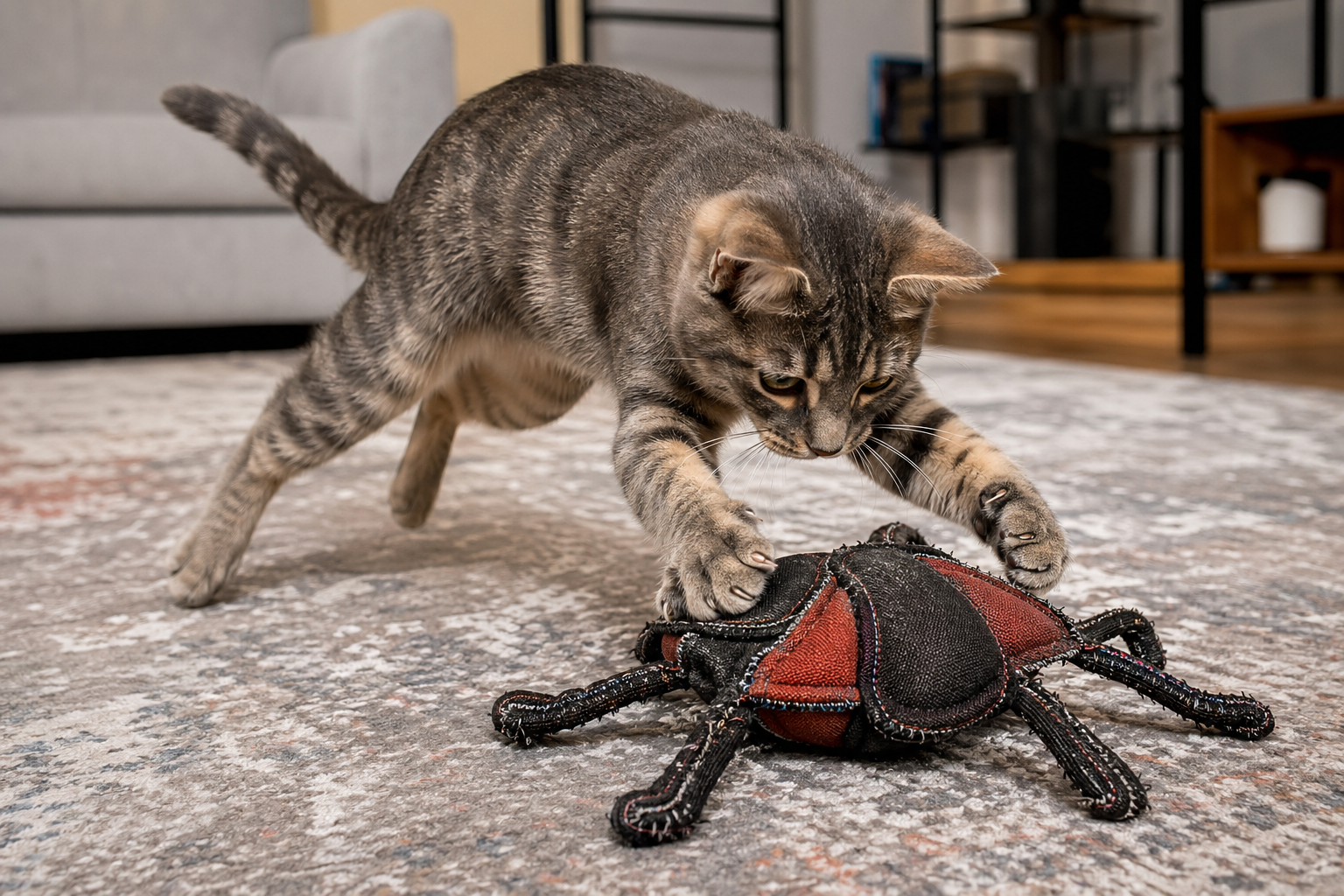
The best interactive toys for cats are the toys that let your cat hunt in a safer, more satisfying way. For most homes, that means a mix of human-led wand play, a few solo-safe chase toys, one food puzzle or treat hunt, and a tougher bite-and-kick toy for cats that grab hard. Automatic toys can help, but they should not replace daily play with you or basic toy safety checks.
If your cat destroys ordinary toys, choose interactive toys by the job they need to do: chase, pounce, wrestle, chew, forage, or burn off late-night energy. Then decide whether the toy is safe for unsupervised access. A wand with string is interactive, but it belongs in a closet after play. A sturdy ball track may be fine for solo play. A fabric kicker may work for rough play if it is large enough, tightly stitched, and inspected often.
What Counts as an Interactive Cat Toy?
An interactive cat toy is any toy that changes the game for the cat. Sometimes the interaction comes from you moving a wand or tossing a toy. Sometimes it comes from the toy itself, such as a puzzle feeder, rolling ball, track toy, motion-activated lure, or treat dispenser. The useful question is not whether the packaging says “interactive.” The useful question is what behavior the toy asks your cat to perform.
Good interactive toys usually support one part of the hunting sequence: stalking, chasing, pouncing, grabbing, biting, bunny-kicking, carrying, searching, or eating. The AAFP and ISFM feline environmental needs guidelines recommend opportunities for play and predatory behavior, including toys cats can manipulate and food devices that let cats work for part of a meal. That is the heart of a good toy plan for indoor cats.
For Titan Claws readers, the extra filter is durability. A toy that entertains a gentle cat for months may fail in one session with a strong chewer. If that sounds familiar, start with our broader guide to choosing safer cat toys for rough play, then use the sections below to build an interactive rotation.
Match the Toy to Your Cat’s Play Style
Before buying another toy, watch what your cat does when play gets intense. A chaser needs movement. A pouncer needs hiding and surprise. A wrestler needs something long enough to grip and kick. A chewer needs fewer detachable parts. A food-motivated cat may need a puzzle more than another plush mouse.
- Chasers: wand toys, rolling balls, springs, track toys, and motion toys that move away from the cat.
- Pouncers: tunnels, crinkle mats, toys hidden under a towel, and lures that vanish behind furniture.
- Biters and kickers: larger kicker toys with dense fabric, tight seams, and minimal trim.
- Problem solvers: puzzle feeders, treat balls, snuffle-style mats, and simple food hunts.
- High-energy indoor cats: scheduled wand sessions plus safe solo toys between sessions.
This is where many list-style articles fall short. They rank popular toys, but they do not help you diagnose why your cat ignores one toy and demolishes another. For a cat that attacks ankles or shreds small plush, the answer is rarely “more toys.” It is usually a better outlet for the specific behavior that is spilling over.
Human-Led Toys: The Highest Value Play
Wand and teaser toys are usually the best interactive toys because you can make them behave like prey. Move the lure away from your cat, pause it, hide it, let it dart, and let your cat catch it. Best Friends Animal Society’s enrichment guidance warns against frantic movements that startle cats and recommends wide, changing motions for wand play. In plain terms: do not jab the toy into your cat’s face. Make it flee.
For rough players, two short sessions often work better than one long chaotic session. Try five to ten minutes in the morning and again in the evening. End with a catch and a small treat or meal so the hunt has a satisfying finish. If play aggression is part of the problem, pair this with our guide to durable toys that reduce play aggression.
Wand toys need stricter storage than most owners expect. String, ribbon, elastic cord, feather bundles, bells, and glued-on pieces can become hazards when chewed. Use them while you are present, then put them away. For more detail on that risk, see our teaser wand safety tips.

Automatic Toys: Helpful, but Not a Babysitter
Automatic interactive toys can be useful for cats that need movement when you are working, cooking, or away for a short stretch. The best candidates have enclosed mechanisms, secure battery compartments, no chewable wires, no loose tails or detachable lures, and an auto-shutoff so the cat does not become overstimulated or bored.
Use automatic toys as a supplement, not the whole enrichment plan. Some cats love unpredictable motion. Others watch for a minute and walk away. A high-prey-drive cat may flip the toy over and start attacking the weakest part. That does not mean the toy is bad; it means the toy needs supervision until you know how your cat treats it.
Before leaving any electronic toy out, inspect the shell, wheels, charging port, screws, battery door, and attachments. If plastic cracks, a lure loosens, or the battery area can be opened by teeth or claws, remove it. The safest automatic toy is the one that still looks boringly intact after your cat’s hardest play.
Puzzle Toys and Food Hunts for Indoor Cats
Puzzle toys are a strong choice because they turn feeding into work. The Cornell Feline Health Center notes that toys encourage stalking, pouncing, problem solving, exercise, and cognitive enrichment, and it also points out that simple items such as boxes and ping pong balls can be useful when chosen safely. A puzzle does not need to be expensive. It needs to be solvable, stable, and cleanable.
Start easy. Put a few pieces of kibble or treats in open cups, a low-difficulty puzzle, or a cardboard tube with holes cut into it. Once your cat understands the game, make it slightly harder. If the cat gives up, the puzzle is not enriching; it is just frustrating. If your cat eats too fast, puzzle feeding can also slow the meal and add a calmer job between active play sessions.
For cats that chew cardboard, supervise homemade puzzles and remove them when they get soggy, torn into small pieces, or covered in tape or staples. For plastic puzzles, check for cracked edges and trapped food. Wash them often enough that they do not become a stale-smelling object your cat avoids.

Rough-Play Rules for Cats That Destroy Toys
Interactive toys for a gentle cat can have feathers, tiny plush parts, little tails, bells, and decorative trim. Interactive toys for a destroyer need a different standard. Avoid small detachable pieces. Prefer larger toys that cannot be swallowed. Choose simple shapes and stronger fabric over cute details. Check seams after hard sessions.
Cornell’s safe toys and gifts guidance cautions against small pieces and strand-like parts such as feathers and string that may separate and be ingested. RSPCA Pet Insurance gives similar warnings about string-like or small sharp materials. Those warnings matter most for exactly the cats Titan Claws writes for: cats that bite, pull, shred, and keep going.
Use this rough-play rule: if a part would worry you if it came off in your cat’s mouth, do not leave that toy out unsupervised. That includes feathers, yarn, ribbons, elastic, bells, plastic eyes, glued trim, dangling tails, and exposed stuffing. Our material-focused guide on what makes cat toys stronger and safer goes deeper on construction choices.
A Simple Interactive Toy Rotation
Most cats do better with a small active rotation than a pile of toys that never changes. The AAFP/ISFM guidelines recommend rotating toys to reduce habituation and boredom, and Cornell gives the same practical advice. Rotation also helps owners inspect toys before damage becomes a swallowing risk.
Try this weekly setup:
- One supervised wand toy: used daily, then stored away.
- One durable kicker: offered when the cat wants to grab, bite, or bunny-kick.
- Two solo-safe chase toys: a track toy, sturdy ball, spring, or oversized toy that has no loose parts.
- One puzzle or food hunt: used for part of a meal several times a week.
- One environmental option: a tunnel, box, perch, window view, or paper bag with handles removed.
Put a few toys away for a week, then bring them back. A toy that felt stale on Monday can become interesting again after absence. More importantly, rotation gives you a natural inspection rhythm: look for loosened seams, exposed stuffing, cracks, missing pieces, and long threads before the toy returns to play.

Safety Checklist Before You Leave a Toy Out
- Is the toy too large to swallow?
- Are seams tight, with no exposed stuffing or long threads?
- Are there no feathers, strings, ribbons, bells, plastic eyes, or small detachable parts?
- If it is electronic, is the battery compartment secure and undamaged?
- Can the toy be cleaned or replaced before it gets gross or brittle?
- Does your cat play with it without trying to eat pieces of it?
- Would you still feel comfortable if your cat played with it for ten minutes while you were in another room?
If the answer is no, treat it as a supervised toy. If your cat may have swallowed string, ribbon, elastic, a battery, stuffing, a bell, or another toy part, contact a veterinarian promptly. Do not pull visible string from a cat’s mouth or rear. Linear material can become anchored internally, and pulling can make an injury worse.
The Bottom Line
Interactive toys for cats should do more than keep a cat busy for a few minutes. They should give your cat a safe way to hunt, chase, solve, bite, and settle. Build the rotation around your cat’s play style, use wand toys with supervision, inspect automatic toys carefully, add puzzle feeding for mental work, and reserve the toughest designs for cats that destroy ordinary toys.
No toy is truly indestructible. The better goal is a smarter system: active play with you, solo-safe options when you are busy, food puzzles for indoor enrichment, and regular replacement before worn toys become hazards.
Leave a Reply