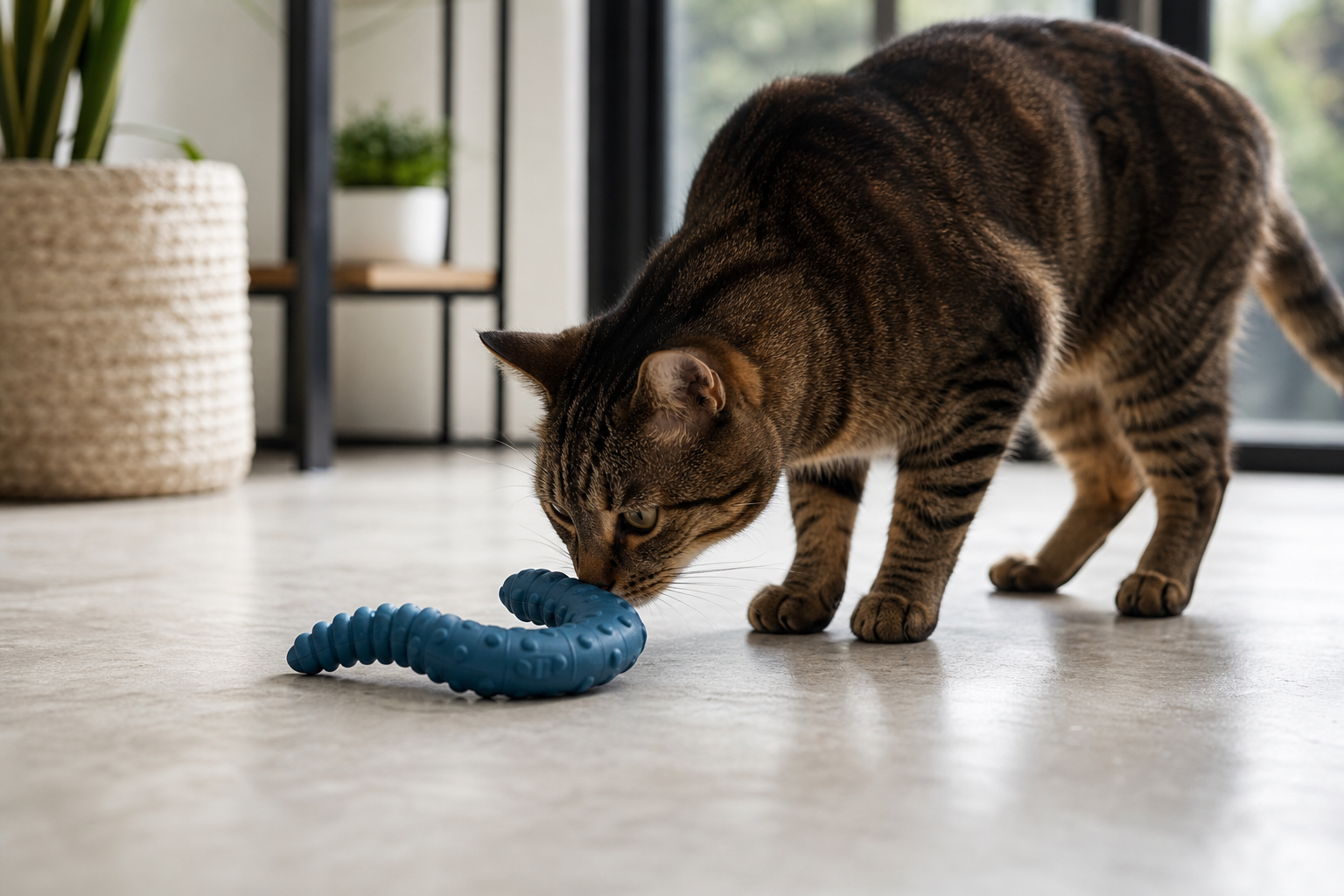
Rubber chew toys for cats can be useful when a cat wants to gnaw, but they are not automatically safe just because they are rubber. The best options are flexible, cat-sized, easy to wash, free of loose parts, and tough enough that your cat cannot quickly bite off chunks. They should be inspected often and removed as soon as cracks, missing pieces, sticky surfaces, exposed inserts, or loose decorations appear.
The bigger question is why your cat is chewing. A teething kitten, a bored indoor hunter, a cat redirecting stress, and a cat swallowing rubber bands are different problems. A rubber toy may help the first two. A cat that eats rubber, plastic, fabric, hair ties, or string needs tighter prevention and, in many cases, a veterinary conversation.
Are Rubber Chew Toys Safe for Cats?
Some rubber chew toys are reasonable for supervised cat play. The safer ones are made for cats or small pets, have a softer bite than hard dog chews, and are large enough that your cat cannot swallow them whole. They give cats a legal target for chewing instead of cords, shoelaces, plastic packaging, or toy parts.
The risk is ingestion. A cat who only mouths and gnaws a toy is different from a cat who bites pieces off and swallows them. Cornell Feline Health Center’s safe toy guidance warns against small pieces and strand-like parts that can separate during chewing and be ingested. That warning applies directly to rubber toys with feathers, ribbons, bells, glued-on shapes, fabric streamers, or thin nibs that can tear away.
Use this rule: if the toy is becoming smaller, sharper, sticky, flaky, or easier to tear, it is done. A durable toy is still a consumable object when a rough chewer is involved.
When Rubber Makes Sense
Rubber or silicone-style chew toys can be a good fit for cats who like pressure on the gums, bat small objects around, carry toys in the mouth, or gnaw lightly after chase play. They are especially worth trying for kittens who are teething, cats who chew fabric seams, and cats who show interest in plastic texture but do not swallow pieces.
They are less useful for cats who want to bunny-kick with the back legs. Those cats often need a longer fabric kicker or rugged plush target they can grab, bite, and rake without wrapping around your arm. If your cat destroys soft toys too quickly, use the rubber chew as one part of a rotation, then pair it with guidance from Titan Claws on durable cat toys and cat chewing toys.
Rubber also should not be treated as dental care by itself. Nubs and ridges may help some cats enjoy chewing, but they do not replace tooth brushing, veterinary dental exams, or a veterinarian’s advice for bad breath, inflamed gums, drooling, tooth pain, or reduced appetite.
How to Choose a Better Rubber Chew Toy
Start with the material and shape, then judge the toy against your actual cat. Product pages often say durable, dental, or non-toxic. Those claims are not enough. The toy still has to survive your cat’s mouth.
- Choose flexible over hard. A cat chew should compress under firm finger pressure. Avoid rock-hard nylon or hard dog chews that are built for a much stronger jaw and heavier bite.
- Avoid detachable extras. Skip glued eyes, bells, plastic beads, feather tufts, fabric streamers, elastic loops, ribbons, and thin rubber spikes that your cat can shear off.
- Size up thoughtfully. The toy should be easy to carry and bat, but not small enough to disappear fully into the mouth. For large cats and aggressive chewers, err larger.
- Look for simple surfaces. Gentle ridges are easier to inspect than complicated crevices. Deep holes can trap food, saliva, and grime unless the toy is designed to be cleaned thoroughly.
- Check odor and surface feel. A strong chemical smell, sticky coating, peeling paint, or greasy residue is a reason to skip the toy.
- Match the toy to supervision. If you would not trust it while you shower, do not leave it out overnight.

For kittens, read Titan Claws’ kitten teething toys guide before giving anything firm. Kitten teeth and gums need gentler materials, and young cats are more likely to explore objects with their mouths.
Rubber, Silicone, TPR, and Natural Rubber
Owners often use the word rubber for several materials. Natural rubber comes from latex-bearing plants. Silicone is a different flexible material that is common in kitchenware and some pet products. TPR, or thermoplastic rubber, is a rubber-like plastic blend used in many inexpensive pet toys. Any of these can be acceptable or poor depending on the formula, design, quality control, and how your cat chews.
Because labels vary, focus on what you can verify. Is the toy marketed for cats or small pets? Is it flexible? Does the manufacturer state that it is free of BPA, phthalates, and lead? Is it one solid molded piece rather than rubber plus dangling decorations? Can it be washed? Does it stay intact after several supervised sessions?
Be careful with dog toys. A small dog toy can be useful for some cats if it is soft enough and too large to swallow, but many dog chews are too heavy, too hard, or shaped for a dog mouth. If a toy hurts when you press it against your own fingernail, it may be too unforgiving for a cat’s teeth.
If Your Cat Chews Cords, Plastic, or Rubber Bands
A chew toy is not the first safety step for cord chewing. First remove access. Use cord covers, route cables behind furniture, unplug tempting cords when practical, and keep rubber bands, hair ties, twist ties, earbud tips, silicone bands, and packaging out of reach. Cornell’s safe-toy guidance specifically warns against electrical cords that a cat can chew, which is the practical starting point: block the hazard before you offer the redirect.
Then give your cat a more acceptable outlet. Place the rubber chew toy near a play area, not beside the forbidden cord. Make it interesting with movement: roll it, hide it partly under a towel, toss it down a hallway, or use it as the catch at the end of a wand session. If your cat ignores rubber but loves plant textures, supervised cat chew sticks or silvervine may be a better match.

If your cat actually eats non-food items, treat that as a different level of concern. UC Davis describes pica as persistent chewing and consumption of non-nutritional substances and notes that it can be linked to medical or behavioral causes, including boredom, anxiety, or nutritional problems. The article also flags possible poisoning, dental problems, and gastrointestinal obstruction. A case-control study on feline pica and chewing behavior found that pica cats commonly targeted shoelaces or threads, plastic, fabric, and also rubber among other materials, which matches what many chew-toy shoppers are trying to manage.
A Safer Chew Routine for Rough Cats
The best routine gives your cat several legal textures without leaving the riskiest objects available all day. Try this for one week:
- Pick one supervised rubber chew. Use it for 5 to 10 minutes while you watch how your cat bites it.
- Add one bite-and-kick toy. A longer kicker helps cats who need to grab and rake, not just gnaw.
- Add one food or puzzle outlet. A puzzle feeder can reduce boredom chewing by making part of dinner more active.
- Rotate, do not flood. Leave out only the toys that are safe for that cat. Store higher-risk toys between sessions.
- Inspect before and after play. Look for missing chunks, cracks, loose fibers, sharp edges, and changes in texture.
This routine lines up with enrichment principles: cats need stalking, pouncing, biting, problem-solving, and novelty. The University of Wisconsin School of Veterinary Medicine advises toy rotation and warns that aggressive chewers may ingest feathers, strings, sparkles, or loose pieces. That is why Titan Claws treats durability and inspection as part of play, not an afterthought.

For a fuller rotation, combine this article with Titan Claws guides to cat toys for enrichment, cat toys for play aggression, and crinkly cat toys. Cats who chew hard often need a system, not one miracle toy.
When to Throw a Rubber Toy Away
Retire the toy immediately if any of these appear:
- Pieces are missing or you find rubber flakes on the floor.
- The toy has a crack, split seam, sharp edge, or stretched hole.
- Your cat can fit the whole toy in their mouth.
- Ridges, spikes, bells, streamers, or attachments are loosening.
- The surface becomes sticky, brittle, oily, or crumbly.
- Your cat guards it intensely and tries to swallow pieces.
- Your cat vomits, drools, paws at the mouth, stops eating, strains in the litter box, or seems lethargic after chewing.
If you suspect your cat swallowed part of a rubber toy, call your veterinarian. Do not wait for an obstruction to become obvious. Signs can be subtle at first, and the right next step depends on the object, timing, symptoms, and your cat’s health history.
Quick Buying Checklist
Before buying rubber chew toys for cats, run through this checklist:
- Is it made for cats or clearly appropriate for a cat-sized mouth?
- Does it flex instead of feeling rock-hard?
- Is it too large to swallow whole?
- Are there no feathers, strings, bells, beads, ribbons, tags, loops, or glued-on decorations?
- Can you wash and inspect every surface?
- Does the manufacturer identify the material and safety claims clearly?
- Does your cat chew without removing pieces?
- Will you supervise the first several sessions?
- Do you have a backup texture if your cat ignores rubber?
- Have cords, rubber bands, hair ties, and plastic packaging already been removed from reach?
Rubber chew toys are best seen as one tool for cats who need to bite something appropriate. Choose flexible, simple, inspectable toys; supervise rough chewers; rotate textures; and retire damaged toys early. If your cat is swallowing rubber or other non-food items, the safer answer is not a tougher toy. It is prevention, enrichment, and veterinary guidance.
Sources
- Cornell Feline Health Center: Safe toys and gifts
- University of Wisconsin School of Veterinary Medicine: Safe Toys for Cats
- UC Davis School of Veterinary Medicine: Abnormal Eating Habits in Cats
- Journal of Feline Medicine and Surgery: Characterization of pica and chewing behaviors in privately owned cats
Leave a Reply