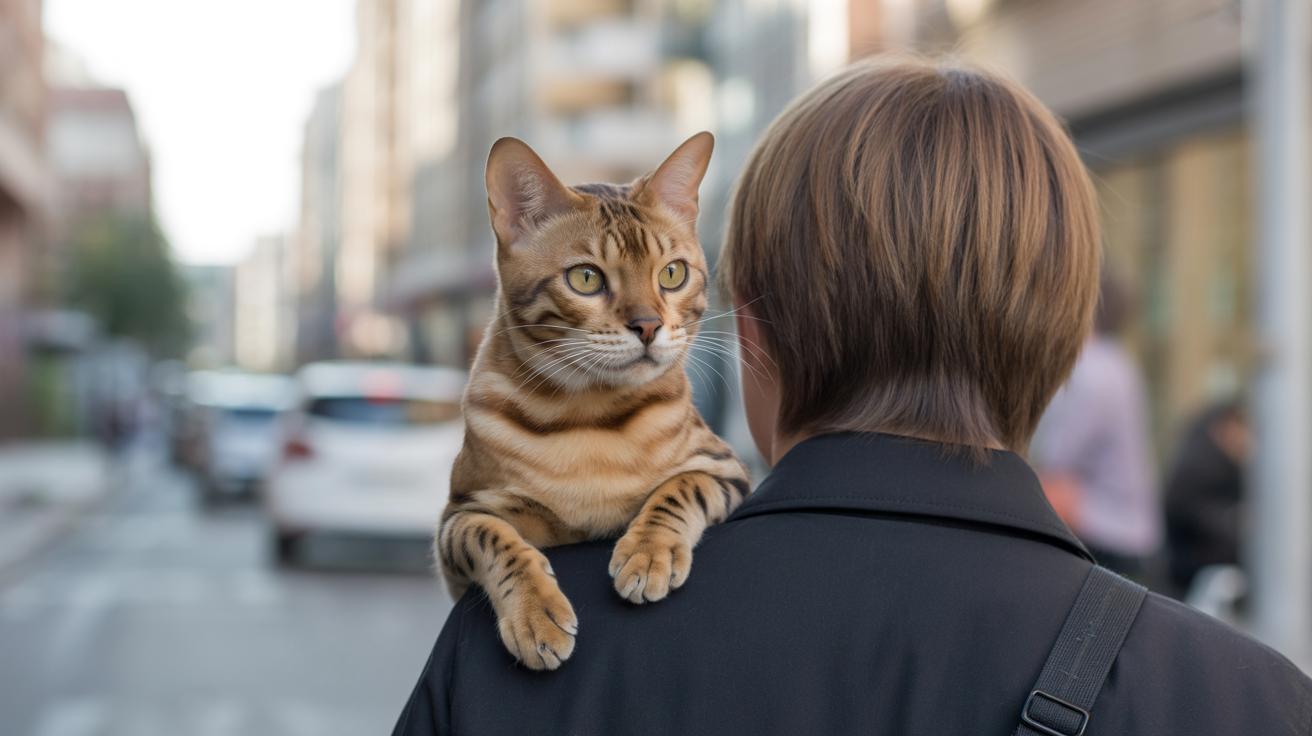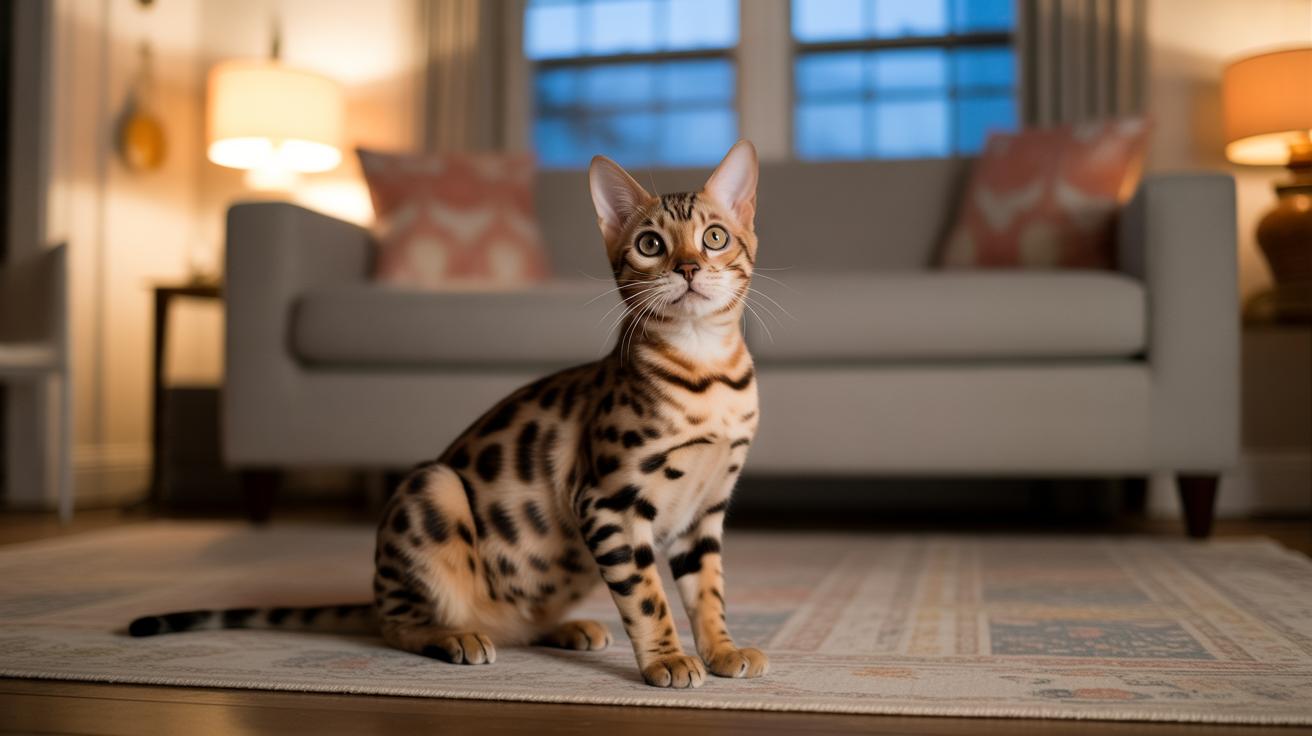
Category: About Cats

  • Bengal Cat Facts: Appearance, Temperament, Care, Health

    Bengal Cat Facts: Appearance, Temperament, Care, Health

    Are Bengals too wild to be housecats? Short answer: not really. Their spotted coat and Asian leopard cat ancestry (a small wildcat species) make them look like tiny jungle athletes, though.

    They really move like it. You’ll see sky-high jumps that make you gasp, chirps that sound like little birds, and a nonstop curiosity that turns a cardboard box into an adventure. Ever watched one open a drawer? It’s hilarious.

    If you’re wondering whether that energy is awesome or a handful, this guide breaks it down. You’ll get the scoop on how they look, what their temperament is like, everyday care, and common vet checks (health screenings for things like heart and eye issues). It’ll help you know what life will actually be like before you bring one home.

    Spoiler: they’re brilliant, demanding, and wildly rewarding if you’re ready to play. Worth every paw print.

    Are Bengals Right for You? Quick Snapshot

    - Are Bengals Right for You Quick Snapshot.jpg

    Yes, if you can keep up with a very active, curious cat that wants lots of play and attention. Bengals started in the 1960s when breeders crossed Asian leopard cats and domestic cats, and that wild heritage shows. They’re medium-to-large and muscular, like tiny jungle athletes, and they love climbing, chasing, and solving puzzles. Their typical lifespan is about 9 to 15 years.

    Ever watched a Bengal leap for a toy and freeze mid-air? Their energy is next-level, so they need daily play, tall cat trees, and puzzles to stay happy. They can be talkative and social, too, so they do best with people around or another playful pet.

    Quick at-a-glance points:

    • Weight: 8–15 lb
    • Lifespan: 9–15 years
    • Coat types: spotted, rosetted, marbled
    • Common colors: brown, snow, silver variations
    • Activity level: very high – needs daily stimulation
    • Typical health screens: HCM (hypertrophic cardiomyopathy – a heart disease test), PRA (progressive retinal atrophy – an eye disease test)
    Stat Typical Range or Note
    Weight 8–15 lb
    Lifespan 9–15 years
    Coat types Spotted, rosetted, marbled
    Common colors Brown, snow, silver
    Activity level Very high – needs daily stimulation
    Recognition date 1983-1990s
    Typical health screens HCM (heart disease test), PRA (eye disease test)

    Thinking of a Bengal? Great, if you love interactive play and a cat that acts like a curious little panther. Not so great if you want a quiet lap-only buddy. Worth every paw-print, if you ask me.

    Bengal Cat Origin and Breed History

    - Bengal Cat Origin and Breed History.jpg

    The modern Bengal started in the 1960s when breeders crossed the Asian leopard cat (a small wild cat native to Asia) with domestic shorthairs (short-haired house cats). They wanted that wild, spotted look in a pet you could actually live with. Over the next two decades breeders worked on coat patterns and calmer temperaments so these cats would fit into homes.

    By the 1980s and 1990s major registries (official cat organizations) began accepting Bengals for shows and stud books. You can almost see the spots flash when a Bengal pounces, so dramatic. But behind that flashy coat was careful selection for friendlier behavior.

    Breeders aimed to keep the wild appearance while choosing cats that enjoy people. Hybrid (offspring of two different species) litters were often backcrossed (bred back to domestic cats) over several generations. The result: bold markings plus a home-friendly attitude. Ever watched a Bengal chase a feather and look like a tiny leopard? Yep, they’re show-offs.

    Rules came up because the breed began with a wild ancestor. Some places limit ownership or import of early-generation Bengals, and a few states or countries require permits. Check local regulations before you fall in love with a kitten, you don’t want surprises.

    Most breeders eventually bred Bengal to Bengal, which toned down wild behaviors, made size and temperament more consistent, and pushed breeders to do better health testing and socialization. Still, Bengals are energetic and curious. If their play needs aren’t met, some end up in rescues, so plan for daily playtime or puzzle toys.

    Breed Generations (F1-F5)

    Generation Wild Ancestry Typical Traits
    F1 About 50% Strong wild traits, often larger and more reactive; very active and less predictable.
    F2 About 25% Still shows noticeable wild behavior; lively and bold, but a bit more social than F1.
    F3 About 12.5% More domestic in size and temperament; playful but generally more predictable.
    F4 About 6% Tends to be calmer and more like a typical pet cat; great for families or busy homes.
    F5 About 3% Mostly domestic behavior with the classic Bengal look; the easiest fit for most owners.

    Thinking about getting one? Pick the generation that matches your lifestyle, are you up for wild-energy playdates or a more chill, couch-side companion? Either way, Bengals bring personality and plenty of zooms.

    Bengal Cat Appearance: Coat Patterns, Colors, and the Glittered Coat

    - Bengal Cat Appearance Coat Patterns, Colors, and the Glittered Coat.jpg

    Bengal fur is short and dense. It feels silky and lies close to the body, which gives the cat a sleek, athletic look you can almost hear when it moves. Ever want to pet something that looks like polished velvet? This is it.

    Their markings go from neat little spots to bold, flowing swirls, and the contrast is eye-catching and tactile. Some coats look like stamped spots; others look like streaked stone. You can spot the difference just by watching how the light plays across the sides.

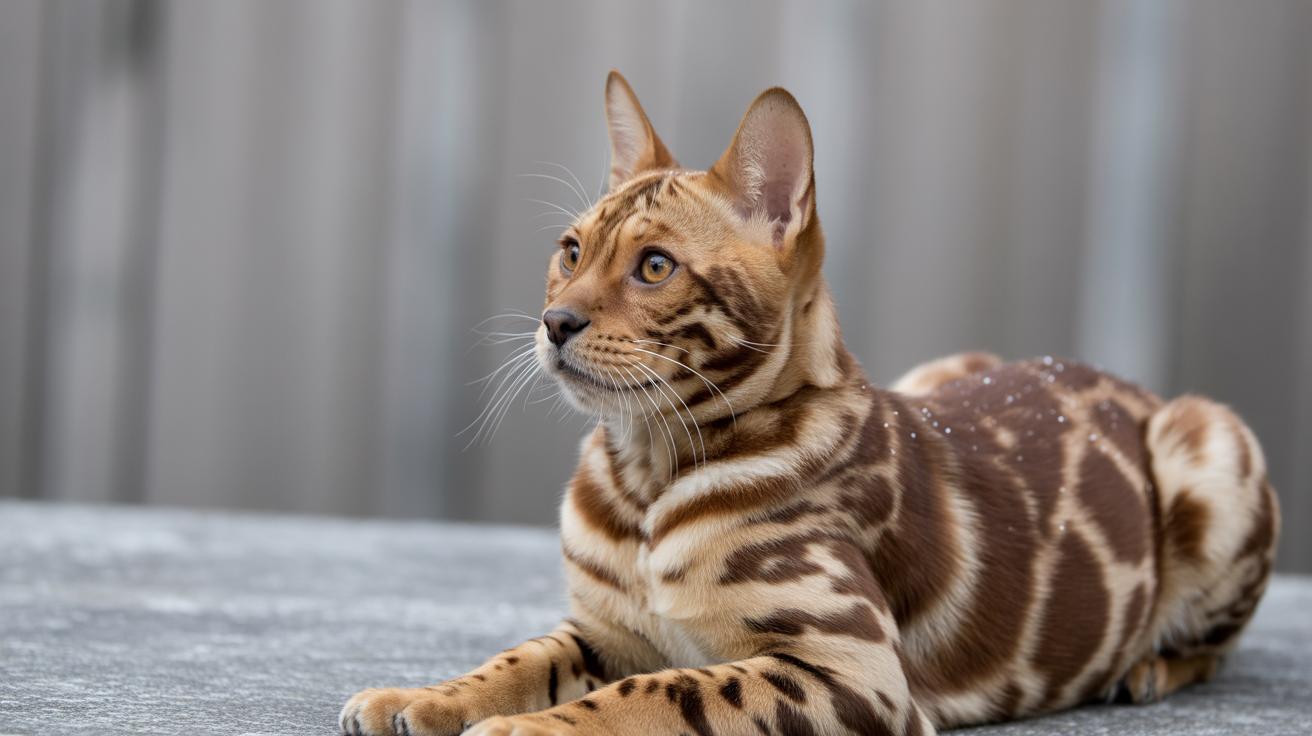
    Rosettes and marbling tell most of the story. Rosettes are two-tone spots with darker rims and lighter centers (think tiny donut-shaped marks). Marbling makes broad, horizontal ribbons that flow along the flanks, like water-streaked marble. Spot patterns sit between them and can be tight and round or stretched into tear-drop shapes.

    • Rosette: two-tone spot with a darker outline and lighter center, often clustered and very three-dimensional.
    • Spotted: single-color dots or small ovals scattered over the body, neat and punchy.
    • Marbled: wide, horizontal swirls and ribbons that run along the sides and back, like carved stone.
    • Snow / lynx variants: paler backgrounds with clear facial markings and contrast on the paws (lynx means tabby-like facial lines).
    Color Group Typical Look / Notes
    Brown group Classic warm background with rich black or dark brown markings
    Silver group Cool, pale base with crisp dark markings and high contrast
    Snow / blue / charcoal group Paler snows, muted blues, or darker charcoals with softer contrast

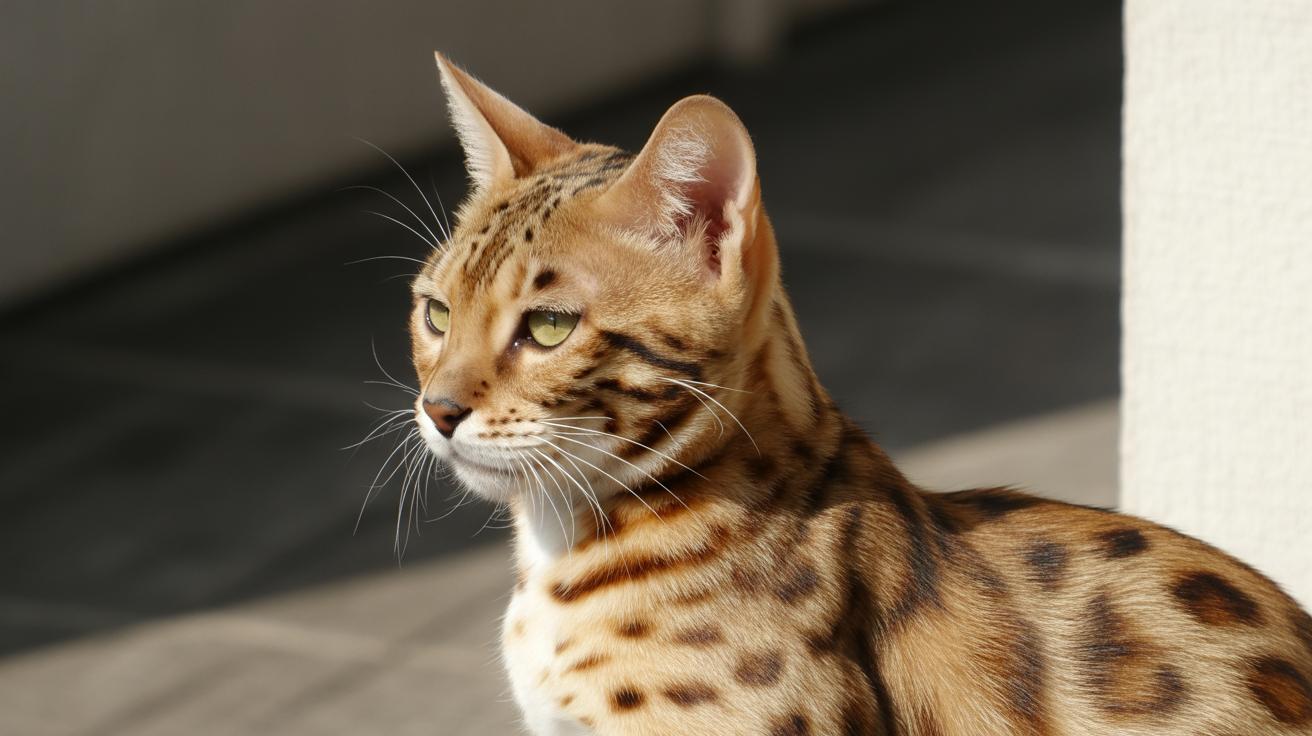
    Many Bengals have literal sparkle called glitter, which comes from hair-shaft refractive properties (how light bends and bounces along each hair). In sunlight the coat can shimmer like sequins. And the eyes, greens, golds, yellows, browns, even orange, really pop against those patterns. I once watched a Bengal catch a sunbeam on the windowsill and, wow, the whole cat glowed.

    Worth every paw-print.

    Bengal Cat Size, Lifespan, and Common Health Considerations

    - Bengal Cat Size, Lifespan, and Common Health Considerations.jpg

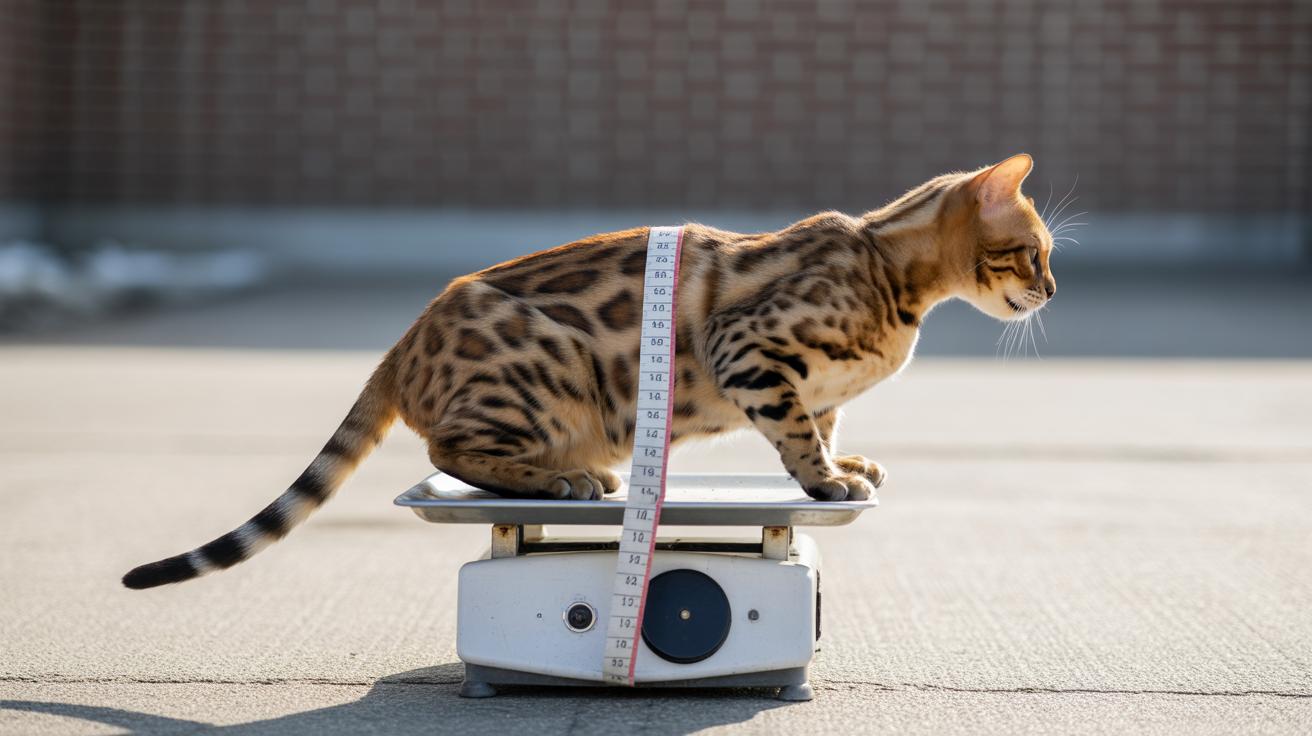
    Bengals are muscular and athletic. Think compact sprinter, not a fluffy loaf. Size and weight change with sex, which generation the cat is (earlier-generation Bengals often grow bigger), how active they are, and what they eat. To check a healthy body feel, you should be able to feel ribs under a light layer of fat, see a waist from above, and notice a tucked belly from the side.

    Many Bengals live well into their teens if they get good food and stay safe indoors or in a secure outdoor run. Lifespan still varies with genes and care, of course. High-quality nutrition, routine dental attention, parasite prevention, and regular vet visits all help add healthy years. Keep play time and weight in check to protect joints and the heart, and give them a comfy catio or a sunny window perch to cut down on risky outdoor encounters. Ever watch a Bengal sprint along a sunbeam? Pure joy.

    Two inherited issues breeders and owners watch closely are hypertrophic cardiomyopathy and progressive retinal atrophy. Hypertrophic cardiomyopathy, or HCM, is a thickening of the heart muscle (the heart gets stiffer and works harder). It can show up as tiredness, breathing changes, fainting, or sudden collapse, sometimes in adulthood and sometimes earlier. Progressive retinal atrophy, or PRA, is a slow breakdown of the retina (the part of the eye that senses light) and usually starts with trouble in low light or clumsy navigation. Responsible breeders screen with cardiac ultrasounds (echocardiograms, a heart ultrasound) and eye exams, and some lines offer DNA testing when a specific mutation is known.

    Practical screening and care are simple steps that pay off. Kittens need frequent early vet checks, adults at least yearly, and senior cats every six months with extra testing as needed. Ask breeders for dated test reports and the vet’s contact, and request an echocardiogram baseline for breeding cats or any with family history. If risk is present, repeat cardiac imaging every 12 to 24 months. Also mention anesthetic sensitivity (some cats react strongly to certain sedatives) before any surgery so your vet runs pre-anesthetic bloodwork and chooses drugs carefully. Little steps like this keep the zoomies coming for years. Worth every paw-print.

    Bengal Cat Temperament, Intelligence, and Communication

    - Bengal Cat Temperament, Intelligence, and Communication.jpg

    Bengals are bundles of energy and curiosity. They treat life like a string of puzzles to solve, always nosing around and testing new things. Think bold, bright, and very social , many act a bit like a loyal dog who wants to be wherever you are.

    They have a lot to say. Expect chirps, trills, and chattering at birds, plus husky meows when they want your attention and sometimes a loud hello at the door. Your ears will learn their library of sounds fast.

    You will get followed, tapped awake, and offered toys as trophies. Some will nudge you with gentle paw taps in the morning, others carry favorite toys around like they own them. Many Bengals also love water play, dipping paws in a running faucet or splashing at treats in a shallow basin.

    The hunting drive is strong. They watch birds from high perches (a raised shelf by a window), stalk shadows, and if given unsupervised outdoor access can catch small wildlife. You may see the classic low crouch, tail flicking, and that intense chitter when prey is in sight.

    Channel that drive indoors and everybody wins. Give high window perches, puzzle feeders (a food toy that makes your cat work for meals), and timed play sessions so they can hunt safely and you avoid trouble. Short daily play bursts beat long, lonely stretches any day.

    Training? Oh yes, they’re game. Use short, frequent sessions of 5 to 10 minutes, high-value treats, and shaping (rewarding tiny steps toward a trick). Try a clicker (a small device that makes a sharp sound) or a verbal marker to mark good behavior, then reward tiny approximations and build up.

    You can teach fetch, target-touch, and even loose-leash walking (walking with a harness and a slack leash). Keep it playful, end each session on a win, and rotate goals so their sharp minds stay curious. Worth every paw-print.

    Bengal Cat Diet and Feeding Guidelines

    - Bengal Cat Diet and Feeding Guidelines.jpg

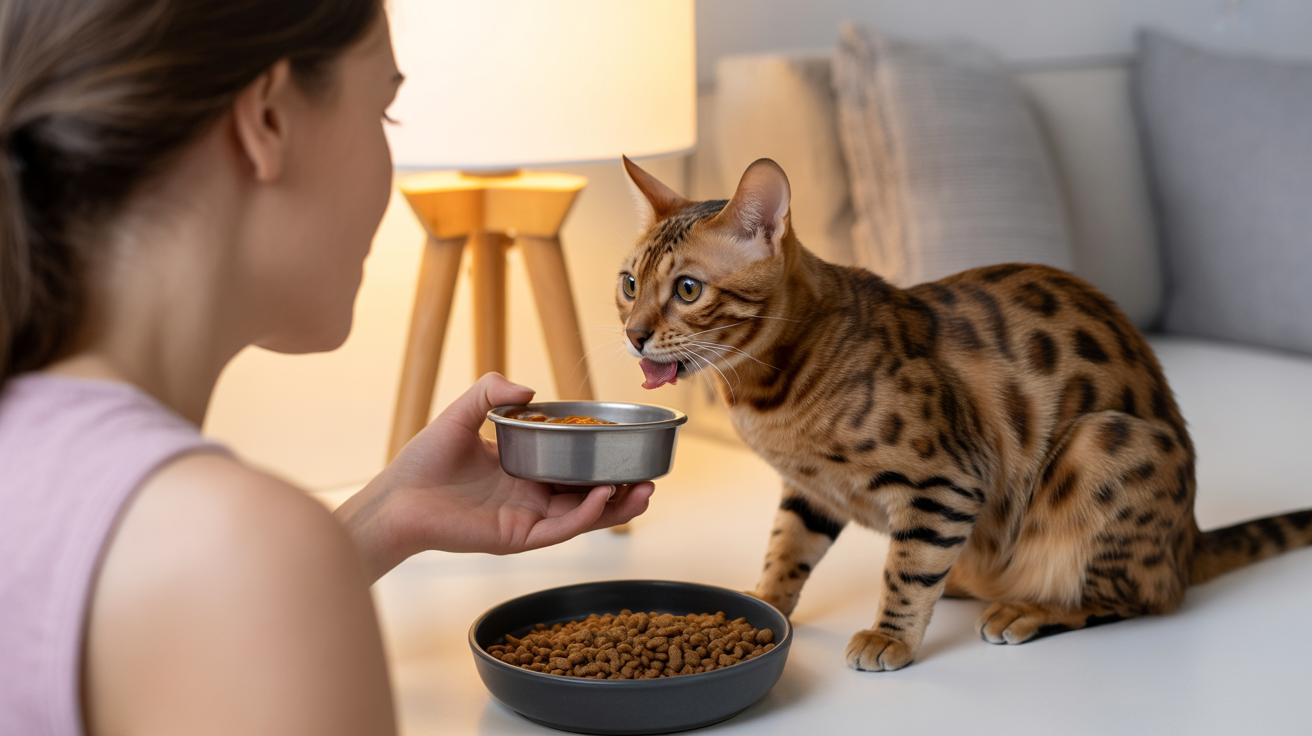
    Think of a Bengal as a tiny athlete , they’re muscular and super active, so they do best on a higher-protein diet. Macronutrients (nutrients your cat needs in larger amounts) should focus on protein (the muscle-building nutrient), moderate fat (the fuel), and relatively low carbs (starches cats don’t digest well). Ever watch a Bengal sprint and then plop down? That’s them burning protein and fat fast.

    Wet, dry, or a mix can all work as long as you portion correctly. Wet food helps with hydration and usually has fewer calories per cup, while dry kibble is calorie-dense and handy for busy households. A typical adult Bengal needs about 180–300 kcal per day (kcal = kilocalorie, aka calorie) depending on size and activity , an 8-lb moderately active cat might need around 160–190 kcal/day, while a very active 12–15-lb cat can be 220–300+ kcal/day. Dry kibble is often about 300–450 kcal per cup; canned food often runs near 70–130 kcal per 3-oz serving, so measure portions and tweak for play level and body shape.

    Some Bengals have sensitive stomachs , signs include loose stools, repeated vomiting, or weight swings. Try a limited-ingredient wet diet (few ingredients to reduce reactions), change foods slowly over 7–10 days, and do short trials of a single-protein option to see what settles them. If problems keep showing up, talk to your vet or a feline nutrition specialist and consider using wet food for sensitive stomachs as one tool in your plan.

    Kittens need more frequent meals and gentle transitions as they grow. Offer four meals a day from weaning to about 3 months, drop to three meals from 3–6 months, then two meals from 6–12 months while watching weight and growth; switch to adult feeding after about a year. When you change diets, mix the new with the old over a week, watch stool and energy, and increase portions during growth spurts so your mini-leopard builds muscle, not fat. Worth every paw-print.

    - Bengal Cat Enrichment, Training, and Recommended Toys (Toys  Training Only).jpg

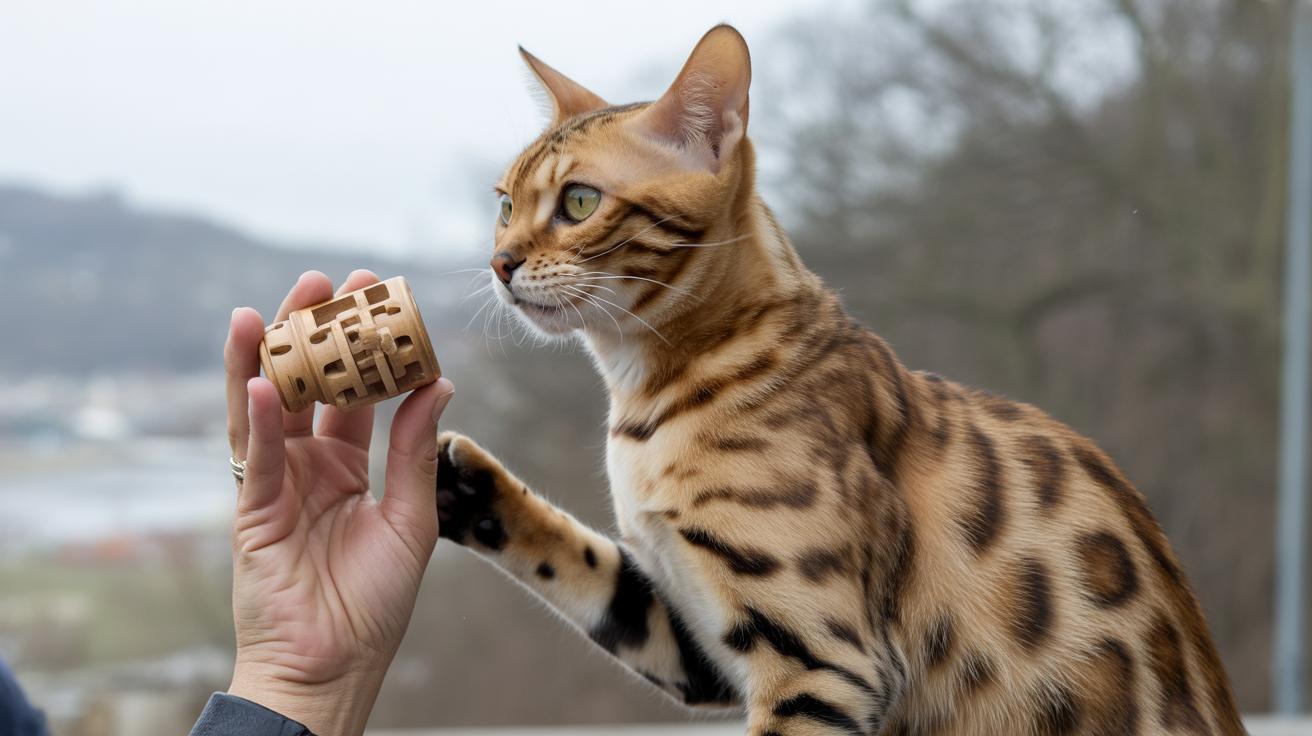
    Bengals thrive on action plus brain games, or they’ll invent trouble. Think running wheels (a spinning track for cats to run on), puzzle feeders (a food toy that hides meals), tall cat trees, wand play that mimics prey, and short training bursts that let them hunt with their heads and paws. Ever watched your kitty chase shadows? Same idea, but more fun.

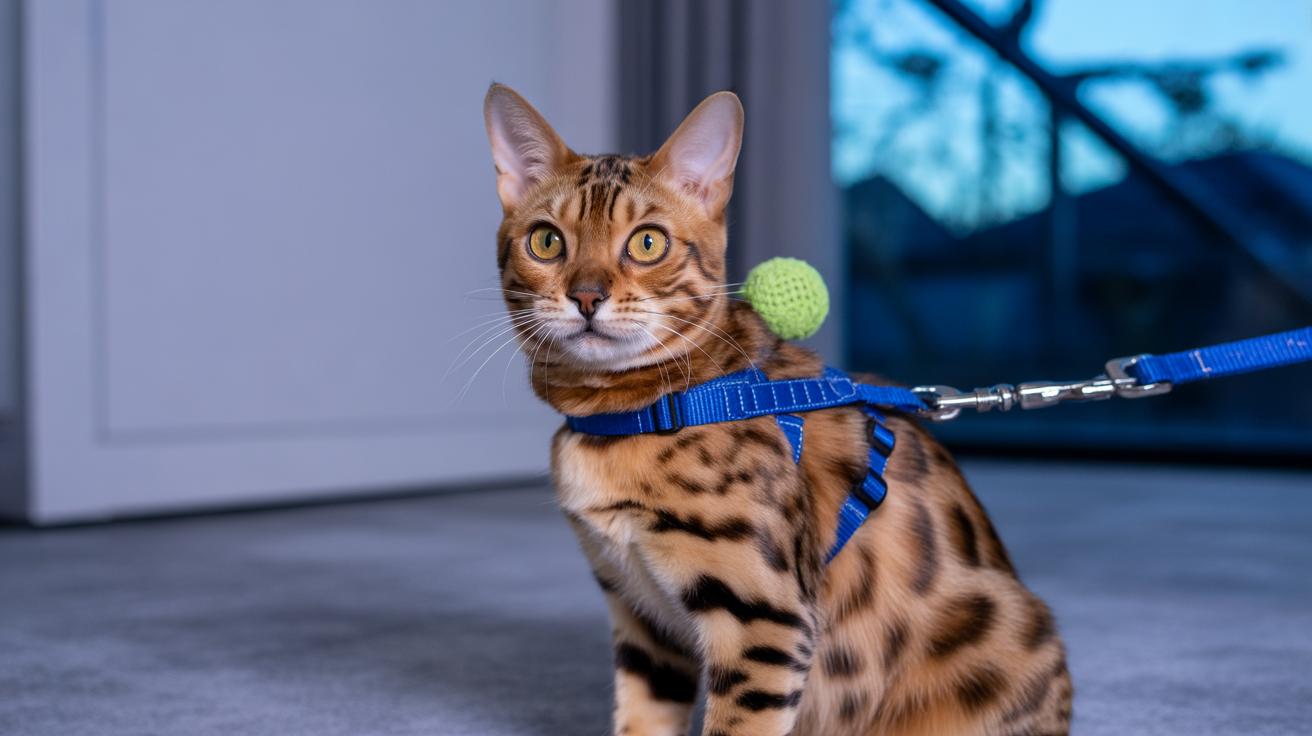
    Start with tiny wins. Clicker basics: use a clicker (handheld device that makes a sharp sound), click the instant your cat does the right thing, then give a treat. Keep loops short – five to ten seconds – so they link click, treat, and action fast. Shaping means rewarding the smallest step toward a trick, little nibble-sized rewards as the behavior builds. Leash and harness intro works best slow: first let the cat sniff and wear the harness for a few minutes indoors, then reward calm behavior, next attach a light leash and follow the cat on brief indoor explorations, then step outside for a minute or two near the door, and gradually increase time over several days.

    Keep toys safe and interesting. Check strings, feathers, and replaceable heads for loose bits and toss anything frayed. Rotate toys every seven to ten days so each one feels new again. Short sessions win – two or three five- to ten-minute plays beat one long marathon. If your Bengal likes water, supervise shallow splashes only. Try this quick session plan: five minutes warm-up with a wand, five minutes puzzle feeder, five to ten minutes on the running wheel or chase, then calm petting so they come down slow. Your cat’s whiskers will twitch; you’ll get those happy, soft purrs.

    Worth every paw-print.

    • Cat tree with multiple perch heights and strong stability (think tall towers for climbing and jumping)
    • Running wheel – cat-size (spinning track for aerobic sprinting)
    • Puzzle feeder (treat-dispensing food toy that slows eating and activates the brain)
    • Wand toy with replaceable heads (feathers or faux fur that you can swap out)
    • Water-play item – shallow basin or fountain (supervised play only)
    • Harness + leash – soft vest style (comfortable, padded harness for walks)
    • Window perch for birdwatching (sunny lookout for stalking and chill time)
    Feature Why it matters
    Height & stability Tall, steady platforms let Bengals climb, spring, and land safely while feeling secure above it all
    Multiple levels & hiding spots Gives vertical travel and cozy retreats for stalking play and quick hide-and-pounce games
    Scratch-resistant surfaces Durable materials like sisal (rough rope used for scratching) protect the tree and let cats sharpen claws safely
    Perch sizes for visibility Wide perches let a Bengal sprawl out and watch the world – great for bird TV and nap breaks

    - Living with Bengal Cats Family, Other Pets, Safety, and Legal Considerations.jpg

    Bengals can be amazing family pets when their energy matches your household and kids know how to handle a fast, confident cat. Aim for older, calm children, roughly 8 years and up, who can learn gentle handling and respect quick moves. Supervise every kitten and child play session, and teach a simple pause-and-reset when the cat gets overstimulated. Seriously, it saves fingers and feelings.

    Introducing a Bengal to a resident dog works best in slow, predictable steps. Start with scent swaps by trading blankets or bedding so they get used to each other’s smell. Next try short, supervised visual meetings through a baby gate or screen, then a brief face-to-face with the dog leashed and the cat free to retreat to a high perch. Reward calm behavior from both, keep sessions short, and only lengthen them when everyone looks relaxed; patience wins.

    Many owners keep Bengals indoors or in a secured outdoor space like a catio (enclosed outdoor run). Use hardware cloth (stiff wire mesh) or heavy-duty netting so birds and small wildlife stay safe and your cat can’t slip through. Balcony netting and full enclosure panels stop slips and jumps, and removing low-hanging bird feeders cuts down on temptation. And put a microchip (tiny ID device implanted under the skin) in your cat, keep the registration current, and add a visible ID tag and local license if required; it helps get your buddy home faster.

    Preventing escapes is mostly about habits and barriers. Double-doored entryways (airlocks) are a great trick, and screened windows should have secure fasteners so they can’t pop open. Use door-alerts or teach your cat to pause at thresholds while you enter and exit, practice makes it normal. Worth every paw-print.

    Before you bring a Bengal home, run a quick legal checklist: check local and state rules on hybrid generations (how many wild-cat ancestors a cat has can matter), because some places restrict early-generation Bengals. Confirm rental or HOA pet rules, and ask breeders about any paperwork or permits you might need. In truth, a little homework now means more time later for purrs, pounces, and play.

    Choosing a Bengal: Adoption, Breeders, Costs, and Checklist

    - Choosing a Bengal Adoption, Breeders, Costs, and Checklist.jpg

    Adoption is a smart first stop. Rescues and shelters often get Bengals when owners underestimate how much energy and social time these cats need, so you can find a loving, people-friendly kitty who’s already used to a home. Plus, adopting can be cheaper and feels great , really satisfying, you know?

    Buying from a reputable breeder gives more predictability on lineage, generation, and early health screening. That matters if you want specific traits or show potential. When you talk with breeders, don’t take promises at face value. Ask for dated paperwork and copies of tests.

    Specifically request genetic test reports for HCM (hypertrophic cardiomyopathy – the heart muscle thickens and can stiffen) and PRA (progressive retinal atrophy – slow retinal deterioration that affects vision). Ask for a recent echocardiogram (heart ultrasound) or a cardiac clearance, and eye exam results. Get vaccination and deworming records, veterinary references, photos of the kitten with its mother and littermates, and notes about socialization – how the kittens were handled and exposed to people. Also insist on a written sales contract or health guarantee that includes a return policy. No verbal-only deals.

    Price depends on generation, pedigree, and color or markings, plus what health work the breeder includes. Adoption fees are usually lower than a breeder’s price for show lines or rare patterns. Don’t forget first-year costs: spay/neuter, microchip (and registration), vaccines, high-protein food, a sturdy cat tree or running wheel, regular vet visits, and sometimes specialty tests or emergency care. Bengals are active and curious , pounce-prone, really , so a small emergency fund or pet insurance can save a lot of stress.

    Bring-Home Checklist

    • Vaccination records
    • Genetic test results (HCM, PRA)
    • Written health guarantee / sales contract with return policy
    • Microchip information and registration
    • Socialization notes (handling, litterbox habits, exposure to people and noises)
    • Recommended first-week supplies (food, carrier, litter, bedding, a few toys)

    Quick tip: for busy days, toss a durable toy or an unbreakable ball before you leave , that’s ten minutes of safe play and a calmer kitty when you get back. Worth every paw-print.

    Bengal Cat FAQs: Targeted Micro-Questions and Internal References

    - Bengal Cat FAQs Targeted Micro-Questions and Internal References.jpg

    How should I verify a breeder's HCM/PRA test records?

    Ask for dated test reports that list the vet or clinic contact so you can call and confirm. Make sure the paperwork specifically names HCM (hypertrophic cardiomyopathy, a heart muscle disease) and PRA (progressive retinal atrophy, a degenerative eye disease), and shows an echocardiogram (heart ultrasound) and an ophthalmic exam (eye check) were done. It’s totally fine to be picky here , better safe than sorry. See: Choosing a Bengal

    What is the safest first step when introducing a Bengal to a resident dog?

    Start with scent swaps: trade bedding and toys so they get used to each other’s smell. Then move to short, supervised visual meetings through a baby gate before any face-to-face time. Keep it calm and slow. See: Living with Bengal Cats: Family, Other Pets, Safety, and Legal Considerations

    At what age can I realistically start leash training a Bengal kitten?

    Begin harness familiarization around 8 to 12 weeks with very short indoor sessions. Let the kitten wear a soft vest harness for a few minutes while you sit and give treats for calm behavior. Try this tiny routine: five minutes of wearing the harness while you hand out treats. See: Bengal Cat Enrichment, Training, and Recommended Toys

    How often should I rotate toys and which rotation schedule works best?

    Rotate toys every 7 to 10 days. Keep a small active set out and stash the rest, then swap them in to keep things fresh. Short, varied play sessions keep their curiosity high. See: Bengal Cat Enrichment, Training, and Recommended Toys

    How much structured play does a very active Bengal need each day?

    Plan for about 20 to 60 minutes of focused hunting-style play daily, split into short 5 to 15 minute bursts to match their bursty energy. Multiple quick sessions beat one long workout. For busy days, toss an unbreakable ball before you head out , ten minutes of safe play can do wonders. See: Bengal Cat Temperament, Intelligence, and Communication

    What early signs suggest cardiac or vision issues that need veterinary follow-up?

    For heart concerns watch for tiredness, changes in breathing, fainting, or sudden exercise intolerance. For vision problems look for bumping into objects, trouble in low light, or sudden changes in how they track things. If you notice any of these, call your vet right away , don’t wait. See: Bengal Cat Size, Lifespan, and Common Health Considerations

    Further Reading / Sources

    This section gathers the external resources, veterinary guidance, and breeder-test repositories (collections of breeders' health results) that back up the breed notes and make it easy for you to follow up in one place. When links or documents are available, we'll add them here only so you don't have to hunt through the article, nice and tidy, right? Ever hate digging for sources? Me too.

    I'll keep this block current as new veterinary studies appear. I'll also add testing protocols (step-by-step testing methods), lab methods (how tests are run), and registry updates so you always have the latest info.

    Prioritize these kinds of sources:

    • Peer-reviewed veterinary articles (checked by other experts).
    • University or specialist veterinary hospital publications (teaching hospitals and specialty centers).
    • Official breed pages from major registries (for example big registries like AKC or TICA).
    • Certified genetic-test lab reports with dated results (genetic tests check DNA).
    • Well-documented breeder health records and recognized rescue or shelter information.

    Make sure sources are recent, cite specific tests or studies (for example cardiac imaging (heart scans like echocardiograms) or ophthalmic exams (eye exams)), and, when possible, include clinic, lab, or registry contact details so you can follow up directly. Seriously, call or email them if you need more detail.

    Worth bookmarking.

    Final Words

    In the action, we answered whether a Bengal fits busy, multi-cat homes.

    We also covered origin, coat patterns, size and lifespan, health checks like HCM and PRA, temperament, diet, training, housing, and sourcing.

    Quick snapshot lists and short tables give fast facts for quick decisions, while the enrichment and toy tips help keep active cats engaged and ease boredom.

    Armed with these bengal cat facts, you’ll be ready to pick smart tests, plan play that cuts down toy turnover, and enjoy many claw-tastic pounces.

    FAQ

    Frequently Asked Questions — Bengal Cats

    What are some interesting facts about Bengal cats?

    Interesting facts about Bengal cats include a 1960s origin from Asian leopard cat crosses, a glittered sheen to their fur, very high activity, strong jumping, and lifespans commonly into the mid-teens.

    Why are Bengal cats illegal in some places?

    Bengal cats are illegal in some areas because early-generation hybrids (hybrid = cross between wild and domestic cat) keep higher wild ancestry, and local rules or permits may restrict those generations.

    Are Bengal cats the smartest and are they one-person cats?

    Bengal cats are highly intelligent and trainable, often learning tricks and puzzles; they form strong bonds but aren’t always one-person cats—many enjoy multiple family members or a special human.

    What personality problems do Bengal cats have?

    Bengal cats can develop boredom-driven mischief, loud vocalizing, and a strong prey drive; these behaviors usually stem from too little play, mental challenge, or interactive time.

    What should I not do with a Bengal cat?

    You should not leave a Bengal understimulated, let them roam near wildlife unsupervised, skip stepwise leash/harness training, or isolate them socially—these lead to stress and problem behaviors.

    What is a marbled Bengal cat?

    A marbled Bengal cat has broad, horizontal swirls across the coat (marbling) rather than rosettes, giving a flowing, streaked look instead of separated spots.

    What do Bengal cats eat?

    Bengal cats do best on higher-protein diets, with wet, dry, or mixed feeding options; calorie needs vary by activity (many adults fall around 200–300 kcal/day) and vets help with sensitivities.

    Are Bengal cats descended from the Asian leopard cat?

    Bengal cats descend from the Asian leopard cat (Prionailurus bengalensis), a small wild felid, with initial crossings in the 1960s that created the modern breed.

    How much does a Bengal cat cost?

    Bengal cat prices typically range from about $1,000 to $4,000 based on generation, color, and breeder reputation, while adoptions or rescues usually cost much less.

    How do Bengals compare to similar breeds like Savannah, Egyptian Mau, Toyger, Burmese, and British Shorthair?

    Bengals share wild-looking coats and high energy with Savannahs and Toygers; Egyptian Mau is spotted but more domestic; Burmese and British Shorthair are generally calmer and less active.

    Related Articles

  • Facts About Hairless Cats: Breeds, Care, Health

    Facts About Hairless Cats: Breeds, Care, Health

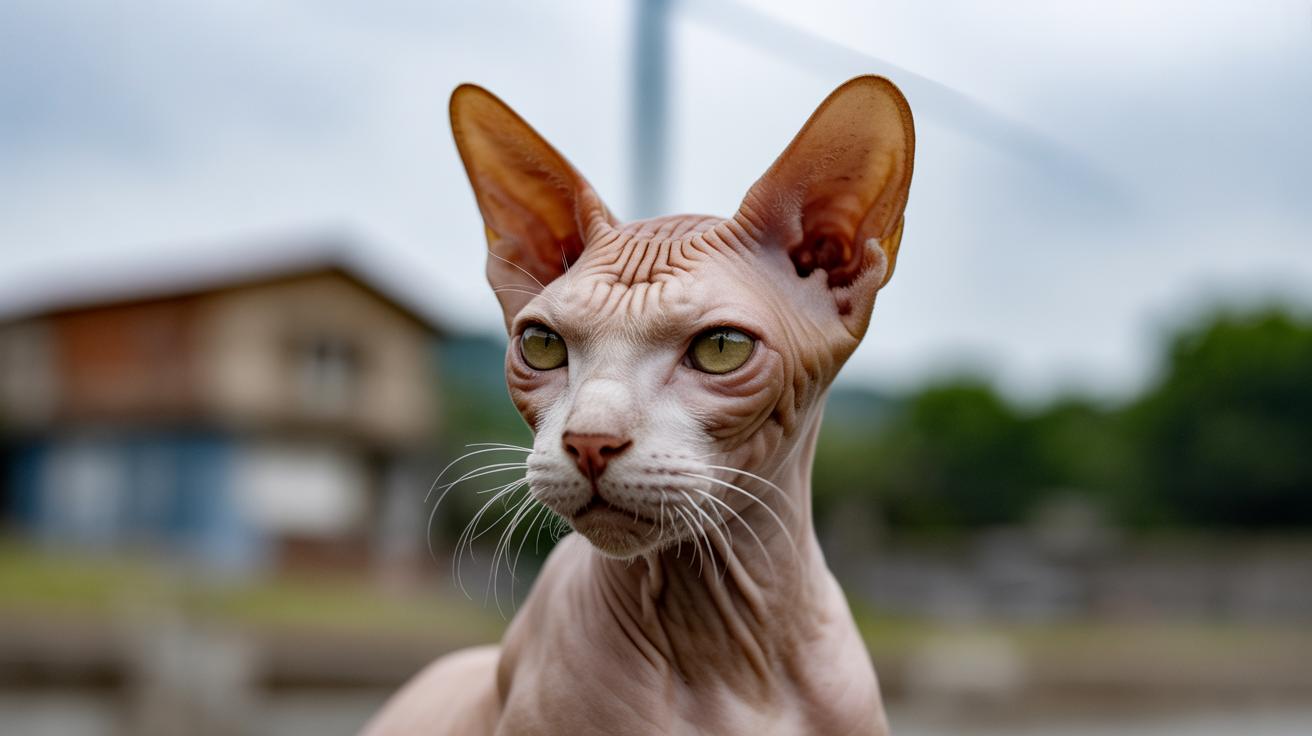
    Think hairless cats are just bald showpieces or hypoallergenic miracle pets (hypoallergenic means less likely to trigger allergies)? They might look naked, but they’re regular housecats with a fine down (very fine fuzz) and skin that can show tabby stripes or tortie patches. When one curls in your lap it feels warm and velvety, like soft suede. Ever watched their whiskers twitch as they stalk a toy? Cute, right.

    We’ll walk you through breeds like the Sphynx, the one that began with the famous 1966 kitten Prune, and cover the everyday care they need. Baths, ear cleaning, a richer diet, and a few specific vet checks are part of normal life with these cats. It’s not harder than caring for other cats , just different.

    Baths help because skin oils build up without fur, so plan on bathing about once a week to every two weeks using a gentle cat shampoo. Ears collect wax more easily too, so wipe them gently with a vet-approved cleaner once in a while. Hairless cats burn extra calories keeping warm, so a richer diet (more calories or healthy fats) often helps, but check with your vet first. Also watch for sunburn and dry patches, keep cozy beds and warm spots, and trim nails regularly.

    Don’t skip vet screenings for heart and skin issues. Ask your vet about routine heart checks and possible testing for HCM (thickening of the heart muscle), and get skin looked at if you see redness, bumps, or sores. Little things now save big worry later, um, and your cat will thank you with purrs.

    Read on for straightforward facts and practical care tips.
    Worth every paw-print.

    Quick answer: hairless cat essentials

    - Quick answer hairless cat essentials.jpg

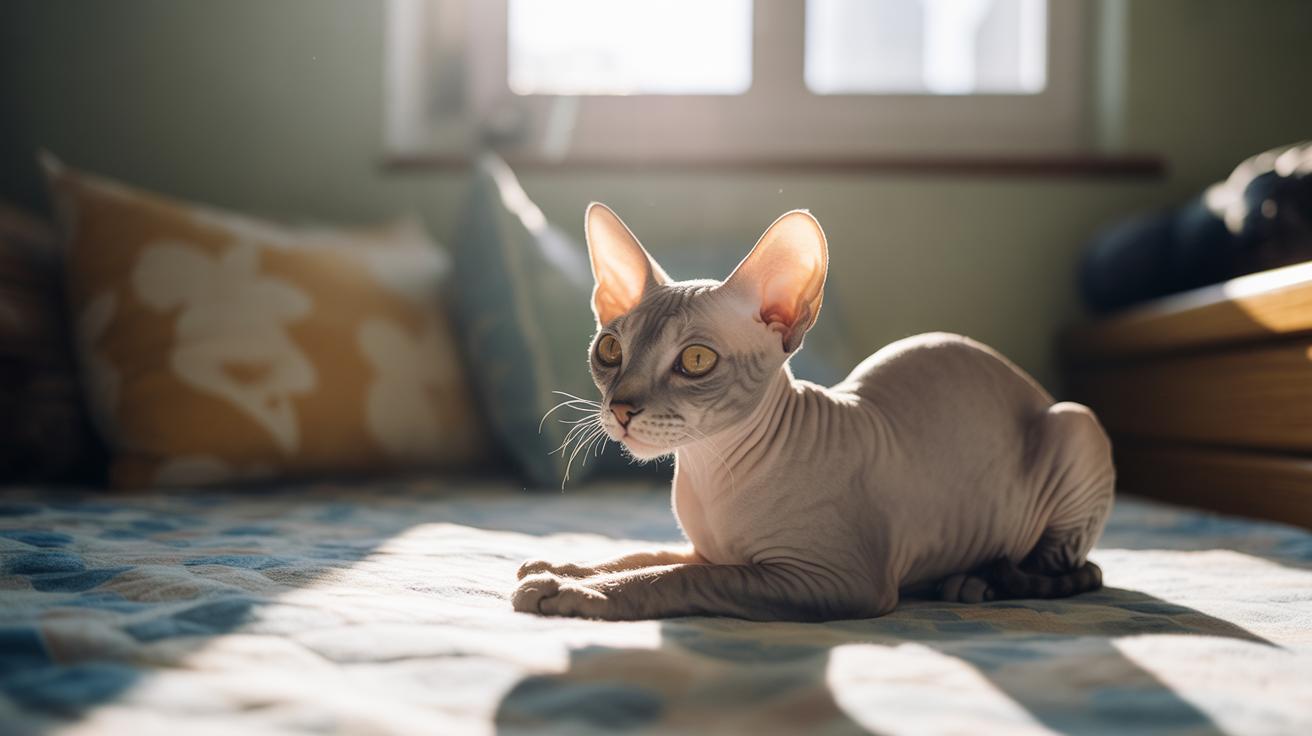
    Hairless cats are just regular domestic cats with very little fur. The best-known type is the Sphynx, which started when a hairless kitten named Prune showed up in 1966 , kind of a famous little troublemaker in cat history.

    No cat is truly hypoallergenic, because allergens come from dander (tiny skin flakes) and saliva.

    • The Sphynx breed began when a hairless kitten named Prune appeared in 1966. Fun fact: that one kitten changed everything for breeders.
    • Most hairless cats wear a fine down (short, soft fuzz) and have big, bat-like ears that twitch when you jingle a toy.
    • Their skin shows the colors and patterns their fur would have had, so you can see tabby stripes or tortoiseshell patches on the skin itself.
    • Core temperature (internal body temp) runs about 101 to 102.5°F, so their skin often feels warm to the touch.
    • Lifespan commonly sits between 9 and 15 years , give or take, depending on care.
    • They need regular baths to remove skin oils. Use a gentle, pH-balanced shampoo (made for cats) and keep it short and calm.
    • Weekly ear cleaning and checking nails every two weeks helps prevent wax build-up and irritation.
    • They burn more calories staying warm, so they often need a richer diet and do well on about 50% animal-protein (meat-based protein) feeds , ask your vet for exact amounts.
    • Main medical risks include hypertrophic cardiomyopathy (HCM, which means thickening of the heart muscle) and skin infections, so regular vet screenings matter; see Health risks for more.
    • Sunburn is real. Keep them mostly indoors, offer shady spots, or use protective clothing and vet-approved pet sunscreen if they’ll be in sun. Typical supplies: a heated bed, soft blankets, and a gentle shampoo.

    Want routines and deeper care tips? See Grooming & skin care for bathing and ear-cleaning routines, Health risks for screenings and warning signs, and Adoption for costs and prep. Worth every paw-print.

    Genetics and origins of hairless cats: why some cats lack fur

    - Genetics and origins of hairless cats why some cats lack fur.jpg

    Hairless pet cats started out as natural surprises. The most famous case is Prune, a hairless kitten born in Toronto in 1966, and breeders later worked to make that trait into what we now call the Sphynx. Ever felt a Sphynx's warm skin? It's oddly cozy, and kind of mesmerizing.

    Hairlessness comes from changes in certain genes that affect how hair develops. In other words, the genes change hair-follicle development (hair follicle: the tiny skin structure that makes hair). Different breeds , Sphynx, Devon Rex, Donskoy, and Lykoi , have different gene changes, so their skin and coat textures can look and feel very different.

    That difference matters. When you know which gene is involved, the physical traits follow patterns breeders and researchers can predict, so they can figure out why one litter is nearly bald while another has a soft down or patchy fur. Think of genes like recipes – swap one ingredient and the whole cake changes. Oops, let me rephrase that… same idea, different look.

    1. Some hairless types are recessive – a kitten needs two copies of the changed gene (one from each parent) to show the hairless trait.
    2. Other types act like dominant traits – a single copy of the changed gene can make a cat hairless, so it can pop up more quickly in a family.
    3. Multiple mutations exist across breeds because different genes and biological pathways can all affect hair growth, so hairless cats evolved that way in separate places.

    So yeah, hairless cats are a mix of cool history and genetics. They ended up hairless for different reasons, and those reasons tell breeders how the trait will show up generation after generation. Worth every paw-print of curiosity.

    Hairless cat breeds: quick ID and temperament guide

    - Hairless cat breeds quick ID and temperament guide.jpg

    Quick ID and temperament notes for the main hairless types, with pointers to Genetics for origins and Health Risks for breed-specific medical issues.

    Sphynx

    The Sphynx has a fine, suede-like down that feels warm under your hand and shows a lot of cute wrinkles. Their eyes are lemon-shaped and their ears are big and bat-like, so they look alert even when they're dozing. They’re super social and clingy in the best way, expect a little shadow following you around the house. Lifespan is usually about 9 to 15 years. See Genetics for origin and Health Risks for HCM (hypertrophic cardiomyopathy) info.

    Donskoy & Peterbald

    The Donskoy often has heavy wrinkles and a bold, curious personality. Some have sparse or variable whiskers and skin that can feel different from cat to cat, like smooth or slightly pebbly. They tend to be outgoing and confident, ready to explore a new box or chair.

    The Peterbald can be completely bald or wear a thin brush of hair, and usually has a sleek, athletic build. They’re lively and very people-focused, think playful attention-seekers who love lap time and games. See Genetics for origins and Health Risks for breed-specific concerns.

    • Elf: big upright ears and a playful, clownish nature; loves lap time and fetch.
    • Bambino: short legs and a compact body with mellow, affectionate vibes and a strong cuddle drive.
    • Minskin: tiny, short-coated legs and a gentle, social temperament that adores company.
    • Lykoi: a "werewolf" look with patchy fur and active, hunting-minded curiosity.
    • Ukrainian Levkoy: inward-folded ears and soft skin, usually calm and people-oriented.

    Worth every paw-print.

    Appearance and temperament facts about hairless cats

    - Appearance and temperament facts about hairless cats.jpg

    Many hairless cats have a delicate sensory setup. They may have missing or sparse whiskers (stiff facial hairs that help them judge space and keep balance). Without full whiskers, judging distance and staying steady can be trickier, so they often move more slowly and carefully around tight spots. You might notice them pausing, nose out, like they’re measuring the world one paw at a time.

    Personality-wise, they tend to be outgoing and curious. They use a wide vocal range , soft purrs, little trills, and attention-getting meows , and they often learn tricks and daily routines fast. Treats help. Short training sessions work wonders. Ever watched one learn the crinkle of a treat bag? Cute and impressive.

    • Vocal range and smarts: soft purrs, trills, and attention-seeking meows. Quick to learn tricks and routines, especially for a tasty reward.
    • Warmth-seeking: they love sunny spots, warm laps, and heated pads or blankets.
    • Play style: agile and curious; big on jumping and stalking small moving targets. You’ll see the focus in their eyes.
    • Training response: responds well to treats and positive rewards; keep practice short and fun.
    • Social needs: they enjoy human time and can form strong, clingy bonds.
    • Tolerance: many do fine with kids and other pets when introductions are slow and supervised.

    Care / Grooming: these cats adore warmth and benefit from heated beds or blankets (see Grooming & skin care) to stay comfy on cool days. Their skin needs gentle care and sun protection, and regular checks help catch any dryness or irritation early. Worth every paw-print.

    Grooming & skin care for hairless cats: bathing, ears, nails, sunscreen, and seasonal adjustments

    - Grooming  skin care for hairless cats bathing, ears, nails, sunscreen, and seasonal adjustments.jpg

    Hairless cats need grooming that feels more like skincare than fur care. Their oils sit on the skin instead of being soaked up by a coat, so dirt and greasiness show up faster. Think clean, hydrated skin and a cozy, dry kitty. Cute, right?

    Bathing

    Baths help lift away extra skin oils and the dirt that clings to them. Use a gentle cat shampoo that is pH-balanced (matches cat skin acidity) and hypoallergenic (gentle for sensitive skin). How often depends on your cat: weekly for oilier kitties, every few weeks or monthly for drier skin. Check the skin, if it looks greasy, bathe more. If it’s dry or flaky, back off.

    Drying is key. Towel off with a warm, soft towel and use a short low-heat dryer session if your cat tolerates it. Keep the dryer moving and never use high heat near the skin. For a longer step-by-step routine and product picks, see Grooming & skin care.

    Seasonal adjustments

    Winter: add warmth. Offer heated beds or soft warm blankets, block drafts, and consider soft clothing for quick trips around a cold house. If the skin gets dry in winter, space baths a little farther apart and try gentle moisturizing wipes or a vet-recommended topical (a cream or gel your vet says is safe). Watch for redness in folds and keep resting spots warm and draft-free.

    Summer: keep them out of direct sun and cool. Pet-formulated sunscreen (SPF – sun protection factor) or lightweight UV-blocking clothing is great for exposed patches when you can’t avoid sun. Keep them mostly indoors during peak sun hours. High humidity can worsen skin problems, so try to keep the air moving and the cat comfy. For any heated gear, choose veterinary-safe options with auto-shutoff and low-heat settings, and place cords where the cat can’t tangle.

    Ears & nails

    Without ear hair, wax builds up faster. Check ears once a week for wax, dark debris, swelling, or a bad smell. Use a cotton pad soaked in a vet-approved cleaner and wipe only the outer ear, don’t push into the ear canal. If you notice strong odor, discharge, redness, or lots of scratching, see the vet.

    Nails grow fast on hairless cats, so trim about every two weeks to avoid skin nicks and accidental scratches. Short trims keep both you and your furniture happier. I once clipped a jagged claw and my cat gave me the slowest, most offended blink, worth it.

    • Check ears weekly for wax, dark debris, swelling, or a bad smell.
    • Use a cotton pad with vet-approved cleaner; wipe only the outer ear.
    • See your vet for persistent odor, discharge, redness, or heavy scratching.
    • Trim nails every two weeks to prevent overgrowth and skin scratches.
    Item Recommended feature Safety note
    Gentle cat shampoo pH-balanced (matches cat skin acidity), hypoallergenic (made for sensitive skin) Avoid human shampoos; rinse well to prevent residue
    Pet-safe sunscreen / protective clothing pet-formulated SPF (sun protection factor) or breathable UV-blocking fabric Test a small area first and avoid human sunscreens with zinc
    Veterinary-safe heated bed / heat pad low-heat settings with auto-shutoff Place on stable surface, cover cords, and supervise initial use
    Drying tools (towel / low-heat dryer) soft microfiber towel (microfiber is a soft, quick-absorbing cloth), dryer with low-heat and quiet setting Keep dryer moving and never use high heat near skin

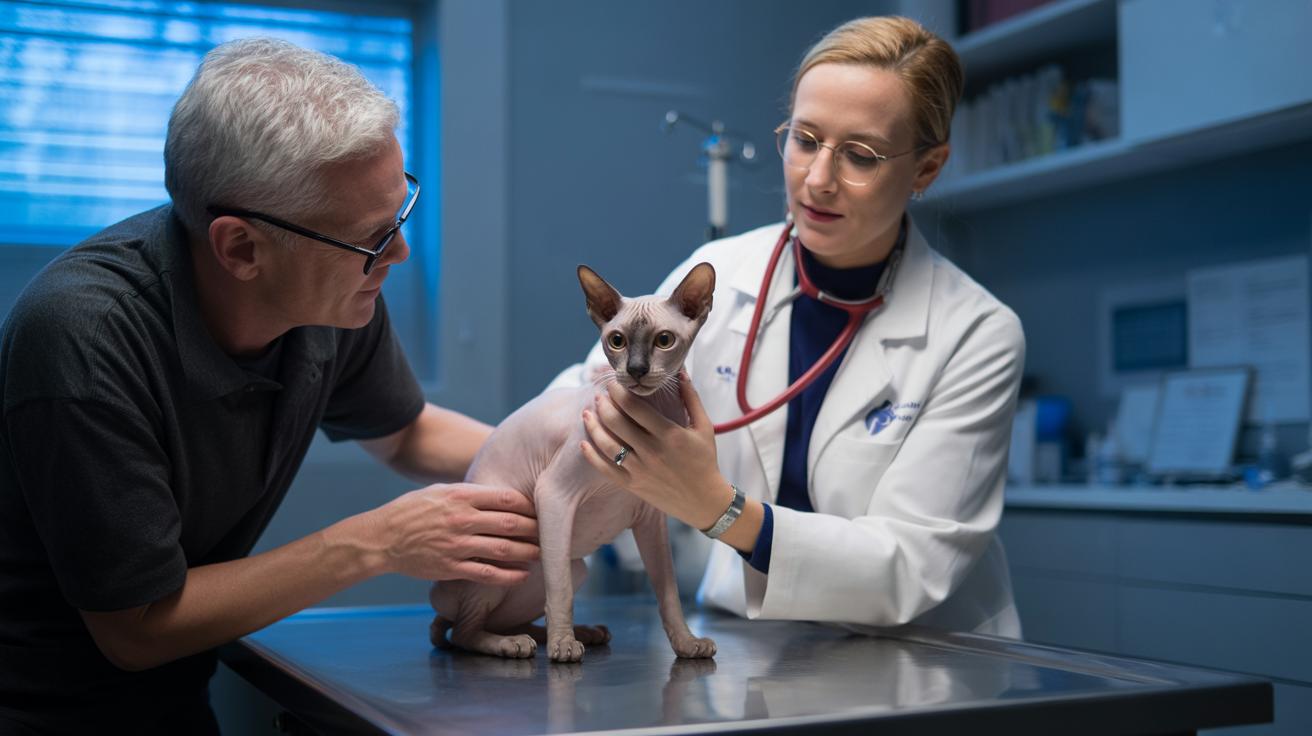
    Health risks, screening and vet care facts about hairless cats

    - Health risks, screening and vet care facts about hairless cats.jpg

    Hairless cats are charming and goofy in their own way, but they do need a bit more watching than their furred cousins. The big things to watch for are hypertrophic cardiomyopathy (HCM) (thickening of the heart muscle that can make the heart pump poorly), skin infections like fungal infections or ringworm (a contagious skin fungus), acne and skin-fold irritation (rubbed or trapped skin in wrinkles), dental disease, and breathing problems in kittens. These show up more often in hairless lines because exposed skin and certain genetics raise the risks. Worth keeping an eye on.

    Find one veterinarian who knows hairless breeds and stick with them. Regular check-ups set a baseline for skin health and heart sounds, so small changes jump out faster. Breeders or rescues that share screening records are a huge help, so keep every vet report with your cat’s files. Ever had a pet file go missing? Yeah, me too. Keep copies.

    Heart screening and HCM

    HCM is a structural heart problem where the heart muscle gets thicker and can limit blood flow or cause abnormal rhythms. Some hairless breeds, like Sphynx and related lines, have higher HCM rates because of genetics, so responsible breeders screen breeding cats. A typical plan is yearly checks or whatever your vet and breeder recommend. Screening often includes an echocardiogram (an ultrasound of the heart) and regular auscultation (listening to the heart with a stethoscope). If a breeder or shelter gives you recent heart-screen results, that’s a strong plus when you’re adopting or buying.

    Watch for these red-flag signs and call your vet right away:

    • Skin ulcers or fast-spreading sores.
    • Struggling to breathe or very fast breathing.
    • Fainting or collapsing.
    • Sudden loss of appetite.
    • Ongoing vomiting.
    • Severe diarrhea.
    • Extreme tiredness or sudden weakness.
    • New heart signs like a murmur you didn’t hear before or an irregular pulse.

    Parasite prevention and vaccine timing
    Keep up with flea control and routine deworming as your vet suggests, because hairless skin shows bites and irritation fast. For vaccines, many clinics stagger shots (for example, don’t give FVRCP and rabies on the same day) to lower short-term stress or sneeze reactions, so talk through timing with your vet. Little planning here saves a lot of worry later, and your cat will thank you with purrs.

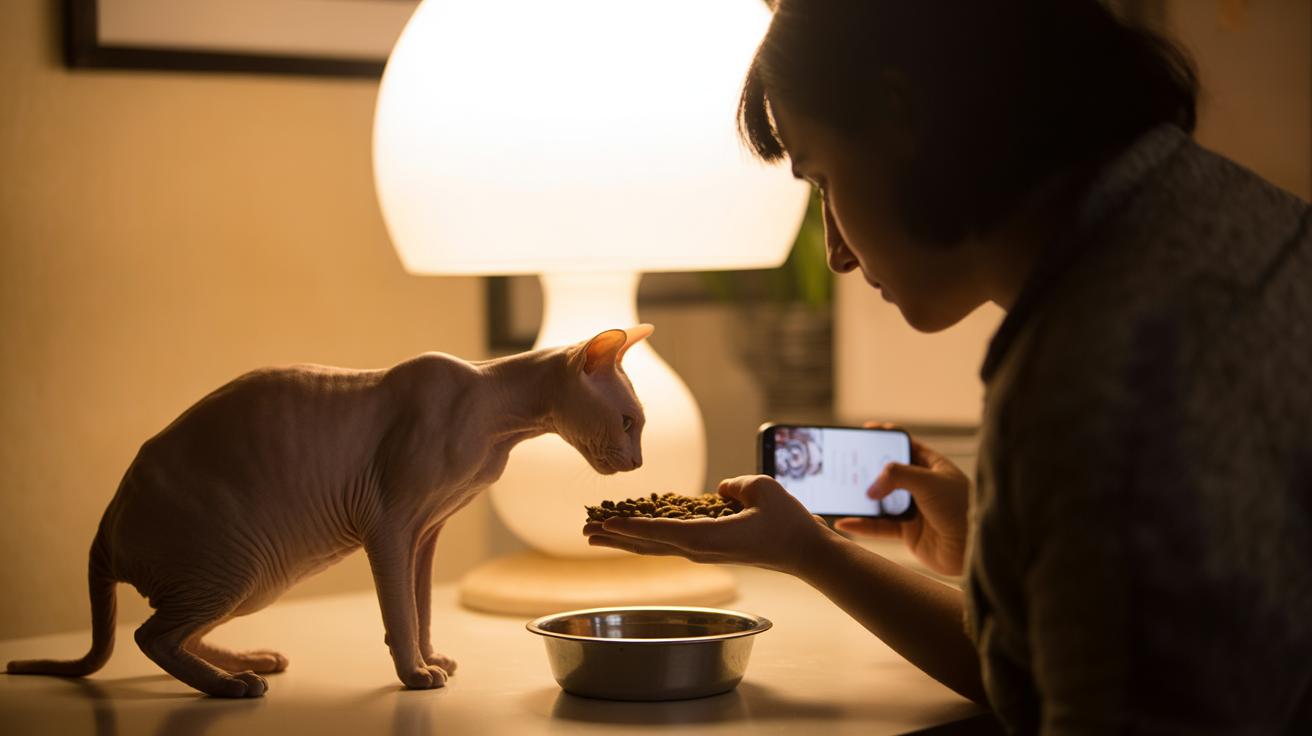
    Feeding, metabolism and nutrition facts about hairless cats

    - Feeding, metabolism and nutrition facts about hairless cats.jpg

    Hairless cats lose heat faster than furry breeds, so they burn more calories just staying warm. In simple terms, their metabolic needs (how many calories they use each day) are higher, and that usually means richer, energy-dense food. Ever watched your kitty seek the sun patch like it’s a heater? That’s why food matters.

    Aim for diets that give about 50% animal protein (meat-based protein, like chicken, turkey, or fish). Animal protein supports muscle and overall energy. Offer a mix of wet and dry food: wet food helps with hydration, and dry food helps keep teeth cleaner. It’s a good balance.

    1. Kittens: feed four times a day with a high-calorie kitten formula (higher-calorie food made for growth). Newborns and growing kittens need extra calories for both warmth and development.
    2. Junior / active adult: give three measured meals a day, or supervised free-feeding with calorie-controlled dry food so they don’t overeat. Keep an eye on body shape and activity.
    3. Senior: switch to two smaller meals a day and cut calories a bit as activity slows and metabolism changes. Older cats often need different nutrient mixes, so check with your vet.
    4. Weigh and check body condition about once a month and tweak portions to keep a lean, healthy figure; your vet can help set a target weight and meal plan.

    Some cats do well with supplements for immune or digestive support, but talk to your veterinarian before adding anything. Keep fresh water available all the time , hairless cats can get warm and thirsty fast. Ask your vet about portioning tied to activity level and seasonal temperature changes, especially in colder months when they may need extra calories to stay cozy.

    Small tip: a short, energy-boosting meal before you head out can give your cat safe playtime and warmth if you’re gone all day. Worth every paw-print.

    Adoption, costs and owner preparation for hairless cats

    - Adoption, costs and owner preparation for hairless cats.jpg

    Picking between adoption and a breeder comes down to a few tradeoffs: money up front, paperwork, and how predictable your new buddy will be. Shelters and rescue groups usually charge lower fees and often give you a vet history or foster notes that tell you how the cat behaves. Reputable breeders tend to offer more documented health screening and clear lineage, and some even include a short insurance window to get you started. For a list of rescues and groups that sometimes list lower-allergen or special-needs kitties, see hypoallergenic cats for adoption. Think of it like balancing cost versus predictability.

    Costs and ongoing expenses

    Hairless cats can cost more to care for than typical furry breeds because they need extra skin care and ways to stay warm. Expect food to run about $30 to $70 per month. Pet insurance (helps cover vet bills) is commonly $20 to $40 per month depending on the plan and the cat's age. Parasite preventives and litter add another $10 to $40 monthly depending on what you choose. One-time starter supplies and grooming items usually total $50 to $150 for good quality gear.

    • gentle cat shampoo (pH-balanced: matches cat skin acidity)
    • ear cleaner (vet-recommended solution)
    • nail clippers (sharp, safe trimmers)
    • soft bedding and washable blankets for snuggles and warmth
    • sun-protective clothing (lightweight, breathable fabric) for outdoor window sunbaths
    • heated pad (safety-reviewed with auto-shutoff, low-heat setting; auto-shutoff turns the pad off if it overheats)
    • secure carrier (well-ventilated, crash-tested style; crash-tested means it meets safety standards for transport)
    • vet-recommended diet (about 50% animal-protein target for energy needs; animal-protein means meat or fish sources)

    Pick a veterinarian who knows hairless breeds, someone familiar with skin care routines and HCM screening (HCM is hypertrophic cardiomyopathy, a common heart condition in cats). You want a vet who will be a partner for checkups, vaccine spacing, and any breed-specific questions. Ever watched your kitty squirm under a towel while you try to trim nails? Yeah, a calm, experienced vet makes those moments way less stressful. Worth every paw-print.

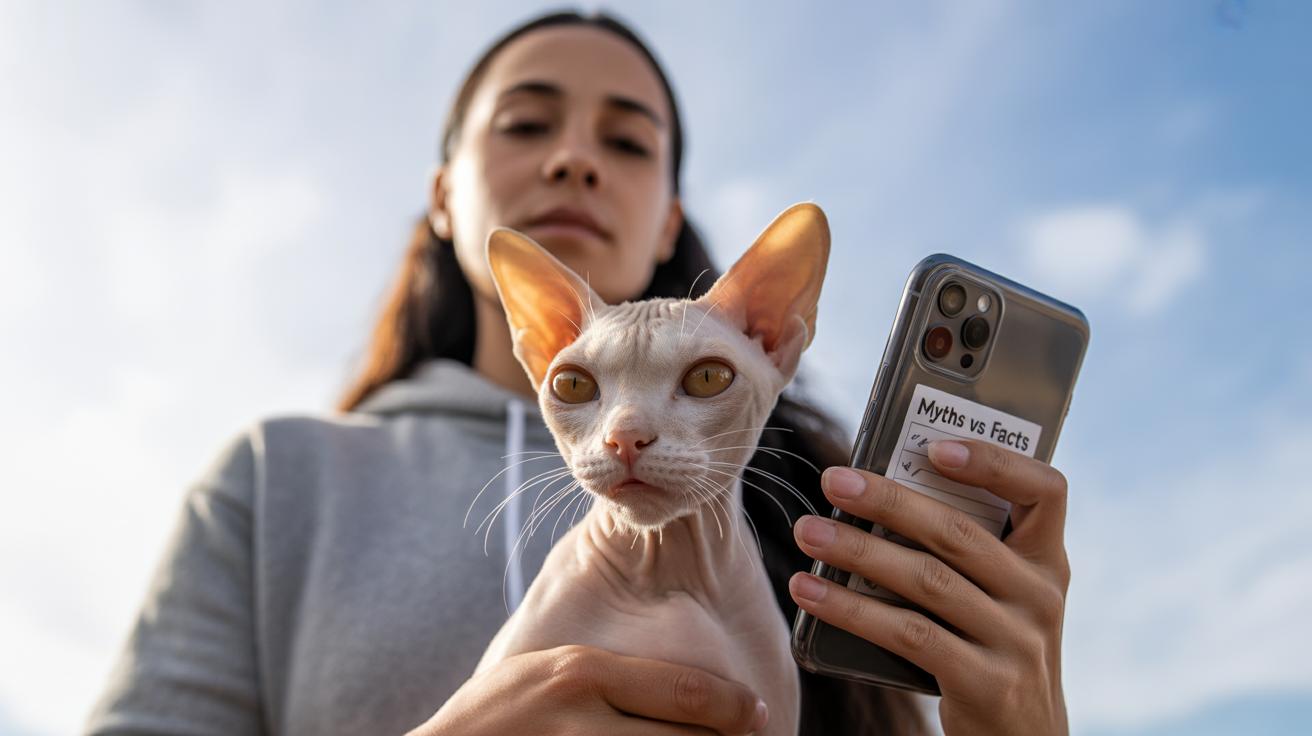
    - Myths vs facts about hairless cats strict mythfact pairs and quick links.jpg

    Here’s a short, friendly take on the most common hairless-cat myths. I’ll keep it tight and clear, no fluff, just what you need to know. Ever watched your kitty tuck into a sunbeam? That scene matters for these facts.

    Myth Fact
    Hairless cats are hypoallergenic and safe for allergy sufferers. No cat is truly hypoallergenic. Allergens come from dander (tiny skin flakes) and saliva, so hairless cats can still trigger reactions. See Health risks and Genetics and origins of hairless cats (how traits pass through genes).
    Hairless breeds need almost no grooming. They need regular skin care because their skin makes oil and can get greasy. Clean gently, overbathing dries skin. For tips see Grooming & skin care.
    You can leave a Sphynx outdoors like any other cat. Without fur they’re prone to sunburn and cold stress, so keep them mostly indoors and protected from strong sun and chilly winds. See Health risks.
    Hairless cats don’t need heart checks. Some lines carry higher risk of HCM (hypertrophic cardiomyopathy, a heart-muscle condition) and benefit from regular screening by a vet. See Health risks.

    See Grooming & skin care, Health risks, and Genetics and origins of hairless cats for details.

    Worth every paw-print.

    Resources, images, and citation plan for facts about hairless cats

    - Resources, images, and citation plan for facts about hairless cats.jpg

    Start with solid sources. Cite peer-reviewed veterinary journals and statements from board-certified cardiologists for HCM guidance (HCM means hypertrophic cardiomyopathy, a heart muscle disease that thickens the heart walls). Use national breed clubs for registry and standard details, and reputable rescue groups for adoption and temperament notes. Primary sources help readers check medical and breed claims, so include full citations, dates, and links when possible. Want readers to trust the facts? Let them follow the trail.

    Image list and captions to show key points. Keep captions clear, with date and provenance so a photo like Prune from 1966 is verifiable.

    • Origin / Prune historic image: Black-and-white photo of Prune (Toronto, 1966). Caption should name the date and provenance so viewers know where it came from.
    • Close-up skin pattern: High-resolution shot showing tabby or tortoiseshell markings visible on bare skin, with natural light so the subtle patterns pop.
    • Wrinkle details: Macro image of forehead and shoulder folds to illustrate common wrinkle placement; show texture and shadow so readers can see depth.
    • Bathing setup: Calm bath scene with a non-slip mat, a gentle pH-balanced shampoo bottle (pH-balanced means gentle for skin), and a warm towel. Soft steam, a relaxed cat, and no stressed expressions.
    • Ear-clean demo: Step-by-step photo series showing an outer-ear wipe using a vet-recommended cleaner (do not insert into the ear canal). Close-ups of technique make this safe and clear.
    • HCM screening / clinic shot: Veterinary echocardiogram image or clinic scene showing a heart ultrasound in progress (echocardiogram means a heart ultrasound, a non-invasive test). Include clinician credentials if possible.

    A quick note on safety and labeling. Always state who provided medical images, list consent if needed, and avoid staging risky behavior. Show safety gear and gentle handling. People notice the little things, like a soft towel or a calm handler.

    Meta description example: "Sphynx origin (Prune, 1966), top care needs (weekly baths, ear cleaning, sun protection), typical lifespan 9–15 years, and adoption prep included."

    Cute, useful, and checkable. That’s the goal.

    Final Words

    In the action, we ran through hairless-cat essentials: a quick answer with Prune/Sphynx history, genetics and breed IDs, appearance and temperament, grooming and seasonal care, health screenings, feeding and adoption notes, myths and image/citation tips.

    Top takeaways: regular baths help control skin oils, watch for HCM (hypertrophic cardiomyopathy, a heart muscle condition) and skin infections, feed higher-protein diets (about 50% animal protein) for their faster metabolism, and keep them indoor or sun-protected.

    Flip to Grooming, Health Risks, and Adoption sections for how-to details. Keep these facts about hairless cats handy when you plan care. Your cats will thank you with purrs and playful zooms.

    FAQ

    Hairless cats — FAQ

    What is special about hairless cats?
    Hairless cats are domestic cats with very little coat; the Sphynx is the best-known type, tracing to a Toronto kitten named Prune in 1966. They have warm, suede-like skin and big ears.
    <dt id="q2">What are some kid-friendly facts about hairless cats?</dt>
    <dd>Kid-friendly facts: hairless cats feel warm to the touch, often have soft downy fuzz, love cuddles, need regular baths to remove oil, seek heat, and typically live about 9–15 years.</dd>
    
    <dt id="q3">How long do hairless cats live?</dt>
    <dd>Hairless cats typically live 9–15 years, with lifespan influenced by genetics, diet, and vet care; some lines live longer with regular heart checks and consistent skin and nutrition routines.</dd>
    
    <dt id="q4">Do hairless cats have teeth?</dt>
    <dd>Hairless cats do have teeth like other cats; lack of fur does not affect dentition, though dental disease can occur, so routine dental checks and at-home brushing help keep teeth healthy.</dd>
    
    <dt id="q5">Where can I buy a Sphynx and how much does it cost?</dt>
    <dd>Sphynx kittens are sold by breeders, available through rescues, and sometimes found in shelters; prices often range $1,200–$3,000 from reputable breeders, with rescue fees typically lower.</dd>
    
    <dt id="q6">What hairless breeds should I know?</dt>
    <dd>Common hairless breeds include Sphynx, Donskoy, Peterbald, Bambino, Elf, and Devon Rex; each shows unique looks and personality, from suede-like skin to varying curl and ear size.</dd>
    
    <dt id="q7">What is typical behavior and common behavior problems in hairless cats?</dt>
    <dd>Hairless cats are social, playful, and people-focused; common behavior problems include separation anxiety, excessive vocalizing, and destructive scratching, which respond well to play, toys and mental games, and predictable routines.</dd>
    
    <dt id="q8">What are ten quick facts about hairless cats?</dt>
    <dd>Ten quick facts: Sphynx origin with Prune (1966); suede-like down and large ears; core temp 101–102.5°F; lifespan 9–15 years; regular baths; weekly ear care; higher metabolism; aim ~50% animal protein; HCM and skin infection risks; sunburn risk.</dd>
    
    <dt id="q9">What health risks do hairless cats face?</dt>
    <dd>Hairless cats face HCM (heart muscle thickening), skin infections and acne, skin-fold problems, dental disease, and kitten respiratory issues; consult the Health Risks section for red-flag symptoms and screening guidance.</dd>
    

    Related Articles

  • Facts about Tortoiseshell Cats: Genetics and Care

    Facts about Tortoiseshell Cats: Genetics and Care

    Think tortoiseshell cats are moody because of their colors? Cute story, but the real reason is chromosomes, not attitude. Your tortie will still plot world domination while looking adorable.

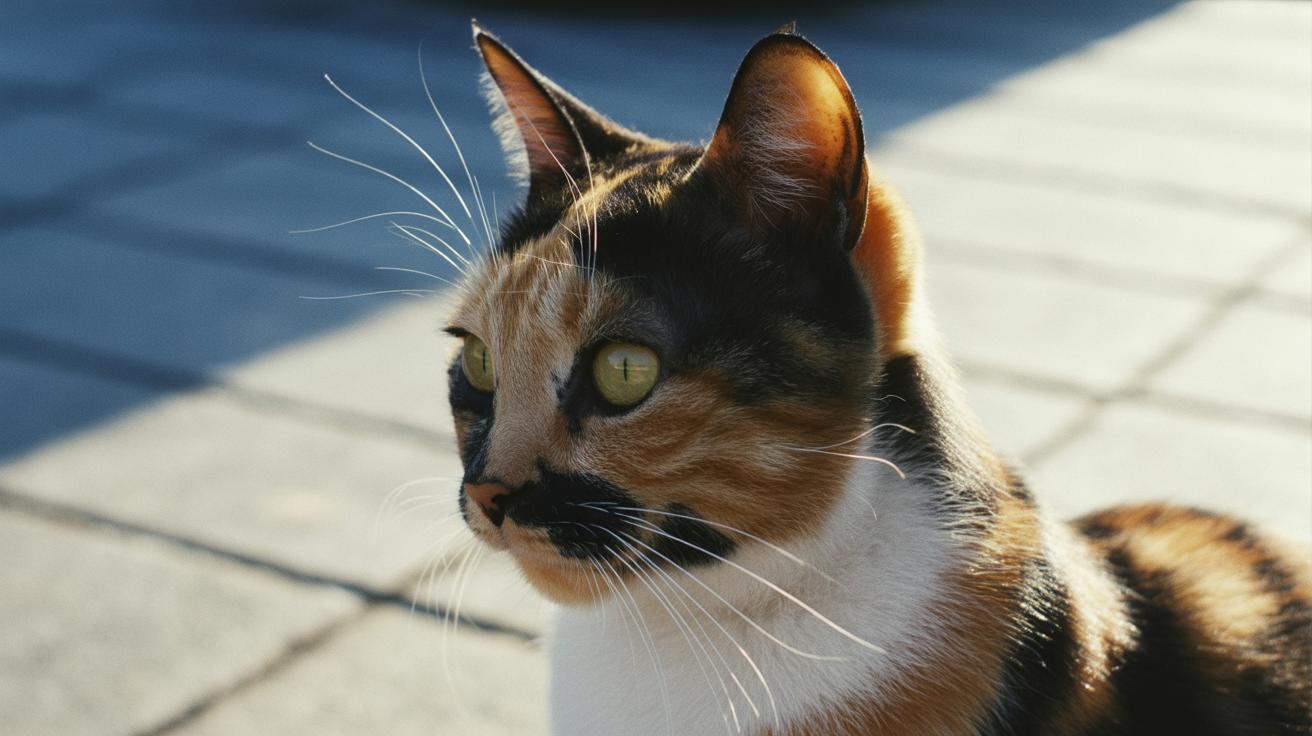
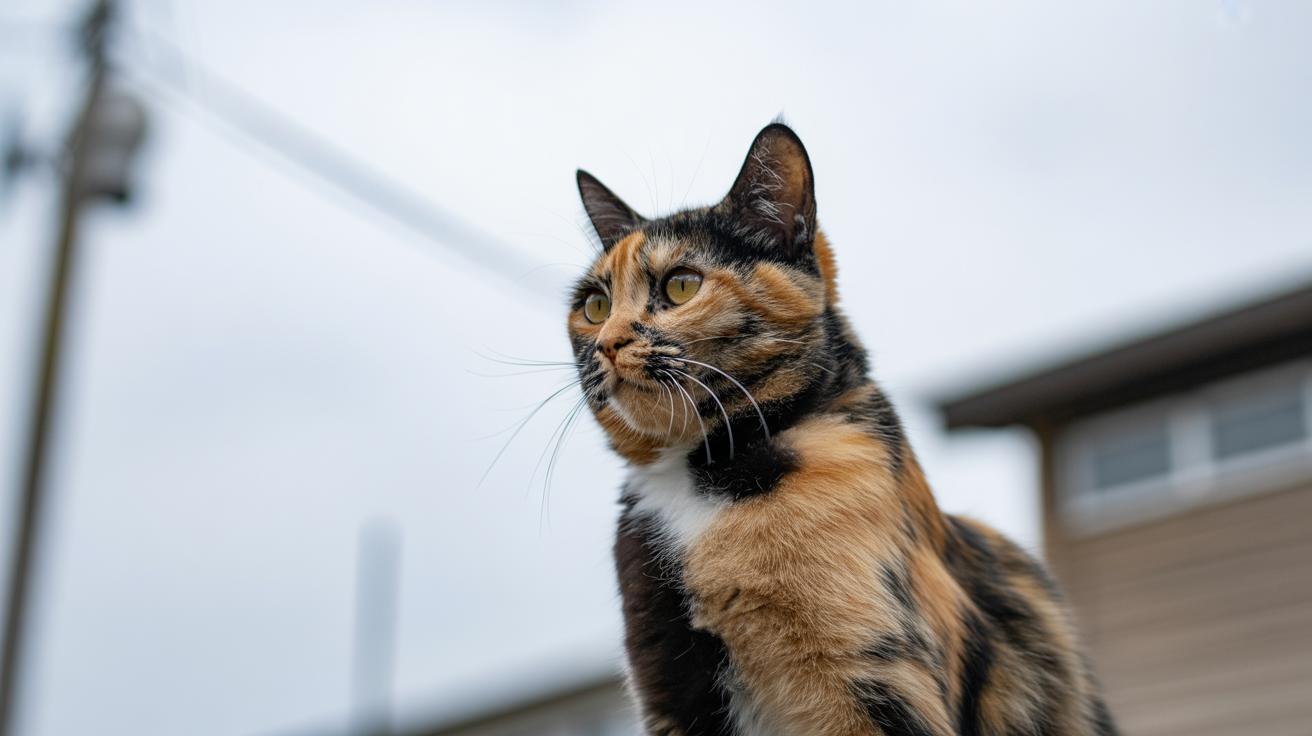
    Tortoiseshell is a coat pattern (a color layout, not a breed). It happens when color genes on the X chromosome (the sex DNA carrier) create patchy black-and-ginger fur. Most torties are female because females usually have two X chromosomes and can show both colors. Male tortoiseshells are rare, about 1 in 3,000, and usually happen when a male has an extra X (XXY, a genetic anomaly) or when two embryos fuse to make a chimera (two embryos merged into one cat).

    So care for a tortie is just good cat care, not mood management. Give her scratching posts, nail trims, and a teaser wand like a fishing rod for cats (light stick plus feathers) so she can burn energy, the satisfying thud of a bouncing ball does wonders. Keep up with regular vet checks, offer quiet spots and interactive play, and you’ll get a purring, playful roommate who just happens to be outrageously patterned.

    Worth every paw-print.

    At-a-glance: quick facts and where to read more

    - At-a-glance quick facts and where to read more.jpg

    Tortoiseshell is a coat pattern (a color layout, not a breed) made of black and red/ginger patches. You’ll spot it in lots of breeds (examples below). It’s overwhelmingly female , male torties are rare, about 1 in 3,000.

    Click any link to dive deeper for full explanations, sources, breed examples, and practical care steps. Worth a quick read if you love torties.

    Tortoiseshell cats genetics explained

    Tortoiseshell coloring comes from genes on the X chromosome (the sex chromosome). The orange and black pigment alleles are X-linked (alleles are just different versions of a gene), so which X shows up in each skin cell shapes the coat you see.

    The big trick is X-inactivation (when one X chromosome is randomly switched off in each cell during early embryo development). That random shut-off makes patches of cells show the orange allele or the black allele, so the fur becomes a marbled mix of colors. If the silencing happens early you get big blocks of color. If it happens later you get a finer, brindled look, like someone splashed paint across a kitten.

    Kittens get one X from their mother and either an X or a Y from their father. So female kittens end up with two Xs and can carry both orange and black alleles, and X-inactivation lets both colors appear in different patches. That’s why tortoiseshells are almost always female. Ever watch a tortie chase a laser? Cute chaos.

    Statistically, tortoiseshell cats are about 99.96% female. Male tortoiseshells are rare, around one in 3,000, and most of those males have an extra X chromosome (XXY, called Klinefelter syndrome, extra X). Those XXY males are usually sterile and often face more health problems than typical females, and they may have shorter lifespans.

    Most tortoiseshell patterns come from mosaicism (X-inactivation creating two cell lines). Chimera is another, much rarer cause, when two embryos fuse very early on, making a cat with two different genetic cell lines; that often gives a sharp split in color down the face or body. In short, mosaicism explains most torties, chimera is rare, and XXY males are uncommon and medically special. Worth every paw-print.

    Tortoiseshell cats: patterns, color variants, and how to identify them

    H3 IDs to create on the page).jpg

    Tortoiseshell shows up a few different ways on a cat’s coat: brindled (colors woven together like paint gently stirred), patched (big, bold blocks of color), torbie (tortoiseshell mixed with tabby stripes), chimera (a very sharp split of colors), and tortiepoint (color piled on the ears, face, paws, and tail like a Siamese-style pattern). Kittens don’t always look the same as adults, since their fur fills in and X-inactivation (when one of the two X chromosomes in each cell turns off randomly) decides how the colors settle. So early photos can be misleading.

    Brindled coats make you think of soft marbling or paint mixed on a brush. Patched coats are obvious blocks of color. The moment X-inactivation happens during development affects whether a cat ends up with big patches or tiny, freckled mottling. Torbies and chimera patterns often give strong visual clues you can use to spot a tortie without grabbing a genetics test right away.

    Dilute tortoiseshells show blue and cream or gray and cream shades (dilute means the pigments are lighter). Tortiepoint or colorpoint tortoiseshells have darker points on the ears, face, paws, and tail, like Siamese cats (Siamese-style point = darker extremities). Colors can shift as kittens grow, orange can fade to cream, black can soften to gray, so pictures taken at a few months old are usually the most helpful.

    Torbie identification

    A torbie mixes tortie colors with clear tabby stripes. Look for stripes on the legs and a striped M on the forehead as quick photo cues. Ever noticed how a torbie’s movement makes the colors ripple? That’s a giveaway.

    Chimera vs mosaic

    Chimera means two embryos fused early on, and it often creates a dramatic left-versus-right color split (think one side bold, the other side different). Mosaic is the result of X-inactivation (random patchy coloring across cells), giving a more random marbled look across the whole body. Chimera looks deliberate. Mosaic looks like natural confetti.

    Dilute and colorpoint tortoiseshells

    Dilute torties are rarer and have soft gray or blue tones next to pale cream. Tortiepoint cats show darker points on their extremities and can look like a tortie wearing a Siamese mask. Both types can be subtle in photos, so watch for those gentle gray tones or darker ears and paws to spot them.

    Worth remembering: look for the pattern, pay attention to how a kitten’s colors change, and if you’re guessing from a photo, give it a few months. You’ll get better at spotting the subtle, claw-tastic differences.

    Tortitude: temperament and behavior of tortoiseshell cats

    - Tortoiseshell cats genetics explained.jpg

    Tortitude is the fun name people give the feisty, sassy attitude many tortoiseshell cats show. Think bold confidence, a little spunk, and a whole lot of charm. Fans call it tortitude because these cats seem to have their own rules, and you kind of love them for it.

    Torties are often described as strong-willed, chatty, high-energy, and weirdly loyal. One minute they’re doing their own thing, the next they’re demanding cuddles. Ever watched a tortie stalk a sunbeam like it owes them money? Your cat’s whiskers twitch, their paws creep forward, and you know something silly and serious is about to happen.

    That said, science doesn’t give us a neat coat-color to behavior rule. Veterinary studies show lots of individual differences, so breed, early socialization (early exposure to people and situations), and life experience shape personality more than fur pattern alone. Owner stories are real and useful, but they don’t make a universal law.

    For everyday care, match activity to their energy. Aim for a few short interactive play sessions daily, 10 to 15 minutes each, and rotate sturdy toys to keep things interesting. Watch for bonding signs like following you, head bunting, or intense play to see how attached they are. At shelters, check play drive, handling comfort, and how much they vocalize around people; if you’re trying one out for adoption, give a quick play trial and a quiet lap moment to meet the real cat. Worth every paw-print.

    Health and lifespan facts for tortoiseshell cats

    - Tortoiseshell cats patterns, color variants, and how to identify them.jpg

    Lifespan depends on breed and care. American Shorthair (a sturdy, short-haired breed) often live about 15 to 20 years. Maine Coon (a big, long-haired breed) averages around 13 years. Female tortoiseshells usually live longer than the rare male torties.

    Most male tortoiseshells are XXY (extra X chromosome, a chromosomal difference sometimes called Klinefelter). That means they’re often sterile (can’t have kittens), may face more health issues, and can have shorter lifespans than XX females. It’s uncommon, but worth knowing if your cat’s coloring surprises you.

    Keeping a tortie healthy is mostly about consistent care. Schedule routine vet exams at least once a year, and more often for senior cats. Don’t skip dental checks and cleanings , teeth problems can make a cat stop eating and cause infections. Parasite prevention (monthly meds to stop fleas, ticks, and worms) helps keep them comfy and infection-free.

    Watch weight and body condition, and keep an eye on mobility as they age. If you notice stiffness, ask your vet about joint supplements like glucosamine (a joint-support supplement). Genetic testing (a simple DNA lab test) can confirm an XXY pattern, but you only need it if your vet sees a reason.

    Breed matters for what screenings are helpful, so talk with your vet about breed-specific tests and vaccines. If you adopt from a shelter, ask for medical history and any past screening results. Small, steady habits , regular exams, a sensible diet, daily play for activity, and dental care , really add up to more healthy years. Worth every paw-print.

    Health Issue Why it matters Recommended action
    XXY males – sterility and extra risks Often sterile (can’t reproduce) and may have more health problems Consider genetic testing (DNA lab test) and thorough vet screening
    Dental disease Pain, trouble eating, and risk of infection Regular dental exams and professional cleanings
    Weight and obesity Raises risk of diabetes and puts strain on joints Control portions, pick a balanced diet, and encourage daily play
    Parasite prevention Stops fleas, ticks, and intestinal worms that make cats sick Use monthly preventives as your vet recommends
    Senior mobility and arthritis Less activity, more pain, lower quality of life Annual mobility checks and consider joint supplements like glucosamine (joint-support supplement)

    Caring for tortoiseshell cats: grooming, diet, and daily routine

    - Tortitude temperament and behavior of tortoiseshell cats.jpg

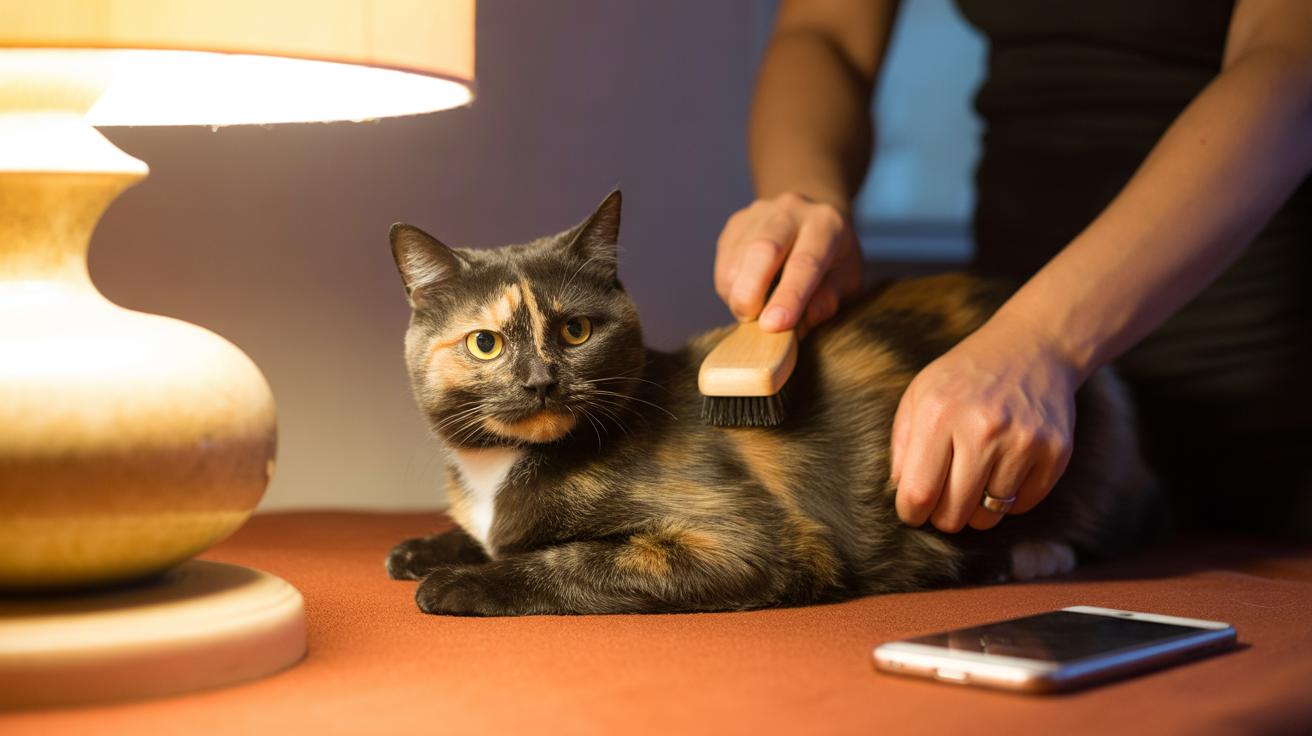
    Coat length decides a lot of the grooming you’ll do. Short-haired torties usually do fine with a weekly brush. Long-haired torties need brushing several times a week to cut down on loose fur and hairballs. You’ll notice the difference right away , less fuzz on the couch and a shinier coat.

    Match brushing to the seasons, since most cats shed more at certain times of year. A quick daily face rub and a short play-before-bed session calms many torties and reduces the nighttime zoomies. Short on time? Try two brief play-and-brush mini-sessions each day. Your cat will purr more and shed less.

    Keep basic grooming simple and steady. Trim nails every 2 to 4 weeks, glance inside ears for dirt or wax, and only bathe when truly needed, since most cats dislike baths. If your tortie coughs up hairballs a lot, chat with your vet about brushing more often or trying a hairball-formula food.

    Grooming schedule and tools

    Tool Best for How often
    Slicker brush (a brush with fine bent wires) Long coats, detangling Several times per week
    Detangler comb (comb for knots) Removing mats gently As needed, carefully
    Bristle brush or rubber curry brush (soft bristles or rubber nodules) Short coats, removing loose fur Weekly
    Nail trimmer Keeping claws tidy Every 2–4 weeks
    Gentle ear wipes Cleaning visible dirt or wax Check weekly

    Baths are rare. Only do them when your cat is dirty or your vet recommends it. And remember to make grooming a calm moment, not a wrestling match. Reward your tortie with treats or a favorite toy so they learn to love the routine. I once bribed Luna with a tiny tuna snack and she became a much better sport. Worth every paw-print.

    Nutrition for coat health

    Pick a protein-forward diet (protein is a muscle-building nutrient) and foods with omega-3 and omega-6 fatty acids (healthy fats that help skin and coat). Keep fresh water available always. Watch body condition so your tortie stays fit but not thin or overweight. Before adding supplements, check with your vet , they’ll tell you if fish oil or special formulas are worth it for your cat.

    For busy days, toss an unbreakable ball before you head out , that can be ten minutes of safe play and less home fur. In truth, consistent care and a little play go a long way toward keeping your tortie happy and feline fine.

    Myths, folklore, and famous tortoiseshell cats

    - Health and lifespan facts for tortoiseshell cats.jpg

    Tortoiseshell cats come wrapped in stories from all over the world. In Scotland and Ireland, a rare male tortie is often called lucky. Other traditions treat torties like little guardians or say they bring money and good luck. Ever watched a tortie suddenly sit where you were about to cry? Yeah, those stories feel true.

    A few famous tortoiseshells add real charm to the tales. Tama, the stationmaster cat in Japan, became a local celebrity and actually drew more visitors to her station. Commuters fed her and celebrated her like a tiny mayor. Marzipan in Australia lived to 21 and was known for curling up with moviegoers at the cinema. Literary lore even points to Cattarina as a muse connected to Edgar Allan Poe. And in the U.S., Cleo and Sarah were tortoiseshell companions at the White House during Reagan’s time. Cute, right?

    These are fun facts, not science. They help explain why torties feel so loved around the world. Worth every purr.

    Also, remember folklore is folklore, not medical advice. There are odd old customs out there , like a tale that rubbing a wart on a male tortie’s tail in May will make it go away. That’s harmless as a story, but it won’t fix a health problem. If your cat seems sick or hurt, call a veterinarian instead of trying folk remedies. Trust me, your vet will know what to do.

    Adopting, evaluating, and FAQs for tortoiseshell cats

    - Caring for tortoiseshell cats grooming, diet, and daily routine.jpg

    Adopting is usually easier on the wallet than buying a purebred. Shelters and rescues often charge less, so start with local shelters (see hypoallergenic cats for adoption for search tips and pricing comparisons). You’ll often find sweet, quirky torties waiting for a home.

    At the shelter, do three quick checks: play drive, comfort with handling, and how much they meow. Ask for a short play trial and a calm lap moment. For example, say: "Try a minute with a teaser wand and a minute of lap time to see how relaxed they are." Ever watched a cat go from zoomies to purr-machine in sixty seconds? These mini-tests tell you a lot about how they bond and take being handled. See the Caring for tortoiseshell cats section under "Bringing a tortie home: first 24 hours" and Health/Genetics (how traits are passed on) for notes about rare male torties and fertility.

    The full first-24-hours checklist lives in Caring for tortoiseshell cats under the subheading "Bringing a tortie home: first 24 hours." Quick run-through of the essentials: a quiet small room, a cozy bed, food and fresh water, a litter box, a scratching post, a safe hiding spot, the carrier for the vet visit, and a couple of interactive toys. Think soft bedding that smells like you, a low light corner to hide in, and one toy that makes a satisfying little rattle.

    FAQ (short and friendly):

    • Do tortoiseshell cats have a universal temperament? No. Personalities vary , some are mellow, some are feisty. See Temperament and Health/Genetics for more.
    • Are male tortoiseshells fertile? Most are sterile; see Health/Genetics for the genetics (how those color traits link to chromosomes).
    • Will a tortoiseshell be high-energy? Some are very active. Plan daily interactive play and check the Caring for tortoiseshell cats section for toy ideas and play tips.

    Worth every paw-print.

    Final Words

    Jumping right in, we ran through X-linked genetics (color genes on the X chromosome) that make tortoiseshells mostly female, the pattern types (brindled, patched, torbie), temperament notes, health and grooming tips, myths, and adoption pointers.

    For busy multi-cat homes, pick sturdy interactive toys, carve out short daily play sessions, keep vet checks regular, and stick to a simple grooming routine. Less toy replacement. Calmer cats. Happier furniture.

    Want bite-sized facts about tortoiseshell cats? Male torties are very rare (≈1 in 3,000), and personality varies by individual and breed. Enjoy the purrs and playful mayhem.

    FAQ

    Frequently Asked Questions — Tortoiseshell Cats

    Are tortoiseshell cats female?
    Tortoiseshell cats are overwhelmingly female because the orange/black color genes are X‑linked (on the X chromosome). Male torties are rare (about 1 in 3,000) and are often XXY (an extra X), which can cause fertility and other health risks.
    <dt>What is a tortoiseshell cat?</dt>
    <dd>A tortoiseshell cat has a coat pattern (not a breed) of mixed black and red/ginger patches or brindling. This pattern appears in many breeds and is caused by X‑linked color genetics.</dd>
    
    <dt>What two cats make a tortoiseshell cat?</dt>
    <dd>A tortoiseshell kitten results when one parent provides an orange allele and the other a non‑orange allele on X chromosomes. In female embryos (XX), random X‑inactivation leads to patchy black and red areas.</dd>
    
    <dt>What are common health problems for tortoiseshell cats?</dt>
    <dd>Health issues generally mirror the risks for the cat's breed. Male torties (often XXY) may face sterility and additional health concerns. Common issues to watch for include dental disease, obesity, parasites, and mobility problems in seniors—routine vet exams and screenings are recommended.</dd>
    
    <dt>Are tortoiseshell cats friendly, do they like to be held, and do they meow a lot?</dt>
    <dd>Tortoiseshells are often described as strong‑willed, vocal, and loyal—sometimes called “tortitude.” However, research finds no consistent link between coat color and behavior; friendliness, handling, and breed influence temperament more than color.</dd>
    
    <dt>What is the difference between a calico and a tortoiseshell (tortoiseshell and white)?</dt>
    <dd>A calico is a tortoiseshell with added white patches. Tortoiseshell‑and‑white cats show white areas alongside the black and red patches. Both patterns follow the same X‑linked color genetics.</dd>
    
    <dt>What is a dilute tortoiseshell cat?</dt>
    <dd>A dilute tortoiseshell has softened colors (blue/cream or gray/cream instead of black/red) due to dilution genes that lighten pigment. Dilute colors are less common and may mellow as the cat ages.</dd>
    
    <dt>How much does a tortoiseshell cat cost?</dt>
    <dd>Prices vary: shelter or rescue fees are usually modest, while purebred tortoiseshell kittens can cost more depending on breed and breeder. Adopting from a shelter is often the most budget‑friendly option.</dd>
    
    <dt>What are some fun facts about tortoiseshell cats?</dt>
    <dd>Fun facts: the pattern is not a breed, most torties are female, “torbies” mix tabby stripes with patches, and many cultures have charming tortie superstitions. There are also several famous tortoiseshell cats.</dd>
    

    Related Articles

  • Maine Coon Facts: Size, Care, Health, Temperament

    Maine Coon Facts: Size, Care, Health, Temperament

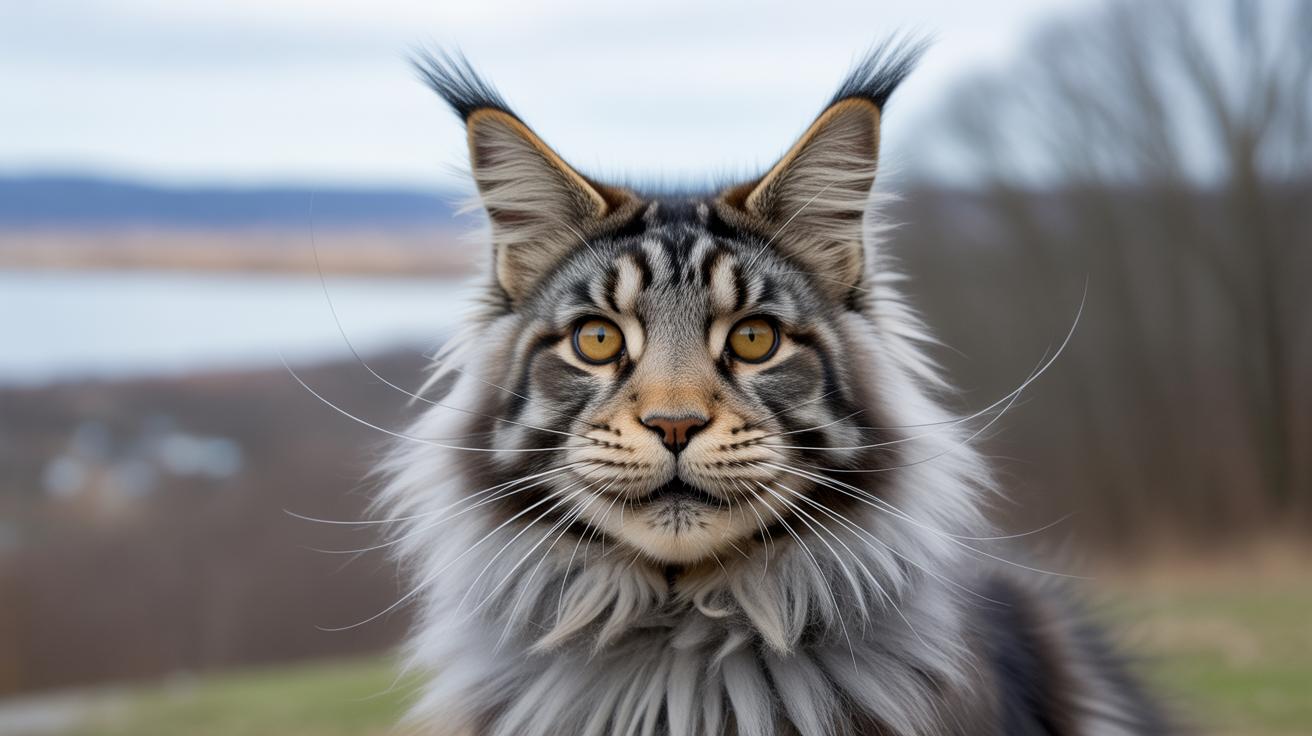
    Meet the Maine Coon. Big, fluffy, and weirdly into water, they feel more like gentle giants than your average tabby. Ever watched a huge cat splash in a puddle? It’s oddly charming.

    Size and growth.
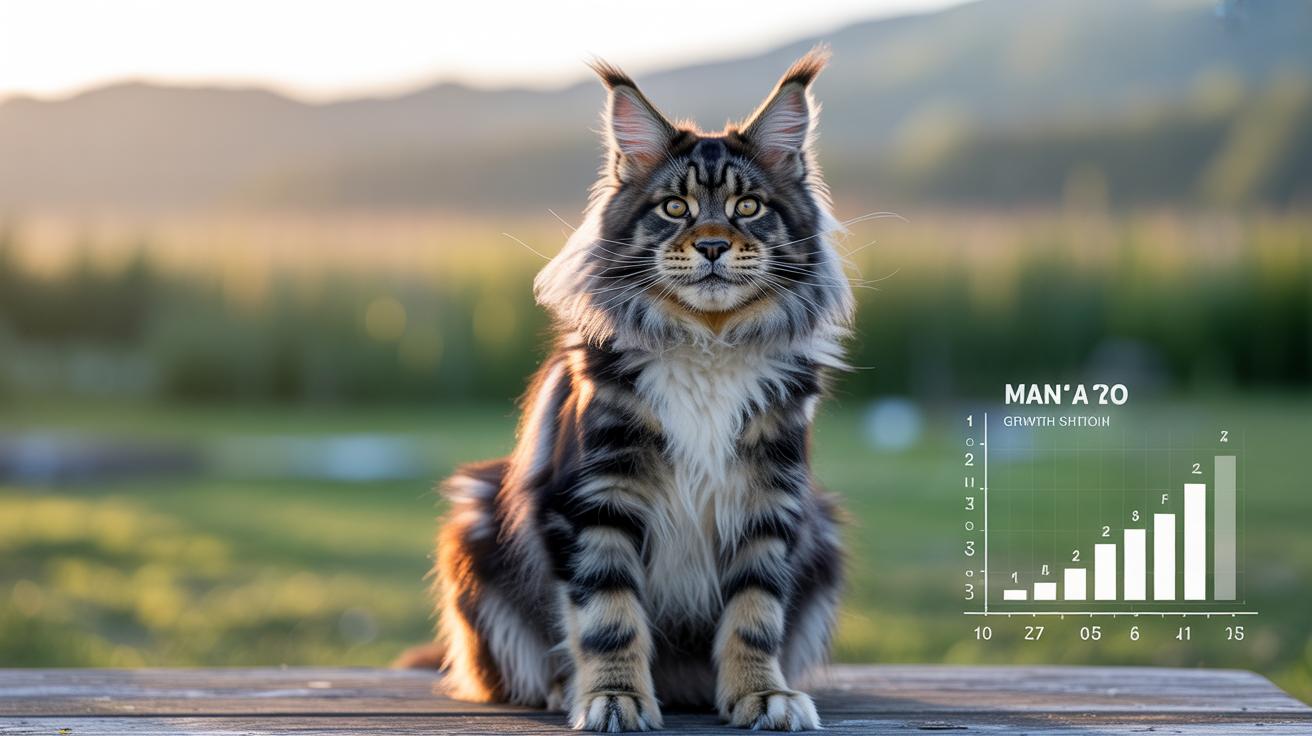
    Maine Coons are one of the largest domestic breeds. Males often weigh 13 to 18 pounds, sometimes more, and females are usually 8 to 12 pounds. They also grow slowly, reaching full size around 3 to 5 years old, so expect kitten energy for a while.

    Coat care made simple.
    They have a shaggy double coat (two layers: a warm undercoat plus a longer topcoat that sheds moisture). Brush them a few times a week to prevent mats and to keep that fur feeling silky. During heavy shed seasons, bump up grooming, check behind the ears and under the belly, and maybe grab a wide-tooth comb. Many Maine Coons like water, so an occasional bath can be okay, and hey, it might turn into playtime.

    Health basics you should know.
    Common issues include HCM (a heart muscle condition), hip dysplasia (hip joint problems), and a genetic spinal condition called SMA (spinal muscular atrophy, which affects some muscles). Ask your vet about screenings: a cardiac ultrasound for the heart, hip X-rays if you see stiffness, and a simple DNA cheek swab for certain genetic tests. Regular wellness checks and watching their weight go a long way toward a long, happy life.

    Personality and play.
    They’re social, playful, and oddly loyal, think couch buddy who fetches a little. They trill and chirp more than they yowl, and they love interactive toys, puzzle feeders, and chasing a wand. For busy days, toss an unbreakable ball before you head out, that’s ten minutes of safe play. Ever watched a Maine Coon leap like a furry rocket? You will, and you’ll laugh.

    Is a Maine Coon right for you?
    If you’ve got space, time for grooming, and a soft spot for big personalities, they’re fantastic. They need vet checkups and a bit more maintenance than some short-haired cats, but the payoff is a friendly, playful giant who becomes family. Worth every paw-print.

    Quick Facts , At-a-Glance Maine Coon Snapshot

    - Quick Facts  At-a-Glance Maine Coon Snapshot.jpg

    Bottom line: Maine Coons are big, friendly cats who often like water. They wear a shaggy double coat (two layers: a warm underlayer and a longer top layer that helps shed moisture) and have a gentle, playful vibe that makes them feel like a "gentle giant." Ever watched one tiptoe through puddles? Cute.

    • Typical lifespan: 9–15 years (veterinary sources, Cat Fanciers' Association and breed studies).
    • Typical adult weight: 9–18 lb (4–8 kg), though big males can push the upper end.
    • Record length (registered): 48.5 in (123 cm), per registry and Guinness World Records.
    • Record weight (largest verified individual): 30 lb (13.6 kg), according to breed records.
    • Longest tail length recorded: 17.58 in (44.66 cm). Imagine that tail swishing.
    • State cat designation: Maine, 1985. A proper hometown honor.
    • Common nickname: "gentle giant" , yep, they earn it.
    • Age to reach full adult size: 3–5 years. They grow slow and steady.
    • CFA recognition year: 1976 (CFA = Cat Fanciers' Association).
    • Polydactylism: Extra toes were common historically in some Maine Coon lines (polydactylism means extra toes).

    See "Size, Growth Timeline & Weight Chart" for growth details; "Health Risks, Screening, Genetic Testing Checklist & Senior Care" for testing details; "Appearance: Identification Traits and Adaptive Functions" for ID traits.

    Worth every paw-print.

    Appearance: Identification Traits and Adaptive Functions

    Maine Coons look big at first glance. They have a long, rectangular body and a broad chest that give them a low, powerful profile, built for balance and movement. They seem sturdy, not gangly, and can slip through snow or scramble up a tree with surprising grace. Ever watched your kitty launch from the couch and land like it was born to climb? That’s very Maine Coon.

    The face is memorable. A square muzzle makes the head look blocky and full of expression. Ears sit high and often have lynx-like tips and inner tufts (hair inside the ear that helps keep out cold and debris). Their eyes come in green, green-gold, yellow, or copper and usually look alert and curious, which fits their chatty, friendly vibe.

    They wear a double coat (two-layer coat: a warm underlayer plus a longer top layer that helps shed moisture), so they stay comfy in wet, chilly weather without getting soaked through. The long, bushy tail is like a built-in scarf, wrap-around warmth and a windbreaker for the rump when the cat curls up. Coat length changes with the seasons, with thicker ruffs and longer belly fur in cold months to trap heat and shed slush. Nice, right?

    Paws are wide and often look like little snowshoes. You’ll see toe tufts (extra hair between the toes that helps grip and insulate) and big, cushioned feet that make walking on soft ground easy. Polydactylism (extra toes) was common in some lines historically and still shows up in certain families. My cat once left perfect round prints in the snow, proof those paws work.

    Notable adaptive features:

    • Ear tufts (lynx tips) – help protect ears and funnel sound.
    • Snow-ready paws – wide, padded feet for traction and warmth.
    • Waterproof outer coat – repels moisture so skin stays drier.
    • Bushy tail – wraps for warmth and helps with balance.

    Common coat colors and patterns:

    • Brown tabby varieties
    • Mackerel tabby
    • Solid colors
    • White
    • Gray/blue shades
    • Rare mixes and combinations

    Top-line numbers like weight, record size, and lifespan are in Quick Facts above. See Grooming for care instructions. Worth every paw-print.

    Size, Growth Timeline & Weight Chart

    - Appearance Identification Traits and Adaptive Functions.jpg

    Maine Coons grow slow and steady. Think of them like a long-term project that pays off with majestic fluff and a big personality. Ever watched their paws get comically huge before the rest of them catches up? Cute and a little like watching time-lapse.

    Males usually end up bigger than females, and many kittens keep filling out well after their first birthday. Early life milestones are simple to spot. 0–3 months is rapid kitten growth with lots of naps and short play bursts. 3–12 months is steady muscle and bone development as coordination sharpens. 1–3 years they keep filling out and getting stronger. By 3–5 years most reach final adult size, though some finish even later. Patience pays off. Worth every paw-print.

    Keep an eye on weight trends and behavior to judge if growth is healthy. If your kitten suddenly loses weight, is very tired (lethargy, very low energy), or refuses food for more than a day or two, call your vet. Small problems can become big ones fast.

    Age Range Expected Weight Range (male) Expected Weight Range (female)
    0–3 months 1.5–4 lb 1.25–3.5 lb
    3–12 months 4–12 lb 3.5–9 lb
    1–3 years 8–16 lb 6–12 lb
    3–5 years (final) 10–22 lb 8–16 lb

    Further reading on growth pacing and weekly kitten metrics is here: when do maine coon cats stop growing.

    Signs of healthy growth and red flags:

    • Steady weight gain following a consistent percentile curve (a growth chart showing how your cat compares to others).
    • Playful energy and normal activity for age; slow or floppy behavior can mean trouble.
    • Good body condition (ribs feel under a light layer of fat, not buried or overly visible); sudden thinness or a bloated belly needs a vet check.

    History, Origin Theories & Timeline

    - Size, Growth Timeline  Weight Chart.jpg

    Most folks think the Maine Coon showed up in New England when long-haired European ship cats (working cats that rode on boats) mixed with local short-haired barn cats. The result was a big, tough cat built for cold, wet winters , thick fur that sheds water and big paws that handle snow. Sailors’ cats probably passed along traits like a water-resistant coat and excellent climbing skills, so these cats could hunt and hang on ships and docks.

    There are some fun origin tales, but a lot of them are just stories. The idea that Maine Coons are part raccoon is impossible biologically , totally different species. The Marie Antoinette shipping story sounds romantic, but the timing and records don’t really back it up. And those tall tales about specific sea captains? Colorful, yes. Proof, not so much.

    A few historical touchpoints help trace the breed’s path. In 1861 there’s the first recorded mention linked to Captain Jenks of the Horse Marines. In 1895 a brown tabby named Cosey won Best Cat at Madison Square Garden, which helped the breed get noticed. Populations dipped by the mid-1900s, and by the 1950s Maine Coons were getting scarce in some areas. Local Maine clubs stepped in around 1973 to revive breeding programs. The Cat Fanciers’ Association gave formal recognition in 1976, and Maine made the breed its official state cat in 1985.

    Polydactylism (extra toes) was common in old Maine Coon lines and added to the breed’s early variety. Fun and odd stories keep popping up , remember the 2004 cloned kitten Little Nicky? That one stirred a lot of debate about cloning pets and made headlines.

    Worth every paw-print.

    Quick recap:

    1. Origin: New England roots with European ship-cat influence.
    2. Myth checks: no raccoon ancestry; Marie Antoinette story unlikely.
    3. Timeline highlights: 1861 mention, 1895 show win, mid-1900s decline, 1973 revival, 1976 CFA recognition, 1985 state cat.

    Temperament, Behavior & Training

    - History, Origin Theories  Timeline.jpg

    Maine Coons are famously friendly and easygoing, social and curious, and they really love people. They often act like a polite, slightly goofy roommate who wants to be where you are. You’ll hear lots of little chirps and trills instead of big yowls, like a running commentary on your day. They’re moderately active: playful and athletic, but happy to nap for long stretches between zoomies.

    They’re smart and very trainable, which is why owners sometimes call them dog-like. Try short, tasty training sessions with praise , think three to five minutes, and repeat. For leash work, follow these simple steps:

    1. Let the cat wear a lightweight harness (a small vest-like strap that fits around the chest) around the house so it gets used to the feel.
    2. Do clicker (small training device) or treat practice while the harness is on, rewarding calm behavior and forward walking.
    3. When your cat is comfy, attach a short leash and practice slow, short outdoor strolls, adding time bit by bit.

    Training should be patient and upbeat. They respond beautifully to positive reinforcement , treats, praise, and a little silliness. For more on friendliness and household fit see are maine coon cats friendly.

    These cats are great with kids and other pets. They’re usually tolerant and playful, and many even enjoy water play more than other breeds. Supervised splash sessions or a shallow water tray can be a blast. They do best with mental and physical outlets so they don’t get bored.

    Try these enrichment ideas to keep your Maine Coon happy:

    • Food puzzles for slow feeding
    • Wand toys for stalking practice
    • Fetch drills with soft toys (yes, many love fetch)
    • Short, frequent harness practice sessions
    • Wide, sturdy climbing shelves and condos for big leaps
    • Supervised shallow water play or sink baths
    • Positive reinforcement with treats, clicker, and praise

    Ever watched your cat’s whiskers twitch as a toy rolls by? It’s magic. For questions about a cat’s socialization history, see Adoption, Cost, Questions to Ask & Ongoing Care.

    Grooming: Tools, Frequency & Practical Care

    - Temperament, Behavior  Training.jpg

    Routine grooming keeps a Maine Coon comfy and cuts down on those hair tumbleweeds around the house. Short, calm sessions build trust, help remove messy mats, and give you a quick health check for skin, lumps, or fleas. Think of it as a quiet check-in that saves you vacuum time later.

    Brush several times a week. During heavy seasonal shedding, brush daily. Keep sessions short and relaxed. Lift the fur as you go to find hidden tangles , belly, behind the legs, and under the collar area are common trouble spots. Ever watched your cat’s whiskers twitch as you roll a comb along their back? It’s oddly satisfying.

    Many Maine Coons will tolerate water, so introduce baths slowly. Use a cat-formulated shampoo (gentle cleanser made for cat skin) and lukewarm water, rinse thoroughly, towel dry, and give treats after , positive reinforcement makes a big difference. If your kitty freaks out, back off and try shorter baths or spot-cleaning instead.

    Trim nails every 2–6 weeks, depending on how much they wear down naturally. Clip just the tip. Brush teeth 2–3 times a week with a pet toothbrush and feline toothpaste (do not use human fluoride toothpaste). If you see tartar, bad breath, or red gums, schedule a professional dental cleaning.

    Call a professional groomer when mats are too tight to remove safely, when your cat strongly dislikes home grooming, or for big seasonal blowouts. Look for a groomer who’s used to large, calm cats. A good pro can trim sanitary areas, thin heavy tangles, and teach you at-home tricks so your sessions stay short and pleasant.

    Worth every paw-print.

    Grooming checklist:

    • Slicker brush (fine bent wires) , removes loose undercoat and gently works out tangles.
    • Wide-tooth comb (spaced teeth) , follow up after the slicker to find and finish smaller knots.
    • De-shedding tool (reaches beneath the top fur) , use sparingly to pull dead undercoat.
    • Nail trimmers (scissor or guillotine-style) , trim every 2–6 weeks, clip only the tip.
    • Toothbrush (pet toothbrush) , brush 2–3x weekly with cat-safe toothpaste.
    • Detangling spray (leave-in conditioner for fur) , spot-use on stubborn knots before combing.
    • Mat-prevention steps , daily short handling, work in small sections, never yank a mat.
    • Carrier prep for vet or groomer trips , leave the carrier out with a towel and a treat so it smells like home.

    Quick tip: for busy days, give a fast brush session before you head out , that little bit of attention buys you calm, clean floors, and a happy cat when you return.

    Health Risks, Screening, Genetic Testing Checklist & Senior Care

    - Grooming Tools, Frequency  Practical Care.jpg

    Maine Coons are big, sturdy cats, but they do have a few breed-linked health issues to watch for. The main ones are hypertrophic cardiomyopathy (HCM – heart-muscle thickening), hip dysplasia (hip joint misalignment), spinal muscular atrophy (SMA – a genetic nerve-muscle condition), and polycystic kidney disease (PKD – cysts on the kidneys). Less dramatic but common problems include obesity, urinary tract trouble, and inflammatory stomach or bowel issues.

    Preventive care is surprisingly simple. Regular vet exams, weight checks, dental cleanings, parasite prevention, and feeding that matches your cat’s activity level go a long way. Brush those teeth, do short play sessions, and watch body condition. Your cat’s whiskers will twitch as the ball rolls across the carpet, and small daily habits add up to fewer vet surprises.

    Senior Maine Coons often need a few comfort upgrades. Soft ramps, low-sided litter boxes, padded beds, and joint-support nutrition like glucosamine (joint-support supplement) can really help. Keep play gentle, watch for stiffness or slower movement, and talk to your vet early about treatments or pain relief so your kitty stays comfortable.

    Common conditions and recommended screening

    • Hypertrophic Cardiomyopathy (HCM) – echocardiogram (heart ultrasound that takes a snapshot of the muscle).
    • Hip Dysplasia – radiographs (X-rays) and a weight-management plan.
    • Spinal Muscular Atrophy (SMA) – DNA test (genetic screen for the SMA mutation).
    • Polycystic Kidney Disease (PKD) – DNA test and/or abdominal ultrasound (scan to check for kidney cysts).
    • Obesity – diet plan, measured portions, and body condition scoring.
    • Urinary issues – urinalysis and a hydration/management plan.
    • Dental disease – oral exams and professional cleanings.

    Genetic testing checklist

    This short checklist is for buyers and breeders to use when planning or before placing kittens. Clear testing lowers the chance of nasty surprises and gives real peace of mind.

    • HCM – echocardiogram (cardiac ultrasound); HCM DNA tests where available.
    • Hip Dysplasia – hip radiographs (X-rays) with OFA or equivalent evaluation.
    • SMA – DNA test for the SMA mutation.
    • PKD – DNA test and/or abdominal ultrasound.
    • Routine cadence – listen to the heart yearly (cardiac auscultation); echocardiogram for breeding cats every 1 to 3 years.

    A responsible breeder should give you test certificates with dates, lab names, and clear health paperwork plus a health guarantee or return policy. Keep those papers with your cat’s records – they’re gold when you need them.

    Feeding, Nutrition & Preventing Obesity

    - Health Risks, Screening, Genetic Testing Checklist  Senior Care.jpg

    Big bodies need the right building blocks. Maine Coons do best on a higher-protein diet (protein = the building blocks that repair and build muscle), with moderate fat (fat = long-lasting energy) and limited simple carbs (simple carbs = quick sugars that add empty calories). Because they grow big and slowly, portion control matters – check the Quick Facts for headline size and growth ranges so you know what to expect.

    Kittens need more frequent, measured meals to build strong bones and muscles without packing on extra fat. Free-feeding dry kibble (leaving crunchy dry food out all day) makes it easy to overdo calories during those slow growth years. Try splitting meals: three to four small feeds for youngsters, two meals a day for most adults, and pick large-breed kitten formulas or high-protein adult recipes. Weigh kittens weekly while they grow, then switch to monthly checks for adults so you can tweak calories if activity or body shape changes.

    Keeping a Maine Coon at a healthy weight saves joints and makes life comfier. Use play and enrichment (toys, short games, food puzzles) to burn calories and keep them sharp. Avoid too many table treats, and learn a simple body condition score (BCS – a quick visual plus feel check) so you know if ribs are lightly covered or buried.

    Worth every paw-print.

    Practical actions:

    • Measure portions with a kitchen scale or scoop and follow calorie guidance.
    • Use food puzzles and slow feeders to stretch mealtimes and make eating fun.
    • Check body condition score (BCS – visual + feel) regularly so you can catch changes early.
    • Choose high-protein formulas suited for active, large-breed cats.
    • Adjust portions for activity level – more play = more calories; couch cat = less.
    • Routine weigh-ins: weekly for growing kittens, monthly for adults.

    Ever watched your kitty chase shadows? That little burst of play helps more than you think. And if you’re unsure about targets, your vet is a great partner to set calorie goals and keep your big buddy feline fine.

    Adoption, Cost, Questions to Ask & Ongoing Care

    - Feeding, Nutrition  Preventing Obesity.jpg

    Picking between a rescue and a breeder comes down to what you want and what you can handle. Rescues usually cost less and sometimes have cats with mixed backgrounds, while responsible breeders will give you lineage, early health checks, and a more predictable temperament , and yes, that paperwork raises the price. If you’re aiming for a show-quality or specially socialized kitten, breeders are the common route. If you want to save a life and give a second chance, rescues often have wonderful Maine Coon mixes and sometimes purebreds too.

    When your new cat arrives, take them to the vet right away for a checkup and any needed vaccines. Microchip (a tiny ID implant placed under the skin) if they don’t already have one, and plan spay or neuter (surgical sterilization) timing with your clinic. Ask the seller or rescue for medical records, vaccination dates, and notes on past vet visits. See "Health Risks, Screening, Genetic Testing Checklist & Senior Care" for the full list of tests to request and what paperwork a responsible breeder should provide , genetic testing means DNA checks for inherited issues, by the way.

    Budget for both one-time buys and monthly costs. Upfront fees can be a bargain at shelters or higher with breeders depending on pedigree (family tree paperwork) and health screening. Expect initial vet bills, microchipping, spay/neuter, a carrier, a cat tree, and starter food. Monthly costs include high-quality food for a large-breed cat, routine vet visits, parasite prevention (flea, tick, and worm medicine), and the occasional professional groom or trim. Big paws often mean a bigger litter box and tougher climbing furniture, so factor those in.

    Help your new cat settle in with a quiet room, a cozy bed, a low-sided litter box, food and water on separate surfaces, and a few items that smell like home. Keep first meetings with other pets short and calm, and make play and handling gentle. Make that first vet visit a friendly check-in so the kitty learns the clinic is okay. Microchip plus a visible ID tag is the best backup if your explorer slips out.

    1. Do you provide health test documentation? (See Health section for which tests matter.)
    2. What vaccinations and deworming has the cat received, with dates?
    3. How has the cat been socialized with kids, dogs, and other cats?
    4. Is the kitten/cat registered with a pedigree or club, and can I see the paperwork?
    5. What contract, health guarantee, or return policy comes with the adoption or purchase?
    6. Are there known issues in the bloodline or common problems in this line?
    7. When should I schedule the first vet visit, and do you recommend a local clinic?
    8. What diet has the cat been eating so far, including brand and feeding schedule?
    9. What supplies do you recommend I buy before bringing the cat home?
    10. Do you offer post-adoption support or help with settling in and behavior?

    Rescue & rehoming tips

    Look for breed-specific rescues or well-run general shelters that ask good questions and do behavior assessments. Expect an application, maybe a home interview or visit, and an adoption fee that helps cover vet care. After you bring your cat home, schedule a full vet exam, update vaccines if needed, confirm or add a microchip, and start a slow introduction plan for people and pets. A little patience up front pays off , your cat will thank you with purrs and playful zooms.

    Common Myths, Fun Facts & Pop Culture

    - Adoption, Cost, Questions to Ask  Ongoing Care.jpg

    Origin myths and tall tales are covered in History. Ever heard the raccoon-cross story or the Marie Antoinette shipping tale? Those make great stories, but they don’t hold up to genetic (DNA) or historical evidence. See History for the full notes if you want the deep dive.

    Quick, shareable fun facts: Maine Coons often chirp and trill instead of yowling, many love water, and sailor lore helps explain polydactyl (extra toes) anecdotes, see Appearance, Temperament, and History for the full stories and sources. Ever watched a Maine Coon paddle at a bowl of water? It’s oddly charming.

    Shareable trivia:

    • See Quick Facts for exact record numbers and source citations.
    • About 75 documented color and pattern combinations (see Appearance).
    • Vocal style: chirps and trills rather than steady yowling (see Temperament).
    • State cat of Maine since 1985 (see History).

    Final Words

    Right in the action: this post packs a Quick Facts box, clear ID traits, a growth timeline, history notes, temperament and training tips, grooming how-tos, a health testing checklist, feeding advice, adoption questions, and a handful of fun myths.

    For busy multi-cat homes, lean on the growth chart, screening checklist, and grooming plan to save time, cut stress, and keep your crew entertained and healthy.

    Try one tip this week. maine coon facts make it easy to spot needs and celebrate those big, chirpy purrs.

    FAQ

    What are some fun facts about Maine Coon cats?

    Fun facts about Maine Coon cats include big size, bushy tails used for warmth, a love of water, friendly ‘chirps,’ state cat status, long growth, polydactyl history, and snow-ready paws that kids adore.

    What makes Maine Coons so special?

    Maine Coons are special because they’re large yet gentle, often dog-like in loyalty and trainability, built for cold with a water-resistant coat, and famous for quirky trills that melt hearts.

    How long does a Maine Coon cat live?

    A Maine Coon cat typically lives about 10 to 15 years, with indoor cats often reaching the upper end when given consistent vet care, good weight control, and a healthy routine.

    Do Maine Coon cats like to be held?

    Maine Coon cats tend to enjoy close contact; many like being held or sitting on laps if socialized early, though some prefer side-by-side companionship rather than full cuddling.

    What should I feed a Maine Coon?

    You should feed a Maine Coon a higher-protein diet formulated for large, active cats, use measured portions during slow growth years, offer food puzzles to prevent overeating, and weigh regularly with your vet.

    What is Maine Coon behavior like?

    Maine Coon behavior is sociable, playful, and intelligent—expect chirps, fetch games, leash-training potential, curiosity about water, and strong compatibility with children, dogs, and busy homes.

    When do Maine Coon cats stop growing?

    Maine Coon cats usually finish growing between three and five years, with males typically larger; monitor steady weight gain and talk to your vet if growth looks too slow or too fast.

    How do Maine Coons compare to Ragdoll, Norwegian Forest Cat, Bengal, and Savannah breeds?

    Maine Coons differ by a rugged, rectangular build and cold-weather coat; Ragdolls are calmer and floppy, Norwegian Forest Cats are similarly cold-adapted, while Bengals and Savannahs are higher-energy and wild-looking.

    Related Articles

  • serval cat facts: Size, Diet, Behavior

    serval cat facts: Size, Diet, Behavior

    What if a cat about as big as a medium dog could launch ten feet straight up and hear a mouse under thick grass? Meet the serval (an African wild cat with long legs and big ears). Ever watched your house cat sprint after a toy and thought, whoa, where did that skill come from? Servals turned those moves into a whole lifestyle.

    They’re built to hunt in tall grass. Long legs give them extra reach and speed, and those huge ears act like sound funnels (they help pinpoint the tiniest rustles). You can almost see the whiskers twitch as they lock on to a hidden prey.

    Let’s break down what makes them so efficient. Size, meaning how long and heavy they get, helps with jump power and stride. Diet includes mostly rodents (mice and similar small mammals), plus birds, frogs and fish. Behavior is the showstopper: high pinpoint pounces (fast, straight-up jumps to catch prey) and soft trills (short chirpy calls) that seem part acrobat, part detective.

    By the end you’ll get why servals move like gymnasts and sound like chatty sleuths. Worth every paw-print.

    Serval Quick Overview

    - Serval Quick Overview.jpg

    Meet the serval. Leptailurus serval is a long-legged African wild cat found across much of sub-Saharan Africa. It’s built for hunting in tall grass, with big ears that seem to listen to every mouse rustle. Ever watched one pounce? It’s a show.

    • Size: head-and-body length 67–100 cm (26–39 in) (measured from the tip of the nose to the base of the tail). Think medium dog body, cat agility.
    • Weight: males 10–18 kg (22–40 lb); females 6–13 kg (13–29 lb). Males are usually noticeably bigger.
    • Primary diet: mostly rodents, plus birds, reptiles, fish, frogs, and insects. They’re rodent specialists but opportunistic feeders.
    • Typical habitat: well-watered savannah (grassland with scattered trees), long grass, reedbeds (thick wetland grasses), and riparian zones (areas next to rivers and streams). In short, places with tall cover and water.
    • Lifespan in captivity: some have lived past 20 years (there are reports of 19+ years elsewhere). They can live a long time with good care.
    • Vertical leap: about 3 m (roughly 9–10 ft) straight up. Whoa. That pounce is why birds never feel safe.
    • Hunting success: roughly 50 percent of hunts succeed. About half the time they bag a meal, which is pretty solid for a wild cat.
    • Vocalizations: a mix of mews, chirps, and trills used for staying in touch and maternal calls. They don’t roar like big cats; they talk more like high-pitched chitchat.
    • Legal and permits: ownership and permit rules vary by jurisdiction. Check your local law before you get excited.

    See sections below for details and sources.

    Serval Appearance, Markings, and Physical Adaptations

    - Serval Appearance, Markings, and Physical Adaptations.jpg

    Those huge, rounded ears sitting wide on a small, delicate head give the serval crazy good directional hearing. They can hear the tiniest rustles in tall grass and zero in on prey. Ever watched a serval cock its head and freeze? That’s hearing doing the work – "Is that a rustle or a mouse?" The skull (head bone structure) and teeth are compact and built for quick, precise bites. Paw pads (thick skin cushions under the paw) are soft and grippy so stalking stays silent.

    The hind legs are much longer than the front legs, so the serval walks with a high-stepping, almost stilted gait and launches huge pounces from those back limbs. Muscles and tendons (stretchy tissue that stores elastic energy) work like a loaded spring, giving sudden, powerful thrusts for ambush attacks. The short tail helps balance during tight turns and mid-air corrections. Think of the serval as a precision jumper and ambush hunter, not a long-chase sprinter. Worth every paw-print.

    Coat colors range from pale yellow to buff, dotted with bold black spots that sometimes merge into stripes along the neck and back. West African speckled variants, called servalines, are reported, and rare melanistic individuals (very dark or black-coated due to extra pigment) show up from time to time. The belly is white, the eyes are amber, and the ringed tail usually has 6 to 7 black bands plus a black tip. See Quick Overview for compact measurements.

    Trait Measurement / Description
    Head & ears Small head with very large rounded ears for acute directional hearing
    Tail length & rings 24–35 cm (9–14 in); typically 6–7 black rings with a black tip

    Serval Hunting Skills, Diet, and Sensory Abilities

    - Serval Hunting Skills, Diet, and Sensory Abilities.jpg

    Servals hunt using a classic listening-hunt posture. They freeze, tilt the head, push whiskers forward, and let their ears twitch until a tiny sound points them to hidden prey. Ever watched one lock onto a mouse under the grass? It’s like watching a furry radar do its thing (see Appearance for the anatomy that makes this possible).

    Diet centers on small mammals, but servals will also take birds, reptiles, fish, amphibians, and large insects depending on where they live. They pick what’s easiest to catch in reedbeds (tall wetland grasses), long grass, or near water. So habitat really shapes the menu.

    For birds they use a vertical leap and a two-paw aerial catch. Picture a straight-up launch, forepaws clapping together to trap the bird midair, quick, precise, and oddly graceful. Like catching a tossed ball with two mitts, only fluffier.

    Ground prey gets a different move: a tucked, springing pounce that ends with a single, decisive bite. You’ll see the body coil, the quiet wait, then that satisfying thud as they land right on target. Really impressive aim.

    Servals will also wade into shallow water for fish or probe muddy edges for frogs, striking with fast, downward swipes. You might catch a splash and a flash of spotted fur as they nab something slippery.

    Their whole hunting style is stealth plus bursts of speed. Vision favors low-light activity, crepuscular (active at dawn and dusk), and hearing does a lot of the locating work in tall grass or under cover. Curious about jump height, speed, or hunting success rates? Check the numbers in the Quick Overview.

    Serval Habitat, Range, and Daily Activity Patterns

    - Serval Habitat, Range, and Daily Activity Patterns.jpg

    Servals live across much of sub-Saharan Africa, with smaller pockets in southwest Africa and a few old records from Morocco and Algeria. They’re common where water and tall cover meet, and sightings thin out near the edges of their range. Think of them as a creature of the wetter, grassy bits of the continent.

    They prefer well-watered savannah (grassland with scattered trees), long grass, reedbeds (thick wetland grasses), and riparian zones (river and stream edges). You’ll also find them in alpine grasslands (high-elevation grassy areas) and woodland edges that border waterways. They avoid dense rainforest and true deserts because there’s no good hiding or hunting there. Picture tall grass brushing against their legs and a soft chorus of mousey noises underfoot.

    Servals are mostly solitary. Their activity peaks at dawn and dusk, with plenty of nighttime hunting too , crepuscular (active at dawn and dusk) and nocturnal (active at night) habits that match their giant ears and pinpoint hearing. Ever watch one freeze, ears swiveling as if tuning a radio? Yeah, that listening style really works.

    Males and females keep largely separate territories (home ranges), only overlapping briefly for mating, and individuals can roam several miles while foraging. When seasons change and water shifts, servals follow the food and move toward wetter ground. See Quick Overview for the compact numeric summaries on size, jump height, and captive lifespan.

    Serval Reproduction, Gestation, and Kitten Development

    - Serval Reproduction, Gestation, and Kitten Development.jpg

    Servals live mostly alone, so moms and dads only meet briefly to mate. These meet-ups are short and quiet. After that, the female raises the kittens on her own, picking a hidden den (a snug, secret nest) and doing the lion's share of parenting. It’s a very private start to life.

    Gestation & Birth

    Gestation (pregnancy length) is about 67 to 77 days, most often around 73 days. Litters can be as small as one kitten or as large as five, but two is the usual number, so moms often handle either a solo baby or a tiny sibling crew. Newborns are fragile and tiny, weighing roughly 240 to 255 g (about 8.5 to 9 oz). For the first few days the mother keeps them hidden, popping in to nurse and then moving them if the den feels unsafe. It’s all careful, low-key parenting.

    Kitten Growth & Maturity

    Eyes usually open at 9 to 12 days, and the little furballs start exploring more as their senses sharpen. Around three weeks they begin tasting solid food while still nursing, which kick-starts the hunting lessons they’ll need later. By 6 to 8 months many kittens are roaming farther from the natal den and can fend for themselves on short trips. Sexual maturity comes at about 18 to 24 months; at that point youngsters, especially males, are often pushed out of mom’s territory and start carving out their own ranges.

    Worth every paw-print.

    Serval Conservation Status, Threats, and Captive Population Notes

    - Serval Conservation Status, Threats, and Captive Population Notes.jpg

    Servals face both natural dangers and human threats. Leopards and free-roaming domestic dogs can kill them or steal their food. People also target servals for pelts, sell hides for ceremonies or tourist curios, and in some places hunt them for meat. Losing tall grass and wetland pockets to farms, new settlements, and deliberate grassland burning fragments their habitat and leaves small, isolated groups that struggle to survive.

    Legally, Leptailurus serval (the serval's scientific name) is listed on CITES Appendix II (the international agreement that regulates trade to prevent overuse). For captive-population figures, the Felid TAG/studbook is the go-to source; Felid TAG is the taxon advisory group and a studbook is the official registry of animals in managed care. It reports 292 servals in zoos worldwide, with 130 in the United States, so treat those numbers as the canonical totals when you need a reliable captive count.

    Zoos help a lot with public education and zoogeographic study, but ex situ management has limits. Most captive servals are of unknown origin, and many are not suitable for managed breeding, which makes genetic planning tricky. The first serval studbook was published in 2003. The Population Management Plan (PMP, a coordinated plan for breeding and genetic goals) sets a target of 80 individuals, a modest number that reflects realistic aims for managed collections.

    Strong, coordinated husbandry and careful record-keeping matter. Support for protecting habitat on the ground matters too. Worth every paw-print.

    - Serval in Captivity Care Needs, Risks, and Legal Considerations.jpg

    Keeping a serval is a serious, long-term choice. They can live many years in care, so you’re signing up for space, specialist medical help, and daily activities that let their hunting instincts run. If you love a sleek, high-energy cat, great, just know it’s a big responsibility.

    Enclosure & Diet Requirements

    A serval needs a large, secure outdoor enclosure with buried fencing to stop digging and a strong top barrier to stop jumps and climbs. Add a buried apron (an underground mesh or concrete extension that keeps them from tunneling out) and a tall top fence – those are non-negotiable for safety. Warm climates suit them best, and a shallow pool gives them a place to drink, paddle, and fish like they would in the wild. Think tall grasses to hide in, ledges for perching, and open vertical space for those amazing leaps.

    Food should be high-protein and prey-focused. Offer whole prey (whole frozen-thawed mice, chicks, or similar) or muscle-and-organ mixes so meals feel like real hunting rewards. Pelleted diets (processed kibble-style pellets) are only a supplemental option. Watch for choking hazards and foreign-body ingestion, servals will chew and swallow small parts. For safe play attachments and enrichment choices, see Feather vs toy attachments on teaser wands. Need play ideas that match a high-drive small felid? Try Teaser wand games for senior cats.

    Behavior, Bonding, and Household Safety

    Servals are naturally solitary and often form a close bond with one main caregiver, not with a crowd. Many don’t enjoy heavy stroking and can be unpredictable around children or small pets, their hunting drive stays sharp. Supervision and strict separation from household pets is the safest plan. Keep loose parts, small toys, and anything chewable off the menu; foreign-body risks can mean emergency surgery, which nobody wants.

    Laws on serval ownership vary by state and country; permits are common and rules change, so check local regulations before you consider one. See the Conservation section for consolidated captive-population figures (Felid TAG).

    Veterinary care should come from an exotic-pet–experienced clinician (a vet comfortable treating non-domestic species). Annual vaccinations and routine de-worming are standard. Declawing is controversial and discouraged by many vets because it causes pain and can make injuries worse during conflicts. Consider safer alternatives like supervised handling, training, and soft nail caps when appropriate.

    Worth every paw-print.

    Serval vs Domestic Cat and Hybrids: Key Comparisons

    - Serval vs Domestic Cat and Hybrids Key Comparisons.jpg

    Serval vs. Domestic Cat – Quick Take

    A serval (a wild African cat about the size of a medium dog) is much larger, can leap crazy high, and keeps a fierce hunting drive day after day. They are not lap pets. You’ll need secure space, tight supervision, and a plan that respects their wild instincts. Ever watched a serval launch after a toy? It’s like watching a tiny, spotted athlete.

    For size context and a quick look at behavior, check the Appearance table below and the Hunting notes that follow. Think of a serval as a wild athlete with independent habits; that really matters if you have small pets or kids around or limited space.

    "A serval will launch like a spring, not curl up on your lap."

    Type Approx. Weight Typical Leap Temperament
    Serval (wild) 20–40 lb (9–18 kg) Can clear several feet straight up Independent, high prey drive, needs large secure space
    Domestic Cat 6–15 lb (3–7 kg) Great jumper, but not serval-level Affectionate to variable, fits indoor homes well
    Savannah Hybrid (varies) 10–30+ lb (4.5–14+ kg) Very high in early generations Energetic, curious, often retains strong hunting traits

    Hunting, Energy, and Daily Care

    Servals hunt obsessively. They listen, stalk, pounce, and repeat, often for hours if allowed. That’s thrilling to watch, but it means you’ll need to offer hunting-style play, secure feeding routines, and enrichment that tires them out safely. For busy owners, toss an unbreakable ball or use food puzzles, ten minutes of focused play can help.

    Domestic cats vary a lot: some will nap and nudge your hand, others turn into shadow-chasers at dusk. It’s easier to meet their needs in a small home than a serval’s. So, if you want cuddles and low-maintenance vibes, a house cat usually wins.

    Hybrids (Savannah cats)

    Savannah cats are hybrids (a cross between a serval and a domestic cat). Early-generation hybrids like F1 and F2 mean first and second generation offspring from a serval parent. Those early generations often keep a lot of serval traits: extreme leaping, huge energy, and a strong prey drive. In plain terms, an F1 is closer to a serval in behavior and needs than an F4 or later.

    Because they can act more like semi-wild animals, many places limit or regulate F1–F2 ownership. That’s not just bureaucracy, those animals need large, secure enclosures, daily hunting-style play, and owners who know how to handle fast, independent cats. An F1 Savannah can clear a sofa in a single bound, thrilling, but not great for a small apartment.

    Practical Takeaways

    If you want a dramatic, high-energy companion and can meet safety, space, and legal needs, a serval or early-generation Savannah might fit, if you’re experienced and prepared. If you want a friendly, lower-energy pet who loves laps and a predictable routine, pick a domestic cat or a later-generation hybrid.

    Worth every paw-print.

    Serval FAQ & Myth vs Fact

    - Serval FAQ  Myth vs Fact.jpg

    Quick, friendly FAQ and a little myth-busting for anyone curious about servals. They’re gorgeous to watch, but they’re not just big house cats.

    FAQ: three essential Q&As:

    • Q: Can you keep a serval as a pet?
      A: Usually no. Ownership often requires permits (official government permission) and is illegal in many places. Check the Legal and Captivity sections for local rules and what permits you might need.

    • Q: Are servals suitable as house pets?
      A: No. They stay wild and need lots of space. Think large, secure outdoor enclosure (high fencing and escape-proof design) and caretakers who know exotic-cat care.

    • Q: Do servals threaten small pets or children?
      A: Yes. Their prey drive (the instinct to chase and kill prey) can put small animals at real risk, and interactions with kids are risky. See the Behavior section for more on safety.

    Myth vs Fact: two key corrections:

    • Myth: Servals can be tamed like house cats.
      Fact: They’re wild animals with strong hunting instincts and often unpredictable behavior. They need specialist care, experienced handlers, and proper enclosures (species-appropriate, secure spaces).

    • Myth: All zoo servals are from managed breeding programs.
      Fact: Some are in coordinated breeding programs (zoo or conservation breeding), but many captive animals have unknown origins and breeding status varies. See the Conservation section for context.

    See the Conservation and Appearance table for captive counts and measurements.

    Sources, Measurement Notes, and Citation Guidance (for editors/writers)

    - Sources, Measurement Notes, and Citation Guidance (for editorswriters).jpg

    Use metric units as the primary format and put imperial equivalents in parentheses for clarity (example: 67–100 cm (26–39 in)). Keep unit punctuation and spacing consistent across the article so readers and editors won’t get confused about conversions or ranges. Think of it like lining up numbers on a ruler, clean and easy to follow.

    Treat the Felid TAG (Feline Taxon Advisory Group) studbook (official registry of captive animals) as the canonical source for captive-population figures, and cite it when you use consolidated numbers. For example: 292 servals in zoos worldwide and 130 in the United States (Felid TAG/studbook). For any captive-population discussion, reference that studbook as the authoritative registry.

    Prefer peer-reviewed papers (articles checked by experts), major field guides (regional ID and natural-history books), and official zoo studbooks or management plans for range, hunting, and life-history stats. When you use site-specific data, name the study and year so editors can trace the original report. Got it? Good.

    Checklist for editors:

    • Do not duplicate numeric tables outside the Appearance or Conservation sections.
    • Use internal cross-links instead of repeating statistics, for example "See Quick Overview" or "See Hunting section".
    • Always show metric first, with imperial in parentheses, and keep spacing and punctuation consistent.
    • Cite the Felid TAG/studbook (official registry) for consolidated captive-population numbers.
    • Prefer peer-reviewed papers, major field guides, and official management plans for key stats.
    • When using site- or study-specific numbers, include the study name and year so the source is easy to trace.
    • If you pull numbers from another source, give the citation and a link when available.

    Clean, clear, and editor-tested. Worth every paw-print.

    Final Words

    A serval springs into the air, and suddenly the measurements and behaviors we covered click into place.

    We ran fast through the Quick Overview, then the Appearance table, Hunting, Habitat, Reproduction, Conservation, Captivity care, comparisons with house cats, the FAQ, and the sources, each part gives a clear, scannable answer for reports or study.

    Keep the husbandry (care practices) and legal notes in mind if you’re thinking about keeping or writing about servals.

    Keep these serval cat facts handy, there’s real joy in knowing how this high-jumping wildcat lives. Worth every paw-print.

    FAQ

    Serval Cat FAQ

    Serval cat facts for kids / What are some fun facts about servals?

    The serval (Leptailurus serval) is a long-legged African wild cat with very large ears and superb hearing. It can leap about 3 m (10 ft) straight up, mainly eats rodents and small animals, and captive individuals have been reported to live past 20 years.

    Can a serval cat kill a human / Are serval cats dangerous?

    Servals are wild carnivores and can be dangerous. They are strong and unpredictable and can seriously injure a person in rare cases, so they pose higher risk to small children and to untrained handlers.

    Serval cat price / Can you keep a serval as a pet?

    Prices vary widely and often run into thousands of dollars. Keeping a serval requires permits in many places, large secure enclosures, exotic-veterinary care and ongoing costs; laws and requirements vary by location.

    Serval habitat?

    Servals live in well-watered savannahs, tall grass, reedbeds and riparian (river) zones across sub-Saharan Africa. They tend to avoid dense rainforest and true deserts and favor areas with water and tall cover.

    How high can servals jump?

    Servals can jump roughly 3 meters (about 10 feet) straight up, using their long hind legs for precise, high leaps to snare birds or pounce on hidden rodents.

    Serval lifespan?

    In captivity servals can exceed 20 years of age; wild lifespans are typically shorter because of predators, disease and human-related impacts.

    What does a serval cat eat?

    Servals eat mostly rodents, plus birds, reptiles, fish, frogs and insects. They locate prey by keen hearing and use stealth followed by sudden bursts of speed or vertical leaps.

    Do serval cats have slit eyes?

    Servals have amber eyes whose pupils change with light. In bright conditions the pupils can appear narrow, similar to many other cat species.

    Related Articles

  • Sand Cat Facts: Appearance, Adaptations, Conservation

    Sand Cat Facts: Appearance, Adaptations, Conservation

    What if the desert's toughest hunter could curl in your palm and erase its footprints like a cat with a magic paw? Ever picture that? Meet the sand cat, a tiny wildcat that seems built for disappearing.

    It's compact, with sand-swirled fur that blends into dunes and big ears like radar dishes that pick up the faintest squeaks. Its paw pads (the furry soles of its feet) act like tiny snowshoes, thick fur on the soles keeps hot sand off and helps mask prints. You can almost feel the soft whisper of sand as it pads by.

    We'll look at how it looks, the clever tricks it uses to live in scorching, silent places, and the conservation picture, what helps it survive and what still threatens it. Ever watch your house cat chase a shadow? Imagine that, but under a blazing sun and under starry nights. By the end, you’ll know how this little cat thrives where few felines can. Worth every paw-print.

    At-a-glance species summary

    - At-a-glance species summary.jpg

    Felis margarita, the sand cat, is a small, specialized desert wildcat. Think compact, stealthy, and built for sand , a quick guide that links to fuller sections below.

    • Felis margarita – named for Gen. Jean Auguste Margueritte; first described in 1858.
    • Range: Sahara, Arabian Peninsula, Southwest and Central Asia – see the mapped below image for details.
    • Small desert wild cat with a compact build; weight about 4–8 lb (1.8–3.6 kg) – Read more: Appearance.
    • IUCN: Least Concern (2016) – IUCN means International Union for Conservation of Nature (the group that tracks species risk) – see conservation.
    • Signature adaptation: thick fur on the paw soles protects from hot sand and helps hide footprints – Read more: Adaptations.
    • Diet: opportunistic carnivore (eats whatever small prey is available) – mainly rodents, birds, reptiles, and insects – details.
    • Behavior: mostly nocturnal and shelters in burrows (underground dens) during the day – Read more: Behavior.
    • Desert specialist: the only wild feline that lives exclusively in desert environments – more on range and habitat in range notes.
    • Quick facts here link back to the detailed sections and their citations so we don’t repeat source lists.

    Alt-text suggestions:
    (1) Range map infographic – "Map showing Felis margarita distribution across the Sahara, Arabian Peninsula, and Central Asia."
    (2) Size-comparison image – "Sand cat (4–8 lb) next to a domestic cat silhouette to show smaller, compact build."

    Sand cat appearance, size, and key measurements

    - Sand cat appearance, size, and key measurements.jpg

    Sand cats are small, compact desert wildcats built low to the ground. See the table below for the authoritative measurements you'll use in reports or ID guides.

    Metric Value
    Adult body length 39–52 cm (15–20 in)
    Tail length 23–31 cm (9.1–12.2 in)
    Adult weight 4–8 lb (1.8–3.6 kg)
    Shoulder height 10–12 in
    Winter coat hair length (max) ~2 in (Central Asia populations)

    Coat color runs from sandy to light gray, with a pale underbelly. The fur is thick and protective, buffering hot daytime sand and cold nights; in winter the hairs can reach about two inches, forming insulating hair (longer strands that trap air and warmth) in colder parts of their range. It looks and feels like a built-in sweater for desert life.

    Faces are kitten-like: broad heads, big green-yellow eyes, a reddish streak from the eye across the cheek, and a small black nose. Tails usually have two or three dark rings and finish with a black tip, which is a handy visual cue when a cat flicks its tail under moonlight. Ever watched those whiskers twitch as it stalks a beetle? Cute.

    Feet are furry underneath, which helps them walk on loose sand (the fur pads act a bit like tiny snowshoes) and also hides tracks. Claws are partly non-retractable (claws that don't fully tuck into the paw pad), so they can look a bit blunt compared with fully retractable claws. Quick ID tips: paw fur far denser than domestic cats or other small wildcats, ears are fluffy and set low, and this is the only felid found exclusively in desert habitats, claw-tastic adaptation, right?

    Editorial note: Use the numeric values in the table above as the single authoritative source for these metrics; other sections should link here instead of repeating full numbers.

    Sand cat adaptations for desert life

    - Sand cat adaptations for desert life.jpg

    Sand cats come with their own built-in climate control: dense fur that slows heat flow (thermal buffering – slowing how fast heat moves through the coat) during hot days and traps warmth on cold nights. The hair is longer and air-trapping in chillier regions, so a sand cat from Central Asia often looks fluffier than one from the Sahara. Field notes and camera-trap photos (motion-triggered cameras) show this seasonal shift, which helps them stay active when nights turn icy and avoid the harshest daylight heat. Ever watched your kitty squint in the sun? Same idea, just more dramatic out in the dunes.

    Their feet and movement are full of clever desert tricks. Thick, wiry hair on the soles spreads their weight, so they don’t sink into loose sand and their pads don’t roast on hot surfaces. That same fur also muffles prints, so sometimes you’ll see faint or no obvious tracks. Their claws are partly non-retractable (claws that don’t fully tuck away), which gives better grip for digging but also means the tips get blunter than in cats with fully retractable claws. Sand cats are expert diggers and will use or extend rodent tunnels into burrows (burrows – underground shelters). Researchers have recorded burrow systems up to 15 ft in length, and these tunnels become staging grounds for short, explosive chases followed by a quick dig-and-hide finish. Cute, efficient, and a little sneaky.

    Water is handled like a pro. Sand cats get most of their moisture from prey and can go weeks without standing water, so diet-based water balance is essential. They mostly hunt at night to dodge daytime heat, and their hearing is insanely sharp – ears pick up the faintest rustles of rodents underground. Camera-trap and telemetry studies (tracking collars or tags that log movement) back up these behavior patterns and show regional differences in how they use burrows and when they’re active. So timing matters as much as body design.

    Foot and paw adaptations

    Thick foot fur reduces sinking, insulates against both hot and cold sand, and hides footprints – so trackers should set camera traps at burrow entrances or along runways and not count on clear paw prints when surveying.

    Note: this section is the go-to source for burrow measurements and related field observations; please link here rather than repeating the 15 ft burrow number elsewhere. Oops, let me rephrase that for clarity, use this part as the authoritative burrow reference.

    Sand cat behavior, hunting methods, and diet

    - Sand cat behavior, hunting methods, and diet.jpg

    Sand cats mostly hunt at night and spend the day tucked into burrows (animal-made tunnels) or old rodent runs. They sit low at den entrances, ears alert, with soft paws that barely leave a trace in the sand. Quiet and solitary, they can be right next to you and still go unseen. Ever watched a house cat crouch and not move? It’s the same kind of focus.

    At night their hearing turns up like a dial. Researchers pick this up with telemetry (tracking collars or tags that log movement) and camera-trap studies (motion-triggered cameras) showing sudden bursts of activity around rodent runs and burrows. They’ll pause, listen, then pounce. The sound of sand shifting as they launch is all the hint you get.

    If prey is under the sand, sand cats dig fast. They’ll widen abandoned tunnels to reach a hiding rodent or to flush it out. Chases are short and explosive, not long sprints, which suits loose, shifting sand and open desert ground.

    Their diet is flexible and opportunistic. Small rodents are the staple, but they’ll also take birds, reptiles, hares, and arthropods (insects and similar critters) when available. For snakes, field observers report a quick head blow to stun and a precise neck bite to finish things off. It’s efficient and, um, pretty claw-tastic hunting.

    Sand cats sometimes stash extra food by covering carcasses with sand, and they’ll reuse or expand gerbil burrows for shelter or ambush sites. Worth noting: study methods have limits. Because they’re nocturnal and often squint or close their eyes at lights, camera surveys and spotlighting tend to undercount them, so long-term telemetry and camera arrays (many cameras set up for long periods) give a truer picture of what these shy hunters do.

    Sand cat reproduction and kitten development (numbers and timeline)

    - Sand cat reproduction and kitten development (numbers and timeline).jpg

    Sand cat breeding timing changes by region. In the Sahara most births happen January-April, Turkmenistan records start in April, and Pakistan shows a peak in September-October. Females can have two litters in good years, so the schedule tracks local climate and prey pulses (short-term boosts in available food). Ever watch a sand cat tuck her kittens into a sandy burrow? It’s quietly impressive.

    Gestation is about 59-63 days (pregnancy length). Wild litters are usually 2-4 kittens; captive moms often have 2-3. Newborns weigh roughly 42-57 g (about 1.5-2 oz) and typically gain around 12 g per day. Eyes open at about day 14, they’re walking by day 21, and they start eating solid food around five weeks.

    Metric Value
    Breeding season (regional examples) Sahara: Jan-Apr; Turkmenistan: from Apr; Pakistan: Sep-Oct
    Gestation length 59-63 days (pregnancy length)
    Litter size 2-4 kittens (captive often 2-3)
    Birth weight about 42-57 g (1.5-2 oz)
    Daily growth rate ~+12 g/day
    Key milestones Eyes open by day 14; walking by day 21; solid food ≈5 weeks
    Independence age 3-4 months
    Age at sexual maturity 10-12 months (age when capable of breeding)

    Captive records give a useful baseline. Juvenile mortality in managed collections is about 41% (percent dying before adulthood), and some sand cats have lived to roughly 13 years under care. Wild survival is more hit-or-miss, influenced by drought, prey availability, and local threats, so mortality in free-ranging populations is often higher and varies by region. Zoos and breeding programs use captive numbers to plan, but, um, they don’t always predict what happens in the wild.

    Worth every paw-print.

    Sand cat distribution, subspecies, and preferred habitats

    - Sand cat distribution, subspecies, and preferred habitats.jpg

    Sand cats live in a wide belt of desert from the Sahara in North Africa, across the Arabian Peninsula, into Turkestan (Central Asia), and east as far as Pakistan. See the At-a-glance range/map for the distribution map and placement of the graphic. Ever picture a little cat living where you would not want to camp? Yep, that is them.

    They prefer sandy and stony deserts with sparse shrubs and tussocks (clumps of grass). Those plant patches help hold small dunes in place and gather rodents (gerbils, mice, and the like), so they become prime hunting spots and cozy microhabitats. Sand cats often shelter in abandoned gerbil and ground-squirrel burrows (underground dens), making use of ready-made hideouts. See Adaptations for burrow measurements and field data.

    Taxonomy

    • F. m. margarita , Sahara (North Africa)
    • F. m. thinobia , Turkestan (Central Asia)
    • F. m. scheffeli , Pakistan
    • F. m. harrisoni , Arabian Peninsula and Jordan

    Place the range-map caption and alt text with the At-a-glance map (suggested caption: "Felis margarita distribution across the Sahara, Arabian Peninsula, and Central Asia." Suggested alt text: "Map showing sand cat range from North Africa through Arabia to Turkestan and Pakistan.").

    Sand cat conservation status, threats, and protective listings

    - Sand cat conservation status, threats, and protective listings.jpg

    The sand cat (Felis margarita) has had a curious slide on risk lists. The IUCN (International Union for Conservation of Nature) moved it from Near Threatened in 2002 to Least Concern in 2016, and that stayed the same in 2020. That sounds reassuring, but it masks patchy data and real local declines, so it’s a cautious kind of good news.

    CITES (Convention on International Trade in Endangered Species) regulates trade for most sand cat populations under Appendix II (meaning trade is allowed but controlled). One subspecies, F. m. scheffeli, sits on Appendix I (the strictest trade restrictions). These listings help, but they don’t solve threats on the ground.

    The main threats are sadly simple and familiar in dry lands. Habitat loss and fragmentation from people settling and grazing livestock breaks up the places sand cats need. Droughts cut the small mammal prey base, making food scarce. Local killing or trapping and disease spillover from feral or free-roaming dogs and cats (pathogens that jump between species) add extra pressure. Desertification and falling prey numbers make all of this worse, so even a wide-ranging species can disappear from local spots.

    Conservation mixes careful captive care and patient field science. Managed breeding programs (SSP-style cooperative programs, SSP meaning Species Survival Plan) aim to keep genetic diversity for future reintroductions or research, though captive numbers are small: compiled figures show about 116 sand cats in human care worldwide, with roughly 36 in the United States (those are captive-holding numbers, not wild population estimates). Field researchers rely on camera traps, telemetry (radio or GPS tracking), and long-term surveys to find these nocturnal, secretive cats. Ever seen a sand cat on a camera trap? It’s like catching a desert ghost on film.

    Want to help? Little things add up. Try these:

    • Support habitat protection groups working in Saharan and Central Asian deserts.
    • Back programs that reduce disease risk from feral cats and dogs, like vaccination and neuter campaigns.
    • Donate to coordinated captive-breeding and field research efforts that fund surveys and genetic management.
    • Discourage trade in wild-caught desert cats and support enforcement of CITES rules.
    • Sponsor camera-trap arrays or targeted surveys, or help fund community projects that reduce livestock pressure on fragile habitats.

    Editorial note for writers and editors: favor citations to the IUCN Red List entry, the CITES appendices, and representative peer-reviewed field studies or authoritative zoo/SSP reports. Don’t duplicate a fast-facts source list here; link conservation claims to detailed-section citations instead.

    Sand cat in captivity, research methods, and how scientists study them

    - Sand cat in captivity, research methods, and how scientists study them.jpg

    Drop this page as a standalone and fold its practical bits into the relevant topic pages. Keeping method notes scattered makes the guide hard to use. Instead, move unique, actionable items into existing sections so readers find what they need fast.

    Behavior (and Foot and Paw Adaptations)

    • Move practical photography and monitoring tips here: camera placement, spotlight bias, telemetry notes, and noninvasive sample collection at burrows.
    • Practical tip to paste into Behavior: Place cameras at burrow entrances or runways. Set the camera low at the burrow mouth and wait; one morning I got a close-up of whiskers and a sand-fluffed paw.
    • Add short notes on spotlight bias (how bright lights change activity), and simple telemetry reminders for collars and receivers.

    Conservation

    • Expand the captive-programs paragraph and insert this exact sentence: Captive husbandry priorities include a minimum 30-day quarantine, enrichment that encourages digging and hunting, and pairing strategies that reduce relatedness and pathogen spillover.
    • Add a brief note on studbook use and genetic goals, and remind readers how captive programs connect to wild population recovery.

    Reproduction

    • Keep the existing link that points captive numbers and juvenile mortality back to the Sand cat reproduction and kitten development section. Do not repeat numeric figures here. Instead, say where readers should look for those numbers.

    Behavior and Distribution / Conservation (research-methods consolidation)

    • Move monitoring methods and spotlight-bias discussion into Behavior.
    • Move gaps like population estimates, genetic sampling, and disease surveillance into Distribution and Conservation.
    • If you must keep an independent methods subsection, replace duplicate text with new, specific protocols and add citations.

    Suggested protocols to include in a retained methods subsection (add citations when publishing)

    Sample collection and storage protocols (brief)

    • Scat: collect fresh scat into sterile tubes with 95% ethanol (high-purity alcohol used to preserve DNA) or dry in silica (desiccant packets used to keep samples stable in the field) for easier transport; keep cool and transfer to -20 C or -80 C for long-term storage.
    • Tissue / biopsy: place in cryovials (small, super-cold storage tubes) and freeze in liquid nitrogen (very cold, -196 C) or at -80 C.
    • Blood: collect into EDTA tubes (anticoagulant tubes for DNA) and keep chilled; freeze for long-term storage.
    • Swabs (oral / rectal): place in RNAlater (solution that preserves RNA) when you plan pathogen screening.
    • Example line to paste into a methods subsection: For genetic samples, place fresh scat into 95% ethanol and freeze at -20 C as soon as feasible; label clearly with GPS and date.

    Camera array spacing and mounting (brief)

    • Spacing: 500 m to 1 km between stations depending on how open the habitat is and the likely density of sand cats.
    • Height and angle: mount about 20 cm off the ground (rough sand-cat eye level) and angle slightly downward; use paired cameras at burrow entrances when possible.
    • Example camera note: Mount cameras about 20 cm high and angle slightly downward; you’ll catch the low, stalking silhouette.

    Quarantine and health screening (brief)

    • Quarantine: minimum 30 days with repeated health checks and pathogen testing before group introductions.
    • Pairing: use pedigree and studbook data to minimize mean kinship when selecting mates; monitor closely for stress and illness after pairing.
    • Example line for husbandry notes: Quarantine newcomers for at least 30 days and run repeated health checks before any introductions.

    Genetic-management targets (brief)

    • Track mean kinship and aim to maintain effective population size targets used in conservation genetics. Document specific targets and cite sources.
    • Example governance note: Use studbook data to prioritize pairings that lower mean kinship and keep genetic diversity.

    Disease surveillance priorities (brief)

    • Regular screening for common feline pathogens, necropsy protocols for any mortalities, and coordinated surveillance of free-roaming dogs and cats near wild populations.
    • Example surveillance line: Routine pathogen screens and necropsies help spot problems early and protect both captive and wild populations.

    Final editorial reminder

    • Any numeric statements about captive numbers, juvenile mortality, lifespan, or similar must link back to the Sand cat reproduction and kitten development (numbers and timeline) and Sand cat conservation status, threats, and protective listings sections.

    Fun sand cat facts, myths, and FAQs for students

    - Fun sand cat facts, myths, and FAQs for students.jpg

    Quick teasers to guide readers to the full sections: sand cats look kitten-like but are wild – see Appearance. Their desert tricks, like thick paw fur (insulating hair under the paw pads), hunting at night (nocturnal, active at night), and living in burrows (underground dens), are in Adaptations and Behavior. Diet basics live in Diet, and reproduction notes are in Reproduction.

    Writing example: Start with a surprising fact – "Sand cats look like house kittens, but they survive on tiny desert prey (small animals they eat) and live mostly in burrows (underground dens)." Ever watched a kitten-size wild cat pounce in slow-motion? Cute, but fierce.

    Cultural note moved and flagged: the Lake Chad cultural anecdote has been relocated to the Distribution/Conservation section under a new paragraph titled "Cultural perceptions and local protections" and is flagged for sourcing. Do not publish that sentence without a verifiable citation – it needs a reliable source before it goes live.

    FAQs (one-line answers linking to full sections)

    • Can sand cats be pets? , No. See Sand cat in captivity for legal and husbandry notes.
    • What do sand cats eat? , Small mammals, birds, reptiles, and insects; see Diet for details.
    • Where can I see one? , Remote desert reserves, camera-trap studies, or a few zoos; see Distribution and Sand cat in captivity.
    • Do they need drinking water? , They get most moisture from prey (the animals they eat); see Adaptations for water-use notes.
    • How do they avoid daytime heat? , Mostly active at night and sheltering in burrows (underground dens); see Behavior.
    • How are they different from house cats? , They look kitten-like but have desert-specific traits; see Appearance and Adaptations.

    Editorial note: link any numeric measures used in image captions or sidebars back to the Appearance or Reproduction sections for sourcing.

    Final Words

    Here’s the heart: the fast-facts box, clear appearance and size metrics, desert-ready adaptations, hunting habits, reproduction timeline, range and conservation, captivity notes, and kid-friendly FAQs.

    Use it for a quick lookup or a deeper read when you have more time. Easy to scan. Quick to share. Ever seen a sand cat pounce? Cute mental image.

    Keep these sand cat facts handy for classroom snippets, field notes, or just pure cat-nerd joy. Worth every curious whisker.

    FAQ

    Sand cat FAQ

    What are some fun facts about sand cats?

    Fun facts about sand cats: they’re a tiny desert wildcat (Felis margarita), paw soles are thickly furred, they kill venomous snakes, they’re nocturnal (active at night), and enjoy burrow naps.

    Sand cat size

    Sand cat size: adults are compact small desert cats with body about 15–20 inches, tail 9–12 inches, shoulder height 10–12 inches, and weight roughly 4–8 pounds.

    Are sand cats dangerous?

    Sand cats are not generally dangerous to people; they’re shy, avoid humans, and hunt small prey, though they can handle venomous snakes when hunting and rarely attack people.

    Are sand cats endangered and how many are left?

    Sand cats are listed as Least Concern by IUCN (International Union for Conservation of Nature), but exact wild numbers are unknown and vary regionally, so population estimates remain uncertain.

    What do sand cats eat?

    Sand cats eat mainly rodents, small birds, reptiles, and arthropods; they use acute hearing to detect subterranean (underground) prey and often dig to extract burrowing animals.

    Sand cat predators

    Sand cat predators include red foxes, large raptors, and feral dogs; young kittens face extra risk from snakes and small mammalian predators in desert habitats.

    Do sand cats bark like dogs?

    Sand cats can make short barking or chirping sounds for alarm or communication, but their vocalizations are brief and catlike, not a steady dog-style bark.

    How fast can a sand cat run?

    Sand cats run in short, high-acceleration bursts when chasing prey; they rely on quick sprints and surprise rather than long-distance speed or endurance.

    Related Articles

  • Why Do Cats Bite Their Claws: Causes

    Why Do Cats Bite Their Claws: Causes

    Ever watched your cat nibble a claw and wondered if it’s hygiene or a cry for help? Most of the time it’s just grooming. Your kitty makes soft little nibbles, whiskers twitching as she chews and peels away the old outer sheath (the thin, dead layer that comes off) so the sharp inner claw can do its job. Claws are made of keratin (the same protein as your fingernails), so think of it like a kitty filing session with tiny teeth and a post. Claw-tastic.

    But pay attention. If the chewing is constant, aimed at one toe, or comes with bleeding, swelling, limping, or dullness and tiredness, it could be an infection, a broken or ingrown claw, or pain. Snap a quick photo and check with your vet, better safe than sorry, uh, right? Worth every paw-print.

    Biological grooming: routine claw-biting explained

    - Biological grooming routine claw-biting explained (fulfills search intent).jpg

    Most claw-biting is just normal grooming. But if your cat chews claws every day or obsessively, if you see blood or swelling, or if your cat is limping or unusually tired, call your vet.

    Cat claws are mostly keratin (the same tough protein as human fingernails). They wear an outer sheath that sheds in layers. When a kitty bites, scratches, or licks a claw, it’s usually pulling away that old sheath so the sharp inner claw can work. Think of it like a cat filing its nails with its teeth and a scratching post. About 90% of nail care is self-managed when cats have good scratching options, though older or less-mobile cats and some kittens may chew more as part of normal grooming.

    When it’s normal

    • removing the outer sheath
    • cleaning out dirt or trapped litter
    • chewing off a small broken tip
    • brief grooming comfort or nervous licking during a grooming session
    • extra attention to paws in older cats who can’t scratch as much

    A worrying change usually shows up in frequency or focus. If your cat keeps chewing the same toe all day, chews every day, or the paw looks red and sore, that’s different from casual grooming. If you see persistent bleeding, swelling, or limping, see Medical causes for red flags so a vet can take a look.

    Watch for patterns over a few days. Note which paw, how long the chewing lasts, and any limping or behavior changes, video or a quick photo can help. Those details help answer why your cat is biting its claws and point to causes like a broken nail, infection, a foreign object, or stress. If the habit is repetitive or looks painful, get your vet involved so they can check for infection or other problems.

    Medical causes that make cats bite their claws

    - Medical causes that make cats bite their claws.jpg

    Sometimes claw chewing is more than grooming. Lots of medical issues make cats gnaw at their toes and nails. Think injuries like a split or broken nail, a cut, or a small foreign object stuck under a claw. Bacterial or fungal nail-bed infections are common too; fungal means a fungus like ringworm that lives on skin and nails.

    Parasites are a big one. Fleas and mites make paws itch so badly your cat will chew and bite. Allergic pododermatitis (paw inflammation from allergens) can do the same. There are also immune diseases like pemphigus foliaceus (an autoimmune skin disease where the body attacks the skin), and neoplasia (abnormal tissue growth), including lung-digit syndrome, which is when cancer spreads to the toes.

    Watch for clear signs of trouble: swelling, redness, sticky or bloody discharge, or a cracked-looking claw. If your cat pulls the paw back, limps, or cries when you touch a toe, that usually means pain. Left alone, a deep infection can move into bone and cause osteomyelitis (a bone infection), which is much harder to treat.

    Parasites and systemic problems can look similar. Ringworm (a fungal infection) can affect nails and skin and can pass to people and other pets. If you worry about shared beds or a dog bringing bugs in, read about do cat fleas live on dogs to see why parasite control matters and how transmission can happen.

    When to see the vet

    • daily or obsessive chewing that does not stop
    • the same paw targeted again and again
    • visible swelling of the paw or toe
    • sticky, bloody, or foul-smelling discharge
    • limping or obvious pain when walking
    • a broken or missing claw you can see
    • fever, extreme tiredness, or not eating

    How vets check it out
    Vets use cytology (a quick cell exam) and cultures to find bacteria. Fungal tests include PCR (a DNA test) or DTM (a fungal culture medium). They may take skin scrapings or swabs for parasites. X-rays help if a fracture or deep object is suspected. Cultures usually come back in 48 to 72 hours. X-rays are immediate. Fungal workups can take several days to weeks, depending on the test.

    If your cat is chewing a paw, don’t guess. Get it checked. It could be something simple, or it could need real treatment, and early care usually means a faster, happier recovery.

    Why Do Cats Bite Their Claws: Causes

    - Behavioral reasons triggers, quick in-home responses, and referral cues.jpg

    Stress and change are big triggers. Moves, new people or pets, guests, or swapped furniture can make a cat over-groom (that means extra licking or chewing). Boredom or not enough play also pushes some cats to chew like they are self-soothing. Ever watched your kitty chase shadows and then nibble a paw? That nervous, repetitive chewing is often the same thing.

    Tension between housemate cats shows up the same way. Some breeds are just more anxious by nature, so if your cat is a nervous type, keep a closer eye on them. Behavioral chewing usually looks repetitive and tidy. Medical chewing often comes with limping (favoring a leg), swelling (puffiness), pus (infected fluid), or obvious pain, so if you see those signs or bloody spots, check the Medical causes right away.

    Try a few quick fixes at home first. Short interactive play sessions, 5 to 10 minutes, two or three times a day, help burn off the hunting drive and cut boredom; the satisfying thud of a chasing toy can work wonders. Reduce sudden stress where you can: keep routines steady, give a quiet room during upheaval, or separate tense cat pairs for a bit. Rotate toys and introduce new items under supervision for a week so things feel fresh; novelty helps a lot.

    Handle paws calmly when you check them, and never punish the cat for chewing, punishment just makes anxiety-related biting worse. If chewing keeps up despite these steps, or your cat chews every day and damages skin or fur, get a behaviorist consult or see a veterinary behaviorist (a vet who specializes in pet behavior). For ongoing enrichment plans and long-term routines, see Long-term prevention.

    Worth every paw-print.

    Inspect and document + first aid

    - Inspect and document + first aid.jpg

    Start by watching from a short distance so you don’t stress the cat more. Take photos from several angles with your phone (the camera’s date/time info is usually enough). Note which paw, how long the chewing lasts, and how often it happens , short video clips are great. Write down any other signs you see, like limping, appetite changes, or hiding, and the time you first noticed the problem. If you see persistent bleeding, swelling, or limping, check the Medical causes for red flags.

    If the cat pulls away, growls, or seems in sharp pain, stop the exam right away and call your vet. Heavy bleeding or dramatic swelling needs a clinic visit. Don’t poke at deep wounds or try to dig out things stuck under the nail yourself (that can make pain, infection, or bleeding worse). If your cat becomes aggressive, give it space and phone the clinic.

    For small, superficial issues you can try a calm first-aid routine. Move the cat to a quiet room or carrier (cat carrier – hard-sided travel box) and speak softly to lower stress. If a toe is bleeding, press gently with clean gauze or a cloth (clean cloth) for several minutes until it slows. Rinse dirt or litter away with lukewarm saline (saltwater solution) , pour or dab gently. Don’t scrub. Take photos after cleaning so the vet can see the before-and-after.

    If bleeding won’t stop, you suspect a foreign object (like a splinter or grass awn), or the wound looks deep, get to the vet promptly.

    When you call the clinic, have your notes ready: date of onset, how the problem has changed, which paw is affected, any past paw issues, and any home treatments you tried. Attach the photos or videos to your message if you can. That little timeline helps the vet triage faster and plan next steps.

    Worth every paw-print.

    Veterinary treatments and diagnostics for persistent claw-biting

    - Veterinary treatments and diagnostics for persistent claw-biting.jpg

    If you’re trying to decide when to see a vet for claw biting, start here: the exam usually begins with a quick history and a hands-on look at the paw and leg. Vets will ask how long your cat has been chewing, whether the same toe gets targeted, and if there were any recent injuries. Your cat might be nervous, so keep a calm voice and maybe a treat nearby. Ever watched your kitty nibble at a sore spot until the fur is gone? Yeah, not fun.

    Common diagnostic tests look for infection, fungus, mites, or something stuck in the paw. Cytology (a quick cell exam under a microscope) and bacterial culture (growing bacteria to find the right drug) are typical. Fungal tests include PCR (a DNA test) or DTM (a fungal culture medium). Skin scrapings check for mites (tiny parasites found under the microscope), and X-rays (radiographs) are used if a fracture or a deep foreign object is suspected.

    Treatment follows the cause. If bacteria are found, oral antibiotics are used (the exact drug depends on culture results). Typical courses run about 2 to 6 weeks, depending on how your cat responds. Topical antimicrobial washes help clean surface infections and usually get used for days to weeks. Antifungal drugs for ringworm or fungal nail disease take longer, often many weeks to months, until the fungus is truly cleared.

    Pain matters. Analgesics and anti-inflammatory meds (pain relievers and swelling reducers) can make your cat stop chewing while the area heals. If a claw or toe is badly damaged or keeps trapping bacteria, surgical nail or toe procedures (removing the nail or fixing the toe) might be recommended, followed by routine post-op care.

    Some cases need extra help from specialists. If infections keep coming back despite treatment, if tests suggest an autoimmune problem, or if your cat is self-injuring without a clear medical cause, a referral to a veterinary dermatologist, surgeon, or behaviorist can speed recovery and keep your cat comfortable. Teamwork is great. Really.

    Treatment When used Typical duration
    Oral antibiotics Confirmed bacterial infection (based on culture or exam) 2 to 6 weeks
    Topical antimicrobial washes Surface bacterial or mixed infections Days to weeks
    Antifungal therapy Ringworm or fungal nail disease (PCR or DTM positive) Several weeks to months
    Analgesics / anti-inflammatories Pain control with swelling or limping Short-term; as needed
    Surgical nail/toe procedures Irreparable damage or chronic nidus of infection One-time procedure plus post-op care

    Expect culture results in about 48 to 72 hours. Plan a recheck at 7 to 14 days so the vet can see healing and adjust medications. Fungal testing and full eradication usually take longer, so follow-ups may continue for weeks or months. Worth every paw-print.

    Long-term prevention: routines, enrichment, and monitoring

    - Long-term prevention routines, enrichment, and monitoring.jpg

    Start with a simple daily routine to stop your cat from chewing its claws. Check paws often for debris or rough edges so you catch problems early. Offer a few scratching spots in areas your cat walks through, and fit short interactive play bursts into each day, about 5 to 10 minutes, two to three times. Keep parasite prevention and regular vet checks up to date so hidden itch or infection doesn’t flare up; do this and you’ll cut the chances your cat uses teeth for paw care and stop the habit before it sticks.

    Rotate toys each week so enrichment feels new and fun. Try puzzle feeders for foraging play, mix cardboard and sisal scratchers at different heights (sisal is a rough plant fiber that holds up to scratching), and add more vertical options like cat trees or wall shelves. Toss in hiding boxes and cozy nooks to ease stress-driven chewing. You can try a pheromone diffuser (a plug-in device that mimics calming cat face pheromones) for 2 to 4 weeks while you watch chewing patterns. For ideas on play schedules and toy choices, check safe play behaviors for indoor cats. Feather wands, battery mice, and food puzzles work best when you swap them out often, keeps kitties curious and claw-tastic.

    When you’re monitoring, look for a pattern over days and weeks, not just a one-off nibble. If there’s an infection, treatment often helps in days to weeks. Behavior changes usually take longer, weeks to months, so be patient. For immediate triggers, see Behavioral reasons; for warning signs, see Medical causes. If chewing comes back or keeps targeting the same paw, get a vet check so the issue doesn’t return. Worth every paw-print.

    Final Words

    You saw which claw-biting is simple grooming and which signs require a vet check. Most nibbling removes the outer sheath; daily, bloody, swollen, or limping behavior is a red flag.

    We covered claw biology, medical causes like infections and parasites, behavioral triggers and quick at-home fixes, how to inspect and document, basic first aid, and likely veterinary tests and treatments.

    If you're still asking why do cats bite their claws, watch the pattern, photograph any lesions, add short interactive play bursts, and call your vet if worrying signs persist.

    Worth every paw-print.

    FAQ

    Cat claw and paw FAQ

    Why do cats try to pull their claws out and is it normal for cats to pull their claws out or bite their nails?

    Cats pull or bite their claws to shed the outer sheath (normal grooming) and to trim broken bits. This is normal unless it becomes daily, bloody, swollen, or causes limping or lethargy.

    Why do cats bite their paws when cleaning and why is my cat biting its claw?

    Cats bite their paws to clean dirt, remove litter, or chew a broken claw. Painful, bloody, or persistent chewing suggests injury or infection and needs a vet check.

    Can nail biting indicate stress in cats and is cat nail bite dangerous?

    Nail biting can signal stress, boredom, or social tension. Chronic, obsessive chewing can cause skin damage or infections, so behavior changes or a veterinary evaluation may be needed.

    Why do cats bite their tails or bite their fur?

    Cats bite tails or fur during grooming or playful mouthing, and also because of fleas, skin allergies, or stress. Look for hair loss, redness, or nonstop biting to decide if medical care is needed.

    What should I do if my cat is biting and pulling nails or if it causes bleeding?

    If your cat is biting and pulling nails, calmly check for swelling or bleeding, photograph the area, rinse gently with saline, apply pressure to stop bleeding, and contact your vet if signs persist.

    When should I see the vet for claw biting?

    See a vet if chewing is daily and obsessive, the same paw is targeted, there’s swelling, bloody or smelly discharge, limping, a broken claw, fever, or a major behavior change.

    Related Articles

  • why do cats knead: Instincts, Scent, Comfort

    why do cats knead: Instincts, Scent, Comfort

    Ever watch your cat press its paws into your lap like a tiny baker working dough? The slow, rhythmic pushes feel warm and oddly soothing. It’s not just a cute quirk. It’s an old nursing reflex from kitten days, plus paw-gland scent-marking (tiny scent glands between the pads that leave a private "this is mine" scent), a satisfying stretch, and a cozy self-soothe that also fluffs up a comfy spot like nest-building.

    So here’s what I’ll do: I’ll walk you through the instincts, the scent habit, and the comfort side so you can tell when a knead means love, when it might hint at discomfort, and easy fixes to keep your skin scratch-free. Try a soft blanket or folded towel for their kneading spot, your arms will thank you. Worth every paw-print.

    why do cats knead: Instincts, Scent, Comfort

    Cats knead for a few simple reasons: an old nursing reflex, scent-marking from paw glands (small scent glands between the pads), comfort and self-soothing, stretching, softening a spot like they would a nest, and showing affection. It’s that mix that makes them push their paws in and out, often with a contented purr and tiny claws at work.

    Most kneading is perfectly normal and usually means your cat is happy or settling into a habit. Pay attention if the kneading suddenly gets much stronger, more frequent, or changes in style, since that could be a sign something’s off and worth checking with your vet.

    • Kitten nursing / milk stimulation (a reflex that helped kittens get milk): Kittens knead to help trigger milk flow, and adult cats sometimes keep the motion because it feels comforting.
    • Comfort / self-soothing: Kneading can calm a cat, like a soft rhythmic massage. Ever watched their whiskers twitch while they do it? Cute.
    • Scent marking via paw glands (tiny glands that leave your cat’s smell): When they press their paws, they’re saying “this is mine” in cat language.
    • Stretching muscles: It’s a good full-body stretch, from toes to shoulders, and often feels satisfying to them.
    • Nest-preparation / softening a surface: Think of it like fluffing a pillow before a nap. It’s practical and cozy.
    • Bonding / affection: Kneading you or a blanket often comes with purring and face rubs. It’s a compliment, your lap is basically a five-star bed.

    A quick note on people-kneading: If your cat uses claws, keep them trimmed or offer a soft blanket to protect skin. If they knead aggressively and seem stressed, try gentle redirection with play or a comfy toy.

    Worth every paw-print.

    Read below for development, anatomy, people‑kneading, and when to call a vet.

    Kittens and kneading: timelines, atypical outcomes, and stimulation alternatives

    - Kittens and kneading timelines, atypical outcomes, and stimulation alternatives.jpg

    Kneading (that cute, rhythmic pawing kittens do) usually shows up really early. Many kittens start during nursing, slow down as they wean (switch from milk to solid food), and then either keep the habit or let it fade as they grow. Ever watched tiny toes flexing while your kitten purrs? It’s soothing for them, and kind of adorable for us.

    Typical kneading timeline

    1. 0–4 weeks: lots of nursing kneading , it helps stimulate milk flow and feels comforting.
    2. 4–8 weeks: weaning transition (weaning = switching from milk to solid food); kneading often drops as feedings change.
    3. 2–12 months: habit consolidation; some juveniles keep kneading into adulthood, others slow down or stop.

    Some kittens don’t follow that neat path. Orphaned or early-weaned kittens tend to knead longer and might also suckle, cry for contact, or cling to soft fabrics. That extra intensity can look like constant pawing at blankets, frantic searching for anything nipple-like, or refusing to settle without a soft item. Cute, yes, but it can also mean they need more comfort.

    For orphaned or early-weaned kittens, try simple substitutes and routines. Offer a warm plush blanket or faux fur (soft fabric that holds heat), provide a nursing-style stuffed toy for gentle suckling, and hold short, frequent handling or play sessions to build secure attachment. Keep feedings predictable on a schedule, and reward the kitten when it uses the designated blanket instead of your clothing. Little steps like this help them feel safe, and save your shirts, too.

    For play-based socialization ideas that build trust and confidence, see Tips for socializing kittens through play.

    Worth every paw-print.

    Scent marking and anatomy: glands, paw-pad mechanics, and the motion of kneading

    - Scent marking and anatomy glands, paw-pad mechanics, and the motion of kneading.jpg

    Cats have tiny scent glands tucked between their toe pads and along the paw pads. Those interdigital glands (small scent-producing pores) release pheromones (simple chemicals animals use to communicate). You probably can't smell it, but your cat sure can; that faint scent quietly says, "This spot is mine and it’s comfy."

    Kneading uses a neat stack of muscles and joints. The forelimbs and the shoulder area do most of the work, while the toe flexor muscles pull and release the pads in a steady rhythm. Think of it like a gentle stretch for the front half of the body, soft presses, short releases, that helps loosen the shoulders and chest and just feels good.

    Paw pads are full of sensitive touch receptors, so every press gives instant feedback. That feeling is rewarding, and it keeps the knead going. Cats will sometimes extend their claws for a deeper grip or keep them tucked for lighter, fluffy presses, depending on their mood. If a cat has joint stiffness or arthritis (joint inflammation that makes movement painful), you’ll often see shallower pushes, a slower tempo, or a preference for softer surfaces.

    What scent-marking accomplishes

    Scent-marking through kneading tells the cat and other cats that a place is familiar and safe. That tiny chemical note lowers stress, so your cat settles faster and relaxes more easily. Nice, huh?

    Paw motion and mechanics

    The basic move is a steady press and release that gives both a little stretch and a lot of sensory feedback. Common kneading patterns you might notice:

    • Alternating presses with just the front paws
    • Front paws pushing while the hind legs give a V-shaped support
    • A soft, all-four-limb rhythmic push
    • Suckling on fabric while applying light paw pressure (a carryover from nursing)

    Ever watched your kitty knead a blanket and purr like it’s the best day ever? It’s equal parts muscle work, memory, and comfort.

    When cats knead people: meaning, body language cues, and protecting skin/clothes

    - When cats knead people meaning, body language cues, and protecting skinclothes.jpg

    Kneading is a big compliment from your cat. It’s that soft, rhythmic push of paws, like tiny dough-kneading hands, that says they feel safe and cozy. Ever watched your kitty purr and press their paws into your lap? Pure heart-melty stuff.

    What kneading means and the cues to watch for

    • If your cat is relaxed, eyes half-closed, purring, and pressing gently, they’re showing contentment and trust.
    • If the kneads are tense, claws extended, ears back, or their tail flicks, they might be overstimulated or anxious, time to give them a break.
    • Kittens knead from nursing instinct; adult cats keep the habit because it feels good and marks you with their scent.

    Quick, easy tricks to protect yourself and your clothes

    • Use a dedicated fleece or flannel blanket on your lap during cuddle time. Fleece (soft synthetic fabric) and flannel (brushed cotton that’s cozy) soak up kneads and save your shirt.
    • Keep a folded towel handy as a fast barrier if a heavy session starts on your stomach. A simple cotton towel works and slips over in two seconds.
    • Place a plush pad nearby to redirect insistent kneading. Plush pad (soft cushion) becomes their VIP knead spot when you nudge them over.
    • Try positive redirection (rewarding the behavior you want, like treats or petting, instead of scolding) , when they hop to the blanket or pad, give a treat and a happy scratch.
    • Trim nails every 2-4 weeks to reduce snagging and accidental scratches. Use cat nail trimmers (scissor-style clippers made for cats) and only clip the sharp tip.

    A tiny real-life note: I once watched Luna knead right through my sweater, oops, so now I keep a fluff blanket ready. Works like a charm.

    If kneading gets too rough, don’t yank your hand away fast. Gently slide your hand out, put the blanket under them, and offer a toy or a treat. Calm moves, calm cat.

    And one rule that’s non-negotiable.
    Never declaw. Declawing (surgically removing the claw and part of the toe) causes long-term pain and behavior changes. It’s not an option.

    Worth every paw-print.

    When kneading may indicate a problem: detailed red flags and next steps

    - When kneading may indicate a problem detailed red flags and next steps.jpg

    Kneading usually feels cozy , little paw presses like a soft massage. But if the pattern changes suddenly, it can mean trouble. Watch for a jump in how often or how hard your cat kneads, any limping or odd walking, swollen or bloody paws, or sudden biting and aggression during a session. If kneading takes over so much that your cat skips sleeping, grooming, or eating, that repetitive behavior may be stress-driven or, rarely, compulsive.

    Older cats often knead less when they have arthritis (joint inflammation that makes movement painful). And sometimes a sudden increase in kneading is your cat trying to soothe themselves during a stressful time. Ever notice your kitty kneading more after a move or a new animal in the house? That’s a clue.

    Start with calm, simple steps at home. Note when and where the kneading happens and look at the paws for cuts, thorns, or swelling. Remove obvious stressors like loud noises or a new pet, and offer soft, nearby alternatives to kneading , a plush blanket or a soft bed. Keep play regular to burn off anxious energy, and trim nails on a schedule so paws don’t get snagged.

    If you think stress is the cause, pheromone options (chemical signals cats use to feel calm), such as Using feline pheromone sprays near litter boxes, may help as part of a broader plan. For pain or repetitive patterns that don’t ease, call your veterinarian instead of trying strong fixes on your own.

    When to contact a veterinarian

    If you see any of these signs, call your vet for advice or to book an appointment:

    1. Sudden increase in kneading frequency or intensity
    2. Signs of pain or limping
    3. Sudden aggression or biting during kneading
    4. Swelling, discharge, or visible paw injury
    5. Appetite loss or litter-box changes
    6. Obsessive or repetitive kneading that interferes with rest or grooming

    At the visit, the vet will likely do an orthopedic check (looks at joints and how your cat moves), inspect skin and paws, and run a neurological screen (checks nerves and reflexes). They’ll also take a behavioral history from you , when it started, what else was going on, that sort of thing. If needed, the vet may recommend X-rays or other imaging to check for arthritis (joint damage), injury, or foreign bodies. From there they might suggest pain relief or anti-inflammatory meds (to reduce swelling and pain), targeted behavior plans, or changes to your cat’s environment to make life easier and more calming.

    Practical solutions: redirecting kneading, protecting furniture, and knead-friendly home setup

    - Practical solutions redirecting kneading, protecting furniture, and knead-friendly home setup.jpg

    Quick note: the step-by-step kneading training (put a lap blanket down when you sit; reward them for using it) and timing tips for kittens were moved into the “When cats knead people” and “Kittens and kneading” sections. This section just keeps the unique, hands-on fixes.

    Quick actions (converted from the original table)

    • Lap blanket – set one on your lap when you sit, then praise or give a tiny treat when your cat uses it. Protects your legs and keeps purrs focused.
    • Designated knead blanket – keep a special blanket by their bed or favorite couch spot. When they knead it, say good kitty or offer a treat so they learn that spot is for kneading.

    Practical tips

    • Short-term deterrents: try aluminum foil (thin metal sheet that crinkles) laid where they usually knead. Cats dislike the crinkly sound and odd texture. Or use a short-term sticky mat (tacky surface that feels weird to paws) until the new blanket becomes their go-to. These are temporary fixes, not forever solutions.
    • Recommended fabrics: fleece (soft synthetic fabric), flannel (brushed cotton that feels cozy), and tightly woven cotton (durable, less likely to snag). These fabrics give the right give for kneading and are comfy for naps too. Ever watched a cat tuck in and knead until they sigh? Yep, these fabrics help that happy sigh happen on purpose.
    • Washing and care: wash knead blankets every 1 to 2 weeks depending on hair and smell. Machine wash warm on a gentle cycle. Tumble low or air dry so the fabric stays soft and doesn’t shrink.

    A tiny aside: if your cat prefers the couch arm or a pillow, try tucking a small corner of the designated blanket there for a few days. Redirect, reward, repeat. It works more often than you'd think.

    Note: nail-trim timing and the declaw warning are kept in the single safety section elsewhere in this article to avoid repeating them here. Worth every paw-print.

    why do cats knead: Instincts, Scent, Comfort

    - FAQs and quick owner reference about why do cats knead.jpg

    Q: Is kneading normal?
    A: Yes. Most cats knead. It started when they were kittens as a nursing reflex (the pressing motion kittens use to help get milk). It also feels comforting, like a soft rhythm under your hand, and it helps them mark a spot with paw glands (tiny scent glands in the paw pads). Ever watched your cat press and purr? That’s classic contentment.

    Example: "Yes. My cat kneads when she’s relaxed and purring , see intro for the why."

    Q: When is kneading excessive?
    A: Watch for sudden big changes. If your cat jumps from gentle presses to frantic, fast kneading, or if kneading breaks up eating, sleeping, or grooming, that’s a worry. If you see frantic motions, any self-injury, or new signs like appetite loss or litter-box changes, check with your vet. These are red flags.
    Example: "If kneading gets frantic and my cat stops eating, that’s a red flag , check the vet section."

    Q: How should I document changes for a vet?
    A: Record clear, dated notes so your vet can spot patterns. Short videos with timestamps (time markers on a video) are really helpful. Here’s a useful checklist to keep:

    • Date and time of each episode
    • Location (lap, bed, carpet)
    • Duration of each session
    • Intensity (gentle vs hard; claws out or tucked?)
    • Any claws or biting observed
    • Other signs (limping, appetite change, litter-box change)
    • Short video clip with timestamps

    Example: "2025-05-02 8:15 PM – living room – 3 minutes – hard kneading, claws extended; video saved."

    Final Words

    We jumped straight into why kneading happens, kitten nursing instinct, scent-marking from paw glands, comfort, stretching, and bonding, and then covered timelines, paw anatomy, kneading on people, red flags, and practical fixes.

    Try a lap blanket, a designated knead blanket, and regular nail trims to protect skin and furniture. Redirecting to a soft pad works better than scolding.

    If you see sudden changes or signs of pain, contact your vet. Knowing why do cats knead helps you keep them purring and playful, purr-fect, right?

    FAQ

    TL;DR

    Cats knead from a mix of kitten nursing instinct, scent-marking from paw glands, comfort/self‑soothing, stretching, and bonding.
    Most kneading is normal, though sudden shifts in pattern, intensity, or signs of pain or distress may need attention.

    • Kitten nursing/milk stimulation
    • Comfort/self-soothing
    • Scent marking via paw glands
    • Stretching muscles
    • Nest‑preparation/softening surface
    • Bonding/affection

    Read below for development, anatomy, people‑kneading, and when to call a vet.

    Why do cats knead on blankets, laps, or my stomach?

    Cats knead on blankets, laps, or your stomach as a leftover nursing instinct and comfort behavior, plus scent-marking from paw glands (tiny glands between toes) and to make a cozy spot.

    Why do cats knead their owners at night or in the morning?

    Cats knead owners at night or morning to seek warmth, settle in, and bond; it acts as a routine rooted in kitten nursing and simple comfort-seeking, often paired with purring or snuggling.

    What does it mean when a cat kneads on you — are they kneading their favorite person?

    When a cat kneads on you, it signals trust and affection; kneading often targets a favorite person since it links to nursing, scent-marking, and comfort, which strengthens your bond.

    Are cats happy when they knead?

    Cats are often happy when they knead; kneading commonly signals contentment and lowered stress, shown by purring, relaxed posture, and slow blinking during the motion.

    Why do cats knead and suckle, and why do they sometimes purr while doing it?

    Cats knead and suckle as a carryover from nursing, seeking tactile comfort; purring often accompanies this as a self-soothing or bonding signal that reinforces calm and closeness.

    Why do so many people post about cats kneading on Reddit?

    People post kneading videos on Reddit since the behavior is common, cute, and varied; sharing helps owners compare patterns, seek advice, and celebrate each cat’s quirky, comforting habits.

    Related Articles

  • why do cats purr: Science and Meaning

    why do cats purr: Science and Meaning

    What if your cat’s soothing rumble was part tiny engine and part secret medicine? Ever felt that low buzz under your palm and wondered what’s going on? It’s oddly comforting, and kinda magical.

    Purring comes from tiny, fast twitches of the laryngeal muscles (muscles around the voice box that help move air and sound). Those twitches are paced by a neural oscillator (a small brain circuit that keeps a steady beat, like a metronome). The muscles and the little brain timer work together to make that steady vibration you can hear and sometimes feel.

    That steady purr does a bunch of jobs. It’s a soft “I’m happy” that helps bonding. It can be a sharper “feed me” or “pet me” plea. And it’s also a self-soothing hum that might help tissues heal through low-frequency vibrations (slow, deep vibrations you can feel). Ever watched your kitty close their eyes and go full content-mode? That’s the purr at work.

    In this post I’ll walk you through the science and the everyday meaning of that feel-good rumble, so you’ll know why your cat purrs, and why it makes both of you feel a little better.

    why do cats purr: Science and Meaning

    - Quick answer What causes purring and the top reasons cats do it.jpg

    If you’re asking why do cats purr, the basic cause is rapid, repetitive contractions of the laryngeal muscles (the muscles around the voice box) driven by a neural oscillator (a tiny brain circuit that fires in a steady rhythm). That makes the vocal cords open and close fast, producing the familiar steady rumble , like a little engine under fur. It’s mostly automatic, so cats don’t have to think about it.

    That steady purr isn’t just background noise. Cats use it to talk to other cats and to people, to ask for things, and to calm themselves when they’re stressed or hurt. Ever watched your cat purr while kneading your sweater? It’s both social and soothing.
    • Signal contentment and social bonding
      Cats often purr when they’re relaxed and close to others, kind of like a soft “I’m happy” or “I’m comfy.”
    • Solicit attention or food (request help)
      Some purrs include a higher, more urgent tone that says “feed me” or “pet me now” , clever, huh?
    • Self-soothe and possibly support healing through low-frequency vibration (slow vibrations that may help tissues heal)
      Those low vibrations can calm a cat and might even promote recovery after injury.

    So next time your cat purrs, you’re hearing something that’s part chat, part request, and part built-in therapy. Worth every paw-print.

    Cats purr to communicate: kittens, mothers, solicitation, and affiliative cues

    - Cats purr to communicate kittens, mothers, solicitation, and affiliative cues.jpg

    Kittens can start purring just a few days after birth. That tiny rumble comes from their little bellies and tells mom they feel safe or that they want to nurse. It’s a soft signal that soothes her and helps keep the bond strong in those wobbly first weeks. For play-based ways to build on that connection as kittens grow, check tips for socializing kittens through play.
    Adults keep purring as a kind of conversation with other cats and with us. You’ll see a classic “feed me” combo: a low purr, a quick meow, and a rub against your ankles. That’s solicitation (asking for something, usually food or attention). If the purr-and-rub stops the moment you put down the bowl, congrats , you just decoded kitty speak.

    Why purr during petting? Often it’s pure pleasure and a gentle nudge for more. Petting can kick off a warm, rhythmic motor that basically says “this feels good, stay.” Ever watched your cat knead and purr at the same time? It’s like they’re making a soft pastry of happiness.
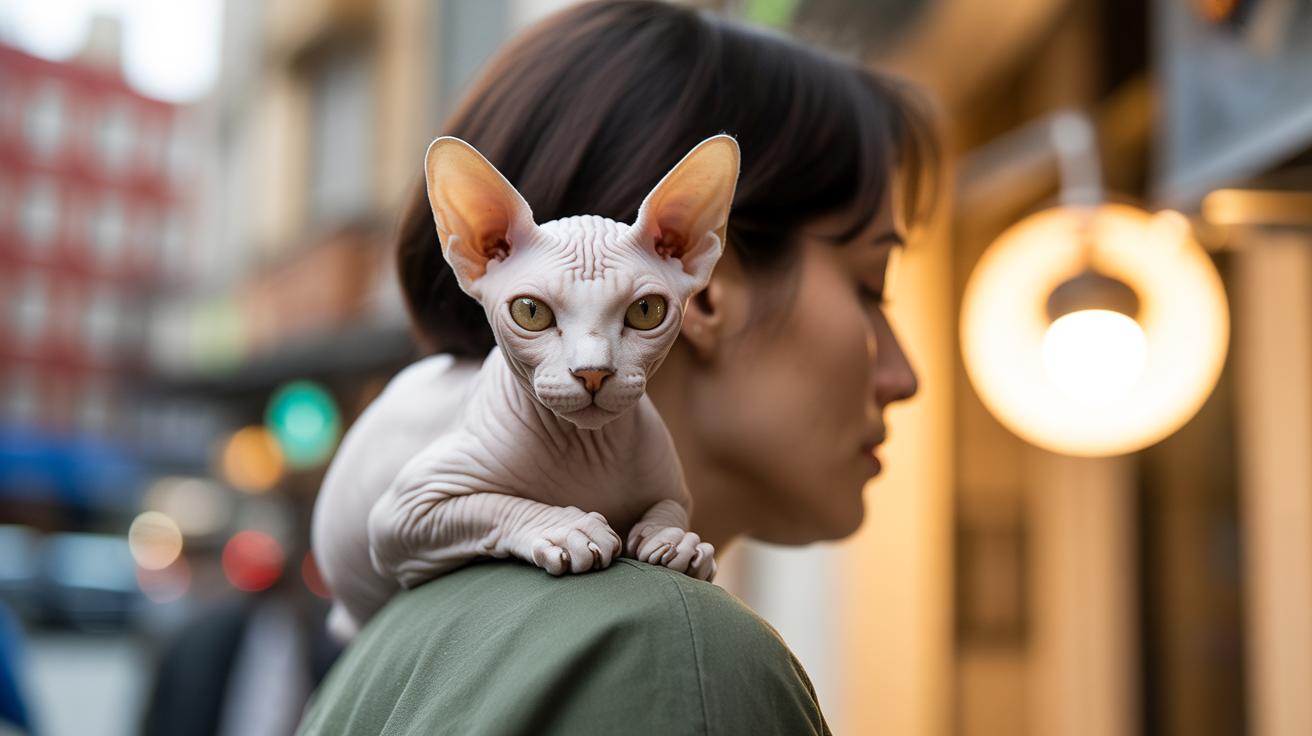
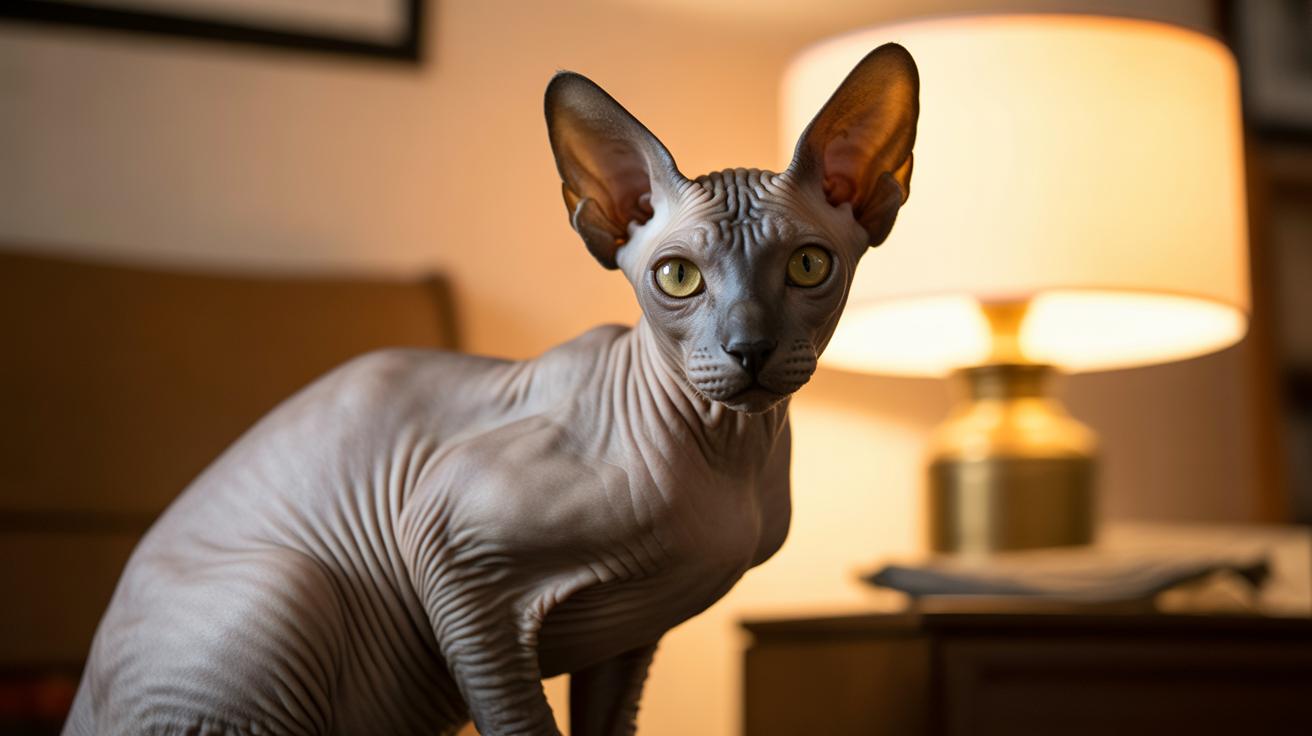
    Purrs usually come with other friendly signals: head nudges, slow blinking, and kneading (those soft, rhythm paw presses). A relaxed body and soft eyes are good signs you’re hearing contentment or a bid for closeness. But if the purr shows up with tense muscles, wide eyes, or flattened ears, that’s a different message , give them space and respect what they’re saying, um, quietly.

    Mechanism of purring

    - Mechanism of purring.jpg

    Purring comes from rapid, repeated contractions of the laryngeal muscles (muscles around the voice box). Ever felt that gentle rumble under your palm when a cat naps? The vocal folds (thin flaps of tissue that vibrate) open and close at a steady pace, and a neural oscillator (a tiny brain circuit that keeps time, like a metronome) paces those contractions.

    For compact technical facts about frequency, breathing mechanics, and throat anatomy, see the concise technical bullets below in "How purring works – technical details."

    How purring works – technical details

    • Mechanism: Rapid contractions of the laryngeal muscles (muscles around the voice box), driven by a neural oscillator (tiny brain circuit that fires in a steady rhythm), make the vocal folds (thin vibrating tissue) open and close and create the audible purr.
    • Frequency: Studies commonly report a purr frequency band around 25-150 Hz (Hz means cycles per second). There’s variation across studies and between cats, so treat the range as a helpful guideline rather than a fixed rule.
    • Breathing: Purring occurs on both inhalation and exhalation, which lets cats produce a near-continuous sound without pausing to breathe.
    • Anatomy: The larynx (voice box) and the hyoid (throat bone) shape resonance and the airway layout, and differences in those structures help explain why some large felids can’t purr like domestic cats.

    Purring for self-soothing and possible healing: hypotheses and evidence

    - Purring for self-soothing and possible healing hypotheses and evidence.jpg

    Cats will often purr when they’re nervous, hurt, or just not feeling great. That low, steady throat rumble feels cozy under your hand, and a lot of people think it doesn’t just soothe the mood but might change how a cat’s body responds to injury or stress. Ever watch your kitty curl up and hum herself calmer? It’s a neat idea.

    One popular guess is that purring helps release endorphins (natural pain-relief chemicals your body makes), which could make pain feel smaller and help a cat relax. Another idea says the slow vibration of the throat – low-frequency vibration (a slow, low-pitched shake) – might gently stimulate tissues or bones, similar to how tiny vibrations help bone cells (the cells that build and repair bone) in lab studies. Those ideas are plausible, but mostly come from observations and small experiments rather than big clinical trials (large, controlled medical studies).

    There’s some real-world support, though. Owners often say their cat seems calmer after a purring session, and small studies found short drops in human blood pressure when people stroked a purring cat. Folks also tell stories of injured cats seeming to recover faster or swell less after lots of purring. Still, these are small samples and messy situations – warmth, rest, gentle handling, and the simple fact of getting attention all help healing, so it’s hard to pin the effect on the purr alone.

    Treat the purr story as promising but not proven. If your cat is hurt or acting strange, get veterinary care rather than relying on soothing purrs by themselves. For the specific frequencies and throat anatomy behind some healing claims, see the Mechanism H3 section below for the technical context. I once watched my foster cat Luna leap up and purr herself calm after a scare – comforting, yes, but not a substitute for a vet visit.

    Research on purring and healing

    Most of the work here is notes from observations, small animal or human studies, and clinicians’ reports. Sample sizes are small and controlled trials are rare, so we need targeted research before making any strong medical claims. Curious? Me too.

    Interpreting and responding to your cat's purrs: body language, context, petting tips, and when to seek help

    - Interpreting and responding to your cats purrs body language, context, petting tips, and when to seek help.jpg

    A purr is only one part of the message. Read the rest of your cat’s body to know what they mean. Content purring usually comes with loose limbs, slow blinking, soft head nudges, and steady kneading, oh, and a relaxed or gently curled tail. By contrast, a purr with a stiff body, flattened or pinned-back ears, wide eyes, a tucked posture, hiding, or changes in eating and activity often points to stress, pain, or fear. Um, important to notice the whole picture.

    If you want to encourage happy purring, use slow, flat-handed strokes and find the spots your cat loves. Try the cheeks, under the chin, or the base of the tail. Keep sessions short if your cat gets easily wound up. Watch for quick tail flicks, skin ripples, or a sudden turn toward biting , those are clear stop signs. If you need a refresher on handling overstimulation (when your cat goes from bliss to bitey), check recognizing overstimulation signs in cats.

    • Relaxed posture plus half-closed eyes equals contentment; respond with calm, gentle petting.
    • Head rubbing, kneading, and purring usually mean your cat wants affection or food; give attention or check the feeding schedule.
    • Purr plus a meow near meal time is likely a food request; offer a meal and see if the purring stops after eating.
    • Purring while asleep with loose limbs means your cat feels secure; avoid waking or moving them.
    • Purring with ears back and tense muscles suggests anxiety, like at the clinic; try to comfort calmly or remove the stressor if you can.
    • Purring with dilated pupils and withdrawal can mean fear or stress; give space and keep an eye on them.
    • Sudden restless purring during handling is often overstimulation; stop petting before things escalate and review recognizing overstimulation signs in cats.
    • Lots of purring plus eating or activity dropping off could signal illness; consider a veterinary check.
    • Purring that hides other signs, such as limping or extra hiding, means take notes and tell your vet.
    • An abrupt start or stop of purring combined with collapse, trouble breathing, or severe pain needs immediate veterinary help.

    Petting technique quick guide: stroke in the direction the fur grows with a flat hand, use light to medium pressure, and avoid sudden moves. For shy or sensitive cats, start with brief 30-60 second sessions, reward calm behavior with a small treat, and build trust over several short meetings instead of one long session. If your cat tends to escalate, keep the recognizing overstimulation signs in cats guide handy.

    Keep an eye on mild changes at home for 48 to 72 hours. Contact a veterinarian right away for severe appetite loss, collapse, labored breathing, bleeding, or an acute injury. And if odd signs show up with sudden purring changes, don’t wait, seek help immediately.

    Worth every paw-print.

    Measuring cat purrs: recording, basic analysis, and limitations

    - Measuring cat purrs recording, basic analysis, and limitations.jpg

    Want to see what your cat’s purr looks like on a graph? Whether it’s for rehab notes or just geeky fun, grab your phone and a comfy spot. Remember, the technical frequency details live in the Mechanism H3 section, so that context makes the numbers meaningful.

    Set the recorder where your cat hangs out without changing their behavior , a quiet corner, not right in their face. Aim for 30 to 60 seconds of steady purring while background noise stays low. Ever watched your cat’s whiskers twitch as a soft rumble rolls across the room? That’s the sound you’re capturing.

    Use an app with a spectrum or FFT (fast Fourier transform, which turns sound into a frequency picture) view, or export the audio to a simple analysis tool. Look for the fundamental frequency band (the main pitch range) mentioned in Mechanism H3, and note how loud the purr sounds to your ear. Frequency here means how often the sound vibrates per second.

    Treat smartphone recordings as clues, not clinical proof. Amplitude (the strength of the sound wave) and perceived loudness change by individual and breed, and distance, bedding, or other noises can skew things. For precise decibel (dB, a unit of loudness) measurements or lab-grade frequency work you need calibrated microphones and controlled conditions.

    Still, recording is super helpful , you can track changes over time and share examples with your vet if something seems off. Worth every paw-print.

    Variations in purring: breed and age differences, and big cats vs domestic cats
    - Variations in purring breed and age differences, and big cats vs domestic cats.jpg
    Cats show their personalities in their purrs. Some purr loud and rumbling, others whisper it like a secret. Body size, mood, and health all shape that sound, so it’s normal for purring to change as a cat gets older or feels different. Ever watched your kitty’s whiskers twitch as a low rumble rolls across the room? It’s oddly soothing.

    Certain breeds tend to give bigger purrs. Big-boned, fluffy cats like Maine Coons or Ragdolls often make deep, hearty rumbles you can feel through a couch cushion, while slimmer or extra-chatty breeds may purr more quietly. Aging can change things too. Older cats might purr less, softer, or with a different tone if arthritis (joint inflammation), dental issues (tooth pain), or respiratory changes (breathing problems) make their throat muscles sore or uncomfortable. Keep an ear out for sudden shifts in volume or pitch , those can be clues that something’s wrong.

    Do big wild cats purr the same way house cats do? Some large felids make purr-like sounds or short chirrups, but the big roaring cats use different vocal anatomy. The shape of the hyoid (throat bone) and the larynx (voice box) changes how sound is made, so domestic and wild cat purring isn’t identical. See the Mechanism H3 for the anatomical details.

    Final Words

    in the action, purring comes from quick, repeated twitches of the laryngeal muscles (throat muscles that twitch) driven by a neural oscillator (a tiny brain rhythm generator). It’s the little engine behind contentment, attention-seeking, and self-soothing.

    We ran through kitten calls, adult solicitation, healing ideas, how to read body language, and simple recording tips so you can spot friendly hums versus worry signs.

    So when that soft motor hums, smile. Now you know the main reasons and why do cats purr.

    FAQ

    Cat purring — Frequently Asked Questions

    Why do cats purr biologically?

    The biological reason cats purr is rapid, repeated contractions of the laryngeal (voice-box) muscles driven by a neural oscillator (a brain rhythm). Cats can also modulate purring to signal different needs.

    What does it mean when a cat purrs to you?

    A cat purring to you can signal contentment, bonding, or a request for attention or food. Check the cat’s body language: a relaxed posture and head rubbing usually mean affection, while tense cues may indicate stress.

    Why do cats purr and knead?

    Cats purr and knead as a carryover from kitten nursing. Kneading mimics pressing a mother’s belly to stimulate milk and signals comfort, security, and affection.

    Why do cats purr when they sleep?

    Cats often purr when they sleep to show relaxed contentment and self-soothing; this is normal when paired with a loose posture and steady breathing.

    Why do cats purr when they are dying?

    When cats purr near death, it often serves as self-soothing and may help modulate pain or call for comfort. Monitor other signs and seek veterinary help if symptoms are concerning.

    Why do cats purr loudly, and what about Reddit anecdotes?

    Loud purrs often indicate stronger solicitation, excitement, or individual/breed traits; loudness varies widely. Reddit anecdotes reflect owners’ observations but are not controlled scientific studies.
    Related Articles

  • Are cats desert animals? Not exactly

    Are cats desert animals? Not exactly

    Think your cat is a tiny desert prowler? Well, not really. House cats trace back to Felis silvestris lybica (a wildcat from Africa and the Middle East) that started hanging around farmers about 10,000 to 12,000 years ago. They kept a few desert-ready tricks: highly concentrated urine (helps them save water), crepuscular hunting times (most active at dawn and dusk), and almost no sweating (they barely sweat except on their paw pads).

    But modern house cats are flexible generalists (they adapt to lots of diets and living situations). Your couch panther actually does best with steady fresh water, wet food, and a cool, shady spot to nap. Ever watched your kitty chase a sunbeam while their whiskers twitch? Yeah, they’re more into creature comforts than surviving sand and sun, feline fine, not desert-ready.

    Are cats desert animals? Not exactly.

    - Quick answer Are cats desert animals.jpg

    Short answer: no. Domestic cats come from the African and Middle Eastern wildcat, Felis silvestris lybica (a wildcat species), which showed up around 10,000 to 12,000 years ago in the Fertile Crescent. So they kept a few desert-ready tricks. But modern house cats are flexible generalists. They do fine in homes, farms, cities, and sometimes in dry places.

    Some desert-friendly traits cats still have:

    • Highly concentrated urine (kidneys, the organs that filter blood and save water, make small, salty pee).
    • Relatively dry feces (poop that wastes less water).
    • Very little sweating; they cool mostly by breathing fast or panting (respiratory evaporative cooling, basically losing heat through quick breaths).
    • Crepuscular or nocturnal habits (they hunt at dawn, dusk, or night to avoid the heat).

    Those traits help a little, but they don’t turn your tabby into a true desert specialist. For everyday care, give constant access to fresh water and wet food. Aim for about 50 ml per kg per day (that’s roughly 200 to 250 ml, or about 3/4 to 1 cup for a typical house cat). Also offer shady, well-ventilated spots to rest and keep outdoor time short during the hottest hours.

    Watch for signs of heat stress: heavy panting, unusual sleepiness, less urine, or weird sprawled sleeping positions. Call your vet if things get worse. Feral cats sometimes get moisture from prey, but most indoor cats need reliable water and a cool spot to be comfortable. Worth every paw-print.

    Felis silvestris lybica and the desert origins of domestic cats

    - Felis silvestris lybica and the desert origins of domestic cats.jpg

    Archaeology (the study of ancient human activity) and DNA (the genetic material that makes each creature unique) point to a Middle Eastern wildcat, Felis silvestris lybica, as the close ancestor of our house cats. They started hanging around people about 10,000 to 12,000 years ago, when Neolithic farming (early farming during human history) and grain stores in the Fertile Crescent (the Middle East region where farming began) drew hordes of rodents. Cats followed the snacks. Smart move, if you ask me.

    About 9,500 years ago we get a clear snapshot: a cat buried on Cyprus alongside people. That burial is direct archaeological proof people and cats were sharing space long before collars or cat shows. Picture a small wildcat curled up with its owner – cozy, right?

    1. Origin: 10,000 to 12,000 years ago – Neolithic farming brought rodents, and wildcats started living near humans.
    2. Early association: around 9,500 years ago – the Cyprus burial gives concrete proof of people and cats together.
    3. Spread: Roman-era trade (roughly 1st to 4th centuries AD) moved these commensal cats (animals that live alongside humans, often benefiting from human food) around Europe, and later ships from the 15th century on carried them overseas with explorers and settlers.

    Genetic studies show modern Felis catus (the domestic cat species) cluster closely with F. s. lybica lineages, which really ties the family tree back to that desert-linked wildcat. The big change during domestication (the process of adapting animals to live with people) was behavior. Cats learned to hang around farms and homes to eat rodents and leftovers. Their basic body shapes and hunting skills stayed much the same. So, domestication was mostly about attitude, not a complete redesign.

    Isn’t it kind of great? Our couch companions are basically wildcats with a fondness for laps. Worth every paw-print.

    Physiology and behavior that support arid tolerance

    - Physiology and behavior that support arid tolerance.jpg

    Cats come with a neat little toolbox for saving water. Their kidneys squeeze urine into a small, salty stream so less water is wasted, and their poop is drier than many other mammals', which also helps conserve fluids. That kidney setup gives them a real edge when free water is scarce, but it’s not endless, those tiny filters wear out over time and too many lost filters can cause real problems.

    Cooling for cats is mostly about breathing, not sweating. They barely sweat through their skin, so when it gets hot they pant or take quick, shallow breaths to lose heat by evaporating moisture from the airway (respiratory evaporative cooling). Cats also tolerate higher skin temperatures than people: humans start to feel uncomfortable around 44.5°C (about 112°F), while cats still manage close to 52°C (about 126°F). Behavior helps a lot too: shade, moving slowly during the day, and curling up in tight cool spots all keep body heat down without relying on sweat.

    Behavior ties the whole strategy together. Many cats hunt at dawn, dusk, or night (nocturnal or crepuscular habits) to avoid the midday oven. They hunker in shaded hollows, rock ledges, or burrows for cooler microclimates, and free-roaming cats often meet much of their water needs from moist prey. Those choices ease the load on kidneys and breathing-cooling systems. So when dehydration or repeated heat shows up, it can speed kidney decline in older cats.

    Kidney structure and water conservation

    Each kidney has roughly 200,000 nephrons (a nephron is a tiny filtering tube in the kidney). Nephrons don’t regenerate, so the body leans on spare units as some fail. Once about 70% of working nephrons are gone, the kidney’s ability to clear waste drops sharply, raising the risk of chronic kidney disease (CKD, long-term loss of kidney function). Clinical takeaways: keep an eye on water intake, watch for changes in drinking or urination, and start hydration measures early when you notice signs.

    Thermoregulation and cooling

    Because cats sweat very little through their skin, they rely on breathing and behavior to cool off. Panting and faster breathing kick in when the air gets hot, but that system can be overwhelmed. Give shady, well-ventilated resting spots and keep activity slow during the hottest hours so respiratory cooling doesn’t get taxed.

    Behavioral tactics for arid tolerance

    Timing activity for cooler hours, using shaded microhabitats or burrows, and getting moisture from prey are core survival moves. These tactics lower heat load and water loss so the cat’s physiology isn’t pushed to the limit. For pet cats, mimicking these strategies helps too, think cool hideaways, wet food, and limiting play in mid-afternoon heat.

    Adaptation Mechanism Practical implication
    Concentrated urine Kidney concentrating ability – nephron/medullary countercurrent (nephron: tiny filtering tube; medullary countercurrent: loop system that concentrates urine); ~200,000 nephrons per kidney Fewer trips to water. Clinical note: CKD risk if too many nephrons are lost (see ~70% threshold)
    Minimal sweating Very limited cutaneous evaporative loss Provide shade and cool resting sites rather than relying on sweat-based cooling
    Respiratory evaporative cooling Panting and faster breathing to evaporate airway moisture Watch for heatstroke signs when breathing-based cooling is overwhelmed
    Nocturnality / burrow use / prey-moisture reliance Timing activity and choosing cool microhabitats; getting moisture from prey Advise shelter design and activity timing to cut heat and water stress

    Clinical relevance is high: start hydration measures early. Wet diets, drinking stimulants, and subcutaneous fluids when prescribed can slow decline and ease symptoms. Worth every paw-print.

    Sand cats and other desert specialist felines compared with house cats

    - Sand cats and other desert specialist felines compared with house cats.jpg

    Ever watched your kitty chase shadows? Sand cats are like that, but built for the real desert. The sand cat (Felis margarita) lives on dunes and dry plains. It hunts small rodents and lizards and moves almost silently across hot sand. Its paws have dense fur (hair on the soft soles of the feet) for protection and insulation, and its sandy color acts like camouflage (colors that help it blend into the sand). Those are body changes you won’t see on your average tabby.

    A few desert and dry-land specialists, with a quick note about each:

    • sand cat (Felis margarita) – dune and plateau expert; paw-pad fur (hair on the foot soles) and other sand-friendly traits.
    • black-footed cat – tiny hunter of dry savanna; fierce at night and super-fast.
    • African wildcat (F. s. lybica) – tolerant of dry places and the wild ancestor of house cats, but not a strict desert-only species.
    • caracal – lives in many places, including arid zones and scrubland; very adaptable.
    • Pallas’s cat – more of a cold steppe and high grassland specialist than a hot-desert cat.

    House cats don’t have the extreme paw-pad insulation or the sand-specific body parts, and they don’t stick to a narrow desert diet. They’re flexible generalists who do fine in lots of environments. So while a sand cat is built for sand and sun, your couch cat is built for cuddles, and chasing that red dot. Worth every paw-print.

    Can house cats survive in desert conditions? Practical care and risk signs for pet owners

    - Can house cats survive in desert conditions Practical care and risk signs for pet owners.jpg

    Lots of indoor cats do okay in hot, dry places as long as they have steady water and cool spots to hide. Aim for about 50 ml/kg per day of fluids for an adult cat , see Quick Answer for the headline figure. Your cat’s whiskers might twitch when a nice bowl of cool water is nearby.

    Practical care (quick tactics):

    • Put out several shallow bowls so water is easy to reach and smell. Cats often prefer shallow dishes.
    • Try a cat fountain. Moving water tempts many kitties.
    • Offer wet food or add a little water or a water topper at mealtime to boost fluids.
    • Move water stations away from litter boxes and noisy machines so your cat feels safe approaching them.
    • Tempt a stubborn drinker with a tiny dab of tuna oil on the bowl rim (pea-sized is plenty). Peek-a-boo!
    • Make shady perches and ventilated igloo-style hides (small domes with airflow). Or set up a wired shaded perch or tarp for outdoor comfort.
    • Shift active play to mornings and evenings when it’s cooler, and save indoor puzzle toys for the hottest hours. See safe play behaviors for indoor cats for ideas.

    Keep cooling measures simple. Shade and good airflow cut heat exposure a lot. Limit outdoor time to the cooler parts of the day. And if you’re busy, toss an unbreakable ball before you head out for a quick ten minutes of safe play.

    Watch for warning signs of overheating or dehydration:

    • Heavy panting, drooling, or breathing fast.
    • Marked lethargy or weakness.
    • Little or no urine output, or dark, sticky urine.
    • Big changes in resting posture, like suddenly stretching out or tucking in tightly (see what do cat sleeping positions mean).
    • Vomiting, collapse, or being unresponsive.

    Lab clues your vet might see include a higher hematocrit (the percent of red blood cells) and patterns of polydipsia and polyuria (that means lots of thirst and lots of peeing). Repeated dehydration raises the risk of chronic kidney disease. Some cats with kidney disease need subcutaneous fluids (under-the-skin fluids) your vet can show you how to give.

    Call your vet right away if your cat is breathing hard, very weak, vomiting, or unresponsive. While you get help, offer cool water and shade and follow your clinic’s instructions. It’s better to be safe. Worth every paw-print.

    Conservation, human impacts, and wildcat persistence in arid regions

    - Conservation, human impacts, and wildcat persistence in arid regions.jpg

    Sand cats are losing ground where dunes and dry plains get chopped up by roads, new development, and off-road vehicles. Picture tiny pawprints fading where traffic, construction, and noise now sit. It’s sad, and it’s happening fast in places that used to feel endless.

    Felis silvestris lybica (the wildcat found across North Africa and the Middle East) still hangs on in many spots, but human expansion, shifting climates, and changes in prey leave less room and less food. Farming and artificial lights change the small, fragile ecosystems these cats depend on, shifting insect and rodent patterns and making hunting harder at night.

    Another big worry is genetic introgression (when domestic cats breed with wildcats and mix genes). That’s already a serious issue in places like Scotland and Hungary. This kind of mixing can wipe out local traits that help wildcats cope with their specific environments, and it can bring new disease risks too.

    So what can we do? Local, practical steps matter: sterilization and managed colonies where feral cats are a problem, protected wildcat zones, and careful monitoring to spot hybrids early. Trap-neuter-return, or TNR (trap, spay or neuter, then return feral cats), works well when it’s tied to habitat-sensitive planning and not used alone.

    Concrete actions that actually help:

    • Protect and reconnect desert patches so cats can move between safe areas. (Corridor projects are wildlife lanes that link habitat fragments.)
    • Cut disturbance from vehicles and lights near key habitat, less noise and less glow at night helps hunting.
    • Run targeted TNR and managed feral programs close to wildcat strongholds, with follow-up monitoring.
    • Fund genetic surveys so managers can detect hybridization early and act fast.
    • Back landscape-scale corridor projects to reduce isolation and boost gene flow.

    Community outreach, local stewardship, and coordinated policy make all this work better. With smart planning and a little neighborhood care, these felids stand a fair chance of sticking around, no miracle needed, just steady, sensible action.

    Final Words

    In the action, we answered the quick question: domestic cats trace back to Felis silvestris lybica about 10,000–12,000 years ago and still carry desert-ready traits, yet today’s house cats are flexible and live in many habitats.

    Keep it simple at home: offer fresh water and wet food, provide shady ventilated spots, time outdoor play for cooler hours, and watch for signs of heat stress.

    So, are cats desert animals? Not exactly , they have desert-smart traits but rely on us for water, shelter, and play. With a little attention, your cats will be feline fine.

    FAQ

    Are cats desert animals?

    Cats are not true desert animals. Domestic cats come from Felis silvestris lybica (the Middle Eastern wildcat) and retain desert-tolerant traits, yet they are flexible generalists that live in many habitats.

    What was the first cat on earth and when did cats evolve?

    The ancestor most directly linked to house cats is Felis silvestris lybica (the Middle Eastern wildcat). Domestication began about 10,000-12,000 years ago as people farmed and rodents gathered around grain stores.

    What is the natural habitat of a cat?

    The natural habitat of early domestic-cat ancestors was semi-arid scrub and farmland edges rich in rodents. Modern cats adapt to forests, farms, cities, and desert fringes thanks to flexible behavior.

    Why do cats have fur if they are desert animals?

    Cats have fur because it insulates against heat and cold, shields skin from sun and sand, provides camouflage, and supports sensitive whisker areas for touch and hunting.

    Can cats survive in deserts?

    Cats can survive in desert-like conditions thanks to water-saving kidneys and clever behavior, but they need reliable water, shade, and monitoring. Aim for about 50 ml/kg/day of water intake and watch for heat stress.

    What do cats eat?

    Cats are obligate carnivores that eat meat and organs, often hunting small prey. Pet cats do well on high-protein diets and wet food, which also helps keep them hydrated.

    What are the 7 levels of classification for a cat?

    The seven taxonomic ranks for a cat are: Kingdom Animalia, Phylum Chordata, Class Mammalia, Order Carnivora, Family Felidae, Genus Felis, Species Felis catus.

    What is the African or Near Eastern wildcat?

    The African or Near Eastern wildcat is Felis silvestris lybica, a desert-tolerant wild ancestor of domestic cats that lives across North Africa and the Middle East and often lived near human settlements.

    Related Articles