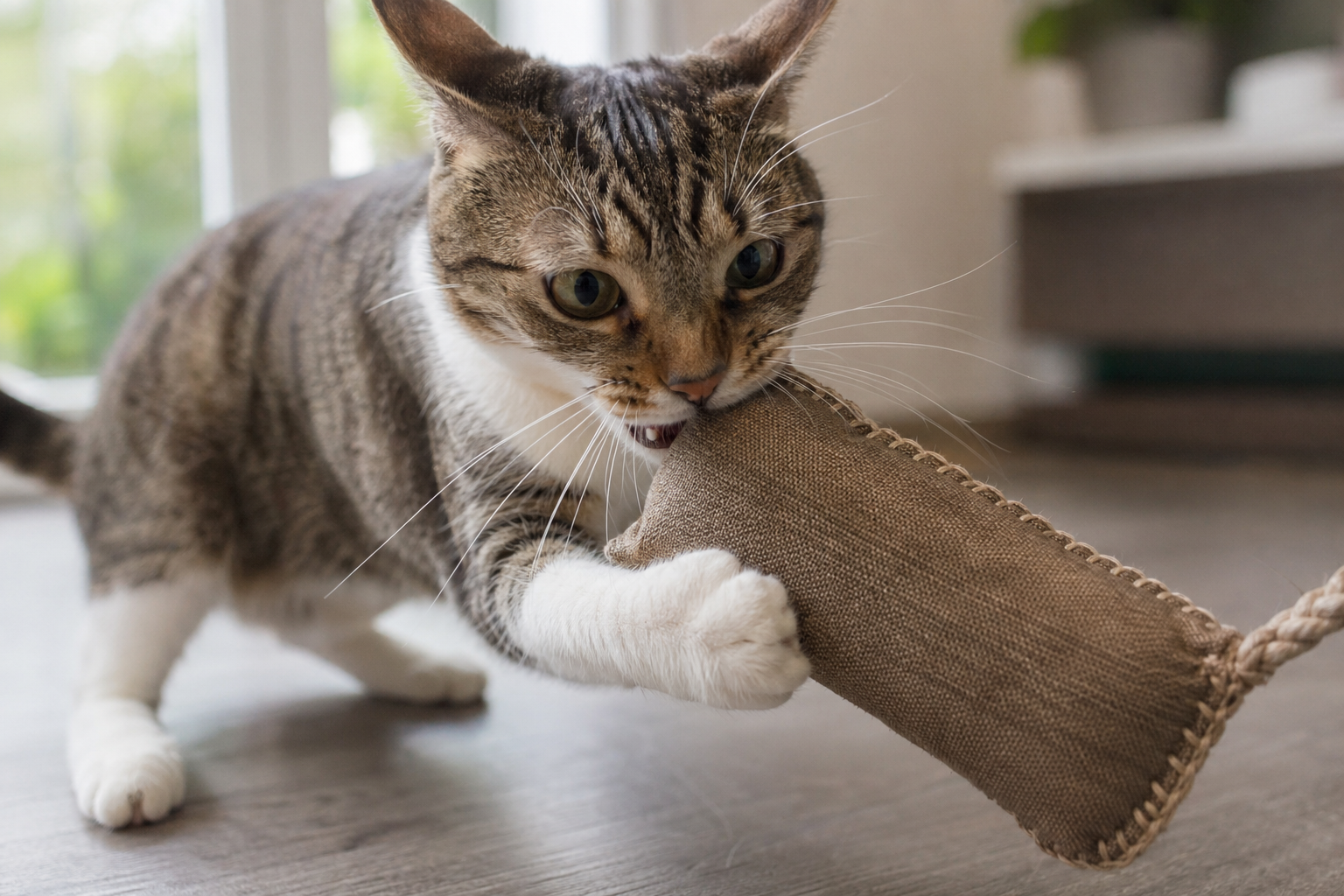
Cat bite toys should give a chewing cat something satisfying to grab, gnaw, kick, and carry without breaking into swallowable parts. For most cats, the safest choices are oversized fabric kickers with reinforced seams, molded rubber or silicone pieces made for pets, sturdy puzzle feeders, and wand toys used only during supervised play. The wrong choices are tiny plush toys, loose feathers, elastic loops, bells, glued-on eyes, fraying rope, and string toys left out after play.
The goal is not to find a magic toy your cat can never damage. Cats have sharp teeth, strong jaws for their size, and a hunting play style built around grabbing and biting. The real goal is to match the toy to the way your cat bites, inspect it before it fails, and give high-chew cats safer outlets than cords, plastic bags, plants, or your hands.
This guide is for owners whose cats bite toys hard, chew plastic, shred plush, carry toys around, or redirect play bites onto people. If your cat swallows non-food items, vomits after chewing, has a sudden change in chewing behavior, or seems unable to stop eating fabric, plastic, rubber, or string, treat that as a health and behavior question for your veterinarian, not just a shopping problem.
What toys do cats like to bite?
Cats usually like to bite toys that behave like prey: something that moves away, gives a little under the teeth, can be pinned with the front paws, and can be kicked with the back feet. That is why many cats prefer kicker toys, wand attachments, crinkly fabric, small stuffed shapes, and rolling puzzle toys over hard objects that do nothing.
For a cat that chews hard, useful bite toys usually fall into five groups:
- Large kicker toys: long enough for the cat to hug and rabbit-kick, with seams that are not easy to pry open.
- Molded rubber or silicone toys: satisfying for cats that mouth objects, as long as the piece is too large to swallow and does not shed chunks.
- Puzzle feeders: good for cats that need to work, paw, and bite lightly for food, especially indoor cats with pent-up hunting energy.
- Wand toys: excellent for bite-and-chase play, but they should be put away when the session ends.
- Simple household options: cardboard boxes, paper bags with handles removed, and ping-pong balls can be useful when supervised and replaced once damaged.
Cornell’s Feline Health Center notes that toys help cats stalk, pounce, problem solve, exercise, and avoid boredom-related behavior problems, but it also warns owners to avoid small pieces, string-like parts, and anything electrical that a cat can chew. That is the right balance: encourage the hunting pattern, but remove the parts that can turn play into ingestion risk.
Choose the toy by bite style
Before buying more cat bite toys, watch one five-minute play session and name what your cat actually does. A toy that works for a cat that grabs and kicks may be wrong for a cat that quietly saws through seams in a corner.
| Bite style | Better toy direction | Avoid |
|---|---|---|
| Grabs, wrestles, and kicks | Oversized kicker, tough fabric tube, refillable catnip kicker | Small plush mice, thin seams, dangling ribbons |
| Chews plastic or cords | Molded rubber or silicone pet chew, puzzle feeder, managed cord protection | Thin plastic springs, brittle hard-plastic toys, exposed charging cords |
| Shreds fabric seams | Reinforced kicker, denim-like fabric, fewer stitched-on decorations | Stuffed toys with eyes, tails, tags, bells, or glued trim |
| Bites hands during play | Long wand toy, kicker redirect, scheduled play before meals | Hand wrestling, teasing with fingers, short toys that keep hands near teeth |
| Gets bored at night | Ball track, puzzle feeder, safe solo toys after supervised testing | String, feather, elastic, or battery toys that can be chewed open |
If rough play is the larger pattern, pair this guide with Titan Claws’ article on why cats destroy toys. If you are building a full toy box rather than solving one chewing habit, start with how to choose cat toys that last.
Safety rules for cats that chew aggressively
The safest cat bite toy is not just a tougher toy. It is a toy with fewer failure points. Every charm, feather, bell, plastic eye, loop, fringe, tassel, and glued seam is another place where a determined cat can create a swallowable piece.
The University of Wisconsin School of Veterinary Medicine gives especially practical advice for young, active cats that chew: many traditional toys include feathers, strings, or sparkly pieces that aggressive chewers may ingest, so those parts are best avoided. The same guidance recommends sturdy construction, no loose decorations, cutting off loops or tags, and removing pieces immediately when they are chewed off.
Use these rules for any cat that really bites toys:
- Size up. Choose toys too large to fit fully in your cat’s mouth. Small toys can become choking or swallowing risks once damaged.
- Prefer one-piece construction. Molded toys and simple sewn shapes usually have fewer weak points than toys with many glued-on features.
- Supervise new toys. The first session tells you how fast your cat can puncture, peel, or shred that material.
- Put string toys away. Wand toys are valuable, but string and ribbon are not safe solo toys for cats that chew.
- Retire early. If stuffing, a hard core, a battery compartment, sharp plastic, or loose threads appear, the toy is done.
For material-level detail, see Titan Claws’ guide to safer durable cat toy materials. The short version: softer materials can be kinder to the mouth but wear faster; harder materials may last longer but can become dangerous if they crack. Inspection matters either way.

What to leave out for solo play
Not every bite toy should be available at 2 a.m. when no one is watching. Solo toys need a higher safety bar because you will not be there to stop a chewing session when the toy starts to fail.
Better solo options, after supervised testing, include ball tracks, large intact kickers, sturdy puzzle feeders, and simple balls too large to swallow. These are not risk-free, but they do not rely on loose strings or tiny parts to be fun.
Keep these in a closet between supervised sessions:
- Wand toys with string, wire, elastic, feathers, or ribbon.
- Any toy with bells, plastic eyes, glued faces, sequins, or tiny ornaments.
- Battery toys your cat can pry open or bite through.
- Catnip plush toys that already show seam stress.
- Rope or fabric toys that produce loose strands when chewed.
This is especially important if your cat likes to chew on wires. Cornell’s holiday hazard guidance warns that chewing bulbs, phone cords, and electrical cords is dangerous and recommends tying cords up or using heavy cord protectors. A chew toy can help redirect the mouth, but it does not replace cord management.
Build a bite-toy routine, not a toy pile
Cats often chew because the object is available, interesting, and part of a bigger need: hunting, food seeking, teething, attention, stress relief, or boredom. A pile of toys on the floor can go stale quickly. A routine keeps the toys valuable.
- Start with movement. Use a wand toy for five to ten minutes and move it like prey: away from the cat, behind furniture, around corners, and across the floor.
- Let the cat catch and bite. If the toy is always just out of reach, some cats get frustrated and redirect onto hands or ankles.
- Switch to a kicker. Once the cat is aroused, offer a large kicker so the bite and back-foot kicking land on the toy.
- End with food or a puzzle. A small meal or measured puzzle feeder completes the hunt-catch-eat pattern.
- Put high-risk toys away. Leave out only the toys that passed your solo-play inspection.
The AAFP and ISFM environmental needs guidelines describe play and predatory behavior as part of a cat’s environmental needs, including feeding devices that let cats work for food and wand movement that mimics prey. That supports a practical point: bite toys work better when they are part of enrichment, not just objects scattered around the room.
If your cat mainly needs active chasing, Titan Claws has a deeper guide to interactive toys for indoor cats. If the behavior includes biting people, also read why cats bite owners so you can separate play biting from fear, pain, petting sensitivity, or overstimulation.

When chewing points to a bigger problem
Some chewing is normal investigation and play. Persistent chewing, sucking, or eating non-food material can be different. Cornell’s destructive behavior handout explains that chewing fabric or houseplants can be part of normal investigation and play, but destructive behaviors can also harm a cat’s health and may require management changes or veterinary behavior help.
Call your veterinarian promptly if you see any of these signs:
- Your cat swallows toy pieces, string, fabric, rubber, hair ties, plastic, or paper.
- There is vomiting, gagging, drooling, appetite loss, belly pain, constipation, diarrhea, hiding, or lethargy after chewing.
- Chewing starts suddenly in an adult cat, especially with bad breath, pawing at the mouth, dropped food, or visible dental discomfort.
- Your cat obsessively seeks one risky material, such as plastic bags, elastic, wool, cords, or plant leaves.
- Chewing gets worse with stress, schedule changes, conflict with another pet, or long periods alone.
Titan Claws also has a focused safety article on foreign body ingestion in cats. Read it before you need it, because string and fabric ingestion can become urgent quickly.
Quick checklist before you buy a cat bite toy
- Is it larger than your cat can swallow, even after chewing?
- Are there any feathers, strings, bells, eyes, tags, loops, or decorations to remove?
- Can your cat puncture, peel, or shred it in the first supervised session?
- Does the material fail softly, or could it crack into sharp edges?
- Can you wash it or wipe it clean after slobbery play?
- Does it match your cat’s actual bite style: kicker, chewer, chaser, puzzle solver, or hand biter?
- Will it be a supervised toy, a solo toy, or a toy that gets retired after one session?
For cats that chew hard, the best cat bite toys are boring in the best way: simple shapes, sturdy materials, few loose parts, and easy inspection. Let your cat bite, kick, chase, and work. Just make sure the toy is built for the job, and remove it before your cat turns play into swallowed debris.
Leave a Reply