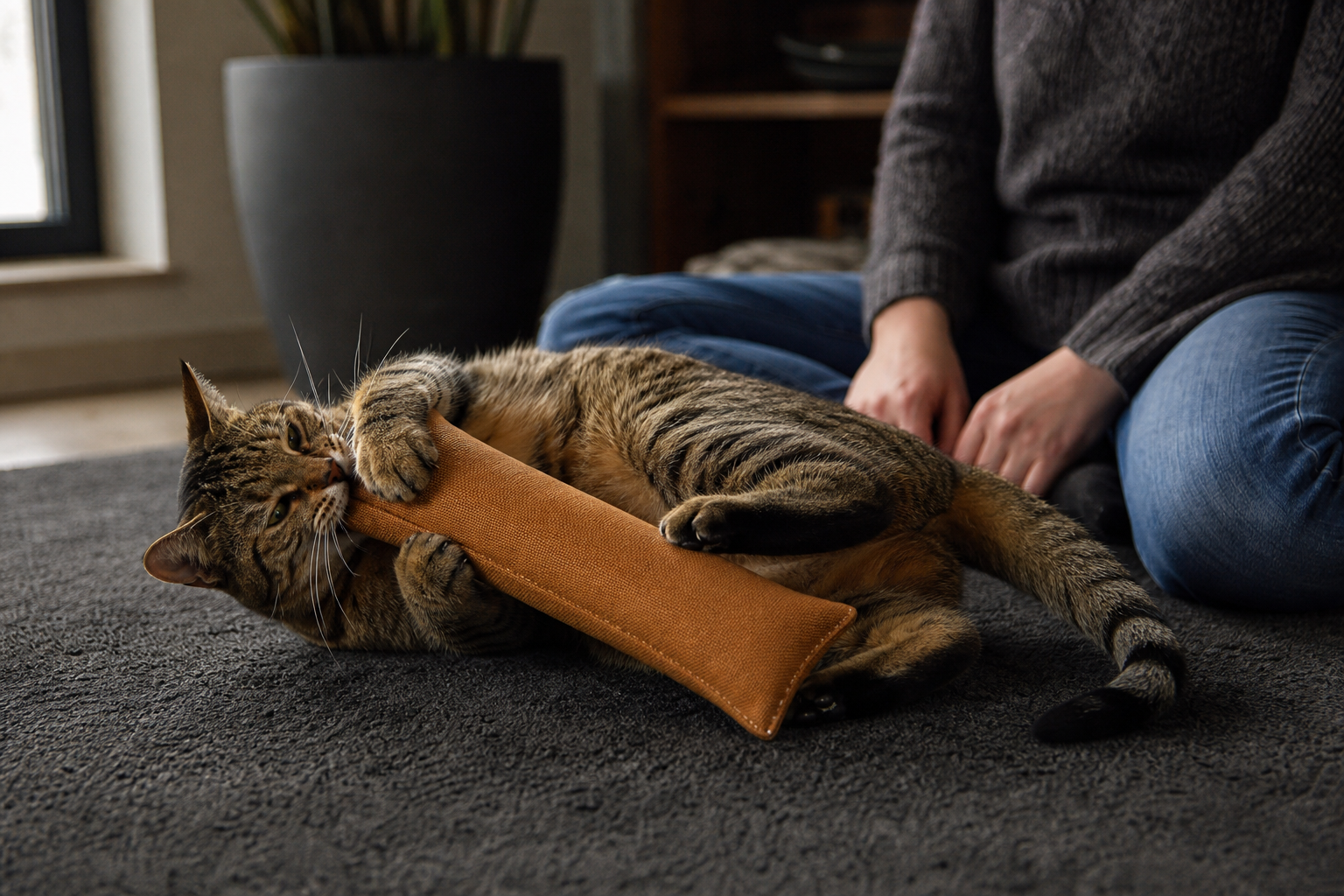
A large cat kicker toy should be long enough for your cat to hug with the front legs while the back feet strike its lower half. For many adult cats, a simple 10-to-15-inch fabric kicker is a sensible range to test. Long-bodied cats may need more usable length, while a bulky or rigid 15-inch toy can still be a poor fit. The cat’s grip and kicking position matter more than the word “large” on the label.
Look for an elongated, compressible body; tightly woven fabric; reinforced seams; contained filling; and no easy-to-remove tails, bells, eyes, or trim. Supervise the first sessions, inspect after hard play, and retire the toy when fabric thins, a seam opens, filling appears, or any piece goes missing. No kicker is indestructible.
What Counts as a Large Cat Kicker Toy?
“Large” is a shopping description, not a standardized cat-toy size. Retail kickers described for adult or large cats commonly span roughly 10 to 16 inches, but listed length can include a floppy tail, fins, ears, or other decoration that does not support the cat’s back feet. Compare the usable body length: the filled, grippable section between the end seams.
A kicker is different from a small toss toy. Its job is to become a wrestling target. The cat holds the upper section with the front legs, bites or mouths it, and rapidly pushes against the lower section with alternating hind feet—the movement often called bunny kicking. A toy can be fun for batting yet too short for that full-body position.
| Cat or use case | Starting length to compare | What to confirm during play |
|---|---|---|
| Kitten or small adult | About 7–9 inches | Easy to hug and move; too large to swallow or wedge deeply in the mouth |
| Average adult cat | About 10–12 inches | Front legs hold the upper body while both back feet contact the lower body |
| Large or long-bodied adult | About 13–16 inches | Enough usable body below the front-paw grip; still light and narrow enough to control |
| Powerful rough player | Fit first, then compare construction | Tightly woven shell, simple shape, reinforced seams, no exposed or detachable extras |
These ranges are starting points, not veterinary standards or safety guarantees. Two cats of the same weight can have different body length, mobility, grip, and preferences. A Maine Coon does not automatically need the longest toy in the store, and a small cat may choose a longer kicker if it can still compress and control it.
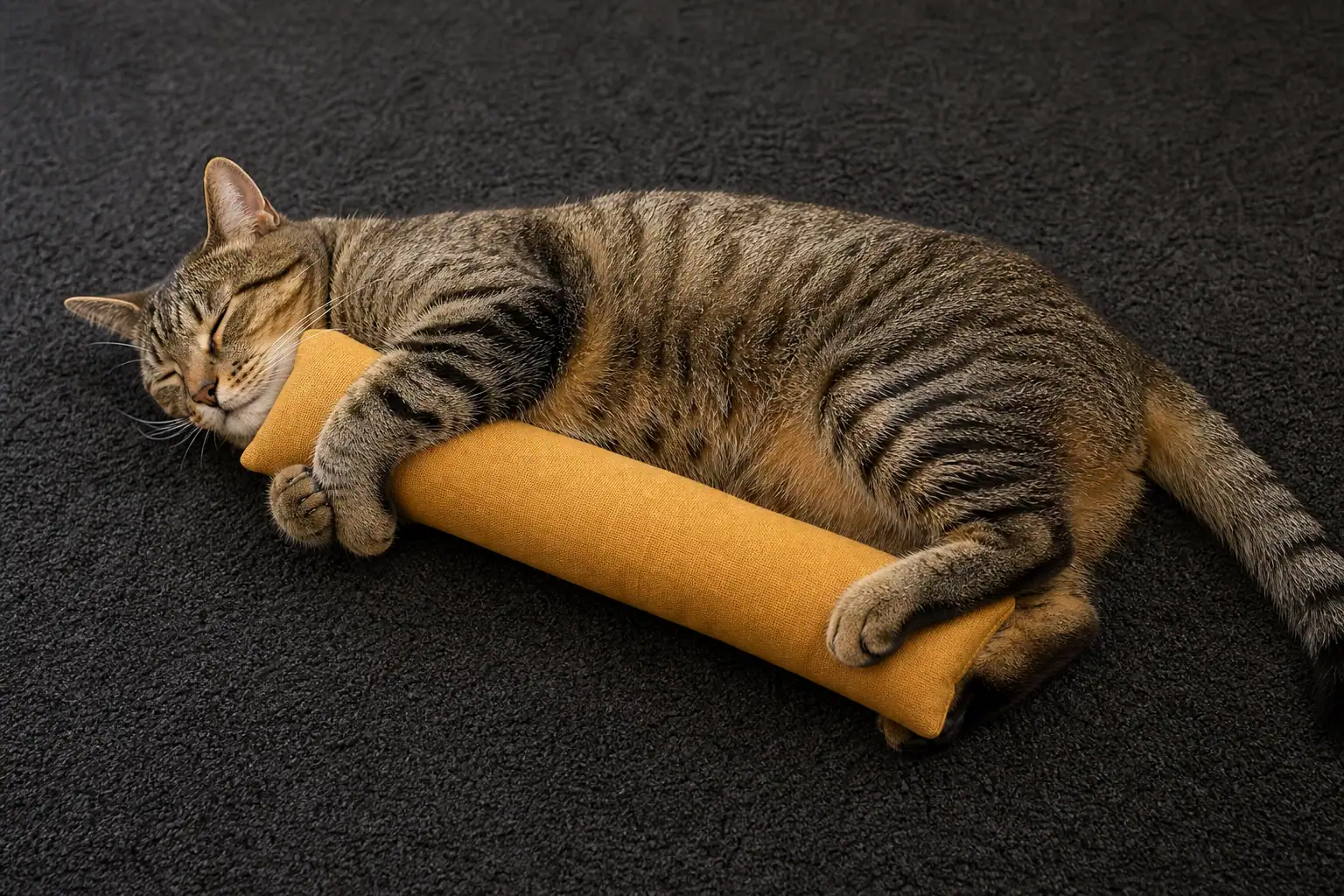
Use the Two-Point Fit Test Instead of Weight Alone
You do not need to pin down a cat with a tape measure. Buy from a seller with clear dimensions, then observe a calm, supervised floor session. Judge the toy at two contact points: the front-paw grip and the back-foot strike.
- Start on the floor. Place the kicker away from your hands and let the cat approach. Do not push it against the cat or hold the far end during biting.
- Watch the front legs. The cat should be able to wrap both front legs around the upper third or half. If the body is too wide or overstuffed to compress, extra length will not fix the grip.
- Watch the back feet. When the cat curls around the toy, both hind feet should reach solidly below the front-paw grip. If they strike empty air or land on one thin tail, the usable body is too short.
- Check control. The cat should be able to pull, roll with, and release the toy. A huge, dense kicker that pins the cat or cannot be repositioned is not a better large kicker.
- Inspect after the test. Look at the exact places held by the front claws, bitten by the mouth, and raked by the back claws. Those are the toy’s real stress zones.
If the toy is just a little short, do not add ribbon, cord, or a homemade tail. Those additions do not create a supportive kicking surface and introduce more failure points. Move to a longer one-piece body. If you sew, the Titan Claws DIY cat kicker pattern includes size adjustments and reinforced seam instructions.
Choose Construction for the Way Your Cat Actually Plays
Size gets the back feet onto the toy; construction determines whether the toy remains safe and useful under repeated grabbing, biting, and raking. Marketing terms such as “tough,” “heavy duty,” and “bite resistant” do not tell you how the seams, fabric, attachments, and filling will fail.
- Shell: Favor a tightly woven canvas, cotton twill, denim, or similarly substantial fabric that is easy to examine. Loose knits, shedding faux fur, open weave, and thin plush can hide or develop damage quickly.
- Shape: A plain tube or rectangular pillow offers a continuous kicking surface and fewer weak points. Decorative fins, legs, ears, cords, and tassels give a rough cat small targets to pull.
- Seams: Look for short, even stitching and reinforced closures. Pay special attention to end seams and curves. A decorative cover over a seam is not proof that the structure underneath is sound.
- Filling: The body should yield under the paws but rebound enough to stay between the front and back legs. Skip toys with loose beads, hard pellets, or unidentified pieces you can feel moving inside.
- Closures: Refillable pockets are convenient, but zippers and hook-and-loop edges need close inspection. For a cat that targets openings, a fully sewn body may be the better tradeoff.
- Electronics: A moving fish-shaped toy is a powered device as well as a kicker. Inspect the battery compartment, motor housing, charging port, and fabric cover; remove it if the cat reaches any hard internal part.
For a rough player, the simplest design is usually the easiest to audit. Our broader durable cat toy guide explains how to compare fabric, seams, parts, and realistic wear claims. If you are weighing a familiar long plush option, the KONG Kickeroo safety and fit review highlights product-specific tradeoffs.
Catnip, Silver Vine, or No Scent?
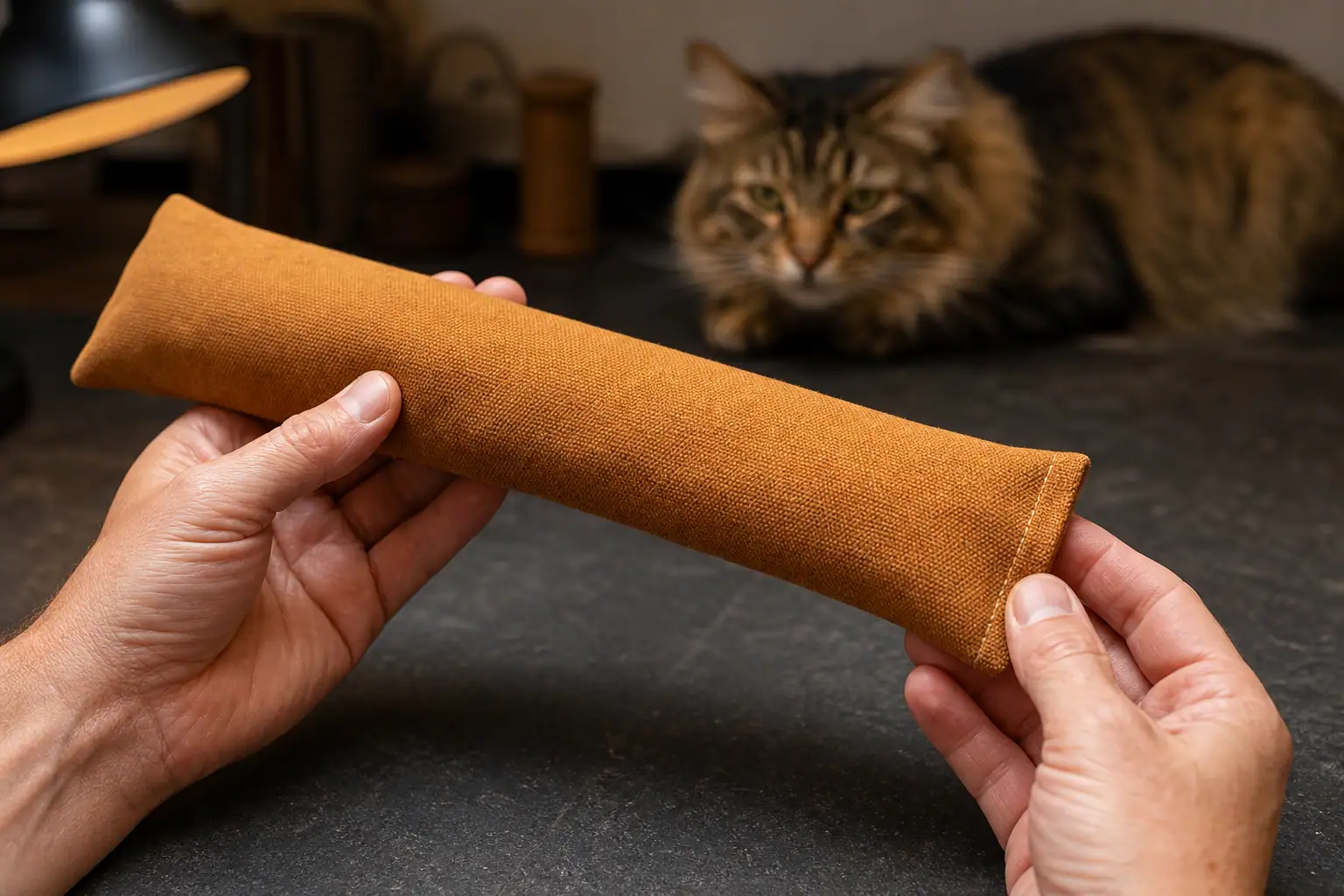
A kicker does not need catnip to work. Shape, movement, texture, and the cat’s individual play style may be enough. A scent-free large cat kicker toy is also easier to wash and may suit a cat that becomes too intense around plant attractants.
Responses vary. In a study of 100 domestic cats published in BMC Veterinary Research, cats were exposed to catnip, silver vine, Tatarian honeysuckle, and valerian; some cats that did not respond to catnip did respond to alternatives. That makes scent a preference to test, not a quality test for the toy.
- Choose no scent if your cat ignores herbs, becomes overaroused, tries to eat plant material, or needs a regularly washable toy.
- Choose a fully enclosed catnip fill if your cat responds calmly and the toy has no accessible herb pocket.
- Consider silver vine as an alternative enrichment scent, but introduce it in a small, controlled session and stop if behavior becomes frantic or defensive.
- Do not apply essential oils, concentrated fragrance oils, or an unknown “herbal blend” to the toy.
Test any scented kicker with one cat at a time. In a multi-cat home, an exciting scent can create competition even when the toy itself fits both cats. Give each cat space, a separate play opportunity, and a clear exit.
Turn the Kicker Into the Catch, Not the Whole Hunt
A large kicker is excellent for the grab, bite, and hind-foot phase of play, but it does not move like escaping prey on its own. Pair it with an owner-controlled chase so the session includes more of the hunting sequence.
- Use a wand or another distance toy to create short stalk-and-chase opportunities.
- Move unpredictably along the floor and behind cover rather than waving the lure in the cat’s face.
- Allow several catches. The Feline Veterinary Medical Association’s environmental-needs guidance recommends intermittent capture so play does not become frustrating.
- Slide or gently toss the kicker away from your body as the final capture target.
- Let the cat hold and kick without putting your fingers at either end.
- End when the cat releases or begins to slow, then offer a small food reward or calm foraging activity if it suits the cat’s diet.
Veterinary behavior literature from The Ohio State University connects feline play with stalking, chasing, pouncing, and biting, recommends toys that keep distance from human hands and feet, and suggests rotating toys to maintain interest. The Titan Claws hunt-catch-cool-down routine turns those principles into a repeatable session.
Keep the kicker in a small rotation rather than leaving every toy on the floor. One kicker, a chase toy, a simple toss toy, and a food puzzle do different jobs. Store string and wand toys securely after use; leave out only toys that your individual cat has repeatedly used without chewing off or swallowing pieces.
Inspect, Clean, and Know When to Retire It
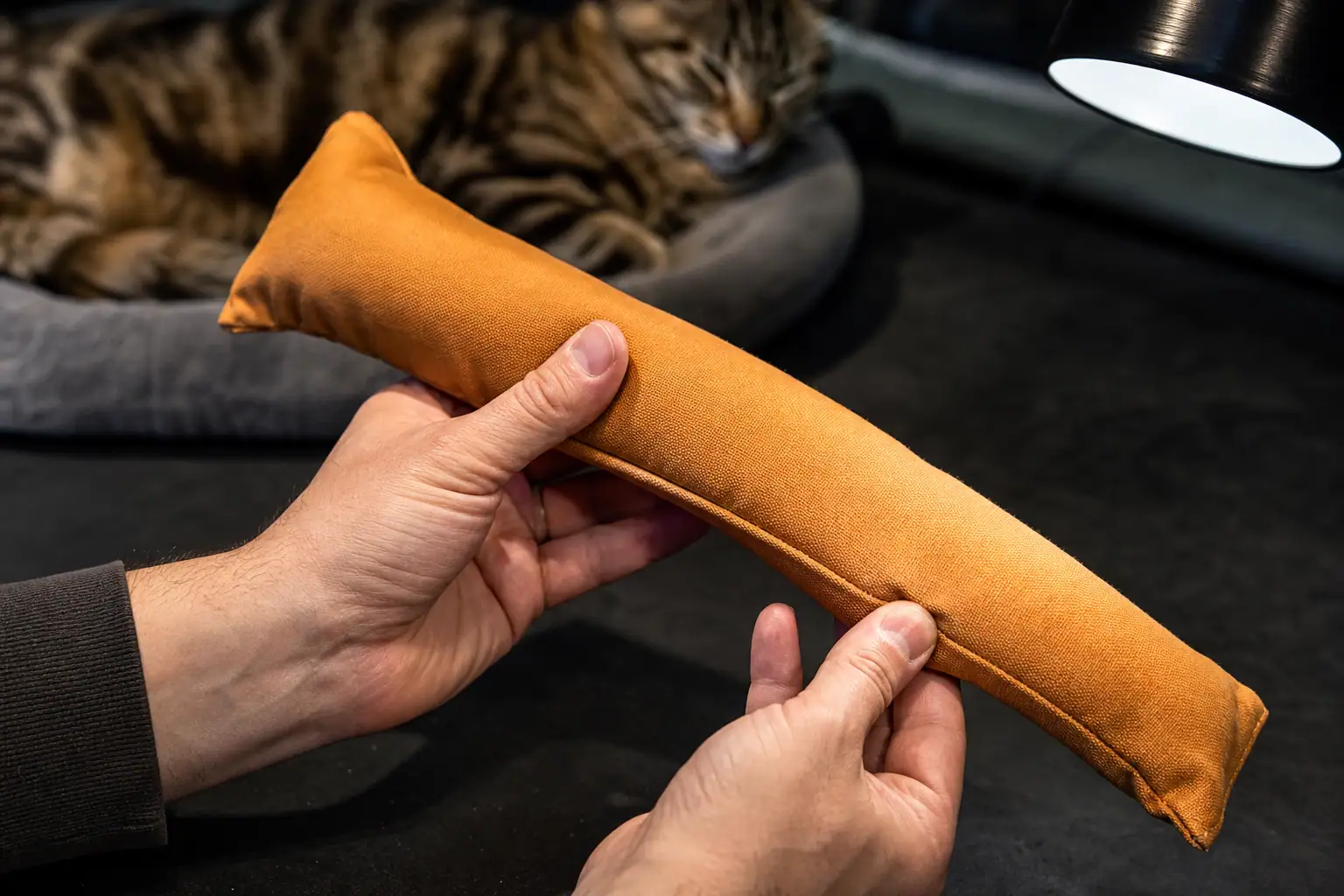
Inspect a kicker before and after every hard session. Use good light and both hands. Flex the body, spread each seam gently, rub high-wear areas against the grain, and compare both ends. A tooth puncture can be hard to see until the fabric is bent.
| What you find | Decision |
|---|---|
| Light surface fuzz; shell still thick; all seams closed | Trim loose fuzz flush, recheck, and continue supervised use |
| One loose stitch with intact fabric | Remove from play until properly reinforced; inspect the full seam |
| Thin spot, puncture, spreading weave, or repeated seam failure | Retire the toy |
| Open seam or visible filling | Stop immediately, collect loose material, and retire it |
| Missing fabric, thread, filling, trim, or a hard component | Remove the remains, search the area, and call your veterinarian for advice |
| Persistent odor, damp interior, or a damaged powered component | Retire it rather than returning it to play |
Follow the maker’s care label. A scent-free fabric toy may be washable, but the surface drying first does not prove that dense filling is dry. After cleaning, check for shrinkage, twisted fill, hardened areas, color transfer, and opened seams. The Titan Claws guide to cleaning cat toys by material helps decide between spot cleaning, washing, and replacement.
If you know or suspect that your cat swallowed string, fabric, stuffing, or another toy part, contact a veterinarian or emergency clinic promptly. VCA’s foreign-body guidance lists vomiting, decreased appetite, abdominal pain or tenderness, straining to defecate, lethargy, and behavior changes among warning signs. Do not pull thread or string from the mouth or rectum; it may be anchored internally.
Quick Buying Checklist
- Compare the filled, usable body length—not a decorative tail or total package dimension.
- Start around 10–12 inches for many adults and 13–16 inches for larger or longer cats, then verify fit.
- Confirm that front paws can grip while both back feet reach the lower body.
- Reject a toy that is too wide, rigid, dense, or heavy for your cat to control.
- Favor tightly woven fabric, a simple shape, reinforced seams, and contained filling.
- Avoid detachable trim, long tails, ribbons, bells, glued eyes, and loose small parts for rough players.
- Treat catnip or silver vine as optional enrichment, not proof of quality.
- Supervise the first sessions and every session for cats that rip or ingest toys.
- Inspect the grip, bite, kick, seam, and closure zones after hard play.
- Retire the toy at thinning, punctures, open seams, exposed filling, or missing pieces.
Bottom line: the best large cat kicker toy is not simply the longest one. Choose enough usable body length for a two-point front-paw-and-back-foot fit, then prioritize control, inspectable construction, and the way your cat actually attacks it. Use it as a satisfying capture target, maintain it like play equipment, and replace it before damage becomes access to the inside.
Large Cat Kicker Toy FAQs
Do cats need kicker toys?
Cats need appropriate opportunities for play and predatory behavior, but no single product is mandatory. A kicker is particularly useful for cats that like to grab, bite, wrestle, and strike with their hind feet because it moves that force away from human hands and feet.
What is the best kicker toy for a large cat?
Choose by demonstrated fit and construction. The cat should grip the upper body while both hind feet contact the lower body, and the toy should remain light and compressible enough to control. A plain, tightly woven, reinforced 13-to-16-inch body is a useful category to compare for many large cats, but individual testing matters more than breed or weight.
Can I use a large dog toy as a cat kicker?
Do not assume a dog toy is suitable. It may be too heavy, rigid, thick, strongly scented, or fitted with parts intended for a different style of play. Evaluate the specific materials, fill, seams, size, and your cat’s ability to release it; ask your veterinarian when the cat has unusual chewing or ingestion behavior.
Is a cat kicker toy without catnip still useful?
Yes. Many cats respond to the shape, movement, and texture. A scent-free version can be easier to clean and a better fit for cats that ignore catnip or become overexcited around it.
Sources
- Feline Veterinary Medical Association and ISFM: Your Cat’s Environmental Needs
- The Ohio State University: Environmental Enrichment for Indoor Cats
- BMC Veterinary Research: Responsiveness of Cats to Silver Vine, Honeysuckle, Valerian, and Catnip
- VCA Animal Hospitals: Ingestion of Foreign Bodies in Cats
Leave a Reply