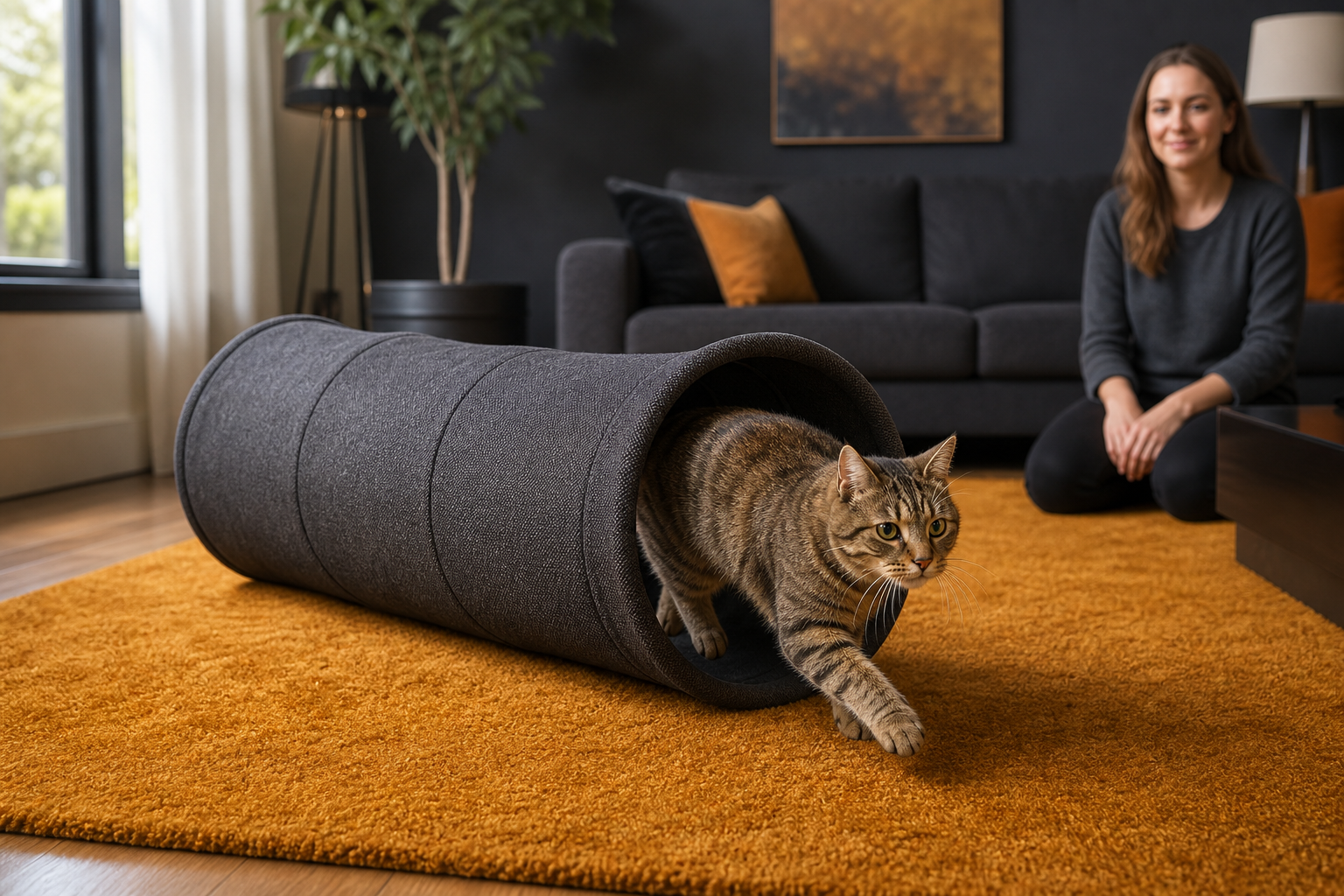
A good cat tunnel toy is wide enough for your cat to enter and turn without squeezing, stable enough not to roll under a full-speed pounce, and simple enough to inspect. Start with a straight, two-exit tunnel made from tightly woven fabric over a fully covered spring frame. Choose a larger internal diameter for a broad, long-haired, or mobility-limited cat, and remove dangling balls, elastic, or ties if your cat chews or pulls attachments.
A tunnel can support hiding, stalking, chasing, and ambush play, but it is not automatically safe because it is soft or collapsible. Supervise the first sessions. Check the entrances, peek holes, frame channels, stitching, and attachments after hard play, and retire the tunnel if wire becomes exposed, fabric tears through, an exit collapses shut, or a piece goes missing.
Quick Choice: Match the Tunnel to the Cat
| Cat or household | Useful starting design | Priority check |
|---|---|---|
| First-time tunnel user | Straight, quiet, two open ends | Cat can see a clear route through and choose whether to enter |
| Large or long-haired cat | Wide straight or gentle-curve tunnel | Shoulders and coat clear the smallest internal opening |
| Rough player | Simple tunnel with dense fabric and no hanging toy | Frame ends stay enclosed after pouncing, rolling, and biting |
| Noise-sensitive or cautious cat | Low-crinkle fabric with a short sight line | No startle, freezing, flattened ears, or immediate retreat |
| Multi-cat home | Two or more full-size exits; optional side opening | No cat can guard the only way out |
| Small apartment | Collapsible straight or U-shaped tunnel | Secure storage loops cannot become chewable cords during play |
| Senior or mobility-limited cat | Short, wide, stable tunnel without a high lip | Easy entry, backing out, and turning on a nonslip surface |
Retail play tunnels are often around 9–10 inches in diameter, while some models marketed for larger cats offer an opening near 11 inches. Those are shopping references, not safety standards. A cat’s shoulder width, coat, mobility, and confidence matter more than weight or a “large” label.
Why Cats Like Tunnels
A tunnel combines two resources cats often value: partial concealment and a route for play. It can become a hide, a runway, a place to watch from cover, or the middle of a stalk-and-pounce sequence. That makes it more flexible than a toy that performs only one movement.
The peer-reviewed AAFP and ISFM Feline Environmental Needs Guidelines identify safe places and opportunities for play and predatory behavior as core parts of a healthy feline environment. They also recommend multiple hiding places and more than one entry for safe places in multi-cat homes so another cat cannot easily block access.
That does not mean every cat will charge straight in. Hiding can be restful, playful, or a way to cope with uncertainty. Respect the cat’s choice. A relaxed tunnel user may loaf inside, watch with neutral ears, chase a lure through, or leave casually. A cat that crouches tightly, flattens the ears, lashes the tail, startles at every crinkle, or refuses to pass an exit may need a quieter, wider, shorter setup—or no tunnel at all.
Size and Shape: Test the Smallest Opening
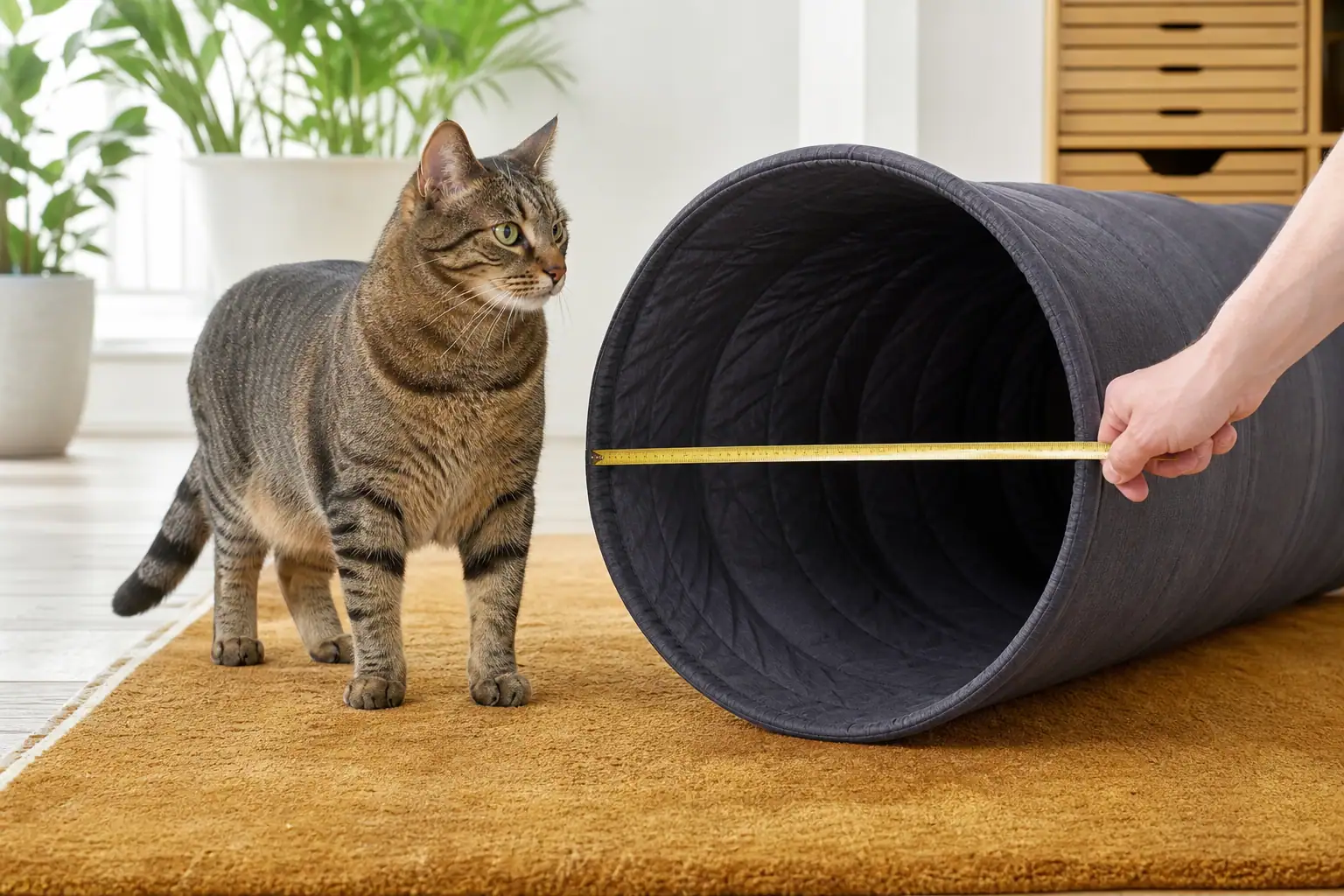
Manufacturers may list the widest entrance while the actual pinch point is a fabric collar, center junction, sharp curve, or flattened section. Check the entire route. Your cat should be able to walk through without compressing the shoulders, dragging the back, or forcing the belly over a tall rim.
- Measure the tunnel, not the package. Confirm the internal diameter at the ends and the narrowest middle point. Product photos can make a short, narrow tube look generous.
- Make a no-pressure comparison. While your cat stands naturally, note shoulder width and standing height. Choose an opening visibly larger than both; add more clearance for long fur, a belly that hangs low, arthritis, or an uncertain cat.
- Open it fully on a nonslip floor. Watch one voluntary pass without a chase toy. The frame should keep its shape, and the cat should not brush, stumble, or become wedged while turning or backing out.
- Recheck under play speed. A tunnel that works for walking may roll, bunch, or collapse during a sprint. Stop if an entrance folds toward the cat’s face or the whole tunnel travels across the floor.
Choose geometry by use rather than novelty. A straight tube has the clearest sight line and is easiest to inspect. A gentle S or U creates ambush cover without a complex junction. A three-way tunnel gives more escape choices but adds a heavily stressed center seam. A donut tunnel bed can double as a resting place but needs a wide passage, a washable cover, and enough structure that a cat lying on top does not trap one inside.
A wall-mounted cat tunnel system is a different product category. Treat every bracket, connector, height transition, load rating, and landing surface as furniture hardware—not as a soft floor toy. Floor-level tunnels are the safer starting point for kittens, seniors, and cats with balance or mobility concerns.
Construction Checks for Cats That Play Rough
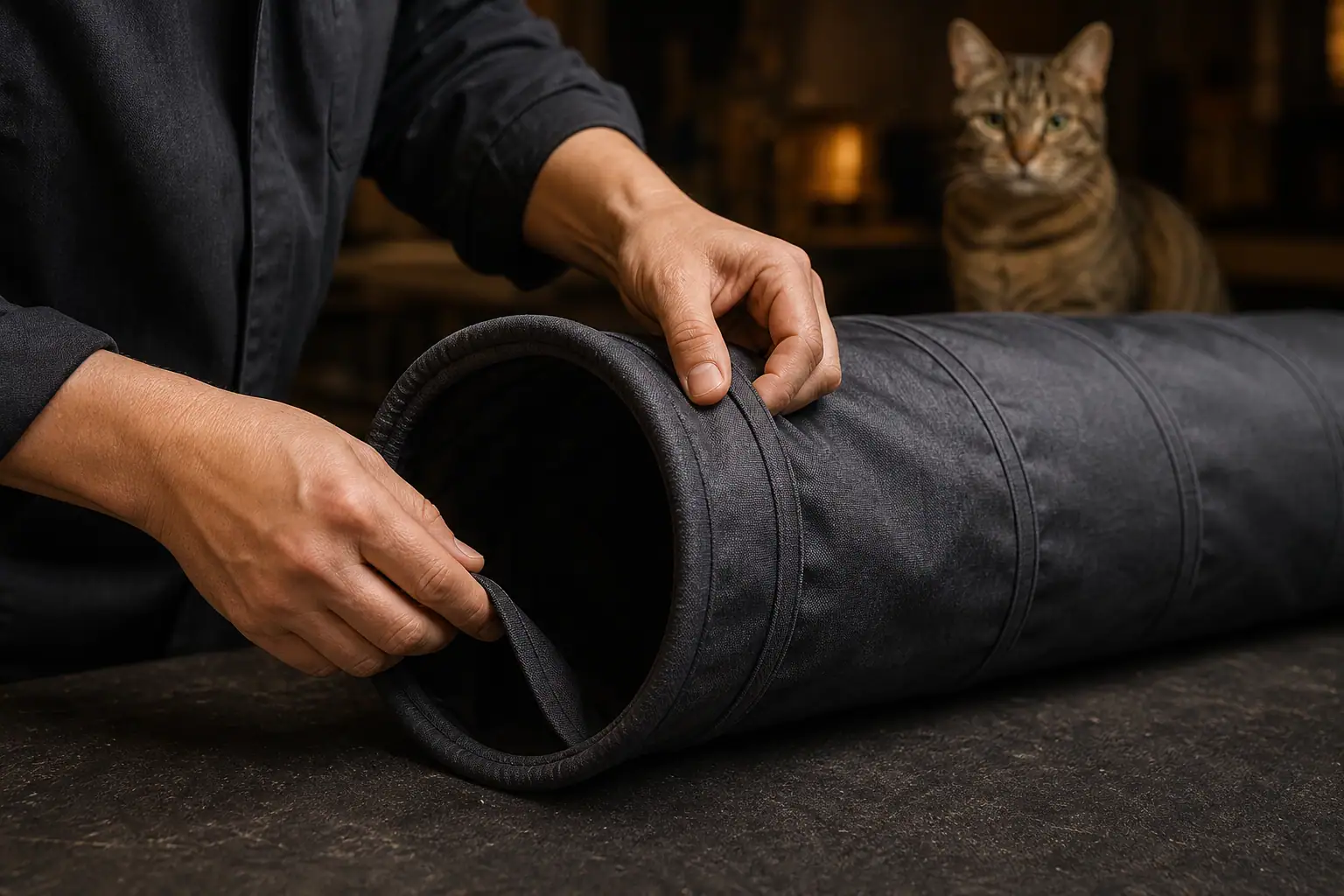
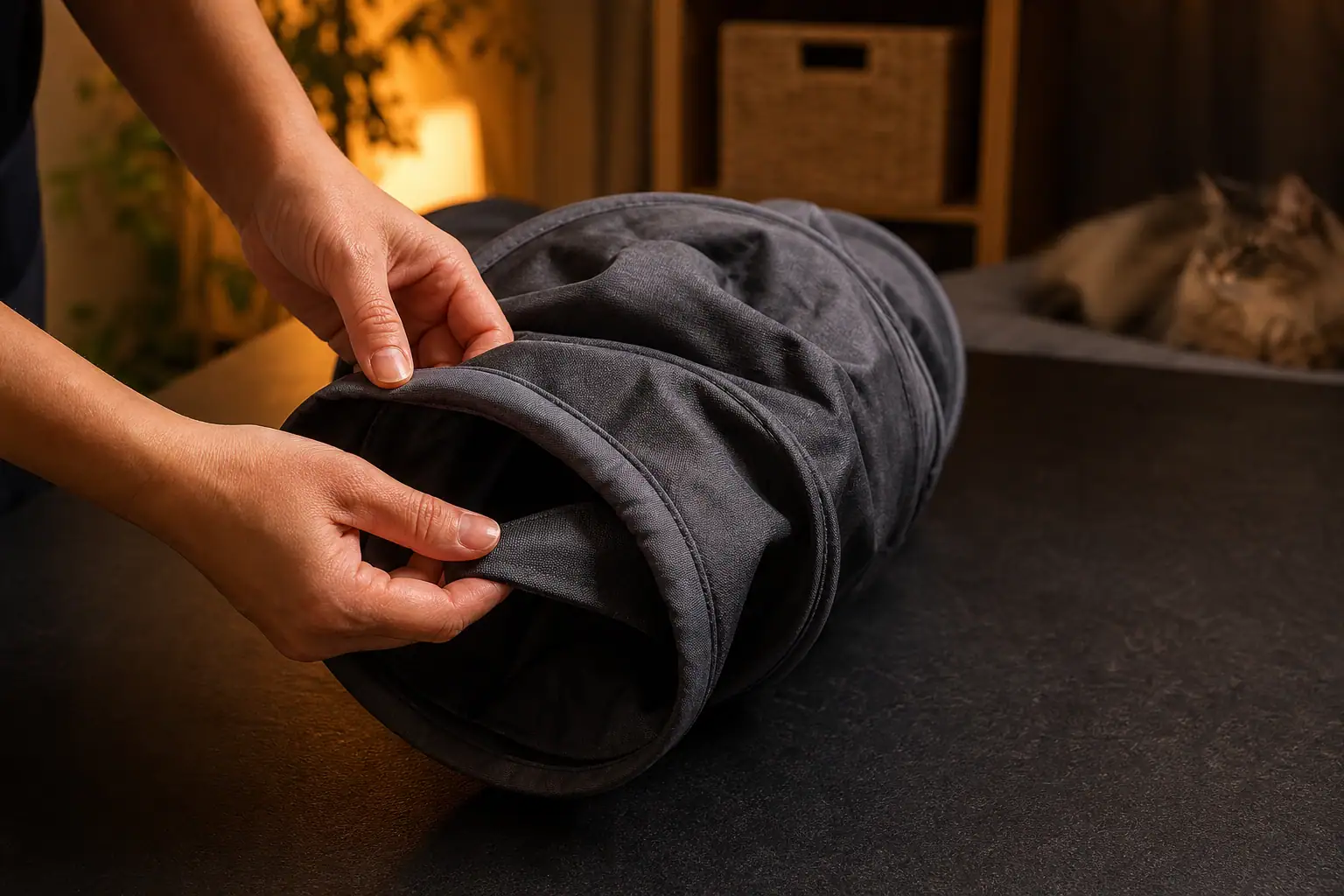
Most collapsible tunnels use a spiral wire or spring-steel frame inside a sewn fabric channel. The frame makes the tunnel pop open, but it also creates the most important hidden failure point. Run your fingers around every ring before use. You should not feel a sharp end, a gap in the covering, a protruding coil, or a hard point pushing through thin fabric.
- Frame channel: Favor a wide, securely stitched sleeve that fully separates wire from teeth, claws, and skin. Reject any exposed metal or frame end that can migrate toward an entrance.
- Fabric: Tightly woven polyester, nylon, canvas-like fabric, or similarly dense material is easier to inspect than loose mesh or long faux fur. Mesh improves airflow but can snag claws and tears quickly once a strand breaks.
- Entrances: Look for smooth bound edges with no loose piping. The entrance ring should stay open when the cat bumps it from the side.
- Junctions and peek holes: These take concentrated force. Spread the seams under good light and check for skipped stitches, thinning fabric, and a wire that sits too close to the cut edge.
- Floor grip: A light tunnel can skid on tile or wood. Place it on a rug or nonslip mat, away from stairs, glass, heaters, doors, and furniture with dangerous gaps.
- Attachments: Dangling balls, feathers, ribbons, elastic loops, and storage ties are separate toys with separate risks. Remove them for a cat that mouths cord, strips plush, or pulls until stitching fails.
Never describe a fabric tunnel as indestructible. For a cat that attacks the frame rather than running through the tunnel, the design is a poor match no matter how heavy the cloth is. Switch to an open box, sturdy cat cave, or another form of cover. The Titan Claws durable cat toy guide explains how to identify the part your cat defeats first and choose around that failure pattern.
Introduce the Tunnel Without Forcing It
Pop-open frames, unfamiliar smells, and crinkle layers can make a new tunnel intense. Set it up when the cat is elsewhere, secure it on a rug, and leave both ends unobstructed. Let it air out if it has a strong packaging odor. Do not push the cat inside or close an exit to make exploration happen.
- Place one familiar blanket or a few treats near an entrance, not deep inside.
- Reward looking, sniffing, and approaching. The cat does not need to enter on day one.
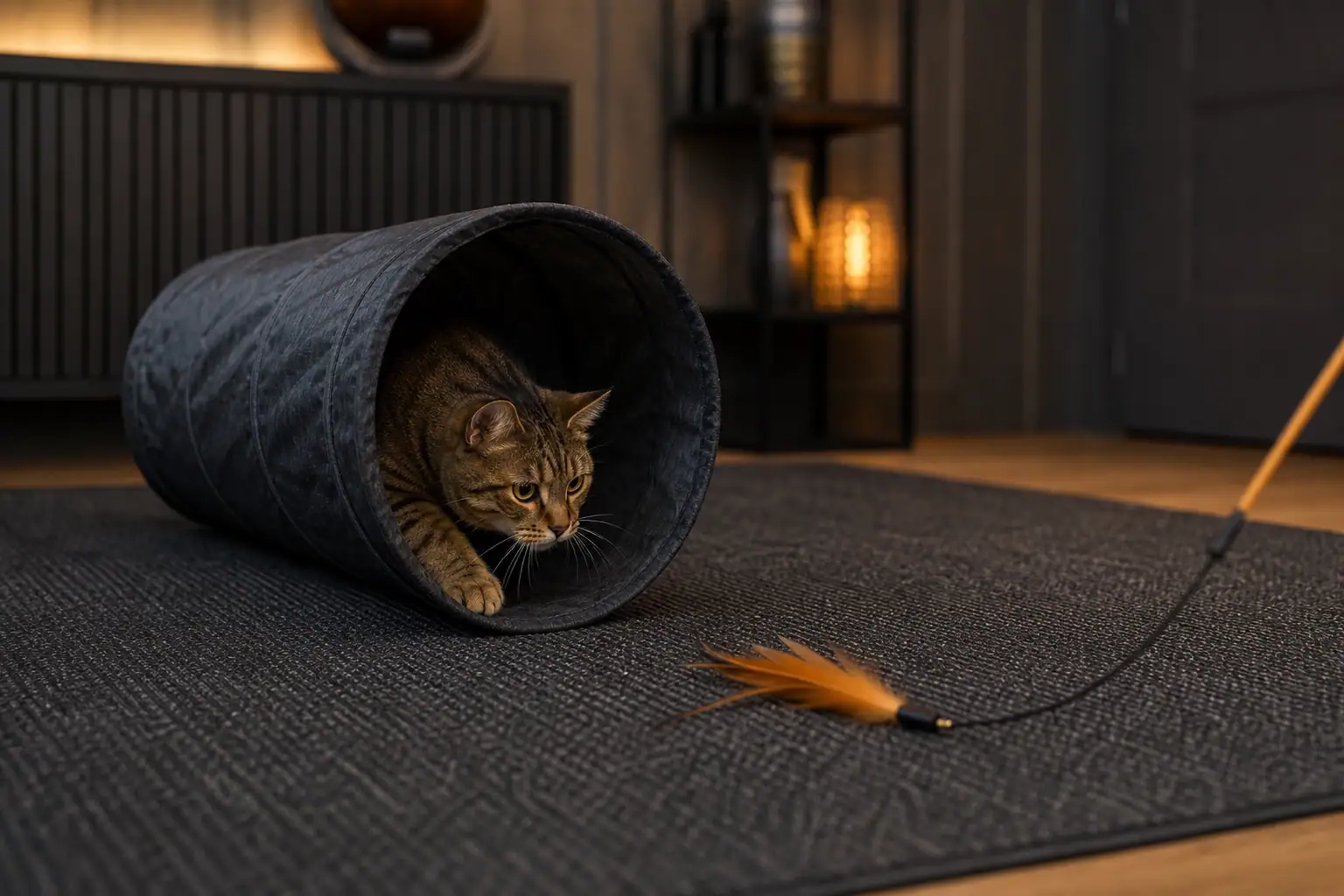
- When the cat is relaxed, move a wand lure past the far exit so attention travels through the tunnel. Keep cord and hands outside.
- Allow a catch in the open after a short chase. The tunnel should create cover, not become a place where the cat can never capture the target.
- End while the cat is still comfortable. Fold and store the tunnel only after the cat has left the area.
If your cat is easily startled, start with a quiet open-ended tunnel or a cardboard box with two large doors. The Titan Claws guide to toys for anxious cats offers a slower, choice-first introduction process.
Three Better Cat Tunnel Games
1. Stalk, pass, and catch
Move a wand lure slowly across one entrance, pause out of sight, then travel beyond the opposite exit. Let the cat stalk from cover and catch the lure in open space. Do not flick string around the cat inside the tunnel, where it can wrap around a paw or become hard to retrieve.
2. Side-window ambush
For a tunnel with a properly bound peek hole, pass a large toss toy across the outside of the opening. Keep fingers away from the window. This gives the cat one quick pounce without teaching that hands appearing beside the tunnel are prey.
3. Two-station search
Place the tunnel between two open play stations: a cardboard scratcher at one end and a large kicker or food puzzle several feet beyond the other. The cat chooses whether the tunnel is a route, a hide, or something to ignore. Rotate the surrounding activity while keeping the safe route familiar.
For a complete session, use the tunnel for stalking and chasing, then move the final catch into open space and let arousal fall. Our interactive play routine covers the hunt-catch-cool-down sequence. If two cats turn tunnel ambushes into relentless chasing, blocked exits, hissing, or one cat hiding afterward, separate the play stations and review the signs in our cat rough play guide.
Inspect, Clean, and Retire the Tunnel
Inspect a tunnel before the first use and after any hard session. Collapse it only far enough to expose folds and high-wear areas—never while the cat is close. Check both sides of every entrance, each peek hole, the central junction, the full frame channel, storage loops, and the floor where loose pieces would land.
| What you find | Decision |
|---|---|
| Surface dust; fabric, frame, and seams intact | Clean according to the care label, dry fully, and recheck |
| One loose storage tie or dangling attachment | Remove the tunnel until the part is safely removed or repaired |
| Small fabric tear away from the frame | Stop use; repair only if the result is smooth, strong, and fully inspectable |
| Wire visible, a hard point pressing through, or frame distortion | Retire immediately |
| Entrance no longer stays open or tunnel rolls dangerously | Retire or replace with a more stable design |
| Missing thread, fabric, foam, plastic, or attachment | Remove all pieces and contact a veterinarian if ingestion is possible |
| Persistent dampness, mildew, urine, feces, or an odor that remains after approved cleaning | Retire the tunnel |
Follow the maker’s care label because spring frames, stiffeners, crinkle film, foam beds, and adhesives tolerate water and heat differently. The CDC’s pet-supply cleaning guidance distinguishes routine cleaning from disinfection and says cleaning is usually sufficient for most pet items. It recommends soap or detergent and warm water for hard items, appropriate machine settings for washable soft items, thorough rinsing, and complete drying.
Do not improvise with essential oils or strongly scented sprays. Do not soak a wire-framed tunnel unless the label permits it, and do not return a damp tunnel to the cat. Moisture can remain between fabric layers or around the frame after the surface feels dry. Our material-by-material cat toy cleaning guide helps separate washable fabric, spot-clean-only parts, and items that should be replaced.
Cornell’s Feline Health Center advises avoiding toys with small pieces or linear parts such as feathers and string that may separate and be ingested. If part of a tunnel, tie, ball, feather, or frame cover is missing, stop play and search the area. Contact your veterinarian promptly if you know or suspect your cat swallowed it; foreign-body obstruction can be life-threatening, and time can matter.
Cat Tunnel Toy Buying Checklist
- Measure the smallest internal opening, not just the widest entrance.
- Choose visible clearance around the cat’s shoulders, back, belly, and coat.
- Prefer two full-size exits; add escape options in multi-cat homes.
- Start with a straight, quiet tunnel for cautious, senior, or first-time users.
- Confirm the frame is fully enclosed in a wide, securely sewn channel.
- Check entrances, peek holes, and center junctions for concentrated stress.
- Use dense, inspectable fabric for rough players; treat mesh and plush as tradeoffs.
- Remove chewable ties, elastic, ribbons, feathers, and dangling balls when necessary.
- Place the tunnel on a nonslip surface away from stairs and hard obstacles.
- Follow the care label and make sure every layer is completely dry.
- Supervise initial use and any cat known to rip, chew, or swallow toy parts.
- Retire at exposed wire, frame distortion, torn channels, collapsed exits, or missing pieces.
Bottom line: the best cat tunnel toy is not the one with the most branches or accessories. It is the tunnel your cat can enter, turn in, and leave easily; the one that stays stable during real play; and the one you can inspect all the way around. Choose fit and exit geometry first, construction second, and novelty last.
Cat Tunnel Toy FAQs
Are cat tunnels good for cats?
They can be. A well-fitted tunnel offers concealment and supports stalking, chasing, and ambush play. It should remain a choice, not a place where a cat is pushed, cornered, or blocked by another pet.
What size cat tunnel should I buy?
Measure the smallest internal opening and compare it with your cat’s natural shoulder width and standing height. Choose visible clearance rather than a tight fit, especially for a large, long-haired, senior, overweight, or mobility-limited cat. Many retail tunnels are roughly 9–10 inches across, but individual fit matters more than that common range.
Are crinkle tunnels safe for cats?
Crinkle material is not automatically unsafe, but it can frighten noise-sensitive cats and becomes a problem if the lining tears or the cat tries to eat it. Supervise the introduction, inspect layers and seams, and choose a quiet tunnel if the sound causes stress.
Can I leave a cat tunnel out overnight?
Only after you have repeatedly observed safe use and removed ingestible attachments. Do not leave it out for a cat that chews the frame channel, pulls ties, tears fabric, or guards an exit. Store a collapsible tunnel securely when it cannot be used safely without supervision.
How many exits should a cat tunnel have?
Two full-size open ends are a strong default. In a multi-cat household, a side opening or branching route can add escape choices, but only if the junction is wide, stable, and strongly constructed. Avoid any setup where one cat can trap another inside.
Leave a Reply