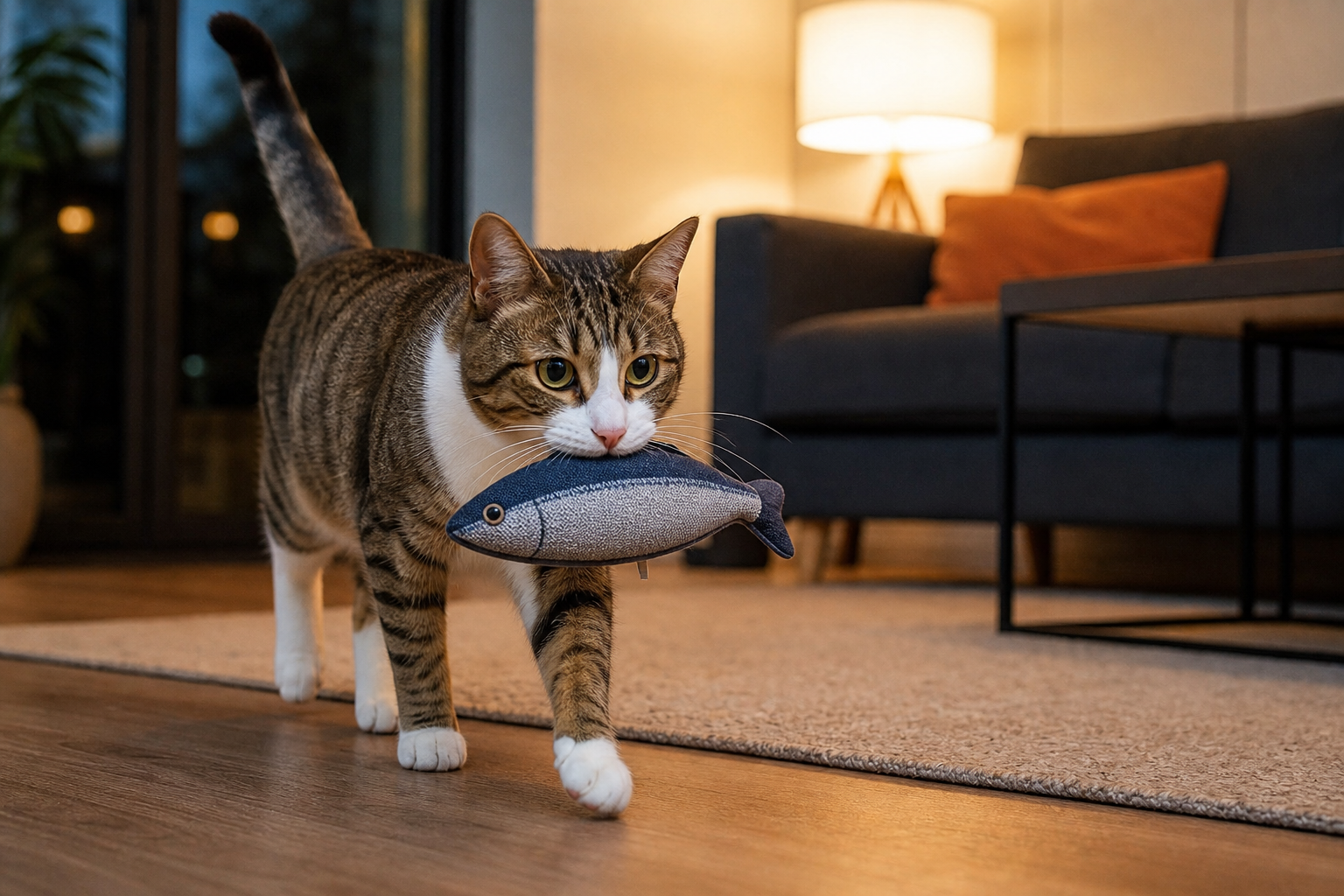
If your cat carries toys around and meows, the most likely explanation is that the toy has activated a prey-like play routine and your cat is vocalizing as part of the event. Your cat may be inviting you to notice or join, moving a valuable object to a preferred place, or repeating a routine that has earned attention before. In an otherwise relaxed, healthy cat, this is usually normal behavior.
There is no single translation for the meow, and the behavior does not prove that your cat thinks the toy is a kitten, is giving you a gift, or is trying to teach you to hunt. Those are appealing stories, but context is more reliable. Watch when the carrying happens, where the toy goes, what the cat does next, and whether anything else has changed.
Why Cats Carry Toys and Meow
Object play in adult cats closely resembles parts of predatory behavior. A cat may stalk a toy, pounce, bite, grab, kick, release it, and carry it to another location. Research on feline object play supports this connection: toy size, texture, novelty, and hunger can change how intensely cats interact with an object. Carrying is therefore not an odd extra step; it can fit naturally into a cat’s prey-handling sequence.
The meow is harder to interpret because cats can use vocalizations in different contexts. It may call your attention to the activity, express arousal during play, request another throw, or simply accompany a well-rehearsed trip through the house. Adult cats also use meows extensively in interactions with people, so your response can become part of the routine.
These explanations can overlap:
- Prey-like object play: your cat catches, carries, drops, and attacks the toy as if completing part of a hunt.
- A play invitation: the cat brings the toy to you, drops it nearby, watches you, or races after it when you toss it.
- Moving the catch: the cat takes the toy to a bed, hallway, food area, or other familiar spot before settling or resuming play.
- A learned attention routine: looking, talking, getting out of bed, or throwing the toy rewards the performance, so the cat repeats it.
- Self-directed excitement: some cats vocalize while aroused even when they do not appear to want help.
Sex alone does not explain it. Male and female cats, including neutered and spayed cats, can carry toys and vocalize. Parental-behavior theories are possible in some contexts, but they should not be treated as the default explanation when ordinary object play and learned interaction fit the evidence.
Use What Happens Next to Read the Behavior
Instead of trying to decode one sound, observe the full sequence. A short phone video can help you notice the destination, posture, and timing without interrupting.
- Drops the toy at your feet and waits: likely a social request. Try one short play session or toss the toy once and see whether the cat retrieves it.
- Carries it to a quiet room, then bites or kicks it: likely prey-like object play in a preferred play area.
- Brings it to bed at night: the activity may coincide with the cat’s normal evening energy and may also have become a reliable way to wake you.
- Places it near food or water: note the pattern, but do not assume the toy is being fed or cared for. The location may simply feel central or safe.
- Kneads beside or around the toy: the cat may be shifting from active play into a comfortable settling routine.
- Paces, hides, crouches tensely, or cannot settle: look beyond play and assess possible stress, pain, or environmental change.
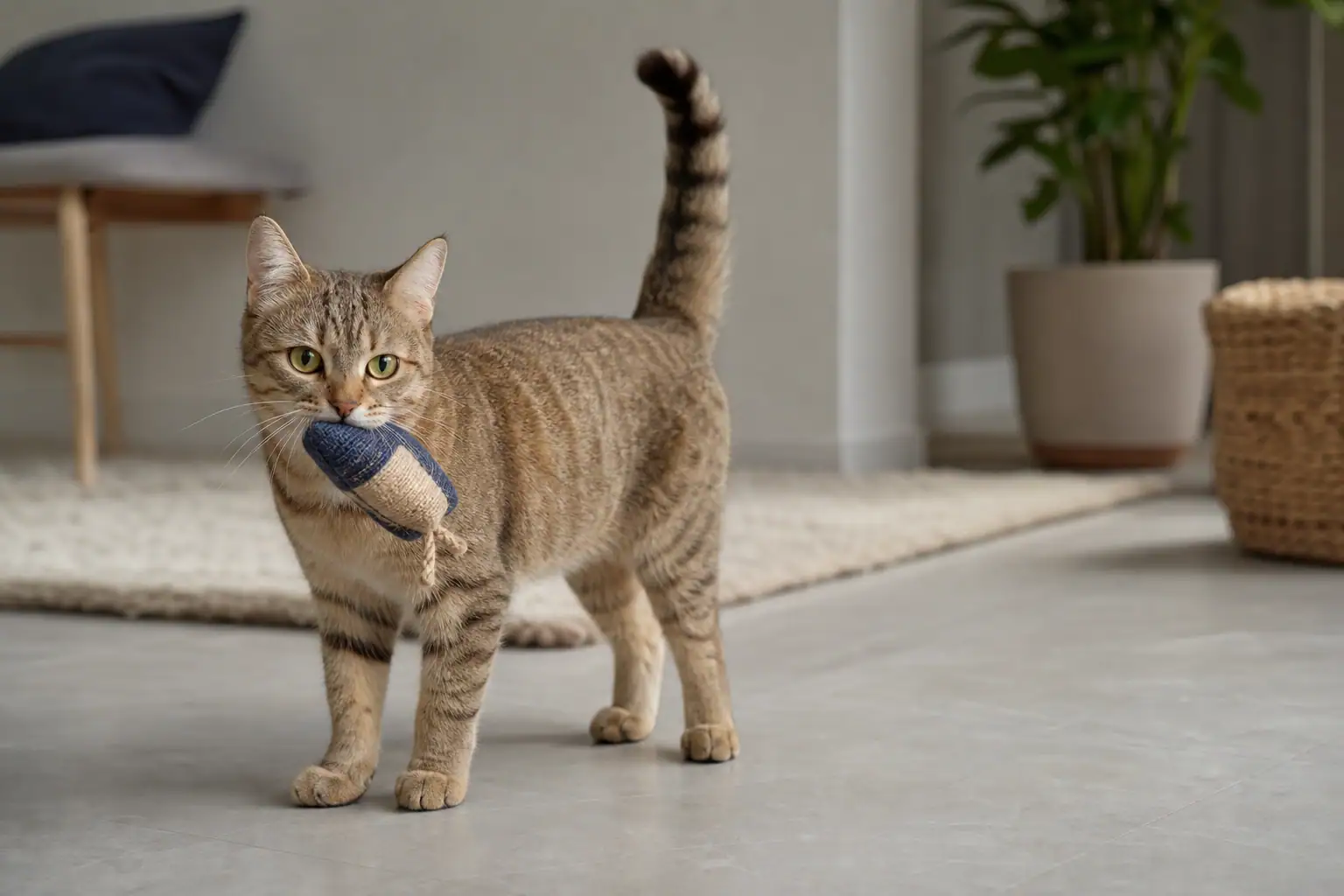
Body language matters. Loose movement, forward or neutral ears, an upright tail, normal appetite, and a quick return to play are reassuring. A hunched body, flattened ears, repeated hiding, disorientation, open-mouth breathing, or a distressed-sounding change from your cat’s usual voice deserves more attention.
Why It Often Happens at Night
Cats commonly become active around dawn and dusk, and a quiet house can make a toy-carrying performance seem dramatically louder. If your cat sleeps through much of the day, an evening burst of stalking and carrying may be the most interesting event available. Night meowing can also persist because it reliably makes a person speak, move, open a door, or throw the toy.
Try a predictable evening routine for one to two weeks:
- Schedule 10 to 15 minutes of interactive play before your bedtime.
- Move a wand or lure away from the cat with pauses for stalking.
- Let the cat make several real catches instead of ending with endless pursuit.
- Hand off to a sturdy carry or kicker toy for grabbing and biting.
- Finish with a small portion of the cat’s normal food, if that fits the feeding plan.
- Put string, ribbon, elastic, feather, and wand toys securely away.
For more ways to make that sequence satisfying, see Titan Claws’ guide to cat toys for hunting. If daytime boredom is fueling the midnight routine, build a broader plan with these cat enrichment activities.
Do not punish or frighten a cat for carrying a toy. If the behavior is harmless but wakes you, reward quiet play and daytime interaction rather than responding enthusiastically to every nighttime delivery. Make changes gradually, especially for a cat that depends on a stable routine.
Should You Throw the Toy, Praise the Cat, or Leave It Alone?
Use your cat’s response as the test. A social cat that drops the toy, looks at you, and chases it after a gentle toss may be asking for a fetch-like game. A cat that keeps walking away with the toy may prefer to carry it privately. Do not chase, corner, or pry the toy from the cat’s mouth.
If you want to encourage fetch, start with a light but sturdy toy that is easy to carry and too large to swallow. Toss it only a short distance. When the cat returns toward you, calmly reward the return with praise, a small treat, or another toss. Never pull on a toy clenched between the teeth; trade for a treat if you need to remove it.
For cats that like the carrying part more than the return, place several safe toys in predictable locations and let the cat choose. A small rotation can preserve novelty. In one controlled study of adult cats, repeated exposure to the same toy produced rapid habituation, while changing the toy’s sensory characteristics renewed play. You do not need a huge basket—just rotate a few different shapes and textures.
Choose a Safer Toy for Carrying
A carry toy spends time between the teeth and may also be chewed, kicked, soaked with saliva, or dragged under furniture. That makes construction more important than appearance. No cat toy is indestructible, and a toy that works for one cat may fail quickly with a determined chewer.
- Choose an appropriate size. The complete toy should not fit inside your cat’s mouth or slide to the back of the throat.
- Prefer simple construction. Strong fabric, reinforced seams, and minimal decoration are easier to inspect.
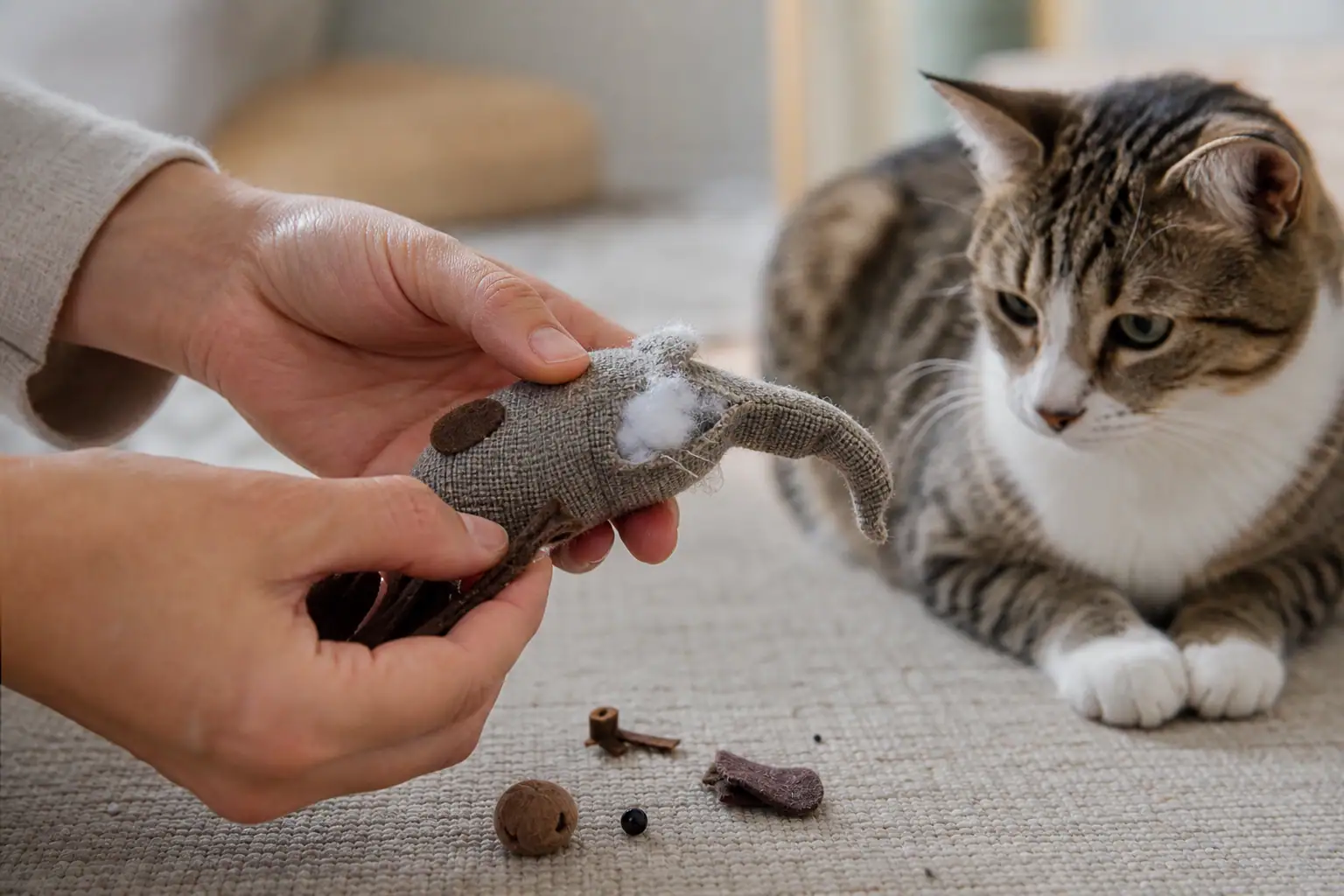
- Avoid detachable details. Loose bells, plastic eyes, beads, feathers, ribbons, yarn tails, and glued trim can become swallow hazards.
- Separate carry toys from wand toys. Strings, cords, elastic, and feather lures are for supervised sessions and secure storage afterward.
- Wash when appropriate. Follow the maker’s instructions and let fabric toys dry fully before returning them.
- Retire damage early. Remove the toy if a seam opens, stuffing appears, threads pull free, plastic cracks, or any part is missing.
If your cat is a toy shredder, use the failure-point approach in Titan Claws’ guide to durable cat toys. Cats that grab and rake the carried toy may do better with the larger shape described in our cat kicker toy guide.
When Carrying and Meowing Needs a Vet Check
A lifelong or familiar toy-carrying ritual in a relaxed cat is generally different from sudden, persistent vocalization. Contact your veterinarian when the behavior is new or escalating and is accompanied by a health or behavior change.
Arrange veterinary guidance if you notice:
- a sudden increase in meowing, especially in an older cat;
- confusion, staring, getting stuck, reversed sleep patterns, or seeming lost at night;
- appetite, thirst, weight, litter-box, mobility, or grooming changes;
- crying when picking up the toy, eating, jumping, or being touched;
- panting, open-mouth breathing, weakness, collapse, or obvious distress;
- repeated chewing or swallowing of fabric, string, foam, plastic, or stuffing;
- vomiting, loss of appetite, lethargy, abdominal discomfort, or straining after a toy part goes missing.
Suspected string or toy-part ingestion is not a wait-and-see play problem. Call a veterinarian promptly, and do not pull visible string from the mouth or rectum unless a veterinarian directs you to do so.
Quick Answer Checklist
- Normal appetite, movement, litter-box use, and social behavior?
- Loose body language while carrying?
- Same toy, time, route, or destination each time?
- Drops the toy near you and waits for interaction?
- Toy still intact, correctly sized, and free of loose parts?
- Night routine improved by scheduled evening hunt-catch play?
- No sudden vocal, medical, or cognitive change?
Most cats that carry toys around and meow are doing something normal: extending a prey-like game, inviting interaction, relocating a favorite object, or repeating a rewarding routine. Observe before assigning a human-style meaning, respond in the way your cat actually seems to request, and keep the carried toy simple, sturdy, and inspected. The behavior is charming—but the context tells you whether it is play, a habit, or a reason to call your veterinarian.
Sources
- University of Southampton: Object play in adult domestic cats—habituation and toy change
- Applied Animal Behaviour Science: The influence of hunger on object play by adult domestic cats
- PLOS ONE: Prevalence and characteristics of fetching behavior in owned cats and dogs
- American Association of Feline Practitioners: Environmental enrichment for indoor cats
- Cornell Feline Health Center: Safe toys and gifts
Leave a Reply